


How Microbes Regulate Nutrient Release in Your Soil | Dr. Mani's Magic
How Microbes Regulate Nutrient Release: The Hidden Engine Behind Every Thriving Plant
Picture this. You're standing in your backyard on a Saturday morning, coffee in hand, staring at a tree you paid good money for. The leaves look pale. A little yellow at the edges. You fertilized it last month. You watered it on schedule. You did everything the bag told you to do.
And yet, something is wrong. The plant looks tired. Beaten down. Like it's fighting a battle it can't win.
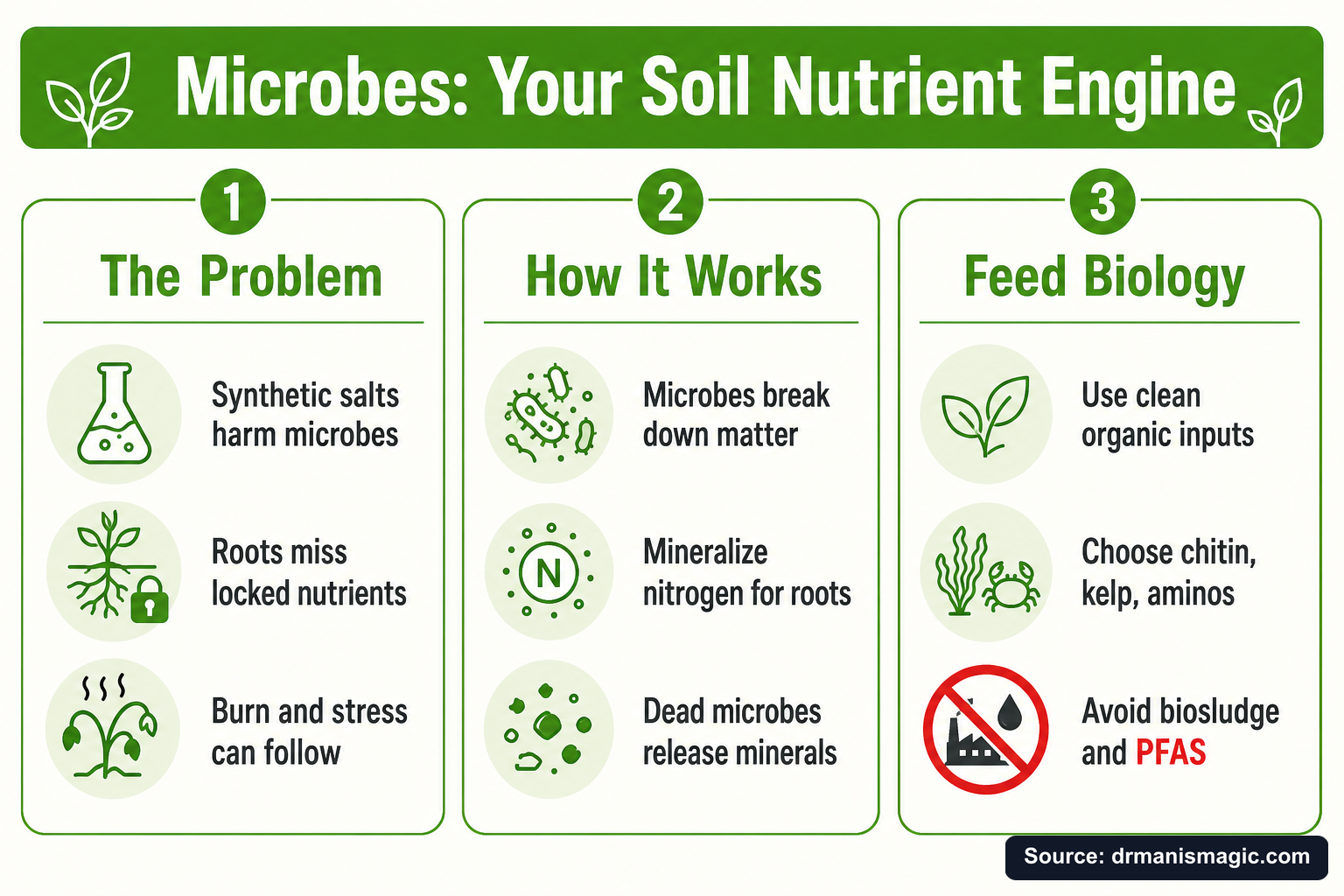
Here's what nobody told you. The problem probably started underground, in a place you can't see. In the invisible world of your soil, a war has been going on every time you opened that bag of fertilizer. The salts in that product were quietly burning the tiny living organisms your plant depends on. The very microbes that were supposed to unlock nutrients and feed your roots were being wiped out, one application at a time. And without those microbes, your plant can't eat. No matter how much fertilizer you pour on top.

Organic Fertilizer | Crab, Kelp & Amino Acids
This is the story most fertilizer companies never tell you. But after growing over 250,000 trees at our South Texas nursery and spending decades studying what actually makes plants thrive, we've learned exactly how nutrients really move from soil to root. It starts with microbes. It ends with your plant looking the way you always dreamed it would. And the path between those two things is something we call microbe-mediated nutrient release. Let's walk through it together.
Key Takeaways
- Microbes are the gatekeepers of soil nutrition. They break down organic matter and convert it into forms your plant roots can actually absorb.
- Salt-based synthetic fertilizers bypass microbes in the short term but kill them over time, destroying the system your plant needs to thrive long-term.
- Organic fertilizers feed the microbes first. The microbes then feed your plant in a slow, steady, natural rhythm that mirrors how plants eat in the wild.
- Fertilizer burn, root rot, and osmotic stress are often caused by salt damage, not overwatering or bad luck.
- Chitin from crab shells, kelp biostimulants, and amino acid nitrogen are three of the cleanest, most effective ways to feed your soil biology without the salt risk.
- PFAS and biosludge are real concerns in some "organic" fertilizers. Clean inputs matter for your family, your pets, and your soil.
- The Three Plant Pillars, developed by Dr. Mani Skaria and proven across 250,000+ trees, give any plant a foundation that works with nature instead of against it.
What Do Soil Microbes Actually Do for Your Plant?
Quick Answer: Soil microbes break down organic matter into simple nutrients your plant roots can absorb. Without them, nutrients sit locked in the soil in forms plants cannot use. Microbes are the essential middlemen between dead organic material and living plant roots, and without them, even a well-fertilized plant can starve.
Think of your soil as a kitchen. The raw ingredients are sitting on the counter. Proteins. Sugars. Minerals. Carbon. All the building blocks of plant nutrition.
But your plant can't eat raw ingredients. It needs them cooked down into something simple. Something it can pull through its roots.
That's exactly what microbes do.
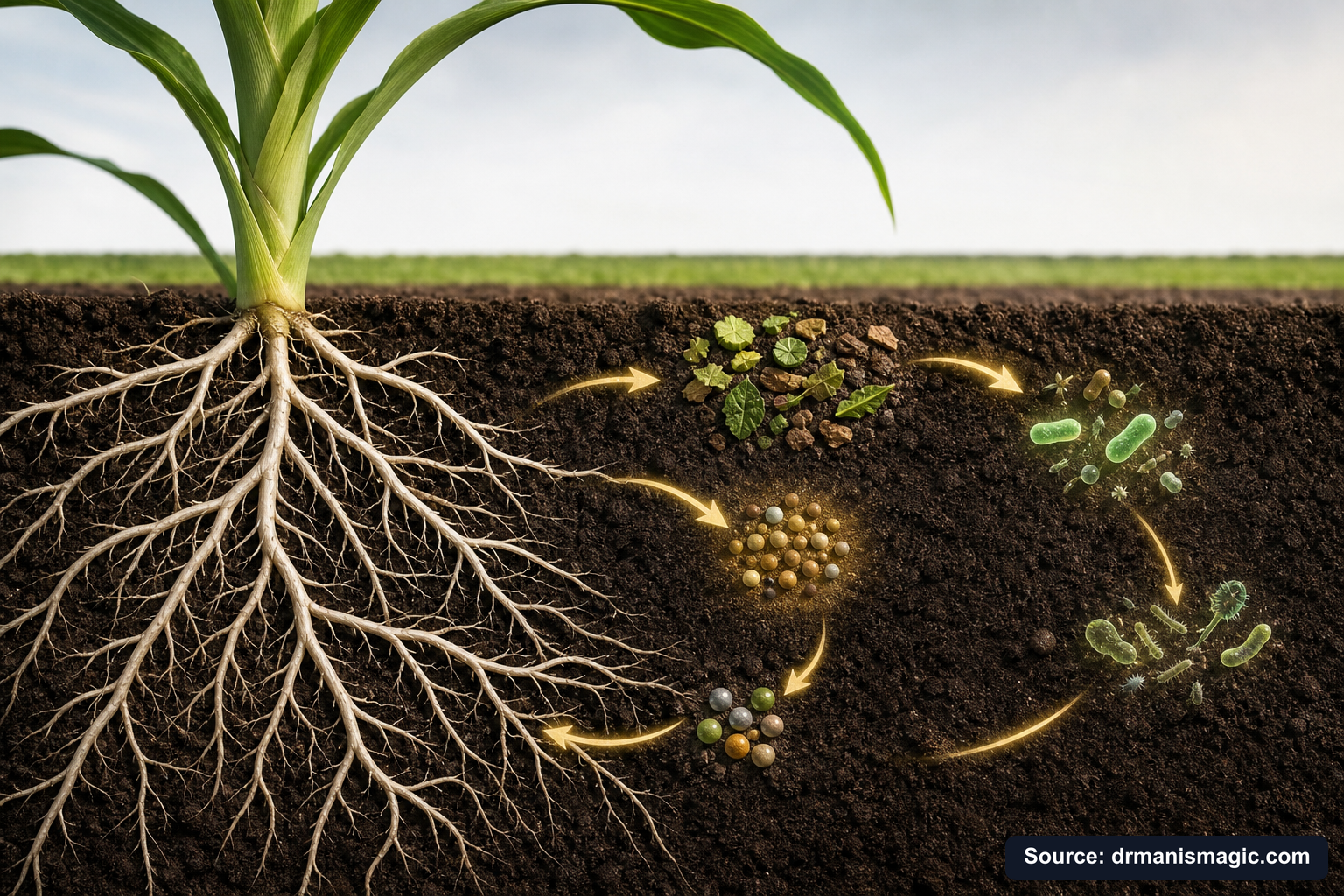
Bacteria and fungi in healthy soil produce enzymes that break complex organic matter apart. They eat it, process it, and transform it. Proteins get broken into amino acids. Then those amino acids get broken into ammonium. Then certain bacteria convert that ammonium into nitrate, a form of nitrogen your plant loves. Scientists call this process mineralization, and it is the engine behind all natural plant nutrition.
According to Penn State Extension, this microbial conversion of organic nitrogen into plant-available forms is the primary reason organic amendments feed plants differently from soluble synthetic fertilizers. The release is biologically paced. It moves at the speed of life, not the speed of chemistry.
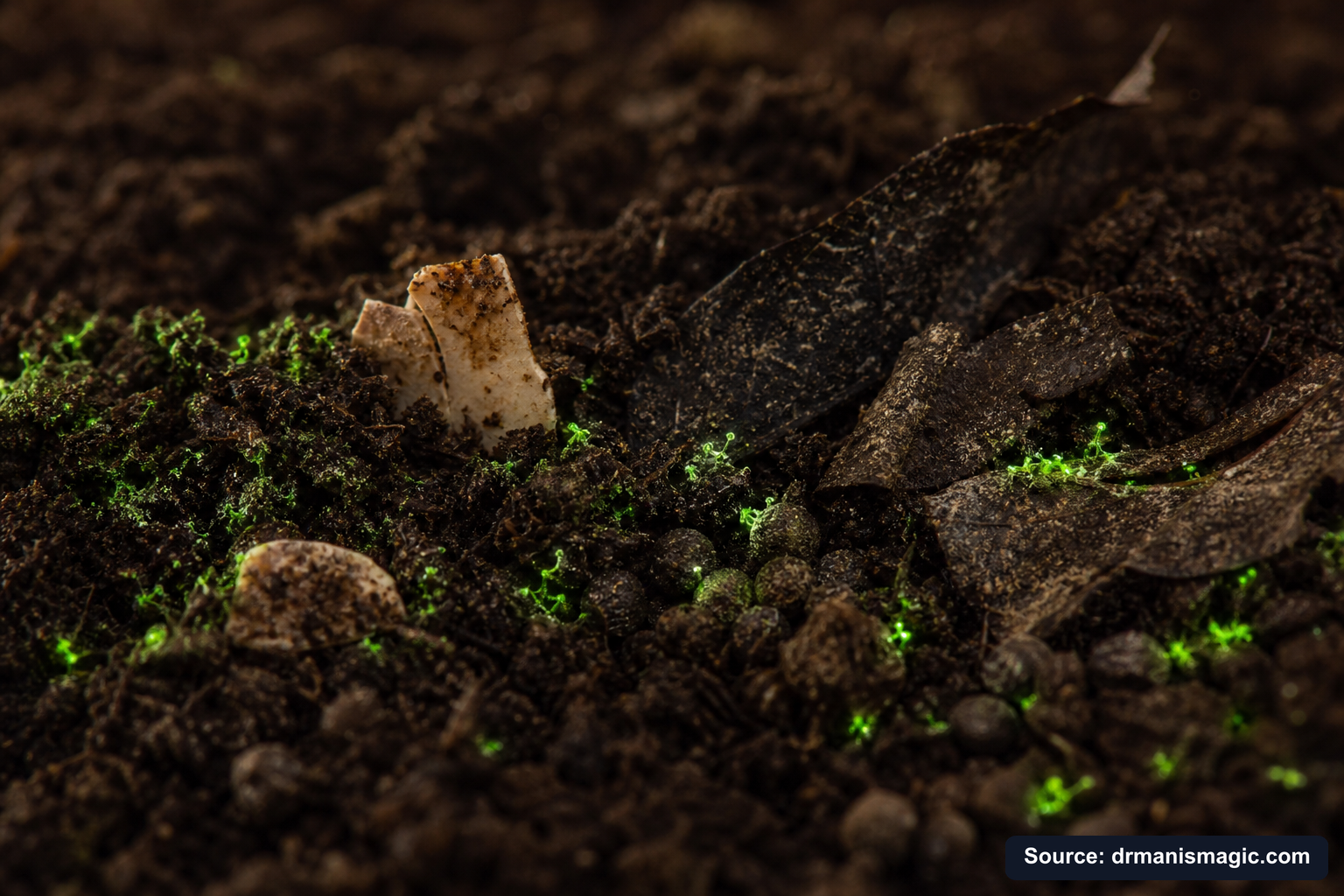
Here is the part that blew our minds when we first understood it. When those microbes die, they release everything they absorbed right back into the soil. All that stored nitrogen, phosphorus, calcium, and trace minerals becomes available to your plant roots in simple, easy-to-absorb form. The microbes are not just nutrient processors. They are living nutrient banks. They hold nutrition safely until your plant needs it, then release it naturally.
That is the slow-release system nature designed. And it has been working for hundreds of millions of years without a single bag of synthetic fertilizer.
What Is Mineralization and Why Does It Matter for Your Lawn, Garden, or Tree?
Quick Answer: Mineralization is the process where soil microbes convert nitrogen and other nutrients locked inside organic matter into simple forms like ammonium and nitrate that plant roots can drink in. It is the reason compost, amino acids, and organic fertilizers keep feeding your plant long after you apply them, without burning or shocking the roots.
Let's make this really simple.
Imagine you drop a handful of dry leaves onto your lawn. Those leaves are full of nutrients. Nitrogen. Potassium. Trace minerals. But your grass cannot eat a leaf. It can only absorb nutrients dissolved in water through its roots.
So what happens?
Fungi in the soil grow into the leaf and start breaking it apart. Bacteria join in. They digest the organic material and release ammonium into the soil water. Other bacteria, called nitrifying bacteria, convert that ammonium into nitrate. Your grass roots absorb the nitrate. The grass turns green. Growth happens.
No fertilizer bag required. Just biology doing its job.
Now here's the flip side that most gardeners never hear about. When you dump a big pile of high-carbon material like wood chips or sawdust onto your soil, microbes rush in to break it down. But they need nitrogen to do that work. So they temporarily pull nitrogen from the soil, away from your plant. Scientists call this immobilization. The nutrients get tied up inside the microbes while they work.
This is not a bad thing. It is a natural safety valve. It prevents nutrients from washing away in rain. It holds them in the living system until conditions are right. But it does mean that high-carbon amendments can cause a short-term nitrogen dip in your plant. Understanding this cycle lets you time your inputs wisely and avoid the confusion of a yellowing plant right after you added compost.
The University of Minnesota Extension describes this nitrogen balance as a natural "microbial bank account." When microbes are active and organic matter is available, nutrients stay in the system. When microbes are killed by salt or lack of oxygen, the account closes and nutrients leak away.
Why Do Salt-Based Fertilizers Kill the Microbes Your Plant Needs?
Quick Answer: Salt-based synthetic fertilizers create high salt concentrations in the soil. This pulls water out of microbial cells and root cells through osmosis, the same way salt pulls moisture out of a cut. It kills beneficial bacteria and fungi, destroys fine root hairs, and leaves your plant in a state of physiological drought even when the soil is moist.
Here is a simple experiment you probably already know from the kitchen.
Sprinkle salt on a slice of cucumber. Watch what happens. Water comes rushing out of the cucumber cells within seconds. The cucumber shrivels. It dries out from the inside.
That is osmosis. Water always moves from an area of low salt concentration to an area of high salt concentration. It follows the salt.
When you pour a soluble synthetic fertilizer onto your soil, you are creating a high-salt zone around your roots. The soil water becomes saltier than the water inside your root cells. So water flows out of the roots, not into them. Scientists call this osmotic stress or physiological drought. Your plant wilts even when the soil is wet. It cannot drink even when water is available.
University of Maryland Extension has documented this effect clearly, noting that soluble fertilizer salts can cause the same leaf scorch, tip burn, and root damage as road deicing salts when applied in excess. The symptoms look identical because the mechanism is identical. Salt is salt.
But the damage goes deeper than the roots. Those beneficial bacteria and fungi in your soil are even more vulnerable to osmotic stress than your plant roots are. A single heavy application of synthetic fertilizer can devastate the microbial population in your root zone. Without those microbes, the natural nutrient cycle breaks down. You need more fertilizer to compensate. The microbes die faster. You need even more fertilizer. The cycle tightens. Your plant becomes dependent on synthetic inputs the way a patient becomes dependent on a drug, needing higher doses for weaker results.
We've seen this pattern play out across thousands of trees at our South Texas nursery. Trees fed with salt-based fertilizers looked good for a season. Then they plateaued. Then they declined. The soil went quiet. The biology died. And the tree had nothing left to lean on.
See also: How Salt-Based Feeding Quietly Destroys Root Systems
What Is the Difference Between Salt-Release and Microbe-Mediated Nutrient Release?
Quick Answer: Salt-release fertilizers dissolve instantly in water and flood roots with nutrients all at once, creating osmotic stress and microbial damage. Microbe-mediated release is slow, steady, and biologically paced. Microbes break organic material down gradually, matching the plant's natural feeding rhythm and keeping soil biology alive and active.
This is the most important comparison in all of fertilizer science. And almost nobody talks about it in plain language. So let's fix that right now.
| Feature | Salt-Release (Synthetic Fast-Release) | Coated Slow-Release Synthetic | Organic / Microbe-Mediated (Chitin, Kelp, Amino Acids) |
|---|---|---|---|
| How fast nutrients reach roots | Immediately soluble, flood-then-crash | Slower but still salt-based inside the plastic shell | Gradual, biologically paced over weeks and months |
| Salt index (root burn risk) | High. Real osmotic stress risk | Medium. Still salt-based when shell breaks | Very low. Protein-bound nutrients, minimal osmotic effect |
| Effect on soil microbes | Kills beneficial bacteria and fungi | Partial damage; plastic shells also contaminate soil | Feeds and supports microbial populations |
| Leaching risk | High. Dissolves in rain and runs off | Medium. Depends on temperature and moisture | Low. Nutrients stay bound in microbial biomass until needed |
| PFAS / biosludge risk | Some products contain biosludge fillers | Plastic coating fragments remain in soil | Clean inputs: zero PFAS, zero biosludge when sourced correctly |
| Long-term soil health | Degrades over time. Biology declines | Neutral to slightly negative | Improves over time. Biology grows richer with each application |
| Best use case | Fast green-up, short-term results only | Convenience, but compromises compound | All plants, all seasons, long-term health and resilience |
Notice something interesting in that table. Coated slow-release synthetic fertilizers are still salt-based. The coating just slows the salt delivery down. The plastic shells break down in soil and leave fragments behind. And when the nutrient pulse does arrive at your roots, it is still a salt hit, just a slower one.
True slow release is not a chemistry trick. It is a biology process. Microbes do the pacing. Nature does the timing. And the result is a steady, gentle trickle of nutrition that never shocks your roots, never burns your soil biology, and never floods your plant with more than it can use.
See also: Why Most Fertilizers Are Actually Salt in Disguise
How Does Organic Fertilizer Feed Both Microbes and Your Plant at the Same Time?
Quick Answer: Organic fertilizer feeds the microbes first. The microbes break it down and convert it into simple nutrients. Then, when those microbes die, they release all that stored nutrition directly into the soil around your roots. Your plant gets a steady, natural trickle of food that keeps coming long after you applied the fertilizer. It is a living, self-renewing feeding system.
This is the mechanism we want you to really feel. Because once you understand it, everything else about organic nutrition clicks into place.
When you apply an organic fertilizer like one made from crab shells, kelp, and amino acids, you are not directly feeding your plant. Not yet.
First, the microbes eat it.
Bacteria and fungi in your soil recognize these organic compounds as food. They produce enzymes to break them apart. They absorb the nutrients into their own cells. They grow. They multiply. And in doing this, they transform complex proteins and chitin and kelp polysaccharides into simple, plant-available forms of nitrogen, phosphorus, calcium, and trace minerals.
Now your plant can drink those in through its roots.
But here is the second act of this story. Microbes have short lives. When they die, every nutrient stored inside their tiny bodies is released back into the soil. Nitrogen. Phosphorus. Calcium. All of it. Right next to your roots. In the simplest, most bioavailable form possible.
So organic fertilizer feeds your plant twice. Once while the microbes are alive and processing it. And again when those microbes die and release everything they stored.
This is why a garden fed with organic inputs keeps getting better over time. The biology grows richer. The nutrient cycling gets more efficient. The soil builds a living reserve that keeps giving, season after season, year after year.
Compare that to a synthetic fertilizer. You apply it. It dissolves. Your plant gets a spike of nutrients. Then the nutrients wash away in the next rain. The microbes are stressed or dead. The soil has nothing stored. And next month you have to do it all over again.
One system builds. The other depletes. The choice is that simple.
What Makes Crab Shell Chitin So Powerful for Soil and Roots?
Quick Answer: Chitin is a natural compound found in crab shells that feeds specific beneficial soil bacteria when it breaks down. Those bacteria produce enzymes called chitinases, which attack the cell walls of fungal pathogens and root-damaging nematodes. Chitin turns your soil microbiome into an active defense system while also supplying calcium and magnesium for strong cell walls and woody growth.
Most people think of crab shells as waste. The stuff you throw away after a crab boil. But in the soil, crab shells are something remarkable.
The main structural compound in a crab shell is called chitin. It is the same material that makes up the outer shell of insects and the cell walls of some fungi. When chitin enters your soil, it does something amazing. It selects for a specific group of beneficial bacteria called chitinolytic bacteria. These bacteria produce enzymes called chitinases to break the chitin down.
Here is where it gets interesting. Those same chitinase enzymes attack the cell walls of harmful soil fungi like Pythium and Phytophthora, the pathogens most commonly responsible for root rot. They also damage the egg casings of root-feeding nematodes. By feeding your soil chitin from crab shells, you are essentially recruiting and arming a natural defense force in your root zone.
Crab shells also bring calcium and magnesium into your soil. Calcium is the primary structural mineral in woody plant tissue. Think of it as the rebar inside concrete. Without enough calcium, cell walls are weak, fruit cracks, and roots are fragile. Magnesium sits at the center of every chlorophyll molecule in every leaf on your plant. Without it, photosynthesis slows and leaves go yellow between the veins.
All of this from a crab shell. Ground up, dried, and worked into your soil by the microbes that live there. Nature wastes nothing.
What Does Kelp Actually Do for Your Plants Beyond Just Nutrients?
Quick Answer: Kelp is a biostimulant, not just a fertilizer. It contains natural plant hormones called auxins and cytokinins that regulate root growth, cell division, and stress response. Cold-processed kelp also delivers trace minerals, complex carbohydrates, and natural compounds that feed soil microbes and signal your plant's own growth systems to activate.
Kelp is one of the most interesting inputs in all of plant science. And it is wildly misunderstood.
Most people think of kelp as a source of nutrients. Potassium. Iodine. Trace minerals. And yes, kelp has all of those. But that is not the most important thing kelp does for your plant.
Kelp is a biostimulant. That is a fancy word for something that activates your plant's own biological systems rather than just supplying nutrients directly. Cold-processed kelp contains natural plant hormones called auxins and cytokinins. These are the same hormones your plant produces internally to regulate root branching, cell division, fruit set, and stress response.
When kelp enters your soil and gets processed by microbes, those hormones become available to your roots. Your plant's own growth signals get amplified. Roots branch more aggressively. Cells divide more readily. The plant responds to heat, drought, and disease stress with more resilience than it would without that hormonal support.
Kelp also contains complex carbohydrates called alginates and fucoidan. These feed soil bacteria directly, boosting microbial populations in your root zone and improving soil structure over time. The polysaccharides help soil particles clump together into aggregates, which creates the tiny pore spaces roots need to breathe and water needs to drain.
Cold-processing matters here. High heat destroys the delicate hormones and biologically active compounds in kelp. When kelp is cold-processed, those compounds survive intact and deliver their full benefit to your soil biology and your plant's root zone.
You Never Had a Brown Thumb.
You were handed the wrong tools. This free guide hands you the right ones.
You watered it. You fed it. It died anyway.
It was never you. It was the dirt, the salt food, and the bad advice.
This guide shows you what really went wrong, and how to fix it for good.
- Why your plants really died, and why it was never your fault
- The salt hiding in your plant food that quietly burns the roots
- The hidden killer in almost every bag of store soil
- The tiny helpers that grow a whole forest for free
- The rescue trick that brings a half dead plant back to life

How Do Amino Acids Work as a Nitrogen Source for Plants?
Quick Answer: Amino acids are pre-processed nitrogen. They are the building blocks that proteins break down into during mineralization. When amino acids are already present in your fertilizer, microbes can convert them to plant-available ammonium rapidly and efficiently. Some amino acids can even be absorbed directly through roots and leaves, bypassing the conversion step entirely.
Remember how we described mineralization? The process where microbes break proteins down into amino acids, and then amino acids into ammonium?
Amino acid fertilizers give your soil a shortcut.
Instead of starting with a whole protein that takes time to break down, amino acid inputs arrive already partway through the process. Microbes can convert them to ammonium quickly. And in some cases, especially under stress conditions when a plant's roots are highly permeable, plants can absorb certain amino acids directly through their root cells and even through leaf surfaces.
This means amino acid nitrogen is gentle, fast-acting compared to whole protein sources, and deeply supportive of soil biology. It does not carry the osmotic shock of synthetic nitrogen. It does not carry the salt index of urea or ammonium nitrate. It feeds the microbes and the plant simultaneously in a form that both find easy to work with.
Amino acids derived from clean animal sources like feather meal and tankage are also naturally high in nitrogen and phosphorus. They bring both macronutrients and the biological signaling compounds that keep your soil ecosystem running efficiently.
And here is something worth noting about the nitrogen cycle as a whole. Lightning actually creates nitrate from atmospheric nitrogen during every thunderstorm, which is part of why your plants always look so happy after a good rain. There are also nitrogen-fixing bacteria in healthy soils that pull nitrogen directly from the air and convert it into forms plants can use. When your soil biology is alive and fed with amino acids, chitin, and kelp, those nitrogen-fixing bacteria thrive. Your plant gets a natural nitrogen subsidy from the atmosphere itself, completely free.
How Does Root Zone Oxygen Connect to Microbial Activity and Nutrient Uptake?
Quick Answer: Roots need oxygen to absorb water and nutrients. Soil microbes need oxygen to mineralize organic matter. When soil is compacted, waterlogged, or packed with decomposing bark that has collapsed into sludge, oxygen disappears. Microbial activity stops. Nutrient release stops. Root rot pathogens like Pythium and Phytophthora take over. The entire nutrient system shuts down.
Here is a truth most fertilizer articles never connect. Nutrient release and soil oxygen are the same problem.
Microbes that do the work of mineralization are mostly aerobic. That means they need oxygen to survive and function. When your soil becomes waterlogged, compacted, or filled with decomposing organic potting mix that has collapsed into a soggy mat, oxygen disappears from the root zone. The beneficial aerobic microbes die or go dormant. Nutrient release stops.
And it gets worse. In low-oxygen conditions, a different group of microbes takes over. Anaerobic bacteria and water mold pathogens like Pythium and Phytophthora thrive in wet, airless soil. These are the organisms responsible for root rot. UC IPM documents clearly that root rot is not just a pathogen problem. It is fundamentally an oxygen management problem. Saturated or poorly drained soil sets the conditions. The pathogens just move in.
This is why Pillar One of the Three Plant Pillars is mineral-based soil. Not potting mix. Not bark-heavy commercial blends that compress and rot within months. Actual mineral-based sandy loam that holds structure permanently, drains freely, and keeps oxygen flowing to roots year after year.
Without that oxygen, no fertilizer in the world can save your plant. The microbes cannot work. The nutrients cannot move. The roots cannot breathe. And all the organic amendments, amino acids, and kelp you add just sit there, unavailable, while your plant slowly declines.
See also: The Hidden Reason Synthetic Fertilizers Cause Root Rot
How Do You Tell the Difference Between Fertilizer Burn, Salt Damage, Root Rot, and Overwatering?
Quick Answer: These problems look almost identical on the surface because they often share the same root cause: salt, low oxygen, or both. Leaf scorch, tip burn, wilting, and yellowing can all signal any of these conditions. The key is to check the root zone, soil drainage, fertilizer history, and electrical conductivity of the soil to find the real source of the problem.
This is one of the most common sources of confusion in all of home gardening. You see yellow leaves. Scorched tips. Wilting in the morning when the soil is still moist. And you reach for more fertilizer, or more water, or a fungicide. And things get worse.
Because the symptoms overlap. And the causes are often tangled together.
Here is a diagnostic framework to help you sort it out.
| Symptom Pattern | Fertilizer Burn / Salt Damage | Overwatering (Low Oxygen) | True Root Rot (Pythium / Phytophthora) | Drought / Underwatering |
|---|---|---|---|---|
| Leaf appearance | Brown tips and margins, crispy edges, scorch pattern | Yellowing, soft, drooping. Often uniform | Yellow to brown, sudden collapse, mushy stem base | Dry, crispy, curling inward. Light and brittle |
| Wilting pattern | Wilts even in moist soil (osmotic stress) | Wilts despite wet soil | Sudden wilting, does not recover with watering | Wilts, recovers quickly when watered |
| Root appearance | Fine root tips brown or shriveled. Roots otherwise intact | Roots pale, soft, may smell sour | Roots brown, black, mushy. Distinct foul odor | Roots dry, brittle, light tan or white |
| Soil condition | Often dry on surface, salt crust possible | Consistently wet, poor drainage visible | Wet, poorly drained, compacted, or bark-based | Bone dry, pulls away from pot edges |
| Fertilizer history | Recent application of synthetic fertilizer | Not relevant | Often preceded by salt damage that weakened roots | Not relevant |
| What to do first | Flush soil with clean water. Stop synthetic fertilizer. Switch to organic inputs | Improve drainage. Reduce watering frequency. Check soil structure | Remove affected roots. Improve drainage. Apply beneficial microbes. Consider mineral soil | Water deeply and consistently. Mulch surface to retain moisture |
Notice that fertilizer burn and the early stages of root rot are closely linked. Salt damage weakens fine root hairs and creates entry points for pathogens like Pythium and Phytophthora. Overwatering in a collapsed, bark-heavy potting mix removes oxygen. Both conditions together create the perfect storm for root rot to take hold.
This is why we say the problem is rarely what it looks like on the surface. Treat the root zone first. Get the soil right. Get the biology right. And most of these problems either never appear or resolve on their own.
Why Should You Be Concerned About PFAS and Biosludge in Some Fertilizers?
Quick Answer: Some fertilizers, both synthetic and labeled organic, use municipal biosolids as filler material. These biosolids can contain PFAS, known as forever chemicals, which do not break down in soil or in the human body. Choosing fertilizers with clean, traceable inputs like crab, kelp, and amino acids from animal processing byproducts eliminates this risk entirely.
Here is something the fertilizer industry would rather you not think about too hard.
Some fertilizers, including products marketed as organic, use biosludge as a filler. Biosludge is treated municipal wastewater solids. Yes, that means exactly what you think it means.
The problem is not just the smell, though that is a real issue. The deeper problem is PFAS. Per- and polyfluoroalkyl substances. Also known as forever chemicals. These compounds do not break down in the environment. They accumulate in soil. They move into groundwater. They enter plant tissue. They accumulate in animal and human bodies.
When you spread a biosludge-containing fertilizer on your lawn, you are potentially introducing PFAS into the soil your children play on, the garden where your vegetables grow, and the grass your dog runs through every day.
The safety themes that drive everything we do at Dr. Mani's Magic come down to one question. What is it worth to you to walk barefoot on your own grass without wondering what is soaking into your skin? To let your kids dig in the garden without worry? To harvest food from your backyard and eat it without hesitation?
Clean inputs are not a luxury. They are a baseline.
Our Crab, Kelp & Amino Acids fertilizer contains zero biosludge, zero PFAS, and zero synthetic salts. The ingredients are crab shells from seafood processing, cold-processed kelp from clean ocean sources, amino acids from animal processing byproducts, and volcanic ash for trace minerals. Every ingredient is traceable. Every ingredient is clean. And the whole product is made right here in the USA.
That matters now more than ever, with supply chains tangled in international politics and fertilizer inputs often sourced from countries with very different safety standards. Knowing exactly what is in your soil, and where it came from, is not paranoia. It is good stewardship of the place you call home.
What Is Volcanic Ash and Why Is It in an Organic Fertilizer?
Quick Answer: Volcanic ash is a natural mineral source of silica, trace elements, and micronutrients that strengthen plant cell walls, increase drought resistance, and support the enzyme systems plants need to stay healthy. It does not contribute salt or synthetic chemicals, and it works synergistically with the biological inputs around it to round out the mineral nutrition picture.
Volcanoes have been fertilizing the Earth's most productive soils for millions of years.
The soils around volcanic regions, places like the Pacific Northwest, parts of Hawaii, and volcanic zones across Latin America, are some of the richest growing soils on the planet. The reason is mineral diversity. Volcanic material brings silica, calcium, potassium, magnesium, iron, manganese, zinc, copper, boron, and molybdenum in a natural mineral matrix that weathers slowly into plant-available forms.
Silica deserves special attention. Most fertilizers never mention it. But silica is the structural compound that makes grass blades rigid, tree bark tough, and cell walls resistant to physical damage and pathogen invasion. Plants with adequate silica are harder for insects to damage. They stand up to wind better. They tolerate heat and drought with more resilience. And their cell walls are less permeable to the entry of fungal pathogens.
The Law of the Minimum is a principle Dr. Mani Skaria emphasizes consistently. If even one essential nutrient is deficient, the plant's overall growth is limited to the level of that deficiency, no matter how abundant everything else is. Volcanic ash fills in the micronutrient gaps that most fertilizers ignore, completing the mineral picture without adding salt or synthetic chemistry.
How Do the Three Plant Pillars Put All of This Together?
Quick Answer: The Three Plant Pillars, developed by Dr. Mani Skaria and proven across 250,000+ trees at US Citrus Nursery in South Texas, combine mineral-based soil for oxygen and drainage, live microbials for biological nutrient cycling, and organic slow-release fertilizer for clean nutrition. Together they create a self-reinforcing system where each pillar makes the others more effective.
After 35 years of growing citrus, studying plant pathology, and testing inputs on over 250,000 trees in South Texas, Dr. Mani Skaria arrived at a framework so simple it almost seems obvious in hindsight.
Plants need three things to thrive at the root level.
They need soil that holds structure, drains freely, and keeps oxygen flowing to roots permanently. Not bark-heavy potting mix that compresses into sludge within a year. Actual mineral-based sandy loam that does not decompose and does not steal oxygen as it breaks down.
They need living microbes. Bacteria, fungi, and mycorrhizae that unlock nutrients, protect roots from pathogens, fix nitrogen from the air, and build the biological ecosystem that makes every other input work better.
They need clean organic nutrition. Slow-release, biology-friendly inputs that feed the microbes first, feed the plant second, and build soil health with every single application instead of depleting it.
These are the Three Plant Pillars. And they apply to every plant you own. Your lawn. Your roses. Your vegetable garden. Your container fruit trees. Your houseplants on the windowsill. The biology is the same. The principles are the same. The results are the same.
Miss one pillar and you get struggling plants. You get root rot from compacted, airless soil. You get microbial die-off from salt-based fertilizers. You get nutrient lockup from high soil electrical conductivity. You spend money and time and energy on plants that never quite thrive.
Stack all three pillars together and something shifts. The soil becomes a living system. The nutrients cycle the way nature intended. The plant stops fighting its environment and starts growing with it. And instead of chasing problems, you start enjoying the results you always imagined.
We have watched this transformation happen thousands of times. A struggling tree. A dead-looking lawn. A houseplant on its last leaves. Given the right foundation, they come back. And they do not just survive. They become something you are proud to show off.
A Simple Recovery Plan: If Your Plant Is Struggling Right Now
If your plant is showing signs of salt stress, fertilizer burn, root rot, or just slow and stubborn growth, here is a practical starting point.
- Stop synthetic fertilizer immediately. If salt-based inputs are the problem, adding more only deepens the damage. Give your soil a break.
- Flush the root zone with clean water. Deep, slow watering helps dilute and move accumulated salts away from the root zone. Do this two or three times over a week if the plant is in a container.
- Check your drainage. If water sits on the surface or in the pot tray for more than a few minutes, your soil structure may have collapsed. Oxygen-starved roots cannot recover without drainage improvement.
- Assess the roots if possible. Pull a container plant gently and look at the roots. White and firm means healthy. Brown and mushy means root rot is already present and needs to be addressed with beneficial microbes and improved drainage.
- Introduce living microbes. Beneficial bacteria, fungi, and mycorrhizae help rebuild the soil ecosystem, outcompete pathogens, and reestablish the nutrient cycling your plant depends on. Apply a liquid microbial drench to the root zone.
- Begin a clean organic fertilizer program. Once microbes are reestablishing, gentle organic nutrition from chitin, kelp, amino acids, and volcanic minerals gives your soil biology the raw material it needs to start feeding your plant again.
- Be patient and consistent. Biology takes time. But once the system is working, the improvement is steady, visible, and lasting. Most people see real change within 30 days.
The Plant You Always Pictured Is Closer Than You Think
Here is the truth that drives everything we do at Dr. Mani's Magic.
You cannot get that time back. The years spent on plants that struggled and stalled. The money spent on fertilizers that burned more than they fed. The frustration of doing everything you were told and watching things decline anyway.
But here is the other side of that truth. The moment you build your plant's foundation the right way, with the right soil, the right biology, and the right organic nutrition, everything changes fast. The yellowing stops. The growth starts. The soil comes alive in a way you can actually smell. That rich, earthy scent that good healthy soil has. The smell of biology working.
People reach out to us all the time with one simple dream. They want to see fruit on a tree they planted. In their own backyard. With their own hands. That desire is as deep as it gets. It connects to something ancient and real in all of us. The drive to tend a living thing and watch it produce.
You do not need years of horticultural training. You do not need to memorize the nitrogen cycle or read university extension papers. You need the right foundation. The Three Plant Pillars handle the science. You get to enjoy the garden.
If you want to see what clean nutrition, living biology, and real mineral soil can do for any plant in your home or yard, start with our Free Plant Care Field Guide. It walks you through the Three Plant Pillars step by step, in plain language, for every kind of plant you grow. No guesswork. No jargon. Just the foundation that works.
Your plants are waiting. And now you know exactly what they have been waiting for.
Frequently Asked Questions
Most gardeners never get told the truth about what is really happening underground. These questions come up again and again from real plant owners who are tired of watching their investment struggle. If you want to stop guessing and start growing, these answers will change the way you think about your soil forever.
What do soil microbes actually do for my plants?
Microbes are tiny living workers in your soil. They break down organic matter into simple nutrients your plant roots can actually absorb. Without them, nutrients just sit in the soil locked up and useless. Think of them like a kitchen crew that takes raw ingredients and cooks them into something your plant can eat. Dr. Mani proved this across 250,000 trees at his South Texas nursery. Healthy microbes equal healthy plants. Period.
Why does my plant look pale and yellow even after I fertilize it?
That yellow color is a big clue. Most store-bought fertilizers are salt-based. Those salts kill the microbes in your soil. Once the microbes are gone, your plant cannot absorb nutrients no matter how much fertilizer you pour on. You are feeding the soil but the delivery system is broken. That is why Dr. Mani built the Three Plant Pillars around live microbes as one of the three non-negotiable foundations for any thriving plant.
What is the difference between organic fertilizer and synthetic fertilizer for microbes?
Synthetic fertilizers are salt-based. They can force a quick green-up but they burn and kill your soil microbes over time. Organic fertilizers like Dr. Mani's Crab, Kelp, and Amino Acids formula feed the microbes first. The microbes then feed your plant in a slow and steady rhythm. That is how nature does it. Your plant gets stronger every month instead of getting weaker every season.
How fast do microbes start working once I add them to my soil?
Live microbes like those in Plant Super Boost get to work quickly. Most growers notice visible improvement in their plants within 30 days. Roots start expanding. Leaves get greener. The plant looks like it woke up. The key word is live. Dead or dormant microbes do nothing. Dr. Mani's Plant Super Boost uses a special stabilization process so the microbes arrive alive and ready to go right out of the bottle.
Can microbes really protect my plant from disease and pests?
Yes. A thriving microbial community in your soil acts like an immune system for your plant. Beneficial bacteria and fungi crowd out harmful pathogens. They compete for space and resources so the bad guys cannot take hold. Plants grown with healthy soil biology are tougher and more resistant to disease. Dr. Mani watched this happen repeatedly across his citrus grove and nursery. Strong microbes mean a plant that fights back on its own.
Will synthetic fertilizer eventually ruin my soil for good?
Repeated use of salt-based fertilizers does serious long-term damage. Every application wipes out more of your soil biology. Over time your soil becomes dependent on chemicals just to keep plants alive at all. It is a trap. The good news is that soil can recover. When you switch to organic fertilizer, live microbes, and a mineral-based soil like Dr. Mani's Super Soil, the biology starts to rebuild. It takes some time but the turnaround is real.
Do I need all Three Plant Pillars or can I just add microbes and skip the rest?
You need all three. Microbes are powerful but they need a good home to live in. If your soil is dense, compacted sawdust-based potting mix, the microbes suffocate and die. If your fertilizer is salt-based, the microbes get wiped out. The Three Plant Pillars work together as a system. Mineral-based soil gives roots air and drainage. Live microbes unlock nutrients. Organic fertilizer feeds the whole ecosystem. Remove one pillar and the whole thing gets shaky.
About the Author
Ron Skaria, MD
Ron Skaria, MD, is the co-founder of Dr. Mani's Magic and the son of Dr. Mani. He trained as a medical doctor at Baylor College of Medicine, did his residency at UT Health Science Center - San Antonio and fellowship training at Texas Tech University. He now works full time on the family farm at US Citrus and US Citrus Nursery in Hargill, Texas, building Dr. Mani's Magic alongside his dad. He wrote the Brown Thumb Field Guide to put his father's 48 years of plant science into plain words any gardener can use. His belief is simple. You never had a brown thumb. You just never had the right help.


