


Feeding Plants vs. Feeding Soil: Why the Difference Changes Everything | Dr. Mani's Magic
The Difference Between Feeding Plants and Feeding Soil (And Why It Changes Everything)
Picture this. You walk out to your backyard on a Saturday morning, coffee in hand, and something stops you cold. Your tree looks tired. Pale yellow leaves. Thin stems. Fruit that never quite formed. You fertilized it last month. You watered it. You did everything the bag told you to do. So why does it look like it's slowly giving up?
Here's the thing nobody at the garden center told you. When you pour fertilizer on your plant, you are feeding the plant directly. Like handing a sick person a vitamin pill and calling it healthcare. It might help a little. For a little while. But the deeper problem — the one happening underground, invisible, in the dark — stays completely untouched. The soil is dead. Or close to it. And a dead soil cannot keep a plant alive for long, no matter how much you pour on top.
This is the difference between feeding plants and feeding soil. One is a quick fix. The other is how nature actually works. After growing more than 250,000 trees at our South Texas nursery, we can tell you with certainty: the gardeners who crack this one idea start seeing results that feel almost impossible. Trees that fruit faster. Lawns that stay green through drought. Flowers that come back stronger every season. It all starts underground, with something most people have never thought about. Keep reading. This is going to change the way you see every plant you own.

Plant Super Boost
Key Takeaways
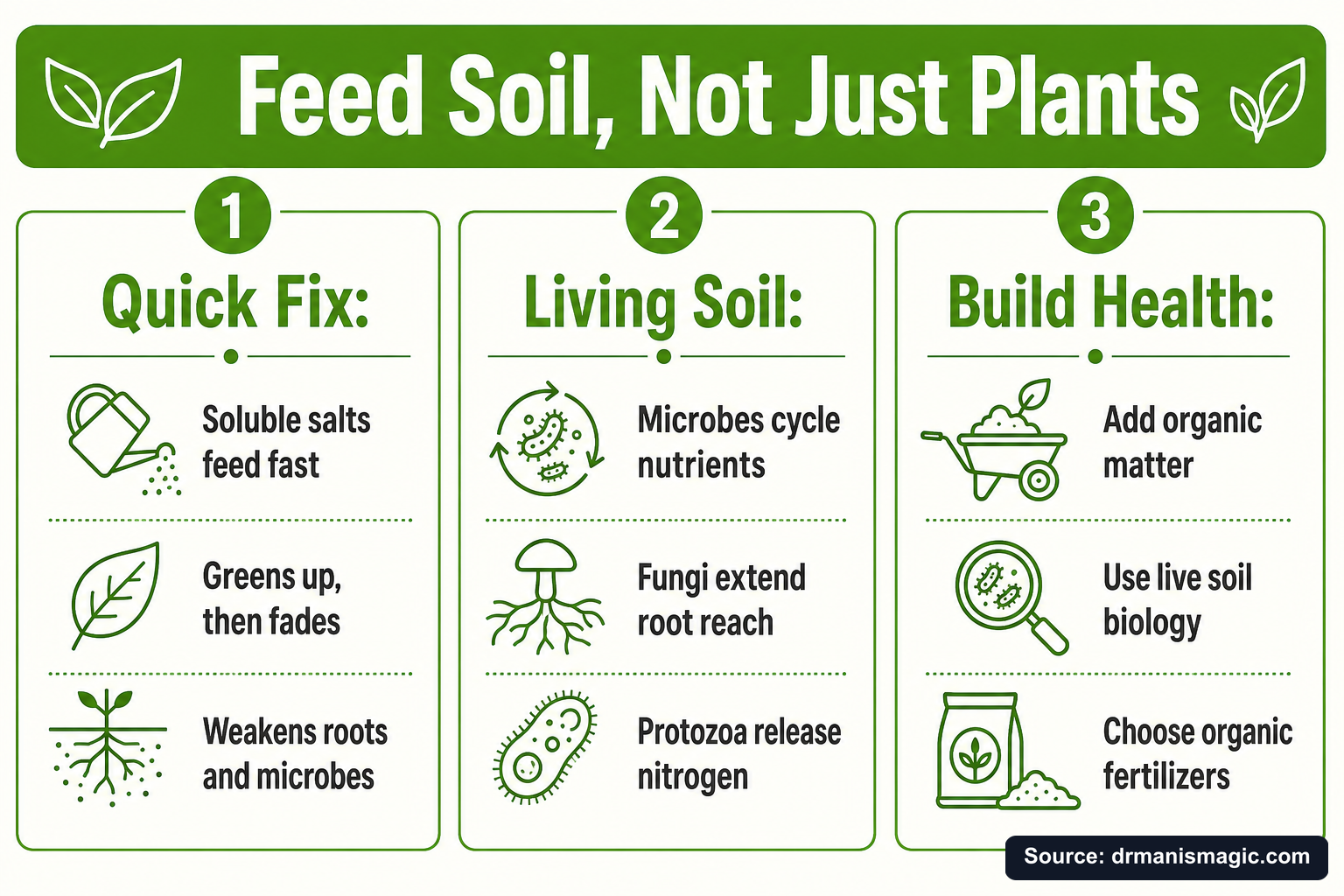
- Feeding plants means giving them soluble nutrients directly. Feeding soil means building the living biology that cycles nutrients naturally, over and over.
- Healthy soil is home to billions of bacteria, fungi, protozoa, and nematodes that work together to deliver nutrients to plant roots.
- Salt-based synthetic fertilizers feed plants short-term but kill the soil biology that would feed plants long-term.
- Protozoa and nematodes are the missing link most gardeners have never heard of — they release plant-available nitrogen by eating bacteria and fungi.
- Mycorrhizal fungi act like a second root system, extending reach for water, phosphorus, and dozens of other nutrients.
- Most microbe products on the market are either dead powder or stinky liquid — neither works well. Live, stabilized microbes are what actually move the needle.
- The Three Plant Pillars — mineral-based soil, live microbials, and organic fertilizer — work together to build real, lasting plant health from the ground up.
What Does "Feeding Plants" Actually Mean?
Quick Answer: Feeding plants means delivering soluble nutrients directly to the root zone so the plant can absorb them immediately. It works fast but does nothing to build the living soil ecosystem that would supply nutrients naturally over time. Think of it as bypassing the kitchen and injecting food straight into the bloodstream.
When you pick up a bag of conventional fertilizer, you are buying soluble salts. Nitrogen, phosphorus, and potassium in a fast-dissolving form. Water it in, and within days, the plant responds. Greener leaves. A little perk. You feel good.
But here is what is actually happening underground. Those salt-based nutrients dissolve into the water in the soil. The plant takes them up through its roots. Fast and direct. No middleman.
Sounds great, right? Here is the problem. Salts pull water out of living cells. That is just basic chemistry. And the cells being damaged are not just your plant's roots. They are the trillions of bacteria, fungi, and other microscopic creatures that live in the soil around those roots. Every time you apply a salt-based fertilizer, you are feeding your plant and quietly burning down the neighborhood it lives in.
University of California Agriculture and Natural Resources extension research describes this clearly: synthetic fertilizer salts raise soil electrical conductivity, creating what researchers call "chemical drought" — a condition where water is physically present in the soil but biologically unavailable because the salt concentration is too high for roots and microbes to function normally. UC ANR extension resources have documented this effect across many soil types.
So the plant gets a short burst of green. Then the biology weakens. Then the plant needs more fertilizer to survive. Then more biology dies. You get the picture. It is a cycle that benefits the company selling you bags of fertilizer, not the plant in your backyard.
See also: How Salt-Based Feeding Quietly Destroys Root Systems
What Does "Feeding Soil" Actually Mean?
Quick Answer: Feeding soil means supplying organic matter, carbon, and live biology so that bacteria, fungi, protozoa, and nematodes can thrive and naturally cycle nutrients into forms plants can absorb. It is slower to start but builds fertility that compounds over time, getting stronger every season instead of weaker.
Walk into an old-growth forest. No one is fertilizing those trees. No one is spraying, treating, or tending them. Yet the canopy is thick. The roots run deep. The trees are enormous. Some of them have been growing for hundreds of years.
How?
The answer is under your feet. The soil in a healthy forest is alive in a way that most garden soil is not. It is home to a staggering community of organisms — bacteria, fungi, protozoa, beneficial nematodes, earthworms, arthropods — all working together in a system scientists call the soil food web.
This food web does something remarkable. It takes dead organic matter — fallen leaves, old roots, compost — and breaks it down into nutrients that plants can absorb. No bag. No label. No NPK ratio on the side. Just biology doing what biology has done for 450 million years.
When you feed the soil, you are feeding that system. You are giving it carbon, organic matter, and the conditions it needs — moisture, oxygen, low disturbance — to keep cycling nutrients for your plants automatically.
The Colorado State University Extension soil food web guide describes it this way: the food web is not just decomposition. It is a nutrient-cycling engine that regulates how quickly nutrients become available to plants, how water moves through soil, how disease organisms are kept in check, and how soil structure forms and holds together.
That is what you are building when you feed the soil. Not just today's meal for your plant. A living infrastructure that feeds your plant next month, next year, and the year after that.
Who Are the Invisible Workers Living in Your Soil Right Now?
Quick Answer: Healthy soil contains bacteria, fungi, protozoa, and nematodes that work as a team. Bacteria and fungi break down organic matter. Protozoa and nematodes eat the bacteria and fungi, releasing nutrients in forms plants can actually absorb. Together they form the soil food web — the engine behind all natural plant nutrition.
Most people know that "good microbes" exist. But knowing they exist is very different from understanding what they actually do. Let's walk through the team, one by one.
Bacteria: The Fast Decomposers
Bacteria are the smallest and most numerous members of the soil food web. A single teaspoon of healthy soil holds hundreds of millions of them. They break down simple organic compounds fast — root sugars, fresh compost, plant residues. They are the first responders of the nutrient cycle.
Some bacteria fix nitrogen directly from the air and convert it into a form plants can use. Others solubilize phosphorus that is chemically "locked" in the soil, making it available to roots that could never reach it on their own.
Fungi: The Long-Distance Network
Fungi work differently. Their thread-like structures, called hyphae, grow through soil in networks that can stretch for miles. They break down tough organic materials — woody stems, old bark, thick roots — that bacteria cannot touch.
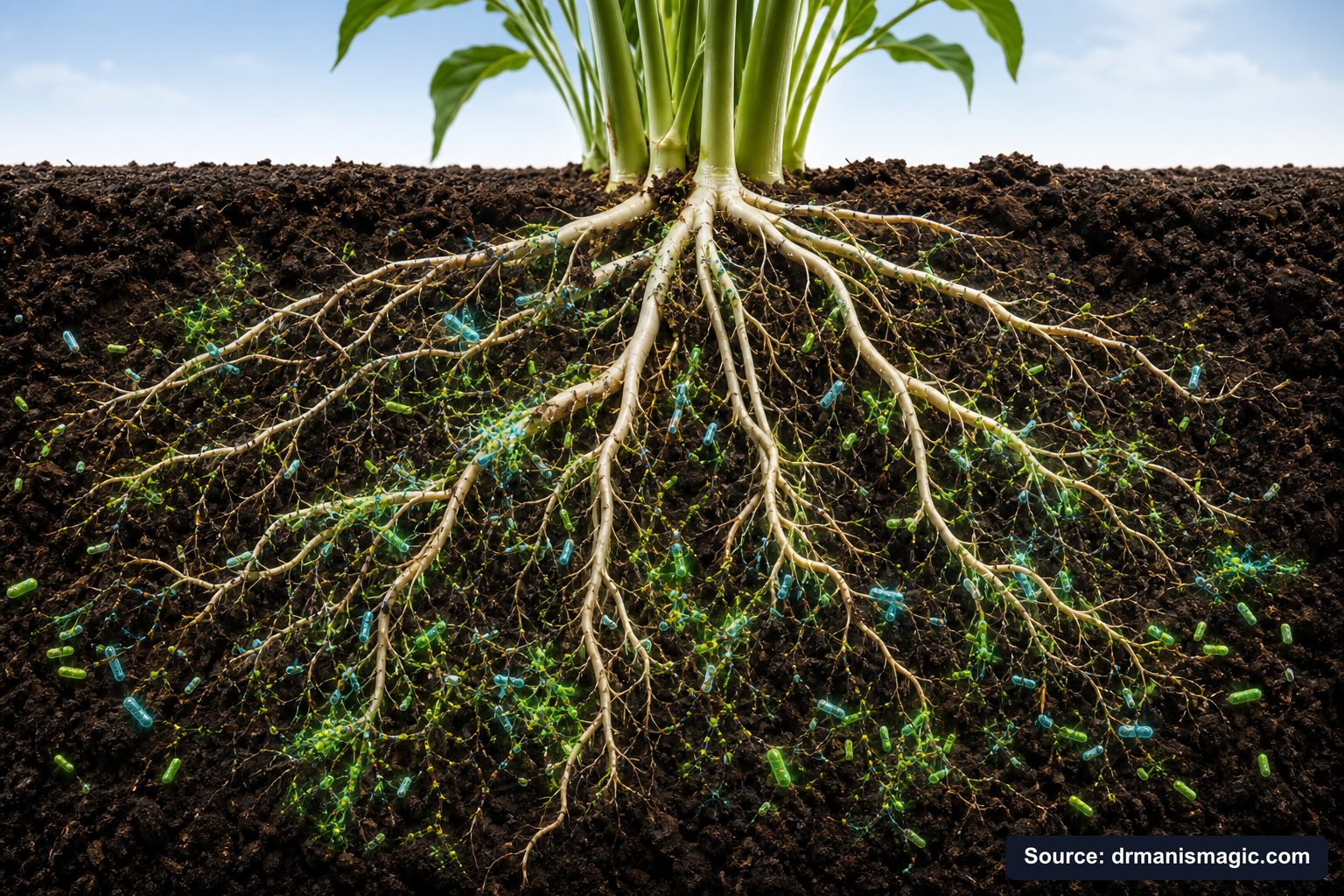
Mycorrhizal fungi are the most famous members of this group. They form a direct partnership with plant roots, physically connecting to them and extending the root system many times over. In exchange for sugars from the plant, they deliver water, phosphorus, nitrogen, and micronutrients from soil zones the roots themselves could never reach. Think of them as a second root system that you never have to grow yourself.
If you have ever pulled a weed and seen fuzzy white threads clinging to the roots, you have seen mycorrhizae in action. That is why weeds grow so aggressively. They have a fungal partnership that most garden plants have lost.
Protozoa: The Missing Link Most Gardeners Have Never Heard Of
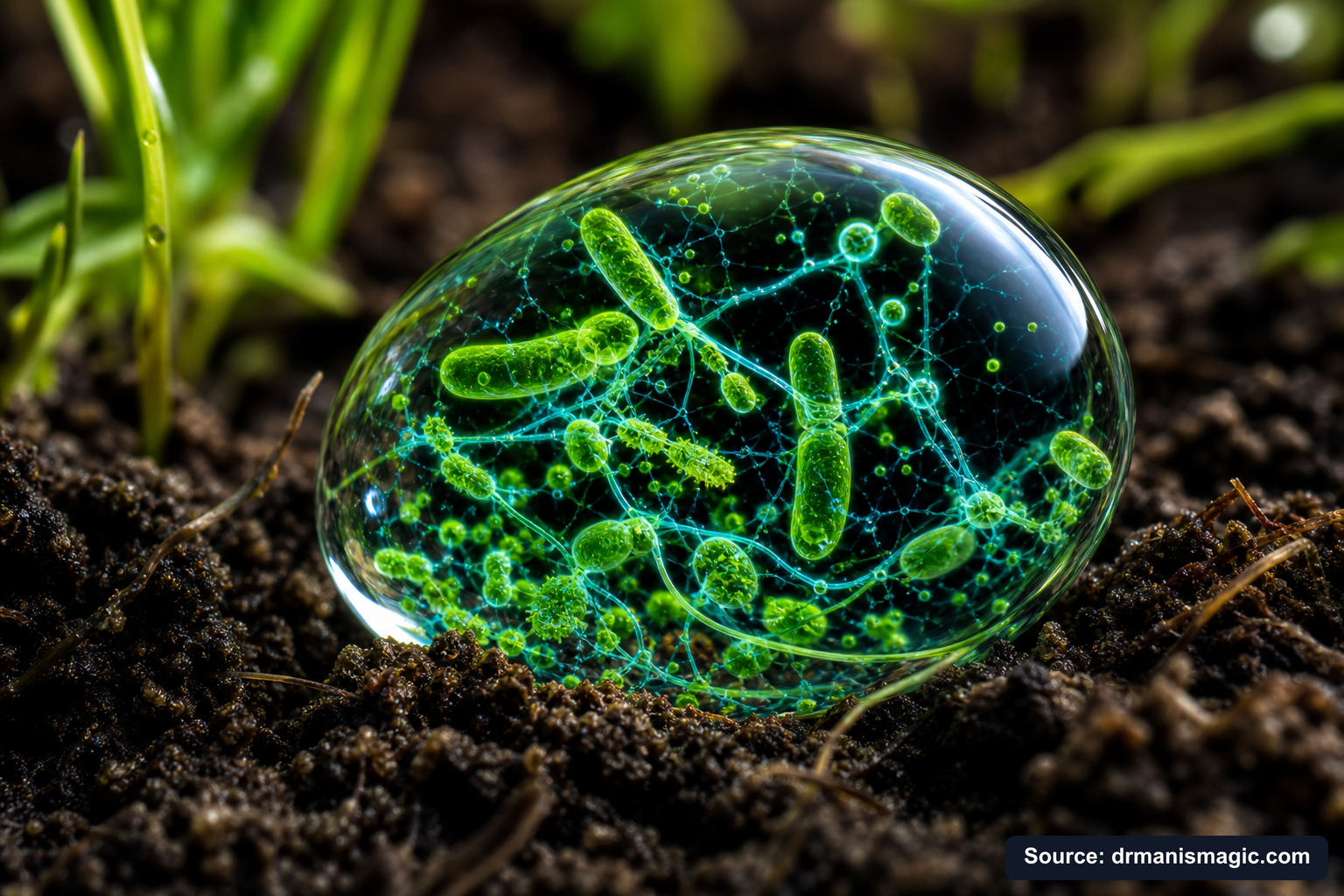
Here is something almost no one talks about. Protozoa are single-celled organisms that eat bacteria. And when they eat bacteria, they release excess nitrogen — in a form that plants can absorb directly. This is called mineralization, and it is one of the most important nutrient-delivery mechanisms in all of nature.
Without protozoa, bacteria accumulate but nutrients stay locked inside them. With protozoa, the nutrient cycle completes. The bacteria get eaten, the nitrogen gets released, and the plant gets fed. It is elegant. It is automatic. And it requires no bag, no label, and no price tag.
Beneficial Nematodes: The Regulators
Nematodes get a bad reputation because some species damage plant roots. But most soil nematodes are beneficial. They eat bacteria, fungi, and other nematodes, releasing nutrients as they go. They also suppress harmful organisms by out-competing them for food and space.
Together, these four groups form a food web that is more complex, more efficient, and more resilient than any fertilizer program ever invented.
| Organism | What It Eats | What It Releases for Plants | Key Benefit |
|---|---|---|---|
| Bacteria | Simple carbon compounds, root sugars, organic residues | Nitrogen, phosphorus, sulfur | Fast decomposition, nitrogen fixation, pathogen competition |
| Fungi (mycorrhizal) | Tough organic matter, plant sugars from roots | Phosphorus, water, micronutrients | Extended root reach, drought resilience, soil aggregation |
| Protozoa | Bacteria | Plant-available nitrogen (mineralization) | Completes the nutrient cycle, regulates bacterial population |
| Beneficial nematodes | Bacteria, fungi, harmful nematodes | Nitrogen, other nutrients | Nutrient release, suppression of harmful organisms |
| Earthworms | Organic matter, bacteria | Nutrient-rich castings, improved soil structure | Aeration, drainage, nutrient cycling |
What Is the Actual Nutrient Pathway From Compost to Plant Root?
Quick Answer: Organic matter feeds bacteria and fungi. Protozoa and nematodes eat the bacteria and fungi, releasing plant-available nitrogen through mineralization. Mycorrhizal fungi deliver phosphorus and water directly to roots. The plant absorbs these nutrients through its root system. This full cycle is what "feeding the soil" actually builds.
Most articles about soil health skip the actual pathway. They say "feed the soil, not the plant" like it is a bumper sticker. But they never show you the map. Here it is, step by step.
- Step 1 — Organic matter enters the soil. This could be compost, fallen leaves, mulch, dead roots, or root exudates (sugars your plant releases through its roots to feed microbes on purpose).
- Step 2 — Bacteria and fungi break it down. Bacteria attack the simple stuff fast. Fungi handle the tough, woody material more slowly. Both are converting organic matter into microbial biomass — nutrients stored inside living cells.
- Step 3 — Protozoa and nematodes graze. They eat the bacteria and fungi. When they do, they release excess nitrogen, phosphorus, and other nutrients in mineral form — exactly the form plant roots can absorb.
- Step 4 — Mycorrhizal fungi deliver directly. Their hyphae reach into soil pockets no root can access and pipe water, phosphorus, and micronutrients back to the root surface.
- Step 5 — The plant absorbs. Roots take up the mineralized nutrients. The plant grows. It rewards the microbes with more root sugar. The cycle repeats.
This is why a forest does not need fertilizer. The cycle is self-sustaining. The more organic matter goes in, the more biology thrives, the more nutrients cycle, the more the plants grow, the more organic matter they produce. It is a loop that builds on itself.
Your garden can work exactly this way. But only if the biology is there.
Feeding Plants vs. Feeding Soil: A Direct Comparison
Quick Answer: Feeding plants with soluble fertilizer gives fast but fragile results. Feeding soil by building live biology gives slower but compounding results. The first approach costs more over time and leaves plants dependent. The second approach costs less over time and makes plants increasingly self-sufficient. The difference becomes obvious within one growing season.
Let's put these two approaches side by side so you can see exactly what you are choosing between.
| Factor | Feeding Plants (Soluble Fertilizer) | Feeding Soil (Building Biology) |
|---|---|---|
| Speed of response | Days to weeks | Weeks to months (then accelerates) |
| Effect on soil biology | Salt damage kills beneficial microbes | Feeds and multiplies beneficial microbes |
| Nutrient availability over time | Declines — plant becomes dependent | Increases — system becomes self-sustaining |
| Drought resilience | Low — no fungal water network | High — mycorrhizae extend water reach |
| Disease suppression | None — biology is impaired | Strong — biology crowds out pathogens |
| Root rot risk | Higher — salts stress root tissue | Lower — aerobic biology protects roots |
| Cost over 3 years | Increasing — you buy more each year | Decreasing — soil improves each year |
| Safety for family and pets | Salt and chemical exposure risk | Zero synthetic salts, zero PFAS, zero biosludge |
| What happens if you stop | Plant declines quickly | Plant maintains on stored biology |
Look at that last row carefully. When you stop feeding a plant with synthetic fertilizer, it declines. Because it had no backup system. When you stop adding inputs to a soil-fed plant, it coasts on the living infrastructure you built. That is the difference between renting fertility and owning it.
See also: The Hidden Reason Synthetic Fertilizers Cause Root Rot
You Never Had a Brown Thumb.
You were handed the wrong tools. This free guide hands you the right ones.
You watered it. You fed it. It died anyway.
It was never you. It was the dirt, the salt food, and the bad advice.
This guide shows you what really went wrong, and how to fix it for good.
- Why your plants really died, and why it was never your fault
- The salt hiding in your plant food that quietly burns the roots
- The hidden killer in almost every bag of store soil
- The tiny helpers that grow a whole forest for free
- The rescue trick that brings a half dead plant back to life

Why Do Most Microbe Products Fail to Deliver What They Promise?
Quick Answer: Most commercial microbe products are either dried powders with low viability or liquid products that go anaerobic and die before they reach you. Dead microbes cannot build a soil food web. The only microbes that help plants are living microbes that are still alive and active when they hit the soil.
This is where the story gets interesting. And a little frustrating.
The microbe market is booming. Walk into any garden center and you will see dozens of products with words like "beneficial bacteria," "mycorrhizal inoculant," and "probiotic soil boost" on the label. Most of them do almost nothing.
Here is why.
The most common type of microbe product is a dried powder. Microbes are grown in giant laboratory vats, then dried into spores and packaged. The idea is that when you add water, the spores "reactivate." In our experience growing over 250,000 trees at US Citrus Nursery, we tested dozens of these products. The results were consistently disappointing. The reactivation rate is low. The species diversity is narrow. And the microbes that do survive are often the hardiest but least beneficial ones.
The second type is a liquid product made from compost or earthworm castings — basically compost tea in a bottle. This sounds great in theory. Fresh compost tea, applied within 24 hours while it is still aerobic, can be genuinely powerful. But by the time a bottle of this product ships to you, sits in a warehouse, rides in a delivery truck, and lands on your doorstep, the microbes inside have gone anaerobic. That means they have run out of oxygen and started to die and decompose. The telltale sign? The bottle stinks. Sometimes it hisses when you open it. That fizz is the gas of fermentation — the smell of microbes dying.
You pour dying microbes onto your soil and wonder why nothing changes.
There is a third type — products using lactobacillus bacteria, the same kind in yogurt. These are vigorous and stay alive easily. But lactobacillus is so aggressive it crowds out the beneficial microbes you actually want. It belongs in your gut, not your garden.
| Product Type | Microbial Viability | Species Diversity | Odor | Real-World Result |
|---|---|---|---|---|
| Dried powder (lab-grown) | Very low | Narrow | Low odor | Minimal to no observable benefit |
| Rehydrated dried powder | Very low | Narrow | Low odor | Same issue — avoid |
| Compost tea, fresh under 24 hours | Moderate (if aerated) | Broad but variable | Earthy | Good if made and used on-site immediately |
| Compost tea, bottled and shipped | Low — anaerobic by delivery | Partial | Strong stench, may fizz | Microbes mostly dead; not recommended |
| Lactobacillus-based products | High but wrong species | Very narrow | Sour | Crowds out beneficial microbes |
| Plant Super Boost (stabilized, full-spectrum) | High — visibly alive under microscope | 2,000+ bacteria, 400-500 fungi including mycorrhizae, plus protozoa and nematodes | Earthy, not foul | Measurable soil biology improvement; confirmed by lab analysis |
What makes Plant Super Boost different is not marketing language. It is the stabilization method. Dr. Mani's team uses a proprietary all-natural technique — developed with a world-renowned compostologist who has advised royal families and governments on agricultural practices — to keep the full spectrum of microbes alive without going anaerobic. No rotting. No stench. Just living, active biology in a bottle.
If you put a drop of Plant Super Boost under a microscope, you can see the microbes moving. That is not a lab claim. That is visible proof of life.
What Happens to Your Soil Biology When You Use Synthetic Fertilizers?
Quick Answer: Salt-based synthetic fertilizers raise the electrical conductivity of soil, creating osmotic stress that damages or kills bacteria, fungi, protozoa, and nematodes. Over repeated applications, the soil food web collapses. The plant becomes entirely dependent on external inputs. This is the cycle that keeps gardeners buying more fertilizer every season.
Here is the part most fertilizer companies would rather you never think about.
When you apply a salt-based fertilizer — and almost all synthetic fertilizers are salt-based — those salts dissolve into the soil water. They raise the concentration of dissolved solids in the water around the roots. This is called electrical conductivity, and it is measurable with a simple soil test.
As that concentration rises, something called osmotic stress kicks in. Water flows from areas of low concentration to areas of high concentration. When the soil water is more concentrated than the inside of a bacterial cell, water flows out of the bacteria. They shrink. They weaken. Many die.
The same thing happens to mycorrhizal fungi. To protozoa. To nematodes. The entire food web is stressed by the salt load you applied trying to help your plant.
This is not a fringe theory. It is well-documented plant science. It is also why plants fed with synthetic fertilizers for years often look progressively worse despite getting more fertilizer. The biology is gone. The soil is essentially sterile. The plant is alive only because you keep injecting soluble nutrients directly. Stop for one season and it crashes.
We call this the fertilizer trap. And millions of American gardeners are in it right now, through no fault of their own. The big chemical companies figured this out in the 1950s. Miracle-Gro was essentially the first mass-marketed synthetic fertilizer brand, and the business model was elegant: sell something that works fast, damages the long-term system, and creates repeat buyers forever. It was not a gardening solution. It was a subscription service dressed up as plant food.
It is not your fault. You were sold a product, not a solution.
How Do You Actually Rebuild Soil Biology After Years of Synthetic Inputs?
Quick Answer: Rebuilding soil biology takes consistent effort over multiple months. Stop the inputs that kill microbes, reduce soil disturbance, add mature compost or a full-spectrum live microbial inoculant, mulch to retain moisture and add carbon, and use organic fertilizer that feeds microbes instead of burning them. Results compound over time — the biology you build this season makes next season easier.
This is the question that matters most if your soil has been on synthetic fertilizers for years. Or if you are planting in commercial potting mix that started sterile. Or if your lawn has been treated with herbicides and weed killers that wiped out the microbial community.
The good news: soil biology is resilient. It wants to come back. You just have to stop doing the things that kill it and start doing the things that feed it.
Here is a practical recovery checklist we use at US Citrus Nursery when rehabilitating struggling plants and depleted soil:
- Stop the biology killers. Pause synthetic salt fertilizers, broad-spectrum herbicides, and synthetic fungicides. These are the primary destroyers of soil biology. You do not have to be perfect, but reducing them matters immediately.
- Test your soil's salt level if possible. An electrical conductivity reading above 2.0 mS/cm in the root zone signals salt damage. Flush with deep watering to leach salts downward before adding biology.
- Add a full-spectrum live microbial inoculant monthly. Not a dried powder. Not a smelly bottle. Living microbes that arrive alive and go to work in the soil. The biology has to be reintroduced because it will not recover on its own fast enough in a damaged environment.
- Add mature compost or organic mulch. This is the carbon source that feeds your new microbial community. Two to three inches of compost worked into the root zone, or four to six inches of wood chip mulch on the surface, gives bacteria and fungi the food they need to multiply.
- Switch to organic, slow-release fertilizer. Organic fertilizers feed the soil biology as they break down, instead of burning it. Crab, kelp, and amino acid-based formulas provide a full spectrum of nutrients without synthetic salts, biosludge, or PFAS contamination.
- Reduce soil disturbance. Tilling and digging destroy fungal hyphae networks that took months to build. Once biology is re-establishing, work with the soil surface instead of turning it over.
- Be patient and consistent. The first month, you will see subtle changes. The second and third month, the momentum builds. By six months, a soil that was biologically dead can support thriving plant life naturally. The system accelerates as it heals.
One honest note on timing. You cannot get time back. Every season you spend in the fertilizer trap is a season your plants are not reaching their potential. The best time to start rebuilding was last year. The second best time is right now. We have seen gardeners in their 60s and 70s who told us their number one wish was to see fruit on a tree they planted with their own hands. When the soil biology is right, that wish comes true faster than you would ever expect.
Learn more about building your soil foundation with the Three Plant Pillars system, which combines mineral-based soil, live microbials, and organic fertilizer into one complete framework.
What Are the Three Plant Pillars and Why Do All Three Matter?
Quick Answer: The Three Plant Pillars are the framework Dr. Mani Skaria developed after decades of growing citrus at US Citrus Nursery. Pillar One is mineral-based soil for drainage and root oxygen. Pillar Two is live microbials for nutrient cycling and disease suppression. Pillar Three is organic fertilizer for complete slow-release nutrition without salt damage. Miss any one pillar and plants struggle. Use all three and they thrive.
Dr. Mani Skaria is a Professor Emeritus of Plant Pathology and the inventor of micro-budding. He spent over 40 years at the Texas A&M Citrus Center researching plant health. He has tested more products on more plants than almost anyone alive. And after all of that, the framework he came back to is surprisingly simple.
Three things. That is it.
Pillar One: Mineral-Based Soil. Most potting mixes are made from pine bark and sawdust. They feel light and fluffy when new. But within months, they begin to decompose. As they break down, they compact, block oxygen from reaching roots, and drain poorly. Roots suffocate. Root rot sets in. The plant looks sick and nobody can figure out why, because they are looking at the leaves instead of what is happening underground. Mineral-based soil — sandy loam from the Rio Grande Valley — does not decompose. It holds its structure permanently. Roots breathe. Water drains. The foundation holds.
Pillar Two: Live Microbials. This is the soil food web in a bottle. Bacteria, fungi including mycorrhizae, protozoa, and nematodes. A full-spectrum community of living organisms that cycle nutrients, suppress pathogens, extend root reach, and build the kind of living soil that forests and prairies run on. Without this, you are farming in a biological desert, no matter how much you water or fertilize.
Pillar Three: Organic Fertilizer. Not salt-based. Not synthetic. Crab meal, kelp, and amino acids provide a slow-release complete nutrition profile that feeds the plant and feeds the biology at the same time. No burning. No salt accumulation. No PFAS, no biosludge. Just earth-born nutrients in the form plants actually evolved to use.
When all three pillars are in place, something shifts. The plant stops struggling and starts thriving. Not because you are doing more. Because the system underneath it is finally working the way nature designed it to.
You can explore the Free Plant Care Field Guide to see exactly how to apply the Three Plant Pillars to any plant you are growing.
What Can You Do Right Now to Start Feeding Your Soil Instead of Just Your Plants?
Quick Answer: Start by adding live microbials to your soil this month. Then switch to organic fertilizer that feeds biology instead of burning it. Mulch the surface to add carbon and protect moisture. Stop or reduce synthetic herbicides and salt-based fertilizers. These four steps begin rebuilding the soil food web immediately and results compound from there.
You do not have to overhaul your entire garden overnight. You just have to start shifting the inputs in the right direction.
Here is what to do first. Walk out to your garden, your potted tree, your lawn, your flower bed — wherever your struggling plants live. Ask yourself one question: when did I last add anything living to this soil?
Not a bag of fertilizer. Not a spray. Something living. Compost. Microbes. Something that adds to the biological community instead of drawing from it.
If the answer is "never" or "I'm not sure," that is your starting point.
Add living biology to your soil. Do it monthly. Be consistent. Pair it with an organic fertilizer that does not burn the biology you are building. Give your roots a soil that breathes and drains. And watch what happens over the next 60 to 90 days.
We have seen this work on citrus trees in South Texas, on lawns in dry climates, on houseplants in apartments, on flower gardens in backyards across America. The biology does not care what plant you are growing. It just needs the right conditions to do what it has always done.
The difference between feeding plants and feeding soil is the difference between renting results and owning them. One approach keeps you dependent. The other builds something that gets better every single season. You have already lost enough time on the old approach. The second-best time to change is right now.
If you are ready to start with a full-spectrum live microbial product that actually contains living, active organisms — not dried powder, not a stinky bottle — take a look at what Dr. Mani built from scratch at US Citrus Nursery and now makes available for every kind of gardener in America: Plant Super Boost. Backed by a 30-day money-back guarantee. Zero synthetic salts, zero PFAS, zero biosludge. Made in the USA.
Your plants have been waiting for this. The soil has been waiting longer.
Frequently Asked Questions
Most gardeners never ask these questions. That is exactly why their plants keep struggling. Once you understand what is really happening underground, everything changes. These answers are grounded in over 30 years of hands-on growing at our South Texas nursery, where we have grown more than 250,000 trees using the Three Plant Pillars.
Is fertilizer the same as soil?
No, and mixing them up is one of the most expensive mistakes a gardener can make. Soil is the living foundation your plant lives inside. It anchors roots, holds water, and houses billions of microbes that do the real work of feeding your plant. Fertilizer is more like a vitamin pill. It adds nutrients, but it cannot replace a healthy, living soil. At Dr. Mani's Magic, we treat these as two completely separate pillars, because they are.
Can too much fertilizer destroy the soil?
Yes, and it happens faster than most people realize. Salt-based synthetic fertilizers raise the electrical conductivity in your soil. That salt pulls water out of living cells, including the bacteria and fungi your plant depends on. Every heavy application quietly kills the microscopic workforce underground. After a few rounds, your soil stops functioning on its own. You become completely dependent on the next bag of fertilizer. That is not gardening. That is a trap.
Do I need to mix soil and fertilizer together?
With synthetic fertilizers, mixing instructions vary and mistakes are easy to make. With the Three Plant Pillars approach, this gets much simpler. You start with a mineral-based soil that does not break down or compact. Then you add live microbials to build your underground workforce. Then you feed with a slow-release organic fertilizer made from crab, kelp, and amino acids. Each layer works with the others. Nothing burns. Nothing clashes. You do not need a chemistry degree to get it right.
Is there a difference between plant food and soil?
A big one. Soil is the home. Plant food is a meal delivered to that home. But here is what most people miss: a healthy soil feeds your plant automatically, over and over, without you doing anything extra. The microbes inside living soil break down organic matter and release nutrients directly to the roots. When your soil is alive and mineral-based, it becomes a self-running feeding system. That is the goal. Fertilizer alone can never get you there.
Which plants do not like fertilizer?
Succulents, cacti, lavender, native wildflowers, beans, peas, and most root vegetables like carrots and radishes prefer lean conditions. Feeding them too much, especially with nitrogen-heavy synthetic products, causes floppy growth, poor blooms, or root damage. The good news is that when your soil is built correctly with live microbes and a mineral foundation, it naturally regulates nutrient delivery. Plants take what they need. Nothing more. That is nature doing its job.
Can I just put fertilizer on top of the soil?
You can, but results depend entirely on what is underneath. If your soil is compacted, oxygen-starved, or biologically dead, surface fertilizer has nowhere useful to go. Rain and watering push salt-based nutrients past the root zone before the plant can use them. With a mineral-based soil that drains well and a living microbial layer underneath, top-dressing with an organic slow-release fertilizer works beautifully. The roots reach up, the microbes break nutrients down, and the plant actually gets fed.
Is October too late to fertilize plants?
It depends on what you are growing and where you live. Cool-season grasses and established trees benefit from a fall feeding after growth slows. Warm-season grasses and perennials are a different story. Pushing new growth right before a frost is a recipe for cold damage. The safest fall approach is a low-nitrogen organic fertilizer that feeds roots without triggering leafy growth. That is exactly what slow-release crab, kelp, and amino acid fertilizer does. It builds strength quietly, underground, right when your plant needs it most.
About the Author
Dr. Mani Skaria, PhD
Dr. Mani Skaria, PhD, is a plant pathologist and the scientific founder of Dr. Mani's Magic. He earned his doctorate at Purdue University and spent 48 years studying how plants, soil, and living microbes work together, including his years as Professor Emeritus at Texas A&M and as a member of the USDA NAREEE Advisory Board. He invented micro-budding, a method for growing healthier, stronger trees, and has grown more than 250,000 trees on the family farm in Hargill, Texas - US Citrus Nursery. His life's work takes real lab science and practical experience and turns it into simple, safe, organic plant care anyone can use at home.


