


The Living Chain That Moves Energy Underground | Dr. Mani's Magic
The Living Chain That Moves Energy Underground: How Roots, Microbes, and Soil Life Feed Your Plants
Picture this. You walk outside on a cool morning, coffee in hand, and look at your favorite tree. The one you planted with hope. The one you imagined heavy with fruit someday. And it just... sits there. Leaves a little pale. Growth a little slow. You've watered it. You've fed it. You've done everything the bag told you to do. But something is missing. Something you can't quite see.
Here's what nobody told you. The most important action in your garden isn't happening above ground at all. It's happening in the dark, just inches below your feet, right now. There is a chain of life down there. A living, moving, breathing network of bacteria, fungi, tiny predators, and invisible grazers. They are transferring energy. They are unlocking food. They are doing work that no fertilizer bottle has ever been able to replicate. And most gardeners have accidentally been killing this chain for years without ever knowing it existed.
After growing over 250,000 trees at our South Texas nursery, we learned something humbling. The plants don't really need us to feed them. They need us to stop destroying the invisible workforce that was already doing the feeding. Once we understood the living chain that moves energy underground, everything changed. And it can change for you too.

Organic Fertilizer | Crab, Kelp & Amino Acids
Key Takeaways
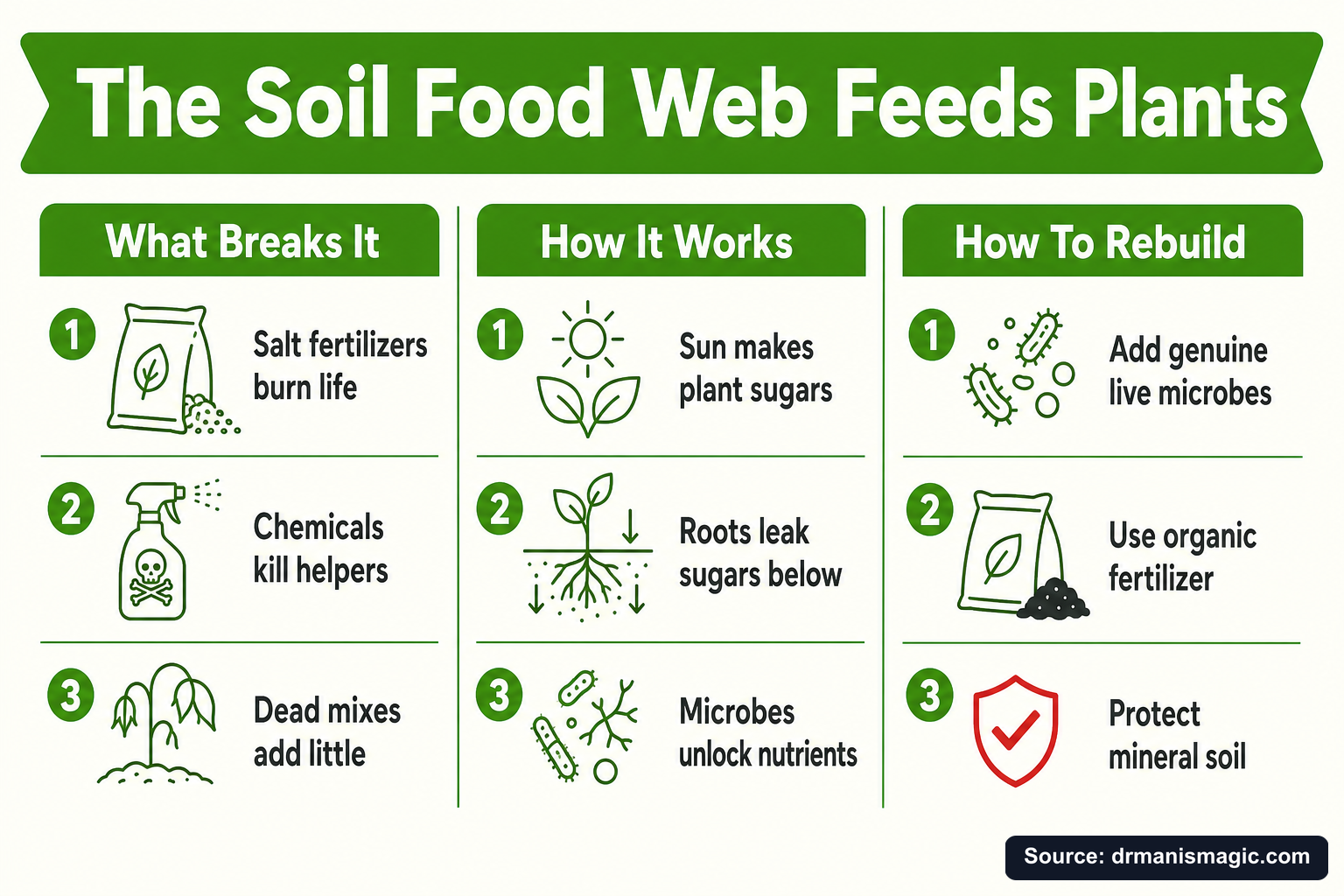
- Plants convert sunlight into sugars, then leak those sugars through their roots to feed billions of underground microbes.
- Bacteria, fungi, protozoa, nematodes, and soil animals form a living chain that cycles energy and releases nutrients back to plants.
- Mycorrhizal fungi are ancient plant partners that extend root reach, improve water and phosphorus access, and help plants survive stress.
- Salt-based synthetic fertilizers and chemical pesticides quietly destroy this underground chain, leaving plants dependent and defenseless.
- Most commercial microbial products are either dried-dead powders or stinking, anaerobic liquids that deliver little real benefit.
- Genuine live microbes, applied consistently, can rebuild the underground chain even in damaged, compacted, or chemically depleted soil.
- The Three Plant Pillars (mineral soil, live microbials, organic fertilizer) create the conditions this living chain needs to thrive.
How Does Sunlight Actually Become Food Underground?
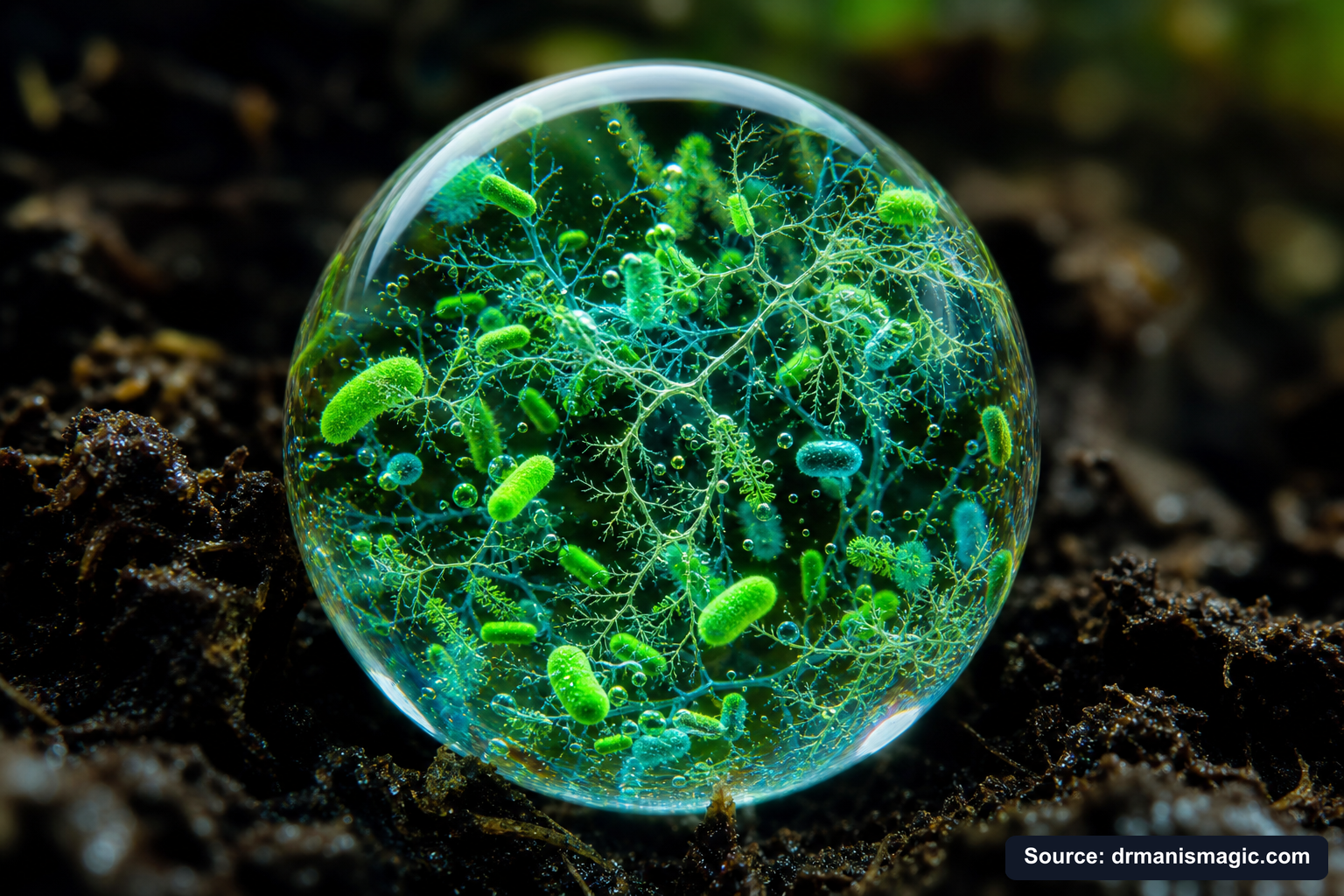
Quick Answer: Plants capture sunlight and turn it into sugar through photosynthesis. Then they leak a large portion of those sugars out through their roots into the soil. Those sugars feed billions of bacteria and fungi, which then process nutrients and deliver them back to the plant. Sunlight becomes soil life, and soil life becomes plant food.
Here is the most surprising fact most gardeners never hear. Plants are not just consumers of the soil. They are the engine that powers the entire underground world.
A plant in full sunlight is running a solar-powered sugar factory. It pulls carbon dioxide from the air. It catches photons from the sun. And it builds sugars, the same basic building blocks as table sugar, through a process called photosynthesis.
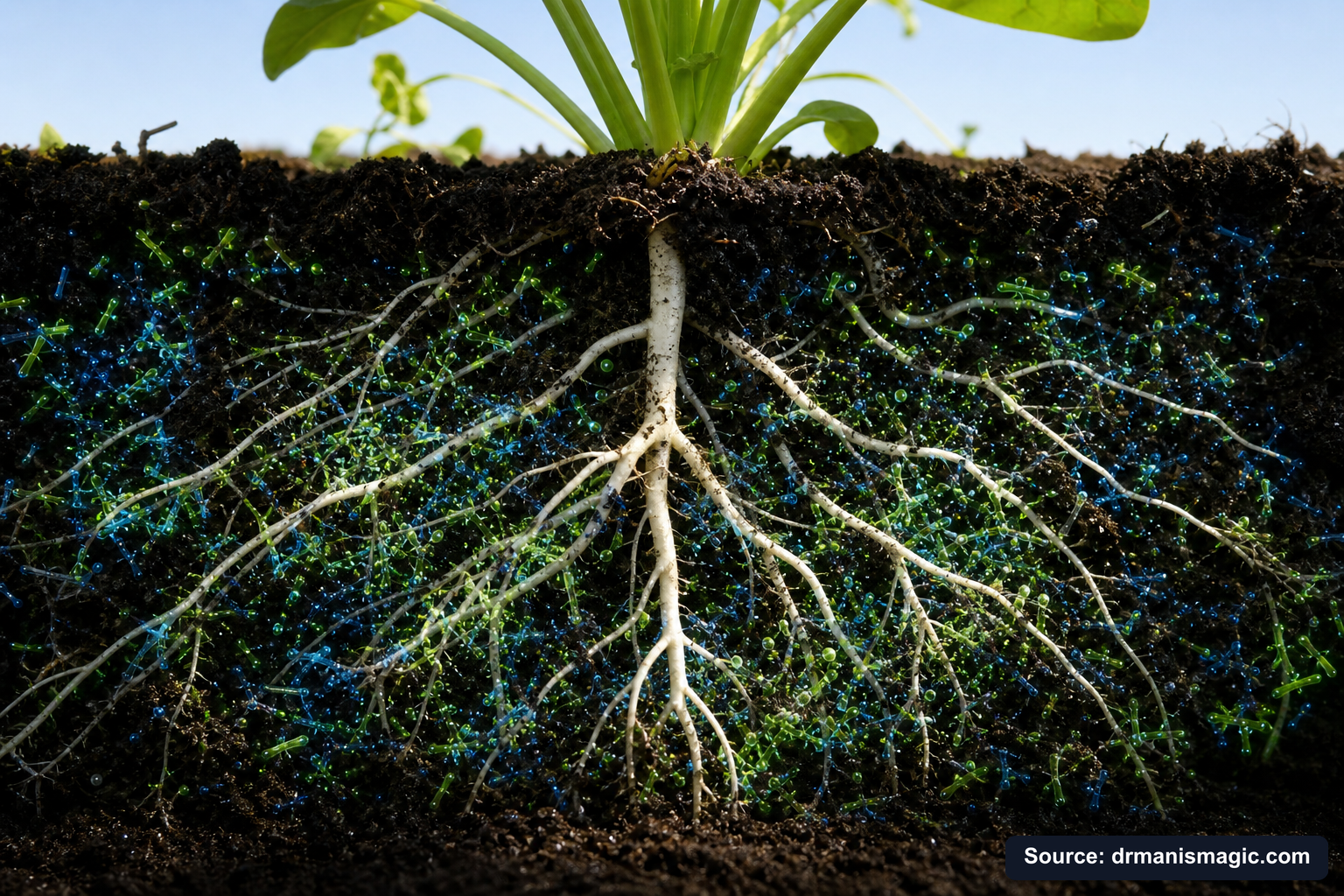
Now here is the part that blows people's minds. Plants don't keep all those sugars for themselves. Research from the University of Maryland Extension and other university sources confirms that plants intentionally release somewhere between 20 and 40 percent of the carbon they fix right back into the soil through their roots. On purpose. This leakage is called root exudate. It is a liquid mix of sugars, proteins, acids, and signaling compounds that the plant pumps into the soil around its roots.
Why would a plant give away nearly half its hard-earned energy?
Because it is buying something far more valuable in return. It is paying the underground workforce.
That thin zone of soil right around the roots, called the rhizosphere, becomes a feeding frenzy. Bacteria arrive first, drawn by the sugar signal. Fungi follow. And then the grazers come to eat the bacteria and fungi. And as they eat, they release nutrients in forms the plant can actually absorb. The plant gets back phosphorus, nitrogen, and dozens of trace minerals it could never unlock on its own. The deal works so well it has been running for over 400 million years without a single interruption. Until modern gardening came along.
Who Are the Players in the Underground Living Chain?
Quick Answer: The underground living chain includes bacteria, fungi (especially mycorrhizae), protozoa, beneficial nematodes, mites, and earthworms. Each group plays a specific role. Bacteria and fungi break down and store nutrients. Protozoa and nematodes eat them and release nutrients in plant-available forms. Together they form the soil food web.
Think of the soil food web like a city that never sleeps. Every organism has a job. Every job feeds the next one. And the whole system exists to cycle energy from sunlight back into plant food.
Here is a look at the key players and what they actually do:
| Organism | What It Does | Why Your Plant Cares |
|---|---|---|
| Bacteria | Break down organic matter, fix nitrogen from air, release enzymes that unlock minerals | First responders to root exudates; unlock nutrients locked in soil particles |
| Mycorrhizal Fungi | Form a web of threads (hyphae) around and inside roots; extend root reach up to 100x; deliver phosphorus and water | Greatest single upgrade to root function; ancient partnership older than dinosaurs |
| Other Beneficial Fungi | Decompose tough materials like lignin; produce glomalin that glues soil into aggregates | Build soil structure; prevent compaction; improve drainage and aeration |
| Protozoa | Graze on bacteria, releasing nitrogen and other nutrients as waste | Key nutrient cyclers; often missing from the gardening conversation entirely |
| Beneficial Nematodes | Graze on bacteria and fungi; some prey on harmful nematodes and insects | Release plant-available nitrogen; regulate pest populations naturally |
| Mites and Microarthropods | Shred organic matter into smaller pieces; regulate fungal and bacterial populations | Speed up decomposition; keep the chain in balance |
| Earthworms | Till and aerate soil; digest organic matter; produce nutrient-rich castings | Create channels for water and air; their castings are a premium plant food |
Notice something? Every single organism in that table is either feeding the plant directly or creating the conditions that let other organisms feed the plant. This is not a metaphor. This is a real, measurable transfer of energy from sunlight all the way to plant growth. Every link in the chain matters.
And protozoa deserve a special mention here because almost nobody talks about them. These single-celled grazers roam the rhizosphere eating bacteria like tiny pac-men. When they digest bacteria, they release nitrogen as a waste product. That nitrogen lands right in the root zone in a form the plant can drink up immediately. No factory needed. No synthetic salt. Just the chain doing its job.
What Do Mycorrhizal Fungi Actually Do for Your Roots?
Quick Answer: Mycorrhizal fungi attach to plant roots and extend millions of tiny threads into the soil, dramatically increasing the surface area through which a plant can absorb water and phosphorus. They also help plants resist drought, salt stress, and disease. This partnership is over 400 million years old and benefits nearly every plant on Earth.
Have you ever pulled a weed and noticed fuzzy white threads clinging to the roots? That is mycorrhizae at work. And here is the wild part: those weeds grow like crazy precisely because of that white fuzz. They have a secret partner most gardeners never give their own plants.
Mycorrhizal fungi are ancient. University of Minnesota Extension research documents that these fungi formed partnerships with land plants more than 400 million years ago. They predate the dinosaurs. They survived every mass extinction. And they show up in virtually every healthy soil on the planet because they work.
Here is what they do in plain language. The fungus grows into and around the root. Then it sends out threads called hyphae that spread through the soil in every direction, sometimes for feet beyond where the root itself reaches. Those threads are thinner than roots and can squeeze into tiny spaces between soil particles that roots cannot enter. Through those threads, the plant gains access to phosphorus, zinc, copper, and water that would otherwise be locked away forever.
In return, the plant feeds the fungus sugar. The same root exudate system that feeds bacteria also feeds the fungal partner. It is the original subscription service. And the benefits keep coming as long as the partnership stays alive.
What kills mycorrhizal fungi? Synthetic fungicides. Salt-based fertilizers. Soil disturbance. Sterilized potting mixes. All the things that come standard with conventional gardening advice. Which is why so many gardeners wonder why their plants struggle even when they do everything right.
How Do Protozoa and Nematodes Release Plant-Available Nitrogen?
Quick Answer: Protozoa and nematodes eat bacteria and fungi that have absorbed nitrogen into their bodies. When they digest those microbes, excess nitrogen is released as ammonium directly into the root zone. This microbial grazing loop is one of the primary ways plants get plant-available nitrogen from organic matter without any synthetic input.
This is the part of the underground story that almost nobody tells. And it's the part that explains why truly living soil feeds plants without any help from a fertilizer bag.
Bacteria are nitrogen hoarders. They absorb nitrogen into their bodies as they eat and grow. All that nitrogen is locked up inside them, unavailable to plants. Enter the protozoa. These microscopic grazers eat bacteria by the millions every single day. And when they digest the bacteria, they release the nitrogen they don't need as ammonium. Ammonium drops right into the soil water. The plant root picks it up almost immediately.
It is the most elegant nutrient delivery system ever invented. And it runs entirely on the energy that the plant itself pumped into the soil as root exudate. The plant pays the bacteria in sugar. The bacteria get eaten by protozoa. The protozoa release nitrogen. The plant absorbs nitrogen. The cycle completes. Energy moves from sunlight to sugar to biology to nutrient and back to the plant.
Nematodes do the same thing at a slightly larger scale. Beneficial nematodes that graze on bacteria and fungi are the second tier of this grazing loop. And some predatory nematodes eat the harmful nematodes that attack roots, giving the plant natural pest protection from within the soil.
When gardeners apply broad-spectrum pesticides or nematicides, they don't just kill the bad nematodes. They wipe out the grazers that were keeping the nitrogen cycling. The nitrogen stops flowing. The plant goes hungry. And the gardener reaches for more fertilizer, not realizing they just broke the very chain that was supposed to do the feeding.
What Destroys the Living Chain Underground?
Quick Answer: Salt-based synthetic fertilizers, chemical pesticides, fungicides, and herbicides all damage or kill the organisms in the soil food web. High salt concentrations dehydrate bacteria and fungi. Broad-spectrum pesticides kill beneficial nematodes and protozoa. Fungicides destroy mycorrhizal partnerships. The result is biologically dead soil that depends entirely on chemical inputs to function.
Here is the honest truth about the last 70 years of mainstream gardening advice. It was never designed to build the underground chain. It was designed to bypass it.
Salt-based synthetic fertilizers, which is most of what you see on store shelves, work by flooding the soil with concentrated mineral salts. Those salts pull water out of plant roots and microbial cells through a process called osmosis. At low levels, plants get a quick green-up. But the bacteria, fungi, protozoa, and nematodes that make up the living chain are far more sensitive to salt than the plant is. They die. Or they go dormant. Or they flee to deeper soil layers where they can't reach the roots.
And once the biology is gone, the plant becomes fully dependent on the next bag of fertilizer. The chain is broken. The plant is on life support. And the company that sold you the fertilizer gets to sell you more next season.
This is not a conspiracy theory. It is simple biology. See also: The Hidden Reason Synthetic Fertilizers Cause Root Rot for a deeper look at how salt accumulation in the root zone leads to rot, not just nutrient loss.
Herbicides like glyphosate have been shown in multiple research studies to disrupt microbial community balance. Fungicides that target powdery mildew or root rot often cannot tell the difference between a harmful fungus and your mycorrhizal partner. Broad-spectrum pesticides land on soil, not just leaves, and they stay there long enough to kill the protozoa and nematodes that were cycling nitrogen for free.
The result? Soil that looks fine on the surface but is biologically dead underneath. And a plant that looks okay for a season, then slowly declines, then needs more inputs, then declines again. You've seen this pattern. Maybe in your own yard.
You Never Had a Brown Thumb.
You were handed the wrong tools. This free guide hands you the right ones.
You watered it. You fed it. It died anyway.
It was never you. It was the dirt, the salt food, and the bad advice.
This guide shows you what really went wrong, and how to fix it for good.
- Why your plants really died, and why it was never your fault
- The salt hiding in your plant food that quietly burns the roots
- The hidden killer in almost every bag of store soil
- The tiny helpers that grow a whole forest for free
- The rescue trick that brings a half dead plant back to life

Live Microbes vs. Dead Microbe Products: What's the Real Difference?
Quick Answer: Live microbial products contain active, viable organisms that can colonize roots and do real biological work. Dead or dried microbial products contain spores or powders that rarely reactivate in real conditions. Stinking liquid products have already gone anaerobic, meaning the microbes are dying. Only genuinely live, stable microbes deliver measurable results in the root zone.
The microbial product market is booming right now. Walk into any garden center and you'll see shelves of products claiming billions of microbes per teaspoon. Most of them don't work. Not because the idea is wrong. Because the microbes inside are already dead.
Here is what is happening inside most of those products.
The majority of commercial microbial products start in a laboratory. Scientists select specific strains of bacteria or fungi, grow them in large vats, then dry them into a powder. The hope is that the dormant spores will reactivate when you add water and pour them into soil. After testing dozens of batches on over 250,000 trees at our South Texas nursery, we found they simply don't deliver results. The reactivation rate is too low. The strains are too narrow. And they don't represent the full spectrum of organisms the living chain needs.
The second type smells like a problem before you even open the bottle. These are liquid products made from compost or earthworm castings that have been left too long. The microbes inside have gone anaerobic, meaning they ran out of oxygen and started fermenting. The gas you hear when you open the cap, and the sewage smell that follows, is the biological activity of dying and dead organisms. Some humic compounds survive, so you get minor benefits. But the living chain components are gone.
Here is a clear comparison so you can evaluate what you're buying:
| Product Type | Microbe Viability | Spectrum of Organisms | Smell | Real-World Results | Our Recommendation |
|---|---|---|---|---|---|
| Dry powder (lab-grown) | Very low; spores rarely reactivate | Narrow; 3-10 selected strains | Minimal | Little to no observed benefit | Avoid |
| Dry powder rehydrated and bottled | Very low; same issue | Narrow | Minimal to mild | Little to no observed benefit | Avoid |
| Compost tea (fresh, under 24 hours) | Moderate when actively aerated | Broad but variable | Earthy, not offensive | Good if applied immediately | Use only if freshly made |
| Compost tea (old, over 24 hours) | Low; anaerobic die-off | Declining | Strong, sewage-like | Diminished; mostly humic benefit | Not recommended |
| Lactobacillus-based products | High; very vigorous organisms | Extremely narrow | Sour, fermented | Outcompetes beneficial microbes | Belongs in yogurt, not soil |
| Plant Super Boost (stabilized, full-spectrum) | High; genuinely live and stable | 2,000+ bacteria, 400-500 fungi including mycorrhizae, plus protozoa and nematodes | Earthy; not offensive | Visible microbial movement under microscope; lab-verified; observed results on 250,000+ trees | Recommended |
What makes Plant Super Boost different is not marketing language. It is a proprietary natural stabilization technique developed through a providential partnership with a world-renowned compostologist whose methods were suppressed by major chemical interests. The microbes are harvested from hand-crafted compost at peak biological activity, then stabilized without going anaerobic. You can take a drop of Plant Super Boost and see the microbes moving under a microscope. That is what alive looks like. And it does not smell bad, because it is not rotting.
How Can You Rebuild a Dead or Damaged Underground Chain?
Quick Answer: Rebuilding the soil food web after chemical damage, sterilization, or compaction is possible but takes consistent action over time. The steps include stopping harmful inputs, improving soil structure, adding genuinely live microbes, feeding the biology with organic matter, and planting living roots. Expect gradual improvement over multiple months, not overnight transformation.
If your soil has been through the wringer, whether from years of synthetic fertilizer, fumigation, solarization, compaction, or just the sterile potting mix that came with a plant from a big box store, the living chain is not gone forever. It is just starved and depleted. And you can bring it back.
Here is a practical recovery checklist we have developed from decades of work at US Citrus Nursery:
- Stop the bleeding. Halt all synthetic herbicides, salt-based fertilizers, and broad-spectrum pesticides. You cannot rebuild the chain while continuing to destroy it. Every application of those products pushes your timeline back months.
- Fix the physical environment. Compacted soil and waterlogged soil both suffocate microbes. Roots need oxygen. Microbes need oxygen. If your soil stays wet for days after rain, or feels like clay when wet and concrete when dry, address drainage first. Consider Super Soil, our mineral-based blend that provides permanent structure without the oxygen-robbing breakdown of bark-heavy potting mixes.
- Inoculate with genuinely live microbes. This is where most people skip to first, but it only works after steps one and two. Add a full-spectrum live microbial product monthly. The organisms need to colonize, compete, and establish themselves. One application is not enough. Monthly applications over several months build a stable, diverse community.
- Feed the biology with organic matter. Compost, mulch, and organic fertilizers give the microbial community the carbon they need to grow and reproduce. Switch to a slow-release organic fertilizer that does not use synthetic salts. Our Crab, Kelp and Amino Acids formula feeds the soil and the plant together without burning the biology you are trying to rebuild.
- Keep living roots in the soil. Bare soil is biologically quiet soil. Roots are what drive root exudates into the ground. Those exudates are what the bacteria and fungi eat. If you have open beds, plant something. A cover crop. A ground cover. Anything with living roots.
- Mulch the surface. A layer of organic mulch on top of the soil moderates temperature, holds moisture, and feeds surface-dwelling fungi and bacteria as it slowly breaks down. It also protects the rhizosphere from UV radiation and drying winds.
- Measure progress, not perfection. Watch for signs of biological recovery: improved water infiltration after rain, earthworms appearing, roots that are white and firm rather than brown and mushy, and steady plant growth without needing to increase fertilizer dose. The chain rebuilds from the bottom up. Give it time.
One important truth about time. You cannot get it back. The months you spend feeding a plant in dead soil, watching it stall and yellow and slowly circle the drain, are months you will never recover. The number one thing people tell Dr. Mani they want is to see fruit on their tree before the years run out. That is not just a gardening wish. It is a deep human desire. We are wired to tend and harvest. And every season you lose to broken soil biology is a season of harvest you will never get back. The best time to fix the underground chain was last year. The second best time is right now.
How Do the Three Plant Pillars Support the Living Chain?
Quick Answer: The Three Plant Pillars create the exact conditions the underground living chain needs. Mineral-based soil provides oxygen and drainage so microbes can breathe. Live microbials restore the organisms that do the nutrient cycling. Organic fertilizer feeds the biology without the salt that kills it. All three work together or not at all.
After 30 years of growing at our nursery in Hargill, South Texas, Dr. Mani Skaria, Professor Emeritus of Plant Pathology and founder of the Clean Citrus Program in Texas, distilled everything he learned into a framework so simple it fits on three lines. But do not let the simplicity fool you. The Three Plant Pillars are the result of hard science and harder lessons.
Pillar One: Mineral Foundation. The underground chain needs oxygen as much as it needs food. Most potting mixes are made of pine bark and wood fibers that compact and decompose within months. As they break down, they squeeze out the air pockets that roots and microbes breathe through. Our Super Soil uses silica-rich sandy loam from the Rio Grande Valley. It does not decompose. It does not compact. It keeps the oxygen channels open permanently, so the living chain always has the environment it needs to function.
Pillar Two: Microbial Muscle. You cannot have the living chain without the living organisms. But as we covered, most microbial products deliver dead or dying biology. The second pillar is about adding genuinely live, full-spectrum microbes consistently. Not once at planting. Every month. Because the chain is always under pressure from environmental stress, chemical residue, and natural competition from pathogens. The workforce needs regular reinforcement.
Pillar Three: Organic Fertilizer. The chain runs on carbon. It runs on the gentle, slow-release nutrition that comes from crab meal, kelp, and amino acids. These materials feed the soil biology and the plant simultaneously, without the salt spike that kills bacteria and fungi within hours of application. Salt-based fertilizers are the enemy of the living chain. They are not a shortcut. They are a dead end. See also: Why Most Fertilizers Are Actually Salt in Disguise for the full story on what synthetic inputs do to the microbial community you are trying to protect.
Miss any one of these three pillars and the other two underperform. Mineral soil without live microbes is just clean dirt. Live microbes without organic food starve out quickly. Organic fertilizer without good drainage and aeration leads to anaerobic rot. The three pillars only work as a complete system. That is by design. That is how nature built it. And that is the Three Plant Pillars system we have built our entire product line to fulfill.
What Can You Do Today to Protect the Underground Living Chain?
Quick Answer: Start by stopping the inputs that destroy soil biology. Then add genuinely live, full-spectrum microbes monthly, switch to organic slow-release fertilizer, improve soil drainage, and mulch bare soil. These steps begin restoring the living chain immediately and compound in benefit over time the longer you stay consistent.
You now know something most gardeners will never know. The real action in your garden is underground. It is invisible. It is alive. And it has been waiting for you to stop working against it.
The living chain that moves energy underground is not complicated once you see it clearly. Sunlight hits the leaf. The plant makes sugar. The sugar flows down through the roots into the soil. Bacteria rush in to eat it. Fungi extend their threads outward and inward. Protozoa graze on bacteria and release nitrogen. Nematodes patrol and regulate. Earthworms aerate and enrich. And the plant drinks up the nutrients that the whole living system just unlocked for it.
That chain has been running for hundreds of millions of years. It is the reason forests grow without fertilizer bags. It is the reason weeds with mycorrhizal fuzz grow through concrete cracks. It is the reason the most fertile soils on Earth have never seen a synthetic chemical in their history.
Your job as a gardener is not to replace the chain. Your job is to protect it. To stop poisoning it. To feed it with organic matter. To give it oxygen through good soil structure. And to reinforce it with live microbial biology every single month.
If you want to go deeper on how to build this system for your plants at home, download our Free Plant Care Field Guide. It walks you through the Three Plant Pillars in plain language, with no jargon and no guesswork. It is the same foundation we use on every tree, garden, and houseplant in our South Texas nursery. And it is yours, free, because we believe that when you understand the living chain underground, you become the gardener you always wanted to be.
The chain is waiting. All it needs is a chance.
Frequently Asked Questions
You just learned how energy moves underground through a living chain of microbes, fungi, and soil life. Now you probably have some big questions. Good. These answers cut straight to what matters most for your plants, your soil, and your time.
How does energy actually move from sunlight to my plant roots?
Your plant catches sunlight and turns it into sugar. Then it leaks up to 40 percent of that sugar out through its roots on purpose. That sugar feeds billions of bacteria and fungi living in the soil. Those tiny organisms then unlock nutrients and push them back to the plant. Sunlight becomes soil life. Soil life becomes plant food. It is a living chain, and it runs 24 hours a day underground.
What breaks the underground energy chain in my garden?
Salt-based synthetic fertilizers are the biggest culprit. They wipe out the bacteria and fungi that keep the chain moving. Chemical pesticides and herbicides do the same thing. Most cheap potting mixes made from sawdust and pine bark rot over time and choke out oxygen. No oxygen means no microbes. No microbes means the chain stops. We proved this growing over 250,000 trees in South Texas. The chain breaks quietly, and most gardeners never see it coming.
Can I rebuild the living chain if my soil is already damaged?
Yes. Damaged soil can come back to life. The key is stopping what killed it and adding genuine live microbes back in. Dr. Mani's Magic Plant Super Boost carries real, living bacteria, fungi, and mycorrhizae straight to your roots. These are not dried-dead powders. They are alive when they arrive. Even compacted, chemically depleted soil starts to wake up when you give it the right inputs consistently.
What are the Three Plant Pillars and why do they matter for energy flow?
The Three Plant Pillars are the foundation Dr. Mani built after decades of trial and error. Pillar One is mineral-based soil that drains well and lets roots breathe. Pillar Two is live microbials that rebuild the underground workforce. Pillar Three is organic fertilizer that feeds the system without burning it. Together they create the exact conditions the living energy chain needs to run at full power. Miss one pillar and the whole system limps.
Do living things release energy back into the soil?
They do, and this is the heart of the whole system. When bacteria eat sugars from roots, they release nutrients plants can absorb. When tiny predators eat bacteria, they release even more. When fungi break down organic matter, they free up minerals locked in the soil. Every living thing in that chain releases something useful when it eats, grows, or dies. That is how the soil feeds itself when you stop fighting it.
Can humans hurt the energy flow happening underground?
Absolutely. This is the part most gardeners never hear. Every time you pour synthetic fertilizer on your soil, you are salting the battlefield where your microbes live. Every time you use a chemical pesticide, you are killing the tiny predators that keep the chain moving. Big box stores and big chemical companies have been selling these products for decades. They profit when your plants struggle and you buy more. Dr. Mani spent 35 years proving there is a better way.
What is the difference between energy transfer in soil versus a regular food chain?
In a regular food chain, energy moves in one direction. One animal eats another and the chain goes forward. In healthy soil, energy loops. Plants feed microbes. Microbes feed plants back. Fungi connect roots across wide distances and share resources. Predators eat bacteria and release nutrients. It is less like a straight line and more like a web that keeps cycling. That web is what makes a garden truly alive, and it is exactly what the Three Plant Pillars are designed to protect.
About the Author
Dr. Mani Skaria, PhD
Dr. Mani Skaria, PhD, is a plant pathologist and the scientific founder of Dr. Mani's Magic. He earned his doctorate at Purdue University and spent 48 years studying how plants, soil, and living microbes work together, including his years as Professor Emeritus at Texas A&M and as a member of the USDA NAREEE Advisory Board. He invented micro-budding, a method for growing healthier, stronger trees, and has grown more than 250,000 trees on the family farm in Hargill, Texas - US Citrus Nursery. His life's work takes real lab science and practical experience and turns it into simple, safe, organic plant care anyone can use at home.


