


How Soil Animals Improve Water Movement in Your Garden | Dr. Mani's Magic
How Soil Animals Improve Water Movement (And Why Dead Soil Drowns Your Plants)
Picture this. It rained last night. A real soaker. You walk outside and look at your garden bed, your lawn, your potted citrus tree on the patio. And the water is just sitting there. Pooling. Not moving. Your soil looks like a parking lot after a thunderstorm.
Now picture your neighbor's yard. Same rain. Same amount of water. But over there, the ground soaked it all up like a sponge. Their roses are standing tall. Their lawn smells like fresh earth. Their fruit trees are drinking deep. You scratch your head and wonder: what are they doing that you're not?
Here's the secret they probably don't even know themselves. It's not the brand of fertilizer they use. It's not a fancy irrigation system. It's what's living inside their soil. Billions of invisible creatures — worms, fungi, bacteria, nematodes, tiny insects — working together like a living plumbing system. They dig the tunnels. They glue the particles. They build the passages that let water flow exactly where your plants need it. When those creatures are thriving, water moves beautifully. When they're gone, your soil turns to concrete. And that's when the real trouble starts.

Plant Super Boost
Key Takeaways
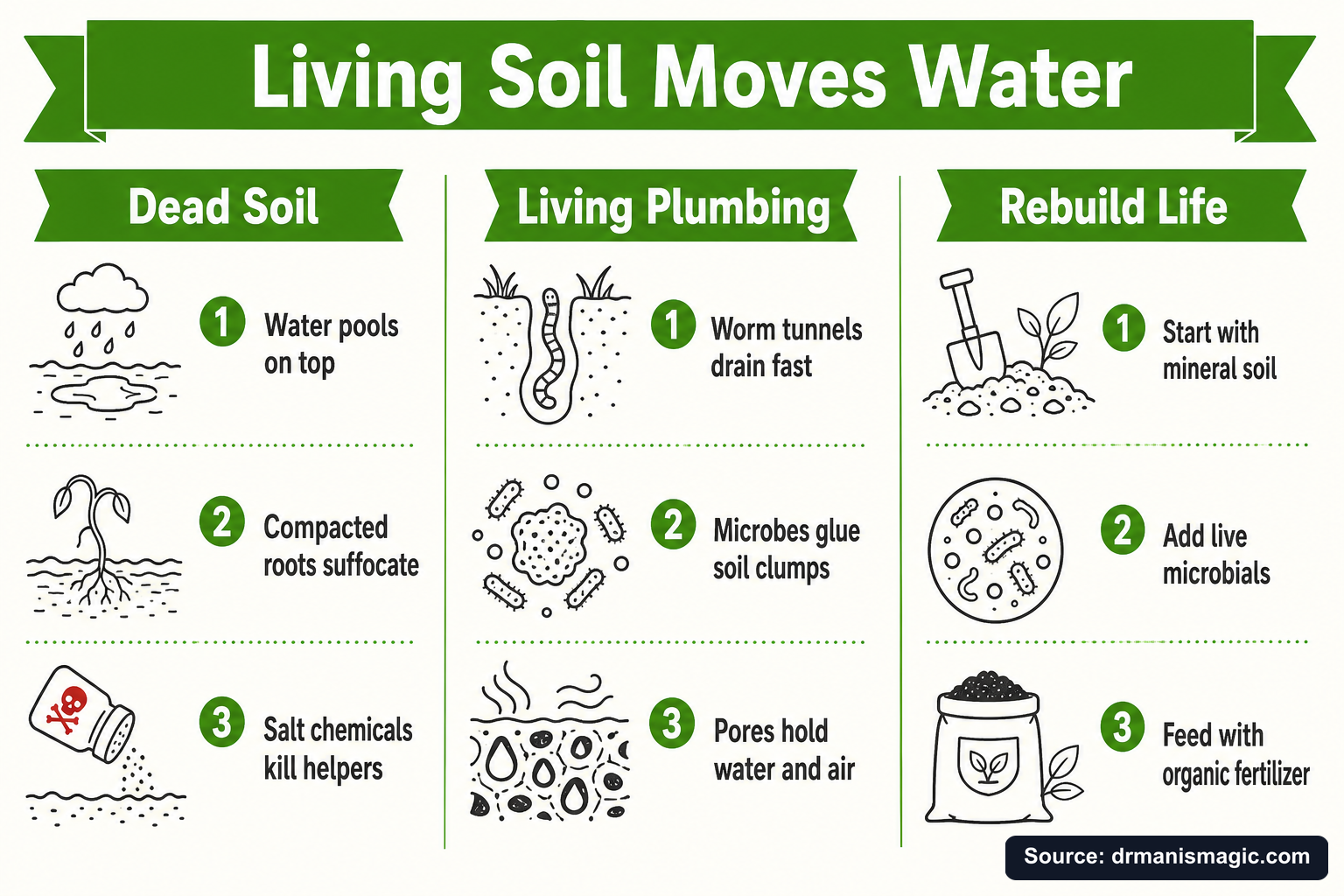
- Earthworm burrows act as direct highways for rainwater and irrigation to enter deep soil fast.
- Bacteria and fungi produce a natural "glue" that holds soil particles together in clumps called aggregates, creating pores that hold both water and air.
- Protozoa and beneficial nematodes graze on bacteria, releasing nutrients and keeping the microbial community balanced and active.
- Synthetic salt-based fertilizers, herbicides, and fungicides destroy the very soil animals that manage your water — creating a cycle of compaction, pooling, and root rot.
- Dead or dried microbial products from big factories don't restore this living system — you need genuinely live biology to rebuild it.
- The Three Plant Pillars — mineral-based soil, live microbials, and organic fertilizer — work together to rebuild your soil's living plumbing from the ground up.
- You can start restoring damaged soil in steps, and real improvement shows up faster than most people expect when you follow the right sequence.
What Do Soil Animals Actually Do to Water?
Quick Answer: Soil animals improve water movement by physically digging channels called macropores, binding soil particles into clumps that hold both water and air, and feeding the microbial communities that produce natural glues keeping those structures stable. Without them, soil compacts, water pools on the surface, and roots suffocate.
Think of your soil like a city. A healthy city has roads, pipes, tunnels, and infrastructure. Water moves through it in an organized way. Soil animals are the construction crew that builds and maintains all of that invisible infrastructure.
Earthworms dig vertical and horizontal tunnels called macropores. These are like express lanes for water. When rain hits, instead of running off the surface or pooling on top, it drops straight down those tunnels into deeper soil. Fast. Efficiently. Penn State Extension describes earthworm burrows as one of the most important physical structures for improving water infiltration in agricultural and garden soils.
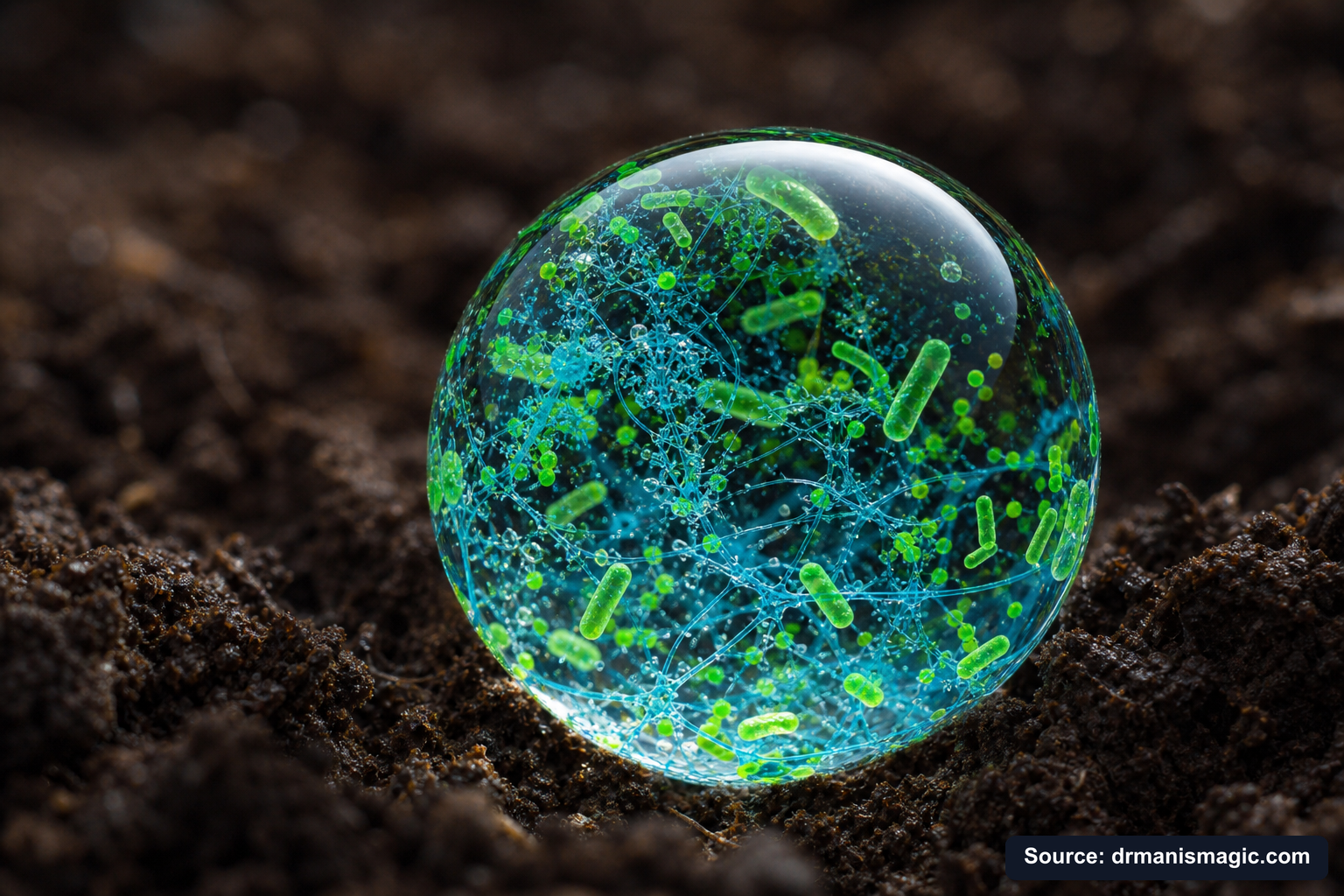
But earthworms are only one part of the crew. Fungi stretch microscopic threads called hyphae through the soil like a web. Those threads physically wrap around soil particles and pull them together. Bacteria produce sticky substances called extracellular polymeric substances, or EPS for short. Think of EPS as nature's glue. It coats soil particles and holds them in clumps called aggregates.
Those aggregates create pores between them. Small pores hold water for your plant roots to drink later. Large pores let excess water drain away and let oxygen flow in. Roots need oxygen just as much as they need water. Without those pores, roots suffocate and rot.
This is not theory. We've watched it happen firsthand growing over 250,000 citrus trees at our South Texas nursery. When the soil biology is alive and working, water moves through like it should. When it's dead — from salt-based fertilizers, synthetic herbicides, or cheap sterile potting mix — water sits, roots drown, and the whole plant falls apart from the bottom up.
Who Are the Soil Animals and What Is Each One's Job?
Quick Answer: The main soil animals improving water movement include earthworms (tunnel builders), fungi (particle-binding thread weavers), bacteria (glue producers), protozoa (microbial grazers), beneficial nematodes (population balancers), and arthropods like springtails and mites (residue shredders). Each one plays a specific role in the water management system underground.
Most gardening advice talks about earthworms and stops there. That's like explaining a city by only mentioning the highway. The real story is richer, and it matters to you because each player in the system contributes something no one else can replace.
| Organism | What It Does | How It Helps Water Move |
|---|---|---|
| Earthworms | Dig burrows, eat organic matter, produce casts | Create macropores for fast infiltration; casts improve aggregate stability |
| Mycorrhizal fungi | Form webs of hyphae around and inside roots; produce glomalin protein | Bind particles into water-stable aggregates; extend root reach to water sources |
| Beneficial bacteria | Produce EPS and polysaccharide glues; decompose organic residues | Stabilize aggregates; improve pore-size distribution; prevent crusting |
| Protozoa | Graze on bacteria; live in water films between soil particles | Regulate microbial populations; release nutrients that fuel root and microbial growth |
| Beneficial free-living nematodes | Graze on bacteria and fungi; move through water films in soil pores | Balance microbial communities; support nutrient cycling that feeds aggregate-building microbes |
| Springtails and mites | Shred leaf litter and organic residues into smaller pieces | Create fine organic material that feeds bacteria and fungi, fueling aggregate formation |
| Beetle larvae and other insects | Tunnel and move organic matter deeper into soil | Open channels; redistribute organic carbon that feeds the whole web |
Here's something most articles skip entirely. Protozoa and beneficial nematodes live inside the thin water films that coat soil particles and sit between aggregates. When those water films are present and healthy, these tiny creatures can move freely, graze on bacteria, and release nutrients. Those nutrients feed more bacteria and fungi. More bacteria and fungi produce more EPS and hyphae. More EPS and hyphae build more aggregates. More aggregates create better pores. Better pores hold more water films.
It's a self-reinforcing cycle. When it runs well, your soil becomes more and more capable of managing water on its own. When it breaks down, it spirals the other direction just as fast.
University of Minnesota Extension connects this entire biological web directly to soil structure, water infiltration, and a plant's ability to access water during dry periods. The science is clear. The living web is your water management system.
How Do Earthworm Burrows Change the Way Water Enters Soil?
Quick Answer: Earthworm burrows create macropores — wide, connected channels — that allow rainwater and irrigation to enter soil up to ten times faster than through compacted ground. These same channels let plant roots follow old burrow paths deep into moist soil layers, improving drought resilience and root access to water and nutrients.
Imagine turning on your garden hose and pouring water onto a piece of flat concrete. It runs off. None soaks in. Now imagine pouring that same water onto a colander — a bowl with hundreds of holes. It flows right through.
Earthworm burrows turn your soil from concrete into a colander.
A single earthworm can create several feet of tunnel in a single night. Multiply that across a healthy garden bed with dozens or hundreds of worms, and you have a network of interconnected channels running in every direction. Water enters those channels on contact. It doesn't sit on the surface. It doesn't run off and take your topsoil with it. It travels down to where roots live and where water is stored.
Earthworm casts — the material worms excrete — are another gift. Casts are rich in bacterial activity and natural binding agents. They help glue nearby soil particles into stable clumps. Those clumps don't collapse when wet. That's the difference between a soil that holds its structure during heavy rain and one that turns to mud and seals shut.
Here's the part most people never hear. When earthworms die or move on, their old burrow channels stay open. Plant roots sense those channels and grow into them. Old worm tunnels become root highways reaching deeper into soil moisture. So even after the worm is gone, its work keeps benefiting your plant for months.
But here is the hard truth. Earthworms need food, moisture, and safety. Spray synthetic herbicide on your lawn and the worm population can crash by more than half. Pour salt-based fertilizer on your beds and the chemistry burns their skin and drives them away. Use broad-spectrum pesticides and you eliminate their food supply. The worms leave. The burrows collapse. The concrete comes back.
What Is Microbial Glue and Why Does It Determine Whether Your Soil Drains or Drowns?
Quick Answer: Microbial glue refers to extracellular polymeric substances from bacteria and glomalin from mycorrhizal fungi. These sticky proteins and polysaccharides coat soil particles and bind them into water-stable aggregates. Those aggregates create the pore structure that controls drainage, aeration, and water retention in your soil.
You've probably squeezed a handful of good garden soil before. It feels crumbly. It holds its shape loosely when you press it. Then you let it go and it falls apart gently into little clumps. That texture has a name: good tilth. And it's not an accident. It's the direct result of microbial glue.
When beneficial bacteria are active and well-fed, they produce EPS — a polysaccharide substance that coats soil particles like a thin layer of natural adhesive. Particles that would otherwise just be loose sand or silt grains get stuck together in small clusters called microaggregates. Earthworms and fungi then pull those microaggregates together into larger macroaggregates.
Mycorrhizal fungi produce their own version of this glue: a protein called glomalin. Glomalin is remarkable stuff. It's sticky, it's durable, and it coats the fungal threads that wrap around soil particles. Studies from USDA ARS researchers have shown that glomalin-related proteins are strongly associated with water-stable aggregates — meaning aggregates that don't fall apart when wet.
Why does that matter to you? Because aggregates that fall apart when wet turn your soil into a sealed, compacted layer. Water can't enter. Oxygen can't move in. Roots can't breathe. The whole plant suffers from what is essentially a suffocation problem underground.
Aggregates that stay stable create a different world. Water enters through the spaces between them. Some of it drains away quickly through large pores. Some of it clings to the surface of aggregates in thin films — available for roots to drink across days and weeks. Air fills the large pores after drainage. Roots grow freely through the open structure. The soil breathes. The plant thrives.
This is Pillar 2 of the Three Plant Pillars in action. Live microbials aren't a supplement. They're the engineering team maintaining your soil's invisible infrastructure every single day.
What Happens to Water Movement When Soil Biology Dies?
Quick Answer: When soil biology dies, the glues and channels that manage water disappear. Aggregates collapse, pores seal shut, and soil compacts. Water pools on the surface, runs off, or sits around roots without draining. Root rot, nutrient lockout, and drought stress all follow. This is the predictable result of salt-based fertilizers, herbicides, and sterile potting mixes.
Let's walk through exactly what happens. Step by step. In slow motion.
You buy a bag of synthetic fertilizer from a big box store. It's salt-based — they almost all are. You pour it on your garden bed. The salt dissolves in soil water. Nearby bacteria absorb it. The salt concentration inside the bacterial cells becomes dangerously high. Water rushes out of the bacteria in an attempt to balance the pressure. The bacteria shrink and die. This process has a name: osmotic shock.
With the bacteria gone, nobody is producing EPS. The microbial glue stops being made. Existing aggregates, no longer maintained, start to break down. The spaces between them close up. The soil surface starts to seal. The next time you water, water sits on top instead of soaking in.
Now the fungi are struggling too. Without live bacteria to graze on, protozoa starve and disappear. Without protozoa releasing nutrients, fungal growth slows. The mycorrhizal web shrinks. Glomalin production drops. More aggregates collapse. Earthworms, finding no food and an increasingly hostile chemical environment, retreat or die.
Within a few months, you have what we call dead soil. It looks like dirt. It feels hard. Water doesn't move through it properly. Roots sit in soggy pockets between watering sessions, then dry out too fast between rains. Root rot becomes a constant threat. Your plant looks stressed. You add more fertilizer trying to fix it. The cycle tightens.
This is not a fringe scenario. This is the story of millions of gardens across America. And it didn't start with you. It started in the 1950s when salt-based synthetic fertilizers became the default recommendation for every lawn, garden, and farm in the country. The chemical companies profited. The soil biology paid the price. And gardeners have been blaming themselves ever since.
You don't have a brown thumb. You were handed the wrong tools.
See also: The Hidden Reason Synthetic Fertilizers Cause Root Rot
You Never Had a Brown Thumb.
You were handed the wrong tools. This free guide hands you the right ones.
You watered it. You fed it. It died anyway.
It was never you. It was the dirt, the salt food, and the bad advice.
This guide shows you what really went wrong, and how to fix it for good.
- Why your plants really died, and why it was never your fault
- The salt hiding in your plant food that quietly burns the roots
- The hidden killer in almost every bag of store soil
- The tiny helpers that grow a whole forest for free
- The rescue trick that brings a half dead plant back to life

Live Microbes vs. Dead Microbe Products: Which One Actually Rebuilds Your Soil's Water System?
Quick Answer: Live microbial products with genuinely active bacteria, fungi, protozoa, and nematodes can rebuild soil structure and water movement. Dried, powdered, or improperly stored microbial products typically contain dead or dormant organisms that never establish in soil. Smelly liquid products have usually gone anaerobic — meaning the microbes are dying, not thriving.
Here's where the industry gets dishonest. Or at least, careless.
The market for microbial soil products has exploded in the last decade. Walk into any garden center and you'll see shelves lined with bottles and bags promising billions of beneficial microbes. Most of them don't work. Not because microbes don't work. They absolutely do. But because the microbes in most of those products are dead before they reach you.
| Product Type | Microbe Viability | Spectrum | Odor | Effectiveness |
|---|---|---|---|---|
| Dried / powdered lab microbes | Very low — most spores never reactivate | Narrow — 2-5 species | Mild or none | Minimal to none in real soil tests |
| Rehydrated powder in liquid | Low — many don't survive rehydration | Narrow | Mild | Unreliable; inconsistent results |
| Compost tea — fresh under 24 hours | Moderate when actively aerated | Partial — depends on compost source | Earthy, turning sour | Good when used immediately; time-sensitive |
| Compost tea — old, over 24 hours | Very low — anaerobic conditions kill microbes | Partial | Strong stench | Poor; microbes dying not thriving |
| Lactobacillus-based products | High — lactobacillus is very vigorous | Extremely narrow | Mild | Can crowd out beneficial microbes; not recommended for soil |
| Plant Super Boost (stabilized, full-spectrum) | High — genuinely live, visible under microscope | 2,000+ bacteria; 400-500 fungi including mycorrhizae; plus protozoa and nematodes | Earthy — not stinky | Consistently strong across 250,000+ trees tested |
After growing over 250,000 trees at our South Texas nursery, we tried dozens of microbial products. Powders. Liquid concentrates. Compost teas. We saw the pattern clearly. The dried powders were convenient. They smelled fine. They listed impressive species counts on the label. And they did almost nothing for the plants.
The compost tea products that smelled bad? Those were going anaerobic in the bottle. The microbes were dying, not thriving. Some residual benefit from humic and fulvic acids remained, but the living biology was gone.
The product that changed everything for us was one developed by a world-famous compostologist who had quietly advised farming programs for royal families and governments around the world. He had cracked a natural method to stabilize the full spectrum of compost microbes — all 2,000-plus bacterial species, 400-500 fungal species including mycorrhizae, plus protozoa and beneficial nematodes — without them dying or going anaerobic. He was eventually blacklisted by large chemical interests. Years later, through what we can only describe as a providential meeting, he joined our team at US Citrus Nursery. That collaboration became Plant Super Boost.
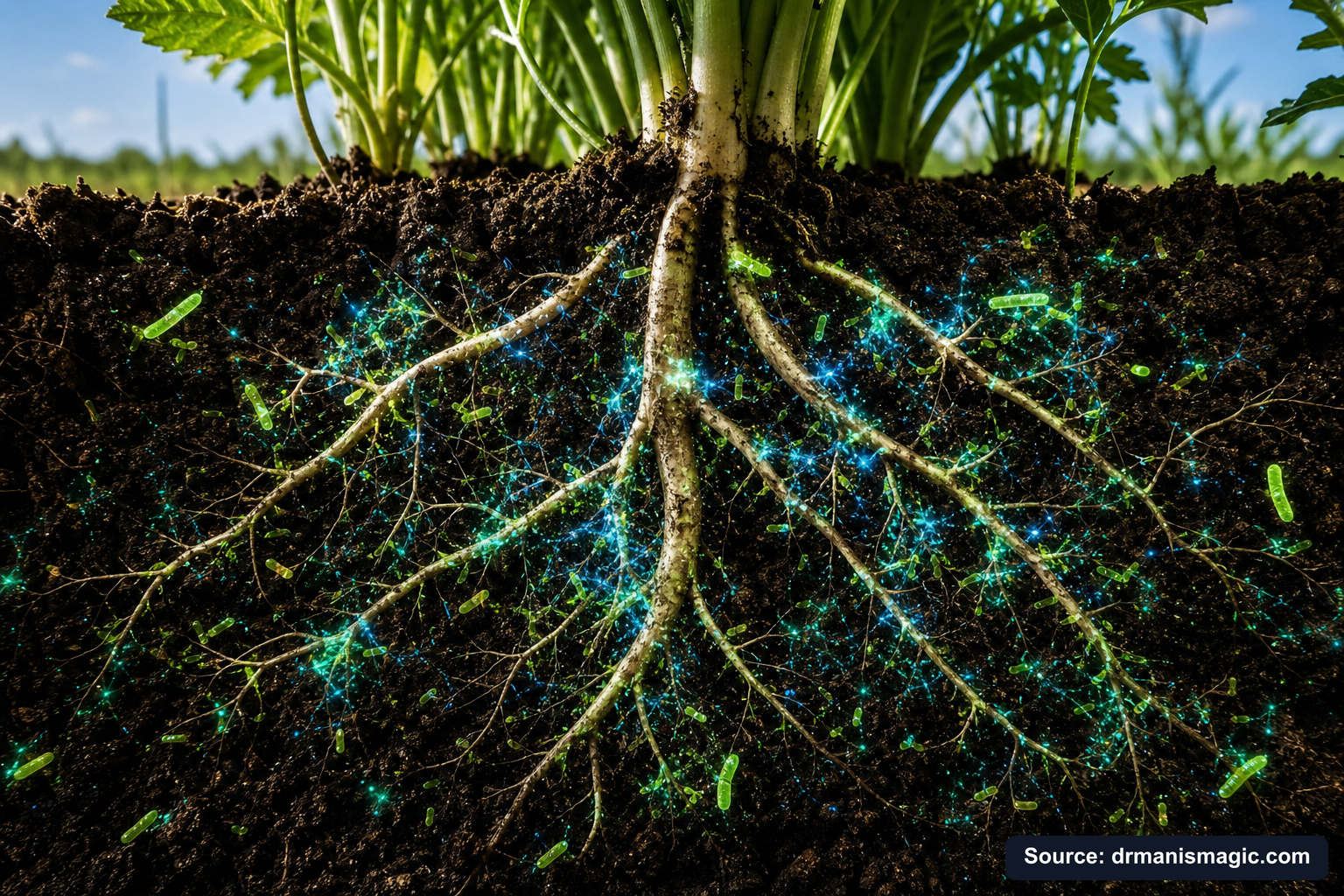
Take a drop of Plant Super Boost and look at it under a microscope. You will see the microbes moving. That's not marketing language. That's visible biology. And it doesn't stink because it isn't rotting. It contains Zero PFAS, Zero Biosludge, and Zero Synthetic Salts — nothing that would harm your garden, your children, or your pets.
How Do Protozoa and Beneficial Nematodes Fit Into the Water Story?
Quick Answer: Protozoa and beneficial free-living nematodes live in the thin water films between soil aggregates. They graze on bacteria, releasing nutrients that fuel more microbial growth. More microbial growth means more aggregate-building glue, which means better pore structure and water movement. They are the population managers that keep the whole system running.
Nobody talks about protozoa in garden articles. They should.
Protozoa are single-celled organisms. They are not bacteria and they are not fungi. They swim through the thin water films that coat soil particles and fill the spaces between aggregates. When they find a cluster of bacteria, they eat them. This sounds harmful, but it's actually essential.
When protozoa eat bacteria, they release nutrients that were locked inside the bacterial cells. Nitrogen in particular. That nitrogen becomes available to plant roots and to other microbes. Those other microbes grow faster. They produce more EPS. They build more aggregates. The pore system improves.
Without protozoa keeping bacterial populations in check, certain bacteria can overgrow and actually clog soil pores. Protozoa are the quality-control inspectors of the soil food web. Their presence keeps the whole system balanced and productive.
Beneficial free-living nematodes do something similar for fungal and bacterial populations at a slightly different scale. These are not the plant-parasitic nematodes that attack roots. They are the good kind — grazers and decomposers. They move through water films in soil pores, feeding on microbes and releasing nutrients, maintaining population balance, and supporting the conditions that allow aggregate-building to continue.
Here's the key insight that most gardeners never learn: all of this activity happens inside the water films between aggregates. Those water films are only possible when aggregates exist and when soil has good structure. Destroy the aggregates and you destroy the habitat for protozoa and nematodes. Destroy protozoa and nematodes and you lose the population managers. The whole web unravels from multiple directions at once.
How Do You Rebuild Dead or Damaged Soil So Water Moves Properly Again?
Quick Answer: Rebuilding damaged soil takes a sequence of steps: stop the inputs that are killing biology, add stable organic matter, plant living roots, maintain consistent moisture, avoid unnecessary disturbance, and introduce genuinely live full-spectrum microbes. Recovery starts within weeks when conditions support microbial survival, but full structural improvement takes months of consistent effort.
The good news is this. Soil can recover. We have watched it happen in our nursery, in backyard gardens, and across our citrus grove. Dead soil is not a death sentence. It's a starting point.
But recovery requires more than just pouring a microbial product on compacted, salt-damaged ground and hoping for the best. Microbes are living creatures. They need food, moisture, shelter, and safety to survive and multiply. Add them to a hostile environment and they die before they can do anything.
Here is the recovery sequence that actually works:
- Stop the damage first. Eliminate or dramatically reduce salt-based synthetic fertilizers, broad-spectrum herbicides, and synthetic fungicides. Every application is resetting your biology back to zero. You cannot rebuild a house while someone keeps knocking down the walls.
- Test your infiltration. Dig a small hole about one foot deep. Fill it with water. If it drains in under an hour, your soil has decent pore structure. If it sits for hours, you have a compaction or aggregate problem to address directly.
- Add stable organic matter. Compost, wood chip mulch on the surface, or well-aged organic amendments feed bacteria and fungi and give them physical material to work with. Don't till it in aggressively. Let it break down slowly on the surface and let biology pull it down.
- Plant living roots or cover crops. Living roots release carbon-rich sugars through a process called exudation. Those sugars are the primary food source for soil bacteria. Bacteria fed by root exudates produce more EPS. More EPS builds more aggregates. More aggregates improve water movement. Even a temporary cover crop makes a significant difference.
- Maintain consistent moisture without saturation. Microbes need moisture to move and function, but they also need oxygen. Waterlogged soil goes anaerobic and kills the beneficial biology you're trying to build. Water deeply and less frequently. Let the soil cycle through wet and dry rather than staying constantly saturated.
- Introduce genuinely live, full-spectrum microbes. This is where a stabilized product matters enormously. You need bacteria, fungi including mycorrhizae, protozoa, and nematodes — not just two or three species dried into a powder. Apply monthly and be consistent. Soil biology rebuilds over time, not overnight.
- Be patient and protect what you're building. Avoid unnecessary tilling. Tilling destroys fungal hyphae networks and disrupts the aggregate structures your microbes just built. Minimum disturbance is one of the highest-value habits you can develop as a gardener.
The Super Soil we developed at US Citrus Nursery was built specifically to give microbes a mineral-based home they can actually thrive in — not sawdust and pine bark that compacts into a root-choking sludge within months. Mineral-based soil doesn't decompose. It holds its structure. It provides the stable pore network that makes everything else possible. That's Pillar 1. Add live microbes through Plant Super Boost. That's Pillar 2. Feed them and your plant with organic fertilizer like our Crab, Kelp & Amino Acids blend that doesn't burn biology with salts. That's Pillar 3.
When all three pillars are in place, you stop fighting your soil. You start working with it.
How Does Soil Biology Connect to Drought Stress and Waterlogged Roots?
Quick Answer: Living soil biology solves both problems at once. Aggregates and pores drain excess water quickly, preventing the waterlogged conditions that cause root rot. Those same aggregates hold water in films between particles, giving roots access to moisture during dry periods. Mycorrhizal fungi extend root reach to water sources far beyond where roots can grow on their own.
Most gardeners think of drainage and water retention as opposites. You want good drainage OR good water holding. But that's the wrong way to think about it. Healthy, biologically active soil does both simultaneously. And the same mechanisms that cause one also cause the other.
Here's how. When aggregates are stable and pores are open, large pores drain quickly after rain or irrigation. Water doesn't sit around roots. Root rot risk drops dramatically. At the same time, small pores between and within aggregates hold water in thin films by capillary force. That water doesn't drain away. It stays in the soil, available to roots across days and even weeks between rainfall events.
Mycorrhizal fungi add another layer entirely. A single mycorrhizal fungal network can extend the effective root zone of a plant by ten times or more. Those fungal threads reach into pores too small for roots to enter. They pull water from those tiny spaces and deliver it back to the root. During a dry spell, the difference between a plant with active mycorrhizae and one without can be the difference between surviving a drought and losing the plant entirely.
We have watched this play out across our citrus grove and in container trees at our nursery. Trees with living biology in their soil come through dry spells looking calm and green. Trees in sterile, salt-damaged soil show stress within days of skipping a watering. The biology is doing invisible work that no amount of irrigation management can fully replace.
Time is the currency here that nobody talks about honestly. You can get money back. You cannot get back the years you spent watching a tree struggle in dead soil before you understood what was actually wrong. Every season you grow in soil that can't manage water properly is a season of stunted growth, stress, and potential loss. The best time to rebuild your soil biology was when you first planted. The second best time is right now.
What Does This Mean for Your Lawn, Garden, Houseplants, and Fruit Trees?
Quick Answer: Every plant you grow benefits from living soil biology managing water movement. Lawns with active biology absorb rain instead of flooding and stay greener through dry spells. Garden beds drain properly and resist root rot. Houseplants in living soil don't sit in stagnant water. Fruit trees with mycorrhizal networks develop deeper, more drought-resilient root systems.
The principles in this article are not citrus-specific. They apply to every plant you grow, in every setting you grow it.
Your lawn. When soil biology is active, earthworm burrows and aggregate structure allow rain to soak straight in instead of running off. You stop seeing puddles after every storm. The grass stays green longer between waterings because the soil holds moisture in aggregate films instead of drying out on the surface. And you stop applying round after round of synthetic lawn products that silently destroy the very biology making all of this possible.
Your vegetable garden. Aggregate structure means you can walk near your beds without compacting them. Water enters fast after irrigation and drains away from roots before rot can set in. The soil smells like earth instead of chemicals. You harvest vegetables that actually taste like something because the full mineral and nutrient cycle is running properly underground.
Your houseplants. This is where people rarely think about soil biology, but it matters enormously. Most houseplant potting mixes are sterile sawdust and pine bark. They have no living biology. Water either sits in them or drains through too fast, leaving roots with nothing to drink. A mineral-based soil with live microbes creates the same aggregate structure and water management indoors as in a healthy garden bed outdoors.
Your fruit trees. Whether they're in the ground or in containers on your patio, fruit trees with active mycorrhizal networks develop root systems that reach water sources you can't even see. They fruit harder, resist stress better, and stay healthier across seasons. Dr. Mani Skaria — Professor Emeritus of Plant Pathology, founder of the Clean Citrus Program in Texas, and the scientist behind everything we do — built his entire approach on this foundation. Over 35 years of work. 250,000-plus trees tested. The biology is not optional. It is the foundation.
See also: Why Most Fertilizers Are Actually Salt in Disguise
What Can You Do Right Now to Improve How Water Moves Through Your Soil?
Quick Answer: Start by stopping the inputs killing your soil biology. Then add stable organic matter, introduce genuinely live full-spectrum microbes monthly, and give your soil a mineral-based structure that supports long-term aggregate stability. You will see measurable improvement in water movement within one growing season when you follow the Three Plant Pillars in sequence.
You now understand what most gardeners never learn. Water doesn't move well through soil because of luck or location. It moves well because billions of invisible creatures built a living plumbing system underground. Every time you see water soak in beautifully, an earthworm tunneled there. A fungus wove its threads. A bacterium produced its glue. A protozoa grazed and released nutrients. The whole invisible crew showed up and did its job.
And when water pools, runs off, or drowns your roots — those creatures are missing. Not because they don't exist. Because something killed them. Usually something sold in a bright bag with a cheerful label at a big box store.
You have everything you need to change that now. Stop the inputs that destroy biology. Build organic matter back into your soil. Plant living roots. Protect moisture without creating saturation. And give your soil a genuine infusion of live, full-spectrum biology — not dried powder, not smelly anaerobic liquid, but genuinely alive microbes that you can see moving under a microscope.
That is exactly what Plant Super Boost was built to deliver. Harvested from our own hand-crafted compost at our South Texas nursery. Stabilized by a natural method so the biology stays alive on its way to you. With a 30-day money-back guarantee because we know what it does when you actually use it.
Your soil has been waiting for this. Your plants have been waiting for this. And the fruit you've been hoping to see on your tree — the harvest you've been imagining for years — is waiting on the other side of living soil that finally knows how to move water the way nature intended.
If you want the complete system — the mineral-based soil, the live microbes, and the organic fertilizer that works with your biology instead of against it — visit the Three Plant Pillars bundle page and start building the foundation your plants have always deserved. Or grab our Free Plant Care Field Guide first if you want to understand the full system before you buy anything. Either way, the knowledge is yours. Use it.
Frequently Asked Questions
If water is pooling in your garden or your soil feels like concrete after a rain, you are not alone. These are the questions we hear most from plant owners who are tired of watching their investment wash away. The answers below come straight from what Dr. Mani learned growing over 250,000 trees in South Texas.
How do soil animals actually improve water movement?
Earthworms dig tunnels called macropores that act like express lanes for rainwater. Bacteria produce a natural sticky substance that glues soil particles into clumps. Those clumps create pores that drain extra water fast and hold just the right amount for your roots. When these tiny creatures are alive and working, water moves like it should. When they are gone, water sits on top and your roots suffocate. Dr. Mani built the Three Plant Pillars around keeping these creatures alive and thriving.
What does soil type have to do with how water moves?
Soil texture changes everything. Sandy soil has big spaces between particles, so water drains fast. Clay soil has tiny, tight particles that hold water but drain slowly and compact easily. That is why Dr. Mani created Super Soil using mineral-based sandy loam from the Rio Grande Valley. It gives you the drainage of sand with the structure roots need. No decomposing bark. No compaction. Just clean, permanent soil that lets water flow the right way every single time.
What is the difference between infiltration and percolation?
Infiltration is when water first enters the soil surface. Percolation is when that water keeps moving down through the layers. Both steps depend on your soil having open, connected pores. Dead, compacted soil blocks both. That is why the first of the Three Plant Pillars is a mineral-based soil foundation. When your soil structure is right, water infiltrates fast at the top and percolates cleanly down to where the roots are drinking deep.
What kills the soil animals that manage water movement?
Synthetic salt-based fertilizers are the biggest culprit. They burn your microbes and wipe out the tiny creatures that build your soil's water system. Herbicides and fungicides add to the damage. Big box store products do this quietly every season. You keep buying, your soil keeps dying, and the water keeps pooling. Dr. Mani spent 35 years watching this happen. That is exactly why the Three Plant Pillars use only organic fertilizer and live microbials that feed your soil instead of destroying it.
What factors most affect how water moves through soil?
Three things work together. First, soil texture determines pore size. Second, soil structure determines how particles clump together. Third, the living biology in your soil, the bacteria, fungi, and earthworms, builds and maintains the channels water travels through. Take away the biology and the other two fall apart fast. Dr. Mani proved this across 250,000 citrus trees. The biology is not a bonus. It is the engine that makes the whole system run.
What is soil permeability and why does it matter for my plants?
Permeability is your soil's ability to let water flow through it. High permeability means water drains well and oxygen gets in. Low permeability means water pools, roots rot, and your plant slowly drowns. Most potting mixes lose permeability as the bark and sawdust break down into sludge. Dr. Mani's Super Soil uses silica-rich sandy loam that does not decompose. It stays open and permeable permanently, so your roots can breathe and drink no matter what season it is.
Can I actually rebuild dead soil that does not drain well anymore?
Yes, and it happens faster than most people expect. The key is hitting all Three Plant Pillars at once. Start with a mineral-based soil that will not compact. Add Plant Super Boost, which delivers genuinely live bacteria, fungi, and mycorrhizae straight to your roots. Feed with organic fertilizer that nourishes your soil life instead of burning it. Dr. Mani tested this system on hundreds of thousands of trees, houseplants, and tropical trees. Real improvement shows up within weeks when the biology gets what it needs to rebuild.
About the Author
Dr. Mani Skaria, PhD
Dr. Mani Skaria, PhD, is a plant pathologist and the scientific founder of Dr. Mani's Magic. He earned his doctorate at Purdue University and spent 48 years studying how plants, soil, and living microbes work together, including his years as Professor Emeritus at Texas A&M and as a member of the USDA NAREEE Advisory Board. He invented micro-budding, a method for growing healthier, stronger trees, and has grown more than 250,000 trees on the family farm in Hargill, Texas - US Citrus Nursery. His life's work takes real lab science and practical experience and turns it into simple, safe, organic plant care anyone can use at home.


