


Osmotic Shock From Synthetic Nutrients: Why Roots Suffer | Dr. Mani's Magic
The Osmotic Shock Your Plants Feel From Synthetic Nutrients (And Why Your Roots Are Silently Suffering)
Picture this. You just fed your plants. You followed the directions on the bag. You watered everything in. You stood back, proud of yourself, and waited for the magic to happen.
But a few days later, something looks wrong. The leaf tips are brown and crispy. The plant looks wilted, even though the soil is soaking wet. You touch the soil. Definitely not dry. So why does your plant look like it's dying of thirst? You water it again. It gets worse. You stare at it, confused, maybe a little frustrated. Maybe even a little guilty. You start to wonder if you just have a brown thumb.
Here's the thing. It is not your fault. And your thumb is not the problem. What just happened to your plant has a name. It's called osmotic shock. And the culprit is almost certainly the fertilizer you used. Not because you used too much. But because of what that fertilizer is actually made of. Salt. And salt does something to roots that most gardening companies never want you to understand. Once you see it, you can never unsee it.

Organic Fertilizer | Crab, Kelp & Amino Acids
Key Takeaways
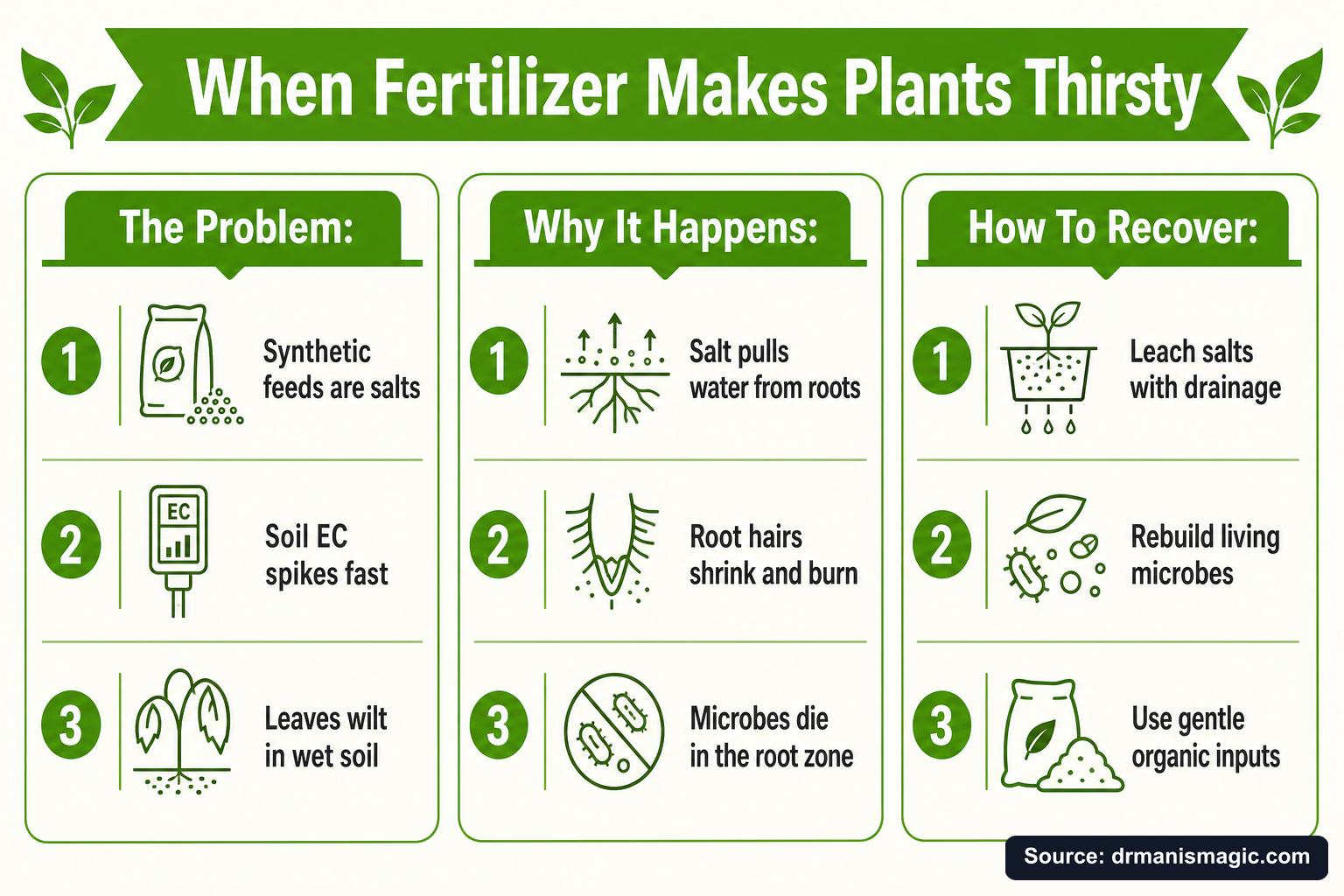
- Synthetic fertilizers are salt-based. When you apply them, they raise the salt concentration in your soil. This is called high electrical conductivity, or high EC.
- When soil EC spikes, water can no longer flow freely into your roots. It can actually flow the wrong way, out of the roots and into the soil. That is osmotic shock.
- Your plant can wilt in perfectly wet soil because the problem is not water availability. It is water access at the root level.
- Salt also burns and kills the beneficial microbes living in your root zone. Those microbes are the invisible workforce that feeds your plant and protects it from disease.
- Slow-release organic fertilizers like crab, kelp, and amino acids work with your soil's biology instead of against it, releasing nutrients gently at the pace your plant actually prefers.
- Recovery is possible. Leaching, improving drainage, rebuilding microbial life, and switching to biology-friendly inputs can restore a damaged root zone over time.
- The Three Plant Pillars, mineral-based soil, live microbes, and organic fertilizer, are the foundation that makes your plants nearly bulletproof against this kind of damage.
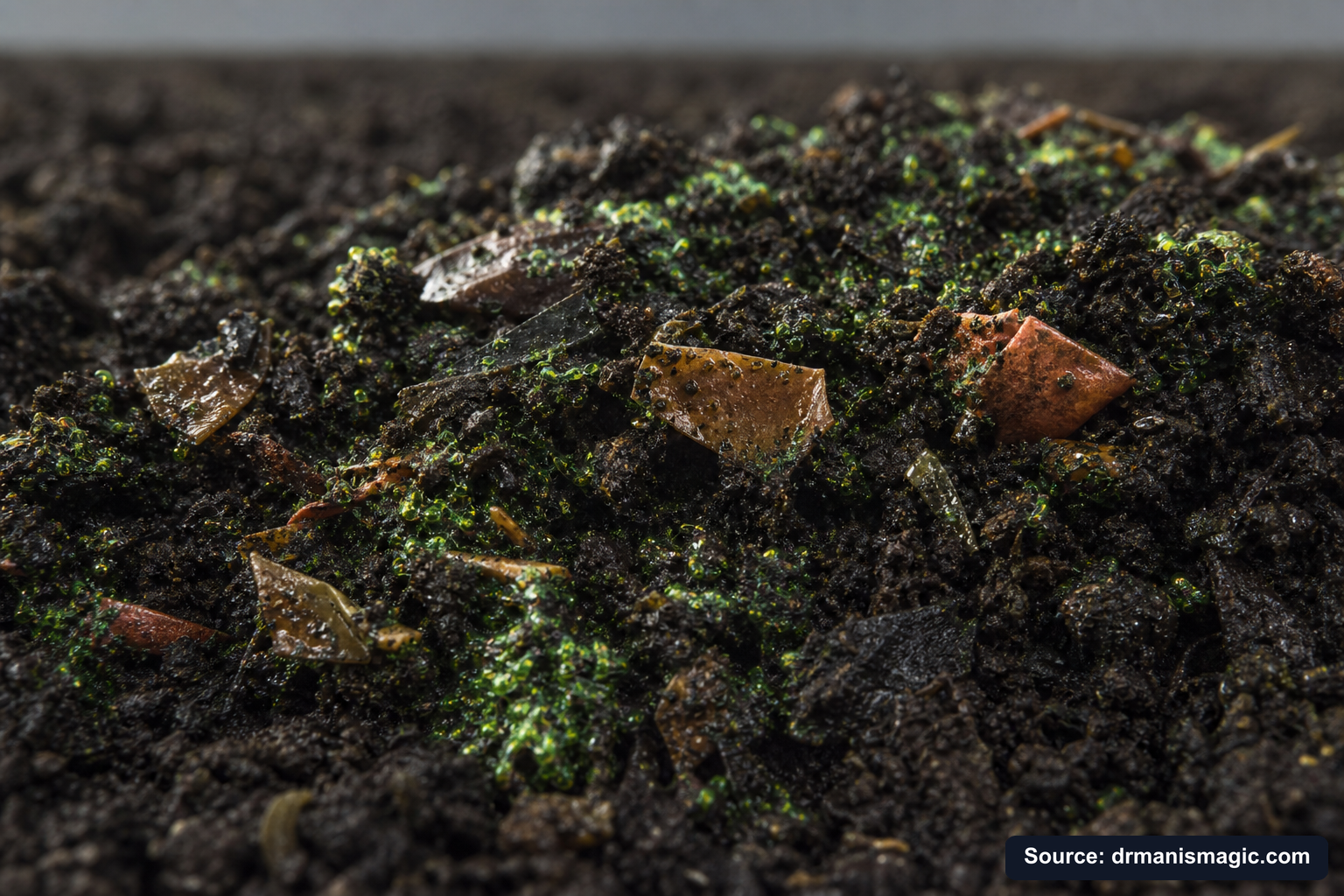
What Is Osmotic Shock in Plants?
Osmotic shock happens when the salt concentration outside a plant's roots suddenly becomes higher than the concentration inside the roots. Water always moves toward higher concentration. That is basic science. It is called osmosis. Under normal conditions, the inside of a root cell is more concentrated than the surrounding soil water, so water naturally flows into the root. The plant drinks.
But when you dump a heavy dose of salt-based fertilizer into the soil, you flip that equation. Now the soil is saltier than the root. Water stops flowing in. In severe cases, water actually flows out of the root cells and into the soil. The root is literally losing water into the ground around it, even when that ground is soaking wet.
That is why your plant wilts in moist soil. It is not thirsty in the way you think. It is experiencing a kind of cellular drought. The water is right there. The roots just cannot grab it. According to extension researchers at Utah State University, Oregon State University, Penn State, and Rutgers, this mechanism, called soluble salt stress, is one of the most common and most misdiagnosed causes of plant decline across every type of plant. Lawns. Trees. Vegetables. Houseplants. Ornamentals. It does not discriminate.
What Does Electrical Conductivity Have to Do With Your Plants?
Electrical conductivity, or EC, is a measure of how many dissolved salts are floating around in your soil water. Pure water has almost no EC. Add fertilizer salts and the EC goes up. The higher the EC, the harder it is for roots to pull water in.
Think of it like a tug of war. On one side, the root is pulling water toward itself. On the other side, the salty soil is holding onto that water. When EC is normal, the root wins easily. When EC spikes after a heavy synthetic fertilizer application, the soil wins. The root loses. The plant wilts.
Extension researchers describe a safe EC range for most plants in container media of roughly 1.0 to 3.5 millisiemens per centimeter. Above that range, root damage begins. Above 5.0, you start seeing real tissue injury. A single heavy application of a concentrated synthetic fertilizer can push a container's EC well into dangerous territory within hours. This is especially true in pots, raised beds, and indoor planters where salts have nowhere to go.
Why Do Your Roots Actually Wilt in Wet Soil?
Your plant wilts in wet soil after fertilizing because the roots cannot access the water that surrounds them. This is the part that trips people up the most, and it is the reason so many gardeners accidentally make things worse by watering more.
Here is what is happening at a cellular level. Each root tip is covered in tiny root hairs. These are the main drinking straws of the plant. They absorb water and dissolved nutrients through a process called osmosis. The cell membranes in those root hairs act like a smart filter, letting water flow in when the chemistry is right.
When salt concentration outside the root spikes, that filter stops working the way it should. The osmotic pressure gradient reverses. Water seeps out of root cells instead of in. The root cells begin to shrink and dehydrate. The plant signals distress by wilting. You see drooping leaves. You feel wet soil. Your brain says water it more. But more water does not fix the salt problem. It may dilute it slightly, but if the fertilizer is still in the soil, the damage continues.
Meanwhile, those burnt root tips lose their ability to absorb oxygen. Roots need oxygen just like we do. When root tips are damaged and the soil stays saturated from extra watering, oxygen gets squeezed out. Now you have a second problem layered on top of the first. Damaged, oxygen-starved roots are the perfect entry point for root rot pathogens like Pythium and Phytophthora. What started as fertilizer burn can quickly spiral into full root rot. This is why so many gardeners who over-fertilize end up losing plants to what looks like disease, when the real cause was salt stress all along.
How Do Synthetic Fertilizer Salts Kill Your Soil's Microbes?
Synthetic fertilizer salts kill your soil's beneficial microbes the same way they damage roots, through osmotic stress. Bacteria and fungi living in your root zone are single-celled or thin-walled organisms. They are even more sensitive to salt spikes than root cells are. When EC jumps, microbial cell membranes rupture or collapse. A significant portion of your soil's living workforce can be wiped out in a single fertilizer application.
Why does that matter so much? Because those microbes are not just passengers in your soil. They are the engine. After growing over 250,000 trees at our South Texas nursery, we learned that the microbes in the root zone are the single biggest difference between a plant that thrives and a plant that slowly declines. They unlock nutrients that are chemically bound in the soil. They fix nitrogen directly from the atmosphere and hand it to the plant. They produce hormones that stimulate root growth. They form a living shield against disease-causing organisms.
When you kill those microbes with salt, you do not just slow the plant down temporarily. You break the entire natural feeding system. The plant becomes dependent on whatever you apply by hand, because the soil can no longer feed it from within. This is not an accident. Big chemical companies benefit when you have to keep buying more product. A thriving soil biology makes you independent. A dead soil makes you a repeat customer.
What Is the Salt Index and Why Does It Matter for Every Plant You Own?
The salt index is a number that measures how much a fertilizer raises soil EC compared to an equal weight of sodium nitrate. The higher the number, the more osmotic stress it creates. Most synthetic fertilizers have high salt indexes. Some common ones used in lawns and gardens rank well above 70 on the scale. Urea, one of the most widely used nitrogen sources, has a salt index of around 75.
Compare that to organic nitrogen sources. Feather meal, crab meal, and amino acid-based fertilizers have salt indexes in the single digits or low teens. They are releasing nutrients slowly through biological processes, not dumping soluble salts into the soil all at once. The root zone EC barely moves. The microbes stay alive. The roots keep drinking.
Here is a simple comparison so you can see the difference clearly.
| Input Type | Salt Index (approx.) | Nutrient Release Speed | Effect on Microbes | Risk of Osmotic Shock | PFAS / Biosludge Risk | Best Used For |
|---|---|---|---|---|---|---|
| Synthetic soluble fertilizer (e.g., 20-20-20 liquid) | High (50-100+) | Immediate | Burns and kills microbes | Very High | Low (but plastic-coated prills possible) | Fast green-up only |
| Synthetic slow-release (plastic-coated prills) | Moderate | Slow (controlled by coating) | Less damaging, still salt-based | Moderate | Plastic microplastic leaching | Lawns, large landscapes |
| Compost (clean source) | Very Low | Slow (microbially mediated) | Feeds and supports microbes | Very Low | Low if sourced carefully | Soil building, all plants |
| Biosolids / municipal waste | Variable | Moderate | Variable | Low to Moderate | HIGH — PFAS contamination documented | Not recommended |
| Crab meal (chitin-based) | Very Low | Slow | Actively feeds beneficial microbes | Very Low | None | All plants, pest resistance |
| Kelp meal / cold-processed kelp | Very Low | Slow | Stimulates microbial activity | Very Low | None | Hormones, trace minerals, biostimulants |
| Amino acid nitrogen (hydrolyzed protein) | Very Low | Slow to moderate | Feeds and supports microbes | Very Low | None (if clean source) | All plants, efficient N uptake |
| Volcanic mineral amendments | Negligible | Very slow (weathering) | Provides mineral habitat for microbes | None | None | Trace elements, cell wall strength |
What Does Organic Fertilizer Actually Do That Synthetic Can't?
Organic fertilizer does not just feed the plant. It feeds the microbes first. And that distinction changes everything.
Here is how it works in plain terms. You sprinkle an organic granular fertilizer on the soil. Bacteria and fungi in the root zone smell that food. They swarm it. They eat it. As they digest it, they convert the raw organic material into simple mineral forms that the plant can absorb directly through its roots. The process takes time. It is not instant. But that is exactly the point.
Nature does not feed plants in one giant spike. Nature feeds plants in a slow, steady trickle. A little nitrogen here. A little phosphorus there. Always in proportion to what the plant is actually asking for. Organic inputs mirror that rhythm. The microbes act as a biological timing mechanism. They release nutrients in step with soil temperature, moisture, and root activity, which are the same conditions that tell the plant it is time to grow.
Now here is the part that most people never hear about. When those microbes die, their tiny bodies are packed with every nutrient they just processed. When they die, they release all of that nutrition directly into the root zone in the most plant-available forms possible. This is called the microbial nutrient cycle. It keeps feeding your plant long after you applied the fertilizer. Days later. Weeks later. The soil keeps working. It is the most elegant slow-release system ever designed, and it did not come from a laboratory. It came from billions of years of evolution.
Synthetic fertilizers skip all of that. They dump soluble salts directly into the soil water. The plant gets a flood of nutrition it cannot fully use, the microbes get burned, and within a few weeks the soil is depleted and you have to apply again. You are not building a soil. You are just renting one.
Why Does Chitin From Crab Shells Actually Help Your Plants Fight Pests and Disease?
Chitin is the structural material in crab shells. It is also the same material found in the outer shells of insects and the cell walls of many harmful fungi. When you add chitin to your soil, something remarkable happens. The microbes that feed on chitin explode in population. These are called chitinase-producing bacteria. They are natural enemies of fungal pathogens and soil-dwelling insects because they eat the same material those pests are made of.
In plain terms, feeding your soil crab shell meal is like recruiting an army of tiny soldiers who are specifically trained to fight the most common enemies of your plants. Root-knot nematodes. Fungal pathogens. Grubs. The chitin-eating microbe population rises, and the pest populations that share that same food source get eaten alive.
At the same time, chitin is a rich source of calcium and magnesium, two nutrients that most plants crave in large amounts. Calcium builds the woody structure of stems and trunks. It strengthens cell walls. It prevents fruit cracking and blossom-end rot. Magnesium sits at the center of every single chlorophyll molecule. Without enough magnesium, photosynthesis slows down, leaves turn yellow between the veins, and growth stalls. Crab meal delivers both, slowly, safely, and in a form the soil can process without any spike in EC.
What Does Kelp Actually Do for Roots and Growth?
Kelp is not just a mineral supplement. It is one of the most biologically complex plant inputs available anywhere. Cold-processed kelp is packed with natural plant growth hormones called auxins and cytokinins. These are the same signaling compounds that tell your plant to grow new roots, set flowers, and develop fruit.
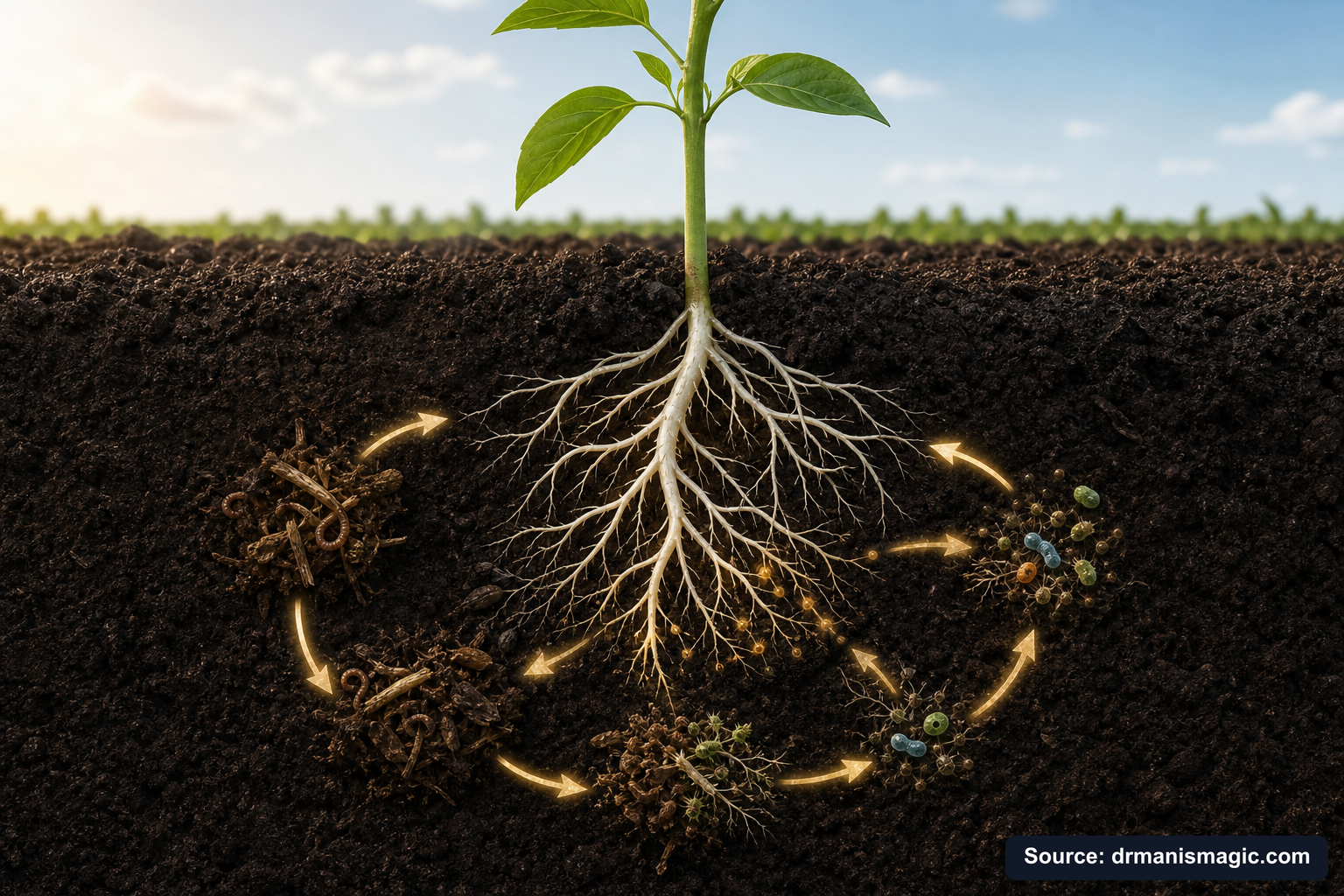
Auxins in particular tell root tips to elongate and branch. More root branching means more surface area for water and nutrient absorption. More roots means a more resilient plant. When you apply kelp-based inputs to any plant, from a lawn to a lemon tree to a houseplant on your windowsill, you are sending a biological signal to the root system to expand and get stronger.
Kelp also carries a broad spectrum of trace minerals harvested from the ocean. These include iron, zinc, manganese, copper, boron, and molybdenum. Each one plays a role in enzyme function, chlorophyll production, and disease resistance. You cannot see any of these working. But you can feel the result when your plant is dense and green and producing like it never has before.
You Never Had a Brown Thumb.
You were handed the wrong tools. This free guide hands you the right ones.
You watered it. You fed it. It died anyway.
It was never you. It was the dirt, the salt food, and the bad advice.
This guide shows you what really went wrong, and how to fix it for good.
- Why your plants really died, and why it was never your fault
- The salt hiding in your plant food that quietly burns the roots
- The hidden killer in almost every bag of store soil
- The tiny helpers that grow a whole forest for free
- The rescue trick that brings a half dead plant back to life

Why Are Amino Acids the Cleanest Form of Nitrogen Your Plant Can Get?
Amino acids are the building blocks of protein. When an organic nitrogen source like feather meal or animal tankage is broken down through hydrolysis, it releases free amino acids. These are small, water-soluble molecules that plant roots can absorb directly, no conversion required.
Compare that to synthetic nitrogen. Synthetic nitrogen comes as nitrate or ammonium salts. The plant can use those forms, but only after they travel through the soil water at high concentration, raising EC along the way. If too much is present at once, the osmotic pressure spikes and the damage begins.
Amino acid nitrogen moves differently. It is released slowly as microbes process the organic material. The concentration in the soil water stays low. The EC barely moves. And because amino acids contain carbon bonds that microbes love to eat, the act of applying amino acid nitrogen actually feeds your soil biology at the same time it feeds your plant. It is a two-for-one that synthetic nitrogen will never match.
Amino acid nitrogen also helps the plant absorb other nutrients more efficiently. When amino acids are present in the root zone, they can chelate, which means they grab onto and carry metal micronutrients like iron and zinc directly to the root membrane. This is especially important in alkaline soils where iron and zinc are often locked up in forms the plant cannot reach. Amino acids unlock them. No synthetic chelating agent required.
What Do Volcanic Minerals Add That Regular Fertilizer Misses?
Volcanic ash and volcanic rock minerals are the oldest soil amendment on earth. Every great agricultural civilization in history, from the rice farmers of Japan to the coffee growers of Central America, built their soils on volcanic ground. There is a reason for that.
Volcanic minerals are loaded with silica and a wide range of trace elements. Silica strengthens cell walls the way rebar strengthens concrete. Plants with adequate silica are physically tougher. Their leaves are harder for insects to chew through. Their stems resist lodging in wind. Their fruit holds together better after harvest. Silica also helps plants handle heat and drought stress by reducing water loss through the leaf surface.
The trace elements in volcanic ash fill in the gaps that most fertilizers leave behind. The Law of the Minimum tells us that plant growth is limited by the scarcest nutrient, not the most abundant one. You can pour on all the nitrogen in the world, but if your plant is missing molybdenum or boron in tiny amounts, growth stalls. Volcanic minerals provide a broad baseline of trace elements that covers those gaps without any risk of salt stress or EC spikes.
What Are PFAS and Biosludge, and Why Should You Care What Is in Your Fertilizer?
Biosludge is treated municipal wastewater waste. In plain English, it is processed human sewage. Some fertilizer companies use it as a filler because it is cheap and contains nitrogen. It is legal. It is also deeply concerning, because biosludge is one of the primary ways PFAS chemicals, sometimes called forever chemicals, enter the food chain through garden soil.
PFAS chemicals do not break down. They accumulate in soil, in water, in plant tissue, and in your body. The Environmental Protection Agency has flagged PFAS contamination from biosolid-amended soils as a serious issue across the country. Some organic fertilizers carry this contamination even though they are technically labeled organic. The label does not tell you everything.
This matters to you if you grow anything you eat. It matters if your children play in the garden. It matters if your pets walk on treated grass. What you put in your soil ends up in your life in ways you cannot always see or measure. Knowing what is in your fertilizer, and what is not, is not just gardening information. It is a health decision for your family.
What Does Osmotic Shock Look Like on Different Plants?
Osmotic shock from synthetic fertilizer salt stress shows up differently depending on what you are growing, but the root cause is always the same. Here is what to look for across the most common plants.
| Plant Type | Common Symptoms of Salt Stress | Where It Starts | Recovery Notes |
|---|---|---|---|
| Lawns and grass | Brown streaks or patches after fertilizing, wilting despite irrigation, white crust on soil surface | Tips of grass blades, then spreading inward | Deep watering to leach, pause fertilizer, aerate |
| Vegetable gardens | Leaf tip and edge burn, wilting in moist soil, poor germination, stunted seedlings | Older outer leaves first, then spreading to new growth | Leach thoroughly, add compost, reduce EC before replanting |
| Fruit trees in containers | Yellowing leaves, leaf drop, wilting in wet soil, white salt crust on pot rim or soil surface | Leaf edges and tips, then full leaf yellowing | Flush pot heavily with water, repot if crust is severe, switch to organic inputs |
| Houseplants | Crispy brown leaf tips, soil pulling away from pot edges, white crust on soil or pot | Leaf tips and margins, especially on newer growth | Flush pot 3 to 4 times its volume with clean water, repot if salt is embedded |
| Ornamental shrubs and flowers | Wilting despite watering, leaf scorch, poor bloom set, dieback of new growth | Newest growth tips and flower buds | Deep watering cycle, mulch to reduce evaporation-driven salt concentration |
| Citrus trees | Leaf curl, tip burn, fruit drop, yellowing between leaf veins, slow new growth | Older interior leaves, then moving outward and upward | Leach, rebuild microbes, switch to slow-release organic fertilizer program |
How Do You Diagnose Salt Stress Versus Other Problems?
Salt stress is the most likely culprit if your plant shows distress within one to two weeks of fertilizing. That timing is the first clue. Here is a simple diagnostic checklist you can run through at home.
- Did you fertilize in the last two weeks? If yes, salt stress moves to the top of your list.
- Is the soil wet but the plant wilting? This is the classic osmotic shock sign. Water is present but unavailable to roots.
- Is there a white or yellowish crust on the soil surface or around the pot rim? That is precipitated salt. It confirms high EC.
- Are the leaf tips and edges brown and crispy, not soft and mushy? Crispy burn points toward salt. Soft, dark, mushy tissue points more toward fungal root rot, though the two often appear together.
- Did you use a synthetic granular or liquid fertilizer at or above the recommended rate? Over-application is the most common trigger.
- Are you in a container or raised bed? Salts have nowhere to drain in confined media. EC builds faster here than in open ground.
If you answer yes to three or more of those, you are almost certainly dealing with osmotic salt stress. The good news is it is fixable.
How Do You Recover a Salt-Damaged Plant?
You can recover a salt-stressed plant by flushing the salt out of the root zone with clean water. This is called leaching. The goal is to push water through the soil until the dissolved salt concentration drops back to a safe level.
For containers, pour clean water through the pot slowly and steadily until water runs freely from the drainage holes. Then do it again. And again. Use roughly three to four times the volume of the pot. Let it drain fully between rounds. This dilutes and flushes accumulated salt out of the medium.
For in-ground beds and lawns, deep watering over several days helps. Apply water slowly enough that it soaks in rather than running off. One inch of water applied three to four times over a week can significantly lower root-zone EC.
After leaching, stop all fertilizer for at least two to four weeks. Let the roots begin to recover. Focus on rebuilding the microbial population in the soil. Live beneficial microbes help restore root function, seal damaged root tips, and restart the natural nutrient cycle that the salt burned away. Once new growth is visible, that is your signal that the root zone is stabilizing. At that point you can reintroduce nutrition, but choose inputs with a low salt index and let them work at the pace the plant prefers.
What Is the Three Plant Pillars System and Why Does It Prevent This Problem in the First Place?
The Three Plant Pillars is the framework Dr. Mani Skaria developed over decades of growing citrus, tropical trees, houseplants, and gardens at our US Citrus Nursery in South Texas. It is the foundation behind every plant in our nursery, all 250,000 plus trees we have grown and sold to growers across the country. And it is the reason osmotic shock is almost never a problem when the system is followed correctly.
The first pillar is mineral-based soil. Most commercial potting mixes are made from pine bark, wood chips, and other organic material that breaks down over time. As it decomposes, it compacts, cuts off oxygen to the roots, and creates the waterlogged conditions that make salt stress and root rot far worse. A mineral-based soil, built on silica-rich sandy loam, does not decompose. It stays open. It drains fast. Roots breathe. Oxygen stays in the root zone. Salt does not accumulate the way it does in dense, decomposed bark media.
The second pillar is live microbials. Bacteria, fungi, and mycorrhizae in the root zone are not optional extras. They are the engine of the whole system. They unlock nutrients, protect roots from pathogens, stimulate growth hormones, and buffer the root zone against EC spikes. When microbes are present in healthy numbers, they can process and dilute small amounts of soluble nutrients before they ever reach a damaging concentration. They are a living buffer system. You cannot buy that protection in a bottle of synthetic fertilizer.
The third pillar is organic fertilizer and biostimulants. Low-salt, biology-friendly nutrition that feeds the microbes first and the plant second. Slow release. Steady. In harmony with the natural pace of the root zone. No EC spikes. No osmotic shock. No microbial massacre. Just consistent, building nutrition that makes the plant stronger every single week.
When all three pillars are in place together, the whole system clicks. The soil drains and breathes. The microbes thrive and work. The nutrition flows at the right pace. And the plant does what it was born to do. Grow. Produce. Thrive. Without the guesswork, without the heartbreak, and without the silent suffering happening underground that you never even knew was there.
What Is the Real Cost of Doing This the Old Way?
You can always get money back. You cannot get time back. That is the hard truth nobody in the fertilizer aisle at the big box store is going to tell you.
When you use salt-based inputs season after season, you are not just wasting money on product that hurts more than it helps. You are losing growing seasons. You are watching your trees and gardens stall out after a promising start, then slowly go sideways, then backwards. You are burning through years of potential growth, years you could have had fruit on your trees, flowers in your garden, grass under your feet that you grew yourself from the ground up.
The number one thing people tell Dr. Mani they want is to see their own tree bear fruit while they are still around to enjoy it. Not someday. Not in theory. In their backyard, this season, in their lifetime. Every season spent chasing the wrong inputs, burning roots with salt, and killing the microbiology that could have been working for you is a season you cannot get back.
The best time to plant the right foundation was ten years ago. The second best time is today.
What Is the Clean Nutrition Solution That Works With Your Biology?
If you want to feed your plants without the osmotic shock, without burning your microbes, without risking PFAS contamination, and without the plastic-coated synthetic prills leaching into your soil for years, then the answer is a low-salt, biologically intelligent fertilizer that mirrors the way nature actually feeds plants.
That is exactly what Crab, Kelp & Amino Acids was built to be. It combines crab shell meal for chitin, calcium, and natural pest resistance. Cold-processed kelp for marine trace minerals, auxins, and root-stimulating hormones. Amino acid nitrogen derived from clean protein sources for efficient, low-salt nitrogen delivery. And volcanic ash for silica and a broad spectrum of micronutrients that cover the gaps most fertilizers leave behind. The NPK is 7-4-4, with 6% calcium and 2% magnesium. No biosludge. No PFAS. No synthetic salts. No smell that drives your pets out of the room.
It feeds the microbes. The microbes feed the plant. The plant builds on that foundation every single week. And the whole cycle becomes self-reinforcing instead of self-destructive. That is not a marketing promise. That is the biology that has been quietly running every healthy ecosystem on this planet since long before the fertilizer industry existed.
Your Plants Have Been Trying to Tell You Something
The brown leaf tips. The wilting in wet soil. The growth that looked great for three weeks and then just stopped. The plant that you treated exactly by the directions and still lost. Those were not signs of a brown thumb. They were signs of a root zone under salt stress, with its microbes burned away and its ability to drink water slowly reversed by the very products that were supposed to help it.
Now you know what was happening. Now you can change it.
The Three Plant Pillars are not complicated. Mineral soil that drains and breathes. Live microbes that protect and feed. Organic nutrition that works with biology instead of against it. Get those three things right and your plants become almost bulletproof. Lawns. Trees. Gardens. Houseplants. Orchards. Containers. It works across every plant you own, because the root-zone biology underneath all of them follows the same rules.
If you want to see what that foundation looks like in practice, and learn how Dr. Mani built it over thirty-plus years in a South Texas nursery that has grown a quarter million trees, visit drmanismagic.com and explore the full Three Plant Pillars system. Everything you need is there, and it was made for gardeners exactly like you.
Frequent Asked Questions (FAQ)
Q1. What is osmotic shock in plants and how does synthetic fertilizer cause it?
Osmotic shock occurs when the salt concentration in the soil surrounding plant roots suddenly becomes higher than the concentration inside root cells, reversing the normal direction of water movement through a process called osmosis. Under healthy soil conditions, the interior of root cells is more concentrated than the surrounding soil water, causing water to naturally flow inward so the plant can drink. When a salt-based synthetic fertilizer is applied, the dissolved salts in the fertilizer raise the soil's electrical conductivity — a measure of dissolved salt levels — to the point where the soil becomes saltier than the root cells themselves. Water then stops flowing into the roots and can actually flow outward from root cells into the surrounding soil, leaving the plant in a state of cellular dehydration even when the soil is completely saturated. Extension researchers at Utah State University, Oregon State University, Penn State, and Rutgers all identify this condition — called soluble salt stress — as one of the most common and most misdiagnosed causes of plant decline across lawns, trees, vegetables, houseplants, and ornamentals.
Q2. Why does a plant wilt in wet soil after fertilizing and what is happening at the root level?
A plant wilts in wet soil after fertilizing because elevated salt concentration from synthetic fertilizer has reversed the osmotic pressure gradient at the root surface, making it physically impossible for root cells to absorb the moisture surrounding them regardless of how much water is present. Each root tip is covered in microscopic root hairs — the primary water and nutrient absorption structures of the plant — whose cell membranes allow water to flow inward only when the internal cell concentration is higher than the surrounding soil solution. When a synthetic fertilizer application spikes the soil's electrical conductivity above safe thresholds, those root hair membranes experience osmotic pressure in the wrong direction, causing water to seep out of root cells into the soil rather than entering the plant. The root cells begin to shrink and dehydrate, the plant signals distress through wilting, and additional watering worsens the situation by dissolving more fertilizer salt into the soil solution without addressing the concentration imbalance that is preventing absorption. Salt-damaged root tips simultaneously lose their ability to absorb oxygen, and the oxygen-depleted, waterlogged conditions created by additional watering provide ideal entry conditions for root rot pathogens including Pythium and Phytophthora.
Q3. What is electrical conductivity in soil and what EC levels cause root damage in citrus trees, vegetables, and houseplants?
Electrical conductivity, or EC, measures the concentration of dissolved salts in soil water — pure water has almost no EC, and the reading rises as fertilizer salts, mineral deposits, and other soluble compounds accumulate in the soil solution. The higher the EC, the greater the osmotic pressure working against root water absorption, and the harder it becomes for roots to pull moisture from surrounding soil. Extension researchers describe a safe EC range for most plants in container growing media of approximately 1.0 to 3.5 millisiemens per centimeter. Above 3.5, root damage begins in sensitive species including citrus trees, most vegetables, and common houseplants. Above 5.0, visible tissue injury including leaf tip burn, wilting, and root hair death becomes likely across most plant categories. A single heavy application of concentrated synthetic fertilizer can push a container's EC well into dangerous territory within hours because pots, raised beds, and indoor planters provide no drainage pathway for accumulated salts to escape the way rainfall flushes salt through open ground soil. A simple EC meter costing fifteen to thirty dollars provides a sixty-second diagnosis that removes the guesswork from identifying salt buildup before visible symptoms appear.
Q4. How does fertilizer salt kill beneficial soil microbes and why does that permanently damage the plant's natural feeding system?
Fertilizer salt kills beneficial soil microbes through the same osmotic stress mechanism that injures plant roots — elevated EC in the root zone pulls water out of bacterial and fungal cells, causing membrane rupture or collapse in organisms that are even more sensitive to salt spikes than root cells are. A single heavy synthetic fertilizer application can eliminate a significant portion of the living microbial workforce from the root zone immediately. The consequences extend far beyond temporary nutrient disruption because soil microbes are the engine of the entire natural plant feeding system — they unlock nutrients chemically bound in soil particles, fix atmospheric nitrogen and convert it into plant-available forms, produce growth hormones that stimulate root development, and form a living biological shield against disease-causing pathogens. When repeated synthetic fertilizer applications collapse this microbial community, the plant loses access to the self-sustaining natural nutrient cycle that soil biology maintains continuously without any external input, becoming entirely dependent on manually applied fertilizer for every nutrient it receives. This dependency is self-reinforcing — each additional application adds more salt, kills more microbes, and deepens the plant's inability to feed itself through the biological system it evolved to rely on.
Q5. What is the salt index of a fertilizer and how does it predict the risk of osmotic shock and root damage?
The salt index is a numerical measurement of how much a fertilizer raises soil electrical conductivity compared to an equal weight of sodium nitrate, directly predicting the osmotic stress risk it creates in the root zone. Common synthetic fertilizers score high on this scale — urea, one of the most widely used nitrogen sources in lawn and garden products, has a salt index of approximately 75, and many soluble synthetic blends score between 50 and 100 or higher. Organic nitrogen sources including feather meal, crab meal, and amino acid-based fertilizers score in the single digits or low teens because they release nutrients slowly through biological processes rather than dumping soluble salts into the soil solution immediately. The practical difference is that a high salt-index fertilizer can spike root zone EC into the damaging range within hours of application, particularly in containers and raised beds where salts have no escape pathway, while low salt-index organic inputs cause EC to rise so gradually that the soil biology and the plant's own regulatory mechanisms can absorb the change without osmotic stress. Choosing fertilizer inputs by salt index rather than NPK numbers alone is one of the most effective single changes a gardener can make to eliminate fertilizer burn as a recurring problem.
Q6. What symptoms does osmotic shock from salt stress produce across different plant types including lawns, citrus trees, houseplants, and vegetables?
Osmotic shock from fertilizer salt stress produces distinct but related symptom patterns across different plant categories, all driven by the same root-level water absorption failure. In lawns and grass, salt stress appears as brown streaks or patches after fertilizing, wilting despite active irrigation, and white salt crust on the soil surface — beginning at grass blade tips and spreading inward. In vegetable gardens, symptoms include leaf tip and edge burn, wilting in moist soil, poor germination, and stunted seedlings — beginning on older outer leaves and progressing toward new growth. In citrus trees, salt stress produces leaf curl, tip burn, fruit drop, yellowing between leaf veins, and slow new growth — beginning on older interior leaves and moving outward and upward. In houseplants, symptoms appear as crispy brown leaf tips, soil pulling away from pot edges, and white crust on the soil or pot rim — concentrated at leaf tips and margins especially on newer growth. In ornamental shrubs and flowers, wilting despite watering, leaf scorch, poor bloom set, and dieback of new growth all indicate osmotic stress — appearing first at newest growth tips and flower buds where cell division demands the highest water availability.
Q7. How does chitin from crab shell meal protect plant roots from fungal pathogens and soil pests?
Chitin from crab shell meal activates two simultaneous biological defense mechanisms in the root zone that provide ongoing protection against fungal pathogens and soil-dwelling pests without any synthetic pesticide involvement. When chitin is applied to soil, it stimulates rapid population growth among chitinase-producing bacteria — specialized beneficial microorganisms that consume chitin as a primary food source. Because many harmful fungal pathogens and soil-dwelling insects including root-knot nematodes, fungal disease organisms, and grubs are composed of the same chitin material, the thriving chitinase-producing bacterial population attacks and suppresses these pests directly as part of its normal biological activity. Simultaneously, plants recognize chitin in the soil environment as a biological signal indicating potential insect or fungal pathogen activity nearby, triggering activation of the plant's own internal defense compounds that make leaf tissue harder for insects to feed on and root tissue more resistant to fungal colonization. Crab shell meal also delivers calcium that builds cell wall strength and prevents fruit cracking and blossom-end rot, and magnesium that sits at the center of every chlorophyll molecule and is a direct prerequisite for photosynthesis — making it a multi-layered input that delivers nutrition, biological defense, and structural mineral support simultaneously.
Q8. How do cold-processed kelp hormones improve root development and stress tolerance in citrus and garden plants?
Cold-processed kelp improves root development and stress tolerance by delivering auxins and cytokinins — natural plant growth hormones that regulate biological growth processes rather than simply providing raw nutrients — in a bioavailable form preserved by cold processing that prevents the heat destruction these hormones would suffer in conventionally processed products. Auxins signal root tip elongation and branching, producing more extensively developed root systems with greater total surface area for water and nutrient absorption and greater resilience during drought and heat stress. Cytokinins signal cell division driving new shoot development, leaf growth, and fruit set, coordinating balanced growth responses across the plant rather than the uneven nitrogen-forced flush that synthetic fertilizers produce. Kelp also delivers a broad spectrum of trace minerals harvested from ocean water — including iron, zinc, manganese, copper, boron, and molybdenum — each playing specific roles in enzyme function, chlorophyll production, and disease resistance. The Law of the Minimum means that deficiency in any single trace mineral sets a ceiling on overall plant performance regardless of how much primary nitrogen, phosphorus, and potassium is supplied, and kelp's comprehensive ocean mineral profile addresses those gaps in a single low-salt-index input that simultaneously feeds the soil biology rather than harming it.
Q9. How do you diagnose salt stress versus other plant problems and what is the step-by-step recovery process?
Diagnosing salt stress requires checking six indicators that together distinguish osmotic shock from drought stress, root rot, and nutrient deficiency. Fertilizing within the past two weeks places salt stress at the top of the diagnostic list. Wilting despite wet soil is the signature osmotic shock sign — water is present but root cells cannot absorb it. A white or yellowish crust on the soil surface or pot rim confirms elevated EC through visible salt precipitation. Brown, crispy leaf tips and edges rather than soft, dark, mushy tissue points toward salt rather than fungal rot, though both often appear together because salt damage creates the root zone conditions that allow rot pathogens to invade. Synthetic fertilizer application at or above the recommended rate is the most common trigger. Container or raised bed growing concentrates salt accumulation because confined media provides no drainage pathway for excess salt to escape. Answering yes to three or more of these indicators confirms osmotic salt stress as the primary cause. Recovery requires flushing containers with three to four times their volume of clean water in repeated passes to dissolve and remove accumulated salt, stopping all fertilizer for two to four weeks to allow root stabilization, rebuilding microbial populations through live beneficial microbe inoculation, and reintroducing only low salt-index organic inputs once new growth confirms the root zone is recovering.
Q10. What are the Three Plant Pillars and how do they prevent osmotic shock from occurring in the first place?
The Three Plant Pillars are a root-level framework developed by Dr. Mani Skaria, Professor Emeritus of Plant Pathology at Texas A&M University-Kingsville, validated across more than 250,000 trees at a South Texas nursery, identifying the three conditions that must exist simultaneously in the root zone to prevent osmotic shock, root rot, and biological soil collapse from occurring regardless of plant species or growing environment. Pillar One is mineral-based soil built from silica-rich sandy loam that does not decompose, compact, or deprive roots of oxygen the way bark and wood-based potting mixes do as they break down — maintaining permanent drainage structure and aeration that prevents the waterlogged, oxygen-depleted conditions that amplify salt damage and allow root rot pathogens to thrive. Pillar Two is live microbials — genuinely alive bacteria, fungi, and mycorrhizae that form a living biological buffer in the root zone, capable of processing small concentrations of soluble nutrients before they ever accumulate to osmotically damaging levels while simultaneously supplying natural nutrient cycling, disease suppression, and root system extension. Pillar Three is organic fertilizer and biostimulants with low salt indexes — including crab shell chitin, cold-processed kelp hormones, volcanic ash trace minerals, and amino acid nitrogen — that feed the microbial community first and deliver complete nutrition at the biological pace the root zone was designed to receive, producing no EC spikes, no osmotic reversal, and no microbial mortality with each application. When all three pillars are in place together, osmotic shock becomes structurally impossible under normal growing conditions because the root environment maintains the drainage, biology, and nutritional chemistry that prevent the salt accumulation cycle from beginning.


