


How to Garden With Nature Instead of Fighting It | Dr. Mani's Magic
How to Garden With Nature Instead of Fighting It: The Living Soil Guide Every Plant Owner Needs
Picture this. You're standing in your backyard on a Saturday morning. Coffee in hand. The air smells like cut grass and something earthy and alive. You look at your garden bed and you feel... calm. Not anxious. Not like you need to spray something, fix something, or Google something. Your tomatoes are fat and red. Your lemon tree is loaded. Your lawn is thick and green. You didn't fight for it. It just happened. Because you stopped fighting nature and started working with it.
Sound too good to be true? It isn't. But right now, most of us are doing the exact opposite. We're waging a daily war on our own soil. Spraying chemicals that kill the invisible helpers living underground. Pouring salt-based fertilizers that burn roots. Sterilizing every inch of growing space in the name of "clean" gardening. And then wondering why our plants keep dying, yellowing, or just... barely surviving. The truth is, the system has been rigged against you. Big chemical companies and big box stores profit every single time your plant fails. Every dead tree means another sale. They were never trying to give you a green thumb. They were building a dependency.
Here at US Citrus Nursery, we grew over 250,000 trees in the South Texas heat. We made every mistake in the book. And after 30 years of hard-won lessons, Dr. Mani Skaria, a Professor Emeritus of Plant Pathology and founder of the Texas Clean Citrus Program, cracked the code. The answer wasn't more chemicals. It was the tiny, invisible world already living in your soil. Once you understand that world, gardening stops being a battle. It becomes something almost magical.

Plant Super Boost
Key Takeaways
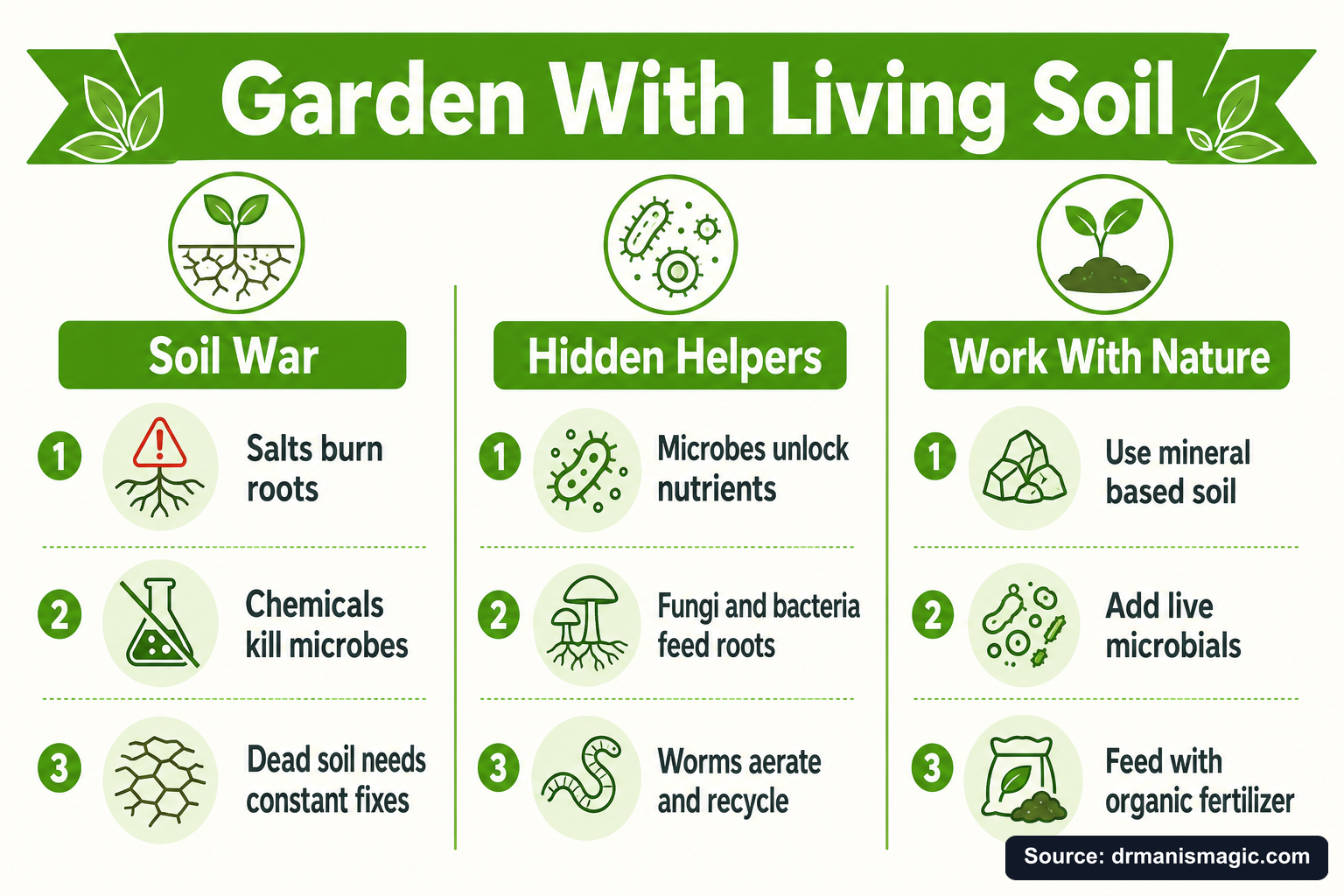
- Healthy soil is a living ecosystem with billions of bacteria, fungi, protozoa, nematodes, and more all working together to feed your plants.
- Salt-based fertilizers and synthetic chemicals kill the beneficial microbes your plants depend on, starting a damage cycle that gets worse over time.
- The soil food web is the invisible workforce behind every thriving plant on the planet. No microbes means no resilience.
- Most commercial microbial products are either dried and dead or going anaerobic and smelly. Neither kind actually works.
- The Three Plant Pillars (mineral-based soil, live microbials, and organic fertilizer) are the foundation for any plant in any garden, anywhere.
- Damaged soil can be rebuilt, but it takes the right steps in the right order. Dumping more products on broken biology doesn't fix it.
- Gardening with nature means less work, not more. When the biology is right, plants practically take care of themselves.
Why Does Your Garden Feel Like a Constant Battle?
Quick Answer: Your garden feels like a battle because most modern gardening advice strips the living biology out of your soil and then tries to replace it with synthetic substitutes. Without the right bacteria, fungi, and microbial life in place, plants can't access nutrients properly, can't fight disease, and can't build strong roots. The system fails, and you keep buying more products to patch it.
You are not bad at gardening. Let that sink in for a second.
The brown thumb isn't real. It's a story the big chemical companies invented, because a confident, successful gardener doesn't need to keep spending money at the big box store. A struggling, confused gardener? That person is a customer for life.
Since Miracle-Gro appeared in the 1950s and convinced an entire country that synthetic salt fertilizer was the answer, we've been chasing a lie. That one advertising decision kicked off decades of chemical dependency in American gardens. And every generation since has been handed the same broken toolbox.
The real problem isn't your skill. It's what's been done to your soil.
According to the University of Minnesota Extension, healthy soil is a full community of bacteria, fungi, nematodes, earthworms, organic residues, and enzymes all linked through nutrient cycles and energy flows. When you kill that community with salts, herbicides, and broad-spectrum pesticides, you're left with something closer to dead sand than living soil. And dead sand can't grow much of anything without constant artificial life support.
That life support is what the chemical companies are selling you. Over and over again.
What Is the Soil Food Web and Why Does It Matter for Your Plants?
Quick Answer: The soil food web is the chain of living organisms in your soil, from bacteria and fungi at the bottom to nematodes, protozoa, insects, and earthworms higher up. Each layer feeds on the one below it, releasing plant nutrients as a byproduct. It's nature's way of feeding plants for free, without any synthetic help.
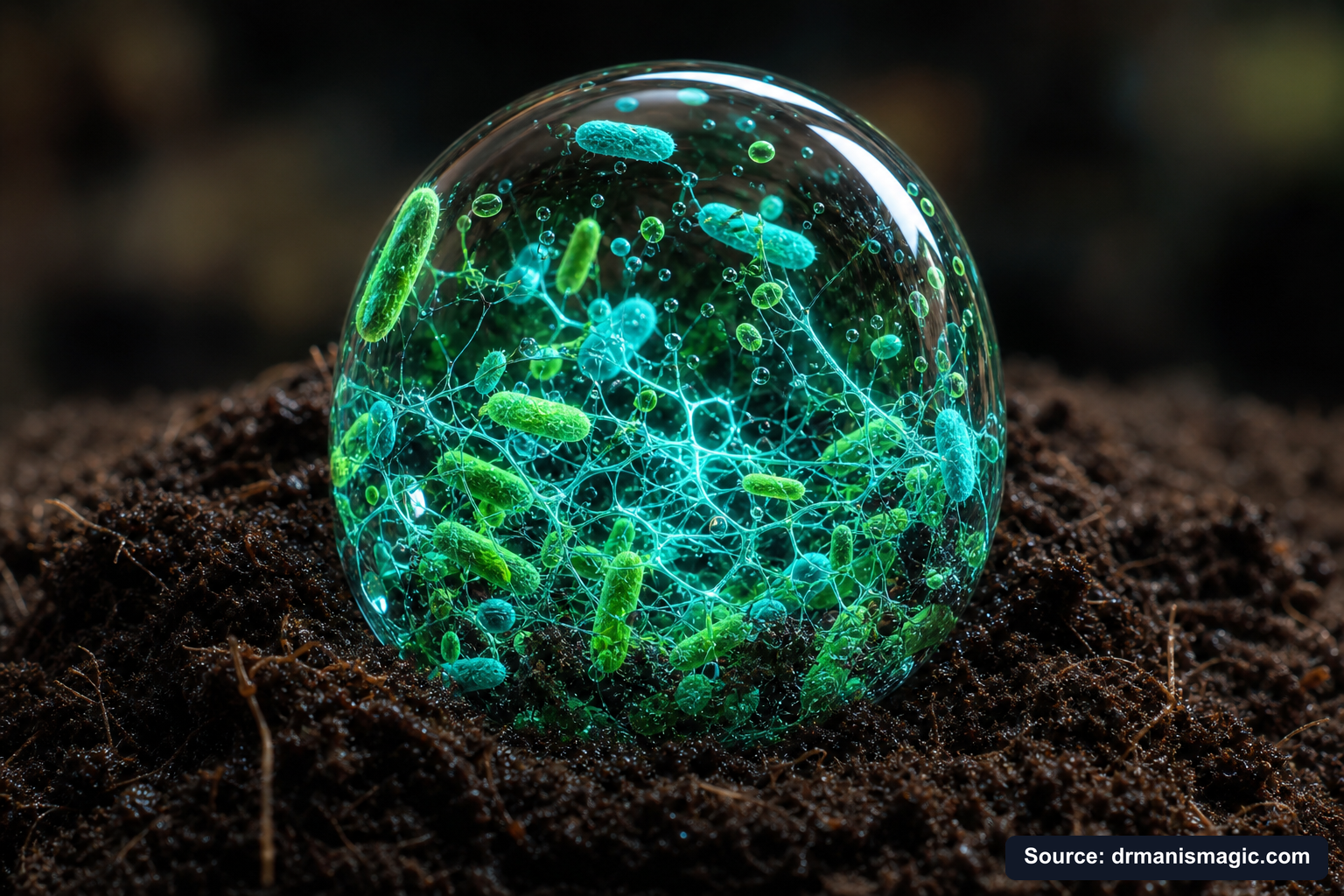
Imagine a city underground. Not a small town. A massive, buzzing, interconnected city with billions of residents per teaspoon of healthy soil.
At the base of that city are bacteria and fungi. They break down dead organic matter, leaves, roots, old wood, animal waste, and turn it into forms plants can actually use. The USDA NRCS Soil Biology Primer describes this system as an energy-transfer network where every organism plays a specific role. Nothing is wasted. Everything cycles back.
Then come the grazers. Protozoa and nematodes eat the bacteria and fungi. When they eat, they release the nutrients locked inside those microbes in forms plants can absorb directly through their roots. Think of it as a nutrient faucet that the soil food web keeps flowing.
Higher up the chain, arthropods, beetles, and earthworms shred organic matter and mix the soil. Their tunnels create air pockets. Their waste feeds the bacteria below. And the whole system keeps spinning.
Here's the part most people never hear. Your plant is not passive in this system. Your plant is actively running it. Plant roots pump sugars and carbohydrates into the soil specifically to feed the bacteria and fungi they want nearby. In return, those microbes deliver water, minerals, and protection. It's a trade. A partnership that evolved over hundreds of millions of years.
When you spray a broad-spectrum pesticide or pour on synthetic salt fertilizer, you break that trade. The plant loses its partners. And it starts to struggle.
| Organism | What It Does | Why Plants Need It |
|---|---|---|
| Bacteria | Break down organic matter, fix nitrogen from air, suppress pathogens | Releases nutrients in plant-available forms, builds soil aggregate structure |
| Mycorrhizal Fungi | Extend root reach up to 100x, trade water and minerals for plant sugars | Improves drought resistance, unlocks phosphorus and hard-to-reach nutrients |
| Protozoa | Graze on bacteria and fungi, mineralizing nutrients as they feed | Releases nitrogen and phosphorus right in the root zone where plants absorb it |
| Beneficial Nematodes | Feed on bacteria, fungi, and insect larvae (depends on type) | Regulates microbial populations, controls soil-dwelling pests |
| Earthworms | Shred organic matter, create tunnels, deposit nutrient-rich castings | Improves drainage, aeration, and nutrient cycling |
| Arthropods and Beetles | Fragment organic debris, regulate insect populations | Accelerates decomposition, supports microbial diversity |
What Do Mycorrhizal Fungi Actually Do for Plant Roots?
Quick Answer: Mycorrhizal fungi form a physical partnership with plant roots, extending them far beyond what the plant could grow alone. They pull in water and minerals, especially phosphorus, from areas roots can't reach and deliver them directly to the plant. In exchange, the plant feeds the fungi with sugars. It's one of the most powerful partnerships in all of nature.
Pull a healthy weed out of your garden sometime. Look at the roots. See those fuzzy white threads clinging to them? That's mycorrhizae. Those threads, called hyphae, can extend the effective root zone of a plant by up to a hundred times its actual root size. A plant with a healthy mycorrhizal network is drinking from a much bigger well.
That's why weeds grow like crazy in neglected soil. They still have their fungal partners. Your garden plants? If you've been using synthetic fertilizers and fungicides, yours probably don't.
Mycorrhizal fungi also produce a sticky protein called glomalin. Glomalin glues soil particles together into clumps called aggregates. Those aggregates create the crumbly, loose texture of great garden soil. The kind that drains well, holds air, and lets roots push through easily. You can't buy that structure in a bag of potting mix. You have to grow it.
This is exactly why Pillar 2 of the Three Plant Pillars is live microbials. Not dried powder. Not a smelly liquid. Living, active fungi and bacteria that can actually do this work for your plants right now.
How Do Salt-Based Fertilizers Destroy the Biology You Need?
Quick Answer: Salt-based synthetic fertilizers work by osmosis, pulling water out of plant roots and soil microbes. High salt concentrations physically damage or kill the bacteria and fungi your plants depend on. Over time, the soil becomes biologically dead, meaning plants can only survive with constant chemical feeding. It becomes an expensive, damaging cycle that gets harder to break the longer it goes on.
Here's something the bag of blue crystals from the big box store never tells you.
Salt kills microbes. All of them. The good ones and the bad ones. When you pour synthetic fertilizer into your soil, you're not just feeding your plant. You're salting the earth beneath it.
At first, you see a big green flush. The plant shoots up. Looks great. You feel like a genius. But what happened underground? The microbial community took a hit. The fungi that were extending your root zone? Weakened or gone. The bacteria that were releasing nutrients? Dead. The protozoa that were cycling minerals into plant-available forms? Wiped out.
Now your plant is dependent. It can't feed itself anymore because the infrastructure is gone. So you feed it again. And again. And the cycle tightens. Meanwhile, without that living biology, roots start sitting in stagnant, poorly aerated soil. Root rot moves in. Pests and pathogens fill the vacuum left by the beneficial organisms you killed. The plant starts to fail. You spend more. Nothing gets better.
That's not a gardening problem. That's a design feature. For them.
See also: The Hidden Reason Synthetic Fertilizers Cause Root Rot
See also: How Salt-Based Feeding Quietly Destroys Root Systems
Is the White Fungus in Your Garden Soil Bad, or Is It Actually Helping You?
Quick Answer: White fungal threads in garden soil are almost always beneficial mycorrhizal fungi or harmless saprophytic decomposers, not pathogens. They are a sign of active biological life, not a problem to spray away. Killing them with a fungicide is one of the most damaging things you can do to your soil's long-term health.
Let's play a quick game called Good, Bad, or Just Gross.
You dig into your garden bed and see white fluffy threads running through the soil. Your first instinct might be to panic. Spray it. Kill it. But stop. Those threads are almost certainly mycorrhizal fungi or saprophytic fungi breaking down organic matter. Both are doing you a favor. The University of Minnesota Extension notes that visible fungi in mulch-rich soil are typically harmless decomposers, not disease-causing pathogens.
Here's a quick guide to what you might see underground and what it actually means:
| What You See | What It Is | Good, Bad, or Neutral? | What To Do |
|---|---|---|---|
| White fuzzy threads on roots | Mycorrhizal fungi or saprophytic fungi | Good | Leave them alone. Add more organic matter to support them. |
| Mushrooms in garden beds | Fruiting bodies of decomposing fungi | Neutral (usually beneficial) | Leave them. They signal active decomposition and good biology. |
| Slime mold (yellow or orange blob) | Single-celled organism, not a true fungus | Neutral | Ignore it. It feeds on bacteria and disappears on its own. |
| Small white worms (potworms) | Enchytraeids, related to earthworms | Good | They decompose organic matter. Leave them. |
| Large white C-shaped grubs | Beetle larvae (some species) | Bad if many, neutral if few | Check species. Use beneficial nematodes if damaging roots. |
| Knobby swellings on roots | Root-knot nematodes (pest species) | Bad | Remove affected plants. Rebuild soil biology. Use cover crops. |
| Tiny orange-red worms | Earthworms (young) or red wigglers | Very good | Celebrate. Add compost to encourage more. |
The point is this. Most of what lives in your soil is working for you, not against you. The reflex to spray, sterilize, and sanitize everything is costing you the very allies your plants need most.
You Never Had a Brown Thumb.
You were handed the wrong tools. This free guide hands you the right ones.
You watered it. You fed it. It died anyway.
It was never you. It was the dirt, the salt food, and the bad advice.
This guide shows you what really went wrong, and how to fix it for good.
- Why your plants really died, and why it was never your fault
- The salt hiding in your plant food that quietly burns the roots
- The hidden killer in almost every bag of store soil
- The tiny helpers that grow a whole forest for free
- The rescue trick that brings a half dead plant back to life

Can Damaged or Sterile Soil Come Back to Life?
Quick Answer: Yes, damaged soil can absolutely recover, but it needs the right conditions in the right order. You can't just dump microbes onto compacted, salt-laden, poorly draining soil and expect miracles. You have to fix the habitat first, then reintroduce biology, then feed it with organic matter. Rebuilding takes weeks to months, but the results last for years.
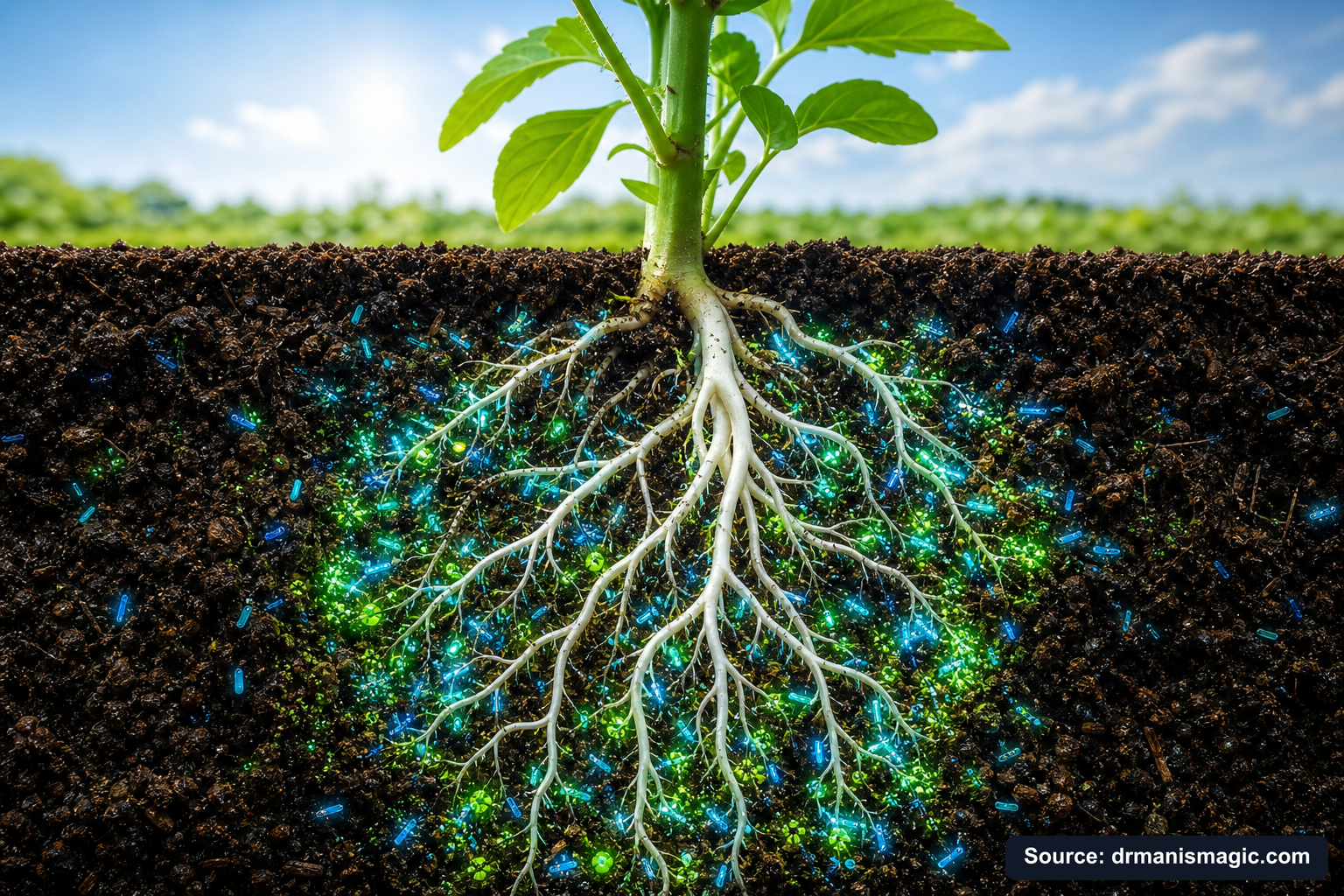
If your soil has been hit hard, by years of synthetic fertilizers, herbicide applications, or flooding, it can feel like starting over. And in a way, you are. But here's the encouraging part. Nature is incredibly good at recovery. Given half a chance and the right inputs, biology comes back.
Here's the recovery plan we use at US Citrus Nursery when soil has been damaged:
- Test your soil first. Check pH, nutrients, organic matter, and salt levels. You can't fix what you haven't measured. Most county extension offices offer basic soil tests affordably.
- Stop the damaging input immediately. No more synthetic salt fertilizers. No more broad-spectrum pesticides or fungicides. The bleeding has to stop before healing can start.
- Fix drainage and compaction. Roots need air and water movement. If the soil is packed tight, add organic matter, perlite, or for containers, consider a mineral-based soil like Super Soil that doesn't compact over time.
- Leach salts if needed. Water deeply and repeatedly to push accumulated salts down and out of the root zone. This step is critical before adding biology.
- Add mature compost and mulch. This feeds the microbes you're about to introduce and gives them places to live. Aim for two to four inches of mulch on top of garden beds.
- Keep living roots in the soil. Cover crops, interplanting, or even leaving weeds temporarily all feed the soil food web through root exudates. Bare soil is biologically quiet soil.
- Reintroduce live biology. Now you're ready. Add a full-spectrum live microbial product monthly. Be patient. Microbial communities take time to establish and expand.
The order matters. Pouring live microbes into salt-saturated, compacted, poorly draining soil is like releasing fish into a swimming pool. The habitat has to be ready first.
Why Do Most Microbial Products From the Store Fail to Work?
Quick Answer: Most store-bought microbial products are either dried into powders where the microbes are largely dead on arrival, or they're compost-tea liquids that go anaerobic and smell like sewage before you even open them. In both cases, the living organisms you're paying for aren't actually alive when they reach your plants. Dead microbes do nothing for your soil.
This is one of the biggest scams in gardening right now. And it's disguised as innovation.
Walk into any garden center and you'll find shelves full of microbial inoculants, mycorrhizae powders, and beneficial bacteria bottles. The labels look impressive. The claims are bold. But after testing dozens of these products on our citrus trees, we kept seeing the same result. Nothing happened. Or almost nothing.
Here's why. Most of these products are made one of three ways, and all three have serious problems.
The dried powder method. Giant factories brew up specific bacterial strains in vats, then dry them into powders. The idea is that the dormant spores will "wake up" when you add water and pour them on soil. In theory, that sounds reasonable. In practice, we saw almost zero improvement across dozens of batches. The reactivation rate is poor, the spectrum is narrow, and the microbes that do survive aren't the complex web your soil needs.
The compost tea method. Some companies harvest microbes from compost or earthworm castings and turn them into liquid. When it's fresh, within the first 24 hours, this can be genuinely effective. But by the time it's bottled, shipped, and sitting on a shelf? It's gone anaerobic. Meaning the microbes have run out of oxygen, started dying, and begun producing gases. You can smell it. Sometimes the bottle fizzes when you open it. That smell is biological death, not biological life.
The lactobacillus method. Some products use lactobacillus, the same bacteria in yogurt. It's easy to grow, stays alive, and people see some response. But lactobacillus aggressively outcompetes beneficial soil organisms. It belongs in fermented food, not in your rhizosphere.
We tried all of these. None of them gave us what fresh, active compost gave our trees. That's what led Dr. Mani and his team to develop something different entirely.
| Product Type | Viability at Use | Microbial Spectrum | Smell | Our Verdict |
|---|---|---|---|---|
| Dried powder (lab-grown) | Very low | Narrow (1-5 species) | Neutral | Avoid. We tested dozens. No consistent results. |
| Dry microbes rehydrated into liquid | Very low | Narrow | Neutral | Same problem as above. Don't be fooled by the liquid format. |
| Fresh compost tea (under 24 hours, aerated) | Moderate to high | Broad | Earthy, turns sour fast | Works well if you make it yourself and use it immediately. Not practical for most. |
| Old compost tea (over 24 hours) | Low, anaerobic | Partial | Strong and foul | Not recommended. The biology is mostly dead. |
| Lactobacillus-based products | High (for lactobacillus only) | Extremely narrow | Sour | Avoid for soil use. Outcompetes beneficial microbes. |
| Plant Super Boost (stabilized, full-spectrum) | High. Visibly alive under a microscope. | 2,000+ bacteria, 400-500 fungi including mycorrhizae, plus protozoa and nematodes | Earthy. No stench. | What we use on all 250,000+ trees. Harvested from compost, not lab-grown. |
What Makes Plant Super Boost Different From Every Other Microbial Product?
Quick Answer: Plant Super Boost is harvested from real, active compost using a proprietary all-natural stabilization method that keeps the full spectrum of microbes alive without going anaerobic. It contains over 2,000 bacterial species, 400 to 500 fungal species including mycorrhizae, plus protozoa and nematodes. You can see living microbes move under a microscope. It doesn't smell bad because it isn't dying.
The story behind Plant Super Boost starts with a man most people have never heard of.
A world-renowned compostologist, someone who had advised the farming practices of royal families and governments across the globe, discovered a natural technique to stabilize living compost microbes without letting them die or go anaerobic. When large citrus groves started thriving with his method, the big chemical companies noticed. He was blacklisted. At one point, he feared for his safety and stopped production entirely.
Years later, through what Dr. Mani and his son Dr. Ron Skaria can only describe as a providential meeting, this expert joined the US Citrus Nursery family. Together, they brought his method into the nursery and built the Dr. Mani's Magic line around it.
The result is a product unlike anything else on the market. It smells like earth because it isn't rotting. It works because the organisms inside it are genuinely alive. If you take a single drop and look at it under a microscope, you can watch the microbes move. We have lab analyses to prove it.
Zero PFAS. Zero biosludge. Zero synthetic salts. No dangerous warnings on the label. No re-entry waiting period. Safe around children. Safe around pets. Safe enough to use on herbs and vegetables you're going to eat the same week.
That matters. Think about how many products you've poured on your plants while holding your breath, keeping the kids inside, and then frantically checking the warning label afterward. That's not how gardening should feel.
What Are the Three Plant Pillars and Why Do They Work Together?
Quick Answer: The Three Plant Pillars are mineral-based soil for drainage and root health, live microbials for biological activity and nutrient cycling, and organic fertilizer for slow-release nutrition that feeds plants without harming microbes. Together they create a self-reinforcing system where each pillar strengthens the other two. Miss any one of them and the whole system gets shaky.
After 30 years of growing citrus in South Texas heat, Dr. Mani identified the three non-negotiable foundations every plant needs. Not just citrus. Every plant. Your houseplants. Your lawn. Your raised beds. Your fruit trees. The pillars are the same.
Pillar 1: Mineral-Based Soil. Most potting mixes are organic disasters. They're packed with pine bark, sawdust, and other decomposing material that breaks down within months. As they rot, they compact. They steal oxygen from roots. They hold water in a way that drowns instead of nourishes. The result is root rot, yellowing leaves, and slow death.
Mineral-based soil doesn't decompose. The sandy loam from the Rio Grande Valley that forms the base of our Super Soil is silica-rich and permanent. It drains fast. It stays open. Roots can breathe and push deep. It's not about adding nutrients. It's about building a structure that supports life long-term.
Pillar 2: Live Microbials. You already know this one. Without the living biology, nothing else works at full power. The fungi can't extend the roots. The bacteria can't release the nutrients. The protozoa can't cycle the minerals. Add live microbes monthly and keep adding them, because many of our soils have been damaged and need ongoing support to rebuild.
Pillar 3: Organic Fertilizer. Plants need nutrients. But how you deliver those nutrients matters enormously. Salt-based synthetic fertilizers dump a shock of concentrated mineral salts into the root zone. It burns microbes. It burns roots at high doses. And it creates a dependency cycle.
Organic, slow-release fertilizer from crab, kelp, and amino acids works differently. It releases nutrition gradually as microbes break it down. It feeds the plant in the same rhythm nature uses. No burn. No boom-and-bust. No microbial massacre. And it smells like earth, not like something you'd find on a hazmat list.
When all three pillars are in place, your plants stop struggling. They start thriving. And you stop spending your weekends troubleshooting disasters.
When Should You Intervene in Your Garden vs. Let Nature Handle It?
Quick Answer: Most minor pest damage, fungal activity, and insect presence doesn't need intervention. The soil food web self-regulates when biology is healthy. Intervene when damage is spreading rapidly, when a confirmed pest or pathogen is identified, or when a plant is in genuine danger. Start with the least disruptive method first, always.
This is the question at the heart of gardening with nature instead of against it. When do you step in? When do you step back?
The honest answer is: most of the time, you can step back further than you think.
A few chewed leaves? That's part of a functioning ecosystem. Ladybugs and parasitic wasps are on their way. Some white fungal threads in the soil? Those are your allies. A mushroom popping up in your garden bed? That's a sign of active decomposition, not disease. A few fungus gnats? Check your watering habits first. They thrive in constantly wet, biologically poor soil.
The integrated pest management approach, backed by university extension programs across the country, teaches a simple framework. First, identify the actual problem before doing anything. Second, decide if the level of damage is economically or aesthetically meaningful. Third, if you must act, start with the least disruptive method possible. Physical removal, water blasts, traps, or targeted organic controls before anything broad-spectrum.
Every time you reach for a broad-spectrum spray, ask one question first. Will this kill the beneficial organisms that are already working to solve this problem for me? If the answer is yes, consider whether the problem is really bad enough to justify that trade-off.
When the Three Plant Pillars are in place and your soil biology is healthy, this decision gets easier over time. Because a biologically thriving soil suppresses most pathogens on its own. The fungi crowd out the bad fungi. The beneficial bacteria compete with the harmful bacteria. The predatory nematodes regulate the pest nematodes. Nature runs a pretty tight security operation when you let it.
What Can You Do Right Now to Start Gardening With Nature?
Quick Answer: Start by stopping the inputs that are killing your soil biology. Then add organic matter, improve drainage, and introduce live microbials. You don't need to overhaul everything at once. Even one change this week, stopping synthetic fertilizer or adding a layer of mulch, starts the shift. The biology responds faster than you'd expect.
You've been fighting your garden for years. Maybe decades. And it's exhausting.
Here's the truth that changes everything. The best gardeners on the planet aren't the ones who work the hardest. They're the ones who've learned to manage an ecosystem instead of muscle through it. They've figured out that the soil wants to grow things. It wants to be alive. It wants to feed your plants. You just have to stop getting in the way.
Here's where to start this week:
- Put down the synthetic fertilizer. Even if you have a full bag sitting in your garage. This single step stops the ongoing damage to your soil biology.
- Add two to four inches of mulch over your garden beds. This feeds the soil food web, holds moisture, regulates temperature, and suppresses weeds all at once.
- Stop tilling if you can. Every time you till, you shred the fungal networks your plants depend on. No-dig gardening preserves the underground architecture that took years to build.
- Check your soil drainage. If water sits for more than an hour after watering, your roots are suffocating. This is often the root cause, literally, of most plant problems.
- Introduce live microbials monthly. Fresh, stabilized, full-spectrum biology that actually works. Not dried powder. Not smelly liquid. Something alive.
You can get money back. You cannot get time back. The number one thing people tell Dr. Mani they want is to see fruit on their own tree with their own eyes. Not someday. Now. And every month spent fighting nature instead of working with it is a month that fruit stays out of reach.
We've watched people go from dead trees and brown lawns to thriving gardens in a single growing season. Not because they got lucky. Because they stopped fighting and started building the right foundation.
That foundation is what the Free Plant Care Field Guide is built around. Real steps. Real biology. No guesswork. No jargon. No products you need to be a chemist to understand.
If you're ready to stop fighting your garden and start working with it, the first step is to get the biology right. That means live microbes your plants can actually use, delivered in a form that works. If you want to experience what a genuinely living microbial product feels like in your soil, Plant Super Boost is where we'd start. It's what we use on every tree we grow. And we've grown a lot of trees.
Your garden isn't broken. The approach was. Now you know the difference.
Frequently Asked Questions
Most gardeners are working way too hard and getting way too little in return. These questions come up again and again from plant owners who are tired of losing money, losing time, and losing plants. The answers below are grounded in over 30 years of real-world growing experience and more than 250,000 trees tested right here in South Texas.
Why does my garden feel like a constant battle no matter what I do?
Because most gardening products are designed to keep you buying, not to fix the root cause. Salt-based fertilizers burn your soil. Cheap potting mixes rot and choke roots. Neither one supports the living biology your plants need to thrive. At Dr. Mani's Magic, we call this the rigged system. The fix is the Three Plant Pillars: mineral-based soil, live microbes, and organic fertilizer. Get those right and the battle stops.
What is the most common mistake first-time gardeners make?
Most people blame watering. But the real mistake runs deeper. It is starting with dead, lifeless soil and then pouring synthetic fertilizer on top of it. That combination wipes out the beneficial bacteria and fungi your plant roots depend on. Without those microbes, your plants cannot absorb nutrients properly no matter how much you water or feed them. Fix the soil first and everything else gets easier.
What are the biggest mistakes to avoid when using raised beds or containers?
Three big ones. First, filling your bed with standard potting mix, which is mostly pine bark and sawdust that breaks down fast, compacts, and suffocates roots. Second, using synthetic fertilizers that kill the microbial life in your soil. Third, skipping microbes altogether. Dr. Mani's Super Soil uses mineral-based sandy loam that never breaks down, so your roots stay loose, airy, and healthy for the long haul.
In what order should you set up a garden for the best results?
Start with your foundation before you think about what to plant. Get your soil right first. That means mineral-based structure for drainage and root space. Then add live microbials so your soil becomes a living, working ecosystem. Then feed with slow-release organic fertilizer. Once those Three Plant Pillars are locked in, you can focus on placement, sunlight, and plant selection. Build the base first and everything on top of it works better.
What is the 70/30 rule in gardening and does it apply to soil health?
The classic 70/30 rule says plant 70 percent proven varieties and experiment with 30 percent. That is solid advice for what you grow. But Dr. Mani adds a layer underneath it. Even proven plants fail in dead soil. So before you plan what goes in the ground, make sure 100 percent of your soil foundation is alive and healthy. Proven plants in living soil with real microbes produce results that feel almost unfair compared to anything else.
What is the best time of day to work in the garden?
Early morning is your best window, before 11 a.m. The soil is cooler, plants are hydrated, and you are not fighting the midday heat. Water in the morning so leaves dry before evening, which cuts down on fungal problems. Avoid heavy pruning or transplanting between 11 a.m. and 2 p.m. in summer. Evening works for light tasks. When your soil is alive with the right microbes, your plants are more resilient to heat stress too.
What is the 5-4-3-2-1 planting method and how do microbes make it work better?
The 5-4-3-2-1 method layers five herbs, four leafy greens, three root vegetables, two flowers, and one fruiting crop into one bed. It is a smart way to use space and create natural pest balance. But here is what most guides leave out: that whole system performs at a fraction of its potential without living soil biology underneath it. Microbes unlock nutrients for every plant type in that mix. Add Plant Super Boost and watch every layer of that bed come alive.
About the Author
Ron Skaria, MD
Ron Skaria, MD, is the co-founder of Dr. Mani's Magic and the son of Dr. Mani. He trained as a medical doctor at Baylor College of Medicine, did his residency at UT Health Science Center - San Antonio and fellowship training at Texas Tech University. He now works full time on the family farm at US Citrus and US Citrus Nursery in Hargill, Texas, building Dr. Mani's Magic alongside his dad. He wrote the Brown Thumb Field Guide to put his father's 48 years of plant science into plain words any gardener can use. His belief is simple. You never had a brown thumb. You just never had the right help.


