


Why Overwatering Isn't the Real Problem for Your Roots | Dr. Mani's Magic
Why Overwatering Isn't the Real Problem: Your Root Zone Lost Oxygen
Picture this. You walk out to your lemon tree on a Tuesday morning, coffee in hand. The leaves are yellow. A few have dropped overnight. You crouch down and press your finger into the soil. Wet. Soaking wet. You've been watering it faithfully. You did everything right. And somehow, the tree looks like it's dying.
So you Google it. "Yellow leaves on citrus tree." Every answer says the same thing: "You're overwatering." So you back off the water. You wait. Two weeks later, the leaves are still yellow. Maybe worse. You start to wonder if you just have a brown thumb. Maybe plants aren't for you. Maybe you're cursed.
Here's what nobody told you: the water didn't kill your roots. Something else did. And once you understand what that something is, everything changes. We've grown over 250,000 citrus trees at our South Texas nursery. We've watched plants fail in wet soil and thrive in wet soil. The difference had nothing to do with how much water they got. It had everything to do with what was living inside the root zone.

Plant Super Boost
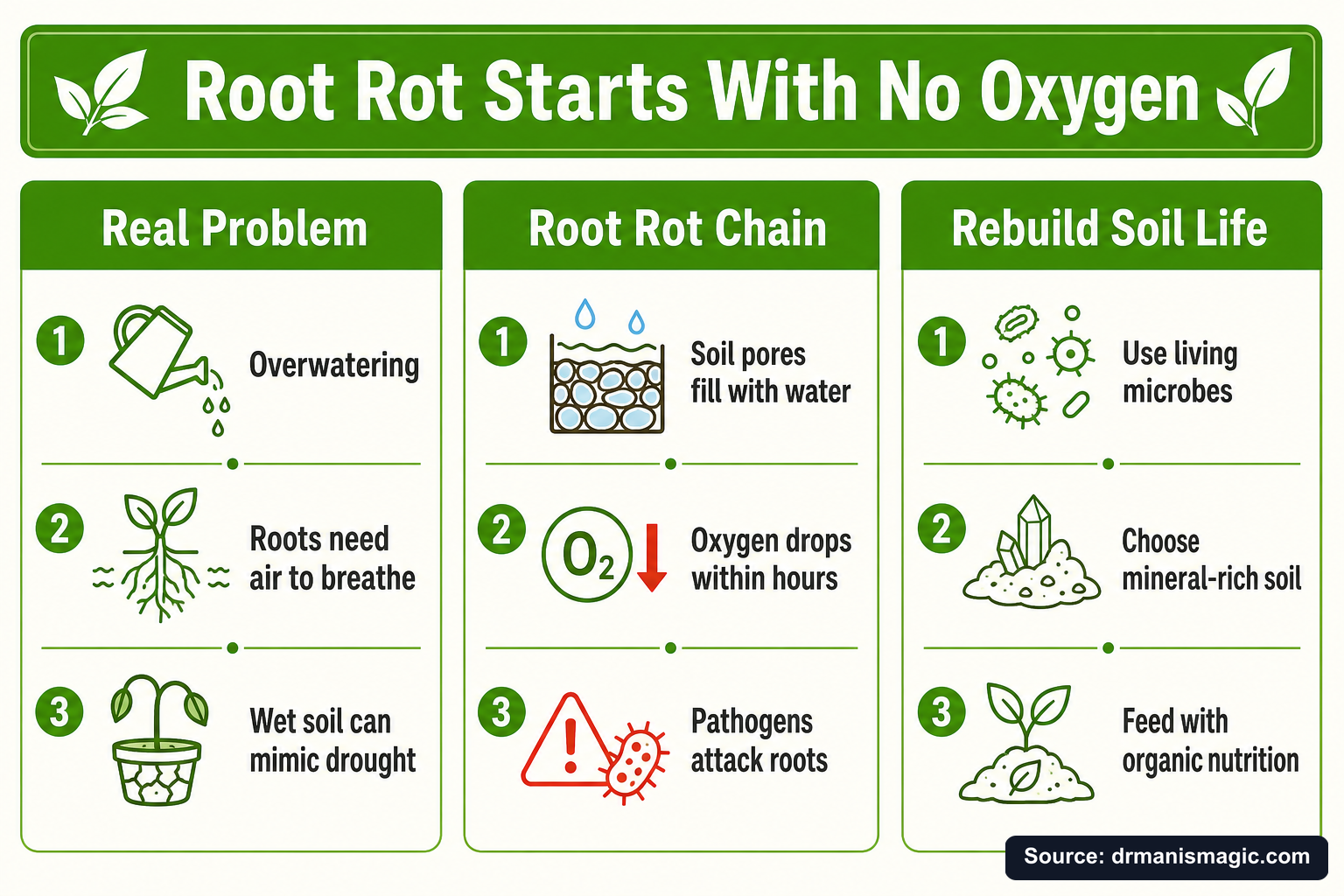
Key Takeaways
- Overwatering is a symptom label, not the real cause of root death. The true killer is oxygen loss in the root zone.
- When soil pores fill with water and stay flooded, roots suffocate and beneficial microbes die off, leaving pathogens in charge.
- The full causal chain runs from wet pores to oxygen loss to microbial collapse to root tissue death to above-ground symptoms like yellowing and wilting.
- Healthy soil is a living food web. Bacteria, fungi, protozoa, and nematodes work together to regulate water, nutrients, and disease pressure.
- Most potting mixes start sterile and never develop the biological defenses that protect roots in nature.
- Salt-based fertilizers, synthetic fungicides, and herbicides destroy the very microbes that protect roots from rot.
- You can rebuild root-zone biology with the right live microbial inoculant, mineral-based soil, and organic nutrition — the Three Plant Pillars.

Why Do Roots Rot in Wet Soil but Not in a Glass of Water?
Quick Answer: Roots rot in wet soil because waterlogged soil traps no oxygen, while roots growing in water (like cuttings in a jar) are surrounded by oxygenated liquid. Oxygen is the missing piece. Roots need it to breathe. When soil stays saturated, air pockets collapse, oxygen disappears, and roots begin to die within hours.
This question stops most gardeners cold. You've seen it yourself. You drop a cutting into a glass of water and roots sprout in a week. You water your potted tree a little too much and the roots rot. Both situations involve water. So why does one work and the other kill?
The answer is oxygen. Roots breathe. Just like you do. They pull oxygen from tiny air pockets between soil particles. When those pockets stay full of water for too long, the oxygen runs out. Roots start to suffocate. It happens fast.
In a glass of water, oxygen dissolves into the liquid from the air above. The roots can still breathe. In a pot of soggy soil, the air pockets are sealed shut. No exchange. No oxygen. Just slow death.
According to the University of Minnesota Extension, healthy soil is a complex ecosystem where aerobic processes — the kind that require oxygen — drive nearly all beneficial biological activity. When soil becomes waterlogged, those aerobic processes shut down, and the root zone shifts toward conditions that favor disease.
That's the first domino. And when it falls, the rest follow fast.
What Actually Happens to Your Roots When Soil Stays Wet Too Long?
Quick Answer: Saturated soil collapses air pockets, cutting off oxygen to roots. Aerobic beneficial microbes begin to die. Anaerobic pathogens like Phytophthora activate and attack weakened root tissue. Feeder roots die first. Then the plant above ground starts showing stress: yellowing, wilting, and leaf drop, even though the soil feels wet.
Here is the full chain, step by step. This is what "overwatering" actually looks like from inside the root zone.
- Water fills the pore spaces. Soil is made of particles with tiny gaps between them. Those gaps hold air and water. When you water too much, or the soil drains poorly, water fills every gap.
- Oxygen disappears. With no air pockets, roots can't breathe. Root cells start to fail within hours.
- Beneficial aerobic microbes decline. The bacteria and fungi that protect your roots need oxygen too. When oxygen is gone, they die off or go dormant. The biological shield around your roots collapses.
- Anaerobic pathogens take over. Organisms like Phytophthora, a water mold, thrive in wet, oxygen-poor conditions. With the beneficial microbes gone, nothing stops them. They move in fast.
- Feeder roots die. The small hair-like roots that absorb water and nutrients are the first to go. They're the most sensitive. Once they die, the plant can't take up water even when the soil is soaking wet.
- Above-ground symptoms appear. The plant looks wilted, yellow, and sick, even though the soil is wet. This is why "overwatering" is so confusing. The symptoms look exactly like drought stress.
This is why backing off water often doesn't fix the problem. The biological damage is already done. The pathogens are already active. The feeder roots are already gone. You're treating the symptom. The root zone needs something much deeper.
UC IPM notes that Phytophthora root rot symptoms in citrus can look nearly identical to nematode damage, salt injury, and flooding stress. That overlap is exactly why so many gardeners stay confused and keep chasing the wrong solution.
Why Does Healthy Soil Never Have This Problem?
Quick Answer: In healthy natural soil, a living food web of bacteria, fungi, protozoa, nematodes, and other organisms maintains structure, drainage, and disease suppression around the clock. Healthy soil self-regulates. It processes excess water, competes against pathogens, and keeps roots oxygenated through biological activity. Sterile potting mixes and compacted soils have none of this defense.
Walk into any forest. Pull up a plant that's been growing wild for years. Look at the roots. White fuzzy threads. Rich dark soil. A living world you can smell. That smell — that deep, earthy, clean scent — is the smell of a thriving soil food web.
Nature built a self-regulating system. It doesn't need you to water it perfectly. It doesn't need a drainage checklist. It works because millions of invisible organisms are constantly processing water, nutrients, and threats.
Here's how that invisible workforce breaks down:
| Soil Organism | What It Does for Your Plant | What Happens When It's Gone |
|---|---|---|
| Beneficial Bacteria | Break down organic matter, fix nitrogen from air, suppress pathogens, improve soil structure | Nutrients lock up, pathogens spread, soil compacts |
| Mycorrhizal Fungi | Extend root reach up to 100x, improve water and nutrient uptake, build soil aggregates | Roots stay small, drought stress increases, structure collapses |
| Protozoa | Graze on bacteria, releasing plant-available nitrogen near the root zone | Nitrogen stays locked, plant starves even in "fertilized" soil |
| Beneficial Nematodes | Feed on bacteria and fungi, cycling nutrients; some attack soil pests | Pest pressure increases, nutrient cycling slows |
| Soil Arthropods | Shred organic matter, aerate soil, distribute microbes through the profile | Organic matter piles up unprocessed, aeration drops |
When all of these players are working together, the soil breathes. It drains. It fights off disease on its own. Roots can handle more water stress because the biological buffer is active.
When that food web is gone — because the soil was sterilized, or because synthetic inputs wiped out the biology — your plant is completely exposed. Every watering event becomes a gamble.
Most store-bought potting mixes start sterile. There is no food web. There is no biological buffer. There is no defense. Just bark, peat, and perlite slowly breaking down, compacting over months, stealing oxygen from roots as they decay.
After 30 years of growing at our South Texas nursery, we learned this the hard way: you can't water your way to healthy roots. You can't fertilize your way to healthy roots. You have to build the biology first. That's Pillar Two of the Three Plant Pillars.
Why Does Most Potting Mix Make the Problem Worse Over Time?
Quick Answer: Most potting mixes are made from bark, wood fiber, and peat that break down within 6 to 18 months. As they decompose, they shrink, compact, and lose their air pockets. The same mix that drained beautifully when your plant was new turns into a wet, dense sludge that holds water against roots and blocks oxygen. The soil itself becomes the overwatering problem.
Think about what most potting mix is made of. Pine bark. Sawdust. Peat moss. Wood fiber. These are organic materials. They decompose. And as they break down, two things happen that are both terrible for roots.
First, the particles shrink and pack together. The air pockets close up. The mix that was light and fluffy in month one becomes a dense, brick-like mass by month twelve. Water sits on top. It pools around roots. Oxygen disappears.
Second, the decomposing organic matter actually consumes oxygen as it breaks down. The microbes doing the decomposing are aerobic. They're competing with your roots for the same oxygen supply. Your roots lose.
This is why so many container plants look healthy for six months and then start declining for no obvious reason. The soil changed underneath them. The structure collapsed. Nobody told you to replace the whole mix every year. And even if they did, that's expensive, time-consuming, and hard on roots.
The solution starts before you ever water. It starts with what's in the pot.
Mineral-based soil — real inorganic sandy loam that does not decompose — holds its structure permanently. The air pockets stay open. Water drains through. Roots breathe. This is why our Super Soil uses silica-rich sandy loam from the Rio Grande Valley as its base. It doesn't rot. It doesn't compact. It doesn't steal oxygen. That's Pillar One.
How Do Salt-Based Fertilizers and Fungicides Make Root Rot Worse?
Quick Answer: Salt-based synthetic fertilizers pull water out of root cells through osmotic pressure and kill beneficial soil microbes, stripping away the plant's biological defense system. Synthetic fungicides, meant to fight bad fungi, also destroy mycorrhizal fungi and other beneficial species. Together, they leave roots naked, stressed, and vulnerable to the exact pathogens they were supposed to fight.
This is where the system gets rigged against you. And we say that with no meanness — just hard truth from decades in the field.
Most fertilizers sold in big box stores are salt-based. Synthetic nitrogen, phosphorus, and potassium in soluble salt form. They work fast. They make things green quickly. That's the pitch. But here's what happens next.
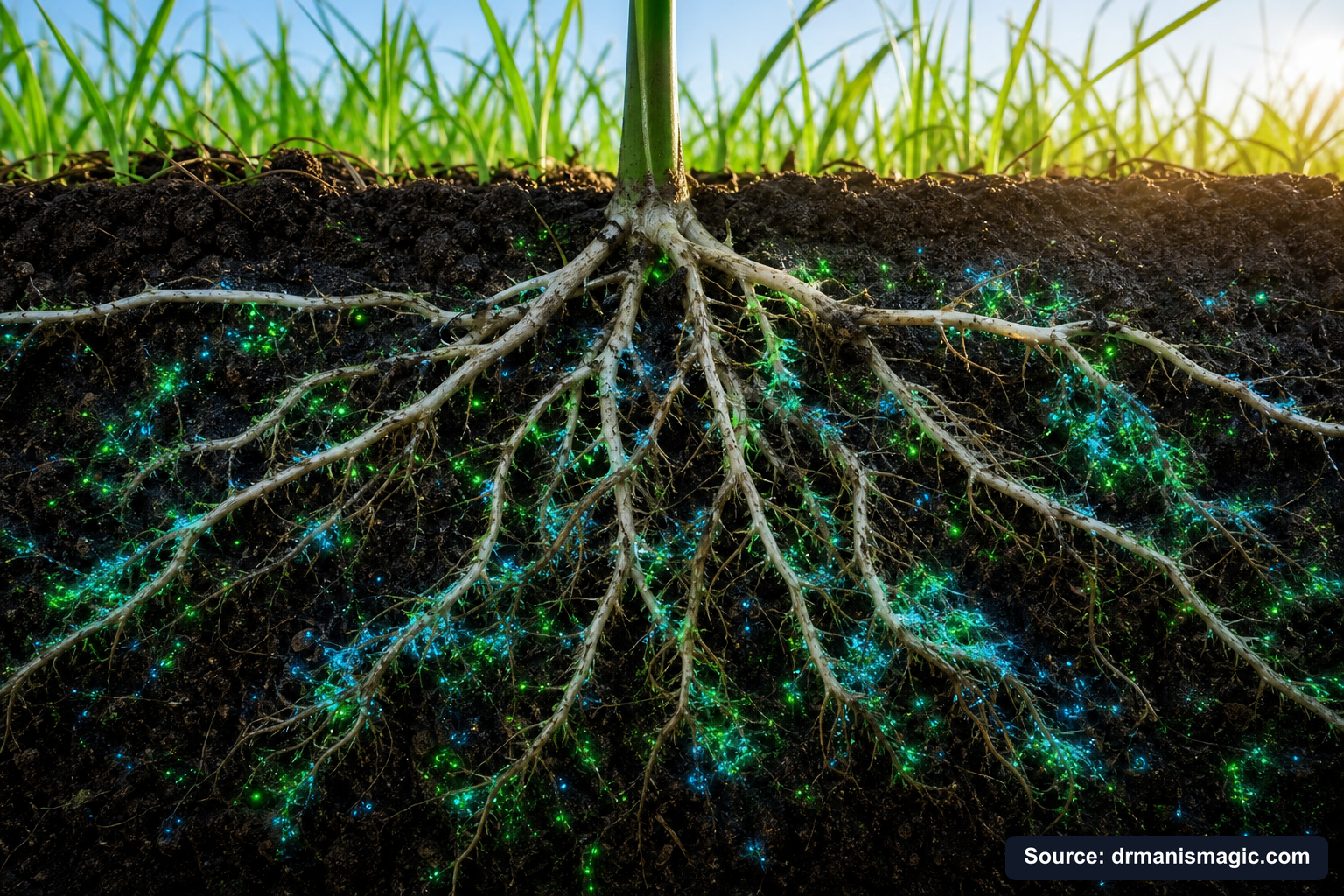
Those salts accumulate in the soil. They raise the electrical charge around the root zone. Beneficial bacteria and fungi — the ones that protect your roots from pathogens — are highly sensitive to salt. They die off. The biological shield disappears.
Then comes the irony. Roots stressed by salt accumulation are more susceptible to Phytophthora and other root pathogens. So the gardener reaches for a fungicide. The fungicide kills the pathogenic fungus. It also kills the mycorrhizal fungi that were helping the roots stay healthy. Now the roots are even more exposed. The cycle repeats.
Oklahoma State University Extension notes that mycorrhizal fungi are inhibited by excessive fertilizer, overwatering, and some fungicides. The very products marketed as plant care are dismantling the biological protection plants evolved over millions of years.
We're not telling you this to sell you something. We're telling you this because we watched it happen to our own trees. Thirty years of trial and error in a working nursery has a way of making things clear.
See also: The Hidden Reason Synthetic Fertilizers Cause Root Rot
You Never Had a Brown Thumb.
You were handed the wrong tools. This free guide hands you the right ones.
You watered it. You fed it. It died anyway.
It was never you. It was the dirt, the salt food, and the bad advice.
This guide shows you what really went wrong, and how to fix it for good.
- Why your plants really died, and why it was never your fault
- The salt hiding in your plant food that quietly burns the roots
- The hidden killer in almost every bag of store soil
- The tiny helpers that grow a whole forest for free
- The rescue trick that brings a half dead plant back to life

Live Microbes vs. Dead Products: Why the Bottle Matters More Than the Label
Quick Answer: Most microbial products on store shelves contain dead or dormant organisms that show no meaningful results in real-world testing. Truly effective microbial inoculants must contain live, active organisms harvested from natural compost and stabilized so they don't die before reaching your soil. If the bottle stinks or comes as a dry powder, the microbes are likely dead or too narrow in spectrum to help.
Walk down the gardening aisle of any store right now. You'll see at least five products promising "beneficial microbes." Most of them don't work. We know because we tested dozens of them on our own trees before we built something better.
Here's what's actually inside most of those products:
| Product Type | How It's Made | Viability When You Use It | Smell | Does It Work? |
|---|---|---|---|---|
| Dry / powdered lab microbes | Grown in factory vats, dried into powder | Very low — spores may not reactivate | Neutral | We saw no results in our testing |
| Dry microbes rehydrated into liquid | Same factory powder, added to water | Very low — same problem | Neutral | Not effective in our trials |
| Compost tea (fresh, under 24 hours) | Brewed from active compost | Moderate when aerated and fresh | Earthy, mild | Good if used immediately |
| Compost tea (old, over 24 hours) | Same, but left too long | Low — microbes going anaerobic | Strong, foul | Not recommended |
| Lactobacillus-based products | Simple fermentation, like yogurt cultures | High viability but wrong organism | Sour | Lactobacillus overtakes beneficial microbes |
| Plant Super Boost (stabilized, full-spectrum) | Harvested from natural compost, stabilized by proprietary all-natural method | High — visibly active under microscope | Earthy, not foul | Yes — proven across 250,000+ trees |
The trick is stabilization. Fresh compost is teeming with life. A hot compost pile can reach 140 degrees Fahrenheit. That heat is biological activity — millions of organisms working at full speed. The magic is in capturing that life and keeping it alive in a bottle.
Most companies can't do that. The microbes die, go anaerobic, and you end up with a product that smells like a swamp and delivers almost no living biology to your soil. Some gardeners notice a small benefit from the humic and fulvic acids in those products, but the microbes themselves are largely gone.
The person who cracked this problem was a world-famous compost expert who had advised royal families and governments on farming practices. When large citrus groves started seeing dramatic results from his methods, the big chemical companies took notice. He was blacklisted. He feared for his livelihood. Years later, in what we can only call a providential meeting, he partnered with Dr. Mani Skaria at US Citrus Nursery. That partnership became the foundation of Plant Super Boost.
It doesn't stink. It isn't going anaerobic. You can take a drop of it and look at it under a microscope and watch the organisms move. That's not a marketing claim. That's what live biology looks like.
Zero synthetic salts. Zero biosludge. Zero PFAS. Just the living soil ecosystem your roots were meant to grow in, in a bottle you can apply monthly.
Is It Overwatering, Phytophthora, Salt Damage, or Something Else? How to Tell
Quick Answer: Yellow leaves and wilting in wet soil can come from oxygen loss, root rot pathogens like Phytophthora, salt accumulation from fertilizers, nematode damage, transplant shock, or compacted media. Symptoms overlap heavily. The fastest way to narrow it down is to check soil structure, look at feeder roots, smell the root zone, and review your fertilizer history.
This is the question we hear most often. And it's the one nobody gives a straight answer on. Here's a practical diagnostic framework.
| Condition | Key Symptoms | What Confirms It | First Step |
|---|---|---|---|
| Oxygen loss from overwatering | Yellowing, wilting, wet soil, no new growth | Soil stays wet more than 3–4 days; no drainage; dark slimy roots | Improve drainage immediately; let soil dry out |
| Phytophthora root rot | Yellowing, leaf drop, gummy bark near soil line, brown feeder roots | Gum oozing at crown or base; roots brown and mushy when squeezed | Improve drainage; restore beneficial biology |
| Salt accumulation from fertilizers | Brown leaf tips, wilting despite moisture, white crust on soil surface | White salt crust on pot rim or soil; history of synthetic fertilizer use | Flush deeply with clean water; switch to organic fertilizer |
| Nematode damage | Stunted growth, yellowing, poor response to watering and fertilizing | Knots or galls on roots when inspected | Soil biology restoration; beneficial nematodes |
| Transplant shock | Wilting, leaf drop, slow growth after repotting | Symptoms begin 1–3 weeks after moving the plant | Reduce sun exposure; add live microbes; do not fertilize yet |
| Compacted / decomposed potting mix | Water pools on surface; soil pulls away from pot edges; slow drainage | Mix is dark, dense, and does not spring back when pressed | Repot into mineral-based, permanent soil |
The fastest diagnostic move: pull the plant gently and look at the roots. Healthy roots are white or cream-colored and firm. Rotting roots are brown, mushy, and smell like decay. If your feeder roots are gone, the plant can't absorb water no matter how much or how little you give it.
How Do You Actually Fix an Overwatered Root Zone?
Quick Answer: Fixing an overwatered root zone means restoring oxygen, structure, drainage, and biological life, in that order. Watering less helps short-term but doesn't rebuild the living ecosystem that protects roots long-term. A full recovery requires addressing soil structure, reintroducing beneficial microbes, and feeding the recovering root system with gentle organic nutrition.
Here is a step-by-step recovery checklist we use when a tree comes into our nursery looking like it's circling the drain.
- Stop the bleeding. Remove the plant from its current environment if possible. Check the roots. Trim off any brown, mushy, or dead root tissue with clean scissors. This hurts to do but it's necessary.
- Fix the drainage first. If the pot has no drainage hole, that's your first fix. If the soil is compacted bark or old potting mix, replace it with a mineral-based soil that holds its structure permanently. You cannot solve an oxygen problem without solving a drainage problem first.
- Let the root zone dry partially. Not bone dry. Just until the top two inches are dry to the touch. Give the roots a chance to breathe before the next watering.
- Reintroduce live biology. Apply a full-spectrum microbial inoculant as a soil drench. This starts rebuilding the biological buffer between your roots and the pathogens already present in the soil. Do this monthly going forward.
- Flush out salt accumulation. If you've been using synthetic fertilizers, water deeply and slowly until water runs freely from the drainage holes. This helps move accumulated salts out of the root zone.
- Switch to organic nutrition. Once roots start recovering, feed with a slow-release organic fertilizer. No synthetic salts. Organic nutrients work with the microbial community, not against it. They feed your microbes, and your microbes feed your plant.
- Give it time and repeat. Biological recovery isn't instant. It takes repeated monthly applications of live microbes to rebuild a food web that may have been damaged for years. The plants that respond fastest are the ones whose growers stay consistent.
We've watched trees that looked completely dead come back with this approach. Not always. But far more often than anyone expected. The root zone is more resilient than most people think — when you give it the right tools.
What Are the Three Plant Pillars and Why Do They Prevent Root-Zone Failure?
Quick Answer: The Three Plant Pillars are the framework Dr. Mani Skaria developed after 30 years of growing at US Citrus Nursery: Pillar One is mineral-based soil that holds its structure and keeps roots oxygenated; Pillar Two is live microbial biology that creates a natural defense system in the root zone; Pillar Three is organic fertilizer that feeds the plant without destroying the biology. Together, they create a root zone that is nearly bulletproof.
Dr. Mani Skaria is a Professor Emeritus of Plant Pathology. He invented micro-budding. He led Texas's Clean Citrus Program. He has spent 40 years studying what makes plants thrive and what makes them fail.
And after all of that, the answer kept coming back to the same three things.
Pillar One: Mineral-Based Soil. Most potting mixes are organic. They decompose. They compact. They steal oxygen. Real mineral-based soil, built on silica-rich sandy loam that doesn't break down, holds its structure permanently. Air pockets stay open. Water drains. Roots breathe. No guesswork.
Pillar Two: Live Microbial Biology. The invisible workforce that regulates water, nutrients, pathogens, and root health. Without it, every wet spell is a crisis. With it, the root zone has a built-in defense system that works 24 hours a day, 7 days a week.
Pillar Three: Organic Fertilizer. Slow-release, salt-free nutrition that works with the microbial community instead of destroying it. Crab, kelp, and amino acids. No synthetic salts. No plastic coatings. No biosludge. No PFAS. Just nutrients in the form plants and microbes were designed to use.
Miss any one of these three and you're always chasing problems. Get all three in sync and your plant becomes nearly bulletproof. That's not a promise from a marketing team. That's what we learned growing 250,000 trees in South Texas, the hard way.
See also: Why Most Fertilizers Are Actually Salt in Disguise
What Can You Do Right Now to Protect Your Root Zone?
Quick Answer: Start by evaluating your soil structure and drainage today. If your mix is old, compacted, or bark-based, plan to repot into mineral-based soil. Add a live microbial inoculant monthly. Replace synthetic fertilizers with organic, salt-free nutrition. These three moves address the root causes of root-zone failure, not just the symptoms.
You've been told "water less" for years. Maybe you've been told it so many times you started believing the problem was your fault. That you just can't get watering right. That you have a brown thumb.
That's not it. That has never been it.
The real problem is that nobody handed you the right system. They handed you sterile bark-based potting mix. They handed you salt-based fertilizer that quietly destroys soil biology. They handed you fungicides that kill the very fungi protecting your roots. And then they blamed you when the plant died.
You can't get that time back. A tree planted today under the Three Plant Pillars will be bearing fruit in a fraction of the time it would take under the old approach. The number one thing people tell Dr. Mani is that they want to see fruit on their tree with their own eyes, in their own lifetime. That's not asking for much. But it requires the right foundation, and it requires starting that foundation now.
Every month you spend with the wrong soil, the wrong biology, and the wrong nutrition is a month that can't be returned. The best time to set up the right root zone was the day you planted. The second best time is today.
If you want a clear, simple starting point, our Free Plant Care Field Guide walks you through the Three Plant Pillars step by step for any plant you're growing, from a houseplant on your windowsill to a citrus tree in your backyard. No jargon. No complicated regimens. No chemicals that require you to read warning labels before touching them.
Just the natural order. Working the way it was always meant to.
Frequently Asked Questions
If your plant has yellow leaves and soggy soil, you have questions. Good. These are the exact questions Dr. Mani has been answering for over 30 years across 250,000 citrus trees in South Texas. The answers might surprise you. The real problem is almost never what you think it is.
Why is overwatering a problem for plants?
Overwatering is a problem because it steals oxygen from your roots. When soil pores stay flooded, air pockets collapse. Roots suffocate. Then the beneficial bacteria and fungi that protect your plant die off too. That opens the door for pathogens like Phytophthora to move in and destroy root tissue fast. The water is not the villain. Dead soil biology is. That is the real story nobody tells you at the garden center.
Why overwatering is not the real problem?
The real problem is what your soil is made of and what is living inside it. Most potting mixes are loaded with pine bark and sawdust that compact and trap water. That kills oxygen flow. Without oxygen, the good microbes die. Without good microbes, your roots have no defense. Dr. Mani proved this across 250,000 trees. Plants in mineral-based soil with live microbes thrived in wet conditions. Plants in cheap organic potting mix rotted. Same water. Totally different result.
Can overwatering damage be reversed?
Yes, if you act fast and fix the right things. Backing off water alone is not enough. You need soil that drains and breathes, like a mineral-based mix that does not compact. You need live beneficial microbes put back into the root zone. And you need clean organic nutrition to help the plant rebuild. That is exactly what the Three Plant Pillars are designed to do. Treat the root zone, not just the watering schedule.
How can you tell if you are overwatering your plant?
Look for soft yellow leaves, soggy soil that never dries out, and a musty smell from the pot. Fungus gnats flying around the soil are a big clue too. But here is what most people miss. Those signs do not always mean you watered too much. They mean your root zone ran out of oxygen. Bad soil structure and dead biology cause the same symptoms even with normal watering. Check your soil first, not just your watering schedule.
Is overwatering once enough to kill a plant?
One bad watering session rarely kills a healthy plant. What kills plants is repeated oxygen starvation in poor soil with no microbial protection. A plant growing in mineral-based soil with a thriving population of beneficial bacteria and fungi can handle extra moisture far better than one stuck in compacted sawdust mix. Build the right foundation first and your plant becomes much harder to kill, even if you water a little too much one week.
What is worse for plants, overwatering or underwatering?
Both hurt. But overwatering in bad soil is more dangerous because it wipes out the microbial life that protects roots. Once those beneficial bacteria and fungi are gone, disease moves in quickly. Underwatering stresses a plant, but the biology can survive and bounce back. Overwatering in dead, compacted soil starts a chain reaction that is much harder to stop. The solution to both problems is the same. Start with soil that drains well and biology that is alive and working.
Will a plant fully recover after overwatering damage?
Yes, most plants can recover if you rebuild the root zone correctly. Stop watering. Move to a mineral-based soil that holds structure and drains freely. Reintroduce live beneficial microbes to restart the biological defense system. Feed with a slow-release organic fertilizer that does not burn or wipe out the biology you just added back. Dr. Mani built this exact system into the Three Plant Pillars after watching plants fail and recover across decades of real nursery work. It works.
About the Author
Dr. Mani Skaria, PhD
Dr. Mani Skaria, PhD, is a plant pathologist and the scientific founder of Dr. Mani's Magic. He earned his doctorate at Purdue University and spent 48 years studying how plants, soil, and living microbes work together, including his years as Professor Emeritus at Texas A&M and as a member of the USDA NAREEE Advisory Board. He invented micro-budding, a method for growing healthier, stronger trees, and has grown more than 250,000 trees on the family farm in Hargill, Texas - US Citrus Nursery. His life's work takes real lab science and practical experience and turns it into simple, safe, organic plant care anyone can use at home.


