


Why Forests Depend on Fungal Networks and the Soil Food Web | Dr. Mani's Magic
Why Forests Depend on Fungal Networks: The Soil Food Web Beneath Every Tree
Walk into an old-growth forest. Stop for a second. Close your eyes and breathe in. That smell — damp earth, rich and alive — is not just soil. It is millions of invisible creatures working in perfect silence beneath your feet. Every tree you see towering above you, every fern, every wildflower pushing through the leaf litter — none of them got there alone.
Right now, under a single footstep of healthy forest floor, there are more living organisms than there are people on Earth. Fungi are threading through the dark in threads thinner than a human hair. Bacteria are breaking down dead leaves into food. Tiny creatures called protozoa are hunting bacteria and releasing the nutrients that feed tree roots. This is not a metaphor. This is happening right now. Billions of acts of invisible labor, every single minute, keeping the trees above alive.
Here is what most people never get told: your garden, your backyard tree, your potted lemon on the patio — they are trying to do the same thing. They are reaching for that same underground partnership. The question is whether your soil gives them a fighting chance. After growing and testing over 250,000 trees at our South Texas nursery, we learned that the biggest difference between a thriving plant and a struggling one almost always starts underground — and it almost always comes down to what is living in the soil.

Organic Fertilizer | Crab, Kelp & Amino Acids
Key Takeaways
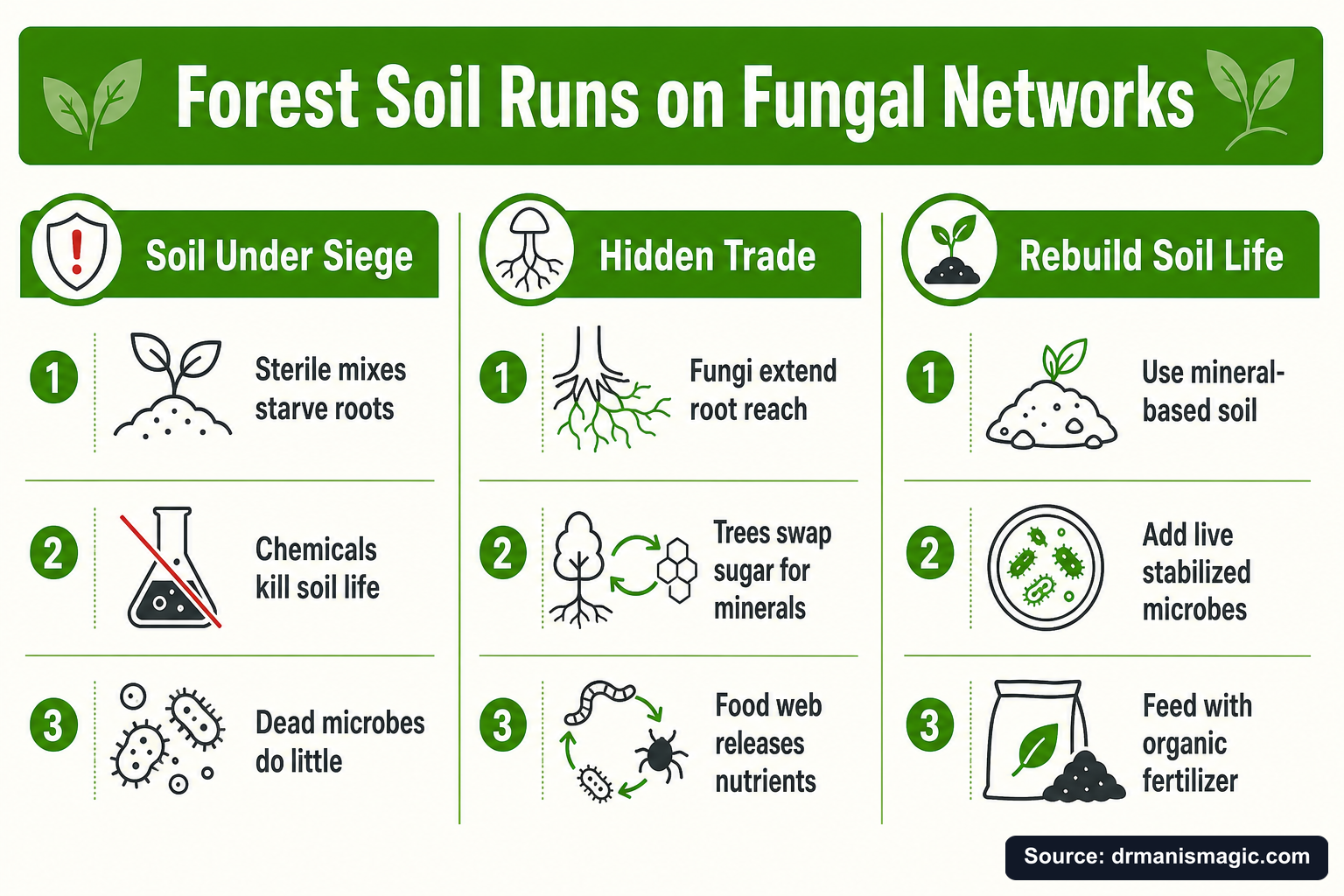
- Forests depend on fungal networks because fungi extend root reach, unlock nutrients, and connect trees to a living underground exchange economy.
- The full soil food web includes bacteria, fungi, protozoa, nematodes, earthworms, and arthropods — not just fungi alone.
- The popular "wood wide web" story is partly true but partly exaggerated. We will show you what the science actually confirms.
- Sterile potting mix, synthetic fertilizers, herbicides, and fungicides destroy the very biology that keeps plants alive.
- Dead or dried microbial products sold at garden centers often do nothing. Live, stabilized microbes are what actually move the needle.
- The Three Plant Pillars — mineral-based soil, live microbials, and organic fertilizer — are the foundation any plant needs to access this underground power.
- You can rebuild damaged soil biology, but it takes the right inputs, repeated application, and time.
What Do Fungal Networks Actually Do for a Forest?
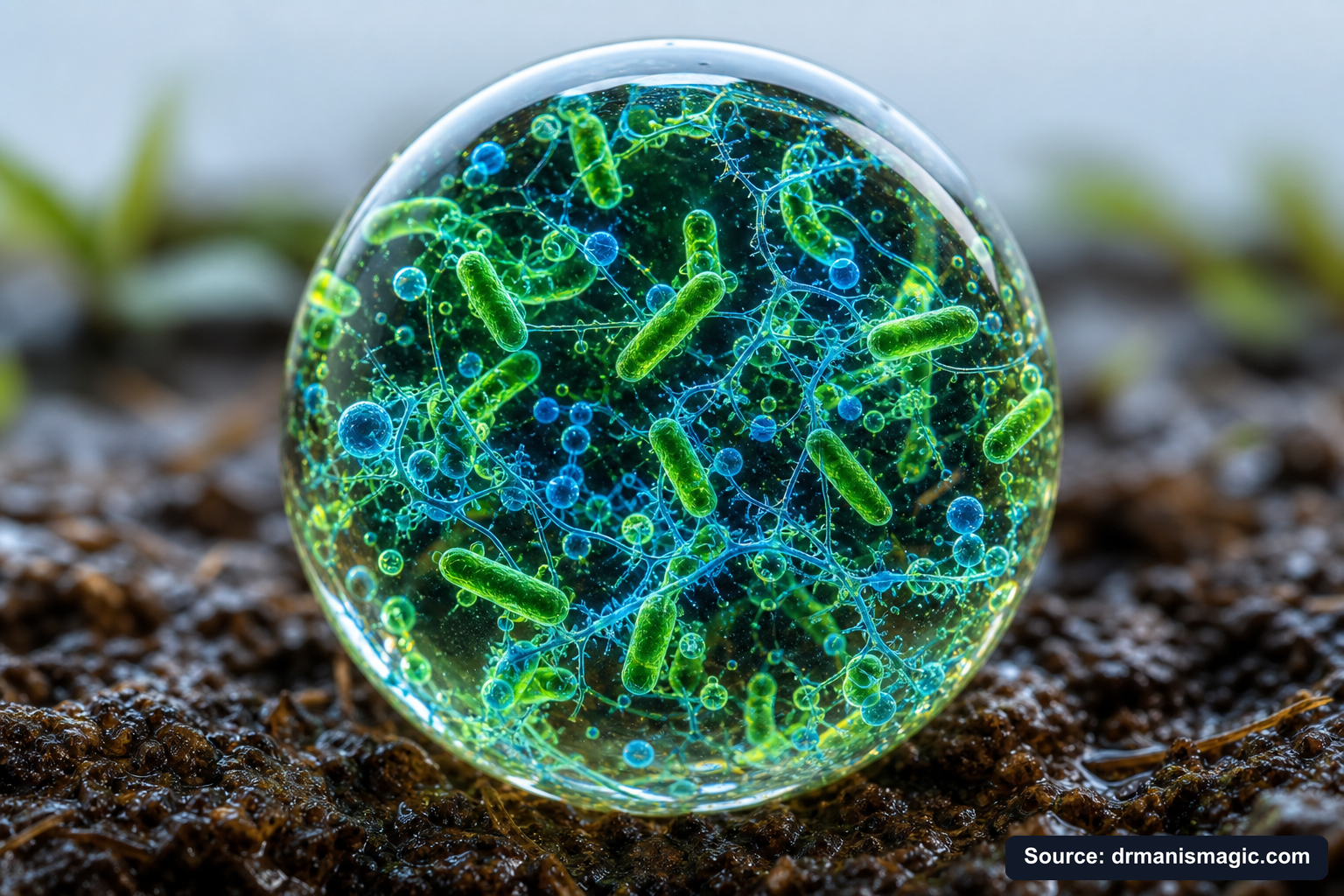
Quick Answer: Fungal networks extend tree root systems far beyond what roots can reach alone, delivering phosphorus, nitrogen, water, and micronutrients in exchange for carbon sugar from the tree. They also help stabilize soil, suppress disease, and support seedling establishment in ways that no amount of synthetic fertilizer can replicate.
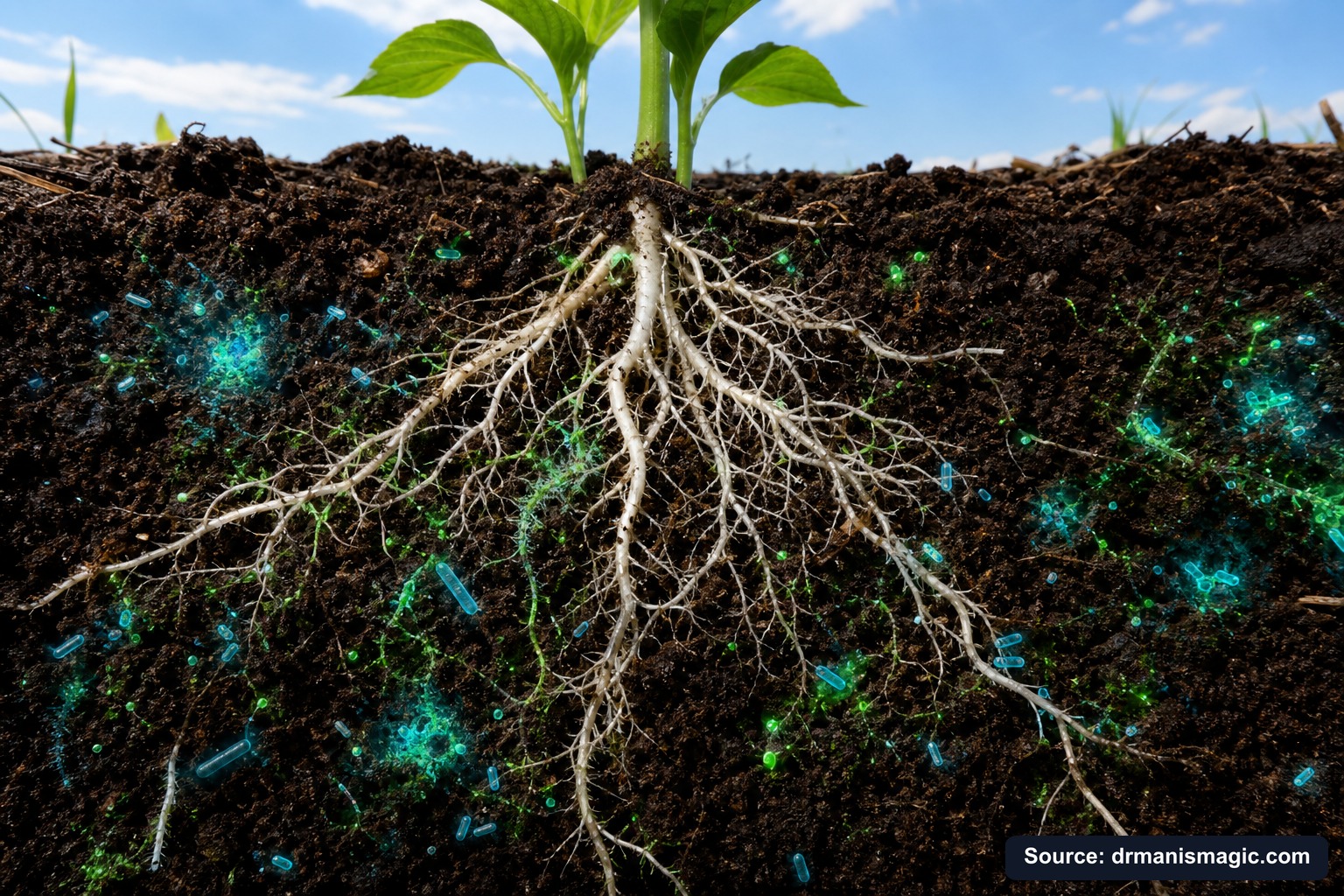
Picture a tree root. It can only grow so far, so fast. It can only squeeze into soil pores of a certain size. But a fungal thread — called a hypha — is incredibly thin. It can push into spaces the root could never reach. It can explore a far wider territory of soil, find phosphorus locked in mineral particles, and carry it back to the root.
This is the core deal: the tree feeds the fungus sugar through its roots. The fungus feeds the tree minerals and water in return. It is a trade agreement that has been running for roughly 450 million years, according to research from the University of Minnesota Extension. Long before humans ever farmed anything, plants and fungi had already worked out how to feed each other.
Here is what that partnership actually delivers:
- Phosphorus uptake. Phosphorus barely moves through soil on its own. Fungal hyphae mine it from rock particles and carry it directly to roots.
- Water access. Hyphae reach soil pores roots cannot. In a drought, this can mean the difference between survival and death.
- Nitrogen cycling. Certain fungi work alongside bacteria to pull nitrogen from organic matter and deliver it in plant-usable forms.
- Disease suppression. Dense fungal networks crowd out harmful pathogens. There is less room for the bad guys to get a foothold.
- Soil structure. Fungi produce a sticky protein called glomalin that glues soil particles together into clumps called aggregates. This creates air pockets roots need to breathe.
- Seedling support. Young seedlings in forests often establish faster when they connect to existing fungal networks already in the soil.
The Oklahoma State University Extension describes mycorrhizal fungi as one of the most important biological relationships in plant life, noting that the majority of land plants form some kind of mycorrhizal partnership. This is not optional biology. It is the default setting of healthy plant life on Earth.
What Is the Soil Food Web and Why Does It Go Beyond Fungi?
Quick Answer: The soil food web is the full community of living things in healthy soil — bacteria, fungi, protozoa, nematodes, earthworms, and arthropods — all feeding on each other in a chain that releases nutrients, builds structure, and keeps plants thriving. Fungi are powerful, but they are one part of a much bigger living system.
Here is where most popular content gets it wrong. Everyone talks about fungi like they are the only hero of the underground story. But healthy soil is more like a city than a single superhero. Every creature plays a role. Pull one out and the whole system wobbles.
Think of it this way. A leaf falls from a tree. What happens to it?
- Bacteria and fungi begin breaking it down.
- Protozoa eat the bacteria. When they do, they release nitrogen that was locked inside the bacteria cells — and that nitrogen becomes available to plant roots.
- Nematodes eat protozoa and bacteria. Same story — nutrients get released.
- Arthropods and earthworms shred bigger pieces of debris into smaller ones, giving bacteria and fungi more surface area to work on.
- Fungi decompose the toughest material — lignin, the woody stuff in stems and branches — that bacteria struggle to break down alone.
- The whole cycle feeds back into root-available nutrients, soil structure, and biological protection for plant roots.
This is the soil food web. It is an underground exchange economy where every organism is both producer and consumer. The USDA Natural Resources Conservation Service describes it as the engine of nutrient cycling in all natural ecosystems. When that engine runs well, plants thrive with almost no outside help. When it breaks down, plants struggle no matter how much synthetic fertilizer you pour on them.
| Organism | What It Does | Why It Matters for Your Plant |
|---|---|---|
| Bacteria | Decompose organic matter, fix nitrogen from air, solubilize minerals, suppress pathogens | Makes nutrients available; protects roots from disease |
| Mycorrhizal Fungi | Extend root reach, deliver phosphorus and water, produce glomalin for soil structure | Bigger effective root system; drought and disease resistance; better soil aeration |
| Other Fungi | Decompose lignin-rich woody material, compete with pathogens | Breaks down tough organic matter; suppresses root rot organisms |
| Protozoa | Graze on bacteria; release nitrogen when they digest | Drives the nitrogen cycle; keeps bacterial populations in balance |
| Nematodes (beneficial) | Eat bacteria, fungi, and other nematodes; release nutrients | Another layer of nutrient cycling; biological pest suppression |
| Earthworms | Shred debris, create channels, excrete rich castings | Improves drainage, aeration, and nutrient availability |
| Arthropods | Fragment litter, create habitat for smaller organisms | Speeds up decomposition; feeds the whole food chain |
When you walk into that old-growth forest and feel the spongy floor under your boots, that sponginess is this whole system at work. It took decades to build. It is incredibly productive. And it asks for almost nothing except to be left alone.
Your garden cannot wait decades. But you can speed up the process dramatically when you know what you are rebuilding.
Is the "Wood Wide Web" Real or Just a Good Story?
Quick Answer: The core science is solid: mycorrhizal fungi do form physical connections between trees, and nutrients and carbon do move through those connections. But popular claims about trees "talking," "choosing" who to help, or forests acting like a cooperative internet go beyond what research currently proves. The truth is fascinating enough without the exaggeration.
You have probably seen the viral documentaries. The ones that show trees whispering to each other through fungal threads. Mother trees sending sugar to their seedling children. Forests cooperating like a single wise organism. It is a beautiful story. And parts of it are true.
Here is what the research actually confirms:
- Mycorrhizal fungi do physically connect the roots of multiple trees in what scientists call a common mycorrhizal network (CMN).
- Carbon, water, and nutrients have been measured moving between connected trees through these networks.
- Seedlings in some forest systems do establish better when connected to existing fungal networks.
- Trees under stress do sometimes send chemical signals through root exudates and fungal connections that can affect neighboring plants.
Here is where the popular story gets ahead of the science:
- There is no evidence that trees "choose" to send resources to specific neighbors or "decide" to cooperate.
- The "mother tree" concept — older trees deliberately nurturing seedlings — is a compelling idea but remains scientifically debated. Some researchers dispute whether the transfers are intentional or simply a side effect of fungal networks optimizing their own survival.
- Forests are not an internet. Information does not flow the way data packets do. The connections are biological and chemical, not digital.
The honest version is actually more useful. Fungal networks create a web of physical connections that allow resources to move where the gradient pulls them. A shaded seedling with low carbon may receive carbon from a sun-lit adult tree because the concentration gradient allows it. Not because the adult tree decided to be generous. The outcome can look like cooperation. The mechanism is chemistry and physics.
For you as a grower, the practical takeaway is this: when fungal networks are present and healthy, your plants benefit from resource sharing, disease suppression, and better access to water and nutrients. When fungal networks are absent — destroyed by synthetic fungicides, salted by chemical fertilizers, or never present in sterile potting mix — your plant is on its own. And alone, it struggles.
What Destroys Fungal Networks and Kills Soil Biology?
Quick Answer: Synthetic fungicides kill beneficial fungi directly. Salt-based fertilizers draw water out of microbial cells and kill them through osmotic stress. Herbicides like glyphosate disrupt microbial communities. Compaction cuts off oxygen. Sterile potting mix starts with no biology at all. Each of these is a common part of mainstream gardening advice.
Here is the uncomfortable truth. Most of what garden centers sell you is designed to work fast and look good on the shelf. Not to build lasting soil biology. In fact, much of it actively tears that biology apart.
Let us go through the main offenders one by one.
Salt-Based Synthetic Fertilizers
When you pour a salt-based fertilizer on your soil, it creates a high-salt environment. Microbial cells, like plant root cells, lose water to that salt through osmosis. They shrivel. They die. You get a short burst of green growth because you temporarily flooded the soil with nitrogen. But you killed the workers who were supposed to keep feeding the plant naturally. A month later, you pour on more fertilizer. The plant becomes dependent. The soil becomes more and more lifeless. This is the addiction cycle that chemical companies built their business on. See also: The Hidden Reason Synthetic Fertilizers Cause Root Rot.
Synthetic Fungicides
Fungicides do not read labels. A broad-spectrum synthetic fungicide applied to fight one harmful fungus will also kill mycorrhizal fungi. Those are the same fungi extending your root system and pulling in phosphorus. You solve one small problem and create a much bigger invisible one.
Herbicides
Glyphosate — the active ingredient in many common weed killers — has been shown in multiple studies to disrupt soil microbial communities, reduce beneficial bacteria populations, and interfere with nutrient cycling. You spray the weeds. The weeds die. And something else dies quietly in the soil beneath them.
Sterile Potting Mix
Here is one almost nobody talks about. Most potting mix you buy at a big box store is sterilized. No biology. None. It is dead organic matter — mostly pine bark and sawdust — that will eventually compact into a root-choking sludge. Your plant gets dropped into a biologically empty container and is expected to thrive. No fungal network. No bacteria. No protozoa. Just dead material slowly breaking down around the roots. It is the opposite of a forest floor.
Compaction
Soil organisms need oxygen. When soil compacts — from heavy foot traffic, construction, heavy clay soils, or decomposing organic potting mix — air pockets collapse. Aerobic bacteria and fungi suffocate. Anaerobic organisms that cause root rot take over. The whole system flips from life-supporting to life-threatening.
You Never Had a Brown Thumb.
You were handed the wrong tools. This free guide hands you the right ones.
You watered it. You fed it. It died anyway.
It was never you. It was the dirt, the salt food, and the bad advice.
This guide shows you what really went wrong, and how to fix it for good.
- Why your plants really died, and why it was never your fault
- The salt hiding in your plant food that quietly burns the roots
- The hidden killer in almost every bag of store soil
- The tiny helpers that grow a whole forest for free
- The rescue trick that brings a half dead plant back to life
Myth vs. Mechanism: What Common Mycorrhizal Claims Are Actually True?
Quick Answer: Mycorrhizal connections are real and measurable. Nutrient transfer between connected plants is documented. Seedling benefits in forest systems are supported by evidence. Claims about intentional tree communication, mother-tree decision-making, or forest-wide cooperative behavior go beyond current science and should be treated as metaphor, not mechanism.
| Popular Claim | What Science Actually Shows | Verdict |
|---|---|---|
| "Trees talk to each other through fungi" | Chemical signals and resources do move through fungal connections. There is no evidence of intentional communication. | Poetic metaphor. Core mechanism is real. |
| "Mother trees feed their seedlings" | Carbon transfer from established trees to seedlings via CMNs has been observed. Whether it is "intentional" is debated. | Partially supported. Intentionality is not proven. |
| "Fungi form an internet under the forest" | Fungal networks connect many plants. Information does not flow digitally. Resources move along concentration gradients. | Useful metaphor. Not literal. |
| "Mycorrhizal fungi improve plant growth" | Extensively documented. Better phosphorus uptake, drought resistance, disease suppression, and root development. | Strongly supported by evidence. |
| "Mycorrhizae can save a dying tree" | Fungal inoculation helps most in low-biology soils. Cannot overcome severe root rot, extreme compaction, or advanced disease alone. | Helpful but not a miracle cure. |
| "All plants need the same fungi" | There are two main types: arbuscular mycorrhizal (AM) fungi for most garden plants, and ectomycorrhizal fungi for trees like oaks and pines. Matching matters. | False. Species-matching is important. |
| "Mycorrhizal networks improve seedling establishment" | Multiple studies confirm seedlings establish better in mycorrhizal-rich soils, especially under shade. | Well supported. |
Why Do Live Microbes Outperform Dried Powder Products?
Quick Answer: Dried and powdered microbial products often contain dead or dormant spores that never reactivate in soil. Compost-tea liquids frequently go anaerobic in shipping and arrive smelling foul, with most organisms already dead. Genuinely live, stabilized microbes — like those in Plant Super Boost — show visible activity under a microscope and deliver the full-spectrum biology your soil actually needs.
Walk into any garden center today and you will see a wall of microbial products. Bags of powder, jugs of brown liquid, colorful bottles promising billions of CFUs. Here is what most of them will not tell you.
Most powder products are made in giant factory vats. Specific strains of bacteria or fungi are brewed, then spray-dried into a powder. The hope is that the dormant spores will reactivate when you add water and pour them into soil. After testing dozens of these products across our nursery, we have seen very little consistent benefit. The organisms are too stressed, too narrow in spectrum, or too dead to make a real difference.
Liquid products from compost or earthworm castings are closer to nature — but they have a timing problem. Once that liquid goes anaerobic, which can happen within 24 hours of brewing without active aeration, the beneficial organisms begin dying. By the time the bottle ships, arrives at the store, sits on the shelf, and gets to your home, the biology you paid for is largely gone. The telltale sign? It smells terrible. That smell is death. Fermentation. The biology going backwards.
There is a third approach that many products use: lactobacillus bacteria, the same family found in yogurt. It is easy to keep alive. But in soil, it crowds out the very organisms you are trying to support. It belongs in your digestive system, not your root zone.
Here is what makes Plant Super Boost different. It is harvested from our own hand-crafted compost — not grown in a factory vat. Dr. Mani's partner, a world-renowned compostologist who has advised royal families and governments on farming practices, developed a proprietary all-natural stabilization technique that keeps the full spectrum of microbes alive without going anaerobic. The result is a liquid that smells earthy — not foul — because it is not rotting. It contains over 2,000 species of bacteria, 400 to 500 fungi including mycorrhizae, plus protozoa and beneficial nematodes. You can take a single drop, put it under a microscope, and see the organisms moving. That is not marketing copy. That is what live biology looks like.
| Product Type | Viability When You Use It | Spectrum of Organisms | Odor | What We Found in Testing |
|---|---|---|---|---|
| Dry / powdered lab microbes | Low — spores often do not reactivate | Narrow — a few selected strains | Neutral | Minimal to no measurable benefit |
| Dry microbes added to liquid | Low — same reactivation problem | Narrow | Neutral to slightly off | Minimal benefit; hard to verify |
| Compost tea (fresh, under 24 hours, aerated) | Moderate — time-sensitive | Partial — depends on compost source | Earthy, then sour | Excellent if truly fresh; impractical for most |
| Compost tea (old, over 24 hours) | Low — anaerobic die-off | Partial and declining | Strong foul odor | Not recommended |
| Lactobacillus-based products | High — survives well | Very narrow — single genus | Sour | Crowds out beneficial microbes; avoid in soil |
| Plant Super Boost (stabilized, full-spectrum) | High — stabilized, not anaerobic | 2,000+ bacteria, 400-500 fungi, protozoa, nematodes | Earthy — no foul smell | Visible microbial activity under microscope; lab-verified; consistent results |
What Happens to Soil Biology When Fungal Networks Are Destroyed?
Quick Answer: When fungal networks are destroyed — by chemicals, compaction, sterile soil, or construction — plants lose their nutrient delivery system, disease resistance drops, soil structure collapses, and roots become isolated. Recovery is possible but takes repeated inoculation with live biology and time measured in months, not days.
Think about what happens when you build a house. The construction crew rolls in heavy equipment. They scrape the topsoil away. They compact the subsoil with machinery weighing tens of thousands of pounds. Then they bring in a load of fill dirt from somewhere else and call it a yard. That soil has almost nothing alive in it. No fungi. No food web. No structure. Just mineral particles pressed together with most of the air squeezed out.
Now picture a tree planted in that yard. It is trying to access a fungal network that does not exist. It is trying to tap into a nutrient cycling system that got buried under a parking lot. It is reaching for help that is simply not there.
This is not just a construction site problem. It happens every time you use a broad-spectrum fungicide. Every time you pour salt-based synthetic fertilizer on your garden and kill the microbial community living in the root zone. Every time you pot a plant in sterilized potting mix and expect it to behave like it is growing in a forest.
The good news is that biology is resilient. Given the right inputs and enough time, damaged soil can recover. But it does not happen by accident, and it does not happen fast. The Penn State Extension's soil microbiome research shows that disturbed soils can take years to fully recover microbial diversity without active intervention. With the right live biology introduced consistently, that window shortens dramatically.
How Do You Rebuild Fungal Networks and Soil Biology in Your Garden or Pots?
Quick Answer: Rebuilding soil biology requires removing the inputs that kill microbes, introducing a full-spectrum live microbial product monthly, switching to organic fertilizer that feeds rather than burns the soil, and giving the system time to establish. The Three Plant Pillars — mineral soil, live microbes, and organic fertilizer — are the fastest proven path to recovery.
Here is the honest timeline. If your soil has been hit hard — by years of synthetic fertilizer, a dose of herbicide, compaction, or it is just sterile potting mix from a bag — you are not going to restore a full forest floor food web in two weeks. But you can start seeing measurable change within a month. And within a growing season, a properly supported soil system will be producing results you can see and feel.
We have watched this happen across 250,000 trees at our South Texas nursery. We have watched it happen in home gardens from Texas to New York. The biology responds when you give it what it needs and stop giving it what kills it.
Here is a practical recovery checklist:
- Stop the killers first. Put down the synthetic fungicides. Stop the salt-based fertilizer. Avoid broad-spectrum herbicides in and around your planting area. You cannot rebuild a workforce while actively poisoning it.
- Fix the soil structure. If you are in a container, consider switching to a mineral-based soil that does not compact and does not steal oxygen from roots as it decomposes. If you are in the ground, add organic matter and aerate compacted areas. Roots need oxygen. Microbes need oxygen. Super Soil was built specifically to solve this problem — it is permanent, mineral-based, and designed to give roots the drainage and aeration they need to thrive.
- Introduce live, full-spectrum biology monthly. Not a dried powder. Not a foul-smelling liquid. Genuinely live, stabilized microbes applied on a regular schedule. This is how you recolonize a depleted root zone.
- Feed the microbes, not just the plant. Switch to an organic, slow-release fertilizer. Salt-based synthetic fertilizers feed the plant temporarily and kill the biology permanently. Organic fertilizers — made from sources like crab, kelp, and amino acids — feed the soil food web and let the web feed the plant. That is the natural order. Our Crab, Kelp and Amino Acids fertilizer was formulated exactly for this purpose: zero synthetic salts, zero biosludge, zero PFAS, slow-release nutrition that works with your microbes instead of against them.
- Be patient and consistent. Apply live microbes every month. Give the biology time to establish, multiply, and connect. A single application is a start. A consistent monthly regimen is a transformation.
- Protect what you build. Once biology is re-establishing, protect it. Avoid anything that resets the clock. Water deeply but not excessively. Let organic matter accumulate on the soil surface like a forest floor does.
- Watch for the signs of life. Earthworms returning. Rich earthy smell. Roots that look white and healthy. Faster new growth. These are not accidents. These are what a recovering soil biology looks like from the outside.
The Three Plant Pillars are the framework that holds this whole recovery plan together. Mineral-based soil that breathes. Live microbials that rebuild the underground workforce. Organic fertilizer that feeds the system without burning it. When all three are in place, the soil stops being a problem you manage and starts being a system that works for you.
What Does This Mean for Your Plants Right Now?
Quick Answer: Every plant you own — tree, houseplant, garden bed, lawn, flower pot — is trying to access the same soil biology that keeps forests alive. If the biology is missing or dead, the plant struggles no matter how much water or fertilizer you add. Restoring live soil biology is the single highest-leverage thing most home gardeners can do.
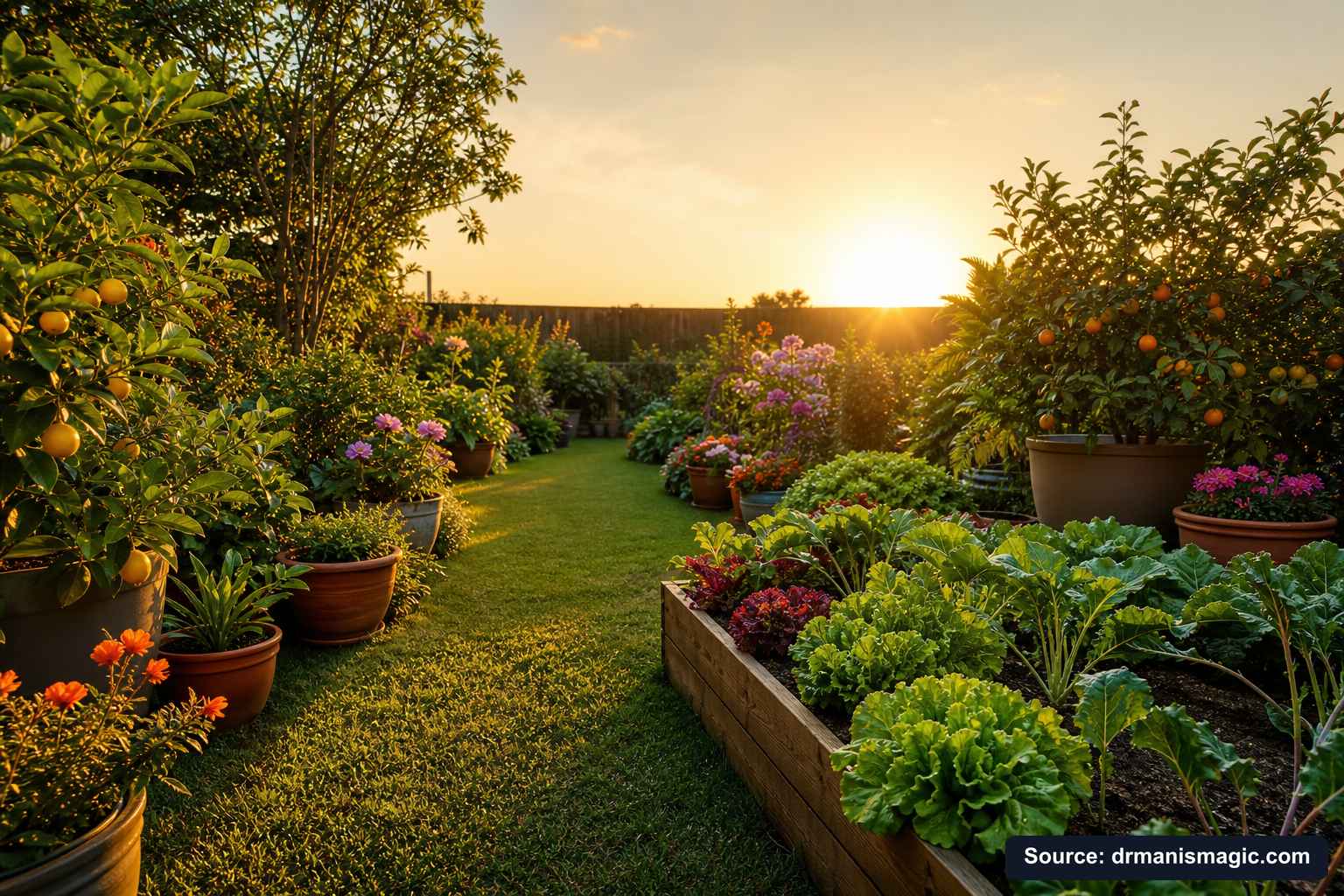
You do not need acres of forest to benefit from this science. The same biology that keeps a 200-year-old oak alive is trying to work in the pot on your kitchen counter. In the raised bed out back. In the fruit tree you planted last spring and watched turn yellow despite everything you tried.
Here is what we know after 30 years of growing at our South Texas nursery and testing on over 250,000 trees. When the soil is right — when it breathes, when the biology is present and fed, when the fertilizer works with the microbes instead of against them — plants do not just survive. They thrive in a way that feels almost effortless. Growth comes faster. Disease pressure drops. Drought resistance goes up. Fruit sets more reliably. Color deepens. The whole plant looks and feels different.
That is not magic. That is what plants look like when they have access to the underground partnership they evolved with over hundreds of millions of years.
The people we work with most often tell us the same thing. They spent years chasing symptoms — yellowing leaves, root rot, slow growth, weak fruiting — with more and more products. Nothing stuck. Then they addressed the foundation. The soil. The biology. The nutrition. And everything changed. One of the most common things we hear is some version of: "I just want to see fruit on this tree while I still can." We hear that more than anything else. That is a real human desire — to nurture something from the ground up and see it bear fruit in your lifetime. Not after years of false starts. Not after the third dead tree. Now. While you have time to enjoy it.
Time is the one thing you cannot get back. Every month a plant spends in biologically dead soil is a month of growth lost. You can always get more fertilizer. You can always buy another bag of soil. But you cannot get back the season that passed while your tree sat struggling in a lifeless container.
The good news is that starting is simple. The Free Plant Care Field Guide walks you through the Three Plant Pillars step by step — no jargon, no guesswork, just the foundation that has worked on our nursery trees and in home gardens across America. If you want to put the underground workforce to work in your own soil, that is the place to start.
See also: Why Most Fertilizers Are Actually Salt in Disguise
Frequently Asked Questions
Fungal networks are the hidden engine behind every healthy forest. Once you understand what they do underground, you will never look at your garden soil the same way again. These questions cover what the science actually shows and what it means for every plant you are trying to grow.
Why do forests depend on fungal networks?
Tree roots can only reach so far. Fungal threads called hyphae are incredibly thin and can push into soil spaces roots can never reach. They pull in phosphorus, water, and minerals, then trade them to the tree in exchange for sugar. Without this underground deal, most trees would struggle to survive. At our South Texas nursery, we saw this play out across more than 250,000 trees. The ones with active fungal partnerships thrived. The ones without them stalled.
Why are fungi so important in nature?
Fungi do two huge jobs. First, they break down dead leaves, wood, and organic matter and turn them into nutrients plants can actually use. Second, certain fungi connect directly with plant roots and deliver minerals the plant could never find on its own. No fungi means nutrients stay locked up in the soil and plants go hungry. It is that simple. This is one reason Dr. Mani built live fungal biology directly into Plant Super Boost.
What types of fungi live in forests?
Three main groups do the heavy lifting. Mycorrhizal fungi attach directly to tree roots and run the nutrient trade system. Decomposer fungi break down dead wood and leaf litter and recycle what is locked inside. Endophytic fungi live inside plant tissue and help fight off disease. All three work together. Healthy forest soil has all three groups active and balanced. Most garden soils and cheap potting mixes have none of them.
Why do fungi grow in forests?
Forests give fungi exactly what they need. There is organic matter to feed on, tree roots to partner with, and undisturbed soil to thread through. Fungi grow where conditions let them survive. The problem in most backyards and containers is that synthetic fertilizers, herbicides, and dead potting mix wipe out fungal life before it ever gets started. That is why Dr. Mani designed Super Soil and Plant Super Boost to rebuild the conditions fungi need to thrive.
What is a mycorrhizal network and what does it do?
A mycorrhizal network is the web of fungal threads connecting plant roots underground. Trees use it to share carbon, water, and nutrients. Some research suggests trees even send chemical warning signals through it when pests attack nearby plants. Think of it as a living communication and supply system running silently beneath your feet. Plant Super Boost puts live mycorrhizae directly into your soil so your plants can plug into that same ancient system right away.
Does synthetic fertilizer hurt fungal networks?
Yes, and this is one of the biggest secrets the big chemical companies do not want you to know. Salt-based synthetic fertilizers flood the soil with concentrated nutrients. When that happens, the tree stops trading with fungi because it does not need to. The fungal network weakens and dies back. Over time your plant becomes dependent on the chemical and loses its natural underground support system. Dr. Mani built the Three Plant Pillars around organic inputs specifically to protect and feed the microbial life your plants depend on.
Can I rebuild fungal networks in my own garden or containers?
You can, but it takes the right inputs and some patience. Dead or dried microbial products from the garden center shelf often do nothing because the biology is already gone. You need live, stabilized microbes. That is exactly what Plant Super Boost delivers. Pair it with mineral-based Super Soil that does not compact and choke roots, add organic fertilizer like our Crab, Kelp and Amino Acids blend, and you are giving your plants the same Three Plant Pillar foundation we used to grow over 250,000 healthy trees in South Texas.
About the Author
Dr. Mani Skaria, PhD
Dr. Mani Skaria, PhD, is a plant pathologist and the scientific founder of Dr. Mani's Magic. He earned his doctorate at Purdue University and spent 48 years studying how plants, soil, and living microbes work together, including his years as Professor Emeritus at Texas A&M and as a member of the USDA NAREEE Advisory Board. He invented micro-budding, a method for growing healthier, stronger trees, and has grown more than 250,000 trees on the family farm in Hargill, Texas - US Citrus Nursery. His life's work takes real lab science and practical experience and turns it into simple, safe, organic plant care anyone can use at home.


