


Why Fungi Are the Slow, Strategic Power of Soil | Dr. Mani's Magic
Why Fungi Are the Slow, Strategic Power of Soil (And Why Your Plants Can't Win Without Them)
Picture this. You pull a weed out of a crack in the sidewalk. A stubborn one. The kind that grows through concrete like it owns the place. You yank it up, roots and all, and there it is: a tangled web of white fuzz clinging to every root hair. It looks almost alive. It is alive. Those white threads are fungi. And that weed? It's not thriving in spite of terrible conditions. It's thriving because of those threads.
Now walk over to your garden bed. Your potted lemon tree. Your lawn. The roses you planted last spring that never quite took off. Ask yourself: do those roots have that same white fuzz? Probably not. Most managed soil — the bagged stuff from the store, the raised bed mix, the sod someone rolled out — is biologically empty. The fungi are gone. And without them, your plants are fighting every single day with one hand tied behind their back.
Here's what most people never find out: bacteria get all the glory in soil health conversations. Fast-acting, visible, measurable. But fungi? Fungi are doing something far deeper. Something slower. Something most gardeners, most fertilizer companies, and most big box stores have never once explained to you. Fungi are building the underground highway your entire garden depends on. And when they're gone, no amount of fertilizer in the world can replace what they do. Let's fix that gap right now.

Plant Super Boost
Key Takeaways
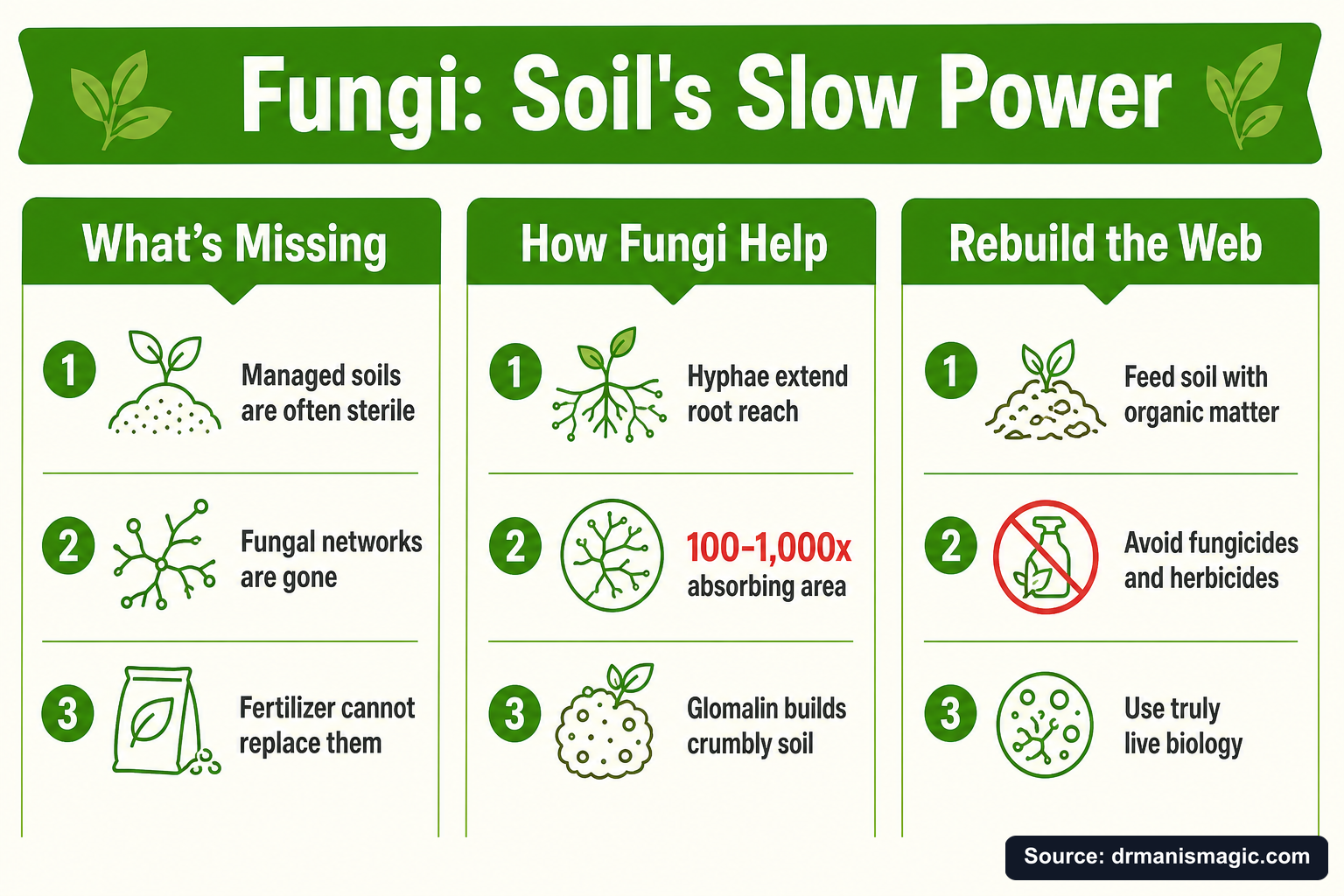
- Fungi are the slow infrastructure-builders of soil — they create the underground networks that hold everything else together.
- Bacteria act fast but burn out; fungi act slow but build lasting structure, drought resistance, and nutrient access.
- Mycorrhizal fungi can expand a plant's root absorbing area by 100 to 1,000 times, according to Colorado State University Extension research.
- The full soil food web — bacteria, fungi, protozoa, and nematodes — works as a team. Remove one player and the whole system weakens.
- Synthetic fertilizers, fungicides, herbicides, and sterile potting mixes all destroy fungal networks, often permanently.
- Most commercial microbe products are dead on arrival — dried powders or smelly liquids that deliver little to no living biology.
- Rebuilding fungal infrastructure takes time, the right habitat, and genuinely live biology — not a quick fix from a shelf.
What Do Soil Fungi Actually Do That Bacteria Can't?
Quick Answer: Soil fungi build the long-term underground structure that bacteria cannot. They break down tough carbon, form physical networks called hyphae that bind soil particles together, extend root reach by hundreds of times, store carbon, and buffer plants against drought and disease. Bacteria cycle nutrients fast. Fungi build the roads those nutrients travel on.
Think of bacteria as the sparks. They ignite fast. They break down fresh sugars, simple residues, and soft plant material in a matter of hours or days. They're the first responders of the soil. Brilliant at their job. But sparks burn out.
Fungi are the wiring. They grow slowly through the soil, threading microscopic filaments called hyphae into every crack, every pore, every crumb of organic matter. These threads don't burn out. They persist. They connect. They remember where the nutrients are.
Where bacteria work with fresh, simple food, fungi specialize in the tough stuff. Dead wood. Thick roots. Waxy leaves. Lignin — the hard scaffolding inside plant stems that almost nothing else can break down. Fungi are patient enough to take it on, slowly converting it into stable organic matter that stays in the soil for years.
And then there's their most important trick: glomalin. This sticky protein, produced by a specific group of fungi called mycorrhizae, acts like biological glue. It binds tiny soil particles into larger clumps called aggregates. Those aggregates create air pockets. Air pockets let roots breathe. They let water drain properly. They prevent compaction. Glomalin is the reason healthy forest soil feels crumbly and alive, while compacted clay or sterile potting mix feels like concrete after a season.
Without fungi building that structure, you don't have soil. You have dirt. And dirt doesn't grow much of anything worth eating.
What Are Mycorrhizal Fungi and Why Does Every Gardener Need to Know This?
Quick Answer: Mycorrhizal fungi are a special group of fungi that form a partnership directly with plant roots. They plug into the root and extend the plant's reach far beyond what roots alone can do — up to 1,000 times the absorbing surface area. In exchange, the plant feeds them sugars. This trade has powered plant life on Earth for over 400 million years.
The word "mycorrhizae" comes from the Greek words for fungus and root. Mykos. Rhiza. Fungus-root. That's exactly what it is: a living merger between plant and fungus.
Here's how it works. The plant's roots grow out into the soil. The mycorrhizal fungus attaches to those roots and then sends out its own threads — hyphae — much thinner than any root hair could ever be. Those threads squeeze into spaces no root can reach. They explore a far wider territory. They find phosphorus, zinc, copper, and water that the plant's roots would never encounter on their own.
According to Colorado State University Extension, mycorrhizal fungi can increase a plant's root absorbing area by roughly 100 to 1,000 times. Let that sink in. Your plant could be accessing a thousand times more of the soil than it currently does. That's not a minor improvement. That's the difference between a plant that barely survives and one that thrives through drought, disease, and stress.
In exchange for this incredible service, the plant gives the fungus something it can't make on its own: sugar. Simple carbon-based food, produced by photosynthesis and shipped down through the roots. The plant feeds the fungus. The fungus feeds the plant. This deal has been running uninterrupted for over 400 million years, according to fossil records cited by researchers at University of Minnesota Extension.
And here's what the nursery industry almost never tells you: most potting mixes are sterile. The mycorrhizae are dead. Your plant arrives in a bag of biologically empty material, and unless someone adds live fungi back in, that 400-million-year partnership never gets started.
At US Citrus Nursery, after growing and testing more than 250,000 trees in South Texas, we saw this pattern over and over. Trees in sterile media struggled. Trees with live mycorrhizal fungi in the root zone pushed through. Every time.
How Does the Full Soil Food Web Actually Work?
Quick Answer: The soil food web is a living community of bacteria, fungi, protozoa, nematodes, arthropods, earthworms, and plant roots, all exchanging carbon and nutrients in a continuous loop. Bacteria and fungi do the breaking down. Protozoa and nematodes graze on them, releasing nutrients right where plant roots can grab them. Remove any layer and the whole system slows down.
Most people think soil biology means bacteria. Maybe fungi. But the real story is bigger and more beautiful than that.
Imagine a city. Bacteria are the factory workers — fast, productive, everywhere. Fungi are the road system — slow to build, but everything moves through them. Protozoa are the managers. They eat the bacteria and fungi, and when they do, they release nitrogen and phosphorus right next to the roots. Nematodes are the specialized contractors — some eat bacteria, some eat fungi, some eat other nematodes. Arthropods and earthworms are the heavy equipment, physically breaking down organic matter and creating new tunnels and channels as they move.
Every layer feeds the next. Every layer releases nutrients. And the plant is at the center of it all, pulling in what it needs and pumping sugars back out to feed the workers.
Here is the part that most gardeners never hear: protozoa and nematodes are not pests. They are the nutrient-release engine. UC Davis research on the soil food web shows that when protozoa graze on bacteria, they excrete nitrogen in plant-available form right in the root zone — precisely where the plant needs it most. Without protozoa, you could have billions of bacteria packed with nutrients, and the plant still can't access them.
| Organism | Speed | Primary Role | What Happens Without Them |
|---|---|---|---|
| Bacteria | Fast | Break down simple sugars and fresh organic matter; cycle nutrients quickly | Slow nutrient cycling; poor decomposition of fresh inputs |
| Fungi (saprophytic) | Slow | Break down tough carbon like wood and lignin; build stable organic matter | Carbon loss; poor long-term soil structure |
| Fungi (mycorrhizal) | Slow to establish | Extend root reach 100-1,000x; deliver phosphorus, water, zinc; produce glomalin for soil aggregation | Reduced nutrient and water access; compaction; drought stress |
| Protozoa | Moderate | Graze on bacteria; release plant-available nitrogen and phosphorus near roots | Nutrients locked inside bacteria; plant starvation despite rich soil |
| Nematodes (beneficial) | Moderate | Graze on bacteria and fungi; regulate populations; release nutrients | Imbalanced microbial populations; reduced nutrient release |
| Earthworms | Slow | Physical breakdown of organic matter; create channels for air and water; deposit castings | Compaction; poor drainage; reduced organic matter processing |
| Arthropods | Variable | Shred organic matter; create habitat; move microbes through soil | Slower organic matter breakdown; reduced microbial distribution |
This is why the Three Plant Pillars are built the way they are. Not just bacteria. Not just fungi. The full spectrum. Because a partial soil food web is like a car with two cylinders. It moves, barely. But it doesn't perform.
Why Are Fungi Slower Than Bacteria — and Why Does That Actually Make Them More Powerful?
Quick Answer: Fungi grow slowly because they're building physical infrastructure, not just running chemical reactions. Hyphal threads take time to extend through soil. But once established, fungal networks persist for months or years, storing carbon, holding water, anchoring aggregates, and providing plant access to nutrients that bacteria can't reach. Slow means lasting.
Speed sounds good. But in soil biology, speed has a cost.
Bacteria respond to a sugar hit like a sprinter off the blocks. They multiply fast, eat fast, and cycle nutrients fast. Pour on a soluble fertilizer and bacteria explode in population, then crash when the food runs out. The boom-bust cycle feels productive, but it doesn't build anything lasting.
Fungi take a different approach. They grow steadily. Their hyphae extend millimeter by millimeter through the soil, forming physical connections that don't disappear when conditions change. Those connections hold moisture during dry spells. They bridge gaps between soil particles. They channel carbon deep into the soil profile where it can be stored for years instead of released into the air as CO2.
This is why natural ecosystems recover from drought so much better than managed fields or gardens. The fungal network is still there. It survived. It buffered the stress. And when rain returns, the network is already in place to capture it, hold it, and move it to plant roots.
Compare that to a lawn or garden that's been hit with synthetic fertilizers season after season. The fungi are gone. The aggregates have broken down. The soil is compacted. When drought hits, there's nothing to buffer it. The plant wilts. The gardener panics. More fertilizer goes on. More fungi die. The cycle tightens.
We saw this play out thousands of times at our South Texas nursery. Trees with active fungal communities in the root zone held through summer heat that would have killed a tree in sterile mix. Not because they had more fertilizer. Because they had infrastructure.
Are Fungi Better Than Bacteria in Soil — or Do You Need Both?
Quick Answer: You need both, but they do different jobs. Bacteria are fast responders that cycle nutrients from fresh organic matter. Fungi are slow builders that create structure, extend root reach, and buffer long-term stress. A healthy soil food web runs both simultaneously. Choosing one over the other is like choosing between a spark plug and an engine block.
This isn't a competition. It's a partnership.
Bacteria and fungi divide the work naturally. Bacteria dominate in the zone right around roots — the rhizosphere — where fresh sugars from root exudates give them easy food. Fungi dominate further out, working through tougher material and extending the network into territory roots and bacteria can't reach.
When both are present and healthy, the results multiply. Bacteria cycle nutrients fast enough for immediate plant needs. Fungi hold the structure in place so those nutrients don't wash away. Protozoa graze on bacteria and release plant-available nitrogen right where it's needed. Nematodes regulate the whole system. The plant sits in the middle of this living web, feeding and being fed in return.
But here's the problem with most gardens and most managed growing environments: the fungi are usually the first to go. They're more sensitive to disturbance. Tillage shreds their hyphae. Fungicide kills them outright. Salt-based fertilizers raise the osmotic pressure in the soil and stress or kill them. Sterile potting mixes contain none to begin with.
Bacteria can bounce back in days or weeks from a disruption. Fungi take months or years to rebuild. That's why so many gardens that look okay on the surface — green leaves, decent growth — are quietly losing ground. The bacterial layer is still functioning. The fungal layer is gone. And without it, the soil is slowly losing structure, losing carbon, and losing its ability to buffer any kind of stress.
See also: The Hidden Reason Synthetic Fertilizers Cause Root Rot
What Destroys Soil Fungi — and Is Your Garden Already Affected?
Quick Answer: Synthetic fungicides directly kill beneficial fungi. Salt-based fertilizers stress and kill fungal hyphae through osmotic pressure. Herbicides like glyphosate disrupt fungal communities. Tillage physically shreds hyphal networks. Sterile potting mixes start with zero fungi. If you've used any of these regularly, your fungal network is likely damaged or gone.
You might be surprised to learn that many standard gardening practices are quietly waging war on your soil fungi.
Let's go through the list honestly.
Synthetic fungicides. Designed to kill fungal disease. The problem is they don't distinguish between pathogenic fungi and beneficial mycorrhizae. One application can wipe out years of fungal network development. The disease goes away. So does your underground infrastructure.
Salt-based fertilizers. This is the one the big chemical companies don't talk about. Synthetic fertilizers are salts. When you pour them into the soil, they raise the osmotic pressure. Water moves away from biological cells — including fungal hyphae — through osmosis. The hyphae dehydrate and die. You get a green flush of growth from the soluble nutrients. Then the fungi are gone, the structure collapses, and the next application has to be bigger to get the same response. The addiction cycle Dr. Mani Skaria spent decades warning about.
Glyphosate and synthetic herbicides. Research shows these compounds disrupt microbial communities broadly, including fungi. Even at sub-lethal doses, herbicide residues in soil shift microbial populations away from beneficial species.
Tillage. Every time you turn the soil, you shred fungal hyphae. Deep tillage can destroy years of network building in one afternoon. No-till and minimal disturbance practices exist specifically because researchers recognized this cost.
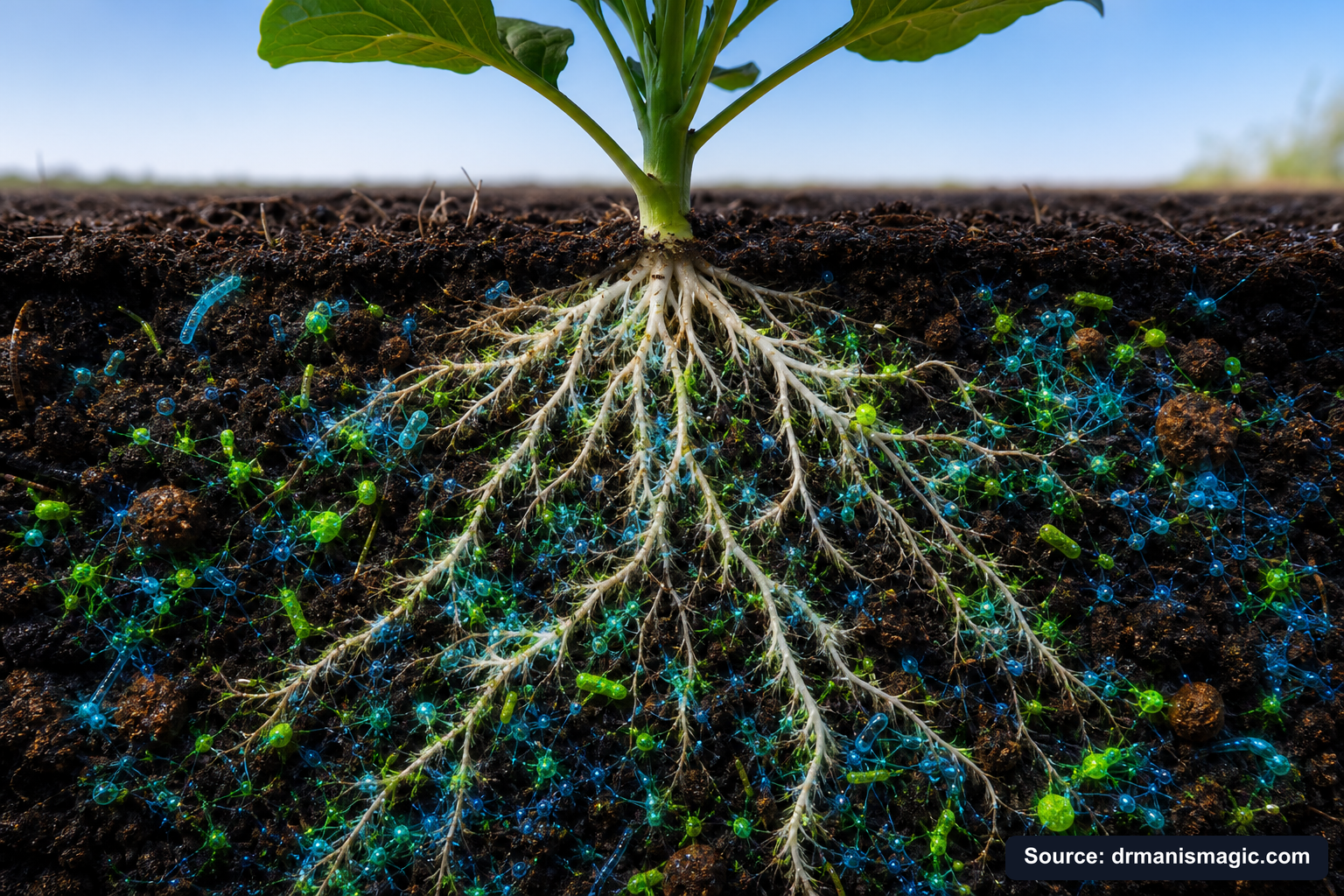
Sterile potting mixes. Most commercial potting mixes are steam-pasteurized or chemically treated to kill pathogens. Smart in theory. The problem is they kill everything. You get a clean slate with zero biological life. Your plant sits in a nutritional desert and waits for someone to add life back in.
If any of these sound familiar — and for most gardeners, several will — your fungal network is compromised. Maybe partially. Maybe severely. The good news is that biology can recover. But recovery takes time, the right habitat, and genuinely live inputs. Not a powder off a shelf. Not a smelly bottle. Live, active biology.
You Never Had a Brown Thumb.
You were handed the wrong tools. This free guide hands you the right ones.
You watered it. You fed it. It died anyway.
It was never you. It was the dirt, the salt food, and the bad advice.
This guide shows you what really went wrong, and how to fix it for good.
- Why your plants really died, and why it was never your fault
- The salt hiding in your plant food that quietly burns the roots
- The hidden killer in almost every bag of store soil
- The tiny helpers that grow a whole forest for free
- The rescue trick that brings a half dead plant back to life

Bacteria vs. Fungi: A Direct Comparison
Most gardening content picks a side. We're going to show you both so you can see exactly why the full spectrum matters more than either one alone.
| Feature | Bacteria | Fungi |
|---|---|---|
| Speed of action | Fast — days to weeks | Slow — weeks to months |
| Primary food source | Simple sugars, fresh organic matter | Tough carbon: wood, lignin, waxy residues |
| Soil structure contribution | Minor — some aggregation through biofilms | Major — glomalin production, hyphal binding of aggregates |
| Root reach | Concentrated in root zone | Extends 100-1,000x beyond root zone (mycorrhizae) |
| Carbon storage | Low — rapid cycling releases CO2 | High — stable humus formation, long-term storage |
| Drought buffering | Low | High — hyphae transport water; glomalin holds aggregates |
| Sensitivity to disturbance | Moderate — can recover in days to weeks | High — can take months to years to recover |
| Killed by fungicide | No (most fungicides target fungi) | Yes — including beneficial mycorrhizae |
| Killed by salt-based fertilizer | Yes, partially | Yes — hyphae dehydrate under osmotic stress |
| Present in sterile potting mix | No | No |
| Time to establish after inoculation | Days to weeks | Weeks to months |
Do Mycorrhizal Inoculant Products Actually Work — or Are They Dead Before They Reach You?
Quick Answer: Most commercial mycorrhizal and microbial products are either dried lab-grown spores with low viability or liquid compost-tea-style products that go anaerobic and die before they arrive. Both categories consistently underperform. Live, stabilized biology — harvested from active compost and preserved through an all-natural process — is what actually delivers results in the root zone.
This is where the conversation gets uncomfortable. Because there are a lot of products on the market claiming to deliver beneficial fungi, mycorrhizae, and live bacteria. Most of them don't work. And after testing dozens of batches over decades at US Citrus Nursery, we can tell you exactly why.
Category one: dried powders. These products are made in large industrial facilities. Microbes are grown in vats, then dried into powder form. The companies hope the spores will reactivate when water is added and poured into soil. In our testing across hundreds of trees and multiple batches from multiple suppliers, these products showed no measurable plant response. The drying process kills most of the organisms. The survivors are so stressed that they rarely establish in soil conditions.
Category two: liquid products that smell bad. These are typically compost-tea-style liquids. They start with genuine biology from compost or earthworm castings. The problem is they go anaerobic — they run out of oxygen — during shipping and storage. The microbes die and begin to ferment. You know this product the moment you open it. It smells like sewage. Some bottles even hiss when you open them, releasing fermentation gas. The biology is dead. Whatever benefit you get is from residual organic compounds like humic acid, not from living organisms.
Category three: lactobacillus products. Easy to produce, highly vigorous, widely sold. The problem is lactobacillus — yes, the same bacteria in yogurt — outcompetes and overwhelms the beneficial organisms you actually want in your soil. It belongs in your gut. Not your garden bed.
Fresh compost, made properly and applied within 24 hours of brewing into a tea, is genuinely effective. But that requires time, equipment, turning, monitoring, and perfect timing. Most gardeners don't have that.
What Dr. Mani Skaria spent years developing — and what the world-renowned compostologist who joined our team at US Citrus Nursery perfected — is a way to stabilize the full spectrum of biology from active compost without letting it go anaerobic. The result is Plant Super Boost: a liquid microbial product that smells like earth, not sewage, because the biology inside it is alive and stable, not dying. You can put a drop under a microscope and watch the organisms move. Lab analyses confirm viability. This is what living biology actually looks like.
| Product Type | Viability at Use | Spectrum of Organisms | Smell | Our Assessment |
|---|---|---|---|---|
| Dried / powdered lab microbes | Low | Narrow (few selected species) | Neutral | No measurable plant response in our testing. Avoid. |
| Dried powder rehydrated in liquid | Low | Narrow | Neutral | Same problem. Hard to identify on label. Avoid. |
| Compost tea — fresh, under 24 hours | Moderate to high | Broad, natural | Earthy, slightly sour | Works if made and used immediately. Time-sensitive and labor-intensive. |
| Compost tea — old, over 24 hours | Very low (anaerobic) | Partial | Strong sewage odor | Biology dead. Some residual organic benefit only. Not recommended. |
| Lactobacillus products | High (but wrong organisms) | Narrow (lactobacillus dominant) | Sour | Outcompetes beneficial organisms. Not for soil use. |
| Fresh active compost (on-site) | High | Broad and natural | Earthy | Excellent if you have time, space, and skill to manage properly. |
| Plant Super Boost (stabilized, full-spectrum) | High — confirmed by lab analysis | 2,000+ bacteria species; 400-500 fungi including mycorrhizae; protozoa; nematodes | Earthy — not foul | Harvested from compost, stabilized by all-natural process. Visible under microscope. Our recommended choice. |
How Long Does It Take for Soil Fungi to Recover After Damage?
Quick Answer: Fungal recovery depends on how severe the damage was and what conditions exist afterward. Bacteria can bounce back in days. Fungi take weeks to months under good conditions — and years if the habitat hasn't been restored first. Adding live biology helps, but the soil must also have organic matter, stable moisture, living roots, and no ongoing chemical pressure for fungi to establish and spread.
This is the question most gardeners ask too late. They've been using synthetic fertilizer for three seasons. Their lawn hasn't responded the way it used to. Their potted tree is yellowing despite regular feeding. They start researching. They find out about fungi. They want to know: how long until it comes back?
The honest answer is: it depends. And the first thing that has to happen before fungi can recover is the damage has to stop.
You can't pour live mycorrhizae into a bed that's still getting drenched in salt-based fertilizer every month and expect them to survive. You can't add a microbial product to soil that's still being treated with a broad-spectrum fungicide. The habitat has to be ready before the biology can take hold.
Here's a practical recovery checklist we use at US Citrus Nursery for damaged, sterile, or chemically compromised soil:
- Stop the disturbance. Halt synthetic fertilizers, herbicides, and fungicides. No more tillage if you can avoid it. This is the non-negotiable first step.
- Check pH and salinity. Fungal communities are sensitive to both. Soil pH between 6.0 and 7.0 supports the widest range of beneficial fungi. High salt levels from years of synthetic inputs need to be flushed with water before biology can re-establish.
- Add stable organic matter. Compost, aged wood chips, or biochar give fungi something to eat and a physical habitat to colonize. Without organic matter, there's nothing for them to live in or on.
- Keep living roots in the ground. Plant roots feed fungi through exudates. Bare soil starves the fungal community. Cover crops, perennial plants, or any living root system helps maintain and encourage fungal growth.
- Mulch the surface. A layer of organic mulch on top moderates temperature, retains moisture, and gives saprophytic fungi a food source right at the surface where they can begin rebuilding networks.
- Introduce genuinely live biology. Once the habitat is ready, a full-spectrum live microbial inoculant can dramatically accelerate recovery. Monthly applications help maintain populations against ongoing environmental pressure and any residual chemical damage still working its way out of the soil.
- Monitor and be patient. Look for soil aggregation improving. Look for earthworms returning. Look for that white fuzz on roots when you gently uproot a plant. These are the signs the fungal network is coming back. It won't happen in a week. Give it a season. Sometimes two.
We say this from hard experience: the gardeners who rush this process — who add live biology without fixing the habitat first — get frustrated and give up. The ones who do it in order see results that genuinely surprise them. Plants that were struggling for years suddenly push. Lawns that never responded to any fertilizer start thickening. It looks like magic. It's just biology working the way it was always meant to.
Should You Add Mycorrhizae to Your Garden, Lawn, or Containers — and When Does It Actually Help?
Quick Answer: Adding mycorrhizal fungi helps most in sterile or disturbed soils: potting mixes, transplanted trees, construction fill, solarized beds, or chemically damaged garden beds. In healthy native soil with existing fungal networks, inoculation is less critical. High phosphorus levels from synthetic fertilizer can suppress mycorrhizal colonization even when live fungi are present. Fix the soil first, then inoculate.
Not every situation calls for a mycorrhizal inoculant. Knowing when it helps — and when it's wasted — saves you money and frustration.
The single biggest factor is phosphorus. This surprises most people. Mycorrhizal fungi develop their partnership with plant roots most aggressively when phosphorus is scarce. That's the deal: the plant can't find phosphorus easily, so it feeds the fungus and the fungus goes and gets it. When phosphorus is abundant — as it often is in soils that have been heavily fertilized for years — the plant has less incentive to feed the fungus. Colonization rates drop. The inoculant doesn't establish the way you'd expect.
This is another hidden cost of years of synthetic fertilizer use. Not only does the salt damage existing fungi. The excess phosphorus suppresses new colonization even after you stop. Recovery is slower than most people expect.
Here's a quick decision framework:
Inoculation is most likely to help when: you're planting in a new container with sterile potting mix; you're transplanting a tree or shrub into a disturbed site; you're working with construction fill or heavily compacted soil; you're recovering from a fumigation, solarization, or heavy fungicide application; you're starting a new raised bed with no biological history.
Inoculation is less critical when: you're planting directly into healthy native soil that has undisturbed biological communities; you're adding to an established bed that already shows signs of active biology (earthworms, good aggregation, no compaction); phosphorus levels are very high from years of synthetic fertilizer.
Inoculation will likely fail when: you're still using synthetic fungicides; salt levels are high from ongoing synthetic fertilizer use; soil pH is very low or very high; the product you're using is dead before it arrives.
The free Plant Care Field Guide walks through the full setup in plain language so you know exactly what order to tackle these steps for any plant type.
Why Does the Time You Spend Getting This Wrong Cost More Than Money?
Quick Answer: Lost time is the real cost of damaged soil biology. A plant struggling in biologically dead soil doesn't just grow slowly — it stalls, declines, and eventually fails, wasting every month of care you put into it. Rebuilding fungal infrastructure takes a season or more. Starting right means you see results while you still have time to enjoy them.
We hear it constantly. The number one thing people tell us they want — more than anything — is to see their tree bear fruit, their garden produce, their lawn go lush, while they're still around to enjoy it. That's not a small thing. That's a deeply human thing. We were put here to tend gardens. That drive doesn't fade.
But here's the math no one talks about. You can get money back. You cannot get time back.
A plant in biologically dead soil, fed by salt-based synthetic fertilizer, might look okay for a season. Maybe two. Then the compaction sets in. The salt accumulates. The roots hit a wall. Growth stalls. The gardener buys more fertilizer. Nothing responds. Three years pass. Four. The plant never thrived. The time was spent, and it never came back.
That's not a brown thumb. That's a stacked deck. The big chemical companies built a system where your plants stay just healthy enough to keep buying, but never healthy enough to truly thrive. It's not your fault. You weren't given the right information.
The Three Plant Pillars exist because Dr. Mani Skaria spent 35 years refusing to accept that answer. Mineral-based soil that doesn't compact and choke roots. Live microbials that restore the biological community your plant evolved to depend on. Organic fertilizer that feeds the plant and the microbes together, without salts, without synthetic chemicals, without PFAS or biosludge. No Zero PFAS, Zero Biosludge, Zero Synthetic Salts — and a 30-day money-back guarantee because we've seen what happens when all three pillars are in place, and we're confident you will too.
See also: Why Most Fertilizers Are Actually Salt in Disguise
What Can You Do Right Now to Start Rebuilding Your Soil's Fungal Power?
Quick Answer: Stop the inputs that kill fungi first. Then add stable organic matter to create a habitat. Then introduce genuinely live, full-spectrum biology. Monthly applications of live microbials maintain and grow the community over time. You don't need to do everything at once — start with one step today, and each step compounds into a healthier system.
You don't have to overhaul everything at once. Start where you are. Here's what matters most, in order.
First, stop the salt. If you're using synthetic fertilizer, switch to an organic option. The salt is not just failing to help the fungi — it's actively killing them every time you apply it. This single change gives everything else you do a chance to work.
Second, give the fungi something to live in. Add compost, aged wood chip mulch, or biochar to your beds and containers. Fungi are physical organisms. They need physical structure to grow through. Bare, compacted soil with no organic matter is a desert for them.
Third, add live biology. Not a powder. Not something that smells like a sewer. Live, stabilized, full-spectrum biology that includes bacteria, fungi, mycorrhizae, protozoa, and nematodes — the whole team, not just a few selected species. Apply it monthly. Let it build. The fungal network won't appear overnight. But within a season, you'll start to see the difference in how your plants look, how they respond to stress, and how they grow.
We've watched this happen on 250,000 trees in South Texas. We've watched it happen on houseplants, lawns, flower beds, and container gardens. The biology is not complicated. It just needs to be alive, in the right habitat, and given time to do what it's been doing for 400 million years.
If you want to see what that looks like in practice — and get the full system laid out step by step — explore the Three Plant Pillars bundle that we use ourselves at US Citrus Nursery for every tree, garden, and plant we grow. It's the same foundation. The same biology. Made in the USA, tested on a quarter million trees, and built to make your plants — any plant — genuinely bulletproof.
The fungi are waiting. Give them a home, and they'll do the rest.
Frequently Asked Questions
Fungi are one of the most misunderstood forces in your garden. Most people never hear about them until something goes wrong. These questions get asked every day by real plant owners who want to stop guessing and start growing with confidence.
Is fungus bad for soil?
Beneficial fungi are not bad for soil at all. They are actually one of the most important things your soil can have. The fungi you want are the ones that build root networks, hold moisture, and protect plants from disease. The fungi you do not want are the ones that show up when soil is already sick, compacted, or flooded. Healthy soil full of the right microbes keeps the bad fungi in check naturally. That is exactly what Dr. Mani's Magic Plant Super Boost delivers: live, stabilized beneficial fungi and bacteria that tip the balance in your favor.
Why are fungi good for soil?
Fungi break down tough organic matter that bacteria cannot touch. They thread tiny root-like filaments through the soil, binding particles together and creating air pockets that roots need to breathe. They also produce a sticky protein called glomalin that holds soil structure together. Without fungi, nutrients get locked up and roots suffocate. Dr. Mani proved this across 250,000 trees at US Citrus Nursery. When live fungi are present, plants grow faster, resist disease better, and stay healthy longer.
What do mycorrhizal fungi actually do for plant roots?
Mycorrhizal fungi attach directly to plant roots and extend their reach by 100 to 1,000 times. Think of it like giving your plant an enormous invisible root system for free. They pull in water and nutrients from areas roots could never reach on their own. This is Pillar Two of Dr. Mani's Three Plant Pillars. Without live mycorrhizae in your soil, your plant is working at a fraction of its real potential, no matter how much fertilizer you throw at it.
Do store-bought potting mixes have fungi in them?
Almost never. Most bagged potting mixes are biologically empty. They are made from pine bark, sawdust, and peat that break down fast and compact into a root-choking sludge. Even if a product claims to have added microbes, those microbes are usually dead by the time you open the bag. Dr. Mani's Magic Super Soil is built on mineral-based sandy loam from South Texas. It does not rot or compact. Pair it with Plant Super Boost and you have genuinely live biology working from day one.
Can synthetic fertilizers hurt fungi in the soil?
Yes, and this is a big deal. Salt-based synthetic fertilizers burn beneficial fungi and bacteria right out of your soil. Once those microbes are gone, your plant becomes dependent on you adding more fertilizer just to survive. It is a trap. Dr. Mani spent 35 years watching this cycle destroy trees and gardens. That is why the third pillar of his system uses only organic, slow-release fertilizer made from crab, kelp, and amino acids. It feeds your plants without wiping out the living biology your soil depends on.
What are some plant diseases caused by harmful fungi?
Root rot is the most common one gardeners face, and it is usually caused by fungal pathogens like Phytophthora and Pythium that thrive in wet, oxygen-starved soil. Other plant-damaging fungi include powdery mildew, botrytis blight, and fusarium wilt. The best defense is not a fungicide. It is a living soil full of beneficial microbes that outcompete and suppress the bad ones. That is the whole point of Pillar Two in Dr. Mani's Three Plant Pillars system.
Would plants survive without fungi?
Most would not last long. Over 90 percent of land plants depend on fungal partnerships to access water and nutrients. Without fungi, organic matter stops breaking down properly, soil structure collapses, and roots lose their extended reach into the surrounding soil. Plants would starve even in nutrient-rich ground because nothing would be unlocking those nutrients for them. This is why Dr. Mani built Plant Super Boost around live fungi and bacteria. It is not a nice extra. It is the foundation everything else depends on.
About the Author
Dr. Mani Skaria, PhD
Dr. Mani Skaria, PhD, is a plant pathologist and the scientific founder of Dr. Mani's Magic. He earned his doctorate at Purdue University and spent 48 years studying how plants, soil, and living microbes work together, including his years as Professor Emeritus at Texas A&M and as a member of the USDA NAREEE Advisory Board. He invented micro-budding, a method for growing healthier, stronger trees, and has grown more than 250,000 trees on the family farm in Hargill, Texas - US Citrus Nursery. His life's work takes real lab science and practical experience and turns it into simple, safe, organic plant care anyone can use at home.


