


How Fungi Transport Water During Drought to Save Your Plants | Dr. Mani's Magic
How Fungi Transport Water During Drought (And Why Your Plants Are Dying Without Them)
Picture this. It's July. The sun is hammering your backyard like a heat gun. You watered two days ago, but your tomatoes are drooping. Your Meyer lemon looks pale. The grass crunches under your feet. You walk over, stick your finger in the soil an inch down, and it's bone dry.
You water again. And again. But something is still wrong. The plant is struggling even though you are doing everything right. Here's what nobody told you: the water you pour on the soil doesn't automatically reach the root. Between the water you add and the cells inside that plant, there is a gap. A dry, crumbly, invisible gap in the soil where water films have broken apart. Roots can't cross that gap. They just sit there, thirsty, surrounded by air pockets they cannot drink from.
But fungi can cross it. And that is one of the most important things happening in healthy soil that almost no one talks about. After growing over 250,000 trees at our South Texas nursery, we learned that the plants that survived brutal droughts weren't the ones we watered the most. They were the ones with the most living biology in the soil. This article is going to show you exactly how fungi move water when your roots can't, why that changes everything, and what you can do about it today.
Key Takeaways
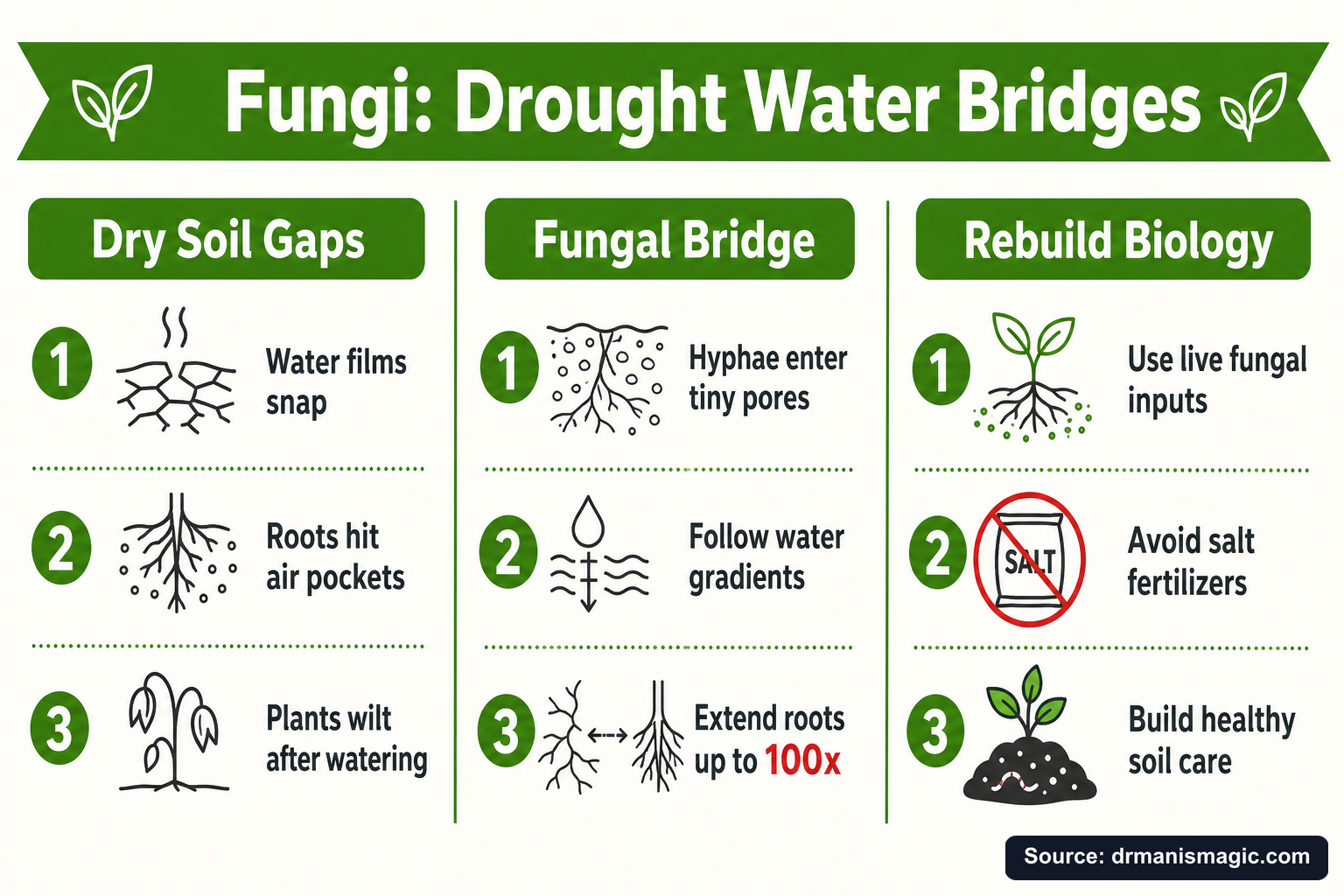
- Fungal hyphae are much thinner than roots and can enter tiny soil pores that roots can never reach, bridging dry gaps to access water.
- Mycorrhizal fungi physically extend the root system, sometimes 100 times farther than the roots themselves, dramatically increasing the plant's access to water and nutrients during drought.
- Fungi do not magically "share" water everywhere. They transport water through real physics: water potential gradients, capillary action, and transpiration pull.
- Drought resilience also comes from indirect fungal benefits: better soil structure, improved phosphorus uptake, hormonal signaling, and healthier root hydraulics.
- Dead, dried, or foul-smelling microbial products can't do any of this. Only genuinely live fungi and bacteria deliver these benefits.
- Salt-based fertilizers and synthetic chemicals kill the very fungi your plants depend on during drought.
- You can rebuild this living system. It takes the right inputs, the right soil, and consistent care rooted in the Three Plant Pillars.
Can Fungi Actually Move Water Through Soil?
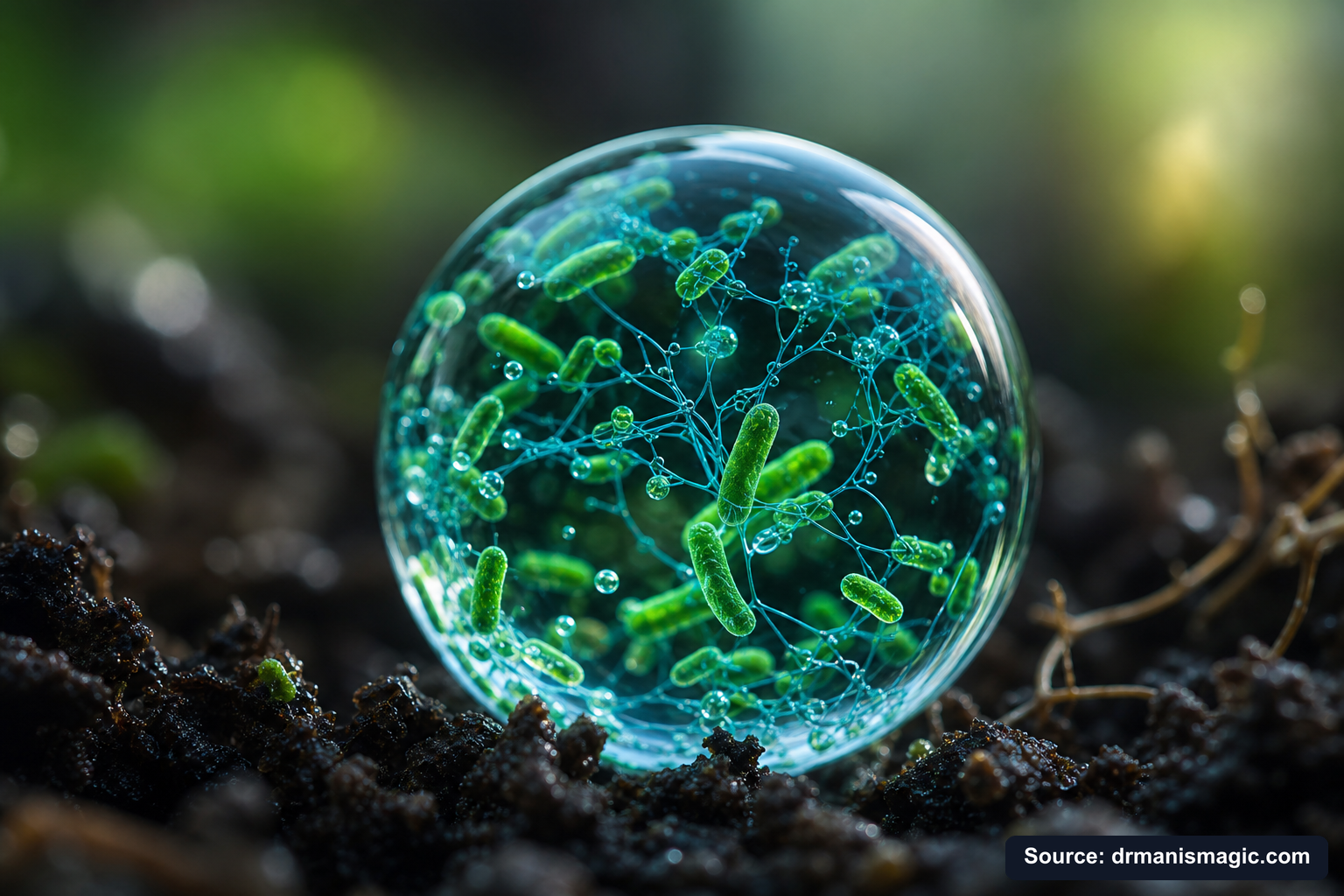
Quick Answer: Yes. Mycorrhizal fungi physically move water through their thread-like hyphae by following water potential gradients from wetter to drier zones. Their hyphae are thin enough to enter micropores that roots cannot access, bridging dry air gaps in soil and maintaining a water connection between moist deep soil and thirsty roots near the surface.
Fungi can and do move water. But it helps to understand exactly how, because this is not magic. It is physics.
Think of soil like a sponge full of tiny tunnels. When soil is moist, water fills those tunnels and everything is connected. But when drought hits, the water retreats. The films of water between soil particles thin out and eventually snap. The soil becomes a bunch of disconnected islands of moisture. Roots can only absorb water where they touch it directly. And as soil dries, that contact disappears.
Now here is where fungi come in.
Fungal hyphae are the thread-like arms of a fungus. They are incredibly thin, far thinner than any root hair. We're talking about 2 to 20 micrometers wide. For comparison, a human hair is about 70 micrometers. A root hair is still much thicker than a hypha. That thinness lets hyphae slip into micropores that roots can never enter. They can reach tiny pockets of water trapped in soil particles that would otherwise be completely inaccessible.
Once inside those pores, water moves along the hypha toward the plant. The driving force is a water potential gradient. The plant is pulling water up through transpiration, which creates a kind of suction. That suction extends down through the root and out through the fungal network attached to it. Water moves from areas of higher potential to lower potential, the same way a paper towel draws up coffee. The fungi are the extension of that pulling force, reaching into places the root simply cannot go.
Scientists at the University of California and other institutions have documented this direct hyphal water transport in multiple experiments. In one study with barley plants grown in drought conditions, researchers used separate compartments to confirm that water was actually moving through fungal hyphae into the host plant, not just through soil or roots. The hyphae were the bridge. The University of California Agriculture and Natural Resources program has documented how mycorrhizal networks influence soil water dynamics in agricultural systems.
What Are Mycorrhizal Fungi and Why Do They Live in Your Soil?
Quick Answer: Mycorrhizal fungi are a specific group of fungi that form a partnership with plant roots. The plant feeds the fungus sugars made from sunlight. In return, the fungus extends the root system, delivers water and nutrients, and helps the plant resist stress. It is a trade, and it has been running for over 400 million years.
The word mycorrhiza comes from the Greek words for fungus and root. And that is exactly what it is. A fungus living in and around a root, in a relationship so tight that most land plants on Earth depend on it.
Here is the deal the plant makes. The plant pushes sugars out of its roots into the soil. This is called root exudate. The fungus feeds on those sugars. In exchange, the fungus builds a vast web of hyphae stretching out through the soil, far beyond where the root can grow. That web gathers water and nutrients like phosphorus, zinc, and copper, and delivers them back to the root.
Dr. Mani Skaria, founder of US Citrus Nursery and the creator of the Three Plant Pillars framework, watched this play out across 250,000 trees over decades. Trees with a thriving fungal network in their root zone handled drought stress in ways that trees without that biology simply couldn't match. The fungal web was acting as an invisible extension of the root system, constantly working even when the visible root had no water to drink.
If you have ever pulled up a weed and seen fuzzy white threads around the roots, you were looking at this network. Those threads are mycorrhizae. They are why weeds survive in terrible conditions where garden plants die. They have that invisible workforce. Most garden plants can have it too. But only if the soil is alive.
See also: Why Most Fertilizers Are Actually Salt in Disguise
How Do Hyphae Bridge Dry Gaps That Roots Cannot Cross?
Quick Answer: When soil dries out, water films between soil particles break apart and roots lose contact with moisture. Fungal hyphae are thin enough to stay inside micropores and crawl through air gaps, maintaining a physical water-conducting thread between moist deep soil and the root surface. Roots are too large to do this on their own.
Let's get practical about what happens underground during a drought.
When soil moisture drops, the big easy-to-access water disappears first. What is left hides in micropores, the tiniest tunnels in the soil matrix. These pores are so small that roots and root hairs cannot fit inside them. The water sits there, unreachable by the plant alone.
But a hypha can fit. It threads into those pores. It pulls water out. It carries that water along its length toward the root. And because a single fungal network can spread hundreds of meters through a cubic foot of healthy soil, the total surface area available for water collection is enormous.
There is another mechanism too. Some plants, especially deep-rooted trees, lift water from moist deep soil through their roots at night. This is called hydraulic redistribution or hydraulic lift. Some of that water can leak out of the roots or the attached fungal network into the dry upper soil. Other plants and organisms in the area can then benefit from that moisture. It is one reason forests survive dry seasons better than bare fields do.
Saprotrophic fungi, the kind that break down dead wood and leaves, can also move water across dry soil patches. They help wet one area and dry another, which drives decomposition and carbon cycling even during drought. The whole soil food web is connected through this fungal plumbing.
| Feature | Root Hair | Fungal Hypha |
|---|---|---|
| Diameter | 10–15 micrometers | 2–20 micrometers |
| Can enter micropores? | No | Yes |
| Survives dry air gaps? | No, loses contact | Yes, maintains contact |
| Reach beyond root zone | Inches | Feet to yards |
| Water transport mechanism | Diffusion and osmosis | Water potential gradient and capillary flow |
| Responds to transpiration pull | Yes | Yes, extends that pull further |
What Else Do Mycorrhizal Fungi Do for Drought-Stressed Plants?
Quick Answer: Beyond moving water directly, mycorrhizal fungi help plants survive drought by improving phosphorus uptake (which powers root growth), producing hormones that regulate how stomata open and close, improving soil aggregation so water penetrates better, and boosting the overall health of the root system. These indirect benefits are just as powerful as direct water transport.
Direct water transport is the headline. But fungi have a whole toolbox of drought-survival tricks, and understanding them helps you see why soil biology is not a luxury but a necessity.
Phosphorus and root growth. During drought, phosphorus barely moves through soil because it needs water to diffuse. Phosphorus is the nutrient plants use to build roots and transfer energy. If phosphorus can't reach the root, the root can't grow deeper to find water. Mycorrhizal fungi are phosphorus specialists. They pick it up and deliver it directly, even in dry soil. The plant gets the phosphorus it needs to keep pushing roots deeper.
Stomatal regulation. Stomata are the tiny pores on leaves that let water vapor out and carbon dioxide in. During drought, plants close stomata to save water. But mycorrhizal fungi send chemical signals that help the plant regulate this more precisely. A plant with a strong fungal network manages its water loss smarter. It doesn't just slam the stomata shut and shut down photosynthesis. It finds the right balance.
Aquaporins. These are protein channels inside root cells that control how fast water moves in. Mycorrhizal fungi influence aquaporin activity, making root cells more efficient at pulling in water. More water in, same amount of stress. UC Davis Cooperative Extension research has highlighted how mycorrhizal associations influence root hydraulic conductance in drought-exposed plants.
Soil structure. Mycorrhizal fungi produce a protein called glomalin. Glomalin glues soil particles together into clumps called aggregates. Those aggregates create pores and channels that hold water better and let rain penetrate instead of running off. Healthy fungal soil is like a sponge. Degraded soil without fungi is like concrete. It repels water instead of absorbing it.
Why Do Most Mycorrhizal Products Fail to Deliver These Benefits?
Quick Answer: Most mycorrhizal products on the market are either dried lab-grown spores that never truly reactivate, or liquid products made from compost tea that goes anaerobic before it reaches you. Dead fungi cannot build hyphae, bridge soil gaps, or transport water. Only genuinely alive microbes can do the job.
This is the part that most gardening companies would rather you not think too hard about.
Walk into any garden center and you will find bags and bottles of mycorrhizal inoculants. Big labels, big promises. "Improves drought resistance!" "Boosts root growth!" Some of these products look impressive. But here is what is happening inside most of them.
The dried powder problem. Many products take living organisms, grow them in a factory vat, then dry them into powder. The idea is that the spores will reactivate when you add water. We have tested dozens of these at our nursery. The results? Minimal. In most cases, the drying process damages the organisms enough that they never fully come back to life. You pour them on your plant and nothing happens. The label says "10 billion CFU" but a dead cell with a number on it doesn't grow roots.
The stinky liquid problem. Other products are made from compost tea or worm casting extracts. These can be excellent, but there is a catch. Once the microbes run out of oxygen, they go anaerobic. They start to die and ferment. The product starts to smell. By the time it reaches your door, many of the microbes are dead or dying. You may still get some benefit from the organic compounds like humic and fulvic acid, but the living biology is largely gone.
The lactobacillus trap. Some products use lactobacillus bacteria because they are easy to keep alive. Yes, the same bacteria in your yogurt. They are vigorous. But they crowd out other beneficial species. They do not belong in soil. They belong in your gut.
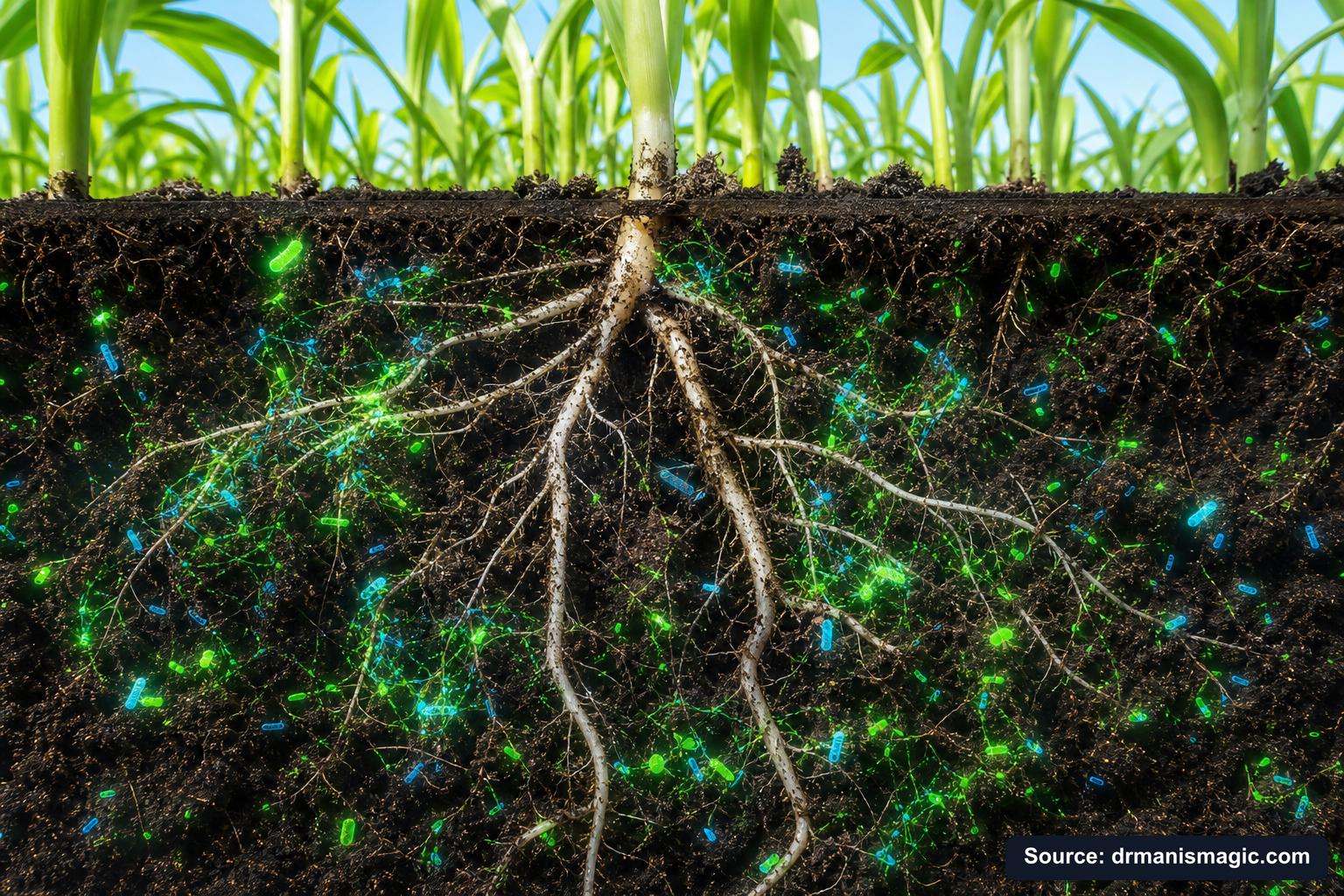
Dr. Mani's Magic Plant Super Boost solves this differently. It starts with real, hand-crafted compost teeming with a full spectrum of life: over 2,000 bacteria species, 400 to 500 fungi including mycorrhizae, plus protozoa and nematodes. Then it uses a proprietary all-natural stabilization technique developed by a world-renowned compostologist to keep those organisms alive without going anaerobic. The result is a liquid that smells earthy, not foul, because it is not rotting. You can literally put a drop under a microscope and watch the microbes move.
| Product Type | Microbe Viability at Use | Spectrum of Species | Odor | Real-World Results |
|---|---|---|---|---|
| Dry/powder lab microbes | Low (mostly dead) | Narrow | Low | Minimal benefit observed |
| Rehydrated dried powder | Low | Narrow | Low | Minimal benefit observed |
| Compost tea, fresh (under 24 hours) | Moderate | Partial | Earthy | Good if used immediately |
| Compost tea, old (over 24 hours) | Low (anaerobic) | Partial | Strong stench | Poor; biology dying |
| Lactobacillus-based products | High (but wrong species) | Very narrow | Low | Crowds out beneficial microbes |
| Plant Super Boost (stabilized, full-spectrum) | High (genuinely alive) | 2,000+ bacteria; 400-500 fungi including mycorrhizae; protozoa; nematodes | Earthy, not foul | Proven across 250,000+ trees |
You Never Had a Brown Thumb.
You were handed the wrong tools. This free guide hands you the right ones.
You watered it. You fed it. It died anyway.
It was never you. It was the dirt, the salt food, and the bad advice.
This guide shows you what really went wrong, and how to fix it for good.
- Why your plants really died, and why it was never your fault
- The salt hiding in your plant food that quietly burns the roots
- The hidden killer in almost every bag of store soil
- The tiny helpers that grow a whole forest for free
- The rescue trick that brings a half dead plant back to life

What Kills the Fungi in Your Soil Before Drought Even Arrives?
Quick Answer: Synthetic herbicides, salt-based fertilizers, broad-spectrum pesticides, and fungicides all damage or destroy mycorrhizal fungi in soil. When these inputs are used repeatedly, the fungal network collapses. The plant enters drought with no underground water delivery system, no structural support, and no reserve biology to draw on.
Here is a painful truth. Most conventional gardening advice sets your plants up for drought failure before the dry season even starts.
Salt-based synthetic fertilizers dissolve easily in water and deliver a quick green-up. That fast color looks like success. But those fertilizers are essentially salt. High salt concentrations in soil draw water out of microbial cells through osmosis, the same way salt dries out a slug. Beneficial bacteria die. Fungal hyphae shrink and pull back. The network breaks apart. Now your plant has no fungal web to extend its reach during drought. It is alone out there.
Herbicides like glyphosate disrupt enzyme pathways that many soil microbes depend on. They don't just kill weeds. They reduce microbial diversity in the root zone. Fungicides are designed to kill fungi. When applied broadly, they cannot tell the difference between a pathogenic fungus and a mycorrhizal partner that took years to build up in your soil. Both get wiped out.
And then there is the soil itself. Most potting mixes are made from pine bark and wood fiber. That material breaks down over months. As it decomposes, it compacts, steals oxygen from roots, and creates the wet, suffocating conditions where root rot thrives. There is no mineral structure to hold the soil together. No permanent pore space for fungi to colonize. No physical home for the biology that delivers drought resilience.
This is not an accident. This is the cycle that has been sold to American gardeners since the 1950s. Buy fertilizer, burn the biology, wonder why the plant struggles, buy more products. The biology was the answer the whole time.
See also: The Hidden Reason Synthetic Fertilizers Cause Root Rot
Direct Fungal Water Transport vs. Indirect Drought Benefits: What Is the Difference?
Quick Answer: Direct fungal water transport means hyphae physically carry water from soil to root. Indirect drought benefits include better soil structure, improved phosphorus delivery, hormonal signaling, aquaporin regulation, and healthier root systems. Both matter. Plants with strong fungal partnerships get both, making them dramatically more drought-resilient than plants without fungi.
It is worth being honest here, because a lot of content online overpromises on mycorrhizae.
Fungi do not magically water your plants. They are not a substitute for irrigation. In a severe, prolonged drought, no amount of fungal activity replaces the water your plant needs to survive. What fungi do is dramatically improve how well your plant uses the water that is available.
Direct water transport is real and documented. But it works best in specific conditions: soils that still have some moisture in micropores, plant systems with transpiration pull active, low-disturbance soils where hyphae are intact, and plant-fungal partnerships that have had time to develop. Compacted, chemically damaged, or bare soil with no organic matter and no fungal network cannot offer these benefits even if you pour inoculants on it.
The indirect benefits are in some ways even more important because they build the conditions for direct transport to happen. Glomalin improves soil aggregation so moisture is held and distributed better. Phosphorus delivery supports root growth so roots can reach deeper water. Hormonal signaling makes the plant smarter about how it uses water. These things compound over time as the soil biology strengthens.
This is why the Three Plant Pillars framework developed by Dr. Mani Skaria matters so much. Mineral-based soil creates a permanent physical structure that gives hyphae somewhere to live and grow. Live microbials provide the actual organisms. Organic fertilizer feeds both the plant and the biology without killing the microbes with salt. Each pillar makes the others stronger. See how all three pillars work together here.
Should You Buy Mycorrhizal Inoculants or Are They a Waste of Money?
Quick Answer: Mycorrhizal inoculants are worth it in specific situations: disturbed soil, containers with sterile potting mix, transplants, low-phosphorus ground, or land recovering from chemicals. In healthy native soil that has never been disturbed, fungi are already present and inoculants may not be necessary. The key is whether you add genuinely live organisms or dead powder.
This is one of the most practical questions in modern gardening. And the answer is more nuanced than product companies want you to know.
If your soil has never been tilled, chemically treated, or covered in synthetic inputs, it probably already has a functioning fungal network. Adding inoculants to it may provide modest benefits or may be unnecessary. The native biology is already doing the job.
But most garden soil in the USA is not that. Most garden soil has been sprayed with herbicides, drenched with salt fertilizers, compacted by foot traffic, sterilized by summer heat and bare soil exposure, and robbed of organic matter year after year. Container soil starts sterile by design. Nursery transplants often come in soilless mixes with no fungal life at all.
In these situations, adding live mycorrhizal fungi and bacteria is not a luxury. It is rebuilding something that should have been there all along.
The caveat is that very high soil phosphorus can suppress mycorrhizal colonization. When phosphorus is abundant, the plant has less need for the fungal partnership and may not invest in it. If you have been applying heavy phosphorus fertilizers for years, the fungi may not establish even if you add them. Reducing synthetic inputs and letting soil phosphorus normalize gives the partnership a chance to form.
How to Build Drought-Resilient Soil: A Recovery Plan
Quick Answer: Drought-resilient soil is built by combining living biology, good physical structure, and organic nutrition. You cannot just add water during drought and expect a depleted soil to perform. The biology has to be in place before the dry season arrives. Here is how to build it step by step.
If your plants have been struggling through dry spells, here is a practical numbered recovery plan you can start right now.
- Stop the inputs that kill biology. Reduce or eliminate synthetic herbicides, broad-spectrum pesticides, and salt-based synthetic fertilizers. Every application is a setback to the fungal network you are trying to build. You cannot add live microbes with one hand and kill them with the other.
- Fix the physical structure. If you are growing in containers, get out of decomposing bark-based potting mix. It collapses, compacts, and suffocates roots. Mineral-based soil like Dr. Mani's Magic Super Soil provides permanent structure, drainage, and aeration so hyphae have a stable home to grow in.
- Add a layer of mulch. Two to four inches of wood chip or straw mulch on top of the soil does several things at once. It keeps moisture in. It moderates soil temperature. It feeds fungi as it slowly breaks down. It protects the soil surface from compaction and UV damage.
- Keep living roots in the soil. Bare soil loses its fungal network fast. Living roots feed fungi through sugar exudates. Where possible, keep something growing. Cover crops in the off season, perennial plants, or companion plantings all help maintain the underground food web.
- Inoculate with genuinely live, full-spectrum microbes. Add live bacteria, fungi, and mycorrhizae monthly, especially when establishing new plants or recovering damaged soil. Use a product with verified live microbes, not dried powder. If it smells foul, the biology is already dying.
- Feed with organic, slow-release nutrition. Organic fertilizers feed the plant and the biology simultaneously. They do not spike salt levels. They release nutrients slowly as microbes break them down, which is exactly how nature intended it to work.
- Water deeply and less often. Shallow frequent watering keeps moisture near the surface and discourages roots from going deep. Deep, infrequent watering pushes roots downward into the soil profile where temperature is more stable and moisture lasts longer. Let the top inch dry between waterings to encourage deep root exploration.
Rebuilding soil biology takes time. You will not see a fully functioning fungal network in one month. But you will see improvements. Plants that used to wilt by noon will hold up longer. Leaves will stay greener. Fruit set will improve. And each month you apply live microbes and feed the system, the network grows stronger and more resilient.
What Does the Soil Food Web Actually Look Like Underground?
Quick Answer: The soil food web is the community of bacteria, fungi, protozoa, and nematodes that live around plant roots. Each organism plays a different role. Together they cycle nutrients, regulate pests, build soil structure, and connect plants to water and minerals spread across the soil. It is the invisible workforce that runs every healthy garden.
Let's make this real. Under one teaspoon of healthy soil, there can be a billion bacteria, several yards of fungal hyphae, and thousands of protozoa and nematodes. Every one of them is doing a job.
| Organism | Primary Role | Drought Contribution | What Destroys Them |
|---|---|---|---|
| Bacteria | Decompose organic matter, fix nitrogen, solubilize minerals | Produce hormones that regulate stomata and root growth; improve nutrient availability even in dry soil | Salt fertilizers, herbicides, pesticides |
| Mycorrhizal Fungi | Extend root system, deliver water and phosphorus | Bridge dry soil gaps, enter micropores, transport water via hyphae, produce glomalin for soil structure | Fungicides, herbicides, high phosphorus, tilling |
| Saprotrophic Fungi | Break down dead organic matter | Redistribute water across dry soil patches, support decomposition and carbon cycling during drought | Fungicides, soil compaction, bare soil |
| Protozoa | Eat bacteria, release nutrients in plant-available form | Maintain nutrient cycling during drought; go dormant and recover when moisture returns | Pesticides, desiccation, chemical inputs |
| Beneficial Nematodes | Regulate microbial populations, cycle nutrients | Aid post-drought recovery; help rebalance soil biology after stress events | Broad pesticides, soil fumigation |
Protozoa and nematodes rarely get mentioned in drought articles, but they matter. Protozoa eat bacteria and release nitrogen in a form plants can immediately use, which is critical when drought slows down all other nutrient cycling. They can go dormant in dry soil and wake up fast when moisture returns. Nematodes do similar work in regulating the microbial community and helping the system bounce back after stress.
This is why a full-spectrum microbial product matters more than one with just one or two species. Drought resilience is not built by a single hero microbe. It is built by a community working together, the same way a forest survives on the relationships between thousands of species above and below ground.

What Can You Do Right Now to Give Your Plants Drought Protection?
You do not need to overhaul your entire garden overnight. But you do need to start somewhere, and the right starting place is the biology.
Every week you wait is a week your plants spend without the underground support they were designed to have. The most common thing people tell Dr. Mani is that they want to see fruit on their tree while they still can, while the kids are young, while the backyard is still theirs. You cannot get that time back. And every season spent running on dead soil with salt fertilizers and no fungi is a season of delay that compounds. Plants don't just stall. They go backward. The roots get weaker. The soil gets more compacted. The biology gets thinner. Until one bad drought finishes the job.
The good news is the biology is forgiving. It can come back. But it needs the right conditions and it needs live inputs, not dead powder.
Start with the Three Plant Pillars. Get the soil structure right so fungi have somewhere to live. Feed the system with organic nutrition that doesn't burn the biology. And add live, full-spectrum microbes consistently, every month, so the invisible workforce has a chance to rebuild the network your plants depend on when the sky goes dry and the soil cracks.
If you want to see what genuinely live microbials look like and how they work as part of a complete plant care system built on 30 years of South Texas nursery experience, the Free Plant Care Field Guide is a great place to start. No sales pressure. Just the real science, explained simply, so your plants actually thrive.
The fungi are ready to go to work. Give them a living home and watch what happens.
Frequently Asked Questions
If your plants are struggling through summer heat, the answers below will change how you think about water, soil, and roots forever. These are the questions gardeners ask after they realize watering more is not solving the problem. Read every one of them before your next plant dies from a drought it should have survived.
How do fungi actually move water to plant roots during a drought?
Fungi grow thread-like arms called hyphae. Those hyphae are incredibly thin, far thinner than any root. That thinness lets them slip into tiny soil pores that roots can never reach. Water moves along the hyphae toward the plant by following a water pressure difference, flowing from wetter zones to drier ones. It works like a straw connecting hidden pockets of moisture straight to your roots. No living fungi in your soil means no straw. Your roots just sit there thirsty.
Do fungi have their own transport system inside the soil?
Yes. Fungi build a living network under the ground called mycelium. Think of it like a web of tiny pipelines stretching in every direction. Water, nutrients, and even chemical signals travel through this web. Some movement happens passively, following pressure gradients. Some happens actively, with the fungus pushing materials through its cells. This network can stretch up to 100 times farther than the roots themselves. That is a massive upgrade to your plant's reach during dry conditions.
How do fungi spread through the soil in the first place?
Fungi spread two ways. First, they grow outward by extending their hyphae through the soil, always searching for water and nutrients. Second, they release spores that travel through air, water, or on insects. Once a spore lands in healthy soil, it sprouts and starts building a new network. The key word there is healthy soil. Compacted, chemical-soaked dirt stops fungal growth cold. That is exactly why our Super Soil and Plant Super Boost work together. They give fungi a real home to grow and spread.
Can fungi survive without water, or do they die in a drought too?
Most fungi need some moisture to stay active. But certain types, including melanized mycorrhizal fungi, are built tough. They can handle dry conditions that wipe out weaker species. These drought-resistant fungi actually become more important during dry spells, holding the soil network together when other biology collapses. That is why building a diverse, living soil community before drought hits is so critical. Our Plant Super Boost delivers live bacteria, fungi, and mycorrhizae so your soil has fighters ready when the heat arrives.
Will fungi still help if I use synthetic fertilizers in my soil?
No. This is the painful truth most gardening brands will never tell you. Salt-based synthetic fertilizers burn and kill the very fungi your plants depend on. You pour on fertilizer thinking you are helping, but you are wiping out your plant's drought defense system at the same time. We proved this across 250,000 trees at our South Texas nursery. The trees that thrived in brutal heat were fed with organic, slow-release nutrition, not salt bombs. That is Pillar Three of the Three Plant Pillars, and it protects your soil biology instead of destroying it.
My soil looks fine. Why would fungi be missing from it?
Soil can look perfectly normal on the outside and be biologically dead on the inside. Synthetic chemicals, compacted organic potting mixes, poor drainage, and even bad watering habits can wipe out fungal populations over time. Most store-bought potting mixes are loaded with decomposing pine bark that breaks down into a soggy, airless sludge. Fungi cannot thrive in that. Our Super Soil is mineral-based, built from sandy loam from the Rio Grande Valley. It stays loose, drains perfectly, and gives fungi the open, airy structure they need to build a real network.
How fast can I rebuild fungal life in my soil?
Faster than you think, when you use the right inputs. Within the first 30 days of using Plant Super Boost with our Super Soil and organic Crab, Kelp, and Amino Acids fertilizer, your soil biology starts waking up. Roots get stronger. Nutrient uptake improves. Drought tolerance builds. We have seen this on citrus trees, houseplants, tropical trees, and garden beds. The Three Plant Pillars work together as a system. Get all three working and your plants stop struggling. They start thriving, even when the summer heat is hammering your backyard.
About the Author
Ron Skaria, MD
Ron Skaria, MD, is the co-founder of Dr. Mani's Magic and the son of Dr. Mani. He trained as a medical doctor at Baylor College of Medicine, did his residency at UT Health Science Center - San Antonio and fellowship training at Texas Tech University. He now works full time on the family farm at US Citrus and US Citrus Nursery in Hargill, Texas, building Dr. Mani's Magic alongside his dad. He wrote the Brown Thumb Field Guide to put his father's 48 years of plant science into plain words any gardener can use. His belief is simple. You never had a brown thumb. You just never had the right help.


