


Why Organic Matter Is Just the Beginning of Healthy Soil | Dr. Mani's Magic
Why Organic Matter Is Just the Beginning: How Living Soil Really Works
Picture this. You haul a bag of premium compost home from the garden center. You mix it into your soil with care. You water it in. You step back, wipe your hands, and think: okay, now we're cooking.
Weeks pass. Maybe the plant perks up a little. But then it stalls. The leaves aren't as green as you hoped. The fruit doesn't come. The lawn still looks patchy. And you're standing there thinking the same thing every frustrated gardener thinks: I did everything right. What is going on underground?
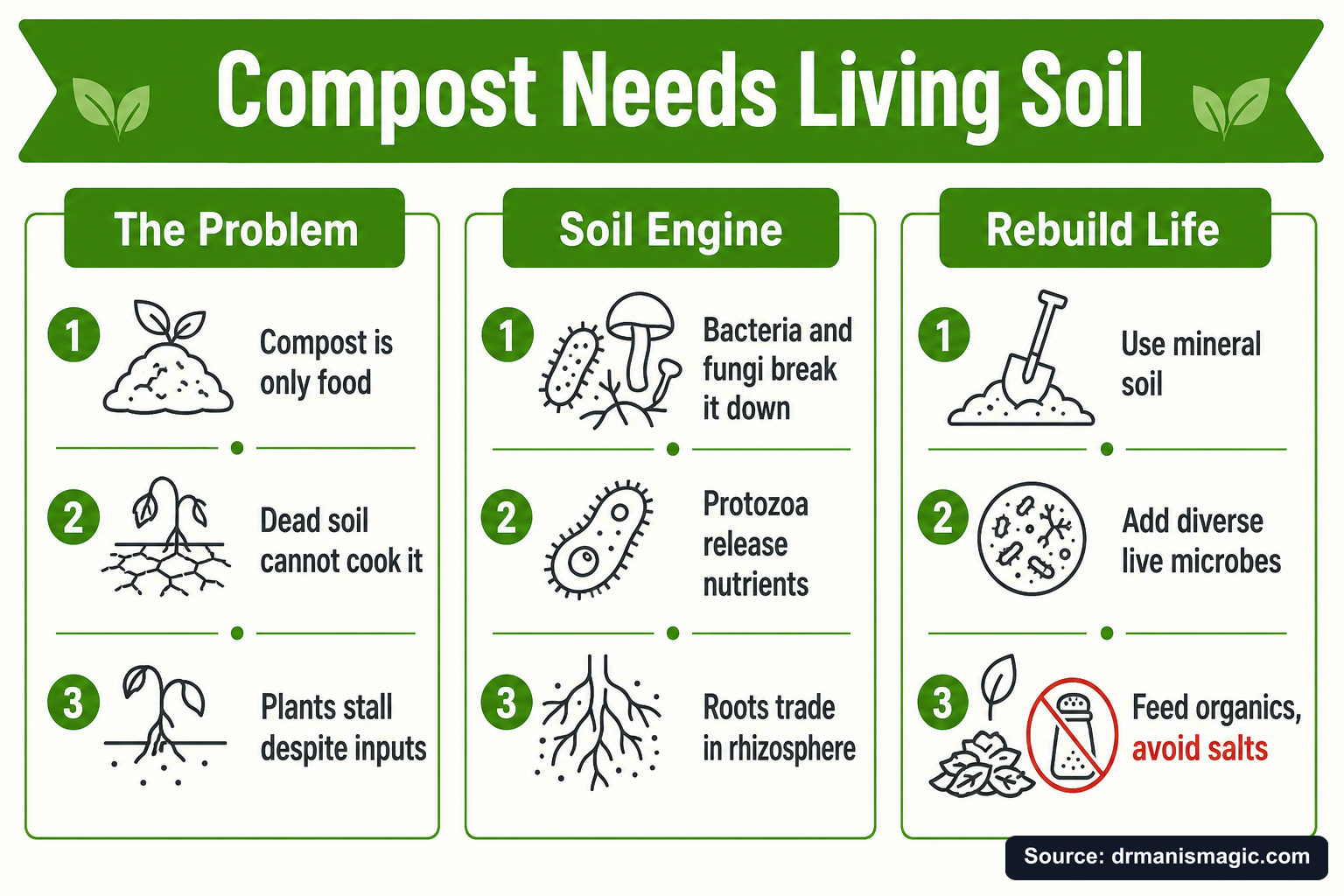
Here's the thing nobody tells you at the garden center. Compost is food. Mulch is food. Organic matter is food. But food sitting in an empty kitchen doesn't cook itself. You need the cooks. You need the whole kitchen crew. And in healthy soil, that crew is alive, invisible, and absolutely extraordinary. After growing and studying over 250,000 trees at our South Texas nursery, we can tell you with total certainty: organic matter is just the beginning. What happens after you add it is where the real magic lives.
Key Takeaways
- Organic matter is food for a living system, not the system itself. Adding compost alone is only step one.
- The soil food web is a complete underground ecosystem: bacteria, fungi, protozoa, nematodes, earthworms, and roots all work together.
- The rhizosphere, the zone right around your roots, is the control center where nutrients are made available, pathogens are suppressed, and resilience is built.
- Mycorrhizal fungi extend your root system like invisible highways, delivering water and nutrients your roots could never reach alone.
- Salt-based synthetic fertilizers and chemical fungicides kill the very microbes that make organic matter useful.
- Most microbial products on the market are either dead on arrival or too narrow to rebuild a real soil food web.
- The Three Plant Pillars (mineral soil, live microbes, organic fertilizer) work together as a complete system and address the root cause, not just the symptoms.
What Is the Soil Food Web and Why Does It Matter for Your Plants?
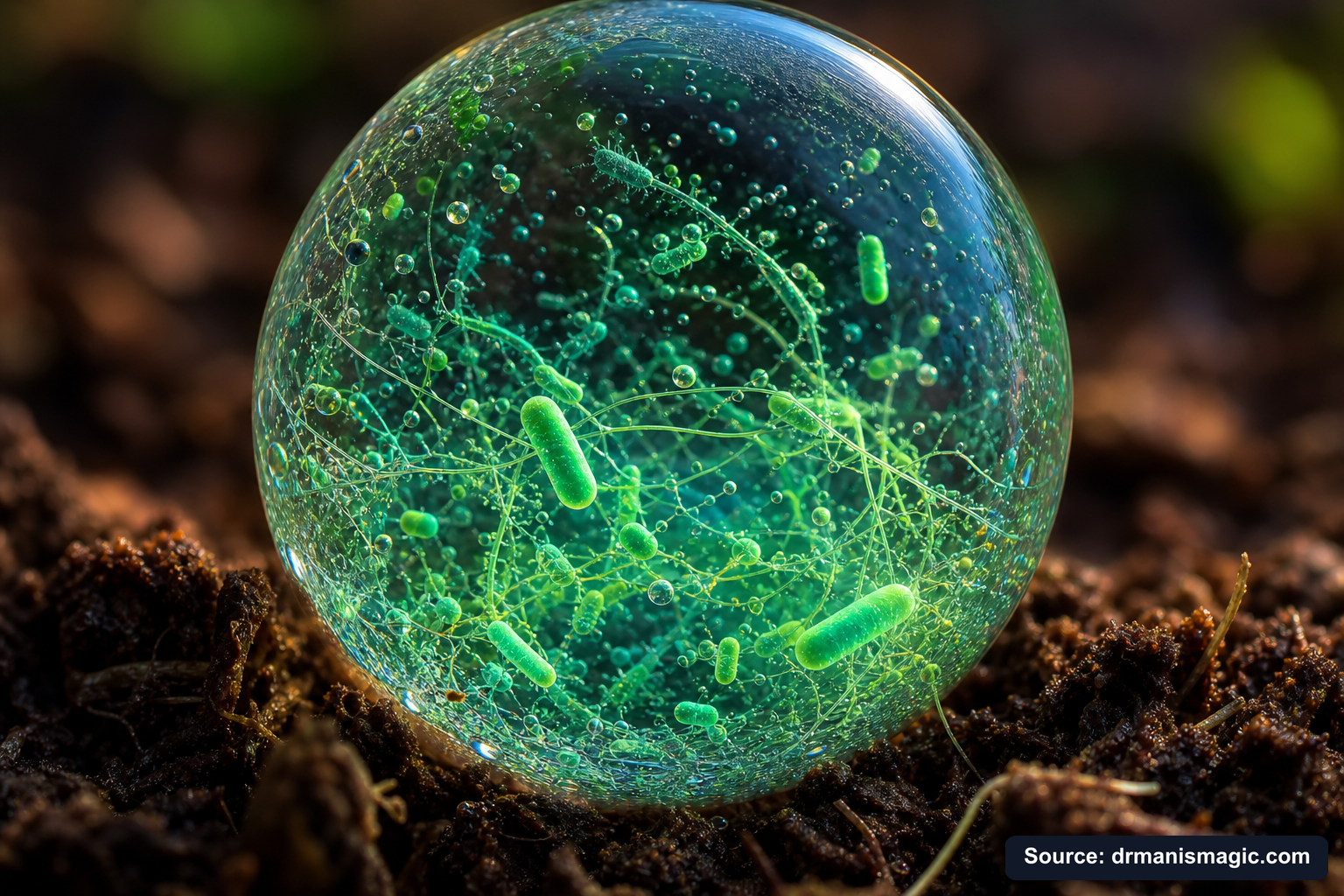
Quick Answer: The soil food web is the living community of bacteria, fungi, protozoa, nematodes, arthropods, and earthworms that break down organic matter and release nutrients your plants can actually use. Without it, organic inputs just sit in the soil doing very little. With it, your soil becomes a self-feeding, self-defending ecosystem.
Think about a forest. Nobody fertilizes a forest. Nobody aerates it or adds compost in the fall. Yet towering trees push up through the ground, growing strong for hundreds of years. Why?
Because the forest floor is alive.
Beneath every square foot of healthy forest soil, there are billions of bacteria. Miles of fungal threads. Protozoa grazing on bacteria. Nematodes hunting through the dark. Earthworms tunneling through, pulling organic matter deeper. Every single one of these creatures plays a role. Together, they form what soil scientists call the soil food web.
According to Colorado State University Extension, this food web governs nutrient cycling, disease suppression, water infiltration, and long-term soil structure. It is not a side feature of healthy soil. It is the engine.
When you add compost or organic matter to your garden, you are adding fuel. But without the engine, fuel just sits there. The food web is what transforms raw organic material into the plant-available nutrients your vegetables, flowers, fruit trees, and lawn grass actually crave.
See also: The Hidden Reason Synthetic Fertilizers Cause Root Rot
Why Is Compost Not Enough on Its Own?
Quick Answer: Compost adds organic material and some microbes, but it does not automatically rebuild a complete soil food web. Damaged soils, sterile potting mixes, and chemically treated ground may lack the full range of bacteria, fungi, protozoa, and nematodes needed to process that compost into plant food. The organic matter just sits there, underperforming.
Compost is incredible. Fresh, hot compost is absolutely teeming with living organisms. When Dr. Mani Skaria first started testing soil biology at US Citrus Nursery, one of the early revelations was watching how a fresh compost application transformed a struggling tree almost like flipping a switch.
But here is the catch. Most of the compost you buy at the garden center has been bagged, stored, and sitting on a shelf. The heat is long gone. A lot of the biology is gone with it.
And even if you add fresh compost to your garden bed, if the soil around it has been treated with synthetic herbicides, salt-based fertilizers, or broad-spectrum fungicides, those living organisms don't have much of a community to join. They're outnumbered by pathogens, or they find a hostile environment and die off.
The result? You add good food, but the kitchen is either empty or full of the wrong crew.
University of Maryland Extension describes it clearly: organic matter decomposition requires a functioning community of soil organisms. When that community is disrupted, decomposition slows, nutrient release stalls, and plant health suffers even when inputs look correct on paper.
This is exactly why so many gardeners feel baffled. They added the "good stuff." They did the research. But the plants still struggle. The missing piece is almost always living biology.
What Does the Soil Food Web Actually Look Like Underground?
Quick Answer: The soil food web works in layers. Bacteria and fungi break down organic matter first. Protozoa eat the bacteria and release nitrogen as waste that plants can absorb. Nematodes eat protozoa and bacteria. Arthropods and earthworms shred and tunnel. Each level of this chain releases more nutrients for your plants. It is a self-running nutrient factory.
Let's walk through it. Slowly. Because this is the part that changes how you see gardening forever.
You add a leaf. Or compost. Or a scoop of organic fertilizer. Here is what happens next, if your soil is alive:
Step 1: Bacteria and fungi arrive first. They start breaking down the organic material. Bacteria handle the easier sugars. Fungi send out long threads called hyphae to reach further, breaking down tougher materials like woody stems and bark. This decomposition releases some nutrients, but most are still locked up inside the microbial cells themselves. Not available to your plant yet.
Step 2: Protozoa move in. They eat the bacteria. And here is where it gets brilliant. The bacteria cells contain a lot of nitrogen, far more than the protozoa need. So the protozoa excrete the excess nitrogen as ammonium, right in the root zone. That is plant-available nitrogen. Made fresh. Delivered locally. No synthetic fertilizer bag required.
Step 3: Nematodes join the party. Beneficial nematodes eat bacteria, fungi, and protozoa. Same story: the nutrients locked inside those organisms get mineralized and released. More food for your plants.
Step 4: Earthworms and arthropods do the heavy lifting. They physically shred organic material, open up air pockets, and drag nutrients deeper into the soil profile. Their castings are among the most nutrient-rich materials in all of nature.
Every step in this chain releases nutrients that your plant's roots can actually absorb. This is why a living soil can feed a forest without a single bag of fertilizer. The system feeds itself.
| Organism | Primary Role | Nutrient Released | Extra Benefit |
|---|---|---|---|
| Bacteria | Break down sugars, fix nitrogen from air, suppress pathogens | Nitrogen, phosphorus, sulfur | Pathogen competition, hormone signaling |
| Fungi (saprophytic) | Break down tough materials like woody stems | Carbon, nitrogen, phosphorus | Soil aggregation via glomalin |
| Mycorrhizal Fungi | Extend root surface area, deliver water and phosphorus | Phosphorus, micronutrients, water | Drought resistance, disease suppression |
| Protozoa | Eat bacteria, release excess nitrogen as plant-available ammonium | Nitrogen (ammonium) | Regulate bacterial populations |
| Nematodes (beneficial) | Eat bacteria, fungi, and protozoa; mineralize nutrients | Nitrogen, phosphorus | Suppress root-feeding pest nematodes |
| Earthworms | Shred organic matter, aerate soil, create castings | Full spectrum | Drainage, tilth, microbial transport |
| Arthropods | Shred plant residues, create channels | Carbon, nitrogen | Aeration, organic matter distribution |
What Is the Rhizosphere and Why Is It the Real Control Center?
Quick Answer: The rhizosphere is the thin layer of soil directly surrounding your plant's roots. It is where roots release sugars to attract and feed microbes, where bacteria and fungi convert organic matter into plant food, and where beneficial organisms crowd out pathogens. Managing the rhizosphere is more important than managing the whole soil profile.
Imagine your root system as a city. The rhizosphere is downtown. That's where everything happens.
Your roots are not passive tubes just sitting there waiting for water and nutrients to drift by. They are active. They release sugars, amino acids, and chemical signals through their surfaces in a process called exudation. These exudates are a deliberate invitation. Roots are essentially advertising for the microbial workers they need most.
Certain bacteria respond to those signals and move toward the root. Mycorrhizal fungi grow toward the root and physically connect to it, extending the root network by up to 1,000 times its original surface area. In exchange for sugar, those fungi deliver phosphorus, water, and micronutrients from places the root alone could never reach.
Meanwhile, beneficial bacteria in the rhizosphere produce compounds that directly suppress Phytophthora, Fusarium, and other root rot pathogens. They crowd them out physically. They produce antibiotics. They signal the plant to activate its own immune system.
This is not theoretical. Penn State Extension's research on rhizosphere biology confirms that root-zone microbial diversity is one of the strongest predictors of plant health outcomes, including disease resistance and nutrient use efficiency.
Here's what this means practically: when you add organic matter to the surface of your soil, it only becomes useful to your plant after the soil food web processes it and the rhizosphere delivers it. The rhizosphere is the last mile of nutrient delivery. If it's populated with the right organisms, your plant thrives. If it's sterile or dominated by pathogens, even the best compost in the world underperforms.
What Do Mycorrhizal Fungi Actually Do for Your Plants?
Quick Answer: Mycorrhizal fungi form a physical partnership with plant roots, extending their reach by up to 1,000 times. They deliver phosphorus, water, and micronutrients in exchange for sugar from the plant. They also improve drought resistance, suppress root pathogens, bind soil particles into stable clumps, and help plants survive stress events that would otherwise kill them.
Have you ever pulled up a weed and noticed fuzzy white threads clinging to the roots? That white fuzz is mycorrhizae. And it is the reason weeds grow like crazy in terrible soil while your carefully tended plants struggle.
Weeds are not tougher than your garden plants by accident. They have a biological partnership your plants may be missing.
Mycorrhizal fungi literally become part of the root. The fungal threads weave into the root tissue and then extend outward through the soil in every direction, sometimes for several feet. They act as a second root system, one that is far thinner, far more branched, and capable of reaching pockets of phosphorus and water that even the best root architecture cannot access.
Research from UC Agriculture and Natural Resources found that organic citrus orchards in California showed significantly higher mycorrhizal biodiversity and more consistent root colonization than conventionally managed orchards. The trees with the richest mycorrhizal networks were healthier, more productive, and more resilient to stress.
But here's the thing most people miss about mycorrhizae. They are not just nutrient haulers. They also produce a sticky protein called glomalin that glues soil particles together into stable aggregates. This creates the crumbly, open texture that healthy soil has. The kind where water drains easily, roots breathe freely, and compaction is rare. When mycorrhizae are absent, soil tends to compact, drainage worsens, and root rot pressure increases.
Mycorrhizal fungi are killed by synthetic fungicides, high phosphorus salt fertilizers, and soil sterilization. Most potting mixes and sterilized soils have zero mycorrhizae. That means container plants, transplants, and garden beds treated with broad-spectrum chemicals are starting from scratch, biologically naked, every single time.
Why Do Salt-Based Fertilizers and Fungicides Destroy the System You're Trying to Build?
Quick Answer: Salt-based synthetic fertilizers raise the salt concentration in the soil water, which draws moisture out of microbial cells and kills them through osmotic stress, the same process as pickling. Broad-spectrum fungicides kill beneficial fungi along with pathogens. Both inputs strip away the living biology that makes organic matter useful and leaves plants chemically dependent instead of biologically resilient.
Here is the cruel irony of conventional gardening advice. You add organic matter to feed your soil biology. Then you apply a synthetic fertilizer to give your plants a quick boost. And that synthetic fertilizer, loaded with salt, quietly kills the very organisms you were trying to feed.
Salt is a preservative. That's why we pickle food in it. It draws water out of cells through osmosis and kills microbes. Synthetic fertilizers are salt-based. When you apply them to soil, the salt concentration around the roots spikes. Beneficial bacteria, protozoa, and mycorrhizal fungi take the hit first. They are more sensitive than the plants themselves.
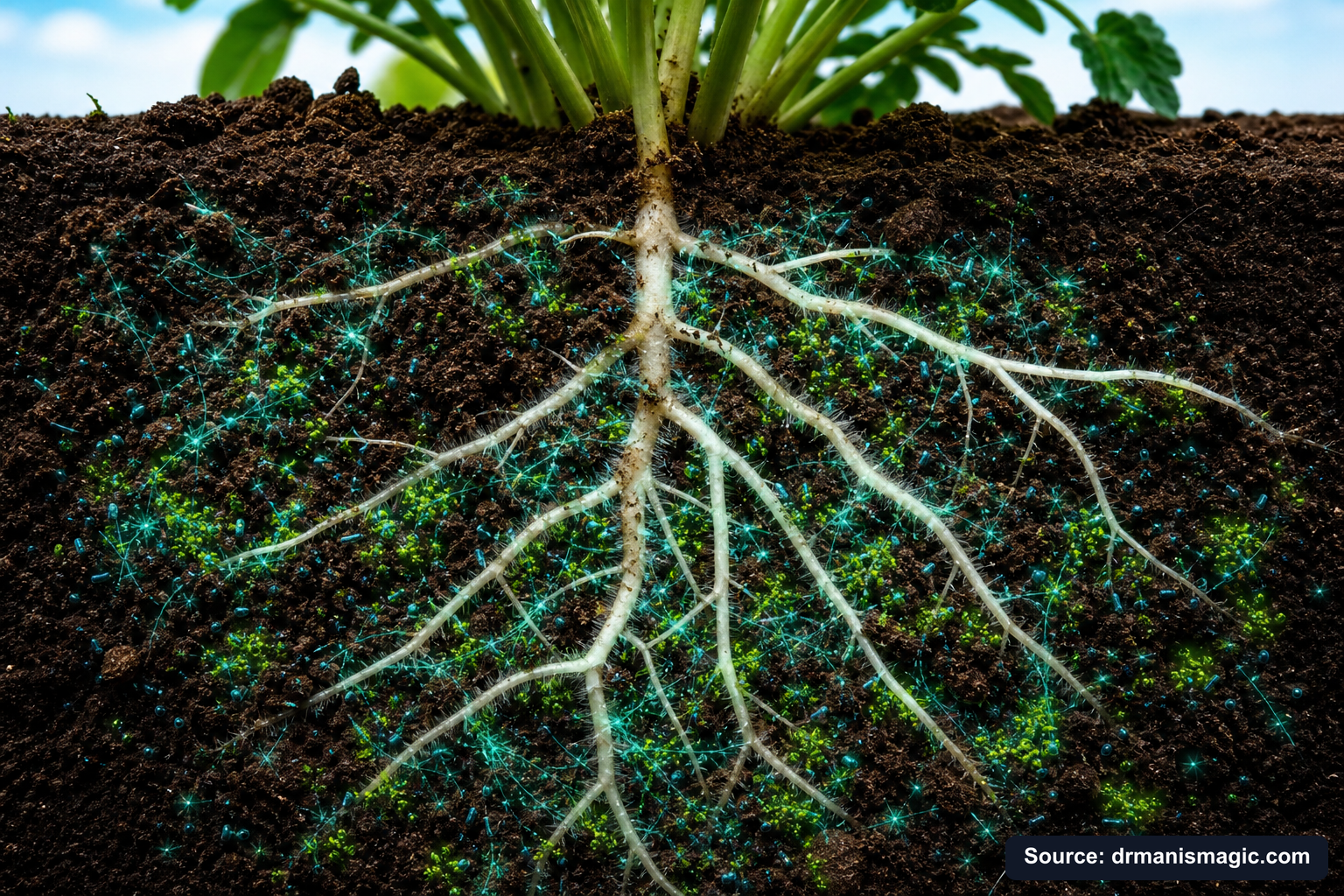
The plant gets a short burst of nutrients. The soil biology collapses. A few weeks later, the plant looks worse than before. So you apply more fertilizer. The cycle repeats. Meanwhile, the soil becomes increasingly dependent on chemical inputs because the natural system that would feed it for free has been dismantled.
This is not an accident. It is the business model.
Broad-spectrum fungicides add another layer of damage. Applied to control one pathogen, they also suppress Trichoderma, mycorrhizal fungi, and other beneficial species that would have suppressed that same pathogen naturally if the biology had been intact. You solve the immediate problem and make the long-term problem worse.
See also: Why Most Fertilizers Are Actually Salt in Disguise
You Never Had a Brown Thumb.
You were handed the wrong tools. This free guide hands you the right ones.
You watered it. You fed it. It died anyway.
It was never you. It was the dirt, the salt food, and the bad advice.
This guide shows you what really went wrong, and how to fix it for good.
- Why your plants really died, and why it was never your fault
- The salt hiding in your plant food that quietly burns the roots
- The hidden killer in almost every bag of store soil
- The tiny helpers that grow a whole forest for free
- The rescue trick that brings a half dead plant back to life
Live vs. Dead Microbial Products: How Do You Know What You're Actually Buying?
Quick Answer: Most microbial products on the market are either dried powders with low survival rates or smelly liquids that have gone anaerobic in the bottle. A genuinely live microbial product should smell earthy, not rotten, contain a full spectrum of bacteria, fungi, mycorrhizae, protozoa, and nematodes, and show visible microbial activity under a microscope. Dead microbes cannot colonize your root zone.
The microbial product market is booming right now. Walk down any garden aisle and you will see dozens of bottles promising living bacteria, living fungi, mycorrhizae. The labels look impressive. The claims are bold. And in most cases, the microbes inside are either dead or barely clinging to life.
After years of testing at US Citrus Nursery, Dr. Mani Skaria identified three categories of microbial products, and the differences are important.
Category 1: Dried powder from factory-grown cultures. These products are made in giant industrial vats. Specific strains of bacteria or fungi are grown in bulk, then spray-dried into powder. The hope is that dormant spores will reactivate when watered in. In our testing across dozens of batches, these products showed no measurable benefit to the plants. The strains are too narrow, the survival rates are too low, and the diversity is nowhere close to what a living rhizosphere needs.
Category 2: Liquid compost tea that has gone anaerobic. Some companies start with real compost or earthworm castings and turn them into liquid. Great concept. But once that liquid is bottled, shipped, and stored, the aerobic microbes that do the most important work start dying. The bottle goes anaerobic. You can smell it the moment you open it. Sometimes it fizzes. That fizz is microbial die-off gas. By the time it reaches your garden, the living fraction is a shadow of what it was. You still get some benefit from the humic acids and fulvic acids in the liquid, but the living biology is mostly gone.
Category 3: Lactobacillus-based products. Yes, like yogurt. Easy to produce, vigorous, and shelf stable. But lactobacillus bacteria are not soil organisms. They are fermenters. They outcompete the beneficial soil bacteria you actually want, and they do not build the kind of rhizosphere community that supports plant health. They belong in your gut, not your garden.
And then there is a fourth way. The way Dr. Mani's Magic does it.
Plant Super Boost is harvested from hand-crafted, actively managed compost, not lab-grown. It contains over 2,000 species of bacteria, 400 to 500 species of fungi including mycorrhizae, plus protozoa and nematodes. And through a proprietary all-natural stabilization technique developed by a world-renowned compostologist who spent decades advising farming operations for royal families and governments before being blacklisted by the chemical industry, the microbes are kept alive without going anaerobic.
That is why Plant Super Boost smells earthy, not rotten. It is not decomposing. It is alive. You can take a single drop, put it under a microscope, and watch the organisms moving. Lab analysis confirms it. Your plants feel it.
| Product Type | Organism Source | Viability at Use | Spectrum | Odor | Real-World Result |
|---|---|---|---|---|---|
| Dried powder (factory lab) | Industrial vat cultures | Very low | Narrow (1-5 strains) | Little to none | Minimal benefit observed |
| Dried powder rehydrated in liquid | Industrial vat cultures | Very low | Narrow | Little to none | Minimal benefit observed |
| Bottled compost tea (old, anaerobic) | Compost or worm castings | Low (mostly dead) | Partial | Strong, foul smell | Some humic/fulvic acid benefit; low microbial benefit |
| Fresh compost tea (<24 hours, aerated) | Active compost | Moderate | Broad | Earthy | Good; but time-sensitive and labor-intensive |
| Lactobacillus-based product | Fermentation cultures | High (wrong organisms) | Very narrow | Sour/fermented | Crowds out beneficial soil bacteria |
| Plant Super Boost (stabilized, full-spectrum) | Hand-crafted compost, natural stabilization | High | 2,000+ bacteria; 400-500 fungi; protozoa; nematodes | Earthy, not foul | Full soil food web support; visible under microscope |
How Do You Rebuild Sterile or Damaged Soil Biology?
Quick Answer: Rebuilding damaged soil biology requires stopping the inputs that kill microbes, reintroducing a full-spectrum live microbial product, adding organic matter as food for the new biology, ensuring good drainage and aeration, and repeating applications over multiple months. Recovery is not instant. Consistent monthly inoculation is more effective than one large dose.
Maybe your soil has been hit with herbicides. Maybe you inherited a garden bed that was treated with synthetic fertilizers for years. Maybe you are growing in a potting mix that was steam-sterilized at the factory and has never had a living organism in it. Maybe you used a fungicide drench to fight root rot and wiped out both the bad and the good fungi in the process.
The biology can come back. But it needs help. And it needs time.
Here is a practical recovery sequence we use at the nursery:
- Stop the inputs that kill microbes. Put down the synthetic fertilizers. Stop the broad-spectrum fungicides unless active disease is present and untreatable otherwise. Give the soil a break from the inputs that have been suppressing biology.
- Fix the physical environment first. Check drainage. Roots and microbes both need oxygen. Waterlogged, compacted soil is a pathogen paradise and a beneficial microbe desert. If you are in a container, consider whether the potting mix has broken down into dense, airless sludge. If it has, it is time for a mineral-based soil that does not decompose and choke roots. See our Super Soil for exactly this purpose.
- Add organic matter as food for the incoming biology. Compost, mulch, or an organic fertilizer like crab, kelp, and amino acids gives the new microbial community something to eat and process. Without food, even live microbes will not establish well.
- Inoculate with a full-spectrum live microbial product. This is the step most gardeners skip or do wrong. Use a genuinely live, broad-spectrum product. Apply it as a soil drench, not a foliar spray. Get it into the root zone where it needs to colonize.
- Keep the soil consistently moist but not wet. Microbes need moisture to move and reproduce. Dry soil kills them just as surely as salt does. Wet soil drives them anaerobic. Aim for the squeeze test: a handful of soil should hold together but not drip.
- Repeat monthly. Environmental pressures, sterile inputs, and ongoing salt from tap water or residual chemical deposits keep thinning the microbial community. Monthly applications rebuild and reinforce the population. One application is a start. Consistent applications build a self-sustaining ecosystem.
- Be patient and watch for signs of life. Healthy microbial activity shows up in the plants before it shows up in a soil test. Leaves get greener. New growth accelerates. Fruit sets more reliably. The soil starts to smell earthy, like a forest floor, rather than flat and lifeless.
What Are the Three Plant Pillars and How Do They Connect to Soil Biology?
Quick Answer: The Three Plant Pillars are Dr. Mani's Magic's framework for plant success: mineral-based soil that drains and breathes, live microbials that build the soil food web, and organic fertilizer that feeds plants and microbes without salt damage. Together, all three address the root cause of most plant problems. Missing any one pillar keeps the system from working.
After 30 years of growing, testing, failing, adjusting, and growing again, Dr. Mani Skaria distilled everything he learned into a three-part framework. Not because it sounds good on paper. Because it is what actually worked on 250,000 trees in the Texas heat, in containers, in the ground, in the nursery, and in the grove.
The Three Plant Pillars are not three separate tips. They are three legs of one stool. Pull any one out and the whole thing tips over.
Pillar 1: Mineral-Based Soil. Most potting mixes are made from pine bark, sawdust, and organic fillers. Those materials break down. As they decompose, they compact, block oxygen from reaching roots, and drain poorly. Root rot does not usually come from overwatering alone. It comes from overwatering into a soil that has collapsed into airless sludge. Mineral-based soil does not decompose. It holds its structure permanently. Roots breathe. Microbes get the oxygen they need to stay aerobic and beneficial. The whole system starts from a stable physical foundation.
Pillar 2: Live Microbials. This is the pillar most gardeners skip entirely, or do wrong. They add compost and call it done. Or they buy a dried powder and wonder why nothing changes. Living, full-spectrum microbials are what process the organic matter, protect the root zone, suppress pathogens, and deliver nutrients to your plant. Without this pillar, you have food but no kitchen crew to prepare it.
Pillar 3: Organic Fertilizer. Salt-based synthetic fertilizers feed the plant directly but destroy the biology doing it. Organic, slow-release fertilizers made from crab, kelp, and amino acids feed both the plant and the microbes. They release nutrients gradually as microbes process them, which means no burn, no salt buildup, no microbial massacre. The nutrients arrive in forms the plant's root chemistry is designed to receive.
When all three are in place, something shifts. The plant stops struggling and starts thriving. Not because you worked harder. Because you stopped fighting nature and started working with it.
Explore the complete Three Plant Pillars system to see how the pillars work together.
How Much Time Are You Losing by Doing It the Old Way?
Quick Answer: Gardening with salt-based fertilizers and no living soil biology can produce short-term results, but the soil degrades, the biology collapses, and plants stall or decline within months to years. The real cost is not the money spent on products. It is the irreplaceable seasons lost while your plants struggle toward a harvest you may never see.
You can always earn more money. You cannot earn more time.
That is not a slogan. It is the most honest thing we can tell you. The number one thing Dr. Mani hears from gardeners, from people who have poured years into their backyard, is some version of the same wish: I just want to see fruit on my trees while I still can. Said differently every time. Felt the same every time.
Here is what happens when you garden the old way. You buy a plant. You use what the big box store recommends. Things look okay for a few weeks. Then growth stalls. You add more fertilizer. The plant perks up briefly, then declines again. The soil is getting saltier. The microbes are gone. The organic matter you added is sitting there unprocessed. A year passes. Two years. The tree is the same size it was when you brought it home. You have spent money on products, time on research, energy on frustration, and the harvest you imagined is still not there.
Months become years. Years become decades. And all that time, the tree could have been growing on a living foundation that fed itself, defended itself, and moved steadily toward the fruit you planted it for.
The right foundation does not just save you money. It gives you back the seasons you would have lost chasing the wrong approach. And once the Three Plant Pillars are in place, the system gets stronger over time instead of weaker. The biology builds on itself. The soil improves each month instead of degrading. The plant stops depending on you to rescue it and starts doing what plants were designed to do: grow.
What Can You Do Right Now to Start Rebuilding Your Soil Food Web?
Quick Answer: Start by stopping the inputs that kill soil biology, then add a live full-spectrum microbial product as a soil drench, pair it with organic fertilizer, and ensure your soil drains and breathes. Apply monthly and watch your plants respond. The soil food web rebuilds faster than most gardeners expect when the right conditions are in place.
You do not need a science degree. You do not need to brew compost tea at 5 in the morning. You do not need to buy twelve different products from twelve different companies and hope they work together.
Here is the practical path forward.
First, look at your soil. If it is dense, dark, and slow to drain, the physical structure is working against you. A mineral-based soil that maintains its structure permanently is the foundation everything else depends on.
Second, add living biology to the root zone. Not a dried powder. Not a smelly bottle. A genuinely live, full-spectrum microbial inoculant with bacteria, fungi, mycorrhizae, protozoa, and nematodes. Applied as a soil drench, monthly, so the community has time to establish and grow.
Third, feed the system with organic fertilizer that works with your microbes instead of against them. Zero synthetic salts. Zero PFAS. Zero biosludge. Slow-release nutrients from real sources like crab, kelp, and amino acids that the microbial community can process naturally.
And then: be consistent. The soil food web is not rebuilt in a weekend. But within a month, you will start seeing it in the plants. Greener leaves. Faster growth. More flowers. Better fruit set. The soil itself will start to smell different. Alive. Earthy. Like a forest floor after rain.
That smell is the food web waking up. That is the beginning of what healthy soil does, and organic matter was always just the first chapter of that story.
If you want the complete picture on caring for your plants the right way, our Free Plant Care Field Guide walks you through the whole system, step by step, in plain language. No jargon. No guesswork. Just the approach that has worked on over 250,000 trees and counting.
The soil is alive. Or it can be. And once it is, everything changes.
Frequently Asked Questions
You just read about the soil food web. Now you have questions. Good. These are the same questions gardeners ask us every day. Get these answers right and you will stop wasting money on compost that goes nowhere.
What is organic matter in simple terms?
Organic matter is any carbon-based material that came from a living thing. Dead leaves, old roots, compost, even the bodies of tiny bacteria. It is the food supply for your soil. But here is what most gardeners miss. Food does not feed your plants by itself. You need living microbes in the soil to break that food down and turn it into something your plant roots can actually drink up. Without those microbes, organic matter just sits there doing almost nothing.
Is organic matter alive?
Some of it is, and some of it is not. Dead plant material and old compost are not alive. But the living roots, bacteria, fungi, and earthworms mixed in with that material? They are very much alive. Those living creatures are the engine. They eat the dead organic matter and release nutrients your plants can use. Dr. Mani calls this the difference between the food and the cooks. You need both working together. That is exactly what the Three Plant Pillars are built around.
How does organic matter form in the first place?
Plants pull carbon out of the air through photosynthesis. That carbon builds leaves, stems, and roots. When those plant parts die and fall to the ground, bacteria and fungi get to work breaking them down. Over time, the most stable pieces turn into humus, a dark and rich layer that holds nutrients and water. This whole cycle depends on a living soil community. Wreck the microbes with synthetic chemicals and the cycle stops. The organic matter just piles up without doing its job.
Can you have too much organic matter in your soil?
Yes, and most gardeners never hear this. When organic matter builds up faster than microbes can process it, you can get nutrient runoff, especially phosphorus. Soggy, oxygen-starved soil is another problem. Roots need air as much as they need water. That is why Dr. Mani built Super Soil around a mineral base from South Texas sandy loam. It does not break down, it does not compact, and it keeps roots breathing. Organic matter works best when the soil structure underneath it is solid and stable.
Why does compost alone stop working after a while?
Compost adds food to your soil. But if your soil has been hit with synthetic fertilizers or chemical fungicides, the microbes that process that compost are already dead or severely weakened. Food with no cooks means nothing gets made. We proved this across more than 250,000 trees at our South Texas nursery. The plants that got compost plus live microbes from Plant Super Boost grew faster, stayed healthier, and produced more fruit. Compost alone was never the full answer. It was only the first step.
What kills the living things in soil?
Salt-based synthetic fertilizers are the biggest culprit. They give plants a quick jolt but they scorch the microbes your soil depends on. Chemical fungicides and herbicides add to the damage. Even most store-bought potting mixes are sterile, meaning they have zero living biology inside them. Once you kill the soil food web, organic matter stops cycling and your plants slowly starve. This is why so many gardeners feel stuck. They keep adding products but the soil underneath never heals.
What is the fastest way to bring living soil back to life?
You need all three pillars working at the same time. Start with a mineral-based soil that does not compact or rot. Add live microbes, real bacteria, fungi, and mycorrhizae that are still alive when they reach your roots. Then feed that living system with slow-release organic fertilizer made from crab, kelp, and amino acids instead of salt-based chemicals. That is exactly what Dr. Mani built after 35 years of testing. Get all three right and your soil wakes up fast. Most gardeners see a real difference within the first 30 days.
About the Author
Dr. Mani Skaria, PhD
Dr. Mani Skaria, PhD, is a plant pathologist and the scientific founder of Dr. Mani's Magic. He earned his doctorate at Purdue University and spent 48 years studying how plants, soil, and living microbes work together, including his years as Professor Emeritus at Texas A&M and as a member of the USDA NAREEE Advisory Board. He invented micro-budding, a method for growing healthier, stronger trees, and has grown more than 250,000 trees on the family farm in Hargill, Texas - US Citrus Nursery. His life's work takes real lab science and practical experience and turns it into simple, safe, organic plant care anyone can use at home.


