


How Fungal Diversity Increases Plant Resilience and Builds Stronger Roots | Dr. Mani's Magic
How Fungal Diversity Increases Plant Resilience: The Living Soil Web Behind Stronger, Tougher Plants
Picture this. You walk out to your backyard on a Saturday morning. Coffee in hand. The air smells like fresh earth after last night's rain. You reach down and pull up a weed — the kind that grows back every single week no matter what you do. You toss it aside, annoyed.
But here is the thing most gardeners never notice. Look at the roots of that weed. See those white fuzzy threads clinging to them? Those threads are fungi. Invisible to most people. Unnoticed. Unappreciated. And they are the exact reason that weed grows back stronger every single time you rip it out. Those fungi extend the weed's root system like a hidden underground network, pulling in water and nutrients from soil that the roots alone could never reach. That weed has an army working for it. Your prize plant probably does not.
After growing over 250,000 trees at our South Texas nursery, we learned one thing that changed everything. The plants that thrived — the ones that survived drought, disease, poor soil, and every kind of stress — were not the ones we fertilized the most. They were the ones with the richest, most diverse underground life. Fungi. Bacteria. Protozoa. Nematodes. A whole invisible civilization doing the work that no bottle of synthetic fertilizer ever could. This article is about that civilization. And why building it is the single most powerful thing you can do for any plant you own — whether that is a citrus tree, a tomato plant, a lawn, or a houseplant on your kitchen windowsill.

Organic Fertilizer | Crab, Kelp & Amino Acids
Key Takeaways
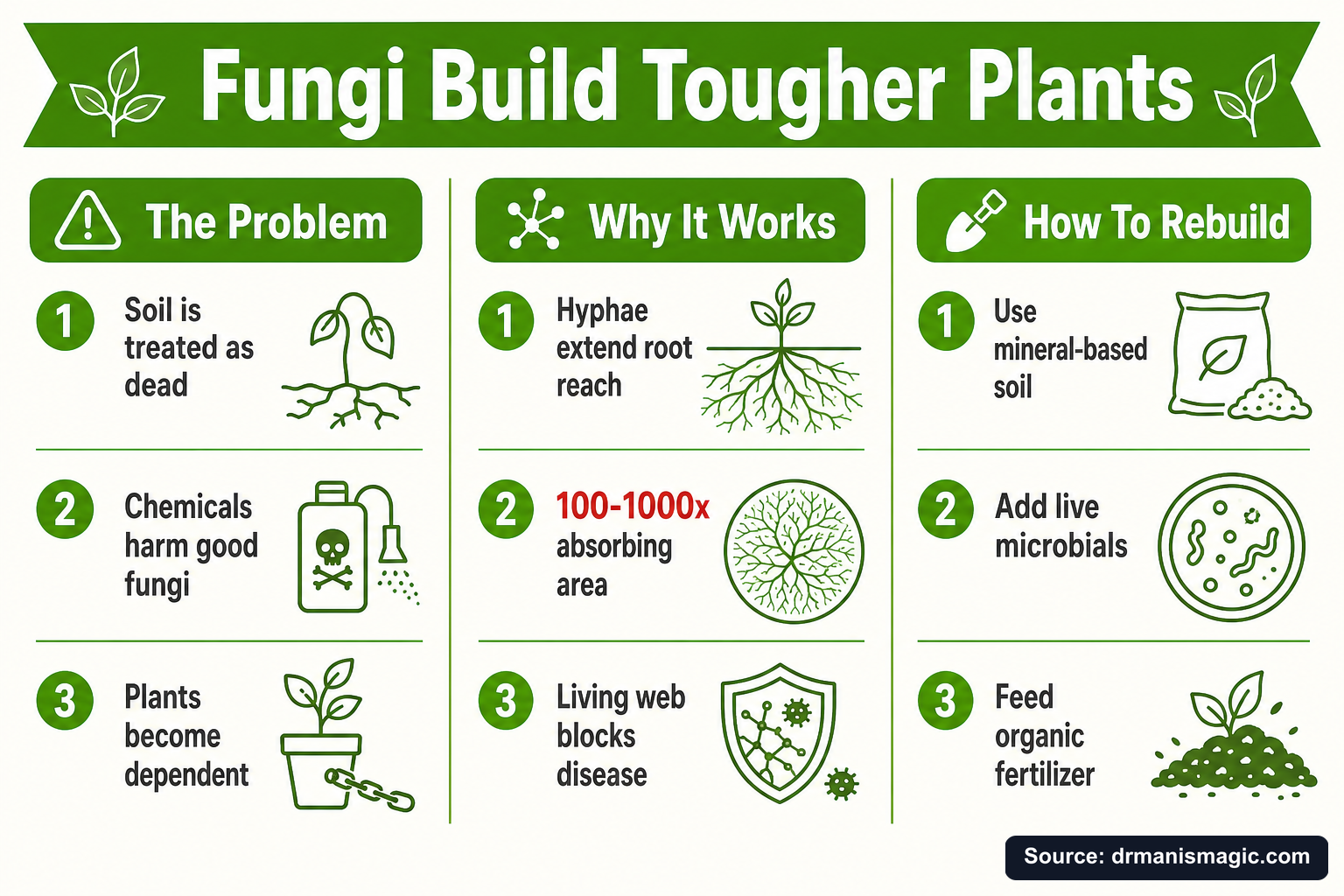
- Fungal diversity increases plant resilience by building a living underground network that extends roots, captures water, and locks out disease — not by acting as a magic additive you pour on once.
- Mycorrhizal fungi can expand a plant's root absorbing area by 100 to 1,000 times, according to Colorado State Extension, letting plants survive drought and nutrient-poor soils that would kill unprotected plants.
- Fungi work best as part of a complete soil food web — bacteria, protozoa, nematodes, earthworms, and roots all play connected roles that reinforce each other.
- Synthetic fertilizers, fungicides, herbicides, and pesticides all damage or destroy beneficial fungi, often leaving plants defenseless and dependent on more chemicals.
- Most microbial products on the market today are either dead dried powder or smelly anaerobic liquids — neither delivers living biology to your roots.
- The Three Plant Pillars — mineral-based soil, live microbials, and organic fertilizer — work together to rebuild and protect the soil food web your plants need to thrive.
- Restoring damaged soil biology takes time and repeated applications; one dose is a start, not a finish.
What Is the Soil Food Web and Why Does It Control Plant Health?
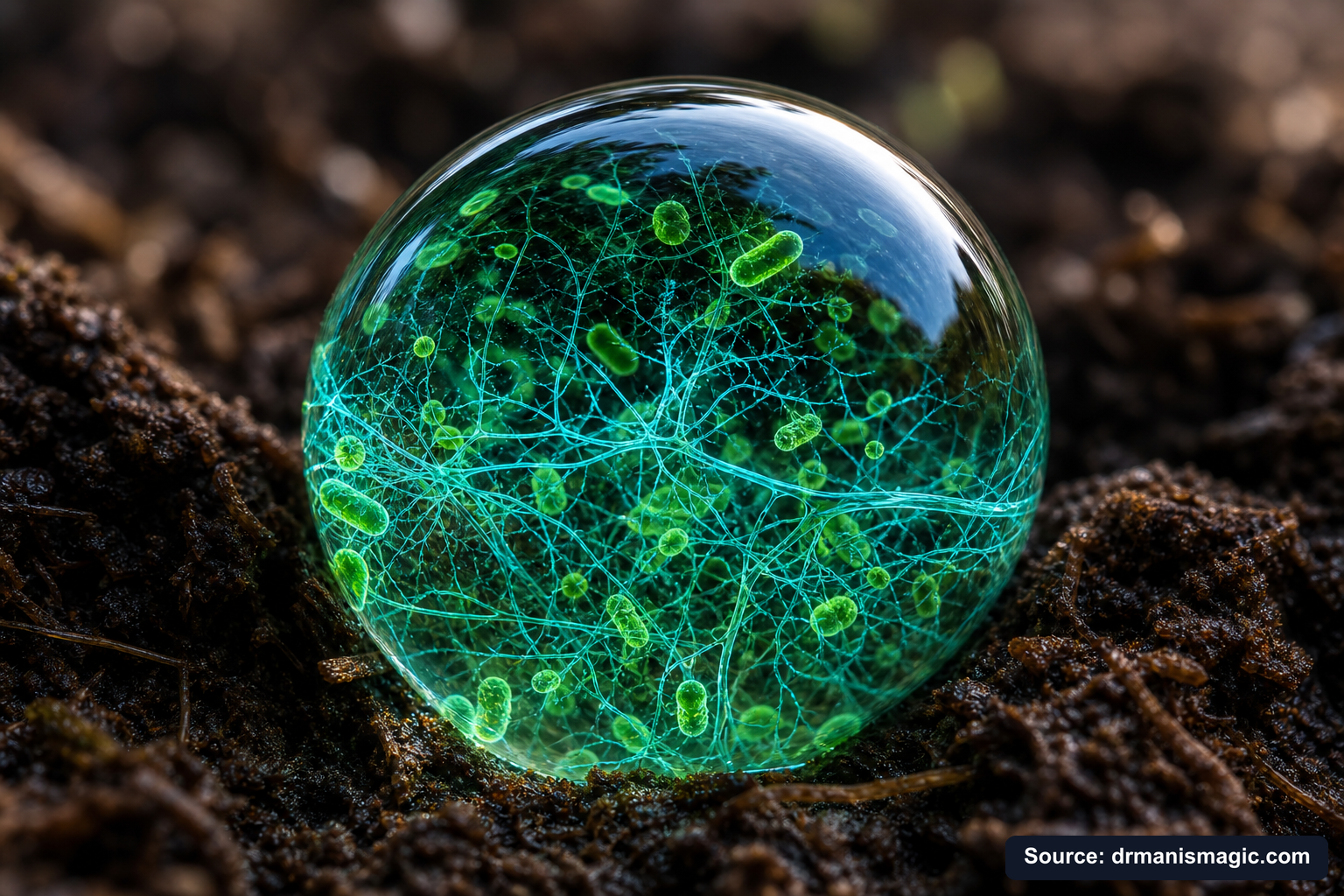
Quick Answer: The soil food web is the living community of bacteria, fungi, protozoa, nematodes, earthworms, and plant roots that all work together underground. This community cycles nutrients, holds water, suppresses disease, and builds the soil structure that keeps plant roots healthy. Without it, plants struggle no matter how much fertilizer you add.
Think of your soil as a city. Not a ghost town. A living, breathing city with millions of residents all doing different jobs.
Bacteria break down organic matter and release nutrients. Fungi weave threads through the soil called hyphae, connecting plants to distant water and mineral deposits. Protozoa graze on bacteria and release nitrogen in a form plant roots can actually use. Nematodes — the beneficial kind — eat bacteria and fungi, cycling nutrients further. Earthworms tunnel through the soil, creating air pockets and dragging organic matter deeper. And roots? Roots are not just passive passengers. They actively pump sugars into the soil to feed the microbes they want nearby.
This is the soil food web. And according to university extension research from sources like the USDA Natural Resources Conservation Service, a healthy soil food web improves nutrient cycling, water retention, disease suppression, and soil structure all at the same time. These are not separate benefits. They are one connected system.
Here is what most gardening advice gets wrong. It treats soil like a delivery vehicle — something you pour nutrients into so the plant can eat. But healthy soil is not a delivery vehicle. It is a living ecosystem. And the moment you treat it like dead chemistry, you start losing the biology that actually runs the show.
| Organism | Primary Role | Key Benefit to Your Plant |
|---|---|---|
| Beneficial Bacteria | Break down organic matter, fix nitrogen from the air, suppress pathogens | Release nutrients in plant-available forms; crowd out harmful microbes |
| Mycorrhizal Fungi | Extend root reach via hyphae threads, transport water and phosphorus | 100-1,000x more absorbing surface; drought and disease tolerance |
| Other Beneficial Fungi | Decompose tough organic matter, stabilize soil aggregates via glomalin | Better soil structure, aeration, and drainage |
| Protozoa | Graze on bacteria, release nitrogen as waste | Mineralize nutrients into forms roots can absorb immediately |
| Beneficial Nematodes | Eat bacteria and fungi, cycle nutrients, suppress pest nematodes | Deeper nutrient cycling; biological pest control underground |
| Earthworms | Tunnel through soil, digest organic matter, produce castings | Better aeration, drainage, and concentrated nutrient deposits |
| Plant Roots | Release sugars (exudates) to feed microbes; form symbiotic partnerships | Recruit beneficial organisms; build long-term root-zone biology |
Notice something. Every organism on that list depends on the others. Pull one thread and the whole web gets weaker. This is exactly why you cannot solve a soil problem by just adding one product. And it is exactly why the Three Plant Pillars work as a system — mineral-based soil, live microbials, and organic fertilizer — because each pillar supports the others.
What Do Mycorrhizal Fungi Actually Do for Plant Roots?
Quick Answer: Mycorrhizal fungi attach to plant roots and send out thread-like hyphae that explore far more soil than roots can reach alone. Colorado State Extension reports this expands the root absorbing area by roughly 100 to 1,000 times. This lets plants pull in water, phosphorus, and trace minerals from soil zones roots never touch on their own.
Mycorrhizae — say it like "my-cor-RY-zee" — is just a fancy word for a fungus that lives with a plant root. "Myco" means fungus. "Rhiza" means root. Together they form one of the oldest partnerships in the history of life on Earth. Scientists believe this relationship is over 400 million years old. Plants and fungi figured this out long before humans planted the first garden.
Here is how it works. The plant root sends out a chemical signal. A nearby fungal spore picks up that signal and grows toward the root. The fungus attaches and begins threading microscopic hyphae — think of them like extra root hairs — out into the surrounding soil. These threads are so thin they can squeeze into tiny soil pores that roots cannot enter. They explore a far bigger area. They find water pockets during dry spells. They locate phosphorus deposits locked in mineral form that roots alone cannot release.
In exchange, the plant feeds the fungus. It pumps sugars through the root connection. The fungus uses those sugars for energy. The plant gets expanded reach. The fungus gets food. Both win.
Colorado State University Extension describes this relationship as enlarging root absorbing area by roughly 100 to 1,000 times. And Purdue Extension research has found that mycorrhizal tree seedlings can survive droughty, low-nutrient conditions where non-mycorrhizal seedlings simply die.
That is not a small difference. That is the difference between a plant that survives a Texas summer and one that gives up in August.
But here is what the weed in your backyard knows that your potted plant does not. Weeds grow in living soil. Your potted plant probably lives in sterile bagged potting mix — a product with zero native fungi, zero bacteria, zero soil food web. It is biological dead space. The weed has an army. Your plant is fighting alone.
How Does Fungal Diversity Help Plants Survive Drought?
Quick Answer: Diverse fungi — especially mycorrhizal species — dramatically extend a plant's reach into the soil for water. When rain stops, fungal hyphae keep exploring while roots stay put. Multiple fungal species cover different soil depths and textures, meaning a plant with diverse fungi finds water in more places than a plant with just one species or none at all.
Imagine your plant is thirsty. The soil near the roots dries out first. Roots cannot move to find new water. But fungal threads can keep growing. They push outward and downward, following moisture gradients through the soil, pulling water back toward the root connection.
Now imagine that instead of one type of fungus, you have dozens. Some species go deeper. Some spread wider. Some specialize in fine-textured clay pockets. Others navigate sandy loam. The more diverse the fungal community, the more of the surrounding soil your plant can effectively access during stress.
We saw this clearly growing citrus in South Texas. The trees with rich fungal diversity in their root zones kept pushing growth through dry spells that stunted or killed trees in sterile potting mix. The biology was doing work that no amount of irrigation could fully replace.
There is also a second mechanism. Certain mycorrhizal fungi produce a sticky protein called glomalin. Glomalin glues soil particles together into clumps called aggregates. These aggregates create tiny pore spaces in the soil. Those pore spaces hold both air and water. Better soil structure means water infiltrates faster during rain and is held longer during dry periods. The fungi literally rebuild the soil's ability to store water over time.
This is why we build our growing system on Super Soil — a mineral-based, permanently structured foundation that gives fungal networks the stable, well-drained, oxygen-rich environment they need to thrive. You cannot build a living fungal network in decomposing pine bark that collapses and compacts within a year.
How Does Fungal Diversity Help Plants Fight Disease?
Quick Answer: A diverse fungal community suppresses disease in three ways: it physically crowds out pathogenic fungi by colonizing root surfaces first; it produces natural antifungal compounds that inhibit harmful organisms; and it trains the plant's own immune system to respond faster to threats. The more diverse the beneficial fungi, the harder it is for any one pathogen to dominate.
Most people hear the word "fungus" and think of disease. Black mold. Root rot. Leaf blight. That association is understandable. But it is only half the story.
Pathogenic fungi cause disease. Beneficial fungi prevent it. And they do it in ways that are genuinely remarkable.
First, beneficial fungi colonize root surfaces before pathogens can. It is a real estate competition. The more beneficial fungi already living on and around your plant's roots, the less room and fewer resources are available for harmful invaders. This is called competitive exclusion. Your good guys crowd out the bad guys just by being there first and in greater numbers.
Second, many beneficial soil fungi and bacteria produce natural compounds that are toxic to pathogens. They essentially manufacture biological pesticides on site, right where disease pressure is highest — the root zone.
Third — and this is the part that most people never hear about — mycorrhizal fungi appear to prime the plant's own immune system. Research from institutions like Cornell University and the Boyce Thompson Institute has found that arbuscular mycorrhizal fungal hyphae host their own distinct bacterial communities. These bacteria and fungi work together as a team near the root zone, not just competing with pathogens but building biological corridors that help release phosphorus and other nutrients while simultaneously keeping the root environment hostile to disease organisms.
A plant with rich fungal diversity is not just better fed. It is better defended. And that defense is self-renewing — as long as the biology is alive and the soil is not poisoned.
What Kills Beneficial Fungi and Collapses the Soil Food Web?
Quick Answer: Synthetic fertilizers, fungicides, herbicides, and pesticides are the four biggest killers of beneficial soil fungi. Salt-based synthetic fertilizers draw water out of fungal and bacterial cells, essentially burning them. Fungicides kill beneficial and harmful fungi without discrimination. Herbicides disrupt microbial communities. Each attack weakens the soil food web and leaves plants more dependent on chemical inputs over time.
Here is the part of the story that the big chemical companies would rather you not think about too hard.
Every time you spray a broad-spectrum fungicide, you are not just killing the powdery mildew on your rose. You are killing the mycorrhizal fungi in your soil too. Every time you pour a salt-based synthetic fertilizer around your tree roots, the high salt concentration pulls moisture out of bacterial and fungal cells the same way it pulls moisture out of a slug. They die. The soil food web shrinks. The plant becomes more dependent on the next application of synthetic input.
It is a cycle. And it is designed — intentionally or not — to keep you buying.
Dr. Mani Skaria spent 35 years watching this happen in citrus production. Growers would spray, fertilize, spray again, and wonder why their trees kept getting weaker. The soil biology was being stripped away with every application. The trees were not failing because of bad weather or bad luck. They were failing because the invisible workforce underground was being eliminated.
See also: The Hidden Reason Synthetic Fertilizers Cause Root Rot
Glyphosate (the active ingredient in Roundup) is particularly damaging to soil microbial communities. Multiple university studies have documented its disruption of beneficial bacteria and fungi at rates far below what is used in typical lawn and garden applications. And broad-spectrum pesticides do not discriminate between the spider mites on your leaves and the beneficial nematodes in your soil. Both get hit.
The result is a soil that looks like soil but functions like dirt. Brown, inert, biologically empty. And then people wonder why their plants struggle.
You Never Had a Brown Thumb.
You were handed the wrong tools. This free guide hands you the right ones.
You watered it. You fed it. It died anyway.
It was never you. It was the dirt, the salt food, and the bad advice.
This guide shows you what really went wrong, and how to fix it for good.
- Why your plants really died, and why it was never your fault
- The salt hiding in your plant food that quietly burns the roots
- The hidden killer in almost every bag of store soil
- The tiny helpers that grow a whole forest for free
- The rescue trick that brings a half dead plant back to life

Beneficial Fungi vs. Pathogenic Fungi: How Do You Tell the Difference?
Quick Answer: Beneficial fungi live in and around roots, forming visible white or cream-colored threads called hyphae or mycelium. They help plants. Pathogenic fungi typically appear as brown, black, or gray rot on roots, leaves, or stems. The key distinction: a rich population of beneficial fungi in healthy soil actually prevents pathogenic fungi from taking hold in the first place.
This question comes up all the time. And it is a fair one. The word "fungus" has a bad reputation in most gardens.
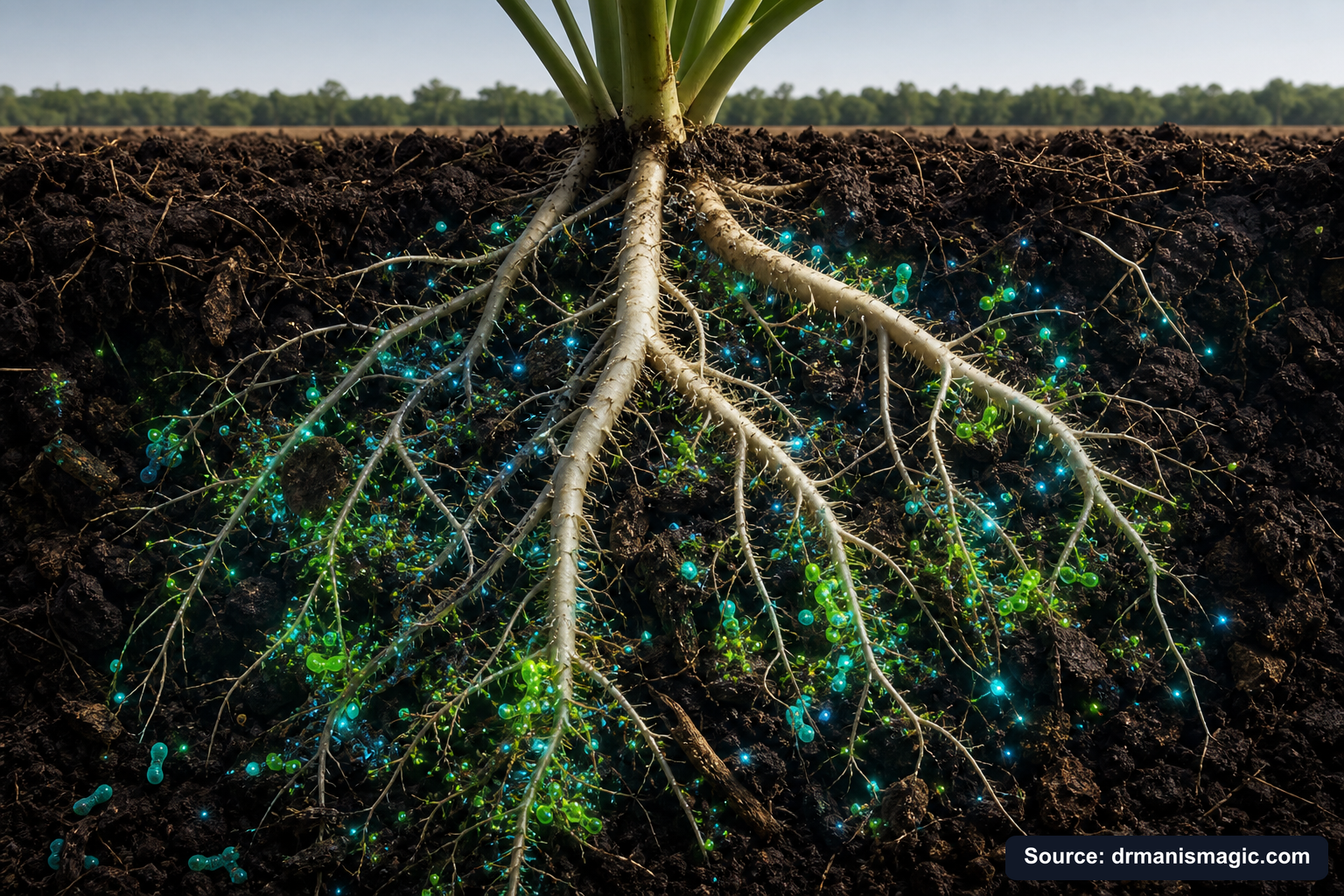
Here is a simple way to think about it. Beneficial fungi are underground and invisible most of the time. They show up as white fuzzy threads on healthy roots — the same white fuzz you see on weed roots when you pull them. They smell like fresh earth. They are part of the living soil system.
Pathogenic fungi are the ones causing visible damage. Brown mushy roots. Black spots on leaves. Gray powdery coatings. Stem rot at the soil line. These are signs that the balance has shifted — that beneficial biology is absent or overwhelmed, and harmful organisms have moved in to fill the gap.
The real protection against pathogenic fungi is not a fungicide. It is a thriving population of beneficial fungi already occupying the root zone. A healthy soil food web is the best disease-prevention system ever invented. It has been running for 400 million years. It has a pretty good track record.
| Feature | Beneficial Fungi (Mycorrhizae and Others) | Pathogenic Fungi |
|---|---|---|
| Location | In and around healthy roots, in soil | On rotting roots, leaves, stems, or fruit |
| Appearance | White or cream fuzzy threads (hyphae/mycelium) | Brown, black, gray rot; powdery or slimy coatings |
| Smell | Fresh earth, no offensive odor | Musty, sour, or rotting smell |
| Effect on plant | Stronger roots, better water uptake, more nutrients | Root rot, wilting, yellowing, decline |
| Relationship with plant | Symbiotic — both organisms benefit | Parasitic — fungus takes, plant suffers |
| Found in healthy soil? | Yes — a sign of good biology | Rarely — they thrive in disturbed, depleted soil |
| Best way to encourage / discourage | Add live microbials, reduce chemicals, use organic inputs | Reduce waterlogging, improve drainage, restore beneficial biology |
Why Do Most Microbial Products on the Market Fail to Deliver Living Fungi?
Quick Answer: Most microbial products are either dried powders with dormant or dead spores that rarely reactivate in real soil conditions, or they are liquid compost teas that went anaerobic — meaning the microbes died and the product started fermenting and smelling foul — before you ever opened the bottle. Neither delivers the living, active biology that plant roots need.
This is where the story gets uncomfortable. Because the microbial product market is booming right now. Walk into any garden center and you will see shelves of products claiming to deliver beneficial bacteria and fungi to your plants. The labels look impressive. The claims sound incredible. And most of them do almost nothing.
Here is what actually happens behind the scenes.
Most commercial microbial products are made in large factory vats. Companies grow specific microbial species in bulk, then dry them into powder form. The idea is that the spores will "reactivate" once you add water and pour them on your soil. In practice, after going through the drying process, packaging, shipping, sitting on a warehouse shelf, and then sitting on a store shelf, very few of those organisms are still viable when they reach your roots. We tested dozens of these products on our nursery trees over the years. The results were consistently disappointing.
The second common form is liquid microbial products brewed from compost or worm castings — essentially compost tea in a bottle. These start out with real, living biology. But once bottled, sealed, and shipped, they go anaerobic within hours to days. The microbes run out of oxygen. They start to die and ferment. By the time the bottle reaches you, it often fizzes when you open it — that is gas from fermentation — and it smells like sewage. The microbes are dead or dying. You are paying for a bottle of biological waste.
Some people do see minor benefits from these products because of the humic and fulvic acids naturally present in compost extracts. But those are passive chemistry, not living biology.
And then there is a third category that sounds clever but causes real harm: lactobacillus-based products. Yes, the same bacteria in your yogurt. Lactobacillus is vigorous and easy to keep alive. But it dominates and crowds out the beneficial fungi and bacteria your plant actually needs. It belongs in your gut. Not in your soil.
What Dr. Mani discovered — through a providential meeting with one of the world's most experienced compost scientists — was a proprietary, all-natural method to stabilize a full-spectrum microbial community harvested from real, active compost. Not grown in a factory vat. Not dried into powder. Not bottled and left to go anaerobic. Stabilized. Living. Active.
That discovery became Plant Super Boost — a liquid microbial formula that contains over 2,000 beneficial bacterial species, 400 to 500 fungal species including mycorrhizae, plus protozoa and beneficial nematodes. If you take a single drop and look at it under a microscope, you can see the microbes moving. That is not marketing language. That is observable, documented biology.
It does not stink. Because it is not dying. It smells like earth — the same clean, rich smell of soil after rain — because it is alive and stable, not fermenting and rotting.
Live Microbes vs. Dead Microbe Products: What Is Actually in the Bottle?
Quick Answer: Live, active microbial products deliver working biology to plant roots immediately. Dead or dormant products — dried powders, anaerobic liquids — deliver chemistry at best and nothing at worst. The difference in plant outcomes is dramatic, especially in disturbed, sterile, or chemically damaged soils where native biology is absent and the plant needs outside help most.
Let us make this comparison concrete. Because this is where most gardeners lose real money — and worse, lose real time.
| Product Type | Microbial Viability | Spectrum of Organisms | Odor | Result in Soil | Our Verdict |
|---|---|---|---|---|---|
| Dry / powdered lab microbes | Very low — most die during processing and shelf storage | Narrow — a few specific species | Minimal | Little to no measurable improvement | Avoid — we tested dozens, saw no results |
| Dried microbes rehydrated in liquid | Low — same viability issues as dry powder | Narrow | Minimal | Marginal at best | Avoid — same problems, harder to detect |
| Compost tea (fresh, less than 24 hours, actively aerated) | Moderate — must be used immediately | Partial — depends on compost source | Earthy, turning sour fast | Good if fresh; impractical for most gardeners | Great if you can make and use it immediately |
| Bottled compost tea (older than 24 hours) | Very low — anaerobic, microbes dying or dead | Partial — degraded community | Strong, foul — sewage-like | Some passive chemistry from humic/fulvic acids; no living biology | Not recommended — you can smell the problem |
| Lactobacillus-based products | High — lactobacillus is very vigorous | Single species | Sour / fermented | Crowds out beneficial fungi and bacteria; net negative for soil diversity | Avoid — belongs in yogurt, not soil |
| Plant Super Boost (stabilized, full-spectrum) | High — living, active, microscopically verified | 2,000+ bacteria; 400-500 fungi including mycorrhizae; protozoa; nematodes | Clean, earthy — not anaerobic | Immediate biological activity in root zone; measurable improvement in plant vigor | Highly recommended — harvested from real compost, not lab-grown |
The time angle here matters more than most people realize. You can always earn more money. You cannot earn back the years you spent watching a plant struggle and decline because the biology in the soil was dead. The number one thing people tell us they want — more than anything else — is to see their tree bear fruit in their lifetime. To watch something they planted grow into something that produces. That desire is real, and it is ancient. We were put here to tend a garden. But doing it the slow, failed way means years of stalled growth before you even realize the foundation was wrong.
When Do Mycorrhizal Inoculants Actually Work — and When Do They Not?
Quick Answer: Mycorrhizal inoculants work best in disturbed, sterile, or chemically damaged soils where native fungi are absent or depleted. They are less effective — sometimes unnecessary — in rich, biologically active native soil that already has a healthy fungal community. High phosphorus levels, fungicide presence, and incompatible plant species can also reduce effectiveness dramatically.
Let us be honest. Fungi are not magic. Adding mycorrhizal inoculants does not guarantee results. The conditions have to be right. And understanding when they work — and when they do not — will save you money and frustration.
Here is when adding mycorrhizal inoculants makes the most sense:
- Sterile or bagged potting mix. Commercial potting mixes are sterilized. They contain zero native biology. Any plant living in bagged potting mix has no mycorrhizal network unless you add one. This is the single most common situation where inoculants make an immediate, visible difference.
- Chemically damaged soil. If your soil has been treated repeatedly with synthetic fertilizers, herbicides, fungicides, or pesticides, the native fungal community has likely been stripped. Reintroducing biology is essential — but so is stopping the inputs that caused the damage.
- Transplanting and repotting. Transplant stress is one of the most dangerous moments in a plant's life. Mycorrhizal inoculants applied at transplant time help the plant rebuild its underground support network faster.
- Low-phosphorus soils. Mycorrhizal relationships are strongest when phosphorus is limited. The plant needs the fungus most when it cannot find phosphorus on its own. In high-phosphorus soils, the plant may not invest as heavily in the fungal partnership.
- New plantings in disturbed ground. Construction sites, recently tilled gardens, and new raised beds all have disrupted soil biology. Inoculants help jump-start the recovery process.
And here is when they are less likely to help:
- When you continue applying fungicides — these kill the fungi you just added.
- When soil phosphorus is very high — the plant has less incentive to maintain the fungal partnership.
- When you use incompatible plant species — a small number of plants, like members of the brassica family (cabbage, broccoli, kale), do not form mycorrhizal partnerships at all.
- When you apply dead or dormant products — no living biology means no real inoculation.
The Purdue Extension notes that mycorrhizal inoculants show the most dramatic results in nursery and transplant settings where native soil biology is absent — exactly the conditions most home gardeners and container growers are dealing with every single day.
How Do You Rebuild Fungal Diversity in Damaged or Sterile Soil?
Quick Answer: Rebuilding fungal diversity requires stopping the inputs that kill fungi, adding living microbial biology, feeding the soil food web with organic matter, and giving the system time and repeated applications to recover. One treatment is a start. A consistent monthly routine with living microbials and organic fertilizer is what actually rebuilds lasting biological diversity.
This is the practical question that matters most. You understand the problem. Now what do you actually do about it?
Here is a recovery checklist we use with growers who are starting from damaged, depleted, or sterile soil conditions:
- Stop the biology killers first. Reduce or eliminate synthetic herbicides, fungicides, and salt-based fertilizers. You cannot build a fungal community while continuing to poison it. Even cutting back is a meaningful first step.
- Get the right soil structure in place. Compacted, waterlogged, or oxygen-poor soil suppresses fungal growth. Beneficial fungi need air. Our Super Soil mineral-based foundation provides the drainage and aeration that fungal networks require to establish and spread.
- Add living microbial biology. Apply a full-spectrum live microbial product at planting time and monthly thereafter. Not a dried powder. Not a smelly anaerobic liquid. Living, active biology that you can verify is working.
- Feed the food web with organic matter. Organic fertilizer feeds not just the plant but the microbes the plant depends on. Salt-based synthetic fertilizers feed the plant while burning the biology. Our Crab, Kelp and Amino Acids organic fertilizer does exactly this — slow-release nutrition that works with microbes, not against them. Zero synthetic salts. Zero biosludge. Zero PFAS.
- Keep roots in the ground. Bare soil loses biology fast. Roots feed fungi. Fungi need living roots to form partnerships with. Mulching and keeping ground covered between plantings helps maintain the microbial community even when main crops are not growing.
- Be patient and consistent. Biological recovery does not happen overnight. It took years of chemical inputs to damage the soil food web. It will take months of consistent, biology-friendly management to rebuild it. Monthly applications of living microbials are not optional — they are part of the program.
- Protect what you build. Once biology begins to recover, avoid anything that would reset the clock: broad-spectrum pesticides, fungicide drenches, or salt-heavy fertilizer pushes. Protect the invisible workforce you are growing.
See also: Why Most Fertilizers Are Actually Salt in Disguise
What You Can Do Right Now to Build a Stronger, More Resilient Plant
You have made it this far. You now know something that most gardeners — and honestly, most gardening "experts" — have never been taught. The plant is not the whole story. The soil around the plant is the story. And the fungi, bacteria, protozoa, and nematodes living in that soil are the characters that determine whether your plant thrives or struggles.
This is not complicated when you understand the foundation. Your plant needs three things working together. Mineral-based soil that drains well and stays structured so roots and fungi can breathe. Living microbials — genuinely alive, genuinely diverse — to build and maintain the underground network. And organic fertilizer that feeds the whole system slowly and gently, without burning the biology alive with salt.
These are the Three Plant Pillars. Not a theory. Not a marketing framework. A system we built and tested on over 250,000 trees at our South Texas nursery because we needed it to actually work. Our livelihood depended on it. Our trees depended on it. And now your plants can benefit from everything we learned.
You cannot get back the years spent watching a plant stall, struggle, and slowly decline. But you can decide today to stop doing the same thing and expecting a different result. The living soil web your plant needs is not complicated to rebuild. It just has to start.
If you want to take the first step, download our Free Plant Care Field Guide — a plain-language, no-jargon guide to building the Three Plant Pillars under any plant you own. Lawns, gardens, fruit trees, houseplants, flowers. It is all here. And it is free, because we believe you deserve the real information, not a brochure designed to sell you more products.
Your plants have been waiting for this underground army. It is time to give it to them.
Frequently Asked Questions
Most gardeners never think about what is happening under the soil. But that invisible world is what decides whether your plants thrive or slowly die. These are the questions we hear most from real growers who want to understand why fungal diversity matters and what they can do about it today.
Why does fungal diversity matter for your plants?
More types of fungi in your soil means more jobs get done. Some fungi pull in water. Others unlock minerals. Some fight off disease. When you have a rich mix of fungal species working together, your plant has a full crew on the job. We saw this firsthand growing over 250,000 trees in South Texas. The healthiest trees were not the most fertilized ones. They were the ones with the richest underground life.
What do soil fungi actually do for a plant?
Fungi grow thin threads called hyphae that spread far beyond what roots can reach on their own. These threads pull in water, phosphorus, and other nutrients and deliver them straight to your plant. Mycorrhizal fungi alone can expand a plant's nutrient-absorbing area by up to 1,000 times. That is not a small upgrade. That is the difference between a plant that survives and one that dominates.
Does fungal diversity help plants handle drought and disease?
Yes, and this is one of the biggest reasons Dr. Mani built the Three Plant Pillars around live microbials. When fungi are diverse and healthy, they create a protective web around roots. That web blocks pathogens, holds moisture during dry spells, and keeps feeding your plant even when conditions get rough. A plant with strong fungal support bends in a storm. A plant without it breaks.
What kills the beneficial fungi in your soil?
Synthetic salt-based fertilizers wipe out fungi fast. So do fungicides, many herbicides, and pesticides. Even the cheap sawdust-based potting mixes from big box stores create soggy, low-oxygen conditions where good fungi cannot survive. This is why so many gardeners keep losing plants and blaming themselves. The truth is the products they were sold destroyed the very biology their plants needed most.
How does biodiversity underground make your whole garden more resilient?
Think of it like a team. If one player gets hurt, others cover for them. A diverse soil food web works the same way. Bacteria, fungi, protozoa, and nematodes all do different jobs. When one group gets stressed, the others keep the system running. That is why gardens built on living soil bounce back from heat, pests, and bad weather while chemically-dependent gardens fall apart under the same pressure.
Are most microbial products on the market actually alive?
Most are not. Dried powders and smelly liquid products often contain dead or dying microbes that never make it to your roots. Dr. Mani spent years solving this exact problem. Plant Super Boost uses a special stabilization method that keeps live bacteria, fungi, and mycorrhizae alive in the bottle and active when they hit your soil. It does not smell bad either. That is how you know the microbes are not rotting before they reach your plant.
What is the fastest way to start rebuilding fungal diversity in your soil?
Start with the Three Plant Pillars. First, switch to a mineral-based soil like Dr. Mani's Magic Super Soil so roots get oxygen and drainage instead of compaction. Second, add live microbials like Plant Super Boost to reintroduce the fungi and bacteria your soil is missing. Third, feed with organic fertilizer like the Crab, Kelp, and Amino Acids blend so you nourish the biology, not kill it. One application starts the process. Consistency builds the results.
About the Author
Ron Skaria, MD
Ron Skaria, MD, is the co-founder of Dr. Mani's Magic and the son of Dr. Mani. He trained as a medical doctor at Baylor College of Medicine, did his residency at UT Health Science Center - San Antonio and fellowship training at Texas Tech University. He now works full time on the family farm at US Citrus and US Citrus Nursery in Hargill, Texas, building Dr. Mani's Magic alongside his dad. He wrote the Brown Thumb Field Guide to put his father's 48 years of plant science into plain words any gardener can use. His belief is simple. You never had a brown thumb. You just never had the right help.


