


The Carbon Trade Between Plants and Fungi Explained | Dr. Mani's Magic
The Carbon Trade Between Plants and Fungi: How Your Roots Pay the Soil Food Web
Picture this. You're standing in an old-growth forest. No fertilizer bags. No sprinklers. No one watering anything. And yet the trees are massive. The leaves are deep green. The fruit is heavy on the branch. Something is feeding these plants. Something invisible.
Now picture your backyard. You've spent real money. Bags of fertilizer. New potting mix every spring. Hours of watering. And still, your plants look tired. Yellowing. Struggling. You start to wonder if you just weren't born with a green thumb. But here's what nobody told you: the forest trees aren't lucky. They're connected. They made a deal underground. A deal so ancient it predates dinosaurs. A carbon trade. And your plants are trying to make that same deal right now, if only you'd let them.
After growing over 250,000 trees at our South Texas nursery, we learned something that changed everything. The real engine of plant growth isn't in a bag of fertilizer. It's alive. It's underground. And once you understand this carbon trade, you'll never look at your soil the same way again.

Plant Super Boost
Key Takeaways
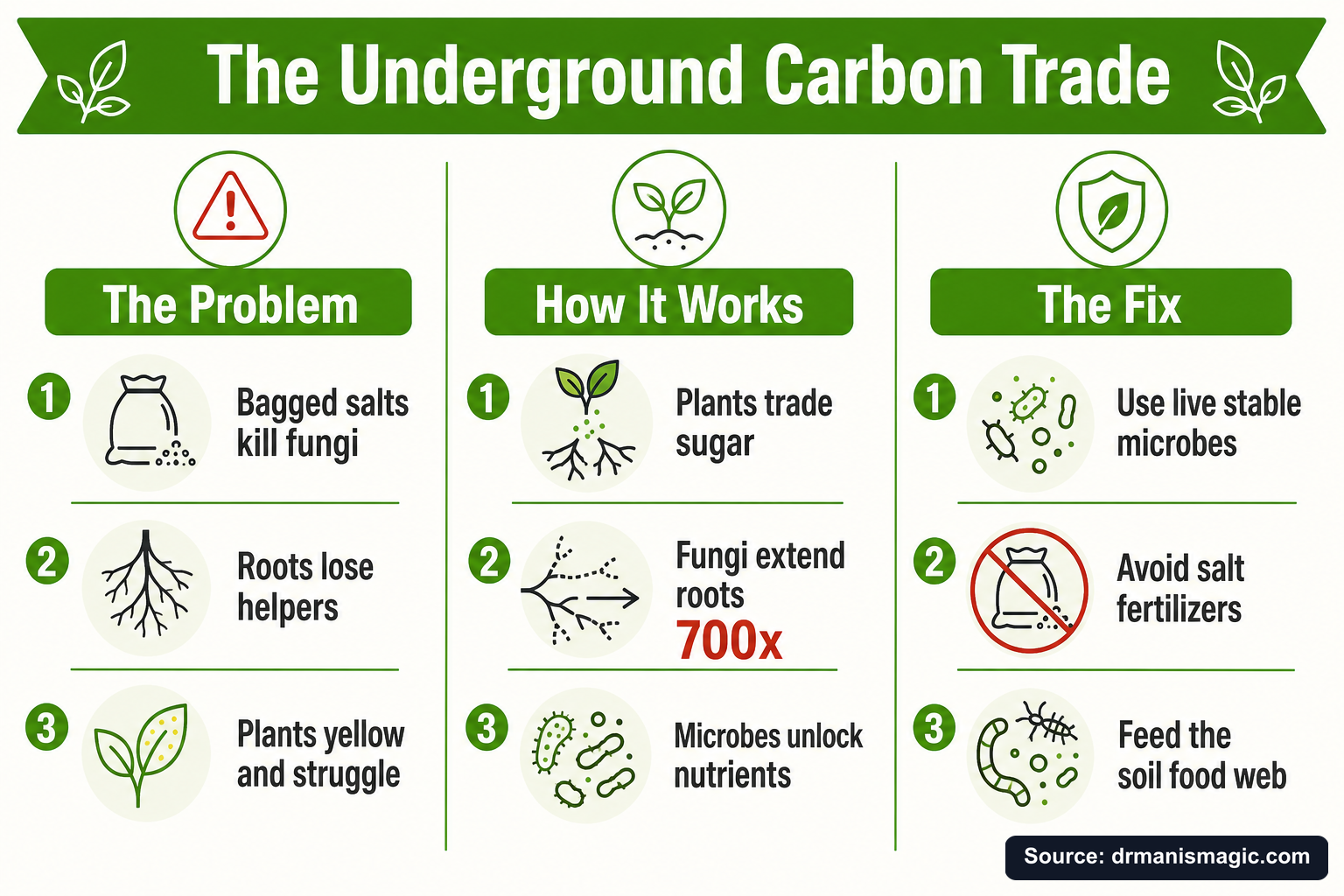
- Plants pump sugars from their roots to feed fungi and bacteria underground. In return, those microbes deliver phosphorus, nitrogen, water, and disease protection back to the plant.
- Arbuscular mycorrhizal fungi can expand a plant's root-absorbing surface by up to 700%. That is not a typo.
- Salt-based synthetic fertilizers break this trade. They kill the fungi and bacteria plants depend on, leaving roots alone and defenseless.
- The carbon trade runs through the entire soil food web: bacteria, fungi, protozoa, nematodes, and more, each playing a specific role.
- Dried, powdered, or foul-smelling microbial products are mostly dead on arrival. Live, stabilized microbes are what actually work.
- You can rebuild this underground economy in your garden, your containers, your lawn, even your houseplants.
- The Three Plant Pillars, developed and proven at US Citrus Nursery, are the fastest path to restoring this natural system.
What Exactly Is the Carbon Trade Between Plants and Fungi?
Quick Answer: Plants convert sunlight into sugar through photosynthesis. They send up to 40% of that sugar down through their roots to feed fungi in the soil. The fungi use that sugar as fuel, then stretch out into the soil and bring back phosphorus, nitrogen, water, and other nutrients the plant cannot reach on its own. It is a trade, not a gift.
Your plant is a sugar factory. Every ray of sunlight that hits a leaf gets converted into glucose. That glucose powers growth. But here's the part most gardening books skip: plants don't keep all of it. They push a massive share of that sugar, sometimes 20 to 40 percent of everything they make, out through their roots and into the soil.
Why would a plant give away nearly half its food supply? Because it is buying something far more valuable.
Waiting in that soil are fungi. Specifically, mycorrhizal fungi (pronounced my-cor-RY-zal). The word comes from Greek: mykes means fungus, rhiza means root. These are root fungi. And they have been partnering with plants for an estimated 450 million years, according to research published through Purdue University Extension.
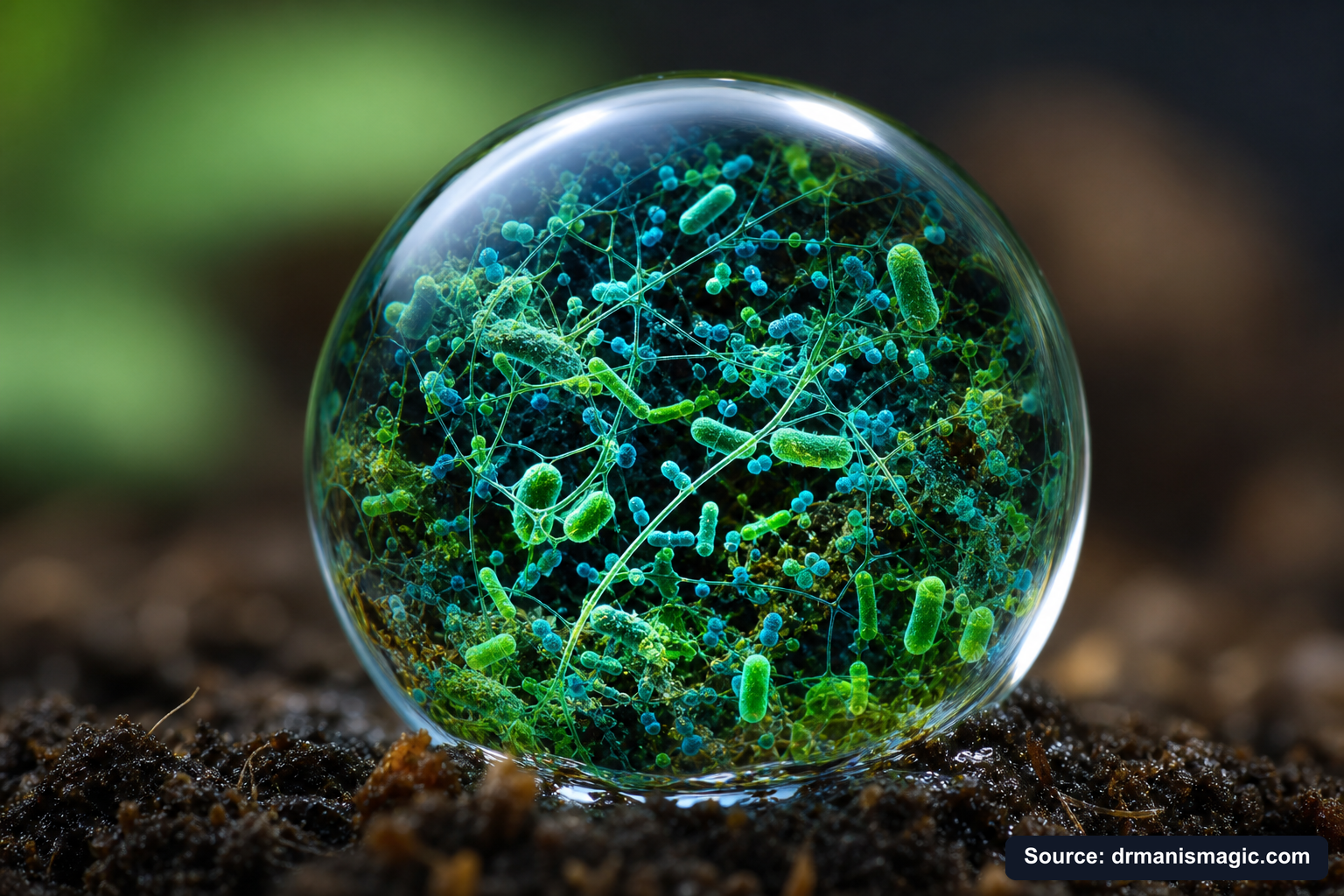
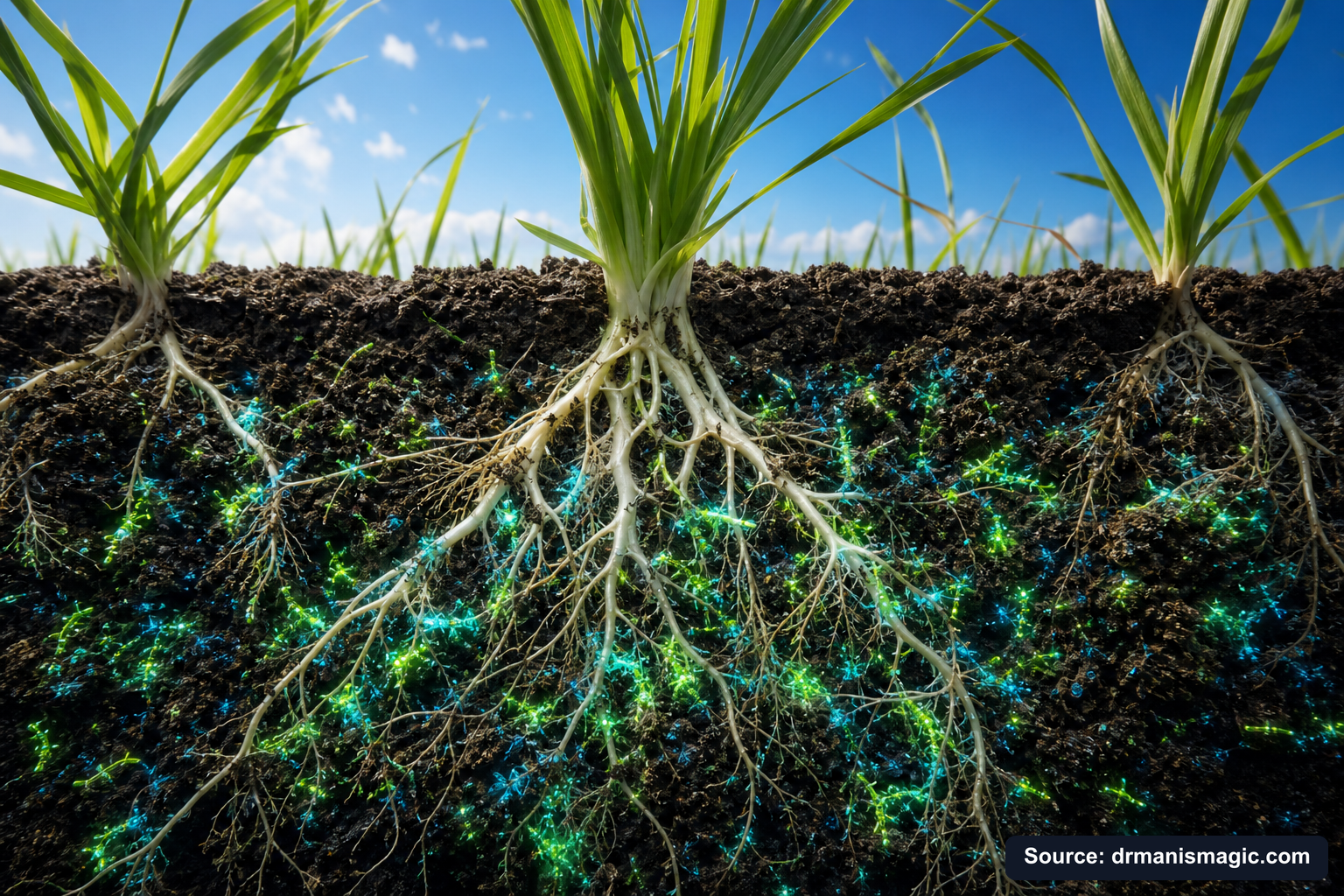
Here is how the trade works. The plant leaks sugars and other carbon compounds from its roots. The fungi absorb those sugars and use them as energy to grow. And grow they do. Fungal threads called hyphae (HY-fee) spread out through the soil like an enormous invisible web. These threads are far thinner than any root. They reach into spaces roots cannot. And they pull back phosphorus, nitrogen, zinc, copper, and water. Then they deliver those nutrients directly into the plant's root cells through tiny structures called arbuscules (AR-buss-kyools). Think of an arbuscule as the handshake point where the trade happens.
The plant gets fed. The fungus gets fed. Both win. That is the carbon trade.
What makes this even more remarkable is that Penn State Extension has documented that mycorrhizal fungi can increase a plant's effective root-absorbing area by 100 to 700 times. Seven hundred times. That is the difference between a plant that struggles and a plant that thrives.
Who Are the Players in the Soil Food Web?
Quick Answer: The soil food web is a chain of living organisms that all run on plant carbon. Bacteria and fungi eat root sugars and organic matter. Protozoa and nematodes eat the bacteria and fungi. When they do, they release nutrients right next to the roots. It is a recycling system powered entirely by what your plant feeds underground.
Mycorrhizal fungi are the most famous player. But they are not alone. Your soil is a city. And every resident has a job.
When your plant leaks sugar into the surrounding soil, called the rhizosphere (RY-zo-sfeer), it does not just feed fungi. It feeds an entire community. Bacteria rush to those sugars. Fungi spread their threads. And then the grazers arrive. Tiny single-celled organisms called protozoa eat the bacteria. Microscopic worms called beneficial nematodes eat both bacteria and fungi. When protozoa and nematodes eat and excrete, they release nitrogen and other nutrients in a plant-ready form. Right there. Right next to the roots. This is the soil food web.
University of Minnesota Extension describes this beautifully: the rhizosphere is the most biologically active zone on Earth, and plant roots are its engine.
| Organism | What It Eats | What It Gives the Plant | Killed By |
|---|---|---|---|
| Bacteria | Root sugars, organic matter | Nitrogen, phosphorus, disease protection, soil aggregation | Salt-based fertilizers, herbicides, fungicides |
| Mycorrhizal Fungi | Plant carbon (sugars) | Phosphorus, nitrogen, water, disease resistance, larger root zone | Synthetic fungicides, high phosphorus fertilizer, soil disturbance |
| Saprophytic Fungi | Dead organic matter | Decomposition, nutrient cycling, soil structure | Fungicides, compacted or waterlogged soil |
| Protozoa | Bacteria, fungi | Nitrogen mineralization near roots | Pesticides, soil compaction, drying out |
| Beneficial Nematodes | Bacteria, fungi, small insects | Nutrient release, pest control | Broad-spectrum pesticides, soil fumigation |
| Earthworms | Organic matter, microbes | Aeration, nutrient-rich castings, soil structure | Synthetic pesticides, compaction, low organic matter |
Every organism in that table runs on carbon that started as sunlight in your plant's leaves. Your plant is not just growing. It is running an economy. And every time you pour salt-based fertilizer into that soil, you are dropping a bomb on that economy.
Why Do Plants Give Away So Much Sugar Underground?
Quick Answer: Plants trade carbon because the return on investment is enormous. Fungi and bacteria deliver nutrients from places roots cannot reach, protect against disease, and help roots find water during drought. The plant spends sugar to avoid spending energy growing more roots. It is cheaper to buy the service than to do it alone.
Think about it from the plant's perspective. Growing a root is expensive. It takes energy, water, and structural material. But a fungal hypha? That thread can grow into microscopic cracks in soil particles, dissolve phosphorus locked in rock, and bring it back to the root. The plant pays in sugar. The fungus does the hard labor. It is the oldest outsourcing deal in nature.
But the trade is not one-size-fits-all. It is negotiated. Research from the University of Western Australia has shown that plants actually regulate how much carbon they send to fungi based on how many nutrients they get back. If a fungus is not delivering, the plant reduces payment. If a fungus is working hard, the plant sends more sugar. Plants are not passive. They are active traders.
This negotiation breaks down when you dump high-phosphorus synthetic fertilizer into the soil. The plant senses it has plenty of phosphorus. It cuts payments to the fungi. The fungi weaken and die off. Now the plant is alone. It has no partner network. No extended root system. No disease protection. The next drought, the next pathogen, the next stress event, and the plant buckles. This is why so many gardens look great in month one and tragic by month six.
We have seen this pattern repeat itself across hundreds of thousands of trees at US Citrus Nursery. The plants that got synthetic fertilizer and no microbes looked green fast. Then they stalled. Then they declined. Time wasted. Money lost. And time, unlike money, never comes back.
What Happens When the Carbon Trade Breaks Down?
Quick Answer: When the carbon trade breaks down, plants lose their extended root system, their nutrient supply shrinks, disease pressure rises, and growth stalls. Most gardeners blame themselves. The real culprit is usually synthetic fertilizers, fungicides, or herbicides that killed the fungal partners their plants needed.
You have probably seen a plant that just stops. It does not die dramatically. It just... fades. Leaves go pale. Growth slows. Fruit drops early or never sets. You fertilize more. Nothing changes. This is a broken carbon trade.
Here is what killed it. Salt-based synthetic fertilizers are, at their core, concentrated salts. When you pour them into soil, they raise the salt concentration around the roots. Microbes are mostly water. High salt pulls that water out of their cells. They shrivel. They die. The fungi that took years to colonize those roots are gone in a season.
Fungicides are even more direct. They are designed to kill fungi. They do not check whether a fungus is beneficial or harmful. Mycorrhizal fungi get hit just as hard as any pathogen. Herbicides like glyphosate disrupt microbial metabolism. Broad-spectrum pesticides knock out protozoa and beneficial nematodes. Every chemical shortcut costs something in the soil food web. The bill comes due slowly, quietly, and then all at once.
See also: The Hidden Reason Synthetic Fertilizers Cause Root Rot
See also: How Salt-Based Feeding Quietly Destroys Root Systems
Are All Mycorrhizal Fungi the Same?
Quick Answer: No. There are several types of beneficial fungi, and they serve different purposes. Arbuscular mycorrhizal fungi work inside root cells and help most garden plants. Ectomycorrhizal fungi work on the outside of roots and are critical for pines and oaks. Saprophytic fungi break down dead matter. Knowing the difference matters when choosing a product.
Not all fungi are your friends. Not all fungi are your enemies either. Here is a plain-English breakdown.
| Fungus Type | Where It Lives | What It Does | Plants It Helps | Your Action |
|---|---|---|---|---|
| Arbuscular Mycorrhizal (AM) | Inside root cells | Trades carbon for phosphorus, nitrogen, water | Most vegetables, fruits, citrus, flowers, grass | Protect and inoculate |
| Ectomycorrhizal (ECM) | Wraps outside of roots | Nutrient and water exchange; tree communication networks | Pines, oaks, birches, beeches | Protect when present |
| Saprophytic (decomposer) | Soil, dead organic matter | Breaks down dead material into nutrients | All plants benefit indirectly | Feed with organic matter |
| Trichoderma-type (biocontrol) | Root zone | Fights pathogenic fungi, boosts root development | Broad spectrum | Encourage and inoculate |
| Pathogenic Fungi | Root zone, leaves, stems | Causes root rot, wilts, lesions | Attacks all plants under stress | Crowd out with beneficial biology |
Here is the critical point about arbuscular mycorrhizal fungi (AM fungi). They are obligate biotrophs. That is a fancy way of saying they cannot survive without a living root. You cannot grow them in a jar of compost. You cannot culture them in a factory vat. They must be maintained with living plant roots at all times. This is why most mycorrhizal products sold in powder form at big box stores are dead before they reach your door. The AM fungi in that powder had no living roots to feed on during packaging, storage, and shipping. They did not make it. You paid for biology that no longer exists.
You Never Had a Brown Thumb.
You were handed the wrong tools. This free guide hands you the right ones.
You watered it. You fed it. It died anyway.
It was never you. It was the dirt, the salt food, and the bad advice.
This guide shows you what really went wrong, and how to fix it for good.
- Why your plants really died, and why it was never your fault
- The salt hiding in your plant food that quietly burns the roots
- The hidden killer in almost every bag of store soil
- The tiny helpers that grow a whole forest for free
- The rescue trick that brings a half dead plant back to life

Live Microbes vs. Dead Microbes: Why This Difference Changes Everything
Quick Answer: A dead microbial product does nothing meaningful for your plant's root zone. Live microbes colonize roots, trade nutrients, fight pathogens, and build soil structure. The difference between live and dead is the difference between hiring a real worker and hiring a photograph of one. Most products on the market today are photographs.
We have tested dozens of microbial products at US Citrus Nursery. Not one of the dried, powdered, lab-grown products we tried made a measurable difference in our trees. Not one. And we understand why now.
Here is what happens in a typical microbial product factory. A few specific bacterial strains get brewed in giant industrial vats. They get spray-dried into a powder. The hope is that the dormant spores will wake up when you add water and pour them into soil. Sometimes a small percentage does reactivate. But the populations are tiny, the species diversity is narrow, and the organisms are weakened from the drying process. Your soil barely notices them.
The second common product type is liquid compost tea made from worm castings or compost. These can be genuinely powerful. When fresh. When they are brewed and applied within 24 hours, with active aeration, the microbial populations are real and alive. But by the time a bottled version ships to your door? Without continuous aeration? Those microbes went anaerobic. They ran out of oxygen. They started fermenting. The bottle smells like a swamp. And while the humic acids and fulvic acids in the liquid still offer some value, the living biology is mostly gone.
We have smelled those bottles. If your microbial product makes you gag when you open it, the microbes did not survive the trip.
| Product Type | Likely Viability at Use | Species Diversity | Smell | Our Assessment |
|---|---|---|---|---|
| Dry/powdered lab microbes | Very low | Narrow (checklist species) | Minimal | We saw no results in our nursery trials. Avoid. |
| Rehydrated dry powder in liquid | Low | Narrow | Minimal | Same problem, harder to identify. Avoid. |
| Compost tea (fresh, under 24 hours, aerated) | Moderate to high | Broad | Earthy, pleasant | Excellent if you can make and use it immediately. Labor intensive. |
| Compost tea (bottled, over 24 hours, no aeration) | Low, anaerobic | Partial | Strong, sulfurous stench | Biology mostly dead. Some humic value remains. Not worth buying for microbes. |
| Lactobacillus-based products | High viability but wrong organism | Very narrow | Sour/fermented | Lactobacillus belongs in yogurt. It outcompetes beneficial soil microbes. Avoid in soil. |
| Plant Super Boost (stabilized, full-spectrum) | High. Visible under microscope. | 2,000+ bacteria species, 400-500 fungi including mycorrhizae, plus protozoa and nematodes | Earthy. No stench. | Harvested from active compost. Stabilized by an all-natural method. Still alive on arrival. This is what works. |
Dr. Mani's Magic Plant Super Boost is different because of a proprietary all-natural stabilization technique developed by a world-renowned compostologist who partnered with Dr. Mani Skaria after decades of advising farming operations for royal families and governments around the world. The microbes are harvested from hand-crafted living compost, not grown in factory vats. They are stabilized so they stay alive and aerobic through shipping and storage. You can take a single drop of Plant Super Boost and look at it under a microscope. You will see them moving. That is what live biology looks like. Zero synthetic salts. Zero PFAS. Zero biosludge. Just alive.
When Is It Worth Adding Mycorrhizal Fungi to Your Soil?
Quick Answer: Adding mycorrhizal fungi is most valuable when you are starting with sterile potting mix, disturbed subsoil, new transplants, or soil that has been damaged by chemicals. In healthy, biologically active native soil, fungi may already be present. But in most home gardens and all containers, they are not, and inoculation makes a dramatic difference.
Not every situation calls for adding mycorrhizal inoculants. Here is a practical guide.
Add mycorrhizal fungi when:
- You are planting in commercial potting mix. It is sterile by design. There are no fungi in there.
- You are transplanting a new tree, shrub, or vegetable start.
- Your soil has been treated with fungicides, herbicides, or fumigants.
- You are working with subsoil exposed by construction, grading, or digging.
- You are establishing a citrus tree, fruit tree, or ornamental in a container.
- You are restoring a lawn, meadow, or native planting on disturbed land.
- Your plants have been on heavy synthetic fertilizer programs for years.
Inoculation may not help when:
- You are planting brassicas (cabbage, broccoli, kale). They do not form mycorrhizal partnerships.
- Your soil is already thriving with diverse biology and you are planting into an established native ecosystem.
- Phosphorus levels in your soil are extremely high. The plant will cut off carbon payments to fungi and the inoculant will not establish.
The honest truth is that most American gardens and nearly all container soils are biologically dead or nearly so. Decades of synthetic fertilizers, herbicides, and pesticides have wiped the slate clean. You are not planting into a forest floor. You are planting into a sterile substrate. Your plants are trying to make a trade with partners that no longer exist. Inoculation is how you bring those partners back.
For a deeper look at how to build this foundation from scratch, the Three Plant Pillars system gives you the complete framework: mineral-based soil, live microbes, and organic fertilizer working together as nature intended.
Do Fungicides and Fertilizers Kill Mycorrhizal Fungi?
Quick Answer: Yes. Synthetic fungicides kill mycorrhizal fungi just as effectively as they kill pathogens. High-phosphorus synthetic fertilizers cause plants to cut off carbon payments to their fungal partners, which eventually starve and die. Both practices destroy the carbon trade and leave roots isolated and vulnerable.
This is the part that makes us genuinely angry. Not at gardeners. At the system.
The big chemical companies have sold American gardeners on a cycle of dependence. Buy the synthetic fertilizer. It works fast. But it kills your soil biology. Now your plants are weak and dependent. Buy more fertilizer next season. Buy the fungicide when disease shows up because your plants have no natural defenses anymore. Buy the pesticide when pests arrive because your beneficial nematodes are gone. The cycle never ends. And your soil gets poorer every year.
Dr. Mani Skaria spent decades watching this pattern in citrus groves across Texas. He watched groves that had been on heavy synthetic programs for twenty years struggle to grow fruit that healthy trees should produce easily. The biology had been stripped. The carbon trade was broken. And no amount of additional fertilizer could substitute for what those fungi used to provide.
The gentler truth is this: your plants are not addicted to your fertilizer. They are trying to reconnect with the biology they evolved with. When you stop the salt-based inputs and restore the living organisms, most plants respond within weeks. Not months. Weeks. We have seen it on citrus, on tropicals, on houseplants, on lawns.
See also: Why Most Fertilizers Are Actually Salt in Disguise
How Do You Recover Sterile or Damaged Soil?
Quick Answer: Recovering damaged soil is a process of ecological succession. You stop the inputs that kill biology, then add organic matter, living microbes, and the right fertilizer to feed them. It takes consistent monthly applications over several months. The good news: once the biology takes hold, it sustains itself and grows stronger every season.
Here is the good news nobody tells you. Soil biology is incredibly resilient. Given half a chance, it comes back. The question is how to give it that chance as fast as possible. Because time is the one thing you cannot get back.
Here is a practical recovery checklist for any damaged, sterile, or chemically depleted soil:
- Stop the inputs that kill biology. This means no more salt-based synthetic fertilizers, no broad-spectrum fungicides, and no systemic herbicides in the area you want to recover. You cannot build a house while someone else keeps knocking it down.
- Correct physical problems first. If the soil is compacted, aerate it. If drainage is poor, address it. Microbes need oxygen. Waterlogged, airless soil is a graveyard for the biology you are trying to restore. This is why mineral-based soil structure matters so much as a foundation.
- Add organic matter. Compost, aged wood chips, leaf litter. This feeds the decomposer fungi and bacteria that start the food web cycling again. It also gives mycorrhizal fungi and bacteria physical habitat to colonize.
- Inoculate with full-spectrum live microbes. Not dried powder. Not foul-smelling liquid. Live, stabilized biology that covers the full spectrum: bacteria, fungi including mycorrhizae, protozoa, and nematodes. Apply once a month.
- Feed the microbes with organic fertilizer. Slow-release organic inputs from sources like crab meal, kelp, and amino acids feed both the plant and the microbial community without the salt damage that would undo your recovery work. Our Crab, Kelp and Amino Acids fertilizer was built for exactly this purpose.
- Keep living roots in the soil. Living roots leak sugars. Those sugars feed fungi and bacteria. Without living roots, the carbon trade cannot happen. Do not leave beds bare for extended periods.
- Be patient and consistent. Biological recovery is not a one-time event. It is a succession. The first organisms to arrive set the stage for the next wave. Monthly applications of live microbes stack those communities over time. Within two to four months of consistent application, most gardeners see a visible change in plant vigor, leaf color, and root health.
One warning: do not expect a single application of any microbial product to transform your soil overnight. The biology you are trying to rebuild took millions of years to evolve and decades of chemical farming to damage. It rebuilds in months with the right inputs. But only with consistent, repeated application. This is not a shortcut. It is a return to how plants actually grow.
What Does This Mean for Your Plants Right Now?
Your plant is ready to make the trade. It has been ready since the day it sprouted. The question is whether the trading partners are there to receive it.
If your soil has been through years of synthetic fertilizer, if your potting mix came from a bag, if your lawn has been sprayed with herbicides, the answer is probably: the partners are not there. Or they are there in such small numbers that the trade barely happens. Your plant is sending sugar into empty soil and getting little back. It is doing the biological equivalent of shouting into a void.
The moment you restore that biology, the trade restarts. Roots light up. Nutrient uptake increases. Disease pressure drops. Color improves. You can feel the difference in the weight of a fruit. You can see it in the depth of green in a leaf. You can smell it in a flower that never bloomed right before.
We built the Free Plant Care Field Guide around exactly this idea: give your plant the three things it actually needs. Mineral-based soil that drains and breathes. Live microbes that restore the carbon trade. Organic fertilizer that feeds both the plant and the biology without burning either one. That is the Three Plant Pillars. That is what 250,000 trees taught us in South Texas.
The best time to restore your soil's biology was years ago. The second best time is right now. Your plants are waiting. The trade is ready to happen. All they need is a partner worth trading with.
If you want to give your plants that partner, start with Plant Super Boost. It is the living microbe formula we use every month on our own trees, our own grove, and our own houseplants. Zero synthetic salts. Zero PFAS. Zero biosludge. Just the full-spectrum living biology your soil has been missing. Try it for 30 days. If you do not see a difference, we will refund every penny. No arguments. That is our promise to you.
Frequently Asked Questions
The carbon trade between plants and fungi is one of the most important things a gardener can understand. Once you get it, everything changes. These are the questions people ask most after learning how this underground deal really works.
What is the carbon trade between plants and fungi?
Plants make sugar from sunlight. Then they push up to 40% of that sugar out through their roots. Fungi in the soil grab that sugar for energy. In return, the fungi spread out through the soil and bring back phosphorus, nitrogen, water, and other nutrients the plant cannot reach alone. It is a trade. The plant feeds the fungi. The fungi feed the plant back.
Why do my plants look tired even when I fertilize them?
Most fertilizers are salt-based. Salt kills the fungi and bacteria your plants depend on. So even if you pour nutrients into the soil, your plant has no living network to deliver them to the roots. It is like paying for a delivery driver who never shows up. The plant sits there hungry. That is not a brown thumb. That is a broken system. Dr. Mani saw this exact problem across 250,000 trees before he cracked the code.
What are mycorrhizal fungi and why do they matter so much?
Mycorrhizal fungi are tiny thread-like organisms that attach to plant roots and spread out through the soil. Those threads, called hyphae, are thinner than roots and reach places roots never could. They can expand a plant's nutrient-absorbing surface by up to 700%. That means your plant gets access to a massive amount of food it would never find on its own. Without these fungi, your plant is working alone.
Do powdered or dried microbial products from the store actually work?
Most of them do not. Dried and powdered microbial products are usually dead before you open the bag. Dead microbes cannot trade with your plant. They cannot spread through your soil. They cannot deliver nutrients. Dr. Mani's Plant Super Boost uses live, stabilized microbes. That means they are alive when they reach you and ready to get to work the moment you water them in. That is a big difference.
Can I restore the carbon trade in containers and houseplants, not just garden beds?
Yes. The carbon trade works in any soil where live microbes can survive. That includes pots, containers, raised beds, and indoor plants. The key is giving those microbes a home they can thrive in. That means skipping sawdust-based potting mix that rots and chokes roots. Dr. Mani's Super Soil is mineral-based, so it stays open and airy. Live microbes in dead soil go nowhere fast.
How do the Three Plant Pillars connect to the carbon trade?
The Three Plant Pillars are built around this exact science. Pillar One is mineral-based soil that keeps roots breathing and gives microbes room to spread. Pillar Two is live microbials that restore the fungi and bacteria your plant needs for the trade to happen. Pillar Three is organic fertilizer that feeds the soil without burning out the microbes. Together, they rebuild the underground economy your plant has been trying to run all along.
How long before I see results after restoring the carbon trade in my soil?
Most people start seeing a real difference within 30 days. Leaves get greener. Growth picks up. The plant stops looking tired. That is not magic, even though it feels like it. That is what happens when your plant finally has the underground team it was designed to work with. Dr. Mani tested this on over 250,000 citrus trees in South Texas before making it available to home gardeners. The results held up every time.
About the Author
Dr. Mani Skaria, PhD
Dr. Mani Skaria, PhD, is a plant pathologist and the scientific founder of Dr. Mani's Magic. He earned his doctorate at Purdue University and spent 48 years studying how plants, soil, and living microbes work together, including his years as Professor Emeritus at Texas A&M and as a member of the USDA NAREEE Advisory Board. He invented micro-budding, a method for growing healthier, stronger trees, and has grown more than 250,000 trees on the family farm in Hargill, Texas - US Citrus Nursery. His life's work takes real lab science and practical experience and turns it into simple, safe, organic plant care anyone can use at home.


