


Why Plants Evolved to Work With Bacteria and Fungi | Dr. Mani's Magic
Why Plants Evolved to Work With Bacteria and Fungi: The Soil Food Web Explained
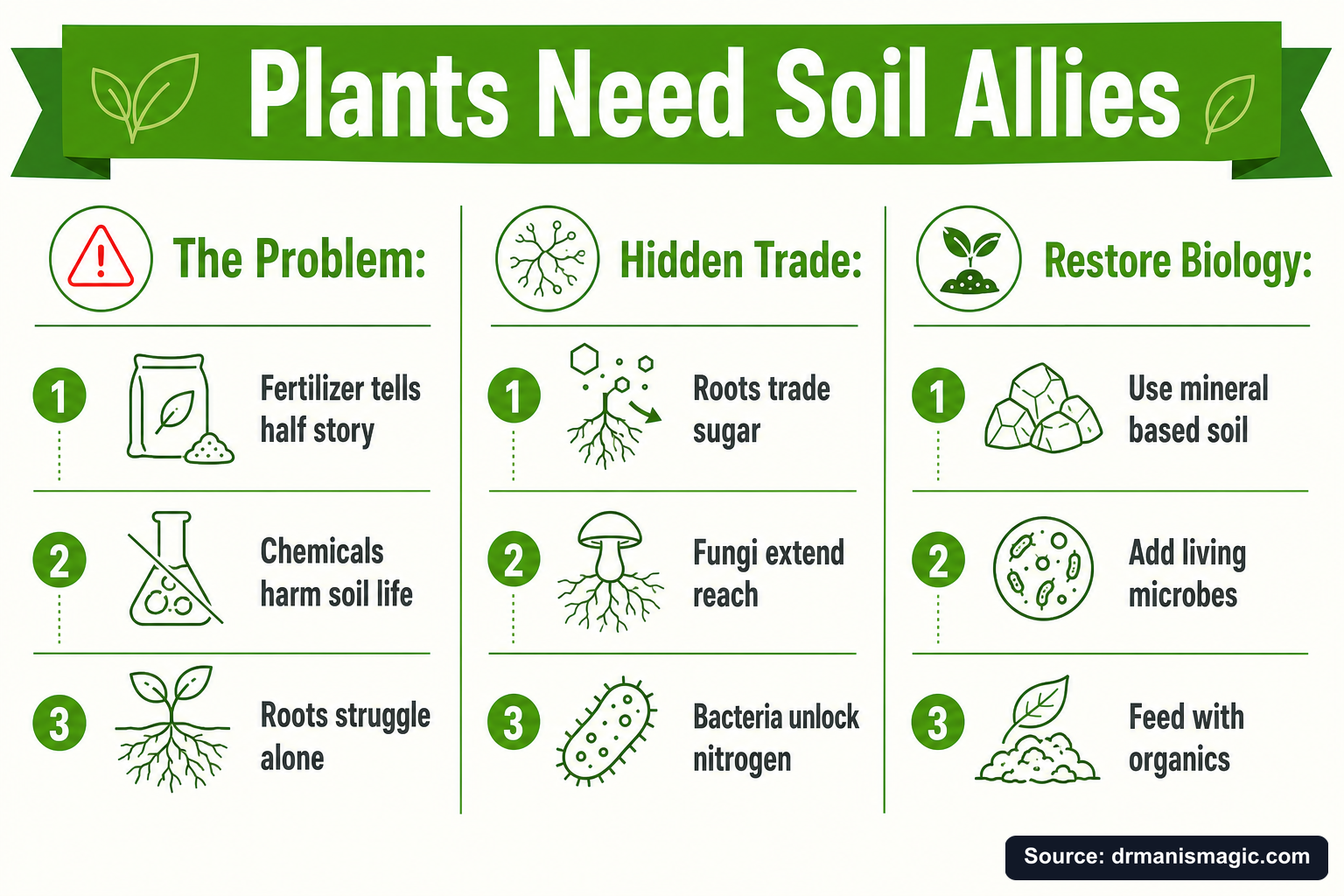
Close your eyes for a second. Picture a forest. No one fertilizes it. No one sprays it. No one comes around with a bag of pellets every spring. And yet those trees grow taller than houses. The soil smells rich and alive. The roots run deep. The leaves glow green. Fruit falls to the ground faster than the animals can eat it.
Now picture your backyard. You bought the fertilizer. You watered on schedule. You did everything the bag told you to do. And still, your tree looks tired. Yellowing leaves. Thin branches. Maybe you lost one altogether. You've started to wonder if you just have a brown thumb. You don't. The deck was stacked against you from the start. Someone sold you half the story and kept the most important part to themselves.
The part they left out? The invisible workforce. Billions of tiny living creatures in the soil doing jobs no fertilizer bag can replicate. Bacteria. Fungi. Protozoa. Nematodes. This ancient partnership between plants and soil life is the real secret behind every thriving forest, every overflowing garden, every fruit tree dripping with harvest. And once you understand it, everything about growing plants clicks into place. Let's pull back the curtain.

Plant Super Boost
Key Takeaways
- Plants evolved to trade sugar through their roots in exchange for nutrients, water, and protection from soil microbes.
- Mycorrhizal fungi partnerships date back over 400 million years and helped plants first colonize dry land.
- The soil food web includes bacteria, fungi, protozoa, nematodes, and arthropods all working together in one living economy.
- Synthetic fertilizers, herbicides, fungicides, and pesticides damage or destroy this invisible workforce, leaving plants defenseless.
- Most microbial products on store shelves use dead or dying microbes that deliver little to no real benefit.
- Rebuilding living soil takes time, repeated application, and the right habitat, not just a one-time inoculant.
- The Three Plant Pillars — mineral-based soil, live microbials, and organic fertilizer — work together to restore and protect this ancient biology.
Why Did Plants Evolve to Work With Bacteria and Fungi in the First Place?
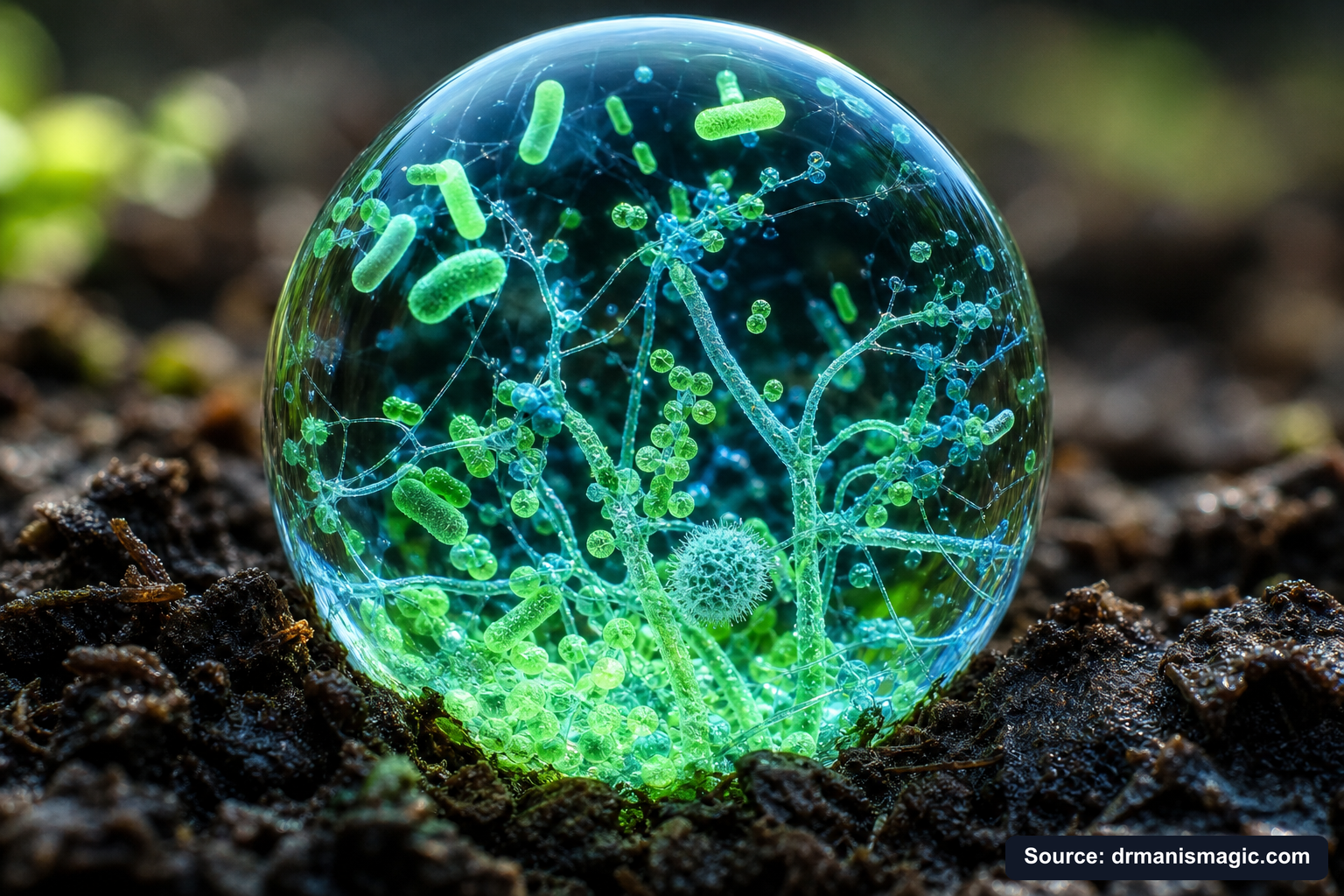
Quick Answer: Plants evolved with bacteria and fungi because early land had almost no available nutrients. Fungi extended root reach to find phosphorus and water. Bacteria unlocked nitrogen from the air. Plants traded sugar for these services. That exchange, which began over 400 million years ago, is still running in every healthy plant alive today.
About 450 million years ago, a brave little green ancestor of today's plants crawled out of the water and onto bare, rocky land. There was no rich soil. No worms. No decomposed leaves. Just mineral rock and a lot of sunlight.
The problem? Rocks don't feed plants. Plants need phosphorus, nitrogen, and dozens of other nutrients. And those nutrients were locked inside the rock, invisible and unreachable.
Enter the fungi.
Fungi had already figured out land life. Their thin, thread-like bodies called hyphae could squeeze into microscopic cracks in rock. They could dissolve minerals and carry them. And when those early plants arrived, something remarkable happened. The fungi and the plant roots formed a partnership. The plant fed the fungi sugar. The fungi fed the plant phosphorus and water. Both survived. Both thrived.
Scientists have found fossil evidence of these arbuscular mycorrhizal fungi partnerships in plants dating back roughly 400 to 460 million years, right around the time plants first colonized land. According to research published through Penn State Extension, mycorrhizal fungi are considered foundational to plant evolution on dry land. This was not a coincidence. It was a survival deal struck before trees even existed.
Bacteria joined the partnership next. Certain bacteria figured out how to pull nitrogen gas straight out of the air and convert it into a form plants could use. In exchange, the plant fed those bacteria too. This is called nitrogen fixation, and it is the reason prairies and forests stay green without a single bag of fertilizer.
Over hundreds of millions of years, this exchange economy became woven into the DNA of almost every plant on earth. Plants did not evolve to grow alone. They evolved as part of a community. Remove the community, and the plant struggles. It is that simple.
What Is the Soil Food Web and How Does It Feed Your Plants?
Quick Answer: The soil food web is a living chain of organisms where plants feed bacteria and fungi through root sugars, bacteria and fungi unlock nutrients, tiny animals called protozoa and nematodes eat the microbes and release those nutrients near the roots, and plants absorb them. Every healthy plant is plugged into this network.
The soil food web sounds complicated. It is not. Think of it as a trading market that runs underground, twenty-four hours a day, seven days a week, without any help from you.
Here is how the trade works, step by step.
Your plant's leaves catch sunlight and make sugar through photosynthesis. That is the plant's income. Up to 40 percent of that sugar gets pushed down through the roots and pumped out into the surrounding soil as liquid called root exudates. This is the plant spending its income. On purpose.
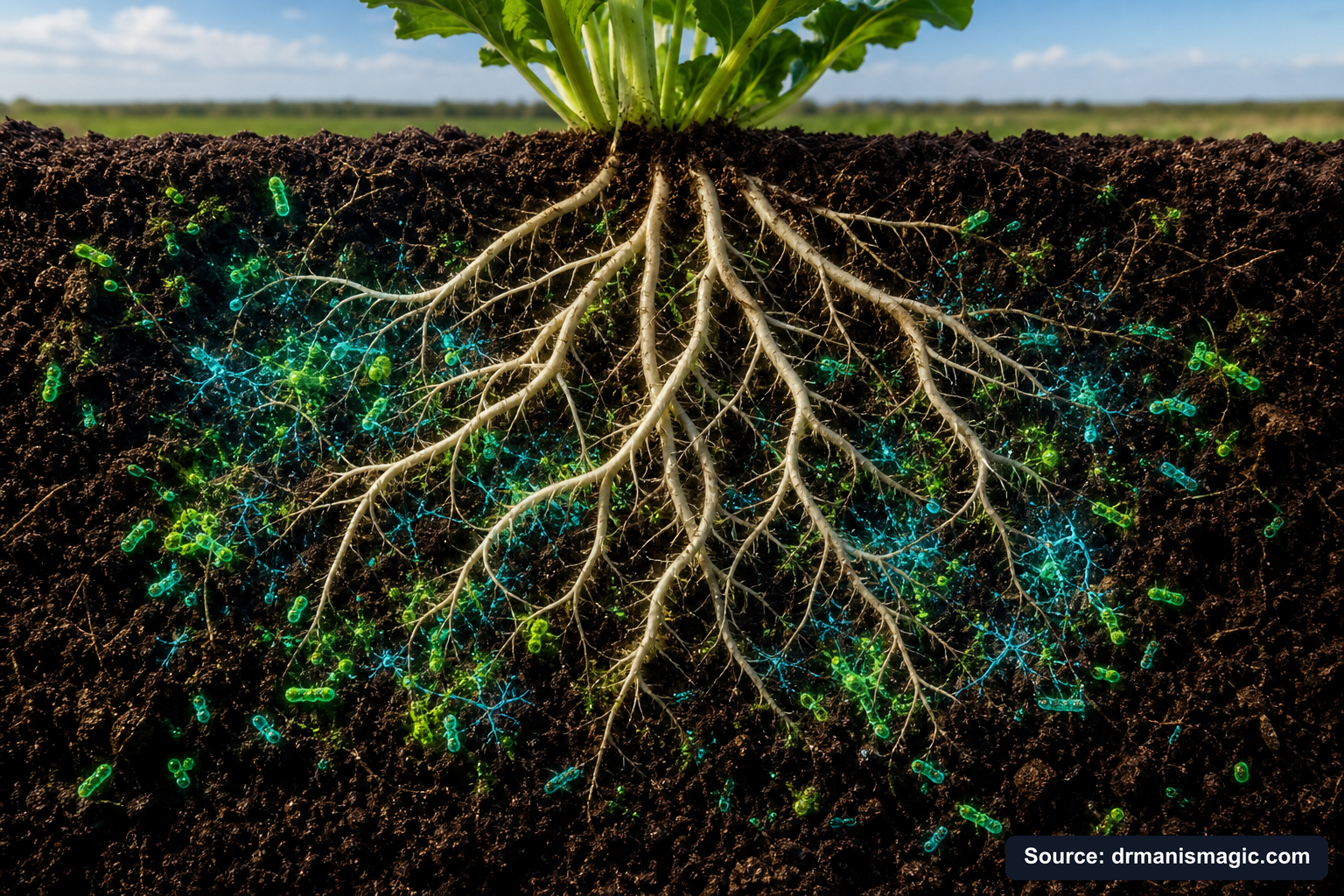
That liquid sugar is like a dinner bell. Bacteria and fungi swarm toward it. They eat the sugar and in return they do jobs the plant cannot do for itself. Bacteria break down organic matter, unlock minerals, and some species pull nitrogen right out of the air. Fungi, especially mycorrhizal fungi, grow thin threads called hyphae that stretch far beyond where roots can reach, bringing back phosphorus, water, and micronutrients.
But here is the part most articles skip. Bacteria and fungi are not the end of the chain. They get eaten. Tiny single-celled animals called protozoa graze on bacteria. Microscopic worms called beneficial nematodes graze on both bacteria and fungi. When protozoa and nematodes eat microbes, they release the nutrients locked inside those microbes as waste. And that waste lands right next to the plant roots. It is the most efficient nutrient delivery system on earth, and it runs entirely on biology.
Then arthropods like soil mites and beetles shred organic matter into smaller pieces, making it easier for bacteria and fungi to break down. Earthworms tunnel through soil, improving drainage and mixing everything together. Every layer feeds the next.
According to the USDA Natural Resources Conservation Service, a single teaspoon of healthy soil can contain over a billion bacteria, several yards of fungal threads, thousands of protozoa, and dozens of nematodes. That is not dirt. That is a civilization.
| Organism | Main Job in the Soil | Benefit to Your Plant |
|---|---|---|
| Bacteria | Break down organic matter, fix nitrogen from air, dissolve minerals | Release nitrogen, phosphorus, and micronutrients near roots |
| Mycorrhizal Fungi | Extend root reach through hyphae networks, trade phosphorus and water | Dramatically increase nutrient and water uptake, improve drought resistance |
| Other Beneficial Fungi | Decompose tough organic material, produce glomalin to glue soil particles | Improve soil structure, aeration, and drainage |
| Protozoa | Graze on bacteria, release excess nutrients as waste | Mineralize nitrogen and other nutrients right at the root zone |
| Beneficial Nematodes | Graze on bacteria, fungi, and harmful nematodes | Regulate microbial populations, release nutrients, control pests |
| Arthropods and Mites | Shred organic matter into smaller pieces | Speed up decomposition, create habitat for bacteria and fungi |
| Earthworms | Tunnel, aerate, mix organic matter into soil | Improve drainage, stimulate microbial activity, create nutrient-rich castings |
What Do Mycorrhizal Fungi Actually Do for Your Plant's Roots?
Quick Answer: Mycorrhizal fungi attach to plant roots and grow a second, much larger root system made of thin threads. These threads reach water and phosphorus that roots cannot touch on their own. The fungi trade these resources to the plant in exchange for sugar. The result is a bigger, stronger, more drought-resistant plant with access to a vastly larger zone of soil.
Pull a weed out of the ground sometime. Look closely at the roots. If you see white fuzzy threads clinging to them, that is mycorrhizae. Those weeds are not growing fast because they are tough. They are growing fast because they have fungi helping them.
Here is the staggering truth. Mycorrhizal hyphae can extend the effective root surface area of a plant by ten to a thousand times. A plant with healthy mycorrhizal connections can reach water and phosphorus dozens of inches away from its roots. A plant without that connection is limited to what its own roots can physically touch.
Phosphorus is almost completely immobile in soil. It does not flow with water. It just sits there, inches from a root that cannot quite reach it. Mycorrhizal fungi are the solution that evolution built for this exact problem. They go get it.
Mycorrhizal fungi also produce a sticky protein called glomalin. Glomalin glues soil particles together into little clumps called aggregates. Those aggregates create tiny air pockets in the soil. Air pockets mean oxygen for roots. Oxygen means healthy roots. Healthy roots mean healthy plants. It is all connected.
Mycorrhizae are not fertilizer. They do not add nutrients. They are a delivery network. A living, expanding, underground highway that brings resources to your plant that would otherwise be permanently out of reach.
For a deeper look at how this biology connects to what you feed your plants, see also: Why Most Fertilizers Are Actually Salt in Disguise
What Do Beneficial Bacteria Do That Fertilizer Cannot?
Quick Answer: Beneficial bacteria in soil fix nitrogen from the air, dissolve locked-up minerals, protect roots from disease-causing organisms, and stimulate root growth through natural hormones. Fertilizer can dump nutrients near a root, but it cannot fix nitrogen from air, cannot produce plant hormones, and cannot crowd out pathogens the way a living bacterial community can.
Bacteria in healthy soil are doing about a dozen jobs at once, and most of them are completely invisible to the gardener.
Some bacteria fix nitrogen. Earth's atmosphere is 78 percent nitrogen gas, but plants cannot use that form. Nitrogen-fixing bacteria grab that gas and convert it into ammonium, a form the plant can absorb. This is why clover turns lawns green and why forest floors never run out of nitrogen. The bacteria are making it, constantly, for free.
Other bacteria are phosphate solubilizers. They produce acids that dissolve mineral phosphorus locked in the soil and make it available to roots. Others produce plant growth hormones like auxins and gibberellins that directly stimulate root development. Longer roots mean better access to water and nutrients.
Then there are the defenders. Certain bacteria colonize the root surface so densely that harmful pathogens simply cannot find a place to attach. This is called competitive exclusion. No space, no infection. It is a biological security system.
Salt-based synthetic fertilizers can dump nitrogen near a root. But they cannot do any of these other jobs. And worse, the salt in those fertilizers harms or kills the bacteria trying to do those jobs. Every bag of synthetic fertilizer is a trade: a short burst of visible green in exchange for quietly damaging the invisible workforce your plant depends on long-term.
See also: The Hidden Reason Synthetic Fertilizers Cause Root Rot
Are All Nematodes Bad for Plants? The Truth About Soil Animals
Quick Answer: No. Most nematodes in healthy soil are beneficial. They eat bacteria, fungi, and harmful nematodes, releasing nutrients right at the root zone as they digest. Only a small fraction of nematode species are plant parasites, and those harmful species are actually kept in check by healthy populations of beneficial nematodes and predatory fungi.
The word nematode tends to make gardeners nervous. Understandably. There are plant-parasitic nematodes that attack roots and cause real damage. But here is what most gardening articles never tell you: the vast majority of nematodes in your soil are not plant parasites at all.
Bacterial-feeding nematodes eat bacteria. When they do, they release nitrogen as waste. That nitrogen lands right next to the roots. This is one of the primary ways nitrogen actually becomes available to plants in a healthy soil food web. Without those nematodes eating bacteria, the nitrogen stays locked inside the bacteria and the plant gets none of it.
Fungal-feeding nematodes do the same thing with fungi. Predatory nematodes eat other nematodes, including the harmful plant-parasitic ones. They are the soil's own pest control system.
When soils get treated with broad-spectrum pesticides, fungicides, or heavy salt-based fertilizer applications, the beneficial nematodes die alongside the harmful ones. The first species to come back are often the plant parasites, because they reproduce faster. The natural checks and balances collapse. The gardener then sees root damage and assumes nematodes are the enemy, when the real problem is that the beneficial nematodes that controlled the bad ones are gone.
This is why rebuilding the full soil food web matters so much. You are not just adding bacteria and fungi. You are restoring an entire ecosystem that keeps itself in balance.
Why Does Sterile Potting Mix Fail Your Plants?
Quick Answer: Sterile potting mix has no living biology. It starts with zero bacteria, zero fungi, and zero protozoa. It also breaks down over time, compacting into a root-choking mass that blocks oxygen and holds too much water. Without the soil food web running, your plant has no nutrient delivery system, no pathogen defense, and no drought buffer beyond what you manually provide.
Walk into any big box store and pick up a bag of potting mix. It smells faintly like sawdust or bark. That is because it mostly is sawdust and bark. That material was sterilized to kill weed seeds and pathogens. The sterilization also kills every beneficial microbe inside it.
So you are planting into a biological desert.
The plant goes in. The roots stretch out. They look for the microbial partners they evolved to work with. There is nothing there. No fungi to extend their reach. No bacteria to unlock nutrients. No protozoa to mineralize nitrogen. The plant is on its own, surviving entirely on whatever you pour onto it from a bottle.
And it gets worse over time. That bark and wood material decomposes. As it breaks down, it actually steals nitrogen from the soil, competing with your plant for the little that exists. The structure collapses. The mix compacts. Drainage slows. Roots sit in wet, oxygen-depleted soil. Root rot follows. The plant yellows. You buy more fertilizer. The cycle continues.
This is not bad luck. This is the predictable result of removing the biology that plants spent 400 million years evolving to depend on.
The fix for the soil structure side of this is a mineral-based growing medium like Super Soil, built on silica-rich sandy loam from South Texas that does not decompose, does not compact, and does not steal oxygen from roots. It is the mineral foundation that lets biology thrive. That is Pillar One of the Three Plant Pillars.
You Never Had a Brown Thumb.
You were handed the wrong tools. This free guide hands you the right ones.
You watered it. You fed it. It died anyway.
It was never you. It was the dirt, the salt food, and the bad advice.
This guide shows you what really went wrong, and how to fix it for good.
- Why your plants really died, and why it was never your fault
- The salt hiding in your plant food that quietly burns the roots
- The hidden killer in almost every bag of store soil
- The tiny helpers that grow a whole forest for free
- The rescue trick that brings a half dead plant back to life

What Kills the Soil Food Web in Home Gardens and Lawns?
Quick Answer: Synthetic herbicides, salt-based fertilizers, broad-spectrum pesticides, and synthetic fungicides all damage or kill beneficial soil organisms. Glyphosate disrupts bacterial communities. Fertilizer salts dehydrate microbes. Pesticides kill non-selectively. Fungicides wipe out mycorrhizal fungi. Each application chips away at the living system your plants depend on.
Here is a painful truth. Most standard lawn and garden care advice is designed to sell more products, not to grow healthier plants. When your soil biology collapses, your plants need more fertilizer to survive. More fertilizer means more sales. Big Chemical companies understood this cycle decades ago. It is not a conspiracy theory. It is just business.
Synthetic herbicides like glyphosate do not just kill weeds. Research shows they disrupt soil bacterial communities and can harm mycorrhizal fungi. Broad-spectrum pesticides kill beneficial soil insects and microbes alongside the target pests. Synthetic fungicides cannot tell the difference between a harmful pathogen and the mycorrhizal fungi your plant relies on. They kill both.
Salt-based fertilizers are perhaps the most insidious. The salts create high-osmotic-pressure zones around roots that literally pull water out of root cells and microbial cells. Both the plant and its microbial partners experience stress. Microbe populations crash. The plant becomes dependent on the next fertilizer application because the biological system that used to feed it is gone. That is not growing a plant. That is maintaining a patient on life support.
Every time you use these inputs, you are not just spending money. You are spending time. Time your garden could have been thriving. And as Dr. Mani says, you can always get money back. Time is gone forever.
Live Microbes vs. Dead Products: Why Most Microbial Inoculants Do Not Work
Quick Answer: Most microbial products on store shelves contain dried, dormant, or dead organisms that were lab-grown in factory vats. They show little to no real benefit in field trials. Effective microbial products must contain genuinely live, full-spectrum organisms harvested from real compost and stabilized so they arrive active and ready to colonize your soil.
The microbial inoculant market is booming. Walk the garden aisle and you will find dozens of products claiming to add bacteria and fungi to your soil. Most of them do not work. After growing over 250,000 trees at the US Citrus Nursery in South Texas, we tested dozens of these products. The results were sobering.
Here is what most of those products actually contain.
Factory-produced microbes grown in giant industrial vats. The manufacturer offers a checklist of bacterial species, you order what you want, and they dry those microbes into a powder or suspend them in liquid. The hope is that when water is added and the powder hits soil, the dormant spores will wake up and do something useful. In our experience, they rarely do. The organisms are too narrow in spectrum, too stressed from the drying process, and too far removed from the complex community they evolved to be part of.
The second type comes from compost or worm castings brewed into a liquid. These can work beautifully when fresh. But fresh means within 24 hours, actively aerated. After that, the liquid goes anaerobic. The microbes start dying. Fermentation begins. The bottle fizzes. The stench hits you the moment you open it. That smell is not earthy. It is decomposition. You are pouring dying microbes onto your plants and calling it a treatment.
The third type uses lactobacillus, the bacteria in yogurt. It is easy to grow and stays alive. But lactobacillus aggressively outcompetes beneficial soil microbes. It belongs in your gut, not your garden.
| Product Type | Viability at Use | Microbial Spectrum | Odor | Real-World Results |
|---|---|---|---|---|
| Dry / powdered lab microbes | Low to none | Narrow (selected species) | Minimal | Little to no benefit observed |
| Dry microbes rehydrated in liquid | Low | Narrow | Minimal | Little to no benefit observed |
| Old compost tea (over 24 hours) | Anaerobic / dying | Partial | Strong, foul odor | Some humic acid benefit; microbial benefit minimal |
| Fresh compost tea (under 24 hours, aerated) | Moderate | Broad but time-sensitive | Earthy | Good when used immediately; not practical for most gardeners |
| Fresh active compost applied directly | High (on-site only) | Broad and natural | Earthy | Excellent; requires time and labor |
| Plant Super Boost (stabilized, full-spectrum) | High | 2,000+ bacteria, 400-500 fungi including mycorrhizae, plus protozoa and nematodes | Earthy, not foul | Consistent results; visible live microbes under microscope; lab verified |
The difference with Plant Super Boost is the stabilization process. Dr. Mani partnered with a world-famous compost expert who developed a proprietary, all-natural method to keep a full spectrum of microbes alive in a bottle without going anaerobic. You can put a drop of Plant Super Boost under a microscope and watch the microbes moving. That is not a marketing claim. That is observable biology. Zero synthetic chemicals. Zero biosludge. Zero PFAS. And it smells like earth, not a sewer, because nothing inside it is dying.
How Does the Rhizosphere Work as an Underground Exchange Economy?
Quick Answer: The rhizosphere is the thin zone of soil directly surrounding plant roots where the biological exchange happens. Plants pump sugar-rich root exudates into this zone to attract microbes. Microbes cluster there in enormous numbers, providing nutrients, hormones, and protection in return. It is a marketplace running on biological currency, not synthetic inputs.
The rhizosphere is one of the most active spots on earth. In a healthy plant, it is buzzing with life.
Think of it as the plant's investment district. The plant spends up to 40 percent of its total photosynthetic output in this zone. That is an enormous biological investment. Plants do not do that by accident. They do it because the return on that investment, in the form of nutrients, water access, and protection, is enormous.
Bacteria populations in the rhizosphere can be 10 to 100 times denser than in surrounding soil. Fungi colonize the root surface and grow outward. Protozoa follow to graze on the bacteria. Nematodes follow the protozoa. The entire food web concentrates right where the plant needs it most.
When the rhizosphere is healthy, the plant is receiving a constant drip of plant-available nutrients, a constant supply of growth hormones, and a constant barrier of biological defenders against pathogens. It is not just feeding. It is a complete support system.
When the rhizosphere is dead, because the soil was sterilized, or drenched in synthetic salt fertilizers, or treated with broad-spectrum pesticides, the plant is exposed. Nutrients become scarce. Pathogens find open real estate on the root surface. Root rot sets in. The plant declines. You call it bad luck. It was bad biology.
How Long Does It Take to Rebuild a Living Soil After Damage?
Quick Answer: Recovery depends on the level of damage and what you do next. Bacterial populations can begin recovering within weeks if given the right inputs. Fungal networks take longer, sometimes months. Full food web function with protozoa, nematodes, and diverse microbial communities can take a full growing season or more without active inoculation. With consistent microbial applications and organic inputs, recovery is measurable within 30 to 90 days.
This is the question most gardeners ask too late. They have already lost a season, maybe two, watching a plant struggle or die. They want to know if they can fix it and how fast.
The honest answer is that recovery is possible, but it is not instant. Soil biology is an ecosystem. You cannot rebuild an ecosystem in a day. But you can start rebuilding it today, and the results will compound over time.
Here is what actually happens in damaged soil. Bacterial populations are usually the first to recover because bacteria reproduce quickly. Given organic food, moisture, and no further chemical insults, some species can double their populations in hours. Within a few weeks of consistent microbial inoculation and organic fertilizer, you will often see visible improvements in root development and leaf color.
Fungal networks take longer. Mycorrhizal fungi grow slowly and need living roots to colonize. They cannot be rushed, but they can be supported. Getting inoculant on the root zone early, using organic fertilizer that does not contain salt, and maintaining soil moisture without waterlogging all help.
The broader food web, including protozoa and nematodes, follows the bacteria and fungi. Once those populations stabilize, the grazers return. Nutrient cycling improves. The plant starts receiving a more consistent supply of available nutrients without you doing anything extra. The system starts feeding itself.
One critical point: in container gardens and raised beds, you are missing the natural recolonization pathways that exist in open ground soil. There is no neighboring mycorrhizal network to grow in from the edges. There are no earthworms migrating in from below. You must actively add the biology, and you must do it repeatedly, because the isolated environment keeps depleting it.
Your Recovery Checklist: Rebuilding Living Soil Step by Step
- Stop the damage first. Pause synthetic herbicides, salt-based fertilizers, and broad-spectrum pesticides. You cannot rebuild what you are still tearing down.
- Flush excess salts. Water deeply and thoroughly to push accumulated fertilizer salts below the root zone. Do this two or three times before adding biology.
- Fix the soil structure. If you are in a container or raised bed, check whether the growing medium has compacted or decomposed. Degraded organic potting mix cannot support a healthy food web. Transition to a mineral-based medium when you repot.
- Inoculate with live, full-spectrum microbes. Apply a genuinely live microbial product to the root zone. Look for visible biological activity, earthy odor, and broad-spectrum diversity including bacteria, fungi, protozoa, and nematodes.
- Feed the microbes, not just the plant. Add organic fertilizer to provide the slow-release food sources that sustain microbial populations. Avoid anything salt-based.
- Add organic matter to the surface. Mulch, compost, or organic top dressing gives soil organisms food and creates the moisture and temperature stability they need to thrive.
- Repeat monthly and be patient. Biology does not recover from one application. Monthly inoculation combined with consistent organic feeding gives the food web time to rebuild and stabilize.
What Are the Three Plant Pillars and How Do They Restore Soil Biology?
Quick Answer: The Three Plant Pillars are Dr. Mani Skaria's framework developed after decades of research and growing over 250,000 trees in South Texas. Pillar One is mineral-based soil that does not compact or decompose. Pillar Two is live microbials that restore the soil food web. Pillar Three is organic fertilizer that feeds both the plant and the microbes without salt damage. Together they recreate the biological conditions plants evolved to thrive in.
Dr. Mani Skaria spent over 40 years as a Professor of Plant Pathology at the Texas A&M Citrus Center. He traveled the world testing products. He watched synthetic fertilizers burn trees. He watched sterile potting mixes collapse. He watched broad-spectrum sprays wipe out beneficial biology and leave plants defenseless against pathogens.
He asked the same question you are asking right now. Why do plants grow so well in nature without any of this stuff? And then he went looking for the answer in the soil.
What he found was the biology we have been describing in this article. The fungi. The bacteria. The protozoa. The nematodes. The entire living economy operating underground. And he built a system to restore it.
The Three Plant Pillars are not generic gardening advice. They are a framework developed and proven on 250,000 trees at the US Citrus Nursery in Hargill, Texas, and refined over 30 years of hands-on growing. Every element was tested in the field, not invented in a marketing meeting.
Pillar One is mineral-based soil. Plants need a permanent, non-decomposing structure that allows oxygen to reach roots and water to drain freely. Without it, the best biology in the world cannot function in waterlogged, compacted soil.
Pillar Two is live microbials. Not dried powder. Not smelly anaerobic liquid. Genuinely alive, full-spectrum biology that arrives active and immediately begins colonizing the root zone.
Pillar Three is organic fertilizer. Slow-release, salt-free nutrients that feed the plant gently while supporting, not destroying, the microbial community doing most of the actual work.
Miss any one of these pillars and you will keep running into the same problems. Root rot. Yellowing leaves. Weak fruiting. Plants that stall and decline just when they should be taking off. Time you cannot get back.
What Can You Do Right Now to Give Your Plants the Biology They Evolved to Need?
Quick Answer: Start by stopping the inputs that damage soil biology. Then add live, full-spectrum microbes to the root zone, switch to organic fertilizer, and ensure your soil structure allows drainage and aeration. Do this consistently, once a month, and your plant's invisible workforce will begin rebuilding. Results are visible within 30 to 90 days.
You do not need a PhD in soil science to do this. You need the right foundation and the right biology, applied consistently. That is it.
The number one thing Dr. Mani hears from new customers is some version of this: "I just want to see fruit on my tree while I still can." Not in ten years. Now. This season, or next. That desire is primal. We were meant to tend growing things and watch them produce. That drive never left us.
The tragedy is that most people spend years going in circles. Buying bags of fertilizer. Trying new sprays. Repotting into fresh sterile mix. Spending money, yes, but spending time above all. Time is the one thing you cannot buy back. Every season your plant spends struggling in dead soil is a season of fruit you will never taste, a harvest you will never hold.
The forest outside your window does not have this problem. It has the full soil food web intact. It has the mycorrhizal networks. It has the bacterial communities. It has the protozoa and nematodes cycling nutrients right at the root zone. It has everything that plants evolved to depend on.
You can give your plants the same foundation. Start with the Free Plant Care Field Guide to understand the full system. Then take one step: get live biology into your root zone with a genuinely active microbial product. Stop guessing. Stop circling. Start with the biology the plant already knows how to use.
If you want to see what 30 years of growing and 250,000 trees of proof looks like in a bottle, Plant Super Boost is where we put everything we learned about living soil into one simple monthly application. No foul smell. No synthetic chemicals. No biosludge. No PFAS. Just the full-spectrum biology your plants have been waiting for, backed by a 30-day money-back guarantee. Because we are not here to sell you a product. We are here to help your plants thrive, the way nature always intended.
Frequently Asked Questions
You just learned something big. Plants and microbes have been working together for hundreds of millions of years. That changes everything about how you grow. Here are the questions people ask most after reading this, answered straight from what we have proven across 250,000 trees at US Citrus Nursery.
How did plants first learn to work with bacteria and fungi?
Plants did not learn it. They were born into it. About 450 million years ago, the first land plants could not survive without fungi pulling minerals from bare rock. Bacteria unlocked nitrogen from the air. Plants traded sugar for those services. That deal is still running in every healthy plant alive today. When you feed your soil the right live microbes, you are plugging back into a system that is older than dinosaurs.
Why do most store-bought microbial products not work?
Most bottled microbes are dead before you open the cap. Heat, light, and bad storage kill them. You pour dead liquid on your roots and nothing happens. Dr. Mani spent years solving this exact problem. Plant Super Boost uses a special all-natural stabilization method that keeps the bacteria, fungi, and mycorrhizae alive and active inside the bottle. When you pour it on your plant, those microbes go straight to work. That is the difference between a living product and a fancy label.
Could plants survive without bacteria and fungi in the soil?
Not for long. Without bacteria, nitrogen stays locked in the air where roots cannot reach it. Without fungi, phosphorus stays trapped in the soil. The plant starves even when the nutrients are right there. This is exactly why synthetic fertilizers create a trap. They feed the plant for a season but wipe out the microbes. Then the plant becomes completely dependent on you buying more bags every year. Nature built a better system. We help you plug back into it.
What is the soil food web and why does it matter for my backyard?
The soil food web is the living economy under your feet. Bacteria break down organic matter. Fungi extend root reach. Protozoa eat bacteria and release nutrients. Nematodes keep the whole system in balance. When this web is alive and healthy, your plants feed themselves. When it is dead, from chemical fertilizers or bad potting mix, you are doing all the work and still losing. Dr. Mani's Three Plant Pillars rebuild this web so your plants can thrive the way nature designed them to.
Did bacteria and fungi help plants move from water onto land?
Yes. Fossil evidence shows that mycorrhizal fungi were partnered with plants right when they first moved onto dry land. The rock had no soil. No worms. No decomposed leaves. Just minerals locked in stone. Fungi cracked those minerals open. Bacteria pulled nitrogen from the air. Without that invisible workforce, plants would have stayed in the water. Every tree you have ever seen exists because of that ancient partnership. Your backyard is just the latest chapter in that story.
How does Dr. Mani's Three Plant Pillars system restore soil biology?
It works in three steps that build on each other. First, Super Soil gives roots a mineral-based home that drains well and never compacts or rots. Roots can breathe and spread freely. Second, Plant Super Boost delivers live bacteria, fungi, and mycorrhizae that go to work immediately in that healthy soil. Third, the Crab, Kelp, and Amino Acids organic fertilizer feeds both the plant and the microbes with slow-release nutrients that do not burn or kill the biology you just built. All three pillars together. That is the system proven across 250,000 trees.
Will rebuilding my soil biology actually show results I can see and feel?
Yes. Roots grow thicker. Leaves get darker green. Fruit comes in heavier and smells the way fruit is supposed to smell. You will notice the soil feels different too. Alive. Loose. It smells earthy, not chemical. Customers who switch to the Three Plant Pillars system start seeing changes within the first month. Trees that were stalling begin pushing new growth. Grass fills in. Flowers get brighter. Your nose, your eyes, and your hands will all tell you something changed. And it did.
About the Author
Ron Skaria, MD
Ron Skaria, MD, is the co-founder of Dr. Mani's Magic and the son of Dr. Mani. He trained as a medical doctor at Baylor College of Medicine, did his residency at UT Health Science Center - San Antonio and fellowship training at Texas Tech University. He now works full time on the family farm at US Citrus and US Citrus Nursery in Hargill, Texas, building Dr. Mani's Magic alongside his dad. He wrote the Brown Thumb Field Guide to put his father's 48 years of plant science into plain words any gardener can use. His belief is simple. You never had a brown thumb. You just never had the right help.


