


How Bacteria Protect Root Health and Plant Immunity | Dr. Mani's Magic
The Role of Bacteria in Root Health and Immunity: How the Rhizosphere Protects Your Plants
Picture this. You're standing in your backyard, holding a plant that cost you real money and real hope. The leaves are yellowing. The soil smells off. You've watered it right. You've fed it. You've done everything the bag told you to do. And it's still dying.
Here's what nobody told you. The problem isn't above the soil. It's below it. Right now, under every thriving tree, every lush garden, every weed that won't quit, there is an invisible army working around the clock. Billions of bacteria. Thousands of fungi. Tiny creatures called protozoa and nematodes. They feed, protect, communicate, and fight so your plant doesn't have to. When that army is alive and thriving, your roots are nearly bulletproof. When that army is gone — wiped out by synthetic fertilizers, fungicides, or sterile potting mix — your plant is completely on its own. And it won't last long.
After growing over 250,000 trees at our South Texas nursery, we learned one truth the hard way: healthy roots start with healthy biology. Not a bag of salt-based fertilizer. Not a powder you shake on once a year. Living, breathing, fighting microbes in the soil around your roots. That's the game. And once you understand it, everything changes. Let's open that world up for you right now.

Plant Super Boost
Key Takeaways
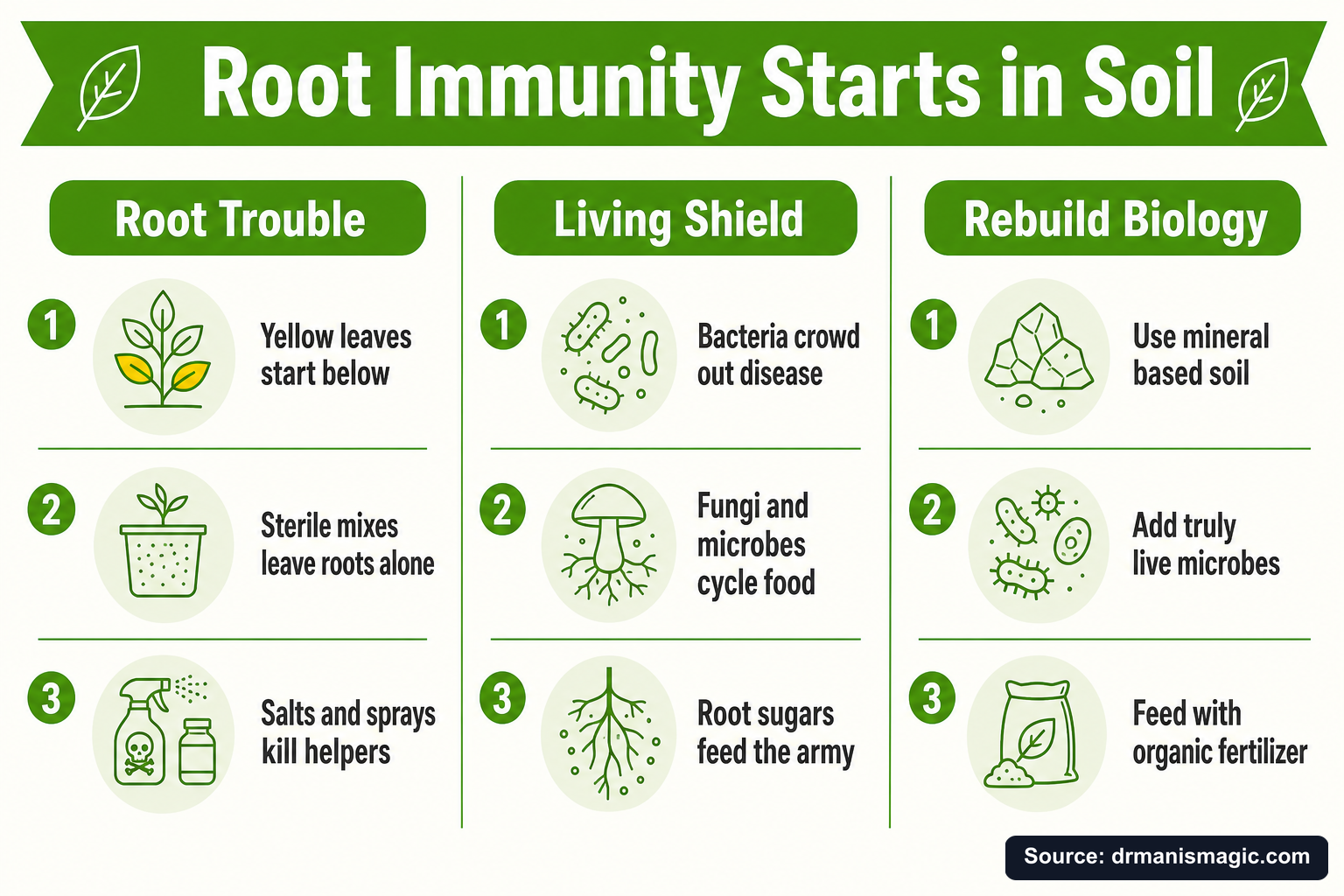
- Beneficial bacteria protect roots by competing with pathogens, producing natural antibiotics, and triggering your plant's immune system from the inside out.
- The rhizosphere — the thin zone of soil around your roots — is the most biologically active place on earth, and it runs on bacteria, fungi, protozoa, and nematodes working together.
- Salt-based synthetic fertilizers and common fungicides silently destroy the very microbes your roots depend on for protection and nutrition.
- Dry, powdered microbial products and foul-smelling compost teas often deliver dead or dying microbes — not the live biology your soil needs.
- Sterile potting mixes and fumigated soils have no living biology at all, making microbial inoculation essential from day one.
- The Three Plant Pillars — mineral-based soil, live microbials, and organic fertilizer — create the conditions where root immunity naturally flourishes.
- You can rebuild a damaged root zone, but it takes repeated applications of genuinely live microbes and time to restore what was lost.
What Is the Rhizosphere and Why Should You Care?
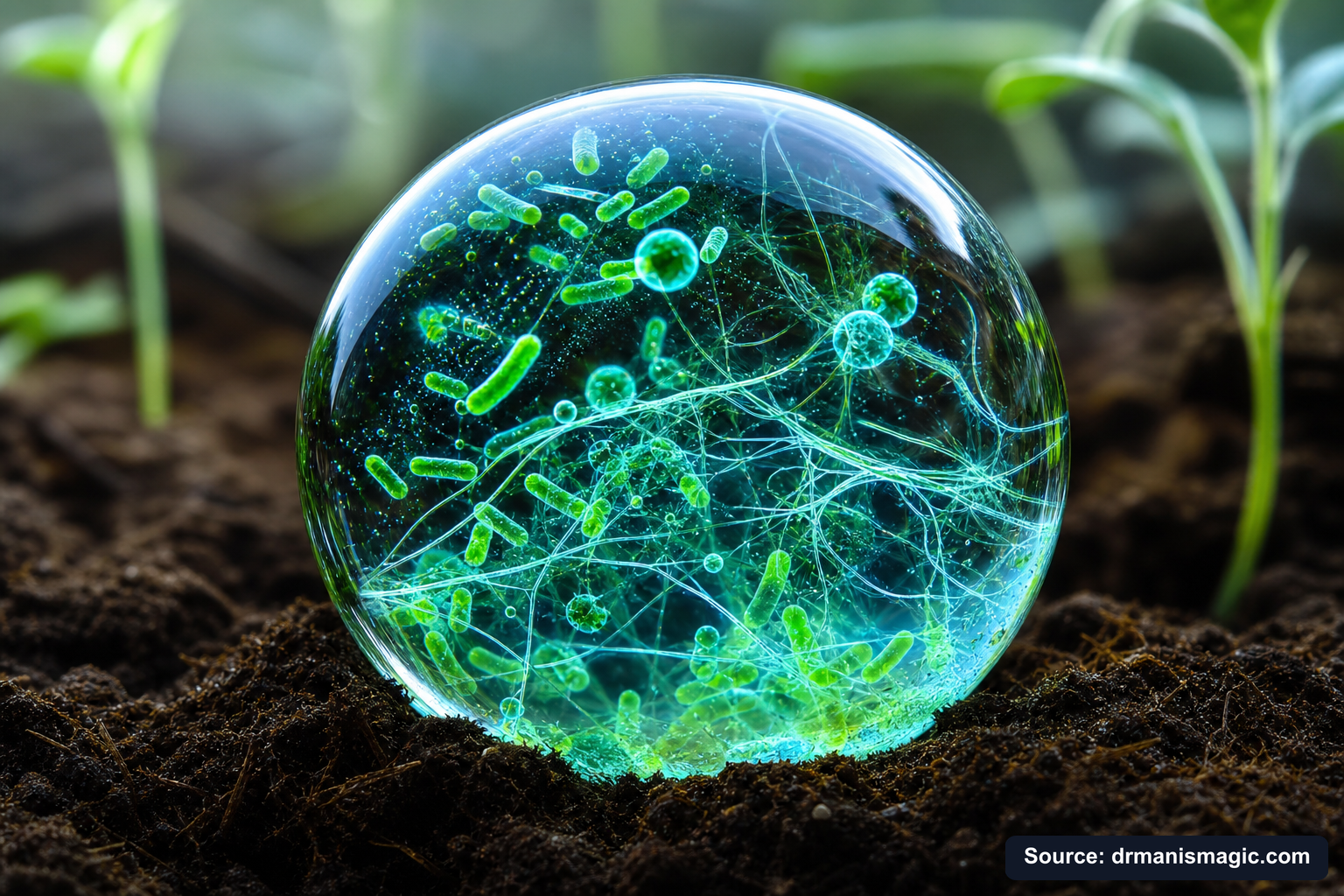
Quick Answer: The rhizosphere is the thin layer of soil directly around your plant's roots. It is the most biologically rich zone on earth. Bacteria, fungi, protozoa, and nematodes all live here together, cycling nutrients, fighting off disease, and keeping your roots strong. Without it, your plant is defenseless.
The rhizosphere is not just dirt. It is a living city. Packed into a zone barely a few millimeters thick around each root tip, there are more living organisms than there are humans on earth — billions of them in just a teaspoon of healthy soil.
Your plant built this city on purpose. Roots leak sugars, proteins, and carbohydrates into the soil around them. Scientists call these leaks "root exudates." Think of them as a free buffet. Bacteria smell that buffet and rush toward the roots. Fungi extend their thread-like arms toward it. And the whole neighborhood comes alive.
In exchange for that free meal, the microbes do something extraordinary. They unlock nutrients trapped in the soil. They fight off harmful pathogens trying to attack the roots. They build structure in the soil so water flows properly and oxygen reaches the roots. They even send chemical signals that prime the entire plant's immune system — not just the roots, but the leaves, the flowers, the fruit.
The University of California Agriculture and Natural Resources describes this relationship as a soil food web — an interdependent system where every organism plays a role in keeping the whole system healthy. When one piece disappears, the whole web weakens.
Most potting mixes you buy at a big box store? They start sterile. No food web. No army. Just dirt with no life in it. Your plant is dropped into a ghost town and expected to thrive.
What Do Beneficial Bacteria Actually Do for Your Roots?
Bacteria are the most abundant life form in your soil, and the good ones are working tirelessly on your plant's behalf. Here is what they are doing right now in every healthy garden on earth.
They Compete With Pathogens for Space
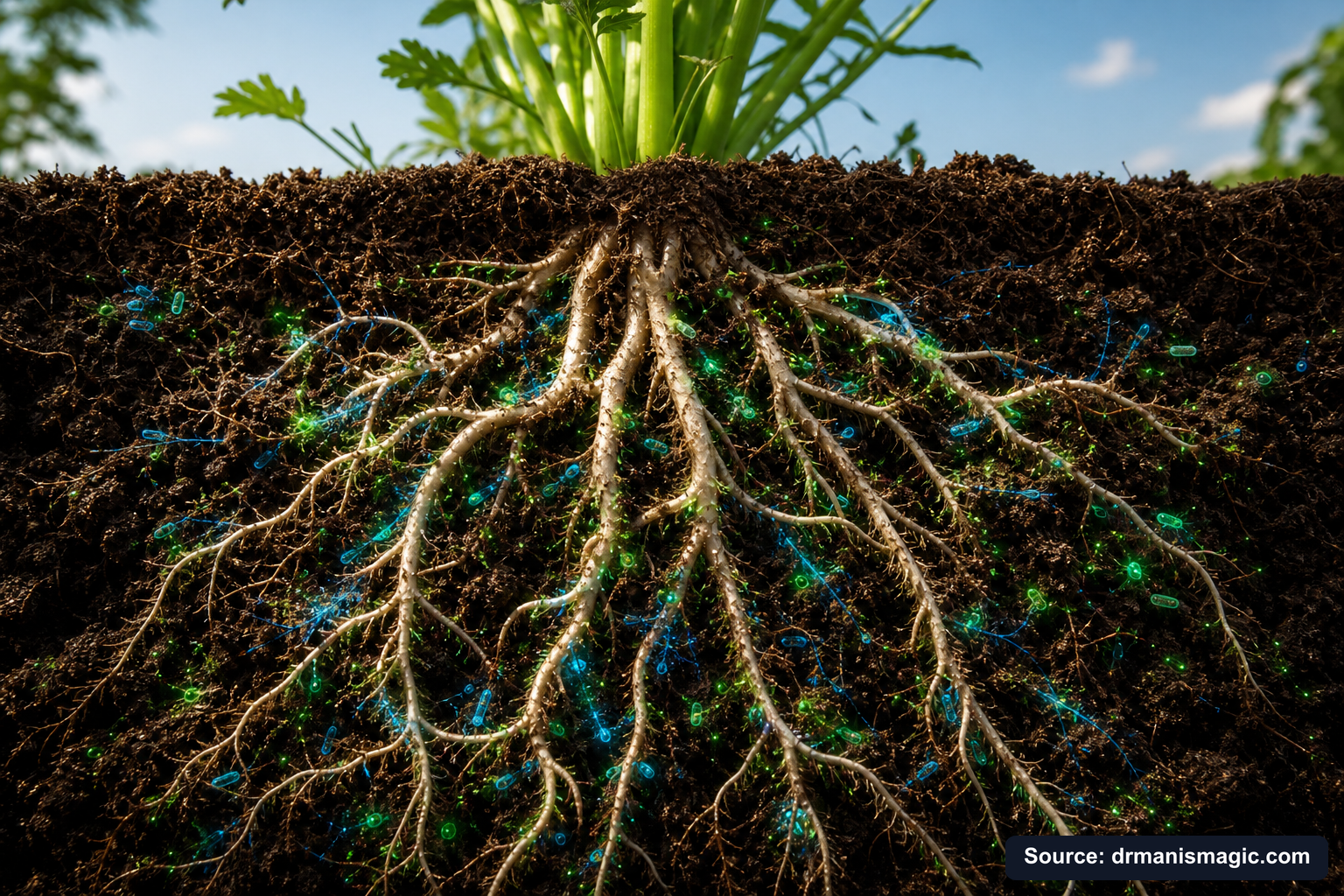
Root diseases like Phytophthora (the cause of most root rot) need a place to land. Beneficial bacteria colonize root surfaces so densely that harmful pathogens simply have no room. It is like showing up to a party where every seat is already taken. The pathogen has nowhere to go.
They Produce Natural Antibiotics
Certain bacteria — including species in the Bacillus and Pseudomonas families — produce chemical compounds that kill or weaken fungal pathogens. This is natural antibiosis happening right in your soil, no bottle of fungicide needed. In fact, reaching for a synthetic fungicide often kills these protective bacteria along with the pathogen you were targeting.
They Unlock Nutrients Your Plant Cannot Reach Alone
Phosphorus is almost always present in soil. But most of it is locked into a form plant roots cannot absorb. Phosphate-solubilizing bacteria break those chemical bonds and release phosphorus directly into the root zone. The same happens with iron, zinc, and other micronutrients. Your plant literally cannot access these nutrients without bacterial help.
They Pull Nitrogen Right Out of the Air
Nitrogen-fixing bacteria convert atmospheric nitrogen — the gas that makes up 78% of the air you breathe — into a form plants can use. This is how forests grow without anyone sprinkling fertilizer on them. The biology handles it.
They Trigger Your Plant's Immune System
This one surprises most people. Certain beneficial bacteria trigger a process called Induced Systemic Resistance, or ISR. Once triggered, the entire plant — not just the roots — is primed and ready to fight off pathogens, insects, and nematodes. Think of it like a vaccine. The bacteria teach your plant how to defend itself before the attack even comes. North Carolina State University Extension confirms that ISR is one of the most powerful biocontrol mechanisms available in natural soil systems.
They Produce Plant Growth Hormones
Bacteria produce auxins and other hormones that directly stimulate root growth. More root surface area means more nutrient uptake, more water absorption, and a stronger, more anchored plant. This is why plants grown in biologically rich soil look so different from plants grown in sterile potting mix — even when both are watered and fed the same way.
How Do Fungi, Protozoa, and Nematodes Fit Into Root Immunity?
Quick Answer: Bacteria are the foundation, but fungi extend the root system, protozoa release nutrients by eating bacteria, and beneficial nematodes prey on harmful pathogens. Together, these four groups form a complete root defense and nutrient delivery system that no single organism could build alone.
Bacteria get most of the attention. But they are just one player in a much bigger team. Here is how the whole crew works together.
Fungi: The Root Extenders
Mycorrhizal fungi form a partnership with plant roots that is almost unbelievable in its scale. The fungal threads — called hyphae — extend out from the roots like a second, invisible root system that can be hundreds of times larger than the roots themselves. This extended network pulls in phosphorus, water, and micronutrients from pockets of soil the roots could never reach on their own.
Look at any weed you pull from your garden. See those white fuzzy threads clinging to the roots? That's mycorrhizae. That is why weeds grow with such stubborn force. They have a fungal partner extending their reach. Your garden plants deserve that same advantage.
Mycorrhizal fungi also act as a physical and chemical barrier against root pathogens. They literally wrap around root tips and produce antifungal compounds that repel harmful organisms.
Protozoa: The Nutrient Releasers
Protozoa are tiny single-celled organisms that eat bacteria. When a protozoan eats a bacterium, the nitrogen inside that bacterium is released in a form the plant root can immediately absorb. This process — scientists call it the "microbial loop" — is one of the primary ways nutrients become available to plants in natural ecosystems. No protozoa means nutrients stay locked inside bacteria instead of flowing to your plant.
Beneficial Nematodes: The Predators
Not all nematodes are bad. This surprises most gardeners. While parasitic nematodes attack roots, bacterial-feeding and fungal-feeding nematodes are essential members of a healthy soil food web. They graze on bacteria and fungi, releasing more nutrients near the root zone. Predatory nematodes hunt harmful nematodes, helping keep the destructive population in check naturally.
A soil with all four groups — bacteria, fungi, protozoa, and nematodes — working together is what scientists call a disease-suppressive soil. It is a soil that fights back on its own.
| Organism | Primary Role | Root Benefit | What Destroys Them |
|---|---|---|---|
| Beneficial Bacteria | Nutrient cycling, pathogen competition, hormone production, ISR | Unlocks phosphorus, nitrogen; primes plant immunity; produces growth hormones | Salt-based fertilizers, synthetic herbicides, fungicides |
| Mycorrhizal Fungi | Extends root network, nutrient and water uptake | Massively increases root surface area; physical barrier against pathogens | Synthetic fungicides, high phosphorus inputs, soil sterilization |
| Protozoa | Eat bacteria; release nutrients near roots | Makes nitrogen available directly at the root zone | Pesticides, soil disturbance, drying, fumigation |
| Beneficial Nematodes | Graze on bacteria/fungi; hunt harmful nematodes | Releases nutrients; controls parasitic nematode populations | Fumigation, broad-spectrum pesticides, soil solarization |
| Earthworms | Aerate soil; move organic matter deeper | Improves drainage and root penetration | Compaction, synthetic pesticides, bare soil |
Why Do Salt-Based Fertilizers Quietly Destroy Root Immunity?
Quick Answer: Salt-based synthetic fertilizers create high-salt conditions in the soil that directly harm and kill beneficial bacteria, fungi, and other soil organisms. Without those microbes, roots lose their natural protection against disease, and the plant becomes dependent on more and more inputs just to survive.
Here is the dirty secret the big chemical companies have been hiding since the 1950s. The fertilizer that makes your lawn green in three days? It's salt. Literally. Synthetic fertilizers are salt-based compounds. And salt is one of the most effective microbial killers on the planet.
When you pour a salt-based fertilizer onto your soil, the beneficial bacteria in the root zone experience osmotic shock. Water is pulled out of their cells. Many die. The fungal networks collapse. The protozoa and nematodes that depended on bacteria for food disappear. In one application, you can set back years of biological progress.
The plant gets a short burst of green. That's the salt forcing a quick nutrient uptake. But the root zone is now biologically depleted. No protection. No immune priming. No nutrient cycling. The plant becomes what we call a "chemical dependent" — it needs more and more input just to maintain the same level of health, because the natural system that supported it is gone.
Then root rot moves in. Because Phytophthora and other pathogens are opportunists. They thrive when the beneficial bacteria that once competed with them are no longer present. That root rot you blamed on overwatering? Often it started with a fertilizer that killed the biology protecting those roots.
See also: The Hidden Reason Synthetic Fertilizers Cause Root Rot
This is why Pillar 3 of the Three Plant Pillars is organic, slow-release fertilizer. Organic fertilizer feeds your plant without harming the microbes doing the real protective work. It works with the biology instead of burning it down.
You Never Had a Brown Thumb.
You were handed the wrong tools. This free guide hands you the right ones.
You watered it. You fed it. It died anyway.
It was never you. It was the dirt, the salt food, and the bad advice.
This guide shows you what really went wrong, and how to fix it for good.
- Why your plants really died, and why it was never your fault
- The salt hiding in your plant food that quietly burns the roots
- The hidden killer in almost every bag of store soil
- The tiny helpers that grow a whole forest for free
- The rescue trick that brings a half dead plant back to life

Are All Microbial Products the Same? Live vs. Dead Microbes Explained
Quick Answer: No. Most microbial products on shelves contain dead or dormant microbes that show little to no benefit when applied. The difference between a live microbial product and a dried powder or an anaerobic liquid is the difference between sending a living soldier into battle and sending a photograph of one.
Walk into any garden center and you will find shelves full of products promising bacteria, fungi, and mycorrhizae. Most of them don't work. We know because we tested dozens of them over years of growing at our South Texas nursery. Here is why so many fail.
The Dried Powder Problem
Most commercial microbial products are made in large factories. Bacteria are grown in giant vats, then dried into a powder. The hope is that the dormant spores will "wake up" when you add water and apply them to soil. In theory, it sounds plausible. In practice, the results are poor. The drying process kills most of the organisms. The ones that survive may not establish in your specific soil conditions. After testing dozens of batches, we consistently saw no meaningful improvement in plant health from these powders.
The Smelly Liquid Problem
Some companies skip the drying step and sell a liquid product. That sounds better. But most of these liquids go anaerobic — meaning they run out of oxygen — during shipping and storage. When microbes go anaerobic, they die and start to decompose. The telltale sign? The bottle smells awful. Rotten. Sometimes it even fizzes when you open it, releasing fermentation gas. Those microbes are not going to protect your roots. They are already dead.
The Lactobacillus Shortcut
Some products use lactobacillus bacteria — yes, the same kind in your yogurt — because they are easy and cheap to grow. They survive well in a bottle. But in your soil, they outcompete and crowd out the beneficial bacteria your roots actually need. We do not use lactobacillus in our formulas for exactly this reason. It belongs in your yogurt, not your root zone.
| Product Type | Microbe Viability at Application | Spectrum of Organisms | Odor | Our Assessment |
|---|---|---|---|---|
| Dry powdered lab microbes | Very low — most dead from drying | Narrow (1-5 species) | Neutral | Avoid — we saw no results in repeated testing |
| Dry powder rehydrated into liquid | Very low — same issue | Narrow | Neutral | Avoid — same poor results |
| Compost tea (fresh, under 24 hours, aerated) | Moderate — time-sensitive | Broad but variable | Earthy | Good if used immediately; difficult to scale |
| Compost tea (old, over 24 hours) | Low — gone anaerobic | Partial | Strong foul odor | Not recommended |
| Lactobacillus-based liquid | High — but wrong organisms | Very narrow | Sour | Avoid — crowds out beneficial bacteria |
| Plant Super Boost (stabilized, full-spectrum) | High — visibly alive under microscope | 2,000+ bacteria, 400-500 fungi including mycorrhizae, plus protozoa and nematodes | Earthy — no foul odor | Recommended — harvested from compost, stabilized by all-natural method |
The difference with Plant Super Boost is the stabilization method. Our world-famous compostologist partner developed an all-natural technique to keep the full spectrum of microbes from fresh compost alive in a bottle — without them going anaerobic and dying. Take a drop and look at it under a microscope. You can actually see the microbes moving. We have lab analyses to back that up. And unlike fish emulsion or anaerobic compost teas, it smells like earth. Because it isn't rotting.
When Is Microbial Inoculation Worth It, and When Will It Fail?
Quick Answer: Microbial inoculation is most valuable when your soil is sterile, depleted, or chemically damaged — like new potting mix, fumigated ground, or soil treated with synthetic fertilizers. In already-living, biologically rich soil, the benefit may be smaller, but regular applications still reinforce and strengthen the existing community under stress.
Not every situation needs the same approach. Here is an honest guide to when live microbial inoculants will make the biggest difference for your plants.
When Microbes Matter Most
- New potting mix or container soil: Almost always sterile. No biology present at all. Inoculation is essential from day one.
- After fumigation or soil sterilization: The entire food web has been erased. Beneficial and harmful organisms alike. Pathogens often recolonize faster than beneficials — making deliberate re-inoculation critical to prevent disease rebound.
- Soils with a history of synthetic fertilizer use: The salt damage has reduced the microbial population significantly. Regular inoculation helps rebuild what was lost.
- Urban or construction-disturbed soils: Compaction, grading, and equipment traffic destroy soil structure and biology alike.
- Transplant stress: Newly transplanted trees and plants have disrupted root zones. Microbes applied at transplant time help establish the protective community faster.
- After flooding or salinity events: Both conditions crash microbial populations. Reintroduction speeds recovery.
- Container plants and houseplants: These live in a closed, isolated system with no natural recolonization possible. They need you to bring the biology to them.
When Results May Be More Modest
- In biologically rich garden beds that have never been chemically treated and have active compost additions regularly applied.
- In established orchards or landscapes with deep root systems and minimal chemical input history.
Even in those cases, ongoing applications of a full-spectrum product still reinforce the existing community and help it resist environmental stressors. Think of it like supporting your immune system when you're already healthy. It never hurts, and during periods of stress — drought, temperature extremes, pest pressure — that extra support can make the difference between a plant that recovers and one that doesn't.
What Kills Your Root Zone Biology and How Do You Know?
Quick Answer: Synthetic herbicides, salt-based fertilizers, broad-spectrum pesticides, synthetic fungicides, soil fumigation, waterlogging, compaction, and high salinity all kill or seriously damage the beneficial organisms in your root zone. Signs of a damaged rhizosphere include yellowing leaves, poor growth despite feeding, chronic root rot, and soil that doesn't absorb water properly.
Your root zone biology can be damaged without you knowing it. The plants don't come with a warning light. But there are signs.
Yellowing leaves that don't respond to fertilizer often mean the nutrient-cycling bacteria are gone — so the nutrients you're adding stay locked in forms the plant can't use. Root rot that keeps coming back despite your best efforts usually means the beneficial bacteria that suppressed Phytophthora are no longer present. Soil that pools water on the surface instead of draining means the fungal networks that built soil structure and aggregation have collapsed. A plant that just looks "tired" — not sick enough to diagnose, but never quite thriving — is often a plant whose rhizosphere army is undersized and outgunned.
Here is the list of common root-zone destroyers:
- Synthetic herbicides (especially glyphosate): Directly disrupts microbial communities and enzyme activity in soil.
- Salt-based fertilizers: High-salt conditions harm and kill beneficial bacteria and fungi through osmotic stress.
- Broad-spectrum pesticides: Non-selective toxicity reduces microbial diversity significantly.
- Synthetic fungicides: Kill beneficial fungi — including mycorrhizae — alongside the target pathogen.
- Soil fumigation and solarization: Erase the entire food web, leaving soil open to pathogen recolonization.
- Waterlogging: Drives out oxygen, killing aerobic beneficial bacteria and triggering anaerobic pathogen growth.
- Compaction: Destroys soil pore structure, eliminating the oxygen channels microbes and roots need to survive.
- High salinity: Whether from synthetic inputs or naturally saline soil, excess salt directly stresses and kills microbial populations.
How Do You Rebuild Root Zone Biology After Damage?
Quick Answer: Rebuilding a damaged rhizosphere takes consistent action over several months. Stop the inputs that caused the damage, reintroduce live microbes, feed them with organic matter, improve soil structure so they can breathe, and give the system time to re-establish. One application is a start, not a finish.
The good news: soil biology can recover. It is remarkably resilient when you stop fighting it and start working with it. Here is a practical recovery checklist we use at our nursery after any serious soil disruption.
- Stop the damage first. Eliminate or reduce salt-based fertilizers, synthetic fungicides, and broad-spectrum herbicides. You cannot rebuild a house while someone is still burning it down.
- Fix the soil structure. Compacted, waterlogged, or bark-heavy potting mix prevents oxygen from reaching the root zone. Microbes need oxygen to survive. Our mineral-based Super Soil provides permanent structure that doesn't compact or decompose, keeping the root zone aerated.
- Inoculate with genuinely live, full-spectrum microbes. Apply a quality live microbial product immediately. This is not optional in a depleted or sterile soil. The beneficial organisms will not appear on their own fast enough to protect roots from opportunistic pathogens.
- Feed the microbes with organic matter. Compost, organic mulch on the surface, and organic fertilizer all provide the carbon food source that keeps the microbial community growing and thriving. Organic slow-release fertilizer like our Crab, Kelp and Amino Acids feeds both the plant and the biology at the same time.
- Apply microbes consistently every month. This is not a one-and-done situation. Environmental pressures, residual chemicals, and ongoing container conditions mean the microbial community needs reinforcement. Monthly applications are our standard protocol at the nursery.
- Keep roots covered. Bare soil dries out and heats up, killing surface-dwelling microbes. Mulch on top of garden beds or around trees keeps moisture in and temperature stable — conditions microbes love.
- Be patient and watch for the signs of recovery. New leaf color. Better water drainage. Firmer stems. Roots that look white and healthy rather than brown and mushy. These changes take weeks to months, not days. But they come.
See also: Why Most Fertilizers Are Actually Salt in Disguise
Does Your Plant Really Have Time to Wait?
Quick Answer: No. Every season spent in biologically dead soil is a season your plant cannot get back. Root systems built without microbial support take far longer to establish, fruit later, and remain vulnerable to disease. The time cost of starting wrong is always greater than the cost of starting right.
Here is something Dr. Mani hears from gardeners more than anything else. More than questions about watering schedules or pruning techniques. More than questions about pests or diseases. The number one thing people say is: "I just want to see fruit on this tree while I still can."
That hits different when you really think about it. Because time is the one thing you cannot get back. You can replace money. You can replace a plant. You cannot replace the years spent coaxing a tree along with the wrong soil, the wrong fertilizer, and no living biology in the root zone. Years of slow growth. Years of disease. Years of "why isn't this working?"
The root zone biology is not a luxury upgrade. It is the foundation your plant was designed by nature to grow in. Every forest, every meadow, every thriving garden on earth is running on this invisible system. When you set it up right — mineral-based soil that breathes, live microbes that fight and feed, organic nutrients that work with the biology — your plant finally has what it was built for. And it responds. Fast.
We have watched it happen across 250,000 trees at our nursery in South Texas. Trees that once sat in sterile potting mix, barely growing, started exploding with new root growth and new leaves within weeks of getting genuine live biology in the root zone. Not because we did something magical. Because we finally stopped fighting nature and started working with it.
Want to know exactly how the Three Plant Pillars work together to create this foundation? Grab the free Plant Care Field Guide — it walks you through every step in plain language, no guesswork, no jargon.
What Can You Do Right Now to Protect and Feed Your Root Zone?
You don't need to overhaul everything overnight. You just need to start. Here is what a strong foundation looks like in practice.
First, look at your soil. If it's bark-heavy, compacted, or smells sour and waterlogged, the structure is already working against your roots. Roots need oxygen. A mineral-based, permanently structured soil gives them that.
Second, look at your fertilizer. If the bag says "fast-acting" or "quick green-up," it's almost certainly salt-based. Those salts are damaging the very biology your roots depend on for protection. Switch to a slow-release organic fertilizer that feeds both the plant and the microbes.
Third, and most importantly: get live biology into your root zone. Not a powder. Not a smelly liquid. Genuinely live, full-spectrum microbes from a source you can verify. At US Citrus Nursery, we built our entire 250,000-tree growing program around this principle. The results speak for themselves.
Your roots have been waiting for their army. It's time to give it to them.
If you are ready to see what a biologically alive root zone actually looks like — in your container plant, your garden bed, your backyard tree — start with the product we built our nursery on: Plant Super Boost. Live microbes, stabilized by an all-natural method, with zero foul odor and a 30-day money-back guarantee. Zero PFAS. Zero biosludge. Zero synthetic salts. Just the living biology your plants were designed to grow with — made right here in the USA.
Frequently Asked Questions
You just learned how bacteria protect your roots from the inside out. Now you probably have some real questions. Good. These are the exact questions gardeners ask us every day, and the answers below are grounded in 30 years of growing over 250,000 trees in South Texas. Read these carefully. They could save your plants.
How do bacteria help protect plant roots from disease?
Beneficial bacteria crowd out harmful pathogens before they can attack your roots. They produce natural compounds that act like antibiotics in the soil. They also send chemical signals that wake up your plant's own immune system. Think of them as a security team that never clocks out. At Dr. Mani's Magic, our Plant Super Boost delivers live bacteria straight to your root zone so that security team is always on duty.
What kills the good bacteria in my soil?
Salt-based synthetic fertilizers are the number one killer. They burn the soil and wipe out the very microbes your roots depend on. Common fungicides do serious damage too. So does sterile potting mix, which arrives with zero living biology. After testing this on over 250,000 trees, Dr. Mani saw firsthand how these inputs gut the rhizosphere and leave roots completely defenseless. That is exactly why the Three Plant Pillars avoid all of them.
Can soil bacteria actually build immunity in my plants?
Yes, and this is one of the most exciting things happening under your feet right now. When live bacteria colonize the root zone, they trigger something called systemic resistance inside the plant. The plant's immune system switches on. Leaves, stems, flowers, and fruit all get stronger. This is not a theory. It is the same biology Dr. Mani relied on across his citrus grove, nursery, and houseplant trials for decades.
Why do most microbial products not seem to work?
Most powdered or dried microbial products are already dead by the time you open the bag. Dead microbes do nothing. Compost teas can go anaerobic and smell like sewage, which means the biology has rotted. Dr. Mani's Plant Super Boost uses a special stabilization method that keeps the bacteria genuinely alive in the bottle. When you pour it on your soil, you are delivering real, living microbes, not a bag of dust.
What are the signs my plant's root zone has lost its healthy bacteria?
Watch for yellowing leaves even when you are watering and feeding correctly. Watch for soggy soil that drains poorly. Watch for roots that look brown, slimy, or stunted when you pull the plant out. A faint sour or rotten smell from the soil is a major warning sign. These are not watering problems. They are biology problems. The invisible army is gone, and the roots are fighting alone.
How do harmful bacteria or pathogens avoid being killed in the soil?
Bad pathogens are sneaky. They form protective coatings and hide in dying organic matter. When beneficial bacteria are wiped out by synthetic fertilizers, there is nothing left to compete with them. They spread fast in that vacuum. This is why sterile or chemically treated soil is actually more dangerous over time, not safer. A thriving microbial community is the best natural defense your roots have against these invaders.
How long does it take to rebuild healthy bacteria in damaged soil?
You can start seeing improvement within 30 days with the right inputs. But full restoration takes time and repeated applications of live microbes. Soil that has been hammered by synthetic fertilizers for years will not bounce back overnight. That is why we say the best time to start was years ago, and the second best time is today. Every week you wait is time your plants spend without their natural protection working for them.
About the Author
Dr. Mani Skaria, PhD
Dr. Mani Skaria, PhD, is a plant pathologist and the scientific founder of Dr. Mani's Magic. He earned his doctorate at Purdue University and spent 48 years studying how plants, soil, and living microbes work together, including his years as Professor Emeritus at Texas A&M and as a member of the USDA NAREEE Advisory Board. He invented micro-budding, a method for growing healthier, stronger trees, and has grown more than 250,000 trees on the family farm in Hargill, Texas - US Citrus Nursery. His life's work takes real lab science and practical experience and turns it into simple, safe, organic plant care anyone can use at home.


