


How Fertilizer Salts Block Water Instead of Helping Plants | Dr. Mani's Magic
How Fertilizer Salts Block Water Instead of Helping Plants (And What to Do About It)
Picture this. You just fertilized your tomatoes, your potted lemon tree, or your front lawn. You watered everything in. You did everything you were supposed to do. Then two days later, the leaves start drooping. The tips turn brown. The plant looks like it's dying of thirst — even though the soil is still wet.
You water it more. It gets worse. You start Googling at midnight. You wonder if you did something terribly wrong. And somewhere in the back of your mind, a dark thought creeps in: "Maybe I just don't have a green thumb."
Stop right there. It is not you. What you just experienced has a name. Scientists call it osmotic stress. We call it chemical drought. And after growing over 250,000 trees at our South Texas nursery, we can tell you this: it is one of the most common and least talked-about ways that fertilizer quietly destroys plants. The good news? Once you understand what is actually happening in that soil, the fix becomes obvious.

Organic Fertilizer | Crab, Kelp & Amino Acids
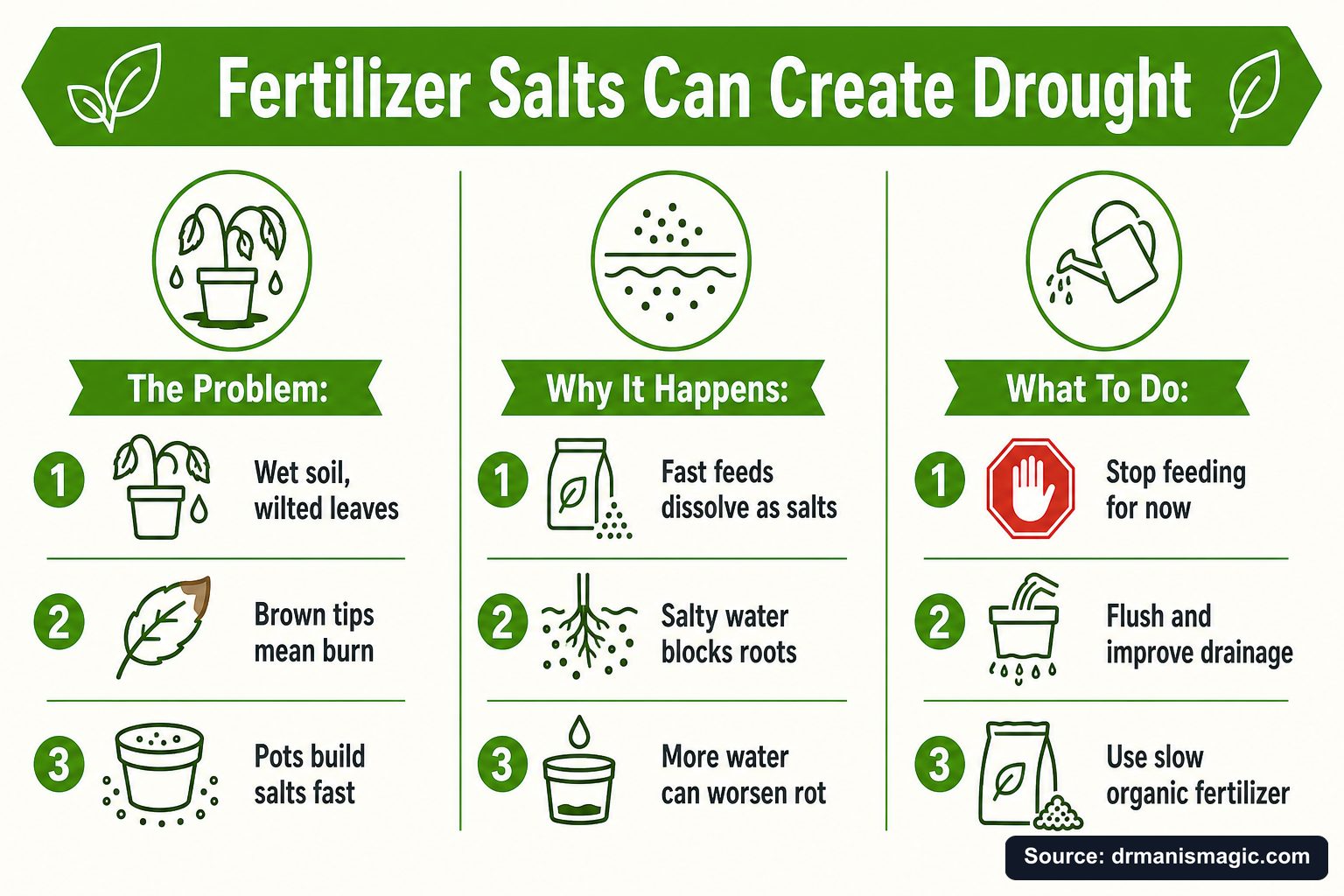
Key Takeaways
- Many common fertilizers are made of concentrated salts that can make soil water harder for roots to absorb — even when the soil looks wet.
- This is called "chemical drought" or osmotic stress, and it can cause wilting, leaf burn, stunted growth, and root damage.
- "Fertilizer salts" does not just mean table salt — it includes nitrate, ammonium, potassium, phosphate, sulfate, and many other compounds found in synthetic plant food.
- Salt stress and root rot feed each other in a dangerous loop: the plant wilts, you water more, drainage gets worse, roots lose oxygen, pathogens move in, and the plant keeps declining.
- Organic, slow-release fertilizers work with your soil's microbes instead of burning them, which means gentler nutrition and far less salt buildup.
- The Three Plant Pillars — mineral-based soil, live microbes, and organic fertilizer — are the foundation for breaking this cycle for good.
- Recovery is possible, but the steps matter: stop feeding, improve drainage, let the soil breathe, and support the biology that was damaged.
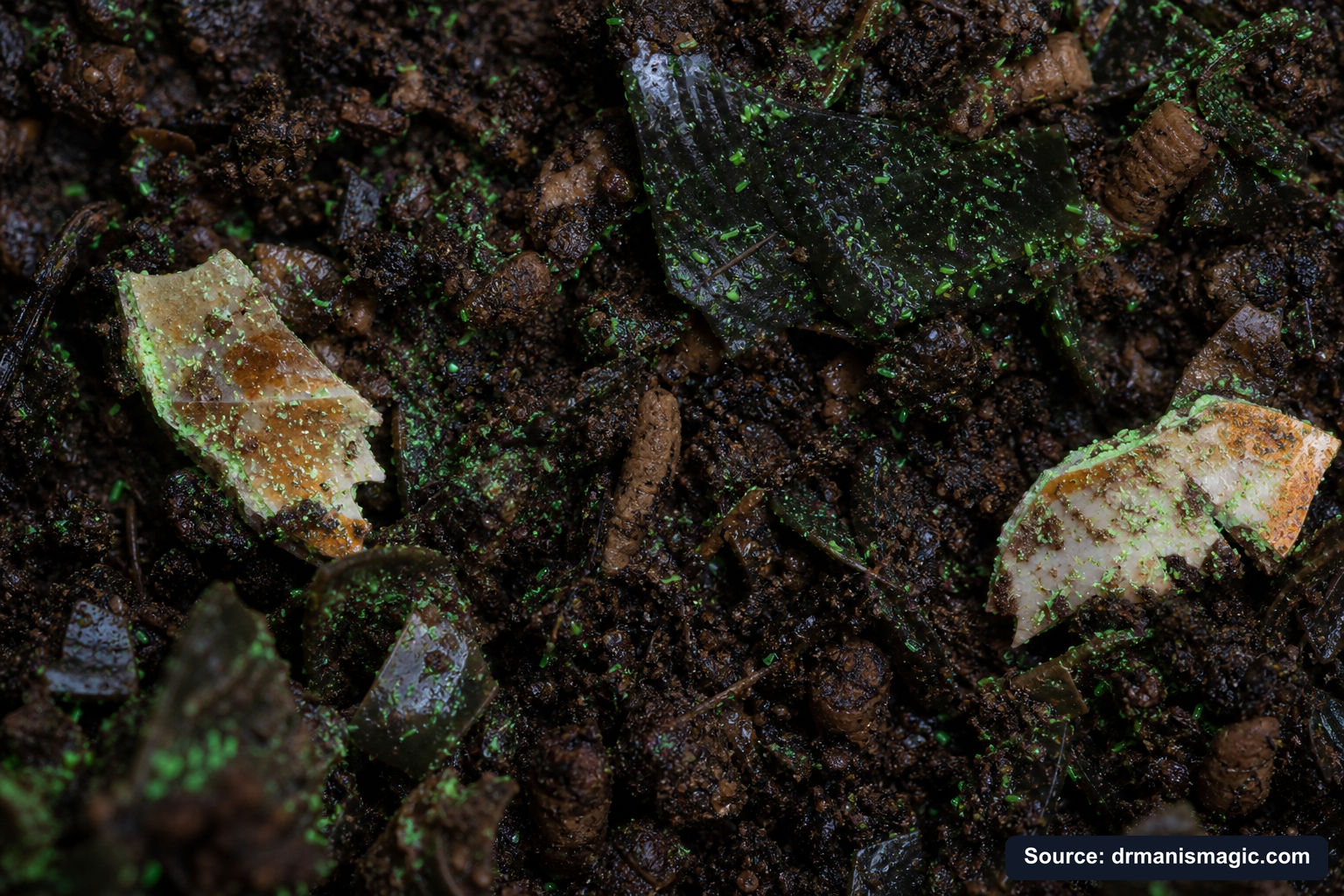
What Does "Chemical Drought" Actually Mean?
Chemical drought means your plant is dying of thirst in wet soil. That sounds impossible. But here is how it works.
Roots absorb water using a natural pressure system. Water in the soil moves from areas of lower concentration into the root, where the concentration of dissolved materials is higher. Think of it like a sponge drawing up liquid. The root wins that tug-of-war because it naturally holds more dissolved material than the surrounding soil water does.
Now add a heavy dose of fast-dissolving fertilizer. Suddenly, the soil water is loaded with dissolved salt ions. The concentration outside the root shoots up. The tug-of-war flips. Instead of pulling water in, the root struggles to hold onto the water it already has. In extreme cases, water can actually be pulled out of the root and into the salty soil. The plant wilts. The leaves burn at the tips. The whole thing looks like drought — because biologically, it is drought. Just not the kind you can fix with a garden hose.
Are All Fertilizers Made of Salt?
Many of the most popular synthetic fertilizers are salt-based, yes — but not all fertilizers are the same kind of salt.
When most people hear "salt," they picture the white stuff on a dinner table. But in chemistry, a salt is any compound formed when an acid and a base combine. That includes ammonium nitrate, potassium chloride, monoammonium phosphate, calcium nitrate, magnesium sulfate, and dozens of other compounds found in the blue and white granules or concentrated liquids sold at every big box store.
These compounds dissolve fast in water. That is the whole point. Fast-release means you see a quick green response. But fast-dissolving also means the salt concentration in your root zone can spike dramatically — especially if you apply too much, apply it to dry soil, skip watering it in, or use it repeatedly in a container where there is nowhere for those ions to go.
Here is what most people are never told: the "fertilizer burn" you see on leaf tips is not a separate problem from salt buildup. It is the same problem showing up in two different places at once — the leaves are scorching because the roots cannot move enough water to keep up with what the leaves are losing to the air.
Why Do Containers and Raised Beds Make Salt Problems Worse?
Salt stress in containers is a faster, more serious problem than in the ground — and the reason comes down to simple math.
In the ground, a plant's roots can spread outward for feet in every direction, constantly seeking fresh soil with lower salt concentrations. In a container, the roots are boxed in. Every application of synthetic fertilizer adds more dissolved ions to the same small volume of soil. There is nowhere for those ions to go unless you deliberately flush them out with deep, thorough watering that carries them out the drainage holes.
Most people water their containers too shallowly. A little bit of water every day actually concentrates the salts near the surface and in the root zone rather than flushing them lower and out. Over time, you can see a white crust forming on the top of the soil or on the outside of clay pots. That crust is the visible tip of the salt iceberg below.
Raised beds sit in the middle — better than a pot, but still limited compared to open ground. If drainage is poor or the bed is watered shallowly, salt can build up just as fast as in a container. And the problem compounds every season you add more synthetic fertilizer on top of last year's residue.
How Does Salt Damage the Roots Themselves?
Salt does not just block water from entering the root. It physically injures the root tissue, and those injuries open the door to something even worse.
When roots are bathed in high-salt water, the outer cells dry out and die. The fine hair-like root tips — the ones responsible for most of the water and nutrient absorption — are the first to go. They are delicate. They are the most exposed. Once they die, the plant loses absorptive surface area. It can pull in less water and fewer nutrients even if conditions improve.
Damaged, oxygen-starved roots are also a welcome mat for pathogens. Pythium, Fusarium, and other root-rot organisms thrive in exactly the conditions that salt stress creates: weakened root tissue, poor drainage, and low oxygen. This is the dangerous feedback loop that almost no one talks about. The plant wilts from salt stress, so you water more. More water without good drainage means less oxygen in the soil. Less oxygen means the roots weaken further. Weakened roots invite root rot. Root rot reduces water uptake even more. And the whole spiral accelerates.
We have seen this exact pattern in citrus trees, houseplants, lawn grass, garden beds, and ornamentals. The symptoms look different on the surface, but the underground story is the same every time.
What Does Salt Do to the Microbes in Your Soil?
Salt kills the living ecosystem in your soil, and that is where the long-term damage really compounds.
Healthy soil is not just dirt. It is a living community of bacteria, fungi, and other microscopic organisms that do essential work for your plants. They break down organic matter and release nutrients in forms roots can use. They form relationships with root tips that dramatically extend the plant's reach for water and minerals. They protect roots from pathogens. They build the spongy, airy structure that lets water drain properly and oxygen move in.
Salt-based fertilizers, applied repeatedly, are hostile to this community. The same osmotic pressure that stresses plant roots stresses microbial cells too. Beneficial bacteria and fungi populations decline. The soil biology that makes nutrients available to plants gets disrupted. And then something subtle but serious happens: even the nutrients that are already in the soil become harder for the plant to absorb, because the microbes that would normally convert and deliver those nutrients are no longer thriving.
This is the hidden cost that never shows up on a fertilizer label. You can keep adding more synthetic fertilizer to compensate for declining nutrient uptake — and many people do — but you are chasing a problem you are simultaneously making worse. The big chemical companies that sell this approach profit every time you buy another bag. Your plant pays the price. And so does your time.
How Do You Know If Salt Stress Is the Problem?
Salt stress is a master of disguise. It looks like drought. It looks like overwatering. It looks like nutrient deficiency. Getting the diagnosis right is the first step to getting the recovery right.
Here is a practical way to think through what you are seeing:
| Symptom | Salt Stress / Fertilizer Burn | Underwatering | Overwatering / Root Rot | Heat Scorch | Nutrient Deficiency |
|---|---|---|---|---|---|
| Wilting in wet soil | Yes — classic sign | No — soil is dry | Yes — roots can't function | Possible in extreme heat | Rare |
| Leaf tip or margin burn | Yes — crispy, brown edges | Possible | Yellow, soft edges | Scattered scorch, not margins | Usually yellowing, not browning |
| Timing after fertilizing | Days to weeks after application | No connection | No direct connection | Hot weather, afternoon sun | Gradual, weeks to months |
| White crust on soil surface | Yes — visible salt deposit | No | No | No | No |
| Root appearance | Brown, brittle tips | Dry, shrunken | Dark brown, mushy, may smell | Usually healthy roots | Usually healthy roots |
| Recovery with deep watering | Often improves if caught early | Improves quickly | Worsens with more water | Improves with shade and water | No response to water alone |
The key question to ask yourself: Did I fertilize recently? Is the soil wet but the plant still drooping? Are the leaf edges crispy brown while the centers are still green? If yes to all three, salt stress is the most likely culprit.
Can Fertilizer Actually Pull Water Out of Roots?
Yes. It sounds dramatic, but the science is straightforward.
The process is called osmosis. Water moves across a membrane from where it is more dilute to where it is more concentrated — trying to balance things out. Roots count on this. Under normal conditions, the inside of the root is more concentrated than the surrounding soil water, so water flows in.
When fertilizer salts are highly concentrated in the soil water, that balance tips. The soil water becomes more concentrated than the root interior. Water flows the wrong direction — out of the root and into the soil. The root cells shrink and lose function. The plant wilts from the inside out, even while sitting in damp ground.
University extension researchers describe this as a "reversed water gradient." It is the same basic reason that drinking seawater makes you more dehydrated. More salt outside than inside means water goes the wrong way, every time.
You Never Had a Brown Thumb.
You were handed the wrong tools. This free guide hands you the right ones.
You watered it. You fed it. It died anyway.
It was never you. It was the dirt, the salt food, and the bad advice.
This guide shows you what really went wrong, and how to fix it for good.
- Why your plants really died, and why it was never your fault
- The salt hiding in your plant food that quietly burns the roots
- The hidden killer in almost every bag of store soil
- The tiny helpers that grow a whole forest for free
- The rescue trick that brings a half dead plant back to life

What Should You Do Right After Over-Fertilizing?
The most important thing is to stop adding more fertilizer immediately. Do not try to "balance" it with another product. Do not add more water without thinking it through first.
Here is a simple recovery sequence that works across containers, raised beds, trees, and garden plants:
- Stop all fertilizer applications right away. Adding more nutrition to a salt-stressed plant is like pouring gasoline on a fire.
- Check your drainage first. If water pools in the pot or bed and does not drain, flushing the soil will make things worse by drowning the already-stressed roots. Fix drainage before you add water.
- If drainage is good, leach the soil deeply. Water slowly and thoroughly until water runs freely out the bottom of the container or drains away from the bed. Do this two or three times over several days. This physically carries dissolved salts down and out of the root zone.
- Do not repeat shallow watering. Small frequent sips keep salts near the surface. Deep, infrequent watering moves them out.
- Inspect the roots if possible. Healthy roots are white or light tan and firm. Brown, mushy, or foul-smelling roots indicate root rot has begun. In a container, you may need to repot into fresh soil and trim damaged roots with clean scissors.
- Improve aeration. Roots need oxygen to recover. If your soil is compacted or heavy, this is the moment to rethink what you are growing in.
- Wait before resuming any feeding. Give the plant at least two to four weeks of recovery before introducing any nutrition at all — and when you do, choose something gentle and biology-friendly.
Why Is Organic Fertilizer Different From Salt-Based Fertilizer?
Organic fertilizer is not just "less salt." It works through a completely different mechanism — one that mirrors how plants have been fed in nature for millions of years.
Here is the part most gardening articles skip entirely, and it is the most important part.
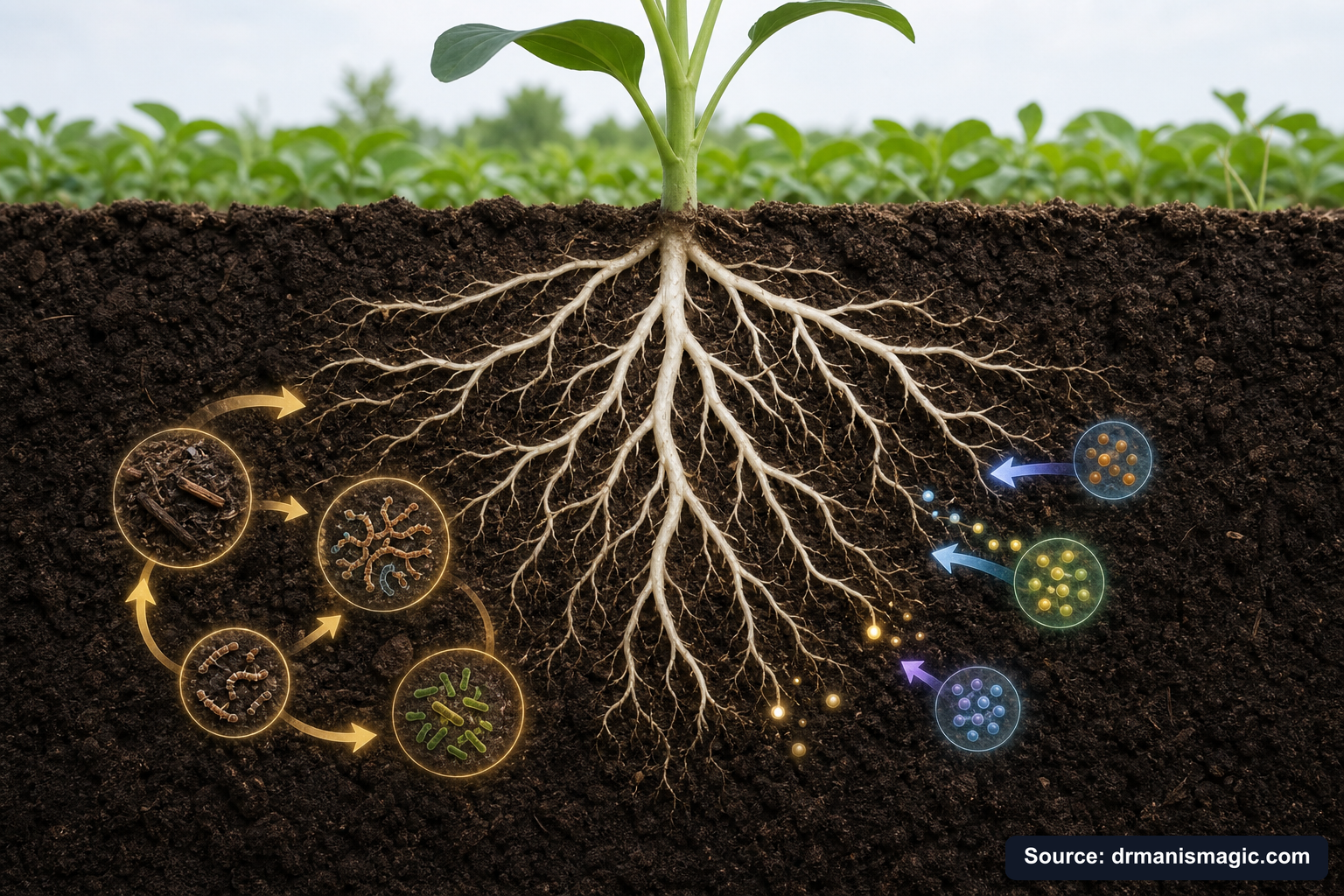
When you apply an organic fertilizer, the nutrients in it are not immediately dissolved and available. They are bound up in proteins, shells, and complex molecules that your plant cannot use directly. But here is where it gets interesting: the microbes in your soil can use them. The bacteria and fungi eat the organic material. They break it down. They convert it into simpler forms — ammonium, nitrate, phosphate — that plant roots can actually absorb.
Then those microbes die. And when they die, they release everything they were holding — all that nutrition — directly into the soil around the roots. In a slow, steady trickle. Like a natural time-release capsule that keeps going long after you applied it.
This is not just a gentler way to fertilize. It is the way the entire natural world fertilizes plants. Lightning, nitrogen-fixing bacteria, decomposing leaves, dying fungi — all of it works through this same biological chain. Organic fertilizer plugs into that chain instead of bypassing it.
The result is nutrition that arrives at a pace the plant can actually use. No salt spike. No osmotic reversal. No chemical drought. Just a steady, consistent supply that supports the biology that supports the plant.
What Makes Crab, Kelp, and Amino Acids Different From Other Organic Options?
Not all organic fertilizers are clean or complete. This is something we learned the hard way after decades of testing at our South Texas nursery.
Some organic fertilizers are made from biosludge — treated municipal waste, which is essentially processed human sewage. This material can carry PFAS compounds, the so-called "forever chemicals" that do not break down in soil or in your body. You will not see "biosludge" printed on the bag. You have to know what to look for and what to ask.
Others use fish emulsion, which is genuinely organic but creates a smell so intense that pets and neighbors notice it immediately. It can go anaerobic in a container — meaning it runs out of oxygen and starts to rot — producing odors that make gardening deeply unpleasant.
What we built with Crab, Kelp & Amino Acids was a clean, complete, slow-release fertilizer that contains no biosludge, no PFAS, no synthetic salts, and no bad smell. Here is what is actually in it and why each ingredient earns its place:
Crab shells bring chitin — a natural compound that does something remarkable. When chitin enters the soil, certain beneficial bacteria recognize it as the shell material of insects and fungal pathogens. Those bacteria ramp up production. The soil's natural immune system activates. Pests and soil diseases find a less hospitable environment, not because you sprayed a chemical, but because the biology of the soil itself became more defensive. Crab shells also deliver calcium and magnesium — two nutrients that are critical for cell wall strength, woody growth, and fruit firmness.
Cold-processed kelp is not just a mineral source. Kelp contains natural plant hormones called auxins and cytokinins. These compounds signal roots to grow, encourage cell division, and help plants handle stress. Kelp also carries carbohydrates and trace elements from the ocean — a mineral profile that land-based fertilizers rarely replicate. Cold processing matters because heat destroys these hormones. Most commercial kelp products are heat-processed, which strips out the very compounds that make kelp valuable.
Amino acids are the building blocks of proteins, and they represent nitrogen in its most plant-friendly form. Synthetic nitrogen is typically delivered as ammonium or nitrate salts — immediately available but immediately adding to your salt load. Amino acid nitrogen requires the soil microbes to break it down first, which means the delivery is paced, the microbes are fed and supported in the process, and the plant gets nitrogen in a form it can build with directly, without fighting through osmotic stress to get there.
Volcanic ash rounds out the mineral profile with silica and trace elements that strengthen cell walls, increase drought tolerance, and build overall plant resilience. Plants grown with adequate silica are physically tougher — their stems are sturdier, their leaves are thicker, and they handle temperature swings better.
The NPK ratio is 7-4-4, with 6% calcium and 2% magnesium included. That is a complete profile for any plant you are growing — not just citrus, but lawn grass, vegetables, flowers, houseplants, ornamental trees, and fruit trees of every kind.
How Does This Connect to the Three Plant Pillars?
Everything we have talked about in this article leads back to one framework: the Three Plant Pillars, developed and proven through 30 years of growing at US Citrus Nursery in South Texas.
The Pillars are not a marketing phrase. They are the answer to a question Dr. Mani Skaria spent decades trying to solve: why do some plants thrive with almost no intervention, while others struggle and die despite constant attention? After testing on over 250,000 citrus trees, plus houseplants, tropical trees, ornamentals, and garden plants of every description, the answer was always the same three things working in harmony.
Pillar One is mineral-based soil. Most commercial potting mixes are made from organic materials — pine bark, wood chips, peat — that break down over time. As they decompose, they compact. They steal oxygen from roots. They hold moisture unevenly. They create exactly the low-oxygen, poor-drainage environment where salt damage and root rot run together. Mineral-based soil — true sandy loam with silica-rich structure — does not decompose. It drains correctly. It stays aerated. Roots can breathe and grow without fighting their own growing medium.
Pillar Two is live microbes. Without beneficial bacteria, fungi, and mycorrhizae in the root zone, the soil is a chemical environment instead of a biological one. Live microbes unlock bound nutrients, protect against pathogens, extend the root's reach for water and minerals, and convert organic inputs into plant-available nutrition. They are the engine that makes everything else work. Salt-based fertilizers suppress this engine. Organic inputs fuel it.
Pillar Three is organic fertilizer and biostimulants. This is where the slow-release, biology-friendly nutrition comes in. Not a salt bomb that spikes and crashes. Not a product that burns the microbes you just spent time and money establishing. A clean, complete input that feeds the biology, which feeds the plant, in a continuous, self-sustaining loop that mirrors the way nature has always worked.
Miss one Pillar and the others cannot fully compensate. Get all three working together and something shifts. The plants stop struggling. They start thriving in a way that feels almost effortless — because it is working with natural systems instead of constantly fighting against them.
Does This Work for More Than Just Trees?
Absolutely. The Three Plant Pillars apply to every plant that grows in soil.
Lawn grass suffers from salt buildup just as much as a potted lemon tree does. Lawn care services that apply synthetic fertilizers four to six times a year are loading your turf's root zone with dissolved salts that suppress the soil biology, reduce water infiltration, and make your grass dependent on more and more inputs just to stay green. The moment those applications stop, the lawn declines — because the living system underneath it was never rebuilt.
Vegetable gardens are extremely sensitive to salt stress. Seedlings especially. A seedling has a tiny root system with almost no margin for osmotic reversal. A heavy synthetic fertilizer application near new transplants or seeds is one of the most common reasons gardeners lose young plants and blame themselves for having a brown thumb. It is not the thumb. It is the fertilizer.
Flower beds, houseplants, shrubs, hedges, ornamental trees — the same principles apply across all of them. Roots need oxygen. Microbes need a living environment. Nutrition needs to arrive at a pace the biology can process. When those three things are in place, the plant's natural resilience does the rest.
We tested this on 250,000 citrus trees because that was our world. But the principles do not change when you walk from the citrus grove to the tomato garden to the living room houseplant. Biology does not know what species it is growing. It just responds to conditions.
What Is the Real Cost of Getting This Wrong?
Here is the thing about salt-based fertilizers and the slow decline they cause: the real cost is not the money you spend on products that do not work. Money you can get back. Time you cannot.
The number one thing people tell us they want — more than anything else — is to see their trees and gardens produce fruit and flowers in their lifetime. Not in some distant future. Now. While they still have the energy to enjoy it, while their kids are still young enough to pick a lemon off the branch and make a face at the sourness.
When you spend a season, or two seasons, or three years chasing the effects of salt damage — repotting dying plants, nursing burned lawns, wondering why your garden never quite takes off — you are not just losing money on products. You are losing seasons. You are losing the years when that tree should have been growing strong roots and setting fruit, but instead was fighting chemical drought underground while you watered it more and wondered what was wrong.
The old approach — buy what the big box store sells, apply it as directed, repeat when the plant declines, buy more — is not gardening. It is a subscription to frustration. And the companies selling that subscription profit every time you buy another bag.
The right foundation — mineral soil that breathes, live microbes that do the conversion work, and organic nutrition that feeds the biology instead of burning it — does not just grow healthier plants. It grows them faster, more consistently, and with far less intervention over time. That is what Dr. Mani proved across three decades and a quarter million trees. Not theory. Tested, measured, observed in the field, season after season.
What Is the Smartest Next Step?
If you have a plant that is struggling right now, start with the recovery steps above — stop feeding, check drainage, leach if you can, give the roots time to breathe.
If you want to build a foundation that does not create these problems in the first place, the Three Plant Pillars are your roadmap. Mineral-based soil that stays aerated. Live microbes that build biology instead of burning it. Organic, slow-release nutrition that works with the soil instead of against it.
Everything Dr. Mani developed over 30-plus years of research, teaching, and hands-on growing at US Citrus Nursery is available through the Dr. Mani's Magic line — made in the USA, tested on our own trees, and designed to make gardening feel like it is supposed to feel: rewarding, simple, and alive.
If you are curious about what a clean, complete fertilizer program looks like — one built around biology instead of salt — the best place to start is reading more about how we put the Three Plant Pillars together at drmanismagic.com. No pressure. No hard sell. Just the same information we wish someone had handed us at the beginning.
Your plants have been waiting for this. And now you know exactly why.
Frequent Asked Questions (FAQ)
Q1. What is chemical drought and how do fertilizer salts cause plants to wilt in wet soil?
Chemical drought is a condition in which plant roots cannot absorb the water surrounding them because dissolved fertilizer salts in the soil have raised the external salt concentration above the internal concentration of root cells, reversing the direction of water movement through osmosis. Under normal conditions, roots absorb water because the interior of root cells is more concentrated than the surrounding soil water, causing water to flow inward naturally. When fast-dissolving synthetic fertilizer is applied, the concentration of dissolved salt ions in the soil water spikes dramatically, flipping that pressure gradient so that water flows outward from root cells into the saltier surrounding soil rather than inward into the plant. The result is a plant that wilts, develops brown crispy leaf tips, and displays all the symptoms of severe drought stress while the soil remains visibly wet — a condition that worsens with additional watering because more water dissolves more fertilizer salt without addressing the concentration imbalance preventing root absorption. University extension researchers describe this reversed water gradient as one of the most common and most misdiagnosed causes of plant decline across all plant categories.
Q2. Why does fertilizer salt stress escalate into root rot and what is the feedback loop that causes plants to keep declining?
Fertilizer salt stress escalates into root rot through a self-reinforcing feedback loop that begins with osmotic dehydration of root tissue and ends with full pathogen invasion. The sequence starts when high salt concentration outside roots dehydrates and kills the fine root hair tips responsible for most water and nutrient absorption — once these delicate structures die, the plant loses absorptive surface area and signals distress through wilting. Gardeners typically respond by watering more heavily, which without adequate drainage removes oxygen from the soil as water fills pore spaces between soil particles. Roots require oxygen to survive and mount biological defenses, and the oxygen-depleted, salt-damaged root tissue becomes the ideal entry point for opportunistic soil pathogens including Pythium and Fusarium that are present at low levels in virtually every garden soil. These pathogens attack the weakened root tissue, reducing water uptake even further, causing more wilting, triggering more watering, deepening the oxygen deprivation, and accelerating pathogen spread in a cycle that continues until the root system collapses entirely. The above-ground symptoms of salt stress and root rot are nearly identical — wilting, yellowing, and leaf drop — causing most gardeners to misdiagnose and apply solutions including additional fertilizer or water that worsen both conditions simultaneously.
Q3. Why do containers and raised beds make fertilizer salt problems worse than open ground growing?
Containers and raised beds concentrate fertilizer salt buildup faster and more severely than open ground because they provide no natural drainage pathway for accumulated salt ions to escape the root zone. In open ground, plant roots can spread outward for several feet in every direction to continuously access fresh soil with lower salt concentrations, and rainfall flushes dissolved salts through the soil profile away from the root zone. In a container, roots are confined to the same fixed volume of growing medium that receives every fertilizer application, leaving accumulated salt ions with nowhere to go unless deliberately flushed through deep, thorough watering that carries them out the drainage holes. Shallow daily watering — the most common container watering pattern — actively concentrates salts near the surface and in the root zone rather than flushing them lower and out. A white crust forming on the soil surface or on the outside of clay pots is a visible confirmation that salt has accumulated to the point of precipitation, indicating that concentrations in the root zone below are already at levels capable of causing root damage. Raised beds occupy an intermediate position — more forgiving than containers but still limited compared to open ground, with salt accumulation compounding each season when synthetic fertilizer is added on top of the previous year's residue without adequate flushing.
Q4. How does fertilizer salt damage the soil microbe community and why does that make plant nutrition worse over time?
Fertilizer salt damages beneficial soil microbes through the same osmotic pressure mechanism that injures plant roots — when EC spikes after a synthetic fertilizer application, bacterial and fungal cells experience the same dehydration stress as root cells, causing population collapse among the organisms that form the biological engine of natural soil nutrition. Healthy soil biology including bacteria, fungi, mycorrhizae, protozoa, and nematodes performs essential functions that no fertilizer bag can replicate: breaking down organic matter into plant-available nutrients, fixing atmospheric nitrogen and converting it into forms roots can absorb, forming mycorrhizal networks that extend root reach for water and minerals by hundreds of times, and maintaining the biological competition that suppresses pathogenic organisms. When repeated synthetic fertilizer applications collapse this microbial community, the natural nutrient cycling system breaks down entirely and even nutrients already present in the soil become harder for plants to access because the microbes that convert and deliver them are no longer thriving. The plant's increasing inability to feed itself from living soil biology drives gardeners to apply more synthetic fertilizer to compensate — which adds more salt, kills more microbes, and deepens the dependency in a cycle that benefits fertilizer sales while progressively degrading the soil's capacity to support plant life independently.
Q5. How does organic fertilizer feed plants differently from synthetic fertilizer and why does it not cause osmotic stress?
Organic fertilizer feeds plants through a microbe-mediated biological pathway that mirrors the natural nutrient cycle rather than delivering immediately soluble salts directly into the soil solution. When organic fertilizer containing proteins, crab shells, amino acids, and other complex biological molecules is applied to soil, the nutrients within it are not immediately plant-available — they are bound in forms that soil bacteria and fungi consume and digest, converting them through a process called mineralization into simple mineral ions including nitrate and phosphate that roots can absorb at a controlled pace. As those microbes complete their life cycle and die, they release all nutrition stored in their cellular bodies directly into the root zone as a continuous secondary nutrient supply that keeps feeding the plant days and weeks after the original application. Because this entire process occurs through slow biological conversion rather than immediate dissolution, the concentration of dissolved ions in the soil water rises gradually and stays well below osmotically damaging thresholds — meaning no salt spike, no reversed water gradient, no chemical drought, and no microbial mortality with each feeding. The delivery pace automatically adjusts to growing conditions because microbial activity accelerates in warm, moist weather when plant growth demands are highest and slows in cooler, drier periods when demand drops, creating a self-regulating nutritional supply that synthetic fertilizer programs cannot replicate.
Q6. What makes crab shell chitin, cold-processed kelp, and amino acids superior ingredients in organic fertilizer compared to conventional alternatives?
Crab shell chitin, cold-processed kelp, and amino acid nitrogen each contribute distinct biological benefits that conventional synthetic fertilizer ingredients structurally cannot provide. Crab shell chitin activates plant immune responses by triggering the multiplication of chitinase-producing beneficial bacteria that recognize chitin — the same structural material found in insect exoskeletons and harmful fungal cell walls — as a food source, causing them to attack and suppress soil pests and pathogens while simultaneously delivering calcium for cell wall strength and magnesium for chlorophyll production without any osmotic stress on roots or microbes. Cold-processed kelp preserves natural plant growth hormones including auxins and cytokinins that heat processing destroys — these hormones signal root elongation and branching, cell division, and stress resilience in ways that raw mineral nutrition cannot trigger, while kelp's ocean-sourced trace mineral profile including boron, molybdenum, zinc, and manganese fills micronutrient gaps that standard NPK formulations ignore entirely. Amino acid nitrogen delivers plant-available nitrogen that has already been broken down to near the end of the natural conversion chain, requiring less metabolic energy from the plant to use while simultaneously providing an excellent food source for soil microbes that extends and strengthens the biological community in the root zone rather than suppressing it. None of these three ingredients contain biosludge, PFAS forever chemicals, or synthetic salts, making them categorically different from conventional fertilizer fillers that introduce contamination risks into garden soil alongside their nutritional content.
Q7. How do you accurately diagnose fertilizer salt stress versus underwatering, overwatering, heat scorch, and nutrient deficiency?
Accurately diagnosing fertilizer salt stress requires examining five indicators simultaneously rather than relying on any single symptom that overlaps with other common conditions. The most definitive indicator is timing — salt stress symptoms typically appear within days to weeks of a fertilizer application, while nutrient deficiency develops gradually over weeks to months with no connection to recent fertilizing. Wilting despite wet soil is the signature salt stress sign that distinguishes it from underwatering, where soil is dry, and from heat scorch, which produces scattered damage rather than margin-following browning. Crispy brown leaf tips and edges that follow leaf margins are characteristic of salt osmotic damage, as opposed to the soft, yellow edges typical of overwatering and root rot or the interveinal yellowing pattern of nutrient deficiency. A white crust on the soil surface or container rim confirms salt precipitation and elevated EC, a clue absent in all other diagnoses. Root appearance provides the definitive underground confirmation — salt-stressed roots show brown, brittle tips while still structurally intact, whereas root rot produces dark brown, mushy roots that may smell foul, drought-stressed roots appear dry and shrunken, and nutrient-deficient roots typically appear healthy. Answering yes to recent fertilization, wilting in wet soil, and crispy brown leaf margins together identifies salt stress as the primary cause with high diagnostic confidence.
Q8. What is the correct step-by-step recovery process for a plant damaged by fertilizer salt over-application?
Recovering a plant from fertilizer salt damage requires a seven-step sequence that addresses the causes in the correct order rather than applying additional inputs that worsen the root zone conditions. The first and most critical step is stopping all fertilizer applications immediately — adding more nutrition to a salt-stressed root zone deepens osmotic stress regardless of the product used. Second, drainage must be assessed and corrected before any leaching attempt, because flushing water through soil without adequate drainage removes oxygen and worsens root suffocation rather than flushing salt. Third, if drainage is adequate, deep leaching is performed by watering slowly and thoroughly two to three times over several days, allowing water to carry dissolved salts downward and out of the root zone rather than concentrating them near the surface through shallow watering. Fourth, root inspection determines whether salt injury has progressed to root rot — healthy roots are white or light tan and firm, while brown, mushy, or foul-smelling roots indicate pathogens have invaded, requiring repotting into fresh soil and trimming of damaged tissue with clean scissors. Fifth, soil aeration is assessed and improved if compaction is present, because damaged roots recovering from salt stress require oxygen availability to rebuild. Sixth, a two to four week recovery period without any fertilization allows the root zone to stabilize before nutrition is reintroduced. Seventh, when feeding resumes, only low salt-index organic inputs are used, allowing the biological system to rebuild without reimposing the osmotic stress that caused the original damage.
Q9. How does the Three Plant Pillars framework prevent chemical drought and fertilizer salt damage from occurring in the first place?
The Three Plant Pillars framework prevents chemical drought and fertilizer salt damage by establishing the three root zone conditions that must exist simultaneously to make osmotic stress structurally impossible under normal growing conditions. Pillar One — mineral-based soil built from silica-rich sandy loam — provides permanent drainage structure and root zone aeration that does not compact or decompose the way bark and wood-based potting mixes do, eliminating the oxygen-depleted, water-retaining conditions that amplify salt damage and allow root rot pathogens to thrive after fertilizer applications. Pillar Two — live microbials including bacteria, fungi, and mycorrhizae — establishes a biological buffer in the root zone capable of processing small concentrations of nutrients before they accumulate to osmotically damaging levels, while simultaneously supplying natural nutrient cycling, pathogen suppression, and root system extension that reduce the plant's dependence on high-concentration synthetic fertilizer applications entirely. Pillar Three — organic fertilizer and biostimulants with inherently low salt indexes including crab shell chitin, cold-processed kelp, volcanic ash, and amino acid nitrogen — delivers complete nutrition through the microbe-mediated biological pathway at a pace that never spikes soil EC to damaging thresholds, feeds the microbial community rather than suppressing it, and creates a self-sustaining nutritional loop that improves soil biology with each application rather than degrading it. When all three pillars function together, the root environment maintains the drainage, biology, and nutritional chemistry that prevent salt accumulation from beginning.
Q10. Does fertilizer salt damage apply only to citrus trees or does it affect lawn grass, vegetables, houseplants, and all other plants equally?
Fertilizer salt damage applies identically to every plant with roots regardless of species because osmosis is a universal biological law that operates the same way across all plant cell membranes. The reversed water gradient that causes chemical drought in a potted citrus tree operates through the same mechanism in lawn grass, tomato seedlings, houseplants, ornamental shrubs, roses, hedges, and flower borders — the soil becomes saltier than the root cells and water flows the wrong direction in every case. Seedlings are among the most vulnerable because their tiny root systems have almost no osmotic tolerance margin, making a single heavy synthetic fertilizer application near new transplants or germinating seeds one of the most common causes of seedling loss that gardeners mistakenly attribute to personal error. Lawn grass managed with four to six synthetic fertilizer applications annually accumulates dissolved salts in the shallow root zone progressively each season, suppressing the soil biology that maintains turf resilience and creating a fertilizer dependency where the lawn declines rapidly if applications stop because the living system that would otherwise maintain it has been repeatedly suppressed. The Three Plant Pillars framework — mineral soil for drainage and aeration, live microbes for biological nutrition and protection, and organic slow-release fertilizer that works with biology rather than against it — produces consistent results across all plant categories for exactly this reason: the root zone biology underlying every plant follows the same biological rules regardless of what is growing above the soil surface.


