


How Soil Biology Reduces Pest Pressure in Your Garden | Dr. Mani's Magic
How Soil Biology Reduces Pest Pressure: The Invisible Army Already Fighting for Your Plants
You walk out to your garden on a quiet morning. Coffee in hand. The air smells like earth after rain. And there it is — that one plant. The one with the yellowing leaves. The one that just looks tired. You've fed it. You've watered it. You've even talked to it. But something keeps gnawing at it. Bugs. Rot. A slow, stubborn decline.
Here's the thing nobody told you. The problem probably isn't what you're adding to that plant. It's what's missing underneath it. Right now, in healthy living soil, there are more microbes in a single teaspoon than there are people on Earth. Bacteria. Fungi. Tiny predators. An entire invisible civilization working around the clock to protect plant roots, fight off disease, and crowd out the bad guys. That army is either working for your plants — or it isn't. And in most backyards, most containers, most bags of store-bought potting mix? It isn't. Because that army was wiped out long before you ever bought the plant.
After growing over 250,000 trees at our South Texas nursery, we at US Citrus Nursery learned something that changed everything we thought we knew about pests and plant health. The plants that fought off disease, shrugged off stress, and kept producing year after year weren't the ones we sprayed the most. They were the ones with the most life in their soil. What follows is the full story of how that invisible army works — and how you can put it back to work in your own backyard, containers, lawn, or garden, starting today.

Organic Fertilizer | Crab, Kelp & Amino Acids
Key Takeaways
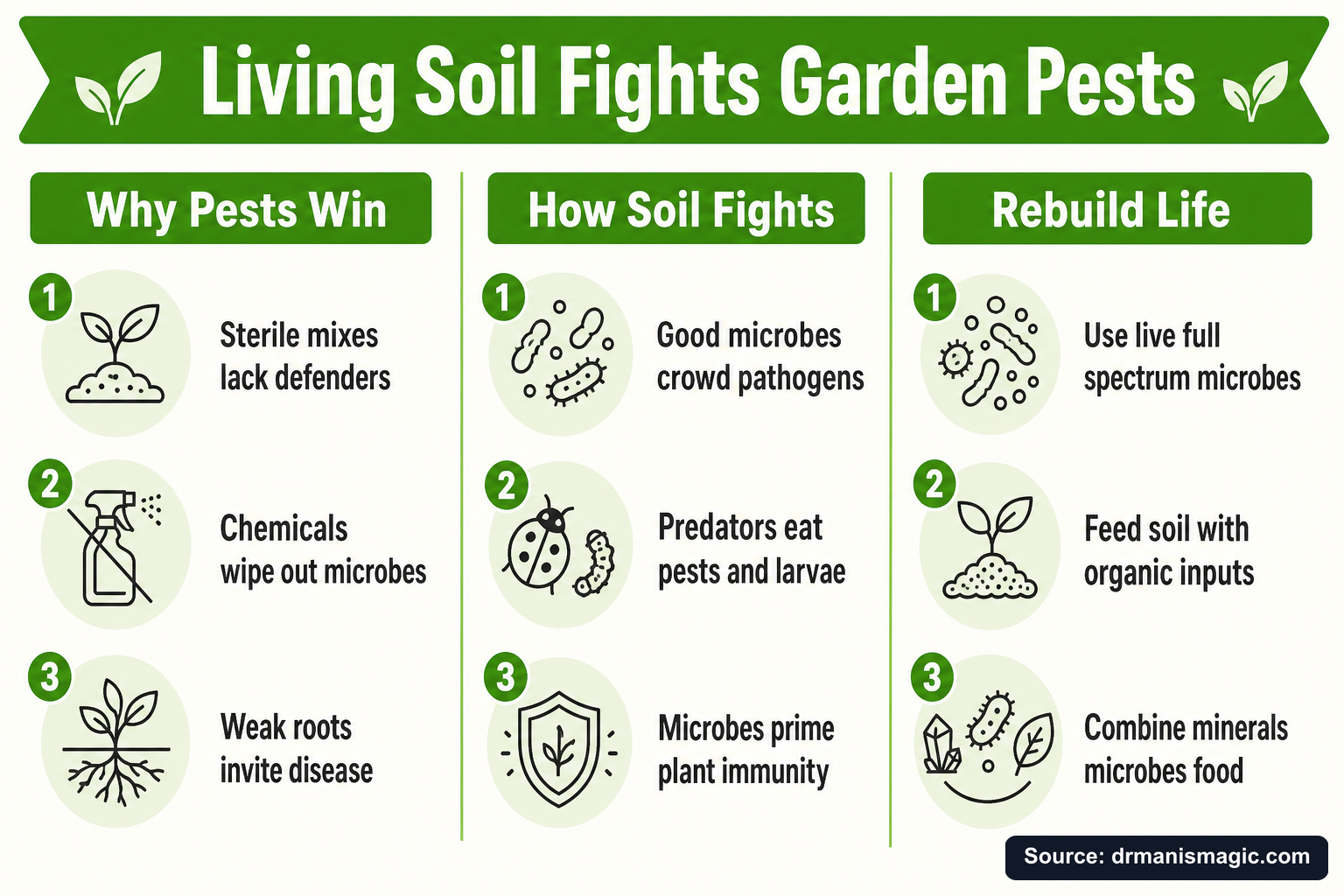
- Living soil reduces pest pressure through four main mechanisms: competition, predation, antibiosis (natural chemical warfare), and plant immune priming.
- The soil food web — bacteria, fungi, protozoa, nematodes, and more — is the root-zone protection system plants evolved with over millions of years.
- Sterile potting mixes, salt-based fertilizers, fungicides, herbicides, and pesticides all destroy this biological army, leaving roots defenseless.
- Plants in biologically rich soil get better nutrition, stronger roots, and more natural disease resistance — making them far less attractive targets for pests.
- Dead or dried microbial products from big factories rarely work. Live, stabilized, full-spectrum microbes make the real difference.
- You can rebuild soil biology even after damage — but it takes the right organisms, applied consistently, with the right foundation.
- The Three Plant Pillars — mineral soil, live microbes, and organic fertilizer — work together as a system, not as separate fixes.
What Is Soil Biology and Why Does It Matter for Pest Control?
Quick Answer: Soil biology is the living community of bacteria, fungi, protozoa, nematodes, and other organisms in the root zone. When this community is healthy and diverse, it directly fights pathogens, competes with harmful organisms, and strengthens plants so they are less likely to be attacked by pests in the first place.
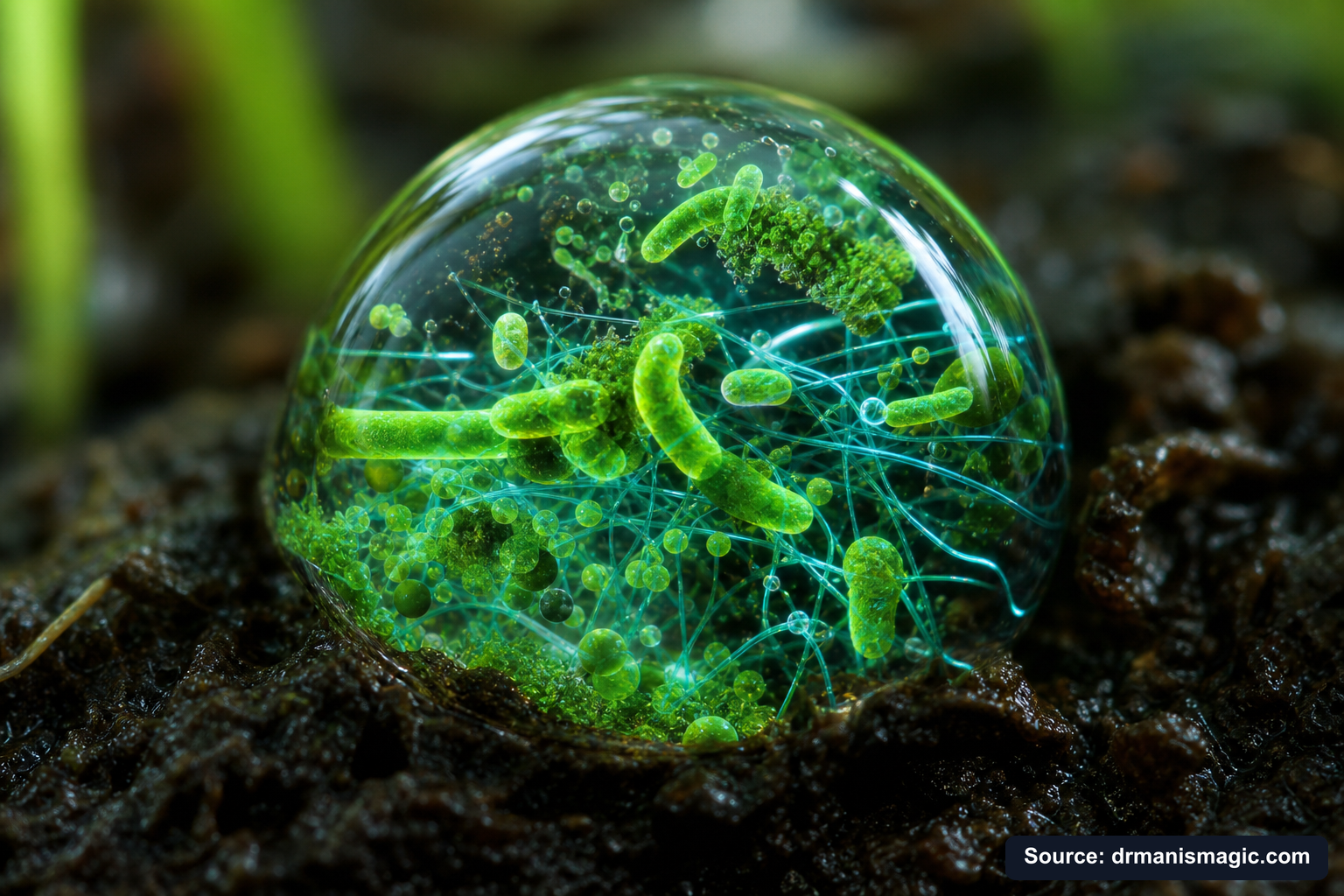
Soil biology is the total web of living things in your soil. Not just earthworms. Not just the stuff you can see. We're talking about organisms so small that billions of them fit in the dirt under one of your fingernails. These are the bacteria, fungi, protozoa, and beneficial nematodes that form what scientists call the soil food web.
Here's the part most gardening advice skips over. These organisms don't just decompose dead leaves and make compost. They are actively, continuously protecting your plants from the inside out. They fight pathogens by crowding them out. They eat harmful organisms. They produce natural antibiotics. And they literally wire your plant's immune system to respond faster when a threat arrives.
According to the University of Minnesota Extension, biologically active soils provide what scientists call "ecosystem services" — including disease suppression — that no single product can replicate. The key word there is ecosystem. It's a system. And just like your own immune system, it only works when all the parts are present and alive.
When that system is intact, your plants are naturally tougher. When it's destroyed — by chemicals, salt-based fertilizers, or sterile potting mix — your plants are essentially naked in a dangerous world. That's when pests move in. That's when disease takes hold. And that's when frustrated gardeners start spending money on spray after spray, getting short-term relief but never solving the real problem.
How Does Soil Biology Reduce Pest Pressure? The Four Core Mechanisms
Quick Answer: Soil biology reduces pest pressure in four main ways: beneficial microbes compete with pathogens for space and food, predatory organisms eat harmful pests, bacteria and fungi produce natural compounds that kill or repel pathogens, and the microbial community primes your plant's immune system to respond faster and stronger when threats arrive.
This is where it gets fascinating. And a little mind-bending. Because the soil isn't just dirt. It's a battlefield. And the good guys fight back in four very different ways.
Mechanism 1: Competition — Crowding Out the Bad Guys
Imagine a crowded restaurant. Every seat is taken. A troublemaker walks in looking for a table. No room. He leaves. That's competition in the soil. When your root zone is packed with beneficial bacteria and fungi, harmful pathogens can't find a place to land and grow. They simply get outcompeted for space, nutrients, and root access.
This is why sterile soils are so dangerous. An empty restaurant has plenty of seats for the troublemakers. Most store-bought potting mixes are essentially sterile. No beneficial biology. No competition. Any pathogen that blows in on the breeze or hitches a ride on your hands gets the whole place to itself.
Mechanism 2: Predation — The Soil Has Its Own Predators
Your soil is full of tiny hunters. Predatory nematodes hunt down and kill pest nematodes and soil-dwelling insect larvae. Protozoa graze on bacteria — including harmful bacteria. Predatory arthropods hunt fungus gnats, root aphids, and other soil pests. This is a real food web. Eat or be eaten. And when you have a full, diverse food web, the pest populations stay in check naturally.
Penn State Extension describes beneficial nematodes as one of the most powerful natural pest suppressors in the soil, capable of targeting over 200 species of soil-dwelling pests. But here's the catch — those predatory nematodes need a living ecosystem to survive. They need prey. They need moisture. They need organic matter. Destroy the food web and you lose the predators too.
Mechanism 3: Antibiosis — Nature's Chemical Warfare
This one is extraordinary. Certain bacteria and fungi in the soil produce natural compounds that are toxic to pathogens. Actinomycetes — those bacteria that give healthy soil its wonderful earthy smell — produce natural antibiotics. Certain Trichoderma fungi attack and parasitize other harmful fungi. Bacillus bacteria produce compounds that disrupt the cell walls of pathogens.
This is not science fiction. This is how penicillin was discovered. Alexander Fleming noticed that a mold — a soil fungus — was killing bacteria around it. That was antibiosis in action. Your garden soil has been doing this for millions of years. The problem is we've been killing the very organisms that produce these natural defenses, then wondering why disease keeps coming back.
Mechanism 4: Immune Priming — Waking Up the Plant's Own Defenses
This is perhaps the most exciting discovery in modern soil science. Certain beneficial microbes in the root zone actually communicate with the plant. They trigger what scientists call Induced Systemic Resistance — or ISR. Think of it as a fire drill for your plant's immune system. The plant learns to recognize threats faster. It activates its defenses more quickly. It produces more of the compounds that slow down attackers.
Plants that grow in biologically rich soil are not just passively protected. They are actively primed to fight back. They're like a boxer who has been training versus one who has been sitting on the couch. Same plant, completely different response to a threat.
Who Are the Key Players in the Soil Food Web?
Quick Answer: The soil food web includes bacteria, fungi, mycorrhizal fungi, protozoa, beneficial nematodes, predatory nematodes, actinomycetes, arthropods, and earthworms. Each one plays a specific role in nutrient cycling, pathogen suppression, root protection, and pest control. You need all of them working together for full soil health.
Think of the soil food web like a sports team. Every player has a different position. Every position matters. Take one out and the whole team gets weaker.
| Soil Organism | What It Does | How It Reduces Pest Pressure |
|---|---|---|
| Beneficial Bacteria | Decompose organic matter, fix nitrogen, produce growth hormones | Compete with pathogens, produce antibiotic compounds, prime plant immunity (ISR) |
| Actinomycetes | Break down tough materials like cellulose and chitin | Produce natural antibiotics that suppress fungal and bacterial pathogens |
| Mycorrhizal Fungi | Extend root system up to 100x, deliver phosphorus and water | Physically block pathogen entry points on roots, improve plant stress tolerance |
| Other Beneficial Fungi | Decompose residues, improve soil structure via glomalin | Parasitize and kill harmful fungi, compete for root space |
| Protozoa | Graze on bacteria, release nutrients near roots | Consume harmful bacteria, cycle nutrients that strengthen plants |
| Bacterial-Feeding Nematodes | Graze on bacteria in the rhizosphere | Drive nutrient cycling, support overall food web balance |
| Predatory Nematodes | Hunt and kill pest nematodes, soil insect larvae, and grubs | Directly eliminate root-damaging pests and soil-dwelling insects |
| Arthropods | Shred organic matter, create aeration channels | Eat fungus gnat larvae, root aphids, and harmful soil insects |
| Earthworms | Till soil, produce castings rich in nutrients and microbes | Improve drainage and aeration, reducing conditions that favor root rot |
Here's the part that blows most people's minds. In a teaspoon of healthy forest soil, you might find a billion bacteria representing 10,000 different species, 200 meters of fungal threads, and thousands of protozoa and nematodes. That's the army your plants evolved with. That's the protection system that was already there before the first person ever bought a bag of fertilizer.
In a typical bag of store-bought potting mix? Virtually none of it. Sterile. Empty. Silent. The Three Plant Pillars framework we developed at US Citrus Nursery addresses exactly this gap — starting with the biology, not the chemistry.
Why Do Plants in Biologically Poor Soil Keep Getting Pests Despite Regular Feeding?
Quick Answer: Feeding a plant without soil biology is like feeding someone junk food while they have no immune system. The plant may show temporary green-up, but it stays structurally weak, nutrient-starved at the root level, and completely vulnerable to pathogens. Salt-based fertilizers actively kill the microbes that would protect those roots, creating a cycle of dependency and decline.
This is the question we hear more than any other. "I feed it every week. I water on a schedule. Why does it keep getting attacked?" The answer lives underground, where you can't see it.
When you use salt-based synthetic fertilizers — and most fertilizers sold in big box stores are exactly that — you are essentially dumping road salt into your root zone. Those salts kill beneficial bacteria and fungi on contact. Every application is a microbial massacre. The plant gets a short burst of nutrients but loses a little more of its protective army each time. Over weeks and months, the soil becomes more and more barren. More and more defenseless.
And here's the cruel irony. A weakened plant under nutrient stress actually attracts more pests. Aphids, spider mites, fungus gnats, and root rot pathogens can literally detect plant stress signals. They target the weak ones. It's nature's sorting mechanism. A plant in biologically poor soil with salt-damaged roots is broadcasting a signal that says "I'm vulnerable. Come get me."
Meanwhile, a plant with a living root zone full of beneficial bacteria and mycorrhizal fungi is broadcasting the opposite signal. Strong. Well-fed. Defended. Pests move on and look for easier targets.
See also: The Hidden Reason Synthetic Fertilizers Cause Root Rot
What Destroys Soil Biology and How Does That Make Pest Problems Worse?
Quick Answer: Synthetic herbicides, salt-based fertilizers, broad-spectrum pesticides, and synthetic fungicides all damage or destroy beneficial soil organisms. Sterile potting mixes start with no biology at all. Fumigation, heat treatment, and repeated chemical use strip soils of their natural defenses, turning them into biological deserts where pathogens thrive unopposed.
One of the most powerful pieces of evidence in all of soil science is this: when researchers take disease-suppressive soil — soil that naturally fights off pathogens — and sterilize it, the disease suppression disappears completely. Then when they add back even a small amount of the original living soil, some of the protection returns. This was documented in landmark research published in peer-reviewed literature going back decades and has been confirmed in studies worldwide. The biology IS the protection. Kill the biology, lose the protection.
Here's what's killing your soil biology right now, possibly without you even knowing it.
- Salt-based synthetic fertilizers: The salts literally dehydrate and kill bacteria and fungi through osmotic shock. Every application weakens the microbial community a little more.
- Synthetic herbicides like glyphosate: Research shows these disrupt microbial communities in ways that go far beyond killing weeds.
- Broad-spectrum pesticides: Most are not selective. They kill beneficial insects and soil organisms along with the target pest.
- Synthetic fungicides: These don't know the difference between Phytophthora root rot and your mycorrhizal fungi. They kill both.
- Sterile potting mixes: Most start with no biology at all. Pine bark, peat, and sawdust-based mixes are biologically empty from day one.
- Compaction: Crushes the oxygen channels that aerobic beneficial microbes need to survive.
- Flooding and poor drainage: Creates anaerobic conditions that kill aerobic beneficials and favor root rot pathogens.
See also: How Salt-Based Feeding Quietly Destroys Root Systems
You Never Had a Brown Thumb.
You were handed the wrong tools. This free guide hands you the right ones.
You watered it. You fed it. It died anyway.
It was never you. It was the dirt, the salt food, and the bad advice.
This guide shows you what really went wrong, and how to fix it for good.
- Why your plants really died, and why it was never your fault
- The salt hiding in your plant food that quietly burns the roots
- The hidden killer in almost every bag of store soil
- The tiny helpers that grow a whole forest for free
- The rescue trick that brings a half dead plant back to life

Live Microbes vs. Dead Microbes: Why Most Products on the Shelf Don't Work
Quick Answer: Most commercial microbial products are made from lab-grown organisms that are dried into powder or added to liquid, where they quickly die. Dead microbes cannot compete with pathogens, cannot colonize roots, and cannot prime plant immunity. Only genuinely live, diverse, stabilized microbes deliver the soil food web benefits your plants need.
This is where we have to be completely honest with you. And a little blunt. Because the microbial product market is full of promises and short on results.
We tested dozens of microbial products over years at US Citrus Nursery. Some were powders. Some were liquids. Some had impressive-sounding species lists on the label. Most of them did essentially nothing for the plants. Here's why.
| Product Type | How It's Made | Are Microbes Alive at Use? | Spectrum | Smell | Does It Work? |
|---|---|---|---|---|---|
| Dry/Powdered Lab Microbes | Grown in factory vats, dried into powder | No — spores rarely reactivate | Narrow (1-5 species) | Odorless | We saw no results in repeated tests |
| Dry Microbes Added to Liquid | Same factory powder, suspended in water | No — most already dead | Narrow | Odorless | Same issue — avoid |
| Compost Tea (Fresh, Under 24 Hours) | Brewed from active compost with aeration | Yes — if used immediately | Broad but time-sensitive | Earthy | Good, but requires constant effort |
| Compost Tea (Old, Over 24 Hours) | Same, but gone anaerobic | No — most microbes dying | Partial | Strong foul odor | Not recommended |
| Lactobacillus-Based Products | Fermented rice water or similar | Yes — very vigorous | Single dominant species | Sour | Overtakes good microbes — avoid in soil |
| Plant Super Boost (Stabilized, Full-Spectrum) | Harvested from hand-crafted compost, stabilized naturally | Yes — genuinely alive | 2,000+ bacteria, 400-500 fungi including mycorrhizae, protozoa, and nematodes | Earthy — not foul | Visible under microscope. Lab-verified alive. |
The trick with most dried microbial products is that they're made in large factory vats, packaged, and shipped. The hope is that the dormant spores will "wake up" when you add water. We tried batch after batch. The plants didn't respond. The biology wasn't really there.
Then there's the smelly liquid category. You've probably seen these — brown bottles of liquid microbes that arrive smelling like a swamp. That smell is a dead giveaway. Literally. When microbes run out of oxygen, they go anaerobic. They start fermenting and dying. The bottle sometimes fizzes when you open it — that's gas from decomposition. The microbes are not working for you. They're dying.
Fresh compost tea — brewed yourself, aerated, and used within 24 hours — actually works beautifully. Gardeners who do this right describe the results as magical. But it takes real time, real effort, and a real compost pile. Most people don't have that.
That's exactly why Plant Super Boost was created. Through a proprietary all-natural stabilization technique developed by a world-renowned compostologist — someone who has advised royal families and governments on agricultural practices — we figured out how to bottle the power of fresh, active compost without it going anaerobic. The microbes stay alive. They don't stink. And you can actually see them moving under a microscope. We have the lab analyses to prove it. No PFAS. No biosludge. No synthetic salts. Just living soil biology in a bottle, ready to go to work the moment you pour it on your soil.
How Does Mycorrhizal Fungi Specifically Protect Against Root Diseases and Pests?
Quick Answer: Mycorrhizal fungi form a physical web around plant roots that acts as both a nutrient highway and a protective barrier. This fungal network physically blocks pathogen entry points, improves water and phosphorus uptake, helps plants tolerate drought and salinity stress, and increases overall root mass — all of which directly reduce disease and pest vulnerability.
Here's a beautiful piece of natural engineering. Mycorrhizal fungi — from the Greek words for fungus and root — form a partnership with plant roots that is about 450 million years old. That's older than the dinosaurs. Plants and these fungi co-evolved together. They are designed to work as one.
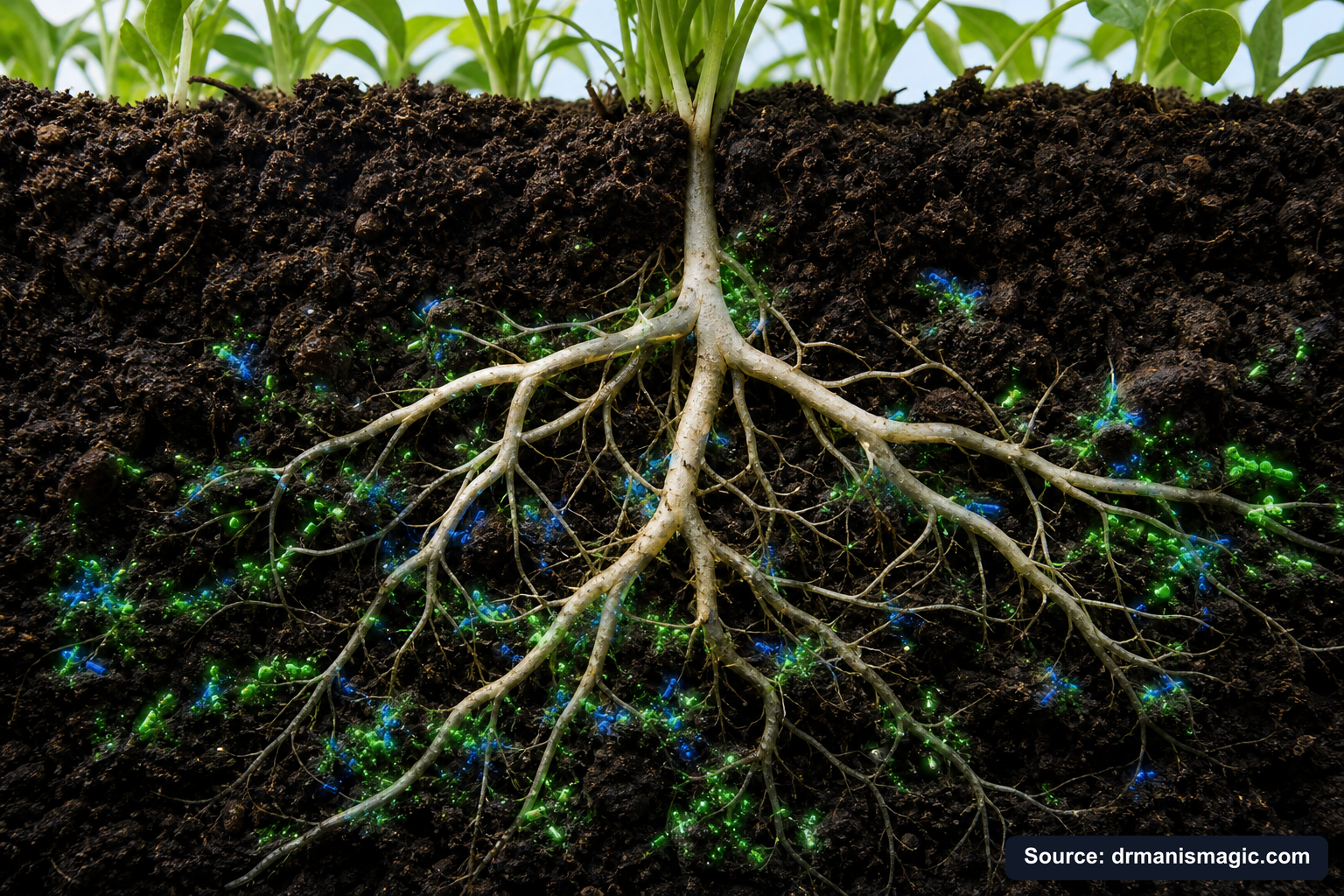
The fungal threads, called hyphae, extend out from the roots like a second root system. Sometimes up to 100 times the surface area of the roots alone. They reach into tiny soil pores that roots can't access. They pull in phosphorus, zinc, copper, and water. They deliver it directly to the plant. In exchange, the plant feeds the fungi sugars through the roots.
But here's the pest-protection part. Those same fungal threads form a physical layer around the root surface. When Phytophthora or other root pathogens try to penetrate the root, they run into that fungal mesh first. It's not impenetrable. But it dramatically slows and reduces infection. It also changes the chemistry around the root zone in ways that are less hospitable to harmful organisms.
Ever pull up a weed and notice fuzzy white threads around its roots? That's mycorrhizae. That's why weeds grow so explosively even in poor soil. They have the fungal partnership working for them. Your garden plants deserve the same advantage.
The problem? Every time you use a synthetic fungicide — even one aimed at a real disease problem — you risk wiping out your mycorrhizal network. Salt-based fertilizers damage it too. And most potting mixes contain none of it to begin with. You have to intentionally put it back.
What Is the Connection Between Plant Nutrition and Pest Pressure?
Quick Answer: Plants with balanced, complete nutrition from organic sources are structurally stronger, produce more natural defensive compounds, and are less attractive to pests. Salt-based synthetic fertilizers push rapid leafy growth that is soft, thin-walled, and highly attractive to sucking insects and fungal pathogens. Soil biology is the key to delivering balanced, gentle nutrition that builds genuine plant strength.
There's a concept in plant science called trophobiosis. The idea is simple. Pests are attracted to plants that have high levels of free amino acids and simple sugars in their tissues — the kind of nutritional profile you get from over-fertilization with salt-based synthetic nutrients. Fast, forced growth creates soft, thin-walled cells loaded with easily digestible compounds. It's essentially a buffet sign for aphids, spider mites, and fungal spores.
Contrast that with a plant fed through healthy soil biology. Nutrients arrive slowly, steadily, in organic forms. The plant builds thick cell walls. It produces its own phenolic compounds and resins — natural pest deterrents. Growth is measured and strong rather than fast and floppy. That's a much harder target for a pest to exploit.
This is why the Three Plant Pillars work as a system. Pillar 2 — live microbes — does the nutrient cycling. Pillar 3 — organic fertilizer — feeds the microbes and the plant together, slowly, without salt damage. When both are working together in the right soil structure, the plant's nutrition is balanced, complete, and delivered in a way that builds genuine strength rather than superficial growth.
Our Crab, Kelp and Amino Acids fertilizer was formulated specifically for this. No synthetic salts. No biosludge. No PFAS. Slow-release organic nutrition from crab meal, kelp, and amino acids that works with your soil biology instead of against it.
How Do You Rebuild Soil Biology After It Has Been Damaged?
Quick Answer: Rebuilding soil biology after pesticide use, fumigation, salt buildup, or sterile potting media takes deliberate action and consistent reintroduction of living organisms. The key steps are removing chemical inputs that kill microbes, reintroducing a full-spectrum live microbial inoculant, feeding the biology with organic matter, improving soil structure, and applying microbes monthly to maintain the community over time.
Here's the truth. If you've been using synthetic fertilizers, pesticides, or fungicides for years — or if your plants are in store-bought potting mix — your soil biology is probably compromised. It can be rebuilt. But it takes time. And it takes the right approach. Not a one-time fix. A consistent program.
Here is a practical recovery checklist you can start today.
- Stop the killing first. Reduce or eliminate salt-based synthetic fertilizers, broad-spectrum pesticides, and synthetic fungicides. You cannot rebuild a house while someone is still knocking down the walls.
- Improve your soil structure. Compacted, waterlogged, or oxygen-poor soil cannot support aerobic beneficial microbes. Make sure your soil drains well and roots can breathe. This is why mineral-based soil matters as Pillar 1.
- Introduce genuinely live, full-spectrum microbes. Not dried powder. Not smelly liquid. Living, stabilized, diverse biology that includes bacteria, fungi, mycorrhizae, protozoa, and nematodes.
- Feed the biology with organic matter. Compost, mulch, and organic fertilizer give the microbial community something to eat. Microbes need food just like every other living thing.
- Apply microbes monthly. Your soil has been under pressure for years. Environmental stressors, salts, and pathogens keep fighting back. Consistent monthly applications maintain the biological advantage over time.
- Be patient for 60 to 90 days. Most people notice visible improvement within the first month. But full soil biology restoration takes a full growing season. The investment is worth it. Because once it's working, it keeps working.
- Watch your plants tell you it's working. Darker green leaves. Firmer stems. Less wilting between waterings. Fewer pest problems appearing out of nowhere. These are the signs of a root zone coming back to life.
We've seen this recovery happen hundreds of times across our nursery, our citrus grove, and in the gardens of our customers across the country. The process is not complicated. But it requires the right inputs in the right order.
Direct Pest Suppression vs. Indirect Pest Reduction: What Is the Difference?
Quick Answer: Direct suppression means soil organisms physically kill, eat, or chemically destroy pests and pathogens. Indirect reduction means a biologically healthy soil produces stronger, better-nourished plants that naturally resist pest attack, tolerate stress better, and recover faster. Both are real. Both matter. And you need both working together for lasting results.
This distinction is important. Because some people hear "soil biology reduces pest pressure" and expect it to work like a pesticide. It doesn't. It's better than a pesticide. But it works differently.
Think of it this way. A pesticide is a weapon. Soil biology is an immune system. A weapon is powerful in a moment. An immune system protects you every day, all day, in ways you never even notice — until you lose it.
| Type of Protection | Mechanism | Key Players | Timeline |
|---|---|---|---|
| Direct Suppression | Microbial competition for root space | Bacteria, fungi | Ongoing, continuous |
| Direct Suppression | Antibiosis — natural compounds that kill pathogens | Actinomycetes, Bacillus bacteria, Trichoderma fungi | Ongoing |
| Direct Suppression | Predation — eating pest organisms | Predatory nematodes, protozoa, arthropods | Ongoing |
| Indirect Reduction | Plant immune priming (Induced Systemic Resistance) | Beneficial bacteria, mycorrhizal fungi | Builds over weeks |
| Indirect Reduction | Better nutrition — thicker cell walls, more defensive compounds | Full soil food web + organic fertilizer | Builds over weeks to months |
| Indirect Reduction | Improved water relations — less drought stress, less pest attraction | Mycorrhizal fungi, water-holding bacteria | Ongoing |
| Indirect Reduction | Lower salt stress — better root function under irrigation | Salt-tolerant bacteria and fungi | Ongoing |
Soil biology is not a standalone pesticide replacement. We want to be completely clear about that. If you have an active, severe pest infestation, you may need to address it directly. But once you have living soil working for your plants, the frequency and severity of those infestations drops dramatically. You spend less time fighting fires because the fire prevention system is finally on.

What Can You Do Right Now to Start Protecting Your Plants With Soil Biology?
Quick Answer: Start by introducing living, full-spectrum microbes to your root zone today. Stop using salt-based synthetic fertilizers that kill the biology. Feed your soil with organic matter. Get the right soil structure so roots and microbes can breathe. Apply microbes monthly. These steps work for any plant — lawns, gardens, containers, fruit trees, houseplants, or flowers.
Here's the thing about time. You can get money back. You can't get time back. The best time to build living soil under your plants was the day you planted them. The second best time is today.
We've had people tell us — more times than we can count — that their deepest wish is to see fruit on a tree they planted with their own hands. To taste something they grew. To stand in a garden that feels alive. That's not a small thing. That's one of the most human desires there is. We were made to tend living things. But going about it the old way — with salt bombs and sterile dirt and crossed fingers — wastes the one thing you can never recover. Time.
The plants that thrive fastest, fight pests most naturally, and produce the most abundantly are the ones rooted in living soil with a full biological community supporting them. We proved that across 250,000 trees at US Citrus Nursery. We see it in our grove. We hear it from customers with lawns, gardens, houseplants, and flower beds across the country.
The path forward is not complicated. It follows three pillars that Dr. Mani Skaria — Professor Emeritus of Plant Pathology, founder of the Clean Citrus Program in Texas, and one of the most respected plant scientists in the country — spent decades proving in the field and in the lab.
- Pillar 1: Get your soil structure right. Roots need to breathe. Oxygen matters as much as water.
- Pillar 2: Put living biology back into your root zone. Not dried powder. Not smelly liquid. Genuinely alive, full-spectrum microbes that can be seen moving under a microscope.
- Pillar 3: Feed your plants and their microbial partners with organic, slow-release nutrition that builds strength instead of burning it away.
You don't need 20 different products. You don't need a chemistry degree. You don't need to lose another plant or another growing season to poor soil biology. You just need the right foundation. And you deserve to have it working for you starting now.
If you want to see what genuinely living soil biology looks and acts like — and what it can do for your specific plants — the Free Plant Care Field Guide is the best place to start. It walks you through the Three Plant Pillars step by step, in plain language, with no guesswork and no jargon. Your plants — whatever they are, wherever they grow — will thank you for it.
Frequently Asked Questions
Gardeners ask these questions every single day. And most of the answers they find online are flat-out wrong. We tested what actually works on over 250,000 trees in South Texas. Here is what we know for sure about soil biology and pest pressure.
What is soil biology and how does it reduce pest pressure in my garden?
Soil biology is the living community of bacteria, fungi, and tiny organisms in your root zone. When that community is healthy, it fights pathogens, crowds out harmful bugs, and wires your plant to defend itself faster. Think of it like a security system built right into the dirt. Plants with rich soil biology are simply harder targets. Pests look for weak plants. Healthy soil makes your plants strong.
Why do most store-bought potting mixes make pest problems worse?
Most bagged potting mixes are full of pine bark and sawdust. That stuff breaks down fast. As it rots, it chokes out oxygen and wipes out the good microbes your plant needs to fight off disease. You end up with roots that are stressed, starving, and wide open to attack. A stressed plant is like a dinner bell for pests. Dr. Mani's Super Soil uses mineral-based sandy loam that does not break down and keeps roots breathing freely.
Do synthetic fertilizers hurt the good microbes in my soil?
Yes. Salt-based synthetic fertilizers burn the very microbes your plant depends on for protection. It is like calling in an airstrike on your own army. You might see a quick green flush, but underneath the soil is getting emptier and weaker. Over time, your plant loses its natural defense system. That is when pest problems spiral. Organic, slow-release fertilizers like Dr. Mani's Crab, Kelp, and Amino Acids feed plants without killing the biology doing the real work.
What are live microbes and why do they matter more than dead microbial products?
Most microbial products on the shelf are already dead by the time you open them. Dead microbes do nothing. Live, stabilized microbes are the ones that actually colonize your root zone, fight pathogens, and unlock nutrients. Dr. Mani's Plant Super Boost uses a special process to keep those microbes alive and active right up until you pour them on your plants. That is the difference between a real army and a picture of one.
Can I rebuild soil biology after using chemicals for years?
Yes, you can. It takes the right organisms applied consistently, plus the right foundation to support them. You cannot just pour microbes into dead, compacted, sawdust-based soil and expect miracles. You need all three pillars working together. Start with mineral-based soil that drains well and holds oxygen. Add live microbes. Feed with organic fertilizer. Within a few weeks, you will see the difference in how your plants look and feel.
How do healthy soil microbes actually stop pests and disease?
They work four ways. They crowd out bad organisms so there is no room to take hold. They eat harmful pathogens directly. They produce natural antibiotics that kill disease before it spreads. And they prime your plant's immune system so it responds faster when a threat shows up. We saw this play out over and over across 250,000 trees at our South Texas nursery. The trees with the most life in their soil needed the least intervention from us.
Is the Three Plant Pillars system really enough to protect my plants from pests?
The Three Plant Pillars are not a magic spray you use once. They are a foundation. Mineral soil keeps roots breathing. Live microbes keep the underground army strong. Organic fertilizer feeds plants slowly and safely without torching the biology. When all three are in sync, your plants are nourished, resilient, and far less attractive to pests. You stop chasing problems and start preventing them. That is the whole game right there.
About the Author
Dr. Mani Skaria, PhD
Dr. Mani Skaria, PhD, is a plant pathologist and the scientific founder of Dr. Mani's Magic. He earned his doctorate at Purdue University and spent 48 years studying how plants, soil, and living microbes work together, including his years as Professor Emeritus at Texas A&M and as a member of the USDA NAREEE Advisory Board. He invented micro-budding, a method for growing healthier, stronger trees, and has grown more than 250,000 trees on the family farm in Hargill, Texas - US Citrus Nursery. His life's work takes real lab science and practical experience and turns it into simple, safe, organic plant care anyone can use at home.


