


Why Instant Green-Up Comes With a Hidden Cost to Your Soil | Dr. Mani's Magic
Why "Instant Green-Up" Comes With a Cost: The Hidden Truth About Fast Fertilizer and What It Does to Your Soil
You walk outside one morning, shake that blue granular fertilizer across your lawn, and water it in. Three days later, the grass is so green it almost glows. You feel like a genius. The neighbors slow down when they drive past. You stand there with a coffee in your hand thinking, "I've finally figured this out."
Then, two weeks later, something is wrong. The tips are brown. There are yellow streaks cutting through the green like bad paint. One corner looks scorched, like someone held a torch to it. You water more. It gets worse. The plants you treated look worse than your neighbor's untreated lawn. The roses you hit with the same stuff? Wilting. The lemon tree in the pot on your patio? Dropping leaves. And somewhere in the back of your mind, a question starts to form: Did I do this?
Yes. But here is the thing. It is not your fault. Nobody told you what was really happening under the soil surface when you opened that bag. Nobody explained what fast fertilizer actually does to your roots, your microbes, and your long-term growing power. That is what this article is about. By the time you finish reading, you will understand why that instant green-up is one of the most misleading moments in gardening. And you will know exactly what to do instead.

Organic Fertilizer | Crab, Kelp & Amino Acids
Key Takeaways
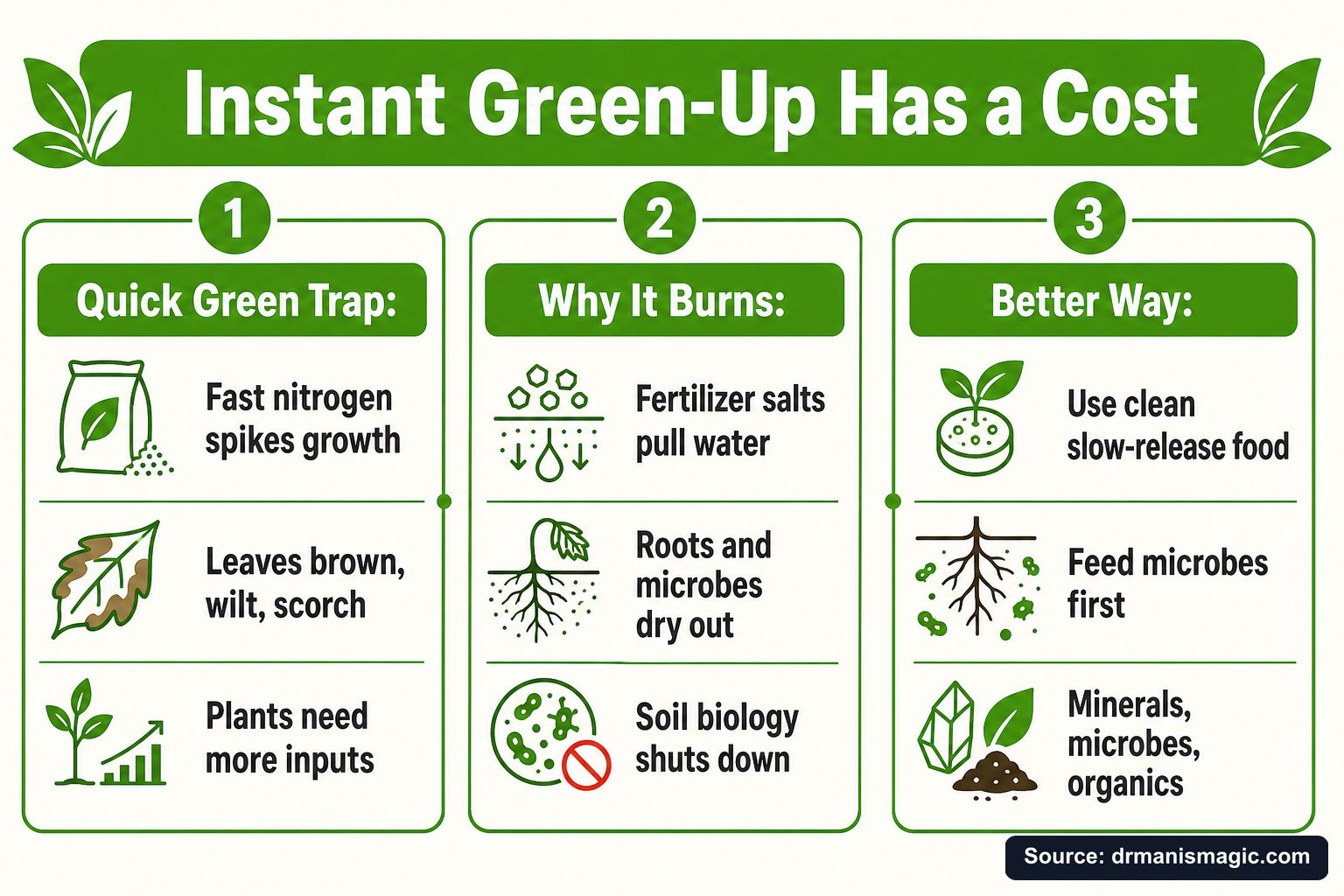
- Fast-release, salt-based fertilizers can green a lawn or plant quickly, but the same salts pull water out of roots and tissues, causing burn, browning, and wilting.
- Salt kills the beneficial microbes in your soil. No microbes means no natural nutrient cycling, no disease protection, and no long-term plant health.
- Instant green-up creates a dependency cycle. Plants grow fast but shallow, demand more water, and become weaker over time.
- Organic, slow-release fertilizers feed the microbes first. The microbes do the work, break it down, and deliver nutrients to your roots in a gentle, steady stream.
- The same damage from salt-based fertilizers happens to every plant: lawns, trees, shrubs, vegetables, houseplants, citrus, and flowers.
- Some fertilizers, both synthetic and organic, contain biosludge and PFAS "forever chemicals." Clean inputs matter for your family, your pets, and your soil.
- The Three Plant Pillars — mineral soil, live microbes, and organic fertilizer — are the foundation for lasting green growth with any plant, anywhere.
What Exactly Is Happening When Your Plant "Green-Up" Turns Brown?
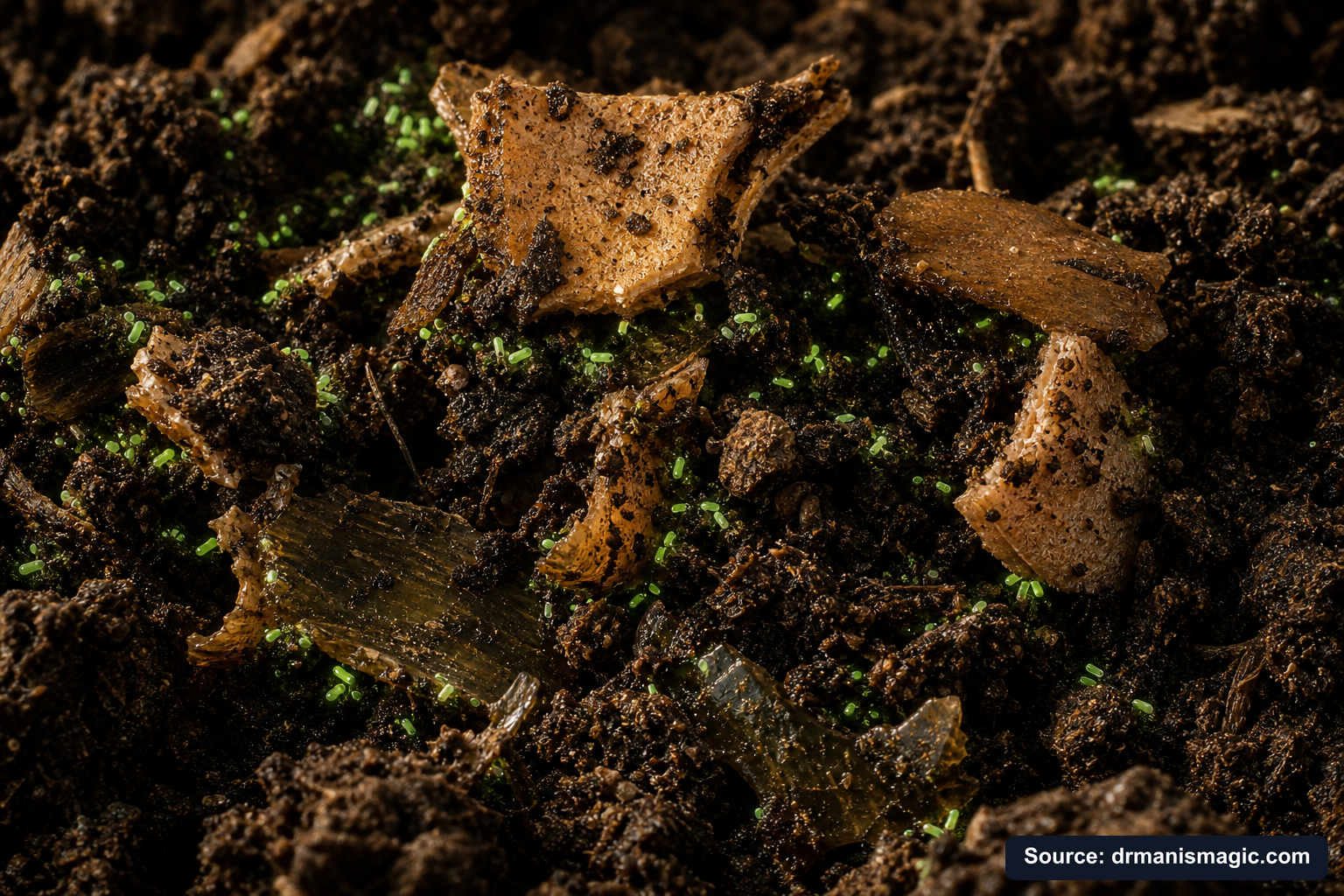
The browning happens because of salt. Not table salt, but the chemical salt in fast-release fertilizers. Here is the simple science behind it.
Water always moves toward higher salt concentration. That is a law of nature called osmosis. When you pour a high-salt fertilizer around your roots or on your leaves, the salt concentration outside the plant becomes higher than inside it. So the water inside your plant's roots and tissues rushes outward trying to balance things out. The plant loses water from the inside. It dehydrates. From the outside it looks like drought stress or burn, even if the soil is wet.
University turf researchers at Oregon State Extension, the University of Minnesota, and the University of Maryland have all documented this. They call it fertilizer burn or salt stress. The plant is not burned by heat. It is burned by osmotic dehydration. The cells collapse. The tips turn brown. In bad cases, whole patches die.
And here is what makes it worse. That dark, glowing green you saw for those first few days? That was a nitrogen surge. A chemical spike of nitrogen hit the plant all at once. It forced rapid, lush, soft growth. That kind of growth is weak. It is the plant equivalent of a sugar rush. The stems are soft, the cells are large and watery, and now they are wide open to disease, insects, and heat stress. The plant looks amazing for a moment. Then it crashes.
Why Does Salt-Based Fertilizer Kill Your Soil's Microbes?
Salt kills beneficial soil microbes the same way it kills the plant's roots — by pulling water out of their cells.
Think of your soil as a living city. There are billions of tiny workers living in every handful of healthy dirt. Bacteria. Fungi. Nematodes. Mycorrhizae. These are not just background noise. According to the University of Minnesota Extension, soil microbes are the engines of nutrient cycling. They supply a huge share of the plant-available nitrogen and phosphorus your plants actually use. They break down organic matter. They fight pathogens. They wire the roots into a nutrient delivery network that no fertilizer bag can replicate.
When you dump a high-salt synthetic fertilizer into that city, it is like flooding the streets. The microbes dry out and die. The fungal threads that connect roots to nutrients snap. The bacteria that convert nitrogen from the air into plant food go silent. What is left is chemically alive but biologically dead soil. It looks like soil. It feels like soil. But it cannot do what soil is supposed to do.
After that, you need more and more fertilizer to keep the plant looking decent, because the natural nutrient recycling system is gone. The big chemical companies know this. They profit from it. You keep buying. The soil keeps getting weaker. The plant keeps depending on the next bag. That is the dependency cycle, and it is by design.
At US Citrus Nursery in South Texas, we have grown over 250,000 trees. We learned this lesson the hard way, testing through failures until the biology of the soil stopped being a mystery and started being the whole game.
What Does "Slow Release" Actually Mean for Your Plant?
Slow release means the nutrients arrive the same way nature delivers them: gradually, steadily, and in a form the plant can actually use without getting overwhelmed.
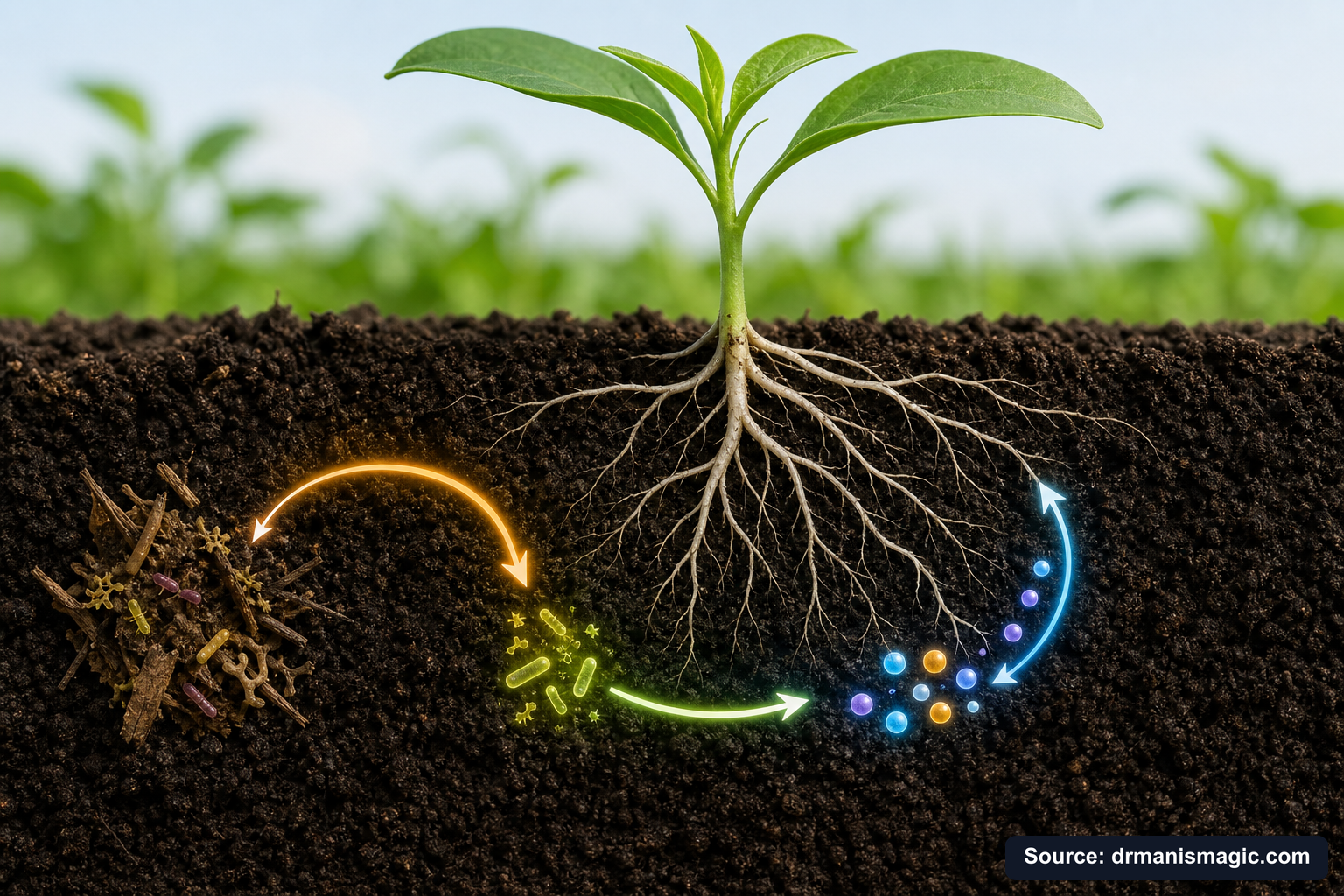
Here is the mechanism most people never get explained to them. When you apply a good organic fertilizer — something made from natural proteins like crab shells, feather meal, or amino acids — the microbes in your soil eat it first. That is not a flaw. That is the system. The microbes digest the organic material and convert it into mineral forms the plant roots can absorb. Ammonium. Nitrate. Phosphate. The plant gets fed through the microbes, not around them.
Then something even better happens. When those microbes die, they release everything they were holding. All that nutrition they were carrying in their tiny bodies gets dumped directly into the root zone. It is like a second feeding, completely free, happening days or weeks after you applied the fertilizer. The plant gets fed in waves. Steady, consistent, never overwhelming.
Picture it like this. Synthetic fertilizer is like pouring a full bucket of water over a dry sponge all at once. Most of it runs off. What stays hits hard and then it is gone. Organic, microbe-mediated feeding is like a slow drip on that same sponge. It soaks in. The plant uses what it needs. The rest stays available. Nothing burns. Nothing runs off into the watershed.
That is why slow release is not just gentler. It is actually more efficient. The plant gets more nutrition from less input, because the delivery system is working with biology instead of bypassing it.
Why Do Your Roots Need Live Microbes to Stay Healthy?
Healthy roots need microbes the same way your gut needs probiotics. Without them, the whole system breaks down.
In nature, plants never grow in sterile soil. They evolved over millions of years in a living, microbial ecosystem. The roots and the microbes developed a partnership. The plant feeds the microbes sugar through its roots. The microbes, in return, unlock nutrients the plant cannot reach on its own, fight off pathogens, and extend the root's reach far beyond what the root alone could cover.
Mycorrhizal fungi, for example, form a web of threads that can extend the root's nutrient-gathering range by hundreds of times. That means more water. More minerals. More of everything the plant needs. Nitrogen-fixing bacteria pull nitrogen right out of the air and convert it into food. Phosphorus-solubilizing bacteria unlock minerals that are bound up in the soil and make them available. These are not optional extras. They are the mechanism behind all healthy plant growth.
When you kill those microbes with salt-based fertilizers, you cut the roots off from that whole system. The plant becomes dependent on whatever you put in the bag. It loses its resilience. Drought hits harder. Disease moves in easier. Pests find it faster. The plant is not just weaker. It is defenseless.
That is Pillar Two of the Three Plant Pillars we developed at US Citrus Nursery after decades of trial and testing. Microbial muscle is not a bonus. It is the foundation of everything else.
Does This Only Happen to Lawns, or Does It Affect Every Plant?
Every single plant. Lawns, trees, shrubs, vegetables, flowers, houseplants, citrus, and seedlings. All of them.
The University of Maryland Extension documents salt damage to trees from both fertilizer and deicing salts. Mississippi State Extension covers the same osmotic stress in ornamentals and vegetables. Kansas State turf resources show it in grass. The mechanism is the same everywhere because roots are roots. They all operate by the same biological rules.
Container plants are actually the most vulnerable. In a pot, there is no place for excess salt to go. It accumulates. It concentrates. The burn comes faster and hits harder. We have seen it on lemon trees, on peace lilies, on potted tomatoes, on ornamental grasses in decorative pots on apartment balconies. The species does not matter. The salt is the problem.
This is why the Three Plant Pillars apply to every plant you will ever grow. Grass. Roses. Mango trees. Basil. Orchids. Every one of them needs mineral-based soil for drainage and root breathing room. Every one of them needs live microbes to cycle nutrients and fight disease. Every one of them needs organic, salt-free nutrition delivered at the pace biology intended.
What About Biosludge and PFAS in Fertilizers? Is That Real?
It is real, and it is a serious issue that most fertilizer companies prefer you not think about.
Some fertilizers, both synthetic and organic, use "biosludge" as a filler. Biosludge is treated municipal waste. Sewage. Human waste processed and dried into a powder or pellet. It is used as a cheap nitrogen source in many commercial fertilizer blends. And the problem is that biosludge frequently contains PFAS, which stands for per- and polyfluoroalkyl substances. These are called "forever chemicals" because they do not break down in the environment. They accumulate in soil, in water, in plant tissue, and in human bodies.
When you put biosludge-containing fertilizer on your vegetable garden, those PFAS can move into your food. When you put it on your lawn, your children play on it. Your pets lie on it. Your dog licks its paws after walking across it.
We built Dr. Mani's Magic Crab, Kelp & Amino Acids with zero biosludge, zero synthetic fillers, and zero PFAS. The ingredients are what the name says: crab shells, cold-processed kelp, volcanic ash, and amino acids. Nothing hidden. Nothing that would concern you if you read the full label out loud to your family.
That matters to us not just as a business decision but as a personal one. Dr. Mani Skaria, the plant pathologist and Texas A&M professor who built this system, spent 40 years studying what hurts plants and what heals them. He would not put his name on something that poisons the soil he spent his life protecting.
What Does Crab Shell Actually Do for Your Plants?
Crab shell is one of the most underrated natural inputs in gardening, and most people have never heard of it.
The key compound in crab shells is chitin. Chitin is a structural polymer, the same material that makes up the shells of insects, crustaceans, and the cell walls of certain fungi. When chitin breaks down in soil, it triggers a remarkable defense response in plants. The plant's immune system recognizes chitin as a signal that insects or fungal pathogens may be present. It activates its own natural defenses. It becomes harder to attack.
Chitin also feeds a specific group of beneficial bacteria in the soil called chitinase-producing bacteria. These bacteria love chitin. When they thrive, they outcompete harmful fungal pathogens. They are natural bodyguards for your root zone. At the same time, crab shells deliver calcium and magnesium, two nutrients that build cell wall strength, support root tip growth, and drive fruit development. The woody structure of a tree is largely calcium. A deficiency there shows up as weak stems, poor fruit set, and cracking.
So crab shell is not just a nitrogen source. It is a multi-layered biological input that feeds the soil, strengthens plant immunity, and delivers essential minerals. That is a lot of work from one ingredient.
You Never Had a Brown Thumb.
You were handed the wrong tools. This free guide hands you the right ones.
You watered it. You fed it. It died anyway.
It was never you. It was the dirt, the salt food, and the bad advice.
This guide shows you what really went wrong, and how to fix it for good.
- Why your plants really died, and why it was never your fault
- The salt hiding in your plant food that quietly burns the roots
- The hidden killer in almost every bag of store soil
- The tiny helpers that grow a whole forest for free
- The rescue trick that brings a half dead plant back to life

What Does Kelp Do That Regular Fertilizer Cannot?
Kelp does something no synthetic fertilizer can do: it delivers natural plant hormones and biostimulants that tell the plant how to grow, not just what to eat.
Cold-processed kelp contains auxins and cytokinins, which are natural plant growth hormones. Auxins regulate root development and cell elongation. Cytokinins signal the plant to push new growth and divide cells. These are not nutrients in the traditional sense. They are biological signals that turn on growth processes the plant already knows how to run. You are not forcing growth. You are giving the plant better information.
Kelp also contains carbohydrates, trace minerals, and other biostimulants that support stress tolerance. Plants treated with kelp handle heat better. They recover from drought faster. They bounce back from transplant shock more quickly. University research has documented these stress-response benefits repeatedly. Kelp is not a miracle. It is a communication tool between the ocean and your plant's biology.
Beyond that, kelp provides dozens of trace minerals that land-based soils often lack. These are not the big three — nitrogen, phosphorus, potassium — but the supporting cast that makes everything else work: boron for flower and fruit set, molybdenum for nitrogen conversion inside the plant, zinc for hormone production and shoot development. When even one trace mineral is missing, growth slows. The Law of the Minimum applies: the weakest link sets the ceiling for everything else.
Why Do Amino Acids Matter as a Nitrogen Source?
Amino acids are the simplest, cleanest form of organic nitrogen a plant can receive, and they are the exact form plants evolved to use.
Here is how nitrogen works in nature. Lightning breaks nitrogen out of the atmosphere and converts it into nitrate. Nitrogen-fixing bacteria in the soil convert atmospheric nitrogen into ammonia, then into nitrate. Decomposing organic matter gets broken down by fungi and bacteria into amino acids, then into ammonium, then into nitrate. The plant absorbs it at the end of that chain.
When you apply amino-acid-based fertilizer, you are starting closer to the end of that chain. The microbes still get to do their work because amino acids are an excellent food source for soil bacteria. But the journey from "applied to soil" to "inside the plant" is shorter and more efficient. Less gets lost to leaching. Less gets converted into gases. More arrives at the root in a usable form.
And because amino acids are protein-based, not salt-based, they do not create osmotic stress. The plant can regulate how much it takes up. It is self-limiting in the best possible way. The plant takes what it needs and leaves the rest for later. No burn. No spike. No crash.
What Does Volcanic Ash Add to the Mix?
Volcanic ash and volcanic minerals supply something that most fertilizers completely ignore: silica and a broad spectrum of trace elements that slowly release over time.
Silica strengthens cell walls. A plant with strong cell walls is physically harder for insects to pierce and pathogens to penetrate. It stands up to wind better. It handles heat stress better. It holds water in its tissues more efficiently during drought. Silica is not an essential nutrient in the classic sense, but the research on its benefits for plant resilience is growing steadily.
Volcanic minerals also contain calcium, magnesium, iron, manganese, zinc, copper, and other trace elements in slow-release mineral form. They do not dump into the soil all at once. They weather gradually as microbes and root acids break them down, releasing a slow trickle of minerals over months and years. This mirrors exactly how soil formed in the first place: from weathered rock, broken down over time by biology. You are just speeding up a process nature already perfected.
What Is the Real Long-Term Cost of Fast Fertilizer?
The real cost is time. And time is the one thing you cannot get back.
Here is what fast fertilizer actually costs you in the long run. Lush, soft growth from nitrogen spikes attracts more insects. You buy insecticide. The salt accumulation in your soil changes the pH and locks up other nutrients. The leaves yellow. You buy a pH adjuster. The weakened microbe population means slower decomposition and less natural nitrogen cycling. Your grass grows so fast from the nitrogen hit that you have to mow twice as often. The shallow roots that result from salt stress make your lawn more vulnerable to drought. You water more. You pay more on your water bill. Every problem you solve with a chemical creates two more problems that need another chemical.
Meanwhile, the soil is getting worse every season. Not better. The plants that should be getting stronger are getting more fragile. The fruit tree you planted three years ago still has not set fruit. The lawn looks okay in March and terrible by August. You have spent hundreds of dollars and many hours, and you are further from the garden you pictured than when you started.
We hear from people every week who tell us they just want to see fruit on a tree they planted with their own hands. That is a real, human desire. It is primal. We were made to tend gardens. But if you spend three, four, five seasons going backward with the wrong inputs, that moment of picking your first homegrown fruit keeps getting pushed further away. The old way does not just waste money. It wastes seasons. And seasons do not come back.
The best time to switch to a biology-first approach was the day you planted. The second best time is right now.
What Does "Fast Green vs. Lasting Green" Actually Look Like Side by Side?
Here is a simple comparison so you can see the whole picture at once.
| Feature | Fast-Release Synthetic (Salt-Based) | Organic Slow-Release (Biology-Based) |
|---|---|---|
| Speed of green-up | 3 to 7 days, very visible | 2 to 4 weeks, steady and even |
| Salt content | High. Burns roots and microbes. | Low. Plant self-regulates uptake. |
| Microbial impact | Kills beneficial bacteria and fungi | Feeds microbes, strengthens soil biology |
| Root development | Shallow, fast, weak roots | Deep, slow, strong root systems |
| Burn risk | High, especially in heat or missed watering | Near zero when used as directed |
| Disease and pest pressure | Increases over time as biology weakens | Decreases as soil biology strengthens |
| Water demand after application | Higher. Soft growth wilts faster. | Lower. Stronger cells retain moisture better. |
| Leaching and runoff risk | High. Soluble nitrogen moves with water. | Low. Microbes hold nutrients in place. |
| PFAS and biosludge risk | Present in many commercial blends | Not present in clean-input organics |
| Long-term soil health | Degrades over seasons | Improves over seasons |
| Dependency cycle | Creates one. More fertilizer needed over time. | Breaks the cycle. Soil feeds itself more over time. |
| Safe for kids, pets, and barefoot walking | No. Especially right after application. | Yes. No toxic residues or re-entry concerns. |
What Is the Symptom I Am Seeing, and What Caused It?
Here is a plain-language guide to what you are looking at and why it happened.
| What You See | Likely Cause | What Actually Happened | Plants Affected |
|---|---|---|---|
| Brown tips and edges | Salt stress from soluble fertilizer | Salts pulled water out of leaf tissues | All plants, especially in containers |
| Dark green streaks across lawn | Uneven spreader application | Nitrogen spike only where granules landed | Lawn, grass |
| Wilting despite wet soil | Root rot or oxygen stress | Compacted or waterlogged soil suffocates roots | Trees, houseplants, vegetables |
| Yellowing after fertilizing | Salt lockout of other nutrients | Salt changed soil chemistry and blocked uptake | All plants |
| Few or no blooms | Excess nitrogen, salt, or nutrient imbalance | Plant pushed leaves instead of flowers | Roses, fruit trees, ornamentals |
| Scorched patch near tree base | Fertilizer placed too close to trunk | Salt concentration burned surface roots | Trees, shrubs |
| Fast green-up then rapid browning | Quick-release nitrogen spike followed by crash | Forced soft growth, then dehydration or disease | Lawn, grass, garden plants |
What Is the Right Foundation for Any Plant You Want to Grow?
The right foundation is what Dr. Mani Skaria spent 40 years in research and 30 years of nursery growing figuring out. He called it the Three Plant Pillars, and we have proven it on 250,000 trees at US Citrus Nursery in South Texas.
Pillar One is mineral-based soil. Not potting mix. Not bark-heavy bags from the big box store. Those organic-matter-heavy mixes break down within months and compact into a suffocating sludge that blocks oxygen from roots. Roots need oxygen to survive. Real mineral-based soil, built on silica-rich sandy loam, does not decompose. It drains. It breathes. It stays open. That is the permanent home your roots need.
Pillar Two is live microbes. Bacteria, fungi, and mycorrhizae that replicate the living ecosystem plants evolved in. Without them, you are growing in a biological desert and relying entirely on whatever you pour from a bag. With them, the soil feeds itself, defends itself, and supports your plant long after you step away.
Pillar Three is organic fertilizer built for biology. No salt. No PFAS. No biosludge. Just clean inputs that feed the microbes, support the roots, and deliver a complete spectrum of nutrients in a form the plant was designed to receive.
That is the whole system. When all three pillars are in place, the plant becomes, in Dr. Mani's words, practically bulletproof. It handles drought better. It fights disease better. It grows deeper, stronger roots. It sets more fruit. It blooms more fully. And it does all of this without creating a dependency cycle that requires you to buy more and more to maintain what you already have.
What Should You Use Instead of Fast-Release Fertilizer?
You need a clean, slow-release, biology-friendly fertilizer that feeds your microbes first and your plant second, through the natural pathway plants evolved to use.
Our Crab, Kelp & Amino Acids fertilizer was built from the ground up to do exactly that. It combines crab shells for chitin, calcium, and natural disease defense. Cold-processed kelp for growth hormones, trace minerals, and stress tolerance. Amino acids from natural protein sources for clean, efficient nitrogen that supports microbes instead of killing them. And volcanic ash for silica and slow-release trace minerals that strengthen every cell in your plant.
The NPK ratio is 7-4-4. That means plenty of nitrogen for green growth, phosphorus for strong roots and flower development, and potassium for fruit quality and resilience. Plus 6% calcium — the highest structural mineral in woody plants — and 2% magnesium to keep the chlorophyll engine running.
It works on every plant. Lawns. Fruit trees. Roses. Tomatoes. Citrus. Orchids. Ornamental shrubs. Seedlings. Container plants. Anything that grows in soil and needs nutrition, which is everything.
It does not smell bad. It does not require re-entry waiting periods. It does not come with a warning label that makes you nervous to read it out loud. You can walk on it barefoot after application. Your kids can play in the garden. Your dog can lie in the grass. That is what gardening is supposed to feel like.
You Already Knew Something Was Wrong. Now You Know Why.
That feeling you had when the green turned brown and you could not explain it? You were right to question it. The fast green-up was always a trick. A temporary color change driven by a chemical spike, paid for with your soil's long-term health, your microbes' lives, and your plant's future resilience.
The good news is the soil can recover. Microbes can come back. Roots can deepen. Plants that looked half dead can come back stronger than they ever looked during their artificial green phase. But only if you stop feeding the problem and start feeding the biology.
Every season you spend with salt-based fertilizer is a season your plants are not building the root depth and biological resilience they need to truly thrive. Every spring you hope for fruit and do not get it is another season that did not have to be lost. The window to see your garden become what you always imagined it could be is real. It is not too late. But it does not wait forever either.
If you are ready to stop the cycle and build something that actually lasts, start with the Three Plant Pillars. Learn the system. Apply it to whatever you are growing. And if you want to see what clean, biology-friendly nutrition looks like in practice, take a look at what we put into every bag of Crab, Kelp & Amino Acids. No pressure. Just an honest look at a better way to feed your plants. Your soil will tell you the difference within a single season.
Frequent Asked Questions (FAQ)
Page Title (58 chars):
Why Fast Fertilizer Destroys Your Soil Long-Term
Meta Description (159 chars):
Discover why instant green-up from salt-based fertilizers quietly kills roots, microbes & soil health — and how organic slow-release feeding fixes it for good.
Blog URL:
/blogs/news/why-fast-fertilizer-destroys-your-soil-long-term
Q1. Why does fertilizer cause plants to green up quickly and then turn brown shortly after?
The rapid green-up followed by browning is caused by a two-stage reaction driven by salt-based nitrogen. When a fast-release synthetic fertilizer is applied, a concentrated nitrogen spike forces rapid, lush, soft cell growth that produces intensely green color within three to seven days. However, the soluble salts in that same fertilizer simultaneously raise the salt concentration in the soil around the root zone, triggering osmosis that pulls water out of root cells and plant tissues rather than allowing the plant to absorb moisture. University turf researchers at Oregon State Extension, the University of Minnesota, and the University of Maryland all document this condition as fertilizer burn or salt stress — a form of osmotic dehydration where plant cells collapse and brown at the tips and margins even when the surrounding soil is wet. The soft, watery cells produced by the nitrogen surge are also highly vulnerable to disease, insect pressure, and heat stress, accelerating the visible decline after the initial flush.
Q2. How does salt-based fertilizer kill the beneficial microbes in garden soil?
Salt-based fertilizers kill beneficial soil microbes through the same osmotic mechanism that injures plant roots — elevated salt concentration in the root zone pulls water out of microbial cells, dehydrating and killing bacteria, fungi, mycorrhizae, protozoa, and nematodes that form the biological engine of healthy soil. According to University of Minnesota Extension research, soil microbes are the primary drivers of nutrient cycling, supplying a large share of the plant-available nitrogen and phosphorus plants actually use, while also fighting pathogens, breaking down organic matter, and extending root reach through fungal networks. When repeated synthetic fertilizer applications collapse this microbial community, the soil becomes biologically dead — it looks and feels like soil but can no longer perform the natural nutrient cycling and disease suppression functions it was designed to provide. The plant then becomes entirely dependent on the next fertilizer application for nutrition, because the self-sustaining biological system that previously fed it for free no longer exists. This dependency cycle, where progressively more fertilizer is required to maintain what was once self-sustaining, is a structural feature of salt-based synthetic fertilizer programs.
Q3. What is the difference between how fast-release synthetic fertilizer and organic slow-release fertilizer feed a plant?
Fast-release synthetic fertilizer delivers immediately soluble nutrients directly into the soil solution in a high-salt, high-concentration flood that overwhelms roots and bypasses soil biology entirely, while organic slow-release fertilizer delivers nutrients through a microbe-first biological pathway that mirrors the natural nutrient cycle plants evolved to depend on. When organic fertilizer containing proteins, amino acids, crab shells, or feather meal is applied, soil bacteria and fungi consume the organic material first, digest it through a process called mineralization, and convert nutrients into mineral forms including nitrate and phosphate that roots can absorb gradually and safely. When those microbes die as part of the natural biological cycle, they release all nutrition stored in their cellular bodies directly into the root zone as a second, self-generated nutrient supply requiring no additional application or cost. The result is a self-regulating slow-release system that adjusts nutrient delivery pace to match plant growth conditions — accelerating in warm, moist weather when growth is fastest and slowing in cool, dry periods when demand drops — eliminating the salt accumulation, osmotic stress, and dependency cycle that define synthetic fertilizer programs.
Q4. Does fertilizer salt damage affect only lawns or does it impact citrus trees, vegetables, houseplants, and all other plants equally?
Fertilizer salt damage affects every plant with roots equally regardless of species, size, or growing environment, because osmosis operates as a universal chemical law that does not differentiate between plant types. University of Maryland Extension documents salt damage to trees from fertilizer and deicing salts, Mississippi State Extension covers the same osmotic stress in ornamentals and vegetables, and Kansas State turf resources confirm it in lawn grass — all describing the identical biological mechanism across different plant categories. Container plants are the most severely affected because pots provide no pathway for excess salt to flush through the soil profile the way rainfall can in open ground, causing salt to accumulate with every application until root damage becomes unavoidable. The same damage pattern has been observed on lemon trees, tomato plants, peace lilies, ornamental grasses in apartment balcony containers, roses, and seedlings — confirming that the species is irrelevant and the salt concentration in the root zone is the determining factor in whether damage occurs.
Q5. What are the real long-term costs of using fast-release fertilizer beyond the visible leaf damage?
The long-term costs of fast-release fertilizer extend well beyond visible leaf burn into a cascading series of soil degradation, increased pest and disease pressure, rising water consumption, and compounding chemical dependency that worsens with each season. The soft, nitrogen-forced growth produced by synthetic fertilizer spikes attracts insects, requiring insecticide purchase. Salt accumulation alters soil pH and locks out other nutrients, causing yellowing that requires pH adjusters. Collapsed microbial populations slow natural nitrogen cycling, requiring more frequent fertilizer applications. Shallow, salt-stressed roots increase drought vulnerability, raising water consumption. Each chemical solution generates new problems requiring additional chemical purchases, while the underlying soil health declines progressively. The cumulative impact is a garden that requires more inputs, more labor, and more money every season while producing worse results — fruit trees that fail to set fruit after multiple years, lawns that look acceptable in spring but deteriorate by summer, and plants that survive rather than thrive despite significant ongoing investment.
Q6. What is biosludge and why do PFAS forever chemicals in fertilizer matter for home gardeners with children and pets?
Biosludge is treated municipal waste — processed sewage including human waste and industrial runoff — that is dried and used as a cheap nitrogen filler in many commercial fertilizer blends, appearing in both synthetic and products marketed as organic. The critical health concern is that biosludge frequently contains PFAS, per- and polyfluoroalkyl substances called forever chemicals because they do not break down in soil, water, plant tissue, or the human body — they accumulate permanently and have been linked in ongoing research to certain cancers, hormone disruption, and immune system dysfunction. When biosludge-containing fertilizer is applied to a vegetable garden, PFAS can move through root uptake into harvested food. When applied to a lawn, children playing on the surface and pets walking across and licking their paws afterward are exposed to direct contact. Biosludge is not always clearly disclosed on fertilizer labels, and the word organic on a garden product does not indicate the absence of biosolid content — making direct supplier verification and ingredient transparency the only reliable way for gardeners to confirm their inputs are free of biosludge and PFAS contamination.
Q7. What does chitin from crab shells do in soil and how does it protect plant roots from fungal pathogens?
Chitin from crab shells activates plant immune responses and suppresses harmful fungal pathogens through a biological mechanism that no synthetic fertilizer input can replicate. Chitin is a structural polymer that makes up the shells of crustaceans and insects and the cell walls of certain fungi. When chitin breaks down in soil, plants recognize it as a signal indicating potential insect or fungal pathogen activity, triggering activation of the plant's own natural defense compounds that make it harder for insects to feed and harmful fungi to colonize root tissue. Simultaneously, chitin stimulates rapid multiplication of chitinase-producing bacteria — beneficial soil organisms that actively attack and suppress harmful fungal pathogens including those responsible for root rot. Crab shells also deliver calcium essential for cell wall strength, structural integrity, and fruit development quality, and magnesium that sits at the center of every chlorophyll molecule and is a direct prerequisite for photosynthesis and green leaf color. The combined effect makes crab shell a multi-layered biological input that feeds soil biology, strengthens plant immunity, and delivers essential structural minerals simultaneously from a single clean ingredient.
Q8. How do natural plant hormones in cold-processed kelp improve root development and stress tolerance?
Cold-processed kelp delivers auxins and cytokinins — natural plant growth hormones that regulate how plants grow rather than simply providing nutrients for them to consume — in a bioavailable form preserved by cold processing that would be destroyed by heat treatment. Auxins regulate root cell elongation, branching patterns, and directional growth, producing deeper, more extensively branched root systems that access larger soil volumes for water and mineral uptake. Cytokinins signal cell division that drives new shoot development, leaf growth, and fruit set, coordinating balanced growth responses across the plant rather than the uneven nitrogen-forced flush that synthetic fertilizers produce. University research has repeatedly documented kelp biostimulants improving plant recovery from heat stress, drought stress, and transplant shock — benefits attributable to these hormonal signals rather than to nutritional content alone. Kelp also provides dozens of ocean-concentrated trace minerals including boron for flower and fruit set, molybdenum for nitrogen conversion inside the plant, and zinc for hormone production and shoot development — micronutrients that are frequently depleted from managed garden soils and whose absence sets a ceiling on overall plant performance regardless of how much primary nutrient fertilizer is applied.
Q9. What does volcanic ash contribute to soil health and plant cell strength that standard NPK fertilizers miss entirely?
Volcanic ash contributes silica and a broad spectrum of slowly weathering trace minerals that standard NPK fertilizer formulations exclude entirely, addressing nutritional gaps that consistently limit plant resilience even when primary nutrient levels appear adequate. Silica builds physically stronger cell walls that are harder for insect mouthparts to pierce and fungal pathogens to penetrate, improves stem uprightness and wind resistance, and increases the plant's capacity to retain water in tissues during drought stress — research on silica supplementation consistently demonstrates improved plant resistance to both fungal and bacterial diseases. The trace minerals in volcanic ash including calcium, magnesium, iron, manganese, zinc, and copper release gradually through microbial weathering over months and years rather than in a soluble flood, providing a stable background mineral supply that mirrors the natural soil formation process of weathered rock broken down by biological activity. The Law of the Minimum determines that one deficient trace mineral sets the ceiling for overall plant performance regardless of primary nutrient abundance — and volcanic ash broadens the nutritional foundation specifically to prevent one hidden gap from limiting the results of everything else being applied correctly.
Q10. What are the Three Plant Pillars and why do all three need to be in place simultaneously for lasting plant health?
The Three Plant Pillars are a root-level framework developed by Dr. Mani Skaria, Professor Emeritus of Plant Pathology at Texas A&M University-Kingsville, validated across more than 250,000 trees grown at a South Texas nursery, identifying the three non-substitutable foundation requirements every plant needs regardless of species or growing environment. Pillar One is mineral-based soil built from silica-rich sandy loam that does not decompose, compact, or deprive roots of oxygen the way bark and wood-based potting mixes do as they break down into dense sludge within months of use — providing permanent drainage structure and consistent aeration that keeps roots breathing and prevents the oxygen-depleted conditions that allow root rot pathogens to thrive. Pillar Two is live microbials — genuinely alive bacteria, fungi, mycorrhizae, protozoa, and nematodes that replicate the soil food web plants evolved within, supplying natural nutrient cycling, disease suppression, and root system extension that no synthetic fertilizer program can substitute. Pillar Three is organic fertilizer and biostimulants — salt-free, biosludge-free inputs including crab shell chitin, cold-processed kelp hormones, volcanic ash trace minerals, and amino acid nitrogen that feed the microbial community and deliver complete nutrition at the biological pace plants were designed to receive it. Missing any single pillar leaves the system structurally incomplete — mineral soil without biology has no nutrient cycling, biology without drainage suffocates, and organic fertilizer without living microbes to process it cannot deliver nutrition effectively — making all three together the minimum viable foundation for plants that stop surviving and begin genuinely thriving.


