


Why Bigger Soil Life Depends on Smaller Soil Life | Dr. Mani's Magic
Why Bigger Soil Life Depends on Smaller Soil Life (And What Happens When the Small Stuff Dies)
Picture this. You're out back on a Saturday morning, coffee in hand, staring at your fruit tree. It looks tired. Pale. A little sad. You've watered it. You've fed it. You've done everything the bag said to do. And yet, something is clearly missing.
Now picture a forest. Nobody waters it. Nobody fertilizes it. Nobody drives to the garden center for it. And yet the trees are enormous. The soil is dark and rich. Pull back a handful of that forest floor and it practically hums with life. Earthworms retreat from the light. Tiny insects scatter. The smell is deep and earthy, like something alive. That is not an accident. That is a system. A finely tuned, ancient system where every living thing depends on something smaller than itself.
Your backyard tree is missing that system. And the surprising truth is, it's not the earthworms or the insects that are the real foundation. It's something you can't even see. Something so small that 25,000 of them could fit on the period at the end of this sentence. Understanding why bigger soil life depends on smaller soil life is the single most important thing you can learn about growing healthy plants. And once you see it, you can never unsee it.
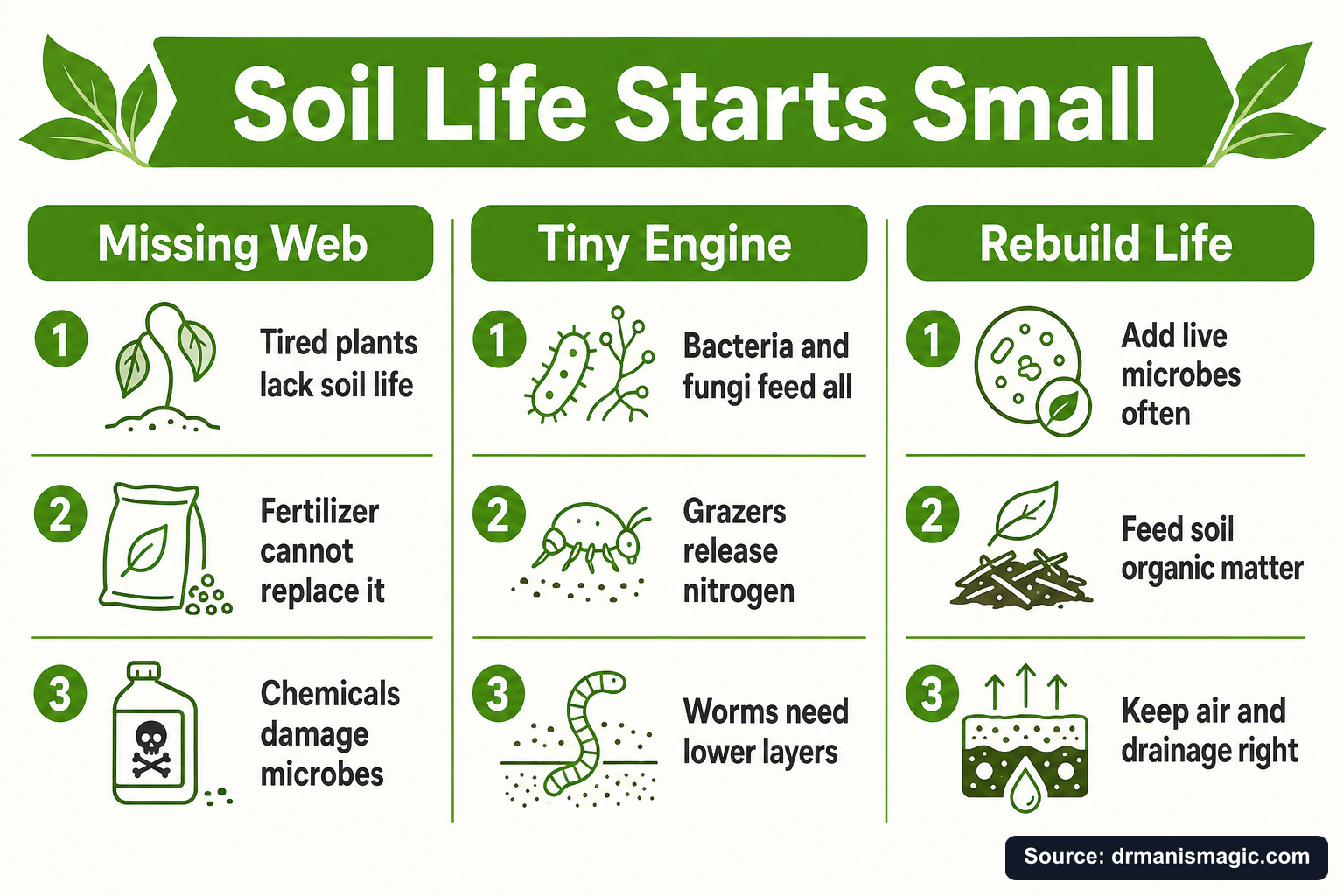
Key Takeaways
- Bacteria and fungi are the base of all soil life. Without them, nothing above them can survive.
- Protozoa and nematodes are the hidden middle layer that release plant-available nitrogen by grazing on bacteria and fungi.
- Earthworms, insects, and healthy roots all depend on this invisible microbial engine running beneath them.
- Synthetic fertilizers, herbicides, fungicides, and pesticides all damage or destroy the soil food web.
- Dead, dried, or foul-smelling microbial products from competitors do not rebuild this web effectively.
- Restoring soil biology takes repeated, live microbial applications alongside organic matter and proper drainage.
- The Three Plant Pillars, developed and proven across 250,000+ trees at US Citrus Nursery, give your soil a real foundation.
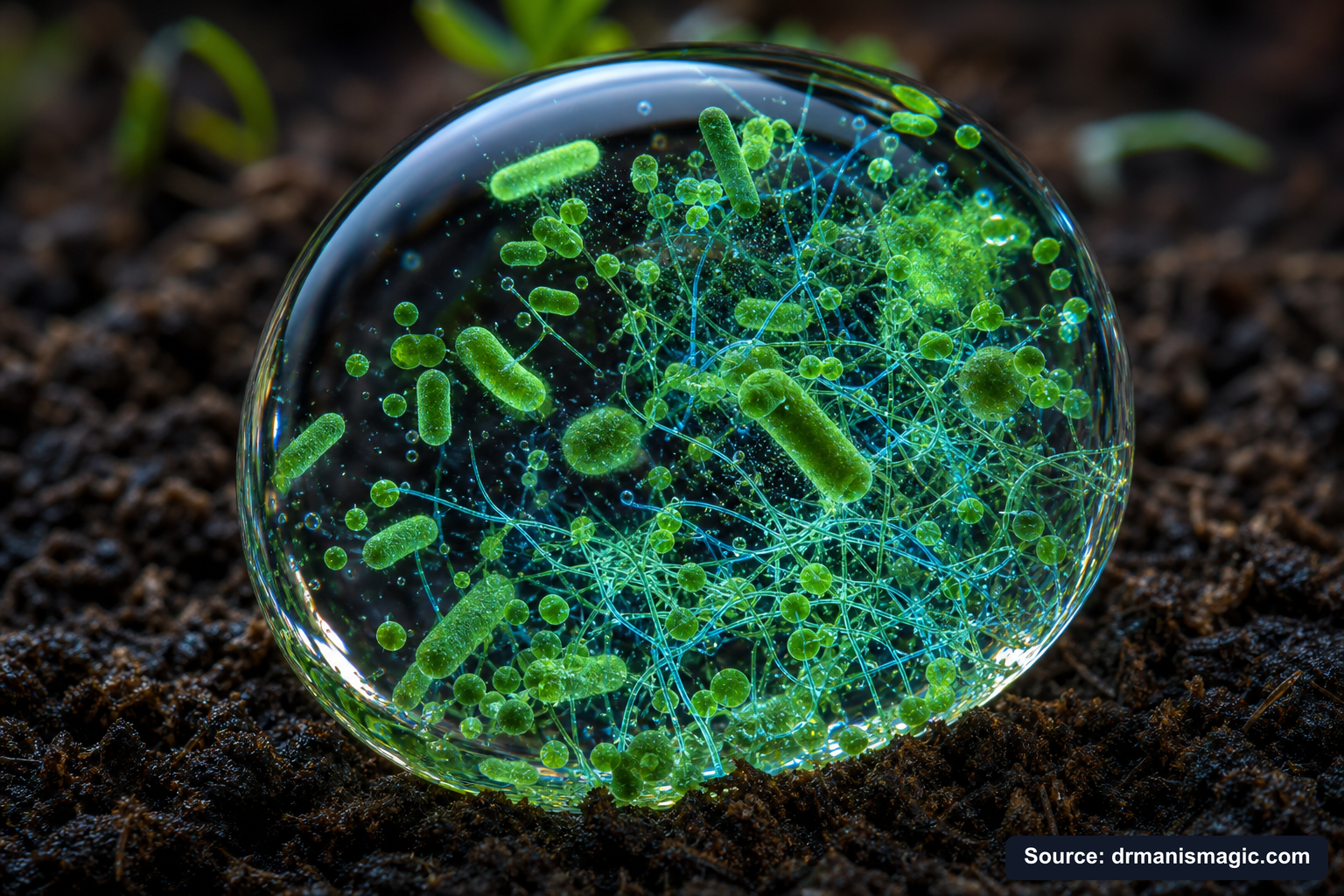
What Is the Soil Food Web and Why Should You Care?
Quick Answer: The soil food web is the chain of living organisms in soil, from bacteria and fungi at the bottom, up through protozoa, nematodes, insects, earthworms, and plant roots, where each layer feeds on the one below it. When the bottom layers thrive, every plant above them thrives too.
Think of it like a ladder. Every rung depends on the rung below it to hold weight.
At the very bottom of that ladder live bacteria and fungi. They are the primary decomposers. They break down dead leaves, old roots, and organic matter into forms that plants can actually absorb. Without them, nutrients stay locked up in the soil, completely out of reach, like food behind glass. Your plant starves even when surrounded by organic material.
One rung up are the protozoa and nematodes. These tiny creatures graze on bacteria and fungi. When they eat, they release excess nitrogen as ammonium, which is a form plants can drink up immediately. According to Penn State Extension, this grazing process is one of the most important nutrient-release mechanisms in healthy soil. Without it, plants rely entirely on whatever fertilizer you pour on them, which is a fragile and expensive way to garden.
Above those are the arthropods, mites, and millipedes. They shred large pieces of organic matter into smaller pieces, making it easier for bacteria and fungi to digest. Think of them as the food processors of the soil kitchen.
And at the top? Earthworms. Roots. Visible plants. The big stuff everyone notices. But here is the thing about the big stuff: it is completely helpless without the small stuff doing its job first.
That is why bigger soil life depends on smaller soil life. Not as a poetic idea. As a biological fact.
| Layer | Who Lives Here | What They Do | What They Depend On |
|---|---|---|---|
| Layer 1 (Base) | Bacteria, fungi | Decompose organic matter, unlock nutrients, suppress pathogens, build soil structure | Organic matter, root exudates, oxygen, correct pH, moisture |
| Layer 2 | Protozoa, nematodes | Graze on bacteria and fungi, release plant-available nitrogen as ammonium | Thriving bacteria and fungi populations |
| Layer 3 | Mites, arthropods, millipedes | Shred organic residues, redistribute microbes, improve soil mixing | Organic matter, functioning Layer 1 and 2 |
| Layer 4 | Earthworms, beetles, ants | Engineer pores, aerate soil, move nutrients and microbes deeper | All layers below them being active |
| Layer 5 (Top) | Plant roots, living plants | Feed microbes with root exudates (sugars), absorb unlocked nutrients | All four layers below working together |
What Do Bacteria and Fungi Actually Do in Soil?
Quick Answer: Bacteria and fungi break down organic matter into nutrients plants can absorb. They also suppress disease, build soil structure, fix nitrogen from the air, and extend the reach of plant roots. They are the digestive system of the soil, and without them, nutrients stay locked away no matter how much fertilizer you apply.
Bacteria are the sprinters of the soil. They multiply fast, work in wet conditions, and specialize in decomposing fresh, soft organic material. Some species fix nitrogen directly from the air and deliver it to plant roots for free. Others produce natural antibiotics that fight off pathogenic fungi and harmful bacteria. According to the University of Minnesota Extension, a single teaspoon of healthy soil can contain up to a billion bacteria.
Fungi are the long-distance runners. They grow in threadlike strands called hyphae that reach far beyond where roots could ever go. They break down tough, woody material that bacteria cannot handle. And one group of fungi, called mycorrhizal fungi, form a direct partnership with plant roots. They literally plug into the root like a charger into a phone, extending the root system many times over and delivering water and phosphorus in return for sugars from the plant.
Mycorrhizal fungi are not magic additives, though. They need the right host plant, the right soil conditions, the right moisture, and the right pH to survive. Rutgers NJAES research confirms that broad-spectrum mycorrhizal inoculants can fail when conditions are wrong. Habitat determines survival. That is why you cannot just sprinkle a packet of dried fungi on your plant and expect miracles. The whole system has to be alive and working.
At US Citrus Nursery, after growing and testing more than 250,000 trees in South Texas, Dr. Mani Skaria saw this firsthand. The trees that thrived were not just the ones that got nutrients. They were the ones whose soil was biologically alive. The ones whose roots had partners.
What Do Protozoa Do in Soil (And Why Does Nobody Talk About Them)?
Quick Answer: Protozoa graze on bacteria and fungi and release the excess nitrogen they cannot digest as ammonium, which is a form plants absorb directly. This makes protozoa one of the most important nutrient-release agents in soil. They are the missing layer in most gardening advice, and most people have never heard of them.
Here is what most gardening content gets wrong. It talks about bacteria. It talks about earthworms. Maybe it mentions mycorrhizal fungi. But it skips the middle layer almost entirely. That middle layer is protozoa, and skipping it is like explaining digestion without mentioning your stomach.
Protozoa are single-celled organisms that swim through thin films of water in the soil. They eat bacteria. Lots of bacteria. When a protozoan eats a bacterium, it absorbs what it needs and releases the rest as ammonium, which is immediately plant-available nitrogen. This process is called nutrient mineralization, and it is one of the primary reasons plants in healthy soil rarely need added nitrogen.
But protozoa do something else that is just as important. They regulate microbial populations. When bacteria populations get too large, protozoa graze them back down. This keeps the soil food web balanced. Without that regulation, certain microbial groups can dominate and crowd out others, weakening the whole system.
When you kill the bacteria with synthetic fertilizers or pesticides, you starve the protozoa. When the protozoa disappear, nitrogen stops mineralizing. Your plant suddenly needs you to hand-deliver every bit of nitrogen it gets. You become the soil food web. And that is exhausting and expensive.
Are All Nematodes Bad for Plants?
Quick Answer: No. Most nematodes in healthy soil are beneficial. Bacterial-feeding and fungal-feeding nematodes help mineralize nutrients just like protozoa do. Predatory nematodes eat harmful pests. Only a small group called plant-parasitic nematodes cause root damage, and those thrive most in disturbed, biologically dead soil.
When most people hear the word nematode, they think of root damage. They think of the tiny worms that attack vegetable gardens. And some nematodes do exactly that. But lumping all nematodes together is like saying all bacteria make you sick. Most do not. Most are working hard in your favor.
Bacterial-feeding nematodes graze on bacteria just like protozoa do, releasing more plant-available nitrogen. Fungal-feeding nematodes do the same with fungi. Predatory nematodes hunt and eat other nematodes, including the plant-parasitic ones. And insect-parasitic nematodes are actually sold as biological pest control agents that hunt and kill soil-dwelling pests from the inside out.
The irony is that plant-parasitic nematodes thrive in disturbed, chemically treated, biologically weak soil. When the predatory nematodes that would normally keep them in check are gone, the bad ones multiply. This is another reason why destroying the soil food web with synthetic inputs does not just weaken your plants. It actively creates the conditions for pest problems to get worse.
Healthy soil biology is its own pest management program. The small stuff protects the big stuff.
Why Do Earthworms and Visible Soil Life Need Microbes to Survive?
Quick Answer: Earthworms eat soil and organic matter, but they cannot digest it without bacteria and fungi already breaking it down first. Remove the microbes and earthworms starve and leave. Without earthworms, soil compacts, pore spaces close, water drains poorly, and roots suffocate. The visible life everyone loves depends entirely on the invisible life nobody sees.
Earthworms are not the foundation of healthy soil. They are the proof of it.
When you see earthworms, it means everything below them is already working. The bacteria are active. The fungi are threading through the soil. The protozoa are grazing and releasing nitrogen. The earthworms show up because the dinner table is set.
Earthworms eat organic matter and soil particles. But as that material passes through their digestive system, it gets mixed with bacteria and further broken down. Their castings, the material they excrete, are extraordinarily rich in plant-available nutrients and beneficial microbial communities. One earthworm casting contains more available nitrogen, phosphorus, and potassium than the surrounding soil.
Earthworms also dig. Their tunnels create pore spaces that let air and water move through the soil. Those pores are the same spaces that plant roots need to breathe. Yes, roots breathe. They need oxygen. When pore spaces close up because the soil is compacted and biologically dead, roots begin to suffocate. That is one of the root causes of root rot, a condition that is far more about biology and drainage than about watering too much.
Want earthworms? Feed the microbes. The earthworms will find the party on their own.
See also: The Hidden Reason Synthetic Fertilizers Cause Root Rot
How Do Synthetic Fertilizers, Herbicides, and Pesticides Destroy the Soil Food Web?
Quick Answer: Salt-based synthetic fertilizers raise soil salinity and directly harm or kill beneficial bacteria and fungi. Herbicides like glyphosate disrupt microbial communities. Broad-spectrum pesticides and fungicides kill beneficial organisms alongside harmful ones. Over time, regular use collapses the soil food web layer by layer, leaving plants dependent on chemical inputs to survive.
This is the part nobody at the garden center tells you. And it is the part that explains why your plants look okay for a season or two and then slowly start struggling, no matter how much you feed them.
Salt-based synthetic fertilizers work by dissolving nutrients in water and pushing them into the plant quickly. The problem is that those salts stay in the soil. Beneficial bacteria and fungi are sensitive to salt. High salt concentrations damage their cell membranes and either kill them outright or make it impossible for them to reproduce. The soil food web does not collapse overnight. It starves slowly, season by season.
Herbicides like glyphosate are particularly damaging because they were designed to disrupt a biological pathway. That same pathway exists in bacteria and fungi. Research has shown that glyphosate reduces microbial diversity in soil, tipping the balance toward harmful organisms and away from beneficial ones.
Broad-spectrum pesticides and fungicides do not read labels. They kill what they contact. The beneficial fungi protecting your roots? Gone. The bacteria that were suppressing root pathogens? Gone. What is left is a simplified, weakened microbial community that cannot regulate itself or protect your plant.
After years of this, you are not gardening with nature. You are gardening against it. And you will always lose that fight eventually, because you can never fully replace what a living soil food web does for free.
See also: Why Most Fertilizers Are Actually Salt in Disguise
You Never Had a Brown Thumb.
You were handed the wrong tools. This free guide hands you the right ones.
You watered it. You fed it. It died anyway.
It was never you. It was the dirt, the salt food, and the bad advice.
This guide shows you what really went wrong, and how to fix it for good.
- Why your plants really died, and why it was never your fault
- The salt hiding in your plant food that quietly burns the roots
- The hidden killer in almost every bag of store soil
- The tiny helpers that grow a whole forest for free
- The rescue trick that brings a half dead plant back to life

Live Microbes vs. Dead Microbes: Why Most Products on the Shelf Do Not Work
Quick Answer: Most commercial microbial products use lab-grown bacteria that are then dried into powder, or they are compost-tea liquids that have gone anaerobic and smell terrible. Dried microbes rarely survive rehydration. Anaerobic liquids contain dying or dead organisms. Only genuinely live, stabilized microbes deliver the biological activity plants need.
You have probably seen them at the garden center. Bottles and bags promising billions of microorganisms. Impressive-sounding species names. Big claims on the front. And yet, after growing more than 250,000 trees at US Citrus Nursery and testing dozens of these products, Dr. Mani and his team kept seeing the same result: no meaningful improvement in the trees.
Here is what is actually inside most of those products.
The first type is lab-grown dried microbes. A factory grows specific bacterial species in giant vats. Then those microbes are dried into a powder. The idea is that the spores will reactivate when you add water and pour them into soil. In practice, the survival rate after drying, shipping, sitting on a shelf at room temperature, and then being rehydrated in your garden is very low. The colony-forming unit count on the label reflects what went into the bag at the factory. By the time it reaches your roots, a fraction of that biology is still functional.
The second type is compost tea or liquid microbial products derived from organic material. These sound better. And if they are fresh, within 24 hours of being made, they can be quite effective. The problem is that most of these products go anaerobic during shipping and storage. Anaerobic means the oxygen is gone and the microbes are dying and fermenting. You can smell it immediately. The bottle fizzes when you open it. The stench is unmistakable. Some benefit remains from the humic acids and organic compounds, but the living biology is largely gone.
The third type is lactobacillus-based products, like the bacteria in yogurt. These survive well. But they are so aggressive that they crowd out the beneficial microbes you actually need. They belong in your gut. Not in your soil.
| Product Type | Viable at Use? | Microbial Spectrum | Smell | What We Found |
|---|---|---|---|---|
| Dried lab-grown powder | Very low | Narrow (1-10 species) | None | No measurable plant improvement in our trials |
| Dried powder rehydrated into liquid | Very low | Narrow | Mild | Same result; survival rate after processing is too low |
| Compost tea (fresh, under 24 hours) | Moderate to high | Broad | Earthy | Works well but requires effort, time, and immediate use |
| Compost tea (old, over 24 hours) | Very low (anaerobic) | Partial | Strong and foul | Microbes dying; some humic acid benefit remains only |
| Lactobacillus products | High | Very narrow | Mild sour | Crowds out beneficial microbes; not recommended for soil |
| Plant Super Boost (stabilized, full-spectrum) | High | 2,000+ bacteria species, 400-500 fungi including mycorrhizae, plus protozoa and nematodes | Earthy, not foul | Visible microbial activity under microscope; lab-confirmed; consistent plant improvement |
What makes Plant Super Boost different is that it starts with real compost, not a factory checklist. A world-renowned compostologist, who had advised royal families and governments on farming practices before being pressured out of the industry by large chemical interests, partnered with Dr. Mani and US Citrus Nursery to develop a proprietary, all-natural stabilization method. This process keeps the full spectrum of microbes alive without the product going anaerobic. It does not stink. You can see the microbes moving under a microscope. And multiple lab analyses confirm the live biology is real and present. Zero PFAS. Zero biosludge. Zero synthetic salts.
Why Does Sterile Potting Mix Fail Your Plants Over Time?
Quick Answer: Most commercial potting mixes are made from pine bark and wood materials that start sterile and decompose within months. As they break down, they compact, block oxygen from roots, and provide no biological activity. Plants that start strong in fresh potting mix often decline as the mix collapses and the microbial support that should be there simply does not exist.
Walk into any big box store and pull a bag of potting mix off the shelf. It looks fluffy. It smells earthy. It feels light and promising. Six months later, it looks like peat paste. Dense. Soggy. Suffocating.
That is because most potting mixes are organic materials, primarily pine bark, wood fiber, and peat. They decompose. As they break down, they compact and steal oxygen from the root zone. Roots need oxygen to survive, and when drainage fails and air pockets close, roots begin to rot. Not from overwatering. From suffocation.
On top of that, these mixes start sterile. There is no living biology in them. No bacteria. No fungi. No protozoa. No nematodes. You plant your tree into a biological vacuum and then wonder why it struggles to thrive long-term.
This is the first of the Three Plant Pillars that Dr. Mani identified after decades of nursery work: your soil must have permanent structure and allow roots to breathe. That is why Super Soil is built on mineral-based sandy loam from the Rio Grande Valley, a base that does not decompose, does not compact, and does not steal oxygen. It is the foundation the biology needs to survive and multiply.
Biology cannot thrive in collapsing structure. You need both.
How Does the Plant Feed the Soil That Feeds It Back?
Quick Answer: Living plant roots leak sugars, proteins, and carbohydrates into the surrounding soil. This is called root exudate. Bacteria and fungi feed on these exudates and gather around the root zone. In return, they unlock nutrients the plant cannot reach on its own. The plant feeds the microbes, the microbes feed the plant. It is the most elegant trade deal in nature.
Plants are not passive recipients of whatever you pour on them. They are active participants in a trade economy that has been running for hundreds of millions of years.
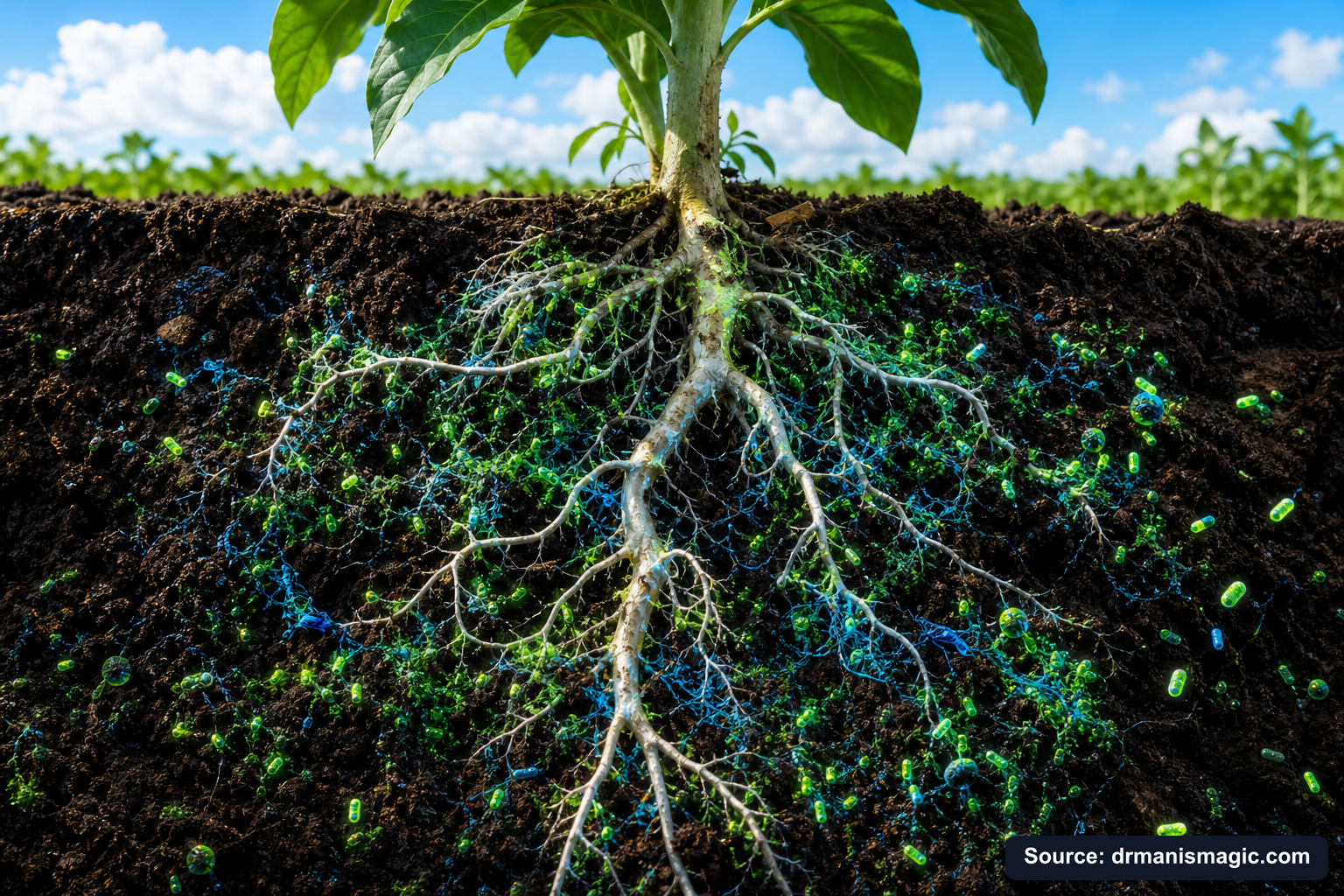
A healthy plant root leaks somewhere between 20 and 40 percent of the carbon it produces through photosynthesis directly into the surrounding soil. On purpose. This is not waste. It is payment. The plant is advertising to the microbial community: come here, set up shop, and I will keep feeding you. In return, the microbes break down nutrients into forms the plant can absorb, produce hormones that stimulate root growth, and build a wall of biological protection against pathogens.
The zone right around the root where this trade happens is called the rhizosphere. It is the most biologically active few millimeters in all of agriculture. More microbial activity happens there than almost anywhere else in the soil profile.
When the soil is dead, this trade breaks down. The plant sends out its signals and nothing answers. Nutrients stay locked. Pathogens go unchecked. The plant becomes dependent on you to deliver everything by hand. You become the soil food web, and you will never do it as well as the real thing.
This is why the Three Plant Pillars work together as a system. Mineral soil gives structure. Live microbes rebuild the web. Organic fertilizer feeds both the plant and the biology without salt damage. Remove any one pillar and the system weakens. Keep all three in place and something remarkable happens: the plant starts running on its own engine again.
How Do You Rebuild Dead or Damaged Soil Biology?
Quick Answer: Rebuilding soil biology takes consistent action over time. You need to add organic matter, introduce live microbes repeatedly, stop using salt-based synthetic inputs, correct drainage and pH, keep living roots in the soil, and reduce chemical disturbance. One application of microbes rarely fixes years of damage. The biology has to be invited back and given reasons to stay.
Here is the honest truth. If your soil has been treated with synthetic fertilizers, herbicides, or pesticides for years, the damage is real. The food web has been simplified. The beneficial populations are depleted. You cannot fix that with one bottle of anything.
But you can fix it. And it is not as complicated as it sounds.
Think of it like rebuilding a neighborhood. You need to build the houses first, the organic matter and soil structure. Then you need to invite the residents, the live microbes. Then you need to keep the neighborhood safe, no more salt bombs or chemical sprays. Over time, the community grows, strengthens, and starts managing itself.
Your Soil Biology Recovery Protocol
- Stop the damage first. Reduce or eliminate salt-based synthetic fertilizers, broad-spectrum pesticides, and herbicides. You cannot fill a bucket with a hole in it. Every application of these inputs resets the clock on your recovery.
- Fix the structure. If you are in containers or raised beds, transition to a mineral-based, well-draining soil. Compacted, waterlogged soil is an inhospitable environment for the biology you are trying to rebuild.
- Add organic matter. Compost, mulch, and decomposing plant material give bacteria and fungi the food they need to establish and multiply. Bare soil is biologically cold. Covered soil is biologically warm.
- Introduce live microbes monthly. A genuinely live, full-spectrum microbial inoculant needs to be applied repeatedly, especially in the first year. The soil has been damaged. One application is not enough to rebuild what years of synthetic inputs removed. Think of it as restocking a depleted river, you have to do it more than once.
- Keep living roots in the soil. Living roots are the microbe cafeteria. They leak exudates continuously. When soil sits bare, the cafeteria closes and microbial populations drop. Cover crops, perennial plants, or simply keeping your plants in the ground year-round helps.
- Correct pH and salinity. Most beneficial bacteria and fungi prefer a pH between 6.0 and 7.0. High salinity from synthetic inputs or poor-quality water can suppress microbial activity even when everything else is right. Flush salts with clean water and test your soil if plants continue to struggle.
- Be patient and consistent. Soil biology recovery is measured in months and seasons, not days. But the momentum builds. By the second season, you will see the difference. By the third, the soil starts working for you instead of against you.
Live Microbes vs. Dried Microbes: Which One Actually Reaches Your Roots?
Quick Answer: Live, stabilized microbes that arrive biologically active reach your roots and establish in the rhizosphere. Dried and rehydrated microbes have very low survival rates after processing, shipping, and storage. The difference is not a marketing claim. It is the difference between planting seeds and scattering sawdust.
This is the comparison that matters most when you are choosing a microbial product. Not the species list on the label. Not the colony-forming unit count at time of manufacturing. What matters is: are they alive when they reach your roots?
A dried microbial powder might list 10 billion CFUs per gram on the label. That number reflects what was in the product when it was made. After drying, packaging, shipping in a hot truck, sitting in a warm warehouse, riding in your car, and then being mixed with water and poured into soil, the survival rate can be a tiny fraction of that. Some research suggests that many commercially dried microbes lose the vast majority of their viability before they ever reach a plant root.
A live, stabilized product that smells earthy and shows visible microbial movement under a microscope is biologically active right now. That activity transfers to your soil. That is the difference you are paying for. Not the number on the label. The life in the bottle.
After testing dozens of products on citrus trees, tropical plants, and houseplants at US Citrus Nursery, Dr. Mani's team consistently found that only genuinely live microbial applications produced measurable improvements in plant health, root development, and disease resistance. The dried products, regardless of their species claims, produced no meaningful results.
See also: Why Dead Microbe Products Fail in Real Gardens
What Can You Do Right Now to Start Feeding the Invisible System?
You cannot see the soil food web. But you can feel the results of it. In the weight of a tomato. In the color of a leaf. In the smell of soil that is actually alive. In the moment you bite into fruit you grew yourself and realize it tastes completely different from anything you ever bought at a store.
That moment is worth protecting. And the time to start is now, not next season, not after one more product fails you.
You cannot get time back. You can get money back. But the seasons you spend gardening against nature instead of with it are gone. The fruit you could have been harvesting from a biologically alive tree while waiting for a synthetic program to somehow start working, that time is spent.
The good news is that the system you need is not complicated. Dr. Mani spent 40 years as a Professor Emeritus of Plant Pathology, led the Clean Citrus Program in Texas, and tested every input he could find across 250,000 citrus trees. What he found was not a complex chemical regimen. It was three simple pillars: mineral-based soil, live microbes, and organic fertilizer that works with the biology instead of against it.
The small stuff runs the whole show. Feed it right, and everything above it flourishes, the worms, the roots, the fruit, the flowers, the lawn you walk on barefoot without wondering what chemicals just touched your skin.
If you are ready to stop fighting nature and start working with it, take a look at the Free Plant Care Field Guide from Dr. Mani's Magic. It walks you through exactly how to apply the Three Plant Pillars to whatever you are growing, whether that is a potted lemon tree on your patio, a raised vegetable bed, a lawn, or a full backyard orchard. No jargon. No guesswork. Just the system that has worked for over 10,000 growers across the United States, backed by a 30-day money-back guarantee and real people on the other end of the phone who have actually grown these plants themselves.
The invisible world beneath your plants is waiting to go to work for you. Give it a reason to stay.
Frequently Asked Questions
If your plants look tired no matter what you do, the answer is almost always hiding underground. These questions cut straight to the truth about soil life, why it matters, and how the Three Plant Pillars fix what synthetic fertilizers and cheap potting mixes have been quietly destroying for years.
Why does bigger soil life depend on smaller soil life?
Earthworms, insects, and healthy roots cannot survive without bacteria and fungi doing the hard work first. Those tiny microbes break down organic matter and unlock nutrients. Protozoa then eat the microbes and release nitrogen plants can actually drink. Remove the small stuff and the whole chain collapses. Dr. Mani proved this across 250,000 citrus trees at US Citrus Nursery. The big, visible growth always starts with invisible microbial activity happening deep in your soil.
Why is plant life so dependent on what is happening in the soil?
Roots cannot make food from thin air. They depend on soil for water, oxygen, and nutrients. But here is the part most people miss. Nutrients locked in soil stay locked unless living microbes unlock them. Without that microbial activity, your plant sits next to a full pantry it cannot open. That is why Pillar One, a mineral-based soil that breathes, and Pillar Two, live microbials, work together to give roots everything they need to thrive.
What kills the soil food web and why does it matter?
Synthetic salt-based fertilizers, fungicides, herbicides, and pesticides all damage or wipe out soil microbes. When the microbial layer dies, protozoa and nematodes lose their food source. Earthworms disappear. Nutrient cycling stops. Your plant becomes totally dependent on whatever you pour on it, which is expensive, fragile, and temporary. This is exactly what big chemical companies have sold America for 70 years. Dr. Mani built his entire Three Plant Pillars system to reverse that damage naturally.
What makes plants grow faster and bigger the natural way?
Live microbes in the root zone are the real growth engine. When bacteria, fungi, and mycorrhizae are active and healthy, they unlock phosphorus, release nitrogen, and stretch root systems far beyond what roots can do alone. Pair that with mineral-based soil that drains perfectly and an organic slow-release fertilizer made from crab, kelp, and amino acids, and your plant gets steady, powerful nutrition without the salt burn that stalls growth and kills microbes.
What are the biggest benefits of having healthy living soil?
Healthy living soil feeds your plants, filters water, fights disease, and builds long-term resilience. It recycles nutrients on its own so you are not constantly chasing problems. It holds moisture without drowning roots. And it creates an environment where pests and rot have a much harder time taking hold. At US Citrus Nursery, trees grown in living soil with active microbials showed stronger root systems, better fruit production, and far fewer losses than trees grown in conventional potting mix.
What depends on soil health beyond just the plants?
Everything above ground depends on what is happening below it. Your grass, your fruit trees, your vegetable garden, your flowers, even the air quality around your home is connected to soil health. When soil biology is alive and working, you get food that tastes better, a yard that smells clean and earthy, and a growing environment that does not need constant chemical intervention. That is what Dr. Mani set out to make available to every home gardener in America.
Can you rebuild dead soil biology and how long does it take?
Yes, you can rebuild it. But it takes the right inputs. Dead or dried-out microbial products sold by competitors will not do the job. You need live, stabilized microbes like those in Plant Super Boost, a mineral-based soil like Super Soil that gives microbes a permanent home to colonize, and an organic fertilizer that feeds them without burning them out. Most gardeners see real improvement within 30 days. The soil food web rebuilds itself from the bottom up, one layer at a time.
About the Author
Ron Skaria, MD
Ron Skaria, MD, is the co-founder of Dr. Mani's Magic and the son of Dr. Mani. He trained as a medical doctor at Baylor College of Medicine, did his residency at UT Health Science Center - San Antonio and fellowship training at Texas Tech University. He now works full time on the family farm at US Citrus and US Citrus Nursery in Hargill, Texas, building Dr. Mani's Magic alongside his dad. He wrote the Brown Thumb Field Guide to put his father's 48 years of plant science into plain words any gardener can use. His belief is simple. You never had a brown thumb. You just never had the right help.


