


The Role of Amoebae in Healthy Soil and Natural Nutrient Cycling | Dr. Mani's Magic
The Role of Amoebae in Healthy Soil: The Tiny Predators Your Plants Desperately Need
Picture this. You're standing in an old-growth forest. No one has fertilized it. No one has sprayed it. No one has watered it. Yet the trees are enormous. The leaves are deep green. The soil under your boots is soft and alive, smelling like rain and earth and something ancient.
Now picture your potted lemon tree on the back patio. Same sunlight. Same water. You've even added fertilizer. But the leaves are pale. The growth is slow. Something is missing. You can feel it, even if you can't name it. The forest has something your pot doesn't. And one of the biggest pieces of that puzzle is something most gardeners have never even heard of. It's not a bacteria. It's not a fungus. It's an amoeba. A microscopic predator so small it fits on the tip of a pin. And without it, your soil is missing one of its most critical workers.
Here is what almost nobody talks about. Healthy soil is not just about adding bacteria and calling it a day. The real magic happens when those bacteria get eaten. When an amoeba swallows a bacterium, it digests what it needs and releases the rest as plant-ready nutrients right next to the root. That is not a side effect. That is the whole system. That is how forests feed themselves. And once you understand it, you will never look at your garden the same way again.

Plant Super Boost
Key Takeaways
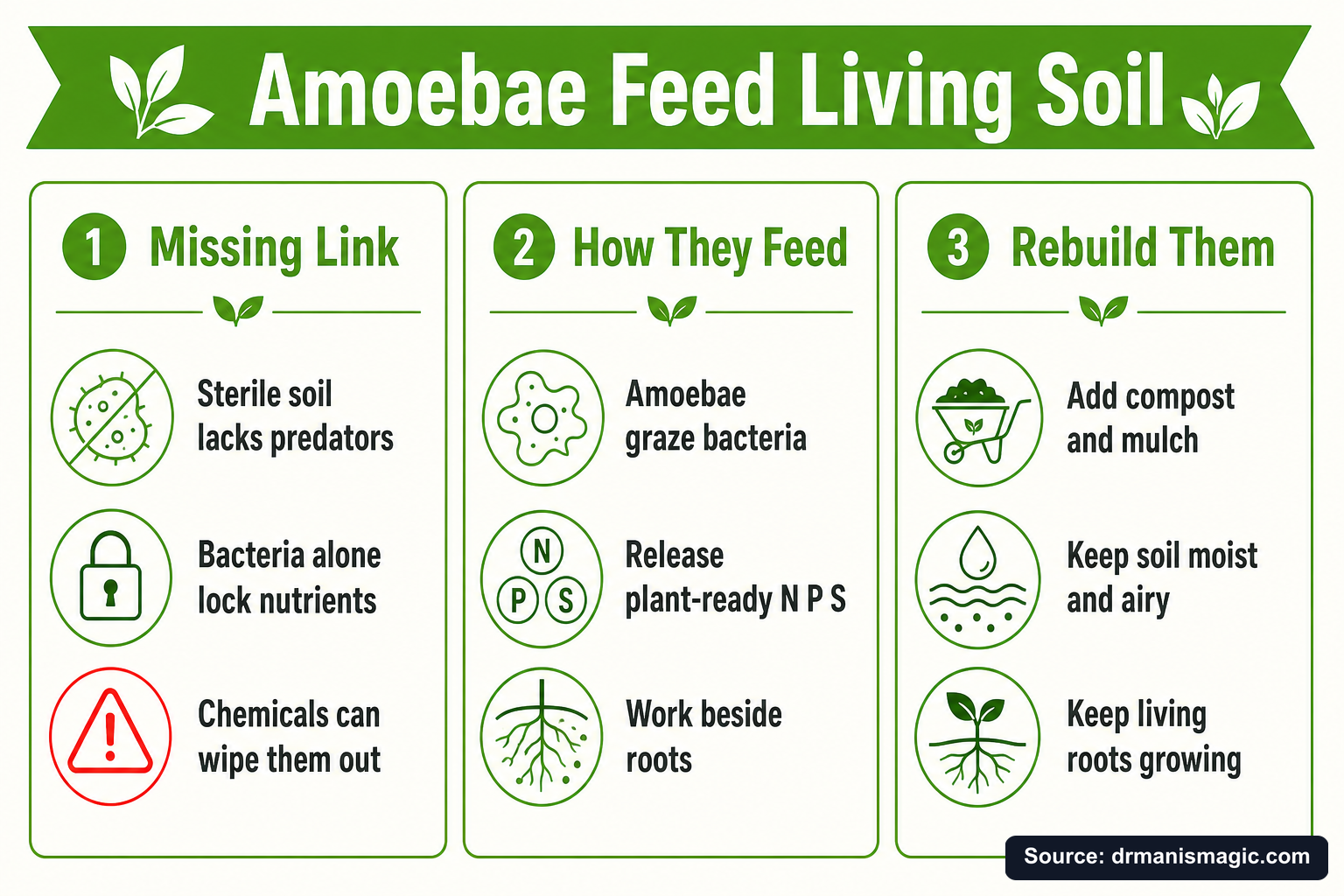
- Amoebae are beneficial soil predators, not germs. They graze on bacteria and release nutrients plants can actually use.
- Healthy soil needs a balanced predator-prey food web, not just bacteria alone.
- Amoebae live in thin films of water around soil particles and need good aeration, moisture, and organic matter to survive.
- Sterile potting soil, synthetic fertilizers, pesticides, and compaction all destroy amoeba populations.
- You can rebuild amoeba populations naturally with compost, mulch, living roots, and full-spectrum microbial inoculants.
- Lab-grown dried microbe products rarely include protozoa like amoebae and often fail to restore real soil biology.
- The Three Plant Pillars framework from Dr. Mani's Magic is designed to rebuild and support the full soil food web, including these invisible nutrient-releasing predators.
What Exactly Are Amoebae and Are They Good or Bad for Your Plants?
Quick Answer: Soil amoebae are single-celled predators that eat bacteria in the rhizosphere and excrete nutrients like nitrogen and phosphorus in plant-available forms. They are beneficial, not harmful. They are a core part of the soil food web that forests and healthy gardens depend on to feed plant roots naturally.
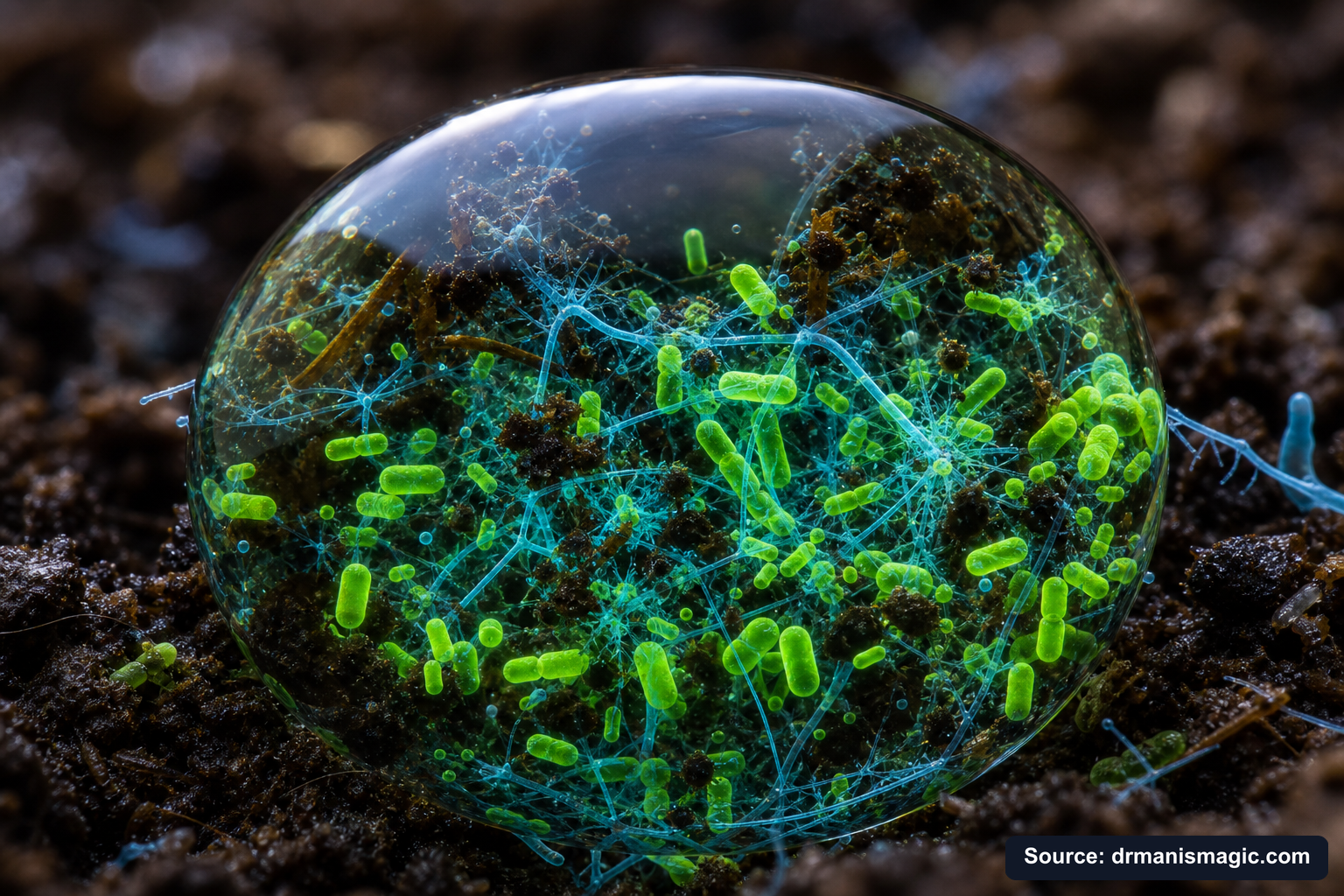
Amoebae are not the germs you learned about in middle school health class. Those are a different story entirely. Soil amoebae are single-celled organisms that crawl through the thin films of water coating soil particles. They stretch out, engulf bacteria, digest them, and release excess nitrogen, phosphorus, and sulfur right where plant roots can grab them.
Think of them as the recycling crew of the soil. Bacteria are fantastic at capturing nutrients from decaying organic matter. But bacteria are also greedy. They lock those nutrients inside their own cells. A big population of bacteria without any predators means nutrients are tied up in biomass your plant cannot touch. Enter the amoeba. It eats the bacteria, keeps what it needs, and releases the rest as plant food.
This process has a name. Scientists call it nutrient mineralization. According to Colorado State University Extension, protozoa like amoebae are critical drivers of nutrient release in the soil food web, particularly in the rhizosphere where plant roots are actively growing. Without this predation step, the entire nutrient cycling system slows to a crawl.
So yes. Amoebae in your soil are a very good sign. They mean your soil food web is alive and working.
How Do Amoebae Fit Into the Larger Soil Food Web?
Quick Answer: Amoebae are one layer in a multi-level food web. Bacteria and fungi break down organic matter. Amoebae, flagellates, and ciliates graze on bacteria and release nutrients. Nematodes prey on protozoa and microbes. Each layer recycles nutrients upward toward plant roots in forms plants can actually absorb.
The soil food web is a living system with layers, just like a rainforest has a floor, a canopy, and everything in between. Every layer feeds the one above it. And plants sit at the top, benefiting from all of it.
Here is how it works, layer by layer.
Organic matter, think dead leaves, grass clippings, old roots, falls onto and into the soil. Bacteria and fungi move in first. They decompose that organic matter and lock the nutrients inside their own cells. That is layer one.
Then the grazers arrive. Amoebae, flagellates, and ciliates are all types of protozoa. They eat bacteria and fungi. When they digest a bacterium, they release the nutrients that bacterium was holding. Those nutrients become plant-available nitrogen, phosphorus, and sulfur right near the root zone. That is layer two, and it is where amoebae do their most important work.
Then the larger predators move in. Bacterial-feeding nematodes eat protozoa and microbes. Predatory nematodes eat other nematodes. Each predation event releases more nutrients. That is layer three.
The table below shows the key players and what each one does.
| Soil Organism | What It Eats | What It Releases for Plants | What It Indicates About Your Soil |
|---|---|---|---|
| Bacteria | Organic matter, sugars from roots | Decomposed nutrients (locked in cells) | Active decomposition happening |
| Fungi / Mycorrhizae | Organic matter, plant sugars | Phosphorus, water, mineral nutrients | Good aeration, stable soil structure |
| Amoebae | Bacteria | Nitrogen, phosphorus, sulfur (plant-ready) | Balanced food web, good moisture and oxygen |
| Flagellates | Bacteria | Nitrogen and other nutrients | Present in wetter, less-aerated conditions |
| Ciliates | Bacteria, algae, other protozoa | Nutrients from grazed biomass | Often signal anaerobic or waterlogged zones |
| Bacterial-feeding nematodes | Bacteria, protozoa | Nitrogen, other nutrients | Healthy, biologically active soil |
| Predatory nematodes | Other nematodes, protozoa | Secondary nutrient release | Complex, mature food web |
Notice something important in that table. Amoebae need oxygen and good moisture. They live in thin water films between soil particles. That means compacted, waterlogged, or bone-dry soil kills them off first. They are sensitive indicators of soil health. When amoebae thrive, the whole system is working.
This is exactly why Pillar One of the Three Plant Pillars is mineral-based soil. Drainage, aeration, and pore space are not just about root comfort. They are about keeping this entire invisible workforce alive and doing its job.
What Is the Difference Between Amoebae, Flagellates, and Ciliates?
Quick Answer: All three are protozoa that graze on bacteria, but they prefer different conditions. Amoebae crawl through soil water films and need oxygen and good soil structure. Flagellates use a tail-like structure to swim and tolerate wetter conditions. Ciliates use tiny hair-like structures to move and often signal anaerobic or poorly aerated soil zones.
Most people lump all protozoa together. That is a mistake. Each type tells you something different about what is happening in your soil right now.
Amoebae are the slow, methodical crawlers. They extend pseudopods (tiny arm-like projections) to engulf bacteria. They need thin water films, good oxygen levels, and proper pore space. They thrive in well-structured, aerobic soil. Seeing them is a green flag.
Flagellates are faster swimmers. They use a whip-like flagellum to move through water. They can tolerate slightly wetter conditions and are often the first protozoa to colonize disturbed or recovering soil. They are a yellow flag, meaning the system is starting to work but is not fully developed yet.
Ciliates move using tiny hair-like cilia covering their bodies. They prefer much wetter, lower-oxygen environments. Lots of ciliates and few amoebae can be a red flag for anaerobic pockets in your soil, places where roots are likely struggling and root rot risk is climbing.
This matters practically. If your soil is compacted, if you are overwatering, if you are using heavy organic potting mixes made of bark and sawdust that break down into sludge, you are pushing your soil biology away from amoebae and toward ciliates. And that shift means fewer nutrients released near your roots and more disease pressure building up.
See also: The Hidden Reason Synthetic Fertilizers Cause Root Rot
Why Do Amoebae Release Nutrients Right Where Plant Roots Need Them?
Quick Answer: Amoebae concentrate their activity in the rhizosphere, the thin zone of soil directly around plant roots, because that is where bacteria are most abundant. Plant roots feed bacteria with sugars, bacteria multiply, amoebae graze on them and excrete nutrients. The whole nutrient exchange happens within millimeters of the root surface.
Here is the beautiful part of this system. It is not random. It is targeted.
Your plant roots leak sugars and proteins into the surrounding soil. Scientists call this rhizodeposition. It sounds complicated. It is actually simple. Your plant is baiting the bacteria. It feeds them so they come close. Bacteria swarm the root zone, attracted by the food.
Amoebae follow the bacteria. More bacteria near roots means more amoebae near roots. More amoebae near roots means more nutrient release right where the root tips can absorb it immediately.
According to research from University of Wisconsin-Madison's Soil Science department, this rhizosphere effect means nutrient cycling near roots is dramatically faster than in bulk soil. The plant essentially engineers its own fertilizer delivery system by feeding microbes and attracting their predators.
This is nature's version of slow-release fertilizer. No synthetic salt required. No plastic coating leaching into the groundwater. Just a living loop that has been running for hundreds of millions of years. The forest does not need a fertilizer bag. It has amoebae.
What Kills Amoebae in Your Soil and Why Does It Happen So Fast?
Quick Answer: Amoebae are killed by compaction, overwatering, drought, synthetic fertilizer salts, broad-spectrum pesticides, fungicides, herbicides like glyphosate, soil sterilization, and sterile potting media. Because they live in thin water films and breathe oxygen, any disruption to soil structure, moisture balance, or biology can wipe them out quickly and silently.
This is where most gardeners lose years of progress without knowing it.
You buy a bag of potting mix. It smells fresh. It looks fluffy. You feel good about it. But that bag is biologically dead. It has been sterilized or pasteurized. There are no amoebae. There are no bacteria worth mentioning. There is no food web at all. You are planting your tree in biological silence.
Then you add a synthetic fertilizer because the leaves look pale. That fertilizer is salt-based. The salts damage whatever fragile microbial life was trying to establish itself. Now the soil gets slightly worse with every application. The plant becomes dependent on the fertilizer because the natural nutrient cycling system has been destroyed. You buy more fertilizer. The company profits. Your plant slowly circles the drain.
We have seen this happen to thousands of gardeners. After growing over 250,000 trees at our South Texas nursery, we learned that the biggest hidden killer in home gardening is not pests or disease. It is the slow erasure of the soil food web through well-meaning but misguided inputs.
Here is a list of the most common amoeba killers and what to do instead.
- Sterile potting mix: No biology present at all. Inoculate with full-spectrum live microbes immediately.
- Salt-based synthetic fertilizers: High salts dehydrate and kill microbial cells. Switch to organic, slow-release fertilizer that works with the biology, not against it.
- Broad-spectrum pesticides: Non-selective toxicity wipes out beneficial microbes along with pests. Use targeted, organic pest controls instead.
- Systemic fungicides: Designed to kill fungi, they also eliminate beneficial mycorrhizal fungi that support the food web amoebae depend on.
- Glyphosate herbicides: Research consistently shows disruption of soil microbial communities, including protozoa populations.
- Soil compaction: Destroys pore space, eliminates water films, cuts off oxygen. Amoebae suffocate. Loosen soil, add organic matter, reduce foot traffic.
- Chronic overwatering: Pushes soil toward anaerobic conditions where amoebae die off and ciliates and pathogens take over.
- Drought and extreme dry spells: Amoebae form cysts and go dormant, but long dry periods reduce populations significantly.
You Never Had a Brown Thumb.
You were handed the wrong tools. This free guide hands you the right ones.
You watered it. You fed it. It died anyway.
It was never you. It was the dirt, the salt food, and the bad advice.
This guide shows you what really went wrong, and how to fix it for good.
- Why your plants really died, and why it was never your fault
- The salt hiding in your plant food that quietly burns the roots
- The hidden killer in almost every bag of store soil
- The tiny helpers that grow a whole forest for free
- The rescue trick that brings a half dead plant back to life

Amoebae vs. No Amoebae: What Your Plant Actually Experiences
Quick Answer: Soil with active amoebae populations releases significantly more plant-available nitrogen and other nutrients near roots compared to soil with bacteria alone. Plants in biologically active soil with functioning protozoa show better growth, stronger roots, and greater resilience to stress than plants in sterile or biologically depleted growing conditions.
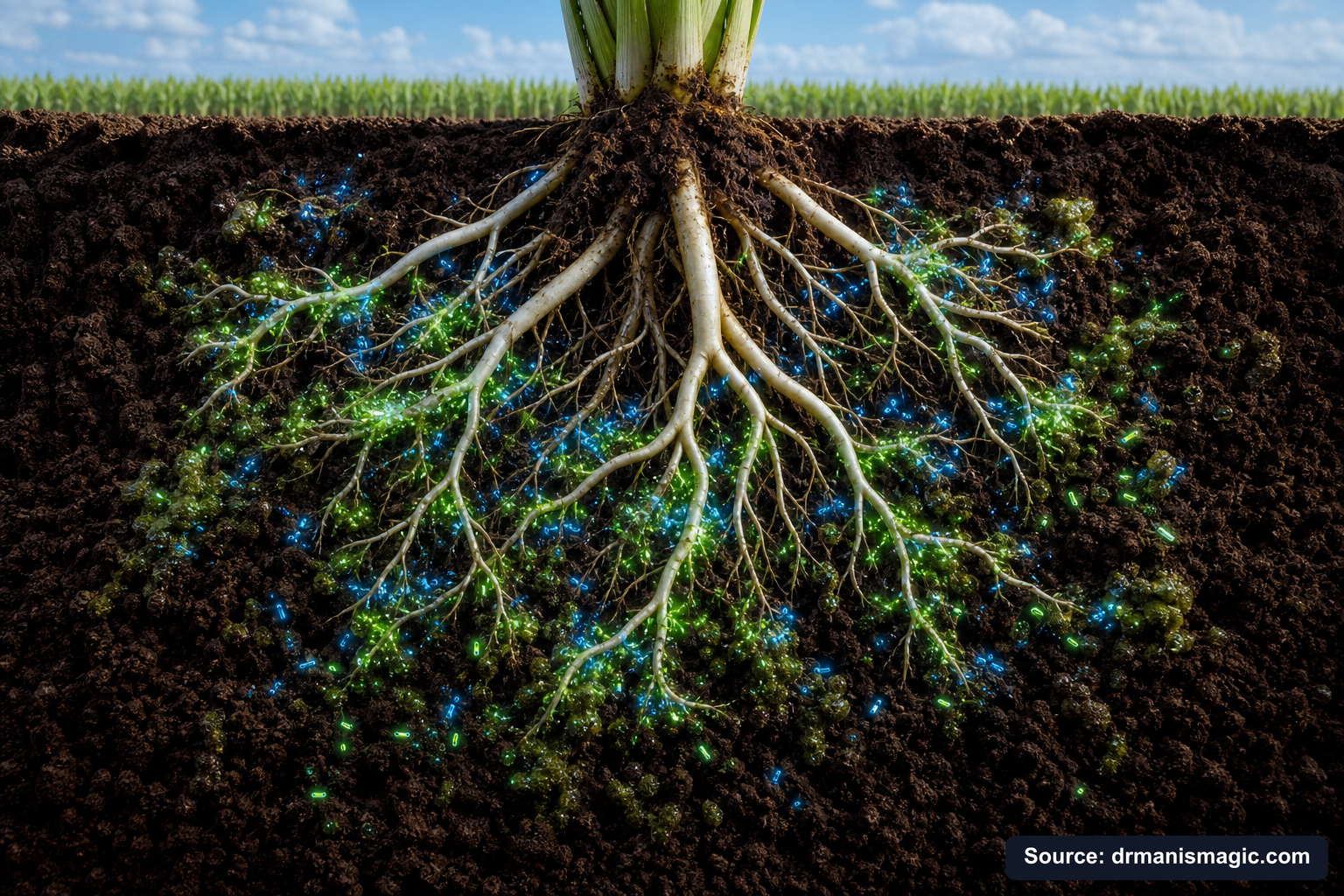
Let us be direct about what this means for your actual plant.
| Condition | Soil With Active Amoebae | Soil Without Amoebae (Sterile or Depleted) |
|---|---|---|
| Nutrient release near roots | Continuous, targeted, plant-available | Locked in bacterial biomass, unavailable |
| Nitrogen availability | High, mineralized by grazing | Low or locked up; plant shows pale leaves |
| Bacterial population balance | Controlled, diverse, healthy | Unchecked, can shift toward pathogens |
| Root health | Strong, well-fed, resilient | Weak, stressed, prone to rot |
| Plant growth rate | Faster, more consistent | Slow, inconsistent, dependent on inputs |
| Disease pressure | Lower (food web suppresses pathogens) | Higher (no biological competition for pathogens) |
| Fertilizer dependency | Lower (natural cycling provides nutrition) | High (plant cannot feed itself without inputs) |
| Long-term soil health | Self-improving over time | Degrading, requires more and more intervention |
The difference is not subtle. A plant in dead, sterile soil is like a person trying to survive in a sterile hospital room forever. All the inputs come from outside. The moment the inputs stop, the system fails.
A plant in biologically active soil, with amoebae running the nutrient release system, is like a person living in a thriving community. The support is built in. The system feeds itself. Time is on your side.
And speaking of time. The number one thing people tell us they want is to see fruit on their tree in their lifetime. Not after years of slow struggle. Not after watching it stall and decline. Now. Soon. That urgency is real. And it is exactly why rebuilding the soil food web, including the amoebae, is not optional. It is the foundation.
Do Live Microbial Products Actually Include Amoebae and Protozoa?
Quick Answer: Most commercial microbial products do not include protozoa like amoebae. They typically contain only specific bacteria or fungi grown in laboratory vats, dried into powder, and packaged. These narrow-spectrum products often fail to restore the full soil food web. Full-spectrum products derived from active compost are far more likely to contain protozoa, including beneficial amoebae.
This is one of the biggest gaps in the microbial product market. And most companies will never tell you about it.
Walk into a garden center. You will see shelves of microbial products. Bags of powder. Bottles of liquid. They all promise thriving soil biology. But look closer. Most of them are made in giant laboratory vats where a handful of bacterial species are brewed, then dried into spores. The hope is that when you add water, those spores wake up. In our experience testing dozens of these products on our nursery trees, they simply do not deliver consistent results. The spectrum is too narrow. The viability is too low. And there is not a protozoan in sight.
Then there are the compost tea-style liquids. Some of these come from real biological sources. But by the time they reach your doorstep, they have gone anaerobic. The microbes are dying. The bottle may even hiss when you open it. That fizz is fermentation gas from microbes suffocating. Some residual benefit exists from humic and fulvic acids in the liquid, but the living biology is mostly gone.
The comparison below shows what you are actually getting from each type of product.
| Product Type | Includes Protozoa / Amoebae? | Microbial Viability | Spectrum | Odor | Our Assessment |
|---|---|---|---|---|---|
| Dried lab powder (bacteria only) | No | Low | Very narrow (2-5 species) | Minimal | Avoid. Rarely works. |
| Rehydrated dry microbial powder | No | Low | Narrow | Minimal | Avoid. Same problem. |
| Old compost tea (shipped, >24 hrs) | Dying or dead | Anaerobic, declining | Partial | Strong, foul | Not recommended. |
| Fresh compost (applied on site) | Yes, when active | High (if hot and fresh) | Broad | Earthy | Excellent, but requires effort. |
| Plant Super Boost (stabilized, full-spectrum) | Yes, including protozoa | High, verified by microscopy and lab analysis | 2,000+ bacteria, 400-500 fungi, protozoa, nematodes | Earthy, not foul | Highly recommended. |
What makes Plant Super Boost different is that it comes from real compost, not a lab checklist. It is stabilized using a proprietary all-natural technique developed by a world-renowned compostologist who has advised royal families and governments on agricultural biology. The microbes are not dried. They are not dying. You can literally put a drop under a microscope and watch them move. The full spectrum includes bacteria, fungi, mycorrhizae, protozoa, and beneficial nematodes. Zero PFAS. Zero biosludge. Zero synthetic salts. And it smells like earth, not sewage, because it has not gone anaerobic.
That is the difference between a product built for a label and a product built by people who stake their nursery's reputation on it every single day.
How Can You Rebuild Amoeba Populations in Your Garden or Containers?
Quick Answer: You rebuild amoeba populations by restoring the conditions they need: organic matter, good soil structure, adequate moisture without waterlogging, living plant roots, reduced chemical disturbance, and full-spectrum microbial inoculants that include protozoa. Amoebae cannot be purchased directly, but they thrive when the rest of the soil food web is healthy and properly fed.
You cannot go to a store and buy a bag of amoebae. They do not work that way. But you can create the conditions where they return, multiply, and get back to work.
Here is a practical recovery checklist for rebuilding your soil food web, including the amoeba layer, whether you are starting with sterile potting mix, recovering from fumigation, reversing years of synthetic fertilizer use, or rebuilding a depleted garden bed.
- Start with a soil that breathes. Amoebae live in oxygen-rich water films. If your soil is compacted, waterlogged, or made of bark-heavy potting mix that has broken down into sludge, the amoebae have nowhere to live. Repot into a mineral-based, well-draining soil or amend your garden beds to improve aeration and pore space.
- Add mature compost. Not bagged compost that has been sitting on a shelf. Fresh, hot, active compost. This is the fastest way to introduce a diverse microbial community, including protozoa, into your soil. Even a thin layer worked into the top few inches makes a real difference.
- Apply a full-spectrum live microbial inoculant monthly. This is the bridge when you cannot make your own compost. A genuinely live, broad-spectrum product that includes protozoa gives the food web its missing members and reinforces the community consistently over time.
- Mulch the surface. A layer of organic mulch, wood chips, straw, or leaves keeps soil moisture stable, moderates temperature, and feeds the surface layer of the food web as it slowly breaks down. Amoebae love the habitat created just below a good layer of mulch.
- Keep living roots in the soil. Plant roots release sugars that feed bacteria. Bacteria attract amoebae. Bare soil with no roots loses its food web fast. Keep something growing, or use cover crops in garden beds between seasons.
- Stop the biology killers. If you are still applying salt-based synthetic fertilizers, broad-spectrum pesticides, or systemic fungicides, the food web cannot rebuild no matter what else you do. Reduce or eliminate these inputs. Switch to organic, slow-release fertilizer that works with microbes rather than burning through them.
- Be patient and consistent. Rebuilding a soil food web takes time. It is not a one-shot fix. Monthly microbial applications over several seasons will steadily deepen and diversify your soil biology. The improvement compounds. The system becomes more self-sustaining. Your results get better and better without more and more effort.
See also: Why Most Fertilizers Are Actually Salt in Disguise
How Do the Three Plant Pillars Support Amoebae and the Full Soil Food Web?
Quick Answer: The Three Plant Pillars from Dr. Mani's Magic directly address every condition amoebae and the broader soil food web need to thrive. Mineral-based soil provides the pore space and oxygen amoebae require. Live microbials restore the bacterial populations amoebae graze on. Organic fertilizer feeds the system without salt-based destruction of soil biology.
After 30 years of growing at our nursery in South Texas, Dr. Mani Skaria developed a framework that, without knowing it at first, was perfectly designed to support every layer of the soil food web, including the amoebae most people have never heard of.
Pillar One is mineral-based soil. Not bark. Not sawdust. Sandy loam from the Rio Grande Valley that does not decompose, compact, or steal oxygen from roots. This creates exactly the kind of stable pore space and moisture balance that amoebae need to survive. No pore space, no water films, no amoebae.
Pillar Two is live microbials. Not dried powder from a factory. Not a smelly liquid that has already gone anaerobic. Living, full-spectrum biology from real compost that includes the bacteria amoebae graze on, the fungi that build soil structure, and the protozoa that complete the nutrient cycling loop.
Pillar Three is organic fertilizer. No synthetic salts. No plastic-coated slow-release pellets leaching toxins. Crab, kelp, and amino acids that feed the soil gently, support microbial diversity, and deliver nutrients in forms that work with the living system rather than burning it down.
Together, these three pillars do not just grow better plants. They rebuild the invisible ecosystem that makes great plants possible in the first place. The amoebae come back. The food web deepens. The soil becomes self-sustaining. And your plant stops depending on you to save it every few months and starts doing what plants have done for hundreds of millions of years: feeding itself, from the inside out.
We have seen this work on lawns. On houseplants. On flower gardens. On tropical trees. On orchards. And on over 250,000 citrus trees at US Citrus Nursery in South Texas. The biology is the same everywhere. The results follow the same pattern. Get the pillars right, and the system works.

What Can You Do Right Now to Start Supporting Soil Amoebae?
Quick Answer: The most impactful steps you can take today are to stop adding synthetic salt-based fertilizers, start adding organic matter through compost or mulch, apply a full-spectrum live microbial inoculant to reintroduce the food web, and make sure your soil drains and breathes properly. These actions create the conditions amoebae need to return and multiply.
You do not need a science degree. You do not need expensive equipment. You do not need to understand every step of the soil food web to benefit from it. You just need to stop working against it and start working with it.
The forest figured this out without any help. The amoebae were there before humans farmed. They will come back when you give them the right conditions. And when they do, something quietly remarkable happens. Your plants start feeding themselves. Your soil starts improving season after season. The guesswork fades. The frustration lifts. Gardening starts to feel the way it was always supposed to feel.
You can get money back. You cannot get time back. Every season you spend on depleted, biologically dead soil is a season of growth your plants will never recover. The best time to start rebuilding your soil food web was ten years ago. The second best time is right now, today, with the plants you already have.
If you want to learn more about how the Three Plant Pillars work together to build the kind of living soil that sustains amoebae and the full food web, start with our Free Plant Care Field Guide. It walks you through the whole system in plain language, step by step. No jargon. No overwhelm. Just the foundation your plants have been waiting for.
Frequently Asked Questions
Most gardeners never hear about amoebae. But these tiny soil predators are a big reason why some plants explode with life while others just sit there and struggle. Once you understand what they do, you will see your soil in a completely new way.
What is the main role of amoebae in soil?
Amoebae eat bacteria in the soil. That sounds simple, but here is why it matters. Bacteria hoard nutrients inside their own cells. When an amoeba eats a bacterium, it releases those locked-up nutrients right next to the root. Your plant can grab them instantly. No amoebae means nutrients stay trapped. That is why soil biology is about the whole team working together, not just one player.
What are amoebae?
Amoebae are single-celled organisms so small you cannot see them without a microscope. They crawl through thin films of water in the soil. They stretch out, wrap around bacteria, swallow them, and release leftover nutrients your plant roots can use. They are not the dangerous germs you heard about in school. In healthy soil, they are one of your best friends.
Is there amoeba in soil?
Yes, healthy soil is full of them. A single teaspoon of rich garden soil can hold thousands of amoebae. But here is the problem. Synthetic fertilizers, compacted soil, and pesticides wipe them out fast. Most potting mixes from big box stores are practically sterile. That is one reason plants grown in cheap bagged soil never reach their full potential, no matter how much fertilizer you pour on.
What do amoebae eat in the soil?
Amoebae mostly eat bacteria. They also eat algae and other tiny organisms. They move toward food using stretchy extensions called pseudopods, then engulf their prey whole. This feeding process is what drives nutrient release in the root zone. It is the same process that feeds giant old-growth trees without any fertilizer bags, garden centers, or guesswork. Nature figured this out long before we did.
What role do bacteria play in healthy soil?
Bacteria are the workers. They break down organic matter, fight off pathogens, and capture nutrients from the environment. But bacteria alone are not enough. Without predators like amoebae eating them, nutrients stay locked inside bacterial cells where your plant cannot reach them. That is why Dr. Mani's Magic Plant Super Boost is built with a full spectrum of live microbes, not just a single strain of bacteria.
Which bacteria are good for soil?
The most powerful ones are nitrogen-fixers like Azotobacter, phosphorus-solubilizers like Bacillus megaterium, and growth-promoting strains like Pseudomonas. These bacteria work best when the whole soil food web is alive and balanced. Dr. Mani tested this on over 250,000 citrus trees at US Citrus Nursery. The results were clear. Live, diverse microbial communities outperform single-strain products every single time.
Why do most gardeners never see results from store-bought microbial products?
Most store products use dried or dead microbes that never truly wake up in your soil. They also ignore the full food web. You need living bacteria, fungi, and the predators that keep the cycle moving. That is the second of the Three Plant Pillars that Dr. Mani built his entire system around. Mineral-based soil, live microbes, and organic fertilizer working together is what makes plants go from struggling to thriving fast.
About the Author
Ron Skaria, MD
Ron Skaria, MD, is the co-founder of Dr. Mani's Magic and the son of Dr. Mani. He trained as a medical doctor at Baylor College of Medicine, did his residency at UT Health Science Center - San Antonio and fellowship training at Texas Tech University. He now works full time on the family farm at US Citrus and US Citrus Nursery in Hargill, Texas, building Dr. Mani's Magic alongside his dad. He wrote the Brown Thumb Field Guide to put his father's 48 years of plant science into plain words any gardener can use. His belief is simple. You never had a brown thumb. You just never had the right help.


