


The Physical Design of Healthy Soil: Why Roots Suffocate and How to Fix It | Dr. Mani's Magic
The Physical Design of Healthy Soil: Why Your Roots Are Suffocating (And How to Fix It)
Picture this. You're standing on your back patio, coffee in hand, staring at a plant that should be thriving. You watered it. You fertilized it. You gave it sunlight. You did everything the bag told you to do. And yet the leaves are yellow. The soil looks dark and wet even though you haven't watered in a week. Something smells faintly musty, like a wet basement. You lean down and press your finger into the pot. The soil doesn't crumble. It squishes. Like wet bread.
That smell, that squish, that slow yellowing? That's not a watering problem. That's not a fertilizer problem. That's a physics problem. Your soil has collapsed. The tiny air pockets that once let oxygen reach your roots are gone. Filled in. Smothered. And your roots, which need oxygen just as much as you do, are quietly suffocating down there in the dark.
Here's the thing nobody tells you at the garden center. The potting mix they sold you was never designed to last. It was designed to look good on a shelf, ship light, and move fast. What happens to your plant six months later? That's not their problem. But it is yours. And it's costing you something you can never get back: time. Time you could have spent watching your garden grow, your trees fruit, your flowers bloom. At Dr. Mani's Magic, we've grown over 250,000 trees at our South Texas nursery. We've seen this story play out thousands of times. And today we're going to show you the real design behind healthy soil, so it never happens to you again.
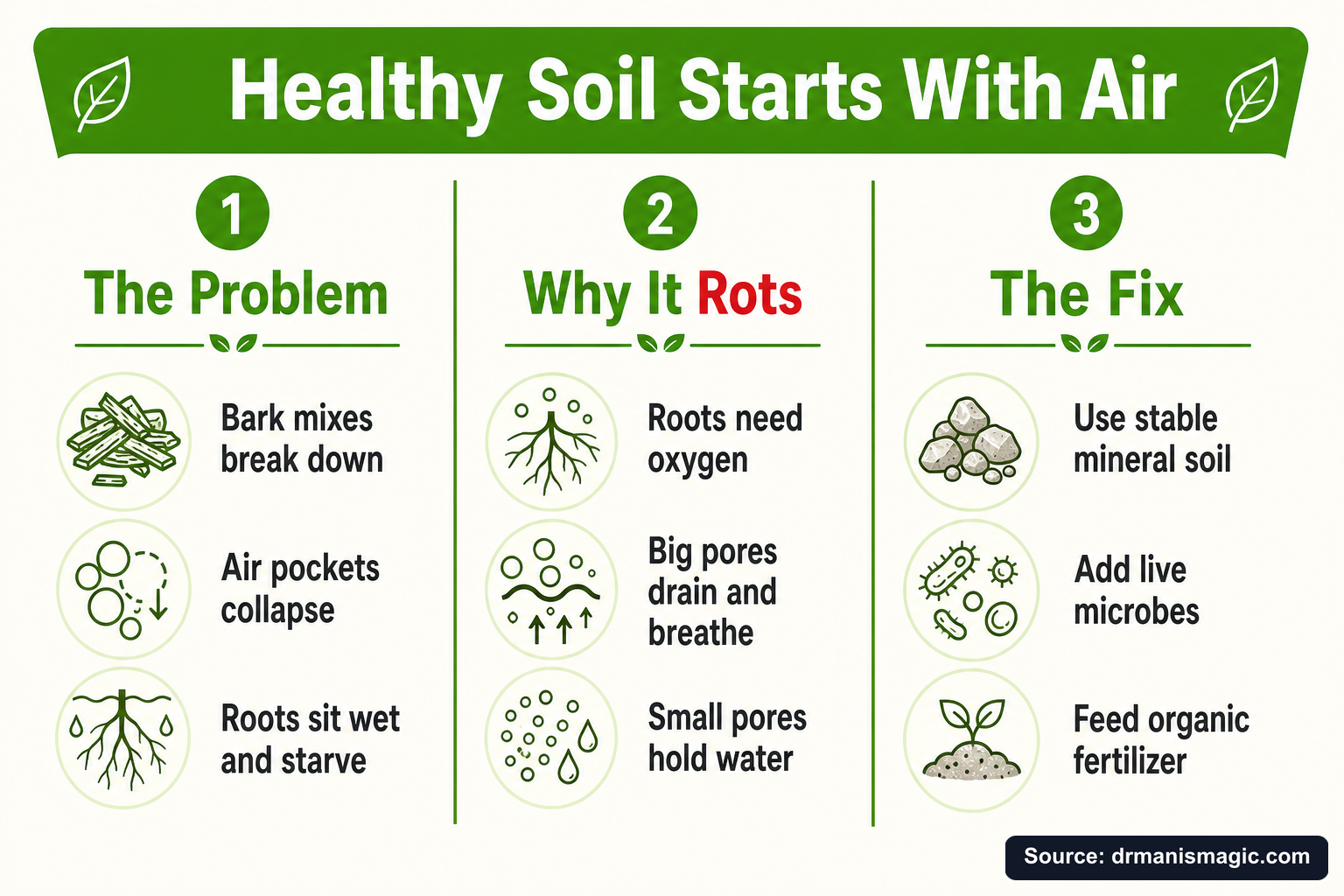
Key Takeaways
- Healthy soil is architecture first, not nutrition first. Roots need oxygen-carrying air pockets more than they need added nutrients.
- Standard potting mix is made from pine bark sawdust, an organic, carbon-based material that decomposes and collapses, stealing oxygen from roots.
- When soil pore space closes off, roots suffocate. That suffocation is what opens the door to root rot, not "overwatering" alone.
- Mineral-based, silica-rich soil does not decompose. It holds its structure for years, keeping air channels open and roots breathing.
- The Three Plant Pillars (mineral soil, live microbes, organic fertilizer) form the only foundation that works with nature instead of against it.
- Drainage holes in your pot mean nothing if the medium inside has already collapsed. The hole can't save a drowned root zone.
- Fixing your soil is the highest-leverage move you can make for any plant: grass, houseplants, fruit trees, orchids, or a backyard garden.
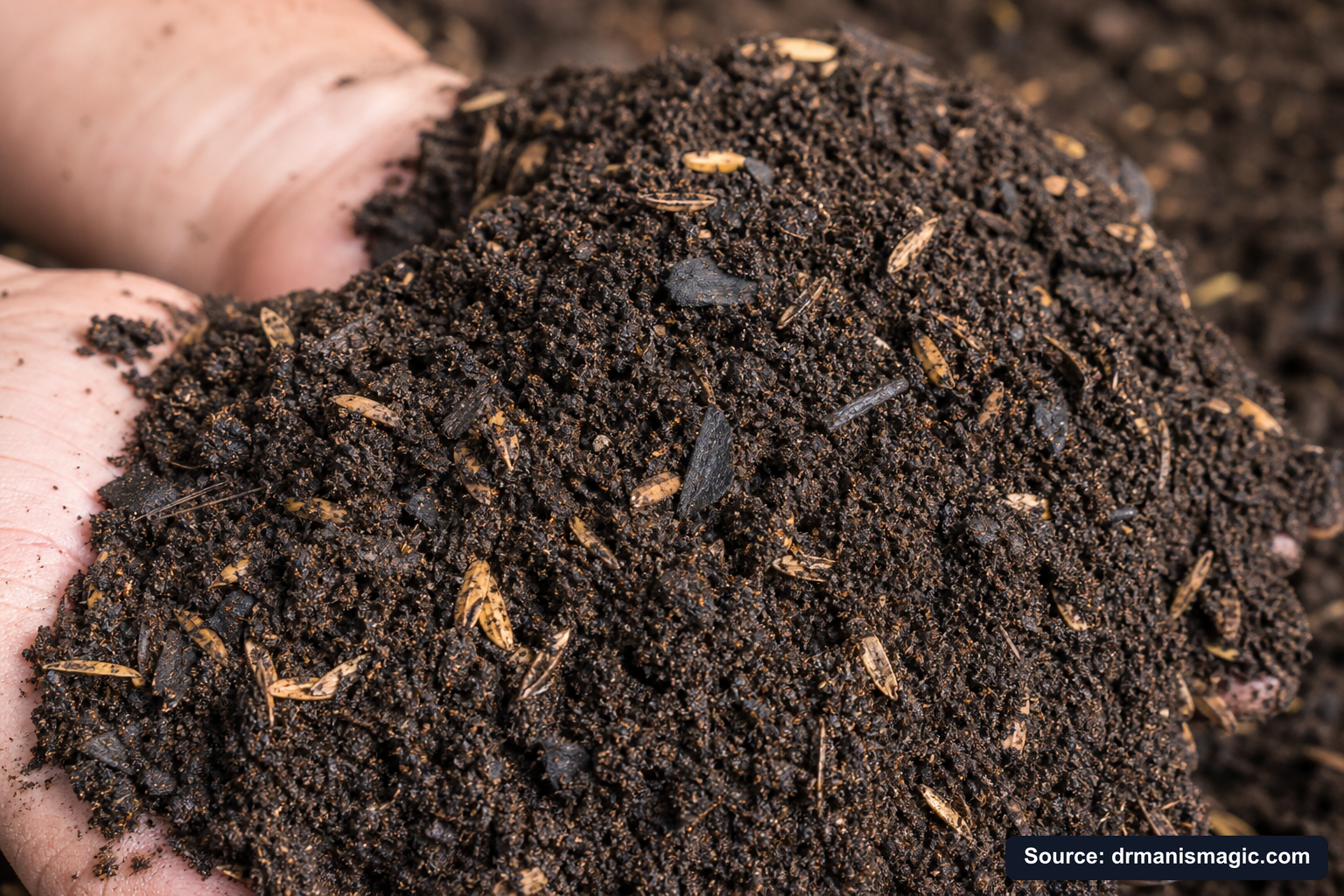
Why Do Roots Need Oxygen in the First Place?
Quick Answer: Roots breathe oxygen to power every cellular process, from nutrient uptake to water transport. Without oxygen in the soil, roots lose energy, turn brown and slimy, and die. A plant can look fine above ground for weeks while its roots are already gone below the surface.
Roots need oxygen to survive, full stop. This surprises people. We all know plants breathe in carbon dioxide and release oxygen above ground. So why would the roots need oxygen too? Because breathing and growing are two different jobs. The leaves handle gas exchange for photosynthesis. The roots handle energy production for growth. And energy production requires oxygen, just like it does in your own body.
Think of roots like tiny engines running 24 hours a day. They pump water upward. They pull nutrients from the soil. They build new cells. They power defenses against disease. Every one of those tasks burns fuel, and the fuel requires oxygen. Cut off the oxygen, and the engine dies. Slowly at first. Then all at once.
The University of Florida IFAS Extension confirms this directly: root respiration depends on adequate oxygen in the soil, and waterlogged conditions collapse that oxygen supply fast, leading to root death within hours in extreme cases. (University of Florida IFAS Extension, Soil Oxygen and Root Health)
So the question is simple: is your soil designed to hold oxygen? Or does it just hold water?
What Is Soil Pore Space and Why Does It Control Everything?
Quick Answer: Soil pore space is the network of tiny gaps between soil particles. Large pores drain quickly and hold air. Small pores hold water longer. Healthy soil needs both. When pores collapse from decomposition or compaction, there is no room for air, roots suffocate, and water sits stagnant.
Imagine holding a handful of marbles. Notice the space between them? That space is pore space. Now imagine replacing those marbles with wet flour. Pack it together. The space disappears. That is exactly what happens when potting mix decomposes.
Soil scientists describe two kinds of pores. Macropores are the big ones. Water drains through them fast and air rushes in behind it. Micropores are tiny. They hold onto water like a sponge, releasing it slowly to roots between waterings. You need both kinds working together. Big pores for breathing. Small pores for drinking.
When both types of pore space are intact and stable, something beautiful happens. Water drains through the big channels after you water. Air follows. Roots drink from the small pores at their own pace. The root zone stays moist but never saturated. Roots breathe, feed, and grow without interruption.
When pore space collapses, all of that stops. Water can't drain. Air can't enter. The medium becomes a wet, anaerobic (oxygen-free) environment. And in that environment, the organisms that destroy roots thrive. This is the physics of root rot. Not a mystery. Not bad luck. Architecture failure.
What Is the Perched Water Table Problem in Containers?
Quick Answer: A perched water table is a layer of permanently saturated soil that sits above the drainage hole in any container, no matter how good your drainage hole is. Fine-textured or collapsed media make it worse. Gravel at the bottom of a pot actually raises this wet layer higher, making it more dangerous, not less.
Here is one of the most misunderstood facts in all of container gardening: a drainage hole does not guarantee drainage. Not even close.
Water does not simply fall straight through soil and out the bottom of a pot. It moves through the medium by capillary force, the same pull that makes water climb up a paper towel. In fine-textured media like decomposed potting mix, that capillary pull is strong. Water clings to every tiny particle. It doesn't want to let go. A layer of permanently wet soil forms near the bottom of the pot, sitting above the drainage hole, never draining out no matter how long you wait.
Scientists call this a perched water table. The Texas A&M AgriLife Extension has documented how this phenomenon is worse in containers with fine-textured media, and how coarser particle sizes dramatically reduce the depth of this saturated zone. (Texas A&M AgriLife Extension, Container Media and Drainage)
And that old advice about putting gravel at the bottom of a pot? It actually makes the problem worse. The perched water table forms at the interface between the fine media above and the coarse gravel below. You just raised it higher into the root zone. More roots sitting in standing water. More suffocation.
The only real fix is coarser, more stable particle structure throughout the entire container. Not a layer of gravel. Not more drainage holes. The whole medium has to be redesigned.
Why Does Potting Mix Destroy Itself Over Time?
Quick Answer: Standard potting mix is made from pine bark sawdust, an organic material that decomposes just like compost. As it breaks down, particles shrink, pores collapse, and the medium turns to dense, airless sludge. Most potting mix reaches this failure point within 6 to 12 months, right when your plant needs stable structure most.
Let's talk about what potting mix actually is, because almost nobody knows the truth.
Potting mix is not soil. It is mostly pine bark, the waste byproduct of the timber industry. The Southeast United States produces vast quantities of pine lumber. After the lumber is cut, what's left? Bark and sawdust. Mountains of it. Cheap, light, easy to bag. Perfect for a nursery supply chain. Terrible for a root zone.
Pine bark is organic, which means it is carbon-based, which means it does one thing over time: it decomposes. And decomposition is not a neutral process. It is an oxygen-consuming process. The microbes that break down organic matter need oxygen to do their work. They consume it from the same pore space your roots depend on. So as the bark breaks down, two bad things happen at the same time. The particles get smaller, closing off pore space. And the decomposition process consumes whatever oxygen was left. Double suffocation.
There is another problem. Pine trees are chemical factories. They produce a family of compounds called terpenes and terpenoids. You already know some of them. Pine-Sol is named after them. Turpentine is made from them. These are powerful, harsh compounds. Great for cleaning floors and stripping paint. Not ideal for your plant roots to sit in. To reduce the harshness, manufacturers let the sawdust decompose in giant outdoor piles for years before bagging it. More decomposition. More oxygen loss before it even reaches your plant.
Then there is the surfactant problem. Dry pine bark repels water naturally. Wood is hydrophobic. To make potting mix hold moisture, manufacturers add surfactants, industrial wetting agents, to the mix. These chemicals force the wood to absorb water. They work at first. Then they wash out over time. After a year or two, old potting mix turns rock-hard when dry and repels water completely. You pour water on the surface and it runs straight down the inside edge of the pot, never touching the root zone at all. The plant dies of thirst while sitting in a bag labeled "moisture control."
We are not being dramatic. We grew over 250,000 trees at US Citrus Nursery. We have seen this failure mode hundreds of times. The plant looks fine for a few months. Then it stalls. Then it slowly declines. By the time you notice the yellowing leaves, the root zone has already been collapsing for months.
You were never growing in soil. You were growing in other dead plants. And those dead plants were slowly taking your living plant down with them.
Potting Mix vs. Mineral-Based Soil: What Actually Happens to Your Roots
Quick Answer: Mineral-based soil uses silica-rich particles that do not decompose. Pore space stays open for years. Roots breathe, drain, and grow without interruption. Potting mix collapses within months, sealing off oxygen and creating root rot conditions. The difference is not nutrition. It is structure.
This is the comparison that changes everything for most growers. Side by side, fresh potting mix and mineral-based soil might look similar. But what happens over the next 12 months is completely different.
| Property | Standard Potting Mix (Pine Bark) | Mineral-Based Soil (Silica-Rich) |
|---|---|---|
| Base material | Organic carbon (pine bark, sawdust) | Inorganic silica (sandy loam, minerals) |
| Decomposition over time | Yes — particles collapse within 6-12 months | No — structure is permanent |
| Pore space stability | Shrinks and closes as bark breaks down | Stable for years, air channels stay open |
| Oxygen availability to roots | Drops sharply as decomposition progresses | Consistently high, roots breathe freely |
| Water behavior when dry | Becomes hydrophobic, repels water | Rewets easily and consistently |
| Chemical environment | Terpenes, surfactants, decomposition acids | Neutral, clean, steam-sterilized |
| Root rot risk | High — anaerobic zones form quickly | Low — drainage and aeration prevent saturation |
| Longevity in a container | 6-12 months before performance drops | Permanent — no need to repot annually |
| Replacement cost over 5 years | High — buy new bags every season | One-time investment, no replacement needed |
The mineral-based difference is not about adding nutrients. Silica-rich sandy loam does not feed your plant directly. What it does is hold the architecture open so your plant can feed itself through its roots. Structure first. Everything else follows.
This is the foundation of the Three Plant Pillars: get the physical foundation right, and the rest of the system works the way nature intended.
What Does Root Rot Actually Look Like From the Inside?
Quick Answer: Root rot starts with oxygen loss, not pathogens. When roots lose oxygen, cells die and turn brown and slimy. Dead tissue then becomes food for fungal and bacterial pathogens that finish the job. By the time you see yellowing leaves, root decay has often been underway for weeks or months.
Most people think root rot is a disease. It is not. Not at first. Root rot is a physics failure that becomes a disease.
Here is the sequence, step by step. Your potting mix compacts. Pores close off. Oxygen drops in the root zone. Roots lose their energy supply. Cells begin to die. The dead cells turn brown and soft. That decaying tissue becomes a food source for pathogenic fungi like Phytophthora and Pythium. The pathogens move in and multiply. They spread to healthy root tissue. The infection accelerates. By the time you see a yellow leaf, you are watching the final chapter of a story that started months ago in the root zone.
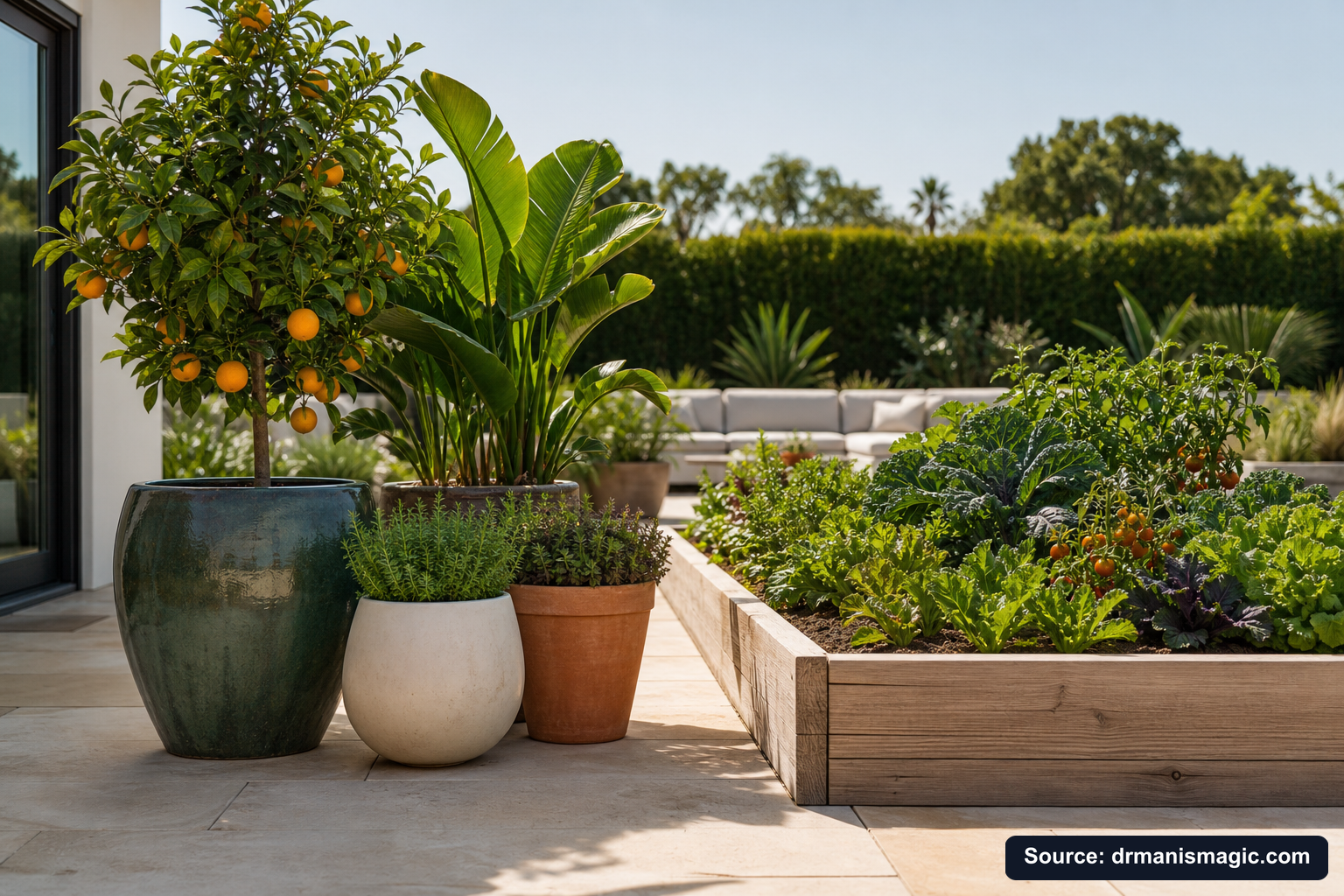
Overwatering does not cause root rot directly either. What overwatering does is extend the duration of oxygen deprivation. A well-structured mineral-based medium drains fast enough that even frequent watering doesn't drown the roots. A collapsed potting mix stays wet for days after watering, and every one of those days is a day your roots cannot breathe.
The three real causes of root damage are: too little oxygen in the soil, too much salt from synthetic fertilizers burning root cells, and too few beneficial microbes to protect the root zone from pathogens. Notice that none of those say "you watered too much." The problem is almost always the medium, not the gardener.
See also: The Hidden Reason Synthetic Fertilizers Cause Root Rot
You Never Had a Brown Thumb.
You were handed the wrong tools. This free guide hands you the right ones.
You watered it. You fed it. It died anyway.
It was never you. It was the dirt, the salt food, and the bad advice.
This guide shows you what really went wrong, and how to fix it for good.
- Why your plants really died, and why it was never your fault
- The salt hiding in your plant food that quietly burns the roots
- The hidden killer in almost every bag of store soil
- The tiny helpers that grow a whole forest for free
- The rescue trick that brings a half dead plant back to life

How Do You Diagnose a Soil Structure Problem Before It Kills Your Plant?
Quick Answer: You can diagnose soil structure failure by checking drainage speed, smell, texture, and root color. Slow drainage, musty odor, dense compaction, and brown slimy roots all signal oxygen loss and structural collapse. Catching these signs early gives you a window to repot before the root system fails completely.
You don't need a laboratory. You need your eyes, your nose, and your hands. Here is a quick diagnostic table you can use on any container plant right now.
| What You Observe | What It Means | Urgency |
|---|---|---|
| Water pools on surface and drains slowly (over 30 seconds) | Macropores collapsed, compaction high | High — repot soon |
| Soil smells musty or sour | Anaerobic activity, oxygen depleted | High — roots already stressed |
| Soil feels dense and brick-like when dry | Organic material fully decomposed and compacted | High — structural failure |
| Water runs down the edges, not through the medium | Hydrophobic (surfactants washed out) | High — roots receiving no water |
| Roots are brown, slimy, or smell bad | Root rot already active | Critical — act immediately |
| Roots are white or cream-colored and firm | Healthy, oxygen-rich environment | Good — maintain current conditions |
| Yellow leaves despite regular watering and feeding | Nutrient lockout from poor root function | Moderate — investigate root zone |
If you are seeing two or more signals from the high or critical rows, here is a simple recovery checklist to follow:
- Gently remove the plant from its container and inspect the roots. White and firm means healthy. Brown and mushy means rot is active.
- Trim any brown, slimy, or soft roots with clean scissors. Cut back to firm white tissue.
- Let the bare root system air-dry for 30 to 60 minutes in indirect light. This helps close wounds and slow pathogen spread.
- Prepare a container with fresh mineral-based, well-draining medium. Never reuse collapsed potting mix.
- Repot at the same depth. Do not bury the crown deeper than it was sitting before.
- Water once to settle the medium, then wait until the top inch is dry before watering again. Let roots re-establish in the new oxygen-rich environment.
- Apply a live microbial drench to the root zone. Beneficial bacteria and fungi recolonize the root zone, outcompete pathogens, and dramatically improve recovery speed.
The Free Plant Care Field Guide walks through these steps in more detail for specific plant types, including citrus, houseplants, and tropical trees.
What Makes Mineral-Based Soil Different From Sand or Gravel?
Quick Answer: Mineral-based soil like silica-rich sandy loam is not just coarse sand or gravel. It combines stable particle size, natural micropore structure for water retention, and inorganic chemistry that does not decompose or consume root oxygen. It drains fast AND holds moisture, which pure sand or pure gravel cannot do alone.
This is where a lot of DIY mixes go wrong. People hear "drainage" and dump in a bunch of coarse sand or pea gravel. Then they wonder why their plant dries out in a day or drowns in a week with no middle ground.
Pure sand drains so fast it holds almost no water. Roots dry out between waterings. Pure gravel is even more extreme. Neither one provides the internal particle moisture that roots need during dry periods. They drain beautifully and hydrate terribly.
The sweet spot is a mineral-based medium with a range of particle sizes. Large particles create macropores for fast drainage and air entry. Smaller mineral particles have internal porosity, tiny holes within the particles themselves, that hold water and release it slowly to roots. The root zone drains fast after watering. Then it holds just enough moisture to keep roots hydrated between waterings. Air and water coexisting in the same medium at the same time. That is the design goal.
This principle is not new. Bonsai masters have known it for centuries. Traditional bonsai substrate mixes use volcanic pumice, lava rock, and akadama clay precisely because these mineral particles hold moisture inside their porous structure while leaving interparticle space open for oxygen. The bonsai world never trusted pine bark. They knew. The mainstream garden industry just never caught up.
Dr. Mani's Magic Super Soil is built on silica-rich sandy loam from the Rio Grande Valley of South Texas, steam-sterilized to remove any soil pathogens, and blended with coco coir, rice hulls, and biochar to balance moisture retention with aeration. The rice hulls are made of silica, just like the sandy loam. They do not decompose quickly. The structure you plant into on day one is essentially the structure your roots live in five years later. That is the difference between a medium and a foundation.
What Are the Three Plant Pillars and Why Does Soil Come First?
Quick Answer: The Three Plant Pillars are mineral-based soil, live microbials, and organic fertilizer. Soil comes first because without stable oxygen-rich pore space, neither microbes nor fertilizer can work. Microbes suffocate in anaerobic soil. Fertilizer cannot be absorbed by dead or rotting roots. Fix the structure first, and everything else amplifies.
Dr. Mani Skaria spent 40 years as a Professor of Plant Pathology at the Texas A&M Citrus Center before developing this framework. He watched trees fail. He watched growers spend money on fertilizers, pesticides, and soil amendments, layer after layer of products, without addressing the root cause. Literally the root cause.
The Three Plant Pillars came out of that experience. They are not a marketing concept. They are a first-principles diagnosis of what every plant needs to survive and thrive, stripped down to the irreducible minimum.
Pillar One: Mineral-Based Soil. This is the physical architecture. Stable pore space. Permanent structure. Oxygen access. No decomposition. Without this, nothing else works. Microbes suffocate. Fertilizer washes through dead roots without being absorbed. The whole system fails from the bottom up.
Pillar Two: Live Microbials. Bacteria, fungi, and mycorrhizae form a living ecosystem around the root zone. They unlock nutrients that are bound in the soil. They defend roots from pathogenic organisms. They extend the effective reach of the root system. In nature, every healthy plant root is surrounded by billions of these organisms. Commercial potting mix, especially after decomposition and compaction, wipes them out. A living microbial community in a stable mineral medium is the closest thing to natural forest soil you can put in a container.
Pillar Three: Organic Fertilizer. Salt-based synthetic fertilizers kill the microbes in Pillar Two. They deliver a fast burst of nutrients and then burn root cells with their high salt concentration. Organic, slow-release fertilizers derived from crab, kelp, and amino acids feed both the plant and the microbes. They work with the system instead of against it. No plastic-coated slow-release pellets leaching into the soil. No synthetic salt burn. Just steady, natural nutrition delivered the way roots evolved to receive it.
Miss any one pillar and the others underperform. Nail all three and something remarkable happens. The plant stops struggling. It starts thriving. We have seen this across 250,000 trees. We have seen it in citrus, in tropicals, in houseplants, in flowering trees. The Three Pillars work because they work with the physical laws of how plants grow, not against them.
See also: Why Most Fertilizers Are Actually Salt in Disguise
Does This Apply to More Than Containers? What About Garden Beds, Lawns, and Houseplants?
Quick Answer: Yes. The same physics applies to every growing environment. Garden beds compact over time. Lawn soil loses pore space under foot traffic. Houseplant media decompose just like container potting mix. Any plant whose root zone loses oxygen will struggle, regardless of where it is growing.
We talk about containers a lot because that is where the problem is most acute. A container is a closed system. The soil cannot replenish itself from deeper layers below. When it collapses, it just collapses. There is no escape route for the roots.
But the same principle plays out everywhere. In a raised garden bed filled with bagged soil and compost, decomposition is always happening. The bed settles lower every season. Pore space shrinks. If you're not adding coarse mineral material annually, the bed is slowly moving toward compaction. In a lawn, foot traffic presses soil particles together and closes pores. That's why lawn aeration exists: to physically reopen the pore structure so grass roots can breathe.
Houseplants suffer the same fate as container trees, just more slowly. That peace lily or fiddle-leaf fig sitting in its original nursery potting mix from two years ago? It is almost certainly sitting in a medium that has significantly less pore space than when it was first planted. The yellowing, the drooping, the failure to thrive despite regular watering, that is structural decay at work.
The Three Plant Pillars apply to every plant you grow. Grass, flowers, vegetables, fruit trees, houseplants, succulents, orchids, palms. The physics of oxygen and pore space do not change based on what is growing in the soil. Roots need oxygen. Oxygen needs pore space. Pore space needs stable, non-decomposing structure. That is true everywhere, always.
How Much Time Are You Actually Losing With the Wrong Soil?
Quick Answer: With collapsed, oxygen-poor soil, most container plants stop growing meaningfully within 6-12 months. Over 2-3 years, they decline. You can refund a bag of soil. You cannot refund the years of growth you lost while your roots were slowly suffocating. Time is the real cost of the wrong foundation.
Here is the honest version of this conversation. You can get your money back. You cannot get your time back.
The number one thing we hear from growers is some version of this: "I just want to see this tree bear fruit while I still can." That is not a small request. That is a deeply human one. We were made to tend gardens. That drive is written into us. And nothing is more heartbreaking than spending years nurturing a plant, doing everything you were told to do, only to watch it stall and slowly decline because the foundation was wrong from day one.
The wrong soil does not kill plants fast. That would almost be kinder. It kills them slowly. The plant looks okay for a few months. Then it stops growing. Then the leaves start showing stress. Then a pest problem appears, because stressed plants attract pests. Then a disease sets in, because weakened roots can't fight back. Three years in, you're still waiting for that first fruit. And the soil you started with has been quietly collapsing the whole time.
Meanwhile, a plant in stable, mineral-based soil with live microbes and proper organic nutrition is doing something completely different. It is growing. Steadily. Month after month. Year after year. The root system is expanding into a medium that never changed, never collapsed, never stole its oxygen. And one day, probably sooner than you expected, there is fruit on that branch.
That is the real cost comparison. Not bag of potting mix versus bag of Super Soil. Years of growth versus years of stagnation. That is a trade you make once, and you feel the results for the entire life of the plant.
You can review the stories of growers who made this switch at our Customer Reviews page. Real people. Real plants. Real results, backed by a 30-day money-back guarantee with Zero Synthetic Salts, Zero PFAS, and Zero Biosludge in any product we make.
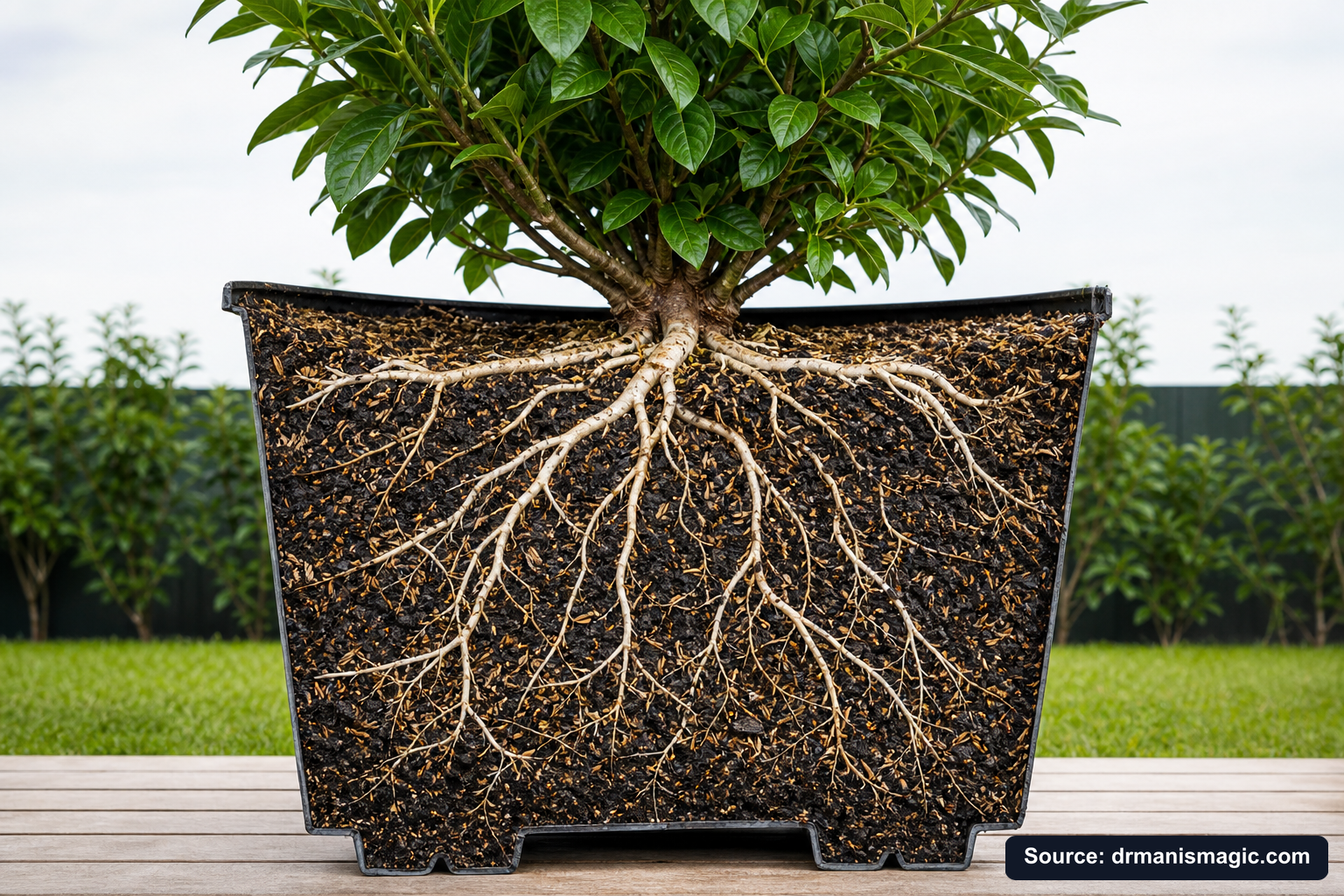
The Bottom Line: Healthy Soil Is Architecture
Here is everything we covered, brought back to one simple idea. Healthy soil is not about what you add to it. It is about how it is built. The structure. The pore space. The stable, permanent particle arrangement that keeps air and water balanced in the root zone, day after day, year after year, without collapsing into anaerobic sludge.
Standard potting mix is designed for the supply chain, not for your roots. It is lightweight for shipping. It is cheap for manufacturers. And it looks great in a bag. But it is made from decomposing pine bark, a carbon-based organic material that breaks down over time, consumes oxygen, collapses its own pore space, and turns your root zone into an airless, waterlogged environment where root rot waits for an invitation. The drainage hole in your pot cannot save roots that are sitting in a medium that has already turned to muck.
Mineral-based soil, built on silica-rich particles that do not decompose, is a different category of thing entirely. It holds its structure. It keeps pore space open. It lets roots breathe and drink and grow the way they were designed to. Pair that with a living microbial community and slow-release organic nutrition, and you have built the Three Plant Pillars, the only foundation that puts nature on your side instead of working against you.
We have proven this across 250,000 trees at US Citrus Nursery in South Texas. We have seen it work in citrus, in tropicals, in houseplants, in roses, in palms, in vegetable gardens. The physics do not change. The results do not lie. If you are ready to stop starting over and start building something permanent, the best time to make the switch is today. Take a look at what we have built for you at Super Soil and see what a real foundation feels like.
Frequently Asked Questions
Most gardeners never think about soil structure until their plants start dying. But the physical design of your soil is the hidden force behind every healthy root, every juicy fruit, and every lush green lawn. These are the questions we hear most often, and the answers could save your plants right now.
Why do my plant roots need oxygen if plants make their own oxygen above ground?
Your leaves make oxygen through photosynthesis. But your roots are doing a completely different job. They are running like tiny engines around the clock, pumping water, pulling nutrients, and building new cells. All of that work burns fuel, and fuel requires oxygen. No oxygen in the soil means the root engine shuts down. The plant looks fine on top for a while. Then it collapses fast. This is the number one thing nobody tells you at the garden center.
What makes standard potting mix so bad for roots over time?
Most potting mix is made from pine bark and wood sawdust. Those are organic, carbon-based materials. They break down. As they decompose, they compact and squeeze shut the tiny air pockets your roots depend on to breathe. What started as light and fluffy soil turns into a dense, wet sponge that holds too much water and blocks oxygen. This is not a watering problem. It is a physics problem built right into the bag you bought.
What is mineral-based soil and why does it stay open longer?
Mineral-based soil uses silica-rich sandy loam instead of organic wood material. Silica is inorganic. It does not decompose. That means the air channels inside the soil stay open for years instead of collapsing within months. Dr. Mani's Magic Super Soil is built on this exact foundation, sourced from the Rio Grande Valley in South Texas. We tested it across more than 250,000 trees at our nursery. The roots stay healthy because they keep breathing.
Is root rot really caused by overwatering, or is something else going on?
Overwatering gets all the blame, but collapsed soil is the real villain. When your soil loses its air pockets, water has nowhere to drain and oxygen has no way in. Even a normal amount of water then becomes deadly. The roots sit in a wet, airless zone and begin to rot. A drainage hole at the bottom of your pot cannot save roots when the soil itself has already sealed shut. Fix the soil structure first, and overwatering becomes far less of a danger.
How do the Three Plant Pillars connect to soil structure?
The Three Plant Pillars work together as one system. Pillar One is mineral-based soil that keeps its structure and lets roots breathe. Pillar Two is live microbes that build a living ecosystem in that soil, breaking down nutrients and fighting disease. Pillar Three is organic fertilizer that feeds plants slowly without burning the microbes away. If your soil structure collapses, Pillars Two and Three cannot do their jobs. Healthy soil architecture is the foundation everything else stands on.
How fast will I notice a difference if I fix my soil structure?
Most people see a change within the first few weeks. Roots that can breathe again start pulling water and nutrients the way they are supposed to. Yellowing slows down. New growth appears. The turnaround is not magic, it is just nature working the way it was designed to when you stop fighting it. Dr. Mani's products are backed by a 30-day guarantee. If you are not happy with your results, you get your money back. No runaround, no excuses.
Does fixing soil structure work for all plants, not just citrus trees?
Yes, completely. Roots are roots. Whether you are growing grass, houseplants, tomatoes, roses, tropical trees, or a backyard orchard, every root on every plant needs oxygen, live microbes, and slow-release nutrition. Dr. Mani developed the Three Plant Pillars by testing on over 250,000 citrus trees at our South Texas nursery. But the same principles apply to any plant you grow. Soil structure is a universal law of nature, not a citrus-specific trick.
About the Author
Ron Skaria, MD
Ron Skaria, MD, is the co-founder of Dr. Mani's Magic and the son of Dr. Mani. He trained as a medical doctor at Baylor College of Medicine, did his residency at UT Health Science Center - San Antonio and fellowship training at Texas Tech University. He now works full time on the family farm at US Citrus and US Citrus Nursery in Hargill, Texas, building Dr. Mani's Magic alongside his dad. He wrote the Brown Thumb Field Guide to put his father's 48 years of plant science into plain words any gardener can use. His belief is simple. You never had a brown thumb. You just never had the right help.


