


The Soil Police That Keep Ecosystems Stable and Your Plants Alive | Dr. Mani's Magic
The Soil Police That Keep Ecosystems Stable (And Why Your Plants Die Without Them)
Picture your backyard on a quiet Saturday morning. The coffee is hot. The air smells like damp earth and fresh grass. You walk outside, barefoot, and look at your garden. Maybe there are fruit trees. Maybe there are flowers. Maybe there is a patch of lawn so green it almost glows. Everything is alive. Everything is thriving.
Now picture the opposite. Brown leaves. Drooping stems. A tree you paid good money for, sitting in a pot, going nowhere. You fed it. You watered it. You Googled it at midnight. And still, something is missing. You just can't figure out what.
Here is the part nobody told you. There is an entire invisible world living in the soil under your plants. Billions of tiny creatures. They patrol the root zone like a police force. They recycle nutrients, chase down pathogens, and build the underground highways your plant roots travel. When this invisible police force is alive and working, plants explode with life. When it is dead or damaged, nothing you do on the surface will save the plant underneath. This is the story of the soil police that keep ecosystems stable, and why understanding them could change every plant you ever grow.

Organic Fertilizer | Crab, Kelp & Amino Acids
Key Takeaways
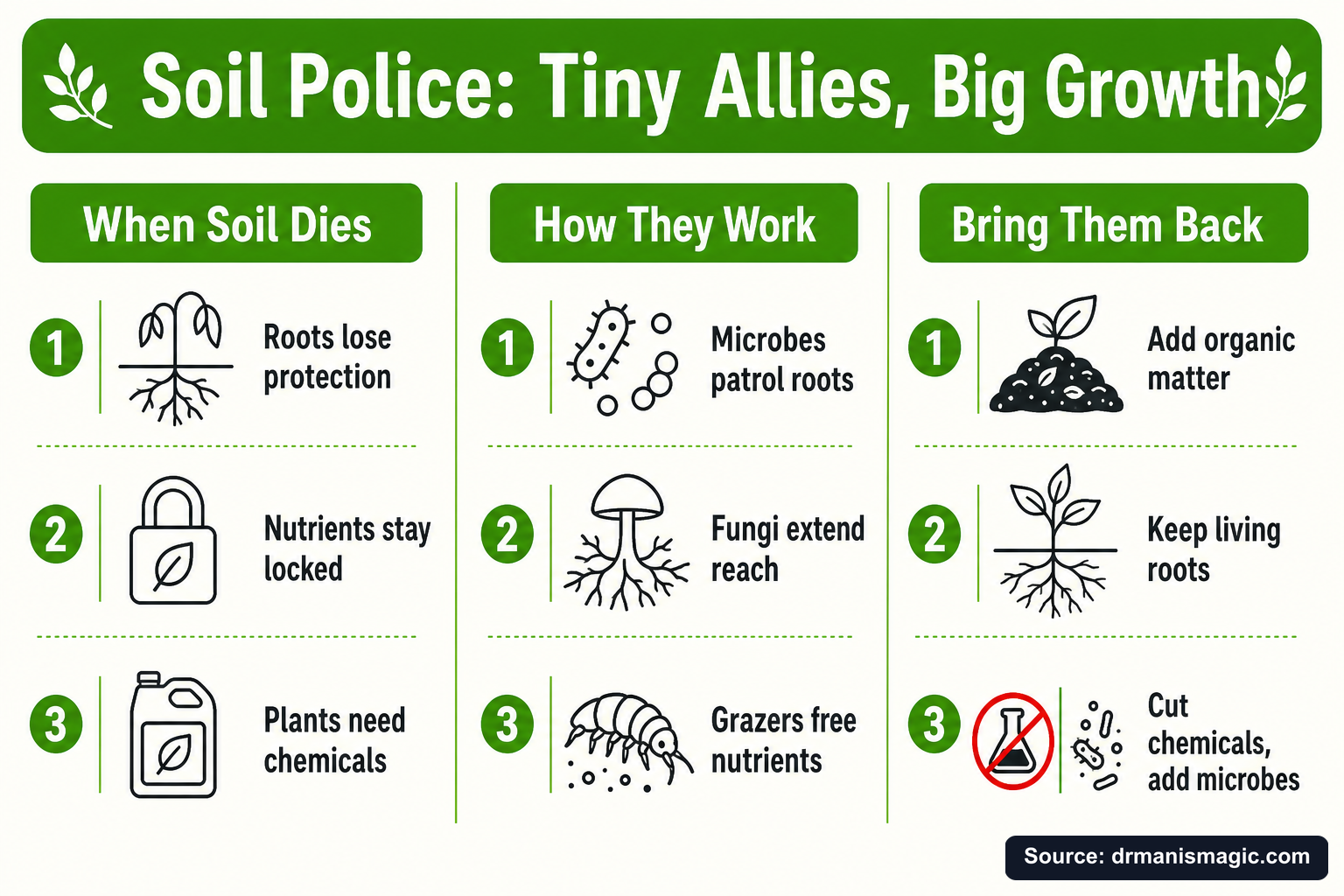
- The soil food web is a living system of bacteria, fungi, protozoa, nematodes, and microarthropods that regulate nutrient release, pathogen suppression, and root health.
- Mycorrhizal fungi originated over 400 million years ago and extend root access to water, phosphorus, and stress protection far beyond what roots can reach alone.
- Salt-based synthetic fertilizers, fungicides, herbicides, and pesticides all kill beneficial soil organisms, leaving your plants defenseless and dependent on chemical inputs forever.
- Most microbial products on store shelves are dead powder or stinking anaerobic liquid. Neither works the way fresh, living biology does.
- Dr. Mani's Magic Plant Super Boost is stabilized, full-spectrum, and harvested from active compost, not factory-grown. You can see the live microbes move under a microscope.
- Damaged soil can recover, but it takes the right steps in the right order, including organic matter, living roots, reduced chemical inputs, and regular microbial reintroduction.
- The Three Plant Pillars, mineral-based soil, live microbials, and organic fertilizer, form the complete foundation that lets the soil police do their job.
Who Exactly Are the Soil Police?
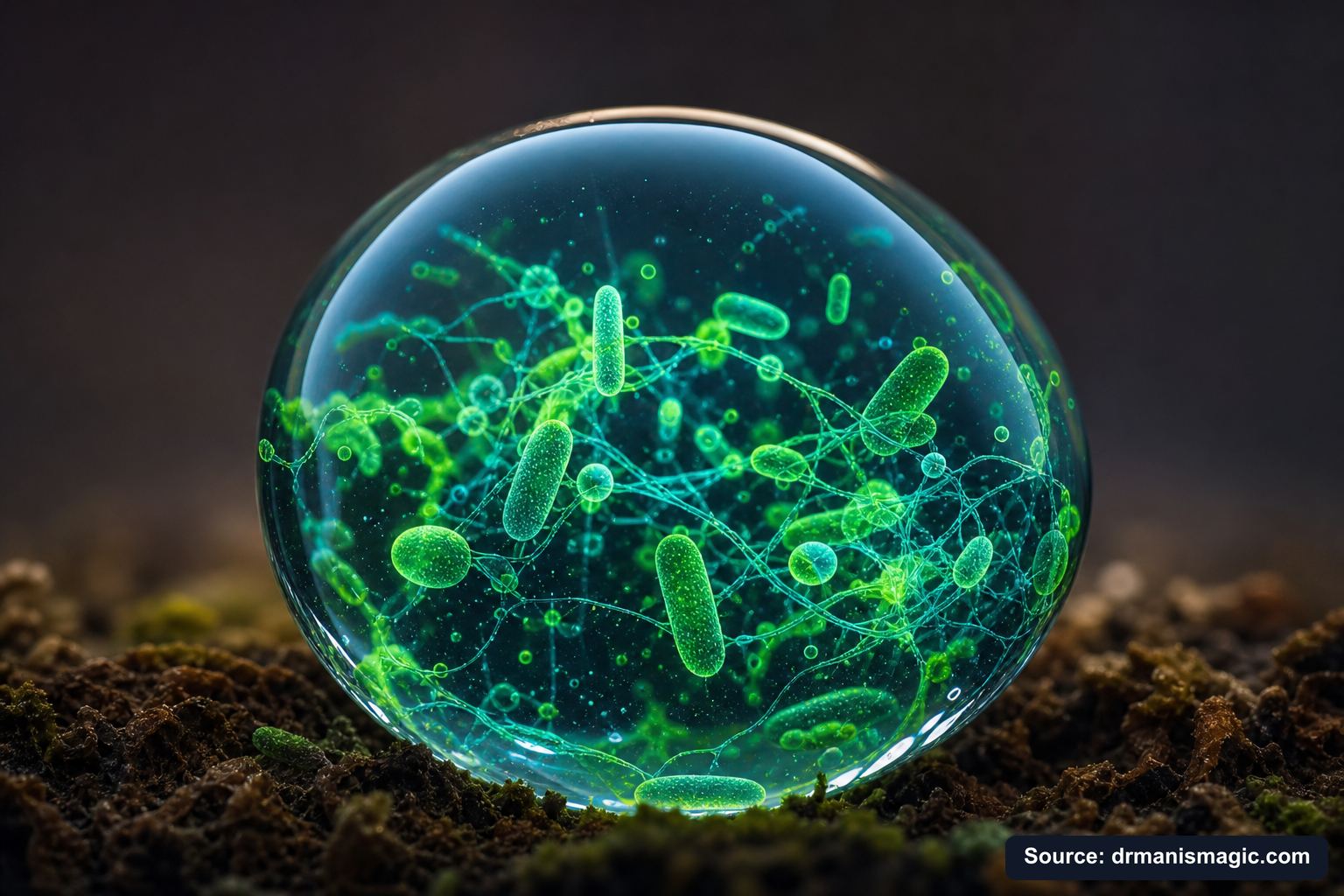
Quick Answer: The soil police are the living organisms inside healthy soil that regulate nutrient cycling, pathogen control, and root protection. They include beneficial bacteria, fungi, mycorrhizae, protozoa, nematodes, and microarthropods. Each group has a specific job, and together they keep the soil ecosystem stable, self-regulating, and productive.
Think of soil as a city. Every city needs workers, officers, engineers, sanitation crews, and border guards. Healthy soil has all of these, and they are microscopic.
This living network is called the soil food web. University of California Agriculture and Natural Resources extension describes it as a community of organisms living all or part of their lives in the soil, linked together through feeding relationships that drive nutrient cycling and energy flow. UC ANR and other land-grant university programs have documented this for decades. But most gardeners never hear about it because it does not sell bags of chemical fertilizer.
Here is who the soil police actually are and what each group does on patrol.
| Organism | Nickname in the Soil City | Primary Role | What Happens Without Them |
|---|---|---|---|
| Decomposer bacteria | Sanitation Crew | Break down dead organic matter into plant-available nutrients | Nutrients stay locked up; organic matter piles up undigested |
| Decomposer fungi | Heavy Equipment Operators | Break down tough residues like wood and cellulose; build soil aggregates | Soil compacts; structure collapses; water pools and drowns roots |
| Mycorrhizal fungi | Border Patrol and Infrastructure | Extend root reach by up to 1,000 times; deliver water and phosphorus; produce glomalin for soil structure | Roots stay small; plants stress under drought; phosphorus stays locked in soil |
| Protozoa | Patrol Officers | Graze on bacteria; release nitrogen in plant-available form right at the root zone | Nitrogen stays trapped inside bacteria; plants stay hungry even with fertilizer |
| Beneficial nematodes | Detectives and SWAT Team | Regulate bacterial and fungal populations; hunt and destroy pest larvae and pathogens | Pathogen populations explode; pest larvae survive in soil unchecked |
| Microarthropods | Infrastructure Engineers | Shred organic matter into smaller pieces; create soil pore space for air and water | Organic matter breaks down slowly; soil pores close; roots suffocate |
| Earthworms | Road Construction Crew | Aerate soil; mix layers; deposit nutrient-rich castings | Soil layers separate; air channels close; nutrient distribution stops |
After growing over 250,000 trees at our South Texas nursery, we learned something that most garden centers will never tell you. The health of the plant above ground is almost entirely a reflection of what is happening below ground. Feed the soil police. Everything else follows.
How Does the Rhizosphere Act Like the Control Room of Your Soil?
Quick Answer: The rhizosphere is the thin zone of soil surrounding plant roots where most biological activity happens. Plant roots release sugars and compounds that feed bacteria and fungi. Those microbes attract grazers like protozoa. The grazers release nutrients plants can absorb. This loop runs 24 hours a day and is the engine behind all plant growth in nature.
Your plant's roots are not just anchors. They are broadcasting stations. Every day, your plant pushes sugars, amino acids, and signals out through its roots into the surrounding soil. Scientists call this zone the rhizosphere. University of Minnesota Extension describes the rhizosphere as the most biologically active zone in any soil ecosystem, with microbial populations up to 1,000 times denser than in bulk soil.
Here is the loop that makes it all work.
- Plant roots release sugars and compounds into the soil around them.
- Bacteria and fungi rush in to eat those sugars. Populations explode.
- Protozoa and bacterial-feeding nematodes arrive to graze on the bacteria.
- As they eat, they release excess nitrogen directly into the root zone as plant-available ammonium.
- The plant absorbs that nitrogen. It grows faster. It releases more sugars. The loop repeats.
This is why plants in nature never need a bag of fertilizer. The soil police run a self-regulating nutrient delivery system that has been operating for hundreds of millions of years. Rutgers NJAES notes that mycorrhizal fungi first appeared more than 400 million years ago and are thought to have played a critical role in helping plants colonize dry land. The partnership between plants and soil organisms is not new. It is ancient, tested, and deeply reliable when left intact.
The problem is that most modern gardening practices do not leave it intact. They destroy it.
What Kills the Soil Police and Why Does That Wreck Your Plants?
Quick Answer: Salt-based synthetic fertilizers, broad-spectrum pesticides, fungicides, and herbicides all kill or severely damage beneficial soil organisms. When the soil police are gone, pathogens take over, nutrients lock up, roots shrink, and plants become dependent on more and more chemical inputs just to stay alive. The damage compounds over time.
Here is the painful truth. Most of what gets sold at big box garden centers actively destroys the very system your plants need to thrive. It is not malicious. It is just how the business model works. A plant that struggles keeps buying product. A plant with a living soil system stops needing most of what they sell.
Salt-based fertilizers are the most common culprit. They push a quick flush of nutrients into the soil. The plant greens up fast. You feel good. But the salts that carry those nutrients are toxic to bacteria and fungi. The soil police absorb the hit. Their populations drop. The next time you fertilize, you need more product because the biological delivery system is weaker than it was before. It is a cycle designed for repeat purchases, not for healthy plants.
See also: The Hidden Reason Synthetic Fertilizers Cause Root Rot
Fungicides are even more targeted in their damage. They are designed to kill fungi, but they do not distinguish between the pathogenic fungi you want dead and the mycorrhizal fungi your plant needs desperately. One application of a broad-spectrum fungicide can collapse the mycorrhizal network your plant spent months building.
| What You Put In the Soil | How It Hurts the Soil Police | Result You See in Your Plant | What to Do Instead |
|---|---|---|---|
| Salt-based synthetic fertilizer | High salts kill bacteria and fungi; osmotic stress collapses microbial populations | Quick green-up followed by yellowing, stunted growth, increased pest pressure | Switch to organic slow-release fertilizer; flush soil; reintroduce live microbes |
| Broad-spectrum fungicide | Destroys mycorrhizal networks along with target pathogens | Short-term disease control followed by weak roots, drought stress, nutrient deficiency | Use targeted biocontrol; reintroduce mycorrhizae after treatment |
| Synthetic herbicide (glyphosate) | Disrupts bacterial communities; reduces microbial diversity | Soil biology collapse over repeated use; increased disease susceptibility | Mechanical weed control; cover crops; reduce herbicide frequency |
| Broad-spectrum pesticide | Non-selective toxicity to protozoa, nematodes, and microarthropods | Nutrient cycling slows; pest pressure rebounds stronger as predators are eliminated | Targeted organic pest control; restore predator populations through biology |
| High-salt irrigation water or sodium buildup | Damages soil structure; collapses pore space; kills beneficial bacteria and fungi | Compaction, poor drainage, root rot, nutrient lockout | Test water quality; improve drainage; use mineral-based soil; add beneficial microbes regularly |
We have seen this pattern repeat thousands of times. A grower spends years fighting disease, pouring on more product, watching trees stall. Then they stop the chemical inputs, rebuild the biology, and within a season the tree does things it had never done before. The soil police were there all along. They just needed to be let back in.
Are Nematodes Good or Bad for Your Plants?
Quick Answer: Most nematodes are beneficial. Pest nematodes that attack plant roots are only a small fraction of the nematode world. Beneficial nematodes hunt and destroy soil-dwelling pest larvae, regulate bacterial and fungal populations, and help drive the nutrient mineralization cycle that feeds your plants.
Nematodes have a reputation problem. Say the word to most gardeners and they picture the root-knot nematode, the tiny worm that attacks tomatoes and makes roots look like a string of pearls. That fear is real but misplaced.
The vast majority of nematodes in healthy soil are beneficial. Bacterial-feeding nematodes graze on bacteria just like protozoa do, releasing plant-available nitrogen. Fungal-feeding nematodes regulate fungal populations. Predatory nematodes hunt pest insects, disease-carrying organisms, and even root-knot nematodes themselves.
When the soil food web is intact, predatory nematodes keep pest nematode populations from exploding. When you kill the soil police with pesticides and fungicides, you remove the predators. Pest nematodes fill the vacuum. The very thing you feared gets worse because you killed what was keeping it in check.
This is one of the most important patterns we have seen across 250,000 trees. Chemical solutions to biological problems almost always make the underlying biology worse. The answer to nematode pressure is not more pesticide. It is more biology.
You Never Had a Brown Thumb.
You were handed the wrong tools. This free guide hands you the right ones.
You watered it. You fed it. It died anyway.
It was never you. It was the dirt, the salt food, and the bad advice.
This guide shows you what really went wrong, and how to fix it for good.
- Why your plants really died, and why it was never your fault
- The salt hiding in your plant food that quietly burns the roots
- The hidden killer in almost every bag of store soil
- The tiny helpers that grow a whole forest for free
- The rescue trick that brings a half dead plant back to life

What Does a Mycorrhizal Fungus Actually Do for Your Plant?
Quick Answer: Mycorrhizal fungi attach to plant roots and send out microscopic threads called hyphae that extend hundreds of times farther than roots can grow. They deliver water, phosphorus, and other nutrients back to the plant. In return, the plant feeds the fungus sugars. The partnership makes roots dramatically more effective and dramatically more resilient.
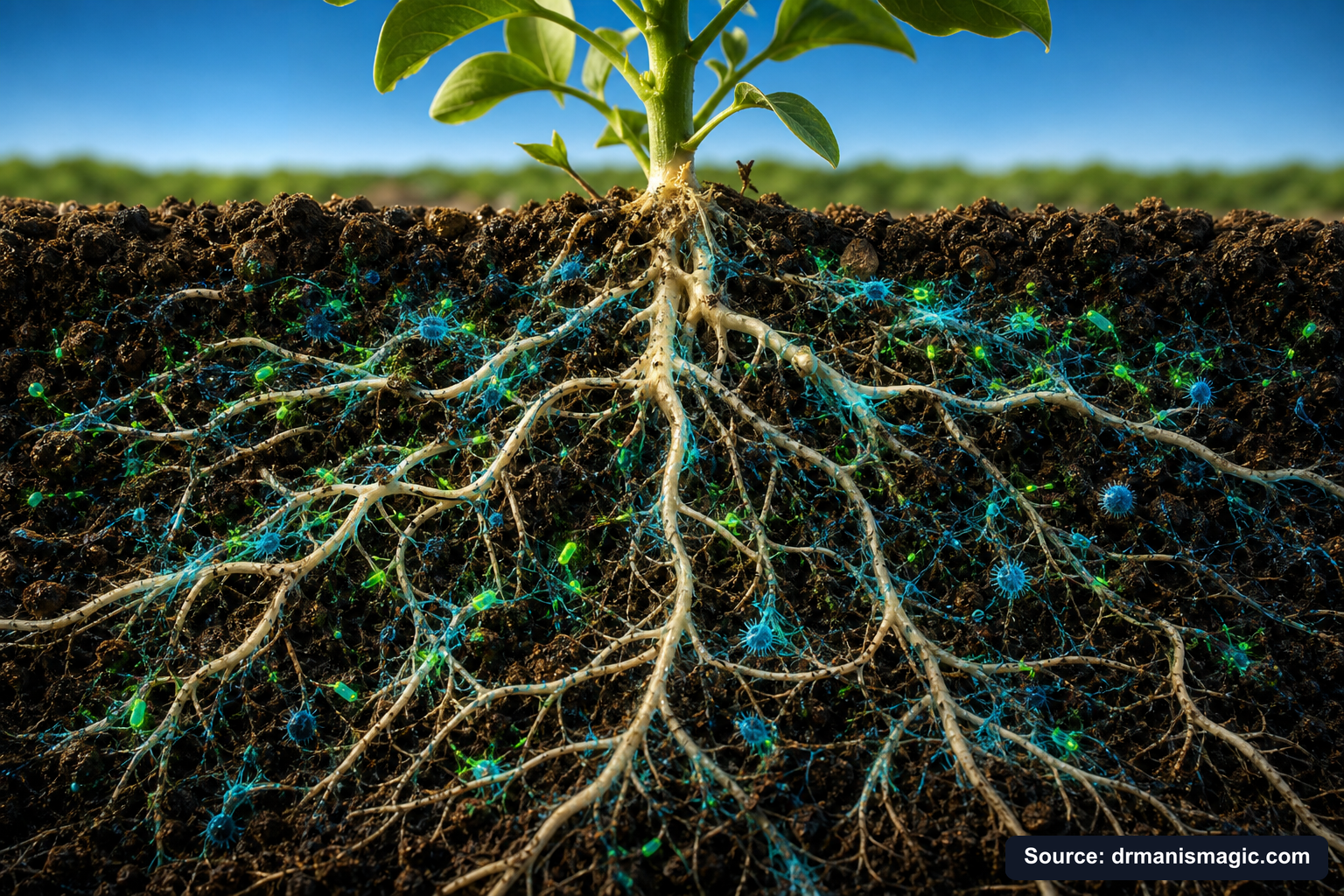
Here is a picture that might help. Imagine your plant's root system as a hand. Mycorrhizal fungi are like gloves with thousands of extra fingers attached to every fingertip. Those extra fingers reach into pockets of soil your bare roots could never touch. They find phosphorus locked to mineral particles. They find water in dry corners of the pot. They bring it all back to the plant.
But that is not all mycorrhizal fungi do. They also produce a compound called glomalin. Glomalin acts like glue. It binds soil particles into clumps called aggregates. Those aggregates create air pockets, water channels, and the loose, crumbly texture that healthy soil has. Without glomalin, soil compacts. Pores close. Roots suffocate. This is why most cheap potting mixes collapse within a year. They start sterile. No fungi. No glomalin. No structure. Just slow suffocation.
Mycorrhizal fungi also make the plant more resistant to salt stress, drought, and root-attacking pathogens. They are not a bonus feature. They are a core part of what it means for a plant to have a working root system. And yet, most commercial growing inputs actively destroy them.
Plant Super Boost contains live mycorrhizal fungi along with hundreds of bacterial species, protozoa, and nematodes, all stabilized and delivered in a form that is genuinely alive when it reaches your plant's roots. You can take a drop, look at it under a microscope, and watch the microbes move. That is not marketing. That is biology you can see.
Why Do Most Microbial Products on Store Shelves Fail to Work?
Quick Answer: Most store-bought microbial products either contain dead or dormant organisms that never fully revive, or they are liquid compost teas that have already gone anaerobic and rotten by the time you pour them. Neither delivers the live, diverse biological population your soil actually needs. Genuinely live, stabilized, full-spectrum microbes are rare and hard to produce.
This is the part of the soil health conversation that nobody in the industry wants to have honestly.
The microbial supplement market is booming. Walk down any garden center aisle and you will find powders, liquids, and granules all promising to restore your soil biology. Most of them do not work. Here is why.
The Three Types of Microbial Products (and Their Fatal Flaws)
Type 1: Dried powder or granules from factory labs. These products are made by growing specific bacterial strains in giant industrial vats, then drying them into spores. The idea is that the spores reactivate when you add water. In practice, we have tested dozens of batches. They simply do not help the plants. The species are too narrow, the survival rate after drying is too low, and the organisms are not the same as what lives in a thriving natural soil ecosystem.
Type 2: Compost tea or liquid products that have gone anaerobic. These start with a real biological source, like compost or worm castings. But by the time they are bottled, shipped, and sitting on a shelf, the oxygen runs out. The microbes die. The bottle starts to ferment. You can tell because it smells like rotting sewage. Some gardeners still see a little benefit from the humic acids and organic compounds left behind, but the live biology is gone. You are paying for a dead product.
Type 3: Lactobacillus-based products. Easy to make. Very vigorous. But lactobacillus belongs in yogurt, not in your soil. It outcompetes the beneficial microbes you actually need. We leave it out of Plant Super Boost on purpose.
See also: Why Most Fertilizers Are Actually Salt in Disguise
Live vs. Dead Microbial Products: What You Are Actually Getting
| Product Type | Organism Source | Viability When You Use It | Spectrum of Life | Smell | Does It Work? |
|---|---|---|---|---|---|
| Dried powder from factory | Lab-grown, single strains | Low (spores often don't revive) | Very narrow | Little to none | No meaningful results in our trials |
| Dry powder rehydrated in liquid | Lab-grown, single strains | Low | Very narrow | Little to none | No meaningful results in our trials |
| Compost tea, fresh under 24 hours | Active compost | Moderate, if aerated and used immediately | Partial, varies by compost | Earthy | Yes, if made and used correctly |
| Compost tea, older than 24 hours | Active compost | Low, anaerobic die-off | Partial | Strong, foul odor | Minimal, mostly dead biology |
| Fish emulsion or biosludge-based products | Fish waste, municipal biosolids | Variable | Variable, risk of PFAS and biosludge contamination | Very strong odor | Some nutrients but serious safety and smell concerns |
| Plant Super Boost (stabilized, full-spectrum) | Hand-crafted active compost, all-natural stabilization | High, visibly alive under microscope | 2,000+ bacteria species, 400-500 fungi including mycorrhizae, plus protozoa and nematodes | Earthy, not foul | Yes, proven across 250,000+ trees |
The difference is not a small one. It is the difference between hiring a real police force and putting cardboard cutouts on the corners. One regulates the neighborhood. The other just looks like it might.
Plant Super Boost is Zero PFAS, Zero Biosludge, and Zero Synthetic Salts. That matters for your family, your pets, and your soil.
Can Damaged or Sterile Soil Come Back to Life?
Quick Answer: Yes, damaged soil can recover, but it takes time, the right inputs in the right order, and patience. Recovery is not instant. A soil that has been sterilized, salted, or chemically damaged needs organic matter, living roots, reduced disturbance, moisture and aeration, and regular reintroduction of diverse live microbes before the full soil police force returns to patrol.
This question matters more than almost any other in practical gardening. Because most soil in pots, raised beds, and even home gardens has been damaged. Sterilized potting mix. Salt-fertilizer history. Pesticide residue. Compaction from foot traffic. The biology is not gone forever. But it needs help coming back.
Here is what recovery actually looks like, in plain language.
When soil is sterilized or heavily damaged, the first colonizers to return are simple bacteria. They are fast and tough. They start breaking down organic matter. Then fungi arrive, building structure and extending networks. Then grazers like protozoa and nematodes arrive to eat the bacteria, releasing nitrogen. Then predators arrive to regulate the grazers. It is a succession, like a forest growing back after a fire, and it takes time.
The key word is succession. You cannot skip steps. You cannot dump a bag of powder on dead soil and expect a forest floor. You have to create the conditions for each stage to develop and then give it time to run.
Soil Recovery After Damage: A Step-by-Step Checklist
- Stop the damage first. Remove or dramatically reduce synthetic fertilizers, herbicides, fungicides, and broad-spectrum pesticides. You cannot rebuild the police force while the building keeps getting bombed.
- Improve the physical structure. Add mineral-based soil to containers, or work in biochar and organic matter to ground beds. Roots need air. Compacted soil cannot support a living food web.
- Add organic matter. Compost, aged wood chips, or organic mulch on the surface feeds the decomposer bacteria and fungi that are the first responders in soil recovery.
- Keep living roots in the soil. Roots release exudates that feed and attract microbes. Bare soil between seasons loses the biological momentum you built. Cover crops or even weeds are better than nothing.
- Apply a genuinely live, full-spectrum microbial inoculant monthly. This is where Plant Super Boost comes in. The first application starts reseeding the police force. Each monthly application deepens the population and diversity. Think of it like depositing money in a biological savings account that compounds over time.
- Feed the microbes organically. Switch to a slow-release organic fertilizer like Crab, Kelp and Amino Acids, which feeds the soil biology instead of salting it out.
- Give it time and repeat. Depending on how damaged the soil was, meaningful recovery takes three to six months of consistent effort. Full restoration of a diverse soil food web may take a full growing season or longer. But the plants tell you when it is working. Leaves darken. Growth accelerates. Pest pressure drops. The soil police have returned to their beat.
We have watched this happen with our own eyes. Trees that sat stalled for two years, moving in the wrong direction, came alive within a season once the biology was restored. Time is the one thing you cannot buy back. That is why starting this process today, not next spring, matters so much. Every season you lose waiting for things to improve on their own is a season you will never get back.
The Three Plant Pillars vs. The Old Way: Why One Works and One Doesn't
Quick Answer: The Three Plant Pillars, mineral-based soil, live microbials, and organic fertilizer, work with the soil food web instead of against it. The old way of cheap potting mix, salt fertilizers, and chemical inputs destroys the very biological system plants depend on. One builds compounding health. The other creates compounding dependence.
Dr. Mani Skaria spent 40 years as a plant pathologist at the Texas A&M Citrus Center watching what actually made plants thrive and what made them fail. He traveled the world testing products. He ran trials on thousands of trees. And he kept arriving at the same conclusion. The growers who worked with soil biology consistently outperformed the growers who fought against it.
The Three Plant Pillars are his answer to that conclusion. Not a collection of random products. A system built around how plants actually work in nature.
Three Plant Pillars vs. The Conventional Approach
| What You Are Doing | Three Plant Pillars (Dr. Mani's Way) | Conventional Approach (Big Box Way) |
|---|---|---|
| Soil foundation | Mineral-based, permanent, drains well, never compacts or steals oxygen from roots | Bark and sawdust-based potting mix that breaks down, compacts, and causes root rot within months |
| Microbial life | Live, full-spectrum inoculant with 2,000+ bacteria species, 400-500 fungi, protozoa, and nematodes applied monthly | Sterile soil with no biology, or dead powdered microbes that never revive |
| Fertilizer | Organic, slow-release, salt-free crab, kelp, and amino acids that feed the soil and the plant together | Salt-based synthetic fertilizer that kills microbes, locks out water, and creates dependency cycles |
| Long-term result | Compounding health: stronger roots, better fruiting, higher pest resistance, self-regulating soil ecosystem | Compounding fragility: weaker biology over time, more product needed each season, higher disease pressure |
| Safety | Zero PFAS, Zero Biosludge, Zero Synthetic Salts. Safe for children, pets, and barefoot walks through the garden | Warning labels. Re-entry intervals. Chemical exposure risk. Questions you don't want to answer around your family |
One path gets better every season. The other gets worse. That is not an opinion. That is what we have watched happen across 250,000 trees over more than 30 years.
What Can You Do Right Now to Feed Your Soil Police?
Quick Answer: Start by stopping the inputs that kill your soil biology. Then add organic matter, improve soil structure, and introduce genuinely live, full-spectrum microbes every month. The soil police rebuild fast when you give them the right conditions. Most growers see visible improvement in plant color, growth rate, and pest resistance within one to three months of consistent biological care.
You do not need a farm. You do not need an advanced degree. You do not need to make your own compost tea at 5 in the morning before work.
You need three things working together. Mineral-based soil that breathes. Live microbes that patrol. Organic fertilizer that feeds without burning. That is the system. That is what works. Everything else is noise.
The number one thing we hear from growers who finally make this shift is that they wish they had done it sooner. Not because of the money they wasted on the old way. Because of the time. The seasons that passed. The harvests that never came. You can always earn more money. You cannot get back a season of growth. You cannot fast-forward a fruit tree. The best time to restore your soil biology was last year. The second best time is today.
Download our Free Plant Care Field Guide to get the complete system in plain language, including how to apply each pillar, how to water correctly, and how to diagnose what your soil police are trying to tell you through your plant's leaves, roots, and growth patterns.
The soil police are waiting to be put back on duty. Give them a living soil to work in. Give them organic food to feed on. And give them the biological backup of a truly live microbial inoculant. When all three pillars are in place, the invisible workforce wakes up. The roots reach deeper. The leaves get darker. The fruit actually comes. And you get to stand in your backyard on a Saturday morning, coffee in hand, barefoot in the grass, with a very well-earned smug grin on your face.
Frequently Asked Questions
Most gardeners never hear about the living world inside their soil. That is exactly why plants die for no obvious reason. These questions cut straight to the truth about what soil biology actually does, why most store-bought fixes make things worse, and what Dr. Mani's Three Plant Pillars do to fix the foundation fast.
How does soil biodiversity help keep an ecosystem stable?
Soil biodiversity means billions of bacteria, fungi, and other tiny creatures all doing different jobs at the same time. Some break down dead material. Some chase off disease. Some unlock nutrients your plant roots cannot reach alone. When you have that full team working together, your garden becomes self-regulating. Pests get controlled naturally. Nutrients cycle back without you doing anything. That is real stability. Dr. Mani proved this across 250,000 citrus trees at US Citrus Nursery. A living soil fixes problems before you ever see them.
What are the biggest benefits healthy soil gives your plants?
Healthy soil does five things nothing else can replace. It anchors roots and feeds them. It soaks up water and filters out junk. It holds carbon and keeps the ground from baking. It houses the microbes that protect your plants from disease. And it recycles dead matter back into food for new growth. Every single one of those benefits depends on living biology in the soil. Kill the biology and you lose all five. That is why Dr. Mani built Plant Super Boost around live microbes, not dead powder.
How does biodiversity underground keep your garden from falling apart?
Think of it like a team. Decomposers recycle nutrients. Fungi build highways for roots. Bacteria fight off pathogens. Protozoa eat bad guys. When you have many different species doing many different jobs, the system covers itself. One group struggles and another picks up the slack. But strip that diversity with synthetic fertilizers or harsh pesticides and the whole system collapses. Your plant is suddenly on its own with no backup. That is when you start Googling at midnight wondering why your tree looks terrible.
What are the Three Plant Pillars and how do they connect to soil health?
Dr. Mani cracked the code after 35 years of growing citrus, houseplants, and tropical trees. He found that every thriving plant needs three things working together. First, a mineral-based soil that drains well and never compacts or rots. Second, live microbes that fight disease, unlock nutrients, and build root strength. Third, organic fertilizer that feeds slowly without burning the soil biology. That is the Three Plant Pillars. Each one supports the others. Skip one and the whole system weakens. Get all three right and your plants become practically bulletproof.
Why do synthetic fertilizers hurt the soil police that protect your plants?
Salt-based synthetic fertilizers are like dropping a bomb on your soil city. They give a fast green burst on the surface while wiping out the bacteria and fungi underground that your plant actually depends on. No microbes means no nutrient cycling, no pathogen defense, and no root support. So you buy more fertilizer. The plant gets worse over time. You spend more money and more time and nothing improves. Dr. Mani watched this trap hurt growers for decades before building an organic system that works with nature instead of against it.
What is the best way to protect your soil from damage?
Stop feeding the soil chemicals it cannot handle. Start adding organic matter and live biology back in. Keep living roots in the ground as long as possible. Reduce tilling that breaks apart the underground highways fungi spend months building. Use a mineral-based soil that does not compact or rot over time. And feed with slow-release organic fertilizer that nourishes the microbes while it feeds the plant. Dr. Mani's Super Soil, Plant Super Boost, and Crab Kelp and Amino Acids fertilizer do all of this together without the guesswork.
What type of soil is most stable for growing plants in containers or gardens?
Mineral-based soil wins every time. Most potting mixes are loaded with pine bark and sawdust that break down fast. As they rot, they compact, choke roots, and block oxygen. Dr. Mani's Super Soil uses sandy loam straight from the Rio Grande Valley. It is silica-rich, steam-sterilized, and it does not decompose. Roots can breathe, water drains perfectly, and you never have to replace it. That permanent structure is the first pillar of the Three Plant Pillars because nothing else works right without a solid foundation underneath.
About the Author
Ron Skaria, MD
Ron Skaria, MD, is the co-founder of Dr. Mani's Magic and the son of Dr. Mani. He trained as a medical doctor at Baylor College of Medicine, did his residency at UT Health Science Center - San Antonio and fellowship training at Texas Tech University. He now works full time on the family farm at US Citrus and US Citrus Nursery in Hargill, Texas, building Dr. Mani's Magic alongside his dad. He wrote the Brown Thumb Field Guide to put his father's 48 years of plant science into plain words any gardener can use. His belief is simple. You never had a brown thumb. You just never had the right help.


