


How Soil Microbes Build Long-Term Fertility in Your Garden | Dr. Mani's Magic
How Soil Microbes Build Long-Term Fertility: The Invisible Workforce Behind Every Thriving Plant
Close your eyes for a second. Picture the healthiest plant you have ever seen. Maybe it was growing wild along a trail. Branches thick and heavy. Leaves a deep, glossy green. Fruit so ripe it practically fell into your hand. Nobody watered it. Nobody fertilized it. Nobody fussed over it with a calendar and a bag of chemicals.
Now picture the plant on your patio. The one you have been nursing for months. The one that always seems one bad week away from giving up. You have bought the fertilizers. You have read the blogs. You have tried all the things. And still, something feels off. The leaves are pale. The growth is slow. The fruit — if you get any at all — is small and takes forever.
Here is the thing nobody tells you. The difference between that wild, thriving plant and the one struggling on your patio is not sunlight. It is not the right brand of fertilizer. It is not even how much you water. The difference is what is living in the soil. Trillions of invisible workers called soil microbes — bacteria, fungi, protozoa, and nematodes — are the real engine behind long-term plant fertility. When they are alive and active, your plant almost cannot fail. When they are gone, no amount of chemicals will fix what is broken underground. This article is going to show you exactly how that invisible workforce builds fertility over time, why most gardening advice ignores them completely, and what you can do starting today to get them working for you.

Plant Super Boost
Key Takeaways
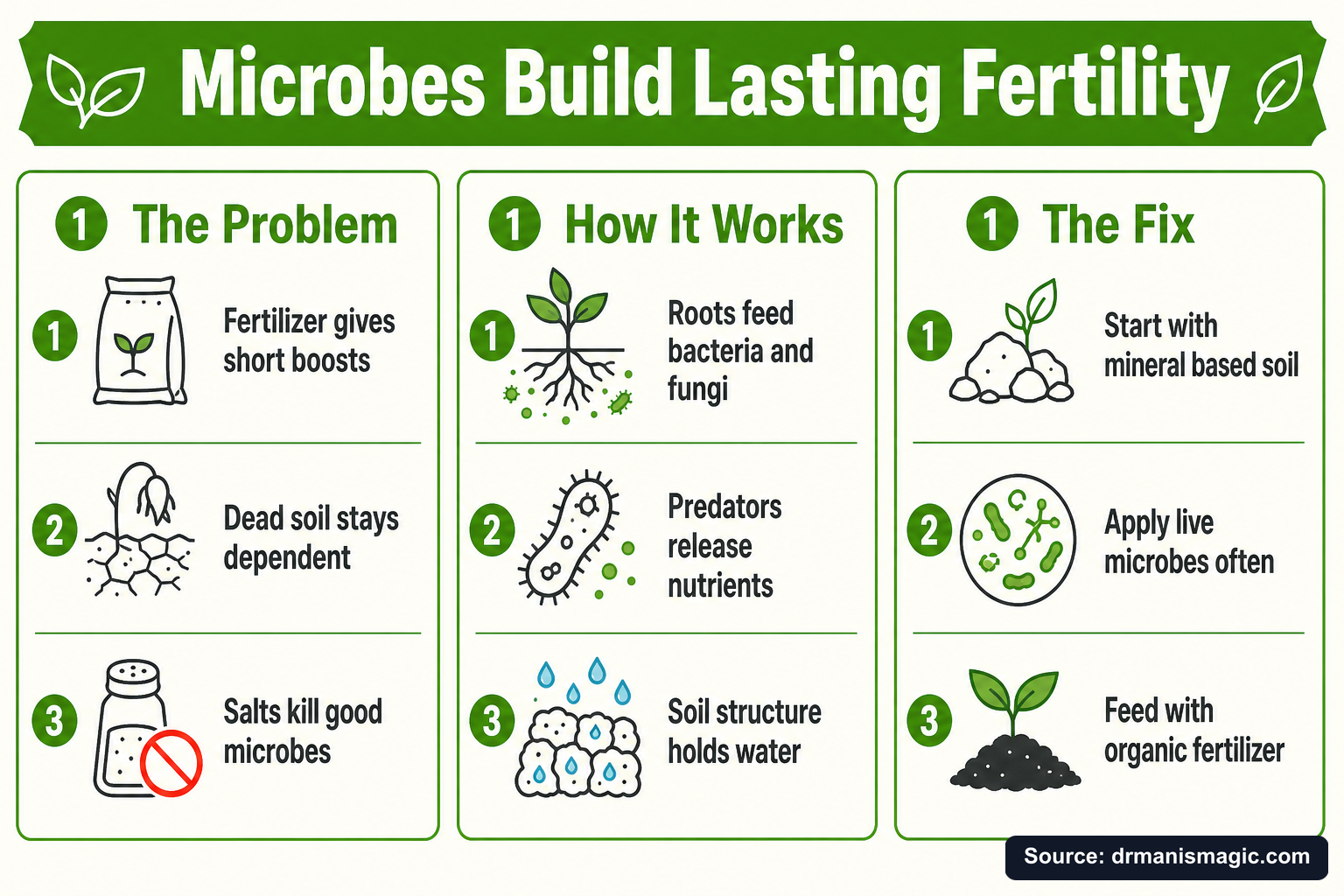
- Soil microbes — not chemical fertilizers — are the true source of long-term plant fertility, cycling nutrients, building soil structure, and protecting roots from disease.
- The soil food web is a chain: living roots feed bacteria and fungi, which feed protozoa and nematodes, which release plant-available nutrients right at the root zone.
- University of Minnesota Extension research shows soil biology can supply roughly 75% of a plant's nitrogen and 65% of its phosphorus when the ecosystem is healthy.
- Salt-based synthetic fertilizers, herbicides, fungicides, and pesticides kill beneficial microbes, quietly destroying the fertility they would have built over years.
- Dead or dried microbial products sold in most stores do not work. Live, stabilized, full-spectrum microbes applied consistently are what actually move the needle.
- The Three Plant Pillars — mineral-based soil, live microbials, and organic fertilizer — form the foundation proven across 250,000+ trees at US Citrus Nursery in South Texas.
- Restoring depleted soil biology takes time and repeated application, but the payoff compounds season after season, unlike chemical fertilizers that stop working the moment you stop buying.
What Is the Soil Food Web and Why Does It Drive Long-Term Fertility?
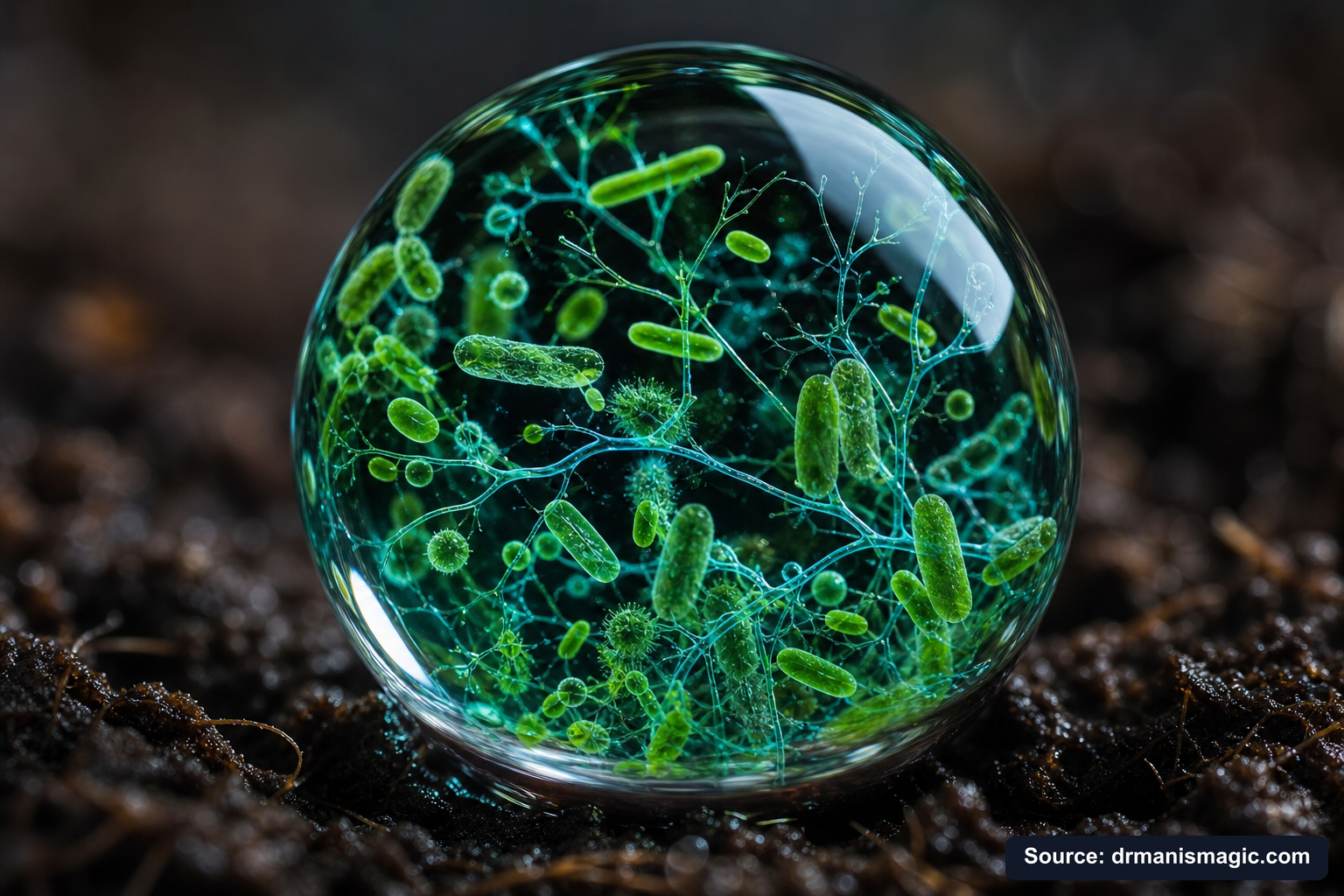
Quick Answer: The soil food web is a living chain of bacteria, fungi, protozoa, nematodes, earthworms, and other organisms that break down organic matter, cycle nutrients, build soil structure, and deliver plant-available nutrition directly to roots. When this web is active, fertility rebuilds itself season after season without synthetic inputs.
The soil food web is nature's fertility engine, and it has been running without human help for millions of years. Think of it like a bustling city underground. Every organism has a job. Every job feeds the next one. And the plant sitting at the center of it all is both the customer and the employer.
Here is how the chain works in plain language:
- Living roots release food. Plant roots leak sugars, amino acids, and organic acids into the surrounding soil. This zone around the roots is called the rhizosphere. It is the most biologically active patch of ground on earth.
- Bacteria and fungi rush in. They eat the root sugars and start breaking down dead leaves, old roots, and organic matter. As they eat, they store nutrients inside their own tiny bodies.
- Protozoa and nematodes arrive next. They eat the bacteria and fungi. When they digest their meal, they release the stored nutrients — nitrogen, phosphorus, and more — right next to the roots in a form the plant can absorb immediately.
- Earthworms and arthropods clean up. They shred larger debris, mix organic matter into deeper layers, and leave behind tunnels that let air and water reach the roots.
- The plant grows stronger. Stronger plants leak more root sugars. More root sugars feed more microbes. The cycle accelerates.
The USDA Natural Resources Conservation Service describes healthy soil as a living ecosystem, not an inert growing medium. Their soil health framework puts biological activity at the center of every fertility outcome: water infiltration, nutrient retention, disease suppression, and structural stability all trace back to the organisms living underground.
This is exactly what Dr. Mani Skaria observed after 35 years of working with citrus trees. Nature does not need a fertilizer schedule. It needs a living soil food web. That discovery became the foundation of the Three Plant Pillars system that has guided the growth of more than 250,000 trees at US Citrus Nursery in South Texas.
What Do Bacteria and Fungi Actually Do for Your Plants?
Quick Answer: Bacteria rapidly break down simple organic compounds and fix nitrogen from the air. Fungi decompose tough materials, bind soil into stable clumps, extend root reach by hundreds of times, and store carbon for long-term fertility. Together they form the two-engine core of the soil food web.
Bacteria and fungi are not interchangeable. They play very different roles, and your plants need both.
Bacteria work fast. They are the first responders. When a root releases sugars or a leaf falls to the ground, bacteria swarm it within hours. They are especially good at processing simple carbon compounds and converting atmospheric nitrogen into a form plants can actually use. This process — called biological nitrogen fixation — happens completely free of charge when your soil biology is intact. University of Minnesota Extension research shows that a healthy soil biology can supply around 75% of a plant's nitrogen needs and roughly 65% of its phosphorus — without a single bag of synthetic fertilizer.
Fungi work slower but deeper. They are built for the tough jobs. Fungi decompose woody material and complex carbon that bacteria cannot touch. They also produce a sticky protein called glomalin that glues soil particles into clumps called aggregates. Those clumps create the crumbly, sponge-like texture that lets water soak in and air reach the roots. Without fungal activity, soil packs down hard and roots suffocate.
Mycorrhizal fungi deserve special mention. These are fungi that actually grow into and around plant roots, extending the root system by hundreds or even thousands of times its natural reach. They bring water and phosphorus from far outside the root zone directly to the plant. In return, the plant feeds them sugars. It is one of the most powerful partnerships in all of nature.
Have you ever pulled a weed out of the ground and seen fuzzy white threads clinging to the roots? That is mycorrhizae. That is why weeds grow so aggressively even in terrible soil. They have a biological partner helping them. Your garden plants deserve the same advantage.
| Organism | Primary Role | Key Fertility Contribution |
|---|---|---|
| Bacteria | Break down simple carbon; fix atmospheric nitrogen | Release plant-available nitrogen; suppress pathogens |
| Actinomycetes (bacteria) | Decompose tough organic matter; produce antibiotics | Disease suppression; earthy soil smell |
| Saprophytic Fungi | Break down complex carbon (wood, lignin) | Carbon stabilization; long-term organic matter |
| Mycorrhizal Fungi (AM) | Extend root reach; mine phosphorus and water | Phosphorus delivery; drought and disease resistance |
| Protozoa | Graze on bacteria | Release stored nitrogen right at the root zone |
| Bacterial-feeding Nematodes | Graze on bacteria and fungi | Accelerate nutrient release; regulate microbial populations |
| Predatory Nematodes | Hunt pest insects and harmful nematodes | Biological pest control underground |
| Earthworms | Mix organic matter; create soil tunnels | Aeration; water infiltration; nutrient-rich castings |
| Arthropods | Shred debris; create habitat for smaller organisms | Accelerate decomposition; soil structure |
How Do Root Exudates Start the Whole Fertility Cycle?
Quick Answer: Plant roots constantly leak sugars, acids, and amino acids into the surrounding soil. This acts as food for bacteria and fungi, which kick off a chain reaction: nutrients get released, soil structure improves, and the plant receives protection and nutrition in return. No living roots means no microbial fertility cycle.
This is the part that blew Dr. Mani's mind when he first started connecting the dots. Plants are not passive. They are actively farming their own soil biology.
A plant's roots are leaking constantly. Not by accident. By design. Up to 40% of the carbon a plant captures from sunlight gets pushed out through the roots as sugars, organic acids, and amino acids. This is called root exudate, and it is the most expensive restaurant in town — open 24 hours a day, free of charge, specifically for the microbes the plant wants to recruit.
Different plants recruit different microbes. A citrus tree selects for specific bacteria and fungi that help it access phosphorus in alkaline soil. A legume recruits nitrogen-fixing rhizobia. A tomato plant surrounds itself with bacteria that suppress soil-borne disease. The plant knows what it needs. It uses root exudates to call in the right help.
This is why bare soil is dead soil. No living roots means no exudates. No exudates means no microbial activity. No microbial activity means no nutrient cycling, no disease suppression, no structure, and no fertility. The clock starts ticking backward the moment you pull a plant out and leave the ground empty.
It is also why keeping living roots in your garden year-round — through cover crops, perennial plants, or permanent tree roots — is one of the single most powerful things you can do for long-term soil fertility. The roots feed the microbes. The microbes build the soil. The soil grows the next generation of plants even stronger than the last.
Why Do Salt-Based Fertilizers Quietly Destroy the Fertility They Promise to Build?
Quick Answer: Salt-based synthetic fertilizers create high-salt conditions in the root zone that directly injure and kill beneficial bacteria and fungi. The nutrients get delivered once, but the biology that would have cycled nutrients for free — season after season — gets wiped out. You get a short green flush followed by a weaker, more dependent plant.
Here is the story nobody at the garden center wants you to know.
Synthetic fertilizers are essentially salt. When you pour them on your soil, you are creating a salty environment in the root zone. Plants absorb some of it quickly, which is why you see a fast green flush. But here is what happens to the biology underneath.
Beneficial bacteria and fungi cannot survive high-salt conditions. Salt pulls water out of their cells the same way it dehydrates food for preservation. The microbes die. The soil food web collapses. The protozoa and nematodes that were cycling nutrients from bacterial and fungal bodies have nothing left to eat. The mycorrhizal networks that were extending the root system dry up and disconnect.
Now the plant is alone. No invisible workforce. No nutrient cycling. No disease protection. No drought buffer. Just you, a bag of synthetic fertilizer, and a plant that has become completely dependent on the next application to survive.
This is not a conspiracy theory. It is basic soil chemistry. It is also, not coincidentally, an extremely profitable business model for companies that sell fertilizer by the bag. The plant struggles. You buy more. The soil gets worse. You buy more. The cycle continues.
At US Citrus Nursery, after growing more than 250,000 trees, Dr. Mani saw this pattern repeat itself so many times that he built an entirely different system. Organic, slow-release nutrition that works with soil biology instead of burning it down. Zero synthetic salts. Zero biosludge. Zero PFAS contamination. The Crab, Kelp & Amino Acids fertilizer feeds plants slowly and gently, in forms that microbes can process and plants can absorb without the salt shock that collapses the whole system.
See also: The Hidden Reason Synthetic Fertilizers Cause Root Rot
You Never Had a Brown Thumb.
You were handed the wrong tools. This free guide hands you the right ones.
You watered it. You fed it. It died anyway.
It was never you. It was the dirt, the salt food, and the bad advice.
This guide shows you what really went wrong, and how to fix it for good.
- Why your plants really died, and why it was never your fault
- The salt hiding in your plant food that quietly burns the roots
- The hidden killer in almost every bag of store soil
- The tiny helpers that grow a whole forest for free
- The rescue trick that brings a half dead plant back to life

Live Microbes vs. Dead Microbes: What Is the Real Difference?
Quick Answer: Live microbes actively colonize roots, cycle nutrients, suppress pathogens, and build soil structure. Dead or dried microbes do nothing. Most shelf products contain microbes that died during manufacturing, drying, or shipping. Only genuinely live, stabilized microbes deliver the biological benefits your soil needs.
This is where the story gets uncomfortable for a lot of brands selling microbial products.
Walk into any garden center and you will find shelves of products promising billions of microbes. Bags of powder. Bottles of liquid. Labels covered in impressive-sounding species names and colony-forming unit counts. But here is what most people never ask: are those microbes actually alive when they reach your soil?
Most of the time, the answer is no.
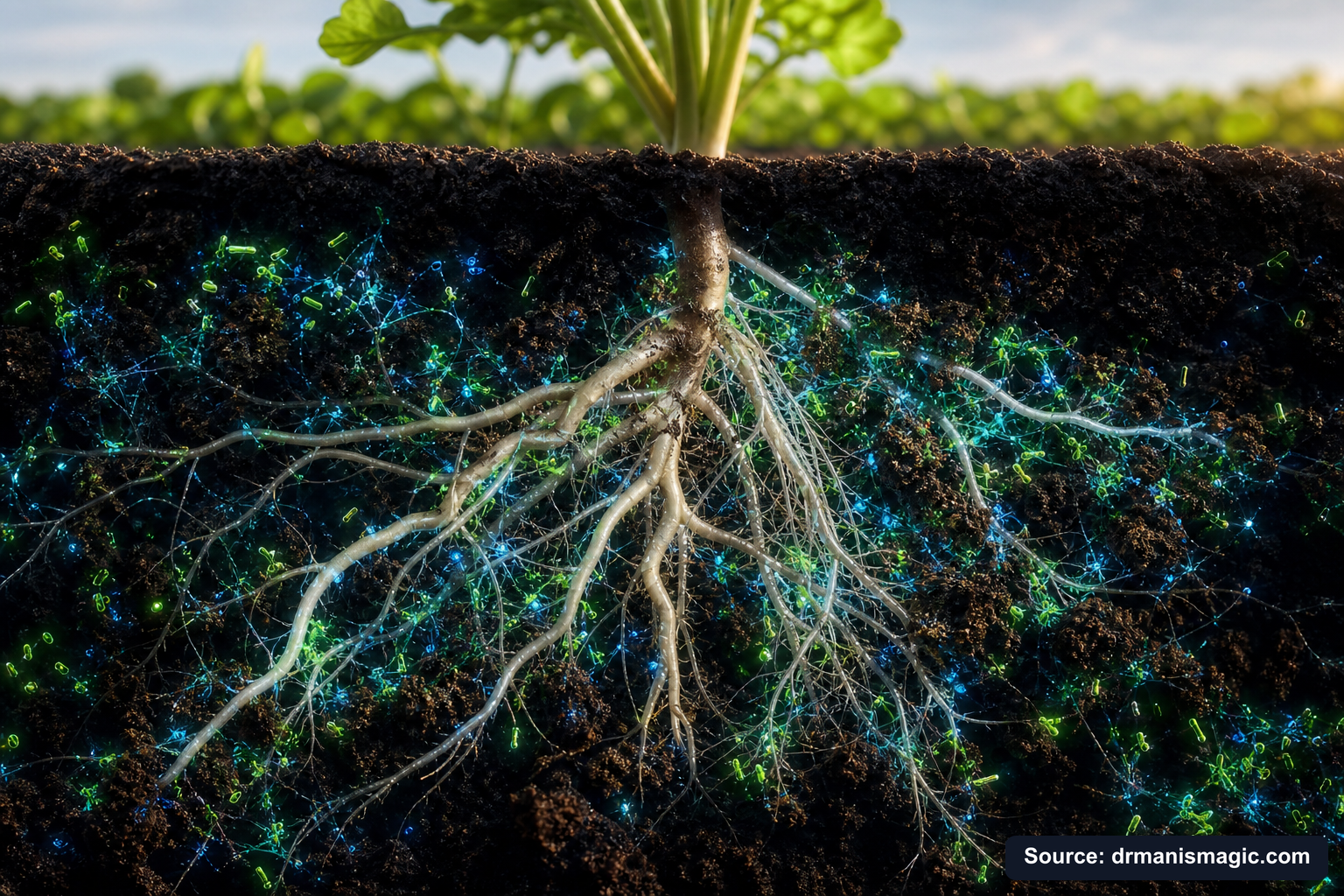
The majority of commercial microbial products are made in large factory vats where specific bacterial strains are grown, then dried into powder form. The idea is that the spores will reactivate when water is added. In practice, after grinding, drying, shipping, and sitting on a shelf under fluorescent lights, most of those spores are dead or too weak to compete with the existing biology in your soil. Dr. Mani's team tried dozens of these products on their own citrus trees. The results were consistently disappointing.
Then there is the compost tea category. These products harvest microbes from compost or earthworm castings and bottle the liquid. When they are fresh — under 24 hours old and actively aerated — they genuinely work. The problem is that by the time you buy one and pour it on your plants, the microbes inside have likely gone anaerobic. The telltale sign? The bottle smells like sewage. That stench is the smell of dying microbes fermenting in an oxygen-starved environment. Some humic and fulvic acid benefit remains, but the living biology is largely gone.
There is also the lactobacillus category — the same bacteria in your yogurt. Easy to grow, extremely vigorous. But lactobacillus is so aggressive it crowds out the beneficial microbes you actually want. It belongs in your gut. Not in your garden.
| Product Type | Viability at Use | Microbial Spectrum | Odor | Real-World Results |
|---|---|---|---|---|
| Dry / powdered lab microbes | Low — mostly dead | Narrow (single strains) | Minimal | Little to no measurable benefit |
| Dry microbes rehydrated in liquid | Low — same issue | Narrow | Minimal | Little to no measurable benefit |
| Compost tea (fresh, under 24 hours, aerated) | Moderate | Broad but inconsistent | Earthy | Good when truly fresh; impractical for most |
| Compost tea (old, sitting in bottle) | Anaerobic — dying | Partial | Strong sewage smell | Not recommended; biology largely lost |
| Lactobacillus-based products | High — but wrong organism | Very narrow | Sour | Crowds out beneficial microbes; avoid in soil |
| Plant Super Boost (stabilized, full-spectrum) | High — genuinely alive | 2,000+ bacteria; 400-500 fungi including mycorrhizae; protozoa; nematodes | Earthy — not foul | Visible microbial movement under microscope; lab-verified; consistent results |
The solution Dr. Mani found came through a providential meeting with a world-renowned compostologist who had advised the farming practices of royal families and governments across the world. This expert had developed a natural, proprietary technique to stabilize the full spectrum of microbes harvested from hand-crafted compost — keeping them genuinely alive without going anaerobic. He was eventually blacklisted by large chemical companies after citrus groves using his method started outperforming conventional operations dramatically. Years later, he joined forces with Dr. Mani's team at US Citrus Nursery.
The result is Plant Super Boost — a bottle of live, stabilized, full-spectrum microbes harvested from compost, not grown in a factory. It smells earthy because it is not rotting. And if you take a single drop and look at it under a microscope, you can see the microbes moving. Lab analyses confirm what your eyes can see: this is genuinely alive.
How Does Depleted or Sterile Soil Lose Its Fertility Over Time?
Quick Answer: Sterile or biologically depleted soil cannot cycle nutrients, build structure, or suppress disease because the organisms that perform those functions are gone. Decades of synthetic fertilizers, herbicides, fungicides, and pesticides can strip a soil of its microbial diversity, leaving plants completely dependent on external chemical inputs to survive.
Picture what happened to American farmland over the last 70 years. Before the 1950s, most farmers composted, rotated crops, and worked with the biology in their soil. Then synthetic fertilizers became widely available, and an enormous advertising machine — starting with what became Miracle-Gro — convinced an entire generation that chemistry was better than biology.
It was not.
Herbicides like glyphosate disrupted microbial communities at a population level. Broad-spectrum fungicides wiped out beneficial fungi along with the pathogens they were targeting. Synthetic pesticides reduced the arthropod and nematode populations that regulate soil health. Salt-based fertilizers accumulated in the root zone, suppressing whatever biology remained.
After a few seasons of this, the soil food web is not just weakened. It is gone. What is left is a growing medium that is essentially biologically sterile. It holds plants upright, but it cannot feed them, protect them, or build itself up over time. Every nutrient has to come from an external bag. Every disease outbreak has to be managed with another chemical. Every crop is weaker than the one before it.
This is the brown thumb problem. It is not a personal failure. It is a systemic one. The deck was stacked against you before you planted your first seed.
How Do You Rebuild Soil Biology in a Depleted Garden or Container?
Quick Answer: Rebuilding soil biology takes deliberate steps over multiple seasons: correct physical and chemical problems first, then add organic matter and living roots, then introduce live microbes, and feed them consistently with organic nutrition. Expect meaningful improvement within the first growing season, with compounding gains in every season after.
The good news is that biology is resilient. Given the right conditions and consistent inputs, microbial communities can rebuild faster than most people expect. Here is a practical recovery sequence based on what Dr. Mani's team has observed across decades of nursery work.
- Diagnose what killed the biology. Was it salt buildup from synthetic fertilizers? Herbicide or pesticide residue? Compaction? Poor drainage? Identifying the cause prevents you from rebuilding biology into a soil that will kill it again.
- Fix drainage and compaction first. Beneficial bacteria and fungi need oxygen. Waterlogged, compacted soil is anaerobic territory where only harmful organisms thrive. If you are working in containers, switch to a mineral-based soil that does not compact or decompose. If you are working in ground beds, aerate and loosen before doing anything else.
- Flush accumulated salts. If synthetic fertilizers have been used repeatedly, the salt residue needs to move out of the root zone. Deep, thorough watering — ideally with rainwater — helps flush salts downward before you introduce new biology.
- Add stable organic matter. Compost, mulch, and organic material give the returning microbes something to eat and a physical environment to colonize. This is food and habitat for the invisible workforce you are about to invite back in.
- Get living roots in the ground. Plant something. Anything. A cover crop, a companion plant, a permanent tree. Living roots release exudates that recruit and feed the microbes you need. Bare soil does not recover — it just stays bare.
- Apply live, full-spectrum microbes at the root zone. This is the moment for a genuinely live microbial inoculant, applied directly to the soil where roots are actively growing. Monthly applications build the colony over time and replenish what environmental stressors remove.
- Feed with organic nutrition that supports — not kills — the biology. Slow-release organic fertilizer keeps the plant nourished without the salt shock that resets the soil food web back to zero. Watch for the signs of returning biology: earthworm activity, crumbly soil texture, improved water infiltration, and healthier plant color over successive months.
This is not a one-time fix. It is a system. And systems compound. The first season you may see modest improvement. The second season the gains accelerate. By the third season, you have a self-reinforcing fertility cycle that does more and more work with less and less intervention from you.
The Microbial Fertility Flywheel: How It Keeps Spinning Faster Over Time
Quick Answer: The microbial fertility flywheel is a self-reinforcing cycle: living roots feed bacteria and fungi, which build soil structure and release nutrients, which grow stronger plants, which feed more microbes, which build more structure and release more nutrients. Each rotation of the flywheel is more powerful than the last.
Here is the concept that separates long-term fertility from short-term fertilizer dependency. It is the difference between a system that builds wealth and a system that spends it.
When the soil food web is intact and well-fed, it does not just maintain fertility. It builds it. Season after season. Year after year. The flywheel keeps spinning and keeps accelerating.
Think about what that means over time. A plant that started in biologically active soil in year one has a stronger root system than one that relied on chemicals. That stronger root system releases more exudates in year two. More exudates feed more microbes. More microbes build more aggregates, release more nutrients, suppress more pathogens. The plant in year three is dramatically more resilient than a chemically-fed plant of the same age.
This is what Dr. Mani saw in his nursery. Trees grown with the Three Plant Pillars system — mineral-based soil for aeration and drainage, live microbials to build and maintain soil biology, and organic fertilizer to feed plants without destroying the biology — consistently outperformed chemically-managed trees not just in the first season, but increasingly over every season that followed. The gap between the two approaches widened over time, not narrowed.
You can never get back the time you spent going the wrong direction. The seasons you spent killing your soil biology with salt-based fertilizers are gone. But the flywheel can start spinning in any direction at any time. The best time to start feeding your soil biology was years ago. The second best time is right now. The Free Plant Care Field Guide from Dr. Mani's Magic walks you through exactly how to apply the Three Plant Pillars to whatever you are growing.
When Should You Buy Microbial Inoculants vs. Just Building Better Habitat?
Quick Answer: Use live microbial inoculants when soil is biologically depleted, sterile, newly disturbed, or in containers where a natural soil food web cannot form. Focus first on building habitat — organic matter, living roots, good drainage, no synthetic salt inputs — because inoculants need habitat to survive and multiply once applied.
This is a fair question, and the honest answer is: both, in the right order.
Microbial inoculants are not magic dust you sprinkle on bad soil to make it good. They are living organisms. Like any living thing, they need the right conditions to survive and thrive after you introduce them. If you pour live microbes into soil that is waterlogged, compacted, salt-saturated, or still being treated with herbicides and fungicides, most of them will die before they can do any good.
So build the habitat first. Fix drainage. Reduce salt inputs. Add organic matter. Get living roots in the ground. Then introduce live microbes into an environment that can actually support them.
But here is the other side of that coin. If you are gardening in containers, if you are working with soil that has been under synthetic chemical management for years, or if you are planting into disturbed ground where the native microbial community was destroyed, you cannot rely on the existing biology to rebuild itself fast enough to help your current plants. You need to introduce it deliberately.
Containers are especially important. Potting mix starts biologically sterile. There is no underground network of mycorrhizal fungi waiting to connect to your plant's roots. There is no active compost layer feeding bacteria. Without deliberate inoculation, a container plant is growing in biological isolation, completely dependent on you for every nutrient it ever receives.
Monthly applications of live, full-spectrum microbes at the root zone — combined with organic nutrition and the right soil structure — give container plants something close to the biological advantage that ground-planted trees enjoy naturally.
What Does This Look Like in Practice? The Three Plant Pillars Applied
Quick Answer: The Three Plant Pillars are mineral-based soil for drainage and aeration, live microbials for biological fertility, and organic fertilizer for slow-release nutrition. Together they create the foundation that every healthy plant needs, proven across 250,000+ trees at US Citrus Nursery in South Texas and applicable to any plant in any setting.
Let us make this concrete. Not abstract. Not theoretical. Real.
Imagine you have a fruit tree in a container on your back patio. You want to see it actually fruit in your lifetime. Not someday. Not after a decade of disappointing seasons. Soon. That desire — to nurture something and watch it produce — is one of the most fundamental human drives there is. Dr. Mani hears it from gardeners constantly: I just want to see fruit on my own tree while I still can. Time is the one thing you cannot buy back.
Here is what the Three Plant Pillars look like for that tree:
Pillar One: Mineral Foundation. The tree lives in a mineral-based soil that does not compact, does not decompose, does not steal oxygen from the roots as it breaks down. Roots can breathe. Water drains. Air reaches the rhizosphere. This is the physical foundation that makes everything else possible.
Pillar Two: Microbial Muscle. Every month, a liquid drench of live, stabilized, full-spectrum microbes is applied to the root zone. Bacteria colonize the rhizosphere and start cycling nutrients. Mycorrhizal fungi extend the root reach and mine phosphorus from zones the roots cannot access alone. Protozoa and nematodes graze on the bacterial population and release mineralized nitrogen right where the tree needs it. Disease-suppressing organisms crowd out pathogens before they can gain a foothold.
Pillar Three: Organic Fuel. A slow-release organic fertilizer — crab meal, kelp, and amino acids — feeds the tree and the microbes together, without the salt shock that would wipe out the biology you just spent months rebuilding. The tree gets a complete spectrum of macronutrients, micronutrients, and biostimulants in a gentle, steady stream.
The three pillars work together. Each one amplifies the others. Pull any one out and the system weakens. Keep all three in place and the flywheel keeps spinning — season after season, compounding gains that no bag of synthetic fertilizer can match.
This is not a system Dr. Mani invented in a laboratory. It is a system he proved in the field, across decades, across hundreds of thousands of trees, across every stress condition South Texas can throw at a plant: heat, drought, alkaline soil, salinity, and disease pressure. It works because it works with nature instead of against it.
See also: Why Most Fertilizers Are Actually Salt in Disguise

What Can You Do Right Now to Start Building Long-Term Fertility?
You do not have to overhaul everything at once. Start where you are.
If you are growing in containers, the single most impactful first step is introducing live, full-spectrum microbes to the root zone. Monthly. Consistently. Give the biology time to establish, and then feed it with organic nutrition that does not undo the work you just did.
If you are growing in the ground, stop adding synthetic salt-based inputs. Let the chemistry normalize. Start adding organic matter — compost, mulch, cover crops. Keep living roots in the soil as much as possible. Then introduce live microbial inoculants to accelerate the recolonization of biology that synthetic inputs have suppressed for years.
Either way, the Three Plant Pillars give you a framework that removes the guesswork entirely. You do not need 20 different products. You do not need to parse through conflicting advice on gardening forums. You do not need to be an expert in soil science. You just need the right foundation — mineral soil, live microbes, and organic nutrition — working together in harmony with how plants have always grown.
Dr. Mani spent 35 years and 250,000 trees figuring this out so you do not have to. The knowledge is here. The products are proven. The only thing standing between the plant you have now and the plant you have always wanted is the decision to build it on the right foundation.
If you are ready to stop guessing and start growing, explore the Three Plant Pillars bundle and see how the full system works together — soil, microbes, and organic fertilizer — backed by a 30-day money-back guarantee and real people who have grown these plants themselves.
Frequently Asked Questions
Most gardeners never hear the truth about what actually builds healthy soil over time. These questions come up again and again from real plant owners who are tired of spending money and watching their plants struggle. Get the straight answers here so you can stop guessing and start growing.
What exactly are soil microbes and why do they matter for my plants?
Soil microbes are tiny living organisms that live in the ground around your plant roots. You cannot see them without a microscope, but they do enormous work. They break down dead matter, unlock nutrients your plant cannot reach on its own, and fight off root diseases. Without them, your soil is basically dead dirt. With them, it becomes a living, self-feeding engine that gets stronger every season.
How do microbes actually build long-term fertility in the soil?
Microbes eat organic matter and release nutrients in forms your plant roots can drink up. They also glue soil particles together, which creates tiny air pockets that let roots breathe and water drain properly. Over time, this process builds on itself. Each season, a healthy microbial community creates more fertility than the season before. That is the opposite of chemical fertilizers, which stop working the moment you stop buying them.
Do chemical fertilizers hurt the microbes in my soil?
Yes, and this is the part most gardening companies do not want you to know. Salt-based synthetic fertilizers burn and kill beneficial bacteria and fungi in the soil. Every time you apply them, you are wiping out the invisible workers that would have built lasting fertility for free. Dr. Mani spent 35 years watching this pattern destroy soil health in gardens, orchards, and nurseries. That is exactly why the Three Plant Pillars use organic fertilizer instead.
Why do most microbial products from garden stores not seem to work?
Most bottled microbial products on store shelves are already dead by the time you buy them. Microbes need to be alive to do anything useful. Dr. Mani's Magic Plant Super Boost uses a special stabilization process to keep the bacteria, fungi, and mycorrhizae alive inside the bottle. That is what makes it different. You are getting a living product, not a jar of dried-out microbe dust that does nothing for your roots.
How long does it take for microbes to rebuild fertility in damaged soil?
You can start seeing real improvement within the first month of consistent use. But here is the honest truth: soil that has been damaged by years of synthetic chemicals takes time to fully recover. The good news is the results compound. Each application builds on the last one. Think of it like interest in a bank account. The longer you stay consistent, the more your soil pays you back in healthier plants, bigger harvests, and roots that practically take care of themselves.
Can I use live microbes on any type of plant, not just citrus trees?
Absolutely. Dr. Mani's Magic developed and tested the Three Plant Pillars across more than 250,000 citrus trees at US Citrus Nursery in South Texas. But the same microbial principles work for houseplants, lawn grass, vegetable gardens, flower beds, tropical trees, and fruit orchards of any kind. Microbes do not care what plant is above them. They just need a healthy home, which is exactly what the Three Plant Pillars give them.
What is the best way to get microbes working in my soil as fast as possible?
Start with the right foundation. That means mineral-based soil that drains well and lets roots breathe, live microbials applied consistently so the underground workforce stays active, and organic slow-release fertilizer that feeds the soil without burning it. That is the Three Plant Pillars system. It is the same approach Dr. Mani uses on his own citrus grove and nursery in South Texas, and it is the fastest honest path to soil that builds itself season after season.
About the Author
Ron Skaria, MD
Ron Skaria, MD, is the co-founder of Dr. Mani's Magic and the son of Dr. Mani. He trained as a medical doctor at Baylor College of Medicine, did his residency at UT Health Science Center - San Antonio and fellowship training at Texas Tech University. He now works full time on the family farm at US Citrus and US Citrus Nursery in Hargill, Texas, building Dr. Mani's Magic alongside his dad. He wrote the Brown Thumb Field Guide to put his father's 48 years of plant science into plain words any gardener can use. His belief is simple. You never had a brown thumb. You just never had the right help.


