


How Soil Life Replaces Guesswork in Your Garden | Dr. Mani's Magic
How Soil Life Replaces Guesswork: The Invisible Workforce Behind Every Thriving Plant
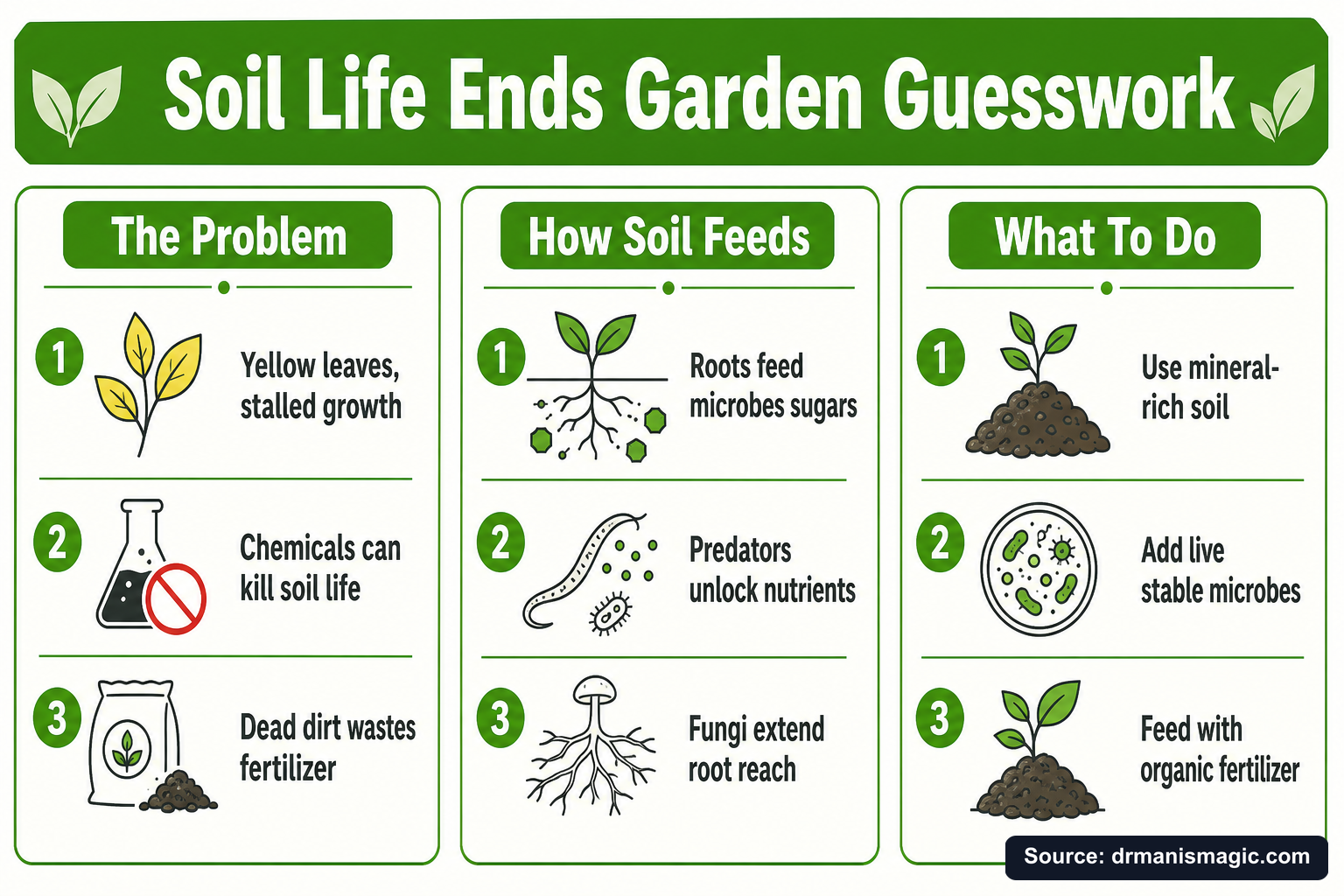
You walk out to your garden on a Saturday morning. Coffee in hand. The air smells like damp earth and possibility. You look at your plants and something feels off. The leaves are a little yellow. Growth has stalled. You fertilized last month. You watered on schedule. You did everything the bag said to do.
So why does your plant look like it's losing a slow fight?
Here's what nobody at the big box store told you. Under your feet, right now, there is an entire civilization working to keep your plants alive. Billions of bacteria. Webs of fungal threads thinner than a human hair. Tiny predators grazing on those bacteria and releasing nutrients your roots can actually drink. When that civilization is healthy, your plants almost grow themselves. When it's broken or dead, you can pour money into the ground all season and get almost nothing back. That frustration you feel? It's not a brown thumb. It's a biology problem. And once you understand it, the guesswork disappears.

Plant Super Boost
Key Takeaways
- Healthy soil is not dirt. It is a living ecosystem with billions of organisms per teaspoon that do the real work of feeding your plants.
- Bacteria, fungi, protozoa, and nematodes each play a specific role in releasing nutrients. Miss any one of them and nutrients stay locked in the ground.
- Mycorrhizal fungi can multiply your plant's effective root surface by hundreds of times, improving water, phosphorus, and mineral uptake without any extra effort from you.
- Salt-based synthetic fertilizers, herbicides, fungicides, and pesticides destroy this living workforce. That is why plants grown on chemicals become dependent and never truly thrive.
- Most bottled microbial products on the market are either dried and inactive or going anaerobic and foul-smelling. Live, stabilized biology is rare and it changes everything.
- You can read your soil like a book. Smell, structure, root density, infiltration, and earthworm counts all tell you whether your biology is alive or dead.
- The Three Plant Pillars — mineral-based soil, live microbials, and organic fertilizer — give your soil biology the foundation it needs to replace guesswork with results.
What Is the Soil Food Web and Why Does It Matter to Your Plants?
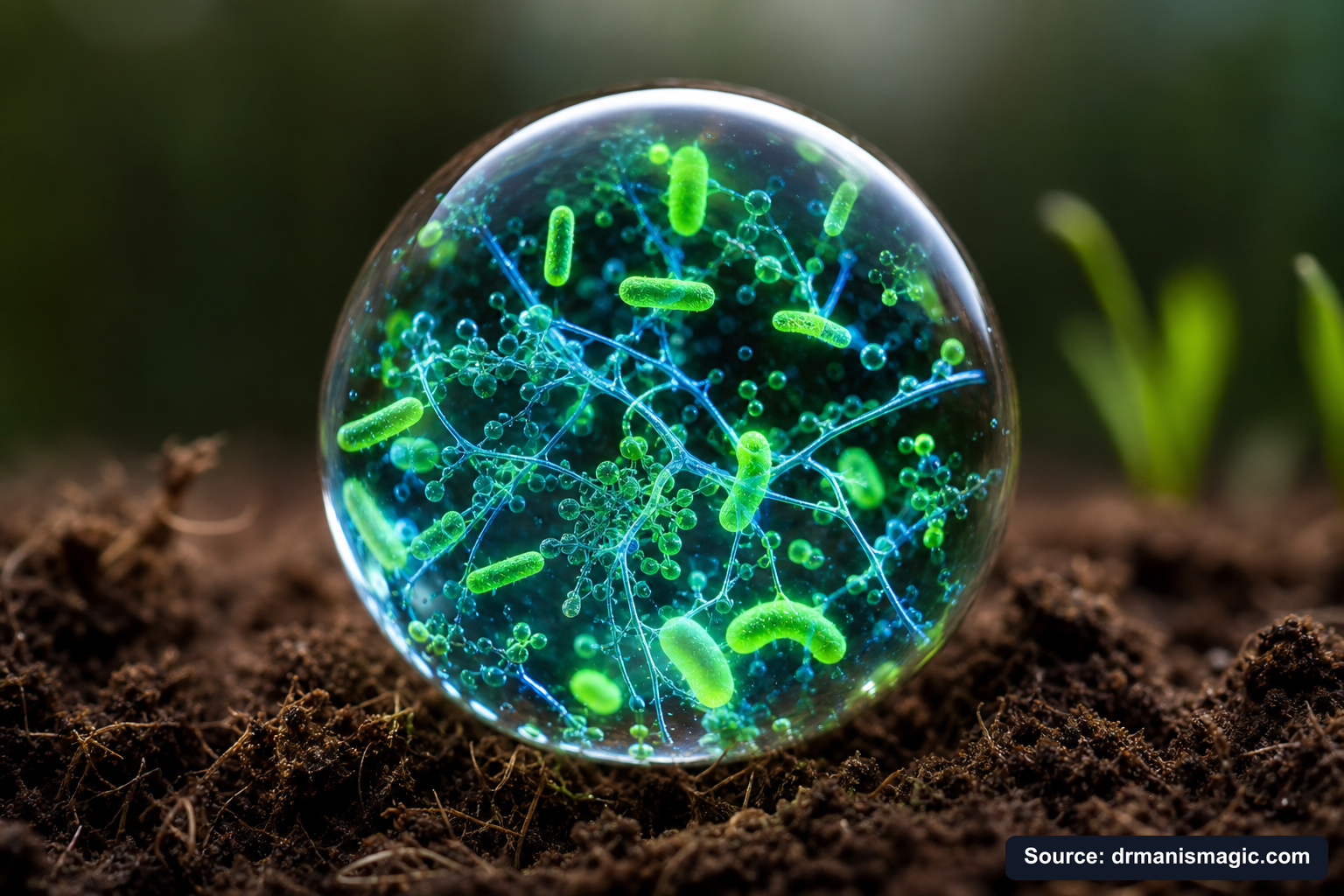
Quick Answer: The soil food web is the chain of living organisms in your soil — bacteria, fungi, protozoa, nematodes, arthropods, and earthworms — that work together to cycle nutrients, suppress disease, and feed your plant roots. When this web is intact and active, your plants get a steady supply of exactly what they need, exactly when they need it.
Think of your soil as a city. Every organism in it has a job.
Your plant roots are the economy. They pump sugars and carbon down into the soil through tiny root pores. Why? To feed bacteria and fungi on purpose. It sounds strange, but plants have been doing this for 450 million years. They discovered long ago that feeding microbes is the smartest investment they can make.
The bacteria and fungi eat those root sugars and multiply. Then something remarkable happens. Protozoa and nematodes — slightly larger organisms — come in and eat the bacteria and fungi. When they digest and excrete, nutrients like nitrogen, phosphorus, and sulfur are released in a plant-available form, right next to the roots that need them.
According to research from the Colorado State University Extension, this process — called nutrient mineralization — is the primary engine that makes healthy soil feed plants naturally, without a bag of fertilizer in sight.
Here are the seven cast members in this story and what each one does for you:
| Cast Member | What They Do | Benefit You See |
|---|---|---|
| Roots | Release sugars and carbon into the rhizosphere | Feed and attract beneficial microbes |
| Bacteria | Break down organic matter, fix nitrogen, suppress pathogens | Steady nutrient flow, disease resistance |
| Fungi (including mycorrhizae) | Extend root reach, unlock phosphorus, build soil aggregates | Drought tolerance, bigger root zone, better structure |
| Protozoa | Graze on bacteria, excrete nutrients near roots | Nitrogen and phosphorus released exactly where roots need it |
| Beneficial nematodes | Graze on bacteria, fungi, and harmful nematodes | Pest suppression, nutrient cycling, food web balance |
| Arthropods | Shred organic matter into smaller pieces | Faster decomposition, better soil aeration |
| Earthworms | Digest and cast organic matter, tunnel through soil | Nutrient-rich castings, improved drainage and aeration |
Most people have heard of bacteria and fungi. Far fewer people know about protozoa and beneficial nematodes. But those two predators are essential. Without them, nutrients stay locked inside microbial bodies. They are the key that unlocks the treasure chest.
A single teaspoon of healthy agricultural soil can hold 100 million to 1 billion bacteria, several meters of fungal threads, thousands of protozoa, and 10 to 20 nematodes. That is not a metaphor. That is a measurable, observable fact.
When you understand who does what, soil health stops being a mystery. It becomes a management decision. And that is exactly how soil life replaces guesswork.
What Do Mycorrhizal Fungi Actually Do for Your Roots?
Quick Answer: Mycorrhizal fungi attach to plant roots and grow a web of threads called hyphae that extend far beyond where roots can reach. This multiplies the plant's effective absorbing area, dramatically improving access to water, phosphorus, nitrogen, and trace minerals while also building drought and disease resistance.
Here is a picture worth holding onto. Your plant's roots look like a hand. Mycorrhizal fungi are like putting a million-fingered glove over that hand. Every nutrient and water molecule within reach of those threads now belongs to your plant.
Pull a healthy weed out of the ground sometime. Look at the roots. If you see white fuzzy threads clinging to them, that is mycorrhizae. Weeds are thriving partly because they have this fungal partnership working for them. Your garden plants deserve the same advantage.
The University of Minnesota Extension explains that mycorrhizal fungi can increase the effective root absorbing area of a plant by up to 700 times. That is not a small improvement. That is a completely different plant.
Beyond nutrient uptake, mycorrhizal fungi produce a sticky protein called glomalin. Glomalin glues soil particles together into aggregates. Those aggregates create the open, crumbly structure that lets water drain fast, air reach roots, and roots push deep without resistance. When mycorrhizae thrive, your soil structure improves on its own.
After growing and testing over 250,000 trees at our US Citrus Nursery in South Texas, we saw this firsthand. Trees inoculated with a full-spectrum live microbial product — including mycorrhizae — developed root systems that looked completely different from trees grown without it. Denser. Whiter. More branched. And those trees moved through growth stages faster and handled stress better when drought or disease pressure hit.
How Do You Know If Your Soil Biology Is Working or Dead?
Quick Answer: You can read soil health through observable signs without a lab. Earthy smell, crumbly structure, fast water infiltration, earthworm presence, dense root growth, and healthy plant color all indicate active biology. Sour or chemical smell, crusty surface, standing water, and slow growth point to depleted or damaged soil life.
You do not need a microscope to diagnose your soil. Nature left you plenty of clues.
Start with your nose. Healthy, biologically active soil smells like petrichor. That is the earthy, fresh smell after rain. It comes from a compound called geosmin that bacteria produce. If your soil smells sour, metallic, like sulfur, or just wrong, biology is struggling.
Then look at the structure. Pick up a handful and squeeze it. Healthy soil with active fungal networks crumbles into small, round aggregates. It does not pack into a hard ball or fall apart like dry sand. The aggregates are held together by fungal threads and bacterial glue.
Dig down six inches and count earthworms. Researchers at the Rodale Institute use earthworm counts as a field indicator of biological health. Ten or more earthworms per shovelful is a sign of a thriving system. Zero earthworms is a warning.
Watch how fast water soaks in. Healthy soil with good aggregate structure absorbs water quickly. If water pools and sits on top, compaction and biological depletion are almost always part of the problem.
Here is a quick diagnostic you can run in your own backyard right now:
- Smell the soil. Earthy and fresh is good. Sour or chemical is a red flag.
- Squeeze a handful. Does it crumble or pack? Crumble is healthy.
- Pour a cup of water on bare soil. Does it soak in within 30 seconds? Good. Does it pool? Biology is damaged.
- Dig six inches and count earthworms. More than five is encouraging. Zero means trouble.
- Pull a struggling plant and look at the roots. White, dense, and branched is healthy. Brown, sparse, or slimy roots signal root rot and depleted biology.
Is Your Soil Alive, Depleted, or Completely Sterile? A Decision Guide
Quick Answer: Soil condition falls into five practical categories: biologically active and healthy, biologically depleted from chemicals or neglect, sterile from potting mix or fumigation, chemically injured from herbicides or salt fertilizers, or compacted and structurally broken. Each condition has a different recovery path, but all of them start with restoring the living organisms that do the real work.
Not all damaged soil is the same. Knowing which category you are dealing with changes what you do first.
| Soil Condition | Signs You Will See | Primary Recovery Action | Timeline |
|---|---|---|---|
| Biologically active and healthy | Earthy smell, crumbly structure, worms present, fast infiltration | Maintain with organic inputs and live microbials monthly | Ongoing |
| Biologically depleted | Slow growth, pale leaves, low worm counts, weak root development | Stop salt-based fertilizers, add live microbials and organic matter | 2 to 6 months with consistent application |
| Sterile (potting mix, sterilized greenhouse media) | No smell, no structure, roots circle or stall, no visible life | Inoculate immediately with full-spectrum live microbials at planting | Weeks to months with monthly inoculation |
| Chemically injured (herbicides, salt fertilizer overload) | Compacted, crusty, standing water, chemical smell, dying roots | Flush salts, stop chemical inputs, inoculate with live biology, add organic matter | 3 to 12 months depending on severity |
| Compacted and structurally broken | Rock-hard surface, no water infiltration, roots cannot penetrate | Physical aeration, mineral-based soil amendment, live microbials to rebuild aggregation | One to two growing seasons |
There is one condition worth special attention: sterile potting mix. Most commercial potting mixes are made from pine bark, peat, and similar materials that start with almost no biology. Some are steam-sterilized. That means the moment you pot a plant into commercial potting mix, your plant has zero microbial support.
This is the dirty secret behind why so many container plants fail. It is not the light. It is not the water schedule. It is the complete absence of the invisible workforce that healthy plants depend on. And most people never find this out because the bag looks just fine on the shelf.
This is exactly why Super Soil starts with a mineral base — silica-rich sandy loam from the Rio Grande Valley that does not decompose, does not compact, and does not steal oxygen from roots the way pine bark sludge does over time. Mineral-based soil is Pillar One of the Three Plant Pillars for a reason. It gives biology a permanent home.
Why Do Protozoa and Nematodes Matter? (Most Articles Skip This Part)
Quick Answer: Protozoa and beneficial nematodes are the microbial predators of the soil food web. They eat bacteria and fungi, and when they excrete waste, nutrients like nitrogen and phosphorus are released right next to plant roots in a form roots can immediately absorb. Without these predators, nutrients stay trapped inside microbial bodies and your plant stays hungry.
Almost every article you will read about soil biology stops at bacteria and fungi. That leaves out two of the most important players in the entire system.
Here is the key insight most people miss. Bacteria and fungi do not release their nutrients when they are alive. The nutrients are locked inside their bodies. It is only when a protozoa or beneficial nematode eats them that those nutrients spill out into the soil solution — right next to the roots waiting to absorb them.
Think of bacteria as tiny nutrient warehouses. Protozoa are the delivery drivers. Without the drivers, the warehouses just sit there full and locked.
Beneficial nematodes play a double role. They graze on bacteria and fungi like protozoa do. But they also hunt harmful nematodes — the kind that attack roots, cause galls, and invite disease. A diverse nematode community is one of nature's best natural pest management systems, and it costs you nothing if your soil biology is intact.
This is part of why most garden fertilizer programs fail over the long term. You can pour nutrients into the soil all day, but if the food web is broken, those nutrients do not reach roots efficiently. You end up with nutrient-rich soil and nutrient-starved plants. More fertilizer does not fix a biology problem. It just adds more salt.
You Never Had a Brown Thumb.
You were handed the wrong tools. This free guide hands you the right ones.
You watered it. You fed it. It died anyway.
It was never you. It was the dirt, the salt food, and the bad advice.
This guide shows you what really went wrong, and how to fix it for good.
- Why your plants really died, and why it was never your fault
- The salt hiding in your plant food that quietly burns the roots
- The hidden killer in almost every bag of store soil
- The tiny helpers that grow a whole forest for free
- The rescue trick that brings a half dead plant back to life

Live Microbes vs. Dead Microbes: Why Most Products on the Shelf Do Not Work
Quick Answer: Most commercial microbial inoculants are either dried powders with inactive organisms, rehydrated powders that never fully revive, or liquid products that have gone anaerobic and are actively dying. Genuinely live, full-spectrum microbial products harvested from real compost and stabilized by a natural process are rare — and they behave completely differently in your soil.
This is where we have to be completely honest with you about what is actually in those bottles and packets at the garden center.
We have tested dozens of microbial products over decades at US Citrus Nursery. We have run them side by side on identical trees. And here is what we found.
Most products fall into one of three categories. None of them work the way the label promises.
Category One: Dried powder lab microbes. These are manufactured in large industrial vats, then dried into spore form. The idea is that the spores will "wake up" when you add water and pour them on soil. In our testing on over 250,000 trees, these products produced no meaningful improvement. The spectrum of organisms is narrow. The survival rate after drying, shipping, and sitting on a shelf is very low.
Category Two: Liquid products that have gone anaerobic. These start as compost tea or earthworm casting extracts, which is actually a good foundation. Fresh compost tea is fantastic. But by the time the product is bottled, shipped, and sitting in a warehouse or on a store shelf, the microbes have consumed the available oxygen and started dying. The telltale sign is the smell. Open the bottle and it hits you like a wave. That stench is the smell of microbial death. Some products even fizz when you open them. That gas is a byproduct of fermentation as the organisms break down.
Category Three: Lactobacillus products. Yes, like the bacteria in yogurt. Lactobacillus is extremely vigorous and stays alive well in a bottle. The problem is it outcompetes and displaces the beneficial organisms you actually need. It belongs in your gut, not your garden.
Here is how the options compare honestly:
| Product Type | Organism Viability | Spectrum | Smell | Real-World Results |
|---|---|---|---|---|
| Dried powder lab microbes | Very low | Narrow — a few species | Neutral | Little to no measurable effect in our testing |
| Rehydrated powder microbes | Very low | Narrow | Neutral | Same as above |
| Old compost tea or liquid (over 24 hours) | Dying — anaerobic | Partial | Strong, foul odor | Some humic acid benefit but biology is compromised |
| Fresh compost tea (under 24 hours, aerated) | Moderate to high | Broad but variable | Earthy | Good results when made and used immediately |
| Fresh active compost (on-site) | High | Broad and natural | Earthy | Excellent — the gold standard for on-farm use |
| Plant Super Boost (stabilized, full-spectrum) | High — genuinely live | 2,000+ bacteria species, 400-500 fungi including mycorrhizae, plus protozoa and nematodes | Earthy — not foul | Consistent root development and growth improvement across 250,000+ trees tested |
The story behind Plant Super Boost is worth telling. It was not invented by Dr. Mani. It came from a world-famous compost expert who had helped royal families and governments improve their farming practices. He developed a completely natural technique to stabilize the full-spectrum biology of fresh compost — keeping it alive without letting it go anaerobic.
When big chemical companies saw large citrus groves thriving with his method, he was blacklisted. He feared for his livelihood and stopped production. Years later, through what Dr. Mani describes as a providential meeting, this expert joined the team at US Citrus Nursery. The Dr. Mani's Magic line was born from that partnership.
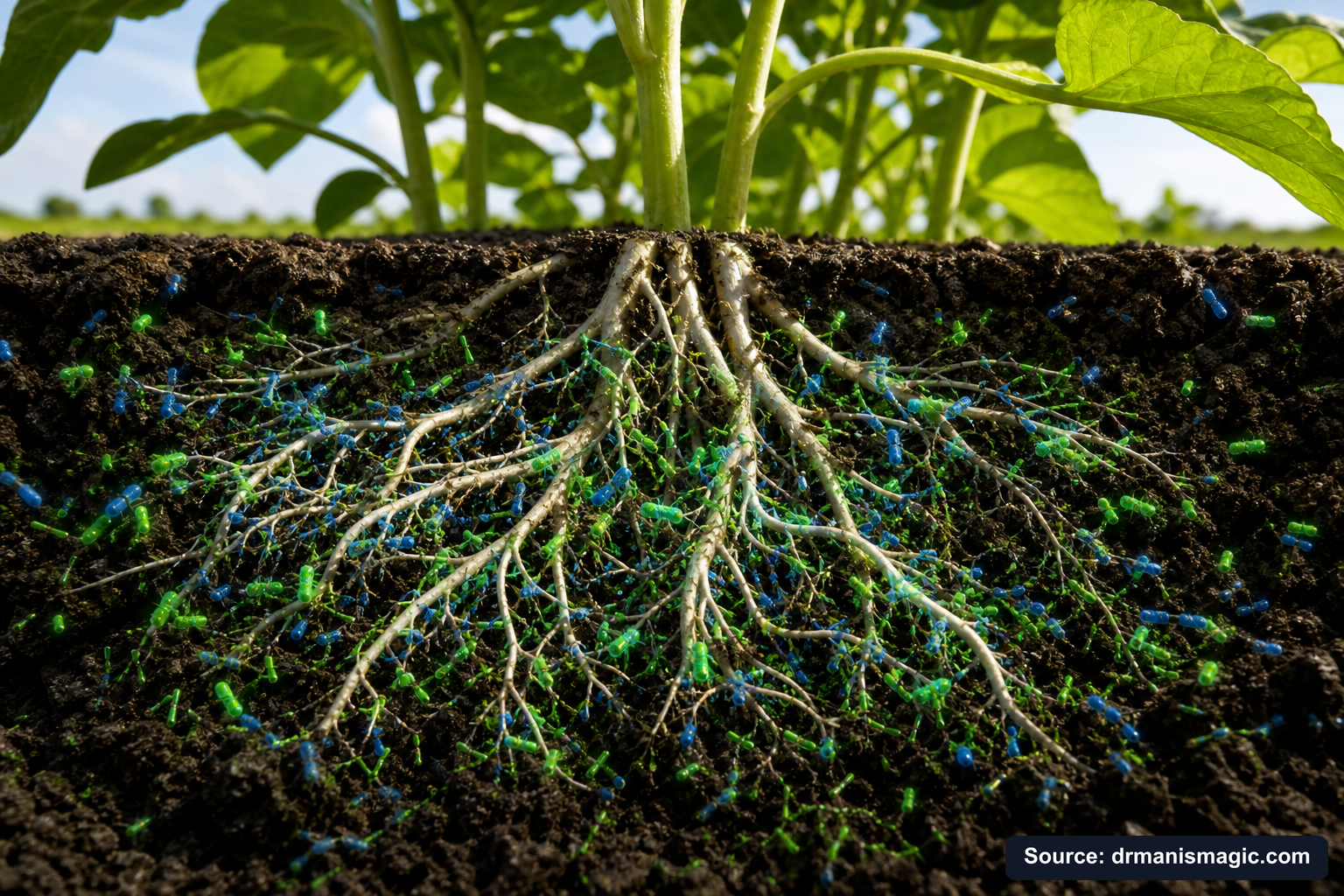
You can actually see the microbes moving in Plant Super Boost under a microscope. That is not marketing language. That is what live biology looks like. It smells earthy and clean because it is not rotting. And it contains the full cast of characters — bacteria, fungi, mycorrhizae, protozoa, and nematodes — working together the way they do in nature.
See also: Why Dead Microbe Products Fail in Real Gardens
What Happens to Soil Biology When You Use Synthetic Fertilizers?
Quick Answer: Synthetic fertilizers are salt-based. High salt concentrations kill beneficial bacteria and fungi through osmotic stress — the same way salt kills bacteria on a cutting board. Over time, repeated synthetic fertilizer use strips your soil of the living organisms that cycle nutrients naturally, creating a dependency cycle where you need more and more fertilizer to get the same result.
Here is something the fertilizer aisle will never tell you. The product you are buying to help your plants is quietly destroying the system that actually feeds them.
Salt draws water out of cells through osmosis. It does this to bacteria and fungi the same way it does it to meat being cured. The microbes shrink, dehydrate, and die. Every time you apply a synthetic salt-based fertilizer, you are staging a small massacre in your soil's living workforce.
At first, the plant responds to the direct nutrient hit and looks great. Green, lush, fast. That is the short-term payoff. But the biology is getting weaker with every application. After months or years, the microbial community is so depleted that the plant is completely dependent on you for every nutrient. Stop the fertilizer and the plant collapses. Keep going and you need higher doses to get the same response. It is a cycle that benefits the fertilizer company, not your plant.
Add herbicides, synthetic fungicides, and broad-spectrum pesticides into the mix — which most conventional garden programs include — and you are systematically eliminating every layer of the soil food web. Herbicides like glyphosate disrupt microbial communities. Fungicides kill the beneficial fungi alongside the harmful ones. Pesticides reduce the arthropods and nematodes that drive nutrient cycling.
By the time a soil has been managed this way for several seasons, it is biologically closer to sand than it is to living earth.
See also: The Hidden Reason Synthetic Fertilizers Cause Root Rot
Can Dead, Sterile, or Chemically Damaged Soil Come Back to Life?
Quick Answer: Yes, damaged soil can recover, but it takes consistent action over time. The biology does not come back on its own in depleted soils because the habitat and food sources have to be rebuilt first. The recovery timeline ranges from a few weeks in mildly depleted container soil to a year or more in heavily fumigated or chemically injured ground.
People ask us this question all the time. They have been using synthetic fertilizers for years. Or they bought a house with compacted, lifeless soil. Or they are starting with a potting mix straight from the bag. Can the biology come back?
Yes. But you have to understand why it takes time and why one application is rarely enough.
Think about rebuilding a team after everyone quits. You bring in new people. But if the building is still broken, the coffee machine still broken, and the work environment still toxic, the new hires leave too. Microbes work the same way. If you inoculate damaged soil but the salt-based fertilizer is still going in, or the herbicide is still being sprayed, the new biology dies almost as fast as it arrives.
Recovery requires removing the things that kill biology first. Then rebuilding the habitat. Then inoculating with live organisms. Then feeding them with organic inputs so they stay and multiply.
Here is a practical recovery checklist for any damaged soil situation:
- Stop the damage. Remove salt-based fertilizers, synthetic herbicides, and broad-spectrum pesticides from your routine. These are the primary biology killers.
- Check your soil structure. If you are in containers, evaluate whether your potting mix has degraded into compacted sludge. If it has, switch to a mineral-based permanent soil that will not decompose and choke roots.
- Flush salt accumulation. In containers and in-ground beds, a deep flush with plain water helps move salt ions away from the root zone before you begin rebuilding.
- Add organic matter as food for biology. Compost, organic mulch, and organic fertilizers give the incoming microbes something to eat and help them establish.
- Inoculate with a full-spectrum live microbial product. One application is a start, not a finish. Apply monthly. Biology needs time to establish, multiply, and build the food web relationships that make the system self-sustaining.
- Feed with organic, non-salt fertilizer. Organic slow-release fertilizer feeds your plant gently while also feeding the microbial community. It works with biology, not against it.
- Be patient and observe. Watch the signs. Root color improves. Leaves green up. Growth resumes. The smell of the soil changes. These are your measurements. Trust them.
We want to be direct with you about time. You can get money back. You cannot get time back. The grower who starts rebuilding soil biology today will have thriving plants in six months. The grower who keeps doing things the same old way will be in the same spot next year, and the year after that, wondering why nothing works. The best time to start was years ago. The second-best time is right now.
What Does the Three Plant Pillars System Have to Do With Soil Life?
Quick Answer: The Three Plant Pillars — mineral-based soil, live microbials, and organic fertilizer — are designed specifically to create and protect the biological conditions that soil life needs to thrive. Each pillar supports the others. Mineral soil provides a permanent, oxygenated home. Live microbials restore the food web. Organic fertilizer feeds both the plant and the biology without the salt that kills it.
Dr. Mani Skaria spent over 40 years as a Professor of Plant Pathology at the Texas A&M Citrus Center. He traveled the world testing products. He ran thousands of trials at US Citrus Nursery. And the conclusion he kept arriving at was the same one nature arrived at 450 million years ago: the three things plants need most are a stable physical home for roots, a living microbial community in the root zone, and a source of nutrients that works with biology rather than against it.
That is the Three Plant Pillars. Not a marketing concept. A biological framework validated across 250,000 trees, multiple growing environments, and decades of observation.
Pillar One: Mineral-Based Soil. Most potting mixes are built on pine bark and wood fiber. Those materials decompose. As they break down, they compact, steal oxygen from roots, and eventually create the anaerobic, wet, oxygen-poor conditions where root rot thrives. Mineral-based soil — silica-rich sandy loam that does not decompose — gives roots permanent structure, drainage, and room to breathe. Microbes also need oxygen. Compacted, waterlogged soil is as hostile to beneficial biology as salt fertilizer is.
Pillar Two: Live Microbials. This is the heart of the system. Live bacteria, fungi including mycorrhizae, protozoa, and nematodes working together in the root zone. Not a narrow selection of lab-grown organisms. A full-spectrum community harvested from real compost and stabilized to stay alive in a bottle. This is what brings the soil food web to life and keeps it there.
Pillar Three: Organic Fertilizer. Organic, slow-release fertilizer from sources like crab, kelp, and amino acids feeds your plant with a complete spectrum of nutrients — without salt. It also feeds the microbial community, giving bacteria and fungi the organic compounds they need to multiply and do their jobs. When all three pillars are in place together, the system becomes self-reinforcing. Biology improves structure. Structure improves drainage. Better drainage reduces root rot. Healthy roots feed more biology. And you stop guessing.
What Are the Practical Signs That Soil Life Is Actually Working?
Quick Answer: When soil biology is actively working, you will see faster root development, deeper green color in leaves, improved drought tolerance, reduced disease pressure, better water infiltration, earthy smell, crumbly soil structure, and visible earthworm activity. These are not opinions — they are measurable, observable outcomes of a functioning soil food web.
This is where the guesswork truly ends. Because biology leaves fingerprints everywhere.
Within the first few weeks of restoring soil life with live microbials and organic inputs, roots change. They become denser, whiter, and more branched. You can see this when you repot a container plant or carefully inspect a transplant. White, fuzzy root tips are mycorrhizal colonization in action.
Leaves start to hold a deeper, more saturated green. Not the flash of artificial nitrogen green that fades in two weeks. A sustained, healthy green that comes from better mineral uptake through a functioning food web.
Drought tolerance improves noticeably. Mycorrhizal threads hold water near the root zone and help plants access moisture that roots alone cannot reach. Plants that used to wilt on hot afternoons start to hold up without drama.
Disease pressure drops over time. A diverse, active microbial community competes directly with pathogens for space and resources. Beneficial bacteria and fungi produce compounds that suppress harmful organisms. This is not magic. It is competitive exclusion — the same principle that keeps a healthy gut from being overrun by harmful bacteria.
Soil structure changes. The earthy smell returns. Water soaks in instead of pooling. You start to see earthworms where there were none before. Earthworms follow biology. When the food web is alive, earthworms show up because there is something to eat.
And plants start to grow on a schedule that feels almost shocking compared to what you were used to. Not because you added more fertilizer. Because you stopped fighting nature and started working with it.
What Can You Do Right Now to Start Replacing Guesswork With Results?
Quick Answer: Start by stopping the inputs that kill biology — salt fertilizers, synthetic herbicides, and broad-spectrum pesticides. Then add a full-spectrum live microbial inoculant monthly, switch to organic slow-release fertilizer, and make sure your soil has the drainage and aeration roots need to breathe. Do those three things consistently and the biology does the rest.
You do not need a soil scientist. You do not need a lab report. You do not need seventeen different products from seventeen different brands that may or may not work together.
You need the three things that nature already proved work. Stable soil structure. Living biology. Organic nutrients that feed plants and microbes without burning either one.
Here is what that looks like in practice starting this week:
- Look at what you are currently putting in your soil. If it is salt-based synthetic fertilizer, that is the first thing to replace. It is not feeding your biology. It is killing it.
- Check your soil or potting mix. If it is a commercial bark-based potting mix that has been in the container for more than a year, it has likely compacted and is beginning to work against your roots rather than for them.
- Add live, full-spectrum microbials. Not dried powder. Not a smelly anaerobic liquid. Genuinely live organisms from a source with a track record. Apply monthly, because biology needs consistent reinforcement in managed growing environments.
- Switch to a complete organic fertilizer that works with your biology. Crab, kelp, and amino acids provide the full nutrient spectrum in a form that is gentle on roots and feeds the soil food web at the same time.
- Give it time and watch the signs. Smell the soil. Look at the roots. Watch the leaf color. The biology will tell you it is working long before you need a test.
We built the Free Plant Care Field Guide to walk you through exactly this process in plain language, step by step, for any plant in any situation. No jargon. No guesswork. Just the foundation that 250,000 trees taught us works.
The gardening world has been telling you for decades that you need more products, more complexity, more chemicals. The truth is simpler and older than any of that. Give the invisible workforce what it needs to thrive, and your plants will take care of themselves in ways that will genuinely surprise you.
If you are ready to stop guessing and start growing, the place to begin is with living soil biology. Everything else builds on that foundation. When the microbes are healthy, the plant is healthy. And when the plant is healthy, the gardening stops being a source of frustration and starts being exactly what it was always supposed to be — one of the most satisfying things a human being can do.
Start with what the biology needs. The rest follows naturally. You can explore the full system, including live microbials, mineral soil, and organic fertilizer that all work together, at Plant Super Boost — formulated from genuinely live, full-spectrum compost biology, stabilized so it arrives alive and ready to go to work in your soil today.
Frequently Asked Questions
You just read about the invisible workforce living under your plants. Now you probably have some real questions. Good. These are the same questions Dr. Mani has heard from thousands of gardeners over 30 years. Here are honest, straight answers grounded in what actually works.
Why do my plants look sick even when I fertilize them on schedule?
Most fertilizers are salt-based. They push a quick green flush, but they quietly kill the bacteria and fungi your roots depend on. Once that soil life is gone, nutrients lock up in the ground and your plant starves no matter how much you pour on. The fix is not more fertilizer. The fix is rebuilding the living workforce in your soil first. That is exactly what the Three Plant Pillars are designed to do.
What does healthy soil actually feel like, smell like, and look like?
Healthy soil smells like a forest after rain. That clean, earthy scent comes from a compound called geosmin, made by active bacteria. It feels loose and crumbly, not packed and hard. You should see earthworms, dark color, and roots that spread easily. If your soil smells sour, feels like concrete, or has roots circling the edges of the pot, your soil biology is in trouble and your plants are telling you so.
Is the brown thumb real, or is something else going on?
The brown thumb is not real. It is a story big chemical companies and big box stores are happy for you to believe. When you buy salt-based fertilizers and sawdust-heavy potting mixes, your plants are set up to fail from day one. Dr. Mani proved this across more than 250,000 citrus trees at US Citrus Nursery. The problem is always biology and foundation, never the gardener. Fix the soil, and the so-called brown thumb disappears.
How do live microbes actually feed my plant roots?
Your roots release sugars into the soil on purpose. That feeds bacteria and fungi. Then slightly larger organisms eat those bacteria and fungi. When they digest and excrete, nutrients like nitrogen and phosphorus are released right next to your roots in a form they can drink immediately. It is a loop that has worked for 450 million years. Dr. Mani's Magic Plant Super Boost delivers live, stabilized bacteria, fungi, and mycorrhizae to restart that loop in your soil fast.
Why do most bottled microbial products not work?
Most products on store shelves are either dried and dormant or going anaerobic and rotting in the bottle. Dead microbes do nothing for your plants. Dr. Mani partnered with a compost expert who developed a special all-natural stabilization method that keeps the microbes in Plant Super Boost alive and active when they reach you. That is why it smells like clean earth instead of sewage, and why it actually works when you water it in.
What is wrong with regular potting mix from the store?
Most potting mixes are loaded with pine bark and wood fiber. That organic material breaks down fast. As it rots, it compacts, chokes off oxygen to your roots, and drains poorly. Roots suffocate. Dr. Mani's Magic Super Soil is built on mineral-based sandy loam from South Texas. It does not decompose. It stays loose, drains perfectly, and lets roots breathe and expand for years. It is a permanent foundation, not a product you replace every season.
How long before I actually see results with the Three Plant Pillars?
Most gardeners notice a visible difference within 30 days. Leaves get greener. New growth picks up. Roots stop circling and start pushing out. The longer the system runs, the stronger it gets because the soil biology compounds on itself. People who have waited years to see fruit on their own tree are often shocked by how fast things shift when the soil, microbes, and organic fertilizer are all working together the way nature intended. That is the promise behind our 30-day guarantee.
About the Author
Dr. Mani Skaria, PhD
Dr. Mani Skaria, PhD, is a plant pathologist and the scientific founder of Dr. Mani's Magic. He earned his doctorate at Purdue University and spent 48 years studying how plants, soil, and living microbes work together, including his years as Professor Emeritus at Texas A&M and as a member of the USDA NAREEE Advisory Board. He invented micro-budding, a method for growing healthier, stronger trees, and has grown more than 250,000 trees on the family farm in Hargill, Texas - US Citrus Nursery. His life's work takes real lab science and practical experience and turns it into simple, safe, organic plant care anyone can use at home.


