


Why Sand Is the True Foundation of Every Stable Soil | Dr. Mani's Magic
Sand Is Structure, Not Food: Why Mineral Particles Are the True Foundation of Every Stable Soil
Picture this. You're standing on your back patio, coffee in hand, staring at a plant that looked perfect six weeks ago. The leaves are yellowing. The soil feels dense and wet, even though you haven't watered in days. You poke your finger down into the mix and it comes back smelling like a swamp. Something is wrong, but you can't see it. The damage is happening underground, in the dark, where roots are quietly suffocating.
You bought the bag with the pretty garden scene on the front. It said "premium." It said "enriched." It probably cost more than it should have. But here's what nobody told you when you scooped that fluffy brown stuff into your container: what you planted your tree in wasn't soil. It was a slow-motion trap. You planted your living, breathing roots inside dead, decomposing wood chips. Pine bark. Sawdust. Glorified mulch. And decomposing wood does something nobody talks about at the garden center. It steals oxygen. The same oxygen your roots need to survive.
That smell coming off your container? That's not "rich organic matter." That's decay. That's the scent of a pore structure collapsing, of roots switching from healthy respiration to anaerobic stress, of pathogens moving in. After growing over 250,000 trees at our South Texas nursery, we've smelled that smell more times than we'd like to count. And every single time, the root cause wasn't too much water. It was a soil that was never built to last. This article is about fixing that. For good.
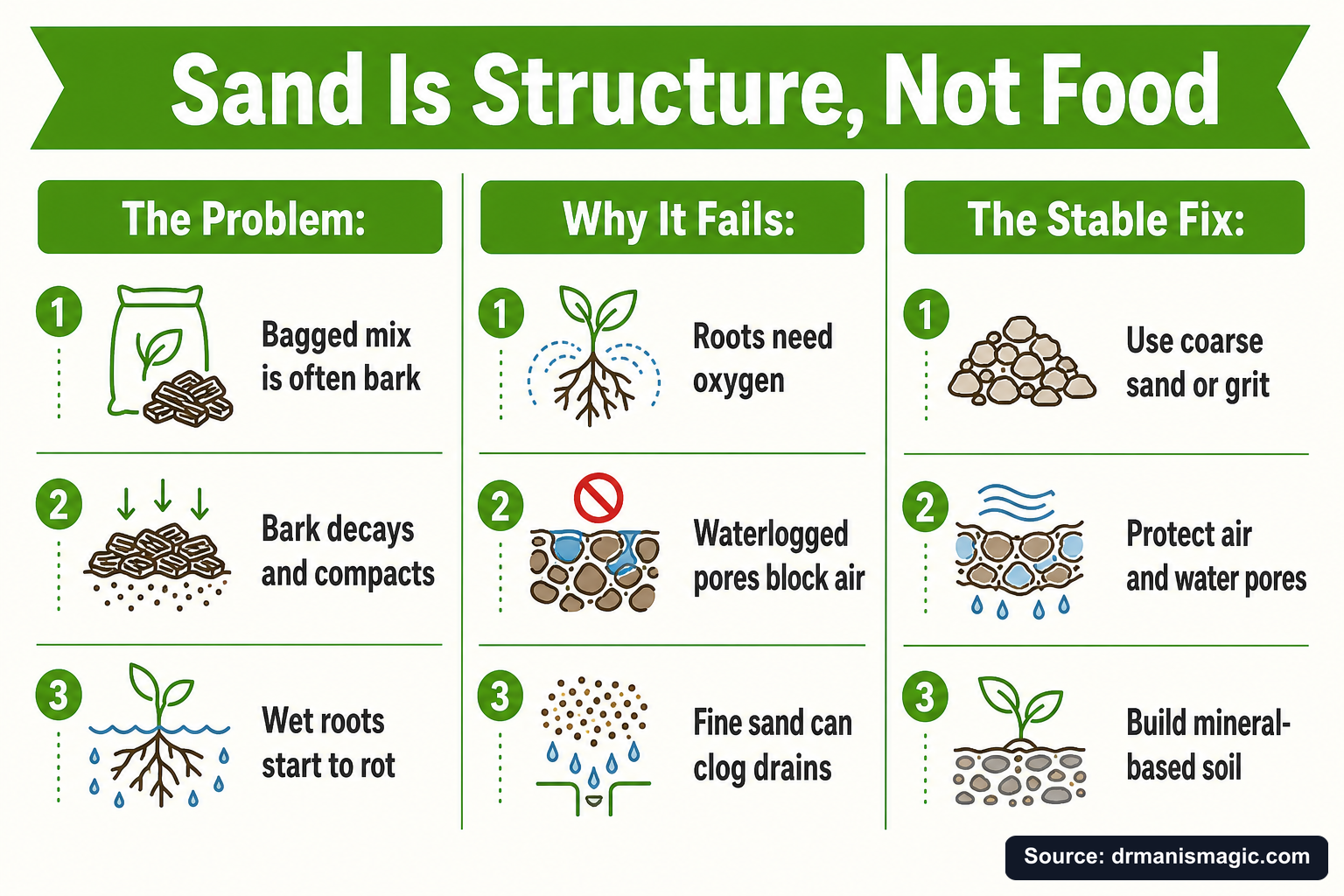
Key Takeaways
- Sand's value is structural, not nutritional. Coarse mineral particles create durable air pockets that roots need to breathe.
- Potting mix is mostly pine bark sawdust. It decomposes, collapses pore space, and suffocates roots over time.
- Root rot is a physics problem first. Waterlogged pores block oxygen. Oxygen-starved roots die. Then pathogens move in.
- Not all sand is equal. Coarse sand and grit open pores. Fine sand, play sand, and beach sand can actually make drainage worse.
- Mineral-based soil does not decompose. It holds its structure for years, giving roots a permanent, stable home.
- The Three Plant Pillars (mineral soil, live microbes, organic fertilizer) work together. Mineral structure is the non-negotiable foundation.
- You can build a container mix that lasts years, not months, if you understand how pore space, particle size, and mineral stability work together.
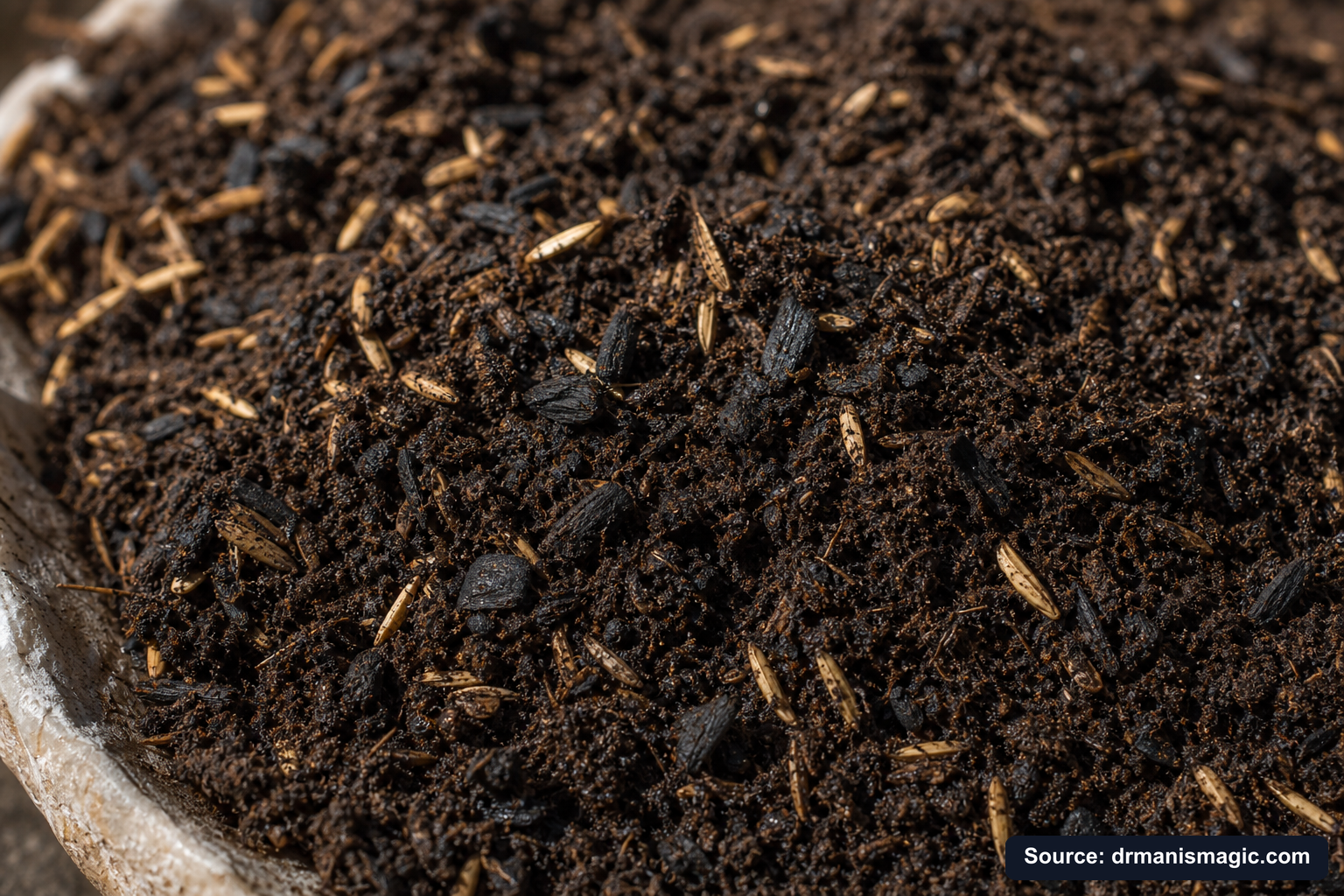
Why Do Roots Need Oxygen in the First Place?
Quick Answer: Roots are living tissue. They burn oxygen to create the energy they need to absorb water and nutrients. When soil pores fill with water and stay full, oxygen cannot reach the roots. Within hours to days, the roots begin to die from the inside out, even if the plant looks fine above ground.
Roots breathe. That surprises a lot of people. We know plants take in carbon dioxide through their leaves. But underground, the roots are doing the opposite. They consume oxygen and release carbon dioxide, just like you do when you breathe. This process is called cellular respiration, and it is how roots generate the energy to do their job.
Think about what roots actually do all day. They push through dense material. They pump water uphill against gravity. They absorb and sort minerals from the soil solution. That takes serious energy. And energy, in biology, means oxygen.
When soil pores fill with water and stay full, oxygen cannot diffuse down to the root zone fast enough. The roots switch to a backup system called anaerobic respiration, which produces toxic byproducts like ethanol and acetaldehyde inside the root tissue. Root cells begin to die. The tissue turns brown and slimy. The damaged roots become an easy target for opportunistic pathogens like Phytophthora, Pythium, and Fusarium. This is root rot.
Here is the part that should make you angry. Most people blame themselves. "I overwatered." But the real villain is the soil structure. Healthy, mineral-based soil drains quickly and lets air rush back in after watering. Collapsed, decomposed potting mix stays saturated for days. The water isn't the problem. The structure is.
University of Florida IFAS Extension confirms that oxygen depletion in the root zone is one of the primary triggers of root decline in container-grown plants, noting that saturated media excludes oxygen and creates conditions favorable for root pathogens within as little as 24 to 48 hours of waterlogging.
What Is Soil Pore Space and Why Does It Matter More Than Nutrients?
Quick Answer: Soil pore space is the empty space between particles. Half of that space should hold water. The other half should hold air. When pore space collapses, both water movement and oxygen diffusion fail. Nutrients become irrelevant when roots cannot breathe to absorb them.
Here is a mental picture that changes everything. Hold a handful of marbles. The marbles are solid. But the gaps between the marbles? Those gaps are where all the magic happens. Water flows through them. Air moves through them. Roots grow through them. The gaps are the point.
Now imagine swapping those marbles for wet sawdust. The gaps disappear. Everything compacts. Water sits. Air cannot move. That is what happens inside most potting mixes over time.
Soil scientists talk about two types of pores. Macropores are the big ones. Water drains out of them quickly, and air rushes in right after. These are your drainage pores, your breathing pores. Micropores are the small ones. They hold onto water longer and supply the plant between waterings. Healthy growing media needs both. The balance between them determines whether your plant thrives or struggles.
Rutgers New Jersey Agricultural Experiment Station extension guidelines recommend that container media maintain at least 10 percent air-filled porosity after drainage to support healthy root function. In a fresh bag of premium potting mix, you might hit that number. Six months later, after decomposition compresses the structure, you almost certainly will not.
Mineral particles, especially coarse sand and grit, do not compress. They do not decompose. They sit where you put them, holding their shape and their pore space, year after year. That is why sand is structure. Not food. Structure.
Why Is Potting Mix Actually Bad for Long-Term Container Plants?
Quick Answer: Potting mix is mostly pine bark sawdust, a cheap timber industry byproduct. It decompresses pore space as it rots, consumes oxygen during decomposition, repels water once dry, and contains harsh pine chemistry that is not ideal for root zones. It is designed for short-term nursery turnover, not long-term plant health.
Let us talk about where potting mix actually comes from. Because the bag never tells you this part.
The southeastern United States has enormous pine forests. Pine trees get harvested for lumber. What is left? Mountains of pine bark. For a long time, that bark was a disposal problem. Then someone figured out you could shred it, bag it, and sell it as "premium potting mix." Problem solved. Except for you and your plants.
Pine bark is carbon-based, which means it is organic in the chemistry sense of the word. Everything organic eventually decomposes. And here is the part nobody puts on the bag: decomposition consumes oxygen. The microbes breaking down that bark are competing directly with your plant's roots for the oxygen in the soil pore space. Your roots lose that competition. Every single time.
But wait, there is more. Pine bark contains natural chemical compounds called terpenes and terpenoids. You already know some of these by name. Pine-Sol is made from them. Turpentine is made from them. These are not gentle substances. They are antimicrobial, antifungal, and genuinely harsh. The industry knows this, which is why fresh pine bark is piled into enormous heaps and left to age for years before it is bagged and sold. The goal is to let that chemistry break down to less harmful levels.
But during that aging process? The bark is decomposing. Losing structure. Losing pore space. So by the time you buy it, you are starting with a substrate that is already partway down the road to collapse.
Then there is the water issue. Raw pine bark repels water. It is hydrophobic. Manufacturers solve this by adding surfactants, chemicals that help the bark absorb water instead of shedding it. These surfactants wash out after a few months. Once they are gone, your dry potting mix can become nearly impossible to re-wet. You pour water on top and it runs straight down the sides of the pot without ever reaching the roots in the center.
This is why the overwatering versus underwatering debate rages in every gardening group online. The real problem is neither. The real problem is a substrate that stopped functioning properly months ago.
We say it plainly at Dr. Mani's Magic: you are not planting your tree in soil. You are planting it in other dead plants. And dead plants decompose. That is not a foundation. That is a countdown clock.
What Makes Coarse Sand Different From Fine Sand, Play Sand, and Builder's Sand?
Quick Answer: Coarse sand and horticultural grit have large particles that create lasting macropores for drainage and oxygen. Fine sand, play sand, and beach sand have tiny particles that can fill existing pore spaces and make drainage worse, not better. Particle size is everything. The wrong sand is worse than no sand at all.
This is where most gardening advice falls apart. Someone hears "add sand for drainage" and grabs a bag of play sand from the hardware store. Their mix gets denser. Drainage gets worse. They conclude that sand is bad. But sand was never the problem. The particle size was.
Here is the physics. Imagine a jar of large marbles. Lots of gaps between them. Now pour fine sand into that jar. The fine sand fills the gaps between the marbles. The total pore space decreases. Drainage slows. Aeration drops. You have made things worse by adding something smaller than what was already there.
This is exactly what happens when you add fine sand to a potting mix. The fine particles wedge into the spaces between the bark or perlite or whatever else is in there. The mix becomes denser and more compacted, not less.
Coarse sand, horticultural grit, and similar mineral materials work differently. Their particles are large enough that they sit alongside other particles, creating new gaps rather than filling existing ones. The structure opens up. Water moves through. Air moves back in.
There is also the chemistry angle. Beach sand often contains salt residue, which is toxic to plant roots and to the beneficial microbes that support them. Decomposed granite and silica-based river sand are far better choices. Silica does not react with plant chemistry. It does not decompose. It simply holds its shape and holds its pore space, indefinitely.
| Amendment | Particle Size | Drainage Effect | Aeration Effect | Decomposes? | Best Use |
|---|---|---|---|---|---|
| Coarse Horticultural Sand | 1–2 mm | Improves | Improves | No | Container mixes, citrus, succulents |
| Fine Sand / Play Sand | 0.05–0.25 mm | Can reduce | Can reduce | No | Not recommended for containers |
| Builder's Sand | Variable | Inconsistent | Inconsistent | No | Use only if particle size is confirmed coarse |
| Beach Sand | Fine–Medium | May reduce | May reduce | No | Avoid — salt contamination risk |
| Horticultural Grit | 2–4 mm | Strongly improves | Strongly improves | No | Heavy containers, long-term stability |
| Pumice | 2–5 mm | Improves | Strongly improves | No | Succulents, bonsai, tropical containers |
| Perlite | 1–5 mm | Improves | Improves | No, but crushes over time | Short-term aeration amendment |
| Pine Bark (potting mix) | Highly variable | Good when fresh | Good when fresh | Yes, rapidly | Short-cycle nursery production only |
Why Does Sand Not Improve Drainage Unless You Use It Correctly?
Quick Answer: Sand only improves drainage when the particles are coarse enough to create new macropores, used in sufficient proportion throughout the mix, and blended uniformly so there are no distinct layers. Layering coarse material under fine material, or adding too little, can actually trap water above the boundary layer rather than moving it through.
There is a concept in soil science called the perched water table effect. It is the reason the old advice of "put gravel in the bottom of your pot for drainage" is completely wrong, and has been proven wrong by university research for decades.
When you put a layer of coarse material under a layer of fine material in a container, water does not drain from the fine layer into the coarse layer until the fine layer is nearly saturated. The difference in pore sizes creates a tension barrier. Water hangs in the fine material above the gravel, waiting. The roots sitting in that saturated zone are the ones that rot.
The University of California Cooperative Extension and multiple horticultural programs have documented this phenomenon and explicitly warn against layering gravel in container bottoms. The fix is to blend amendments uniformly throughout the mix, so pore sizes transition gradually rather than abruptly.
This is why the mineral-based soil approach works so well. When silica-rich sandy loam, coarse sand, and organic amendments like coco coir and rice hulls are uniformly blended throughout the container, water moves through consistently. Air follows water. Roots find oxygen at every depth. No trapped zones. No perched water tables. No hidden rot developing in the bottom third of your pot where you can't see it.
Mineral-Based Soil vs. Potting Mix: What Is the Real Difference?
Quick Answer: Mineral-based soil uses silica-rich particles that do not decompose, hold their pore structure for years, and never steal oxygen from roots. Potting mix uses decomposing pine bark that collapses within months, consumes oxygen as it breaks down, and becomes hydrophobic once dry. One is a permanent foundation. The other is a temporary scaffolding that falls apart.
Let us put them side by side so there is no ambiguity.
| Factor | Mineral-Based Soil | Standard Potting Mix (Pine Bark) |
|---|---|---|
| Primary ingredient | Silica-rich sandy loam, coarse sand, grit | Pine bark sawdust, peat moss, wood fiber |
| Decomposes? | No | Yes, within 6–12 months in a container |
| Pore space stability | Permanent | Degrades steadily over time |
| Oxygen delivery to roots | Consistent | Good when fresh, poor after decomposition |
| Drainage after watering | Fast and consistent | Fast when new, slow once compacted |
| Hydrophobic risk | None | High once surfactants wash out |
| Pine chemistry in root zone | None | Present (terpenes, terpenoids) |
| Oxygen consumption from decomposition | None | Ongoing, competes with roots |
| Root rot risk over 12 months | Low | High |
| Need to repot or replace | Rarely | Every 6–12 months for best results |
| Long-term cost | Lower (permanent investment) | Higher (repeated replacement) |
| Supports beneficial microbes? | Yes, stable mineral surfaces are ideal habitat | Partially, but pine chemistry can inhibit some species |
The big box store business model makes more sense now, doesn't it? If your potting mix collapses every six to twelve months, you buy more. Your plant declines, maybe dies. You buy a replacement. Rinse and repeat. Their profit model depends on your plants not thriving permanently. Ours depends on the opposite.
See also: The Hidden Reason Synthetic Fertilizers Cause Root Rot
You Never Had a Brown Thumb.
You were handed the wrong tools. This free guide hands you the right ones.
You watered it. You fed it. It died anyway.
It was never you. It was the dirt, the salt food, and the bad advice.
This guide shows you what really went wrong, and how to fix it for good.
- Why your plants really died, and why it was never your fault
- The salt hiding in your plant food that quietly burns the roots
- The hidden killer in almost every bag of store soil
- The tiny helpers that grow a whole forest for free
- The rescue trick that brings a half dead plant back to life

What Did Ancient Growers, Bonsai Masters, and Hydroponic Pioneers Know About Mineral Structure?
Quick Answer: Growers throughout history solved the oxygen and drainage problem by leaning on mineral and inorganic substrates. Roman citrus growers used terracotta and coarse native soil. Bonsai masters developed akadama, pumice, and lava rock mixes centuries ago. Early hydroponic researchers proved that mineral structure, not organic richness, is what roots fundamentally need.
This is not a new idea. It just got buried under a hundred years of clever marketing.
Bonsai practice, which has been refined over more than a thousand years in China and Japan, figured this out before modern soil science had a name. Traditional bonsai mixes use fired clay granules like akadama, volcanic pumice, and lava rock. Almost no organic matter at all. The masters knew that the tree did not need the substrate to feed it. The tree needed the substrate to hold it, drain it, and air it. The nutrients came from regular, careful feeding. The structure came from inorganic mineral particles that would never decompose and never collapse.
Early hydroponic researchers in the 20th century made the same discovery from a completely different direction. Dr. William Gericke at the University of California grew enormous tomato plants in mineral solution and gravel. No organic soil at all. The roots thrived because they had oxygen, water, and nutrients available simultaneously. The gravel was never the food. It was the architecture.
Roman gardeners growing citrus and figs in terracotta containers around the Mediterranean were working with native sandy loam soil. Not because they understood soil physics. Because that is what was outside. That mineral-heavy, silica-rich material from the landscape happened to behave exactly the way container plants need. Good drainage. Stable structure. No decomposition. Their trees lived for decades in those containers.
Every culture that grew plants long-term in containers figured out, independently, that the substrate needed to be mineral-dominant. The organic material was a small part of the picture. The mineral skeleton was the foundation.
After more than thirty years of growing at the US Citrus Nursery in Hargill, Texas, Dr. Mani Skaria arrived at the same conclusion through the same trial and error those ancient growers experienced. The difference is that he had plant pathology, soil science, and 250,000 test trees to sharpen the understanding fast.
How Does Root Rot Actually Start and What Is the Real Sequence of Events?
Quick Answer: Root rot starts with oxygen deprivation, not with a pathogen. Saturated pore space blocks oxygen diffusion. Oxygen-starved root cells switch to toxic anaerobic metabolism and begin dying. Dying tissue becomes a food source for opportunistic fungi and water molds like Phytophthora and Pythium. The pathogens did not cause the death. They arrived after it started.
Most people treat root rot like a disease problem. Add a fungicide. Maybe repot. Hope for the best. But that misses the entire first chapter of the story.
Here is the actual sequence, step by step.
- Soil pore space fills with water and stays filled. This happens faster in decomposed potting mix because the pore structure has already collapsed.
- Oxygen diffusion to the root zone drops below the level roots need for normal respiration.
- Root cells switch to anaerobic backup metabolism. Ethanol and acetaldehyde build up inside root tissue. This is toxic to the cells producing it.
- Root cell walls weaken. The outer layer of the root, the epidermis and cortex, begins to break down.
- Dying, sugary root tissue is an ideal food source. Opportunistic pathogens already present in the soil, including Phytophthora, Pythium, Fusarium, and Rhizoctonia, colonize the damaged tissue rapidly.
- Infection spreads. Roots turn brown and slimy. The plant loses its ability to absorb water and nutrients.
- Above ground, you see yellowing leaves, wilting, and decline. By this point, the root system may already be severely compromised.
The fungicide cannot fix step one through three. Only restoring oxygen to the root zone can do that. And restoring oxygen means restoring pore space. Which means the substrate must change.
This is why Pillar 1 of the Three Plant Pillars is mineral-based soil. Not because it is trendy. Because root rot is a physics problem before it is a biology problem. Fix the physics first. Everything else follows.
What Should a Container Mix Actually Be Made Of? The Five-Function Framework
Quick Answer: A complete container mix needs five things working together: a structural mineral component for drainage and aeration, a moisture-holding component to supply water between waterings, a nutrient-holding component, a ballast component to anchor the plant, and a biological component to support the microbial ecosystem. No single ingredient does all five.
Once you understand what soil actually needs to do, building a better mix becomes logical. Let us walk through the five functions and what fills each role.
Function 1: Structure and Aeration. This is the mineral skeleton. Coarse sand, silica-rich sandy loam, grit, pumice, or lava rock. These particles do not decompose. They hold pore space open permanently. They are the reason your roots can breathe three years from now, not just on day one.
Function 2: Moisture Retention. Roots need water between waterings. Coco coir is excellent here. It holds moisture well without becoming hydrophobic. It is also pH neutral and does not contain the harsh chemistry of pine bark. Rice hulls add a secondary moisture-management layer, and because they are made of silica, they last far longer than bark before breaking down.
Function 3: Nutrient Holding. Cation exchange capacity is the technical term. It describes how well a material holds onto and releases mineral nutrients. Biochar is exceptional here. Its porous structure creates enormous surface area for nutrient and water retention. It also becomes a long-term home for beneficial microbes.
Function 4: Ballast and Stability. A top-heavy container plant in a light, fluffy mix will fall over. Mineral-based soil has weight. It anchors the plant. It keeps the container stable in wind. This is not glamorous, but it matters every time a storm rolls through.
Function 5: Biological Support. The rhizosphere, which is the thin zone of soil immediately surrounding plant roots, is one of the most biologically active environments on Earth. Beneficial bacteria and fungi live there. They protect roots, unlock bound nutrients, and build the living ecosystem that makes long-term plant health possible. Mineral surfaces with a small organic fraction are ideal habitat for these organisms. Pine terpenes are not.
Dr. Mani's Super Soil was engineered around exactly these five functions. Silica-rich sandy loam from South Texas forms the mineral skeleton. Coco coir handles moisture retention. Rice hulls and biochar manage aeration and nutrient holding. The whole blend is steam-sterilized to eliminate pathogens before it ever reaches your container. Zero PFAS. Zero biosludge. Zero synthetic salts. It is a permanent investment in your plant's home, not a six-month placeholder.
Does Sand Improve Drainage in Garden Beds the Same Way It Does in Containers?
Quick Answer: In ground beds, adding coarse sand to clay soil can improve drainage and structure, but only in large enough proportions and when mixed thoroughly. Adding a small amount of sand to clay can create something resembling concrete. In containers, the same particle-size rules apply, but the perched water table effect means uniform blending throughout the mix matters even more than in open ground.
Ground beds and containers follow the same physics, but the consequences of getting it wrong differ in scale.
In a clay-heavy garden bed, adding a small amount of sand can actually make things worse. Clay particles are extremely fine. When you introduce sand in a small proportion, the sand particles fill the spaces between clay aggregates without creating enough new macropores to improve drainage. Soil scientists sometimes describe this result as something close to concrete in density and drainage characteristics. The fix is not a little sand. It is a lot of coarse sand, at least 30 to 50 percent of the total volume, mixed uniformly throughout the planting depth.
In containers, the physics are the same but the stakes are higher. The plant's entire root system lives in that limited volume. Every inch of that volume needs to drain and aerate consistently. This is why uniform blending matters more in containers than in any other growing situation.
The takeaway for any growing situation: more mineral material than you think you need, coarser than you think you need, mixed more thoroughly than you think you need. That is the direction of safety.
What Happens to Your Plant When the Potting Mix Finally Gives Out?
Quick Answer: When potting mix decomposes past its functional life, pore space collapses, drainage slows, oxygen disappears from the root zone, and the plant begins a slow decline that looks like nutrient deficiency but is actually structural failure. Adding fertilizer at this stage makes things worse, not better, because damaged roots cannot absorb what you are feeding.
This is the part of the story that breaks people's hearts. And it happens to almost everyone who grows perennial plants in standard potting mix.
The plant looks great for the first few months. Then growth slows. A few leaves turn yellow. You add fertilizer. Maybe the yellowing gets a little worse. You try a different fertilizer. Nothing changes. The plant stalls. Maybe it slowly declines over the next year. You blame yourself. You assume you are bad at this. You have a brown thumb.
But here is what was actually happening. The potting mix was decomposing. Pore space was collapsing. The root zone was becoming oxygen-deprived. The roots were weakening. And weakened roots cannot absorb nutrients no matter how much you feed them. Pouring fertilizer into a suffocating root zone is like leaving food at the door of a hospital patient who cannot get out of bed to reach it.
The nutrient problem is downstream of the structure problem. Fix the structure, and the plant often recovers without changing the feeding program at all.
We have seen this hundreds of times. A grower repots from old potting mix into mineral-based soil, adds live microbes, and watches the plant push new growth within weeks. Not because we added nutrients. Because we gave the roots back their oxygen.
You can get money back. You cannot get time back. Every month a plant spends in collapsed, oxygen-poor media is a month of growth lost. If you have been waiting years to see fruit on a tree you planted, this is very likely the reason why. The goal was always there. The foundation just was not under it.
See also: Why Most Fertilizers Are Actually Salt in Disguise
How Do You Recover a Plant That Has Been in Bad Soil for Too Long?
Quick Answer: Recovery is possible if some healthy root tissue remains. The key steps are removing all decomposed media from the roots, pruning dead root tissue, replanting in mineral-based soil with good drainage, adding live beneficial microbes to colonize the new root zone, and holding back fertilizer until new root growth begins. Patience is required, but recovery is common when the structure is corrected first.
Here is a practical recovery checklist for any plant that has been sitting in collapsed, oxygen-poor media.
- Unpot the plant carefully. Look at the roots. Healthy roots are firm and light-colored. Rotten roots are brown, slimy, and may smell. If more than half the root mass is gone, recovery is uncertain but still worth attempting.
- Remove all the old media. Shake and rinse it off completely. Do not leave old decomposed potting mix clinging to the roots and contaminating the new substrate.
- Prune dead roots cleanly. Use clean, sharp scissors or pruners. Cut back to firm, healthy tissue. This removes the food source that pathogens are feeding on.
- Let the roots dry briefly. An hour or two of air drying before replanting allows cut surfaces to seal slightly and reduces immediate reinfection risk.
- Repot into mineral-based, well-draining media. This is the structural fix. Without this step, everything else is temporary.
- Drench with live beneficial microbes. Plant Super Boost delivers live bacteria, fungi, and mycorrhizae directly to the new root zone. These organisms compete against pathogens, produce growth hormones, and begin rebuilding the biological ecosystem around recovering roots.
- Hold off on fertilizer for two to four weeks. New roots are tender. Give them time to establish before asking them to absorb nutrients. Then introduce organic, slow-release fertilizer gently once new growth appears.
Most plants with any healthy root tissue remaining will respond to this protocol within a few weeks. New root tips are white, firm, and actively growing. When you see those, you know the foundation is working.
How Do the Three Plant Pillars Work Together Once the Mineral Foundation Is in Place?
Quick Answer: Mineral-based soil creates the physical structure that makes everything else possible. Live microbes colonize the stable mineral surfaces and protect and feed the roots. Organic fertilizer supplies nutrients in forms the microbes can process and plants can absorb. Remove any one pillar and the other two cannot compensate. Together, they create a self-reinforcing system that gets stronger over time.
Think of it like building a house. The mineral soil is the foundation and the walls. Without it, nothing else stays up. Live microbes are the electrical and plumbing systems. They make the house functional, not just structural. Organic fertilizer is the heat and light. Essential for comfort and growth, but useless without the infrastructure beneath it.
The reason synthetic fertilizers fail over time is not that they lack nutrients. It is that they come in a salt-based form that damages or kills the beneficial microbes in the root zone. Remove the microbes, and the living ecosystem collapses. Nutrients lock up. Pathogens move in. The plant weakens even as you keep feeding it.
The reason standard potting mix fails over time is not that it lacks nutrients either. It is that the physical structure collapses. Once pore space is gone, neither microbes nor nutrients can do their job. The foundation was never stable to begin with.
When all three pillars are in place simultaneously, something remarkable happens. The mineral structure supports the microbes. The microbes unlock nutrients and protect roots. The organic nutrients feed both the plant and the microbes. The system becomes self-reinforcing. Each pillar makes the other two stronger. This is what Dr. Mani spent thirty-five years and 250,000 trees discovering. Not a product. A system. A framework based on how nature actually works.
For a complete walkthrough of how to implement all three pillars for any plant, visit our Free Plant Care Field Guide. It covers soil, microbes, feeding, and timing in plain language, with no jargon and no guesswork.
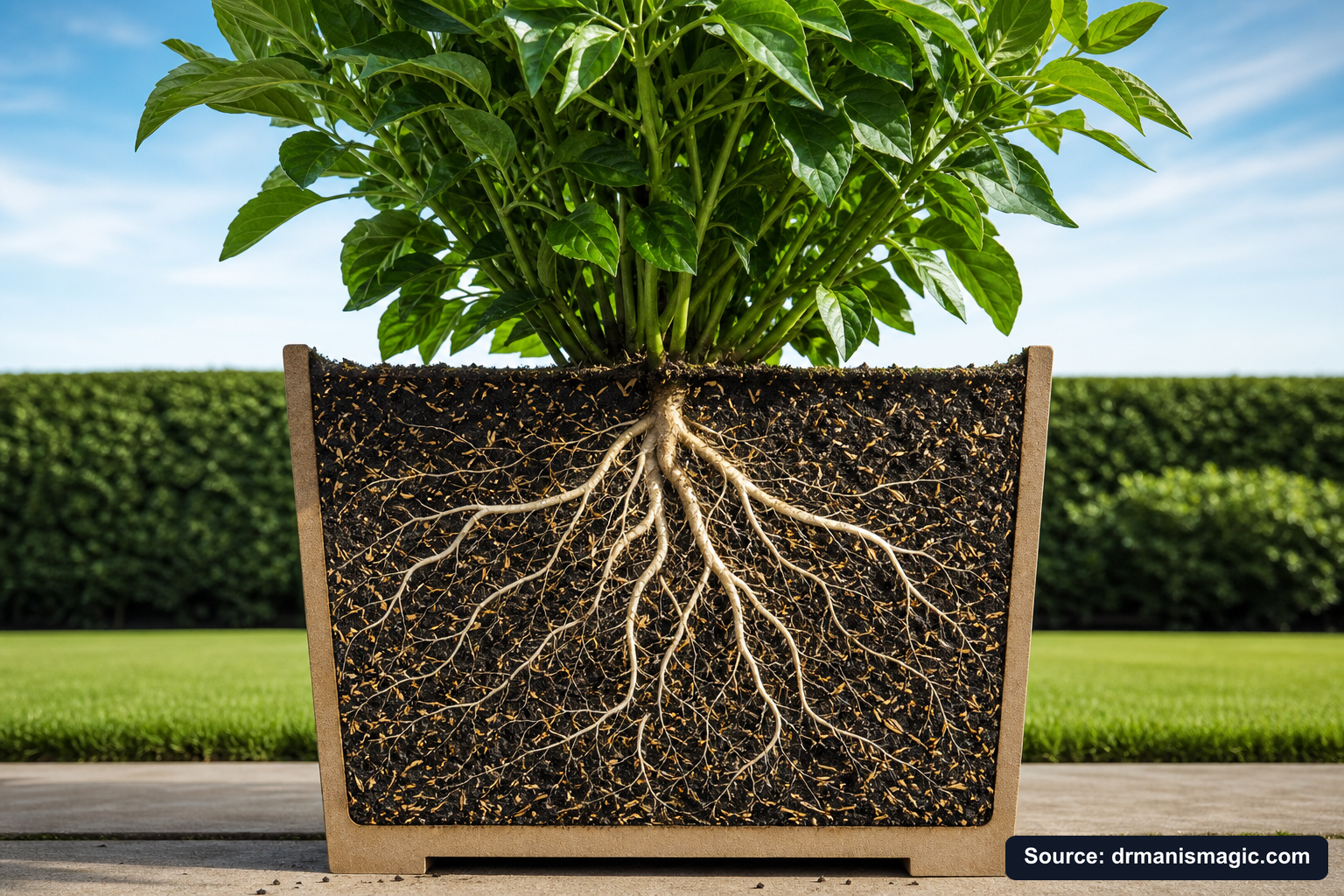
Sand Is Structure. And Structure Is Everything.
Here is the simplest version of everything we have covered. Roots need oxygen. Oxygen lives in pore space. Pore space lives in mineral structure. Mineral structure does not decompose. So mineral structure is the foundation of every soil that stays healthy over time.
Sand, grit, silica, rocky loam. These are not exotic ingredients. They are what plants evolved in. The ground outside is mostly mineral. The organic layer on top is a thin, dynamic, constantly replenished fraction. Nature figured this out over millions of years. We have been trying to plant trees in bags of decomposing wood chips for about seventy years, mostly because pine bark was cheap and the marketing was good. The results speak for themselves.
The plants in your yard, your containers, your living room, your orchard, they are not failing because you have a brown thumb. They are failing because no one explained the foundation to you. Now you know it. Structure first. Oxygen always. Mineral before organic. Permanent before temporary.
You cannot get back the years a plant spent stalled in collapsed media. But you can make a different choice starting today. If you are ready to build on a foundation that actually lasts, explore what Super Soil was built to do, and see why over 10,000 growers across the country have trusted it to give their plants a permanent, oxygen-rich home.
Frequently Asked Questions
If you have ever poked your finger into a soggy pot and wondered why your plant looks sick, these questions are for you. Understanding why sand matters is the first step toward building soil that actually works. Dr. Mani's team has grown over 250,000 trees in South Texas, and the answers below come straight from that hard-won experience.
Why is sand the foundation of every stable soil?
Sand creates structure. Its coarse mineral particles hold their shape and keep tiny air pockets open so roots can breathe. Organic materials like pine bark break down and collapse those pockets over time. Sand does not decompose. That means your roots get steady oxygen, steady drainage, and a stable home for years, not months. That is the first of Dr. Mani's Three Plant Pillars: a mineral foundation that never quits on you.
What does sand actually do for plant roots?
Roots burn oxygen to pump water and nutrients uphill against gravity. When soil pores stay clogged with water, oxygen cannot reach the roots. The roots switch to a backup system that creates toxic byproducts inside the root tissue. Sand keeps those pores open so oxygen flows freely. Think of sand as the lungs of your soil. Without it, your roots are slowly suffocating in the dark where you cannot see it happening.
Is the sand in regular potting mix good enough?
Most bagged potting mix contains very little sand, if any. What it does contain is pine bark, sawdust, and decomposing wood chips. That fluffy feel you notice when you first open the bag? It disappears within months as the organic material breaks down and compacts into a dense, airless sludge. Dr. Mani built Super Soil around silica-rich sandy loam from the Rio Grande Valley precisely because it holds its structure permanently, not temporarily.
Does adding sand to regular potting mix fix the problem?
Not if you use the wrong kind. Fine sand, play sand, and beach sand have rounded, smooth particles that actually fill pore space and make drainage worse. You need coarse, angular mineral particles. Even then, mixing a small amount of coarse sand into a decomposing pine bark base is like putting a good tire on a broken axle. The base is still rotting underneath. The right move is starting with a mineral-based soil that is built correctly from the beginning.
Why does my potting mix smell like a swamp?
That smell is decay. The organic material in your potting mix is breaking down and going anaerobic, meaning it is rotting without oxygen. When pore space collapses and water sits still, harmful pathogens like Phytophthora and Pythium move in fast. This is root rot, and it starts with a soil problem, not a watering problem. Dr. Mani's Super Soil uses steam-sterilized sandy loam that does not rot, does not compact, and does not produce that swamp smell.
How does mineral-based soil connect to the Three Plant Pillars?
The Three Plant Pillars are mineral soil, live microbes, and organic fertilizer. Mineral soil is Pillar One because it is the foundation everything else rests on. Without proper drainage and aeration, live microbes cannot thrive and organic fertilizer cannot reach the roots. Dr. Mani proved this system across 250,000 citrus trees and dozens of houseplants and tropical trees. Get the structure right first, and the other two pillars do their job powerfully.
How long does mineral-based soil last compared to regular potting mix?
Regular potting mix can start breaking down and compacting within three to six months. After a year or two, the structure is mostly gone. Dr. Mani's Super Soil is built on sandy loam that does not decompose. The silica particles hold their shape indefinitely. That means you are not repotting every season, not buying new bags every spring, and not starting over from scratch. You plant once in a stable foundation and let your roots grow without interruption.
About the Author
Dr. Mani Skaria, PhD
Dr. Mani Skaria, PhD, is a plant pathologist and the scientific founder of Dr. Mani's Magic. He earned his doctorate at Purdue University and spent 48 years studying how plants, soil, and living microbes work together, including his years as Professor Emeritus at Texas A&M and as a member of the USDA NAREEE Advisory Board. He invented micro-budding, a method for growing healthier, stronger trees, and has grown more than 250,000 trees on the family farm in Hargill, Texas - US Citrus Nursery. His life's work takes real lab science and practical experience and turns it into simple, safe, organic plant care anyone can use at home.


