


Why Killing All Nematodes Backfires and Worsens Your Soil | Dr. Mani's Magic
Why Killing All Nematodes Backfires: The Underground Workforce You Never Knew You Had
You're on your knees in the garden. Again. The leaves are yellowing. The roots look sad and stunted. You pull one up, and it's a mess of knobby, swollen bumps. You Google it. "Root-knot nematodes." Your stomach drops.
So you do what anyone would do. You head to the hardware store, grab something labeled "nematode killer," and drench the soil. Problem solved, right? Except two months later, the plants look worse. The soil smells off. Nothing seems to grow right anymore. You spent money, you spent time, and somehow you ended up further behind than when you started. Here's what nobody told you at that store: you just fired your entire underground workforce to catch one bad employee.
Most gardeners have never heard of the soil food web. They've never heard of bacterial-feeding nematodes, or predatory nematodes, or the invisible trophic chain that converts dead leaves into nitrogen your plants can actually use. They only hear the word "nematode" and think "pest." That's the mistake. And after growing over 250,000 trees at our South Texas nursery, we've seen what happens when that mistake gets made at scale. It isn't pretty. But the good news? It's completely fixable. Let's walk through exactly what's going on underground and why a balanced ecosystem always beats a sterile one.

Plant Super Boost
Key Takeaways
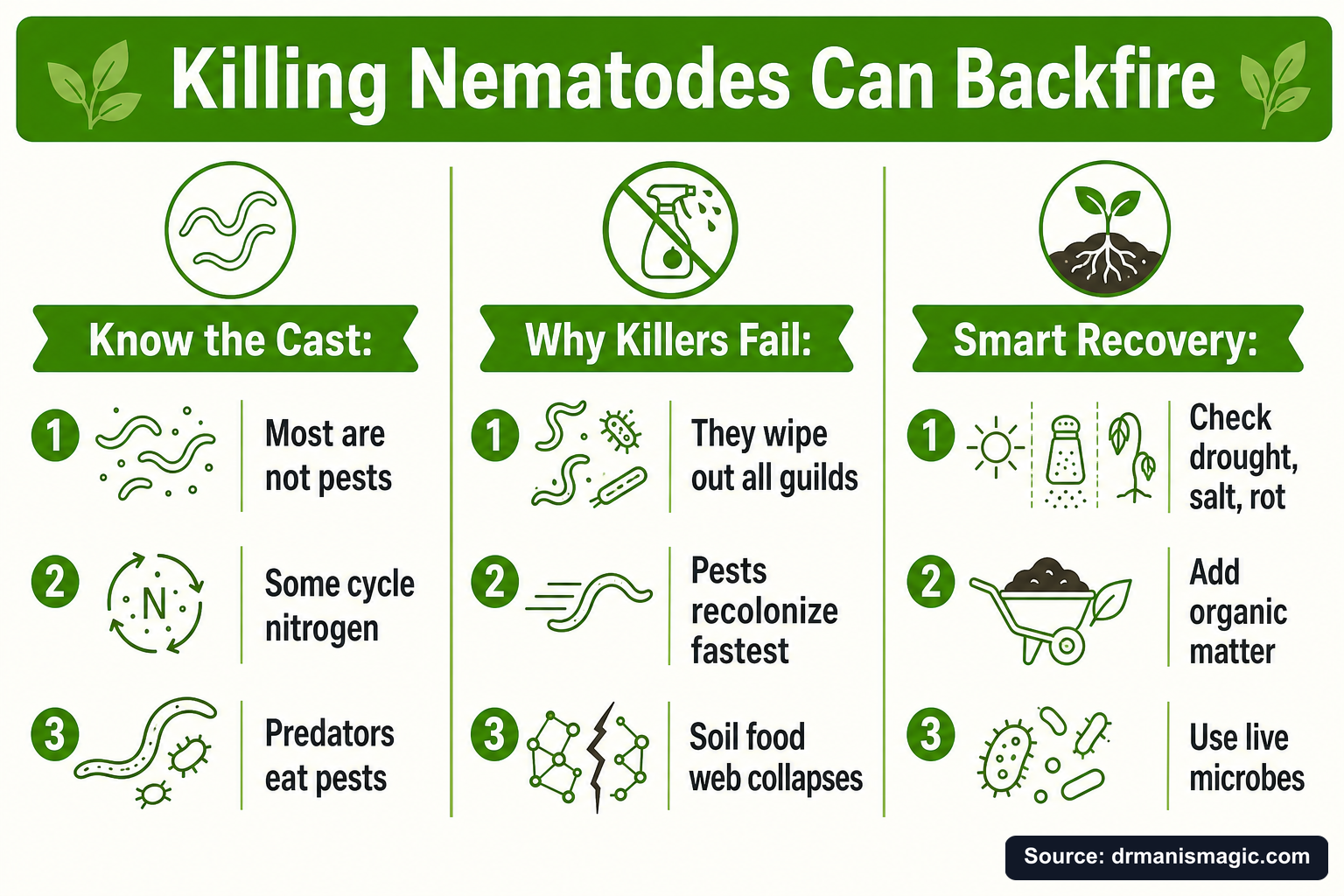
- Most nematodes in your soil are beneficial or neutral. Only a small fraction are plant parasites.
- Killing all nematodes removes predators and nutrient cyclers, creating a biological vacuum that pest nematodes fill first.
- Beneficial nematodes, bacteria, fungi, and protozoa work together as a nutrient-release engine that feeds your plants for free.
- Broad-spectrum nematicides and soil sterilization wipe out the checks and balances that keep bad organisms in line.
- Symptoms like yellowing leaves and stunted roots often look like nematode damage but are caused by drought, salt buildup, or root rot instead.
- Soil can recover after sterilization, but it takes time, organic matter, and living microbial inoculants to rebuild the food web.
- The Three Plant Pillars framework — mineral soil, live microbes, and organic fertilizer — gives your garden a foundation where beneficial biology thrives naturally.
Are All Nematodes Bad for Your Plants?
Quick Answer: No. The vast majority of nematodes in healthy soil are beneficial or neutral. Colorado State Extension confirms that most nematode species are beneficial, feeding on bacteria, fungi, and other nematodes rather than plant roots. Only a small group called plant-parasitic nematodes actually damage roots.
Here's the thing about nematodes. They are not one creature. They are a whole guild system. Think of them like different departments in a company. Some employees do damage. Most are doing critical work that keeps the whole operation running.
There are six main nematode guilds living in your soil right now:
| Nematode Guild | What They Eat | What They Do for Your Soil | Friend or Foe? |
|---|---|---|---|
| Plant-Parasitic | Plant root cells | Damage roots, reduce water and nutrient uptake | Foe (the minority) |
| Bacterial-Feeding | Bacteria | Release nitrogen as plant-available ammonium when they eat bacteria | Friend |
| Fungal-Feeding | Fungi | Mineralize nutrients locked in fungal bodies, support fungal turnover | Friend |
| Predatory | Other nematodes, protozoa | Eat plant-parasitic nematodes, regulate population balance | Friend |
| Omnivorous | Bacteria, fungi, nematodes | Flexible role in food web, nutrient cycling | Friend (mostly) |
| Entomopathogenic | Insect larvae | Kill soil-dwelling pest insects like grubs and root weevils | Friend (your best pest control) |
When you drench your soil with a broad-spectrum nematicide, you are not targeting the plant-parasitic column. You are wiping out the entire table. Every guild. Gone.
Penn State Extension clearly distinguishes plant-parasitic nematodes from the many species that feed on fungi, bacteria, protozoa, other nematodes, and insects. Their research makes it clear: these are not one organism. They are hundreds of species playing very different roles.
What Actually Happens When You Kill All Nematodes in Your Soil?
Quick Answer: When you kill all nematodes, you remove the predators, nutrient cyclers, and pest regulators that keep your soil food web balanced. The harmful plant-parasitic nematodes recolonize faster than their natural enemies, creating a worse problem than before. This is called the biological vacuum effect.
This is the part nobody talks about. It's called the rebound problem. And it is brutal.
When you sterilize or nematicide your soil, you do remove plant-parasitic nematodes for a short time. But here's what happens next. The soil is now an open field. A biological vacuum. And what fills a vacuum first? The fastest reproducers. Plant-parasitic nematodes can rebuild populations in weeks. Their predators, the ones that kept them in check, take much longer to return.
So you treated. You waited. The symptoms came back. Worse this time. And you have no idea why, because the box said it worked.
You also lost your bacterial-feeding nematodes. Those are the ones that eat bacteria and release nitrogen as ammonium. That is free fertilizer. Right in your root zone. Gone.
You lost your fungal-feeding nematodes. Those are the ones that graze on fungi and keep the fungal community cycling and renewing. Gone.
You lost your predatory nematodes. The ones that physically eat plant-parasitic nematodes or block them from reaching roots, as Colorado State Extension describes in their living soil research. Gone.
And your entomopathogenic nematodes, the ones killing grubs and root weevils underground? Also gone. Now those insects have free rein too.
You did not solve a problem. You created four new ones.
How Do Beneficial Nematodes Actually Feed Your Plants?
Quick Answer: Bacterial-feeding and fungal-feeding nematodes eat microbes and release excess nitrogen as plant-available ammonium. This is one of the most important nutrient-release mechanisms in healthy soil. When these nematodes are gone, that natural fertilizer system shuts down completely.
Let's talk about the nitrogen story because this is where most gardeners' eyes go wide.
You buy fertilizer. You pay for it. You apply it. Your plant uses some of it. But here's what nature figured out millions of years before anyone invented a fertilizer bag: there is nitrogen everywhere. It is literally raining down from the atmosphere. The trick is converting it into a form plants can use.
That is the job of your soil food web. And nematodes are a critical link in that chain.
Here is how it works. Bacteria eat organic matter in your soil. They store nitrogen in their bodies. Bacterial-feeding nematodes eat those bacteria. They use what they need. They release the rest as ammonium, which is a form of nitrogen your plants can drink up through their roots immediately. No fertilizer bag required.
University of Minnesota Extension documents how soil organisms contribute to nutrient cycling, water retention, disease suppression, and soil structure. That is not marketing language. That is documented science. These organisms are doing the work we used to have to do with chemicals. For free. If we let them live.
Protozoa do the same thing. They eat bacteria. They release ammonium. University of Maryland Extension describes the soil as an intricate food web fueled by root exudates and organic residues, where predators and decomposers keep nutrients moving and pest populations in check. When you sterilize that web, you stop the nutrient engine. You will then need to buy more fertilizer to compensate. Which, of course, is exactly what the companies selling you nematicides also want to sell you next.
We've seen this pattern play out on thousands of trees at US Citrus Nursery. The growers who tried to sterilize their way to healthy roots always ended up spending more, growing less, and coming back confused. The growers who fed their soil biology? Their trees thrived season after season.
How Do You Know If You Actually Have Plant-Parasitic Nematodes?
Quick Answer: You cannot tell just by looking at sick plants. Root-knot nematode damage looks almost identical to drought stress, nutrient deficiency, root rot, and salt toxicity. The only reliable way to diagnose plant-parasitic nematodes is a soil and root nematode test through a certified lab or university extension service.
This is where so many gardeners make the costly mistake. Their plant looks sick. The roots look bad. They Google the symptoms. "Root-knot nematodes" shows up. They buy a nematicide. They apply it. Except they never had nematodes. They had root rot from poor drainage. Or salt damage from synthetic fertilizer. Or compacted soil choking the roots of oxygen.
Symptoms that look like nematode damage:
- Yellowing leaves that don't respond to fertilizer
- Wilting even when soil is moist
- Stunted growth despite good sun and water
- Roots that look brown, mushy, or knotted
- Gradual decline over one to two seasons
Symptoms that actually confirm plant-parasitic nematodes:
- Galls or knots on the roots themselves (not just discoloration)
- A confirmed nematode soil test showing species and population levels above economic thresholds
- Symptoms that match the nematode species suspected for your specific plant type
Before you treat anything, test. Your state's cooperative extension service can guide you to a certified nematode testing lab. That test costs far less than a nematicide treatment that may not be needed and may make things worse.
Here is a practical decision path for you:
- Symptoms appear. Do not panic. Do not treat yet.
- Rule out the common culprits: drought, salt buildup from fertilizer, poor drainage, root rot, compaction.
- Submit a soil and root sample to a certified nematology lab.
- Identify the specific nematode guild and species present.
- Determine population thresholds. Are levels actually high enough to cause damage?
- Choose targeted, biology-friendly management: crop rotation, resistant varieties, organic matter addition, or specific biocontrol.
- Rebuild your soil biology with live microbials and organic matter.
What Is the Soil Food Web and Why Does It Keep Plants Healthy Without Chemicals?
Quick Answer: The soil food web is the community of bacteria, fungi, protozoa, nematodes, arthropods, and other organisms that decompose organic matter, cycle nutrients, suppress disease, and build soil structure. When this web is intact, plants get fed, watered, and protected almost automatically. When it is destroyed, you have to do all that work with products and money.
Picture a forest. Nobody is out there fertilizing the trees. Nobody is spraying fungicides. Nobody is watering. Yet those trees are massive, healthy, and thriving. Why? Because the soil under them is alive with a complete food web. Every layer of that web is doing a job.
| Soil Organism | What It Does | Why Your Plant Needs It |
|---|---|---|
| Bacteria | Decompose organic matter, fix nitrogen, suppress pathogens | Free fertilizer, disease resistance |
| Mycorrhizal Fungi | Extend root reach up to 100x, deliver water and phosphorus | Drought tolerance, massive nutrient uptake |
| Protozoa | Eat bacteria, release nitrogen as ammonium near roots | Concentrated plant-available nitrogen in root zone |
| Bacterial-Feeding Nematodes | Graze on bacteria, mineralize nitrogen | Nitrogen release, microbial population control |
| Fungal-Feeding Nematodes | Graze on fungi, drive fungal community turnover | Nutrient cycling, fungal diversity |
| Predatory Nematodes | Eat plant-parasitic nematodes and harmful organisms | Natural pest suppression without chemicals |
| Entomopathogenic Nematodes | Kill soil-dwelling pest insects | Grub and weevil control, no sprays needed |
| Arthropods and Earthworms | Shred organic matter, create channels for water and air | Drainage, aeration, organic matter breakdown |
When you apply a broad-spectrum nematicide, a heavy dose of synthetic herbicide, or a chemical fungicide, you are not just hitting your target. You are collapsing this entire web. And once it collapses, your plant becomes completely dependent on you. You have to fertilize it. You have to water it more carefully. You have to spray for pests. You have to fight diseases. Because you fired the team that was doing all of that for free.
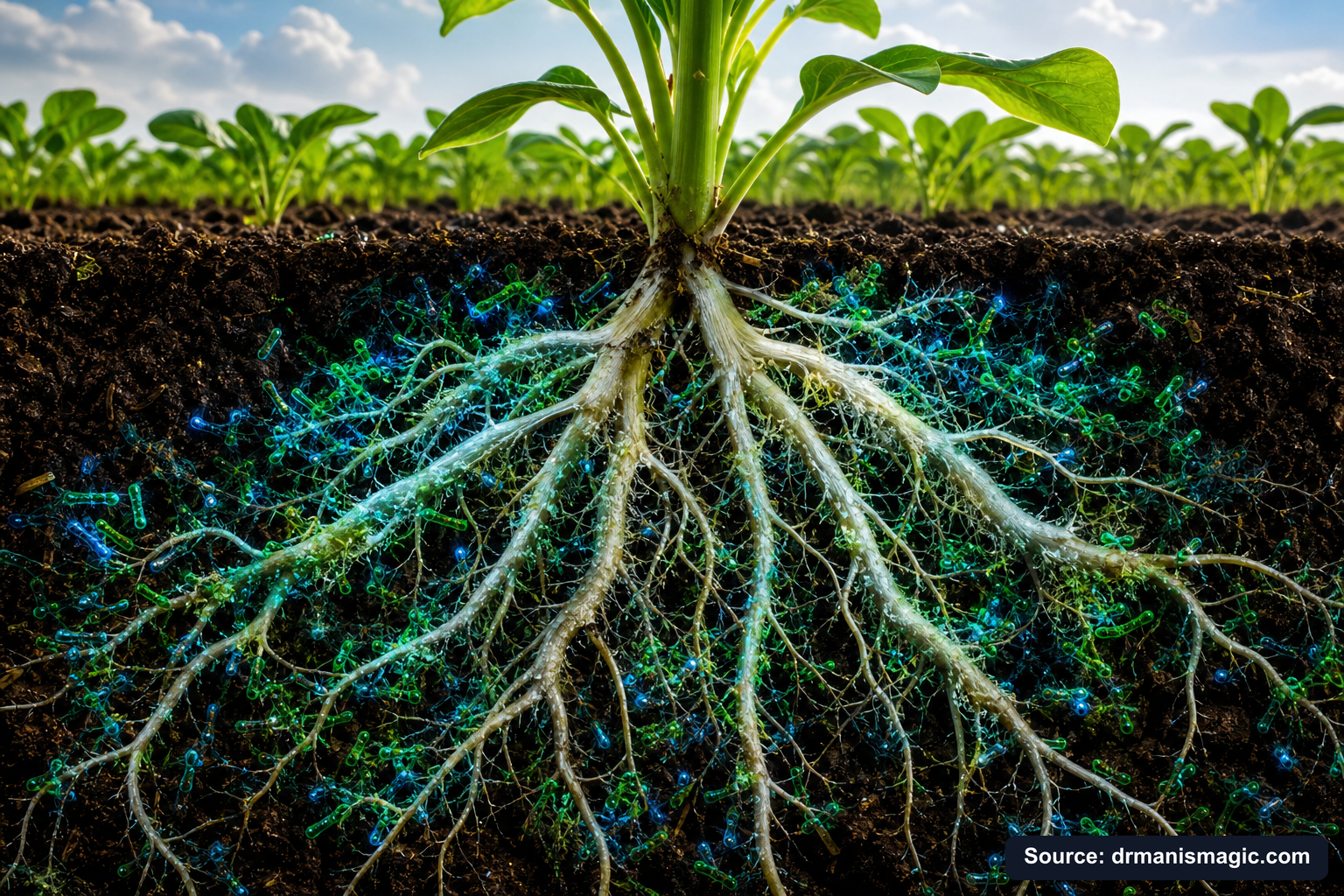
At US Citrus Nursery, this is why Dr. Mani Skaria built the Three Plant Pillars framework. It's not just about adding products. It's about restoring the conditions where a complete biological food web can live, thrive, and do the heavy lifting for your plants automatically.
You Never Had a Brown Thumb.
You were handed the wrong tools. This free guide hands you the right ones.
You watered it. You fed it. It died anyway.
It was never you. It was the dirt, the salt food, and the bad advice.
This guide shows you what really went wrong, and how to fix it for good.
- Why your plants really died, and why it was never your fault
- The salt hiding in your plant food that quietly burns the roots
- The hidden killer in almost every bag of store soil
- The tiny helpers that grow a whole forest for free
- The rescue trick that brings a half dead plant back to life

What Chemicals Destroy the Soil Food Web (Including Beneficial Nematodes)?
Quick Answer: Synthetic herbicides, salt-based fertilizers, broad-spectrum fungicides, and nematicides all damage or destroy soil biology. They kill bacteria, fungi, protozoa, and beneficial nematodes along with any target pests. The damage compounds over time, leaving soil progressively less alive and more dependent on chemical inputs.
Here is the cycle nobody talks about when they sell you the bottle.
You apply a synthetic fertilizer. It's salt-based. Those salts stress and kill beneficial bacteria in your root zone. The bacteria that were feeding your plant, protecting your roots, and cycling your nutrients are gone. Now your plant is weaker. More susceptible to disease. So you apply a fungicide. The fungicide kills the beneficial fungi along with the bad ones. Now your mycorrhizal network is damaged. Roots shrink. Nutrient uptake drops. You apply more fertilizer. More salts. More dead bacteria. The spiral continues.
Eventually, someone tells you that you might have nematodes. You apply a nematicide. Now what little remains of your soil food web is gone.
This is not an accident. This is what happens when you treat soil like a chemistry set instead of a living ecosystem.
See also: The Hidden Reason Synthetic Fertilizers Cause Root Rot
The inputs that most damage your soil food web include:
- Synthetic herbicides like glyphosate, which disrupt microbial communities at the root level
- Salt-based fertilizers, which create osmotic stress that kills beneficial bacteria and burns roots
- Broad-spectrum pesticides, which reduce microbial diversity and knock out predatory organisms
- Synthetic fungicides, which suppress helpful fungi including mycorrhizae along with pathogens
- Broad-spectrum nematicides, which kill all nematode guilds indiscriminately
- Fumigation and soil sterilization, which remove every living organism from the soil profile
And there's one more problem worth naming. Many commercial fertilizers and soil amendments are made with biosludge, which can carry PFAS chemicals and other contaminants that further compromise soil biology over time. At Dr. Mani's Magic, our products contain zero PFAS, zero biosludge, and zero synthetic salts. That is not a small thing. It means the biology you build stays intact.
Plant-Parasitic Nematodes vs. Beneficial Nematodes: What's the Real Difference?
Quick Answer: Plant-parasitic nematodes puncture and feed on root cells, causing galls, lesions, and reduced water and nutrient uptake. Beneficial nematodes feed on bacteria, fungi, other nematodes, or insects and actively improve soil fertility and pest control. The difference is not just what they eat. It is whether your soil food web is intact enough to keep populations in balance.
Let's get specific about the bad actors so you know what you are actually looking for.
The most common plant-parasitic nematodes that cause real damage include:
- Root-knot nematodes (Meloidogyne species): cause the classic galls or knots on roots
- Lesion nematodes (Pratylenchus species): create brown lesions on roots, allowing secondary pathogens in
- Sting nematodes (Belonolaimus species): particularly damaging to turf and warm-season grasses
- Lance nematodes (Hoplolaimus species): feed on root cells, common in sandy soils
- Dagger nematodes (Xiphinema species): can transmit plant viruses while feeding
These are real pests. We are not minimizing them. But here is the critical insight: in a healthy soil food web, predatory nematodes, competing organisms, and biological checks keep plant-parasitic nematode populations below damaging thresholds naturally. The moment you sterilize that web, you remove those checks. The parasites boom. You get damage. You treat again. The cycle repeats.
A balanced soil ecosystem is your best long-term defense. Not a nematicide. Not fumigation. Balance.
How Do You Rebuild Soil Biology After Sterilization or Chemical Damage?
Quick Answer: Rebuilding soil biology after sterilization requires adding organic matter, reducing chemical inputs, improving drainage, correcting pH, and consistently applying live microbial inoculants over several months. The food web rebuilds through succession, and beneficial nematodes return as bacterial and fungal populations recover.
This is the question that matters most if you've already made the mistake. Good news: soil can recover. It just needs time, the right conditions, and a living microbial starter.
Here is your recovery checklist:
- Stop the damage first. Eliminate or dramatically reduce synthetic herbicides, salt-based fertilizers, and broad-spectrum fungicides. You cannot rebuild a fire while someone is still pouring water on it.
- Add organic matter. Compost, aged manure, cover crop residue. Organic matter is food for bacteria and fungi. It kickstarts the food web succession.
- Fix drainage and aeration. Compacted, waterlogged soil cannot support aerobic biology. If your soil is packed down or sitting in water, your microbes will die no matter how many you add. This is why mineral-based soil structure matters so much. Organic potting mixes break down into suffocating sludge. A mineral-based blend stays open, draining, and oxygenated.
- Correct pH if needed. Most beneficial soil organisms thrive in a slightly acidic to neutral range (6.0 to 7.0). Extreme pH locks out nutrients and limits microbial activity.
- Apply live microbial inoculants consistently. This is where most recovery plans fall short. People add microbes once and expect miracles. But damaged soils have been colonized by pathogens and harmful organisms. Beneficial biology needs repeated reinforcement, especially in the first three to six months of recovery.
- Use organic fertilizer that feeds microbes, not salts that kill them. Synthetic fertilizer poured into recovering soil is like rebuilding a house while someone keeps knocking down the walls. Organic, slow-release fertilizer from natural sources feeds both the plant and the microbial community simultaneously.
- Be patient and consistent. Soil food web succession takes time. The bacteria come first. Then the fungi. Then the protozoa. Then the nematode guilds. This is not a one-week fix. But every month of consistent biological feeding compounds. After three to six months, most gardeners see a dramatic shift.
We have watched this recovery happen on trees at our nursery that looked nearly dead. The soil biology came back. The trees followed. It is not magic. It is just nature, finally allowed to do its job.
Why Do Most Microbial Products Fail to Restore Beneficial Nematodes and Soil Biology?
Quick Answer: Most commercial microbial products are either lab-grown and dried into powders that barely survive, or compost-derived liquids that go anaerobic and die before you ever open the bottle. Neither delivers the full-spectrum living biology your soil food web needs to rebuild and sustain beneficial nematode populations.
Here's where we need to be honest with you about something. Not all microbial products are equal. Not even close. And understanding why matters if you are serious about rebuilding your soil.
There are three types of microbial products on the market:
Type 1: Dried, lab-grown powders. These are manufactured in giant factories, dried into spores, and packaged with impressive species lists on the label. The idea is that the spores will reactivate when wet. In our testing of dozens of these products at US Citrus Nursery, we saw no meaningful results. The viability rate at the time of application is very low. The species list is narrow. And the organisms that do survive are often not the right ones for a complex soil food web.
Type 2: Compost-derived liquids that have gone anaerobic. These smell. Sometimes they fizz when you open the bottle. That fizz is gas from fermentation. The microbes are dying. By the time you apply them, you are pouring a dead or dying liquid onto your soil. Some residual benefit from humic and fulvic acids may remain. But the living biology is largely gone.
Type 3: Stabilized, full-spectrum, compost-derived microbes. This is what Dr. Mani's Magic Plant Super Boost delivers. Our proprietary natural stabilization method keeps the full spectrum of microbes alive, active, and ready without going anaerobic. We are talking about over 2,000 bacterial species, 400 to 500 fungi including mycorrhizae, plus protozoa and nematodes. The same diversity you would find in thriving, mature compost. But stable enough to ship to your door, smell earthy instead of rotten, and go to work the moment you pour it on your soil. You can even see the microbes moving under a microscope. We have lab analyses that confirm it.
| Product Type | Microbial Viability | Spectrum | Odor | Real-World Results |
|---|---|---|---|---|
| Dried lab-grown powder | Very low | Narrow (checklist species) | None | Minimal in our testing |
| Rehydrated dried powder | Low | Narrow | None | Minimal in our testing |
| Old compost tea (over 24 hours) | Anaerobic, dying | Partial | Strong foul odor | Some humic/fulvic benefit only |
| Fresh compost tea (under 24 hours) | Moderate | Partial, variable | Earthy to sour | Good, but time-sensitive and labor-intensive |
| Fresh active compost | High | Broad | Earthy | Excellent, requires ongoing effort |
| Plant Super Boost (stabilized full-spectrum) | High, confirmed by lab | 2,000+ bacteria, 400-500 fungi, protozoa, nematodes | Earthy, not foul | Strong, proven across 250,000+ trees |
See also: Why Dead Microbe Products Fail in Real Gardens
The nematodes in Plant Super Boost, by the way, are beneficial. Bacterial-feeding and fungal-feeding nematodes are part of the natural compost ecosystem. They come along with the full spectrum of biology. And they are part of what makes the product function like a genuine soil food web starter rather than a simple fertilizer additive.
What Can You Do Right Now to Protect and Restore Your Soil's Biological Balance?
Quick Answer: Stop broad-spectrum chemical applications, add organic matter, apply a full-spectrum live microbial inoculant monthly, switch to organic slow-release fertilizer, and give your soil structure the ability to drain and breathe. These five steps align with the Three Plant Pillars and begin showing results within four to eight weeks for most gardeners.
You cannot get that time back. Every month your soil runs biologically empty is a month your plants are not growing at their potential. A month without fruit. A month without the thick, lush green you've been picturing. Dr. Mani hears it all the time from gardeners: "I just want to see my tree fruit before I run out of seasons." That is not an unreasonable dream. It is what nature intended. But it requires a foundation built on biology, not chemistry.
Here is what you can start today:
- Test before you treat. If you suspect nematode damage, submit a soil sample to a nematology lab. Do not treat blindly.
- Reduce or eliminate synthetic inputs. Every synthetic herbicide, salt-based fertilizer, and broad-spectrum fungicide you stop using is a win for your soil biology.
- Add compost or organic matter. This feeds the bacteria and fungi that feed everything else in the food web chain.
- Apply live microbials monthly. Not dried powders. Not smelly dead liquids. Living, full-spectrum biology that goes to work immediately.
- Feed with organic, slow-release fertilizer. One that works with your microbes instead of burning them away. Crab, kelp, and amino acids in a 7-4-4 formulation delivers the complete nutrient spectrum without salts.
- Fix your soil structure. If your potting mix is old, compressed, or made from decomposing bark, it is strangling your roots and choking out aerobic biology. A mineral-based, permanent soil gives roots and microbes the oxygen they need.
- Be consistent. Soil biology does not rebuild overnight. Monthly applications, good organic matter, and patience compound into something remarkable within one growing season.
Everything above is what the Three Plant Pillars framework was built to make easy. Mineral soil. Live microbes. Organic fertilizer. When those three elements are in sync, the soil food web rebuilds. Beneficial nematodes return. Predators regulate parasites. Bacteria and fungi cycle nutrients. Your plant stops struggling and starts thriving the way nature designed it to.
We built these products for our own nursery first. Over 250,000 trees. Our grove. Our houseplants. Our tropical trees. Every product in the Dr. Mani's Magic line carries a 30-day money-back guarantee because we are confident in what biology, done right, can do.
If you want to see what a living, balanced soil can do for your garden, lawn, fruit trees, houseplants, or flowers, start with the Free Plant Care Field Guide. It walks you through the Three Plant Pillars step by step, in plain language, with everything you need to get started without guesswork.
The underground world beneath your plants is not your enemy. It never was. Give it a chance to work, and it will grow plants you never thought possible.
Frequently Asked Questions
Most gardeners only think about nematodes when something goes wrong. But the questions below show why that is exactly backwards. Once you understand what is really happening underground, you will never reach for a broad-spectrum nematicide again. These answers are grounded in over 30 years of hands-on growing at our South Texas nursery, where we have tested this system on more than 250,000 trees.
Are all nematodes bad for my plants?
No. Most nematodes in your soil are working for you, not against you. Bacterial-feeding nematodes release nitrogen your plants can actually use. Predatory nematodes hunt and eat the plant-parasitic ones. Only a small fraction of nematode species damage roots. When you treat your soil with the Three Plant Pillars, you build the kind of living ecosystem where beneficial nematodes thrive and keep the bad ones in check naturally.
What kills nematodes instantly, and is that a good idea?
Boiling water, soil baking at 140 degrees Fahrenheit, and fast-acting chemical nematicides will kill nematodes quickly. But here is the problem. They kill every guild at once. The predatory nematodes that were eating the plant-parasitic ones? Gone. The bacterial feeders cycling your nitrogen? Gone too. Plant-parasitic nematodes are survivors. They bounce back first into that empty soil. You end up worse than before. Rebuilding with live microbes and organic inputs is the smarter move.
How long do beneficial nematodes live in the soil?
Beneficial nematodes typically live four to six weeks under normal conditions. Soil moisture, temperature, and food supply all affect how long they last. Dry soil kills them fast. Temperatures above 90 degrees Fahrenheit stress them quickly. This is why a living soil ecosystem matters so much. When your soil has the right mineral structure, organic matter, and a steady microbial population, beneficial nematodes have a home worth staying in.
Is there a downside to applying beneficial nematodes as a product?
Yes. Bottled beneficial nematodes are sensitive to heat, light, and dry conditions. They can be expensive. They need reapplication. And if you misidentify the pest, you buy the wrong species and nothing happens. The deeper fix is building a soil environment where predatory and bacterial-feeding nematodes already live and reproduce on their own. That starts with mineral-based soil, live microbial inoculants, and organic fertilizer that feeds the whole food web, not just the plant.
Can I apply nematodes in October?
Yes. Early to mid-October is actually a great time to apply beneficial nematodes because soil is still warm and pest grubs are feeding near the surface. Soil temperature should be between 50 and 68 degrees Fahrenheit. Apply at dusk or on a cloudy day since nematodes die in direct sunlight. Keep the soil moist for several days after application. For long-term results, pair any nematode application with organic inputs that support the broader soil food web.
What do beneficial nematodes eat in the soil?
Different nematode types eat different things. Bacterial-feeding nematodes eat bacteria and release nitrogen as a byproduct. Fungal-feeding nematodes eat fungi. Predatory nematodes eat other nematodes, including plant-parasitic ones. Omnivorous nematodes shift their diet based on what is available. Entomopathogenic nematodes hunt and kill soil-dwelling pest insects like grubs. Together, they form a nutrient-cycling engine that feeds your plants for free when your soil ecosystem is intact.
My roots look damaged. How do I know if nematodes are really the problem?
Root-knot nematode damage shows up as swollen, knotty bumps on roots. But yellowing leaves and stunted growth also come from salt buildup from synthetic fertilizers, root rot from poor-draining soil, and drought stress. Many gardeners treat for nematodes and miss the real cause entirely. At Dr. Mani's Magic, we have seen this pattern across more than 250,000 trees. Start with the foundation: mineral-based soil that drains properly, live microbes that fight pathogens, and organic fertilizer that does not burn roots. Most root problems trace back to one of those three pillars being broken.
About the Author
Dr. Mani Skaria, PhD
Dr. Mani Skaria, PhD, is a plant pathologist and the scientific founder of Dr. Mani's Magic. He earned his doctorate at Purdue University and spent 48 years studying how plants, soil, and living microbes work together, including his years as Professor Emeritus at Texas A&M and as a member of the USDA NAREEE Advisory Board. He invented micro-budding, a method for growing healthier, stronger trees, and has grown more than 250,000 trees on the family farm in Hargill, Texas - US Citrus Nursery. His life's work takes real lab science and practical experience and turns it into simple, safe, organic plant care anyone can use at home.


