


How to Grow Sweeter, Juicier Fruit at Home | Dr. Mani's Magic
How to Grow Sweeter, Juicier Fruit at Home: A Diagnostic Guide for Real Results
Picture this. You walk out to your backyard on a warm morning. You reach up and pull a peach right off the branch. It is heavy. The skin is warm from the sun. You bite in and wait for that rush of sweet juice.
Instead, you get something flat. Watery. A little sour. Maybe even dry and grainy on the inside. You stand there thinking, "What went wrong? I watered it. I fed it. I did everything right." That fruit looks good from the outside. But it tastes like disappointment.
Here is what most people do next. They grab a fertilizer with "fruit sweetener" on the label. They dump it on and wait. And nothing changes. Sometimes it gets worse. Because sweeter, juicier fruit is not something you pour on from a bottle. It starts underground, with a root system that is alive, balanced, and working the way nature intended. We learned this the hard way growing over 250,000 citrus trees at our South Texas nursery. And in this guide, we are going to show you exactly what is actually causing your fruit to taste bland, and what to do about it.

Organic Fertilizer | Crab, Kelp & Amino Acids
Key Takeaways
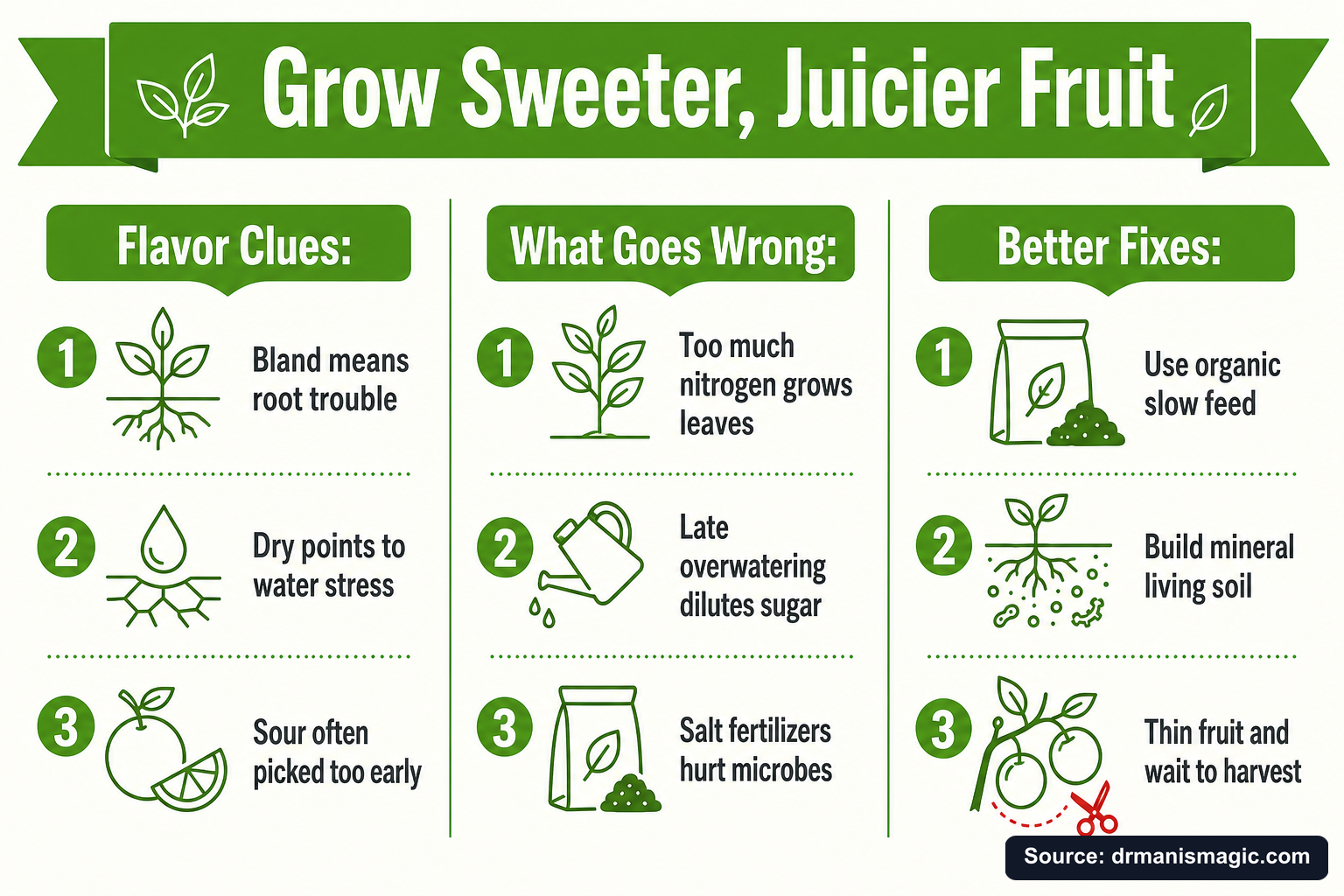
- Bland, dry, or sour fruit almost always has a root-level cause, not a flavor problem you can fix by adding sugar or "sweetener" fertilizer.
- The biggest mistake most home growers make is too much nitrogen, which pushes leafy growth and shuts down flowering and fruit development.
- Sweetness and juiciness can actually work against each other: more water means bigger, juicier fruit but can dilute sugars if overdone near harvest.
- Salt-based synthetic fertilizers burn the soil microbes your fruit trees depend on, leading to weak roots, locked-up nutrients, and flavorless harvests.
- The Three Plant Pillars, mineral-based soil, live microbes, and organic slow-release fertilizer, form the proven foundation for fruit that actually tastes good.
- Harvest timing matters more than most people realize. Fruit pulled too early will never develop its full sugar-acid balance, no matter what you fed it.
- A simple diagnostic check of your symptoms, whether bland, dry, sour, small, cracking, or dropping, will point you to the real fix faster than any bottle on a store shelf.
Why Does Your Fruit Taste Bland or Disappointing?
Quick Answer: Bland fruit is almost never caused by a single missing ingredient. The most common culprits are too much nitrogen, not enough sunlight, wrong harvest timing, excess water near ripening, poor soil biology, and salt buildup from synthetic fertilizers. Fixing the right problem is what changes the flavor.
Most gardeners assume bland fruit means the plant is hungry. So they feed it more. But extension research from the University of Florida IFAS consistently shows that excess nitrogen is one of the top causes of fruit trees making beautiful, lush leaves while producing little or no fruit, and when they do fruit, the flavor is flat.
Here is why. Nitrogen tells a plant to grow. Leaves, stems, branches. That is great up to a point. But when nitrogen is too high, the plant keeps growing instead of shifting into fruit-making mode. The sugars that should be flowing into your fruit are being burned up building more green tissue instead.
At our nursery in Hargill, Texas, we watched this happen over and over with trees that looked gorgeous. Dark green leaves. Strong branches. And fruit that tasted like nothing. The fix was not more fertilizer. It was better fertilizer, the kind that feeds the whole soil system instead of just spiking nitrogen.
But nitrogen is only one part of the story. Let us walk through the full diagnostic picture so you know exactly which problem you are actually dealing with.
The Fruit Flavor Diagnostic Table
| Symptom | Most Likely Root Cause | What to Check First |
|---|---|---|
| Bland, flavorless fruit | Excess nitrogen, low sunlight, premature harvest, or diluted sugars from overwatering | Shoot growth length, sun hours, harvest timing, fertilizer type |
| Dry, mealy texture inside | Water stress during fruit expansion, root damage, or salt buildup | Soil moisture consistency, salt crust on pot rim, root health |
| Sour fruit that never sweetens | Harvested too early, wrong cultivar, insufficient sun, or low potassium | Harvest date vs. expected maturity, sun exposure, fertilizer NPK balance |
| Small fruit | Too many fruits on one branch (crop overload), water stress, or nutrient deficiency | Thin fruits when young, check watering schedule and root zone |
| Cracking fruit | Uneven watering, especially a big drink after dry stress near ripening | Irrigation consistency, mulch coverage, container vs. in-ground |
| Fruit dropping early | Pollination failure, nutrient imbalance, water stress, or root rot | Drainage, salt exposure, root condition, pollinator presence |
| Lots of leaves, no fruit | Excess nitrogen, overpruning, or immature plant not yet in fruiting mode | Fertilizer N content, pruning history, plant age |
| White or crusty ring on pot rim | Salt buildup from synthetic fertilizer accumulation | Switch to organic fertilizer, flush pot thoroughly with water |
| Yellow leaves on fruit tree | Nitrogen deficiency, iron deficiency from high pH, or root rot from poor drainage | Soil pH, drainage quality, fertilizer type, root inspection |
What Is the Real Difference Between Sweeter Fruit and Juicier Fruit?
Quick Answer: Sweetness comes from sugar concentration, which is built by sunlight, leaf area, good harvest timing, and thinning fruit. Juiciness comes from water availability during fruit growth. More water can make fruit bigger and juicier, but too much water late in the season dilutes sugars and flattens flavor. These two goals can work against each other.
This is the tradeoff almost nobody talks about. And it is the reason so many well-intentioned gardeners end up with fruit that is big but bland.
Think of it like making orange juice concentrate. If you add a little water, you get a sweet, full-flavored drink. Add too much water and it tastes thin. The same thing happens inside your fruit. Water during the growth phase makes cells expand and creates juice. But when you keep watering heavily right up to harvest, you keep diluting those sugars.
Research from the University of California Cooperative Extension on citrus and tomatoes confirms this pattern: consistent moisture during fruit sizing improves yield and juice content, but reducing irrigation slightly as fruit approaches maturity can concentrate soluble solids and improve flavor. The key word is slightly. Full drought stress near the end makes fruit small and damages the plant. It is a balance.
The practical rule: water consistently through the whole growing season. Then ease off just a little as fruit reaches full size and color change begins. Do not stop watering. Just stop overwatering.
For container trees, this matters even more. Pots dry out faster and can swing from soaked to bone dry in ways that crack fruit or stress the root zone. Consistent moisture without waterlogging is the goal.
Does Fertilizer Actually Make Fruit Sweeter?
Quick Answer: No single fertilizer makes fruit sweet. But the wrong fertilizer, especially salt-based synthetic products high in nitrogen, can make fruit actively worse by pushing leafy growth over fruiting and killing the soil microbes that help roots absorb the nutrients that do affect flavor, especially potassium and calcium.
Walk into any big box store and you will find fertilizers with names that imply they make fruit taste better. But here is the truth they do not put on the label. Most of those products are salt-based. And salt is one of the worst things you can put near a fruit tree that you want to actually taste good.
Here is what happens underground when you use a salt-based fertilizer. The salts build up in the soil or potting mix. They create what scientists call osmotic stress, which is a fancy way of saying the roots have a harder time pulling water and nutrients in. The same way salt on a slice of eggplant pulls moisture out of it, salt in your soil pulls water away from your roots.
Worse, salt kills the beneficial bacteria and fungi living around your root zone. These microbes are not decoration. They are the workers that unlock nutrients from the soil and deliver them to your plant. When they die, your plant goes hungry even if it is sitting in a pile of fertilizer. You can see this as yellowing leaves, weak growth, or fruit that never develops flavor no matter how much you feed it.
After growing over 250,000 trees at our South Texas nursery, we stopped using salt-based fertilizers entirely. Not because of ideology. Because the fruit tasted better when we switched.
The nutrients that most directly influence fruit flavor are potassium, which improves sugar transport and fruit firmness, calcium, which strengthens cell walls and prevents cracking and blossom end rot, and a steady, balanced supply of nitrogen, not a spike of it. An organic slow-release fertilizer delivers all of these gently, without salt, and without burning the microbes that make the whole system work.
See also: How to Feed Fruit Trees Without Burning Them
Salt Fertilizer vs. Organic Approach: What Actually Happens in Your Soil
| Factor | Salt-Based Synthetic Fertilizer | Dr. Mani's Magic Organic Approach |
|---|---|---|
| Nutrient release speed | Fast spike, then nothing | Slow and steady, mirrors nature |
| Effect on soil microbes | Kills beneficial bacteria and fungi | Feeds and supports microbial life |
| Salt accumulation in soil | High, builds up over time, visible as white crust | None, no salt-based compounds |
| Root zone health | Burns fine roots, causes osmotic stress | Supports root expansion and uptake |
| Nitrogen effect on fruiting | Spikes nitrogen, promotes leafy growth over fruit | Balanced N with P and K, supports flowering and fruit set |
| PFAS or biosludge risk | Some products contain PFAS from biosludge fillers | Zero PFAS, zero biosludge, zero synthetic salts |
| Long-term soil health | Degrades soil biology over seasons | Builds living soil that improves year after year |
| Fruit flavor outcome | Diluted sugars, flat flavor, inconsistent quality | Better sugar-acid balance, fuller flavor, improved quality |
Why Do Soil Microbes Matter for Fruit Flavor?
Quick Answer: Soil microbes, including bacteria, fungi, and mycorrhizae, unlock nutrients in the soil and deliver them directly to plant roots. Without them, roots cannot absorb potassium, calcium, and other minerals that build flavor and fruit quality, even when those nutrients are physically present in the soil.
Here is a question worth sitting with. How do wild fruit trees in a forest produce sweet, flavorful fruit with no fertilizer, no watering schedule, and no one tending them?
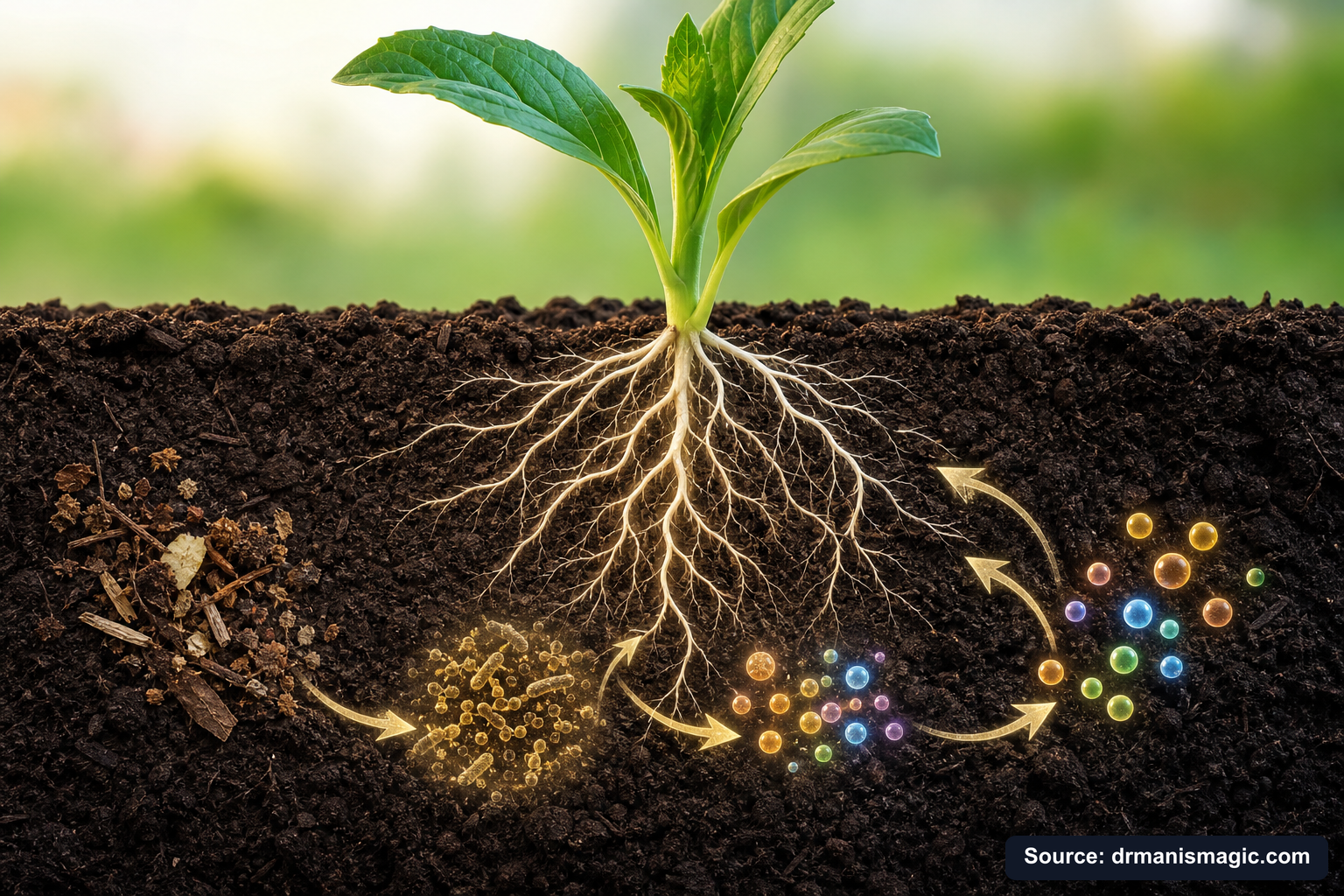
The answer lives underground. Every healthy patch of soil is teeming with trillions of microorganisms. Bacteria that pull nitrogen right out of the air. Fungi that extend root systems to reach water and minerals ten times farther than the roots could reach alone. Protozoa that recycle nutrients back into forms the plant can use.
These are not bonus features. They are the original operating system that plants evolved with over millions of years. When you strip them out with synthetic herbicides, salt-based fertilizers, or broad-spectrum pesticides, you are not just losing microbes. You are disconnecting your plant from the very system it was built to rely on.
Dr. Mani Skaria, who spent over 40 years as a plant pathologist at the Texas A&M Citrus Center and invented the micro-budding technique used to propagate trees faster than anyone else, discovered this truth through hard trial and error in his own nursery. He watched trees fail even with good water and fertilizer. Then he found the missing piece. A world-class compost expert showed him a natural method to stabilize living microbes in a bottle so they stayed alive and active, not dead powder or stinky anaerobic liquid, but genuinely living biology.
That discovery became Plant Super Boost, a liquid microbial formula made from stabilized full-spectrum compost microbes. When you drench your soil with it monthly, you are restoring the living ecosystem that makes root systems work the way they were designed to. Better roots absorb more potassium. More potassium means better sugar transport. Better sugar transport means fruit that actually tastes like something.
See also: What Are Soil Microbes, and Why Do Your Plants Need Them?
How Does Sunlight Affect Fruit Sweetness?
Quick Answer: Sunlight is the original sugar factory. Leaves convert sunlight into carbohydrates through photosynthesis. Those carbohydrates travel to developing fruit and become the sugars that make it sweet. Less sunlight means less sugar production, full stop. No fertilizer can compensate for a tree that is not getting enough light.
This is the most overlooked cause of bland fruit, and it is the one nobody wants to hear because you cannot fix it by buying something.
Every leaf on your fruit tree is a tiny solar panel. It captures light and uses it to convert carbon dioxide and water into sugars. Those sugars are the raw material of flavor. When your tree does not have enough leaf area, or when it is shaded by a fence, a building, or nearby trees, it simply cannot produce enough carbohydrates to fill your fruit with sweetness.
The rule of thumb most extension services use is a minimum of six to eight hours of direct sunlight per day for most fruit trees. Citrus, peaches, apples, figs, and tomatoes all need full sun to reach their flavor potential. Blueberries and strawberries can manage with slightly less, but flavor still suffers in shade.
If your tree is in a container, you have an advantage. You can move it. South-facing walls and patios that catch reflected heat are often surprisingly productive spots for container fruit trees. If your in-ground tree is in a permanent shady spot, no amount of feeding will fully compensate. Pruning nearby trees or structures to open up light is often more valuable than any product you can buy.
You Never Had a Brown Thumb.
You were handed the wrong tools. This free guide hands you the right ones.
You watered it. You fed it. It died anyway.
It was never you. It was the dirt, the salt food, and the bad advice.
This guide shows you what really went wrong, and how to fix it for good.
- Why your plants really died, and why it was never your fault
- The salt hiding in your plant food that quietly burns the roots
- The hidden killer in almost every bag of store soil
- The tiny helpers that grow a whole forest for free
- The rescue trick that brings a half dead plant back to life

What Role Does Harvest Timing Play in How Sweet Your Fruit Tastes?
Quick Answer: Harvesting fruit before it reaches full maturity locks in acidity and low sugar levels that cannot be reversed after picking. Most fruit that tastes sour or bland at home was simply picked too early. Letting fruit reach true maturity on the tree is one of the highest-impact changes you can make for flavor.
Here is something that will save you a lot of frustration. Most store-bought fruit is harvested before it is ripe, then artificially ripened in transit or at the warehouse. That fruit was never going to taste as good as something you grew yourself and left on the tree until it was genuinely ready.
But home growers make the same mistake in the opposite direction. They see full-size fruit and assume it is ready. They pick it too early. The sugars are still developing. The acid-to-sugar ratio is still tilted sour. And then they wonder why homegrown fruit tastes no better than store-bought.
Each fruit has its own signal for true maturity. For citrus, color is not always the best indicator since some varieties stay green when fully ripe. The better test is taste. For peaches, the background skin color behind the blush shifts from green to yellow or cream. For tomatoes, the flesh gives slightly when pressed. For blueberries, the berry should slip easily off the cluster with no pulling. For strawberries, the white shoulders near the stem should be mostly gone and the whole berry should be red and fragrant.
Give your fruit more time on the tree than you think it needs. That last week or two of ripening is when the most sugar accumulates and the acid level drops to balance it out. That balance, called the Brix-to-acid ratio in research settings, is what your tongue actually reads as "sweet." It is not just sugar. It is sugar relative to acid, plus aroma and texture. No fertilizer product can create that. Only time on the tree can.
Why Are Your Blueberries or Strawberries Sour Instead of Sweet?
Quick Answer: Sour berries are usually caused by one of three things: harvesting too early, wrong soil pH blocking nutrient uptake, or a cultivar that needs more chill hours or sun than your climate provides. Blueberries especially need acidic soil in the pH 4.5 to 5.5 range or they cannot absorb the iron and other nutrients needed for full flavor development.
Berries are different from tree fruit in one critical way. Their flavor is extremely sensitive to soil pH. Blueberries, in particular, evolved in acidic woodland soils. When you plant them in neutral or alkaline soil, their roots physically cannot absorb the iron, manganese, and other micronutrients they need. The leaves turn yellow between the veins, a classic sign of iron chlorosis. And the berries, even when fully ripe, taste flat and sour because the whole nutrient system is out of balance.
Strawberries are more forgiving with pH but share the same harvest timing problem. A strawberry that is still white near the stem cap is not ready. It needs another three to five days minimum. Pull it then and it will taste sour no matter how well you grew it.
For both blueberries and strawberries, salt buildup from synthetic fertilizers is a major hidden problem. Berries have relatively shallow, fine root systems that are very sensitive to salt stress. Even a small amount of salt accumulation in the soil can cause root damage that shows up as small, dry, or sour fruit. Switching to a salt-free organic fertilizer and maintaining a steady supply of living soil microbes makes a measurable difference in berry flavor.
See also: How to Grow Strawberries That Actually Taste Like Strawberries
See also: Why Are My Blueberry Leaves Turning Red or Yellow?
How Does Fruit Thinning Make the Remaining Fruit Sweeter?
Quick Answer: When a tree carries too many fruits at once, it spreads its sugar supply thin across all of them. Removing some fruits early in the season directs more carbohydrates into fewer fruits, making each one larger, sweeter, and more flavorful. This is called thinning, and it is one of the most impactful things you can do for fruit quality.
This feels counterintuitive. Pulling fruit off a tree when you want more fruit seems backwards. But think of it like a garden hose. Open it halfway and you get strong, steady pressure. Open twenty sprinklers off the same line and each one barely trickles.
Peaches and nectarines respond most dramatically to thinning. Extension research from the University of California recommends thinning peaches to one fruit every six to eight inches along the branch when fruits are about the size of a marble. The remaining fruits can double in size compared to unthinned clusters, and the sugar content increases noticeably.
Apples, pears, and plums also benefit from thinning. Citrus generally thins itself through natural fruit drop in late spring, but a tree carrying an exceptionally heavy load can still benefit from hand-thinning small or misshapen fruits early.
For container fruit trees, thinning is even more important. A tree in a pot has a limited root zone. It simply cannot support a full commercial crop and still put enough energy into each fruit to make it taste good. Fewer, better fruits is the right goal for a container tree.
What Is the Three Plant Pillars Approach and Why Does It Affect Fruit Flavor?
Quick Answer: The Three Plant Pillars, mineral-based soil, live soil microbes, and organic slow-release fertilizer, create the healthy root environment that allows a plant to absorb the nutrients that build fruit flavor. Without all three working together, roots struggle, nutrient uptake is compromised, and fruit quality suffers at the source.
After thirty years of growing citrus, houseplants, tropical trees, and everything in between at our nursery in South Texas, Dr. Mani Skaria identified a pattern. The trees that produced the best fruit were not the ones that got the most fertilizer. They were the ones with the healthiest roots. And healthy roots came down to three things, every single time.
First, the soil itself has to drain and breathe. Most standard potting mixes are made from pine bark and wood chips. That sounds natural, but here is the problem. Organic matter decomposes. As it breaks down, it compacts. Compacted soil stops draining. Pooled water suffocates roots, which need oxygen just like the leaves above ground do. Root rot sets in. And a tree with rotting roots cannot move water and nutrients into its fruit no matter what you feed it.
Second, the living biology in the soil has to be intact. When you use synthetic herbicides, salt-based fertilizers, or broad-spectrum pesticides, you destroy the microbial community that connects roots to nutrients. Without that biological bridge, nutrients sit locked up in the soil where roots cannot reach them.
Third, the fertilizer has to feed the plant without feeding the problem. Salt-based fertilizers spike nutrients fast but burn fine roots and kill microbes in the process. Organic, slow-release fertilizer built from sources like crab shells, cold-processed kelp, and amino acids delivers nutrients gently over time, the same way decomposing organic matter does in a forest, without the salt damage.
When all three pillars are in place, the root zone becomes what it was always supposed to be. A living, breathing, nutrient-rich ecosystem that supports the entire plant from the ground up. That is when fruit flavor improves. Not because you added a "sweetener," but because the whole system is finally working.
You can explore the full Three Plant Pillars system here and see how the pieces fit together for any plant you are growing.
A Step-by-Step Recovery Plan If Your Fruit Tree Is Underperforming
Quick Answer: Most underperforming fruit trees can be turned around in one to three seasons by fixing the root zone first, adjusting water habits, switching to organic feeding, and being patient about harvest timing. Here is a straightforward sequence to follow.
If your fruit has been bland, small, dry, or dropping, do not panic. These problems are fixable. Here is the sequence we recommend based on what we have seen work across hundreds of tree varieties and thousands of home growers.
- Check your soil first. If you are in a container, look for a white crusty ring on the rim or surface. That is salt buildup. Flush the pot thoroughly with plain water until it runs clear from the bottom. If you are in the ground, feel the soil six inches down after watering. If it is still soggy two days later, drainage is your first problem to solve.
- Count your sun hours. Stand at your tree at noon and look honestly at how much direct light it is getting. Less than six hours is a real problem for most fruit trees. Move the container if you can. Prune competing shade if you cannot move the tree.
- Switch your fertilizer. Stop using any salt-based synthetic product. Replace it with an organic, slow-release granular fertilizer like Crab, Kelp & Amino Acids, which delivers balanced nitrogen, phosphorus, potassium, calcium, and trace minerals from crab shells, cold-processed kelp, and amino acids, without salt, without biosludge, and without PFAS. This directly supports fruit set and flavor development without pushing excessive leafy growth.
- Restore your soil biology. Apply a full-spectrum living microbial drench to your root zone monthly. Healthy soil microbes unlock the nutrients already in your soil and build the root-level ecosystem that supports consistent fruit quality. This is where most gardeners have the biggest gap.
- Adjust your watering. Water consistently throughout the growing season. Avoid letting the tree dry out completely or sit in pooled water. As fruit reaches full size and begins to change color, ease off slightly to concentrate sugars. Do not stop watering. Just stop overdoing it.
- Thin your fruit load. If your tree is carrying a heavy crop, remove some of the smaller or misshapen fruits early in the season so the remaining fruits get a bigger share of the tree's sugar supply.
- Wait for true maturity before harvesting. Give fruit an extra week beyond when you think it is ready. Taste test one piece. If it still has sharp acidity and no sweetness, leave the rest on the tree a little longer. The last phase of ripening is when flavor develops most rapidly.
How Long Does It Take to See Sweeter Fruit After Making These Changes?
Quick Answer: Root zone improvements from switching to organic fertilizer and adding living microbes typically show visible plant health changes within four to six weeks. Meaningful fruit quality improvement usually becomes clear in the following fruiting season, though some gardeners notice differences within the same season if changes are made early enough.
We want to be honest with you about this. Fruit flavor is built over an entire growing season. The sugars that end up in your peach or citrus or strawberry were manufactured by the leaves over many weeks. You cannot fix a bland harvest in the last two weeks before picking.
But here is the encouraging part. The changes you make today start working underground right away. Within a month of switching to organic fertilizer and adding living microbes, you will typically see greener leaves, stronger new growth, and a plant that looks more alert and vigorous. That is the root zone waking up. And a healthy root zone in year one means dramatically better fruit in year two.
People who have spent years buying expensive plants only to watch them stall and decline know the real cost is not just money. It is time. You cannot get that back. A few months of doing things the right way, building real living soil instead of chasing quick chemical fixes, sets up a foundation that keeps improving for years. The best time to start was when you first planted. The second best time is right now.
If you want a complete reference for taking care of your plant from the ground up, the Free Plant Care Field Guide walks through everything we have learned across 250,000 trees in a format anyone can follow.
Sweetness vs. Juiciness: A Head-to-Head Comparison
Quick Answer: Sweetness is about sugar concentration, built by sunlight, leaf area, balanced nutrition, thinning, and harvest timing. Juiciness is about cell water content, built by consistent moisture during fruit expansion. The two goals can conflict: more water increases juiciness but can dilute sweetness. Great fruit requires balancing both.
Most gardening advice treats sweetness and juiciness like the same thing. They are not. And understanding the difference is what separates a good harvest from a great one.
Sweetness is a concentration game. Sugars are built by photosynthesis in the leaves and transported into the fruit. The more sunlight, the more sugar. The fewer fruits competing for that sugar, the more concentrated it becomes in each one. The drier the conditions near harvest, the less the sugars get diluted. Sweetness is about getting more sugar into less water.
Juiciness is a hydration game. Fruit cells expand when water is available during the growth phase. A well-watered tree during fruit sizing produces bigger cells and more juice. But those same cells are also more dilute. The ratio of sugar to water is lower.
The sweet spot, literally, is consistent water during fruit growth followed by a modest reduction as the fruit approaches maturity. Not a drought. Just the difference between "watering every day" and "watering every other day" in that final stretch. Combined with good sun exposure and a soil that drains well, this produces fruit that is both juicy and sweet rather than choosing one over the other.
See also: How to Get a Fruit Tree to Actually Produce Fruit
Growing Sweeter, Juicier Fruit Starts at the Roots
The best fruit you have ever tasted did not happen by accident. Somewhere, a plant had exactly what it needed. Good drainage. Living soil. Balanced nutrition without salt. Enough sunlight. Water at the right times. And the patience to let the fruit ripen fully before picking.
None of that is complicated. But it does require building from the ground up rather than chasing symptoms with whatever product has the most appealing label. Salt-based fertilizers, bark-based potting mixes that turn to sludge, and "fruit sweetener" products that spike nitrogen without supporting the root zone are not the answer. They are part of why so many home growers end up frustrated season after season.
The Three Plant Pillars, mineral-based soil that drains and breathes permanently, living microbes that restore the underground ecosystem, and organic slow-release fertilizer that feeds without burning, give your plants the foundation they were always supposed to have. We proved this across 250,000 trees in South Texas. We see it in our grove, our houseplants, our tropical trees. And thousands of home growers across the country are seeing it too.
If you want to read through what other growers have experienced, you can see real results on our customer reviews page. And if you want to start building the right foundation for your fruit trees, garden, or houseplants today, every product comes with a 30-day money-back guarantee, no hassle, no argument.
The fruit you have been imagining is not out of reach. It just needs the right foundation underneath it.
Frequently Asked Questions
Growing sweet, juicy fruit at home sounds simple. But most gardeners hit a wall and cannot figure out why their fruit tastes flat, dry, or sour. These are the questions we hear most often from real growers, and the answers come straight from 30-plus years of growing over 250,000 trees in South Texas.
What actually makes fruit taste sweet on the tree?
Sweetness starts underground, not in a bottle. When your soil has the right minerals, live microbes, and organic nutrients working together, roots pull in potassium and phosphorus the right way. Those nutrients help the tree convert energy into natural fruit sugars. No healthy root system means no sweet fruit. That is the core lesson from every tree we have grown at our South Texas nursery.
Why does my homegrown fruit taste bland even after I fertilize it?
Too much nitrogen is almost always the problem. Nitrogen tells your tree to grow leaves and branches. When it is too high, the tree keeps building green tissue instead of putting energy into fruit. The sugars never make it into the fruit. Switching to a slow-release organic fertilizer with potassium and phosphorus, like our Crab, Kelp, and Amino Acids blend, shifts the tree back into fruit-making mode without burning the soil.
Does the type of soil really affect how sweet my fruit tastes?
Yes, and most people never think about this. Standard potting mix is full of pine bark and sawdust. It breaks down fast, compacts around roots, and blocks oxygen. Roots suffocate. Nutrients lock up. Fruit suffers. Mineral-based soil, like our Super Soil made from Rio Grande Valley sandy loam, stays open and airy so roots can breathe, spread, and actually absorb what the tree needs to make sweet fruit.
What do soil microbes have to do with fruit flavor?
Microbes are the missing link most gardeners never hear about. Bacteria and fungi in healthy soil unlock nutrients that are already there but stuck. Without live microbes, your tree cannot access those nutrients no matter how much you feed it. Our Plant Super Boost puts live microbes directly into the root zone. We watched trees transform on our own grove after adding them. Better roots equal better fruit, every single time.
Will salt-based fertilizers hurt my fruit tree over time?
They will. Salt-based synthetic fertilizers burn off the beneficial microbes your tree depends on. Over time, your soil becomes a dead zone. Nutrients lock up. Roots weaken. Fruit gets smaller and blander. You end up buying more fertilizer to chase results that keep getting worse. That cycle costs you money, but worse, it costs you years of growing time you cannot get back.
Does putting salt on cut fruit actually make it taste sweeter?
A tiny pinch of salt on cut fruit does make it taste sweeter at the table. Salt blocks the tongue's bitter and sour receptors, so your brain picks up more of the natural sugar. It works well on watermelon, grapefruit, and tart stone fruit. But this is a kitchen trick. If you want fruit that is sweet right off the branch, that fix has to happen in the soil long before harvest day.
When should I harvest fruit to get the best flavor?
Timing is everything. Fruit pulled too early will never develop its full sugar balance, no matter what you fed it. Most fruit needs to stay on the tree until it gives slightly to gentle pressure and smells fragrant near the stem. Rushing the harvest is one of the most common reasons homegrown fruit disappoints. Build the right root foundation first, then let the tree do its job and finish the fruit fully before you pick it.
About the Author
Dr. Mani Skaria, PhD
Dr. Mani Skaria, PhD, is a plant pathologist and the scientific founder of Dr. Mani's Magic. He earned his doctorate at Purdue University and spent 48 years studying how plants, soil, and living microbes work together, including his years as Professor Emeritus at Texas A&M and as a member of the USDA NAREEE Advisory Board. He invented micro-budding, a method for growing healthier, stronger trees, and has grown more than 250,000 trees on the family farm in Hargill, Texas - US Citrus Nursery. His life's work takes real lab science and practical experience and turns it into simple, safe, organic plant care anyone can use at home.


