


Feeding Growth vs. Feeding Stress: What Plants Actually Need | Dr. Mani's Magic
The Difference Between Feeding Growth and Feeding Stress in Plants
You walk out to your garden on a Saturday morning, coffee in hand, and something looks wrong. The leaves are yellowing. The tips are brown and crispy. Maybe the whole plant looks tired, droopy, like it gave up overnight. So you do what most people do. You grab the fertilizer. You pour it on. You think, "This will fix it."
Three days later, it looks worse.
That moment right there — that is the difference between feeding growth and feeding stress. One fills a healthy engine with fuel. The other pours gasoline on a fire. And the hardest part? The symptoms look almost identical. Yellowing leaves. Wilting. Brown edges. Your plant could be starving. Or it could be drowning in salt. Or it could have roots so damaged they can no longer drink anything at all. Most fertilizer advice skips right past this. It jumps straight to "add this product." But at Dr. Mani's Magic, after growing more than 250,000 trees at our South Texas nursery, we learned a hard truth: the single most common reason plants decline after fertilizing is that nobody checked whether the plant could actually use what they gave it.

Organic Fertilizer | Crab, Kelp & Amino Acids
This article is going to change how you think about plant nutrition forever. Not because we want to sell you something. But because once you understand what is actually happening underground, in the roots, in the soil, in the microscopic world beneath your feet, you will never look at a bag of fertilizer the same way again.
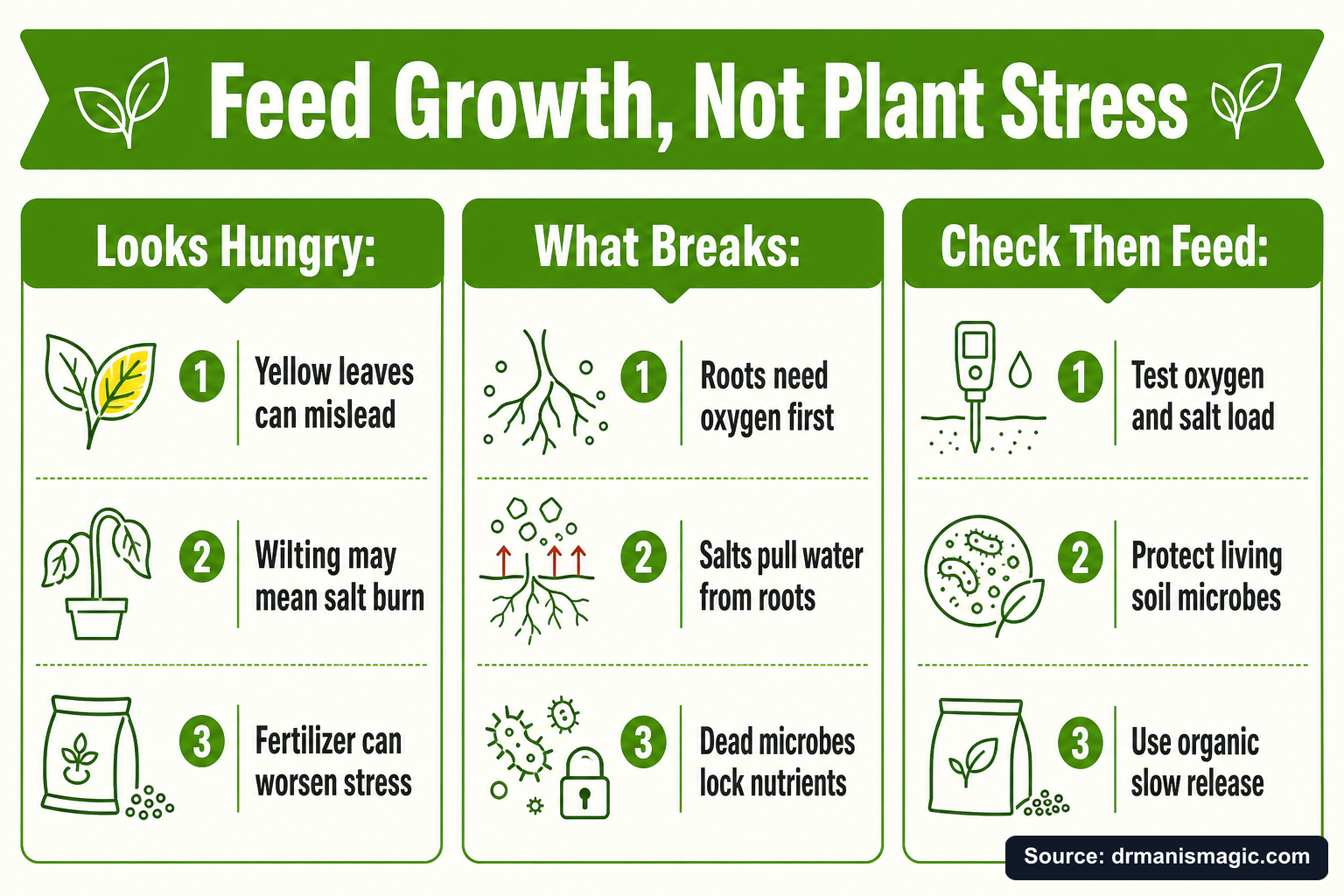
Key Takeaways
- Feeding growth means supplying nutrients through healthy roots, living soil, and active microbes. Feeding stress means pushing fertilizer into a system that cannot use it.
- Salt-based synthetic fertilizers can cause the same symptoms as nutrient deficiency: yellow leaves, wilting, brown tips, and stunted growth.
- Soil microbes supply roughly 75% of plant-available nitrogen and 65% of available phosphorus. Kill the microbes, starve the plant.
- Before you fertilize any struggling plant, check four things first: oxygen in the soil, salt load, microbial health, and actual nutrient need.
- Organic fertilizers feed the microbes first. The microbes convert nutrients into a form the plant can easily absorb. This creates a natural, slow-release cycle that keeps feeding long after you apply it.
- Biosludge-derived fertilizers may contain PFAS "forever chemicals." Clean inputs like crab, kelp, and amino acids carry none of that risk.
- The Three Plant Pillars — mineral-based soil, live microbes, and organic fertilizer — are the root-first framework that makes any plant nearly bulletproof.
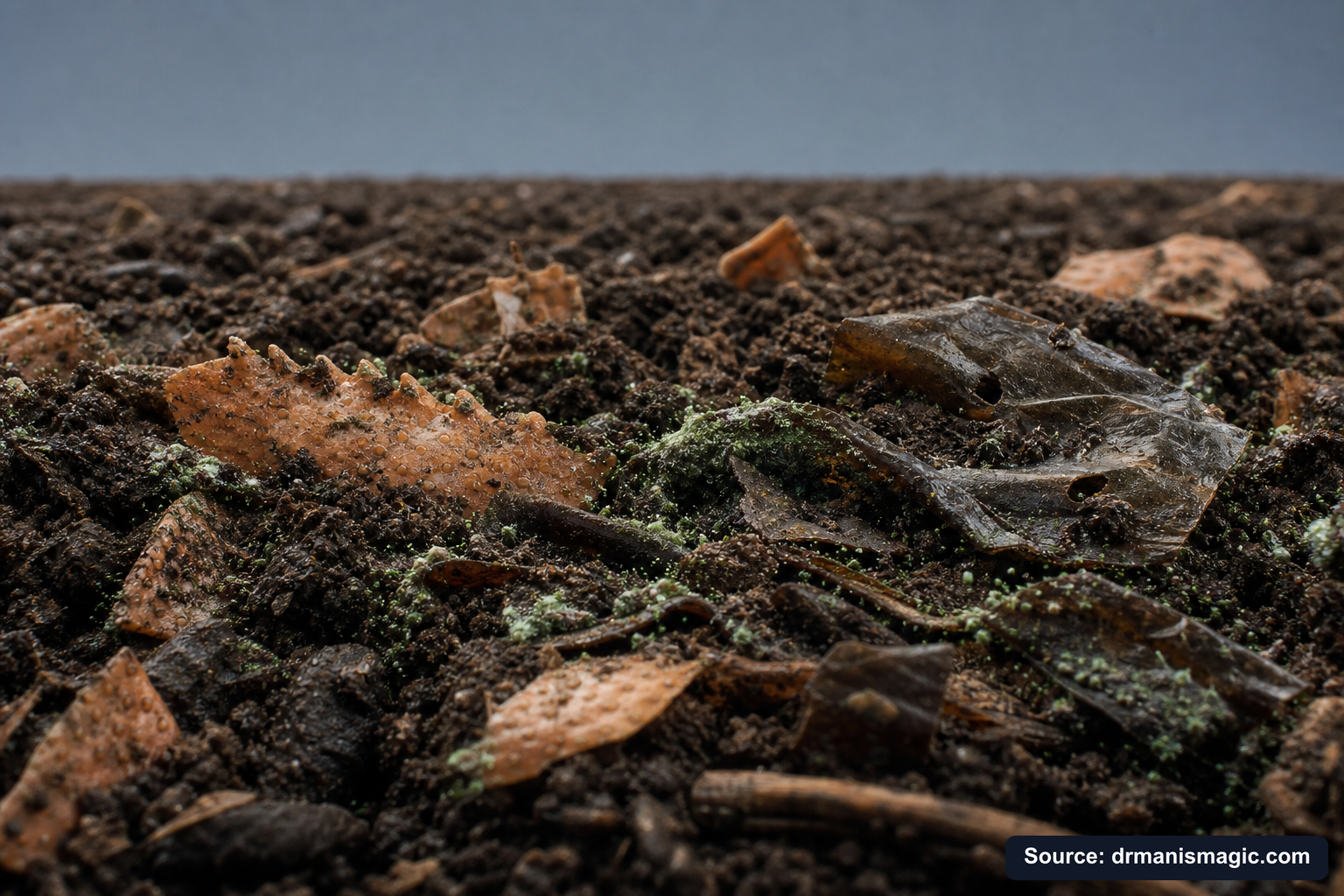
What Is the Real Difference Between Feeding Growth and Feeding Stress?
Feeding growth means the plant's roots, oxygen supply, soil biology, and salt levels are all in good shape, and nutrients can actually reach the plant. Feeding stress means one or more of those systems is broken, so adding fertilizer makes things worse, not better. Fix the system first. Feed second.
Think of it like this. Your plant is a factory. The workers are the microbes in the soil. The machines are the roots. The raw materials are water, oxygen, and nutrients. When everything is running, the factory hums. Product rolls off the line. Growth happens.
Now imagine the power goes out. The workers go home. The machines shut down. Then someone backs a truck up to the loading dock and dumps in a mountain of raw materials. Nothing gets made. The materials just pile up. Some of them start to cause damage.
That is what happens when you fertilize a stressed plant.
According to University of Minnesota Extension, soil biological processes supply roughly 75% of plant-available nitrogen and 65% of available phosphorus naturally, through a living ecosystem of bacteria, fungi, and other microorganisms. Those microbes are not a nice bonus. They are the engine. When roots lack oxygen, when salts are too high, or when the soil food web collapses, the engine shuts down. And pouring in more fertilizer does not restart it. It usually makes it worse.
The Four Gates you need to check before feeding any plant:
- Oxygen. Can the roots breathe? Compacted soil, overwatering, and bark-heavy potting mixes all steal oxygen from roots. No oxygen, no root function.
- Salt load. Is there already too much salt in the soil from previous fertilizing? High salt pulls water out of roots through osmosis, causing what scientists call physiological drought — the plant is surrounded by moisture but cannot drink.
- Soil biology. Are your microbes alive and working? Salt-based fertilizers wipe them out. Dead microbes mean locked-up nutrients, no matter how much you add.
- Actual nutrient need. Is the plant showing a true deficiency, or are you looking at salt burn, root rot, drought stress, or transplant shock?
Only after all four gates are open should you fertilize.
Why Do Salt-Based Fertilizers Feed Stress Instead of Growth?
Salt-based synthetic fertilizers raise the salt concentration around the roots. This pulls water out of root cells through osmosis, injuring or killing root tissue. The plant wilts, edges burn, and leaves yellow — the exact same symptoms as nutrient deficiency. The plant looks hungry when it is actually being chemically burned.
Here is something most gardening advice will never tell you. The yellowing leaves and wilting you see after over-fertilizing look almost identical to the symptoms of nitrogen deficiency. Same yellow color. Same droopy posture. Same general sadness.
But the causes are completely opposite.
True nitrogen deficiency means the plant needs more. Salt injury means the plant has been given too much of the wrong kind, and the roots are now damaged.
University of Maryland Extension explains it clearly: many common fertilizers contain soluble salts, and repeated or excess applications raise the salt level in the soil. When that salt concentration around the roots gets higher than the concentration inside the root cells, water moves out of the roots by osmosis. The roots dehydrate from the outside in. This is called osmotic stress, and it is a form of physiological drought. The plant is sitting in moist soil and still dying of thirst.
The visible symptoms include:
- Wilting that does not respond to watering
- Brown, scorched leaf edges (leaf scorch)
- Yellowing that starts at the tips and margins
- Stunted new growth
- White crusty deposits on the soil surface or pot edges
And the tragic part? Most people see this and reach for more fertilizer. The cycle feeds itself.
See also: The Osmotic Shock Your Plants Feel From Synthetic Nutrients
How Does Salt Kill the Microbes Your Plant Depends On?
Soil microbes are living organisms. High salt concentrations pull water out of their cells just like they do to root cells. Beneficial bacteria and fungi die, the nutrient-cycling engine shuts down, and the plant loses access to the 75% of nitrogen and 65% of phosphorus those microbes were delivering for free.
Picture a city full of workers who keep your plant fed. They live underground. You never see them. But every single day they are breaking down organic matter, unlocking minerals, fixing nitrogen from the air, and trading nutrients with the roots in exchange for sugar.
Penn State Extension describes these microbes as the workforce for carbon, nitrogen, sulfur, and phosphorus cycling in the soil. Without them, those nutrients stay locked in forms the plant cannot use.
Now dump a high-salt synthetic fertilizer on that city.
The salt dehydrates the microbial cells. The bacteria die. The fungi retreat. The workforce disappears. And now you have a plant that is sitting in soil loaded with nutrients it cannot access, surrounded by dead biology, with damaged roots that cannot absorb what little is available.
Dr. Mani Skaria, Professor Emeritus of Plant Pathology and founder of the Clean Citrus Program in Texas, saw this pattern over and over across 40 years of research. The plants that struggled most were not the ones in poor soil. They were the ones in salt-saturated soil that used to have good biology. The fertilizer had destroyed the very system the plants depended on.
See also: How Salt-Based Feeding Quietly Destroys Root Systems
What Does Root Rot Actually Have to Do With Fertilizer?
Salt-based fertilizers injure root tissue and create oxygen-depleted soil conditions. Injured roots cannot fight off soil pathogens like Pythium and Phytophthora. Those pathogens thrive in low-oxygen, high-moisture environments, dissolving root tissue and cutting off all nutrient and water flow to the plant. Fertilizer can directly set the stage for root rot.
Most people think root rot is just about overwatering. Pour in too much water, the roots sit wet, they rot. Simple. But that is only part of the story.
Here is what actually happens underground:
When soil lacks oxygen — from compaction, from decomposing bark-based potting mixes collapsing into sludge, or from waterlogging — root cells cannot perform respiration. They cannot make energy. They weaken. And weakened roots cannot defend themselves against soil pathogens like Pythium and Phytophthora, which thrive in exactly those low-oxygen, moist conditions.
Now add salt-based fertilizer to that scenario. The salt further injures the root tissue. The roots are now both oxygen-starved and chemically burned. The pathogens move in fast. The root system dissolves. The plant above ground wilts, yellows, drops leaves, and eventually dies.
This is why you can have a plant sitting in damp soil that looks like it is dying of drought. The roots are gone. There is nothing left to drink with.
And this is also why simply "fixing the watering" does not save a plant once root rot has set in. You have to address the soil structure, the oxygen, the salt load, and the biology all at once.
See also: The Hidden Reason Synthetic Fertilizers Cause Root Rot
What Is Feeding Growth, and How Does Organic Fertilizer Create It?
Feeding growth means nutrients enter the plant through healthy roots supported by living soil biology. Organic fertilizer feeds the microbes first. The microbes digest it and release nutrients slowly in plant-ready forms. When the microbes die, they release even more nutrition directly into the root zone. It is a self-renewing, natural time-release system.
Here is the most important thing this article will teach you. Read it twice.
Organic fertilizer does not just avoid killing the microbes. It feeds them first.
When you apply an organic fertilizer made from sources like crab meal, kelp, and amino acids, the microbes in your soil eat it. They break it down. They convert it into forms the plant's roots can absorb easily. Nitrogen locked inside protein becomes amino acid nitrogen that slides right into the root without effort. Chitin from crab shells gets broken down by specific bacteria that, in the process of eating it, also produce compounds that suppress harmful soil pathogens like Pythium.
Then those microbes die — as all living things do — and when they do, all the nutrition stored in their tiny bodies releases directly into the root zone. Another feeding. Another wave of nutrition. All without you doing anything.
This is why organic fertilizer feels slow at first and then seems to build momentum. It is not slow. It is running on a natural clock. The plant is getting fed in the same rhythm that plants evolved with over millions of years. Steady. Consistent. Impossible to overdose.
Compare that to a synthetic salt-based fertilizer. The nutrients flood in all at once. The plant gets a spike. Then nothing. Then you have to apply again. And each application pushes the salt index higher, damages more root tissue, kills more microbes. You are not building anything. You are borrowing against the future health of your soil.
At US Citrus Nursery, we watched this play out across 250,000 trees. The trees on organic programs kept improving year after year. The trees on synthetic programs needed more and more intervention just to stay the same.
Feeding Growth vs. Feeding Stress: A Complete Comparison
The chart below shows exactly what separates a growth-feeding program from a stress-feeding cycle. The difference is not just in the fertilizer. It is in the roots, the soil, the microbes, and the timing of when you apply anything at all.
| Factor | Feeding Growth | Feeding Stress |
|---|---|---|
| Root condition | Healthy, white, firm roots with good oxygen supply | Brown, soft, injured roots with low oxygen |
| Soil structure | Mineral-based, drains well, holds air pockets | Compacted, bark-heavy, collapsed, waterlogged |
| Soil biology | Active bacteria, fungi, mycorrhizae feeding the roots | Microbe population damaged or wiped out by salt |
| Salt index | Low, no osmotic pressure on roots | High, water pulling out of root cells |
| Fertilizer type | Organic, slow-release, feeds microbes first | Synthetic, salt-based, fast-release spike |
| Nutrient availability | Steady flow, microbe-mediated, plant controls uptake | Flood then famine, plant cannot regulate intake |
| Plant response over time | Steadily stronger, more resilient, more productive | Short-term green-up, then decline, then dependence |
| Microbial impact | Fertilizer feeds and supports the soil food web | Salt kills bacteria and fungi with each application |
You Never Had a Brown Thumb.
You were handed the wrong tools. This free guide hands you the right ones.
You watered it. You fed it. It died anyway.
It was never you. It was the dirt, the salt food, and the bad advice.
This guide shows you what really went wrong, and how to fix it for good.
- Why your plants really died, and why it was never your fault
- The salt hiding in your plant food that quietly burns the roots
- The hidden killer in almost every bag of store soil
- The tiny helpers that grow a whole forest for free
- The rescue trick that brings a half dead plant back to life

How Do You Tell the Difference Between Salt Damage, Overwatering, and True Root Rot?
These three problems look almost identical above ground but have different causes and different fixes. The diagnostic table below will help you identify what you are actually dealing with before you add anything to the soil.
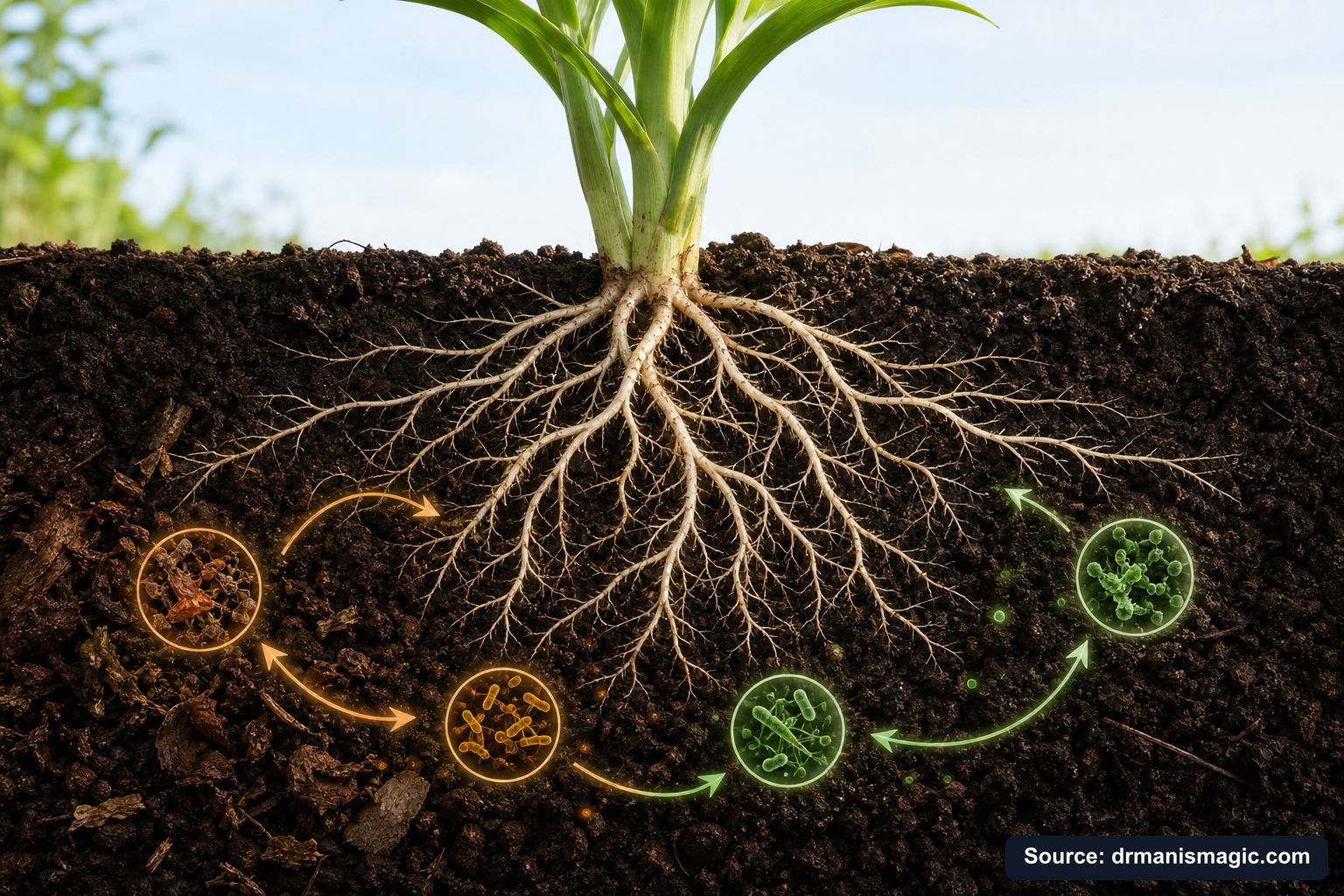
This is the question that trips up every gardener. The leaves look the same. The plant looks the same. But the cause — and the fix — are completely different. Adding fertilizer is the right move for one of these. It is the wrong move for the other two.
| Symptom / Clue | Salt Damage / Fertilizer Burn | Overwatering (Pre-Rot) | True Root Rot (Pythium / Phytophthora) |
|---|---|---|---|
| Leaf color change | Yellow to brown at tips and margins first | Pale yellow, uniform across older leaves | Yellow then brown, often rapid progression |
| Wilting pattern | Wilts even in moist soil, does not recover with watering | Wilts then recovers slightly, then wilts again | Wilts and does not recover at all |
| Soil surface clue | White crusty salt deposits on soil or pot rim | Soil stays wet for days, smells musty | Soil wet, roots visible may smell sour or rotten |
| Root appearance | Brown outer tips, inner root still somewhat firm | Roots pale, soft, starting to break down | Roots brown or black, mushy, fall apart when touched |
| Recent history | Fertilizer applied recently or frequently | Watered too often, poor drainage | Long-term wet conditions, oxygen-depleted soil |
| Fix | Flush soil with water to leach salts. Stop fertilizing. Rebuild biology. | Allow soil to dry. Improve drainage. Check soil structure. | Remove affected roots. Repot in mineral soil. Drench with live microbes. Do not fertilize until recovery begins. |
| Should you fertilize now? | No. Flush first, wait for recovery. | No. Fix water and oxygen first. | No. Never fertilize a plant in active root rot. |
When Should You Never Fertilize a Plant?
Do not fertilize during heat waves, active drought, waterlogging, visible root rot, fresh transplant shock, or when salt deposits are visible on the soil. In all of these situations, the plant cannot use the nutrients, and fertilizer will make the stress worse, not better.
There is a list every gardener needs to print out and tape to their shed wall. It is the list of times when fertilizing is the worst possible thing you can do.
- During a heat wave. Roots are already under thermal stress. Salt makes it worse.
- During drought or if the plant has not been watered recently. Dry soil concentrates any salts already present. Adding more is like pouring salt on an open wound.
- When the soil is waterlogged. No oxygen means no root function means no nutrient uptake. The fertilizer just sits there and raises the salt index.
- Active root rot. The roots cannot absorb anything. The fertilizer feeds the pathogens, not the plant.
- Fresh transplant shock. New transplants are already stressed. Their root systems are not established. Hit them with fertilizer and you add osmotic stress on top of transplant stress.
- When you see white salt crust on the soil surface. This is your soil telling you the salt load is already too high. Adding more fertilizer is like ignoring a fire alarm.
- When the problem is unknown. If you do not know what is wrong, do not guess with fertilizer. Diagnose first.
The rule is simple: when in doubt, hold off. Fix the roots, the oxygen, and the salt first. Then feed.
What Are the Three Plant Pillars and Why Do They Matter Before Any Fertilizer?
The Three Plant Pillars are the root-first framework developed and tested by Dr. Mani Skaria across 250,000 trees at US Citrus Nursery. They are: mineral-based soil for oxygen and drainage, live microbes for nutrient cycling and root protection, and organic fertilizer that feeds the biology instead of burning it. Without all three, any fertilization program is working against nature.
Dr. Mani did not invent the Three Plant Pillars in a lab. He discovered them by watching what worked and what failed across decades of growing citrus trees, houseplants, tropical trees, lawns, and gardens in South Texas.
What he noticed was this: the plants that thrived were not the ones that got the most fertilizer. They were the ones whose soil, biology, and nutrition were all working together at the same time.
The plants that failed were almost always missing one of three things.
Pillar One: Mineral-Based Soil. Most potting mixes are made from pine bark, sawdust, and other organic matter that breaks down fast. As it decomposes, it compacts. It seals off oxygen. It holds too much water. Roots suffocate. Dr. Mani's Super Soil uses mineral-based sandy loam from the Rio Grande Valley — silica-rich material that does not decompose, does not compact, and keeps oxygen flowing to the roots permanently. This is the foundation. Without it, the other two pillars cannot function.
Pillar Two: Live Microbes. Bacteria, fungi, and mycorrhizae are not decoration. They are the nutrient delivery system. They mine phosphorus from rock particles, fix nitrogen from the air, suppress soil pathogens like Pythium and Phytophthora, and trade nutrition with the roots in exchange for carbon. Plant Super Boost delivers a concentrated population of these living organisms directly to your root zone, fast.
Pillar Three: Organic Fertilizer. Once your soil breathes and your biology is active, you need clean, slow-release nutrition that works with the microbes, not against them. This is where organic fertilizer earns its place. Not because it is trendy. Because it mirrors the way plants have been fed by nature for millions of years.
When all three pillars are in place, something remarkable happens. The plant stops being fragile. It stops needing constant intervention. It builds resilience from the inside out. Pests have less to attack. Disease has less to grab onto. Growth becomes the default state, not something you have to force.
What Makes Crab, Kelp, and Amino Acids Different From Regular Fertilizer?
Crab, kelp, and amino acid fertilizers feed the microbes first, carry zero synthetic salts, include natural growth hormones from kelp, provide chitin that activates plant immune responses, and deliver nitrogen in amino acid form that roots absorb with almost no energy. There is no salt index spike, no microbial die-off, and no osmotic stress risk.
Let us talk about what is actually inside a clean organic fertilizer — and why each ingredient does something a salt-based product simply cannot.
Crab Shells and Chitin. Crab meal contains chitin, the same compound found in insect exoskeletons and fungal cell walls. When chitin-digesting bacteria in the soil break it down, they release enzymes that also attack and suppress harmful pathogens like Pythium and Phytophthora. You are feeding your plant and fortifying its defenses at the same time. Crab meal is also rich in calcium — the nutrient that makes up the largest portion of a plant's woody structure — and magnesium for chlorophyll production.
Cold-Processed Kelp. Kelp is not just trace minerals, though it has plenty of those. Cold-processed kelp preserves natural plant growth hormones called auxins and cytokinins. These hormones signal roots to grow faster, tell the plant to set more flowers, and help the plant manage drought and temperature stress. You cannot get this from a synthetic fertilizer. It does not exist in a bag of ammonium nitrate.
Amino Acid Nitrogen. Regular synthetic nitrogen comes as nitrate or ammonium — simple ions the plant pulls in through its roots. Amino acid nitrogen is already one step further along. It is pre-built protein. The plant can absorb it with almost no energy cost and use it directly for growth. This is why amino acid fertilizers show results without the salt penalty. The nitrogen is already in a form life understands.
Volcanic Ash. Volcanic minerals deliver silica and a broad spectrum of trace elements that strengthen cell walls, increase drought resistance, and improve the plant's overall structural integrity. Plants fed volcanic minerals stand up better to heat, wind, and pest pressure.
Put it all together in one product — a 7-4-4 NPK ratio with 6% calcium and 2% magnesium — and you have something rare: a fertilizer that feeds the plant, feeds the microbes, supports root immunity, supplies growth hormones, and carries zero synthetic salts, zero biosludge, and zero PFAS forever chemicals.
That is exactly what Crab, Kelp & Amino Acids is. We built it to solve our own problems growing 250,000 trees. We made it available to you because we could not find anything like it anywhere else.
What About Biosludge and PFAS — Why Do Clean Inputs Matter?
Some fertilizers, both synthetic and organic, use biosolids (treated municipal sewage waste) as a filler. These materials may contain PFAS "forever chemicals" that do not break down in soil. They can contaminate garden beds, lawn soil, and food crops for years. Clean inputs with no biosludge and no PFAS protect your family, your pets, and your soil for the long term.
This is the part nobody puts on the front of the bag.
Some fertilizers marketed as "organic" use biosolids as a nitrogen source. Biosolids are treated municipal waste. Human sewage, processed and dried. The label might say "heat-dried microbes," "Class A biosolids," "municipal waste," or "wastewater residuals." These materials often contain PFAS compounds — per- and polyfluoroalkyl substances, known as "forever chemicals" because they do not break down in the environment.
You apply them to your garden. They stay. They move into the soil. They can move into food crops. They can move into your children and pets who walk barefoot across the lawn.
We do not use biosludge. We do not use biosolids. We do not use synthetic salt compounds. The inputs in our fertilizer program — crab meal, kelp, amino acids, volcanic ash — are clean, traceable, and free of PFAS contamination. Every ingredient is sourced from the USA, with the sole exception of coco coir, which is a tropical material by nature.
This is not just about plant health. It is about what you are willing to put in your backyard, your garden beds, and your kids' play space.
What Is the Recovery Checklist for a Plant That Has Been Fed When Stressed?
If your plant has been fertilized while stressed and is now declining, follow this seven-step recovery sequence. Do not add more fertilizer until step six. The goal is to restore root function, flush excess salt, and reintroduce living biology before asking the plant to grow again.
If you have already fertilized a stressed plant and things went sideways, here is what to do. Work through these steps in order.
- Stop all fertilizer immediately. Nothing goes in until the plant has stabilized. Adding more nutrition to a compromised root zone will only intensify the damage.
- Check your soil structure. If the soil is compacted, waterlogged, or smells sour, the root zone lacks oxygen. This must be fixed before anything else. For potted plants, consider repotting into mineral-based, well-draining soil.
- Flush with plain water. For potted plants, water deeply and let water run freely from the drainage holes. This leaches excess salt out of the root zone. Repeat two or three times over a week.
- Inspect the roots. Carefully unpot or gently dig near the root zone. White, firm roots are healthy. Brown, mushy roots indicate rot. Remove all rotted root tissue with clean scissors before repotting.
- Reintroduce living microbes. Once the soil is draining properly and salt has been flushed, drench the root zone with a live microbial product. This rebuilds the biological workforce that was killed by the salt. Give it two to four weeks to establish.
- Begin light organic fertilization. Only after roots show signs of recovery — new white root tips, new leaf growth, improved color — introduce a clean, slow-release organic fertilizer at half the recommended rate. Organic inputs cannot cause salt burn, so there is almost no risk of overdose as you rebuild.
- Be patient and consistent. Recovery is not instant. But with the right foundation, most plants that look hopeless will come back. We have seen it hundreds of times. Trust the biology.
Why Does Time Matter More Than Any Fertilizer You Can Buy?
Every month a plant spends in damaged soil, with dead microbes and salt-burned roots, is a month of growth it will never get back. Money can be replaced. Time cannot. The fastest path to a thriving, productive plant is the root-first approach from day one, not a series of rescues after repeated failures.
Here is the thing about plants that nobody says plainly enough.
The number one thing people tell Dr. Mani they want is to see their tree bear fruit while they still can. To taste something they grew with their own hands. To hand a lemon from their own tree to their grandchild. That desire is not small. It is deeply human. We were put on this earth to tend a garden. That drive never left us.
But every month a plant spends in salt-saturated soil, with no microbes, no oxygen at the roots, and damaged root tissue — that is a month of potential growth that is gone forever. You can get money back. You cannot get time back.
The old way of gardening — grab whatever fertilizer is on sale, pour it on, hope for the best, watch it struggle, repeat — is not just expensive. It is a time thief. Years pass. The plant never quite thrives. You never quite get there.
The Three Plant Pillars are not a complicated system. They are the opposite of complicated. Mineral soil that breathes. Living microbes that feed the roots. Clean organic nutrition that works with the biology instead of destroying it. When all three are in place, the plant stops being a project you manage and starts being something alive that takes care of itself.
That is what gardening is supposed to feel like.
You can read more about building this foundation from the ground up in our Free Plant Care Field Guide, where we walk through every step in plain language with no guesswork.
If you have been fertilizing a struggling plant and wondering why it keeps getting worse, now you know why. The problem was never the plant. It was the system underneath it. Fix the system — the oxygen, the salt, the biology — and feeding growth becomes easy. Natural. Almost automatic.
When you are ready to stop guessing and build that foundation the right way, start with the Three Plant Pillars program we developed and tested on over 250,000 trees right here in South Texas. Everything in it was made to work together, without the salt, without the biosludge, without the guesswork. And if you are not completely happy with what you see in 30 days, we will give your money back. No arguments. No fine print.
Your plants have been waiting for this. So have you.
Frequently Asked Questions
Most gardeners ask the wrong question. They ask "what do I feed my plant?" when they should ask "is my plant even able to eat right now?" These questions cut straight to the truth about feeding growth versus feeding stress, so you stop wasting money and time on fertilizer that cannot work.
How do I know if my plant is stressed or just hungry?
Look at the whole picture, not just the leaves. Yellow leaves, brown tips, and wilting can mean your plant is starving. But those same symptoms show up when roots are burned by salt-based fertilizer, sitting in compacted soil, or cut off from oxygen. Before you add any fertilizer, check your soil first. Is it draining well? Does it smell sour or rotten? If yes, you have a stress problem, not a hunger problem.
What happens when you fertilize a stressed plant?
You make things worse, fast. A stressed plant has damaged roots or dead soil microbes. It cannot absorb nutrients. So the fertilizer just sits there, building up salt in the soil. That salt pulls water out of the roots instead of pushing it in. The plant gets more burned, more wilted, and more confused. Dr. Mani saw this happen over and over across 250,000 trees. The fix is never more fertilizer. The fix is a healthy root system first.
Why do synthetic fertilizers cause the same symptoms as nutrient deficiency?
Salt-based synthetic fertilizers create a condition called fertilizer burn. The salt concentration in the soil gets so high that water actually flows out of the roots instead of into them. Your plant looks thirsty and starved even though you just fed it. It is the same reason you feel thirstier after eating salty chips. The plant is not lying to you. It is telling you the soil chemistry is off and the roots are under attack.
What role do soil microbes play in feeding a plant?
Soil microbes are the real engine of plant nutrition. Research shows that soil biology supplies roughly 75 percent of plant-available nitrogen and 65 percent of available phosphorus naturally. Those numbers are not small. That means your fertilizer is a supporting player, not the star. When you kill the microbes with synthetic chemicals, you cut off most of the plant's food supply. Dr. Mani built Plant Super Boost around live bacteria, fungi, and mycorrhizae to keep that engine running strong.
What should I check before I fertilize a struggling plant?
Check four things in this order. First, is the soil draining or sitting wet and compacted? Roots need oxygen to work. Second, have you used synthetic fertilizer recently that may have built up salt? Third, are there any living microbes in your soil, or has chemical use wiped them out? Fourth, does the plant actually need nutrients right now, or is it in shock from repotting, pests, or overwatering? Fix the foundation before you add fuel.
What makes organic fertilizer different from synthetic when it comes to plant stress?
Organic fertilizer feeds the microbes first. The microbes break the nutrients down slowly and hand them to the plant roots in a form they can actually use. There is no salt spike, no burn, no microbial massacre. Dr. Mani's Crab, Kelp, and Amino Acids fertilizer works exactly this way. It delivers nitrogen, phosphorus, and potassium slowly and safely, with zero toxic runoff. It does not smell bad either, which matters when you are growing food or keeping plants indoors.
What are the Three Plant Pillars and how do they prevent feeding stress?
The Three Plant Pillars are mineral-based soil, live microbes, and organic fertilizer working together. Mineral soil from the Rio Grande Valley drains perfectly and never compacts, so roots get oxygen. Plant Super Boost fills that soil with living microbes that unlock nutrients and fight disease. Organic fertilizer then feeds those microbes slowly and cleanly. When all three are in place, the plant is never stressed by what you feed it. It is ready to grow. Dr. Mani proved this system across 250,000 trees before putting it in your hands.
About the Author
Ron Skaria, MD
Ron Skaria, MD, is the co-founder of Dr. Mani's Magic and the son of Dr. Mani. He trained as a medical doctor and now works full time on the family farm in Hargill, Texas, building Dr. Mani's Magic alongside his dad. He wrote the Brown Thumb Field Guide to put his father's 48 years of plant science into plain words any gardener can use. His belief is simple. You never had a brown thumb. You just never had the right help.


