


Why More Fertilizer Often Means Weaker Plants | Dr. Mani's Magic
Why More Fertilizer Often Means Weaker Plants (And What to Do Instead)
Picture this. You just bought a beautiful fruit tree. Maybe it's sitting in a pot on your back patio right now. You can almost taste it — that first piece of fruit you'll pick with your own hands, still warm from the sun. So you do what anyone would do. You feed it. You figure, more food means faster growth. More growth means fruit sooner.
So you pour on the fertilizer. Maybe a little extra, just to be sure. And for a week or two, something exciting happens. The leaves go a deep, dark green. New growth pushes out. You feel like a genius. Then, slowly, things change. The leaf tips turn brown. Growth stalls. The plant looks tired. You add more fertilizer, thinking it must need a boost. And somehow, week by week, a plant that looked so promising starts circling the drain.
Here's the thing nobody told you. That fertilizer didn't feed your plant. It burned it. After growing over 250,000 trees at our South Texas nursery, we've seen this exact story play out thousands of times. The good news? Once you understand what's really happening underground, everything changes. And it changes fast.

Organic Fertilizer | Crab, Kelp & Amino Acids
Key Takeaways
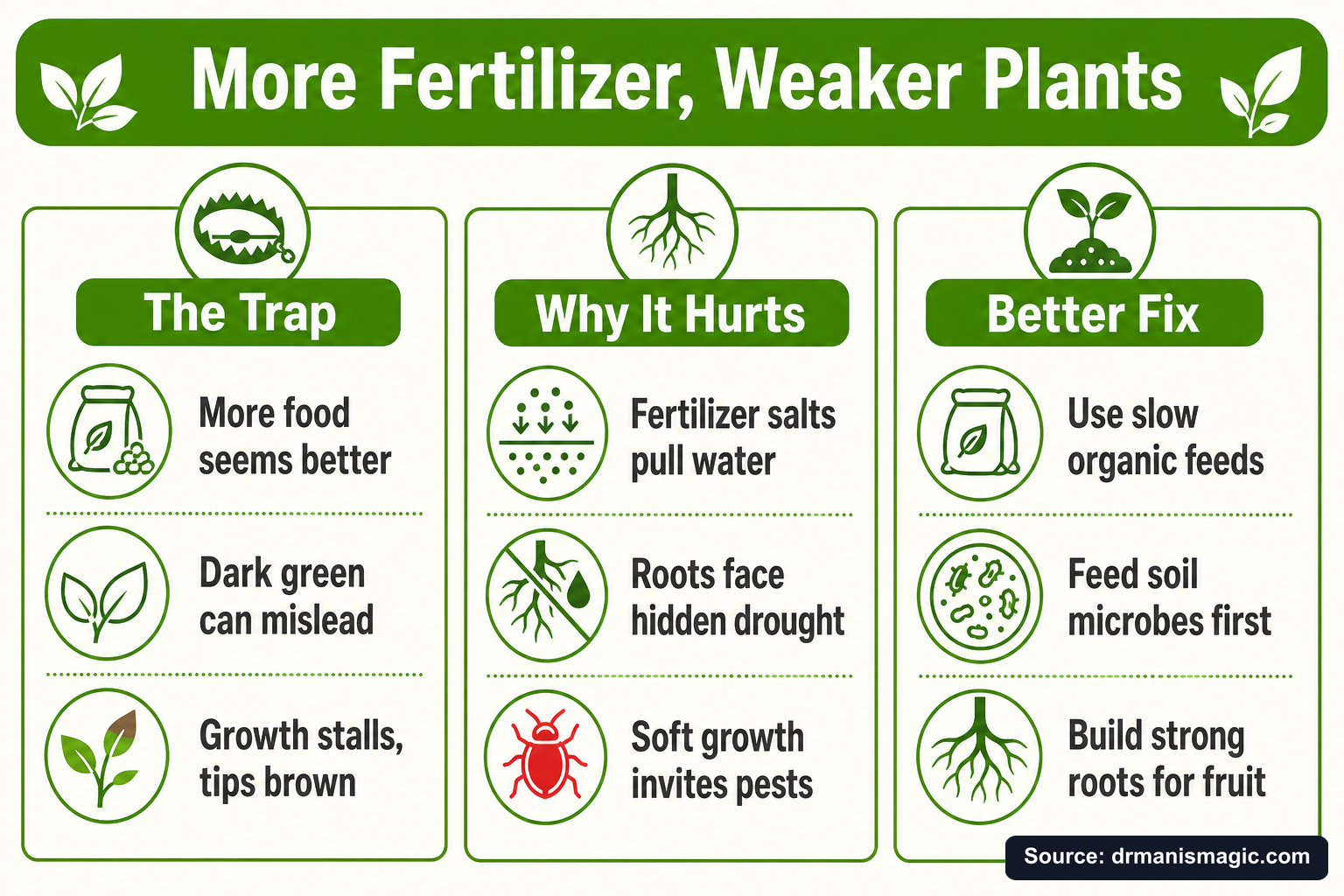
- Most synthetic fertilizers are salt-based, and salt pulls water away from roots instead of toward them.
- Too much fertilizer creates "physiological drought" — your plant is surrounded by moisture but can't drink a drop.
- Excess nitrogen makes plants look lush but actually creates soft, weak growth that's a magnet for pests and disease.
- Salt kills the soil microbes your plant depends on to unlock nutrients naturally.
- Organic, slow-release fertilizers feed the microbes first — and the microbes then feed your plant in a steady, natural rhythm.
- Recovery from over-fertilization is possible, but it takes time — and time is the one thing you can never get back.
- The Three Plant Pillars — mineral soil, live microbes, and organic fertilizer — are the root-cause solution, not another band-aid.
What Actually Happens to Your Roots When You Over-Fertilize?
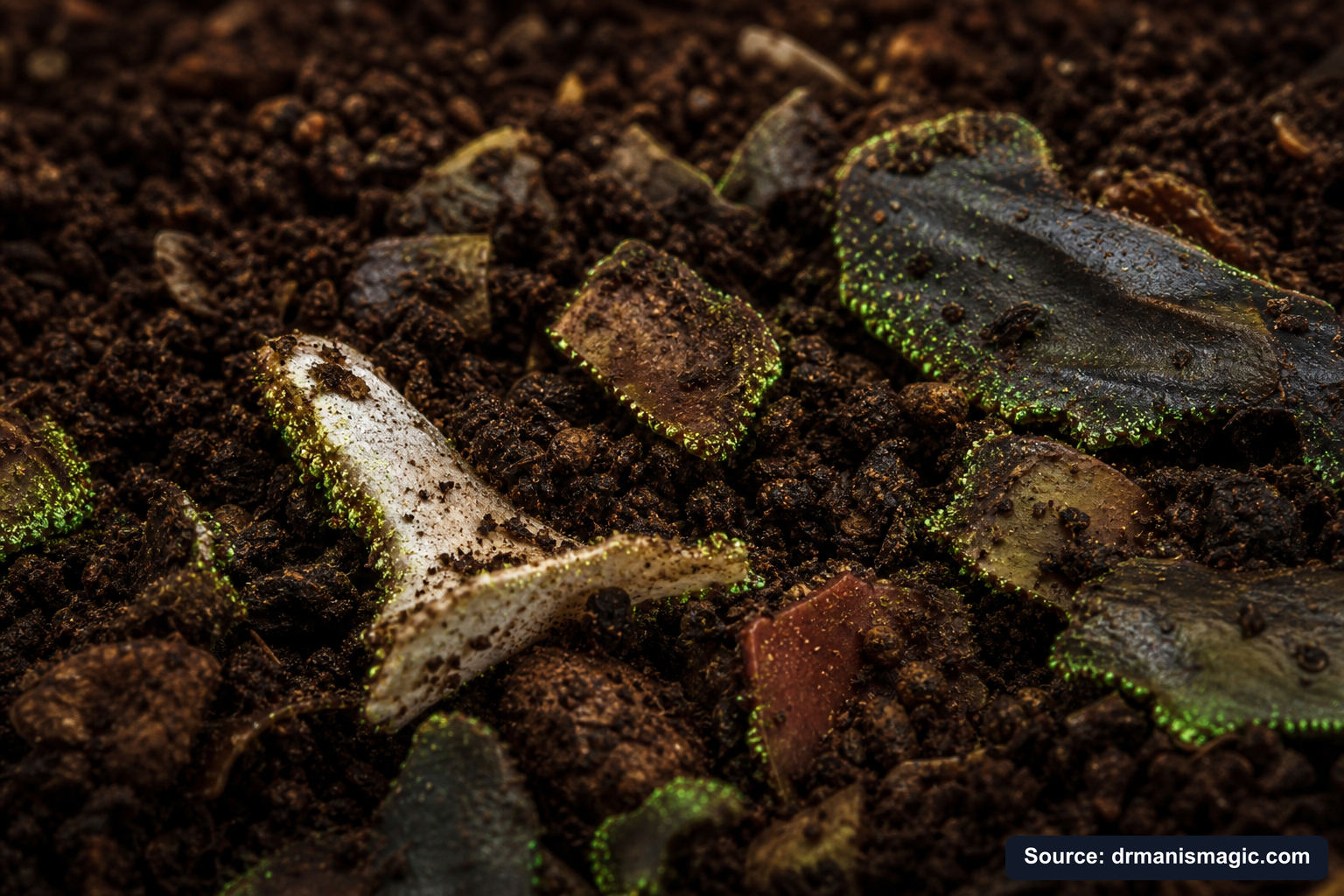
Excess fertilizer salts raise the salt concentration around your roots. This creates an osmotic pressure imbalance that forces water out of root cells instead of letting water in. Your plant essentially experiences drought — even if you just watered it. Fine root hairs die, and the door opens for root rot pathogens like Pythium and Phytophthora.
Let's keep this simple. Think of a pickle. When you put a cucumber in salt brine, the salt pulls the water out of it. That's osmosis. The same thing happens to your plant roots in salty soil.
When you dump synthetic fertilizer into your soil, you're not adding vitamins. You're adding salts. Soluble salts. And those salts raise what scientists call the osmotic pressure in the soil water around your roots.
Now your roots are trying to drink, but the salty water outside is actually pulling moisture out of the root cells. Plant scientists at Penn State Extension describe this as "physiological drought" — a condition where a plant wilts and struggles even in moist soil, simply because the salt concentration is too high for the roots to absorb water normally.
The fine root hairs — the tiny, delicate structures responsible for almost all water and nutrient absorption — get burned. They die. And dead root hairs mean a plant that can't drink, can't eat, and can't defend itself.
That's when the real trouble starts.
Root rot organisms like Pythium, Phytophthora, and Fusarium are always lurking in the soil. They're opportunists. When your root hairs are healthy, your plant fights them off. When root hairs are burned and dying, those pathogens move in fast. What looked like fertilizer burn on the leaves is actually the end stage of a root-zone collapse that started the moment you poured on too much.
See also: How Salt-Based Feeding Quietly Destroys Root Systems
Why Does a Plant Look Greener After Fertilizing But Actually Get Weaker?
Nitrogen pushes rapid leaf and stem growth, which looks healthy at first. But that new growth is soft, watery, and thin-walled — exactly what pests and diseases prefer. The plant is spending energy growing leaves, not building roots, immunity, or the internal chemistry needed for flowers and fruit.
This is the cruelest trick in gardening. You feed your plant. It turns a gorgeous deep green. You feel great. You tell your neighbor. Then two months later, you've got aphids, leaf miners, powdery mildew, or a plant that simply refuses to flower.
Here's why this happens.
Nitrogen is the gas pedal for leafy, vegetative growth. When you dump a lot of fast-release nitrogen on a plant, it responds by throwing out new leaves and stems as fast as it can. And that new growth is lush. Dark green. Impressive-looking.
But that growth is soft. The cell walls are thin. The plant tissue is watery and tender. Pest insects can literally smell it. Fungal diseases love it. University of Maryland Extension points out that excess nitrogen promotes lush, succulent growth that is more susceptible to pest pressure and disease.
Meanwhile, the plant is doing something else you can't see. It's neglecting its roots. Colorado State Extension notes that when nitrogen pushes canopy growth hard, root development often lags behind. A plant with a big leafy top and a weak root system is like a house built on sand. It looks fine — right up until the first storm.
And here's something most gardeners never hear. Flowers and fruit require a different kind of internal chemistry than leaves do. A plant that's been pushed into fast, nitrogen-heavy vegetative growth often delays or skips flowering entirely. It's putting all its energy into leaves. The fruit you were waiting for? It keeps getting pushed back.
At our nursery in South Texas, we've seen this with our own citrus trees. A tree that looks the biggest isn't always the one that fruits first. The tree with balanced, slow-release nutrition and a healthy root zone beats the overfed, fast-growing one every single time — in fruit production, in disease resistance, and in long-term survival.
How Do Fertilizer Salts Kill the Microbes Your Plant Depends On?
Soil microbes — bacteria and fungi — live in a delicate water environment around root zones. High salt concentrations dehydrate and kill them the same way salts stress plant roots. Without microbes, your soil becomes biologically dead, nutrients lock up, and your plant loses its natural defense system completely.
Here's a secret the big chemical companies would rather you not know.
Your plant doesn't absorb most of its nutrients directly from the soil. It gets them through an underground partnership with billions of living microbes — bacteria, fungi, and mycorrhizae — that break down organic matter and convert raw minerals into forms the plant can actually use.
The University of Minnesota Extension states plainly that soil organisms drive nutrient cycling, support water infiltration, suppress disease, and provide a large share of the plant-available nitrogen and phosphorus in healthy soil. This isn't fringe science. It's the foundation of how plants grew and thrived for millions of years before a bag of synthetic fertilizer ever existed.
Now pour synthetic fertilizer on that system. High salt index. Immediately soluble. Concentrated.
The salts dehydrate the microbes. They die. Billions of them, wiped out in a single application.
At first, your plant doesn't care. The synthetic nitrogen is right there, ready to absorb. Fast green-up. Happy gardener. But underneath, the biological engine that was supposed to run your soil for decades has been switched off. The natural nutrient cycling stops. The disease suppression stops. The living ecosystem your plant evolved to live inside — gone.
Now your plant is chemically dependent. It needs another hit of fertilizer to get the same response. And another. And another. Each time, the soil gets a little more biologically dead. Each time, the salt accumulation builds a little higher. Each time, the plant gets a little more fragile.
This is not an accident. It's the business model.
At US Citrus Nursery, we learned this lesson the hard way — then we built our entire Three Plant Pillars system around fixing it for good.
What Is the Difference Between Salt Damage, Overwatering, and Root Rot — And How Do You Tell Them Apart?
Salt damage, overwatering, and true root rot can look nearly identical above ground — wilting, yellowing, brown leaf tips, and decline. But the cause and fix are completely different. Checking root color and texture, and thinking about recent fertilizer and watering history, is the fastest way to tell them apart.
This is the diagnostic question that trips up almost every gardener. You see your plant wilting. You water more. It gets worse. You fertilize. It collapses. What went wrong?
Here's a simple framework to sort it out.
| Symptom | Salt / Fertilizer Burn | Overwatering | True Root Rot (Pythium / Phytophthora) |
|---|---|---|---|
| Leaf tips / margins | Brown, crispy, scorched edges | Yellow, soft, mushy edges | Yellow then brown; rapid decline |
| Wilting despite moist soil | Yes (osmotic stress) | Yes (oxygen-starved roots) | Yes (root death = no uptake) |
| Root appearance | Tan, shriveled tips; fine hairs gone | White roots, sour-smelling soil | Brown-black, mushy, rotting smell |
| Soil feels | Dry or normal | Consistently wet / waterlogged | Wet + foul odor |
| Recent history | Heavy fertilizer application | Frequent watering, poor drainage | Combo of wet + salt stress + poor soil |
| Immediate fix | Flush soil with plain water; stop fertilizing | Improve drainage; let dry out | Remove rotted roots; repot in mineral soil; add live microbes |
One thing to notice in that table: root rot is almost always a combination of problems, not just one. Salt stress burns the root hairs. Poor drainage keeps oxygen out. And then Pythium or Phytophthora move into the weakened zone and finish the job. Treating root rot without fixing the soil and the salt situation is like putting a bandage on a broken foundation.
See also: The Hidden Reason Synthetic Fertilizers Cause Root Rot
Can You Recover an Over-Fertilized Plant — And How?
Yes, most over-fertilized plants can recover if you act quickly. The recovery process is about removing salts, restoring oxygen to the root zone, giving the soil biology time to rebuild, and being patient. Do not add more fertilizer during recovery — that is the single most common mistake.
The great news: plants want to recover. They're resilient. But you have to work with the natural order, not against it.
Here's a step-by-step recovery checklist:
- Stop all fertilizer immediately. This sounds obvious, but the urge to "help" your struggling plant with more food is the trap that kills most of them. Stop completely.
- Remove any visible granular fertilizer from the soil surface. If you can see it, scoop it out gently.
- Flush the root zone with plain, unchlorinated water. For containers, water slowly and deeply — enough to push water out the drainage holes several times. This leaches accumulated salts. For in-ground plants, deep watering over several days does the same job.
- Improve drainage if it's poor. Standing water after flushing means the root zone stays oxygen-deprived. Repotting into a mineral-based soil with proper structure can be the difference between recovery and continued decline.
- Add live soil microbes. This is the step most recovery guides skip. Beneficial bacteria, fungi, and mycorrhizae compete with root rot pathogens and begin rebuilding the biological engine in the root zone. Without them, recovery is slower and the plant stays vulnerable.
- Prune only if necessary. Remove dead or severely damaged leaves and stems to reduce stress on the root system. But don't over-prune — the remaining leaves are still photosynthesizing and helping the plant recover.
- Wait and observe. New root hair growth takes two to four weeks to show visible improvement above ground. Trust the process. Resist the urge to do more.
The hardest part of this list is number seven. Waiting. But here's the honest truth from thirty years of growing: the gardeners who recover their plants are the ones who stop doing damage and let biology do its job.
You Never Had a Brown Thumb.
You were handed the wrong tools. This free guide hands you the right ones.
You watered it. You fed it. It died anyway.
It was never you. It was the dirt, the salt food, and the bad advice.
This guide shows you what really went wrong, and how to fix it for good.
- Why your plants really died, and why it was never your fault
- The salt hiding in your plant food that quietly burns the roots
- The hidden killer in almost every bag of store soil
- The tiny helpers that grow a whole forest for free
- The rescue trick that brings a half dead plant back to life

How Do Organic Fertilizers Feed Plants Differently — And Why Does It Matter?
Organic fertilizers don't go straight to the plant. They feed the soil microbes first. The microbes digest the organic material and convert it into forms the plant can absorb. When those microbes die, they release a steady stream of nutrition directly into the root zone. This creates a natural, self-regulating slow-release system — and it never burns roots.
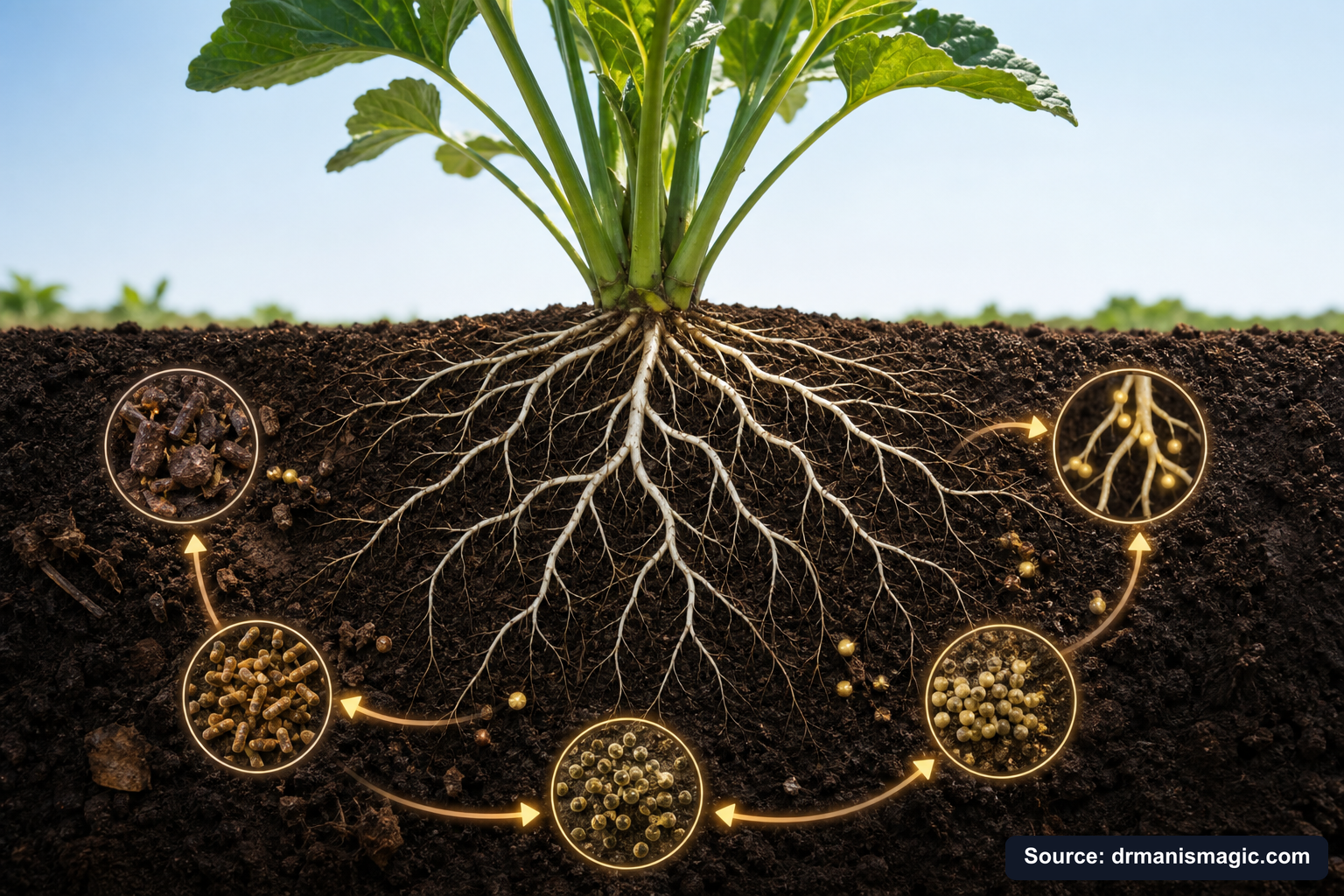
This is the part that changes how people think about feeding plants forever. So let's walk through it step by step, as simply as possible.
When you apply a synthetic fertilizer, the nutrients dissolve instantly in soil water. They're available immediately — a sudden flood of salts and ions rushing into the root zone all at once. The plant absorbs what it can. The rest builds up as salt residue. The soil microbes get burned. The cycle of dependency begins.
Organic fertilizer works completely differently. Here's the sequence:
Step 1: You apply organic fertilizer — something like crab meal, kelp, and amino acids — to the soil surface. It doesn't dissolve. It sits there.
Step 2: Soil bacteria and fungi start eating it. They're breaking down the proteins, the chitin from crab shells, the complex compounds in kelp. This is their food. They thrive on it.
Step 3: As the microbes digest the organic material, they convert it into simple, plant-available forms — ammonium, nitrate, phosphate — in small, steady amounts. The plant's roots pick it up as fast as they need it, no more, no less. No flood. No salt spike. No osmotic stress.
Step 4: When those microbes die — as all living things eventually do — their bodies release all of that stored nutrition directly into the soil around your plant's roots. A second feeding, built right into the biology. Automatic. Slow. Sustained.
This is how plants fed themselves for millions of years before synthetic fertilizers were invented. It's not a new idea. It's the oldest idea there is. We just had to rediscover it.
And here's what this means for you practically: you almost cannot overfeed a plant with a well-formulated organic fertilizer. The microbes regulate the pace. The plant takes what it needs. There's no salt index spike. There's no root burn. There's no microbial massacre.
Synthetic vs. Organic vs. Slow-Release: Which Fertilizer Type Actually Builds a Stronger Plant?
Synthetic fast-release fertilizers deliver nutrients quickly but cause salt stress, microbial die-off, and dependency. Organic slow-release fertilizers work with soil biology to deliver steady nutrition without salt damage. For long-term plant strength, flowering, fruiting, and resilience, organic and biology-friendly inputs win every time.
| Feature | Synthetic Fast-Release | Coated Slow-Release Synthetic | Organic (Crab, Kelp & Amino Acids) |
|---|---|---|---|
| Salt index | High — root burn risk is real | Moderate — coating delays but doesn't eliminate salts | Very low — no soluble salt spike |
| Microbial impact | Kills beneficial microbes on contact | Harms microbes as salts slowly release | Feeds and supports microbes |
| Release speed | Immediate flood | Gradual but still salt-based | Microbe-mediated, truly slow and steady |
| Root burn risk | High, especially in containers | Moderate | Near zero |
| Plastic / PFAS risk | Some coated prills leave plastic residue in soil | Polymer coating = microplastics in soil | Zero — no plastic coatings, no biosludge fillers |
| Biosludge / PFAS fillers | Common in some products | Common in some products | Zero in Dr. Mani's Magic CKAA |
| Long-term soil health | Degrades over time — biology collapses | Slow degradation — still hurts biology | Builds biology and soil structure over time |
| Flowering and fruiting support | Pushes leaf growth, can suppress flowering | Moderate | Balanced — supports roots, flowers, and fruit together |
There's one more thing on that table that deserves its own paragraph. Biosludge and PFAS.
Some fertilizers — both synthetic and organic — use "biosludge" as a filler. Biosludge is treated municipal sewage waste. And biosludge contains PFAS — per- and polyfluoroalkyl substances. These are called "forever chemicals" because they do not break down. They build up in soil. In water. In plants. In you.
If you're growing food in your garden, or if your kids play on your lawn, or your dog rolls in the grass — this matters. A lot.
Dr. Mani's Magic Crab, Kelp & Amino Acids contains zero biosludge, zero synthetic salts, and zero PFAS. That's not a marketing claim. It's a commitment that started in our own family's backyard and our own nursery, where our children and grandchildren play.
What Makes Crab Shells, Kelp, and Amino Acids Special Ingredients for Plant Health?
Crab shells contain chitin, which triggers a plant's natural defense against soil pathogens and pests. Kelp delivers natural growth hormones and trace minerals that support root development and stress tolerance. Amino acids provide nitrogen that plants can absorb directly and efficiently — all without a single grain of synthetic salt.
Let's break down each ingredient, because every one of them is doing something remarkable underground.
Crab Shells and Chitin: Your Plant's Built-In Defense System
Crab shells are rich in a substance called chitin. Chitin is the same material that makes up insect exoskeletons and fungal cell walls. When chitin enters the soil, something interesting happens. The microbes that break it down are the same microbes that naturally suppress chitin-containing pathogens — like root rot fungi. In other words, feeding your soil crab meal is like training an army that specifically targets the organisms most likely to kill your roots.
Crab shells also provide calcium and magnesium — two nutrients that build strong cell walls, support woody stem development, and help plants hold their structure under stress. Calcium makes up a huge proportion of the woody mass of any plant. Without it, stems are weak and fruit cracks.
Cold-Processed Kelp: The Ocean's Gift to Your Garden
Kelp is one of the most nutrient-dense organisms on earth. Cold-processed kelp — meaning it's not heat-treated and stripped of its biology — delivers natural plant growth hormones called auxins and cytokinins. These hormones signal roots to grow deeper and wider. They help the plant manage stress. They support fruit set and cell division in ways that synthetic fertilizers simply cannot replicate.
Kelp also carries dozens of trace minerals — iron, manganese, zinc, boron, molybdenum — in organic, chelated forms that plants and microbes can actually use. Not locked up in salt compounds. Not requiring a perfect soil pH to unlock. Just available, steady, and natural.
Amino Acids: Nitrogen the Right Way
Amino acids are the building blocks of protein. When amino acids are present in the soil, plants can absorb nitrogen directly from them — skipping several steps of the normal nutrient conversion process. This is faster and more efficient than waiting for microbes to convert raw nitrogen compounds. And because amino acids are protein-based rather than salt-based, they carry no osmotic risk. No burn. No spike.
Amino acids in the soil also feed the beneficial bacteria that fix atmospheric nitrogen — meaning your soil biology gets stronger over time, not weaker.
Volcanic Ash: Trace Minerals and Silica for Resilience
Volcanic ash is a natural source of silica and trace micronutrients. Silica strengthens cell walls, making plants physically tougher against pests and physical stress. It also improves drought tolerance. Plants with strong silica-reinforced cell walls are harder to chew through for insects and more resistant to fungal penetration. It's armor, built from the inside out.
Together, these four ingredients in Crab, Kelp & Amino Acids create a complete, low-salt, biology-friendly nutrition system — tested on over 250,000 citrus trees and proven across lawns, gardens, houseplants, fruit trees, vegetables, and flowers.
Why Is the Three Plant Pillars Framework the Root-Cause Solution — Not Just Another Tip?
Most fertilizer advice treats symptoms — yellow leaves, slow growth, pest pressure. The Three Plant Pillars treats the root cause: a root zone without the right soil structure, living biology, and clean nutrition cannot produce a healthy plant regardless of how much fertilizer you add. Fix the foundation, and everything else follows naturally.
Here's the honest story of how this system was built.
Dr. Mani Skaria spent 40 years as a Professor of Plant Pathology, leading the Clean Citrus Program in Texas at Texas A&M Kingsville, and watching plant after plant struggle despite every input that was supposed to help. He wasn't just watching from the sidelines. He was grafting trees, testing soils, and growing our nursery's inventory from the ground up in the demanding heat of South Texas.
What he kept seeing was the same root-cause problem in three parts:
First, the soil was wrong. Most potting mixes and commercial soils are full of pine bark and wood fiber. That organic matter decomposes. As it breaks down, it compacts. It steals oxygen from roots. It creates an anaerobic, suffocating environment where root rot pathogens thrive. The fix wasn't a new fertilizer. The fix was a permanent, mineral-based soil that doesn't break down, doesn't compact, and keeps roots breathing.
Second, the biology was missing. Synthetic inputs had wiped out the microbial populations that healthy plants depend on. Without bacteria, fungi, and mycorrhizae in the root zone, nutrients lock up, pathogens win, and plants become permanently dependent on chemical inputs. The fix was live microbes — stabilized so they stay alive in a bottle and arrive at your door ready to work.
Third, the fertilizer was burning everything. Salt-based synthetics were destroying root hairs, killing microbes, and pushing soft, disease-prone growth. The fix was clean, organic, slow-release nutrition — crab, kelp, amino acids — that feeds the biology, not just the plant.
These three pillars are not three separate tips. They are one system. Miss any single pillar, and the other two can't fully compensate. But when all three are working together, something remarkable happens. The roots breathe. The biology thrives. The nutrients flow in a natural, steady rhythm. And plants that used to struggle become, in Dr. Mani's words, nearly bulletproof.
We tested this on over 250,000 citrus trees. We tested it on houseplants and tropical trees in our South Texas greenhouse. We tested it on lawns, gardens, and ornamentals. The framework holds, every single time.
For a full walkthrough of each pillar and how to apply them together, visit the Free Plant Care Field Guide — it's the same guide we hand to every new grower who asks us where to start.
What Is the Real Cost of Doing Fertilizing the Old Way?
The real cost isn't just the money spent on fertilizer that harms more than it helps. It's the months and years of slow decline, the plants that never fruit, and the time lost waiting for results that never come. You can earn money back. You cannot earn time back.
We hear one request more than any other from the gardeners who come to us.
They want to see fruit on their own tree while they still can. Not in some distant future. Now. Before another year goes by. Before another season of waiting and hoping and watching a struggling plant produce nothing.
That request hits us every single time, because it's not really about fruit. It's about something deeper. It's about the primal human drive to tend a living thing and watch it give back. To nurture. To grow something real with your own hands. That instinct is not a hobby. It's part of who we are.
And here's what breaks our hearts: the old way of fertilizing — the salt-based synthetics, the big-box store advice, the "more is more" mentality — doesn't just cost money. It costs seasons. It costs years. You pour on fast-release fertilizer in spring. Things look good for six weeks. Then the microbes are dead, the roots are burned, the salt is building up, and by summer the plant is declining again. You try again in fall. Same cycle. Year after year, you lose ground instead of gaining it.
Meanwhile, a plant growing on a proper foundation — mineral soil, live microbes, clean organic nutrition — is getting stronger every single month. Its root system is expanding. Its microbial community is building. Its immune system is hardening. It's not just surviving. It's compounding.
Time is the one input you cannot buy more of. Every month spent on the wrong system is a month you cannot recover. That's the real cost of the old way. Not the bag of fertilizer. The time.
You can read hundreds of real stories from growers who made the switch at our Customer Reviews page — people with lawns, fruit trees, houseplants, and gardens who changed one thing and watched everything shift.
A Warm Word Before You Go
You came here because something wasn't working. Maybe your plant looked worse after feeding. Maybe your lawn browned after fertilizing. Maybe you've been at this for years and something just feels off.
You're not bad at gardening. You were never given the right information.
The salt-based fertilizer model has been the default since the 1950s, not because it's the best way to grow plants, but because it was the first heavily marketed option and it creates repeat customers. Plants that struggle keep buying fertilizer. Plants that thrive on biology don't need the same inputs month after month.
The Three Plant Pillars — mineral soil that breathes, live microbes that work, and clean organic nutrition that feeds the whole system — are not complicated. They're not expensive. And they work on any plant you're trying to grow, from a potted lemon tree on your apartment balcony to a half-acre backyard garden in the suburbs.
If you want to start with one thing, start with your fertilizer. Swap the salt bomb for something clean, biology-friendly, and genuinely slow-release. Give your soil's living community something to eat, not something that kills them.
And if you want the whole foundation in one place — soil, microbes, and clean nutrition — the Three Plant Pillars bundle is exactly where we'd tell our own family members to start.
Your plants are ready. The question is just whether you're ready to stop doing what hasn't worked — and give the natural order a real chance to do what it was designed to do.
Frequently Asked Questions
After growing over 250,000 trees in South Texas, Dr. Mani has seen the same fertilizer mistakes wreck plants over and over again. These are the questions people ask most once they realize something is going wrong underground. The answers might surprise you.
What actually happens when you add too much fertilizer to your plants?
Too much fertilizer floods your soil with salts. Those salts pull water out of your roots instead of letting water in. Your plant gets thirsty even when the soil is wet. Leaf tips turn brown and crispy. Roots go dark and mushy. New growth looks weak and spindly. At Dr. Mani's Magic, we call this the silent killer. The fix starts by ditching salt-based synthetics and switching to slow-release organic fertilizer that feeds your soil microbes first, not last.
Can too much fertilizer destroy the soil itself?
Yes, and this is the part most gardeners never hear. Excess synthetic fertilizer salts wipe out the beneficial bacteria and fungi living in your soil. Those microbes are the real workers. They unlock nutrients, fight disease, and keep roots healthy. Kill them off and your soil goes dead. Dead soil means your plant is on its own with no backup. That is exactly why Pillar Two of the Three Plant Pillars is live microbes. Without them, even good soil and good fertilizer cannot do their jobs.
Why do plants sometimes look great right after fertilizing but then crash?
Synthetic fertilizers give plants a fast sugar rush. You see a burst of deep green leaves and new shoots. It feels like winning. But that growth is soft and weak. It attracts pests like a neon sign. Meanwhile, the salt buildup is quietly burning root hairs underground. A few weeks later the plant looks exhausted. That crash is not bad luck. It is the predictable result of feeding the wrong way. Organic slow-release fertilizer from crab, kelp, and amino acids builds real strength that lasts.
What is the sleep, creep, leap rule and does it apply to all plants?
Sleep, creep, leap describes how newly planted trees and perennials grow in their first three years. Year one they focus on roots. Year two they push some top growth. Year three they take off. This is completely normal. But here is the thing. With the right mineral-based soil, live microbes, and organic fertilizer working together, you give roots every possible advantage in that first year. A strong root year means a much bigger leap in year three. The Three Plant Pillars compress that timeline in your favor.
Which plants actually do not need much fertilizer at all?
Lavender, native wildflowers, succulents, agave, and legumes like beans and clover are built for lean soil. Pour synthetic fertilizer on lavender and it gets floppy and rots. Beans fix their own nitrogen straight from the air. The lesson here is not to fertilize less across the board. It is to match your inputs to what each plant actually needs. That is why Dr. Mani built a system around organic slow-release feeding instead of a one-size-blasts-all salt bomb approach.
Can I just put fertilizer on top of the soil instead of mixing it in?
You can, but results depend entirely on what type of fertilizer you use. Synthetic granules sitting on top can concentrate salts right at the soil surface and burn shallow roots on contact. Organic slow-release fertilizer is much safer as a top dressing because it breaks down gently and lets water carry nutrients down slowly. Even better, when live microbes are already in your soil, they intercept those nutrients as they travel down and make them available to roots in the exact form plants can use.
What is the biggest mistake people make that costs them time, not just money?
Spending months or years on the wrong foundation. You can recover money. You cannot recover time. The number one thing people tell Dr. Mani is that they want to see fruit from their own tree while they still can. Every season spent with dead soil, burned roots, and salt-wrecked microbes is a season gone forever. The Three Plant Pillars exist so you stop starting over. Mineral soil that never breaks down, live microbes that build a living root zone, and organic fertilizer that feeds without burning. Get the foundation right once and watch everything change.
About the Author
Dr. Mani Skaria, PhD
Dr. Mani Skaria, PhD, is a plant pathologist and the scientific founder of Dr. Mani's Magic. He spent 48 years studying how plants, soil, and living microbes work together, including his years as Professor Emeritus at Texas A&M and as a member of the USDA NAREEE Advisory Board. He invented micro-budding, a method for growing healthier, stronger trees, and has grown more than 250,000 trees on the family farm in Hargill, Texas - US Citrus Nursery. His life's work takes real lab science and turns it into simple, safe, organic plant care anyone can use at home.


