


What Happens When Soil Loses Its Bacteria and How to Fix It | Dr. Mani's Magic
What Happens When Soil Loses Its Bacteria (And How to Bring It Back to Life)
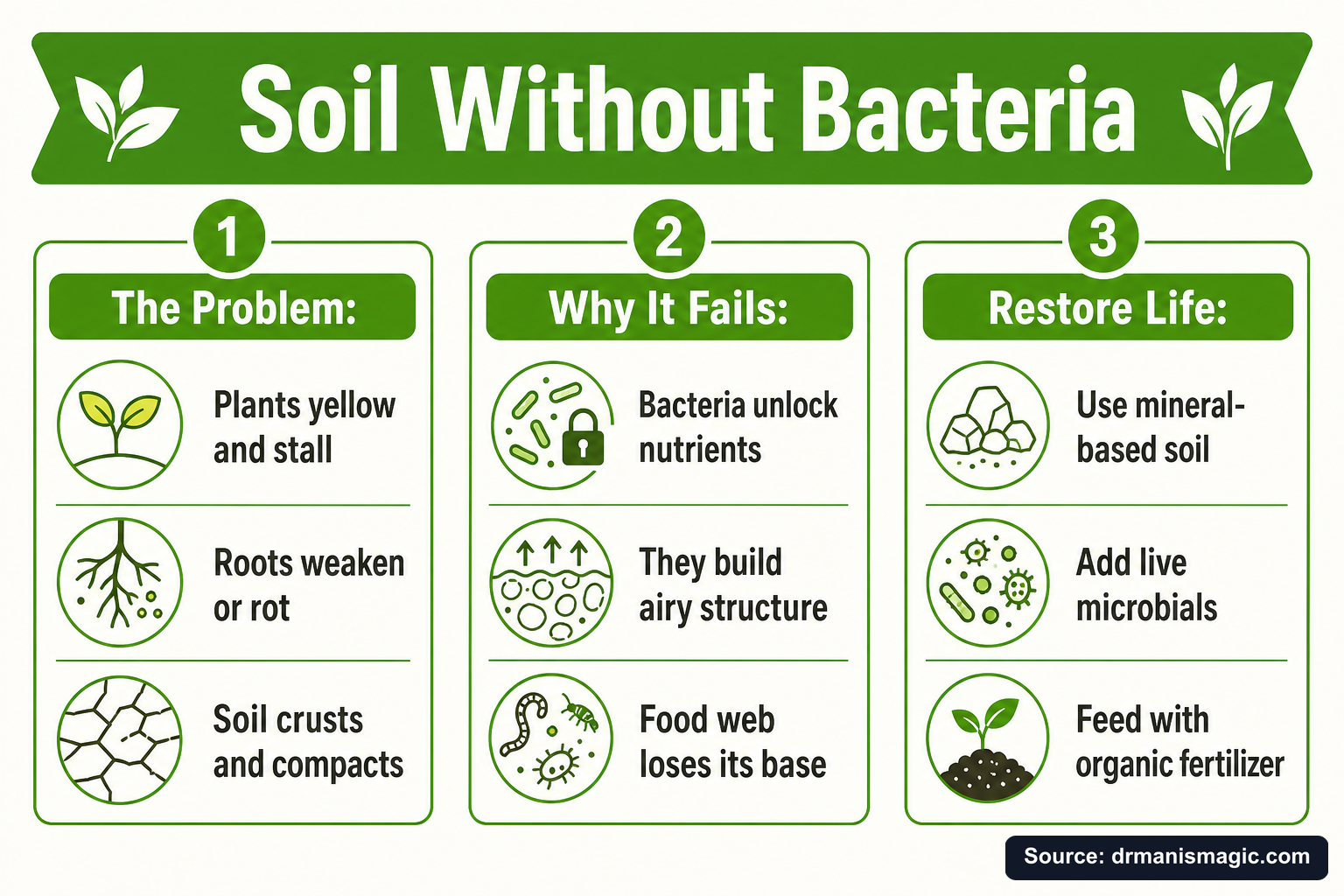
You push a healthy-looking plant into the ground. You water it. You wait. And nothing happens. Or worse — it slowly fades. The leaves go yellow. The roots turn mushy. You buy more fertilizer. You try again. Still nothing.
You think it's you. You think you have a brown thumb. But here's what almost nobody tells you: it was never about the plant. It was never about you. The real problem was invisible. It was happening underground, in a world you couldn't see, touch, or smell. Your soil had lost its bacteria. And the moment that happened, a cascade started. A slow, silent collapse that no amount of fertilizer could fix.
After 30-plus years growing over 250,000 trees at our South Texas nursery, we've seen this pattern more times than we can count. Dead soil looks like regular soil. It feels like dirt. But it's missing the invisible workforce that makes everything work. Understanding what breaks — and in what order — is the first step to fixing it. So let's walk through exactly what happens when soil loses its bacteria, and what you can do about it today.

Plant Super Boost
Key Takeaways
- Soil bacteria are not just "helpful extras" — they supply roughly 75% of plant-available nitrogen and 65% of available phosphorus, according to University of Minnesota Extension.
- When bacteria collapse, the whole soil food web follows: protozoa, nematodes, fungi, and earthworms all lose their food source and decline.
- Plants in bacteria-depleted soil show real, visible symptoms: yellowing leaves, weak roots, crusted soil, slow growth, and recurring disease.
- Salt-based synthetic fertilizers, herbicides, fungicides, and pesticides are the biggest killers of beneficial soil bacteria.
- Dead, powdered, or foul-smelling microbe products from the store are not the answer — most simply do not work.
- Recovery is possible, but it takes time: days for some recolonization, months for food-web stability, seasons to years for full fungal networks.
- The Three Plant Pillars — mineral-based soil, live microbials, and organic fertilizer — are the proven foundation for restoring and keeping soil biology alive.
What Do Soil Bacteria Actually Do Every Day?
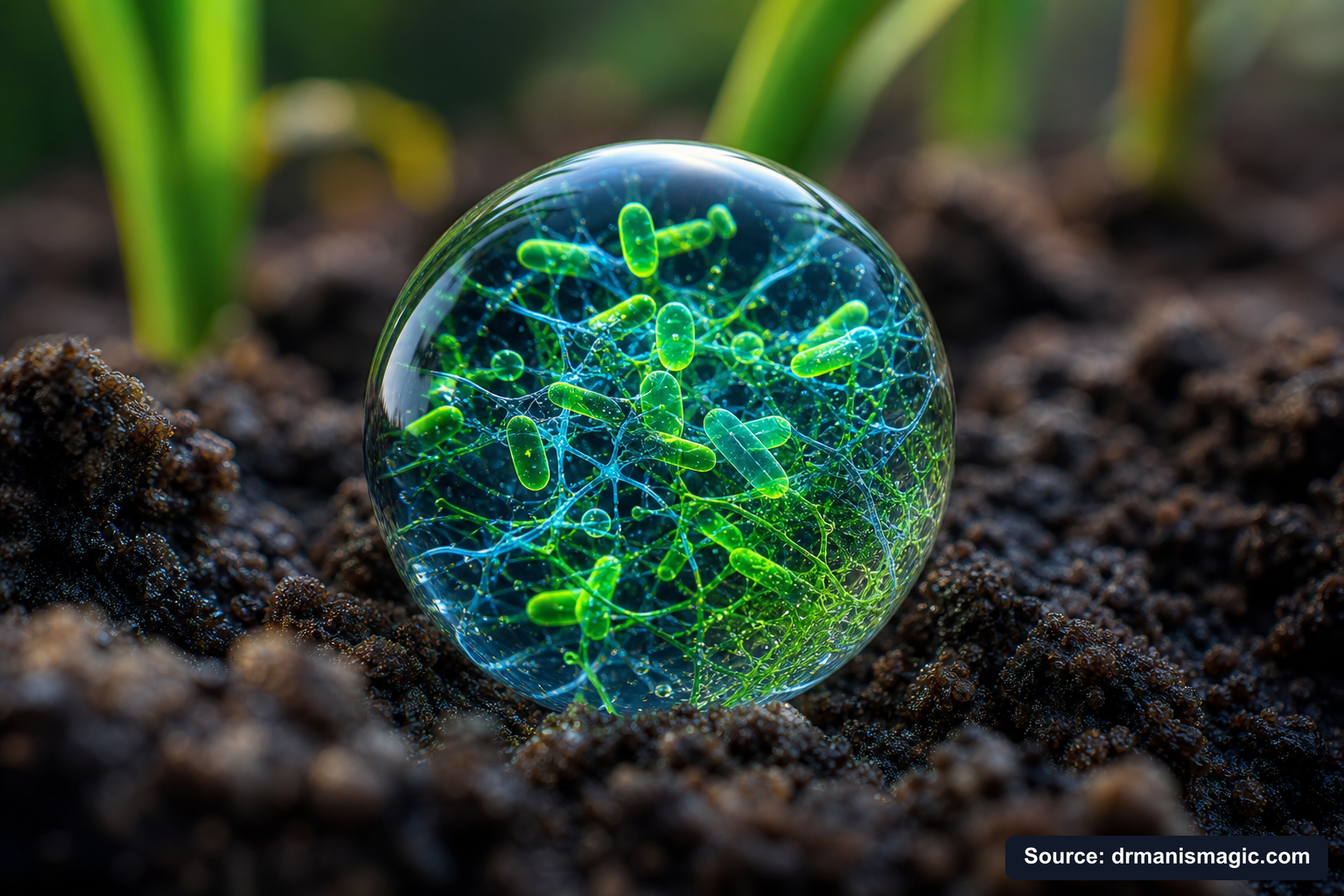
Quick Answer: Soil bacteria break down organic matter, release locked-up nutrients, convert atmospheric nitrogen into forms plants can use, glue soil particles into healthy structure, and crowd out disease-causing organisms. Without them, nutrients get locked away, soil hardens, roots struggle, and pathogens move in.
Think of your soil as a city. A thriving, humming city with millions of workers on every block.
Bacteria are the first responders. They show up the moment a leaf falls or a root dies. They start breaking it down. They release nutrients that were locked inside. They convert atmospheric nitrogen — the kind floating invisibly all around us — into a form plant roots can actually drink in. University of Minnesota Extension estimates that biological processes in healthy soil supply roughly 75% of plant-available nitrogen and 65% of available phosphorus. Not from a bag. From bacteria doing their job.
But bacteria do more than feed plants. They stick soil particles together using sticky substances called bioglues. This creates what scientists call "aggregates" — little clumps of soil with air pockets between them. Those pockets let roots breathe. They let water drain properly. They prevent the soil from crusting over like concrete after rain.
Bacteria also compete with pathogens. They crowd out the bad guys. They take up space, eat available food, and release compounds that slow or stop harmful organisms. Healthy soil has so much bacterial activity that most pathogens never get a foothold.
And bacteria are food. They get eaten by tiny organisms called protozoa. Those protozoa release nitrogen as a waste product — right next to plant roots where it's needed most. This "predator-prey loop" is one of the most important nutrient-delivery systems on the planet. When bacteria disappear, the whole loop breaks.
| What Bacteria Do | Why It Matters to Your Plant | What Happens When It Stops |
|---|---|---|
| Break down organic matter | Releases nitrogen, phosphorus, and micronutrients | Nutrients stay locked up; plants starve even when fertilized |
| Fix atmospheric nitrogen | Free nitrogen from air becomes plant food | Plants become 100% dependent on synthetic fertilizer |
| Glue soil particles together | Creates airy, well-draining soil structure | Soil crusts, compacts, and floods or dries out fast |
| Compete with pathogens | Keeps disease-causing organisms in check | Root rot and fungal disease move in unchecked |
| Feed protozoa and nematodes | Powers the nutrient-release predator loop near roots | Nutrient mineralization near roots slows dramatically |
| Produce plant hormones | Stimulates root branching and growth signals | Smaller root systems, weaker plants |
What Is the Soil Food Web and Why Does It Collapse Without Bacteria?
Quick Answer: The soil food web is the chain of living organisms in healthy soil — bacteria, fungi, protozoa, nematodes, and earthworms — that feed on each other and release nutrients for plants. Bacteria sit at the base. When they disappear, every organism above them loses its food source, and the whole system weakens.
Imagine a forest. At the bottom, you have plants. Deer eat the plants. Wolves eat the deer. Remove the plants and every animal above them eventually disappears too.
The soil food web works the same way. Bacteria and fungi are the base. Protozoa eat the bacteria. Bacterial-feeding nematodes eat the bacteria. Larger nematodes eat the protozoa. Arthropods eat the nematodes. Earthworms eat everything. Each step releases nutrients. Each step builds more stable, healthier soil.
When bacteria populations crash, the cascade looks like this:
- Day 0 to Week 1: Bacteria decline. Decomposition slows. Fresh organic matter sits without breaking down. Nutrients stay locked in forms plants cannot use.
- Week 1 to Month 1: Protozoa and bacterial-feeding nematodes start to starve. Predator-mediated nitrogen release near roots weakens. Plants get less nitrogen even if organic matter is present.
- Month 1 to Season 1: Soil aggregation weakens. Structure breaks down. Crusting and compaction begin. Water infiltration drops. Disease-suppressing organisms decline. Pathogens have less competition.
- Season 1 and Beyond: Mycorrhizal fungal networks weaken. Root systems shrink. Drought tolerance drops. Disease pressure rises. Plant performance declines visibly — yellowing, slow growth, weak fruiting.
This is not a metaphor. This is a measured, documented cascade. The USDA Natural Resources Conservation Service describes healthy soil biology as essential to nutrient cycling, disease suppression, water dynamics, and overall plant performance. Take bacteria out of the equation and the whole system starts to fall apart — slowly, then quickly.
See also: The Hidden Reason Synthetic Fertilizers Cause Root Rot
What Are the Visible Symptoms of Bacteria-Depleted Soil?
Quick Answer: Bacteria-depleted soil shows itself through crusted, hard-to-wet surfaces, yellowing leaves, slow or stalled growth, roots that turn brown or mushy, nutrient deficiencies that persist even after fertilizing, recurring disease, and very little earthworm or insect activity when you dig in.
Dead soil doesn't announce itself. It just makes gardening feel impossible.
Here's what to look for. Run your hand over the soil surface after a rain. Does water bead up instead of soaking in? Does the surface crack and crust? That's a sign of lost bacterial glue — the biological cement that normally holds soil particles in an open, spongy structure.
Dig down two inches. Does it smell like rich earth, or does it smell flat and dusty? Healthy soil smells alive. It smells like rain on warm pavement. That scent — called petrichor — actually comes from bacteria producing a compound called geosmin. No smell means low bacterial activity.
Look at your plants. Are the leaves pale yellow between the veins? Are they yellowing from the bottom up? Are you feeding regularly but seeing no response? Nutrient lockup is a classic sign of bacterial decline. The nutrients are often present in the soil — they're just locked in forms your plant cannot access without microbial help.
Check your roots if you can. Healthy roots are white or cream-colored, firm, and slightly fuzzy with fine hairs. Roots in bacteria-depleted, pathogen-heavy soil turn brown, soft, and hollow. They smell sour or rotten. That's root rot — and while overwatering gets the blame, the real culprit is usually a soil biology collapse that let pathogens take over.
Finally, dig down and count earthworms. A healthy square foot of soil should have at least a few. Zero earthworms is a red flag. Earthworms need bacteria to survive too.
What Kills Beneficial Soil Bacteria in the First Place?
Quick Answer: The biggest bacteria killers are salt-based synthetic fertilizers, broad-spectrum herbicides (especially glyphosate), synthetic fungicides, and pesticides. Compaction, flooding, severe drought, soil solarization, fumigation, and repeated tillage also destroy bacterial communities by removing oxygen, water balance, and physical habitat.
Here's the part nobody puts on the label.
Salt-based synthetic fertilizers — the kind sold in nearly every box store in America — are one of the leading causes of bacterial death in home gardens and orchards. Salt draws water out of bacterial cells through osmosis. High-salt soil is essentially a hostile desert for soil microbes. You apply more fertilizer because the plant looks hungry. The salt kills more bacteria. The plant gets hungrier. You apply more. It's a cycle that profits the fertilizer company and slowly destroys your soil.
Herbicides like glyphosate disrupt soil microbial communities. Synthetic fungicides kill beneficial fungi along with harmful ones — including the mycorrhizal fungi that extend root systems and improve drought tolerance. Broad-spectrum pesticides reduce the diversity of organisms across the board.
Compaction cuts off oxygen. Bacteria need air just like you do. Pack the soil down with foot traffic, heavy machinery, or waterlogged conditions, and anaerobic (oxygen-hating) bacteria take over. These are the ones that produce that sour, rotten smell. They do not help plants. They make things worse.
Heat sterilization, solarization, and soil fumigation are the most extreme versions of this. They are designed to kill everything. And they do. But they also kill everything beneficial — every bacterium, every fungal thread, every protozoan. What grows back first? Pathogens. Because they evolved to be the fastest colonizers in disturbed soil.
See also: Why Most Fertilizers Are Actually Salt in Disguise
How Do Soil Bacteria and Mycorrhizal Fungi Work Together?
Quick Answer: Bacteria and mycorrhizal fungi are partners in the soil. Bacteria break down organic matter and release nutrients. Mycorrhizal fungi extend root systems through microscopic threads called hyphae, delivering water, phosphorus, and zinc to roots in exchange for sugar. Together they make plants dramatically more resilient. Lose bacteria and the whole partnership weakens.
If bacteria are the workers, mycorrhizal fungi are the engineers.
Mycorrhizal fungi attach to plant roots and extend outward in a web of microscopic threads called hyphae. These threads can reach far beyond where roots could ever grow on their own. They find water in dry pockets. They mine phosphorus and zinc from soil particles. They build direct pipelines into the root system and deliver everything in exchange for sugars the plant produces.
University of Minnesota Extension notes that arbuscular mycorrhizal fungi associate with about 80% of all land plants. That's not a coincidence. That's co-evolution. Plants and mycorrhizal fungi have been partners for more than 400 million years.
But here's what most gardening advice misses: mycorrhizal fungi depend on bacteria too. Bacteria decompose organic matter into the simple compounds that feed the fungal network. Bacteria also help maintain the soil structure — the air pockets and moisture balance — that fungal threads need to grow and spread.
When bacteria collapse, the fungal network weakens. When the fungal network weakens, roots shrink. When roots shrink, plants become vulnerable to drought, nutrient deficiency, and root disease. The whole system is connected. You can't restore one part without addressing the others.
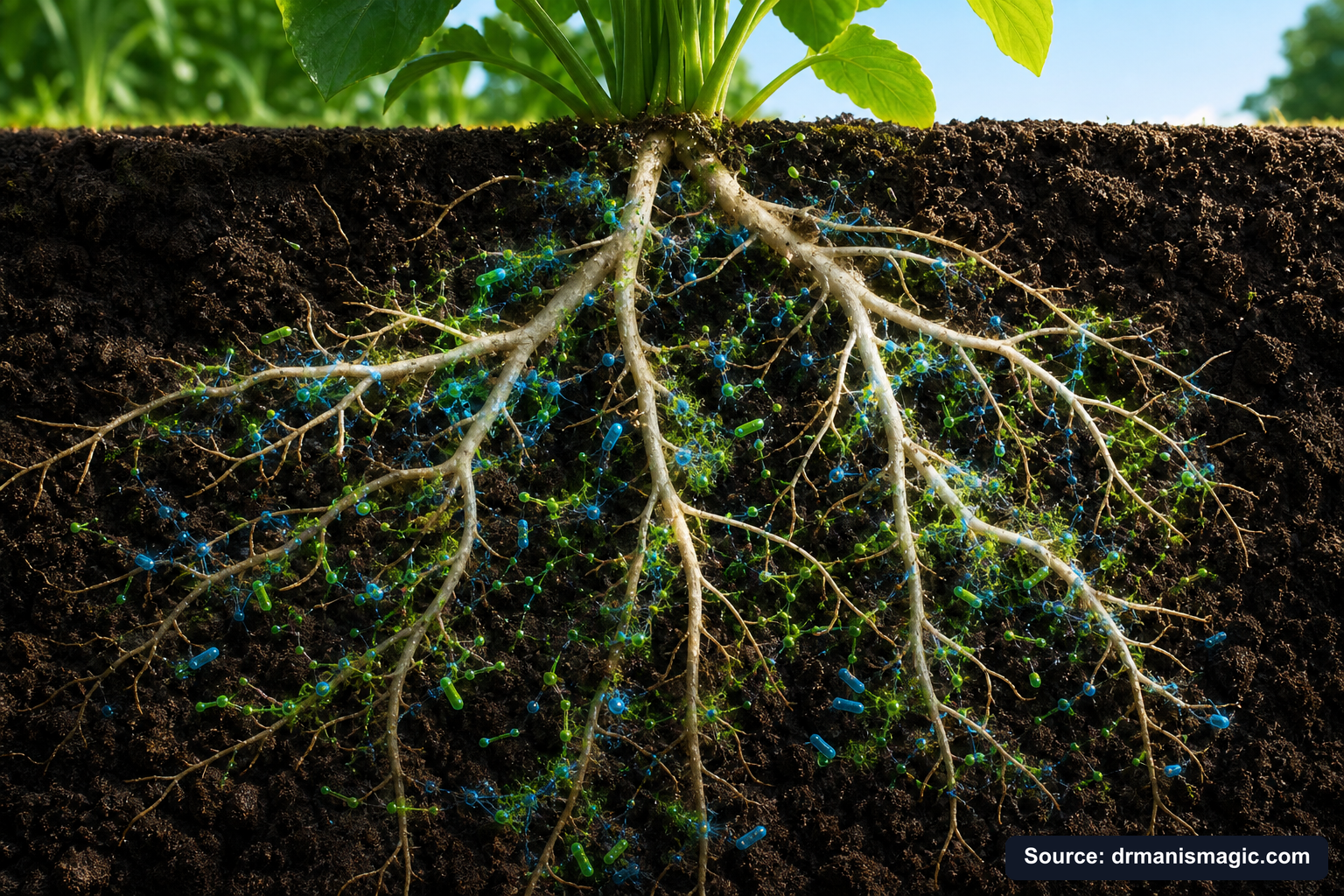
That's exactly why Plant Super Boost was formulated with both bacteria and mycorrhizal fungi — because rebuilding one without the other is like replacing half an engine and wondering why the car won't start.
You Never Had a Brown Thumb.
You were handed the wrong tools. This free guide hands you the right ones.
You watered it. You fed it. It died anyway.
It was never you. It was the dirt, the salt food, and the bad advice.
This guide shows you what really went wrong, and how to fix it for good.
- Why your plants really died, and why it was never your fault
- The salt hiding in your plant food that quietly burns the roots
- The hidden killer in almost every bag of store soil
- The tiny helpers that grow a whole forest for free
- The rescue trick that brings a half dead plant back to life

Live Microbes vs. Dead or Dried Products: What's the Real Difference?
Quick Answer: Live microbial products contain actively functioning organisms that can immediately colonize roots and soil. Dried or powdered products often contain dormant or dead organisms that show little to no real-world plant benefit. Liquid compost-tea-style products frequently go anaerobic (oxygen-depleted) during shipping and storage, killing the microbes and producing a foul smell.
Walk into any garden center today and you'll find shelves of "probiotic soil booster" and "mycorrhizae blend" and "beneficial bacteria concentrate."
Most of them don't work.
We know this because we tested dozens of them at our South Texas nursery — on real trees, in real soil, over real growing seasons. The results were consistently disappointing. Here's why.
Most microbial products are made in large factories. Organisms are grown in vats, then dried into a powder. The idea is that the dormant spores will "reactivate" when water is added. In theory, this sounds reasonable. In practice, we saw little to no benefit on our trees. The organisms either don't survive the drying process, or they can't establish in real-world soil conditions.
Liquid products made from compost or worm castings can be effective — but only when they're fresh. Within about 24 hours of being made, the liquid goes anaerobic. The microbes start dying. The product begins to ferment. By the time it reaches your front door, the bottle may fizz when opened. It almost certainly smells terrible. That's not biology working. That's biology rotting.
Then there's lactobacillus — the bacteria from yogurt. It's easy to grow, it stays alive, and some companies add it to their soil products. The problem? Lactobacillus is so vigorous it outcompetes the beneficial organisms you actually need. It belongs in your gut, not your garden.
| Product Type | Viability at Use | Microbial Spectrum | Odor | Real-World Effectiveness |
|---|---|---|---|---|
| Dry powdered lab microbes | Low — often dormant or dead | Narrow, single species | None | Little to no benefit observed |
| Dried microbes rehydrated in liquid | Low — same problem | Narrow | None or mild | Little to no benefit observed |
| Compost tea (fresh, under 24 hours) | Moderate — time-sensitive | Broad, natural | Earthy to slightly sour | Good when truly fresh; impractical to ship |
| Compost tea (old, over 24 hours) | Very low — anaerobic die-off | Partial | Strong, foul smell | Poor; microbes mostly dead |
| Lactobacillus-based products | High — but wrong organism | Single species, aggressive | Sour | Outcompetes beneficial microbes; not recommended |
| Plant Super Boost (stabilized, full-spectrum) | High — live and active | 2,000+ bacteria; 400-500 fungi including mycorrhizae; protozoa; nematodes | Earthy — does not stink | Proven on 250,000+ trees; visible under microscope |
Plant Super Boost is different because it starts from real, hand-crafted compost — not a factory vat. Dr. Mani's team uses an all-natural stabilization technique developed by a world-famous compostologist who spent decades advising farms and royal estates before being blacklisted by large chemical companies for producing results that were too good. The technique keeps microbes alive and aerobic without the smell or fermentation. You can literally put a drop under a microscope and watch them move.
It contains zero synthetic salts. Zero biosludge. Zero PFAS chemicals. And it comes with a 30-day money-back guarantee because we know it works.
Can Sterile or Dead Soil Come Back to Life?
Quick Answer: Yes — but not overnight. Some bacterial recolonization can begin within days if conditions are right. Meaningful biological activity returns over weeks to months. A stable, diverse soil food web takes seasons. Full mycorrhizal fungal networks after severe damage can take years. The key is removing what's harming the biology and actively restoring what's missing.
This is the question everyone really wants answered.
My soil is dead. Can it come back?
Yes. But recovery is not a one-time event. It's a process. And it has a sequence.
Think about a forest after a fire. The first things to return are not the tall trees. The first things to return are bacteria and simple fungi. They colonize the ash. They start breaking down charred organic matter. They make the soil habitable again. Only then do larger organisms follow. Only then do plants establish. The trees come last.
Your garden or lawn follows the same recovery sequence. Here's what it looks like in real time:
- Days 1 to 7: Some bacterial species can begin recolonizing if organic matter and moisture are present. This is fragile and easily reversed.
- Weeks 2 to 6: Bacterial populations can grow meaningfully if harmful inputs stop and habitat improves. Protozoa begin returning as bacterial food supply rebuilds.
- Months 1 to 3: Nutrient cycling activity starts to recover. Soil structure begins improving. Plants may show visible response — greener leaves, new root growth.
- Seasons 1 to 2: Disease suppression strengthens. Earthworm populations may return. Aggregate structure improves noticeably.
- Year 1 and beyond: Mycorrhizal fungal networks require the longest time to fully rebuild, especially after fumigation, solarization, or heavy synthetic use. This is where patience and consistent inoculant applications matter most.
The important thing to understand: dumping microbes into hostile soil does not work. If your soil is still salty from synthetic fertilizers, if you're still applying herbicides, if the pH is off or drainage is blocked — the microbes you add will simply die. You have to fix the habitat first, then restore the inhabitants.
That's the whole point of the Three Plant Pillars framework developed at US Citrus Nursery. Mineral-based soil creates the right physical habitat. Live microbials restore the biological workforce. Organic fertilizer feeds both the plant and the microbes without the salt burn that kills everything. All three work together. Miss one and you're fighting against nature instead of working with it.
How Do You Revive Dead Soil? A Step-by-Step Recovery Protocol
Quick Answer: Reviving dead soil means stopping what's harming the biology, improving the physical habitat for microbes, adding organic matter as food, introducing live full-spectrum microbial inoculants, and giving the system time to stabilize. It takes consistency over weeks and months — not a single application of any one product.
Here is the practical sequence we've seen work — tested across 250,000 trees and every kind of growing condition in South Texas.
- Stop the bleeding first. Identify what's been killing your soil biology. Salt-based synthetic fertilizers, herbicides, synthetic fungicides, broad-spectrum pesticides — any of these can undo your recovery before it starts. Swap to organic inputs. Give the soil a break from chemicals.
- Fix drainage and aeration. Compacted, waterlogged soil is an oxygen-dead zone. Bacteria need air. Break up compaction with a fork, add organic mulch on the surface, or consider a mineral-based soil amendment if you're working in containers or raised beds. Roots and microbes both need to breathe.
- Add organic matter as food. Bacteria need carbon to eat. Top-dress with mature compost, mulch with wood chips or straw, or plant a cover crop. This is the pantry you're stocking for your microbial workforce.
- Introduce live, full-spectrum microbials. Add a genuinely live inoculant — not dried powder, not a smelly old liquid. Apply monthly and consistently. Recovery is not a one-time event. Repeated application rebuilds populations that compete with pathogens and re-establish the food web.
- Feed with organic, non-salt fertilizer. Organic slow-release fertilizers feed both plants and microbes. They do not create the salt spike that kills the biology you're trying to restore. Amino acids, crab meal, and kelp support microbial activity while delivering a full nutrient spectrum.
- Reduce disturbance. Tillage breaks fungal threads and disrupts bacterial communities. Minimize digging once biology starts recovering. Let the network build undisturbed.
- Be patient and consistent. This is not a 10-day fix. A season of consistent care will produce visible results. A year of it will transform soil that felt hopeless into something alive and productive.
You can get money back. You cannot get time back. The gardeners who see fruit on their trees — who harvest their own vegetables, who walk barefoot on grass they grew themselves — are the ones who set up the right foundation and let it compound. Every month you wait with the wrong inputs is a month you lose. Every month you invest in the right biology is a month that builds on itself.
For a full walkthrough of the Three Plant Pillars approach and how to apply it to any plant — trees, lawns, houseplants, gardens, flowers — download the Free Plant Care Field Guide from Dr. Mani's team.
Why Does Organic Fertilizer Help Bacteria While Synthetic Fertilizer Hurts Them?
Quick Answer: Synthetic fertilizers are salt-based. High salt concentrations in soil draw water out of bacterial cells and kill them through osmotic stress. Organic fertilizers release nutrients slowly, without the salt spike, and they provide carbon compounds that actually feed and support microbial populations instead of destroying them.
This is the part of the story that the big chemical companies have spent decades keeping quiet.
Salt kills bacteria. That's not controversial. It's basic biology. Salt draws moisture out of cells through osmosis. Enough salt, and the cell dies. This is why salt was used for thousands of years to preserve food — it killed the bacteria that would cause spoilage.
Synthetic fertilizers are salts. Ammonium nitrate. Potassium chloride. Monoammonium phosphate. All salts. When you apply them to soil, the salt concentration spikes. Your plant gets a quick hit of nitrogen or phosphorus. The leaves green up fast. You feel like it worked.
But underground, bacteria are dying. The soil biology you need for long-term plant health is being burned away. The plant becomes dependent on the next application. You buy more. Apply more. The soil gets worse. The plant looks okay on the surface but becomes increasingly fragile underneath.
We've watched this cycle play out at our nursery for decades. Trees that were fed only with synthetic fertilizers looked green for a season or two, then started declining. Root systems shrank. Disease pressure increased. They weren't able to tolerate drought or stress. The soil under them was biologically empty.
Organic fertilizers work differently. Crab meal, kelp, and amino acids break down slowly. They release nitrogen and phosphorus in forms that are gentle on soil biology. They also provide carbon compounds that microbes use as food. They work with the biology instead of against it. The results are slower to appear but they build — season after season, year after year.
See also: How Salt-Based Feeding Quietly Destroys Root Systems
What Can You Do Right Now to Protect Your Soil's Bacteria?
You made it this far. That means you're serious about this. And that means your plants are going to get better.
The big picture is simple. Soil bacteria are the invisible workforce behind everything your plant does — from feeding itself to fighting disease to tolerating drought. When they disappear, everything else follows. The food web collapses in a cascade. Plants show symptoms. Gardens stop producing. Trees struggle to survive.
The good news: soil is resilient. It wants to come back to life. It just needs the right conditions and the right help. Stop the inputs that are killing the biology. Fix the physical habitat. Add organic matter. Introduce genuinely live, full-spectrum microbes on a consistent schedule. Feed with organic nutrients that work with the biology instead of against it.
That's not a complicated program. That's the Three Plant Pillars — the same system Dr. Mani Skaria developed across 30 years and 250,000 trees at US Citrus Nursery in South Texas. It works for citrus. It works for roses. It works for lawns, houseplants, vegetable gardens, and container trees on a condo balcony. Because the biology underneath every plant is the same.
If you're ready to stop guessing and start building soil that actually works, explore Plant Super Boost — the live, full-spectrum microbial formula that smells like earth, not a swamp, because the microbes inside it are alive and working, not dying and rotting. It's the first step toward soil that feeds itself, protects your plants, and compounds its benefits every month you use it.
Your plants are waiting. The bacteria are ready to get to work. The only question is how soon you want to see the difference.
Frequently Asked Questions
If your plants keep struggling no matter what you do, the answer is probably underground. These are the questions Dr. Mani hears most from gardeners who are tired of losing time and money on plants that just will not grow. Read these answers carefully. They could change everything.
What kills bacteria in the soil?
The biggest killers are salt-based synthetic fertilizers, chemical herbicides, fungicides, and pesticides. These wipe out the beneficial bacteria your plants depend on. Heat can also destroy soil bacteria, but the real everyday threat in your backyard is the chemical products sold at big box stores. Dr. Mani spent 30 years watching synthetic inputs quietly destroy the living soil in gardens across the country. That is why the Three Plant Pillars start with getting clean inputs into your soil first.
What do soil bacteria actually do for my plants?
Soil bacteria supply roughly 75% of the nitrogen your plants can actually use. They also release locked-up phosphorus, glue soil particles together so roots can breathe, and crowd out disease-causing organisms. Without them, your soil turns into dead dirt. Nutrients sit there locked away. Roots suffocate. Plants fade. Dr. Mani proved this across 250,000 trees at US Citrus Nursery. Healthy bacteria are not optional. They are the engine.
What are the most common bacteria found in healthy soil?
Healthy soil is packed with Proteobacteria, Actinobacteria, Bacillus, and Rhizobium, among others. Actinobacteria give soil that fresh earthy smell you notice after rain. Rhizobium pulls nitrogen right out of the air and feeds it to roots. Bacillus fights off harmful fungi naturally. Dr. Mani's Plant Super Boost delivers live bacteria and fungi, including mycorrhizae, straight to your plant's root zone so this invisible workforce gets to work fast.
How long does it take for soil bacteria to come back after they are wiped out?
Some recolonization can start within days if you give bacteria the right environment. But rebuilding a stable soil food web takes months. Full fungal networks can take a season or longer. That is time you cannot get back. The fastest way to recover is to stop adding chemicals, switch to a mineral-based soil that does not compact and choke roots, and introduce live microbials like Plant Super Boost so the recovery starts the day you plant.
Are soil bacteria harmful to humans?
A small number of soil bacteria can cause illness, including tetanus and anthrax, but these are rare. The billions of beneficial bacteria in healthy garden soil are not a threat to you. In fact, research suggests that exposure to healthy soil microbes may actually support your immune system. The real danger is not the bacteria in good soil. It is the synthetic chemicals people spray on their gardens that end up on their skin, in the air, and on the food they eat.
Can dead or powdered microbe products from the store fix depleted soil?
Most of them cannot. Dead microbes do nothing. Powdered products sitting on a store shelf for months have usually lost their living cultures. That is why Dr. Mani and his team developed Plant Super Boost using a special stabilization method that keeps the bacteria and fungi alive in the bottle. When it arrives at your door, those microbes are ready to work. It smells earthy, not rotten, because nothing inside it is dead.
What is the fastest way to restore bacteria in my soil right now?
Stop using salt-based fertilizers and chemical sprays immediately. Then build on the Three Plant Pillars. Start with a mineral-based soil like Dr. Mani's Super Soil, which does not compact or rot and lets roots breathe. Add live microbials through Plant Super Boost to repopulate your soil fast. Then feed with a slow-release organic fertilizer made from crab, kelp, and amino acids. This is the exact system proven on 250,000 trees. It works for any plant you are growing.
About the Author
Dr. Mani Skaria, PhD
Dr. Mani Skaria, PhD, is a plant pathologist and the scientific founder of Dr. Mani's Magic. He earned his doctorate at Purdue University and spent 48 years studying how plants, soil, and living microbes work together, including his years as Professor Emeritus at Texas A&M and as a member of the USDA NAREEE Advisory Board. He invented micro-budding, a method for growing healthier, stronger trees, and has grown more than 250,000 trees on the family farm in Hargill, Texas - US Citrus Nursery. His life's work takes real lab science and practical experience and turns it into simple, safe, organic plant care anyone can use at home.


