


The Supporting Role of Carbon in Stable Soil and Why It Fails in Containers | Dr. Mani's Magic
Carbon Is Not Structure: The Hidden Reason Your Potting Mix Slowly Suffocates Your Plants
Picture this. You're standing on your back patio, coffee in hand, staring at a plant you paid good money for. It looked incredible when you brought it home. Lush. Green. Full of promise. You watered it. You fertilized it. You did everything the bag told you to do.
And yet. Something is wrong. The leaves are yellowing. The stems look tired. The soil feels hard and dense, almost like concrete. You press your finger into it and it barely gives. You think, "Maybe I'm overwatering. Maybe I'm underwatering. Maybe I just have a brown thumb." But here's the truth nobody told you: the plant isn't dying because of what you did. It's dying because of what the soil stopped doing. Slowly. Quietly. Without a single warning label.
This article is about the one thing most gardening advice completely misses. It's about what soil is actually supposed to do. It's about why carbon-heavy potting mixes are a ticking clock for any plant you plan to keep alive for more than a season. And it's about why the growers who have been getting this right for centuries never relied on a bag of sawdust in the first place. Stick with us. What you're about to learn could save every plant you own.

Plant Super Boost
Key Takeaways
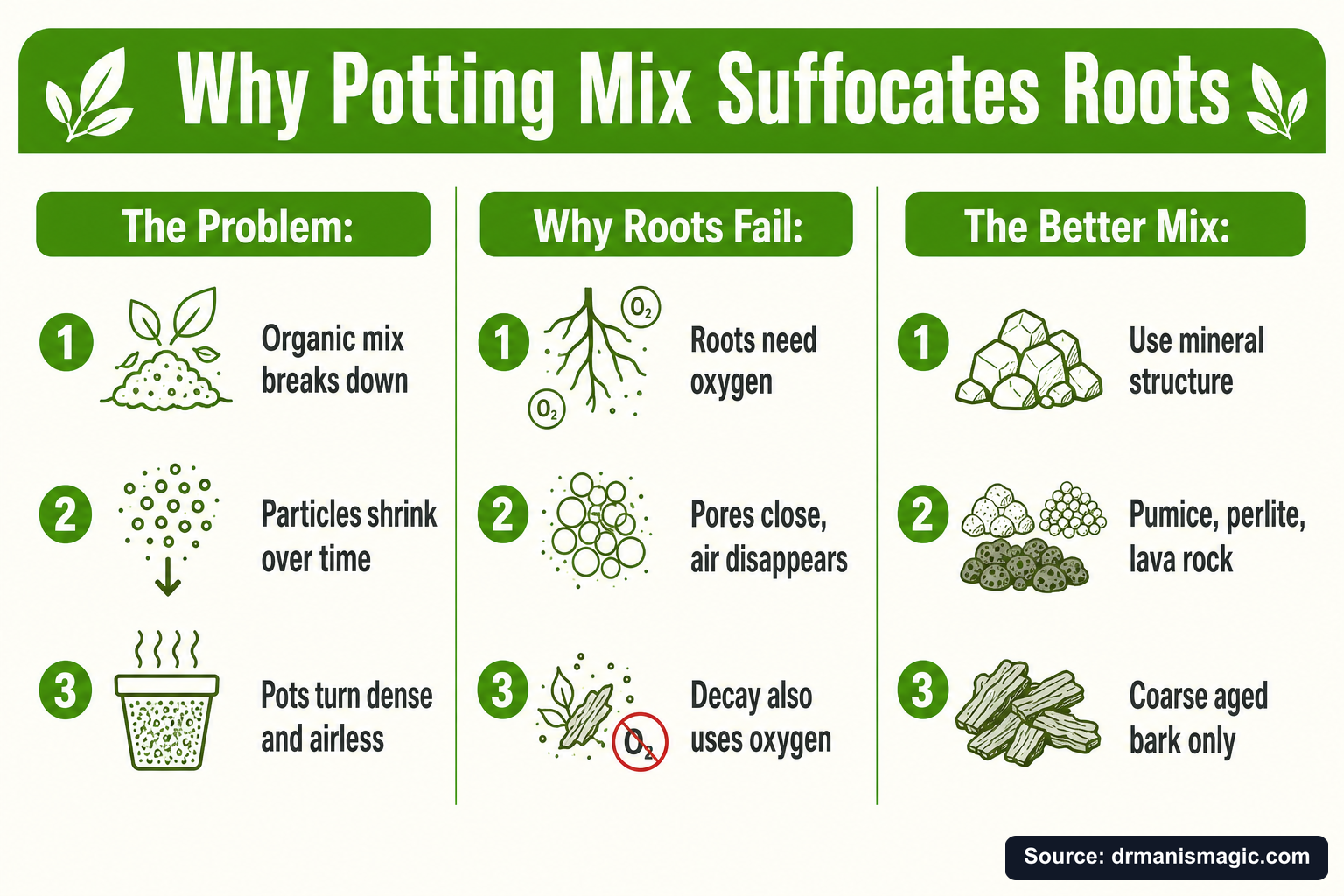
- Carbon-based potting mix (pine bark, sawdust, compost) physically decomposes and shrinks over time, collapsing the pore spaces roots need to breathe.
- Roots need oxygen just as much as leaves need sunlight. When pore space disappears, oxygen disappears, and roots begin to rot.
- Mineral-based ingredients like silica sand, pumice, perlite, and lava rock do not decompose. They hold their shape for years and keep oxygen pathways open.
- The decomposition process itself consumes oxygen in the root zone, making the problem double: less space AND less air.
- Most container plant declines after one to three years trace back to media collapse, not watering mistakes or fertilizer failures.
- Aged or coarse pine bark can support structure and beneficial microbes, but fresh, fine, or rapidly decomposing organics are dangerous in a closed container.
- The Three Plant Pillars framework, developed and tested on over 250,000 trees at US Citrus Nursery in South Texas, puts mineral-based soil first for a reason.
Does Carbon Make Soil Stable?
Quick Answer: In garden beds and farm fields, stable organic carbon helps bind soil particles together and improves structure. But in a container, carbon-based materials like pine bark, peat, and compost are consumed by microbes over time. As they decompose, they shrink, reduce pore space, and cut off the oxygen supply that roots depend on to survive.
This is the question at the heart of everything. And the honest answer is: it depends where you are.
In a wide-open field, carbon is a hero. Organic matter from leaves, roots, and animal waste breaks down slowly and bonds with mineral particles. That bonding creates little clumps called aggregates. Those aggregates hold pore space open. They let water drain. They let air move through. Soil scientists call this good tilth, and it's what farmers and gardeners have been chasing for centuries. Penn State Extension confirms that stable organic carbon is one of the most important contributors to field soil structure and long-term productivity.
But here is the part nobody talks about. A container is not a field.
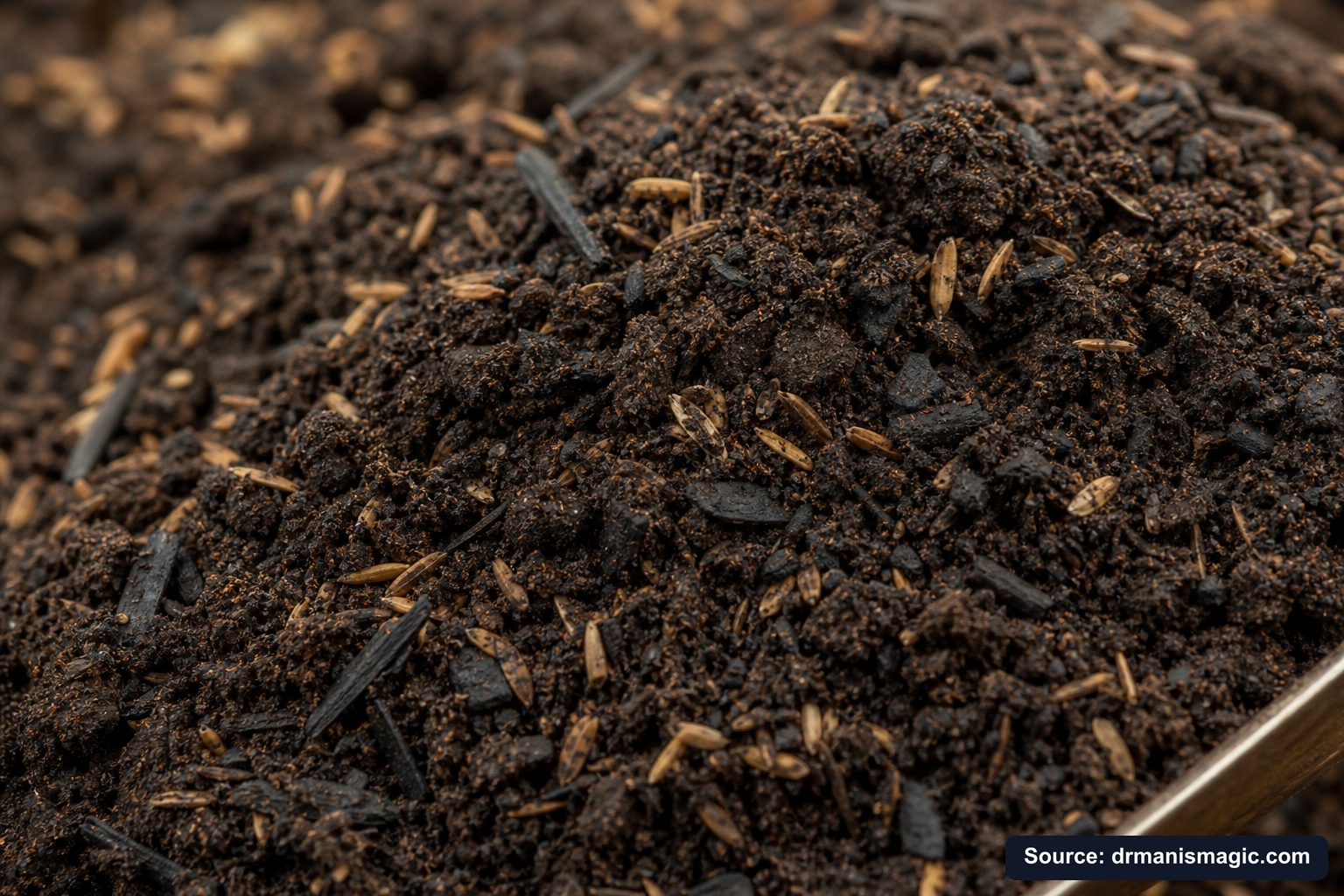
A pot is a small, closed, bounded world. The soil inside it does not have acres of mineral earth beneath it. It does not have earthworms cycling nutrients from ten feet down. It does not have centuries of geology holding the structure together. It has only what you put in it. And if what you put in it is mostly carbon-based organic matter, that matter will be consumed. The microbes that help your plant will eat it. The water you add will accelerate the breakdown. And when the carbon is gone, the structure it was providing goes with it.
What you are left with is compacted, airless sludge. And that is when the real trouble begins.
Why Do Roots Need Oxygen to Survive?
Quick Answer: Roots breathe. They take in oxygen and release carbon dioxide through a process called respiration. Without a continuous supply of fresh oxygen flowing through soil pore spaces, roots cannot produce the energy they need to grow, absorb water, or take up nutrients. Oxygen-starved roots turn brown, go slimy, and become easy targets for root rot pathogens.
Here is something that surprises a lot of plant owners. The leaves of your plant love carbon dioxide. They take it in and use sunlight to convert it into sugar. That part you probably learned in school.
But the roots are doing something completely different. Roots breathe oxygen. Just like you do. They pull it in from the tiny air pockets between soil particles. They use it to make energy. And they push carbon dioxide back out through those same pockets.
Cornell University's greenhouse media research makes this very clear: roots require continuous oxygen diffusion into the pore spaces in the root zone, and continuous carbon dioxide diffusion out. If either direction stops, the root zone becomes toxic. Cornell's guidance on container media frames healthy soil structure as an engineering challenge, not just a chemistry challenge. The physics of air movement through pore space matters just as much as nutrients.
So when your potting mix compacts and the pore space closes up, it is not just inconvenient. It is suffocation. Slow, invisible, impossible to see from the outside. Your leaves might look fine for weeks while the roots are quietly dying below the surface. By the time you see yellowing or drooping, the damage is already done.
This is the root of the problem. Literally.
What Happens to Potting Mix After Six Months in a Container?
Quick Answer: Potting mix is mostly pine bark and wood fiber. After six months in a container, microbial activity and moisture cause it to break down. The particles shrink. The pore spaces close. The mix compacts. Drainage slows. Oxygen levels drop. What started as fluffy, light media becomes dense, waterlogged, and hostile to roots. Most container plants are silently suffering in degraded media right now.
Let's talk about what potting mix actually is. Not what the marketing says. What it actually is.
Walk into any big box store and grab a bag of potting mix. Read the label. You will see pine bark, wood fiber, peat moss, maybe some compost. What you are holding is essentially a bag of dead plants. Shredded, processed, and sold to you as soil.
Now think about that for a second. You are planting your living plant into other dead plants.
Pine bark became popular for one reason. The timber industry in the southeastern United States generates enormous quantities of it as a waste product. It is cheap. It is lightweight. It ships easily. It looks acceptable in a bag. And it sells. The nursery industry adopted it because it was convenient and profitable. Not because it was ideal for your plant's long-term health.
There is another layer to this story. Fresh pine bark is not even safe to use right away. Pine wood contains a family of chemical compounds called terpenes and terpenoids. You already know some of them. Pine-Sol is named after them. Turpentine comes from them. These compounds are antimicrobial and can be harsh on the beneficial microbes and root tissue you need for healthy growth.
So manufacturers pile pine bark sawdust into gigantic heaps and let it sit. For years. They let it decompose partially to drive off some of those harsh chemicals. Which means the decomposition process starts before the product even reaches you. The pore structure begins collapsing in the warehouse.
And then there is the surfactant problem. Raw pine bark repels water. It is hydrophobic by nature. To make it hold moisture like soil, manufacturers add surfactants, which are wetting agents that help water move into the wood fibers. This works fine at first. But every time you water, those surfactants wash away. Eventually, old potting mix becomes completely hydrophobic again. You pour water on it and it runs straight down the inside edge of the pot, never touching the root zone at all. The plant sits in bone-dry media while water pours out the drainage hole.
So you have a media that starts compromised, compacts within months, and eventually repels the water it is supposed to hold. That is what most plants in America are growing in right now.
How Does Carbon Decomposition Steal Oxygen From Roots?
Quick Answer: Decomposition is a biological process. Microbes consume organic carbon and use oxygen to do it. In a container, the microbes breaking down your potting mix and the roots of your plant are competing for the same limited oxygen supply. When decomposition accelerates, especially in warm, moist conditions, the microbes can consume oxygen faster than it can be replenished, creating anaerobic (no-oxygen) zones where root rot thrives.
Here is the part that ties everything together. And it is the part that almost nobody explains.
When organic matter decomposes, microbes are doing the work. Those microbes are not passive. They are active, living organisms with high metabolic demands. And what do they need to fuel that metabolism? Oxygen.
So in a container packed with pine bark, peat, and compost, you have two oxygen consumers competing in the same tiny space. Your plant's roots on one side. The decomposing organic material on the other. In warm weather, when decomposition speeds up, the microbes can win that competition. Oxygen in the pore spaces drops. The root zone goes anaerobic. The beneficial microbes that protect your plant die off. And the water molds and rot pathogens that love low-oxygen environments move in.
Oregon State research shows that air-filled porosity above roughly 30 percent can significantly reduce the severity of Phytophthora root rot. The UC ANR program similarly found that higher air-filled porosity correlates directly with lower Phytophthora severity. These are the pathogens that kill container plants. And they thrive exactly where oxygen is lowest.
This is not a watering problem. This is not a fertilizer problem. This is a structural problem. The media itself is creating the conditions that kill the plant.
See also: The Hidden Reason Synthetic Fertilizers Cause Root Rot
Organic Carbon vs. Mineral Structure: What Is the Real Difference?
Quick Answer: Organic carbon ingredients like bark, peat, and compost are temporary. They decompose and shrink. Mineral ingredients like coarse sand, pumice, perlite, lava rock, and silica do not decompose. They hold their shape for years and maintain the pore space that roots need to breathe. In a long-lived container plant, mineral structure is what keeps the root zone stable over time.
Think of it this way. Imagine building a house out of ice and a house out of stone. Both look solid on day one. But one of them has a clock running against it.
Organic carbon in a container is the ice house. It is real structure. It provides real benefit in the short term. But time and biology are working against it from the moment you plant. Peat shrinks as it dries and compresses. Compost breaks down as microbes consume it. Fresh wood products can tie up nitrogen while they decompose, robbing your plant of a nutrient it needs right now. The whole system is temporary by design, whether you intended it or not.
Mineral structure is the stone house. Coarse silica sand, pumice, perlite, lava rock, expanded shale, calcined clay. These materials are inorganic. They come from rocks. Rocks do not decompose. They hold their particle size and their shape regardless of how long they sit in a pot, how many times you water, or how warm the weather gets. The pore space they create on day one is still there on day 1,000.
This is the core idea behind the Three Plant Pillars that Dr. Mani Skaria developed after 30 years of growing at US Citrus Nursery. Pillar One is mineral-based soil. Not because minerals are nutritious. They mostly are not. But because mineral structure is permanent. It does not steal oxygen. It does not collapse. It does not turn into sludge.
That permanence is worth more than any nutrient you can add to a decomposing mix.
| Ingredient | Type | Decomposition Rate | Pore Space Longevity | Oxygen Support | Best Use |
|---|---|---|---|---|---|
| Fresh pine bark (fine) | Organic carbon | Fast (6-18 months) | Poor, collapses quickly | Decreases over time | Short-term annuals only |
| Aged/coarse pine bark | Organic carbon | Moderate (2-4 years) | Fair, holds longer | Moderate | Improved container mixes |
| Peat moss | Organic carbon | Slow but shrinks when dry | Fair, becomes hydrophobic | Decreases as it compacts | Short-term moisture retention |
| Fresh compost (fine) | Organic carbon | Very fast | Poor, shrinks rapidly | Low, consumes oxygen | Field amendment only |
| Fresh sawdust | Organic carbon | Fast, ties up nitrogen | Very poor | Very low | Avoid in containers |
| Coarse silica sand | Mineral | None | Excellent, permanent | High | Long-term drainage and ballast |
| Pumice | Mineral | None | Excellent, permanent | Very high | Long-term aeration |
| Perlite | Mineral | None | Good, can float or compress | High | Aeration in lighter mixes |
| Lava rock | Mineral | None | Excellent, permanent | Very high | Long-term structure |
| Coco coir | Organic carbon | Slow (3-5 years) | Good, resists compaction well | Moderate to good | Useful in mineral-heavy blends |
| Rice hulls | Silica-based organic | Very slow (silica shell) | Good, lasts longer than bark | Good | Aeration amendment, top dressing |
| Biochar | Stable carbon | Extremely slow | Very good, porous structure | High | Microbial habitat, long-term amendment |
Is Sand Good or Bad for Drainage in a Container Mix?
Quick Answer: Coarse, sharp silica sand improves drainage and adds durable mineral structure to a container mix. Fine sand is a different story. Fine sand particles can fill in the macro pores between larger particles and actually make drainage worse. The type of sand matters enormously. Coarse and sharp is right. Fine and smooth is wrong.
You have probably heard that adding sand to your potting mix helps drainage. And you have probably also heard that it does not work. Both groups are right. They are just using different sand.
Particle size is everything. Coarse, sharp-edged silica sand creates its own pore space between particles. It adds ballast and weight to keep a tall plant upright. It does not decompose. It does not compact. It is inert and permanent.
Fine sand is the opposite. Fine sand particles are small enough to slip in between the larger particles of bark or perlite already in your mix. Instead of creating new pore space, fine sand fills existing pore space. You can actually make drainage worse by adding the wrong sand. This is why Rutgers and Texas A&M extension materials both emphasize particle size distribution, not just the word "sand," when recommending container media amendments.
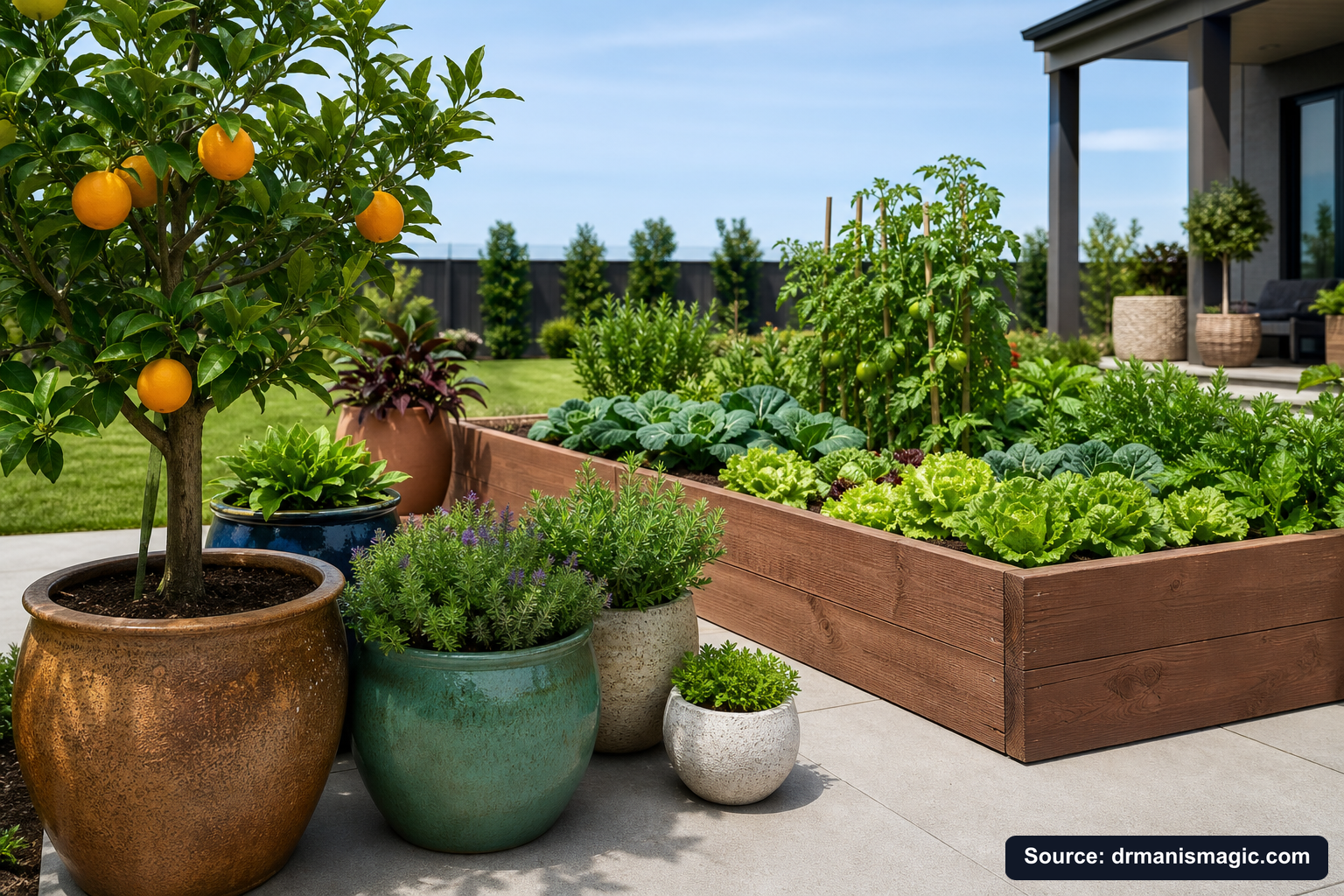
The ancient bonsai tradition figured this out long ago. Japanese practitioners have used gritty mineral media, including akadama clay, pumice, and lava rock, for centuries. They were not doing it for aesthetics. They were doing it because trees kept in containers for decades need a media that will not collapse. The same logic applies to your potted citrus, your houseplant in the corner, or your raised garden bed.
Coarse sand: yes. Fine sand: no. The difference sounds small. The results are not.
You Never Had a Brown Thumb.
You were handed the wrong tools. This free guide hands you the right ones.
You watered it. You fed it. It died anyway.
It was never you. It was the dirt, the salt food, and the bad advice.
This guide shows you what really went wrong, and how to fix it for good.
- Why your plants really died, and why it was never your fault
- The salt hiding in your plant food that quietly burns the roots
- The hidden killer in almost every bag of store soil
- The tiny helpers that grow a whole forest for free
- The rescue trick that brings a half dead plant back to life

Potting Mix vs. Mineral-Based Soil: A Side-by-Side Comparison
Quick Answer: Standard potting mix is carbon-based and temporary. It drains well at first, then compacts and fails as it decomposes. Mineral-based soil is permanent. It maintains drainage and oxygen pathways for years because the mineral particles do not break down. For any container plant you plan to keep alive longer than one growing season, mineral-based soil is the better foundation.
Let's put these two approaches side by side so you can see exactly what you are choosing between.
| Category | Standard Potting Mix (Pine Bark / Sawdust) | Mineral-Based Soil (Silica Sandy Loam + Amendments) |
|---|---|---|
| Primary ingredients | Pine bark, wood fiber, peat, compost | Silica sand, pumice, lava rock, coco coir, rice hulls, biochar |
| Decomposition | Begins immediately, accelerates in heat and moisture | Mineral fraction does not decompose |
| Pore space over time | Collapses within 6-18 months | Maintained for years |
| Oxygen availability | Decreases as media compacts | Remains high due to stable mineral structure |
| Drainage over time | Worsens, becomes waterlogged | Consistent and reliable |
| Hydrophobic risk | High after surfactants wash out | Low, mineral particles are naturally wettable |
| Root rot risk | High after media collapse | Low when air-filled porosity is maintained |
| Microbial habitat quality | Degrades as oxygen drops | Stable, supports beneficial microbe populations |
| Repotting frequency | Every 1-2 years (media fails) | Every 3-5 years or longer (media holds) |
| Cost over 5 years | High (repeated repurchase) | Lower (one investment lasts) |
| Ideal for | Annual flowers, short-term plants | Citrus, tropicals, perennials, any long-term container plant |
The big box store sells you a bag of potting mix. It looks great. It smells earthy. Your plant does well for a few months. Then the plant starts to struggle. You buy more fertilizer. It helps a little. Then it doesn't. You buy a new bag of potting mix and repot. The cycle repeats. You keep spending. They keep profiting.
That is not a conspiracy theory. It is a business model built around annual plant turnover. Plants that thrive permanently do not drive repeat purchases. Plants that slowly decline do.
Why Do Container Plants Decline After One to Three Years Even With Good Care?
Quick Answer: The most common cause of gradual container plant decline is media collapse. The organic matter in standard potting mix decomposes, shrinks, and loses pore space over one to three years. Even if you water correctly and fertilize regularly, roots that cannot access oxygen cannot function. The plant looks maintained but is slowly suffocating from below the surface.
This is the question that brings people to us. They are doing everything right. They water on schedule. They fertilize every month. They check for pests. And yet, the plant just gets worse every year.
After growing over 250,000 trees at our nursery in South Texas, we can tell you what is almost always happening. The media collapsed. The pore space closed. The oxygen disappeared. And everything downstream of that, the fertilizer uptake, the microbial activity, the water movement, all of it, broke down with it.
No fertilizer can fix a root zone that cannot breathe. No watering schedule can compensate for media that repels water. No microbial product can colonize a space that has gone anaerobic. The foundation has to be right first. Everything else builds on top of it.
Time is the invisible factor here. You cannot see your root zone. You cannot smell the decomposition happening inside the pot. You only see the symptoms on the leaves, by which point months of damage have already accumulated. And those months of slow decline represent time you can never get back. Time you could have been watching your plant grow. Time you could have been harvesting fruit. Time you could have been enjoying what you planted.
People come to us all the time and tell us the same thing. They want to see fruit on their tree. They want to know they will get there before life moves on. That is a real desire rooted in something deeply human. We were made to tend things and watch them flourish. But that only happens when the foundation is right from the beginning.
How Do You Know If Your Container Soil Has Already Collapsed?
Quick Answer: Signs of media collapse include soil that feels hard and dense when pressed, water that runs straight down the pot's inner edge without absorbing, yellowing leaves despite regular feeding, slow or no new growth, roots circling tightly near the surface, and a sour or musty smell from the pot. Any combination of these signs points to degraded media, not a watering or fertilizer problem.
Here is a simple diagnostic you can do right now. Walk over to any container plant you own. Press your finger firmly into the soil surface. If it feels like damp concrete, the media has compacted. Now water it slowly and watch where the water goes. If it pools on the surface for more than a few seconds or runs immediately down the inner edge of the pot, the media has lost its ability to absorb water evenly.
If you tip the pot gently and look at the drainage holes, do you see roots poking through? That means the roots are desperately searching for oxygen and water movement at the edges of the container where conditions are slightly better. That is not a sign of a healthy root system. That is a sign of a root system looking for an exit.
Smell the soil. Healthy soil smells earthy and clean. Anaerobic soil smells sour, musty, or in severe cases, like rotten eggs. That sulfur smell is a byproduct of the anaerobic bacterial activity that takes over when oxygen is gone. It is the same chemistry that makes a swamp smell like a swamp.
If you are seeing any of these signs, here is a recovery checklist to get your plant back on track.
- Remove the plant from its container carefully. Examine the roots. Healthy roots are white or light tan and firm. Rotten roots are brown, black, or gray and mushy. Trim away any rotten sections with clean scissors.
- Shake off as much old media as possible. You want to remove the compacted, decomposed material from the root zone. Do not wash the roots aggressively. Just remove the spent media.
- Choose a mineral-based media for repotting. Look for coarse silica sand, pumice, perlite, lava rock, or a blend built around these mineral components. Avoid fresh, fine, or carbon-heavy mixes.
- Repot into a container with excellent drainage holes. Confirm water runs freely through the bottom within seconds of watering. If it does not, the drainage is inadequate.
- Add live beneficial microbes to the root zone. Beneficial bacteria and mycorrhizal fungi help rebuild root health and outcompete the pathogens that moved in during the anaerobic period.
- Hold fertilizer for two to four weeks after repotting. Let the roots stabilize and begin recovering before adding any nutritional load.
- Water deeply but allow the media to partially dry between waterings. In a proper mineral-based media, the structure stays open even when moist. You should not see standing water or soggy conditions.
What Does the Three Plant Pillars Framework Say About Soil Structure?
Quick Answer: The Three Plant Pillars framework, developed by Dr. Mani Skaria and proven across 250,000 trees at US Citrus Nursery, puts mineral-based soil as Pillar One because stable structure is the non-negotiable foundation everything else depends on. Without oxygen-rich, non-decomposing soil, live microbes cannot colonize effectively and organic fertilizer cannot reach the roots that need it.
Dr. Mani Skaria spent over 40 years in plant pathology. He led the Clean Citrus Program in Texas. He taught at the Texas A&M Citrus Center. He invented a grafting technique called micro-budding that lets citrus trees establish faster and stronger than traditional methods allow.
And after all of that research, all of those trees, all of those experiments, here is what he concluded. You cannot grow a healthy plant in a dying medium. The soil has to come first.
That is why Pillar One of the Three Plant Pillars is mineral-based soil. Not because minerals feed plants. They mostly do not. Nutrients come from Pillar Three, the organic fertilizer. Biological protection comes from Pillar Two, the live microbes. But without Pillar One, the stable mineral foundation, Pillars Two and Three have nowhere to work.
Think of it like building a house. You can buy the finest furniture in the world. You can hang the most beautiful art. But if the foundation is crumbling underneath, none of it matters. The house is going to fall.
The mineral-based Super Soil we formulated at US Citrus Nursery is built around silica-rich sandy loam from the Rio Grande Valley. It is steam-sterilized to remove any pathogens before it reaches you. It includes coco coir for water retention, rice hulls for aeration (rice hulls are made of silica, so they last far longer than wood-based amendments before breaking down), and biochar to provide a stable home for the microbial community. The result is a media that holds its structure, holds its pore space, and holds its oxygen pathways for years.
It is a permanent investment. Not a seasonal purchase.
See also: Why Most Fertilizers Are Actually Salt in Disguise
What Role Does Carbon Play When It Is Stable and Slow to Decompose?
Quick Answer: Not all carbon is equal in a container. Stable carbon forms like aged pine bark, coco coir, biochar, and rice hulls decompose slowly enough to provide real structural and biological benefit without rapidly collapsing pore space. The problem is fresh, fine, or rapidly decomposing carbon, not carbon itself. Used wisely, stable carbon is a supporting player in a mineral-first media blend.
Here is the nuance that separates good growers from great ones. Carbon is not the enemy. Unstable carbon is the enemy.
Biochar, for example, is carbon that has been transformed by high-heat, low-oxygen processing into a form that does not decompose at any meaningful rate on a human timescale. It is porous, it hosts microbial communities, and it holds water and nutrients in forms that roots can access. It is carbon doing everything you want it to do without the ticking clock.
Aged, coarse pine bark, the kind that has been composted for two or three years and screened to larger particle sizes, behaves very differently from fresh, fine pine bark sawdust. The harsh terpene chemistry has largely broken down. The particles are large enough to maintain pore space. The decomposition rate is slow enough that the media holds its structure for a meaningful period. This is why aged bark is a legitimate ingredient in quality container media, while fresh sawdust is a liability.
Coco coir, made from coconut husks, is another carbon-based ingredient that punches above its weight class. It resists decomposition better than most organic materials, holds moisture without becoming waterlogged, and has a naturally balanced chemistry that is not harsh on roots or microbes. It is not mineral, but it is stable enough to be a reliable supporting ingredient in a mineral-dominant mix.
Rice hulls are perhaps the most underappreciated amendment in the container gardening world. They are covered in a silica shell that makes them far more resistant to decomposition than any wood-based product. They create excellent aeration. They can even be used as a top dressing to reduce weed pressure. And they are a byproduct of rice production, making them an abundant and American-sourced resource.
The common thread in all of these is stability. Carbon that stays put is carbon that keeps working for you. Carbon that disappears takes the pore space with it.
You can explore how Super Soil combines these stable carbon ingredients with a silica-rich mineral foundation to create a media that lasts.
How Does Oxygen Loss in the Root Zone Connect to Root Rot Disease?
Quick Answer: Root rot is most often caused by water mold pathogens like Pythium and Phytophthora, which thrive in low-oxygen, waterlogged conditions. Decomposing organic media creates exactly those conditions by consuming oxygen and collapsing drainage pathways. The pathogens do not create the problem. The anaerobic environment created by media collapse invites them in.
Most people think root rot is a watering problem. Water less, and the rot goes away. That is not quite right.
Root rot pathogens like Pythium and Phytophthora are everywhere. They exist in most soils and most environments. They are opportunists. They do not attack healthy, oxygen-rich root zones because those environments are dominated by beneficial bacteria and fungi that outcompete them. But when oxygen drops and the beneficial microbial community collapses, the root rot pathogens move in fast.
Cornell University's work on container media clearly links low oxygen availability to increased root susceptibility to Pythium and Phytophthora. Oregon State research shows that maintaining air-filled porosity above 30 percent can significantly reduce the severity of Phytophthora infections. These are not small effects. They are the difference between a plant that survives and one that does not.
So the chain looks like this. Organic media decomposes. Pore space shrinks. Oxygen drops. Beneficial microbes die off. Root rot pathogens colonize. Roots turn brown and slimy. The plant declines. You blame the watering schedule.
The real fix is not to water less. The real fix is to restore the oxygen. And the only reliable way to do that in a container is to use media with stable, permanent pore structure. Mineral-based media.
When you combine that mineral foundation with live beneficial microbes, as described in Pillar Two of the Three Plant Pillars, you get a double layer of protection. The physical pore structure keeps oxygen moving. The microbial community provides biological competition against pathogens. Neither one alone is as powerful as both together.
The Payoff: What Stable Soil Actually Feels Like
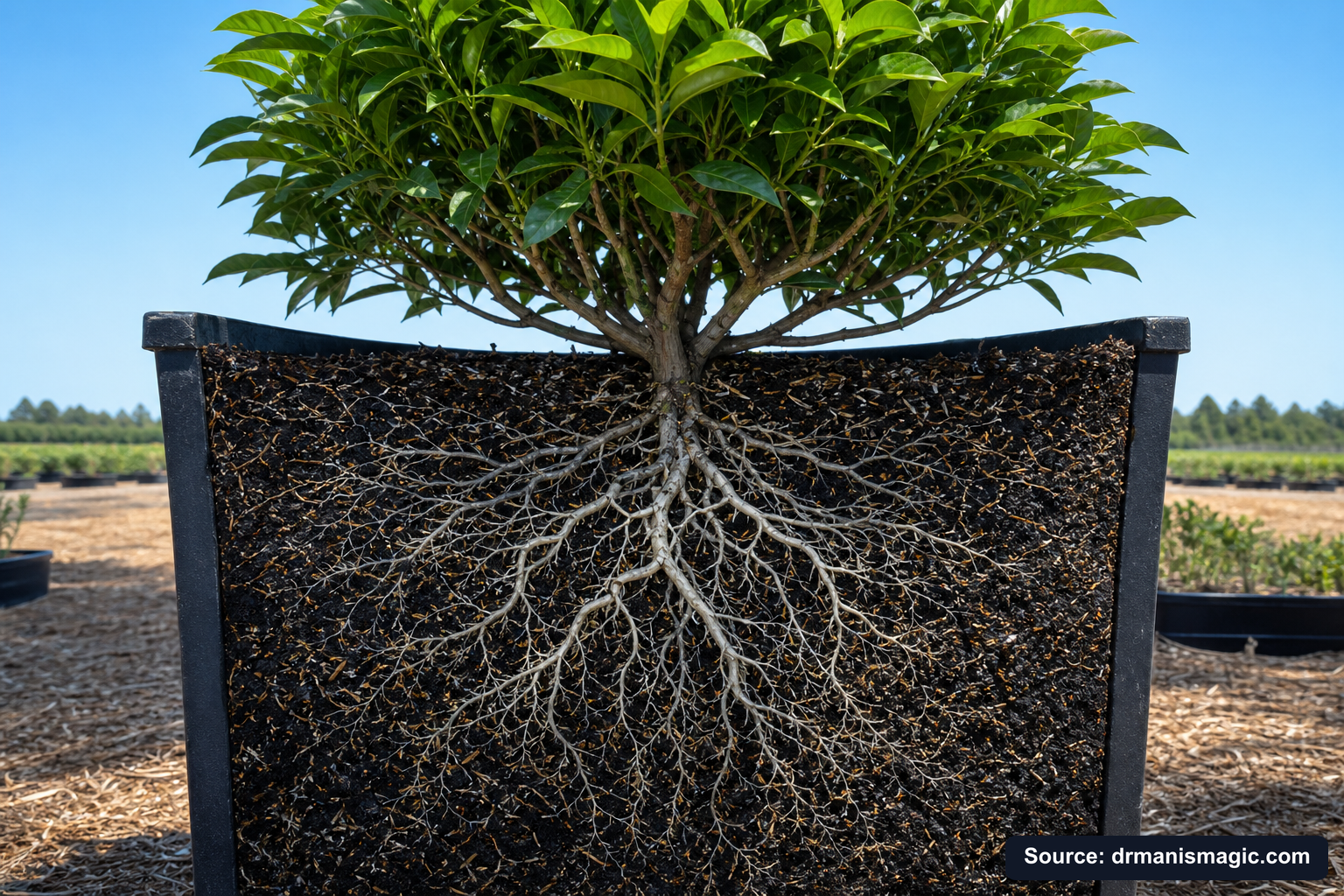
Imagine watering your plant and watching the water absorb evenly, quickly, and completely. No pooling on the surface. No running down the edge. The media drinks it in because the pore structure is intact and the mineral particles hold their position.
Imagine pressing your finger into the soil after a week without rain and finding it still loose and airy, not compacted into a dense mat. Imagine the roots inside that container growing long and white and branched, pushing confidently through open pore space, breathing freely, absorbing every drop of nutrition you give them.
Imagine not repotting every single year. Not buying bag after bag of media that breaks down in a season. Not wondering why your plant is declining despite everything you are doing right. Just a plant that grows. Year after year. Getting stronger with time instead of weaker.
That is what stable soil actually feels like. And it is not magic. It is physics. It is chemistry. It is the biology of a root zone that has what it needs.
After 30 years and over 250,000 trees, Dr. Mani Skaria's conclusion is simple. Get the foundation right and the rest follows. That is why Pillar One exists. That is why mineral-based soil is not optional. It is the starting point for everything else.
If you want to see what this foundation looks like in practice, the Free Plant Care Field Guide walks you through the Three Plant Pillars step by step, in plain language, with no jargon and no guesswork. It is the clearest starting point we know of for any plant owner ready to stop losing time and start growing something worth keeping.
Frequently Asked Questions
Most gardeners never think about carbon in their soil until their plants start dying. But once you understand what carbon actually does, and what it stops doing over time, everything changes. These questions get straight to the point so you can stop guessing and start growing.
What is the role of carbon in soil?
In a garden bed or open field, carbon helps hold soil particles together and keeps water and nutrients from washing away. It supports a living, breathing root zone. But here is the catch: in a container, carbon-based materials like pine bark and sawdust break down fast. When they do, the structure collapses. Roots lose oxygen. Plants slowly suffocate. That is why Dr. Mani built Super Soil around mineral-based ingredients that do not decompose and do not disappear on you.
How does carbon in the soil support soil biology?
Soil microbes eat carbon as their food source. When carbon is present, bacteria and fungi thrive. They break down nutrients and deliver them directly to plant roots. This is exactly why the Three Plant Pillars put microbial life at the center of healthy growing. Dr. Mani tested this system on over 250,000 citrus trees at US Citrus Nursery. The results were clear. Feed the microbes right and the plants take care of themselves.
How does carbon get into soil?
Plants pull carbon from the air through photosynthesis. Then they push carbon-rich sugars down through their roots into the soil. Those sugars feed microbes. Dead leaves and roots also break down and add carbon over time. In a healthy garden bed, this cycle keeps going on its own. In a container, that cycle gets cut short fast. The carbon runs out, the microbes go hungry, and your plant has nothing left to lean on.
Why does carbon-based potting mix hurt container plants over time?
Pine bark, peat, and sawdust all break down. Microbes eat them. Water speeds up the process. As they shrink, the tiny pore spaces that hold oxygen disappear. Roots need oxygen just as much as leaves need sunlight. When oxygen is gone, roots begin to rot. Most container plant declines after one to three years trace directly back to this collapse. Dr. Mani watched this happen over and over before he engineered Super Soil to stop it permanently.
What makes mineral-based soil better than carbon-heavy potting mix for containers?
Mineral ingredients like silica sand, pumice, and lava rock do not decompose. They hold their shape for years. They keep oxygen pathways open around roots no matter what season it is. Dr. Mani sourced his base soil from the Rio Grande Valley, a silica-rich sandy loam that stays stable long after organic mixes have turned to dense, airless sludge. Your roots keep breathing. Your plant keeps growing. You stop replacing dead plants every spring.
What are the real benefits of healthy soil for a home gardener?
Healthy soil anchors roots, stores nutrients, filters water, and hosts billions of living microbes that do the heavy lifting for your plants. When all three of Dr. Mani's Plant Pillars are working together, mineral structure plus live microbes plus organic fertilizer, your plants become practically bulletproof. Flowers smell stronger. Fruit tastes better. Grass feels thick under your feet. Soil is not just dirt. It is the foundation everything you grow depends on.
How do you know if your soil carbon is working for your plants or against them?
Press your finger into the soil. If it feels hard, dense, or concrete-like, the carbon has broken down and the structure is gone. Yellowing leaves and tired stems are another sign. Roots have no room and no air. The fix is not more fertilizer. The fix is starting with a stable mineral base that never collapses, adding live microbes that keep nutrients moving, and feeding with slow-release organic fertilizer. That is the Three Plant Pillars in action, and it works from houseplants all the way up to full citrus orchards.
About the Author
Dr. Mani Skaria, PhD
Dr. Mani Skaria, PhD, is a plant pathologist and the scientific founder of Dr. Mani's Magic. He earned his doctorate at Purdue University and spent 48 years studying how plants, soil, and living microbes work together, including his years as Professor Emeritus at Texas A&M and as a member of the USDA NAREEE Advisory Board. He invented micro-budding, a method for growing healthier, stronger trees, and has grown more than 250,000 trees on the family farm in Hargill, Texas - US Citrus Nursery. His life's work takes real lab science and practical experience and turns it into simple, safe, organic plant care anyone can use at home.


