


The Silica Backbone Every Thriving Plant Needs to Survive | Dr. Mani's Magic
The Silica Backbone Beneath Every Thriving Plant: Why Roots Need Mineral Structure, Oxygen, and Soil That Actually Lasts
Picture this. You're standing in your backyard on a Saturday morning, coffee in hand, staring at a plant that cost you real money. It was gorgeous when you brought it home. Now the leaves are yellow. The soil looks dark and wet even though you haven't watered in days. You dig your finger in and catch a whiff of something sour. Something wrong. You've done everything the bag said to do. You watered. You fertilized. You gave it sunlight. And still, it's dying.
Here's what nobody told you. The problem isn't you. The problem is what the plant is sitting in. That dark, wet, sour-smelling stuff in the pot? It used to be pine bark. Dead tree. Ground up, piled high in a warehouse, left to rot, then bagged and sold to you as "premium potting mix." And right now, it's still rotting. Slowly. Silently. Stealing the one thing your roots cannot survive without. Oxygen.
What your plant actually needs is something ancient. Something hard. Something that doesn't rot, doesn't compact, and doesn't suffocate the invisible world living around every root tip. It needs a mineral backbone. A silica skeleton that holds space open so air can move, water can drain, and life can happen. Once you understand this one idea, everything about how you grow plants changes forever.
Key Takeaways
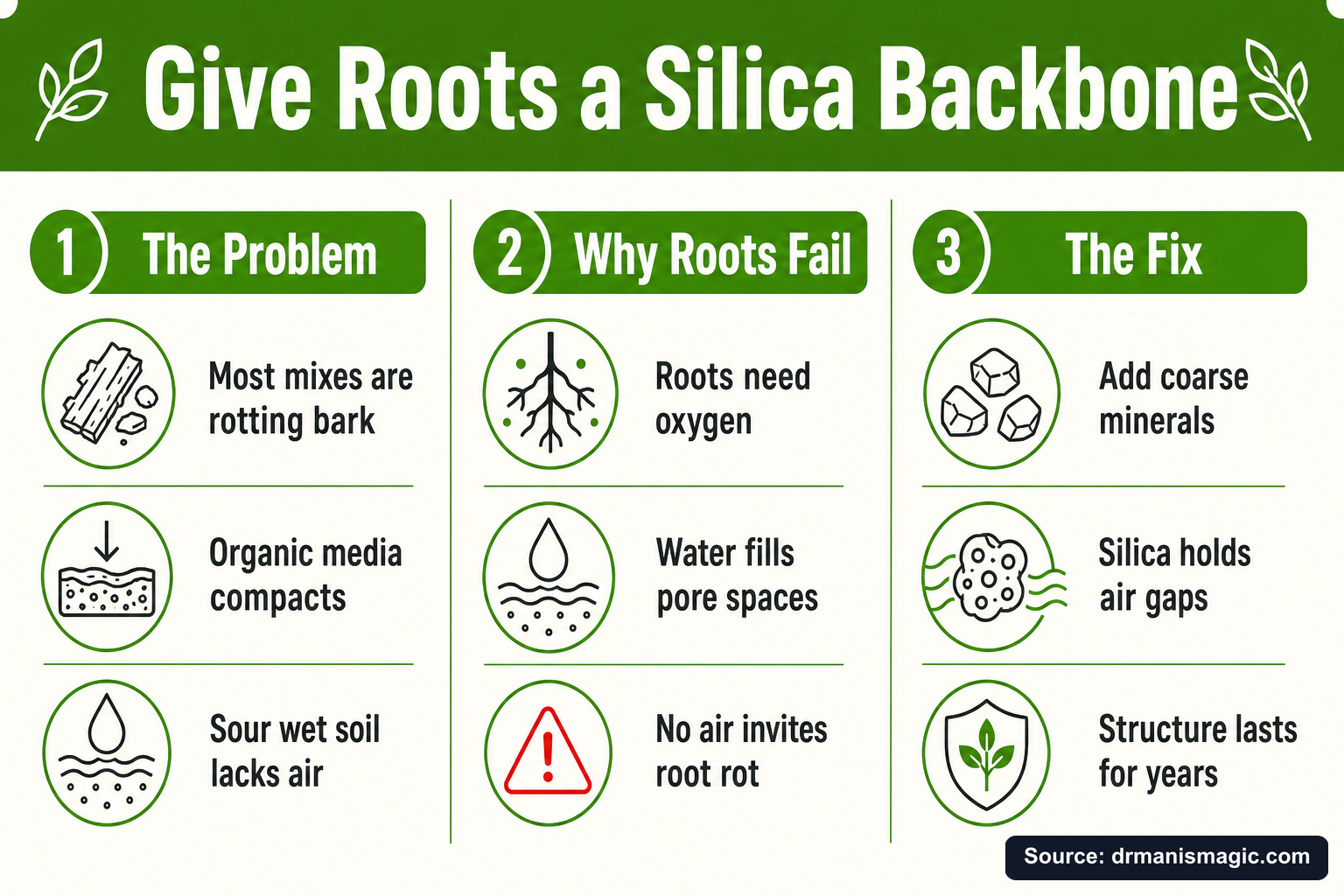
- Most potting mix is pine bark sawdust that decomposes, steals oxygen, and collapses within months.
- Roots need oxygen just as much as they need water. When oxygen disappears, roots rot.
- Silica-rich mineral particles like coarse sand, pumice, lava rock, and rice hulls create stable air pockets that organic media cannot.
- Mineral-based soil does not decompose, so it preserves root-zone structure for years, not months.
- Silicon is also a biological benefit: it strengthens plant cell walls, improves drought tolerance, and boosts disease resistance.
- The Three Plant Pillars developed at US Citrus Nursery start with mineral-based soil as the non-negotiable foundation.
- You cannot get time back. Every month a plant spends in decomposing media is a month of growth lost forever.
Why Do Roots Suffocate Even in Wet Soil?
Quick Answer: Wet soil fills pore spaces with water, which pushes oxygen out. Roots need oxygen to breathe just like you do. When all the air pockets fill with water and stay full because the media has compacted or decomposed, roots can't breathe, they weaken, and pathogens move in fast.
Roots breathe. That's not a metaphor. It's biology.
Every root tip in every pot on your patio right now is pulling oxygen from the air spaces between soil particles. No air space, no oxygen. No oxygen, no healthy root. It is that simple and that serious.
Here's the part that trips most gardeners up. A pot can look wet and actually be oxygen-starved at the same time. Water and oxygen compete for the same real estate inside soil. When water wins, oxygen loses. And when oxygen is gone long enough, the roots start to die.
NC State University Extension describes this clearly: field soil used in containers typically holds too much water, contains too little air-filled pore space after drainage, and is too heavy for container culture. NC State Extension on container growing media. Rutgers Cooperative Extension adds that an effective container medium needs rapid drainage and at least around 10 percent air-filled pore space after watering for roots to stay healthy. Rutgers Extension on potting media.
Ten percent sounds like a small number. But in a pot full of decomposing pine bark that has compacted into something resembling wet cardboard, you're getting zero. And zero is a death sentence for roots.
After growing over 250,000 trees at our South Texas nursery, we learned this the hard way. The plants that struggled almost always had one thing in common. Their root zone had no air left in it.
What Is the "Silica Backbone" and Why Does It Matter?
Quick Answer: The silica backbone is the mineral skeleton of your soil. Silica-rich particles like coarse sand, pumice, lava rock, rice hulls, and perlite are hard, angular, and stable. They hold pore spaces open permanently. They do not compress. They do not rot. That open structure is what keeps oxygen flowing to roots year after year.
Silica is the most abundant mineral on earth. Sand is mostly silica. Rocks are largely silica. The dirt your ancestors grew food in for thousands of years was ground-up silica-rich rock mixed with a thin layer of organic matter on top.
Notice that. Organic matter on top. Mineral structure underneath. That is the natural order.
When you flip that ratio and plant your tree inside a bag of organic material with almost no mineral content, you are asking it to live upside down from what nature designed.
Silica particles have two jobs in your root zone. One is physical. One is biological.
The physical job is structure. Coarse, angular mineral particles stack against each other and hold gaps open. Those gaps are where oxygen lives. Water flows through and drains out. Air rushes back in behind it. The particles themselves do not shrink, do not compress, and do not change shape over time. Oklahoma State Extension specifically notes that coarse sand increases air pockets between grains and improves root-zone aeration, while excessively fine particles reduce that aeration significantly.
The biological job is plant strengthening. Silicon, the element inside silica, is absorbed through roots and deposited in cell walls. Research shows that silicon improves stress tolerance, disease resistance, drought response, and root hydraulic conductance. Plants with silicon in their tissues are physically tougher. Their cell walls are harder. Pests have a harder time chewing through them. Fungal pathogens have a harder time breaking in.
That is a backbone. Literal and biological at the same time.
Why Is Most Potting Mix Actually Dead Tree Sawdust?
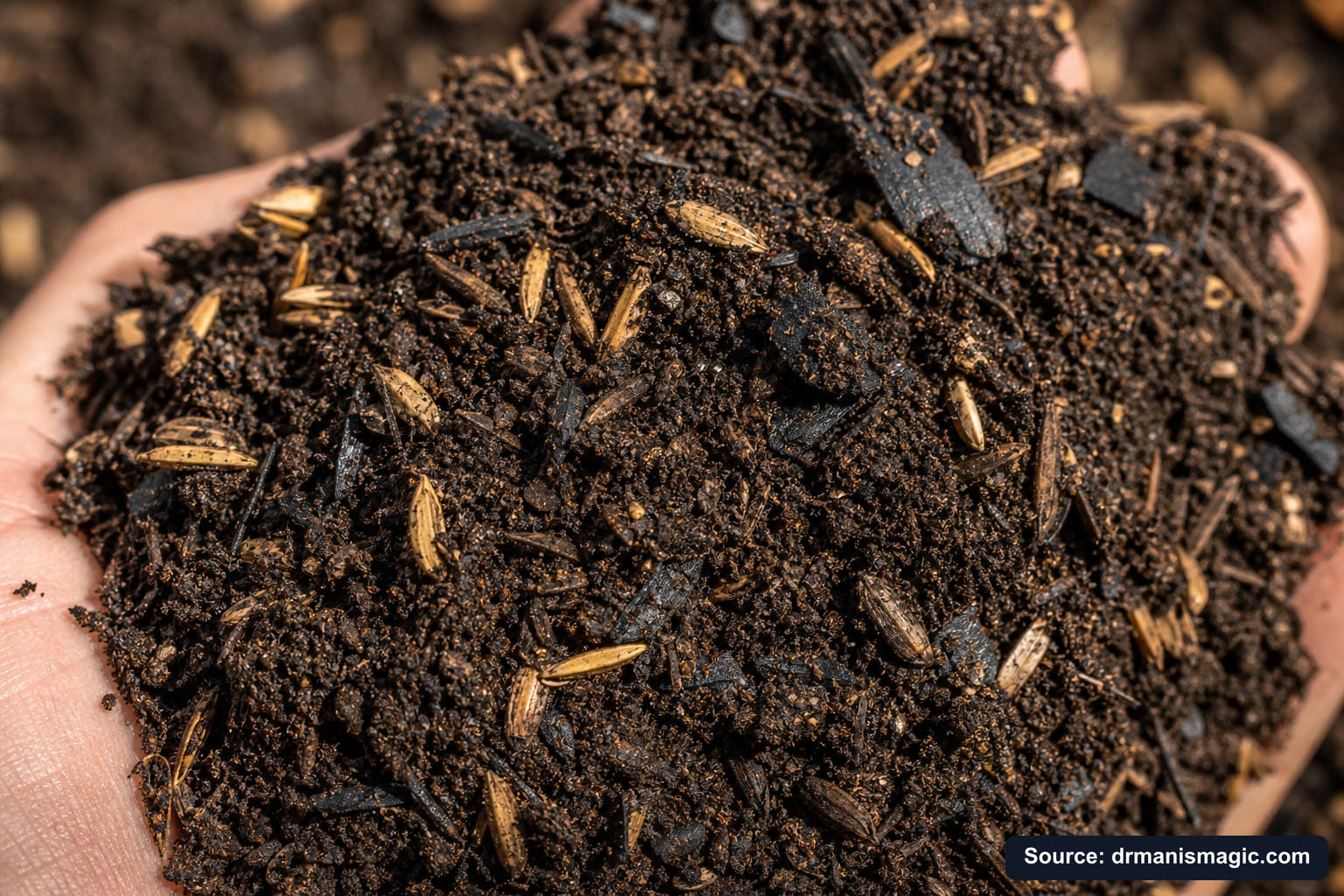
Quick Answer: Commercial potting mix is primarily pine bark, a cheap waste product from the timber industry. It is organic, carbon-based, and it decomposes. As it breaks down, it steals oxygen from the root zone, collapses into a dense sludge, and creates the exact low-oxygen conditions that cause root rot. It is not soil. It is a marketing word for dead wood.
Ever wonder why it's called "potting mix" instead of "potting soil"? Because it isn't soil. Calling it soil would be dishonest even by the loosest standards.
The pine bark in most potting mix is a waste byproduct from timber mills. Southeastern US pine forests produce enormous volumes of it. It is cheap. It is light. It is easy to ship. And it is absolutely perfect for generating quick profits, because it breaks down fast enough that customers have to buy more every year.
Here is something nobody in the garden center aisle will tell you. Pine trees contain a family of chemicals called terpenes and terpenoids. These are the same compounds in Pine-Sol and turpentine. Great for cleaning floors. Genuinely terrible for planting your beloved fruit tree's roots in.
To make those chemicals less harsh, manufacturers pile the sawdust in enormous outdoor heaps and let it decompose for years. Decomposition softens the chemistry. But decomposition also eats oxygen. The same process that makes the pine bark less toxic to roots is the process that trains it to consume oxygen. You've solved one problem and created a worse one.
Then it gets bagged, shipped, and sold to you with a picture of tomatoes on the front.
But wait. There's more. Because pine bark naturally repels water, manufacturers add surfactants. Chemicals that force the wood to hold moisture. Those surfactants wash out after several waterings. When they're gone, dry potting mix turns hydrophobic. It actually pushes water away. You pour water in and it runs straight down the inside edge of the pot without ever touching the root zone. The plant is bone dry in the middle of what looks like damp soil.
So you've got: harsh pine chemistry, oxygen-stealing decomposition, chemical surfactants that disappear, and then a brick-hard root zone that repels water. And you're blaming yourself for having a brown thumb.
It is not your fault. You were handed bad tools and told they were the best.
We literally plant our trees in other dead trees. Let that sink in for a moment.
Potting Mix vs. Mineral-Based Soil: What's the Real Difference?
Quick Answer: Potting mix is organic, decomposes within months, collapses pore space, and must be replaced regularly. Mineral-based soil is silica-rich, permanent, holds its structure for years, and preserves the oxygen pathways roots depend on. One is a short-term convenience. The other is a long-term foundation.
Let's lay this out side by side so it's impossible to ignore.
| Property | Pine Bark Potting Mix | Mineral-Based Soil (Silica-Rich) |
|---|---|---|
| Main material | Pine bark sawdust (carbon-based, organic) | Coarse sand, pumice, lava rock, rice hulls (inorganic mineral) |
| Does it decompose? | Yes. Rapidly. Within 6 months of use. | No. Mineral particles are stable for decades. |
| What happens over time? | Compacts, loses pore space, turns sludge-like | Holds structure, maintains air pockets, stays open |
| Oxygen availability | Drops sharply as decomposition consumes O2 | Stays high because macropores remain stable |
| Water behavior | Holds water too long, then turns hydrophobic | Drains fast, wets evenly, allows re-wetting easily |
| Root rot risk | High, especially after 6 months | Low when properly sized and drained |
| Chemical concerns | Pine terpenes, synthetic surfactants | Neutral, inert, no chemical load |
| How often replace? | Every 12-18 months minimum | Rarely. Can be permanent with proper sterilization. |
| Cost over 5 years | High. Buying and repotting repeatedly. | Low. One investment that holds its value. |
That last row is the one that gets people. Because potting mix looks cheap at the store. But over five years of repotting stressed plants, buying replacement bags, and losing trees you loved? The real cost is enormous. And that's just money. The cost in time is something you can never get back.
We know from our nursery in Hargill, Texas that the number one thing people tell Dr. Mani they want is to see fruit on a tree they planted while they still have the chance to enjoy it. That is not a small wish. That is a deeply human one. And it gets stolen, slowly, every month a tree sits in collapsing organic media that is quietly suffocating the root zone.
What Particle Size Actually Does for Drainage and Oxygen?
Quick Answer: Coarse, angular mineral particles create large pore spaces called macropores that drain quickly and refill with oxygen. Fine particles pack tightly together, fill with water, and leave almost no air space. The size and shape of what's in your pot matters more than almost any other factor in container growing.
Not all sand is the same. This surprises a lot of people.
Fine sand, the kind on a beach, packs tight. The particles are small and round. They fit together almost perfectly. There's very little space between them. Water moves slowly. Oxygen moves slowly. It's not much better than clay.
Coarse sand is different. The particles are larger and irregular in shape. They don't stack neatly. They leave gaps. Big gaps. Those gaps are where oxygen lives and where water drains out fast. Oklahoma State Extension specifically warns that excessively fine materials reduce aeration while coarse sand improves root-zone aeration by increasing air pockets between grains.
The same principle applies to every mineral amendment you might use.
| Amendment | Particle Type | Oxygen Preservation | Water Retention | Longevity in Mix | Best Use Case |
|---|---|---|---|---|---|
| Coarse sand | Mineral, angular, silica-rich | High | Low | Permanent | Trees, citrus, succulents |
| Pumice | Volcanic mineral, porous | Very high | Moderate | Permanent | Bonsai, succulents, citrus |
| Lava rock | Volcanic mineral, rough texture | Very high | Low-moderate | Permanent | Trees, perennial containers |
| Perlite | Expanded volcanic glass | High | Low | Long (can float) | Houseplants, seed starting |
| Rice hulls | Silica-rich organic shell | Moderate-high | Low | Long (slower decompose) | All containers, top dressing |
| Peat/coir fines | Organic, fine particle | Low when wet | Very high | Short (compacts fast) | Seed germination only |
| Bark fines | Organic, carbon-based | Very low after 6 months | High when fresh | Short (decomposes fast) | Short-cycle annuals only |
Rice hulls deserve a special mention here. They are the outer shell of a rice grain. They are made of silica. They last much longer than organic materials before they break down. They create air pockets, improve drainage, and can even be used as a top dressing to suppress weeds. Dr. Mani's Magic Super Soil includes rice hulls specifically because they bring silica-based structure without the weight of pure sand.
The bonsai world has known this for a hundred years. Bonsai masters in Japan grow trees in mixes that are almost entirely mineral. Akadama clay, pumice, lava rock. Almost no organic matter at all. And those trees live for decades, sometimes centuries, in small pots. The same physics apply to your lemon tree, your fiddle leaf fig, your rose bush, and your Meyer lemon in a patio container.
You Never Had a Brown Thumb.
You were handed the wrong tools. This free guide hands you the right ones.
You watered it. You fed it. It died anyway.
It was never you. It was the dirt, the salt food, and the bad advice.
This guide shows you what really went wrong, and how to fix it for good.
- Why your plants really died, and why it was never your fault
- The salt hiding in your plant food that quietly burns the roots
- The hidden killer in almost every bag of store soil
- The tiny helpers that grow a whole forest for free
- The rescue trick that brings a half dead plant back to life

Why Does Root Rot Happen Even With Drainage Holes?
Quick Answer: Drainage holes only help if water can actually move through the media and exit quickly. When potting mix decomposes and compacts, it holds water like a sponge regardless of the hole at the bottom. Root rot is caused by oxygen starvation in the root zone, which decomposed organic media creates even with perfect drainage holes.
This question comes up constantly. "But I have drainage holes. Why are my roots still rotting?"
Here's the physics lesson nobody gave you.
A drainage hole at the bottom of a pot does not help much if the media above it is holding water like a sponge. Water in decomposed potting mix is held in tiny micropores between the fine particles. That water doesn't want to move. Surface tension holds it in place. The drainage hole is there, but the water above it isn't going anywhere.
Think of a wet sponge. You set it flat on the counter. The water inside it doesn't run out through the bottom. It stays. That is your decomposed potting mix. That is what is sitting around your roots right now if you've had the same potting mix for more than six months.
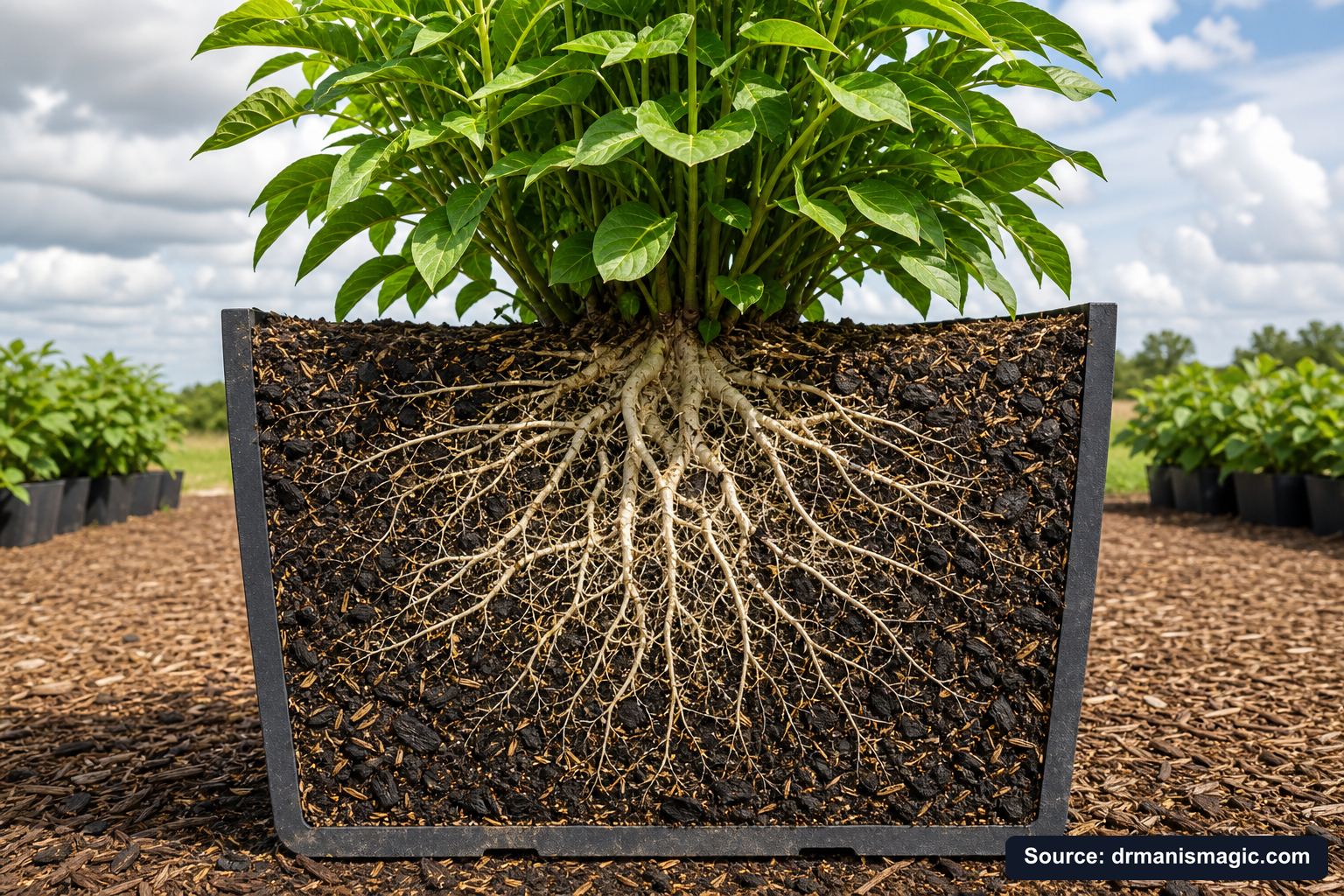
Coarse mineral particles don't work like sponges. They work like gravel. Water flows through fast. Air rushes in right behind it. The root zone drains in minutes, not days. The oxygen comes back. The roots stay healthy.
Root rot, by the way, is rarely caused by "too much water" in the simple sense. What it's actually caused by is too little oxygen at the root zone. Water is just the thing that displaces the oxygen. The real enemy is a media that holds water too long because it has no structure left to drain it quickly.
Three things damage roots before pathogens ever get involved:
- Too little oxygen in the root zone
- Too much salt from synthetic fertilizers burning root hairs
- Not enough beneficial microbes protecting and strengthening the root zone
Notice that overwatering is not on that list. It never was. See also: The Hidden Reason Synthetic Fertilizers Cause Root Rot
How Does Silicon Strengthen Plants From the Inside Out?
Quick Answer: Silicon absorbed through roots is deposited in plant cell walls, making them physically harder and more resistant to stress. Research links silicon to improved drought tolerance, stronger resistance to fungal disease, better structural support in stems and leaves, and improved root hydraulic conductance. It is one of the most underappreciated plant nutrients in modern gardening.
We have talked about silicon as structure in the soil. Now let's talk about what happens when plants absorb it.
Silicon moves from soil particles into root cells and then up through the plant. It deposits in the outer cell walls of leaves, stems, and roots. It literally hardens them. Imagine your plant's cells getting a mineral armor coating from the inside.
What does that mean in practice?
Fungal pathogens that attack leaves have a harder time penetrating silica-reinforced cell walls. Insects chewing on silica-rich leaf tissue wear down their mouthparts faster. Drought stress causes less wilting because silicon improves the plant's ability to manage water pressure inside cells. Root systems in silicon-rich media show better hydraulic conductance, meaning water and nutrients move more efficiently from soil to stem to leaf.
This is why growing in silica-rich mineral soil is not just about drainage and oxygen, as important as those are. It is also feeding the plant a biological building material that makes every part of it tougher.
Rice hulls are a great example of this dual role. They provide physical structure and air pockets in the media. And as they slowly break down over time, they release bioavailable silicon directly into the root zone. The plant picks it up and uses it to reinforce its own cell walls.
This is what we mean when we say the silica backbone is both physical and biological.
What Are the Three Plant Pillars and How Does Mineral Soil Fit In?
Quick Answer: The Three Plant Pillars are the framework Dr. Mani Skaria developed over decades of growing 250,000+ trees at US Citrus Nursery. Pillar One is mineral-based soil that preserves oxygen and structure. Pillar Two is live microbes that protect roots and unlock nutrients. Pillar Three is organic fertilizer that feeds plants without burning roots or killing microbes. All three must work together.
Dr. Mani Skaria spent 40 years as a Professor of Plant Pathology at the Texas A&M Citrus Center. He invented micro-budding. He founded the Clean Citrus Program in Texas. He has seen more dying trees, more root rot disasters, and more potting mix failures than almost anyone alive.
And what he concluded after all of that is simple. There are three things every plant needs at the root level. Get all three right and the plant becomes nearly bulletproof. Miss even one and you are fighting an uphill battle forever.
Pillar One: Mineral-Based Soil. The foundation. Silica-rich, permanent, oxygen-preserving. Not decomposing pine bark. Real mineral structure that holds its shape for years. This is the backbone this entire article is about.
Pillar Two: Live Microbials. The invisible army. Beneficial bacteria, fungi, and mycorrhizae that live in the root zone, protect roots from pathogens, unlock bound nutrients, and create the living ecosystem plants evolved to grow in. Without microbes, a plant is defenseless. With them, it has an immune system.
Pillar Three: Organic Fertilizer. The slow, complete nutrition. Not salt-based synthetic chemicals that burn root hairs and kill the microbes from Pillar Two. Organic, slow-release nutrition from sources like crab meal, kelp, and amino acids that feeds the plant gently and works with the microbial life rather than destroying it. See also: Why Most Fertilizers Are Actually Salt in Disguise
These three pillars were not invented in a lab. They were proven in a nursery. On 250,000 real trees in South Texas heat. On houseplants. On tropical trees. On citrus groves. They are the distilled result of decades of trial, failure, observation, and eventually breakthrough.
You can learn more about how all three work together at the Three Plant Pillars bundle guide.
Mineral-Based Soil vs. Potting Mix: A Recovery Checklist for Struggling Plants
Quick Answer: If your plant is yellowing, draining poorly, or showing signs of root rot, the most important first step is diagnosing the root zone. In most cases, decomposed organic media is the root cause. Transitioning to mineral-based soil and restoring microbial life gives the plant its best chance at recovery.
If you have a struggling plant right now, here is a simple step-by-step recovery plan.
- Smell the soil. Sour or sewage-like smell means anaerobic decomposition is happening. The oxygen is gone. The root zone has gone bad.
- Check the roots. Gently remove the plant from its pot. Healthy roots are white or cream-colored and firm. Rotten roots are brown, slimy, and soft. Cut off all rotten root material with clean scissors.
- Dump the old potting mix. All of it. Do not try to save decomposed media. It is the source of the problem, not the solution.
- Wash the pot thoroughly. If you can, let it dry in full sun for a day to kill any lingering pathogens.
- Repot into mineral-based media. Use a silica-rich mix with coarse particles, good drainage, and no pine bark fines. Super Soil from Dr. Mani's Magic is steam-sterilized, mineral-based, and built to hold its structure permanently.
- Inoculate with live microbes. Add beneficial bacteria and mycorrhizal fungi to help the root zone recover and protect against future pathogen attack. Plant Super Boost delivers live microbes in a liquid form you drench into the soil monthly.
- Hold off on fertilizer for two weeks. Let the roots stabilize first. Then begin a gentle organic feeding program that works with the microbes rather than against them.
Most plants recover faster than you expect when you remove the thing that was slowly killing them and replace it with a root zone that actually works.
Can Bonsai Soil Physics Work for Citrus, Houseplants, and Other Long-Lived Container Plants?
Quick Answer: Yes. Bonsai masters have used mineral-dominant media for centuries precisely because woody plants in small containers need durable, oxygen-preserving soil that won't collapse. The same physics apply to citrus trees, tropical houseplants, and any perennial grown in a restricted root volume. Mineral structure is not a bonsai trick. It is universal root-zone science.
Bonsai is over a thousand years old. Chinese and Japanese masters have been growing full-sized trees in tiny pots for generations. And they figured out something that modern horticulture forgot when it discovered cheap pine bark.
You cannot grow a woody plant in a small container using organic media that decomposes. The math doesn't work. The tree lives for decades. The media lasts months. You would be repotting constantly, stressing the roots constantly, and fighting root rot constantly. The bonsai masters solved this by using mineral media almost exclusively. Akadama. Pumice. Lava rock. Coarse grit. Almost zero organic content.
Those trees live for a hundred years in the same pot.
The same principle applies to your Meyer lemon on the patio. Your fiddle leaf fig in the living room. Your olive tree in a terracotta pot. Your orchid in a bark mix that's starting to smell. Any plant that you plan to keep for more than a year deserves a media that will still be doing its job a year from now.
The US Citrus Nursery has been proving this in South Texas since 2006. Sandy loam soil from the Rio Grande Valley. Silica-rich. Steam-sterilized. Blended with coco coir and rice hulls for moisture balance and biochar for microbial habitat. Not sawdust. Not pine bark. Not a bag of decomposing carbon that will be sludge by fall.
The result? Trees that thrive for years without repotting. Root zones that stay open and oxygenated. Plants that don't collapse the moment a Texas summer hits.
Is Silica the Same as Silicon for Plants? And Which Form Matters Most?
Quick Answer: Silica (SiO2) is the mineral form of silicon. Plants absorb silicon as monosilicic acid through their roots. In the soil, silica-rich particles weather slowly and release plant-available silicon over time. For container plants, using silica-rich mineral media like coarse sand, pumice, lava rock, or rice hulls provides both physical structure and a slow, steady source of bioavailable silicon.
Silicon is the second most abundant element in the earth's crust. Silica is the mineral compound it forms with oxygen. SiO2. Two oxygen atoms bonded to one silicon atom.
Plants absorb silicon as monosilicic acid, a dissolved form that roots pull in with water. Inside the plant, it deposits in cell walls as a hard, glassy layer. That's the biological armor we talked about earlier.
Now here's the practical part. In a pot full of pine bark, there is almost no silicon available. Organic materials don't supply it. The plant gets none of the structural benefit. It is growing without that mineral armor.
In a pot with coarse silica sand, pumice, lava rock, or rice hulls, the particles slowly release small amounts of bioavailable silicon as they weather. The plant picks it up. The armor builds. Over months and years, plants in mineral media tend to be physically tougher, more resistant to disease, and better at handling heat and drought stress.
This is not a fringe idea. Silicon supplementation for crops is an active area of agricultural research, especially in rice, sugarcane, and wheat production where silicon availability correlates with yield and disease resistance. The same biology applies at the container scale.
Rice hulls, which Dr. Mani's Magic includes in its Super Soil blend, are among the highest natural sources of plant-available silica. They pull double duty: physical pore structure now, slow silicon release over time.
What Makes Dr. Mani's Magic Super Soil Different From Everything Else?
Quick Answer: Super Soil is built on steam-sterilized, silica-rich sandy loam from South Texas, not pine bark. It is mineral-based and permanent, meaning it holds its structure for years without compacting or decomposing. It includes rice hulls for silica and aeration, coco coir for moisture balance, and biochar for microbial habitat. Zero PFAS, zero biosludge, zero synthetic salts. Made in the USA.
Here's what most soil products will never tell you. The media in most bags on store shelves was designed around what is cheap and available, not what roots actually need.
Pine bark is a timber industry waste product. It is cheap because mills have mountains of it they need to get rid of. Selling it as "premium potting mix" is one of the great marketing achievements of the 20th century.
Dr. Mani's Magic Super Soil was built to solve our own problem. When you're growing 250,000 trees at a nursery in South Texas, you cannot afford to use media that collapses in six months. You need something that holds its structure through 110-degree summers, hard rains, and years of root growth.
So Dr. Mani went back to the beginning. Sandy loam from the Rio Grande Valley. Silica-rich. Naturally draining. Steam-sterilized at high temperature to eliminate pathogens before it ever touches a root. Then blended with coco coir for moisture retention, rice hulls for additional silica and aeration, and biochar to create habitat for the beneficial microbes in Pillar Two.
No pine terpenes. No synthetic surfactants that wash out and leave the media hydrophobic. No decomposing carbon stealing oxygen from your roots. No PFAS. No biosludge. No synthetic salts. All American materials except for the coco coir, which grows in the tropics and cannot be sourced domestically.
Permanent media. One investment. No annual repotting. No sour smell. No suffocating roots.
If you want to check what real customers are saying about it, read through the verified customer reviews.
What Is the Real Cost of Getting This Wrong?
Quick Answer: The real cost of decomposing potting mix is not just the money spent on replacement bags or dead plants. It is the time lost. Months and years of a tree sitting in collapsing media, growing slowly if at all, never reaching its potential. Time is the one thing you cannot get back. Every season in bad soil is a season of growth you cannot recover.
You can always earn more money. You cannot earn more time.
That is the part of this conversation that lands hardest with people. Dr. Mani hears it constantly. The number one thing people want when they plant a fruit tree is to see it produce fruit while they are still around to enjoy it. That is a deeply human desire. It connects to something primal in us. The need to nurture. To see what we planted grow into something real.
And that dream gets stolen, quietly, one month at a time, when a tree sits in potting mix that is slowly collapsing around its roots.
After six months in standard potting mix, the media has compressed significantly. The pore space has shrunk. The oxygen has dropped. The tree is no longer getting what it needs at the root zone and you cannot see it happening. The leaves look a little pale. The growth slows. You add more fertilizer. It doesn't help. You water more carefully. It doesn't help. Because the problem is not nutrition or water. It is oxygen. And the only fix is changing what the roots are sitting in.
The gardeners who figure this out early, who put their plants in mineral-based media from the start, who add live microbes and organic fertilizer, those gardeners see fruit. They see growth. They get to stand in their backyard and pick something they grew from a tree they planted.
The gardeners who keep buying bags of potting mix every spring, keep wondering why their trees never quite take off, keep losing plants they loved, those gardeners are spending the same money over and over and getting less and less back for it. In money and in time.
The second-best time to fix this is today. The best time was years ago. But today still works.
If you want a complete, step-by-step guide to all three pillars, including how to set up the right mineral foundation, which microbes to use, and how to feed your plants without salt-based fertilizers, the Free Plant Care Field Guide from Dr. Mani's Magic walks you through it all in plain language. No jargon. No guesswork. Just the system that has worked for over 250,000 trees and counting, made available to every gardener who is ready to stop fighting against nature and start working with it.
Frequently Asked Questions
If you have ever stared at a dying plant and wondered what went wrong, you are not alone. These are the questions real gardeners ask every day. Understanding silica and mineral soil structure is the key that unlocks everything else about how plants grow strong and stay that way.
What does silica actually do for your plants?
Silica is the structural backbone your plant depends on. It strengthens cell walls so stems stand firm, leaves resist disease, and roots push deeper without collapsing. In the soil, silica-rich particles like coarse sand and rice hulls hold open air pockets so oxygen reaches every root tip. At Dr. Mani's Magic, silica-rich Rio Grande Valley sandy loam is the foundation of Super Soil for exactly this reason. We proved it across 250,000 trees.
Why does most potting mix fail roots so fast?
Most potting mix is ground-up pine bark. It looks fine in the bag. But it is already decomposing. Within months it compacts into a wet, airless sludge that suffocates roots and invites rot. Roots need oxygen just as badly as they need water. When the air pockets disappear, the roots start dying. That sour smell coming from your pot is not normal. It is a warning. Mineral-based soil does not decompose, so it never collapses on your roots.
What is the best natural source of silica for soil health?
For soil structure, rice hulls are one of the best natural silica sources you can use. They are made of silica, so they break down very slowly and keep soil light and airy for a long time. Dr. Mani's Magic Super Soil includes rice hulls alongside silica-rich sandy loam for this exact reason. Together they create the open, breathing root zone that gives your plants a real fighting chance from day one.
Is silica safe to handle in the garden?
Yes. Silica in soil, rice hulls, and sandy loam is completely safe to handle. The health warnings you may have heard are about breathing in fine crystalline silica dust in industrial settings like construction or mining. Garden soil and potting products are handled wet or in coarse form, which is not a hazard. You can dig, plant, and repot with confidence. Dr. Mani's Magic products are clean, natural, and made with your family and pets in mind.
What plants benefit most from silica-rich soil?
Every plant benefits from silica-rich mineral soil, but heavy feeders and fruiting plants show the biggest difference. Citrus trees, tropical trees, vegetables, and flowering plants all push harder when their roots have oxygen and structure. Dr. Mani tested this across citrus, houseplants, and tropical trees at US Citrus Nursery. The results were the same every time. Strong mineral structure under the roots equals stronger, faster, healthier growth above ground.
Why does regular soil from the yard fail in containers?
Yard soil is made for the ground, not a pot. In a container it compacts fast, drains poorly, and holds too much water. NC State University Extension confirms that field soil in containers holds too much water and leaves almost no air-filled pore space after watering. That is a root killer. Dr. Mani's Super Soil was engineered specifically for container growing, using mineral-based sandy loam that drains fast, stays open, and never turns into the wet cardboard problem that yard soil always becomes.
How does mineral soil connect to the Three Plant Pillars?
Mineral-based soil is Pillar One. It is the foundation that makes everything else work. Without it, your microbes have no stable home and your organic fertilizer cannot reach the roots properly. Dr. Mani built the Three Plant Pillars after 30 years of growing trees in South Texas. Mineral soil comes first because you cannot build anything lasting on a rotting base. Get the foundation right and the rest of the system snaps into place naturally.
About the Author
Dr. Mani Skaria, PhD
Dr. Mani Skaria, PhD, is a plant pathologist and the scientific founder of Dr. Mani's Magic. He earned his doctorate at Purdue University and spent 48 years studying how plants, soil, and living microbes work together, including his years as Professor Emeritus at Texas A&M and as a member of the USDA NAREEE Advisory Board. He invented micro-budding, a method for growing healthier, stronger trees, and has grown more than 250,000 trees on the family farm in Hargill, Texas - US Citrus Nursery. His life's work takes real lab science and practical experience and turns it into simple, safe, organic plant care anyone can use at home.


