


Soil Stability Is the Hidden Secret to Easy Gardening | Dr. Mani's Magic
Soil Stability Is the Hidden Secret to Easy Gardening (And Nobody Talks About It)
Picture this. You're standing on your back patio, coffee in hand, staring at a plant that cost you real money and real hope. The soil looks damp. You watered it. You fed it. You Googled it at midnight. And still, the leaves are yellow. The roots, when you finally pull the thing out, are brown and slimy. It smells like a swamp.
You did everything right. Or so you thought.
Here's what nobody told you. The problem wasn't your watering schedule. It wasn't the fertilizer. It wasn't even the weather. The problem was the stuff your plant was sitting in. That bag of fluffy, dark, sweet-smelling potting mix you grabbed off the shelf at the hardware store? It was slowly collapsing. Decomposing. Stealing the one thing your roots needed most: oxygen. You weren't overwatering your plant. You were suffocating it. And the clock started ticking the moment you filled that pot.
After growing over 250,000 trees at our South Texas nursery, we kept seeing the same heartbreak play out. Healthy-looking plants going sideways after six months. Gardeners blaming themselves. Buying more products. Starting over. Losing time they could never get back. We finally traced every single failure back to the same root cause. Literally. The soil structure collapsed. The pores closed. The oxygen disappeared. And the plant quietly died from the inside out. Once we understood that, everything changed. And we want it to change for you too.
Key Takeaways
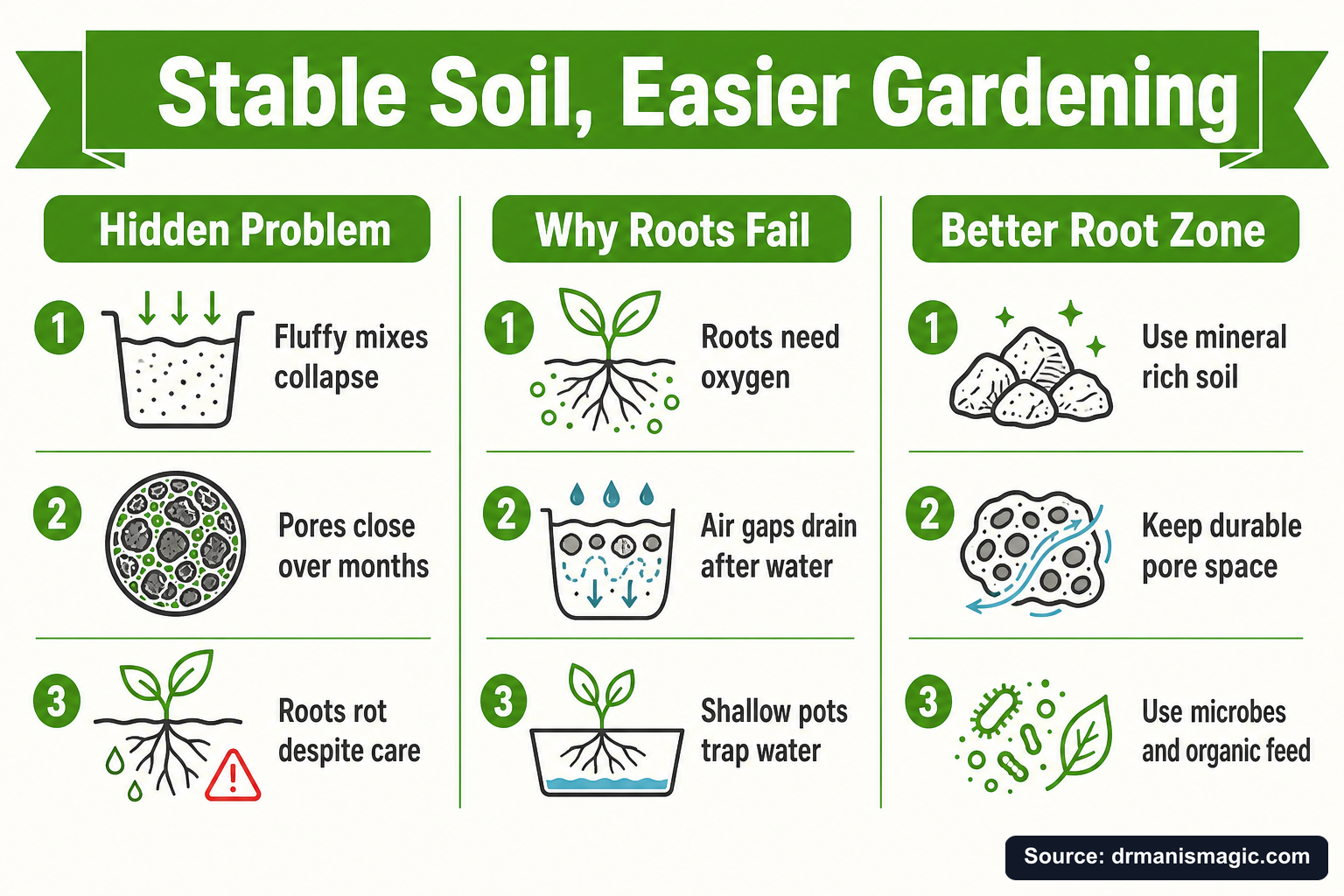
- Most potting mix is pine bark sawdust. It decomposes, collapses, and steals oxygen from roots within months.
- Roots need oxygen just like you do. When soil pore space closes up, roots rot — even if you water perfectly.
- The secret to easy gardening is durable pore structure: stable gaps in the soil that hold air after watering.
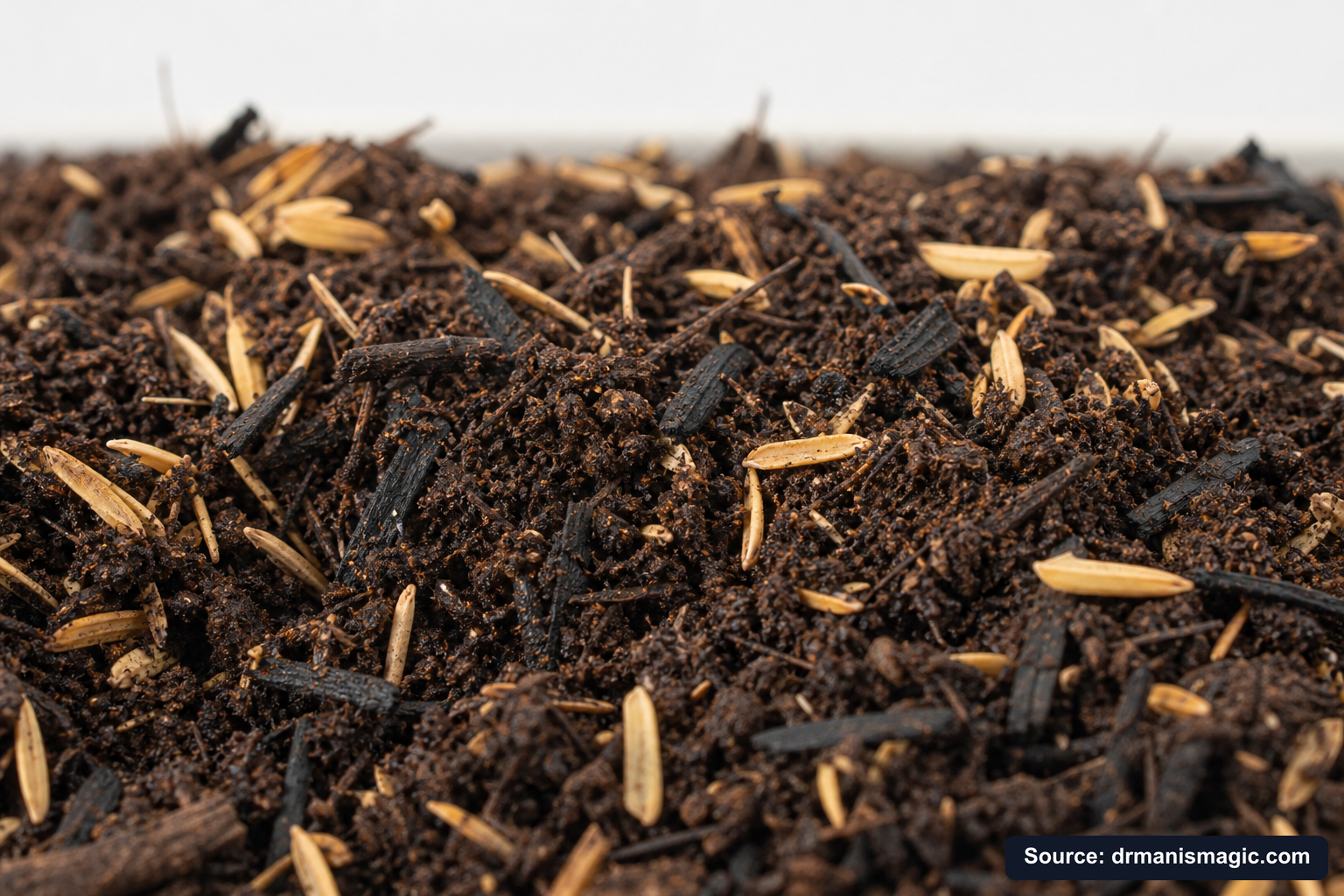
- Mineral-based, silica-rich soil does not decompose. It holds its shape for years, keeping roots oxygenated.
- Shallow containers create a perched water table that traps water at the bottom and drowns roots from below.
- The Three Plant Pillars — mineral soil, live microbes, and organic fertilizer — work together to create a root zone that practically runs itself.
- You can diagnose your soil's health right now with a squeeze test, a smell test, and a simple drainage check.
Why Do Your Roots Need Oxygen More Than Nutrients?
Quick Answer: Roots breathe oxygen the same way your lungs do. When soil pore space collapses from decomposition or compaction, roots are cut off from air. Without oxygen, roots die first, then the whole plant follows. No amount of fertilizer fixes a root that can't breathe.
Roots are not passive anchors. They are living, breathing organs.
They burn energy. They push through soil. They pull in water and minerals. All of that biological work requires oxygen. Not the carbon dioxide your leaves drink in through the sun. Actual atmospheric oxygen, O₂, diffusing down through the soil from the surface into the root zone.
The University of Illinois Extension puts it plainly: root respiration depends on a continuous supply of oxygen in the soil. When that supply drops, root cells begin to die. Waterlogged or compacted soils cut off oxygen just as surely as holding a pillow over someone's face.
Think of your soil as a sponge with two kinds of holes. Tiny holes, called micropores, hold water like a reservoir. Big holes, called macropores, hold air. After you water, the gravity pulls the free water down and out of the pot. What stays behind in the macropores should be air. That air is what your roots breathe between waterings.
When your soil is healthy and structured, this works beautifully. Water drains. Air rushes in. Roots breathe. Growth happens.
When your soil collapses? The macropores close. Water sits. Roots suffocate. Rot begins. And here is the cruel twist: the rot often smells like overwatering. So you water less. But the problem was never water. It was oxygen.
Rutgers New Jersey Agricultural Experiment Station gives us a practical benchmark worth writing on your potting bench: healthy container media should retain at least 10% air-filled porosity after drainage. Below that number, your roots are in oxygen stress. Most decomposed potting mixes don't come close after six months of use.
See also: The Hidden Reason Synthetic Fertilizers Cause Root Rot
What Is Soil Stability and Why Does It Change Everything?
Quick Answer: Soil stability means your growing medium keeps its physical structure — its pores, its texture, its drainage — over time. Stable soil stays open and airy for months or years. Unstable soil collapses, compacts, and turns into a dense, airless sludge that slowly kills roots. Stable soil is the hidden foundation of effortless gardening.
Soil stability is not about nutrients. It is not about pH. It is about structure that lasts.
Imagine building a house on a foundation of sand versus a foundation of concrete. Both look fine on day one. But one holds its shape for decades. The other shifts, settles, and cracks. Your plant's root zone works the same way.
Stable soil has particles that don't break down. Particles that don't compress under their own weight. Particles that create a durable network of pores. Those pores stay open after you water, after you fertilize, after months of sun and rain and root growth.
Unstable soil has particles that decompose. As they break down, they shrink. The pores between them collapse. The structure disappears. What started as a fluffy, open mix becomes a dense brick of compacted organic sludge. And that is exactly what commercial potting mix does, on a schedule, every single time.
Penn State Extension describes healthy growing media as a system that must maintain adequate aeration and drainage throughout the growing season. The problem is that most potting mix is only designed for a single growing season — annuals, seedlings, short-cycle houseplants. It was never engineered for a citrus tree, a fig, a palm, an olive, or any perennial plant you want thriving on your patio for years.
For those plants, you need a growing medium that stays stable. Not for six months. For years. That is the hidden secret. That is what soil stability means. And once you understand it, everything about gardening gets simpler.
Why Is Potting Mix So Bad for Long-Term Container Plants?
Quick Answer: Potting mix is mostly pine bark sawdust — a cheap timber industry byproduct. It decomposes within months, collapsing soil pore space and suffocating roots. It also contains harsh pine chemistry, was never designed for perennial plants, and becomes hydrophobic and rock-hard once it dries out.
Here is something that will make you look at that bag of potting mix very differently.
It's not soil. The name is a marketing invention. It should legally be called "ground-up dead trees."
You have been planting your living plants in other dead plants. Let that sit for a moment.
Pine bark became the dominant ingredient in commercial potting mix for one reason: it is a waste product from the timber industry. The Southeast United States has enormous pine forests. When timber mills process pine logs, they are left with mountains of bark. That bark is cheap. It is lightweight. It is easy to ship. And someone figured out how to sell it to gardeners as "premium growing medium."
It was perfect for the industry. It was terrible for your plants.
Here is why. Pine bark is organic matter. All organic matter decomposes. As it breaks down, the decomposition process consumes oxygen — the same oxygen your plant roots are desperately trying to get. The decomposing pine bark literally competes with your roots for air. And the pine bark wins, because decomposition is relentless.
But wait, it gets worse.
Pine trees are loaded with chemical compounds called terpenes and terpenoids. You already know some of them by their brand names. Pine-Sol. Turpentine. These are real chemicals with real industrial uses. They are excellent for cleaning floors and stripping varnish. They are not what you want bathing the delicate root tips of your prize lemon tree or your living room fiddle-leaf fig.
To reduce the harshness of those pine chemicals, manufacturers let the sawdust sit in giant outdoor piles for years, "aging" it. That aging process is decomposition. So the product you buy is already partially decomposed before it hits the shelf. And it is already consuming oxygen before you ever plant anything in it.
To make the situation truly spectacular, dry pine bark naturally repels water. It is hydrophobic. So manufacturers add surfactants — chemical wetting agents — that force the bark to absorb moisture. Those surfactants wash out after a few waterings. Once they're gone, the old potting mix turns hard as pavement and refuses to absorb water evenly. You pour water in and it channels straight down the sides of the pot without ever reaching the root zone.
So the full timeline of your potting mix looks like this: starts with pine chemistry, gets partially decomposed, gets dosed with surfactants, sells you on fluffiness, loses its structure in months, goes hydrophobic, and then you blame yourself for having a brown thumb.
Your thumb is fine. The potting mix was always the problem.
Potting Mix vs. Mineral-Based Soil: What's the Real Difference?
Quick Answer: Potting mix is carbon-based organic matter that decomposes and collapses. Mineral-based soil is silica-based inorganic material that does not decompose. Mineral soil keeps its pore structure for years. Potting mix loses its structure in months. For any plant you want thriving long-term, this difference is everything.
This is the core truth that changes how you garden forever.
There are two kinds of material in the world. Organic, meaning carbon-based, made from anything that was once living. And inorganic, meaning mineral-based, made from things like silica and rock that were never alive. What do all organic materials eventually do? They decompose. What do inorganic mineral materials do? They stay exactly the same, essentially forever.
Rocks don't rot. Sand doesn't shrink. Silica doesn't steal oxygen.
This is not a new discovery. Bonsai growers figured this out centuries ago. They use mineral-heavy media — akadama clay, lava rock, pumice — precisely because they need a growing medium that stays structurally stable in a very shallow container for decades. They cannot afford pore collapse. And neither can you.
| Property | Potting Mix (Pine Bark Based) | Mineral-Based Soil (Silica Based) |
|---|---|---|
| Primary ingredient | Pine bark sawdust (organic, carbon-based) | Sandy loam, silica sand, mineral particles |
| Does it decompose? | Yes — within 6 to 18 months | No — stable for years or permanently |
| Oxygen competition with roots | High — decomposition consumes oxygen | None — inorganic material does not respire |
| Pore structure longevity | Collapses as particles break down | Maintained long-term |
| Water behavior over time | Becomes hydrophobic when dry | Consistent drainage and absorption |
| Pine chemistry in root zone | Yes — terpenes, terpenoids present | None |
| Sterilization | Rarely steam-sterilized | Can be steam-sterilized (as in Super Soil) |
| Ideal for perennial container plants | No — designed for annuals and short cycles | Yes — engineered for long-term use |
| Re-purchase cycle | Every 6 to 12 months | Once — a permanent investment |
| Root rot risk over time | High — increases as structure degrades | Low — pore space stays open |
Dr. Mani Skaria, Professor Emeritus of Plant Pathology and founder of the Clean Citrus Program in Texas, built his entire growing system around this distinction. At our nursery in South Texas, after growing more than 250,000 trees, the pattern was impossible to ignore. Trees in mineral-based media stayed healthier longer. Their roots stayed white and firm. Their growth didn't stall at the six-month mark. They didn't need to be repotted every season. The soil wasn't the problem anymore. It was the solution.
That insight became Pillar One of the Three Plant Pillars: mineral foundation. Not because we wanted to sell a product. Because it was what the trees actually needed.
What Is the Perched Water Table and Why Does It Drown Roots in Pots?
Quick Answer: A perched water table is a layer of water that sits at the bottom of any container after watering, because the soil above it is too shallow to drain by gravity alone. It permanently saturates the bottom of your pot, cutting off oxygen to the lowest roots. Shallow containers and fine-particle media make this worse.
Here is a physics fact that most gardening advice never mentions.
When you water a container, gravity pulls the water down. In a garden bed, that water keeps traveling deep into the earth. But in a pot, it hits the bottom and stops. It cannot drain further than the drainage holes allow. And even after the water drains out, a layer of water-saturated soil remains at the very bottom of every pot. This is called the perched water table.
In a tall container with coarse-particle media, the perched water table is thin and low. The dry zone above it is large. Roots have plenty of oxygenated space to grow.
In a shallow container with fine-particle media — like a typical decorative pot packed with standard potting mix — the perched water table takes up a much larger percentage of the total root zone. The roots at the bottom are permanently sitting in waterlogged, oxygen-depleted soil. They do not know you only watered once. They are drowning constantly.
Now add decomposing organic matter that shrinks the pore spaces even further. Add fine particles that slow drainage. Add a shallow pot that shrinks the gradient. You have engineered a root-rot machine. And it came in a cheerful bag with a picture of flowers on it.
The fix is not complicated. Coarser, mineral particles drain faster and create bigger macropores. Taller containers increase the drainage gradient. Durable particles that don't decompose keep those macropores open over time. This is basic soil physics, and once you see it, you cannot unsee it.
How Do You Know If Your Soil Has Collapsed? The Home Diagnostic Test
Quick Answer: You can diagnose collapsed soil right now using four simple tests: the squeeze test, the drainage test, the smell test, and the visual root check. No lab equipment needed. These tests tell you within minutes whether your growing medium is still supporting your roots or slowly killing them.
You don't need a laboratory. You need five minutes and your own senses.
Here are the four tests we use at the nursery when diagnosing a struggling plant.
The Squeeze Test. Grab a handful of your potting mix and squeeze it hard. Open your hand. If it holds a tight clump and doesn't crumble, the pore structure is compromised. Healthy growing media with good macroporosity will fall apart loosely when you open your hand. Compacted, collapsed media holds its shape like modeling clay. Clay-like texture means no air spaces. No air spaces mean no root oxygen.
The Drainage Test. Water your plant heavily and watch the drainage hole. Healthy media drains freely within seconds. If water sits on top and seeps down slowly, or if it takes more than a minute to see any drainage from the bottom, your soil has collapsed pore structure or has gone hydrophobic. Either way, your roots are not getting the air flush they need after each watering.
The Smell Test. Healthy soil smells earthy. Clean. Like a forest after rain. Collapsed, oxygen-depleted soil smells sour, rotten, or like a swamp. That smell is anaerobic bacteria — microbes that only survive in oxygen-free environments. They are a sign that your root zone has gone anaerobic. At that point, root rot is not a risk. It is already happening.
The Visual Root Check. When you repot, look at the roots. Healthy roots are white or light tan. Firm. They have a faint clean smell. Roots in collapsed media turn brown or black. They feel mushy when you touch them. They may smell sour or rotten. If you see this, the soil structure failed long before the roots did.
You Never Had a Brown Thumb.
You were handed the wrong tools. This free guide hands you the right ones.
You watered it. You fed it. It died anyway.
It was never you. It was the dirt, the salt food, and the bad advice.
This guide shows you what really went wrong, and how to fix it for good.
- Why your plants really died, and why it was never your fault
- The salt hiding in your plant food that quietly burns the roots
- The hidden killer in almost every bag of store soil
- The tiny helpers that grow a whole forest for free
- The rescue trick that brings a half dead plant back to life

The Soil Stability Scorecard: Which Ingredients Actually Help?
Quick Answer: Ingredients differ wildly in how long they maintain soil structure. Mineral particles like pumice, lava rock, coarse silica sand, and calcined clay hold their shape for years. Organic ingredients like peat, pine bark, and compost decompose and collapse within months. Matching your ingredient choice to your plant's lifespan is the key decision most gardeners never make.
Not all soil ingredients are equal. Not even close.
The most important question to ask about any ingredient is not "does it drain well on day one?" It is "will it still drain well in a year? In three years?" For a pot of annual basil, this barely matters. For a container citrus tree, a potted olive, a fig, or any plant you want alive and producing for years, it matters enormously.
| Ingredient | Type | Structure Longevity | Oxygen Support | Decomposition Risk | Best For |
|---|---|---|---|---|---|
| Coarse silica sand | Mineral | Permanent | Excellent | None | Perennials, citrus, long-term containers |
| Pumice | Mineral | Permanent | Excellent | None | Succulents, bonsai, citrus, long-term containers |
| Lava rock (scoria) | Mineral | Permanent | Excellent | None | Bonsai, perennials, drainage layers |
| Calcined clay | Mineral | Long (years) | Good | Very low | Lawns, containers, mixing amendment |
| Rice hulls (silica-based) | Mineral/Organic hybrid | Long (1-3 years) | Good | Low (silica-rich) | Aeration amendment, top dressing |
| Coco coir | Organic | Medium (1-2 years) | Moderate | Moderate | Short to medium-term containers |
| Perlite | Mineral (volcanic glass) | Long | Good | None | Mixing amendment, drainage boost |
| Peat moss | Organic | Short (6-12 months) | Poor over time | High | Seed starting, short-cycle annuals only |
| Pine bark / potting mix | Organic | Very short (3-6 months) | Very poor over time | Very high | Annuals, seedlings — not perennials |
| Raw compost | Organic | Very short | Very poor over time | Very high | Garden beds only — not containers |
One important note about sand. "Sand" is not one thing. Coarse silica sand with large, angular particles creates excellent macropores. Fine play sand or beach sand — rounded, tiny particles — actually makes drainage worse by filling in the gaps between other particles. The particle size matters more than the ingredient name. Always use horticultural-grade coarse sand or silica sand, never fine masonry sand, play sand, or beach sand.
At our nursery, Dr. Mani sourced his mineral base from the Rio Grande Valley — a naturally silica-rich sandy loam with the particle size distribution and drainage characteristics we needed. Then he steam-sterilized every batch to remove any soil pathogens. That is the base of Super Soil. It is not magic. It is physics. And it works because it is permanent. You plant once. The soil holds its structure. You never have to repot because the growing medium collapsed.
What Is the Difference Between Drainage and Aeration?
Quick Answer: Drainage is how fast water moves out of the soil. Aeration is how much air stays in the soil after the water leaves. You can have fast drainage and still have terrible aeration if the remaining pore space is too small to hold air. Both matter, but aeration is what actually keeps roots alive.
This is one of the most misunderstood distinctions in all of container gardening.
People hear "well-draining soil" and think the problem is solved. It is not. Fast drainage just means water moves through quickly. What matters is what happens after the water leaves. Are there large enough pore spaces left behind to hold atmospheric oxygen? Or does all available pore space fill back up with retained water and fine particles?
Think of it this way. You can pour water through a bucket of marbles and it drains in two seconds. You can pour water through a bucket of wet sand and it also drains — just slower. But the marbles leave large air-filled gaps behind. The wet sand leaves almost none. Drainage speed does not tell you about oxygen availability. Pore size distribution does.
This is why sand gets a bad reputation when used incorrectly. Mixing fine sand into potting mix can actually make things worse. Fine sand particles fill the existing macropores in the organic mix, reducing air-filled porosity even further. This is not a theory. It is basic particle physics. University of Maryland Extension explains that mixing fine-textured materials into coarser ones reduces total pore space rather than improving it.
The fix is using coarse, durable, mineral particles that create and maintain macropores over time. Not fine. Not fluffy. Structurally stable, particle-size-matched mineral media that holds its shape and keeps those air pockets open between every watering cycle.
See also: Why Most Fertilizers Are Actually Salt in Disguise
How Does Soil Stability Connect to the Three Plant Pillars?
Quick Answer: Soil stability is Pillar One — the mineral foundation. Without it, Pillars Two and Three cannot work properly. Microbes die in oxygen-depleted soil. Organic fertilizer cannot reach roots in compacted media. Stable, oxygenated mineral soil is the platform that makes everything else possible.
Dr. Mani Skaria spent over 40 years as a plant pathologist. He watched plants succeed and fail across tens of thousands of trials. And he kept arriving at the same conclusion: most plant problems are not nutrient problems, disease problems, or pest problems at their root. They are infrastructure problems.
The soil is the infrastructure. If the infrastructure fails, nothing else works.
That is why the Three Plant Pillars begin with mineral foundation. Not microbes. Not fertilizer. Soil structure first. Because here is what happens when the soil structure fails:
The microbes in Pillar Two need oxygen to survive. Beneficial bacteria and mycorrhizal fungi are aerobic organisms. They die in anaerobic, oxygen-depleted soil. So if your growing medium has collapsed pore space, you can pour all the live microbes you want into the pot and they will be dead within days.
The organic fertilizer in Pillar Three needs roots to absorb it. Roots that are brown, slimy, and rotting do not absorb nutrients efficiently. The organic nutrients sit in the soil unused. Your plant starves despite being "fed."
When Pillar One is solid — when the soil is mineral-based, structurally stable, and oxygen-rich — the microbes thrive. The roots stay white and healthy. The organic nutrients move into the plant efficiently. Growth happens. The whole system works in sync. That is the Three Plant Pillars working together. And it all starts with the soil.
The number one thing people tell us they want is to see their plant produce fruit, or flowers, or real growth, while they are still here to enjoy it. They do not want to wait three years for results and then watch everything stall because the potting mix gave out at month six. Stable soil removes that barrier entirely. The clock stops working against you and starts working for you.
Is Your Container Plant in the Wrong Soil? A Recovery Checklist
Quick Answer: If your plant has been in standard potting mix for more than six months, if the roots smell sour, if drainage has slowed, or if growth has stalled despite feeding, your growing medium has likely collapsed. Follow these steps to recover your plant and rebuild on a stable mineral foundation.
You do not have to start from zero. But you do need to act before the roots go past the point of recovery.
Here is the step-by-step process we use at the nursery:
- Unpot and inspect the roots. Gently remove the plant from its container. Look at the roots. White and firm means healthy. Brown, black, or mushy means oxygen stress or active root rot. Smell the root ball. Clean earth smell is good. Sour or swampy smell means anaerobic conditions have taken hold.
- Remove the old media. Shake as much of the old potting mix off the roots as possible. Do not try to save it. It has served its purpose and collapsed. Using old, degraded potting mix as a base for new media is like rebuilding a house on a cracked foundation.
- Trim any damaged roots. Use clean scissors or pruning shears. Cut off any roots that are mushy, black, or slimy. Cut back to clean, firm tissue. Healthy root tissue is white or light tan and feels firm. If more than half the root system is damaged, cut back the above-ground growth proportionally to reduce the demand on the surviving roots.
- Let roots air dry briefly. Give the trimmed roots 15 to 30 minutes of open air before replanting. This helps seal the cut ends and reduces the risk of pathogens entering fresh cuts immediately.
- Repot into mineral-based, stable growing media. Use coarse, durable, mineral-rich media that will hold its structure long-term. The new media should drain freely within seconds of watering and hold its open, granular texture when squeezed.
- Introduce live microbes to rebuild the root zone. After repotting, drench the root zone with live beneficial bacteria, fungi, and mycorrhizae — Plant Super Boost is exactly what we use for this step. These living organisms colonize the new root zone, protect against pathogens, and unlock nutrients. They need oxygenated soil to survive, which is why you fix the soil first.
- Hold fertilizer for two to three weeks. Let the roots stabilize and begin new growth before feeding. Once you see new white root tips or new leaf emergence, resume with a gentle organic fertilizer that works with the microbes, not against them.
Why Does Big-Box Gardening Keep You Buying the Same Bad Soil?
Quick Answer: Big-box stores and commercial nurseries make money when plants cycle through quickly. Short-lived potting mix that collapses in months means you repot, repurchase, and restart. A permanent mineral-based growing medium breaks this cycle, which is why it will never be the product on the shelf at the hardware store.
This is not a conspiracy theory. It is just business math.
A plant that dies is a plant you have to replace. A potting mix that collapses is a bag you have to buy again. A fertilizer that burns roots creates a problem that needs another product to fix. The entire commercial gardening supply chain is built around short cycles, high turnover, and repeat purchases.
The nursery employee bagging your plant at the big-box store is not a plant scientist. They water plants while listening to music. That is not a criticism of them. It is just reality. There is no incentive in that system to tell you that the pine bark sawdust your tree is sitting in will be a collapsed, oxygen-depleted sludge by spring. Because if you knew that, you might not buy it.
Dr. Mani built his products to solve his own problem at the nursery. He needed 250,000 trees to survive in containers and ship healthy to customers. He could not afford potting mix failures. He could not afford root rot. He could not afford collapses at the six-month mark. So he engineered growing media that would not do any of those things. He tested it across an entire commercial citrus operation. Then he made it available to home gardeners.
The goal was never to sell you more soil every year. It was to sell you the last soil you would ever need. That is what a permanent mineral foundation means. Buy once. Plant confidently. Stop the cycle. Zero PFAS. Zero biosludge. Zero synthetic salts. Made in the USA from American materials.
The Whole System: What Happens When All Three Pillars Work Together
Quick Answer: When mineral-based soil, live microbes, and organic fertilizer all work together, the root zone becomes a self-sustaining ecosystem. Roots breathe. Microbes thrive. Nutrients flow. Plants grow faster, fight disease more effectively, and produce more fruit, flowers, and foliage than any single-product approach can deliver.
Picture a root zone that is fully alive.
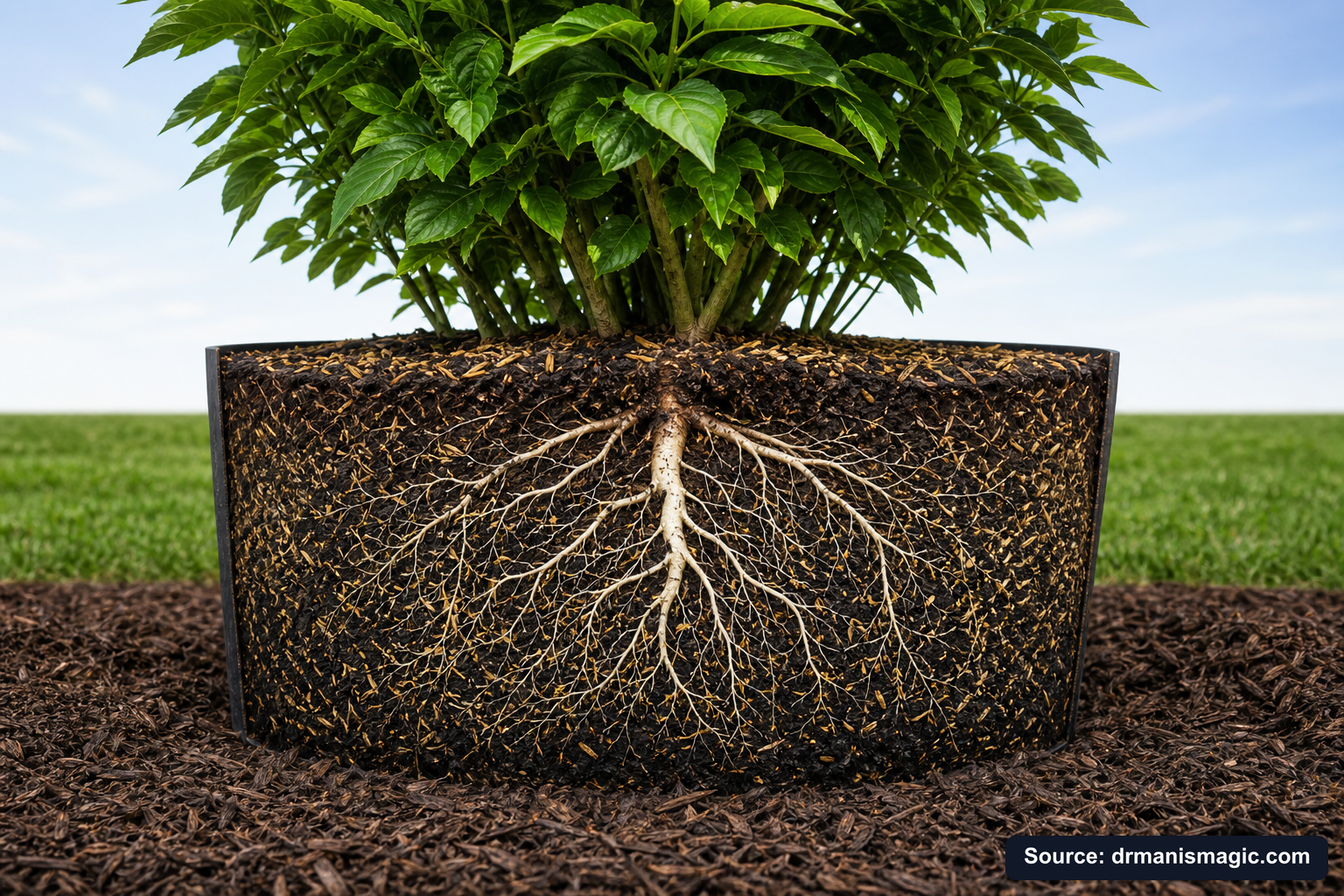
The soil is mineral-based and permanent. The pores stay open. After every watering, air rushes back in and oxygen reaches every root tip. The roots stay white. They grow outward and downward. They push through stable, granular media that supports them without compressing.
In that oxygenated zone, billions of beneficial bacteria and mycorrhizal fungi are working. They colonize the root surface. They break down organic matter into plant-ready nutrients. They produce compounds that strengthen root cell walls against pathogens. They form a living shield around the root zone that pathogens cannot easily penetrate. This is what healthy soil ecosystems have done in nature for hundreds of millions of years. We are not inventing anything new. We are re-creating what was always there.
And feeding that whole system is a slow-release organic fertilizer — made from crab, kelp, and amino acids — that delivers nitrogen, phosphorus, potassium, and trace minerals in forms the microbes can process and the roots can absorb. No salt. No burn. No synthetic coating leaching plastic compounds into your soil. Just whole-food nutrition for plants, delivered at the pace plants were designed to absorb.
The result is a plant that grows the way plants were designed to grow. Fast enough to be exciting. Steady enough to be reliable. Strong enough to handle stress, weather, and the occasional missed watering without collapsing.
That is the Three Plant Pillars working in sync. That is what we built at US Citrus Nursery over 30 years and 250,000 trees. And that is what we made available to every gardener in America through the Free Plant Care Field Guide and the Dr. Mani's Magic product line.
You can get money back. You cannot get time back. The best time to build a proper foundation for your plants was years ago. The second best time is right now, today, with the pot sitting in front of you.
Start With the Soil and Everything Else Gets Easier
You now know something most gardeners will never figure out. The secret to easy gardening is not a better fertilizer schedule. It is not a special watering technique. It is not more expensive plants or more hours in the garden.
It is soil stability.
It is building a root zone with durable pore structure that stays open, oxygenated, and biologically alive for years instead of months. It is choosing mineral-based, silica-rich media that does not decompose, does not steal oxygen, and does not turn into compacted sludge by the time your plant is just hitting its stride.
Once that foundation is in place, everything else works. The microbes thrive. The nutrients flow. The roots stay white and healthy. The plant grows the way you imagined it would when you bought it. The fruits you pictured hanging from your own branches actually show up. And you get to be there when they do.
That is what Dr. Mani built. That is what we tested across an entire commercial nursery. And it is what we want for every plant in every pot on every porch and patio in America.
If you are ready to stop guessing and build on a foundation that actually lasts, explore the Three Plant Pillars system — the complete mineral soil, live microbe, and organic fertilizer approach that made everything simpler for us, and for thousands of gardeners who were tired of starting over.
Frequently Asked Questions
Gardeners ask us the same questions every week. They want to know why their plants keep failing. They want to know if there is a simpler way. These answers cut through the noise and get straight to what actually works, backed by over 30 years of growing more than 250,000 trees in South Texas.
What is the real secret to easy gardening that most people miss?
The secret is soil stability. Most potting mixes are made from pine bark and sawdust. They look fluffy and rich when you buy them. But they start breaking down fast. As they decompose, the air pockets close up. Roots lose oxygen. Plants slowly suffocate. Stable, mineral-based soil holds its structure for years. That one change makes everything else easier. This is the foundation of the First Plant Pillar at Dr. Mani's Magic.
What is the 70/30 rule for gardening, and does it apply to soil too?
The 70/30 rule says to plant 70 percent proven performers and 30 percent experiments. That is smart advice for plant selection. But it does not go far enough. Your soil mix matters just as much as what you plant. At Dr. Mani's Magic, we say start with 100 percent stable, mineral-based soil every single time. No experiments with your foundation. Experiment with your plants all you want, but give every one of them the same solid base to grow from.
Why do plants seem to do great for a few months and then fall apart?
This is the most heartbreaking pattern we see. The plant looks healthy at first. Then around the six-month mark, it starts going sideways. The reason is almost always soil collapse. That fluffy potting mix you started with has been decomposing the whole time. The pore spaces close. Oxygen disappears. Roots begin to rot from the bottom up. You lose months of growth and all that time you can never get back. Mineral-based soil from Dr. Mani's Magic does not decompose, so this cycle stops.
What is the 3-year rule in gardening, and how do the Three Plant Pillars speed things up?
The old saying goes: year one it sleeps, year two it creeps, year three it leaps. That timeline assumes average soil, average inputs, and a lot of guesswork. The Three Plant Pillars change the math. Mineral soil keeps roots breathing from day one. Live microbes in Plant Super Boost unlock nutrients and fight off disease immediately. Organic fertilizer feeds the plant slowly and steadily without burning anything. Gardeners using all three pillars see that "year three leap" arrive much sooner.
What are the biggest mistakes people make with potted plants and raised beds?
The number one mistake is using the wrong soil. Cheap potting mix breaks down fast and drowns roots. The second mistake is using synthetic fertilizer, which is salt-based and burns the very microbes your soil needs. The third mistake is skipping microbes entirely. Without live bacteria and fungi in the soil, plants are defenseless. At Dr. Mani's Magic, the Three Plant Pillars fix all three mistakes at once. Mineral soil, live microbes, and organic fertilizer work together so your plants have everything they need from the start.
Can gardening actually lower your stress and cortisol levels?
Yes, and the science backs it up. Time spent in a garden has been shown to lower cortisol, which is your body's main stress hormone. But here is the thing. Gardening only feels calming when it is working. Watching plants die, Googling solutions at midnight, and spending money with nothing to show for it raises stress. Dr. Mani's Magic is built to make gardening feel like the peaceful, rewarding experience it should be. When your soil is stable and your plants are thriving, the garden becomes your happy place again.
Is gardening good for your body, not just your mind?
Absolutely. Gardening gets you moving, bending, lifting, and walking. That kind of weight-bearing activity is great for bone density and overall strength. But the benefits go deeper than exercise. When you grow food and flowers without toxic chemicals, you are not breathing in pesticides or getting synthetic herbicides on your skin. Dr. Mani's Magic products are all-natural. No harsh warning labels. No re-entry wait times. Just clean soil, live microbes, and organic fertilizer that are safe for you, your kids, your pets, and your garden.
About the Author
Dr. Mani Skaria, PhD
Dr. Mani Skaria, PhD, is a plant pathologist and the scientific founder of Dr. Mani's Magic. He earned his doctorate at Purdue University and spent 48 years studying how plants, soil, and living microbes work together, including his years as Professor Emeritus at Texas A&M and as a member of the USDA NAREEE Advisory Board. He invented micro-budding, a method for growing healthier, stronger trees, and has grown more than 250,000 trees on the family farm in Hargill, Texas - US Citrus Nursery. His life's work takes real lab science and practical experience and turns it into simple, safe, organic plant care anyone can use at home.


