


Why Compost Is Really a Bacterial Factory That Builds Living Soil | Dr. Mani's Magic
Why Compost Is Really a Bacterial Factory — And How That Factory Builds Living Soil
Picture this. You dig your hands into a steaming compost pile on a cold morning. You can feel the heat rising against your palms. That warmth is not from the sun. It is not from a chemical reaction. It is from billions upon billions of tiny living creatures eating, breathing, multiplying, and doing the most important work in all of gardening — right there in your hands.
Most people think compost is just "rotted stuff." Old leaves. Kitchen scraps. Dead plant matter broken down into something brown and crumbly. And sure, that is part of it. But here is what almost nobody tells you: compost is not a product. Compost is a living factory. A bacterial factory. And what it manufactures is not just dirt — it is the invisible workforce that makes every plant on Earth possible.
We have grown over 250,000 trees at our South Texas nursery. We have watched healthy soil turn plants into powerhouses and we have watched sterile soil quietly kill them. The difference, almost every single time, came down to one thing: what was alive in the dirt. Once you understand how the bacterial factory inside compost actually works, you will never look at a bag of potting mix the same way again. And you will finally understand why your plants have been struggling — and exactly what to do about it.

Plant Super Boost
Key Takeaways
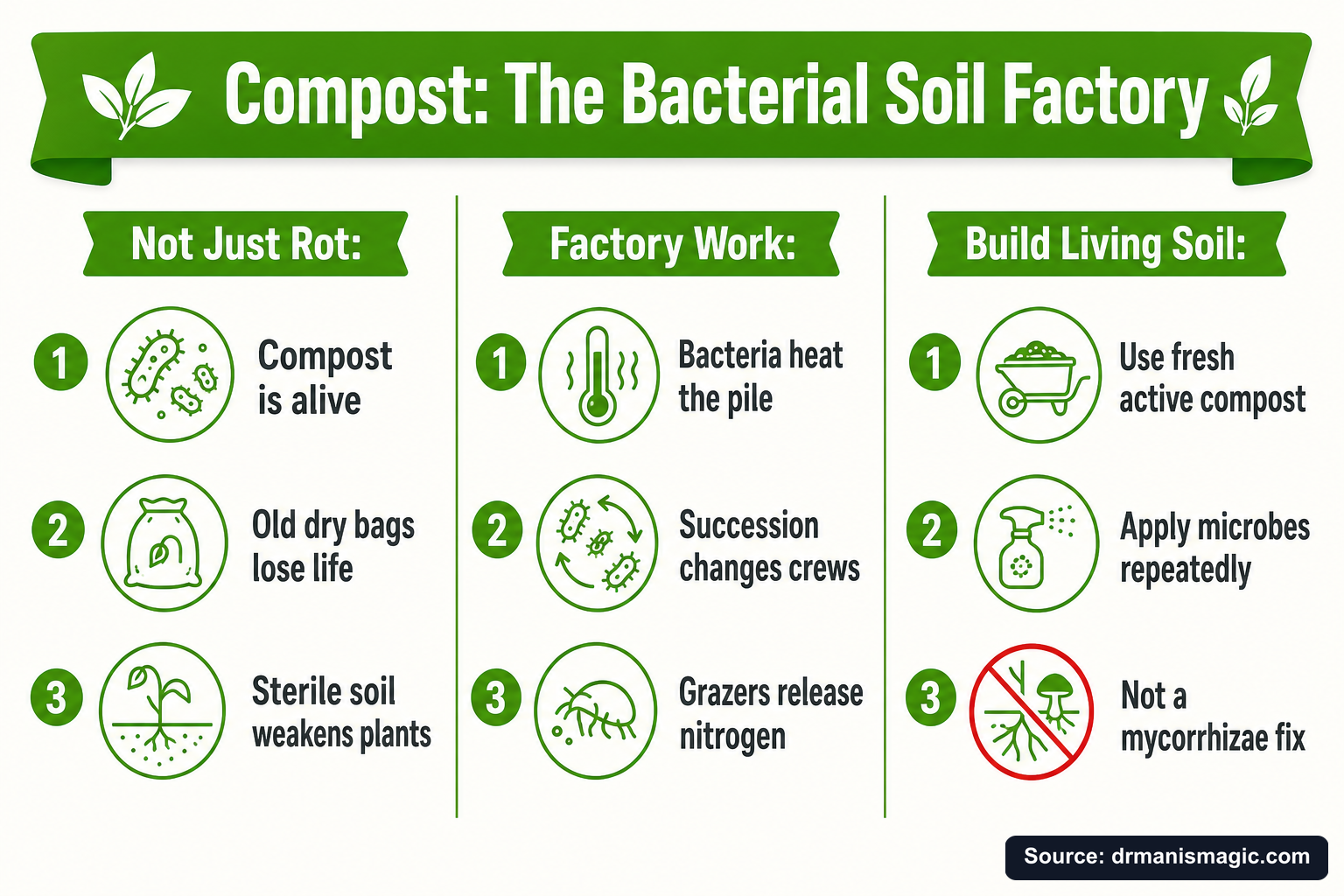
- Compost is a living bacterial factory, not just decomposed waste — it generates heat, enzymes, and plant-available nutrients through microbial activity.
- Bacteria are the first responders in compost: they reproduce fast, generate the heat that kills pathogens, and kick off the entire fertility chain.
- Microbial succession is the secret: bacteria dominate early, then fungi, actinomycetes, protozoa, and nematodes take over — each stage releasing nutrients plants can use.
- Protozoa and nematodes graze on bacteria and release nitrogen in plant-available form — this is how bacterial biomass becomes food for your garden.
- Finished bagged compost loses much of its living biology over time — dry, old, or overheated compost has reduced microbial value even if the nutrients remain.
- Compost supports mycorrhizal habitat but is NOT a reliable mycorrhizal inoculant — that is a widespread myth worth busting.
- Restoring damaged or sterile soil takes repeated microbial applications, not a one-time fix — and the Three Plant Pillars give you the complete system to do it right.
What Is Actually Happening Inside a Compost Pile?
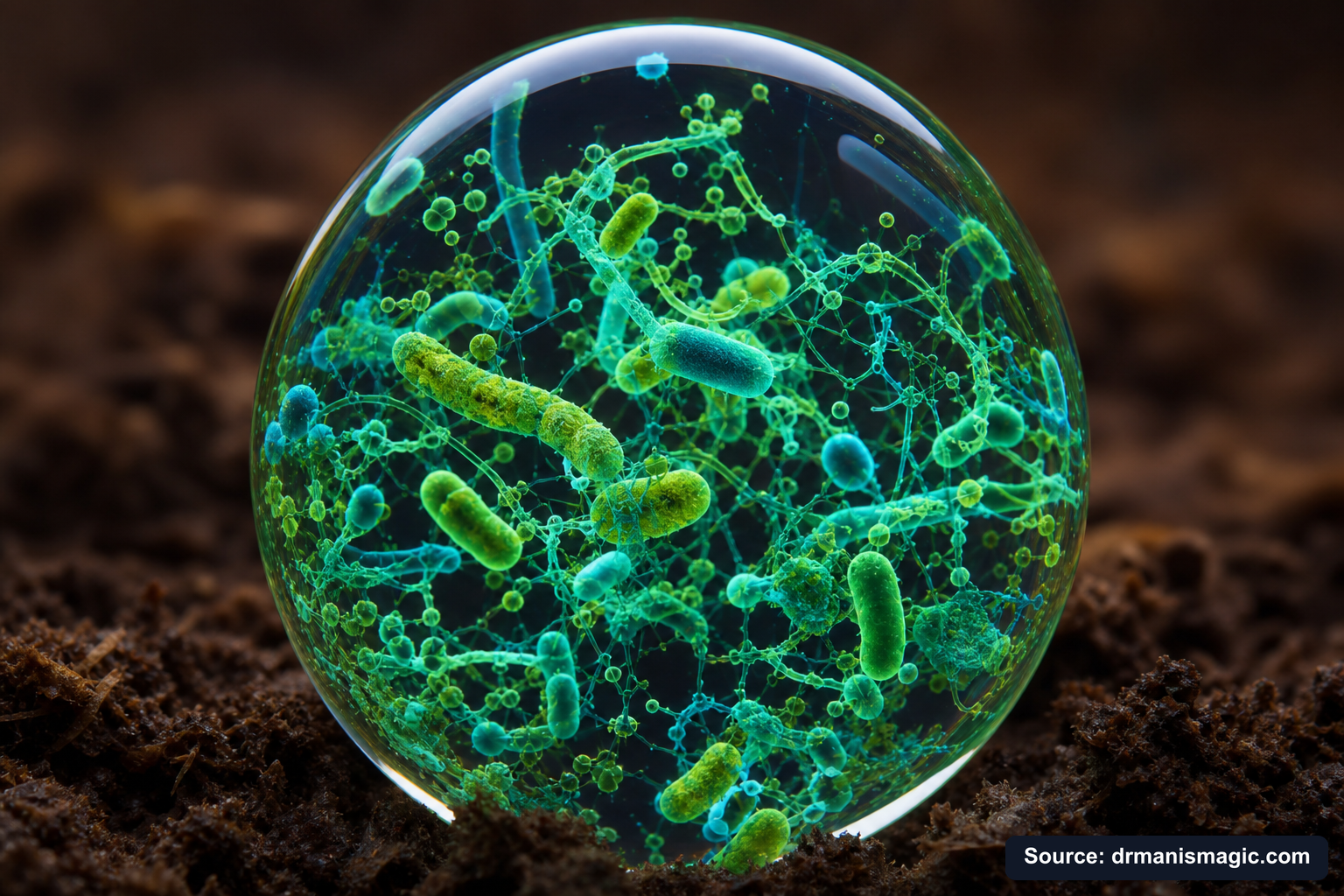
Quick Answer: Inside a compost pile, bacteria are reproducing at explosive speed, consuming simple sugars and proteins from raw organic matter. Their respiration generates intense heat — sometimes over 140°F. That heat is proof of life, not decomposition. It is the bacterial engine running at full power, transforming waste into living soil fertility.
Stick a thermometer into an active compost pile and you might see 130, 140, even 160 degrees Fahrenheit. That is hotter than most dishwashers run. It is hot enough to kill weed seeds. Hot enough to destroy many plant pathogens. And it is generated entirely by living organisms too small to see without a microscope.
Here is what is happening in plain English. Raw organic matter — food scraps, grass clippings, fallen leaves — contains simple sugars, proteins, and carbon compounds. Bacteria smell that feast and they show up fast. Bacteria reproduce faster than almost any other organism on the planet. Under good conditions, one bacterium can become millions within hours.
As they eat, they breathe. And as they breathe, they release heat. This is the same process happening in your own body right now — metabolism. Just multiply it by billions of microscopic bodies packed into a cubic foot of organic matter. That is your compost pile. That is your bacterial factory, running at full tilt.
According to research from UC Davis Extension, this initial mesophilic bacterial phase — where moderate-temperature bacteria dominate — transitions quickly into a thermophilic phase as temperatures climb. New heat-loving bacteria take over, pushing temperatures even higher. This is not chaos. This is microbial succession, one of the most elegant systems in all of nature.
What Is Microbial Succession and Why Does It Matter for Your Soil?
Quick Answer: Microbial succession is the natural sequence of different microbe types taking over a compost pile as conditions change. Bacteria dominate first, generating heat. Then fungi and actinomycetes move in during the cooler curing stage. Finally, protozoa and nematodes arrive to graze on bacteria and release plant-available nitrogen. Each stage builds on the last.
Most gardening content misses this completely. They tell you compost is "full of microbes" and leave it there. But not all microbes do the same job. And they do not all show up at the same time. The order matters enormously.
Think of it like a construction project. First the bulldozers come in — those are the bacteria. Fast, powerful, generating energy, clearing the ground. Then the framers arrive — those are the fungi. Slower, more methodical, breaking down the tough woody material the bacteria could not handle. Then the finish crew — protozoa, nematodes, and other soil animals — come in and do the fine work that turns everything into something usable.
Here is the succession in plain order:
- Mesophilic bacteria — Show up first. Eat simple sugars and proteins. Temperature rises fast.
- Thermophilic bacteria — Take over as heat climbs past 104°F. These heat-lovers push temperatures to 140°F+, killing pathogens and weed seeds.
- Fungi and actinomycetes — Move in during the cooling phase. They break down tough lignin and cellulose — the woody stuff bacteria cannot fully digest. Actinomycetes are what give finished compost that clean, earthy smell.
- Protozoa and bacterial-feeding nematodes — The final stage. They graze on bacteria. This grazing is the secret step most people never hear about. And it is how bacterial biomass becomes nitrogen your plants can actually eat.
| Stage | Temperature Range | Who Is in Charge | What They Do | What Gets Made |
|---|---|---|---|---|
| Early (Day 1–3) | 50–104°F | Mesophilic bacteria | Eat simple sugars, proteins, soluble carbon | Heat, CO2, bacterial biomass |
| Hot Peak (Day 3–14) | 104–160°F | Thermophilic bacteria | Intense decomposition, pathogen suppression | Pathogen-free material, ammonia, enzymes |
| Cooling (Week 2–6) | 70–104°F | Fungi, actinomycetes | Break down lignin, cellulose, woody material | Humic substances, stable organic matter |
| Curing / Maturing (Week 6+) | Ambient | Protozoa, nematodes, diverse bacteria | Graze on bacteria, release nutrients | Plant-available nitrogen, stable humus |
| Finished Compost / Soil Integration | Ambient | Full soil food web | Build soil structure, cycle nutrients | Living fertility, glomalin, resilient soil |
How Do Protozoa and Nematodes Turn Bacteria Into Plant Food?
Quick Answer: Protozoa and bacterial-feeding nematodes graze on bacteria in the soil. Bacteria store nitrogen in their cells. When protozoa eat bacteria, that nitrogen gets released in a form plants can absorb — ammonium. This "bacterial grazing loop" is the primary way finished compost delivers nitrogen to plant roots. Without it, the fertility chain breaks.
This is the piece almost nobody talks about. And it might be the most important part of the whole story.
Here is the simple version. Bacteria are tiny packages of nitrogen. Their cells are loaded with it. But plants cannot eat bacteria directly. They need nitrogen in a dissolved, available form — specifically ammonium or nitrate.
Enter the grazers. Protozoa are single-celled organisms that eat bacteria. Nematodes — the bacterial-feeding kind, not the plant-attacking kind — do the same. When they eat bacteria, they take in more nitrogen than they can use. The excess gets excreted right into the soil, right near plant roots, in exactly the form plants can absorb.
This is the grazing loop. Bacteria multiply. Protozoa eat bacteria. Plants feed on the nitrogen released. Roots grow. Roots release sugars back into the soil. Those sugars feed more bacteria. The loop keeps spinning.
Without protozoa and nematodes, that loop stops. Bacterial biomass builds up but the nitrogen stays locked inside microbial cells. Plants go hungry even though there is plenty of nitrogen nearby. This is one reason why a truly alive soil — with its full food web intact — outperforms any synthetic fertilizer program. The biology does the releasing. You do not have to.
Research from the UC Davis Soil Health Institute confirms that soil food web diversity — including protozoa and nematode populations — is one of the strongest predictors of nitrogen availability and long-term soil fertility.
Is Compost Actually Alive — or Is It Just Nutrients?
Quick Answer: Fresh, finished compost is alive with bacteria, fungi, protozoa, and nematodes. But its biological value drops over time, especially in bags. Old, dry, or heat-sterilized compost retains chemical nutrients but loses most of its living biology. It still has value as a soil conditioner and nutrient source — but it is not the same as a biologically active compost.
Here is something that surprises most gardeners. Compost wears four different hats at once:
- Nutrient source — It contains nitrogen, phosphorus, potassium, and trace minerals.
- Soil conditioner — It improves structure, drainage, and water retention.
- Microbial inoculant — It introduces living organisms into your soil. But only when it is fresh and biologically active.
- Disease-suppressive habitat — A rich microbial community crowds out pathogens and protects plant roots.
The problem with most bagged compost from a garden center? It has been sitting in a plastic bag, cut off from oxygen. The biology has declined. Significantly. You are getting the nutrients and the soil-conditioning benefits. But you are not getting the full living workforce that makes fresh compost so powerful.
This is exactly what our team discovered after years of working with fresh compost at the US Citrus Nursery. When we applied genuinely live, biologically active material to our trees, the results were stunning. When we applied old or depleted material, results were ordinary. The biology made all the difference.
That discovery is part of what led Dr. Mani to develop Plant Super Boost — a way to bottle the living power of fresh compost without the biology dying before it reaches your plants. More on that in a moment.
Does Compost Contain Mycorrhizae? The Myth That Costs Gardeners Years
Quick Answer: Compost does NOT reliably contain live mycorrhizal fungi. Mycorrhizae are heat-sensitive and are largely destroyed during the hot composting phase. Finished compost creates excellent habitat for mycorrhizal fungi to colonize later — but it is not a mycorrhizal inoculant. Do not rely on compost alone to restore this critical fungal partnership.
This one trips up even experienced gardeners. And it wastes time — the one thing you can never get back.
Mycorrhizal fungi form deep partnerships with plant roots. They extend the root system by hundreds of times its normal reach. They unlock phosphorus that would otherwise stay locked in the soil. They build drought resistance. They help plants fight disease. They are, in short, one of the most valuable biological relationships in all of plant life.
But here is the hard truth. The thermophilic phase of composting — that 140°F-plus heat that kills pathogens and weed seeds — also kills mycorrhizal fungi. They are sensitive to heat. By the time most compost finishes its hot phase, the mycorrhizae are gone.
What compost does do is build the habitat that mycorrhizal fungi love. Rich organic matter, stable structure, diverse microbial activity — all of that creates the conditions where mycorrhizae can thrive if they are introduced from another source. But compost alone will not deliver them to your plant roots.
If mycorrhizae are what you need — and they almost certainly are — you need a dedicated full-spectrum microbial inoculant that includes live mycorrhizal fungi, bacteria, protozoa, and nematodes together. That is the complete picture. That is what works.
You Never Had a Brown Thumb.
You were handed the wrong tools. This free guide hands you the right ones.
You watered it. You fed it. It died anyway.
It was never you. It was the dirt, the salt food, and the bad advice.
This guide shows you what really went wrong, and how to fix it for good.
- Why your plants really died, and why it was never your fault
- The salt hiding in your plant food that quietly burns the roots
- The hidden killer in almost every bag of store soil
- The tiny helpers that grow a whole forest for free
- The rescue trick that brings a half dead plant back to life

Live Microbes vs. Dead Microbes — Why Most Products on the Shelf Do Not Work
Quick Answer: Most commercial microbial products use dried, lab-grown microbes that have very low viability when applied to soil. Others are liquid compost-tea extracts that go anaerobic and die before they reach you. A genuinely live, full-spectrum microbial product — stabilized without going anaerobic — delivers results that dried or dead products simply cannot match.
Walk into any garden center and you will find shelves full of microbial products. Bags of powder. Bottles of liquid. They all make big promises. Most of them disappoint.
Why? Because the microbes are dead — or close enough to it that it does not matter.
Here is how most commercial microbial products are made. Bacteria and fungi are grown in giant factory vats. Then they are dried into a powder. The idea is that the spores will "reactivate" when water is added and the powder hits soil. In theory, that sounds reasonable. In practice, after testing dozens of batches on over 250,000 trees at our nursery, we found that these dried powders simply do not move the needle for plant health.
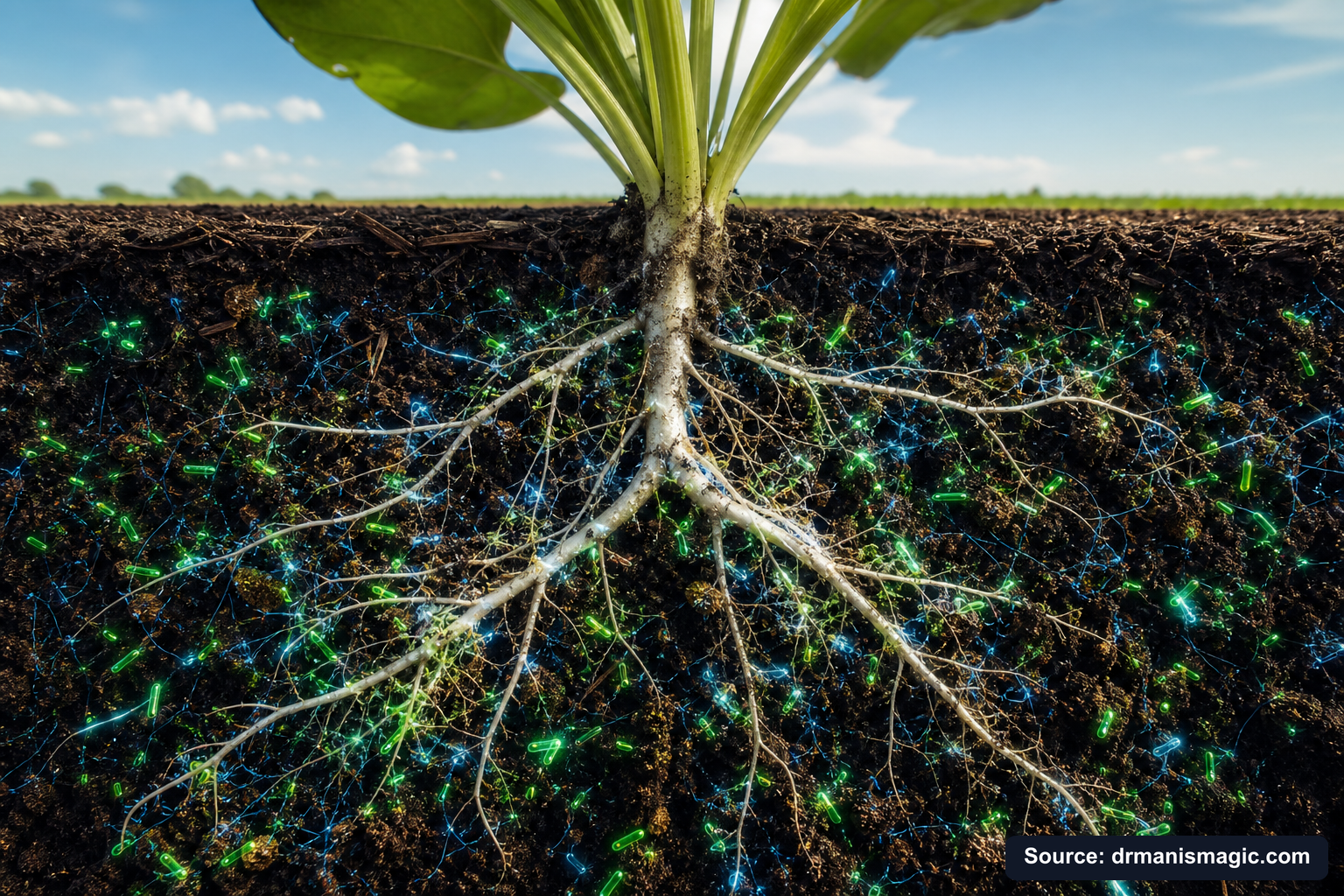
The second common approach is liquid compost tea. This one is trickier because it does work — when it is fresh. Within the first 24 hours, actively aerated compost tea is teeming with life. But after that, it goes anaerobic. The good microbes start dying. The liquid starts to ferment. And by the time a bottle ships from a warehouse, travels across the country, and sits on a shelf at your local store? It smells. Bad. That stench is the smell of biology dying in a bottle.
Some products smell terrible and gardeners still use them because they see minor benefits from the humic acids and organic compounds in the base material. But the living workforce is gone.
| Product Type | Microbe Viability | Spectrum of Organisms | Does It Smell? | Real-World Results | Verdict |
|---|---|---|---|---|---|
| Dry / powdered lab-grown microbes | Very low | Narrow (checklist species) | No | Minimal to none observed | Avoid |
| Liquid with rehydrated dry microbes | Low | Narrow | Mild | Marginal | Avoid |
| Old / anaerobic compost tea (>24 hrs) | Very low (dying) | Partial — dominated by fermenters | Strong stench | Some humic benefit; biology gone | Not recommended |
| Fresh compost tea (<24 hrs, aerated) | Moderate | Broad but incomplete | Earthy → sour | Good — if applied immediately | Good but time-intensive |
| Fresh active compost (on-site) | High | Broad and natural | Earthy | Excellent | Best DIY option |
| Lactobacillus-based products | High (but wrong species) | Narrow (fermentation-focused) | Low | Can crowd out beneficial microbes | Avoid for soil use |
| Plant Super Boost (stabilized, full-spectrum) | High — visibly live under microscope | 2,000+ bacteria, 400–500 fungi including mycorrhizae, protozoa, nematodes | Earthy — not anaerobic | Consistently strong across 250,000+ trees | Recommended |
Zero PFAS. Zero biosludge. Zero synthetic salts. That is the standard we hold every product to — because your garden is where your family lives, where your children play, and where your food grows.
Can Compost Revive Dead or Damaged Soil?
Quick Answer: Yes, compost can help revive damaged soil — but it is the start of a process, not an instant fix. Soils damaged by herbicides, salt-based fertilizers, fungicides, or compaction need repeated biological inputs, proper drainage, and time for microbial succession to rebuild. One application helps. A consistent system transforms.
Here is a scene you might recognize. You buy a bag of fancy compost. You mix it into your garden bed. You water it in. You wait. A few weeks later — not much has changed. The plants are still struggling. You wonder if you did something wrong.
You did not do anything wrong. You just did not know what you were up against.
Modern soils are damaged. Badly, in many cases. Decades of synthetic herbicides — especially glyphosate — have disrupted microbial communities at the root level. Salt-based fertilizers have burned beneficial bacteria and fungi out of the soil with every application. Broad-spectrum fungicides have killed the beneficial fungi right along with the harmful ones. Compaction has cut off oxygen. And without oxygen, aerobic bacteria cannot survive.
A single bag of compost dropped into that environment will not instantly rebuild what took years to destroy. The biology needs help. It needs the right conditions. It needs repeated inoculation. And it needs time.
See also: The Hidden Reason Synthetic Fertilizers Cause Root Rot
The good news is that soil biology is remarkably resilient when given the right support. We have seen soils that looked completely dead come back to life within a single growing season. But it requires a system — not just one bag, one application, or one product.
Soil Recovery Protocol: A Practical Step-by-Step Checklist
- Stop the stressor first. No more synthetic herbicides, salt-based fertilizers, or broad-spectrum fungicides. You cannot rebuild the biology while still killing it.
- Check your soil structure. Is water draining well? Is the soil compacted? Roots need oxygen. If water pools for hours after rain, aeration and structure come before biology.
- Add mature, biologically active compost. Work it into the top few inches of soil. This seeds the microbial community and feeds the existing biology.
- Apply a full-spectrum live microbial inoculant monthly. Compost alone will not reliably deliver mycorrhizae or the full food web. A stabilized, live product fills that gap consistently.
- Keep the soil moist but not waterlogged. Microbes need moisture to move through soil and do their work. Dry soil slows biology to nearly nothing.
- Mulch the surface. A layer of organic mulch protects soil from temperature swings, holds moisture, and feeds surface fungi as it slowly breaks down.
- Give it a full season. Microbial succession takes time. Plants will respond within weeks. Full soil restoration takes months. Be consistent and let the biology do its work.
What Does White Mold in Compost Mean — and Is It Good or Bad?
Quick Answer: White mold or white fuzzy threads in compost or soil are usually beneficial fungi — either compost-dwelling species breaking down woody material, or mycorrhizal networks extending through the root zone. White growth in compost is generally a very good sign that the biological process is working. It is not something to worry about or spray away.
We get this question all the time. Someone pulls back their mulch or digs into their compost and sees white thread-like growth weaving through everything. Their first instinct is to panic. "Is this a disease? Should I spray it?"
Please do not spray it.
Those white threads are almost certainly fungal mycelium — the underground network of beneficial fungi doing exactly what they are supposed to do. During the curing phase of composting, fungi are the organisms breaking down the tough woody material that bacteria could not fully digest. They produce enzymes that dissolve lignin and cellulose, turning it into stable humic substances.
If you ever pull up a weed and see white fuzzy threads wrapped around the roots, that is mycorrhizae. Those fungi are extending the root system, pulling in water and nutrients from a much wider area than the root alone could reach. Weeds thrive partly because they often have better mycorrhizal connections than the ornamental plants and crops we grow in managed soil.
The takeaway: white fungal growth in your compost or soil is a sign of biological health. Protect it. Feed it. And make sure your garden plants have access to the same fungal partnerships — not just your weeds.
Compost vs. A Complete Microbial System — What Is the Real Difference?
Quick Answer: Compost is a soil conditioner, nutrient source, and biological habitat all in one — but it is not a complete replacement for a targeted live microbial inoculant. Compost builds the environment. A full-spectrum live microbial product delivers the specific organisms — including mycorrhizal fungi, protozoa, and nematodes — directly to the root zone with reliable viability.
This is the honest conversation most gardening advice skips.
Compost is wonderful. We are not here to say otherwise. But compost is not the whole story. Especially not bagged, shelf-stable compost that has been sitting in a warehouse for months.
Think about it this way. Compost builds the neighborhood. It creates good soil structure. It adds organic matter. It improves drainage and water retention. It even brings in some biological life. But if the neighborhood has been badly damaged — by synthetic chemicals, salt buildup, compaction, or herbicide residue — you need more than a good neighborhood plan. You need to move the workers back in directly.
That is what a genuinely live, full-spectrum microbial inoculant does. It delivers bacteria, fungi, mycorrhizae, protozoa, and nematodes — the complete workforce — directly to the root zone. Not dried. Not dead. Actually alive.
The Three Plant Pillars system we developed at US Citrus Nursery addresses this directly. Pillar Two is live microbials — not as a nice-to-have, but as a non-negotiable foundation of plant health. Because without the biology, the nutrients cannot move. Without the biology, the roots cannot defend themselves. Without the biology, you are gardening uphill against nature instead of with it.
| Function | Finished Compost | Full-Spectrum Live Microbial Inoculant |
|---|---|---|
| Adds nitrogen, phosphorus, potassium | Yes — slow release | No — not a fertilizer |
| Improves soil structure and drainage | Yes — excellent | Indirectly — fungi produce glomalin which aggregates soil |
| Introduces live bacteria | Partially — declines rapidly in bags | Yes — high viability at point of use |
| Delivers live mycorrhizal fungi | No — destroyed by composting heat | Yes — when product is genuinely live |
| Delivers protozoa and nematodes | Partially — in fresh, mature compost | Yes — in full-spectrum products |
| Suppresses soil pathogens | Yes — through diverse microbial competition | Yes — targeted competitive exclusion |
| Reliable across container and managed soil | Moderate — volume-dependent | High — liquid delivery reaches root zone directly |
| Consistent viability guarantee | No — depends on age, storage, source | Yes — when stabilized and tested |
See also: Why Most Fertilizers Are Actually Salt in Disguise
Why Does Synthetic Fertilizer Undermine Everything the Bacterial Factory Builds?
Quick Answer: Synthetic fertilizers are salt-based. High salt concentrations in soil water kill beneficial bacteria and fungi through osmotic stress — the same way salt kills a slug. Every time you apply salt-based fertilizer, you are partially dismantling the bacterial factory you are trying to build. This is why plants appear to thrive briefly, then decline, then need more product to keep going.
This is the part of the story that the big chemical companies would rather you not think too hard about.
Salt draws water out of cells. That is chemistry, not opinion. When you pour a high-concentration synthetic fertilizer around a plant, the salt level in the soil water spikes. Bacteria cells — just like plant root cells — lose water to osmosis. They shrink. They struggle. Many of them die.
The plant gets a short burst of available nutrients because the synthetic fertilizer broke those nutrients into immediately available ions. The grass greens up. The flowers flush. It looks like it worked. But underneath, the microbial community just took a hit. The next time you need to fertilize, the biology is weaker than before. The cycle of dependency tightens.
This is not a conspiracy theory. This is basic soil chemistry confirmed by land-grant university research programs across the country. The bacterial factory cannot run at full power when it is being salted at regular intervals.
Organic fertilizers — the kind made from crab, kelp, amino acids, and other natural sources — do not carry this problem. They release nutrients slowly, through biological pathways, in a form that works with the microbial community instead of against it. The difference in long-term plant health is not subtle. It is dramatic.
What Can You Do Right Now to Start Building a Living Bacterial Factory in Your Own Soil?
Quick Answer: Stop adding biology-killing inputs. Add mature compost to feed and condition the soil. Apply a genuinely live, full-spectrum microbial inoculant monthly to restore and maintain the biological workforce. Use organic fertilizer that feeds microbes instead of burning them. Keep soil moist, aerated, and mulched. Then give the system time to run.
Here is the beautiful thing about all of this. Nature wants to run the bacterial factory for you. It has been doing it for hundreds of millions of years. Your only job is to stop working against it and start working with it.
You do not need a chemistry degree. You do not need a warehouse full of products. You do not need to mix and match a dozen different inputs and hope they are compatible. You need three things working together — the Three Plant Pillars that Dr. Mani Skaria developed and proved across 250,000 trees in South Texas:
- Mineral-based soil that drains well, stays aerated, and does not compact and choke roots over time.
- Live microbials — genuinely alive, full-spectrum, delivered to the root zone consistently every month.
- Organic fertilizer that feeds the biology and feeds the plant, without the salt burn that dismantles everything you are building.
When those three pillars are in place, you are not fighting nature. You are the one who finally stopped fighting it. And the results show up fast. Within weeks, roots start looking healthier. Within a season, plants that were struggling start to look like they belong there. The bacterial factory wakes back up. The protozoa start grazing. The nitrogen starts flowing. The plants feel it. You see it.
We started this journey to solve our own problems at the nursery. Dr. Mani spent decades testing, failing, and finally cracking the code. The moment he applied genuinely live microbial biology to the root zone — the same biology that makes a steaming compost pile work — everything changed. And we have been sharing that discovery ever since.
If you are ready to stop wasting time on approaches that never quite get there — and start building the kind of living soil that makes plants thrive almost effortlessly — explore the Free Plant Care Field Guide we put together for home gardeners. It walks you through the Three Plant Pillars in simple, practical steps — no jargon, no guesswork, no more brown thumbs.
The bacterial factory is already waiting to work for you. All it needs is a little help getting started.
Frequently Asked Questions
You are starting to see that compost is not just dead stuff in a pile. It is a living, breathing bacterial factory. These questions come up all the time from gardeners who want to stop guessing and start growing. The answers below are grounded in over 30 years of real-world growing experience and lessons learned from more than 250,000 trees at our South Texas nursery.
Is compost actually full of bacteria?
Yes, and the numbers will shock you. A single gram of active compost can hold billions of bacteria. They are the first responders in any compost pile. They eat the raw organic matter, breathe, multiply at explosive speed, and generate the heat that kills off pathogens and weed seeds. Bacteria are doing 80 to 90 percent of the heavy lifting. Without them, you do not have compost. You just have a pile of rotting stuff.
What is actually happening inside a hot compost pile?
When you stick your hand near an active compost pile and feel heat rising, that warmth is life. Bacteria are consuming sugars and proteins from raw organic matter and releasing heat as a byproduct of their metabolism. Temperatures can hit 140 to 160 degrees Fahrenheit. That heat is your bacterial factory running at full power. It is the same reason Dr. Mani built Plant Super Boost around live, stabilized microbes instead of dead inputs that deliver no biological firepower.
What should you never put in compost?
Keep meat, dairy, fats, diseased plants, and pet waste out of your compost pile. Meat and dairy attract rodents and create foul smells. Diseased plants can spread pathogens that home compost piles are not always hot enough to destroy. Chemically treated grass clippings can wipe out the beneficial bacteria you are trying to build. The same reason we never use synthetic, salt-based fertilizers in our Three Plant Pillars system is the same reason you protect your compost from chemical contamination.
Do potato peelings in compost attract rats?
They can, yes. Rodents are drawn to the scent of decomposing food scraps, and potato peels are a favorite. The fix is simple. Bury scraps deep in the center of your pile, use a closed bin with a wire mesh base, and keep your carbon-to-nitrogen ratio balanced. A hot, fast-working pile breaks down scraps before pests can find them. A slow, cold, unbalanced pile is an open invitation for unwanted visitors.
Does compost contain worms?
Often yes, especially in outdoor piles. Earthworms move in naturally as the pile matures and cools. They are a sign of a healthy, living system. Worm castings are incredibly rich in plant-available nutrients and beneficial biology. This is exactly why vermicompost is so powerful. If you find worms in your finished compost and you are using it outdoors, that is a good thing. They will keep working for your soil long after the pile is gone.
What are the main types of compost?
There are four primary types. Traditional garden compost is made from kitchen and yard scraps layered and turned over time. Farmyard manure is aged animal waste from cows, horses, or chickens. Green manure uses cover crops plowed back into the soil while still alive. Vermicompost is produced by earthworms and is extremely rich in biology and plant-available nutrients. Each type feeds the soil differently, but all of them work best when your soil already has a living microbial foundation in place.
If compost has so much biology, why do my plants still struggle after I add it?
Because bagged compost loses most of its living biology sitting on a shelf. Heat, dryness, and time kill microbes fast. You may be adding nutrients, but not life. That is exactly the gap Dr. Mani set out to close with Plant Super Boost, which delivers live, stabilized bacteria, fungi, and mycorrhizae directly to your plant's root zone. Compost feeds the soil. Live microbes activate it. You need both, along with the right mineral-based soil structure, to complete all Three Plant Pillars and give your plants a real fighting chance.
About the Author
Dr. Mani Skaria, PhD
Dr. Mani Skaria, PhD, is a plant pathologist and the scientific founder of Dr. Mani's Magic. He earned his doctorate at Purdue University and spent 48 years studying how plants, soil, and living microbes work together, including his years as Professor Emeritus at Texas A&M and as a member of the USDA NAREEE Advisory Board. He invented micro-budding, a method for growing healthier, stronger trees, and has grown more than 250,000 trees on the family farm in Hargill, Texas - US Citrus Nursery. His life's work takes real lab science and practical experience and turns it into simple, safe, organic plant care anyone can use at home.


