


Why Wild Plants Thrive Without Care: The Underground Secret | Dr. Mani's Magic
The Hidden Reason Wild Plants Thrive Without Care (And Why Your Garden Struggles)
Picture a forest you drove past last weekend. Nobody watered it. Nobody spread fertilizer. Nobody ran out with a bag of potting mix. No one scheduled a pest control appointment. And yet those trees are massive. The undergrowth is lush. The whole thing hums with life. You could almost smell the rich, dark earth from the car window.
Now picture your garden. You water on a schedule. You buy the fertilizer with the bright label. You repot when things look sad. You Google at midnight wondering why the leaves are yellow again. You do everything right, and something still feels like it is fighting you. That gap, the gap between the thriving wild forest and your struggling backyard, is not about effort. It is not about your green thumb or lack of one. It is about something invisible happening underground that nobody ever told you about.
After growing over 250,000 trees at our South Texas nursery, we finally understood what that invisible thing is. And once you see it, you cannot unsee it. The wild forest is not lucky. It is not magical. It has a system. A living, breathing, self-feeding underground economy that your garden is almost certainly missing. We are going to show you exactly what that system is, why most gardening advice destroys it, and how you can bring it back to any plant you own, whether that is a houseplant on your windowsill, a lawn you want to walk on barefoot, or a fruit tree you hope to harvest from before too many seasons pass you by.
Key Takeaways
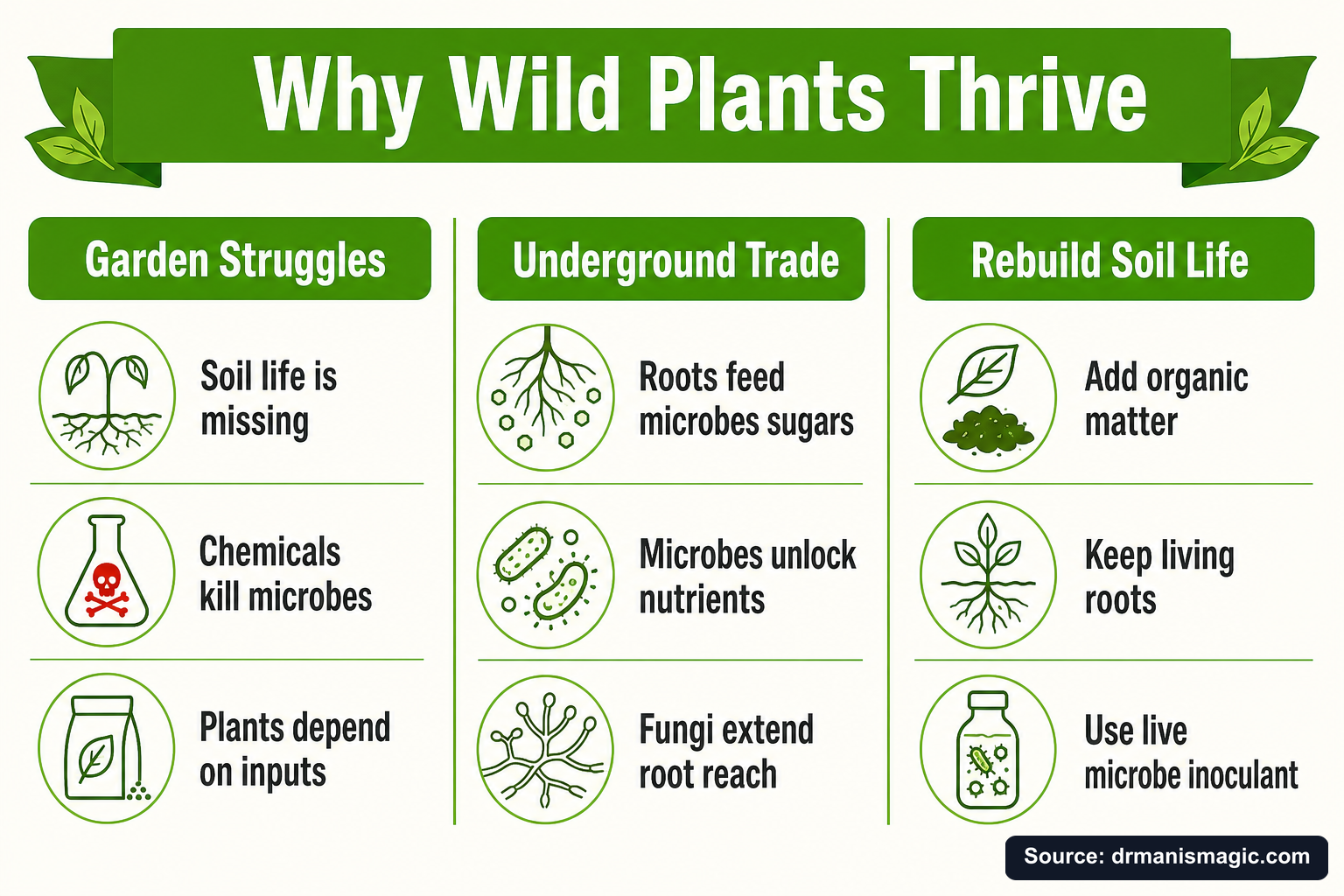
- Wild plants thrive because their soil is alive with trillions of bacteria, fungi, protozoa, and nematodes working as a self-feeding nutrient engine.
- Plant roots leak sugars on purpose to feed soil microbes, and those microbes feed nutrients back to the roots in return. It is a trade, not an accident.
- Mycorrhizal fungi extend roots up to 100 times farther into the soil, giving plants access to water and nutrients they could never reach alone.
- Salt-based synthetic fertilizers, pesticides, and herbicides quietly wipe out this underground workforce, leaving your plants defenseless and dependent on the next bag of chemicals.
- Dead or dried microbial products sold in powder form at most stores do not work. Genuinely live microbes are what actually move the needle.
- You can restore dead or damaged soil biology by following a simple recovery sequence using organic matter, living roots, and a full-spectrum live microbial inoculant.
- The Three Plant Pillars, developed by Dr. Mani Skaria at US Citrus Nursery, give any plant owner the exact foundation that wild ecosystems have naturally.
Why Do Wild Plants Grow Without Fertilizer or Water Schedules?
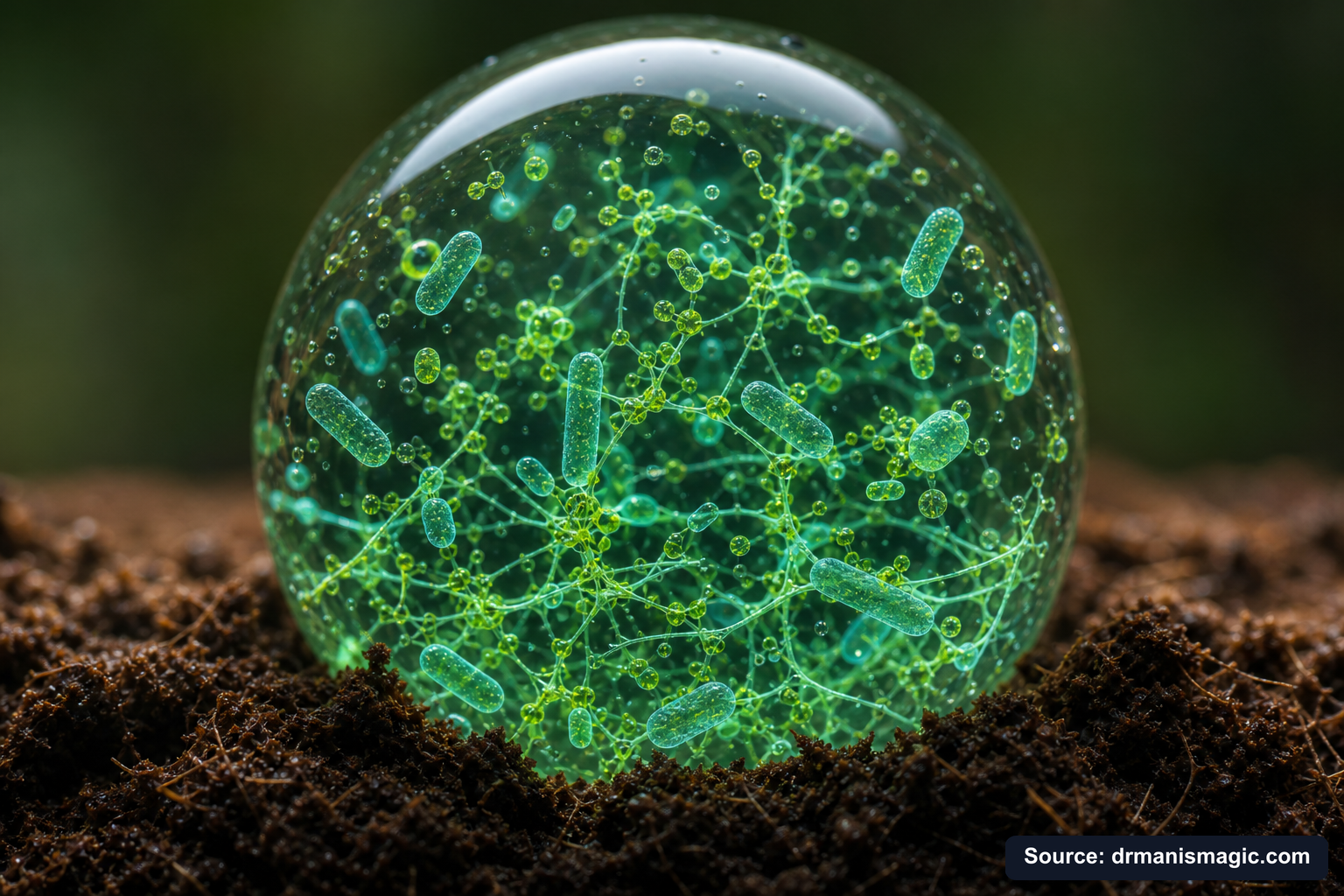
Quick Answer: Wild plants grow without human help because their soil contains a complete, living food web. Bacteria and fungi break down organic matter, protozoa and nematodes release nutrients back to roots, and mycorrhizal fungi extend the root system far beyond what roots alone can reach. The plants feed the microbes, and the microbes feed the plants. It is a closed loop.
The secret is not the plant. It is the dirt under the plant.
Healthy wild soil is not just dirt. It is a living city. One teaspoon of healthy forest soil can contain more bacteria than there are people on Earth. There are fungi weaving through it like a hidden internet. There are tiny animals called protozoa grazing on bacteria. There are nematodes hunting through soil pores. There are earthworms tunneling and aerating and leaving behind rich castings. Every single creature in that underground city has a job, and together they run a nutrient recycling system that no bag of fertilizer has ever come close to matching.
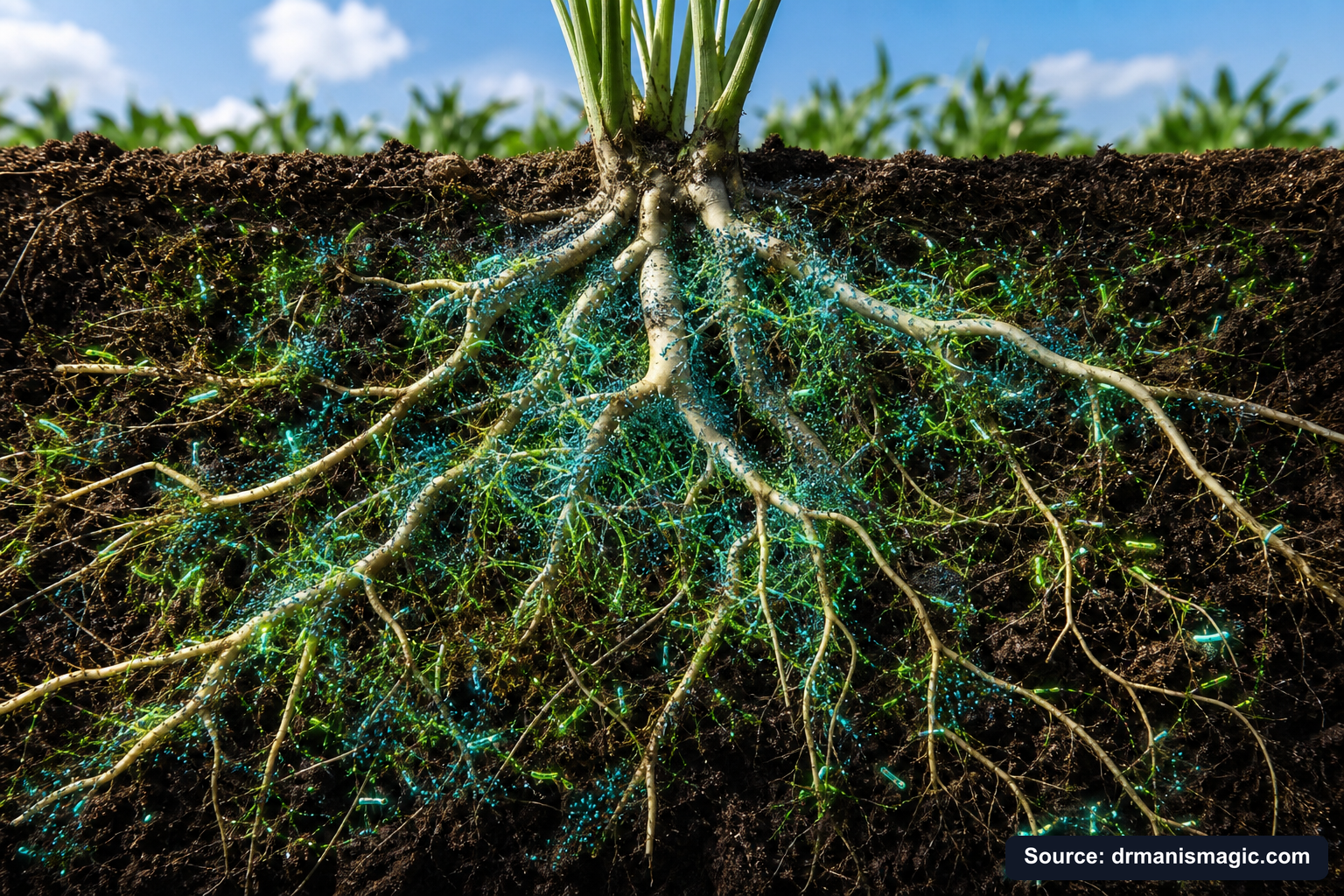
Here is the thing that blew our minds when we first dug into this research. The plant is not passive in this arrangement. Plant roots actually leak sugars, amino acids, and other compounds into the surrounding soil on purpose. Scientists call these root exudates. The plant is essentially paying its underground workforce. In return, the microbes break down organic matter, unlock minerals locked in the soil, fix nitrogen from the air, and deliver all of it directly to the root zone where the plant needs it most. Colorado State University Extension describes healthy soil as a living ecosystem, not an inert growing medium, and that framing changes everything about how you think about feeding your plants.
The wild forest does not need you to bring fertilizer because it already has a workforce doing that job. The question is: does your garden?
What Is the Soil Food Web and Why Does It Feed Your Plants?
Quick Answer: The soil food web is a network of living organisms, from bacteria and fungi up through protozoa, nematodes, insects, and earthworms, that recycle nutrients and make them available to plant roots. When all the layers of this web are present and active, plants get a steady, natural supply of everything they need without synthetic inputs.
Think of the soil food web like a restaurant kitchen. The bacteria and fungi are the prep cooks. They break down dead leaves, old roots, and organic matter into smaller pieces. The protozoa are like the quality control team. They eat the bacteria and excrete excess nitrogen as ammonium, which is a form plants can absorb directly. The nematodes eat the protozoa and the bacteria and release even more nutrients. The earthworms are the dishwashers, moving everything around, aerating, and leaving behind castings that are incredibly rich in plant-available nutrients.
Every layer of this food web is doing something the layer below it cannot do alone. When you remove even one layer, the whole kitchen slows down. Remove several layers, which is exactly what synthetic chemicals do, and the kitchen stops producing food entirely. Your plant stands there hungry, waiting for a meal that never arrives. So you run out with a bag of synthetic fertilizer, which is essentially fast food for the plant. It works for a moment. But it does not rebuild the kitchen.
| Organism | What It Does | Why Your Plant Cares |
|---|---|---|
| Bacteria | Break down organic matter, fix nitrogen from air, solubilize minerals, suppress pathogens | Delivers nitrogen, phosphorus, and trace minerals directly to the root zone |
| Mycorrhizal Fungi | Extend root surface area, improve water and phosphorus uptake, produce glomalin to bind soil particles | Gives roots access to nutrients and water far beyond their physical reach; builds soil structure |
| Protozoa | Graze on bacteria, releasing excess nitrogen as ammonium near the root zone | Creates a nutrient delivery system right where roots need it most |
| Beneficial Nematodes | Prey on bacteria, fungi, and pest insects; release nutrients through excretion | Recycles nutrients and suppresses harmful soil pests and pathogens |
| Earthworms | Aerate soil, shred organic matter, leave nutrient-rich castings | Improves drainage, aeration, and slow-release nutrient availability |
| Microarthropods | Shred organic matter into smaller pieces for bacteria and fungi to process | Speeds up the decomposition cycle so nutrients become available faster |
Dr. Mani Skaria spent four decades studying plant pathology at the Texas A&M Citrus Center. He watched citrus trees and tropical plants struggle despite perfect watering and fertilizer schedules. And what he kept coming back to was the same missing ingredient. Not a nutrient. Not a chemical. The living biology in the soil. When he restored that biology, the trees changed. Growth accelerated. Disease pressure dropped. The soil itself started to feel different, darker, more crumbly, alive in a way that sterile potting mix never is.
What Do Mycorrhizal Fungi Actually Do for Plant Roots?
Quick Answer: Mycorrhizal fungi attach to plant roots and grow threadlike hyphae out into the soil, dramatically expanding the root's reach. This gives the plant access to phosphorus, water, and micronutrients it could never find on its own. The fungi receive sugars from the plant in exchange. It is one of the oldest partnerships in nature, and it works in almost every plant species on Earth.
Have you ever pulled a weed and noticed white fuzzy threads clinging to the roots? That white fuzz is mycorrhizae. And here is what is wild about it. Those threads are why that weed grew so fast and so stubbornly. The fungi are literally extending the root system, sometimes by a factor of 100, reaching into tiny pores in the soil that the root itself is too big to enter.
In a wild ecosystem, most plants have this fungal network already. It connects trees to each other underground. It carries water during drought. It carries warning signals when one plant is attacked by pests. The University of Wisconsin Extension explains that mycorrhizal associations exist in roughly 80 to 90 percent of all plant species, making this one of the most universal partnerships in the plant kingdom.
The problem is that most container soils, potting mixes, and heavily managed garden beds have none of this. The fungi are gone. The network was never established. Your plant is growing with the equivalent of one hand tied behind its back, reaching only as far as its physical roots allow, while the wild plants next door have a thousand invisible arms stretching in every direction.
This is not a small difference. This is the difference between a plant that survives and a plant that thrives.
How Do Salt-Based Fertilizers and Pesticides Destroy Soil Biology?
Quick Answer: Salt-based synthetic fertilizers raise the salt concentration in soil, which pulls water away from microbial cells through osmosis and kills them. Pesticides and herbicides like glyphosate further disrupt or eliminate beneficial bacteria and fungi. The result is sterile soil that looks fed but is biologically dead, forcing plants into total dependency on the next chemical application.
Here is the part of the story that made Dr. Mani genuinely angry. And once you hear it, it might make you a little angry too.
Synthetic fertilizers are salt-based. That is not a controversial statement. It is chemistry. When you pour salt-heavy fertilizer into your soil, the salt concentration around the roots spikes. Microbial cells, which are mostly water, respond the same way a slug responds to salt. Water rushes out of them. They die or go dormant. The very organisms that were doing the feeding, protecting, and recycling work underground are wiped out by the thing that was supposed to help your plant.
Now your plant gets a short burst of nutrients from the fertilizer. It looks green for a few weeks. You feel good. But the underground workforce is gone. So when the fertilizer runs out, the plant has nothing. No microbes to unlock nutrients. No fungi to reach for water. No bacteria to suppress disease. The plant is now completely dependent on you and your next bag of chemicals. And the company that sold you the first bag is counting on that.
We have watched this pattern play out across tens of thousands of trees. The grower does everything the label says. The tree looks okay for a season. Then it stalls. Then it starts circling the drain. Money was spent. But worse than the money, time was lost. And unlike money, you cannot get time back.
See also: The Hidden Reason Synthetic Fertilizers Cause Root Rot
Live Microbes vs. Dead Microbe Products: What Is the Real Difference?
Quick Answer: Most microbial products sold in stores are either dried powders with dormant spores that rarely reactivate, or compost-tea liquids that went anaerobic during shipping and now smell terrible. Genuinely live, stabilized microbes from a full-spectrum natural source are a completely different thing. They are biologically active the moment they hit your soil.
Not all microbial products are the same. Not even close. This is where most gardeners get fooled, and where most of the money in the "soil biology" market quietly disappears.
Walk into any garden center and you will find shelves of products promising beneficial bacteria, mycorrhizae, and soil biology in a bag or bottle. Most of them do not work. We have tested dozens of them on our own trees over the years, and the results were consistently disappointing. Here is why.
| Product Type | Viability at Use | Microbial Spectrum | Smell | Does It Work? |
|---|---|---|---|---|
| Dry / powdered lab microbes | Very low. Spores rarely reactivate in typical soil conditions. | Narrow. A handful of lab-selected strains. | Neutral | We saw no consistent results across dozens of trials. |
| Dry microbes rehydrated in liquid | Very low. Same spore problem as above. | Narrow. | Neutral | No. Same issue. |
| Compost tea, fresh (under 24 hours, aerated) | Moderate. Time-sensitive. Must be used immediately. | Broad but inconsistent. | Earthy to slightly sour | Yes, when truly fresh. Not practical for most gardeners. |
| Compost tea, old (over 24 hours) | Low. Gone anaerobic. Microbes are dying. | Degraded. | Strong stench. Rotten sewage smell. | Minimal. Some humic acid benefit but biology is largely lost. |
| Fresh active compost (on-site) | High. Best natural source. | Broad and natural. | Rich and earthy | Yes. But requires time, space, and effort most people do not have. |
| Plant Super Boost (stabilized, full-spectrum) | High. Genuinely live. Visible under microscope. | 2,000+ bacteria species, 400-500 fungi including mycorrhizae, plus protozoa and nematodes. | Earthy. Not offensive. | Yes. Proven across 250,000+ trees at US Citrus Nursery. |
The problem with most commercial microbial products is they are manufactured in giant industrial vats. Specific microbial strains are selected from a checklist, multiplied in those vats, then dried into a powder. The hope is that the spores survive shipping, survive sitting on a shelf, survive being poured into your soil, and then somehow reactivate. In our experience testing these products, that chain of hopes does not hold up.
The second category is worse in a different way. Compost-derived liquid products start with genuinely good biology, but by the time that bottle travels from the producer to the warehouse to the store shelf to your doorstep, it has been sitting for weeks or months. Without active aeration, those microbes go anaerobic. They start dying. They start fermenting. The bottle smells like a sewer. You open it, grimace, and wonder if you are supposed to pour this on your tomatoes. The answer is probably not.
What Dr. Mani's team discovered, through a providential partnership with a world-renowned compostologist who had been blacklisted by large chemical companies for producing results that threatened their market, was a natural, proprietary method to stabilize full-spectrum compost biology. The microbes stay alive. They do not go anaerobic. The product smells like earth, not sewage. And if you put a single drop under a microscope, you can actually watch them move.
That is Plant Super Boost. It is not a lab-grown product. It is not a dried powder. It is the closest thing to pouring fresh, steaming hot compost directly on your roots, in a bottle you can use monthly on any plant you own, with zero synthetic chemicals, zero PFAS, zero biosludge, and zero salt.
You Never Had a Brown Thumb.
You were handed the wrong tools. This free guide hands you the right ones.
You watered it. You fed it. It died anyway.
It was never you. It was the dirt, the salt food, and the bad advice.
This guide shows you what really went wrong, and how to fix it for good.
- Why your plants really died, and why it was never your fault
- The salt hiding in your plant food that quietly burns the roots
- The hidden killer in almost every bag of store soil
- The tiny helpers that grow a whole forest for free
- The rescue trick that brings a half dead plant back to life

Why Does Your Garden Soil Become Biologically Dead Over Time?
Quick Answer: Garden soil loses its living biology through repeated applications of salt-based fertilizers, pesticides, fungicides, and herbicides, combined with compaction, lack of organic matter, and the absence of living roots. Container soil starts sterile and never gains biology without deliberate inoculation. The result in both cases is soil that cannot feed, protect, or sustain plants on its own.
Here is something most gardening content never tells you. Potting mix starts biologically dead. There are no microbes in it. It is sterilized to prevent pathogens, which also kills every beneficial organism. So the moment you plant something in a bag of potting mix, your plant is already starting without its underground workforce.
In-ground garden soil has a different problem. It used to have biology. But decades of synthetic herbicides, pesticides, and salt-based fertilizers have systematically stripped it away. Glyphosate, the active ingredient in many common weed killers, has been shown to disrupt microbial communities in the soil. Synthetic anti-fungals wipe out the mycorrhizal fungi that are essential to root extension and phosphorus uptake. Broad-spectrum pesticides kill indiscriminately, taking beneficial nematodes and protozoa along with the pests they were meant to control.
And then there is compaction. When soil is compacted, the tiny air pockets that aerobic microbes need to survive are crushed out. The soil becomes anaerobic in the wrong way. Oxygen-loving beneficial bacteria cannot survive. The biology collapses inward.
The result is soil that looks like soil but functions like sand. Water runs through it or pools on top. Nutrients wash away. Disease pressure rises because the natural suppressors are gone. And the plant sits there in the middle of it all, trying to grow with almost nothing to work with.
How Can You Bring Dead or Damaged Soil Back to Life?
Quick Answer: Soil biology recovers when you stop the inputs that killed it, add organic matter and living roots, apply full-spectrum live microbials, and give the system time. Recovery does not happen overnight. It happens in layers, over weeks and months, and it accelerates dramatically when you address all three of the core pillars at once.
The good news is that soil can recover. We have watched it happen over and over at our nursery and in the gardens of growers across the country. But there is a right way and a wrong way to do it.
The wrong way is to buy one product, pour it on once, and expect a transformation. Biology does not work like that. You are rebuilding an ecosystem. That takes repeated effort, the right inputs, and a commitment to stopping the things that are destroying the system in the first place.
Here is the recovery sequence we recommend, developed from decades of growing at US Citrus Nursery:
- Stop the damage first. Eliminate or dramatically reduce synthetic herbicides, pesticides, fungicides, and salt-based fertilizers. You cannot rebuild biology while continuously poisoning it. This is the non-negotiable first step.
- Test your pH and salt levels. Soil that is too acidic, too alkaline, or too salty cannot support healthy microbial life regardless of what you add to it. Aim for a pH in the range your target plants prefer, and flush accumulated salts with deep, thorough watering before adding new inputs.
- Add organic matter. Compost, aged wood chips, and mulch on the soil surface feed the organisms you are trying to rebuild. They also protect soil temperature and moisture, which are critical for microbial survival.
- Keep living roots in the soil. Living roots release exudates that feed microbes directly. Cover crops, companion plants, or simply keeping your beds planted rather than bare speeds up biological recovery dramatically.
- Apply a full-spectrum live microbial inoculant monthly. This is where most recovery programs fall short. They add organic matter but never reintroduce the organisms that process it. Applying genuinely live, full-spectrum microbes, not dried powder, not anaerobic compost tea, but actively living biology, gives the recovery process the workforce it needs.
- Switch to organic, slow-release fertilizer. Organic fertilizers feed both the plant and the microbes. They release nutrients gradually in forms that work with biology, not against it. They do not spike salt levels. They do not burn roots. They do not wipe out the workforce you just rebuilt.
- Be patient and consistent. Microbial communities do not rebuild in a week. Give the process two to four months of consistent application before drawing conclusions. The plants will tell you when it is working. Growth will change. Color will change. The soil itself will start to smell different, richer, earthier, alive.
This recovery process is not complicated. But it requires that all three pieces are working together. Which brings us to the framework that changed everything for us.
What Are the Three Plant Pillars and Why Do Wild Plants Already Have Them?
Quick Answer: The Three Plant Pillars are the exact conditions that wild plants grow in naturally: mineral-based soil with proper structure and drainage, a living microbial community in the root zone, and a steady supply of organic slow-release nutrients. Wild plants have all three automatically. Garden plants almost never do unless you deliberately provide them.
After 30-plus years of growing citrus and tropical plants in South Texas, Dr. Mani Skaria distilled everything he had learned into a framework simple enough for anyone to follow. He called it the Three Plant Pillars. And when you see it laid out, you realize it is just a description of what wild soil already is.
Pillar One: Mineral Foundation. Wild soil is mineral-based. It has structure that does not collapse. It has drainage that moves water through without drowning roots. It has aeration that lets roots breathe. Most store-bought potting mixes are built from pine bark and wood fibers that decompose within months, compact into a suffocating sludge, and rob oxygen from the root zone as they break down. Super Soil from Dr. Mani's Magic is built on sandy loam from the Rio Grande Valley, a mineral-based soil that does not decompose, does not compact, and does not need to be replaced every year.
Pillar Two: Microbial Muscle. Wild soil has trillions of live microbes working around the clock. Garden soil, container soil, and any soil treated with synthetic chemicals is largely devoid of this workforce. This pillar is the one most gardeners have never heard of, and it is the one that changes everything when it is restored.
Pillar Three: Organic Fertilizer. Wild ecosystems are fertilized by falling leaves, decomposing roots, animal waste, and the microbial processing of all of that organic matter into plant-available nutrients. The release is slow, steady, and perfectly timed to plant need. Our Crab, Kelp and Amino Acids organic fertilizer mirrors that process. It feeds the plant and the microbes simultaneously, without salt, without synthetic chemicals, and without the boom-and-bust cycle that synthetic fertilizers create.
Wild plants thrive without care because they already have all three pillars in place. They were born into them. Your garden plants were not. But you can give them that same foundation. And when you do, the change is not subtle. It is the difference between a plant that is surviving and a plant that is actually, visibly, unstoppably alive.
You can explore how all three pillars work together at the Three Plant Pillars bundle page.
Is There a Practical Difference Between Wild Soil and Managed Garden Soil?
Quick Answer: Yes. The practical difference is measurable and significant. Wild soil has biological diversity, stable structure, active nutrient cycling, and natural disease suppression. Most managed garden or container soil has none of these by default. The gap between them explains why wild plants look effortless while garden plants require constant intervention.
Let us make this concrete. Here is a side-by-side comparison of what wild soil has versus what most managed growing conditions look like.
| Factor | Wild / Forest Soil | Typical Managed Garden or Container Soil |
|---|---|---|
| Microbial diversity | Thousands of species of bacteria and fungi; full food web present | Low to none. Sterile by design or depleted by chemicals. |
| Nutrient cycling | Continuous. Organic matter is constantly broken down and recycled. | Dependent on external inputs. Stops when fertilizer runs out. |
| Soil structure | Aggregated by fungal glomalin. Well-aerated with good water retention. | Compacted or broken down. Poor drainage or waterlogging. |
| Disease suppression | Natural. Beneficial organisms crowd out pathogens. | Absent. Pathogens thrive in biology-free soil. |
| Drought resilience | High. Mycorrhizae extend water reach. Aggregated soil holds moisture. | Low. Roots limited to physical root zone. Soil dries fast. |
| Root extension | Massively extended by mycorrhizal hyphae reaching micro-pores. | Limited to physical root length. No fungal extension in sterile soil. |
| Nitrogen source | Atmospheric fixation by bacteria, recycling by protozoa and nematodes. | Synthetic application. Salt-based. Wipes out the biology it replaces. |
| Long-term trajectory | Improving. More biology builds better soil over time. | Declining. Each chemical application degrades the system further. |
The gap is not a mystery. It is not bad luck. It is a structural difference in the growing environment. And the Three Plant Pillars exist specifically to close that gap, deliberately and permanently, for any plant you want to grow.
If you want to go deeper on how salt-based inputs specifically sabotage this process, see also: How Salt-Based Feeding Quietly Destroys Root Systems
What Can You Do Right Now to Give Your Plants What Wild Plants Have?
Quick Answer: Start by restoring the biology in your soil. Stop the inputs that are killing it. Add organic matter and mulch. Apply full-spectrum live microbes monthly. Switch to an organic slow-release fertilizer. These steps, taken together and consistently, rebuild the underground economy that wild plants rely on automatically.
This is where we bring it home.
You now know what wild plants have that your garden probably does not. You know that the invisible underground workforce is the engine behind all that effortless growth. You know that most of what you have been sold has been quietly dismantling that engine. And you know that you can rebuild it.
Here is what that looks like in practice, whether you are growing citrus trees in containers, managing a backyard garden, trying to green up a lawn, or keeping houseplants alive on a windowsill.
Start with the soil. Not the plant. The soil. Get the structure right first, because biology cannot live in compacted, waterlogged, or oxygen-deprived conditions. If you are in containers, look at what you are growing in. If it is a wood-based potting mix that has been sitting for more than a year, it is likely breaking down and compacting. Super Soil gives you a mineral-based foundation that does not decompose, does not compact, and does not steal oxygen from roots.
Then bring the biology back. Pour a monthly drench of genuinely live, full-spectrum microbes into your root zone. Not a powder. Not a stinky liquid that has been sitting in a warehouse. Living biology that you can actually see moving under a microscope. Biology that includes 2,000-plus species of bacteria, 400 to 500 fungal species including mycorrhizae, plus protozoa and beneficial nematodes. The same diversity that a thriving wild ecosystem already has. That is what Plant Super Boost delivers.
Then feed the system with organic nutrients that work with the biology instead of burning it down. No salt. No synthetic chemicals. No PFAS. No biosludge. Just slow-release, earth-born nutrients from crab, kelp, and amino acids that nourish the plant and the microbes simultaneously.
That is it. Three pillars. The same three things wild soil already has. When all three are in place, the transformation is not subtle. Growers tell us about it all the time. Roots look different. Leaves look different. The soil smells different. And the plants, whether they are citrus trees or houseplants or a struggling lawn, start to behave the way wild plants do. Like they belong in the ground. Like they are not fighting anything. Like they are finally, genuinely home.
You have already spent enough time and money on the old approach. The best time to restore your soil biology was years ago. The second best time is right now. If you want to see what the Three Plant Pillars can do for any plant you own, download the Free Plant Care Field Guide and start with the foundation that wild plants have always had.
Frequently Asked Questions
You just learned why wild plants thrive without a single bag of fertilizer or a watering schedule. Now your brain is probably firing off questions. Good. These are the exact questions gardeners ask us every day, and the answers might change the way you look at every plant you own.
Why do wild plants thrive without any care but my garden keeps struggling?
Wild plants sit on top of a living underground city. Billions of bacteria, fungi, and other microbes break down organic matter and push nutrients straight to the roots. Your garden struggles because most store-bought soils, synthetic fertilizers, and pesticides quietly wipe that underground city out. No microbes means no nutrient delivery. The plant starves even when you feed it. That is the gap. Dr. Mani spent 35 years and over 250,000 trees figuring that out.
What are the Three Plant Pillars and why do they matter?
The Three Plant Pillars are the same foundation wild ecosystems use naturally. Pillar One is mineral-based soil that drains perfectly and never compacts or rots. Pillar Two is live microbes, the bacteria and fungi that unlock nutrients and fight off disease. Pillar Three is slow-release organic fertilizer that feeds without burning. Get all three working together and your plants stop fighting you. Miss even one and the whole system limps.
Do the microbes in most gardening products actually work?
Most powder and granule products on store shelves are dead before you open the bag. Microbes need to be alive to do anything. Dr. Mani partnered with a compost expert who figured out how to keep live bacteria, fungi, and mycorrhizae stable in a bottle without them rotting. That is what makes Plant Super Boost different. It does not smell bad. It is not dead. It goes to work the moment you water it in.
Why does regular potting mix cause so many problems?
Most potting mix is loaded with pine bark and sawdust. That organic material breaks down fast. As it rots, it compacts around the roots, blocks oxygen, and holds too much water. Roots need oxygen to breathe. Choke the oxygen and you get root rot, yellow leaves, and a plant that slowly gives up. Dr. Mani's Super Soil uses mineral-based sandy loam from South Texas. It does not decompose. Roots breathe. Drainage stays perfect. No rot.
Is synthetic fertilizer really that harmful to my plants and soil?
Synthetic fertilizers are salt-based. Salt burns roots and wipes out the beneficial microbes your soil depends on. The plant gets a quick green flush and then crashes. You buy more fertilizer. The cycle repeats. Meanwhile your soil gets deader with every application. Some slow-release synthetics are coated in plastic that leaches toxins into the ground. Dr. Mani's organic fertilizer uses crab, kelp, and amino acids. Slow release. No salt burn. No plastic. No dead soil.
How long does it take to see results after fixing the soil biology?
Most people start seeing a difference within the first month. Roots get more oxygen. Microbes start unlocking nutrients that were already locked in your soil. Leaves green up. New growth appears. The longer you stay consistent with all Three Plant Pillars, the stronger your plants get. This is not a band-aid. It is a foundation. And a solid foundation keeps building. Every season is better than the last instead of worse.
Can the Three Plant Pillars work for plants other than citrus trees?
Yes. Dr. Mani tested this system on over 250,000 citrus trees at US Citrus Nursery, but the Three Plant Pillars work for any plant. Houseplants, lawns, vegetable gardens, flower beds, tropical trees, hedges. Every plant on the planet needs good soil structure, living microbes, and clean nutrition. The species changes. The foundation never does. If it works for a citrus grove in South Texas, it works for the tomato plant on your back porch.
About the Author
Dr. Mani Skaria, PhD
Dr. Mani Skaria, PhD, is a plant pathologist and the scientific founder of Dr. Mani's Magic. He earned his doctorate at Purdue University and spent 48 years studying how plants, soil, and living microbes work together, including his years as Professor Emeritus at Texas A&M and as a member of the USDA NAREEE Advisory Board. He invented micro-budding, a method for growing healthier, stronger trees, and has grown more than 250,000 trees on the family farm in Hargill, Texas - US Citrus Nursery. His life's work takes real lab science and practical experience and turns it into simple, safe, organic plant care anyone can use at home.


