


Why Wild Citrus Survives Where Backyard Trees Fail | Dr. Mani's Magic
Why Wild Citrus Survives Where Backyard Trees Fail (And What the Forest Floor Knows That You Don't)
Picture this. You're driving down a back road in Florida or South Texas. The pavement is cracked. Nobody has been out here in years. And there, growing out of the clay and gravel and dead leaves, is a citrus tree. No irrigation system. No fertilizer bags stacked nearby. No gardener checking on it every week. Just a tree. And it is loaded with fruit.
Now picture your backyard. You bought a beautiful lemon tree. You watered it. You fertilized it. You followed the directions on the bag. You did everything right. And yet the leaves are yellow. The fruit is small, if it comes at all. Something is wrong, and you cannot figure out what. You start to wonder if you just have a brown thumb. You don't. The truth is something nobody at the garden center ever told you.
That wild tree by the road is not surviving on luck. It is plugged into something invisible. Something alive. Something that most backyard setups have accidentally destroyed. And once you understand what that is, everything about your struggling tree will finally make sense. This is the story of the soil food web, and why the forest floor is smarter than any bag of fertilizer ever made.

Plant Super Boost
Key Takeaways
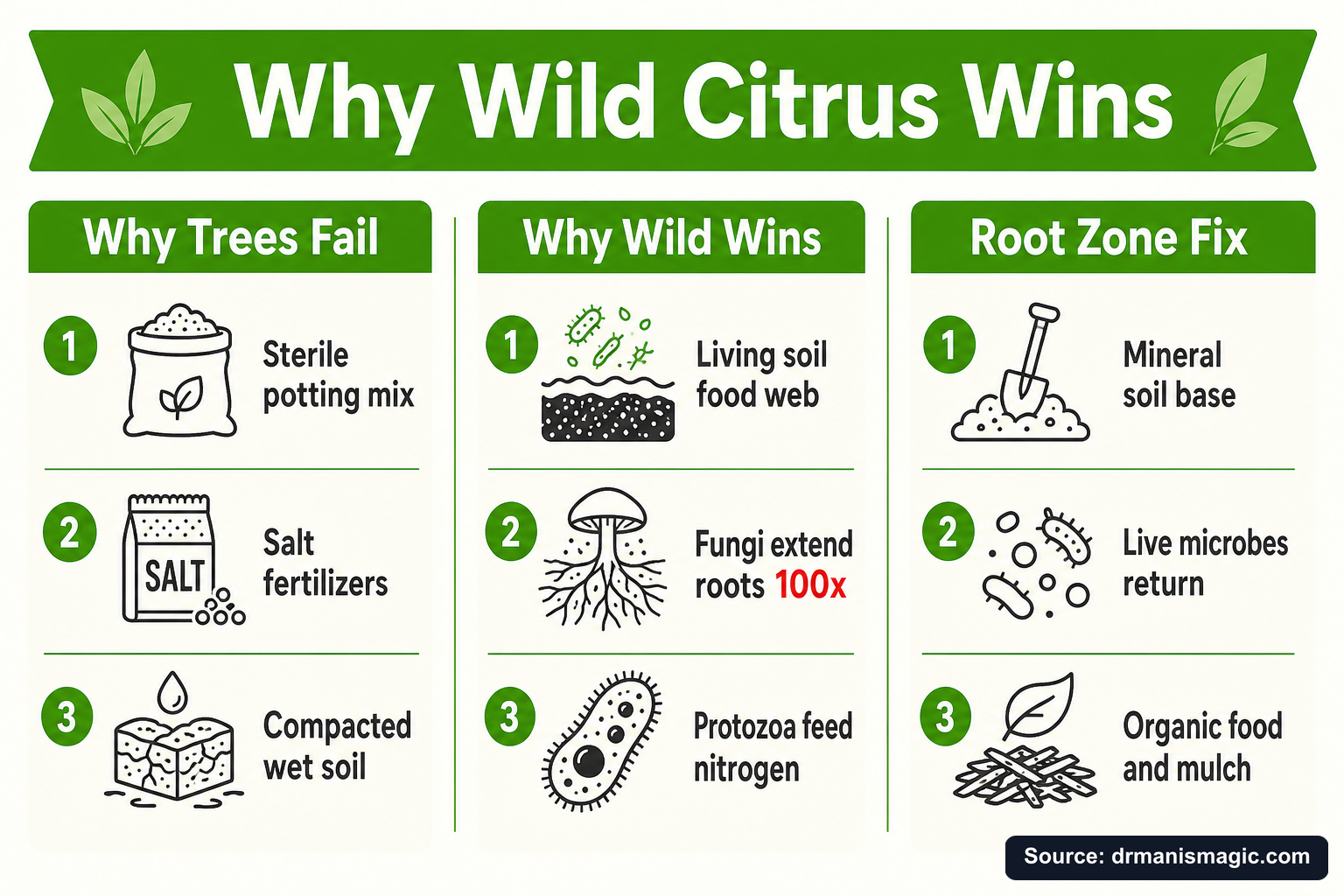
- Wild citrus survives because it lives inside a complete, self-repairing soil ecosystem with billions of living microbes working 24 hours a day.
- Backyard citrus fails most often because the root zone becomes sterile, salty, compacted, or biologically dead, not because of bad luck or a brown thumb.
- Citrus roots are unusually short and sparse, making them more dependent on mycorrhizal fungi than almost any other backyard tree.
- Salt-based synthetic fertilizers, fungicides, and herbicides kill the very microbes that protect roots and unlock nutrients.
- Protozoa and beneficial nematodes are the invisible nutrient recyclers nobody talks about, and their absence is a hidden cause of yellowing leaves.
- Rebuilding a living root zone takes time, the right biology, and a step-by-step plan, not more fertilizer.
- The Three Plant Pillars (mineral soil, live microbes, organic fertilizer) are the root-cause solution, not a band-aid.
What Is the Soil Food Web and Why Does It Keep Wild Trees Alive?
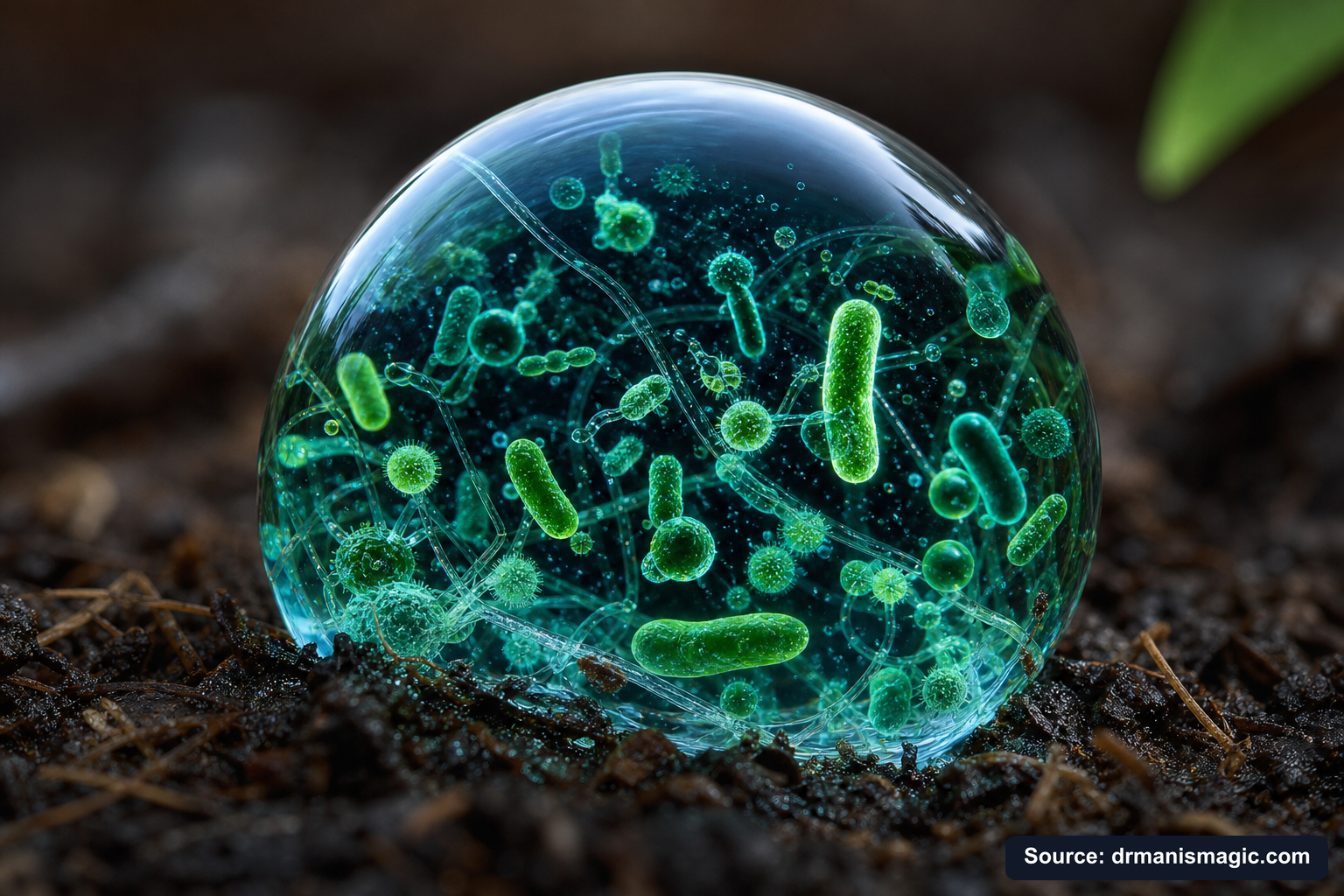
Quick Answer: The soil food web is a community of bacteria, fungi, protozoa, nematodes, and other organisms that live around plant roots. They cycle nutrients, fight disease, build soil structure, and move water. Wild citrus thrives inside this web. Most backyard trees are cut off from it.
The soil under a wild citrus tree is not dirt. It is a city. A living, breathing, eating, fighting, reproducing city with trillions of residents. Bacteria break down dead leaves. Fungi stretch out like underground cables, connecting roots to nutrients fifty feet away. Protozoa hunt bacteria and release nitrogen right next to the roots. Nematodes keep everything in balance. And the tree? It feeds them all sugar through its roots. In return, they feed it everything it needs to grow.
University of California Agriculture and Natural Resources describes healthy soil as a living ecosystem where biological activity drives nutrient cycling, disease suppression, water movement, and soil structure all at once. (UC ANR Soil Health.) That is not a metaphor. That is the actual operating system of every thriving plant on earth.
The wild tree has this operating system fully installed. Your backyard tree, planted in a bag of dead potting mix and fed synthetic salts, often does not. That is the whole story in two sentences. Now let's go deeper.
| Organism | What It Does for Your Tree | What Kills It |
|---|---|---|
| Bacteria | Break down organic matter, fix nitrogen from the air, fight pathogens, release nutrients next to roots | Salt-based fertilizers, herbicides, synthetic fungicides |
| Mycorrhizal Fungi | Extend root reach by 100x, unlock phosphorus, improve drought resistance, produce glomalin to hold soil together | Synthetic fungicides, phosphorus overload, compaction, waterlogging |
| Protozoa | Eat bacteria, release nitrogen directly at the root zone (nature's slow-release fertilizer) | Drying out, pesticides, synthetic inputs |
| Beneficial Nematodes | Eat bad bacteria, bad fungi, and harmful root-feeding nematodes; regulate the food web | Broad-spectrum pesticides, soil fumigants, compaction |
| Arthropods (tiny insects) | Shred dead leaves into smaller pieces so bacteria and fungi can finish the job | Pesticides, loss of mulch layer |
Each one of these plays a role. Remove any one, and the chain breaks. In a wild forest, the chain is intact. In a typical backyard planting hole, it is often broken before the tree even goes in the ground.
Why Are Citrus Roots More Vulnerable Than Other Trees?
Quick Answer: Citrus roots have unusually short, sparse root hairs. This makes them more dependent on mycorrhizal fungi to absorb water and nutrients than most other trees. When those fungi are absent or killed, citrus suffers fast, even when fertilizer is being applied.
Here is something most gardeners never hear. Citrus roots are not great at feeding themselves. Unlike many other trees, citrus has short and sparse root hairs. Root hairs are the tiny threads that reach out and grab water and nutrients from the soil. Citrus doesn't have many of them.
So how does wild citrus survive? It outsources the job. It forms a partnership with mycorrhizal fungi. These fungi wrap around and even grow inside the root cells. Then they send out their own threads, called hyphae, deep into the soil. We are talking about a network that can be hundreds of times larger than the root system itself. They find phosphorus, zinc, copper, and water in places the roots alone could never reach.
Research from the University of Florida IFAS Extension confirms that arbuscular mycorrhizal fungi (AMF) are critical partners for citrus, especially in phosphorus uptake, because phosphorus moves so slowly through soil that roots cannot reach it fast enough without fungal help. (UF/IFAS Extension Citrus Resources.)
Now think about what happens when you plant a citrus tree from a big box store. The potting mix is sterile. No fungi. No bacteria. No protozoa. Nothing alive. The tree is on its own with its short root hairs, trying to survive in biological silence. You pour on synthetic fertilizer to compensate. The salts in that fertilizer make things worse. And the tree slowly declines. The fertilizer bag gets blamed. The tree gets blamed. You get blamed. But the real problem was invisible from the start.
What Does the Litter Layer Do That Your Backyard Skips?
Quick Answer: The litter layer is the layer of dead leaves and organic material on the forest floor. It feeds bacteria and fungi, keeps soil moist, moderates temperature, and constantly restocks the soil food web. Most backyard trees never get this. Without it, the biology collapses slowly over time.
Walk into any wild grove or forest. Look down. You will see a carpet of dead leaves, broken twigs, and old fruit. That is not a mess. That is a factory. Bacteria and fungi break it down from below. Arthropods and worms shred it from above. The nutrients get released slowly, right where the roots can grab them. The soil stays loose and moist. The temperature under that layer stays stable even on hot days.
Now look at most backyard citrus trees. The ground around them is bare. Maybe there is a ring of mulch, but often it is pushed right up against the trunk (which causes rot). The bare soil bakes in the sun. It dries out fast. There is nothing to feed the soil food web. No litter cycle. No biological restock. Just empty ground waiting for the next bag of fertilizer.
Wild citrus does not need fertilizer bags because the litter layer IS the fertilizer. It is also the irrigation buffer, the disease suppressor, and the microbe hotel. All in one. For free. The forest figured this out billions of years before we started selling gardening products.
If you want to give your backyard tree a fighting chance, start by thinking like a forest. Mulch is not optional. It is the foundation of everything else. Just keep it a few inches away from the trunk.
How Do Salt-Based Fertilizers Quietly Destroy What Wild Soil Has?
Quick Answer: Salt-based synthetic fertilizers kill or impair beneficial bacteria and fungi in the root zone. They cause a short burst of green growth, then a slow collapse. The microbes that protect roots and unlock nutrients die off, leaving the tree dependent on more and more fertilizer just to stay alive.
Here is the trap most gardeners fall into. The tree looks yellow. You add fertilizer. It greens up for a few weeks. Then it looks yellow again. So you add more. And more. And the cycle never ends. This is not a nutrient problem. This is a biology problem wearing a nutrient costume.
Salt-based synthetic fertilizers work like a quick energy drink. Fast results. Then a crash. The salts in these products pull water out of microbial cells the same way they pull water out of a slug. The bacteria and fungi around the roots die. The protozoa have nothing to eat. The nematodes disappear. The whole food web collapses. And the tree, stripped of its invisible workforce, becomes completely dependent on you for every single nutrient it needs.
Wild trees never get into this cycle. The soil food web is intact. Nutrients are released slowly and steadily by living organisms. No crash. No addiction. No yellowing leaves that come back two weeks after fertilizing.
See also: The Hidden Reason Synthetic Fertilizers Cause Root Rot
See also: How Salt-Based Feeding Quietly Destroys Root Systems
What Is Rhizosphere Recruitment and Why Does It Matter for Backyard Trees?
Quick Answer: Rhizosphere recruitment is the process where healthy citrus roots pull specific beneficial bacteria from the surrounding soil and concentrate them right at the root surface. Wild trees do this naturally. Trees in sterile soil or disturbed soil cannot recruit the microbes they need because those microbes simply are not there to find.
Here is a concept almost nobody talks about in home gardening. It is called rhizosphere recruitment. And it is one of the biggest reasons wild citrus outperforms backyard citrus.
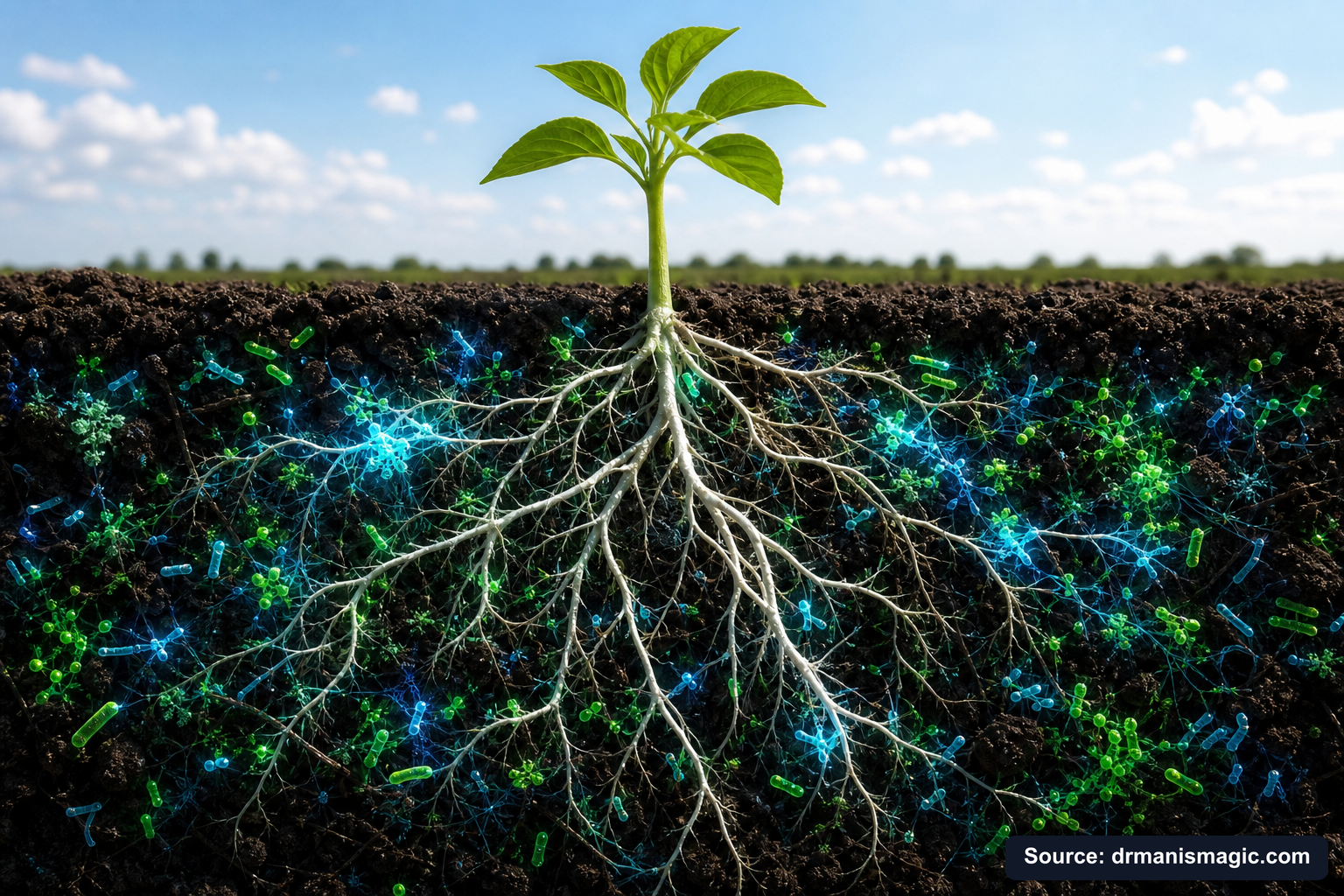
A healthy citrus root leaks sugars and proteins into the soil around it. This is called the rhizosphere, the zone right around the root. Those sugars are like a dinner bell. They attract specific bacteria. Genera like Bacillus, Pseudomonas, Burkholderia, and Bradyrhizobium show up to eat. And while they eat, they do incredible things. They fight pathogens. They fix nitrogen. They dissolve mineral nutrients. They produce compounds that make the tree stronger.
This is not random. The tree is actively recruiting its own defense team from the soil around it. It is picky about which microbes it invites close. The healthier the soil, the more candidates there are to choose from. Wild trees have millions of options in every teaspoon of soil. A tree planted in sterile potting mix has almost none.
Studies on citrus greening (HLB) have shown that healthy citrus rhizospheres are rich in these beneficial genera. When disease or stress disrupts the root zone, that recruitment process breaks down. The tree loses its ability to build its own defense team. This is not just academic. It is the root cause of why so many backyard trees spiral downward even when they look like they are being cared for.
You Never Had a Brown Thumb.
You were handed the wrong tools. This free guide hands you the right ones.
You watered it. You fed it. It died anyway.
It was never you. It was the dirt, the salt food, and the bad advice.
This guide shows you what really went wrong, and how to fix it for good.
- Why your plants really died, and why it was never your fault
- The salt hiding in your plant food that quietly burns the roots
- The hidden killer in almost every bag of store soil
- The tiny helpers that grow a whole forest for free
- The rescue trick that brings a half dead plant back to life

What Are the Most Common Root Zone Problems That Kill Backyard Citrus?
Quick Answer: The most common root zone killers are sterile soil with no biology, salt buildup from synthetic fertilizers, poor drainage causing root rot, compaction blocking oxygen, and chemical disruption from herbicides or fungicides. Most yellow-leaf problems trace back to one or more of these, not to a simple nutrient deficiency.
Not every yellow leaf means your tree is hungry. That is one of the most expensive myths in gardening. Before you buy another bag of fertilizer, run through this checklist.
| Symptom | Likely Root Zone Cause | Common Mistake | Biological Recovery Step |
|---|---|---|---|
| Yellow leaves after fertilizing | Salt buildup locking out nutrients | Adding more fertilizer | Flush with clean water, switch to organic fertilizer, rebuild microbes |
| Wilting despite watering | Root rot from Phytophthora or flooding | Watering more | Improve drainage, add mineral-based soil, reintroduce beneficial fungi |
| Pale leaves with no new growth | Sterile soil, no microbial activity | Applying more synthetic fertilizer | Add full-spectrum live microbes, mulch, and organic fertilizer |
| Slow decline over months | Compacted or suffocating root zone | Assuming it is a pest problem | Repot into mineral-based soil with proper aeration, add live microbes |
| Leaf burn on edges | Salt toxicity or herbicide drift | Adding micronutrients | Flush salts, remove chemical source, restore biology |
| No fruit despite flowers | Poor nutrient flow from collapsed microbiome | Applying bloom boosters | Restore full soil food web, use organic slow-release fertilizer |
After growing over 250,000 trees at our South Texas nursery, Dr. Mani Skaria and our team have seen every one of these symptoms. And in almost every case, the fix was not more fertilizer. It was rebuilding the root zone from the inside out.
Wild Citrus vs. Backyard Citrus: The Real Difference Explained
Quick Answer: Wild citrus has intact soil biology, a continuous litter layer, deep roots, natural leaching from rainfall, and no chemical disruption. Backyard citrus typically has sterile soil, salt buildup, no litter layer, poor drainage, and a disrupted or absent soil food web. The gap between them is biological, not botanical.
Let's put both trees side by side and look at what is actually different.
The wild tree does not have a gardener. But it has something better. It has a complete ecosystem. Leaves fall. They decompose. Fungi break them down. Bacteria release the nutrients. Rain leaches any salt buildup through the soil naturally. Roots go deep, following water and fungi through undisturbed earth. Disease organisms are present, but so are the beneficial microbes that keep them in check. Nobody sprays anything. Nothing gets sterilized. The system just runs.
The backyard tree has a gardener. But it often has a broken ecosystem. The soil is a bag of compressed bark and sawdust that decompresses and suffocates roots within months. The fertilizer feeds a quick green flush then leaves a salt residue that harms bacteria. The fungicide kills not just the bad fungus but the mycorrhizal fungi the tree depends on. The ground around the tree is bare, so the soil food web has nothing to eat between applications. And if the drainage is poor, Phytophthora root rot moves in quietly and does its damage before anyone notices.
The gap between these two trees is not talent or luck. It is biology. Specifically, the presence or absence of a living, functioning soil food web. That is the whole secret. And it is a secret you can actually do something about.
Why Do Most Microbial Products From the Store Fail to Help?
Quick Answer: Most store-bought microbial products are either dried powders with low-viability spores that don't reactivate, or liquid products that have gone anaerobic and smell foul because the microbes are dying. Neither delivers the living, full-spectrum biology your root zone actually needs.
The microbial market is booming right now. Walk into any garden store and you will find dozens of products promising to "add beneficial microbes." Most of them don't work. Here is why, and this is something we learned the hard way after testing dozens of batches at our nursery.
The first type is a dry powder. These are manufactured in giant vats, then dried into spores. The idea is that you add water and the microbes wake up. In our testing, they simply did not help the plants. The spectrum is too narrow. The viability is too low. The microbes never truly reactivate in meaningful numbers.
The second type is a liquid with a strong smell. These come from compost or worm castings, which is a good start. But by the time they reach you, they have gone anaerobic. The bottle might even fizz when you open it. That fizz is the gas from dying microbes. The stench is decay. Some benefit remains from humic and fulvic acids in the base material, but the living biology is mostly gone.
The third type uses lactobacillus bacteria, like in yogurt. Easy to make. Stays alive. But lactobacillus overtakes the beneficial microbes in soil and crowds them out. It belongs in your gut, not your garden.
None of these come close to what wild soil delivers naturally. That is the gap Plant Super Boost was built to fill. It is harvested from hand-crafted compost, not manufactured in a lab vat. And it is stabilized through a proprietary all-natural technique that keeps the full spectrum of microbes alive without going anaerobic. No stench. No dead powder. If you put a drop under a microscope, you can actually see the microbes moving. Living biology, delivered to your door.
How Do the Three Plant Pillars Rebuild What Wild Soil Already Has?
Quick Answer: The Three Plant Pillars (mineral-based soil, live microbials, and organic fertilizer) are designed to replicate the three things wild soil gets naturally: a stable physical structure that drains and breathes, a full living microbiome, and slow-release nutrients that feed plants without harming biology. Together they rebuild what synthetic inputs destroy.
Dr. Mani Skaria spent 40 years studying citrus as a Professor of Plant Pathology at the Texas A&M Citrus Center. He invented micro-budding. He led the Clean Citrus Program in Texas. And after all of that, here is what he discovered: the trees that thrived were always the trees with the healthiest soil biology. Not the most fertilized. Not the most sprayed. The most biologically alive.
That discovery became the Three Plant Pillars, and we built the entire Dr. Mani's Magic line around them.
Pillar One: Mineral Foundation. Most potting mixes are organic material that breaks down, compresses, and suffocates roots within months. Our Super Soil is mineral-based sandy loam from the Rio Grande Valley. Silica-rich. It does not decompose. It does not compact. Roots breathe. Water drains. This is the physical structure wild soil has naturally in undisturbed ground.
Pillar Two: Microbial Muscle. Wild soil is teeming with thousands of species of bacteria, hundreds of species of fungi, protozoa, and nematodes. Plant Super Boost delivers that full spectrum, stabilized and alive, in a form any gardener can apply. Just mix with water and drench the root zone. Monthly. That is it.
Pillar Three: Organic Fertilizer. Wild trees eat slowly. Nutrients release from decomposing leaves over months, not minutes. Our Crab, Kelp and Amino Acids fertilizer works the same way. Slow release. No synthetic salts. No PFAS. No biosludge. Zero toxic burn. It feeds the tree without harming the microbes, which is the opposite of what salt-based synthetic fertilizers do.
Miss any one of these three, and you are back to chasing symptoms instead of fixing causes. Get all three working together, and you are finally playing by nature's rules. Visit the Free Plant Care Field Guide to see exactly how to put all three pillars into practice.
What Can You Do Right Now to Start Rebuilding Your Tree's Root Zone?
Quick Answer: Start by stopping what is killing the biology: synthetic salt fertilizers and broad-spectrum chemicals. Then rebuild in order: fix drainage and soil structure, add organic mulch, inoculate with live full-spectrum microbes, feed with organic slow-release fertilizer, and monitor for new healthy root and leaf growth.
You cannot get back the time already spent on products that did not work. But you can start today. And when you start right, you will see changes within weeks, not years.
Here is the recovery plan we give every grower who comes to us with a struggling tree. We have used this same framework on over 250,000 trees at our nursery in Hargill, Texas. It works for citrus. It works for houseplants, garden beds, and lawns too.
- Stop the bleeding first. Stop using salt-based synthetic fertilizers and broad-spectrum fungicides or herbicides near your tree. These are actively destroying the biology you are trying to rebuild. You cannot fill a bucket with a hole in the bottom.
- Check your drainage. If water sits around the roots for more than an hour after watering, you have a drainage problem. Phytophthora root rot lives in waterlogged soil. Fix drainage before anything else.
- Test your water. If you are on well water or municipal water high in dissolved salts, you may be adding salt stress with every watering. Awareness here changes everything.
- Flush accumulated salts. Water deeply and slowly to push built-up salts down and out of the root zone. Do this two or three times before moving to the next step.
- Add mulch correctly. Lay two to three inches of organic mulch over the root zone, starting a few inches from the trunk. This feeds the soil food web, holds moisture, and moderates temperature. This is your litter layer replacement.
- Inoculate with live, full-spectrum microbes. This is the step most recovery plans skip. Add Plant Super Boost monthly to drench the root zone with living bacteria, fungi including mycorrhizae, protozoa, and nematodes. Give the biology time to establish. Repeat every month.
- Switch to organic slow-release fertilizer. Feed the tree and the microbes together with an organic fertilizer that contains no synthetic salts, no biosludge, and no PFAS. Let the microbes convert it slowly, just like the forest floor does.
You will not see overnight magic. Wild soil took years to build. But with these steps, most trees show new root growth and improved leaf color within four to eight weeks. Stay consistent. Nature rewards patience more than it rewards product purchases.
The Closing Truth: Your Tree Wants to Thrive. It Just Needs the Right World Around It.
The wild citrus tree on that broken road is not special. It is not lucky. It is just plugged into a living system that has been running for millions of years. A system of bacteria and fungi and protozoa and nematodes, all working in a chain, all fed by dead leaves, all protecting roots that would otherwise be vulnerable.
Your backyard tree wants to do the same thing. It is trying to recruit its own defense team from the soil around it. It is trying to reach out with fungal threads to find phosphorus. It is trying to build the partnerships it evolved to depend on. The only question is whether the soil around it will let it.
We cannot get back the time already spent on the old approach. The years of yellowing leaves, the bags of fertilizer, the plants that came close and then faded. That time is gone. But here is what we know from 30 years in South Texas, from Dr. Mani's 40 years of plant pathology research, from every one of the 250,000 trees we have grown: when the Three Plant Pillars are in place, plants do not just survive. They thrive in a way that surprises even experienced gardeners. Fast. Visibly. Durably.
The second best time to get this right is today. If you want to see what living biology can do for your trees, your garden, your lawn, or your houseplants, start with the Three Plant Pillars bundle and let us walk you through the rest. Real people. Real experience. Real results.
Frequently Asked Questions
If your citrus tree is struggling while wild trees thrive without any help, you are asking the right questions. These are the exact questions Dr. Mani hears from real growers every single day. The answers below are grounded in 35 years of hands-on experience and the lessons learned from over 250,000 trees grown at US Citrus Nursery in South Texas.
Why do wild citrus trees survive without fertilizer or care?
Wild citrus trees are plugged into a living soil ecosystem full of bacteria, fungi, and other microbes that work around the clock. Those microbes break down organic matter, unlock nutrients, and protect roots from disease. Your backyard tree struggles because most potting mixes and synthetic fertilizers accidentally destroy that ecosystem. Dr. Mani's Three Plant Pillars rebuild it on purpose. Mineral soil, live microbes, and organic fertilizer give your tree the same invisible support system the wild tree already has.
What do yellow leaves on a citrus tree really mean?
Yellow leaves almost always mean the roots cannot absorb nutrients. The usual suspect is not a missing nutrient. It is a dead root zone. Salt-based synthetic fertilizers kill the beneficial microbes that unlock iron, nitrogen, and magnesium. Without those microbes, nutrients sit locked in the soil and your tree starves. Before you chase symptoms with sprays and supplements, rebuild the biology first using live microbials like Plant Super Boost. That is the root cause fix, not a band-aid.
Do coffee grounds help citrus trees?
Used coffee grounds can slightly lower soil pH and add a small amount of nitrogen over time. That is a real benefit. But here is what nobody tells you. Coffee grounds alone cannot rebuild a dead root zone. They have no live microbes, no mineral structure, and no slow-release organic nutrition. Think of them as a tiny helper, not a solution. If your soil biology is already strong thanks to the Three Plant Pillars, coffee grounds can be a nice addition to your mulch layer.
What does Epsom salt actually do for citrus trees?
Epsom salt delivers magnesium, and magnesium is part of every chlorophyll molecule in every leaf. If your older leaves are yellowing between the veins, a magnesium shortage may be part of the problem. But Epsom salt is a salt. Used too often, it can throw off your soil balance and harm the beneficial microbes your tree depends on. A better long-term move is feeding your tree with a clean organic fertilizer like Dr. Mani's Crab, Kelp, and Amino Acids blend, which delivers trace minerals without the salt damage.
What is the best fertilizer for a struggling citrus tree?
The best fertilizer is one that feeds your tree without killing the microbes in the soil. Synthetic salt-based fertilizers give a quick green-up and then cause long-term damage by wiping out the biology your roots depend on. Dr. Mani's organic fertilizer uses crab, kelp, and amino acids to deliver nitrogen, phosphorus, and potassium in a slow-release form that plants actually crave. It builds soil health over time instead of creating a cycle of dependency and decline. That is the difference between a band-aid and a real fix.
What are the signs of magnesium deficiency in citrus trees?
Look for yellowing that starts between the veins on older leaves, often leaving a green triangle or V-shape near the leaf stem. This pattern shows up most in summer and fall when the tree is pulling magnesium toward developing fruit. The tricky part is that magnesium deficiency and a dead root zone look almost identical. If your soil biology is healthy, your tree can absorb the magnesium already present in the ground. Rebuilding microbial life with Plant Super Boost is the first step before adding any supplements.
How often should I fertilize my citrus tree?
With a clean organic fertilizer, feeding three times a year during the active growing seasons works well for most citrus trees. Spring, early summer, and early fall are the right windows. Never fertilize in late fall or winter when the tree is resting. More important than timing is what you feed it. Organic slow-release fertilizer builds the soil between feedings. Synthetic fertilizers force a flush of growth and then leave the soil worse than before. Feed less often, feed clean, and let the microbes do the heavy lifting in between.
About the Author
Ron Skaria, MD
Ron Skaria, MD, is the co-founder of Dr. Mani's Magic and the son of Dr. Mani. He trained as a medical doctor at Baylor College of Medicine, did his residency at UT Health Science Center - San Antonio and fellowship training at Texas Tech University. He now works full time on the family farm at US Citrus and US Citrus Nursery in Hargill, Texas, building Dr. Mani's Magic alongside his dad. He wrote the Brown Thumb Field Guide to put his father's 48 years of plant science into plain words any gardener can use. His belief is simple. You never had a brown thumb. You just never had the right help.


