


Why Containers Make Soil Biology Even More Important | Dr. Mani's Magic
Why Containers Make Soil Biology Even More Important (And What to Do About It)
Picture this. You bring home a beautiful potted lemon tree. Maybe a fig. Maybe a fiddle-leaf fig or a climbing rose in a terra cotta pot on your back patio. You set it in the perfect sunny spot. You water it. You fertilize it. You wait.
For a few weeks, it looks great. Then the leaves start to yellow at the edges. The new growth slows down. The soil smells a little off. You buy a different fertilizer. You try more water. Less water. You Google it at 11pm. Sound familiar? Here is what nobody told you: that pot is not just a container for dirt. It is a shrunken ecosystem. And when you shrank the ecosystem, you made every single biological function inside it more fragile, more concentrated, and more dependent on you. The invisible workforce that keeps plants alive in nature — billions of bacteria, fungi, protozoa, and beneficial nematodes — got cut off. And without them, your plant is fighting alone.
After growing over 250,000 trees at our South Texas nursery, we learned something that changed everything. The ground does not just hold roots. It is a living city. Trillions of microbes cycle nutrients, fight disease, build soil structure, and deliver water more efficiently than any fertilizer label ever could. When you put a plant in a pot, you take it out of that city and put it in a studio apartment. Same plant. Tiny world. And that tiny world needs your help to stay alive. Let us show you exactly why — and exactly what to do about it.
Key Takeaways
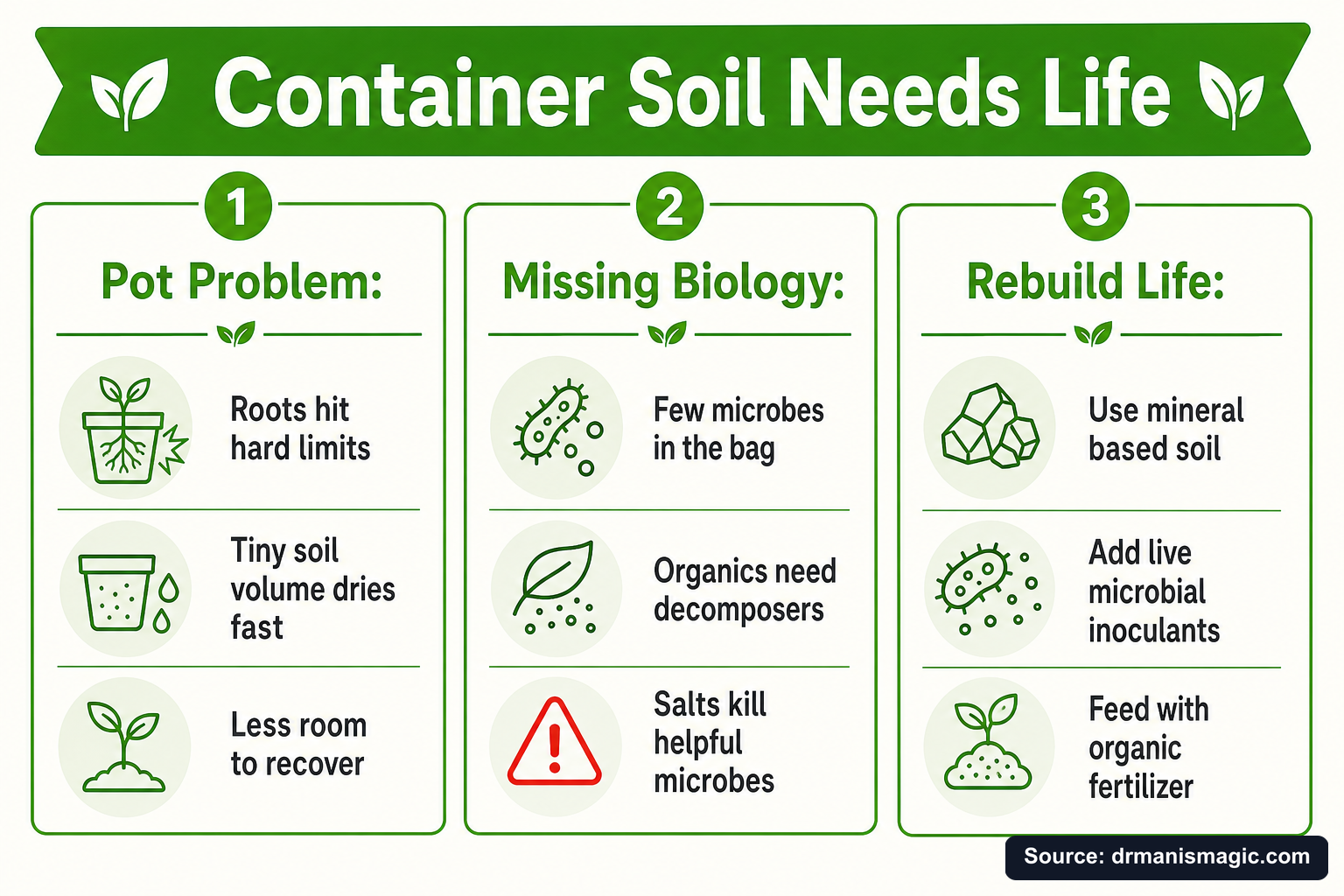
- Containers shrink the root zone, so every biological function becomes more concentrated and more fragile.
- Sterile or peat-based potting mix has little to no living soil biology — organic fertilizers cannot work properly without microbes to break them down.
- The full soil food web includes bacteria, fungi, mycorrhizae, protozoa, and beneficial nematodes — all of which contribute to nutrient cycling and disease suppression.
- Salt-based synthetic fertilizers kill beneficial microbes and make the container problem worse over time.
- Live, stabilized microbial inoculants outperform dry, powdered, or foul-smelling liquid competitors because dead microbes do nothing for roots.
- The Three Plant Pillars — mineral-based soil, live microbials, and organic fertilizer — are the proven system for rebuilding biology in any container.
- You can restore container soil biology in a matter of weeks with the right inputs, consistent watering habits, and a practical recovery checklist.
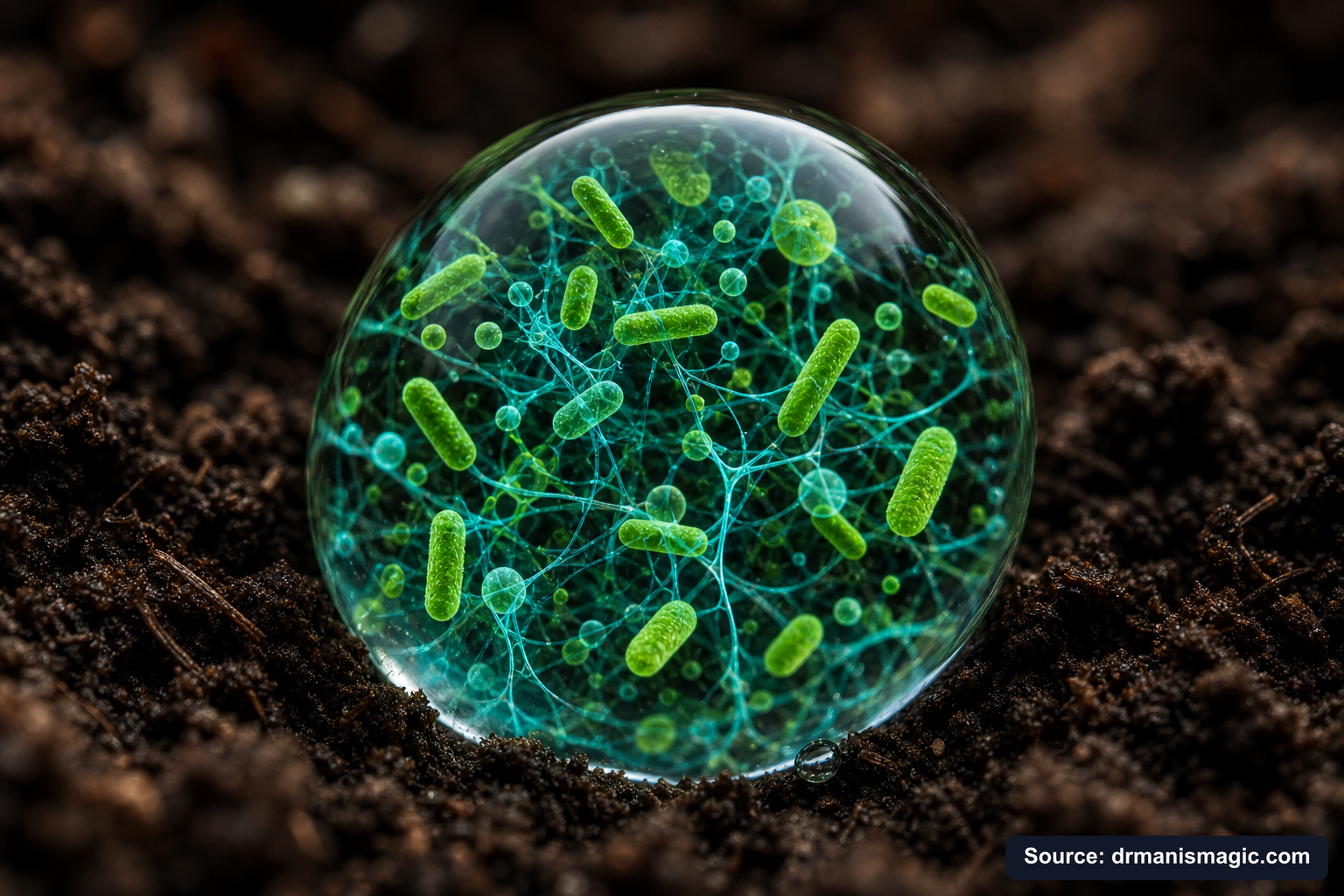
Why Is a Container So Different From Garden Soil?
Quick Answer: A container traps roots in a tiny, fixed volume of growing media with no connection to the wider soil food web. There is no reservoir of wild microbes to replenish what is lost, no deep root exploration, and no natural buffering against drought, salt, or disease. Everything that happens in ground soil on a large scale must happen in a pot the size of a bucket.
In the ground, a tree's roots can stretch outward for many feet. They find water in one zone, nutrients in another, and microbial partners in a third. When one area goes dry or depleted, roots just keep exploring. The soil food web underneath a healthy lawn or garden is enormous. The University of Minnesota Extension describes it as a complex community of organisms that contribute to nutrient cycling, water retention, disease suppression, and soil structure — supplying a large share of the plant-available nitrogen and phosphorus a plant ever receives.
In a container, none of that exploration happens. The roots hit the wall of the pot and stop. Every drop of water, every molecule of nutrition, and every microbial interaction must happen in a few quarts of growing media. That is it. The stakes are higher. The margin for error is smaller. And because most potting mixes start out nearly sterile, there is almost no biology in there to begin with.
Think of it this way. A forest is a continent. A container is a small island. Same sun. Same rain. But the island has fewer species, less resilience, and far less room to recover from a storm.
Is Potting Mix Actually Sterile? What Is Missing From the Bag?
Quick Answer: Most commercial potting mixes are pasteurized or heat-treated to kill pathogens, which also kills most beneficial biology. They are made primarily from peat moss, pine bark, or coco coir — materials with almost no living microbial community. Your plant gets drainage structure but almost zero soil food web from day one.
Here is the ugly truth about the bag of potting mix you bought at the big box store. It was designed to be clean. Pathogen-free. Consistent. Those are reasonable goals for sanitation. But the same heat treatment that kills harmful fungi also kills beneficial bacteria, mycorrhizal fungi, protozoa, and nematodes. The bag is biologically empty.
That is not a conspiracy theory. It is simple biology. The University of New Hampshire Extension explains that plants cannot use most organic fertilizer molecules until bacteria and fungi break them down into ionic forms that roots can actually absorb. If your potting mix has no biology, your organic fertilizer just sits there. It is like buying premium gasoline for a car with no engine.
Now add to that the fact that peat and pine bark break down over time. They compact. They steal oxygen from roots as they decompose. The drainage gets worse. The aeration drops. And the conditions that would allow beneficial microbes to thrive — moisture, oxygen, organic matter — become increasingly hostile. Most potting mix is already failing your plant within six to twelve months, and you might not even notice until the leaves start telling you.
See also: Why Most Potting Mix Collapses Within 6-12 Months
What Is the Soil Food Web and Why Does It Matter in a Pot?
Quick Answer: The soil food web is the community of living organisms — bacteria, fungi, protozoa, nematodes, and more — that convert raw organic matter into plant-available nutrients, suppress disease, build soil structure, and recycle waste into growth. In a pot, this web is tiny or absent, which is why container plants are far more fragile than those in healthy garden beds.
Most people think soil is just dirt. It is not. A single teaspoon of healthy forest soil contains more living organisms than there are people on Earth. We are talking about bacteria in the billions, fungi that form networks longer than a football field, protozoa that hunt and eat bacteria, and nematodes that patrol the root zone like tiny security guards.
Each of these players has a job. Here is how they work together inside a healthy root zone:
| Soil Food Web Member | What It Does for Your Plant | What Happens Without It |
|---|---|---|
| Beneficial Bacteria | Break down organic matter into plant-available nutrients; fix nitrogen from the air; suppress pathogens | Organic fertilizer does not mineralize; nitrogen is locked up; disease pressure rises |
| Mycorrhizal Fungi | Extend root surface area up to 1,000x; deliver phosphorus and water; produce glomalin to build soil structure | Roots stay small; phosphorus stays locked; water stress increases |
| Other Beneficial Fungi | Decompose tough organic materials; compete with root-rot pathogens; produce antibiotics | Root rot organisms go unchallenged; organic matter stalls |
| Protozoa | Eat bacteria; release excess nitrogen as plant-available ammonium (the "microbial loop") | Nutrient cycling slows; less available nitrogen even when bacteria are present |
| Beneficial Nematodes | Graze on bacteria and fungi; suppress harmful nematodes and soil pathogens; cycle nutrients | Pathogenic nematodes go unchecked; nutrient release slows |
| Microarthropods | Fragment organic matter; create habitat for bacteria and fungi; cycle carbon | Organic matter breaks down more slowly; less microbial diversity |
In a container, most of these players are absent or barely present. The protozoa-bacteria loop that releases nitrogen? Gone. The mycorrhizal network that delivers phosphorus? Gone. The fungal antibiotics that suppress root rot? Gone. You are left with a plant standing in biologically empty media, hoping the number on the fertilizer bag is enough to keep it alive.
It rarely is. Not for long.
Do Organic Fertilizers Actually Work in Containers Without Microbes?
Quick Answer: No. Organic fertilizers require bacteria and fungi to break their molecules down into forms roots can absorb. In a sterile or biologically depleted container, organic nutrients sit unused. This is why plants in sterile potting mix can look underfed even when they have been fertilized regularly — the biology needed to unlock those nutrients simply is not there.
This is one of the most confusing moments for container gardeners. You bought the good organic fertilizer. You followed the directions. And your plant still looks pale and tired. What went wrong?
The nitrogen in crab meal, kelp, and amino acids is not instantly available. It is locked inside complex organic molecules. Bacteria break those molecules apart and release the nitrogen as ammonium. Fungi help solubilize phosphorus. Protozoa eat bacteria and release even more ammonium as a byproduct. This whole chain of events — the nutrient mineralization cycle — depends on living biology. Without it, organic fertilizer is just expensive compost sitting on top of dead media.
Synthetic salt-based fertilizers bypass this process, which is why they seem to work faster. You pour in a salt, the salt dissolves, and the root absorbs it directly. But here is the cost. Salt harms beneficial microbes. Each application of synthetic fertilizer is a small massacre of the very organisms you need to build long-term soil health. Over months and years, the biology gets weaker. The soil gets saltier. The plant gets more and more dependent on the next dose. It is a cycle designed to keep you buying, not growing.
See also: Why Most Fertilizers Are Actually Salt in Disguise
Why Does Container Biology Break Down Faster Than In-Ground Soil?
Quick Answer: Containers dry out faster, accumulate salts from fertilizer and tap water, have no connection to wild microbial reservoirs, and hold a much smaller total volume of media. All of these factors stress and reduce microbial populations more quickly than in a garden bed, requiring growers to actively replenish biology on a regular basis.
Imagine running a marathon on a treadmill versus running through a park. Both involve the same motion. But the treadmill offers no scenery, no fresh air, no variation — and if the belt stops, you fall. Container soil is the treadmill. Every stress hits harder because there is no buffer.
Here are the specific forces working against container biology every single day:
- Fast drying: Containers lose moisture quickly, especially in terra cotta or during hot weather. When the media dries out, microbial activity drops sharply. Many bacteria and fungi die during extreme dry cycles.
- Salt buildup: Every time you water with tap water or use fertilizer, salts accumulate in the media. Unlike in-ground soil, containers cannot flush salts laterally. They concentrate near the roots. High salt levels are toxic to beneficial microbes and roots alike.
- No wild microbial reservoir: In ground soil, microbes migrate from surrounding areas. New fungi colonize from the wider network. Containers have no such connection. What you start with is what you have — unless you add more.
- Media breakdown: Pine bark and peat compact and decompose over time. This reduces pore space, cuts oxygen to roots, and creates anaerobic (no oxygen) zones where harmful pathogens thrive instead of beneficial microbes.
- Root-bound stress: When roots circle the pot and run out of room, they become stressed. Stressed roots release distress signals that attract pathogens and reduce the sugars they normally share with beneficial microbes.
The University of Maryland Extension states that container roots depend entirely on a relatively small volume of growing medium for all their water, nutrients, and biological support. When that volume degrades, there is nowhere else to go.
You Never Had a Brown Thumb.
You were handed the wrong tools. This free guide hands you the right ones.
You watered it. You fed it. It died anyway.
It was never you. It was the dirt, the salt food, and the bad advice.
This guide shows you what really went wrong, and how to fix it for good.
- Why your plants really died, and why it was never your fault
- The salt hiding in your plant food that quietly burns the roots
- The hidden killer in almost every bag of store soil
- The tiny helpers that grow a whole forest for free
- The rescue trick that brings a half dead plant back to life

Do Potted Plants Need Mycorrhizae? When Do They Actually Help?
Quick Answer: Yes, most potted plants benefit from mycorrhizal fungi — especially at transplant when roots are actively growing and media is low in phosphorus. Mycorrhizae are less effective in high-phosphorus environments or if the inoculant is old and the fungi are dead. Live, stabilized mycorrhizal products applied at the root zone give the best results.
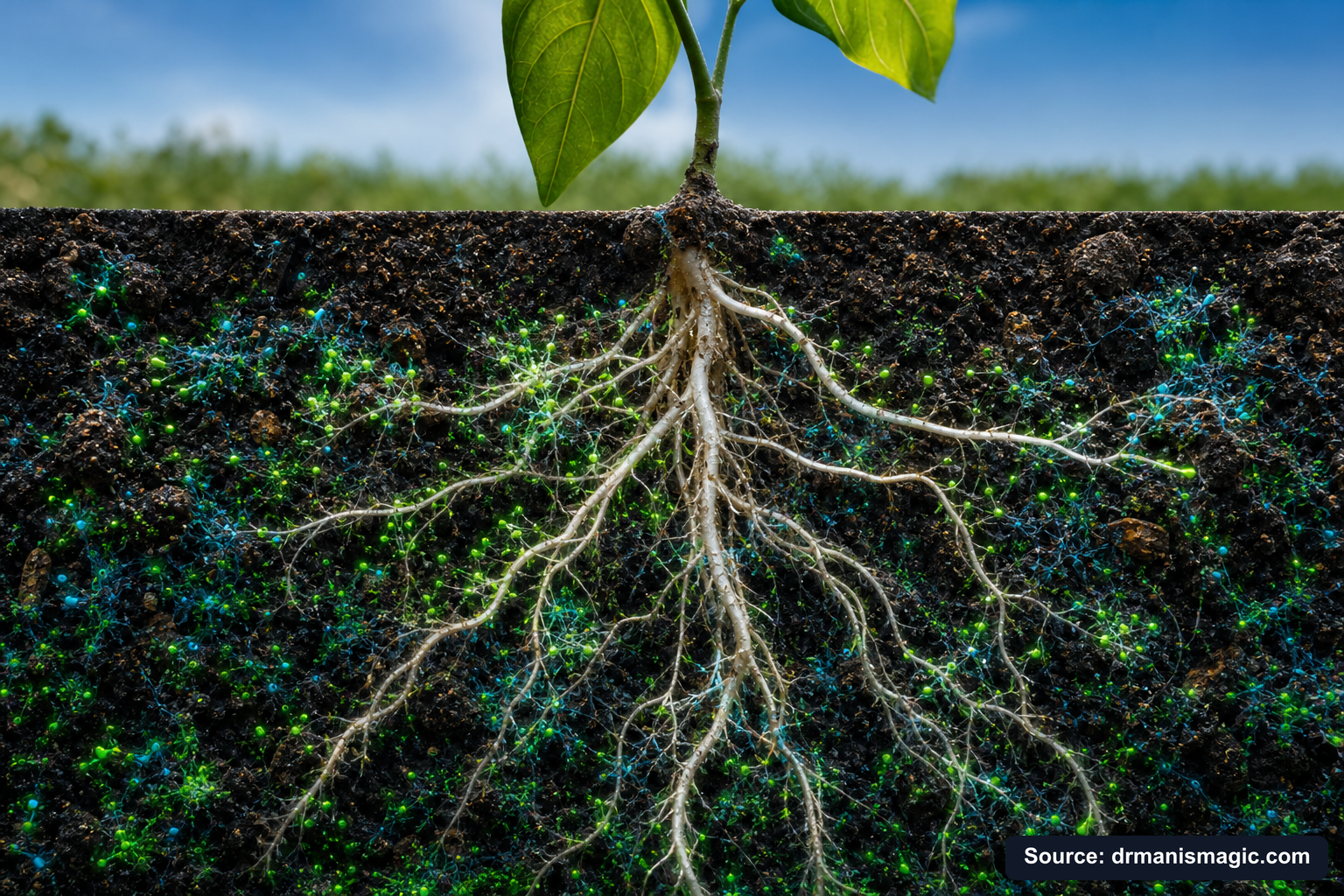
Have you ever pulled up a weed and seen white fuzzy threads clinging to the roots? That is mycorrhizae. It is why weeds grow so aggressively even in terrible soil. They have a fungal partner extending their root system in every direction, pulling in water and phosphorus from areas the roots themselves could never reach.
Your container plant deserves the same advantage. Mycorrhizal fungi can extend the effective root surface area by up to a thousand times. In a pot where roots are already confined, that kind of amplification is not just helpful. It is transformational. The fungus reaches into every corner of the media, finding phosphorus and micronutrients locked in organic particles, and delivers them directly to the root.
But here is the catch most mycorrhizae product sellers will not tell you. If the product sat on a shelf for a year in a dried powder form, the fungi are likely dead. Mycorrhizae need to be alive at the moment of application to colonize roots. A dead spore does nothing. This is why the source and viability of your microbial inoculant matters far more than the species list on the label.
Why Do Most Microbial Products Fail in Containers? Live vs. Dead Biology
Quick Answer: Most commercial microbial products are either dried powders with dormant spores that rarely reactivate, or liquid compost teas that go anaerobic during shipping and arrive smelling foul with dying microbes. Neither delivers the full-spectrum living biology that roots need. Only a stabilized, genuinely live product applied fresh to the root zone produces real results.
We have tried dozens of microbial products over thirty years at our nursery. Most of them did nothing. Here is why.
| Product Type | How It Is Made | Viability When You Use It | Smell | Does It Work? |
|---|---|---|---|---|
| Dry powder (lab-grown) | Bacteria grown in vats, dried to powder | Low — spores rarely reactivate in potting media | Neutral | We have seen no consistent results |
| Dry powder added to liquid | Same dried spores suspended in water | Low — still mostly dormant | Neutral | Same problem as dry powder |
| Compost tea (fresh, under 24 hours) | Brewed from active compost with aeration | Moderate — works well if used immediately | Earthy | Yes, but only if you make it yourself and use it right away |
| Compost tea (bottled, shipped) | Goes anaerobic in transit | Low to none — microbes dying or dead | Strong, foul, sewage-like | No — anaerobic microbes harm more than they help |
| Fresh active compost | Maintained on-site, turned regularly | High — teeming with live organisms | Earthy, hot | Yes — the gold standard, but requires time and labor |
| Plant Super Boost (stabilized, full-spectrum) | Harvested from natural compost, stabilized by an all-natural proprietary technique | High — visibly alive under a microscope; lab-verified | Earthy, not foul | Yes — 2,000+ bacterial species, 400-500 fungi, mycorrhizae, protozoa, nematodes |
The reason Plant Super Boost does not smell bad is not just a nice bonus. It is proof. When a liquid microbial product smells like sewage, that is anaerobic fermentation. The microbes are dying and rotting. The smell is the biology failing. When Dr. Mani's Plant Super Boost arrives earthy and clean, it is because the biology is stable, alive, and ready to work the moment it hits your container soil.
You can see it for yourself. Take a single drop and look at it under a microscope. The microbes are moving.
What Happens When Synthetic Fertilizers Enter a Container Ecosystem?
Quick Answer: Synthetic salt-based fertilizers dissolve immediately in water and create high salt concentrations around roots and microbes. These salts damage beneficial bacteria and fungi through osmotic shock, reducing the microbial population with each application. Over time, this leads to compacted, biologically dead media, salt accumulation, root burn, and increased disease pressure — especially root rot.
Here is the picture nobody shows you on the fertilizer box. You pour in a synthetic fertilizer. It dissolves. The salt concentration around the roots spikes. Beneficial bacteria, which need moisture to survive, lose water through osmosis — the same way a slug shrinks when you pour salt on it. They weaken. Many die. The pathogenic organisms in the media, which are often more salt-tolerant, fill the void.
Now do it again next month. And the month after that.
After a year of salt-based feeding in a container, you have media with almost no beneficial biology, rising salt levels that stress the roots, and a pathogen community that has been given free reign. Root rot is not bad luck. It is the predictable end of a biological system that was slowly destroyed, one salt application at a time.
This is not an obscure theory. It is why Dr. Mani spent years developing an organic fertilizer — our Crab, Kelp and Amino Acids formula — that feeds plants without salts, without biosludge, and without PFAS contamination. Zero synthetic salts. Zero biosludge. Zero PFAS. The nutrients release slowly, working with the microbial community instead of burning it down.
See also: The Hidden Reason Synthetic Fertilizers Cause Root Rot
How Do You Rebuild Soil Biology in a Container? A Practical Recovery Checklist
Quick Answer: Rebuilding container biology takes several weeks of consistent action: start with well-aerated mineral-based media, introduce live full-spectrum microbes, feed those microbes with organic slow-release nutrients, avoid synthetic salts and fungicides, manage watering to prevent anaerobic zones, and repot when media physically breaks down. Consistency matters more than any single application.
You cannot pour one product in and fix years of biological damage overnight. But you can start a recovery cycle right now. Here is the practical checklist we give our own customers.
- Start with the right foundation. If your container media is compacted, smelly, or more than a year old, it is time to repot. Use a mineral-based, well-aerated media that does not decompose and steal oxygen from roots. This is Pillar One of the Three Plant Pillars. Our Super Soil is engineered from sandy loam from the Rio Grande Valley — it does not break down, compact, or go toxic over time.
- Introduce genuinely live microbes. Apply a full-spectrum, stabilized microbial inoculant at the root zone. Not a dried powder. Not a foul-smelling liquid. A live product you can verify. Do this at transplant and then monthly to keep the population strong as environmental pressures work against them.
- Feed the biology, not just the plant. Switch to a slow-release organic fertilizer that microbes can process over time. Granular crab, kelp, and amino acids release nutrients gently, feeding both the plant and the microbial community simultaneously. No salt spikes. No microbe kill-off.
- Water correctly. Water deeply but allow the top inch of media to dry between waterings. This keeps oxygen flowing through the media and prevents the anaerobic conditions where root rot pathogens thrive. Overwatering in a depleted container is one of the fastest ways to lose a plant.
- Flush salts periodically. Every few months, water heavily until water runs freely from the drainage hole. This flushes accumulated salts from tap water and past fertilizer applications. Salt buildup is one of the silent killers of container biology.
- Avoid synthetic fungicides and herbicides. These inputs kill beneficial fungi and bacteria indiscriminately. If you are trying to rebuild biology and applying fungicide at the same time, you are working against yourself. Use biology-friendly, organic methods for pest and disease management instead.
- Repot before the media collapses. Even the best inputs cannot overcome physically degraded media. When the mix has become dense, hydrophobic, or structurally broken down, repot into fresh mineral-based media and restart the biological cycle with fresh microbial inoculant.
The Three Plant Pillars vs. The Conventional Container Approach
Most container gardening advice boils down to this: buy a bag of sterile potting mix, add a synthetic fertilizer, water on a schedule. It is simple. It is convenient. And it quietly fails most plants within a year because it ignores the biology entirely.
Here is how the conventional approach compares to the Three Plant Pillars system developed and proven at US Citrus Nursery across 250,000 trees:
| Factor | Conventional Container Approach | Three Plant Pillars Approach |
|---|---|---|
| Growing Media | Peat or pine bark — compacts, decomposes, steals oxygen | Mineral-based sandy loam — permanent, does not break down, drains and aerates freely |
| Soil Biology | Sterile or dead from the bag; never replenished | Full-spectrum live microbes added monthly; continuously replenished |
| Fertilizer | Salt-based synthetic — fast but burns microbes and accumulates | Organic slow-release — feeds microbes and plant together, no salt damage |
| Disease Suppression | Fungicides — kills beneficial fungi along with pathogens | Competitive microbial colonization — beneficial organisms crowd out pathogens naturally |
| Long-Term Trajectory | Declining soil health, increasing inputs, more frequent plant loss | Improving soil health, fewer inputs needed over time, more resilient plants |
| Nutrient Availability | Dependent on soluble salt — works until media or roots are damaged | Dependent on microbial mineralization — improves as biology strengthens |
| Root Rot Risk | High — no biological suppression, compacting media, salt stress | Low — aerated media, pathogen-suppressive biology, no salt accumulation |
The conventional approach was not designed to help you grow great plants. It was designed to sell you more product every season. We have seen this pattern for thirty years. The plants that thrive long-term — in containers, in gardens, in orchards — are the ones with a living, breathing soil ecosystem underneath them.
What Can You Do Right Now This Week?
Quick Answer: This week, check your container media for compaction, smell, and drainage. If it is older than a year or draining poorly, plan to repot into mineral-based media. Apply a live microbial inoculant to your existing containers. Switch to an organic slow-release fertilizer. These three actions start rebuilding the biology your container needs to thrive long-term.
You do not need to overhaul everything at once. Start with what you have.
Pick up your container plant. Check the drainage holes. Is water flowing freely or sitting? Stick your finger an inch into the media. Does it smell earthy and clean, or does it smell sour and musty? Press on the surface. Is it fluffy and open, or dense and hard?
If the media is compacting, smelling off, or draining slowly — that is your biology telling you something. It is not a pest problem. It is not a watering problem. It is a soil ecosystem problem. And now you know exactly how to fix it.
The most important thing you can do today is stop treating the symptom and start feeding the system. Add live microbes. Add organic matter. Give the roots oxygen. The rest follows naturally — just the way it has in every healthy ecosystem on Earth, long before we started putting plants in pots and wondering why they struggled.
One of the most common things Dr. Mani hears from gardeners is this: "I just want to see fruit on my tree while I still can." We hear that more than anything else. And it breaks our heart a little, because we know those years of struggle were not necessary. When the biology is right, the plant does what it was designed to do. It grows. It flowers. It fruits. It thrives. Not because you worked harder — but because you stopped working against nature and started working with it.
You can get money back. You cannot get time back. The best time to build a living container ecosystem was the day you planted. The second best time is right now.
If you want a complete, ready-to-use system that covers all three pillars — mineral-based soil, live stabilized microbes, and organic slow-release fertilizer — take a look at our Free Plant Care Field Guide and see how the Three Plant Pillars work together from day one. Everything we use at US Citrus Nursery for 250,000 trees, available for your containers, your garden, your lawn, and your houseplants. Made in the USA. Backed by a 30-day money-back guarantee. No risk. No guesswork. Just living soil doing what living soil does best.
Frequently Asked Questions
Container gardening looks simple. But most people hit a wall fast. The plant looks great for a few weeks, then slowly falls apart. These questions come up again and again from real growers who want real answers. Here is what 30 years of growing over 250,000 trees in South Texas taught us about keeping container plants alive and thriving.
Why is soil biology so much more important in containers than in the ground?
In the ground, roots explore. They find microbes, water, and nutrients across a wide area. In a pot, everything happens in a tiny, fixed space. There is no backup. No reserve of wild bacteria or fungi to replenish what is lost. Every biological function gets squeezed into a few quarts of growing media. That means one wrong move, like a dose of salt-based fertilizer, can wipe out the whole living system your plant depends on to survive.
What actually goes wrong when container soil loses its biology?
First, nutrients lock up. Without living microbes to break down organic matter, your plant cannot absorb what it needs even if you keep fertilizing. Then disease pressure rises because nothing is fighting the bad guys anymore. Roots start to suffocate if the soil compacts. The whole system collapses slowly. You see yellowing leaves, stunted growth, and that faint sour smell from the pot. That smell is a warning sign that the biology is gone.
Do containers work for growing fruit trees and vegetables?
Yes, absolutely. Citrus, figs, dwarf fruit trees, tomatoes, peppers, herbs, and many more thrive in containers when the soil biology is right. Dr. Mani has grown and shipped over 250,000 citrus trees, many started in containers, using the Three Plant Pillars system. The key is not the size of the pot. It is the quality of what is inside it. Mineral-based soil, live microbes, and organic fertilizer change everything.
Why do most potting mixes fail container plants over time?
Most bagged potting mixes are made from pine bark, peat, and sawdust. Those materials break down fast. As they rot, they compact, choke oxygen from the roots, and drain poorly. They also start out nearly sterile, with almost no living biology. Dr. Mani's Super Soil uses mineral-based sandy loam from South Texas that does not decompose. It stays loose, drains well, and keeps roots breathing for years, not months.
Can synthetic fertilizers fix a container plant that is struggling?
No. This is one of the biggest mistakes container gardeners make. Salt-based synthetic fertilizers give a quick green flush but they burn the soil microbes that your plant needs to actually absorb nutrients. Over time they make the problem worse. You end up in a cycle of feeding more and more while the plant gets weaker. Organic fertilizers with crab, kelp, and amino acids work with the biology, not against it, giving slow steady fuel without the damage.
How do live microbes help a container plant that is already in trouble?
Live microbes go to work fast. Bacteria and fungi start unlocking nutrients that were bound up in the soil. Mycorrhizae attach to roots and expand the plant's ability to pull in water and minerals. Disease-fighting microbes crowd out the bad pathogens. Most people see a visible difference within a few weeks. Dr. Mani's Plant Super Boost uses stabilized live microbes that arrive alive and ready, not dried-out powder or foul-smelling liquid that lost its punch before it reached your door.
What is the fastest way to restore biology in a container that has been on synthetic fertilizers?
Start with the Three Plant Pillars. Flush the pot with clean water to move salts out. Switch to a mineral-based soil if you are repotting. Add live microbials like Plant Super Boost right away to reintroduce the beneficial bacteria and fungi. Then feed with a slow-release organic fertilizer that rebuilds nutrition without burning what you just restored. Most growers see the turnaround begin within 30 days. You do not need to start over. You just need the right foundation.
About the Author
Ron Skaria, MD
Ron Skaria, MD, is the co-founder of Dr. Mani's Magic and the son of Dr. Mani. He trained as a medical doctor at Baylor College of Medicine, did his residency at UT Health Science Center - San Antonio and fellowship training at Texas Tech University. He now works full time on the family farm at US Citrus and US Citrus Nursery in Hargill, Texas, building Dr. Mani's Magic alongside his dad. He wrote the Brown Thumb Field Guide to put his father's 48 years of plant science into plain words any gardener can use. His belief is simple. You never had a brown thumb. You just never had the right help.


