


Why Volcanic Soils Grow the World's Best Crops | Dr. Mani's Magic
Why Volcanic Soils Grow the World's Best Crops: The Mineral Biology Behind Fertile Soil
Picture the most famous coffee in the world. It grows on the slopes of a volcano in Colombia. The wine grapes that command hundreds of dollars a bottle? Volcanic hillsides in Italy and California. The sweetest oranges you ever tasted, the bananas so ripe they smell like candy, the rice so tender it falls apart on your tongue — all of it, grown in the shadow of mountains that once erupted fire.
You've probably heard the claim before: volcanic soil grows the best crops on Earth. And you've probably nodded along without really knowing why. Is it magic? Is it just the minerals? Or is there something deeper going on — something most people completely miss?
Here's what almost nobody tells you. The real secret of volcanic soil isn't just the minerals. It's what those minerals do for the invisible world living inside the dirt. The world of microbes. The world of roots breathing freely. The world of slow, steady nutrition that feeds plants the way nature intended. Once you understand that system, you'll never look at your lawn, your garden, or your fruit trees the same way again.

Organic Fertilizer | Crab, Kelp & Amino Acids
Key Takeaways
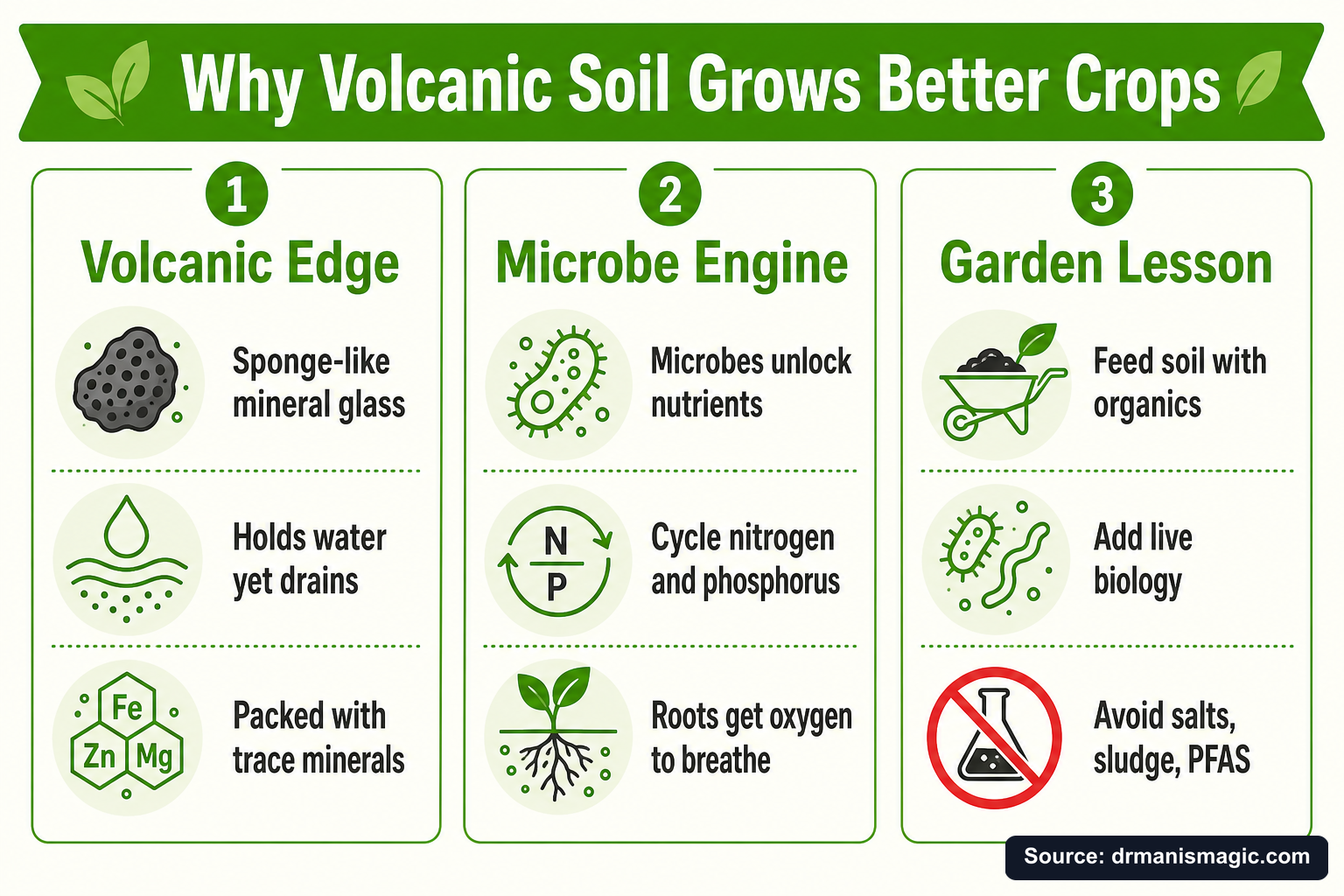
- Volcanic soils — called Andisols — grow exceptional crops because of their porous structure, water-holding capacity, trace minerals, and ability to support a thriving soil microbiome, not minerals alone.
- Weathered volcanic glass creates microscopic particles that hold nutrients and water like a sponge while still draining well enough for roots to breathe.
- Microbes are the real engine: they cycle nitrogen, phosphorus, and other nutrients from raw minerals into forms plants can actually absorb.
- Volcanic soils have a known weakness — they can lock up phosphorus so tightly that plants starve for it even when it's sitting right there in the ground.
- You can bring the biology of volcanic soil to any garden, lawn, or container by feeding the root zone with organic inputs, live microbes, and mineral-based soil structure — the Three Plant Pillars framework developed and proven at US Citrus Nursery across 250,000+ trees.
- Salt-based synthetic fertilizers destroy the very microbial life that makes fertile soil work, whether that soil sits on a volcano or in a pot on your porch.
- Clean inputs matter: biosludge, PFAS "forever chemicals," and synthetic salts are the enemies of long-term soil health.
What Makes Volcanic Soil So Fertile in the First Place?
Quick Answer: Volcanic soil is fertile because weathered volcanic minerals create a porous, sponge-like structure that holds both water and nutrients while still draining well. That structure supports massive microbial activity, which converts raw minerals into plant food. It's not one thing — it's a whole system working together.
Let's start with the basics. When a volcano erupts, it doesn't just cover the land with rocks. It deposits glass. Volcanic glass. Tiny, jagged particles that, over hundreds and thousands of years, slowly break apart and weather into something scientists call allophane and imogolite.
You don't need to memorize those words. Here's what matters: those weathered particles are shaped in a way that gives them an enormous amount of surface area. Think of a crumpled-up ball of paper versus a flat sheet. The crumpled one has far more surface to touch. These volcanic minerals work the same way.
That massive surface area does two things at once that almost no other soil type can do simultaneously.
First, it holds water. Volcanic soils can hold significantly more moisture than regular soils. The USDA Natural Resources Conservation Service identifies this high water-holding capacity as one of the defining traits of Andisols — the official soil classification for volcanic soils. That means during a dry spell, plants in volcanic soil keep drinking when plants in sandy soil are already wilting.
Second — and this is the part most people skip right past — that same porous structure lets air flow through the root zone. Roots need oxygen just like you do. When soil gets waterlogged and airless, roots suffocate and rot. Volcanic soils stay aerated even when wet. That's a rare and powerful combination.
And then there's the mineral diversity. Basalt and other volcanic rocks contain dozens of trace elements — silica, iron, calcium, magnesium, manganese, zinc, copper, boron — minerals that most agricultural soils have been slowly depleted of over decades of farming. Volcanic soils arrive pre-loaded with the full mineral toolkit. But here's the thing: having minerals and using minerals are two completely different things. That's where the biology comes in.
Is Volcanic Soil Just Mineral-Rich, or Is Something Bigger Going On?
Quick Answer: Most articles stop at "volcanic soil has more minerals," but that's only half the story. The deeper truth is that volcanic soil's porous structure and trace mineral content create ideal conditions for microbial life to thrive — and it's the microbes that actually unlock those nutrients and deliver them to plant roots.
Here's the part that almost nobody writes about.
Minerals sitting in rock are useless to a plant. A plant can't bite into a piece of basalt and pull out its zinc. Minerals have to be dissolved, broken down, and converted into a form the root can absorb. And who does that work?
Microbes.
Bacteria, fungi, and other microscopic organisms living in the soil are the real nutrient-delivery system. Penn State Extension describes soil microbes as the primary force behind cycling carbon, nitrogen, sulfur, and phosphorus — the four elements that matter most for plant growth. Without microbes, nutrients stay locked in mineral form. Unavailable. Useless.
Volcanic soil creates a perfect home for microbes. The porous structure gives them oxygen. The trace minerals give them raw material to work with. The water-holding capacity keeps them from drying out between rains. It's like giving those microscopic workers a fully equipped factory with consistent utilities.
Researchers at UC San Diego's Scripps Institution of Oceanography discovered something remarkable. Volcanic ash can triple plant productivity and rebuild entire soil ecosystems — and the increase in plant growth couldn't be explained by the ash's nutrients alone. The researchers pointed to soil-life stimulation and nutrient cycling as the real driver. In other words, the ash wasn't just feeding plants. It was waking up the biology.
That finding is important. It means the secret of volcanic soil isn't what's in the minerals. It's what the minerals do for the living organisms that do the actual feeding.
At our South Texas nursery, after growing more than 250,000 trees over three decades, we arrived at the same conclusion from a completely different direction. Dr. Mani Skaria — Professor Emeritus of Plant Pathology, founder of the Clean Citrus Program in Texas, and a citrus scientist who has spent 40 years studying why plants thrive or fail — calls this the core of what he named the Three Plant Pillars. Mineral foundation. Microbial life. Organic nutrition. These three things together create the same conditions that make volcanic soil legendary. And you can recreate all three of them anywhere. Even in a pot on a balcony in the middle of a city.
Why Do Microbes Matter So Much for Plant Nutrition?
Quick Answer: Microbes are the middlemen between raw minerals and plant roots. They break down organic matter, fix nitrogen from the air, dissolve mineral-bound nutrients, and when they die, they release everything they've eaten directly into the root zone. That's the natural slow-release fertilizer system plants evolved inside of for millions of years.
Think about what happens in a forest. Nobody fertilizes a forest. Nobody spreads synthetic chemicals on the Amazon. Yet those trees grow enormous. They live for centuries. Their roots pull up minerals from deep rock. Their leaves come in green every spring. How?
The forest feeds itself through microbes.
Here's the cycle in plain language.
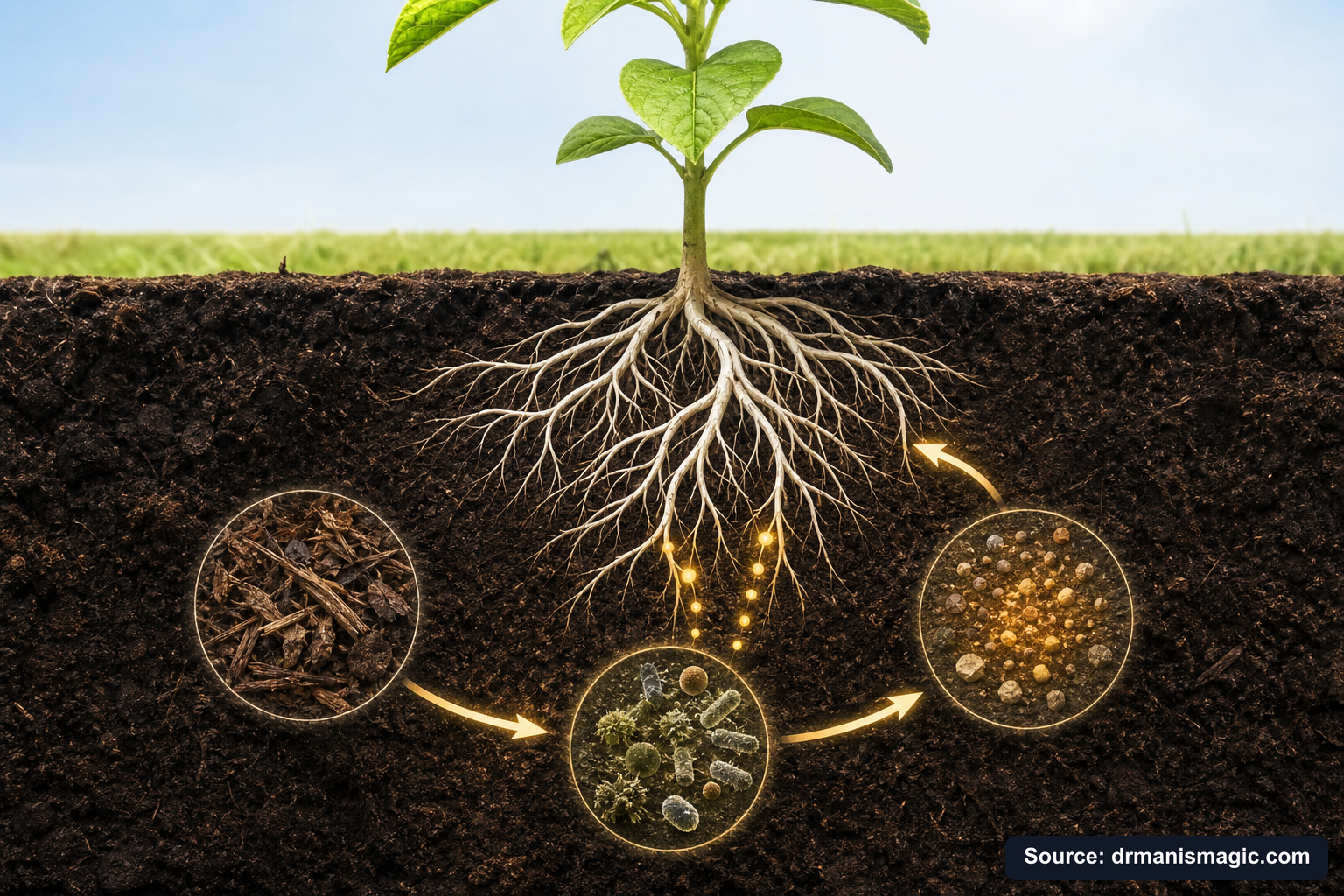
Leaves fall. Branches rot. Animals die. Fungi and bacteria break all of that organic matter apart into simpler pieces. Those simpler pieces become nutrients. The nutrients dissolve into the water that passes through the soil. The water carries those nutrients right to the roots. The roots drink them in.
At the same time, nitrogen-fixing bacteria living right on plant roots pull nitrogen gas straight out of the air — the same air that's 78% nitrogen — and convert it into a form the plant can use. This is free fertilizer from the atmosphere, manufactured by microbes on demand.
And here's the part that makes organic fertilizer so powerful compared to synthetic options. When you feed the soil with organic material — crab shells, kelp, amino acids, compost — the microbes eat it first. They process it, break it down, and convert it into forms plants can easily absorb. Then, when those microbes die, they release all of that stored nutrition right back into the root zone. It's a built-in time-release system. Not a coating on a pellet. Not a plastic shell. A living process that keeps delivering nutrition for weeks and months after a single application.
Synthetic fertilizers short-circuit this whole system. They are salt-based. Salt is the enemy of microbes. High salt concentrations pull water out of microbial cells through a process called osmotic stress — the same process that causes physiological drought in plant roots. The microbes die. The living delivery system collapses. The plant becomes dependent on you adding more and more synthetic inputs just to survive. You've traded a self-sustaining ecosystem for a chemical addiction. And the soil gets worse every season.
See also: The Hidden Reason Synthetic Fertilizers Cause Root Rot
What Is the Hidden Problem With Volcanic Soil That Nobody Talks About?
Quick Answer: Volcanic soils can lock up phosphorus so tightly that plants can't use it, even when the total phosphorus content looks high. The same minerals that make volcanic soil great at holding nutrients can hold phosphorus too well, binding it to aluminum and iron compounds and making it unavailable to roots.
Here's the part that should come with a warning label.
Volcanic soil sounds perfect. Rich in minerals. Great drainage. Holds water. Full of microbes. And it largely is. But there's a catch that the "volcanic soil is magical" crowd almost never mentions.
Phosphorus fixation.
The same allophane and imogolite particles that make volcanic soils so good at holding nutrients also have a powerful attraction to phosphorus. They grab phosphorus ions and lock them up in compounds that plant roots can't access. The phosphorus is there, technically. But it's trapped. Unavailable. The plant starves for phosphorus while sitting in soil that contains plenty of it.
Britannica's entry on Andisols notes this phosphorus-fixation problem as a defining limitation of volcanic soils, especially in younger Andisols where the weathering process hasn't yet broken down the most reactive minerals.
This is important for gardeners to understand because it breaks the myth that "natural" automatically means "balanced." Even the most fertile-looking volcanic soil can produce phosphorus-deficient plants. Stunted growth. Poor root development. Weak flowering. Bad fruit set. And the grower blames themselves when the soil itself is the bottleneck.
The solution? Microbes — specifically phosphorus-solubilizing bacteria and mycorrhizal fungi — can break that grip. They secrete organic acids that release phosphorus from those mineral bonds and deliver it to roots. This is one of the most powerful arguments for keeping your soil biology alive and active. Not just in volcanic soil. In every soil. In every pot. In every garden bed.
Salt-based fertilizers that kill those microbes don't just burn roots. They destroy your natural phosphorus-delivery system. And you'll never see it on the bag.
Can You Bring Volcanic Soil Biology to Your Own Garden?
Quick Answer: Yes. You can recreate the key conditions of volcanic soil — mineral structure, microbial activity, and slow-release organic nutrition — in any garden, lawn, raised bed, or container. The Three Plant Pillars framework is built on exactly this idea, and it's been tested across 250,000+ trees at US Citrus Nursery in South Texas.
You don't live near a volcano. Neither do most of us. But the conditions that make volcanic soil extraordinary aren't locked inside a mountain in Hawaii or Italy. They're a set of principles you can apply in your own backyard.
Dr. Mani spent decades studying why some trees explode with fruit and others slowly die. He tested everything. He watched plants fail in the same peat-based potting mix that every big box store sells. He watched salt fertilizers torch root systems. And he built a framework — the Three Plant Pillars — that mirrors what volcanic soil does naturally.
Pillar One: Mineral Foundation. Volcanic soil is mineral-based, porous, and permanent. It doesn't decompose. It doesn't compact. It doesn't steal oxygen from roots as it breaks down. Most commercial potting mixes do exactly the opposite. They're loaded with pine bark, sawdust, and decomposing organic matter that slowly collapses into a dense, airless sludge. Roots suffocate. Water pools. Root rot follows. The fix is a mineral-based soil that stays open and airy for years — one that mirrors the porous, oxygen-rich structure of a good volcanic Andisol.
Pillar Two: Microbial Muscle. Volcanic soil teems with bacteria, fungi, and mycorrhizae because it gives them what they need: oxygen, moisture, trace minerals, and organic matter to eat. You can introduce this living biology to any soil with live microbial inoculants. Not dead powder. Not heat-killed bacteria. Live organisms that can wake up the root zone, fix nitrogen, unlock phosphorus, and protect roots from pathogens like Pythium and Phytophthora — the same fungi responsible for most cases of root rot.
Pillar Three: Organic Nutrition. Volcanic soil releases minerals slowly as it weathers. That slow, steady trickle of nutrition is exactly what plants evolved to thrive on. It's not a flood. It's not a spike. It's a consistent, gentle supply. Organic fertilizers work the same way — microbes break them down gradually, releasing nutrients in sync with plant demand. No salt. No osmotic shock. No microbial massacre.
These three pillars together don't just grow healthy plants. They build a self-sustaining root zone that gets better with every season. Just like the slopes of a volcano that have been growing extraordinary food for centuries.
Volcanic Soil vs. Common Garden Amendments: What Really Compares?
Quick Answer: Not all soil amendments are created equal. Some build long-term biology. Others spike growth and damage roots. The table below compares the most common options so you can see exactly where each one fits — and where each one can hurt you.
| Amendment | Key Benefit | Salt Risk | PFAS Risk | Microbial Impact | Best Use |
|---|---|---|---|---|---|
| Volcanic / Andisol Soil | Porous structure, trace minerals, high water-holding capacity | None | None | Highly supportive | In-ground growing in volcanic regions |
| Volcanic Rock Dust / Ash | Trace mineral replenishment, silica, soil biology stimulation | None | None | Beneficial; stimulates microbial cycling | Garden beds, compost addition, soil amendment |
| Compost | Organic matter, microbial food, nutrient cycling | Low | Low to moderate (depends on source) | Very supportive | Soil building, garden beds, top-dressing |
| Biosolids / Sewage Sludge | Nitrogen and phosphorus content | Low to moderate | High — PFAS contamination documented | Mixed; depends on processing | Not recommended for food gardens or containers |
| Synthetic Salt Fertilizer (fast-release) | Immediate green-up | Very High | Low | Destructive — kills microbes | Short-term cosmetic results only; not recommended |
| Crab, Kelp & Amino Acids (organic, slow-release) | Full nutrient spectrum, biostimulants, chitin, kelp hormones, volcanic ash trace minerals | None | None | Feeds and supports microbes | All plants: trees, lawns, gardens, containers, houseplants |
| Biochar | Long-term water and nutrient retention, microbial habitat | None | None | Excellent long-term microbial habitat | Soil amendment, container mix, garden beds |
| Kelp Extract | Growth hormones (auxins, cytokinins), trace minerals, carbohydrates | None | None | Supportive; feeds microbial activity | Foliar spray or soil drench; all plants |
Notice the pattern. The inputs that hurt plants the most — synthetic salts and biosludge with PFAS — are also the ones most aggressively marketed. The inputs that build long-term soil health are the ones that rarely get a TV commercial.
See also: Why Most Fertilizers Are Actually Salt in Disguise
You Never Had a Brown Thumb.
You were handed the wrong tools. This free guide hands you the right ones.
You watered it. You fed it. It died anyway.
It was never you. It was the dirt, the salt food, and the bad advice.
This guide shows you what really went wrong, and how to fix it for good.
- Why your plants really died, and why it was never your fault
- The salt hiding in your plant food that quietly burns the roots
- The hidden killer in almost every bag of store soil
- The tiny helpers that grow a whole forest for free
- The rescue trick that brings a half dead plant back to life

What Does Chitin From Crab Shells Actually Do for Your Plants?
Quick Answer: Chitin is a natural compound found in crab shells that triggers a plant's immune system when it enters the soil. Soil microbes break chitin down, and the process activates the plant's defenses against fungal diseases and soil-dwelling pests — while also providing a slow, clean source of nitrogen and calcium.
You've walked past crab shells your whole life without knowing they were one of nature's most powerful plant inputs.
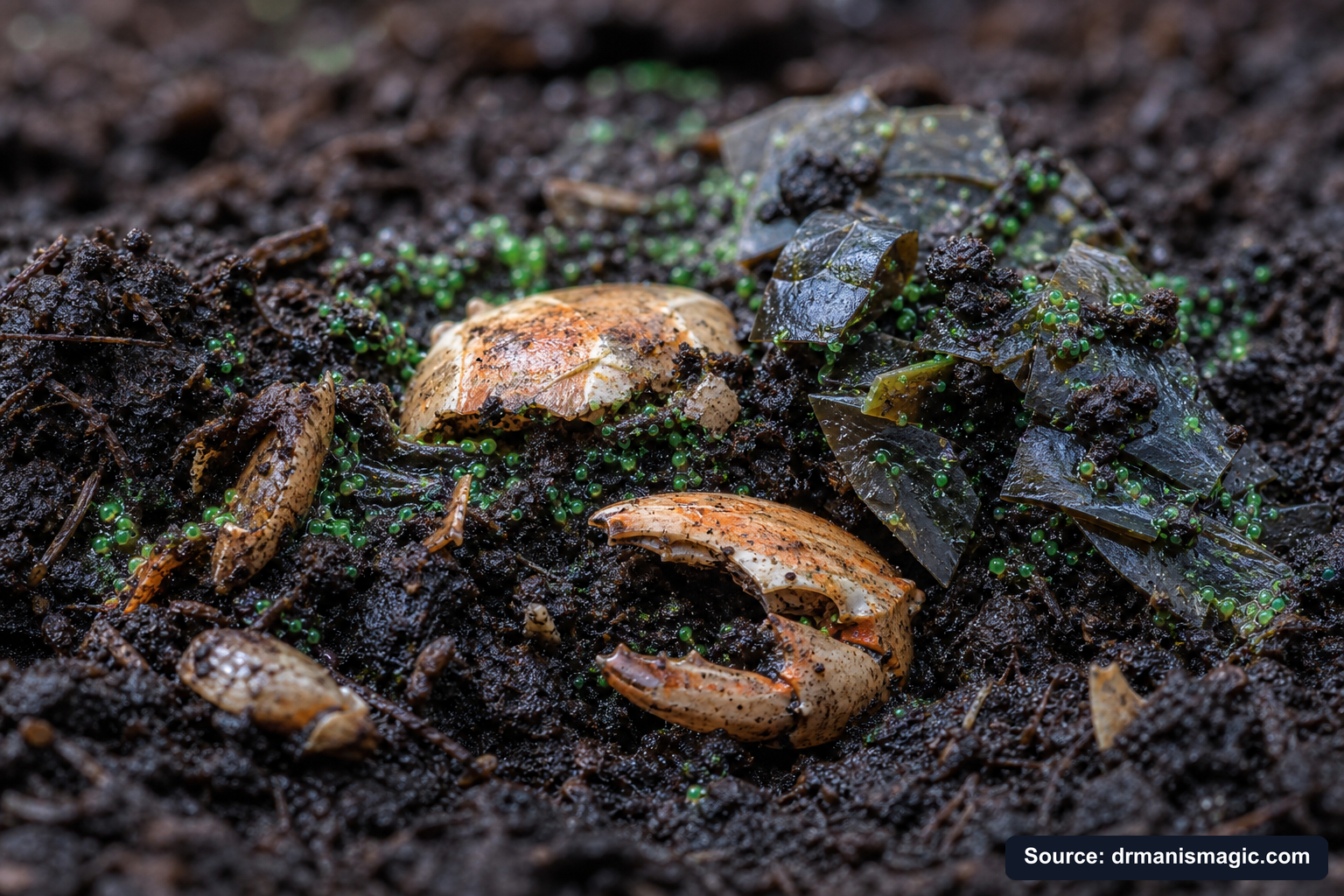
Chitin is the structural material that makes up the shells of crabs, shrimp, and insects. When chitin enters the soil, something remarkable happens. Certain bacteria and fungi produce enzymes specifically designed to break chitin apart. Those microbes multiply rapidly. And as they do, they release both nitrogen and calcium into the root zone in a slow, plant-available form.
But here's the part that makes chitin truly special. Many of the harmful organisms that attack plant roots — nematodes, fungal pathogens like Pythium and Phytophthora — have bodies made partly of chitin. When you add chitin to your soil, you're training the microbial community to digest it. Those same microbes then attack the chitin in pathogen bodies, suppressing disease naturally.
It's biological pest control. Built into your fertilizer. With no chemicals required.
Combine that with the calcium in crab shells — which builds strong cell walls in plants the same way calcium builds strong bones in your body — and you have a fertilizer ingredient that does far more than just add nitrogen to a number on a bag.
What Does Kelp Do That Regular Fertilizer Can't?
Quick Answer: Kelp is a marine plant packed with natural growth hormones — especially auxins and cytokinins — that help plants develop stronger roots, recover from stress, and set more fruit. These hormones work even at very low concentrations and cannot be replicated by synthetic fertilizer at any price.
Cold-processed kelp is not just a trace mineral source. It's a biostimulant library.
Auxins are hormones that tell plant cells to divide and elongate. They're responsible for root tip growth, fruit development, and the plant's ability to direct energy toward new growth. Cytokinins signal cells to multiply — they're the "grow" command in a plant's internal language. Kelp carries both.
It also carries carbohydrates that feed soil microbes directly, keeping the biology in the root zone active and diverse. And its trace mineral profile — iodine, selenium, and dozens of others — fills in micronutrient gaps that even good volcanic soil sometimes misses.
Here's what makes cold-processed kelp different from heated or chemically extracted versions. Heat destroys those delicate hormones. Cold processing preserves them. The method of extraction matters as much as the source material.
When kelp, chitin from crab shells, and amino acids all work together in a single organic fertilizer, they don't just add up. They multiply each other's effects. The amino acids provide immediately bioavailable nitrogen. The kelp hormones activate growth responses. The chitin feeds the microbial community and suppresses pathogens. And volcanic ash trace minerals — naturally present in Crab, Kelp & Amino Acids — provide silica that strengthens cell walls and increases drought resistance.
That combination mirrors what volcanic soil delivers naturally. Mineral diversity. Biological activity. Slow, steady nutrition. All from a single organic granular fertilizer with zero synthetic salts, zero biosludge, and zero PFAS.
How Does Salt-Based Fertilizer Damage the Volcanic Soil Model?
Quick Answer: Salt-based fertilizers work against everything volcanic soil does right. They spike nutrient levels, kill soil microbes through osmotic stress, cause physiological drought in roots, and accelerate the kind of soil degradation that takes volcanic soil centuries to build — all in a single growing season.
This is the part that should make you angry. Not at yourself. At the industry that kept this from you.
Synthetic fertilizers are salts. Not table salt exactly, but chemical compounds with the same osmotic behavior. When you dissolve salt in water, it pulls moisture through membranes toward the higher concentration. That's osmotic stress. It's how salt dehydrates meat for preservation. And it's exactly what happens to root cells and soil microbes when synthetic fertilizer soaks into the ground.
Root cells lose water to the concentrated salt solution around them. Roots experience what scientists call physiological drought — they're surrounded by water but can't absorb it because the salt concentration outside is higher than inside. Leaves yellow. Plants wilt. You add more fertilizer thinking the plant needs more food. The problem gets worse.
Meanwhile, the microbial community that took years to build — the same kind of biological engine that makes volcanic soil extraordinary — is being killed off with every application. Bacteria and fungi can't survive in high-salt environments. The organisms that fix nitrogen, unlock phosphorus, suppress disease, and build soil structure are gone. What's left is biologically dead dirt that's completely dependent on chemical inputs to produce any growth at all.
This is the cycle big chemical companies built their business on. Not intentionally malicious, maybe. But profitable. Every bottle of synthetic fertilizer you buy is proof that the last one didn't build anything lasting.
Volcanic soil took thousands of years and billions of microbes to become what it is. You can destroy the biology that makes it work in a single season with the wrong fertilizer. And you can rebuild that biology — in any soil — by going back to organic inputs that feed the living system instead of poisoning it.
| Symptom | Salt / Fertilizer Burn | Overwatering | True Root Rot (Pythium / Phytophthora) |
|---|---|---|---|
| Leaf appearance | Brown tips and edges; crispy margins; older leaves affected first | Yellowing all over; soft, limp leaves; new growth affected | Sudden wilting despite wet soil; black or brown streaking on stems |
| Root appearance | Brown, dried, withered fine roots near fertilizer | Mushy, pale, waterlogged roots; no firmness | Dark brown or black roots; foul smell; roots fall apart when touched |
| Soil condition | White crust or residue visible on soil surface | Soggy, dense, poorly draining; may smell sour | Consistently wet; poor drainage; compacted |
| Speed of onset | Days to one week after fertilizer application | Gradual over weeks | Can be rapid — days to a week once established |
| Primary cause | High salt index; osmotic stress; microbial death | Lack of oxygen to roots; poor drainage | Fungal pathogen in anaerobic, wet conditions; often follows overwatering |
| Recovery approach | Flush soil thoroughly with water; switch to organic fertilizer; add live microbes | Improve drainage; reduce watering frequency; add perlite or rice hulls | Remove affected roots; treat with beneficial microbes; improve drainage immediately |
How Do You Recover a Plant Damaged by Salt Fertilizer or Root Rot?
Quick Answer: Recovery from salt damage or root rot requires removing the cause first, then rebuilding soil biology. The steps below apply whether you're dealing with a container citrus tree, a struggling lawn, a vegetable garden, or any plant that's been treated with synthetic fertilizers.
If your plant is showing signs of fertilizer burn, root rot, or general decline after synthetic inputs, here's a recovery path that works with the biology instead of against it.
- Stop all synthetic fertilizer immediately. Adding more salt to a salt-damaged root zone makes everything worse. The first step is always removing the source of the problem.
- Flush the root zone with plain water. For container plants, water deeply until water runs freely from the drainage hole three to four times in a row. This leaches accumulated salts out of the root zone and reduces osmotic stress on damaged roots.
- Check drainage and soil structure. If water doesn't drain freely, the soil itself is the problem. Compacted, organic-heavy potting mix that has broken down over months becomes dense and airless — the perfect environment for Pythium and Phytophthora to thrive. Consider repotting into a mineral-based soil with good pore space.
- Remove visibly dead or rotted roots. Dark, mushy, foul-smelling roots can't recover. Cut them back to healthy tissue with clean scissors. This is painful to do, but leaving dead roots in the soil spreads pathogens further.
- Introduce live microbial inoculants. Beneficial bacteria and mycorrhizal fungi suppress the pathogens responsible for root rot, begin rebuilding the microbial community, and start unlocking nutrients again. This is the biological reset your soil needs.
- Begin a gentle organic feeding program. Once drainage is corrected and biology is being rebuilt, start feeding with a slow-release organic fertilizer. No salt spikes. No flood of soluble nutrients into a recovering root zone. Steady, gentle, microbially mediated nutrition.
- Be patient with new growth. A plant recovering from root damage redirects energy to rebuilding roots before it shows new top growth. That can take weeks. Don't panic. Don't add more fertilizer to "help it along." Let the biology do its work.
See also: How Salt-Based Feeding Quietly Destroys Root Systems
Why Does Your Root Zone Need Oxygen as Much as Water?
Quick Answer: Roots breathe oxygen constantly. When soil becomes compacted, waterlogged, or filled with decomposing organic matter, the oxygen in the pore spaces disappears. Roots suffocate, stop absorbing nutrients and water, and become vulnerable to every pathogen in the soil. Porous, well-structured soil is not optional — it's the foundation everything else depends on.
Here's something that surprises most new gardeners. Plants breathe through their leaves — taking in carbon dioxide for photosynthesis. But their roots breathe oxygen. Just like you do. Through their roots, they consume oxygen and release carbon dioxide in a process called cellular respiration. Cut off the oxygen supply to the root zone, and the plant is suffocating from the bottom up while looking fine from the outside.
This is exactly what happens when organic-heavy potting mix breaks down over months. The bark, peat, and wood chips compact into dense layers. The pore spaces between particles — the tiny air channels that let oxygen reach roots — collapse. Water pools instead of draining. The environment turns anaerobic, meaning without oxygen. And in anaerobic conditions, the organisms that thrive are not the beneficial ones. They're the pathogens. Pythium. Phytophthora. The microbes that cause root rot.
University of Minnesota Extension emphasizes that healthy soil organic matter stabilizes moisture, pH, nutrients, and microbial communities while helping maintain aerobic pore space — the oxygen-rich structure that keeps roots alive and active. The key word is "stabilizes." Stable structure. Not decomposing structure. Not structure that collapses within six months.
Volcanic soils maintain their aerobic pore space because the mineral particles — allophane, imogolite, volcanic glass fragments — don't decompose. They stay open. They stay porous. Year after year.
That's the model worth copying. Not the brand of fertilizer you pour on top. The structure of the root environment that lets roots breathe, drink, and grow without interference.
For container plants and garden beds, a mineral-based soil that resists compaction and maintains drainage over years is the foundation that everything else — microbes, organic fertilizer, trace minerals — depends on to work. Without it, you're building on sand. Without it, you're fighting biology instead of working with it.
You can explore how Dr. Mani's three-pillar approach builds this foundation from the ground up with the Free Plant Care Field Guide — the same system we use at our South Texas nursery on every tree we grow.
What Does Volcanic Ash Actually Do in a Fertilizer Formula?
Quick Answer: Volcanic ash in a fertilizer contributes silica, iron, manganese, and dozens of other trace minerals that most soils have been depleted of. Silica in particular strengthens plant cell walls, increases drought and pest resistance, and improves the structural integrity of stems and fruit. It's a trace mineral supplement and a soil biology stimulant at the same time.
Silica is one of the most underrated nutrients in modern gardening. It's not on the standard N-P-K label. You won't see it advertised on a bag of synthetic fertilizer. But plants that receive adequate silica are measurably more resistant to physical damage, fungal infection, and drought stress.
Here's a simple way to picture it. Silica is to a plant cell wall what rebar is to concrete. The concrete alone can hold weight. But add rebar and it becomes dramatically stronger, more resistant to cracking, and better able to handle stress. Plants with high silica content have thicker cell walls, sturdier stems, and harder fruit skins that resist cracking and pest penetration.
Volcanic ash delivers silica in a form that soil microbes can slowly process and make available to roots. It doesn't flood the system. It doesn't spike. It weathers gradually — mirroring the same slow mineral release that makes actual volcanic soil so sustainably productive over centuries.
Combine volcanic ash trace minerals with the chitin from crab shells, the growth hormones from cold-processed kelp, and the bioavailable nitrogen from amino acids, and you have a fertilizer that does what volcanic soil does — minus the volcano. Slow release. Mineral diversity. Microbial support. Clean inputs with zero PFAS, zero biosludge, and zero synthetic salts.
How Do the World's Best Crop Regions Compare — And What Do They Have in Common?
Quick Answer: The most celebrated agricultural regions on Earth — whether volcanic or not — share the same underlying conditions: mineral diversity, porous soil structure, active microbial communities, adequate organic matter, and low salt inputs. Volcanic soil makes these conditions easy to achieve naturally. But they can be built anywhere with the right approach.
Walk through the world's most famous growing regions and look for the pattern.
The volcanic slopes of Etna in Sicily. The Kona coffee belt in Hawaii. The tea gardens of Java. The citrus orchards of the Azores. The rice paddies of Japan's volcanic islands. What do they all have in common beyond the geology?
Mineral diversity. Porous soil. Low salt. Active biology. And growers who, for generations, fed the soil rather than the plant.
Traditional farmers in volcanic regions didn't use synthetic fertilizers. They composted. They rotated crops. They returned organic matter to the soil. They kept the biology alive. The volcanic minerals gave them a head start. The biology did the rest.
The tragedy of modern agriculture is that we took the chemistry of volcanic fertility — the minerals, the nutrients, the N-P-K numbers — and tried to reproduce it with salt-based shortcuts. We got the numbers right. We got the biology completely wrong. And crops that should thrive on the richest soil in human history are instead dependent on increasing chemical inputs every season just to stay alive.
You don't need volcanic soil to grow extraordinary plants. You need the system that volcanic soil runs on. Mineral structure that stays open and oxygenated. A living microbial community that cycles nutrients and protects roots. Organic nutrition that feeds that community and releases slowly over time. That system works in South Texas. It works in a container on a porch in Ohio. It works for grass, flowers, vegetables, fruit trees, and houseplants. We know because we've grown more than 250,000 trees on it, and we've heard from gardeners across the country who rebuilt struggling plants with it in thirty days or less.
Bringing Volcanic Soil Biology Home: A Practical Framework
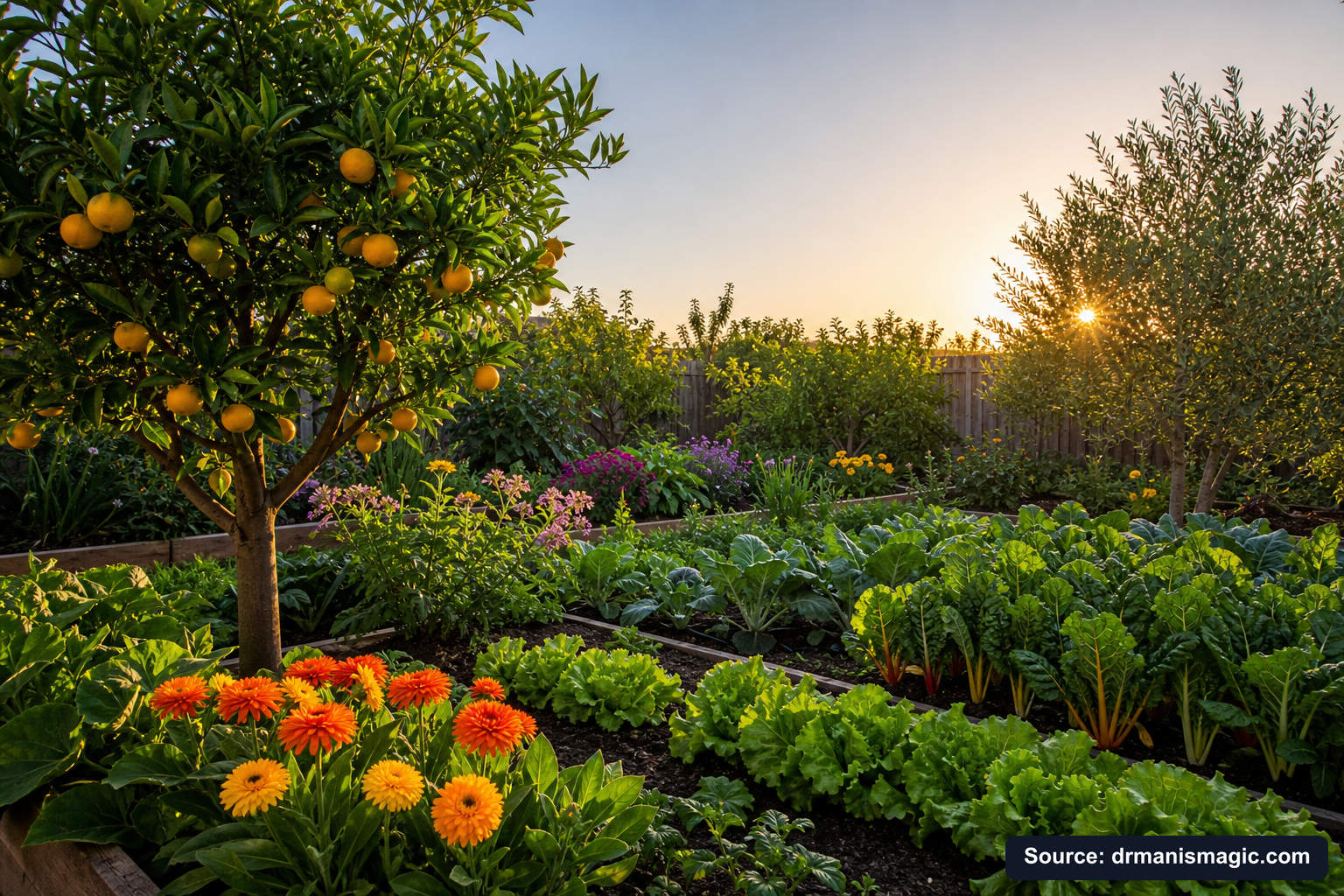
The slopes of a Hawaiian volcano aren't coming to your backyard. But the biology that makes them extraordinary can.
After thirty years of growing at our South Texas nursery, testing on hundreds of thousands of trees, and listening to thousands of gardeners describe the same frustrations with the same products — Dr. Mani's conclusion is simple. Plants don't need more chemicals. They need their natural growing system restored.
Mineral-based soil that holds structure and lets roots breathe. Live microbes that unlock nutrients and protect roots from disease. Organic nutrition — crab shells for chitin and calcium, cold-processed kelp for hormones and trace minerals, amino acids for bioavailable nitrogen, volcanic ash for silica — that feeds the biology first and the plant second, slowly, continuously, the way a volcano feeds its slopes over centuries.
That's not a metaphor. That's exactly how it works. And it works for lawns, gardens, containers, orchards, flowers, and houseplants — not just the citrus trees we're famous for.
The best time to build healthy soil was years ago. The second best time is right now. Every season you spend on salt-based shortcuts is a season of soil biology you're spending down instead of building up. And unlike money, that time doesn't come back.
If you want to see what the Three Plant Pillars look like in practice — and get a clear, simple guide for applying them to whatever you're growing — the Free Plant Care Field Guide is the place to start. No jargon. No guesswork. Just the same system we use every day in South Texas, written so a first-time gardener can follow it and an experienced grower can finally understand why the old approach kept failing.
Your soil can be extraordinary. The volcano just gave us the blueprint.
Frequently Asked Questions
Volcanic soil has fed civilizations for thousands of years. But most gardeners never get to live on a volcano. The good news? Once you understand why volcanic soil works so well, you can bring that same power to your backyard, your containers, and your lawn. These questions cut straight to what matters most.
Why does volcanic soil grow better crops than regular soil?
Volcanic soil works because of three things happening at once. It drains well so roots can breathe. It holds water so plants never go thirsty. And it feeds a massive army of soil microbes that convert raw minerals into food plants can actually use. That last part is the big secret most people miss. The minerals matter, but the microbes are the real engine. No microbes, no magic. This is exactly what Dr. Mani's Three Plant Pillars are built around, proven across 250,000 trees at US Citrus Nursery.
What crops grow best in volcanic soil?
Coffee, bananas, citrus, papayas, wine grapes, and rice all thrive in volcanic soil. The common thread is not the crop itself. It is the soil structure underneath. Porous, mineral-rich, microbe-friendly soil grows exceptional plants of almost any kind. That is why the Three Plant Pillars work for fruit trees, houseplants, lawns, and flower gardens alike. The crop changes. The foundation does not.
What is the best soil structure for growing any plant?
The best soil drains fast, holds some moisture, and stays loose enough for roots to breathe and push through freely. Loamy soil does this well in the ground. For containers and raised beds, a mineral-based soil is even better because it does not break down and compact over time. Dr. Mani's Super Soil uses sandy loam from South Texas as its base. It stays open and airy for years, unlike pine bark potting mixes that rot into a root-choking sludge.
Why is volcanic soil more fertile than other soils?
Weathered volcanic glass creates tiny particles with enormous surface area. Those particles hold nutrients and water like a sponge while still letting excess water drain away. Over time, that structure attracts organic matter and supports a thriving microbe population. The microbes then unlock minerals from the soil and deliver them directly to plant roots. It is a living system, not just a bag of nutrients. Synthetic salt fertilizers destroy that system. Organic inputs and live microbes rebuild it.
Can you recreate the benefits of volcanic soil in a pot or garden bed?
Yes. You do not need to live near a volcano. You need the same three things volcanic soil provides naturally. A mineral-based structure that drains well and does not compact. A living microbial population that cycles nutrients. And slow-release organic food that feeds the microbes and the plant without burning either one. That is the Three Plant Pillars system Dr. Mani developed and tested on over 250,000 citrus trees. It works in containers, raised beds, lawns, and in-ground gardens across the USA.
Do synthetic fertilizers work in volcanic or mineral-rich soils?
Salt-based synthetic fertilizers cause real damage in any fertile soil, including volcanic soil. They kill the beneficial bacteria and fungi that make mineral-rich soil so productive in the first place. Once those microbes are gone, the soil stops cycling nutrients on its own. Plants become dependent on more and more fertilizer just to survive. It is a trap. Dr. Mani watched this happen in nurseries for decades before building a system around organic fertilizer and live microbes that work with the soil, not against it.
Is volcanic ash good for skin and plants the same way?
Volcanic ash contains silica, magnesium, and other minerals that benefit both skin and soil. For skin, those minerals support collagen and reduce inflammation. For plants and soil, silica improves structure and longevity. In fact, rice hulls, which are made of silica, are one of the ingredients in Dr. Mani's Super Soil. Silica does not break down quickly. That means it keeps soil open and aerated for a long time, just like the lasting fertility you see in volcanic growing regions around the world.
About the Author
Ron Skaria, MD
Ron Skaria, MD, is the co-founder of Dr. Mani's Magic and the son of Dr. Mani. He trained as a medical doctor at Baylor College of Medicine, did his residency at UT Health Science Center - San Antonio and fellowship training at Texas Tech University. He now works full time on the family farm at US Citrus and US Citrus Nursery in Hargill, Texas, building Dr. Mani's Magic alongside his dad. He wrote the Brown Thumb Field Guide to put his father's 48 years of plant science into plain words any gardener can use. His belief is simple. You never had a brown thumb. You just never had the right help.


