


How to Tell If Your Soil Is Actually Alive | Dr. Mani's Magic
How to Tell If Your Soil Is Actually Alive: Signs, Tests, and Recovery Steps
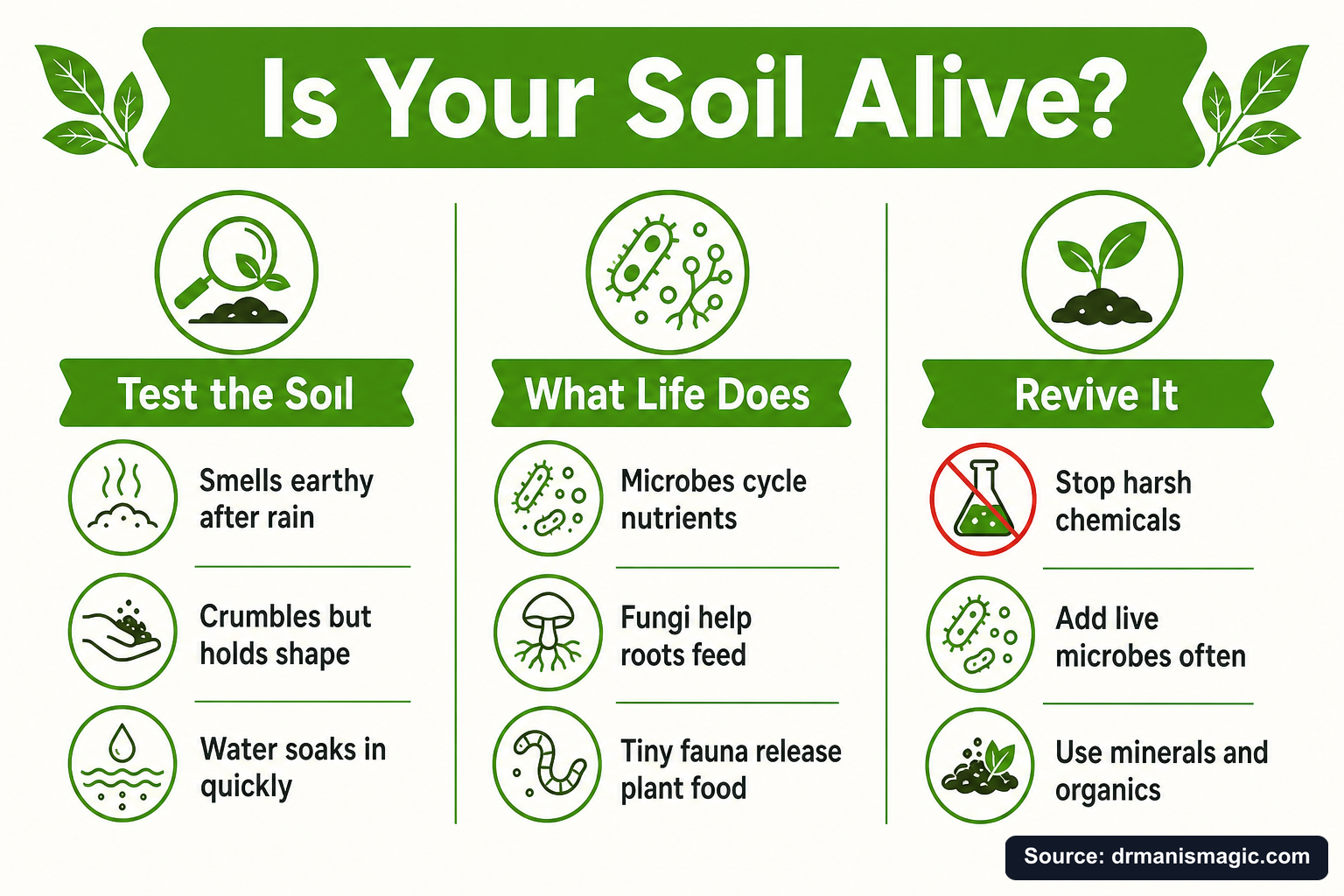
Pick up a handful of soil from your garden. Close your eyes. What do you smell?
If it smells like a forest after rain — that clean, rich, earthy scent — something remarkable is happening in your hands right now. That smell has a name. Scientists call it petrichor, and it comes from a compound called geosmin, released by a family of bacteria called Streptomyces. You are literally smelling life. Billions of invisible workers, churning, cycling, protecting. You are holding an ecosystem, not just dirt.
But if that soil smells like nothing, or worse, like a wet basement or something rotten, that is a story too. And it is not a good one. Most gardeners never stop to ask this question. They water, they fertilize, they hope. Then they wonder why the plants look pale and tired, why the fruit never quite gets there, why things start strong and slowly circle the drain. Here is what almost nobody tells you: the problem is almost never the plant. It is what is going on — or not going on — a few inches below the surface.

Plant Super Boost
After growing over 250,000 trees at our South Texas nursery, we have seen every version of this story. And we want to give you a way to finally diagnose what is happening in your soil, right now, without expensive lab equipment, without a PhD, and without guesswork. Your soil is not simply alive or dead. It is somewhere on a spectrum: functioning, stressed, depleted, imbalanced, or recovering. Let's figure out where yours stands — and what to do about it.
Key Takeaways
- Living soil is not just dirt with worms. It is a functioning ecosystem with bacteria, fungi, protozoa, and nematodes all working together to feed your plants.
- The smell test is one of the fastest free diagnostics you have. Rich, earthy smell means biology is active. Sour, rotten, or no smell at all are warning signs.
- Worms are helpful but not required. Their absence does not automatically mean your soil is dead. Look at the whole picture.
- Salt-based fertilizers, synthetic fungicides, and herbicides are the biggest killers of beneficial soil biology. Many gardeners are unknowingly destroying their own microbes every season.
- Most bagged potting mixes start biologically sterile. They need living microbes added to them before they can truly support your plants.
- Soil biology can recover, but it takes more than one application. Consistent, repeated inoculation with genuinely live microbes is the key.
- The Three Plant Pillars — mineral-based soil, live microbials, and organic fertilizer — are the foundation that makes everything else work.
What Does "Living Soil" Actually Mean?
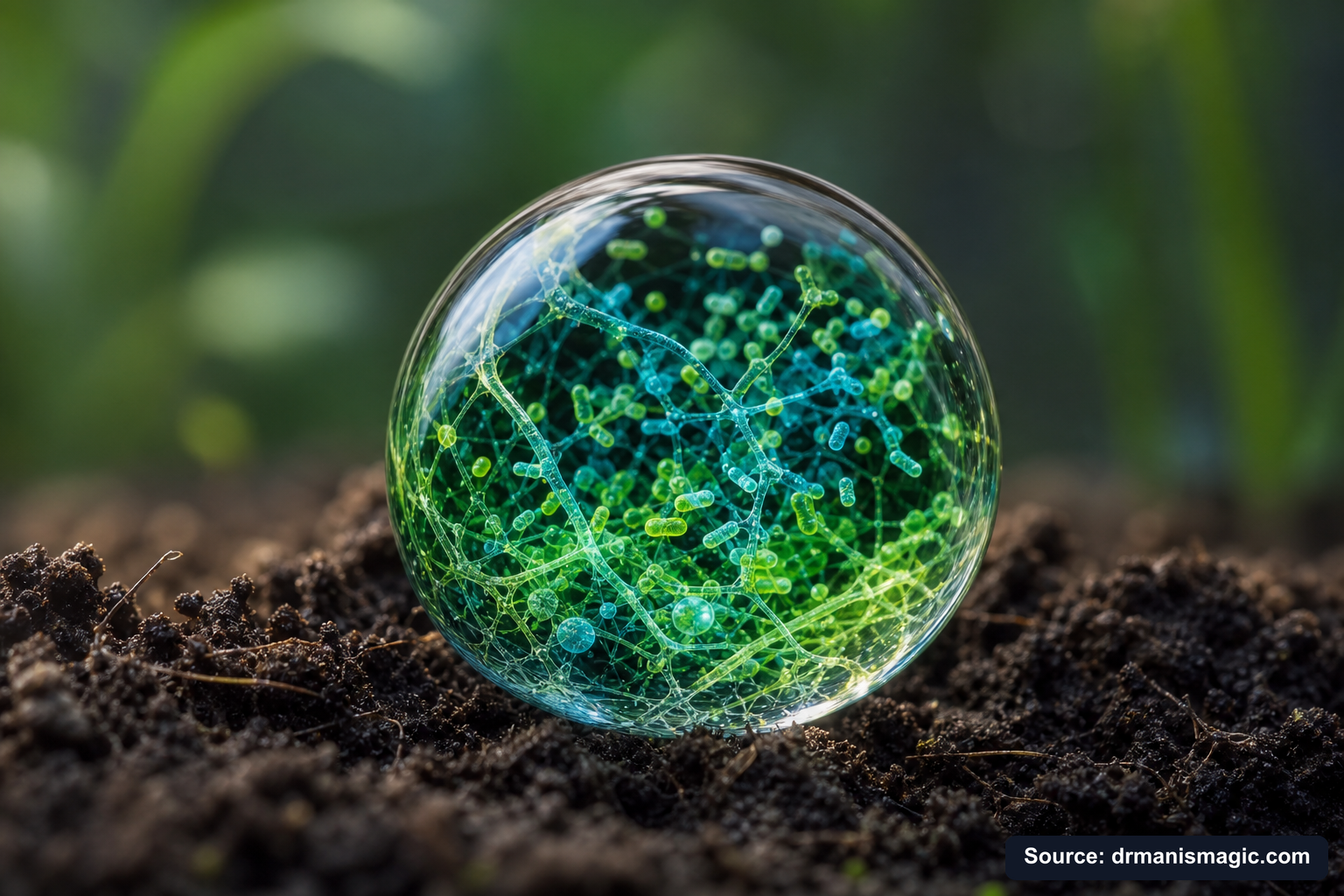
Quick Answer: Living soil is not just soil that contains organisms. It is soil that is actively functioning as an ecosystem — where bacteria and fungi are decomposing organic matter, protozoa and nematodes are cycling nutrients, roots are exchanging sugars with microbes, and the whole community is working together to feed and protect your plants.
Here is the thing most gardening advice gets wrong. It treats soil like a storage unit for nutrients. Pour in the right chemicals, and out comes a healthy plant. That is not how nature works.
Think about a forest. Nobody fertilizes it. Nobody waters it on a schedule. Nobody sprays it with fungicide. Yet trees hundreds of feet tall pull moisture from rock, flowers bloom in shade, and the whole system hums along for centuries. How?
The answer is underground. A single teaspoon of healthy forest soil contains more living organisms than there are people on Earth. We are talking billions of bacteria. Miles of fungal threads. Microscopic animals grazing, hunting, and releasing nutrients in forms plant roots can drink up in seconds.
According to Penn State Extension, living soil is defined by its biological activity — the rate at which organic matter is being broken down, nutrients are being cycled, and beneficial organisms are maintaining the structure of the soil itself. It is a process, not a property.
When that process is running well, your plants almost take care of themselves. When it breaks down — from chemicals, compaction, salt buildup, or sterile inputs — even the most expensive fertilizer in the world cannot fix what is missing. You can pour money into the ground and still watch your plants struggle. Because plants do not respond to your bank account. They respond to biology.
This is the core idea behind the Three Plant Pillars that Dr. Mani Skaria developed after 40 years of working with citrus trees, houseplants, and tropical trees. Mineral-based soil. Live microbials. Organic fertilizer. Get all three right, and your plants become nearly bulletproof. Miss even one, and you are fighting uphill every single season.
What Are the Visible Signs That Your Soil Is Biologically Active?
Quick Answer: The clearest visible signs of biologically active soil are a rich earthy smell, crumbly clumps that hold their shape, organic matter breaking down in the top layer, roots with white fuzzy threads attached, fast water infiltration, and visible small creatures when you dig. No single sign tells the whole story — look for the pattern.
You do not need a lab to get a strong read on your soil biology. Your senses are powerful diagnostic tools, and they are free.
The Smell Test
Grab a handful of moist soil and smell it deeply. Healthy, biologically active soil smells like the earth after rain. That scent is geosmin, produced by Streptomyces bacteria. It is one of the most reliable indicators that your microbial community is alive and working. If your soil smells sour or like rotten eggs, it has gone anaerobic — meaning the oxygen is gone and the wrong kind of microbes have taken over. If it smells like absolutely nothing, the biology has been depleted or was never there to begin with.
The Structure Test
Squeeze a handful of moist soil in your fist and release it. Healthy soil forms clumps that hold together but crumble easily when you poke them. Those clumps — called aggregates — are held together by a sticky protein called glomalin, produced by mycorrhizal fungi. No fungi, no glomalin, no aggregates. What you get instead is either dust that falls apart immediately or dense clay that stays in one hard lump. Both are signs of biological depletion.
The Root Inspection
Pull up a struggling plant and look at its roots. Healthy roots should be white or cream-colored, firm, and slightly fuzzy at the tips. That white fuzz? Those are mycorrhizal fungi forming a symbiotic partnership with the root. Dr. Mani calls this the moment you know the magic is working underground. Dark, slimy, or mushy roots are a sign of root rot, which is almost always connected to poor drainage and absence of the beneficial fungi that protect root tissue from pathogens.
The Infiltration Test
Dig a small hole about 12 inches deep and fill it with water. In biologically active soil with good structure, the water should drain within 30 to 60 minutes. If it sits there for hours, your soil structure has collapsed. That usually means compaction, salt buildup, or the loss of the fungal networks that create the tiny pore spaces water moves through.
The Decomposition Check
Bury a small piece of cardboard or a cotton cloth a few inches below the surface. Come back in four to six weeks. If it has broken down significantly, bacteria and fungi are actively at work. If it looks almost unchanged, biological activity is very low.
| What to Check | Healthy Sign | Warning Sign | Score (1 pt each) |
|---|---|---|---|
| Smell | Rich, earthy, after-rain scent | Sour, rotten, or odorless | |
| Structure | Crumbly aggregates that hold shape | Dusty, hard clumps, or crusted surface | |
| Root appearance | White, firm, with fuzzy tips | Brown, slimy, or mushy | |
| Water infiltration | Drains in under 1 hour | Sits for hours or pools on surface | |
| Decomposition | Organic matter actively breaking down | No breakdown visible after weeks | |
| Visible life | Worms, beetles, or small arthropods present | Nothing visible when digging | |
| Surface covering | Mulch, leaves, or living plants | Bare, exposed, or crusted soil | |
| Salt crust | No white crust on soil surface or pot edges | White mineral crust visible | |
| Plant response | Steady growth, good color, vigorous | Yellowing, stunted, or stalling despite feeding |
Score 7-9: Your biology is functioning well. Keep feeding it. Score 4-6: Stressed or depleted. Recovery is possible and worth starting now. Score 0-3: Severely depleted or dead. Time to rebuild from the foundation up.
Do Earthworms Mean Your Soil Is Healthy?
Quick Answer: Earthworms are a good sign in many gardens, but their absence does not automatically mean your soil is dead. Worms need specific conditions — moisture, temperature, and food. Many healthy soils in arid climates, containers, or sandy environments have very few worms yet support thriving microbial communities. Look beyond worms to the full picture.
Everybody says "if you've got worms, you've got good soil." And it sounds right. Worms are great. They shred organic matter, create drainage channels, and deposit nutrient-rich castings. We love worms.
But here is what the worm fans leave out.
Earthworms require moisture. In hot, dry South Texas where we grow our trees, worms are scarce even in perfectly healthy soil. They need cool temperatures. They need a consistent food source of decaying matter. In containers, raised beds, and arid gardens, all three can be missing even when the microbial community is thriving. The University of Minnesota Extension notes that worms are useful indicators but one of many, and that in many native ecosystems, earthworms are not naturally present at all.
The real biology driving plant health is invisible. Bacteria. Fungi. Protozoa. Nematodes. These are the organisms doing the heavy lifting. Worms are visible helpers, but they are not the engine. They are more like the maintenance crew that shows up after the real work is done.
So if you have no worms, do not panic. Ask the other questions on the checklist above. The full picture matters.
Who Are the Real Workers Inside the Soil Food Web?
Quick Answer: The soil food web is a layered community. Bacteria and fungi break down organic matter. Protozoa and nematodes graze on bacteria and release plant-available nitrogen. Arthropods shred larger material. Mycorrhizal fungi extend the root system to access water and phosphorus far beyond what roots can reach alone. Every layer depends on the others.
Let's meet the crew. This is the team working around the clock, completely invisible, entirely free, and almost always ignored by conventional gardening advice.
| Organism | What They Do | Why Plants Need Them |
|---|---|---|
| Bacteria | Break down organic matter, fix nitrogen from the air, suppress pathogens, build soil aggregates | First responders — they unlock nutrients from raw organic material and protect root zones |
| Mycorrhizal Fungi | Extend the root system by up to 1,000 times its size, deliver phosphorus and water, produce glomalin to build soil structure | The single biggest amplifier of root function — without them, roots are working at 1% capacity |
| Free-living Fungi | Decompose tough carbon materials like lignin and cellulose, create pore spaces, support aggregate stability | Break down the hard stuff bacteria cannot touch; build the physical architecture of the soil |
| Protozoa | Graze on bacteria, releasing nitrogen in plant-available form | The most underrated nutrient cycler in the garden — they turn locked-up nitrogen into something roots can actually drink |
| Beneficial Nematodes | Graze on bacteria and fungi, release nutrients, some hunt pest insects in the soil | Part of the nutrient cycling chain and a natural pest control layer |
| Arthropods | Shred larger organic debris into smaller pieces for bacteria and fungi to process | Speed up decomposition by creating more surface area for microbial action |
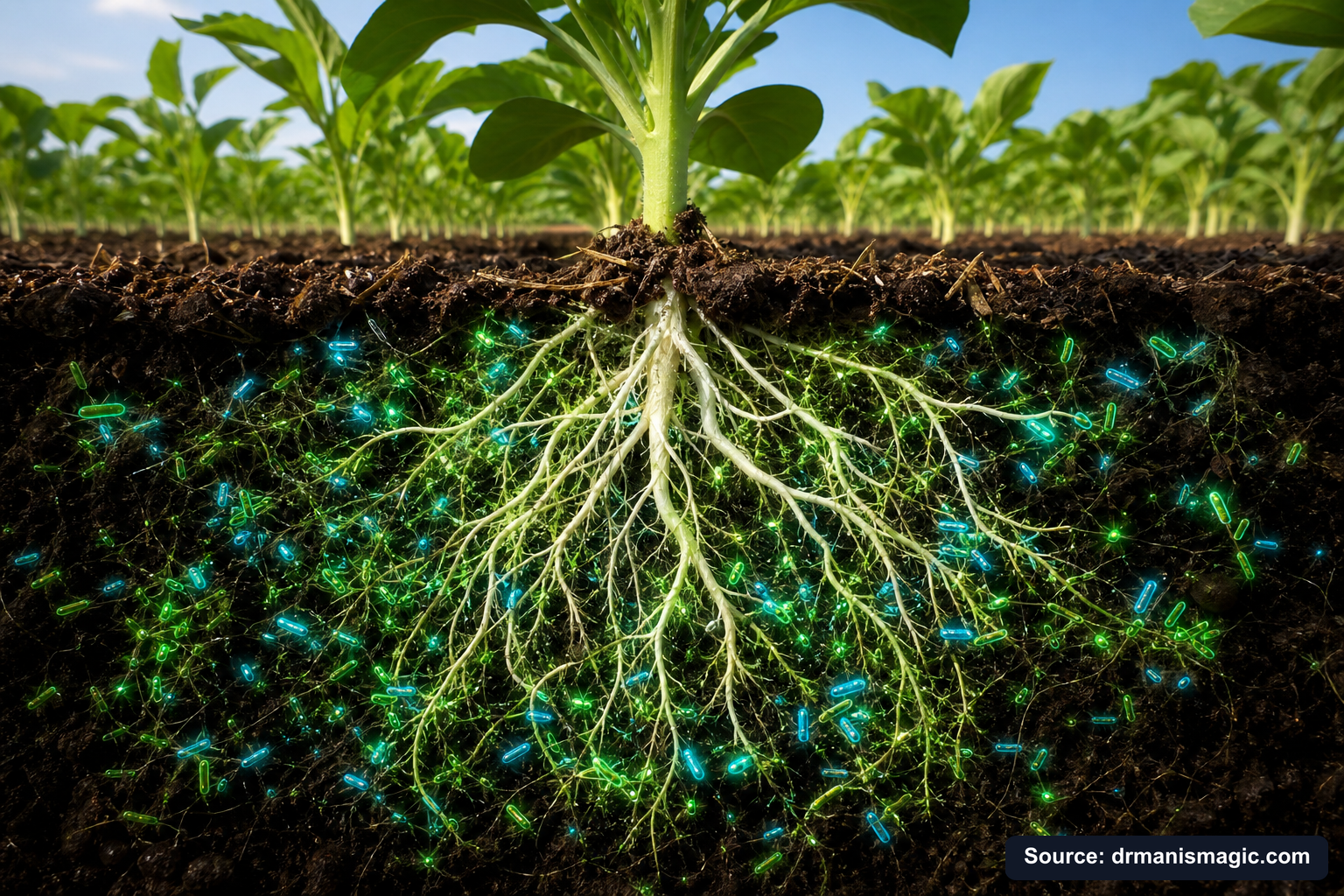
Here is the part that most gardening books skip entirely: protozoa and free-living nematodes are some of the most important nutrient cyclers in your soil. When a protozoan grazes on a bacteria cell, it releases nitrogen in ammonium form — exactly what plant roots can absorb instantly. This is not a slow process. It happens continuously, right at the root zone, triggered by the plant's own root activity.
Plants are not passive recipients of nutrients. They are actively trading with their soil community. Roots release sugars to feed bacteria and fungi. In return, the microbes unlock and deliver nutrients the plant cannot access on its own. It is a negotiation that has been happening for 450 million years. We just keep trying to replace it with a bag of salt-based crystals.
Is My Bagged Potting Mix or Store-Bought Soil Biologically Dead?
Quick Answer: Most bagged potting mixes are biologically sterile when they reach you. They are steam-treated or processed in ways that kill microbial life. They also tend to be bark and sawdust based, which breaks down over time, compacts, and blocks oxygen from roots. Without a living microbial community, they cannot cycle nutrients or protect roots no matter how much fertilizer you add.
Walk into any big box store. Grab a bag of "premium potting mix." Read the ingredients. Pine bark. Peat moss. Perlite. Maybe a little slow-release fertilizer pellet thrown in.
What you are holding is biologically empty.
Those materials were processed and packaged in ways that strip out virtually all microbial life. There is no food web. There is no nutrient cycling. There is no root protection. There is just a growing medium that, over the course of months, will compact, turn anaerobic, and start choking the very roots it was supposed to support. That is not a theory. We have seen it happen to tens of thousands of plants brought to us after being grown in conventional potting mix.
This is exactly why Dr. Mani developed Super Soil — a mineral-based blend built on silica-rich sandy loam from the Rio Grande Valley. Unlike bark-based mixes, it does not decompose. It does not compact. It does not steal oxygen from roots. It is a permanent, stable foundation that you can inoculate with live biology and trust to support your plants for years, not months.
But even the best soil starts as a blank canvas. The biology has to be added. And that is where most gardeners — even the experienced ones — make the critical mistake.
You Never Had a Brown Thumb.
You were handed the wrong tools. This free guide hands you the right ones.
You watered it. You fed it. It died anyway.
It was never you. It was the dirt, the salt food, and the bad advice.
This guide shows you what really went wrong, and how to fix it for good.
- Why your plants really died, and why it was never your fault
- The salt hiding in your plant food that quietly burns the roots
- The hidden killer in almost every bag of store soil
- The tiny helpers that grow a whole forest for free
- The rescue trick that brings a half dead plant back to life

What Kills Soil Biology and How Do You Know If Yours Has Been Damaged?
Quick Answer: Salt-based synthetic fertilizers, herbicides, broad-spectrum pesticides, and synthetic fungicides are the four biggest killers of beneficial soil biology. If you or a previous gardener has used any of these regularly, your soil biology has almost certainly been damaged. Signs include white salt crust on soil, plants that respond well to fertilizer initially then crash, and roots that look brown or slimy despite correct watering.
Here is the uncomfortable truth that the big chemical companies do not want you sitting with too long.
Every bag of synthetic, salt-based fertilizer you pour on your soil is creating a hostile environment for the very organisms that make your soil work. Salt draws moisture out of microbial cells through osmosis — the same way it draws moisture out of a slug. High enough salt concentration and the bacteria die. The fungi shrivel. The protozoa vanish. And the nutrient cycling stops.
Then your plant looks pale, so you add more fertilizer. And the cycle gets worse.
Herbicides like glyphosate have been shown to disrupt microbial communities directly, particularly the bacteria that fix nitrogen and the fungi that form mycorrhizal partnerships. Broad-spectrum fungicides do not distinguish between the pathogenic fungi you are targeting and the beneficial mycorrhizal fungi your plant depends on. They wipe out both.
Here are the warning signs that your soil biology has been damaged:
- White, powdery crust forming on the soil surface or along the edges of pots — that is salt accumulation
- Plants that flush green after fertilizing but then yellow out faster and faster each cycle
- Root rot despite normal watering — the protective fungal community that fights root pathogens has been eliminated
- Soil that repels water initially before absorbing it — called hydrophobic soil, caused by the collapse of fungal networks
- Plants that seem "addicted" to inputs — they need more and more product for less and less result
- Organic matter that sits on the surface for months without breaking down
See also: The Hidden Reason Synthetic Fertilizers Cause Root Rot
Live vs. Dead Microbe Products: How Do You Tell the Difference?
Quick Answer: Most microbial products sold in stores are either dried powder cultures that rehydrate poorly, or liquid compost-tea products that have gone anaerobic and smell terrible by the time you open them. Genuinely live microbial products should smell earthy, not rotten, and should contain a broad spectrum of organisms harvested from active compost, not grown in a lab vat and dried.
This is where it gets personal for us. Because we tried dozens of products before we found the answer.
When Dr. Mani started testing microbial inoculants on our citrus trees, the results were mostly disappointing. Powder products, liquid products, expensive products, cheap products. Most of them did nothing measurable. And after years of testing, we figured out why.
There are three ways most microbial products are made, and two of the three simply do not work.
The powder approach. A handful of specific bacterial or fungal species are grown in industrial vats, then dried into spores and packaged as powder or mixed into a liquid. The hope is that when you add water, the spores reactivate. In theory, it works. In practice, the species diversity is too narrow, the survival rate after drying is too low, and the organisms are too foreign to the complex community already in your soil. We ran dozens of trials. We saw no meaningful results.
The rotten liquid approach. Some products are made from compost tea or earthworm castings that are harvested and bottled. When fresh, compost tea is genuinely powerful. But within 24 hours, without active aeration, it goes anaerobic. The beneficial aerobic microbes start dying. The bottle builds pressure. When you open it, it fizzes and smells like sewage. People see some benefit from the humic and fulvic acids that remain, but the living biology they paid for is mostly gone.
The stabilized approach. This is what we developed with our world-class compost expert — a proprietary, all-natural technique that keeps the full spectrum of microbes from our own hand-crafted compost alive and stable without letting them go anaerobic. The result is a product that smells earthy, not rotten. That can be shipped to your door. That contains over 2,000 species of bacteria, 400 to 500 species of fungi including mycorrhizae, plus protozoa and nematodes. And if you put a drop under a microscope, you can watch the organisms moving.
| Product Type | Viability When You Use It | Spectrum of Organisms | Smell | Our Verdict |
|---|---|---|---|---|
| Dried powder (lab-grown) | Low — spore reactivation is unreliable | Narrow — a few selected species | Odorless | We saw no results. Not recommended. |
| Powder added to liquid | Low — same issues as dry powder | Narrow | Mild to odorless | Same problems, different packaging. Skip it. |
| Compost tea, fresh under 24 hours | Moderate — only if actively aerated | Partial — whatever was in the compost | Earthy, then turns sour fast | Great if you make it yourself and use it immediately. Very time-sensitive. |
| Compost tea, over 24 hours old | Low — gone anaerobic | Partial | Strong rotten smell | The biology is mostly dead. Not worth using. |
| Plant Super Boost (stabilized, full-spectrum) | High — genuinely live at point of use | Broad — 2,000+ bacteria, 400-500 fungi incl. mycorrhizae, plus protozoa and nematodes | Earthy, not rotten | Harvested from real compost. Stabilized naturally. Verified by lab analysis. This is what we use on our own trees. |
Plant Super Boost was born from that discovery. It is not lab-grown biology in a dried packet. It is the power of fresh, active compost — captured and stabilized so it arrives alive at your door. Zero PFAS. Zero biosludge. Zero synthetic salts.
See also: Why Most Fertilizers Are Actually Salt in Disguise
Standard Soil Test vs. Biological Soil Test: Which One Do You Actually Need?
Quick Answer: A standard soil test tells you your pH, nutrient levels, and salt content — the chemistry. A biological soil test measures respiration, microbial biomass, and organism diversity — the biology. Most home gardeners should start with a standard test to fix obvious chemistry problems, then focus on building biology through organic inputs and live microbial inoculants.
People ask us all the time: "Should I get my soil tested?" The answer is yes. But you need to know what different tests can and cannot tell you.
A standard soil test from your county extension service or a mail-in lab will tell you your soil pH, levels of nitrogen, phosphorus, potassium, and other nutrients, organic matter percentage, and electrical conductivity (which is a measure of salt content). This is your chemical foundation. If your pH is way off, your plants cannot absorb nutrients no matter how many microbes you have. If your salt levels are high, you are actively harming your biology. Fix these first.
A biological soil test goes deeper. It measures soil respiration (how much CO2 is being produced by microbial activity), microbial biomass carbon, PLFA (phospholipid fatty acid analysis, which identifies the types of organisms present), nematode trophic groups, and aggregate stability. These tests are more expensive and less widely available, but they tell you whether your biological community is functioning.
For most home gardeners, the practical path is this: fix the chemistry first with a standard test, then rebuild the biology through organic matter, live microbial inoculants, and organic fertilizer. You do not need a biological assay to start. The checklist you already have above tells you enough to begin.
Are Mushrooms and White Fuzz on Soil Signs of Disease or Signs of Life?
Quick Answer: Mushrooms and white fuzzy threads in or on your soil are almost always signs of beneficial biological activity, not disease. Mushrooms are the fruiting bodies of decomposer fungi doing exactly what they should. White fuzz on roots or in soil is typically mycorrhizal fungi or beneficial molds. Actual pathogenic fungi usually show up on leaves, stems, or roots as slimy brown tissue, not white fuzz in soil.
We get this question a lot. Someone digs in their garden, sees white threads running through the soil, and panics. Or mushrooms pop up in a container after a wet week, and the first instinct is to Google "dangerous fungus plant killer."
Slow down. Take a breath.
White mycelium threads running through healthy soil and mulch are almost always your friends. They are the vegetative body of fungi doing the work of decomposing organic matter, connecting root systems, and building the aggregate structure that makes your soil crumbly and airy. Mushrooms are just those same fungi making seeds. They show up when conditions are moist and the fungal network is large and active. That is a healthy sign.
What actually looks like disease? Brown, mushy roots. Yellowing leaves paired with wet, heavy soil that smells sour. A white powdery coating on leaf surfaces (that is powdery mildew, which is a leaf problem, not a soil problem). Soft, collapsing stems at the soil line.
The real risk in soil biology is not that you will see too much fungal activity. It is that you will destroy the beneficial fungi with a broad-spectrum fungicide application — and then lose the very protection system that was keeping your roots safe from actual pathogens.
How Do You Recover Depleted or Dead Soil? A Step-by-Step Plan
Quick Answer: Recovering depleted soil takes consistent action over time. You cannot fix years of chemical damage in one application. The recovery path involves correcting chemistry first, then rebuilding biology through organic matter, live microbial inoculants, organic fertilizer, and management changes that stop the ongoing damage.
You can get money back. You cannot get time back. The single most painful thing we hear from gardeners — and we hear it more than almost anything else — is some version of: "I have been trying to grow this tree for three years and I still haven't seen any fruit." Three years of watering, fertilizing, hoping. Three years of using the wrong inputs and fighting nature instead of working with it.
That time is gone. But the next three years do not have to look the same.
Here is the recovery path we use at our nursery, built on the Three Plant Pillars and tested across 250,000 trees:
- Test your soil chemistry first. Get a standard soil test and check pH, nutrient levels, and electrical conductivity. High EC (above 2 dS/m) means salt damage. You need to flush with clean water before biology can come back. Fix pH to within the right range for your plant before anything else.
- Stop the damage. If you are using salt-based synthetic fertilizers, herbicides, or synthetic fungicides, stop. Every application you make is pushing the recovery further away. Switch to organic inputs that work with your biology, not against it.
- Add carbon and organic matter. Compost, mulch, and organic material are the food source for your microbial community. You cannot build a workforce without a cafeteria. Layer 2 to 3 inches of compost or mulch on the soil surface and let it break down naturally.
- Inoculate with genuinely live microbes. Not powder. Not a rotten-smelling liquid. Live, full-spectrum biology that is actually alive when it reaches your roots. Apply monthly. Biology takes time to rebuild, and ongoing applications keep the beneficial community dense enough to compete with pathogens.
- Feed with organic fertilizer. Slow-release organic fertilizer feeds both your plant and your microbial community. It does not burn roots. It does not spike and crash. It works in harmony with the biology you are rebuilding.
- Keep the soil covered. Bare soil loses moisture, overheats, and loses biology fast. Mulch, cover crops, or even a layer of leaves dramatically stabilizes the environment your microbes need.
- Be patient and consistent. Biological recovery is not a one-week project. A badly depleted soil can take one full growing season to show meaningful improvement. But it will improve. Every month of consistent, biology-friendly management is compounding in your favor.
For a complete guided approach to setting up all Three Plant Pillars at once, visit our Free Plant Care Field Guide. It walks you through exactly what to do, in plain language, without jargon.
Your Soil Is Trying to Tell You Something
You started this article holding a handful of soil. Maybe now you are looking at it differently.
Not as dirt. Not as a growing medium. As an ecosystem that has been either thriving or struggling, depending on what it has been given — or taken from it — over the years.
The good news is that biology is resilient. Soils that have been stripped, salted, sprayed, and starved can come back. We have seen it happen at our nursery in South Texas, in containers, in gardens, in lawns, and in orchards. The biology wants to recover. It just needs the right conditions and the right inputs to do it.
The Three Plant Pillars are not complicated. Mineral-based soil that breathes. Live microbes that cycle nutrients and protect roots. Organic fertilizer that feeds without burning. Put all three together and you stop fighting nature. You start working with it. And when you are working with nature instead of against it, plants do not just survive — they thrive in ways that genuinely surprise you.
If you want to start rebuilding your soil biology today, take a look at Plant Super Boost — our live, full-spectrum microbial formula, made from real compost, stabilized naturally, and backed by a 30-day money-back guarantee. It is the exact product we use on our own trees. And it is a great first step toward soil that is genuinely, measurably alive.
Frequently Asked Questions
These are the questions we hear most from gardeners who are finally starting to ask the right things. After growing over 250,000 trees in South Texas, we have seen what living soil does for plants and what dead soil does to them. The answers below cut straight to the truth.
How can you tell if your soil is actually alive?
Pick up a handful and smell it. Living soil smells rich and earthy, like a forest after rain. That smell comes from real biological activity happening right in your hands. Beyond smell, living soil feels crumbly and light. Water soaks in instead of pooling on top. Roots look white and healthy when you pull a plant out. If your soil smells like nothing or smells sour, the biology is either gone or going wrong fast.
What are the signs of unhealthy soil?
Watch for these warning signs. Water puddles on top instead of soaking in. The soil feels hard and dense when you try to dig. Plants start strong then slowly fade. Leaves look pale or yellowed even after you fertilize. Roots look brown and mushy instead of white and firm. Most of the time, the problem is not the plant. It is the soil underneath it. Salt-based fertilizers and synthetic chemicals are the biggest culprits. They quietly wipe out the beneficial bacteria and fungi your plants depend on.
What are five key indicators of healthy soil?
First, it smells earthy and clean. Second, water moves through it evenly without pooling. Third, it feels loose and springy, not packed and hard. Fourth, roots growing in it look white, firm, and branching outward. Fifth, you can see organic matter slowly breaking down over time. At Dr. Mani's Magic, we call this the living foundation. It is what the Three Plant Pillars are built around: mineral-based soil, live microbes, and organic fertilizer working together as one system.
Is 2-year-old potting soil still good?
Maybe, but probably not in the way you are hoping. Most bagged potting mixes start out biologically sterile anyway. They are mostly pine bark and wood fibers that break down fast, compact over time, and choke roots of oxygen. After a season or two, that structure collapses. Even if the soil looks okay, the biology is gone. The fix is not just replacing the bag. It is switching to a mineral-based soil that does not break down, then adding live microbes back in so the soil actually works for your plants.
How long does potting soil last before it goes bad?
An opened bag of standard potting mix typically breaks down within nine to twelve months. An unopened bag can last up to two years. But here is the real problem nobody talks about. Most potting mix never had living biology in it to begin with. When the organic material inside it decomposes, it steals oxygen from your roots and creates the perfect conditions for rot and pests. That is why Dr. Mani built Super Soil around sandy loam, a mineral base that does not decompose and does not need to be replaced every year.
Is soil just dead plants and dirt?
Not even close. A single teaspoon of truly healthy soil holds more living organisms than there are people on Earth right now. We are talking billions of bacteria, miles of fungal threads, and microscopic creatures all working together to feed and protect your plants. The problem is that most gardeners have been using salt-based fertilizers and synthetic chemicals for years without knowing it. Those products quietly destroy that underground world. When the microbes are gone, the soil becomes just dirt. And dirt does not grow great plants.
Why do people use vinegar to test their soil?
Vinegar is acidic. When you drop two tablespoons of soil into a jar of vinegar and it fizzes, that means your soil is leaning alkaline. More fizzing means higher alkalinity. No fizzing means your soil is neutral or acidic. It is a fast, free test you can do right now. Knowing your pH matters because it affects whether your plants can actually absorb the nutrients in the soil. But pH is just one piece of the picture. Without live microbes in the soil, even perfect pH will not save your plants.
About the Author
Dr. Mani Skaria, PhD
Dr. Mani Skaria, PhD, is a plant pathologist and the scientific founder of Dr. Mani's Magic. He earned his doctorate at Purdue University and spent 48 years studying how plants, soil, and living microbes work together, including his years as Professor Emeritus at Texas A&M and as a member of the USDA NAREEE Advisory Board. He invented micro-budding, a method for growing healthier, stronger trees, and has grown more than 250,000 trees on the family farm in Hargill, Texas - US Citrus Nursery. His life's work takes real lab science and practical experience and turns it into simple, safe, organic plant care anyone can use at home.


