


Why Transparency in Garden Inputs Matters More Than Labels | Dr. Mani's Magic
Why Transparency in Garden Inputs Matters More Than Labels
You're standing in the garden center. The bag looks great. The label says "organic," "natural," "plant food," and "safe for families." There's a picture of lush green tomatoes and happy kids playing in the grass. You feel good about this one. You take it home. You follow the directions. And six weeks later, your grass looks scorched, your tree is dropping leaves, and you're back on Google at midnight typing "why is my plant dying."
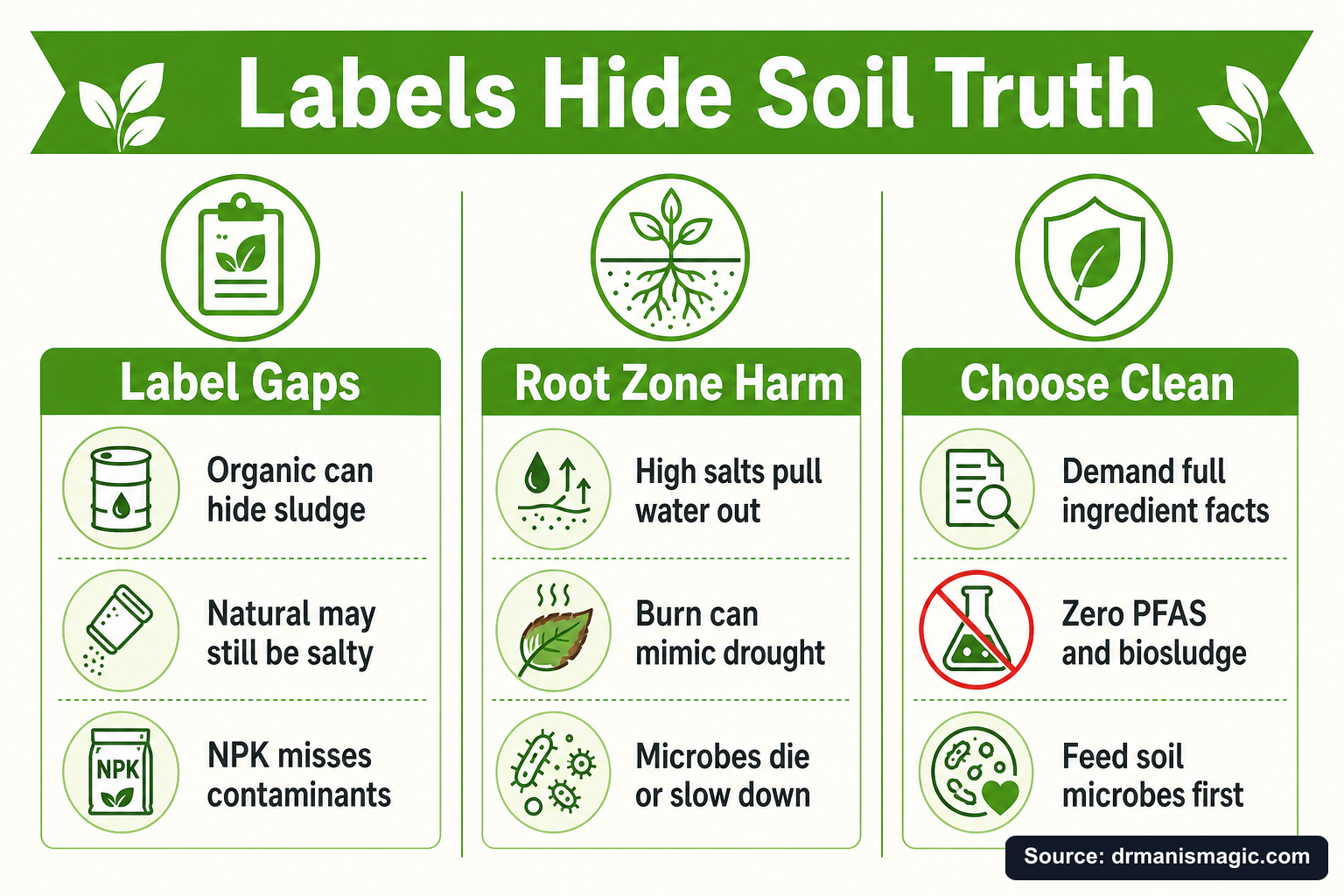
Sound familiar? Here's what nobody told you. That bag wasn't lying exactly. But it wasn't telling you what you actually needed to know. The word "organic" doesn't tell you if it contains sewage sludge. "Natural" doesn't mean low-salt. "Plant food" doesn't tell you whether it feeds the plant or quietly kills the microbes that the plant depends on. The label tells you what the marketing team decided to print. It doesn't tell you what's actually happening in your soil the moment you apply it.
After growing over 250,000 trees at our South Texas nursery, we learned something that changed everything. Plants don't respond to labels. They respond to chemistry, biology, salt load, oxygen, and what's actually living in the root zone. That's what this article is about. We're going to show you exactly what to look for, what to avoid, and why transparency in garden inputs matters more than anything printed on the front of a bag.

Plant Super Boost
Key Takeaways
- "Organic," "natural," and "plant food" are marketing categories, not functional descriptions of what an input does in your soil.
- Salt-based synthetic fertilizers create osmotic stress, can cause fertilizer burn, and kill the beneficial microbes your plant depends on.
- Some fertilizers, including products labeled organic, contain biosludge and PFAS "forever chemicals" that can contaminate edible gardens and lawns.
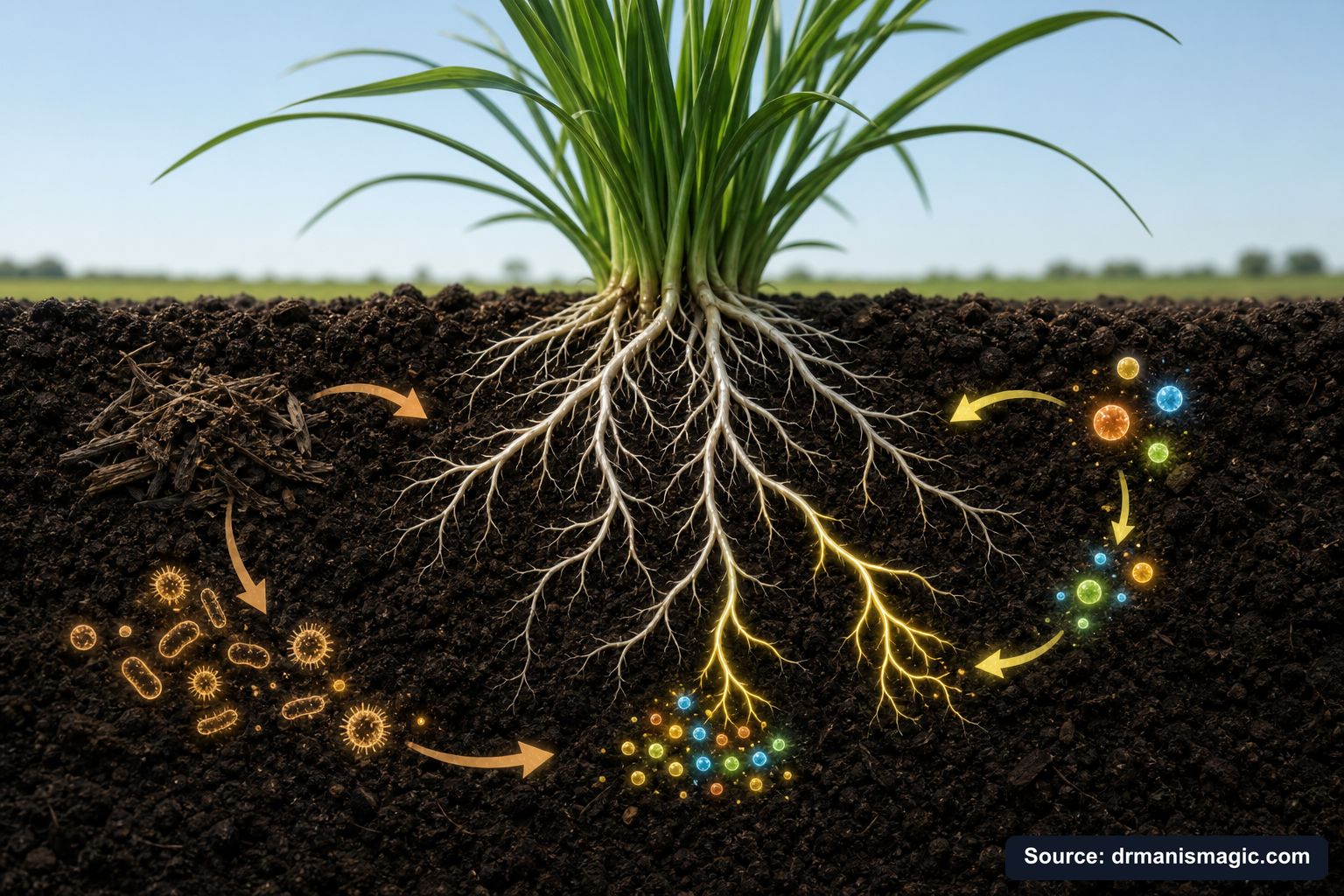
- Organic fertilizers work by feeding soil microbes first. The microbes then convert nutrients into forms the plant can absorb, acting like a natural slow-release system.
- The Three Plant Pillars, developed and proven at US Citrus Nursery, give every plant a foundation that works with nature rather than against it.
- Fertilizer burn, wilting despite watering, and root rot can all look alike. Knowing what's in your input helps you diagnose the real cause.
- Clean inputs, meaning zero PFAS, zero biosludge, and zero synthetic salts, are the only inputs that protect your soil biology long-term.
Why Does the Label on Your Fertilizer Not Tell You the Full Story?
Quick Answer: Fertilizer labels are required to list nutrient percentages and certain ingredients, but they are not required to disclose salt content, biosludge feedstocks, PFAS contamination risk, or whether the nitrogen form requires soil microbes before the plant can use it. Two products can have identical labels and behave completely differently in your soil.
Think about it this way. You buy two bags. Both say "6-4-4 organic fertilizer." One is made from crab shells, kelp, and amino acids. The other is made from processed municipal sewage sludge. Both are technically "organic" by legal definition. But one feeds your soil biology. The other may contain PFAS, heavy metals, and hormone-disrupting compounds that linger in your garden soil for decades.
The University of Maine Cooperative Extension has published guidance on exactly this problem. They advise consumers to ask whether a compost or fertilizer product contains sewage sludge or biosolids, whether it has been tested for PFAS, and what the actual feedstock sources are. Those questions are not answered anywhere on a standard fertilizer bag.
The N-P-K number on the front tells you the percentage of nitrogen, phosphorus, and potassium by weight. That's useful. But it doesn't tell you whether the nitrogen is in a fast-release salt form that can scorch roots, or a slow-release amino acid form that feeds microbes gently. It doesn't tell you the salt index. It doesn't tell you whether the product has been tested for contaminants. And it doesn't tell you what happens to your soil biology after you apply it.
That gap between what labels say and what gardeners actually need to know is exactly why plants fail. Not because gardeners aren't trying. But because the information they need isn't being shared.
What Is the Salt Index and Why Does It Destroy Root Zones?
Quick Answer: The salt index measures how much osmotic pressure a fertilizer creates in the soil water around your roots. High-salt fertilizers pull water out of roots instead of letting roots pull water in. The result looks like drought stress or fertilizer burn. It also kills the beneficial microbes that plants depend on for nutrient cycling and disease resistance.
Here's the picture. Your root tips are surrounded by soil water. That water carries dissolved nutrients. When everything is balanced, the water flows into the root. The plant drinks. It grows. Simple.
Now add a high-salt fertilizer. Suddenly the soil water around your roots becomes more concentrated than the water inside the root. Physics takes over. Water starts flowing the wrong direction, out of the root and into the soil. The plant is sitting in wet soil and dying of thirst. This is called osmotic stress. And it's exactly why fertilizer burn can look identical to drought stress.
University of Delaware Cooperative Extension describes this process clearly. They explain that soluble salts in fertilizers can create osmotic stress severe enough to cause wilting, leaf scorch, root injury, and impaired nutrient uptake, even when the soil appears moist. Utah State University Extension and Wisconsin Extension have published similar findings. Oregon State and Nevada Extension both describe the same root-zone water stress pattern in high-salt soil conditions.
And here's the part the fertilizer bag never tells you. The microbes in your soil are even more sensitive to salt than your roots are. Those beneficial bacteria and fungi are tiny. A salt spike that merely stresses your plant can wipe out entire microbial communities in a single application. Once those microbes are gone, your soil loses its ability to cycle nutrients naturally. You become dependent on the next fertilizer application just to keep the plant alive. This is the cycle that benefits the fertilizer company, not your garden.
See also: How Salt-Based Feeding Quietly Destroys Root Systems
Can Compost and Organic Fertilizers Contain PFAS and Biosolids?
Quick Answer: Yes. Products labeled "organic," "composted," or "natural" can legally contain biosolids derived from municipal sewage sludge. Biosolids are a known source of PFAS, which are synthetic chemicals that do not break down in soil or in the human body. Clean inputs require explicit testing and disclosure, not just a green label.
This is the part most gardening articles skip. The word "organic" in fertilizer labeling does not mean what most people think it means. In chemistry and in federal fertilizer law, "organic" simply means the material contains carbon. Sewage sludge, also called biosolids, is technically organic. So is processed municipal waste. And both are used as filler and nutrient sources in some widely sold fertilizers and bagged composts.
PFAS, short for per- and polyfluoroalkyl substances, are often called "forever chemicals" because they do not break down in the environment or in living tissue. They accumulate over time. Research from multiple universities and state extension services has linked PFAS exposure to disrupted hormone function, immune system effects, and elevated cancer risk in long-term exposure scenarios. When you apply biosolid-based compost to your vegetable garden year after year, you may be slowly concentrating these compounds in the soil where your food grows.
The University of Maine Cooperative Extension recommends that gardeners ask four specific questions before buying any compost or soil amendment. Does it contain sewage sludge or biosolids? Has it been tested for PFAS? What are the feedstocks? Was any topsoil sourced from land treated with sludge or contaminated manure? These are not paranoid questions. They are the minimum standard for transparency that every input supplier should be able to answer.
At Dr. Mani's Magic, we can answer all four. Zero PFAS. Zero biosludge. Zero synthetic salts. Every input in our line is traceable back to known, clean feedstocks. That's not a marketing claim. It's a verifiable fact we hold ourselves to because Dr. Mani Skaria, a Professor Emeritus of Plant Pathology with over 40 years of research experience, built this brand on exactly that standard.
How Do Organic Fertilizers Actually Feed Plants? (The Microbe Secret)
Quick Answer: Organic fertilizers do not feed plants directly. They feed soil microbes first. The microbes break down the organic molecules, converting them into ion forms the plant can absorb through its roots. When those microbes die, they release stored nutrients in a slow, steady stream. This natural cycle acts like a time-release system that keeps feeding your plant long after application.
This is the most important thing most gardeners never learn. And once you understand it, everything about fertilizer labels and gardening choices changes completely.
Picture a crab shell sitting in your soil. It doesn't dissolve instantly. It doesn't flood your root zone with a salt spike. Instead, the bacteria and fungi in your soil start breaking it down. They eat the chitin, the proteins, the minerals. As they digest it, they convert those raw materials into forms the plant root can actually absorb, things like ammonium, nitrate, and phosphate ions.
University of New Hampshire Extension explains this process clearly. Most organic fertilizer molecules must be decomposed by bacteria and fungi before plant roots can use them. The microbes do the conversion work. The plant waits. And then it receives a gentle, steady trickle of nutrition that mirrors exactly how plants have been fed in nature for millions of years.
But here's the part that makes it even better. When those microbes finish their work and die, every nutrient stored in their tiny bodies gets released directly into the root zone. The microbe itself becomes fertilizer. It's a self-reinforcing cycle. More organic matter feeds more microbes. More microbes release more nutrients. More nutrients grow stronger plants. The whole system builds on itself over time, instead of depleting over time the way synthetic programs do.
Minnesota Extension research confirms that soil organisms drive nutrient cycling, nutrient retention, water infiltration, disease suppression, and soil structure, with biological processes supplying a large share of the plant-available nitrogen and phosphorus in healthy soil. This isn't a niche finding. It's the consensus of soil science. The microbes are the engine. Organic inputs are the fuel. Labels that ignore this are telling you an incomplete story.
What Does Amino Acid Nitrogen Actually Do for Your Plant?
Quick Answer: Amino acids are the building blocks of proteins. When used as a nitrogen source in fertilizer, they are small enough for plant roots to absorb directly in some cases, and they are easily broken down by soil microbes into plant-available nitrogen. They support microbe populations, build soil carbon, and provide nitrogen without the salt load of synthetic sources.
Nitrogen is the nutrient plants need most. It builds chlorophyll, the green pigment that captures sunlight and powers photosynthesis. Without enough nitrogen, leaves turn pale yellow, starting with the oldest leaves first. Growth slows. Fruiting drops off.
But not all nitrogen is equal. Synthetic nitrogen fertilizers are typically delivered as urea, ammonium nitrate, or ammonium sulfate. These are salts. They dissolve fast and flood the root zone with a concentrated pulse of ions. That pulse can scorch fine root hairs, spike osmotic pressure, and devastate microbial communities, all in a single application.
Amino acid nitrogen works differently. The amino acids in a product like Crab, Kelp & Amino Acids are derived from natural animal sources like feather meal and tankage. These molecules are protein-based, not salt-based. Some can be absorbed directly through root membranes. Others are broken down by soil microbes first. Either way, the plant receives nitrogen in a form it can regulate, absorbing what it needs when it needs it, rather than being flooded all at once.
The result is steady, consistent growth rather than the boom-and-bust cycle you see with synthetic programs. Leaves stay consistently green. Roots stay consistently healthy. And the microbes that make everything work stay alive and active because you're feeding them, not burning them.
Why Does Chitin From Crab Shells Matter for Soil Health?
Quick Answer: Chitin is a natural compound found in crab shells. When added to soil, it feeds specific bacteria that also consume the chitin-like coating on fungal pathogens and pest eggs. This means chitin actively stimulates natural disease and pest resistance in the root zone, without any synthetic chemistry.
Crab shells are not just a calcium source. They contain chitin, a tough, fibrous compound that makes up the structure of the shell. When chitin breaks down in soil, it does something remarkable. It feeds a specific group of bacteria called chitinolytic bacteria. These bacteria produce enzymes called chitinases.
Here's why that matters. Many harmful soil fungi, including Pythium and Phytophthora, the organisms behind root rot, have cell walls made partly of chitin-like compounds. When chitinolytic bacteria are active in your root zone, they produce enzymes that break down those fungal cell walls. They also break down the chitin-coated eggs of harmful nematodes and soil insects.
In practical terms, adding crab-derived chitin to your soil is like recruiting a specialized defense force. You're feeding the bacteria that naturally attack the pathogens. No synthetic fungicide required. No chemical re-entry period. No warning labels. Just a biological cascade that nature has been running for millions of years.
The calcium in crab shells builds strong plant cell walls. The magnesium supports chlorophyll production. And the chitin activates your soil's natural immune system. That's why crab meal is not just a fertilizer ingredient. It's a soil biology investment.
What Do Kelp and Marine Biostimulants Do That Fertilizers Cannot?
Quick Answer: Kelp contains natural plant hormones called auxins and cytokinins, along with carbohydrates, trace minerals, and alginic acid. These compounds stimulate root growth, improve stress tolerance, support flowering, and feed soil biology in ways that N-P-K numbers cannot capture. Kelp is a biostimulant, not just a fertilizer.
When you look at a kelp product, you might see a very low N-P-K number and wonder why you'd bother. That number is missing the point entirely.
Kelp works through compounds that aren't measured by the N-P-K system at all. Auxins are natural plant hormones that regulate root development and cell elongation. Cytokinins promote cell division and help plants resist stress. Alginic acid improves soil structure and water retention. Mannitol, a natural carbohydrate in kelp, helps plants tolerate drought and temperature extremes.
Cold-processed kelp preserves these compounds in their active form. Heat processing destroys many of them. This is why the processing method matters, and why a label that just says "kelp" isn't telling you enough. You need to know whether the kelp was cold-processed to preserve its biologically active compounds.
The trace minerals in kelp, including iodine, selenium, and dozens of other elements, support enzyme function throughout the plant. The carbohydrates feed soil bacteria directly, giving your microbial community an energy boost alongside the slower-releasing nutrients from crab and amino acids.
Think of kelp as the part of the fertilizer that wakes the system up. The crab and amino acids are the long, steady fuel. The kelp is the ignition.
You Never Had a Brown Thumb.
You were handed the wrong tools. This free guide hands you the right ones.
You watered it. You fed it. It died anyway.
It was never you. It was the dirt, the salt food, and the bad advice.
This guide shows you what really went wrong, and how to fix it for good.
- Why your plants really died, and why it was never your fault
- The salt hiding in your plant food that quietly burns the roots
- The hidden killer in almost every bag of store soil
- The tiny helpers that grow a whole forest for free
- The rescue trick that brings a half dead plant back to life

What Does Volcanic Ash Add to Your Soil That Fertilizers Miss?
Quick Answer: Volcanic ash provides silica and dozens of trace minerals that standard N-P-K fertilizers do not contain. Silica strengthens plant cell walls, increases drought resistance, and improves disease resistance. Trace minerals activate enzymes throughout the plant that support immunity, reproduction, and nutrient transport.
Most fertilizers focus on the big three, nitrogen, phosphorus, and potassium. But plants need at least 12 essential nutrients to function properly, plus silica and a range of trace elements that play critical roles in enzyme activation and structural health.
The law of the minimum states that a plant's growth is limited by whatever nutrient is most deficient, even if every other nutrient is abundant. You can have perfect nitrogen and potassium levels and still have a struggling plant if zinc, boron, or manganese is missing. Standard fertilizers often ignore this entirely.
Volcanic ash addresses trace mineral gaps across the board. Silica specifically strengthens the physical structure of cell walls, making leaves and stems more resistant to mechanical damage, pest feeding, and fungal penetration. Plants with adequate silica stand up straighter, resist drought better, and recover from stress faster than plants grown without it.
The combination of crab chitin, cold-processed kelp, amino acid nitrogen, and volcanic ash in a single granular formula means you're covering the full spectrum of what a plant needs, not just the three nutrients that fit on a simple label.
What Is the "What Labels Say vs. What Gardeners Need to Know" Framework?
Quick Answer: Every garden input should be evaluated on seven functional criteria, not just its marketing category: What is the feedstock? What is the nutrient form and release speed? What is the salt load? Does it require microbes to work? Has it been tested for PFAS and heavy metals? What is the release curve? And what plants and soil conditions is it appropriate for?
Here is the framework we use at US Citrus Nursery when evaluating any input for our 250,000-plus trees. Apply it to anything you're considering buying.
| What the Label Says | What You Actually Need to Know | Why It Matters |
|---|---|---|
| Organic Fertilizer | What is the feedstock? Crab, kelp, and feather meal vs. biosolids and sewage sludge? | Biosolid-derived "organic" products may contain PFAS and heavy metals. |
| Natural Fertilizer | What is the salt index? Many "natural" products have high soluble salt content. | High salt causes osmotic stress, root burn, and microbial die-off. |
| Slow Release | Is release controlled by biology (microbe-mediated) or by a plastic polymer coating? | Plastic-coated synthetics leach microplastics. Biology-mediated release builds soil over time. |
| Plant Food | Does this feed the plant directly, or does it feed soil microbes who then feed the plant? | Inputs that feed microbes build long-term soil function. Direct-feed salt inputs deplete it. |
| Composted Material | What was composted? Municipal waste? Manure from farms with PFAS-contaminated land? | Compost feedstock determines contaminant risk. Vague terms hide the source. |
| Biosolid-Derived | Has this been tested for PFAS? Has it been tested for heavy metals? | Biosolids are a primary pathway for PFAS contamination in garden soil. |
| 6-4-4 or Any N-P-K Number | Are those nutrients in a salt form or a protein/amino acid form? | Same N-P-K number, completely different behavior in the root zone. |
How Do Synthetic Fertilizers Compare to Organic and Chitin-Kelp-Amino Acid Inputs?
Quick Answer: Synthetic fertilizers release nutrients fast because they are salts, but that speed comes at the cost of root damage, microbial death, and soil degradation over time. Organic inputs release slowly through microbial activity, feed soil biology, and build long-term soil health. The comparison below shows why the type of input matters as much as the amount.
| Input Type | Release Speed | Salt Content | Microbial Impact | PFAS Risk | Long-Term Soil Effect |
|---|---|---|---|---|---|
| Synthetic Fast-Release (urea, ammonium nitrate) | Immediate | High | Damages or kills microbes | Low (but plastic-coated versions add microplastics) | Degrades soil biology over time |
| Plastic-Coated Slow-Release Synthetic | Weeks to months | Moderate to High | Less acute damage, still harmful over time | Microplastic contamination risk | Microplastic accumulation, biology still suppressed |
| Biosolid-Based "Organic" | Slow | Low to Moderate | Can support biology if PFAS-free | HIGH (primary PFAS pathway) | May contaminate soil with forever chemicals |
| Crab, Kelp & Amino Acids (7-4-4) | Slow (microbe-mediated) | Very Low | Feeds and supports microbes | None (zero biosludge, zero PFAS) | Builds soil biology and long-term fertility |
See also: Why Most Fertilizers Are Actually Salt in Disguise
What Do Root Rot, Fertilizer Burn, and Drought Stress Actually Look Like?
Quick Answer: These three conditions can look nearly identical on the surface, which is why knowing what's in your soil input is so important. Wilted leaves despite watering, scorched leaf edges, and yellowing can all result from too much salt in the root zone, not just from overwatering or drought. The diagnostic table below helps separate the causes.
This is where gardeners get stuck most often. The plant looks terrible. They add more water. Or more fertilizer. And it gets worse. Because the real cause is salt damage, not drought. Or it's root rot caused by a combination of poor drainage and microbial imbalance. The symptoms overlap and the wrong response makes things worse.
| Symptom | Salt Damage / Fertilizer Burn | Overwatering | True Root Rot (Pythium / Phytophthora) |
|---|---|---|---|
| Wilting despite moist soil | Yes, osmotic stress prevents water uptake | Yes, roots suffocate without oxygen | Yes, roots are destroyed and cannot transport water |
| Leaf edge scorch / brown tips | Yes, most common first symptom | Possible if prolonged | Uncommon early, appears as disease progresses |
| Yellowing leaves | Yes, nutrient lockup from high salt | Yes, root oxygen deprivation | Yes, roots cannot deliver nutrients |
| Soil condition | May appear normal or crusty with salt deposits | Soggy, waterlogged, no drainage | Can be wet or dry; roots are brown, mushy, or absent |
| Root appearance | Brown root tips, fine roots burned | Pale, soft, mushy roots | Dark brown to black, foul smell, complete collapse |
| Response to more water | Gets worse | Gets worse | Gets worse |
| Response to leaching / flushing soil | Often improves within days | No change until drainage improves | No improvement without biological intervention |
If salt damage is the cause, flushing the soil with clean water to leach out accumulated salts is the first step. Then switching to a low-salt organic input and rebuilding the microbial community is what restores long-term health. This is exactly why knowing what's in your fertilizer matters before the damage is done, not after.
See also: The Hidden Reason Synthetic Fertilizers Cause Root Rot
How Do the Three Plant Pillars Create a Transparent, Biology-First Growing System?
Quick Answer: The Three Plant Pillars, developed and proven at US Citrus Nursery across 250,000-plus trees, replace guesswork with a root-cause growing system. Mineral-based soil provides oxygen and drainage. Live microbes build biological resilience. Organic fertilizer feeds the microbes and the plant gently over time. Together, they make healthy plants predictable rather than accidental.
Here's the honest truth about most gardening advice. It starts at the surface. Add this fertilizer. Spray this treatment. Try this trick. But none of it addresses the root cause, literally, of why plants thrive or fail. The answer is almost always in the soil.
Dr. Mani Skaria spent over 40 years as a Professor Emeritus of Plant Pathology, working at the Texas A&M Citrus Center, traveling the world, and testing inputs on hundreds of thousands of trees. What he discovered was not complicated. It was three things, always the same three things, that determined whether a plant lived or died, struggled or thrived.
Pillar One is Mineral Foundation. Most potting mixes are made from pine bark and wood byproducts that decompose within months. As they break down, they compact. They steal oxygen from roots. They turn into an anaerobic sludge that can't drain and can't support life. Dr. Mani's approach starts with mineral-based soil, permanent, silica-rich sandy loam from South Texas that doesn't decompose, doesn't compact, and never needs replacing. Roots breathe. Water drains. The foundation is stable forever.
Pillar Two is Microbial Muscle. Healthy soil is not dirt. It's a living ecosystem. Bacteria, fungi, and mycorrhizae work together to unlock nutrients, protect roots from Pythium and Phytophthora, suppress disease, and build the biological resilience that no synthetic chemistry can replicate. Without active microbes, your plant is defenseless. With them, it becomes nearly bulletproof.
Pillar Three is Organic Fertilizer. Not the synthetic salt-based kind that burns roots and kills microbes. The kind that feeds the microbes first, lets them convert it into plant-available nutrition, and then releases that nutrition in a slow, steady, natural trickle that mirrors how plants have been fed since the beginning of time. That's what clean organic inputs like crab, kelp, and amino acids actually do.
You can explore the full Three Plant Pillars system and see how all three inputs work together. This framework applies to every plant you own. Fruit trees. Vegetable gardens. Houseplants. Lawns. Flowers. Hedges. The biology is the same. The principles are the same. Only the species changes.
What Is a Simple Recovery Plan If You've Been Using Salt-Based Fertilizers?
Quick Answer: If your plants have been on a synthetic fertilizer program and you're seeing signs of salt damage, microbial depletion, or declining health, recovery is possible. The process involves flushing accumulated salts, rebuilding soil biology, and switching to a biology-friendly nutrition program. Here is a simple step-by-step plan.
You didn't know. Nobody told you. The bag looked fine and the label said all the right things. That's exactly the problem this article is trying to fix. The good news is that soil recovers. Microbes recolonize. Roots regrow. Here's how to start.
- Flush the root zone with clean water. Water deeply and let it drain completely. Do this two or three times over a week to leach accumulated salts out of the root zone. Do not add any fertilizer yet.
- Assess the soil structure. If you're using a bark-heavy potting mix that has compacted or is draining poorly, consider repotting into a mineral-based soil that provides lasting aeration. Poor drainage and salt damage together are a fast path to root rot. Learn more about the benefits of mineral-based soil with our Super Soil.
- Reintroduce beneficial microbes. Apply a live microbial inoculant containing bacteria, fungi, and mycorrhizae. These organisms will begin colonizing the root zone and rebuilding the biological community that salt inputs destroyed. Our Plant Super Boost delivers living microbes in a stable liquid form that won't smell and won't degrade before you use it.
- Switch to a low-salt organic fertilizer. Once the root zone has been flushed and biology is being reintroduced, start a gentle, slow-release organic fertilizer program. Apply monthly rather than in large infrequent doses.
- Watch the leaves, not just the soil. Recovery shows up in the foliage first. Look for new leaf flush that is darker green and firmer. Watch for improved water uptake, where the plant perks up after watering rather than staying wilted. These are signs the biology is working.
- Be patient with the timeline. Soil biology rebuilds over weeks to months, not days. The slow improvement is proof the system is working correctly. Fast results from synthetic inputs come with hidden costs. Slow, steady improvement from biological inputs builds compounding health over time.
- Commit to transparency going forward. Read ingredient lists. Ask about feedstocks. Look for PFAS testing. Choose inputs you can trace back to clean sources. Your plants respond to what's actually in the soil, not to what's on the label.
What Should You Actually Ask Before Buying Any Garden Input?
Quick Answer: Before buying any fertilizer, compost, or soil amendment, ask these seven questions: What is the feedstock? What is the nutrient form and salt content? Does it require microbes to work? Has it been tested for PFAS and heavy metals? What is the release curve? Is there a certificate of analysis available? And what plants and soil conditions is it designed for? If a company can't answer these, keep looking.
The gardening industry has spent decades training consumers to read the front of the bag. Big, bright N-P-K numbers. Words like "organic," "natural," "safe," and "enriched." These are marketing decisions, not scientific disclosures.
The back of the bag is slightly better. The guaranteed analysis section lists nutrient percentages. Some products list ingredients. But even the ingredient list doesn't tell you the salt index, the PFAS testing status, the feedstock source, or whether the nitrogen form is slow-release amino acids or fast-release urea.
The companies that can answer all seven questions above without hesitation are the ones worth trusting. They've done the work. They've tested their products. They know exactly what's in them and why. That level of transparency is what plants actually need, and what gardeners actually deserve.
You can review what real growers say about this approach at our customer reviews page, where over 2,400 gardeners have shared their results across trees, gardens, lawns, and houseplants.
One more thing worth saying plainly. Time is the one thing you cannot buy back. You can replace a bag of fertilizer. You cannot replace the years a struggling plant costs you. The gardeners who reach out to us most often say the same thing. They wish they had understood this sooner. They wish someone had told them what was actually in the bag before the damage was done.
The best time to demand transparency from your garden inputs was years ago. The second-best time is right now, before you open the next bag.
If you want to start with a foundation that has been tested on 250,000-plus trees and proven across every plant type, our Free Plant Care Field Guide is the clearest starting point we know. It walks you through the Three Plant Pillars in plain language, so you can stop guessing and start growing with confidence.
Frequently Asked Questions
Most gardeners never think to question what is actually in their fertilizer bag. But after growing over 250,000 trees at our South Texas nursery, Dr. Mani learned that what a label says and what a product actually does to your soil are two very different things. These questions will help you understand why transparency in your garden inputs is the single most important thing you can know right now.
Why does ingredient transparency matter more than what the label says?
Labels are written by marketing teams. They tell you what sounds good, not what is actually happening in your soil the moment you apply it. Two bags can both say "organic 6-4-4" and behave completely differently underground. One feeds your soil biology. The other may contain sewage sludge, heavy metals, or PFAS chemicals that linger for decades. At Dr. Mani's Magic, every ingredient is chosen on purpose and we tell you exactly what it is and why it is there.
What does transparency in garden inputs actually mean for your plants?
Your plants do not read labels. They respond to what is physically happening in the root zone. Salt levels, oxygen flow, living microbes, and nutrient forms all determine whether your plant thrives or slowly dies. Transparent inputs mean you know the salt load, the feedstock source, and whether the product supports or destroys your soil biology. That knowledge is what separates gardeners who get results from gardeners who keep losing plants and losing time.
Why do so many fertilizers that say "organic" or "natural" still burn or damage plants?
Because those words are legal marketing categories, not descriptions of how a product behaves in soil. Some products labeled organic are made from processed municipal sewage sludge, which can carry PFAS forever chemicals and heavy metals. Others labeled natural still carry a high salt load that scorches roots and wipes out beneficial microbes. Dr. Mani's Magic Crab, Kelp, and Amino Acids fertilizer uses slow-release, earth-born nutrients with zero synthetic salts and zero biosludge. Period.
What happens to your soil when you use inputs that are not transparent about their ingredients?
Hidden salt-based compounds create osmotic stress on roots. That means water is actually pulled away from the root instead of into it. Your plant wilts even when the soil is wet. Beneficial bacteria and fungi die off. Nutrients get locked up. Over months and years, your soil becomes a dead zone that needs more and more product just to stay flat. That is not a coincidence. That is a cycle that benefits the companies selling you the inputs, not your garden.
How do the Three Plant Pillars protect you from bad inputs?
The Three Plant Pillars give you a first-principles framework so you are never guessing. Pillar One is mineral-based soil that drains perfectly and never compacts. Pillar Two is live microbes that build a living, self-defending root zone. Pillar Three is clean organic fertilizer that feeds those microbes slowly and safely. When all three are in place with clean, transparent ingredients, your plants have a foundation that works with nature. Dr. Mani proved this across 250,000 trees before a single bag shipped to a customer.
What are the real risks of not knowing what is in your fertilizer?
The risks are not just about a dead plant. PFAS chemicals from biosludge-based fertilizers have been detected in edible gardens and lawns where children and pets play. Synthetic salt buildup poisons soil biology over time and that damage is slow and invisible until it is too late. You also lose something you can never get back: time. Months and years of growth wasted on inputs that were working against your plants from day one. Money can be replaced. That time cannot.
How do you know if a garden product company is actually being transparent with you?
Ask three questions. First, what are the actual feedstock sources, not just the N-P-K numbers? Second, has this product been tested for PFAS or biosludge contamination? Third, can you talk to a real person who has used these products on real plants? At Dr. Mani's Magic, the answers are crab shells, kelp, and amino acids; yes; and absolutely, because our team has grafted and grown the very trees and plants our products are built for. That is what real transparency looks like.
About the Author
Dr. Mani Skaria, PhD
Dr. Mani Skaria, PhD, is a plant pathologist and the scientific founder of Dr. Mani's Magic. He spent 48 years studying how plants, soil, and living microbes work together, including his years as Professor Emeritus at Texas A&M and as a member of the USDA NAREEE Advisory Board. He invented micro-budding, a method for growing healthier, stronger trees, and has grown more than 250,000 trees on the family farm in Hargill, Texas - US Citrus Nursery. His life's work takes real lab science and turns it into simple, safe, organic plant care anyone can use at home.


