


Why Traditional Agriculture Was Built on Biology and Soil Life | Dr. Mani's Magic
Why Traditional Agriculture Was Built on Biology: The Soil Food Web Behind Old Farming Practices
Picture a forest. Nobody waters it. Nobody fertilizes it. Nobody sprays it with anything. Yet the trees grow tall. The fruit drops heavy. The soil stays rich year after year, century after century. How?
Now picture your backyard. You water. You fertilize. You worry. You Google at midnight. You lose plants you loved. You spend money. You spend time you can never get back. And still, something always seems just a little off. The leaves yellow. The fruit never comes. The grass patches thin out. You start to wonder if you just have a brown thumb.
Here is the truth nobody at the big box store ever told you. The forest does not need your help because it has something your backyard probably lost a long time ago. Something invisible. Something alive. Trillions of tiny workers living in every handful of healthy soil, doing a job that no synthetic chemical can replicate. The farmers who fed the world for ten thousand years before synthetic fertilizers existed? They did not know the science. But they managed these tiny workers perfectly. And when we finally figured out the science, we discovered something humbling. Traditional agriculture was built on biology all along.

Plant Super Boost
Key Takeaways
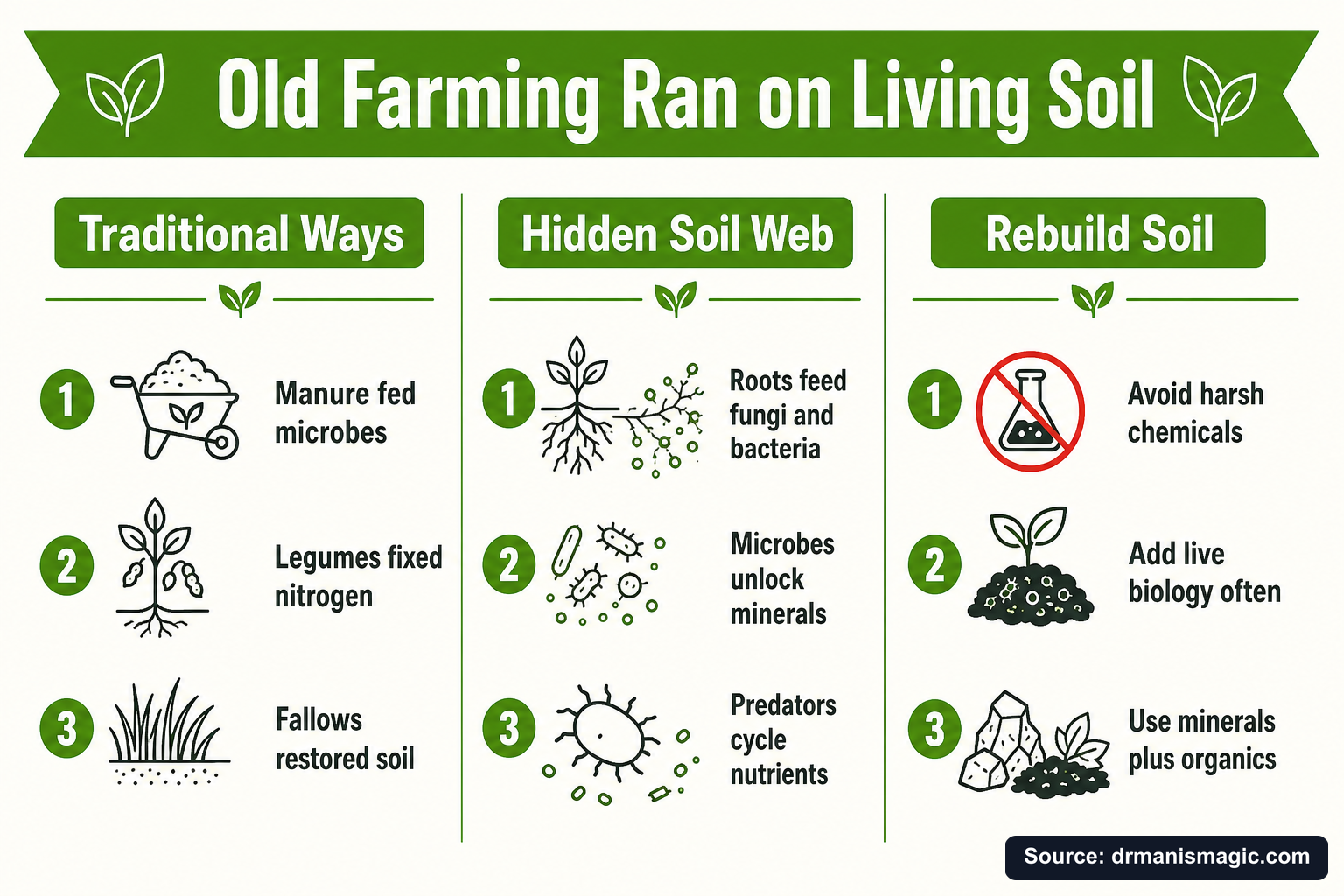
- Traditional practices like manure, compost, crop rotation, legumes, and fallows worked because they fed and protected living soil biology, not because of chemistry.
- The soil food web is a layered system of bacteria, fungi, protozoa, and nematodes that recycles nutrients and feeds plant roots.
- Synthetic salt-based fertilizers, herbicides, fungicides, and pesticides damage or kill this invisible workforce, leading to weak plants, root rot, and soil that cannot sustain itself.
- Damaged or sterile soil can recover, but it takes the right conditions, the right inputs, and repeated applications of genuinely live biology.
- Most commercial microbial products on the shelf are either dead dried powders or stinking anaerobic liquids that deliver little or no benefit.
- Dr. Mani's Magic Plant Super Boost uses a natural stabilization technique to keep a full spectrum of live microbes viable and effective right up to the moment you use them.
- The Three Plant Pillars framework (mineral soil, live microbes, organic fertilizer) rebuilds what traditional agriculture maintained by instinct for thousands of years.
What Did Traditional Farmers Actually Know About Soil Biology?
Quick Answer: Traditional farmers did not know about bacteria or fungi by name, but every major practice they used, from manure to crop rotation to fallows, directly fed and protected the living microbial communities in their soil. They managed the biology without ever seeing it.
They knew what worked. They just did not know why.
A farmer in ancient Egypt spreading river silt on his fields was unknowingly inoculating his soil with billions of fresh microbes from upstream organic matter. A medieval peasant rotating wheat with beans was feeding nitrogen-fixing bacteria that live on legume roots. A Chinese farmer composting kitchen scraps and animal waste was running a biological reactor that turned dead material into living fertility.
These were not random habits. They were hard-won wisdom, passed from parent to child, tested by hunger and survival across generations. And every single practice pointed at the same invisible engine underneath the soil.
In 1896, researchers at Auburn University started an experiment called the Old Rotation. They planted cotton and rotated it with legumes, tracking soil health and yields year after year. The experiment is still running today. Over 125 years of data. The finding? Rotation with legumes sustained and actually improved yields over time, without the heavy chemical inputs modern farming depends on. The biology in the soil did the work.
The USDA and George Washington Carver documented similar findings. Crop rotation was nearly as effective as manure and complete fertilizers for maintaining wheat, corn, and oat yields across long periods. The common thread? All of these practices kept living biology in the soil. They fed the invisible workforce. They protected it. And the soil rewarded them with fertility, year after year.
Then came the 1950s. Miracle-Gro showed up. Synthetic fertilizer from foreign factories became cheap and available. It was fast. It was easy. It made things green overnight. And slowly, quietly, over the next seventy years, we forgot everything the old farmers knew.
We stopped feeding the biology. We started poisoning it. And we wonder why our plants struggle.
What Is the Soil Food Web and Why Does It Feed Your Plants?
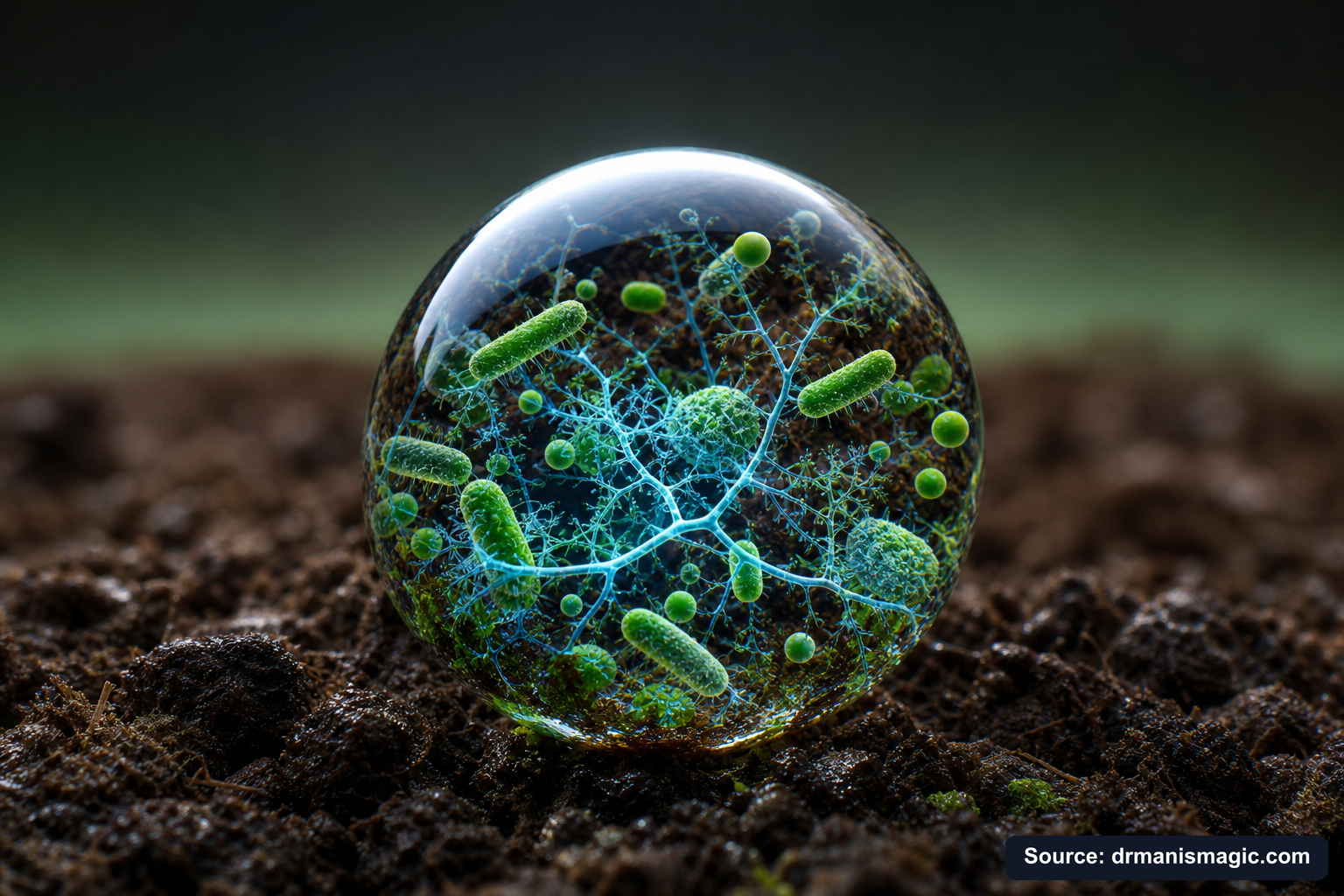
Quick Answer: The soil food web is a community of bacteria, fungi, protozoa, nematodes, and other organisms that break down organic matter, cycle nutrients, and release plant-available minerals right at the root zone. Plants evolved to depend on this web, not on soluble synthetic inputs.
Soil is not dirt. Dirt is dead. Soil is alive.
A single teaspoon of healthy soil contains more living organisms than there are people on Earth. That is not a poetic exaggeration. That is the finding of soil biologists at North Dakota State University Extension, who describe soil as a living ecosystem, not an inert mineral substrate. The organisms inside it perform every major fertility function your plants need.
Here is how the cycle works, in plain language.
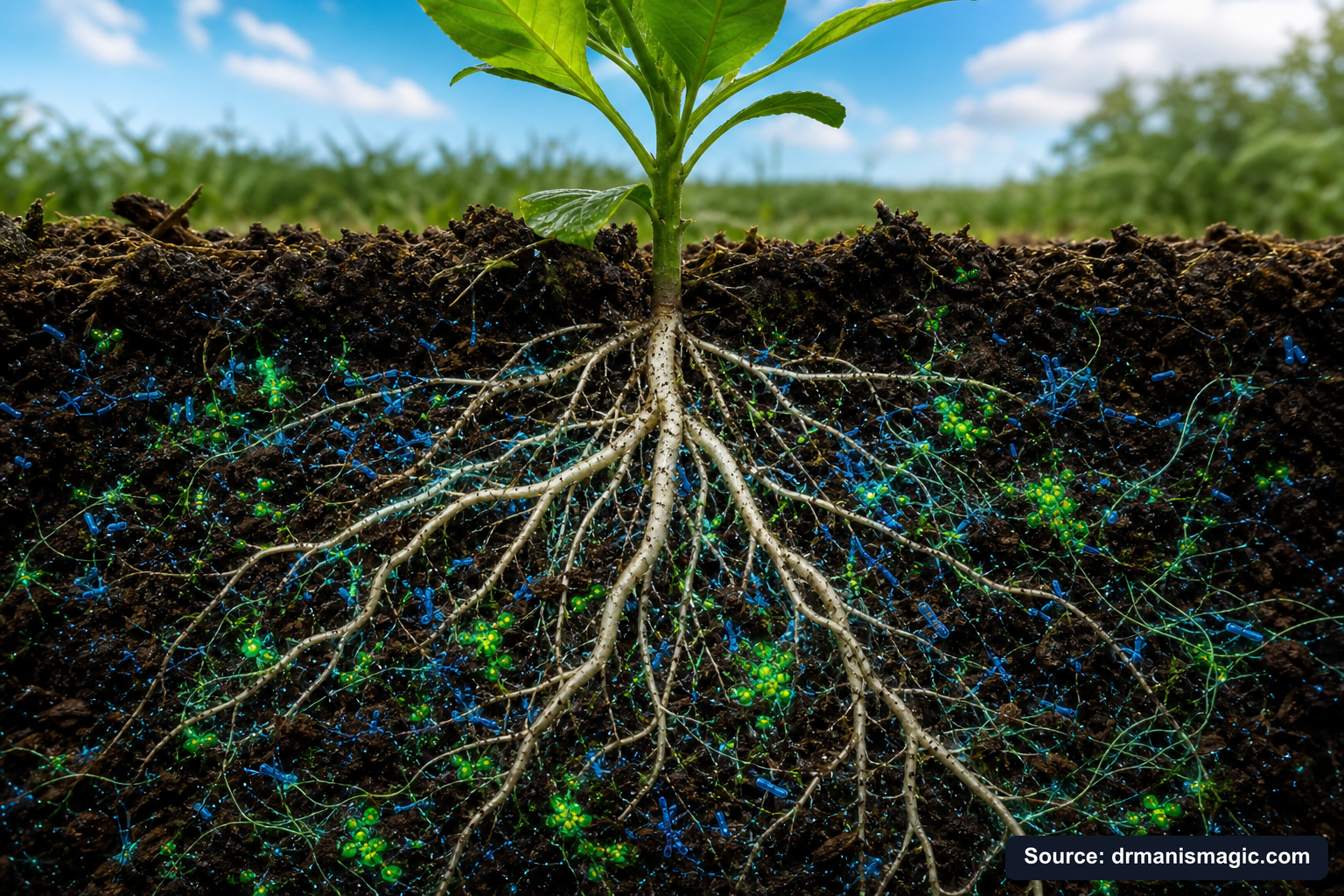
Your plant's roots release sugars into the soil. This is called the rhizosphere, the zone right around the roots. Those sugars are food for bacteria and fungi. The bacteria and fungi eat them, and in return they do something remarkable. They break down organic matter and release nutrients in forms the plant can actually absorb. They also physically extend the root system through fungal threads called mycorrhizae, reaching water and minerals far beyond where roots could ever grow alone.
Then the predators arrive. Protozoa and nematodes eat the bacteria and fungi. When they digest them, they release nitrogen and other nutrients as waste products, right next to the roots, right where the plant needs them. This is called the microbial loop, and it is the reason healthy soil feeds plants without any fertilizer added at all.
This is not a theory. Penn State Extension confirms that beneficial bacteria fix nitrogen from the atmosphere, solubilize phosphorus, suppress pathogens, build soil aggregates through sticky exudates, and even degrade herbicides and pollutants. The biology is not just feeding your plants. It is protecting them. Cleaning up after them. Building the physical structure that lets water drain and roots breathe.
Every single one of those functions? Traditional farmers triggered them without knowing it. Manure fed bacteria. Compost fed fungi. Legumes fed nitrogen-fixers. Fallows let the web recover. Mulches fed the decomposers. Intercropping kept diverse populations thriving.
They were managing the soil food web with nothing but observation and instinct. And it worked for ten thousand years.
| Organism | What It Does for Your Plant | Why It Matters |
|---|---|---|
| Bacteria | Fix nitrogen from air; break down organic matter; suppress pathogens; build soil aggregates; degrade herbicides | The primary drivers of nutrient cycling and soil structure |
| Mycorrhizal Fungi | Extend root system up to 100x; deliver water and phosphorus; produce glomalin that holds soil together; stimulate root growth | Plants without mycorrhizae are cut off from the majority of available soil nutrients |
| Protozoa | Eat bacteria; release plant-available nitrogen as waste near the root zone | The main nutrient-release trigger; most gardeners have never heard of them |
| Beneficial Nematodes | Eat bacteria and fungi; release nitrogen; suppress harmful nematodes and soil pathogens | Complete the microbial loop; balance pathogen populations |
| Decomposer Fungi | Break down lignin, cellulose, and woody material; release carbon and minerals | Convert mulch, residues, and compost into plant food |
| Nitrogen-Fixing Bacteria | Pull nitrogen gas from the atmosphere and convert it into ammonium the plant can use | Free nitrogen fertilizer, no factory required; legumes host them on root nodules |
Notice something on that table? Protozoa and nematodes. Most gardening content talks about bacteria and fungi. Almost nobody talks about the predators. But those predators are what close the loop. They are the reason nutrients actually become available to the plant at the right time, in the right place. Without them, the web is incomplete. The plant still struggles.
This is what we discovered after growing over 250,000 trees at our South Texas nursery. A partial biology is better than no biology. But a full-spectrum biology, bacteria, fungi, protozoa, nematodes, all working together, that is where the real magic happens.
How Did Traditional Practices Like Manure, Compost, and Crop Rotation Actually Feed the Biology?
Quick Answer: Each traditional practice fed or protected a different layer of the soil food web. Manure fed bacteria. Compost fed the full web. Legumes fed nitrogen-fixers. Fallows let the web recover. Intercropping kept microbial diversity high. These were biological management tools, not just nutrient delivery systems.
Let us walk through the old practices one by one. Because when you see the biology behind each one, something clicks. You realize these farmers were not primitive. They were running the most sophisticated biological system on the planet, and they did it with a shovel and an ox.
Manure. Animal waste is not just nutrients. Fresh manure is teeming with bacteria from the animal's gut, plus partially digested plant material that becomes food for soil fungi. When a farmer spread manure on his field, he was inoculating the soil with a fresh dose of biological activity and feeding it all at once. The nitrogen in manure is not soluble salt. It is nitrogen locked inside organic matter and microbial bodies, released slowly as the biology processes it. That is why manured fields kept producing for decades without crashing.
Compost. A hot compost pile can reach 140 degrees Fahrenheit inside. That heat is not a problem. That heat is the sound of biological activity. Billions of microbes eating, reproducing, and transforming waste into something plants love. When gardeners spread fresh compost and describe the results as magical, they are right. They just applied a massive dose of live biology to their soil. The magic was never the compost. It was the microbes inside it.
Crop rotation. Different plants feed different microbes. Grasses feed bacteria. Legumes host nitrogen-fixing bacteria on their roots. Deep-rooted plants pull up minerals that surface-feeding microbes can then process. Rotating crops kept microbial diversity high. It prevented any one pathogen from dominating. It is ecological balance managed at the field scale.
Fallows. Letting a field rest is not giving up. It is letting the biology recover. When you stop disturbing soil, mycorrhizal networks rebuild. Organic matter accumulates. Predator populations catch up to prey populations. The web rebalances. Farmers who skipped fallows to squeeze more yield often watched their fields crash within a generation.
Intercropping. Planting two or more crops together creates root diversity underground. Different root exudates feed different microbes. Multiple canopy layers protect soil from erosion and drying. The result is a more complex, more resilient biological community. More diversity above ground means more diversity below it.
Every single one of these practices, practiced by farmers who had never seen a microscope, was managing the soil food web. They did not call it that. But that is exactly what they were doing.
See also: Why Most Fertilizers Are Actually Salt in Disguise
What Happens When Chemicals Replace Biology in Soil?
Quick Answer: Synthetic salt-based fertilizers, herbicides, fungicides, and pesticides damage or kill the bacteria, fungi, protozoa, and nematodes that make soil fertile. Plants become dependent on soluble inputs because the biology that would naturally feed them is gone. Soil structure collapses. Root rot increases. Plants become weaker over time, not stronger.
Here is what nobody in the fertilizer aisle tells you.
Synthetic fertilizers are salt-based. That is not a metaphor. The nitrogen, phosphorus, and potassium in most commercial fertilizers are soluble mineral salts. When you pour them onto soil, they raise the salt concentration around the roots and in the surrounding soil. Bacteria and fungi are living cells. High salt concentration pulls water out of living cells through osmosis. It kills them or shuts them down.
You get a green burst. Fast color. Fast growth. It looks like it is working. But underneath, the biology that would have fed your plant for free, for years, is dying. You have traded long-term biological fertility for a short-term chemical fix. And now you need more next month. And the month after that. The plant is no longer feeding itself through biology. It is on a drip of soluble nutrients that it cannot live without.
Then you add a herbicide to kill the weeds. Penn State research confirms that microbial degradation is actually the primary pathway through which herbicides break down in soil. In other words, your soil biology is what cleans up the herbicide. But if the herbicide kills the biology, the biology cannot clean it up. The residue stays. It keeps harming future biology. The cycle deepens.
Add a broad-spectrum fungicide to fight root rot. It kills the pathogenic fungus. But it also kills the mycorrhizal fungi that were extending your root system and protecting it from drought. Now the roots are smaller. More vulnerable. More dependent on you.
Add a pesticide. Non-selective toxicity hits beneficial bacteria and predatory nematodes alongside the target pest. The pathogen suppressors are gone. Disease pressure increases. You need more pesticide.
This is not a conspiracy. It is just physics and biology. Salt kills microbes. Broad-spectrum chemicals hit broad spectrums of organisms. The companies selling these products are not evil. They are just selling what is fast and visible and profitable. But the long-term cost is paid by your soil, your plants, and your time.
After working with 250,000 trees at US Citrus Nursery, we learned this the hard way ourselves. We watched trees that had every chemical input available still struggle, yellow, and fail. Then we discovered the biology. And we watched the same trees come alive.
| Practice / Input | Traditional Biological Approach | Modern Chemical Approach | Long-Term Outcome |
|---|---|---|---|
| Soil fertility | Manure, compost, crop residues feed microbial communities that release nutrients slowly | Soluble salt-based NPK applied directly to root zone | Biology builds over time vs. biology collapses; dependency increases |
| Nitrogen supply | Legume rotation hosts nitrogen-fixing bacteria; free atmospheric nitrogen | Synthetic nitrogen from industrial process (often imported) | Self-sustaining vs. externally dependent; soil structure maintained vs. degraded |
| Disease control | Diverse microbial communities compete with and suppress pathogens naturally | Fungicides and pesticides kill pathogens and beneficials together | Resilience builds vs. resilience collapses; pathogen resistance increases over time |
| Soil structure | Mycorrhizal glomalin and bacterial exudates bind soil particles into aggregates | Tillage and chemical inputs disrupt aggregate formation | Drainage and aeration maintained vs. compaction and root rot increase |
| Weed and pest management | Intercropping, rotation, and biological predation keep populations in balance | Herbicides and pesticides target specific organisms but damage biology broadly | Ecological balance vs. resistance cycles and biology destruction |
| Input cost over 10 years | Decreasing as soil biology builds and self-sustains | Increasing as soil biology declines and dependency grows | Time and money saved vs. time and money spent with diminishing returns |
See also: The Hidden Reason Synthetic Fertilizers Cause Root Rot
You Never Had a Brown Thumb.
You were handed the wrong tools. This free guide hands you the right ones.
You watered it. You fed it. It died anyway.
It was never you. It was the dirt, the salt food, and the bad advice.
This guide shows you what really went wrong, and how to fix it for good.
- Why your plants really died, and why it was never your fault
- The salt hiding in your plant food that quietly burns the roots
- The hidden killer in almost every bag of store soil
- The tiny helpers that grow a whole forest for free
- The rescue trick that brings a half dead plant back to life

Can Damaged or Sterile Soil Actually Recover Its Biology?
Quick Answer: Yes, damaged soil can recover, but it requires removing the inputs that caused the damage, reintroducing a full spectrum of live microbes repeatedly, adding organic matter for them to feed on, and giving the biology time to rebuild. Recovery timelines depend on how severely the biology was disrupted and what type of disturbance occurred.
This is the question most gardening content never answers. Everyone talks about how great soil biology is. Almost nobody tells you what to do when yours is gone.
Here is the honest answer. Recovery is possible. But it is not instant. And it requires more than one application of microbes, because the conditions that killed your biology the first time are often still present. Residual salts. Herbicide carryover. Compaction that prevents oxygen from reaching microbial communities. These conditions need to be addressed before or alongside biological reintroduction.
University of Minnesota Extension notes that microbial inoculants tend to help most where the correct species or strains are genuinely low in the soil, and that suitable environments often already contain beneficial organisms. The practical implication for most gardeners and growers is this: if you have been using synthetic inputs, herbicides, or fungicides, your soil is almost certainly low in the organisms that matter most. Inoculation helps. But it works best when conditions support the microbes after they arrive.
Soil Recovery Checklist: What to Do Right Now
- Stop adding what is killing the biology. Reduce or eliminate synthetic salt-based fertilizers, broad-spectrum herbicides, and systemic fungicides. You cannot build a biological community while continuously poisoning it.
- Flush excess salts. Deep watering, especially with rainwater, helps push accumulated salts below the root zone. Do this before reintroducing biology.
- Add organic matter. Compost, mulch, and organic fertilizers give microbes something to eat. Biology without food does not thrive. Cover the soil surface with mulch to protect microbial communities from heat, drying, and UV exposure.
- Reintroduce a full-spectrum live biology. Not a dried powder. Not a smelly liquid that has already gone anaerobic. Genuinely live bacteria, fungi, protozoa, and nematodes introduced directly to the root zone. Apply monthly. Biology needs to be replenished regularly, especially in managed and container growing environments where the normal decomposition cycle is missing.
- Reduce compaction. Microbes need oxygen. Compacted soil starves them. Aerate, use mineral-based soil that does not compact, and avoid over-watering that drives oxygen out.
- Be patient and consistent. A biological community that took years to damage does not rebuild overnight. Expect to see meaningful improvement within one to three months of consistent biological inputs. Full recovery of diverse, stable communities can take longer depending on the severity of past disruption.
- Switch to organic fertilizer that works with biology, not against it. Organic slow-release fertilizers from sources like crab, kelp, and amino acids feed the plant and the microbial community simultaneously, without the salt spike that sets recovery back.
Why Do Most Commercial Microbial Products Fail to Deliver Results?
Quick Answer: Most commercial microbial products are either dried-and-dead lab-grown powders that never reactivate effectively in soil, or they are compost-tea-style liquids that have already gone anaerobic and smell terrible because the microbes are dying. Neither delivers the full-spectrum live biology that plants actually need.
You have probably seen the bottles. "Contains 17 strains of beneficial bacteria." "1 billion CFUs per gram." "Mycorrhizal inoculant for stronger roots." The labels are impressive. The results are often disappointing. Here is why.
The market for biological products has exploded. Most of what is on the shelf falls into three categories. None of them are what they claim to be.
Category one: dried lab-grown powder. Major factories brew certain bacterial strains in giant vats, then dry them into a powder. The theory is that the spores will reactivate when you add water and apply them to soil. After testing dozens of these products across our nursery operations, we have not seen consistent results. The organisms that matter most, the diverse full-spectrum communities that drive real soil health, are not the ones that survive industrial drying and reactivation. You are getting a narrow slice of the biology at best.
Category two: liquid compost tea that has gone anaerobic. Some companies harvest microbes from compost or earthworm castings and bottle them as liquid. Fresh compost tea, applied within 24 hours while actively aerated, can be excellent. But by the time that bottle travels through a warehouse, sits on a shelf, and arrives at your door, the oxygen is gone. The microbes shift to anaerobic survival. They start dying and fermenting. The bottle fizzes when you open it. The smell is unmistakable, like rotting sewage. Some value remains from humic and fulvic acid compounds, but the live biology you paid for is largely gone.
Category three: lactobacillus products. Like what is in yogurt. Easy to grow, very vigorous, stays alive. But lactobacillus outcompetes and crowds out the beneficial bacteria you actually need. It belongs in your gut, not your soil.
This is not a minor problem. It means most people who try biological products conclude that biology does not work. They give up and go back to synthetics. The biology never failed them. The product failed them.
| Product Type | Viability at Application | Microbial Spectrum | Odor | Our Assessment |
|---|---|---|---|---|
| Dry/powdered lab-grown microbes | Low — most do not reactivate effectively | Narrow — only strains that survive industrial drying | Little to none | We tested dozens of batches and saw no consistent plant response. Avoid. |
| Dry microbes rehydrated into liquid | Low — same issue as powder form | Narrow | Little to none | Same result as dry powder. Avoid. |
| Compost tea (fresh, under 24 hours, aerated) | Moderate — good if genuinely fresh | Partial — depends on compost quality | Earthy | Excellent if you make it yourself and use it immediately. Impractical for most. |
| Compost tea (bottled, shelf-aged) | Low to none — anaerobic by the time you use it | Partial — degraded | Strong and foul — fermentation odor | The stench tells the story. The microbes are dying. Not recommended. |
| Lactobacillus-based products | High — very vigorous and stable | Very narrow — one dominant strain | Sour or mild | Outcompetes the beneficial bacteria you need. Wrong tool for the job. |
| Plant Super Boost (stabilized full-spectrum compost-sourced) | High — stabilized by all-natural technique, stays alive without going anaerobic | Full spectrum — 2,000+ bacteria strains, 400–500 fungi including mycorrhizae, plus protozoa and nematodes | Earthy, not foul — because it is not fermenting | Harvested from natural compost, not lab-grown. Visible microbial movement under microscope. Lab-verified. |
What Makes Plant Super Boost Different From Every Other Microbial Product?
Quick Answer: Plant Super Boost is harvested from natural compost using a proprietary all-natural stabilization technique that keeps the full spectrum of microbes alive without going anaerobic. It contains 2,000-plus bacterial strains, 400-500 fungal species including mycorrhizae, plus protozoa and nematodes. You can see the live microbes moving under a microscope. It does not smell because it is not dying.
The story of how Plant Super Boost came to exist is one of the most unusual in gardening history.
Dr. Mani Skaria, Professor Emeritus of Plant Pathology, inventor of micro-budding, and founder of the Clean Citrus Program in Texas, spent decades looking for a biological answer to the problems he saw in groves and nurseries. He had the science. What he needed was the technique.
Then, through what can only be called a fortunate meeting, he connected with a world-renowned compostologist. This man had spent his career advising farming practices for royal families and governments across the globe. He had discovered a natural method to stabilize compost-sourced microbes, keeping them alive and active without the fermentation and die-off that makes other liquid products go bad. His technique kept the full spectrum intact. Not just the easy-to-grow strains. All of them. Bacteria, fungi, protozoa, nematodes. The whole web.
He was blacklisted by large chemical companies after certain citrus groves started seeing results that made synthetic programs look unnecessary. He feared for his life and stopped production entirely. Years later, he came back. And he came to us.
He joined US Citrus Nursery. We built the Dr. Mani's Magic line around his technique. And we tested it on our trees.
The results were what made us stop second-guessing biology and start building everything around it.
If you open a bottle of Plant Super Boost, you will notice something. It smells earthy. Clean. Like good soil after rain. Not sour. Not foul. Not like something dying in a bottle. That smell is the first signal that what is inside is genuinely alive and stable. Take a single drop and look at it under a microscope. You will see movement. Real, live microbial movement. We have the lab analyses to back it up. Zero PFAS. Zero biosludge. Zero synthetic salts. Just living biology, stabilized the way nature intended, ready to go to work the moment you apply it.
Mix two ounces into a gallon of water. Pour it on your soil. Or fill the bottle into a hose-end sprayer and cover your entire lawn or garden in minutes. Apply monthly. That is it.
What Are the Three Plant Pillars and How Do They Rebuild What Traditional Agriculture Had?
Quick Answer: The Three Plant Pillars are Dr. Mani's framework for building plant health from the ground up: mineral-based soil that does not compact or rot, live full-spectrum microbes that feed and protect roots, and organic slow-release fertilizer that nourishes without synthetic salts. Together, they recreate the biological foundation traditional farmers maintained for thousands of years.
Traditional farmers did three things right without knowing it.
They used mineral-based soils. River silt. Rocky hillside loam. Soils that drained well, did not compact into sludge, and gave roots room to breathe. They did not pot their plants in pine bark sawdust that rots into a suffocating, anaerobic mess within months. Most modern potting mixes do exactly that.
They fed the biology. Manure. Compost. Crop residues. Rotations. Every practice delivered organic matter that bacteria and fungi could eat. The biology thrived. The biology fed the plants. The plants thrived.
They fertilized with organic materials. Animal waste. Green manures. Bone meal. Plant residues. These release nutrients slowly as biology processes them. They do not spike salt levels. They do not kill the microbes. They work with the system, not against it.
The Three Plant Pillars are the modern version of exactly that framework, developed and proven across 250,000-plus trees at US Citrus Nursery in South Texas, then refined for every plant type, from lawns to houseplants to orchards to flower gardens.
Pillar One: Mineral Foundation. Our Super Soil is built on sandy loam from the Rio Grande Valley. It is silica-rich mineral soil that does not decompose, does not compact, does not steal oxygen from roots by rotting underneath them. It drains. It breathes. Roots move through it freely. It is a permanent soil. You do not need to replace it every year. You make one good decision and it pays you back for a lifetime.
Pillar Two: Microbial Muscle. Plant Super Boost delivers the full soil food web in a bottle. Not a dried powder. Not a stinking anaerobic liquid. Live bacteria, live fungi including mycorrhizae, live protozoa, live nematodes. The full web that traditional agriculture maintained through manure and compost and rotation. Applied monthly, it keeps the biology strong even in container environments where the normal underground networks and decomposition cycles are missing.
Pillar Three: Organic Fertilizer. Our Crab, Kelp and Amino Acids blend is a slow-release granular fertilizer that feeds the plant and the microbial community simultaneously. No synthetic salts. No PFAS contamination from biosludge. No plastic-coated slow-release beads leaching toxins into your soil. Just nitrogen, phosphorus, potassium, and a full array of trace elements, amino acids, and biostimulants in forms that work with biology, not against it.
Miss any one pillar and you get the same problems traditional farmers got when they skipped one of their practices. Root rot. Yellowing leaves. Weak fruiting. Pests. Stunted growth. A plant that looks like it is barely surviving instead of thriving.
Get all three working together, and something shifts. The plant stops struggling and starts performing. Not because of any single product. Because the system underneath it is finally working the way nature designed it to work.
You can download our Free Plant Care Field Guide to see exactly how to apply all three pillars together, step by step, for any plant you are growing.
What Can You Do Right Now to Start Rebuilding Your Soil Biology?
Quick Answer: Start by stopping what is harming your biology, then add organic matter, introduce genuinely live full-spectrum microbes monthly, switch to organic fertilizer, and give the system time and consistent inputs to rebuild. The first visible improvements often appear within four to six weeks. The deeper transformation takes longer, but it compounds.
Here is the practical truth about time.
You can always make more money. You cannot make more time. The number one thing people tell Dr. Mani they want from their garden is to see fruit on a tree they planted, in their own lifetime. Not as a distant hope. As a real, tangible, hold-it-in-your-hand experience. That desire is ancient. We were put on this earth to tend a garden. That drive never left us.
But every year you spend fighting your soil with the wrong tools is a year of growth you cannot get back. Every season you pour synthetic salt fertilizer onto dying biology is a season your tree spends surviving instead of producing. Every month you apply a dried powder that does nothing is a month the real biology could have been working for you.
The good news is that biology responds faster than most people expect once the right conditions are in place. We have seen container trees that had been struggling for years begin visibly improving within a single growing season after switching to the Three Plant Pillars approach. Not because we did anything miraculous. Because we stopped fighting nature and started working with it.
That is what traditional agriculture knew. That is what ten thousand years of farming by observation and survival proved. The biology was always there. The biology was always doing the work. All we had to do was stop killing it and start feeding it.
The forest does not need your help because it has never lost its biology. Your garden can have that same invisible workforce. You just need to bring it back.
If you want to see what the full Three Plant Pillars system looks like for your specific plants, whether that is a container fruit tree, a backyard garden, a lawn, or a houseplant collection, start with our Free Plant Care Field Guide. It walks you through everything, step by step, in plain language, with no guesswork. Built from thirty years of growing at US Citrus Nursery and tested on more plants than most people will ever see in a lifetime.
Your plants are ready to thrive. The biology is ready to work. The only question is whether you are ready to let it.
Frequently Asked Questions
You just learned that traditional farmers fed the world for thousands of years using living soil biology. Now you probably have some questions. Good. These are the exact questions that will help you understand why your plants struggle and what to do about it starting today.
Why is biology so important in agriculture?
Biology is the engine under the hood of every garden, farm, and lawn. Bacteria and fungi in your soil unlock nutrients, fight disease, and feed plant roots. Without that living biology working for you, it does not matter how much fertilizer you pour on. The plants stay weak. Dr. Mani proved this across 250,000 trees at US Citrus Nursery. Biology is not a bonus. It is the whole game.
What does biology actually mean when we talk about agriculture?
It means the living organisms in your soil are doing the real work. Bacteria break down organic matter. Fungi stretch out like tiny highways to deliver water and nutrients to roots. Protozoa eat bacteria and release nitrogen right where plants need it. This invisible crew is called the soil food web. When it is alive and thriving, your plants thrive. When it is dead, nothing works right no matter what you spend.
How does biology help a regular home gardener or plant owner?
When your soil has the right living microbes, your plants can feed themselves more efficiently. Roots grow deeper and stronger. Plants fight off pests and disease on their own. You stop chasing problems with sprays and quick fixes. Dr. Mani's Magic Plant Super Boost puts live bacteria, fungi, and mycorrhizae right into your soil. That is the same microbial muscle that turned struggling citrus trees into thriving, fruit-bearing powerhouses.
What is biological farming and how is it different from what most people do today?
Biological farming works with the living soil instead of replacing it. Most people today use salt-based synthetic fertilizers that kill off the very microbes their plants depend on. Biological farming feeds those microbes instead. It uses compost, organic nutrients, and live biology to build soil that gets stronger over time. The Three Plant Pillars from Dr. Mani's Magic follow this exact approach with mineral-based soil, live microbes, and organic fertilizer.
What biological principle from traditional farming applies most to backyard gardening right now?
The most powerful principle is this: healthy soil is alive, and alive soil feeds healthy plants. Traditional farmers kept their soil alive through compost, crop rotation, and manure. You can do the same thing in a pot or a backyard bed. Start with a mineral-based soil that does not rot and collapse. Add live microbes. Feed with slow-release organic fertilizer. That is the Three Plant Pillars in plain English, and it works for any plant you grow.
Why do synthetic fertilizers hurt the biology in your soil?
Synthetic fertilizers are salt-based. Salt pulls water out of microbial cells and kills them. It is that simple. You get a quick green flush and then a crash. Over time your soil becomes dependent on chemicals because the biology that used to do the work is gone. Worse, slow-release synthetic fertilizers are coated in plastic that leaches toxins into your soil and water. Organic fertilizers made from crab, kelp, and amino acids feed your plants without wiping out the microbial workforce underneath them.
What are the most important biological methods any plant owner can use at home?
Three things matter most. First, use a mineral-based soil that drains well and never compacts or rots. Second, add live microbes that include bacteria, fungi, and mycorrhizae to build a thriving soil food web. Third, feed with slow-release organic fertilizer that nourishes your plants without burning the biology underneath. That is exactly what the Three Plant Pillars system does. It is the same foundation Dr. Mani built after 35 years of growing citrus, houseplants, and tropical trees in South Texas.
About the Author
Ron Skaria, MD
Ron Skaria, MD, is the co-founder of Dr. Mani's Magic and the son of Dr. Mani. He trained as a medical doctor at Baylor College of Medicine, did his residency at UT Health Science Center - San Antonio and fellowship training at Texas Tech University. He now works full time on the family farm at US Citrus and US Citrus Nursery in Hargill, Texas, building Dr. Mani's Magic alongside his dad. He wrote the Brown Thumb Field Guide to put his father's 48 years of plant science into plain words any gardener can use. His belief is simple. You never had a brown thumb. You just never had the right help.


