


Why Soil Never Forgets What You Add to It | Dr. Mani's Magic
Why Soil Never Forgets What You Add: The Hidden Memory Inside Every Garden Bed, Lawn, and Container
Picture this. You walk outside on a Saturday morning, coffee in hand, and crouch down next to your raised bed. The tomatoes you planted two months ago look pale. Tired. You've been watering. You added fertilizer. Twice. Maybe three times. But something is off, and you can't put your finger on it.
Here's what nobody told you. That soil remembers everything. Every bag of synthetic fertilizer you poured in. Every application of quick-green lawn food. Every time you overwatered and let roots sit in soggy ground. Every scoop of cheap potting mix that broke down and turned to mush. The soil didn't forget any of it. It stored it. Like a ledger. And right now, that ledger is being called due.
This isn't a scary story. It's actually the most useful thing you can learn about growing plants. Because once you understand that soil has a memory — chemical, biological, and physical — you stop chasing symptoms. You stop buying product after product. You start building something that lasts. After growing over 250,000 trees at our South Texas nursery, we learned this the hard way. And we want to save you the years it took us to figure it out.

Plant Super Boost
Key Takeaways
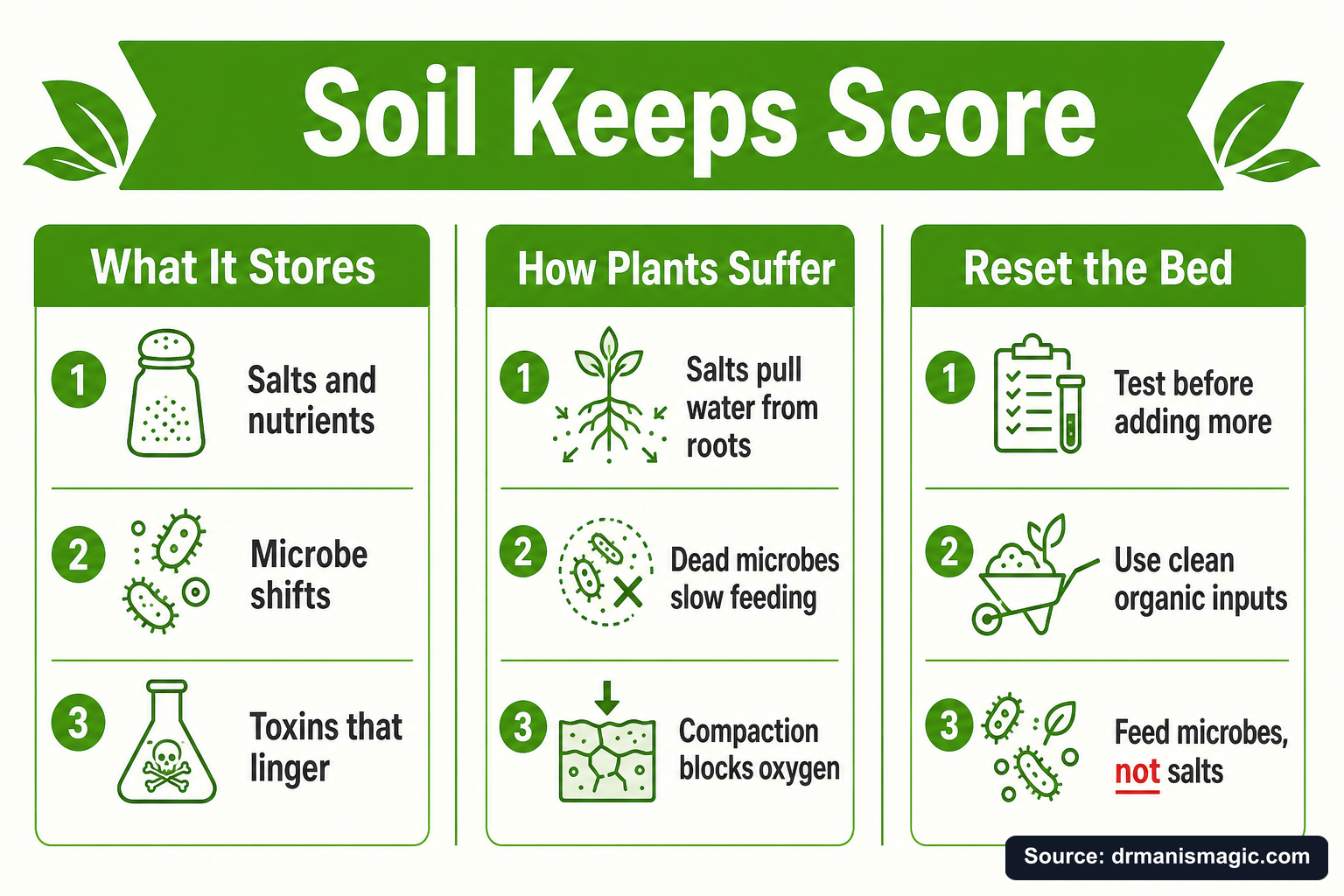
- Soil stores the effects of every input you add — salts, nutrients, microbes, and contaminants can all persist for months or years.
- Salt-based synthetic fertilizers kill the beneficial microbes that plants depend on for nutrition and disease resistance.
- Organic fertilizers feed the microbes first, which then convert nutrients into easy-to-absorb forms for your plants — a natural slow-release system.
- Phosphorus, potassium, and salts can build up to toxic levels even from "safe-sounding" inputs like compost or manure applied too often.
- Biosolids and municipal compost may carry PFAS "forever chemicals" and heavy metals that persist indefinitely in your soil.
- The Three Plant Pillars — mineral-based soil, live microbes, and organic fertilizer — work together to prevent the most common soil memory problems.
- A simple soil test, clean inputs, and biology-friendly nutrition can reset and protect your root zone without harsh chemistry.
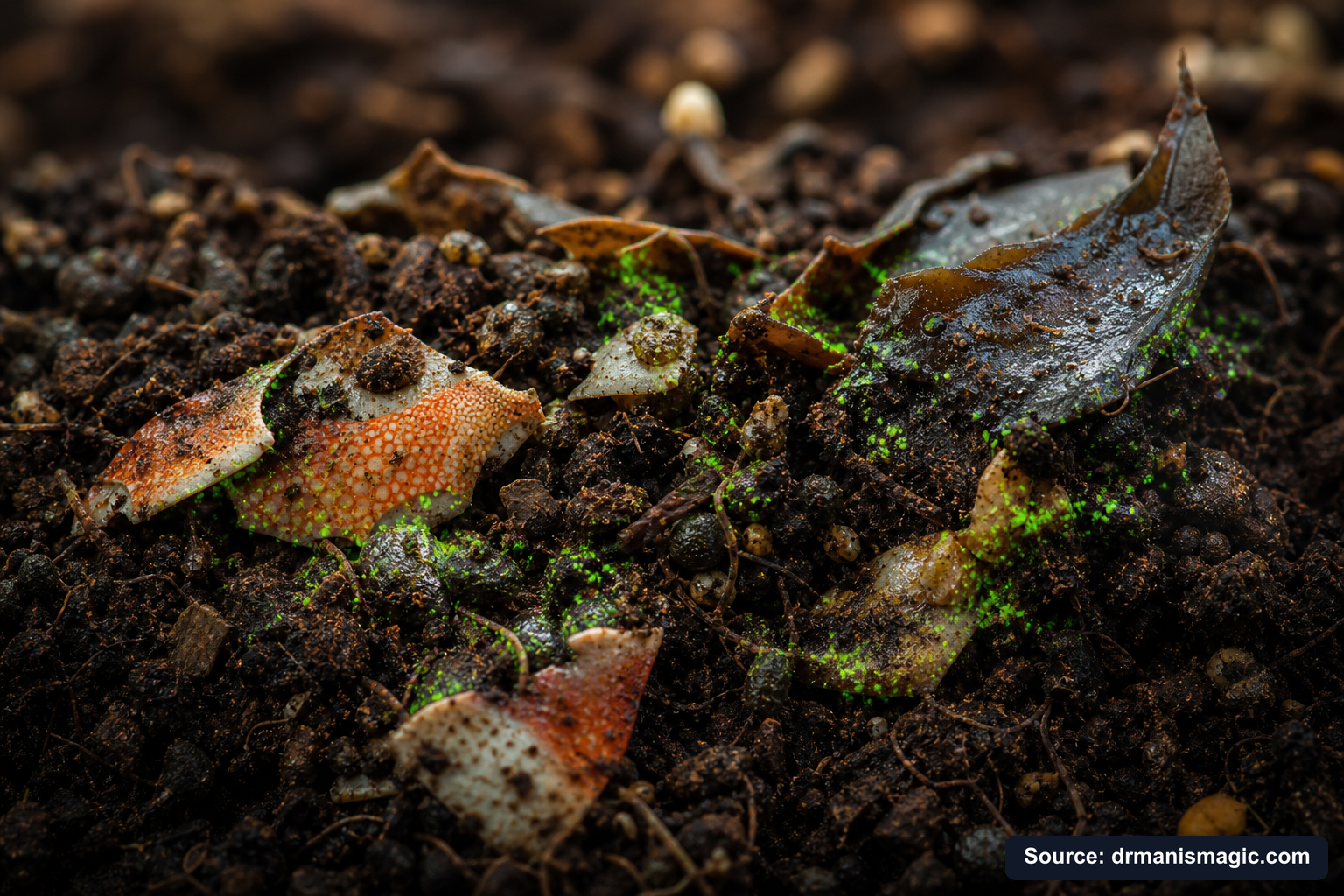
What Does "Soil Memory" Actually Mean?
Quick Answer: Soil memory means that whatever you add to your soil leaves a lasting effect. Salts, nutrients, chemicals, and even microbes don't just disappear after one watering. They accumulate, shift pH, alter biology, and change how well roots grow — sometimes for years after a single application.
Think of your soil like a bank account. Every input is a deposit or a withdrawal. The problem is, most gardeners are making deposits without ever checking the balance.
Soil memory works in five real ways:
- Chemical memory: Nutrients like phosphorus and potassium build up over time. So does salt. Add too much, and the soil becomes hostile to roots.
- Biological memory: The microscopic life in your soil — bacteria, fungi, and other organisms — shifts based on what you add. Synthetic salts wipe out beneficial microbes. Organic inputs feed and grow them.
- Physical memory: Soil structure changes with compaction, repeated tilling, or the collapse of organic potting mix. Once it compacts, roots can't breathe.
- Water and oxygen memory: Poor drainage from collapsed soil or overwatering starves roots of oxygen. This is how root rot starts.
- Contaminant memory: Heavy metals, PFAS "forever chemicals," and other pollutants don't leave. They stay put, sometimes for decades.
Each one of these is worth understanding. Because each one is the reason your plants might be struggling right now, even if you're doing "everything right."
See also: Why Most Fertilizers Are Actually Salt in Disguise
How Do Fertilizer Salts Build Up in Soil and Damage Roots?
Quick Answer: Most synthetic fertilizers are salt-based compounds. Every application leaves behind salt residue. Over time, salt concentration rises in the root zone, pulling water out of roots through a process called osmotic stress. Roots essentially get dehydrated even when the soil is wet. This leads to burnt tips, wilting, and eventually root rot.
Here's the part that surprised us most when we first dug into the science.
When you pour a synthetic fertilizer onto your soil, the plant doesn't absorb all of it. Not even close. A large portion stays in the ground. And because synthetic fertilizers are salt compounds — they're manufactured by bonding nutrients to salt molecules — those salts accumulate with every application.
You've seen the evidence. White crusty buildup on the rim of a terracotta pot. Burned brown edges on lawn grass near the sidewalk. A plant that wilts even though the soil feels moist. That's salt. That's your soil's memory of every quick-fix fertilizer application, stacking up in the root zone.
University of Minnesota Extension confirms that high soluble salt levels in soil cause what scientists call osmotic stress — the same mechanism that makes saltwater undrinkable. The salt outside the root pulls water OUT of the root, causing what looks exactly like drought stress, even when you're watering regularly. Read more at UMN Extension.
It gets worse. Salt doesn't just hurt roots directly. It kills the microbes that plants depend on. And without those microbes, the whole nutrient cycle collapses. Penn State Extension notes that soil bacteria and fungi drive carbon, nitrogen, sulfur, and phosphorus cycling — essentially running the nutrient delivery system for your plants. Wipe out the microbes with salt, and you've cut the supply chain. Penn State Extension explains soil microbiology here.
This is the hidden cost of the quick green-up. You see a burst of growth. The plant looks great for a few weeks. Then things stall. Then they go backward. Not because you did something wrong that week, but because the soil remembered everything from the months before.
See also: The Long-Term Damage Caused by Salt Accumulation in Soil
Why Do Microbes Hold the Key to Soil Nutrition?
Quick Answer: Soil microbes supply roughly 75% of plant-available nitrogen and 65% of available phosphorus according to university research. They break down organic matter, unlock bound nutrients, and deliver them in forms roots can actually absorb. Without healthy microbes, most of the nutrition in your soil stays locked up and unavailable to your plants.
Here's something most gardening content skips right over. The biggest nutrition story in your garden isn't about fertilizer. It's about who's living in your soil.
Beneath every thriving lawn, every productive garden bed, every fruit tree dripping with citrus — there's a world you can't see. Billions of bacteria. Miles of fungal threads. An ecosystem so complex it makes a rainforest look simple. And this ecosystem does one thing above all others: it feeds your plants.
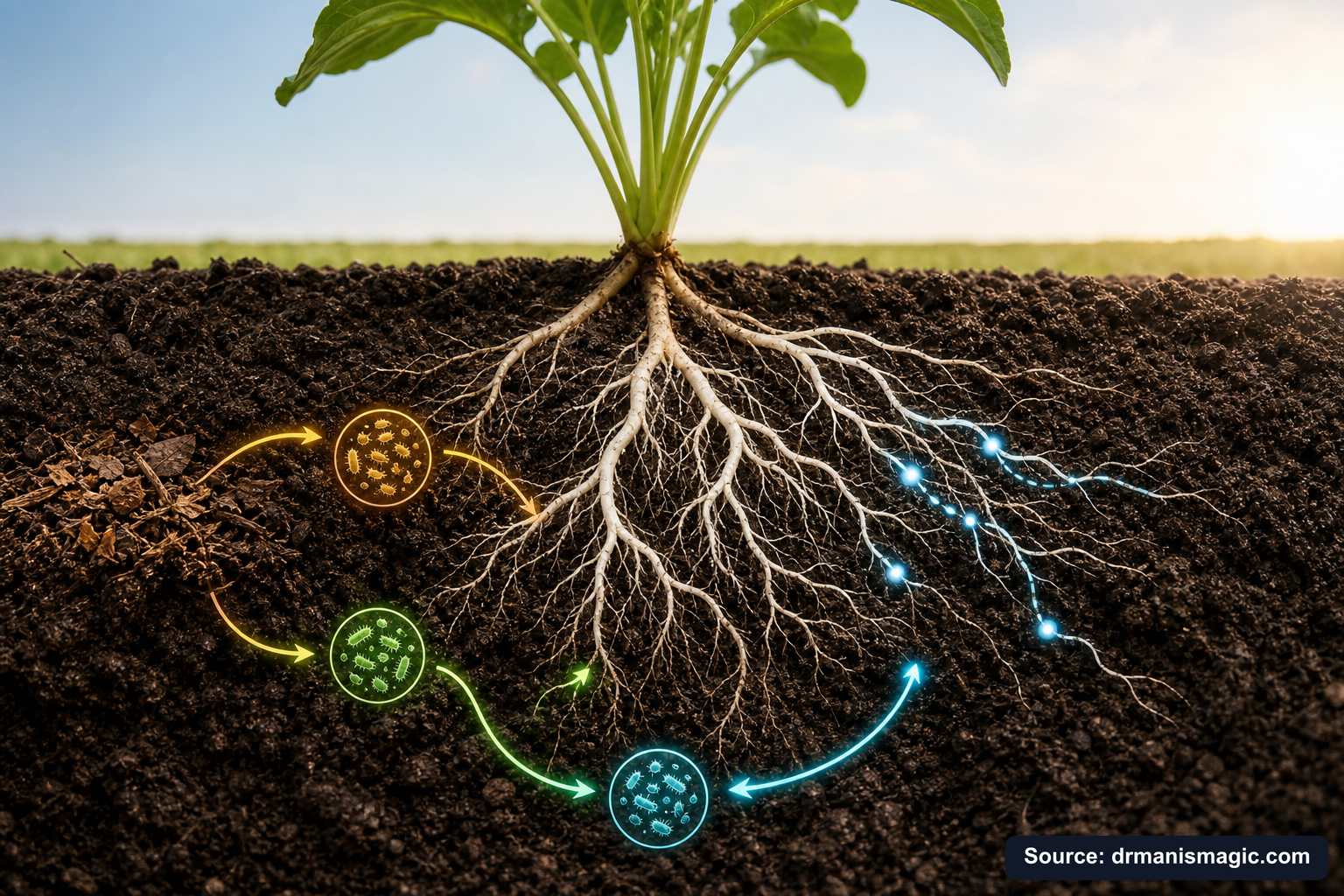
Bacteria grab nitrogen right out of thin air and convert it into a form roots can drink. Fungi stretch out past the root zone and bring back phosphorus, zinc, and water from places roots could never reach alone. When organic matter lands on the soil — a fallen leaf, a dead root, a granule of crab shell — microbes break it down and release every nutrient locked inside it, right into the root zone, right when the plant needs it.
This is nature's slow-release system. It's been running for 400 million years. It doesn't need a plastic coating or a timer. It just needs to be alive.
And here's what organic fertilizer does that synthetic fertilizer cannot. Organic fertilizer feeds the microbes first. The microbes eat it — the crab shells, the kelp, the amino acids — and convert all of those nutrients into easy-to-absorb forms. Then, when those microbes eventually die, they release every bit of stored nutrition straight into the soil around the roots. The plant sips it slowly, steadily, exactly as nature intended. It's a living, self-renewing delivery system.
Synthetic fertilizer skips this entirely. It dumps nutrients directly into the soil in salt form. Some of it gets absorbed fast. The rest builds up. And the salt wipes out the very microbes that would have kept the system running. You've just fired your best workers and put up a sign that says "closed."
At US Citrus Nursery, we saw this play out across 250,000 trees over 30 years. Trees grown with live microbes and organic nutrition didn't just grow better. They stayed healthier, resisted disease, and recovered from stress faster. Trees grown the conventional way with synthetic salt fertilizers started strong and then slowly declined. The soil remembered what we added. Every single time.
Can Compost Damage Your Soil Over Time?
Quick Answer: Yes. Compost is excellent for soil, but repeated applications without soil testing can cause phosphorus, potassium, and salt to build up to harmful levels. Too much of a good thing still becomes a problem. Even natural inputs leave a lasting chemical signature in the soil that accumulates over years.
This one surprises a lot of gardeners. Compost is natural. It feels safe. How could it possibly hurt anything?
The issue isn't one application. It's the cumulative effect of years of adding compost every season without ever testing what's already in the soil. Compost contains phosphorus and potassium. So does manure. Add them year after year and those nutrients stack up. Eventually, you can reach levels that are actually toxic to roots or that lock out other nutrients entirely.
High phosphorus in soil, for example, can block iron and zinc absorption — triggering yellowing leaves even when the soil is packed with nutrition. The plant is starving in the middle of a feast, because the chemistry is out of balance.
And then there's the bigger issue. Municipal compost and biosolids — materials made from treated sewage sludge — may contain PFAS compounds (per- and polyfluoroalkyl substances), also called "forever chemicals." These chemicals don't break down. They don't wash away. Once they're in your soil, they stay there. They can move into your vegetables, your fruit, your water supply. This is not a fringe concern. The USDA and EPA have both acknowledged PFAS contamination in biosolids-derived products as a real risk for home gardeners and farmers alike.
This is exactly why the fertilizer inputs you choose matter so much. Not just for this season. For every season that follows.
Our Crab, Kelp & Amino Acids fertilizer contains zero biosludge, zero PFAS, and zero synthetic salts. The ingredients are exactly what the name says — crab shells, cold-processed kelp, volcanic ash, and amino acids. Clean inputs. A clean soil ledger going forward.
What Is Osmotic Stress and How Does Salt Cause Physiological Drought?
Quick Answer: Osmotic stress happens when salt concentration outside the root is higher than inside the root. Water moves toward higher salt concentration, which means water moves OUT of the root instead of into it. The plant wilts and shows drought symptoms even in wet soil. This is called physiological drought, and synthetic fertilizer salt is a leading cause in home gardens.
Imagine wrapping your lips around a saltwater hose on a hot day. You'd be surrounded by liquid but getting more dehydrated by the second. That's exactly what your plant roots experience when salt levels in the soil climb too high.
Roots absorb water through osmosis — water naturally flows from lower salt concentration to higher salt concentration. In a healthy soil, the concentration inside the root is higher, so water flows in. When synthetic fertilizer salts build up in the root zone, the concentration outside the root becomes higher. Water flows the wrong way. Right out of the root.
The plant shows you wilting leaves. Brown tips. Slow growth. You assume it needs more water and you water more. But more water doesn't help when salt is the problem. It can even make it worse by spreading the salt deeper into the root zone.
Fungal pathogens like Pythium and Phytophthora thrive in exactly these conditions — stressed roots, waterlogged soil, depleted microbial defenses. This is the chain that leads to root rot. Salt stress weakens the root. Poor drainage keeps it wet. Pathogens move in. The plant dies. And most gardeners never trace it back to the fertilizer they added three months ago.
The soil remembered. Even when you didn't.
See also: The Hidden Reason Synthetic Fertilizers Cause Root Rot
Synthetic Fertilizer vs. Slow-Release Organic: What's Really the Difference?
Quick Answer: Synthetic fertilizers are salt-based and release nutrients all at once, flooding roots and killing microbes. Organic fertilizers are protein and mineral-based, releasing nutrients slowly as microbes break them down. Organic inputs feed the biology that feeds the plant, creating a self-sustaining cycle rather than a boom-and-bust pattern.
Let's put both side by side so you can see exactly what you're choosing between.
| Feature | Synthetic Fast-Release | Synthetic Slow-Release (Coated) | Organic / Chitin / Kelp |
|---|---|---|---|
| Salt content | Very high | High (inside the coating) | Negligible — not salt-based |
| Microbe impact | Kills beneficial microbes | Still kills microbes when released | Feeds and supports microbes |
| Release speed | Instant flood | Slower but still spikes | Slow and steady — plant-controlled |
| Root burn risk | High — osmotic stress common | Moderate | Very low — plant regulates uptake |
| Soil legacy | Salt buildup, microbial decline | Plastic shell residue in soil | Improves soil biology over time |
| PFAS / biosludge risk | Possible with some products | Possible with some products | None with clean-sourced organics |
| Works with microbes? | No — works against them | No | Yes — designed to work together |
| Container safe? | Salt accumulates fast — risky | Moderate risk | Safe for regular monthly use |
That coating on "slow-release" synthetic pellets? It's plastic. It stays in your soil. It breaks down into microplastics over time. You planted a garden. You didn't sign up to bury plastic in your backyard season after season.
And here's the part that most fertilizer companies never mention. The "slow" in slow-release synthetic means the salt releases slowly. It's still salt when it arrives. The microbe damage still happens. The osmotic stress still happens. You've just stretched out the timeline.
Organic fertilizer works on an entirely different principle. The nutrients are bound in protein and mineral structures — crab shells, kelp, amino acids, volcanic ash. Microbes eat those structures and release the nutrients gradually into the soil in plant-ready forms. The plant takes what it needs, when it needs it. There is no flood. There is no crash. There is no salt ledger building up in your root zone.
You Never Had a Brown Thumb.
You were handed the wrong tools. This free guide hands you the right ones.
You watered it. You fed it. It died anyway.
It was never you. It was the dirt, the salt food, and the bad advice.
This guide shows you what really went wrong, and how to fix it for good.
- Why your plants really died, and why it was never your fault
- The salt hiding in your plant food that quietly burns the roots
- The hidden killer in almost every bag of store soil
- The tiny helpers that grow a whole forest for free
- The rescue trick that brings a half dead plant back to life

What Does Salt Damage Look Like vs. Overwatering vs. Root Rot?
Quick Answer: Salt damage shows as brown leaf tips, wilting in wet soil, and white crust on soil or pots. Overwatering shows as yellowing lower leaves and soggy soil. True root rot — caused by pathogens like Pythium or Phytophthora — shows as black, mushy roots that smell foul. All three can overlap, and all three are worsened by salt-based fertilizer use.
Here's a diagnostic table to help you tell them apart.
| Symptom | Salt Damage | Overwatering | True Root Rot (Pythium / Phytophthora) |
|---|---|---|---|
| Leaf appearance | Brown tips and edges; scorched look | Yellow lower leaves; soft, droopy | Sudden wilting; leaves turn brown fast |
| Soil moisture | Can be normal or dry | Consistently wet or soggy | Wet — pathogen needs moisture to spread |
| Root appearance | Dry, shriveled brown tips | Pale, waterlogged, soft | Black, mushy, foul-smelling |
| Soil surface clues | White crust, crystalline residue | Algae, moss, or mold growth | May look normal on surface |
| Speed of onset | Gradual — builds over weeks or months | Gradual — builds over weeks | Can be rapid — days to weeks |
| Common cause | Synthetic fertilizer, pet urine, road salt, hard water | Too frequent watering, poor drainage | Waterlogged roots + depleted microbes + pathogen entry |
| Connection to fertilizer? | Direct — synthetic salt is the cause | Indirect — bad soil structure worsens it | Strong — salt kills protective microbes first |
Notice something? All three problems share a common upstream cause. Salt-based fertilizer sets the stage for all of them. It burns roots directly. It kills the microbes that would protect against pathogens. It alters soil chemistry in ways that trap water and reduce oxygen. And it leaves a record in your soil that shapes everything that grows there next season, and the season after that.
The good news is that the fix is the same for all three. Rebuild the biology. Restore the mineral foundation. Feed the system with clean organic nutrition. That's what the Three Plant Pillars are built to do.
Should You Worry About Biosolids and PFAS in Your Soil?
Quick Answer: Yes, if you use products containing biosolids — treated sewage sludge — you should be aware of PFAS contamination risk. PFAS are synthetic chemicals that don't break down in soil, water, or the human body. Some organic fertilizers and municipal composts use biosolids as filler. Always read ingredient labels and choose products that explicitly disclose no biosludge and no PFAS.
This is the part of the soil memory conversation that most gardening companies quietly skip. But you deserve to know it.
Biosolids are a byproduct of municipal wastewater treatment. Human waste, industrial runoff, pharmaceutical residues, and household chemicals all pass through the treatment plant. What remains gets processed and sold as fertilizer or compost amendment. It's legal. It's widely used. And it carries real risks.
PFAS — per- and polyfluoroalkyl substances — are industrial chemicals used in everything from non-stick cookware to firefighting foam. They end up in wastewater. They survive treatment. They end up in biosolids. And when you spread biosolids on your garden, you are adding PFAS to your soil.
PFAS do not break down. Not in your soil. Not in water. Not in your body. That's why scientists call them "forever chemicals." Once they're in your garden, they stay. They can move into vegetables you eat. Into fruit your children pick off the tree. Into groundwater beneath your property.
Some fertilizers — synthetic AND organic — use biosolids as a cheap filler. You'd never know from the front of the bag. That's why ingredient transparency matters. That's why we are explicit about what's in our products and what isn't. Zero biosludge. Zero PFAS. Zero synthetic salts. The ingredients are the label.
Your soil will remember what you add. Make sure what you're adding is something you're comfortable with permanently.
Why Do Chitin, Kelp, and Amino Acids Create a Different Kind of Soil Legacy?
Quick Answer: Chitin from crab shells activates plants' natural immune responses and feeds beneficial microbes. Cold-processed kelp delivers natural growth hormones, trace minerals, and carbohydrates that stimulate root development. Amino acids provide immediately bioavailable nitrogen that microbes and plants both use efficiently. Together they build soil biology instead of depleting it — creating a positive, compounding memory in the root zone.
Let's talk about what these ingredients actually do, in plain language.
Crab shells and chitin. Chitin is the structural material in crab shells. It's also the same material that makes up the outer shell of fungal pathogens and many soil insects. When you add chitin to soil, something remarkable happens. The beneficial microbes that eat chitin start thriving. And as their population grows, they begin consuming the chitin in fungal pathogens and pest eggs too. You're essentially training your soil's immune system. Studies from university extension programs show that chitin amendments can suppress soilborne diseases including some caused by Pythium and Phytophthora — the same pathogens behind most root rot. Chitin also provides calcium and magnesium, which build strong cell walls and support root tip development.
Cold-processed kelp. Kelp from cold ocean waters contains natural plant growth hormones — auxins and cytokinins — that signal roots to grow and cells to divide. These aren't synthetic growth stimulants. They're the same signals plants use naturally. Kelp also carries a dense spectrum of trace minerals pulled from seawater, plus complex carbohydrates that feed soil microbes directly. Cold processing matters because heat destroys these hormones. Most commercial kelp products are heat-processed and stripped of their biological value. Cold-processed kelp keeps those compounds alive and active.
Amino acids. Amino acids are the building blocks of protein. When you add them to soil, microbes use them directly as a nitrogen source. But plants can also absorb certain amino acids through their roots without waiting for microbial conversion. This means amino acid nitrogen is available faster than most organic nitrogen sources, yet still without the osmotic stress of synthetic salts. It's the best of both worlds — speed without the burn.
Volcanic ash. Volcanic minerals provide silica and a broad array of trace elements that strengthen cell walls, increase drought resistance, and support overall plant resilience. Silica doesn't just make plants physically stronger. It helps them resist pest damage and environmental stress. It's a trace element that most fertilizers ignore entirely.
When you combine these four inputs, you're not just feeding a plant. You're building a living soil system that gets better with every application. The soil remembers this kind of input differently. Instead of accumulating salt and dead biology, it accumulates microbial richness, nutrient availability, and structural health. That's a ledger worth building.
How Do You Reset a Soil That Has Been Damaged by Years of Salt-Based Inputs?
Quick Answer: You can recover salt-damaged soil by flushing it with fresh water, improving drainage, rebuilding microbial populations, and switching to biology-friendly organic nutrition. Recovery takes time — typically one to three growing seasons for serious cases — but the biology of healthy soil is remarkably resilient once you stop adding salt and start supporting life.
If you've been using synthetic fertilizers for years, your soil isn't ruined. But it does need a reset. Here's a practical recovery checklist.
- Get a soil test first. Before adding anything, know what's already there. A basic soil test from your local cooperative extension office will show you pH, salt levels, phosphorus, potassium, and organic matter. You can't fix what you haven't measured.
- Flush with water. For containers and raised beds, a slow, deep flush with clean water pushes accumulated salts down and out through the drainage holes. Do this two or three times over a few days before switching your nutrition program.
- Improve drainage and soil structure. If your soil compacts easily or holds water, the physical memory problem is as important as the chemical one. Consider mixing in a mineral-based amendment or repotting containers with Super Soil — a permanent mineral base that doesn't break down, compact, or rob roots of oxygen.
- Reintroduce live microbes. A single flush of live bacteria, fungi, and mycorrhizae can begin rebuilding your soil biology within weeks. Plant Super Boost delivers stabilized live microbes that arrive active and ready to work — not dead cultures sitting in a bottle. Apply monthly as a soil drench.
- Switch to organic nutrition only. Stop adding synthetic salt fertilizers. Switch to a clean, slow-release organic fertilizer with no biosludge, no PFAS, and no synthetic salts. Let the microbes do the conversion work they're designed to do.
- Be patient with the timeline. Real soil recovery isn't instant. A soil that's been salt-damaged for three years won't bounce back in three weeks. But within one growing season of clean inputs and live biology, most gardeners notice a visible difference — deeper green color, stronger new growth, and plants that hold up to stress instead of collapsing under it.
- Test again at the end of the season. Compare your numbers. You'll see the ledger shifting in the right direction.
See also: How Salt-Based Feeding Quietly Destroys Root Systems
What Is the Three Plant Pillars Framework and Why Does It Matter for Soil Memory?
Quick Answer: The Three Plant Pillars are a growing system developed and tested at US Citrus Nursery across 250,000+ trees: Pillar 1 is mineral-based soil that doesn't compact or decompose; Pillar 2 is live microbials that rebuild root-zone biology; Pillar 3 is organic fertilizer that feeds the biology without adding salt. Together they create a soil environment that gets healthier with every season instead of degrading.
Dr. Mani Skaria spent 40 years studying plant pathology at the Texas A&M Citrus Center. He traveled the world. He tested products across thousands of trees. And what he found was consistent across every climate, every plant type, every soil condition.
Plants don't fail because gardeners don't care. They fail because the foundation is wrong. And most of the time, the foundation is wrong because of what was added to the soil over months and years — not what was missing.
The Three Plant Pillars are his answer to that problem. Not a product. A framework. A first-principles approach to growing anything — grass, flowers, fruit trees, houseplants, vegetables — on a foundation that works with nature instead of against it.
Pillar 1: Mineral-Based Soil. Most potting mixes are organic — pine bark, wood chips, peat. These materials break down. As they decompose, they compact. Compacted soil holds water instead of draining it. Roots suffocate. Oxygen disappears. This is the physical memory problem. Mineral-based soil doesn't decompose. It holds its structure permanently. Roots stay aerated. Water drains. The physical foundation stays solid season after season.
Pillar 2: Live Microbials. A healthy root zone is not empty space. It's a living community. Bacteria fix nitrogen. Fungi extend the root's reach. Mycorrhizal networks connect plants to nutrients they couldn't access alone. Without this community, the plant is on its own in a difficult world. With it, the plant has an immune system, a delivery system, and a safety net.
Pillar 3: Organic Fertilizer. Clean nutrition that feeds the biology and lets the biology feed the plant. No salt. No burn. No accumulation. No forever chemicals. Just a steady, natural trickle of nutrition that mirrors how plants eat in the wild.
When all three pillars are in place, the soil's memory starts working for you instead of against you. Every application of organic nutrition enriches the microbial community. Every season of mineral soil stability keeps the structure intact. Every flush of live biology deepens the root zone's resilience.
The soil remembers this, too. And it rewards you for it.
For a complete look at how to put all three pillars into practice for your specific plants, see the Free Plant Care Field Guide.
Before You Add Anything: A Simple Input Decision Guide
Quick Answer: Before adding any fertilizer, compost, manure, or amendment, ask three questions: What does a soil test show is already present? Does this input contain synthetic salts, biosludge, or PFAS? Will this input support or harm the microbial life in the root zone? If you can't answer all three with confidence, start with a soil test and switch to clean organic inputs.
Here's a plain-language guide to common inputs and their long-term soil memory footprint.
| Input | What It Adds | What Persists | Risk Level | Best Use |
|---|---|---|---|---|
| Synthetic fast-release fertilizer | Immediate N, P, K | Salt, microbial damage | High | Avoid for long-term use |
| Synthetic slow-release (coated) | Delayed N, P, K | Salt, plastic shell fragments | Moderate-High | Avoid — plastic residue |
| Municipal compost / biosolids | Organic matter, P, K | PFAS, heavy metals, excess P | High if PFAS-contaminated | Test source first; avoid biosolids |
| Manure (fresh or uncomposted) | N, P, K, organic matter | Pathogens, excess salt, excess P | Moderate | Compost first; test soil annually |
| Crab shell / chitin | N, Ca, Mg, chitin | Improved microbial diversity | Very low | Excellent for regular use |
| Cold-processed kelp | Trace minerals, hormones, carbohydrates | Better soil biology, trace element balance | Very low | Excellent for regular use |
| Amino acids | Bioavailable N, protein fractions | Microbial enrichment | Very low | Excellent for regular use |
| Volcanic ash / minerals | Silica, trace elements | Long-term mineral availability | Very low | Excellent as a background mineral |
| Lime or gypsum | pH adjustment, Ca, S | pH shift; persists until neutralized | Low if soil-tested first | Use only when soil test indicates need |
| Mulch | Organic matter, moisture retention | Improved structure, microbial habitat | Very low | Use freely as a surface layer |
The pattern is clear. Clean, biology-friendly inputs leave a positive legacy. Salt-based and biosolids-contaminated inputs leave a negative one. And the soil keeps the score whether you're paying attention or not.
How Much Time Are You Losing to the Wrong Inputs?
We can get money back. We can earn more. Save more. Spend more. But we cannot get time back.
The number one thing people tell Dr. Mani when they call our nursery is this: they want to see their tree bear fruit while they still have the time to enjoy it. Not someday. Not eventually. Now. They want to walk outside on a warm evening and pick something they grew. They want their grandkids to taste a lemon from a tree they planted. They want that feeling — that primal, deep satisfaction of tending something and watching it thrive.
That's not a small thing. That's a human need. We were made to tend gardens. That drive never left us.
But here's what happens when you use the wrong inputs. The first season looks okay. Maybe even good. Then things slow down. Then they stall. Then they start going backward. The soil has been building a ledger of salt, dead biology, and depleted structure — and one day the bill comes due. You've lost not just money on products that didn't work. You've lost time. Seasons. Years.
The gardeners who plant on a proper foundation — mineral soil, live microbes, clean organic nutrition — don't follow that path. Their plants start strong and get stronger. Their soil gets richer every season. Their fruit trees bear earlier, their lawns green up fuller, their gardens produce longer. Because the soil is remembering the right things.
You don't have to figure this out from scratch. Dr. Mani spent 40 years doing that work so you don't have to. The Three Plant Pillars system is the result. It works for lawns. Gardens. Houseplants. Fruit trees. Flowers. Anything you grow.
If you're ready to start building a soil that gets better every season — and stop losing time to inputs that work against you — the Three Plant Pillars are the place to begin. The soil will remember what you add from this day forward. Make it something worth remembering.
Frequently Asked Questions
Soil is not just dirt. It is a living system that remembers every single thing you put into it. These questions come up again and again from gardeners who are tired of spending money and watching their plants struggle. The answers below are grounded in over 30 years of real growing experience and more than 250,000 trees tested at our South Texas nursery.
What is one surprising fact about soil that most gardeners never learn?
A single teaspoon of healthy soil holds more living organisms than there are people on Earth. That means every time you pour synthetic fertilizer into your garden bed, you are not just feeding your plant. You are either feeding or killing billions of tiny helpers that your plant depends on. Dr. Mani built the Three Plant Pillars around protecting that invisible army, not wiping it out.
What is actually hiding inside healthy soil?
Healthy soil is packed with bacteria, fungi, protozoa, and mycorrhizae. These organisms break down nutrients and deliver them straight to your roots. Most gardeners never see them. But when you use salt-based synthetic fertilizers, you wipe them out fast. That is exactly why Dr. Mani created Plant Super Boost, a live microbial product that puts those warriors back where they belong.
Does soil really have a lifespan?
Yes, and most potting mixes burn through theirs in one to two years. Cheap mixes made from pine bark and sawdust break down, compact, and choke roots. That is why Dr. Mani engineered Super Soil from mineral-based sandy loam straight out of the Rio Grande Valley. It does not decompose. It does not compact. It lasts, and your roots keep breathing year after year.
What makes soil rich and dark, and why does it matter?
Dark soil is loaded with broken-down organic matter called humus. It smells earthy and alive. That rich smell is a sign of healthy microbial activity. When you feed your soil with Dr. Mani's Crab, Kelp, and Amino Acids organic fertilizer, you are building that organic richness slowly and safely. No salt burn. No chemical crash. Just steady, deep nutrition your plants can actually use.
What is so special about soil that scientists still do not fully understand it?
Less than one percent of soil microorganisms have ever been identified. Scientists are still discovering what lives down there. That is humbling. It also means that when you drench your garden in synthetic chemicals, you are destroying organisms we have not even named yet. Dr. Mani spent decades learning to work with this mystery instead of against it. That is the whole idea behind the Three Plant Pillars.
Who first figured out that soil is a living system, not just crushed rock?
A Russian scientist named Vasily Dokuchaev is called the Father of Soil Science. In the late 1800s, he proved that soil is a dynamic, living body shaped by climate, plants, and time. Dr. Mani built on that same truth. Real soil science says you protect the biology first. That is why every product in the Dr. Mani's Magic line is designed to feed and protect the living world under your feet.
Why does it feel like no matter what I add to my soil, nothing works for long?
Because your soil is keeping score. Every bag of synthetic fertilizer leaves salt behind. Every cheap potting mix collapses over time. Every missed watering or overwatering shifts the biology. The effects stack up. That is soil memory working against you. The fix is not another product. It is the right foundation. Mineral-based soil, live microbes, and organic fertilizer working together. That is the Three Plant Pillars, and it is the only way to stop starting over.
About the Author
Dr. Mani Skaria, PhD
Dr. Mani Skaria, PhD, is a plant pathologist and the scientific founder of Dr. Mani's Magic. He spent 48 years studying how plants, soil, and living microbes work together, including his years as Professor Emeritus at Texas A&M and as a member of the USDA NAREEE Advisory Board. He invented micro-budding, a method for growing healthier, stronger trees, and has grown more than 250,000 trees on the family farm in Hargill, Texas - US Citrus Nursery. His life's work takes real lab science and turns it into simple, safe, organic plant care anyone can use at home.


