


Why Serious Growers Are Returning to Crab-Based Inputs | Dr. Mani's Magic
Why Serious Growers Are Returning to Crab-Based Inputs (And What They Know That Most Don't)
Picture this. You're standing in your backyard on a warm Saturday morning, coffee in hand. The grass is patchy. The fruit tree you planted two springs ago looks tired. The leaves are pale. The soil smells like nothing — flat, dead, lifeless. You've fed it. You've watered it. You've done everything the bag told you to do.
And still. Nothing.
Here's what nobody told you. That bag you've been using? The one with the bright label and the big N-P-K numbers? It's mostly salt. High-concentration, water-stealing, microbe-killing salt. Every time you sprinkle it around your roots, you're not feeding your soil. You're burning it. Slowly. Quietly. And the worst part? The clock is ticking. You can get your money back. You can never get that growing season back.

Organic Fertilizer | Crab, Kelp & Amino Acids
Serious growers figured this out. Not overnight. Through seasons of watching their best plants stall, yellow, and struggle under programs that looked good on paper. And one by one, they started coming back to something older, cleaner, and smarter. Something built around a tiny, hard-shelled ingredient that most people have never even heard of. Crab. And what crab does to the living world beneath your feet is nothing short of remarkable.
Key Takeaways
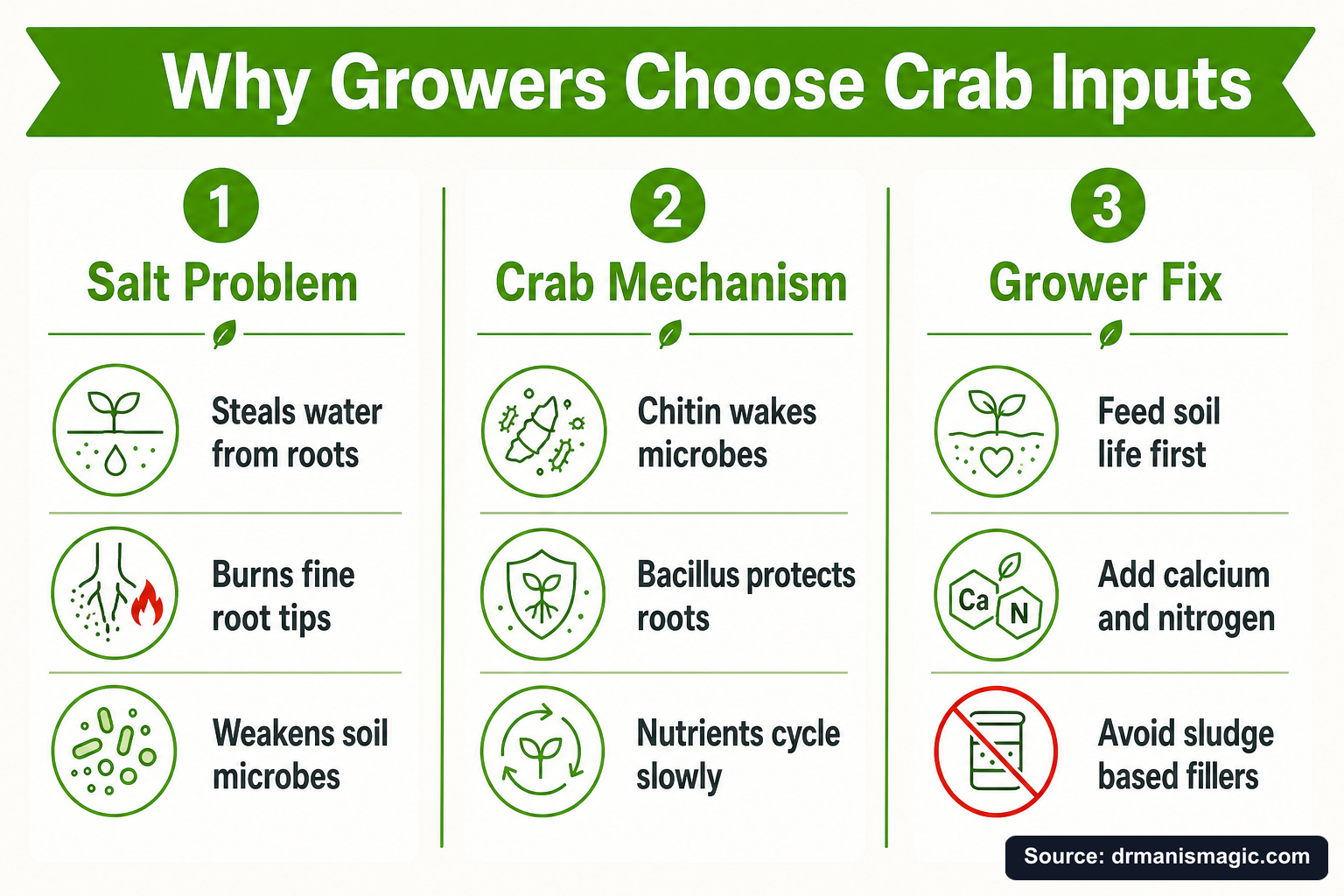
- Most mainstream fertilizers are salt-based, and excess salt burns roots, kills soil microbes, and triggers a cycle of decline that looks like a watering problem.
- Crab shell meal contains chitin, a natural compound that wakes up beneficial microbes including Streptomyces, Bacillus, and Pseudomonas — the same bacteria that protect roots and cycle nutrients.
- Organic crab-based inputs feed microbes first. The microbes then convert nutrients into a plant-ready form. When those microbes die, they release even more nutrition directly to your roots. It is a natural time-release system.
- Crab shell also delivers calcium, magnesium, and amino acid nitrogen — slow, steady, and never burning — exactly the way plants in nature prefer to eat.
- Biosludge and PFAS "forever chemicals" contaminate many organic and synthetic fertilizers. Clean crab-based inputs with no municipal waste fillers answer a real and growing trust problem.
- The Three Plant Pillars — mineral soil, live microbes, and organic fertilizer — form the foundation that makes crab-based inputs work their best.
- After growing over 250,000 trees at our South Texas nursery, we learned that the biology under the soil matters more than the number on the bag.
What Is the Real Problem With Salt-Based Fertilizers?
Quick Answer: Salt-based fertilizers pull water away from roots through osmotic pressure, injure root tips, and kill the beneficial microbes your soil needs to function. Over time they create a cycle where the soil becomes dependent on synthetic inputs while getting weaker every season.
Let's start with something most gardeners have never been taught.
When you pour a high-salt fertilizer around your plant's roots, something called osmotic stress happens. The salt in the soil pulls water out of the root cells instead of letting water in. Your plant gets thirsty even when the soil is wet. University of Missouri Extension describes this as physiological drought — the roots are surrounded by moisture they literally cannot drink.
That is the first injury. But it is not the last.
Salt at high concentrations also damages the fine hair-like root tips that do most of the absorbing. The University of Illinois Extension notes that excess soluble salts cause marginal leaf burn, stunted growth, and increased susceptibility to root diseases like Pythium and Phytophthora. Those are the two most common root rot pathogens. And they love weakened, salt-stressed root zones.
There is a third injury that almost nobody talks about.
Salt kills microbes. The very bacteria and fungi that your soil needs to convert nutrients, suppress disease, and build structure — gone. Wiped out by the same product you bought to help your plant grow. And once those microbes are gone, the soil goes quiet. No more nutrient cycling. No more natural protection. Just a growing dependency on the next bag of fertilizer to keep things green for another few weeks.
This is not an accident. It is the business model.
We have been growing trees in South Texas for over 30 years. We have watched salt-based programs stall trees that should have been thriving. We have seen container plants burn from the inside out while the grower thought they were doing everything right. The salt index of a fertilizer — that is the measure of how much osmotic pressure it creates in the soil — is almost never printed on the label. But it should be.
See also: The Hidden Reason Synthetic Fertilizers Cause Root Rot
See also: How Salt-Based Feeding Quietly Destroys Root Systems
Why Is Chitin From Crab Shell Such a Big Deal for Soil Biology?
Quick Answer: Chitin is a tough natural fiber found in crab shells. When it enters the soil, specific beneficial bacteria rush in to break it down. Those bacteria — including Streptomyces, Bacillus, and Pseudomonas — also protect roots from pathogens, cycle nitrogen, and build a disease-suppressive environment around your plant.
Chitin is the secret the label never mentions.
It is a long-chain natural polymer — think of it like a biological fiber — that makes up the hard outer shell of crabs, shrimp, and other crustaceans. It is also what root-knot nematode eggs are made of. That last part matters a lot, and we will get to it in a moment.
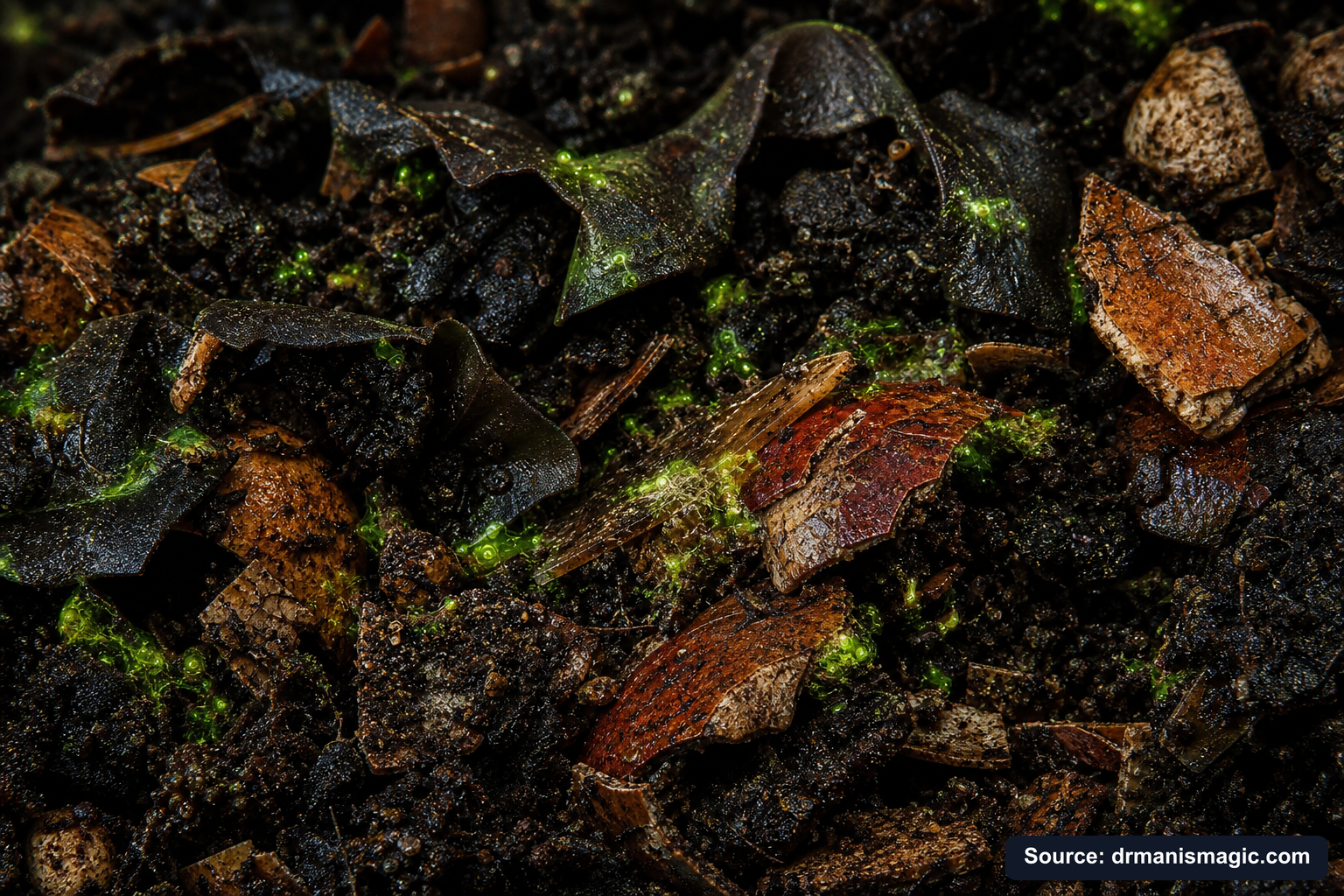
When you add crab shell meal to your soil, the chitin triggers a very specific response in the soil microbiome. Microbes that produce an enzyme called chitinase rush into the area. They want to eat the chitin. And the microbial families that do this work include some of the most beneficial organisms in all of agriculture: Actinobacteria, Streptomyces, Bacillus, and Pseudomonas.
Recent research on crab shell meal amendments found exactly this shift. Soils treated with crab shell showed increased populations of these beneficial bacteria, with predicted increases in both chitin hydrolysis and nitrification. That means the soil started breaking down organic nitrogen more efficiently while simultaneously building a more protective microbial community around the root zone.
Here is why that matters beyond the science words.
Streptomyces is the same genus that gives healthy forest soil its rich, earthy smell. It produces natural antifungal compounds that suppress root pathogens. Bacillus is one of the most studied beneficial bacteria in plant science. Pseudomonas species colonize root surfaces and outcompete harmful organisms for space and nutrition. These are not generic microbes. They are the elite squad of soil biology.
And crab chitin calls them in.
Now back to nematodes. Root-knot nematodes are tiny worm-like pests that attack plant roots. Their eggs have a chitin shell. When you add crab meal to the soil, the chitinase-producing bacteria that arrive to eat the crab chitin will also attack those nematode egg shells. It is not a silver bullet. But it is a real, biologically meaningful mechanism — and one that most fertilizer programs completely ignore.
How Does Organic Crab Nitrogen Actually Feed Your Plant?
Quick Answer: Organic nitrogen from crab protein does not go straight to the plant. It feeds the microbes first. The microbes break it down and convert it into plant-available forms. Then, when those microbes die, they release even more nutrition into the root zone. The whole cycle is a living, self-renewing slow-release system.
This is the part that changes everything once you understand it.
Synthetic fertilizers dump soluble nitrogen directly into the soil water. The plant can grab it fast. That sounds good. But fast also means it leaches away fast. It means the salt concentration spikes fast. And it means the microbes that could have processed it naturally are bypassed completely — or burned out by the salt.
Organic crab nitrogen works differently. The nitrogen is bound up inside the protein structure of crab shells and crab meal. Your plant cannot eat it directly. But your soil microbes can.
Here is the sequence, step by step.
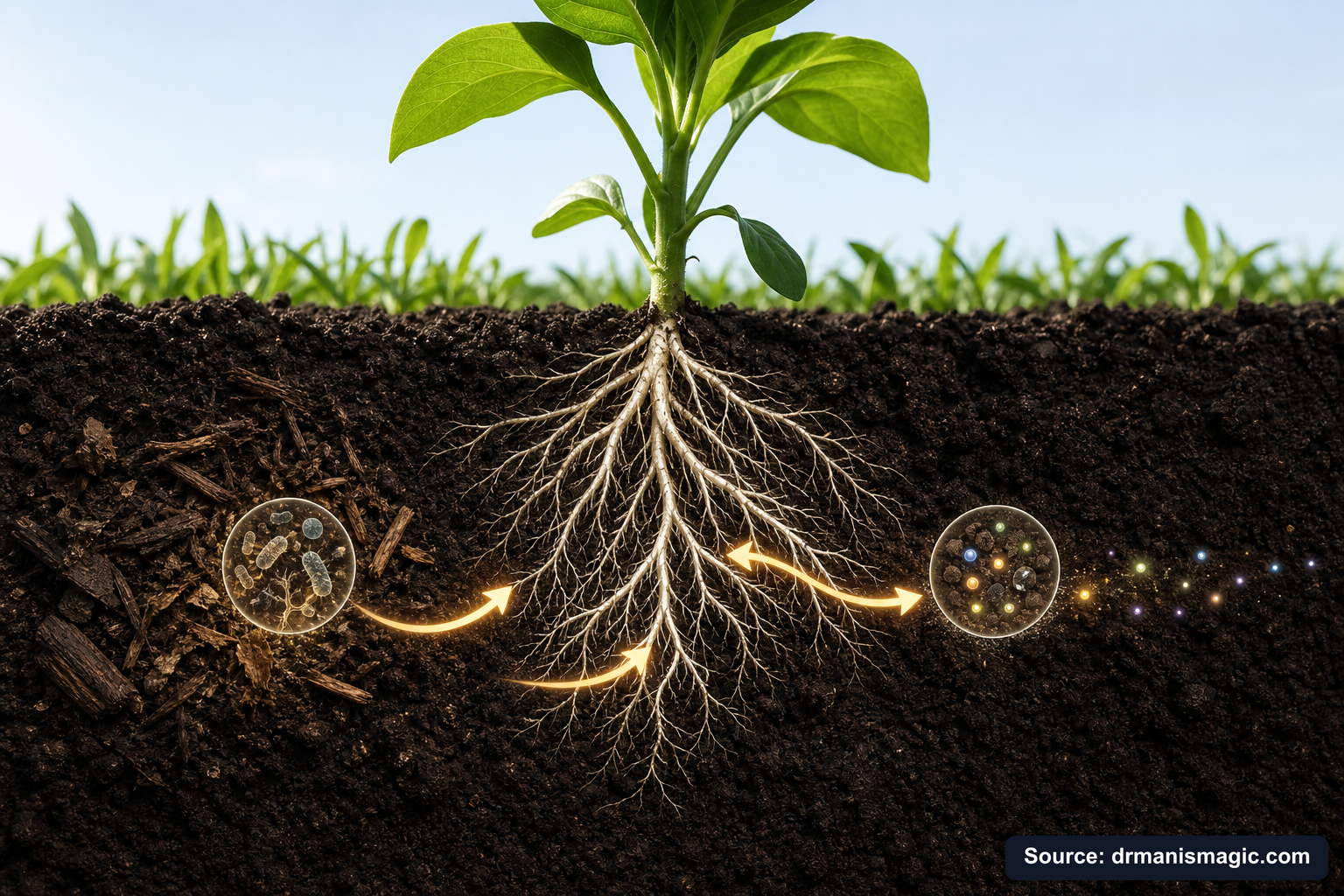
First, you apply crab-based organic fertilizer. The granules sit in the soil. Bacteria and fungi begin to colonize them. They secrete enzymes that break down the crab protein into amino acids. Those amino acids are small enough for plant roots to absorb directly — and plants love amino acid nitrogen because it skips several energy-costly conversion steps.
Second, as the microbial population grows, they continue mineralizing the organic matter. They convert it into ammonium and then into nitrate — the two forms of nitrogen plants use most. This process is called nitrification, and it happens at the pace of biological activity, not all at once.
Third — and this is the part that most people miss — when those microbes eventually die, their own bodies become nutrition. Every microbial cell is packed with nitrogen, phosphorus, and micronutrients. When they die in the root zone, they release all of that directly to the plant. The microbes are not just workers. They are also the delivery system.
The result is a slow, steady trickle of nutrition that mirrors exactly how plants eat in nature. No spikes. No crashes. No burning. Just consistent, gentle feeding that builds the soil stronger with every cycle.
We tested this across 250,000 trees at our nursery. Trees on organic crab-based programs consistently showed deeper root development, more vibrant leaf color, and stronger fruiting than trees on salt-based programs — even when the salt-fed trees looked greener in the first few weeks. Short-term green versus long-term thriving. That is the real comparison.
What Does Calcium From Crab Shell Do for Your Plants and Soil?
Quick Answer: Calcium from crab shell carbonate strengthens cell walls, improves root tip growth, firms up fruit, and helps correct soil chemistry over time. It is the same calcium that makes up the largest mineral portion of a plant's woody structure — and most fertilizers do not include nearly enough of it.
Calcium is the most underappreciated nutrient in gardening. Full stop.
Most gardeners think about nitrogen for green leaves, phosphorus for roots, and potassium for fruit. Calcium barely gets a mention on the average fertilizer label. But here is what the research shows: calcium makes up a larger proportion of the woody structure of a plant than any other mineral nutrient. The cell walls, the root tips, the fruit walls — all calcium-dependent.
Crab shell is loaded with calcium carbonate. Not calcium chloride. Not calcium nitrate. Calcium carbonate — a slow-dissolving form that releases into the soil gradually as microbes and mild soil acids break down the shell material. This is gentle. It does not spike the soil pH or create a salt load. It just quietly makes calcium available over weeks and months.
What does that calcium do?
It strengthens cell walls so plant tissue is more resistant to physical damage and pest penetration. It supports root tip growth so roots can push deeper and explore more soil volume. It firms up fruit, which reduces cracking and improves shelf life. And it supports the activity of many soil enzymes that depend on calcium as a cofactor.
There is also a soil chemistry benefit. Calcium carbonate from crab shell has a mild liming effect. In acidic soils, this can gently raise pH toward the neutral range where most nutrients become more available to plant roots. Not dramatically. Not overnight. But consistently and naturally.
Add magnesium — also present in crab shell — and you have the central atom in the chlorophyll molecule covered too. Magnesium deficiency shows up as yellowing between the leaf veins on older leaves. It is one of the most common deficiencies in container plants and depleted soils. Crab meal addresses it without requiring a separate product.
Why Are Growers Worried About PFAS and Biosludge in Their Fertilizer?
Quick Answer: Many fertilizers — both synthetic and labeled "organic" — use biosludge as a filler. Biosludge is treated municipal waste, and it frequently contains PFAS "forever chemicals" that do not break down in soil or in the body. Clean crab-based inputs with no biosludge are a transparent, traceable alternative.
This is the conversation nobody wants to have. So let's have it.
Biosludge is the polite industry word for treated human sewage waste. Municipal water treatment plants generate enormous amounts of it. For decades, some of it has been processed and used as a filler or nutrient base in fertilizers — including some products sold as organic.
The problem is PFAS. Per- and polyfluoroalkyl substances. They are called forever chemicals because they do not break down. They accumulate in soil. They move into groundwater. They move into plants. They move into the bodies of people who eat those plants or walk barefoot on that grass. The Environmental Protection Agency has flagged PFAS contamination in biosolid-amended soils as a serious public health concern.
You have a right to know what is in your fertilizer. Especially if you are growing food. Especially if children or pets play in that soil. Especially if you are trying to build a healthy, living ecosystem in your backyard.
Our Crab, Kelp & Amino Acids contains zero biosludge, zero PFAS, and zero synthetic salts. The crab shell is a traceable, US-sourced ingredient. The kelp is cold-processed to preserve its natural hormones and minerals. There are no mystery fillers. No municipal waste byproducts. No forever chemicals. Just clean inputs you can feel good about putting in your garden.
And every ingredient in Dr. Mani's Magic is sourced from within the United States. In a world of supply chain disruptions, tariffs, and international uncertainty, that matters. Fertilizers are considered part of national security infrastructure. Much of the potash and phosphorus used in conventional programs comes from Russia, Canada, or China. We chose a different path. American materials. American manufacturing. American accountability.
What Does Cold-Processed Kelp Add to a Crab-Based Fertilizer?
Quick Answer: Cold-processed kelp adds natural plant hormones called auxins and cytokinins, trace minerals from the ocean, carbohydrates that feed soil microbes, and biostimulants that help plants handle drought, cold, and transplant stress. It makes crab inputs much more complete.
Kelp from the ocean has been used by coastal farmers for centuries. They did not know the chemistry. They just knew it worked.
Now we know why.
Kelp contains auxins — natural plant hormones that regulate root growth and cell elongation. It contains cytokinins — hormones that signal cells to divide and stimulate new shoot development. It contains natural carbohydrates that soil microbes love to eat, which means adding kelp to your fertilizer also feeds the biological community around your roots.
Cold processing matters. Heat destroys these hormones. Many kelp products on the market are heated during manufacturing, which breaks down the very compounds that make kelp valuable. Cold-processed kelp preserves the auxins, the cytokinins, and the trace minerals intact.
The ocean is also one of the most complete mineral environments on earth. Kelp draws minerals from seawater and concentrates them in its tissue. When you apply kelp to your soil, you are adding a broad spectrum of trace elements — iodine, iron, manganese, zinc, copper, boron, and more — that land-based fertilizers almost never provide.
Combine that with the chitin and calcium from crab shell, and you have a genuinely complete fertility program in a single product. Not a shortcut. A synergy.
You Never Had a Brown Thumb.
You were handed the wrong tools. This free guide hands you the right ones.
You watered it. You fed it. It died anyway.
It was never you. It was the dirt, the salt food, and the bad advice.
This guide shows you what really went wrong, and how to fix it for good.
- Why your plants really died, and why it was never your fault
- The salt hiding in your plant food that quietly burns the roots
- The hidden killer in almost every bag of store soil
- The tiny helpers that grow a whole forest for free
- The rescue trick that brings a half dead plant back to life

Why Do Volcanic Ash Minerals Belong in a Plant Nutrition Program?
Quick Answer: Volcanic ash minerals add silica and a broad spectrum of trace elements that strengthen plant cell walls, increase drought resistance, and support the microbial life that makes other nutrients available. They fill mineral gaps that crab and kelp alone cannot cover.
Volcanic ash sounds dramatic. But its role in plant nutrition is quiet and steady.
When a volcano erupts, it releases pulverized rock minerals that have been locked deep inside the earth for millions of years. That rock dust settles on soil and, over time, weathers into plant-available trace elements. Some of the most fertile soils on the planet — in Hawaii, in the Pacific Northwest, in parts of Central America — owe their richness to volcanic deposits.
The key mineral in volcanic ash for plants is silica. Silicon builds cell wall strength. Plants with adequate silica are physically tougher — more resistant to insect feeding, more tolerant of environmental stress, better able to hold water during dry spells. Research from multiple university extension programs has linked silicon supplementation to improved drought tolerance and reduced disease pressure in a wide range of crops.
Volcanic ash also brings a wide array of micronutrients that are often depleted in containerized and intensively managed soils. Iron, manganese, zinc, copper, boron, molybdenum — the nutrients needed in tiny amounts but that cause visible problems when they are missing. Adding a volcanic mineral source to an organic fertility program closes those gaps without adding salt or synthetic chelates.
This is why the combination of crab, kelp, and volcanic ash minerals in a single fertilizer is so much more powerful than any one ingredient alone. Each one addresses a different layer of plant nutrition and soil biology. Together, they create a complete system.
How Do the Three Plant Pillars Make Crab-Based Inputs Work Better?
Quick Answer: Crab-based organic fertilizer is Pillar Three of the Three Plant Pillars system. Without Pillar One (mineral soil that drains well and does not compact) and Pillar Two (live beneficial microbes), even the best organic fertilizer cannot reach its potential. All three pillars work together or not at all.
Here is the truth about crab meal that most sellers will not tell you.
Crab-based organic fertilizer is genuinely excellent. But it depends on biology to work. And biology depends on the environment you create for it. If your soil is compacted, waterlogged, or oxygen-starved, the microbes that convert crab protein into plant nutrition cannot survive. If your soil has no living microbial community to begin with, the chitin signal has no one to answer it.
This is exactly why we built the Three Plant Pillars system.
Pillar One is mineral-based soil. Not bark. Not sawdust. Not peat that compacts into a wet, airless sludge within a year. True mineral soil — silica-rich sandy loam from the Rio Grande Valley — that drains freely, holds its structure permanently, and lets roots breathe and push deep. UC IPM and Illinois Extension both emphasize that roots require oxygen. Waterlogged, compacted soil creates oxygen stress that predisposes plants to root rot and decline. The soil you plant in is not a background detail. It is the foundation.
Pillar Two is live microbials. Bacteria, fungi, and mycorrhizae inoculated directly into the root zone. These are the organisms that answer the chitin call. They are the workers that convert crab protein into amino acid nitrogen. They are the defenders that produce antifungal compounds against Pythium and Phytophthora. Without them, your crab meal sits in the soil doing far less than it should. Our Plant Super Boost delivers living, stabilized microbes in a liquid form you simply drench into your soil monthly. It does not smell. It does not rot. It just works.
Pillar Three is organic fertilizer — crab, kelp, amino acids, and volcanic minerals working together as a slow, complete, biology-friendly nutrition program.
When all three pillars are in place, something shifts. The soil comes alive. The roots go deep. The leaves get their color back. The fruit sets. You stop chasing problems and start watching things grow.
We have seen this on 250,000-plus trees. We have seen it on lawns, flower beds, raised vegetable gardens, container houseplants, and tropical trees. The pillars are not a marketing concept. They are the operating system that nature already uses. We just stopped fighting it.
Crab-Based Inputs vs. Synthetic Fertilizers vs. Other Organic Options: A Full Comparison
Quick Answer: Crab-based inputs offer the best combination of low salt risk, no PFAS concern, chitin biology, slow-release nitrogen, and calcium support. Synthetic fertilizers work fast but damage roots and microbes over time. Other organic options like fish meal and feather meal lack chitin and often carry odor or contamination concerns.
Let's lay it all out so you can see it clearly.
| Input Type | Salt Risk | PFAS / Biosludge Concern | Nitrogen Release | Chitin | Calcium | Microbial Impact | Odor | Safe for Edibles |
|---|---|---|---|---|---|---|---|---|
| Synthetic fast-release (e.g. soluble N-P-K) | High | Low (but salt damage is primary risk) | Immediate spike, then crash | None | Rarely included | Burns and kills microbes | Low | Residue concerns; leaching risk |
| Slow-release synthetic (coated prills) | Medium | Plastic coating residue in soil | Gradual but still salt-based | None | Rarely included | Less acute burn, still disruptive | Low | Plastic microparticle concern |
| Biosolids / municipal compost | Low to medium | High — PFAS confirmed in many biosolid products | Moderate, variable | None | Some | Mixed — can add pathogens | High | Not recommended for edible gardens |
| Fish meal / fish emulsion | Low | Low | Moderate, microbially mediated | None | Low | Feeds microbes | Very high — causes nausea in many users | Yes, but odor is limiting indoors |
| Feather meal | Low | Low | Slow, high nitrogen | None | Low | Feeds microbes | Moderate | Yes |
| Bone meal | Low | Low | Very slow, low nitrogen | None | High | Neutral to slightly positive | Low to moderate | Yes |
| Kelp meal alone | Very low | None | Very low nitrogen | None | Low | Feeds microbes; provides hormones | Low to mild | Yes |
| Crab, Kelp & Amino Acids (crab-based blend) | Very low | None — zero biosludge | Slow, amino acid-mediated, steady | Yes — chitin drives biology | High (6% calcium) | Strongly feeds and stimulates microbes | Mild, earthy | Yes — clean and traceable |
The pattern is clear. Crab-based inputs are not just "another organic option." They fill a category of their own — the only common organic input that brings chitin, calcium, amino acid nitrogen, and microbial stimulation all in one material, without the odor problems of fish or the contamination risks of biosludge.
How Do You Know If Salt Damage Is What's Hurting Your Plant Right Now?
Quick Answer: Salt damage, overwatering, and true root rot can look almost identical above ground. The key differences are in the soil conditions, watering history, and root color. Use this diagnostic table to tell them apart before you treat the wrong problem.
This is where most growers waste the most time. The leaves are yellowing. The plant looks droopy. So they water more. Or they fertilize more. And it gets worse. Because they are treating the wrong cause.
| Symptom | Salt / Fertilizer Burn | Overwatering | Root Rot (Pythium / Phytophthora) |
|---|---|---|---|
| Leaf tips and margins | Brown, crispy edges — especially on older leaves | Yellow, soft, limp | Yellow to brown, wilting even when soil is wet |
| Soil smell | Normal or slightly chemical | Musty, wet | Sour, rotten, sulfurous |
| Root appearance (when inspected) | Roots may be brown at tips, otherwise intact | Roots pale, soft, beginning to die | Roots dark brown or black, mushy, foul smell |
| Soil surface crust | White mineral crust common — sign of salt accumulation | Algae or moss growth on surface | Surface may look normal; problem is underground |
| Watering history | Normal watering, recent fertilization | Frequent watering, poor drainage | Persistent wetness, warm temperatures, stressed roots |
| Fertilizer history | Recent synthetic fertilizer application, especially in heat | Not the cause — watering pattern is | Salt damage may have opened the door to infection |
| First response | Flush soil with water; stop synthetic feeding; switch to organic | Reduce watering; improve drainage; check soil structure | Remove affected roots; treat with beneficial microbes; improve drainage immediately |
If you see a white crust on your soil surface, that is almost always salt accumulation. That crust is the residue left behind as water evaporates and salt concentrates. It is a visible signal that your soil's salt index is too high. The solution is not more fertilizer. The solution is to flush the soil with clean water and switch to a low-salt organic program before the root zone damage goes further.
Recovery Checklist: What to Do After Salt-Based Fertilizer Damage
- Stop all synthetic fertilizer immediately. Give the root zone a rest from any salt-based inputs.
- Flush the soil. Water deeply three times over a week to push accumulated salts below the root zone. Use clean water — not fertilizer water.
- Check drainage. If water sits on the surface or in the pot for more than 30 minutes, your soil structure is the deeper problem. Compacted or bark-heavy mixes need to be addressed at the root level.
- Inoculate with live microbes. Beneficial bacteria and fungi help rebuild the root zone, suppress opportunistic pathogens, and restart the nutrient cycle. Apply a liquid microbial drench directly to the root zone.
- Apply a crab-based organic fertilizer at half the normal rate. Let the biology take over. Do not rush back to high-nitrogen feeding.
- Wait and observe. New leaf growth is the best sign of root recovery. Be patient. Roots heal before the leaves show it.
- Reassess soil structure long-term. If you are using a bark-heavy potting mix, consider transitioning to a mineral-based soil that will not compact and steal oxygen from your roots over time.
See also: Why Most Fertilizers Are Actually Salt in Disguise
Can You Use Crab-Based Inputs on Lawns, Vegetables, Houseplants, and Trees — Not Just Citrus?
Quick Answer: Yes. Crab-based inputs improve soil biology, deliver slow-release nutrition, and add calcium to any plant system. We developed and tested these inputs across 250,000-plus citrus trees, but the same biology applies to lawns, raised vegetable beds, ornamentals, houseplants, and fruit trees of every kind.
We are a citrus nursery at our roots. But the lessons we learned under citrus trees in South Texas apply everywhere plants grow.
Roots need oxygen. Roots hate salt. Roots thrive when microbes are present. Roots absorb nutrients better when those nutrients arrive in slow, steady, biologically mediated forms. Those are not citrus rules. Those are nature's rules. And they apply to your lawn, your tomatoes, your roses, your fiddle-leaf fig, your oak tree, and your container Meyer lemon equally.
We have seen crab-based organic inputs transform turf that had been burned yellow by synthetic lawn programs. We have seen them rebuild vegetable garden beds that had been depleted by years of heavy feeding with soluble fertilizers. We have seen houseplants that had been slowly dying in salt-crusted bark-based mixes come back to life when the soil was corrected and the nutrition was switched to an organic, biology-friendly program.
The mechanism is the same every time. Feed the microbes. Let the microbes feed the plant. Build the soil. Let the soil build the plant.
If you want to understand how this applies to your specific situation — lawns, trees, gardens, containers, or all of the above — our Free Plant Care Field Guide walks through the Three Plant Pillars in plain language for every plant type. No guesswork. No jargon. Just the foundation that works.
See also: Why Most Potting Mix Collapses Within 6-12 Months
The Growers Who Already Know This Are Years Ahead
Here is the thing about time that nobody wants to say out loud.
You can always earn more money. You cannot get back the growing seasons you lose. Every year you spend on a salt-based program that burns your roots, kills your microbes, and stalls your growth is a year you cannot recover. The fruit that should have been on your tree last summer. The lawn that should have been lush three springs ago. The garden bed that should have been producing for years by now.
The number one thing people tell us they want — more than anything else — is to see something they planted actually bear fruit while they can still enjoy it. Not someday. Soon. In their lifetime. In their backyard. With their own hands.
That is not a gardening goal. That is a deeply human one. We were put on this earth to tend things. To nurture. To grow. And when the system is rigged against that — when the products you buy are secretly working against your soil — it does not just cost money. It costs time. It costs joy. It costs the experience of standing in your own backyard, reaching up, and pulling something beautiful off a branch you planted yourself.
Serious growers are returning to crab-based inputs because they figured this out. Not because it is trendy. Because it works. Because the biology is real. Because the soil responds. Because the roots go deep and stay healthy and the plants keep producing long after the synthetic programs have burned out and the soil has gone quiet.
The Three Plant Pillars — mineral soil, live microbes, and clean organic fertilizer built around crab, kelp, and amino acids — are the foundation Dr. Mani spent 40 years developing and we have spent 30 years proving on over 250,000 trees. It is not complicated. It is not expensive. It just requires understanding what the soil actually needs.
If you are ready to stop fighting nature and start working with it, explore the full Three Plant Pillars system and see what your plants are actually capable of. And if you are not happy with what you find in 30 days, we will make it right. No arguments. No runaround. That is our promise.
The best time to make the switch was last season. The second best time is right now.
Frequently Asked Questions
Serious growers are asking hard questions right now. They want to know why their plants stall, why their soil feels dead, and why crab-based fertilizers keep coming up in every honest conversation about plant health. These answers are grounded in over 30 years of growing more than 250,000 trees in South Texas. Read them carefully. The answers might change how you garden forever.
Why are serious growers going back to crab-based fertilizers?
Because they got burned by salt. Mainstream fertilizers are mostly concentrated salts. Salt pulls water away from roots. Salt kills the beneficial microbes your soil needs to thrive. Growers watched their best plants stall and yellow season after season. Crab shell meal contains chitin, a natural compound that wakes up the good bacteria in your soil. Those bacteria protect roots, unlock nutrients, and build a living ecosystem that keeps working long after you walk away.
What does chitin in crab shell actually do for my soil?
Chitin is like a dinner bell for beneficial soil bacteria. When you add crab shell meal to your soil, microbes like Streptomyces, Bacillus, and Pseudomonas wake up and multiply fast. These are the same bacteria that fight root rot pathogens and free up locked nutrients. As those microbes break down the chitin, they also release slow, steady nitrogen directly to your roots. No burning. No spike. Just clean, natural feeding the way plants prefer it.
How is crab-based fertilizer different from the bag I already use?
Most bags on the shelf are salt-based. When you pour them around your roots, osmotic pressure pulls moisture out of root cells. Your plant gets thirsty even when the soil is wet. That is called physiological drought. Crab-based inputs do the opposite. They feed the microbes first. The microbes convert nutrients into a form your plant can actually drink. When those microbes die naturally, they release even more nutrition. It is a living, self-sustaining cycle that salt fertilizers destroy.
Will crab fertilizer burn my plants or smell bad?
No burning and no bad smell. Salt fertilizers burn because they hit roots with concentrated chemicals all at once. Crab shell meal releases nutrients slowly through microbial activity. There is no salt spike and no scorched roots. As for smell, Dr. Mani's Magic Crab, Kelp, and Amino Acids fertilizer was specifically formulated without fish emulsion or anything that goes anaerobic. It does not smell like sewage. You can use it on indoor plants and enjoy your garden the same day.
How does crab fertilizer fit into the Three Plant Pillars system?
The Three Plant Pillars are mineral-based soil, live microbes, and organic fertilizer. Crab-based fertilizer is Pillar Three. It is the ignition. But it works best when all three pillars are in place. Dr. Mani's Magic Super Soil gives roots oxygen and drainage. Plant Super Boost delivers live bacteria, fungi, and mycorrhizae. The crab, kelp, and amino acids fertilizer then fuels the whole living system. Together, they work like a team. Alone, each one helps. Together, your plants become practically bulletproof.
Is it true that some organic fertilizers contain harmful chemicals?
Yes, and this is a real problem. Some fertilizers labeled organic use biosludge, which is processed municipal waste. Biosludge can carry PFAS compounds, also called forever chemicals, that build up in soil and plants over time. Dr. Mani's Magic uses clean crab shell, kelp, and amino acids with no municipal waste fillers. Every ingredient is sourced from the USA. You can use it around your children, your pets, and your food garden without fear. That peace of mind is worth more than any N-P-K number on a bag.
How fast will I see results with crab-based inputs?
Most growers notice a visible difference within 30 days. Leaves get greener. Roots push deeper. Soil starts to smell alive again, rich and earthy instead of flat and chemical. The full power builds over time because you are rebuilding a living ecosystem, not just giving your plant a quick sugar rush. Dr. Mani tested this system on more than 250,000 citrus trees in South Texas and on houseplants, tropical trees, and gardens. The biology works. The only thing you lose by waiting is time you cannot get back.
About the Author
Dr. Mani Skaria, PhD
Dr. Mani Skaria, PhD, is a plant pathologist and the scientific founder of Dr. Mani's Magic. He earned his doctorate at Purdue University and spent 48 years studying how plants, soil, and living microbes work together, including his years as Professor Emeritus at Texas A&M and as a member of the USDA NAREEE Advisory Board. He invented micro-budding, a method for growing healthier, stronger trees, and has grown more than 250,000 trees on the family farm in Hargill, Texas - US Citrus Nursery. His life's work takes real lab science and practical experience and turns it into simple, safe, organic plant care anyone can use at home.


