


Why Roots Respond to Crustacean Compounds: Chitin and Root Immunity | Dr. Mani's Magic
Why Roots Respond to Crustacean Compounds: Chitin, Microbes, and Root Immunity Explained
You walk out to your patio on a Saturday morning. Coffee in hand. The air smells like damp soil and possibility. You look at your lemon tree — or your rose bush, or your raised garden bed — and something is just... off. The leaves are pale. A little yellow around the edges. The new growth looks tired before it even starts.
You fertilized it last month. You watered it. You did everything the bag said. So why does it look like it's slowly giving up on you? Here is the thing nobody at the garden center ever told you. The problem almost certainly started underground. In the roots. And the fertilizer you used — the one in the bright bag with the cheerful green logo — may have made things worse, not better.
What if the answer was sitting at the bottom of the ocean? What if crab shells, kelp, and amino acids were doing something so smart, so perfectly tuned to how roots actually work, that once you understood it, you could never go back to the old way? That is exactly what we are going to show you. After growing over 250,000 trees at our South Texas nursery and testing these principles on citrus, tropicals, houseplants, lawns, and garden beds, we learned something that changed everything. And it starts with a molecule you have probably never heard of.

Plant Super Boost
Key Takeaways
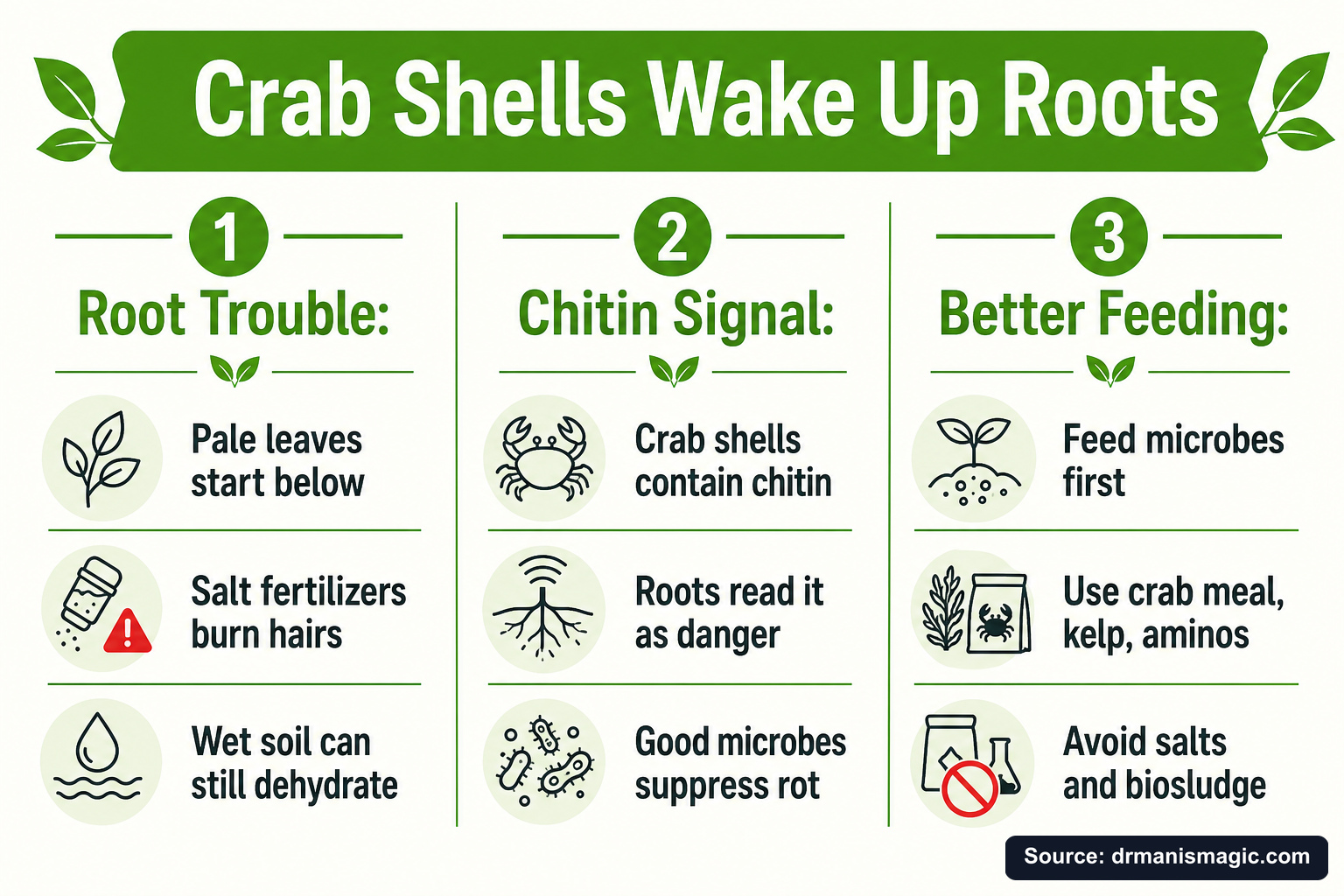
- Crustacean shells contain chitin, a natural compound that feeds beneficial soil microbes and signals plant roots to activate their own immune defenses.
- Synthetic fertilizers are salt-based. Salt burns fine roots, kills beneficial microbes, and creates a cycle of dependency that weakens plants over time.
- Organic fertilizer feeds the microbes first. The microbes then convert nutrients into a form roots can easily absorb — a natural slow-release system that mirrors how nature works.
- Crab meal, kelp, and amino acids each bring a different gift: chitin for immunity, hormones for growth signaling, and amino nitrogen that roots absorb gently without osmotic shock.
- Root rot, salt burn, and overwatering damage all look similar but have different causes. Knowing the difference saves your plant and your time.
- Zero PFAS, zero biosludge, zero synthetic salts — clean inputs matter for your soil, your food, your kids, and your pets.
- The Three Plant Pillars — mineral soil, live microbes, and organic fertilizer — are the foundation. Everything else is detail.
What Is Chitin and Why Do Roots Care About It?
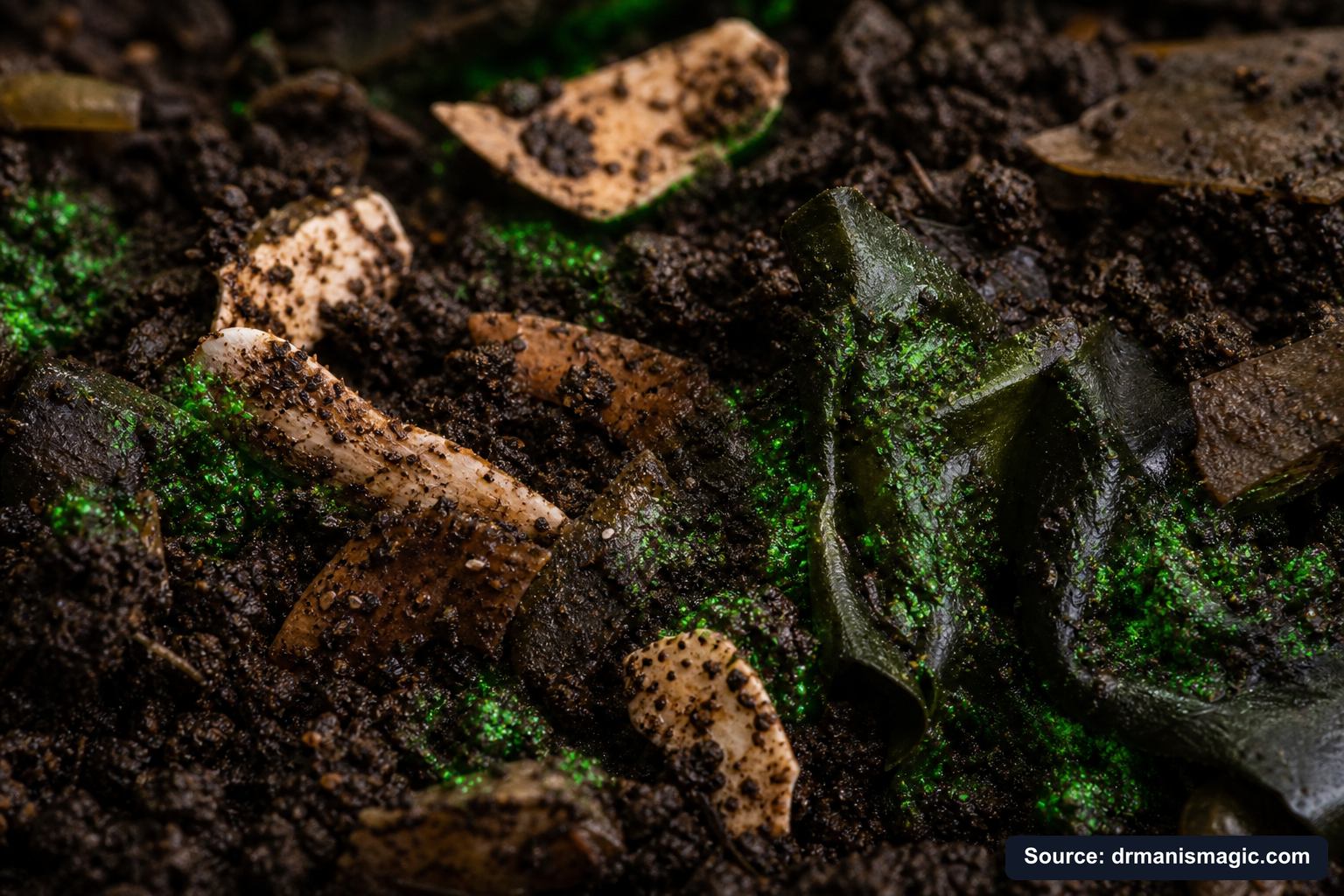
Quick Answer: Chitin is a tough, fibrous compound found in crab, shrimp, and lobster shells. When it enters the soil, beneficial microbes break it down and release nutrients slowly. At the same time, roots detect chitin as a signal to activate their own immune system — the same immune trigger that fires when a fungal pathogen shows up.
Chitin is one of the most abundant natural materials on Earth. It is what makes a crab shell hard. It is also what makes the cell walls of many harmful soil fungi tough and flexible.
Here is the fascinating part. Your plant's roots have been evolving for hundreds of millions of years. During that time, they learned to recognize chitin as a warning signal. When chitin shows up in the soil, the root's immune system wakes up. It gets ready. It starts producing defense compounds. Scientists call this pattern-triggered immunity, and it has been documented in peer-reviewed research going back decades.
A landmark study published in the National Library of Medicine showed that chitin amendments shift the entire soil community toward beneficial, chitin-degrading microbes — including Streptomyces, Pseudomonas, Flavobacterium, and Actinobacteria. These are the same microbes that suppress harmful pathogens like Fusarium, Verticillium, Rhizoctonia, and root-attacking nematodes. (PMC, National Library of Medicine)
So crab shells are not just fertilizer. They are a biological signal. A call to arms. The root reads the chitin, summons its microbial army, and prepares its own defenses — all at once.
How Do Salt-Based Fertilizers Hurt Roots?
Quick Answer: Salt-based synthetic fertilizers increase the salt concentration around the roots. This pulls water out of root cells through osmosis — the same way salt draws moisture out of meat. Roots dehydrate, fine root hairs die, and the door opens wide for root rot pathogens like Pythium and Phytophthora.
Imagine your root tips as tiny, delicate straws. They are covered in microscopic root hairs so fine you could barely see them. Their whole job is to sip water and dissolved nutrients from the soil and pull them up into the plant.
Now pour a high-salt fertilizer around them.
Salt changes the chemistry of the water in the soil. It makes the soil water saltier than the water inside the root cells. Water naturally moves from low-salt zones to high-salt zones — that is osmosis. So instead of water flowing into the roots, it starts flowing out. The plant experiences what scientists call physiological drought. It is thirsty even when the soil is wet. Leaves wilt. Edges scorch. Growth stalls.
The Colorado State University Extension explains this clearly in their resource on saline soils: high salt concentrations in the root zone restrict a plant's ability to take up water even when water is physically present. (Colorado State University Extension)
And here is what makes it worse. Stressed roots are weak roots. Pythium and Phytophthora — the two most common root rot pathogens — are opportunists. They do not attack healthy, oxygen-rich roots very easily. But the moment roots are stressed, burned, or oxygen-deprived, those pathogens move in fast. The salt fertilizer did not just burn the roots. It handed the pathogens an open invitation.
We have seen this pattern over and over in our South Texas nursery. The fertilizer spike is the hidden villain in more plant deaths than almost anything else.
See also: The Hidden Reason Synthetic Fertilizers Cause Root Rot
How Does Organic Fertilizer Actually Feed a Plant?
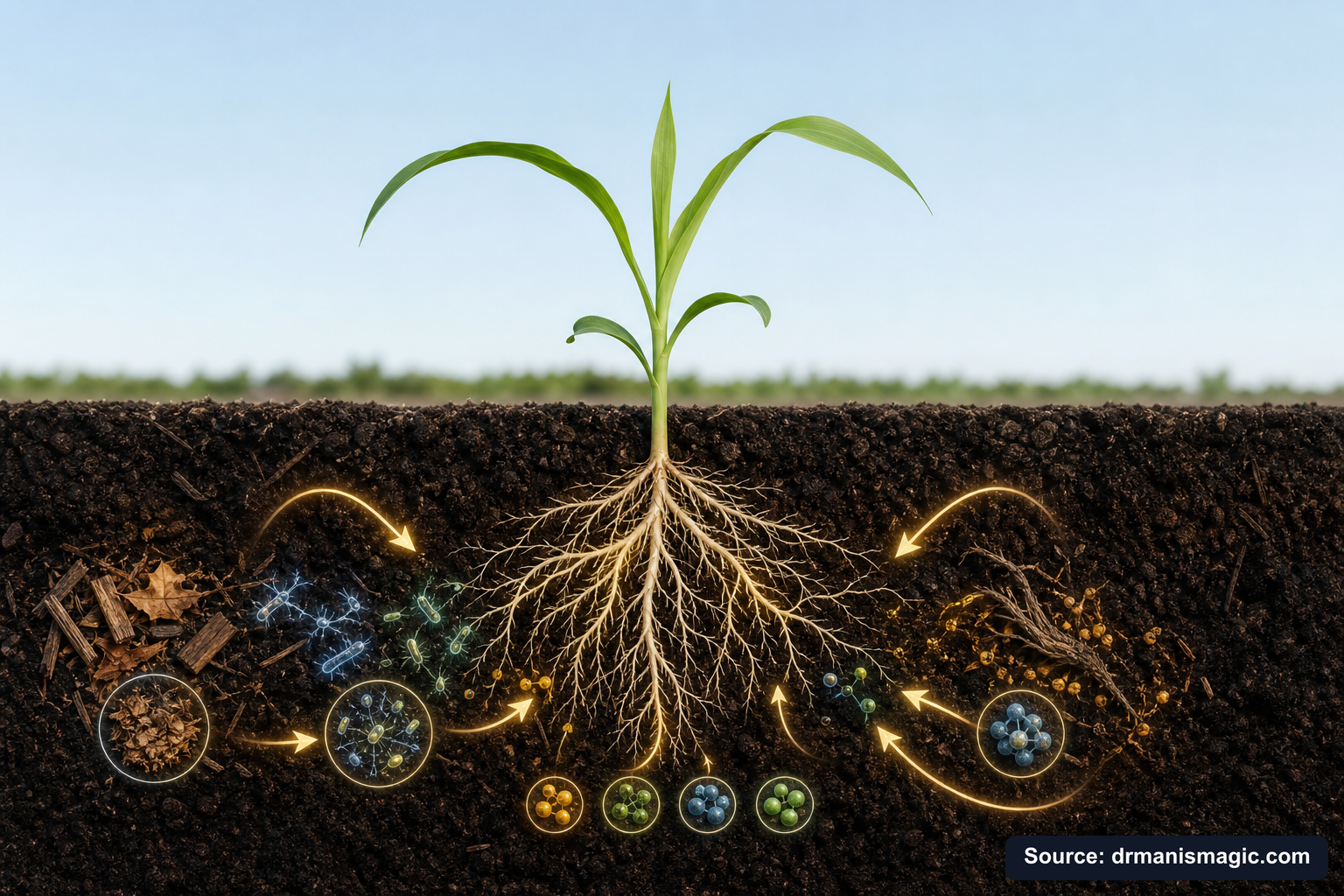
Quick Answer: Organic fertilizer does not feed the plant directly. It feeds the microbes in the soil first. The microbes eat the organic material, break it down, and convert it into simple mineral forms the plant can absorb. When those microbes die, they release even more nutrition right into the root zone — a natural slow-release system that never burns.
This is the piece most gardening advice skips completely. And it is the most important thing we can teach you.
When you sprinkle crab meal, kelp, or amino acid fertilizer around your plant, the plant does not immediately absorb it. The granules sit in the soil. Billions of microbes — bacteria and fungi — smell it, find it, and start eating it. As they digest it, they release nutrients in simple mineral forms: nitrates, phosphates, potassium ions. Forms the plant's roots can absorb easily and gently.
No spike. No shock. No osmotic stress.
Then, when those microbes die — which they naturally do after a few weeks — their own bodies break down and release even more nutrition directly into the soil. Their tiny corpses become fertilizer. The plant gets a second feeding without you doing anything at all.
This is exactly how nature works in a forest or a meadow. No one is out there pouring chemical salts on tree roots. Lightning fixes some nitrogen. Bacteria fix more. Fungi break down fallen leaves. Everything cycles. Everything feeds everything else. The plant evolved to work inside this system — not outside it.
Organic, chitin-rich fertilizer like the kind found in crab meal plugs right back into that ancient system. The microbes recognize it. The roots recognize it. The whole soil community wakes up and starts working together.
Salt-based synthetic fertilizers do the opposite. They skip the microbes entirely. They bypass the system. They deliver a nutrient spike so fast and so concentrated that they actually kill the microbes living around the roots. Then the next application has to be even heavier because the natural cycling system is gone. You end up dependent on the bag. That is not a coincidence. That is how the business model works.
See also: Why Most Fertilizers Are Actually Salt in Disguise
What Does Kelp Actually Do for Roots and Growth?
Quick Answer: Kelp contains natural plant hormones called auxins and cytokinins that signal roots to grow longer and branch more. It also carries trace minerals, complex carbohydrates, and biostimulants that feed soil microbes and help the plant handle stress from heat, drought, and cold.
Kelp is a marine plant. It lives in some of the most nutrient-rich, mineral-dense water on the planet. Over millions of years, it developed a remarkable cocktail of compounds to thrive in cold, moving water with intense light variation.
When you bring cold-processed kelp into the soil, several things happen at once.
First, the auxins and cytokinins in kelp are natural plant growth hormones. Auxins in particular signal root cells to elongate and divide. More root branching means more surface area. More surface area means more water and nutrient uptake. Your plant gets bigger and stronger not because you pushed it harder, but because you gave it the signal to grow the way it was designed to.
Second, kelp feeds microbes. The complex carbohydrates in kelp — called alginates and fucoidan — are food for beneficial soil bacteria. When the microbial population thrives, the whole root zone ecosystem functions better.
Third, kelp brings trace minerals. Iron, manganese, zinc, boron, molybdenum — the micronutrients that most fertilizers leave out. These are the vitamins of the plant world. You can have all the nitrogen and phosphorus in the world, and if you are short on boron, your flowers will not set fruit. If you are short on iron, your new leaves will turn yellow. Kelp fills those gaps quietly and completely.
And it does all of this without adding salt to the soil. Without burning the roots. Without touching the microbial community in a harmful way. It works with the system, not against it.
Why Do Amino Acids Matter for Root Nutrition?
Quick Answer: Amino acids are the building blocks of protein. When they enter the soil as fertilizer, they carry nitrogen in a form that bypasses the need for heavy microbial conversion. Roots can absorb certain amino acids directly, making them one of the gentlest and most efficient nitrogen sources available — with essentially zero salt index.
Nitrogen is the most important nutrient for plant growth. It builds chlorophyll, amino acids, enzymes, and every protein in the plant's body. Without enough nitrogen, leaves turn pale and growth crawls.
But not all nitrogen is equal. Synthetic urea and ammonium sulfate deliver nitrogen as a salt. Fast, cheap, and brutal on the soil. Amino acid nitrogen is different. It arrives as organic molecules — the same building blocks the plant will eventually use to make its own proteins. The conversion work is already partially done.
Some amino acids, like glycine and glutamate, can be absorbed directly through root membranes. No waiting for microbes. No salt spike. No osmotic stress. The plant gets fed the way it would in a healthy, living forest floor — through a gentle trickle of organic nitrogen that the whole soil system recognizes and welcomes.
Feather meal and other animal-derived amino acid sources also happen to be high in nitrogen and phosphorus. That is why our Crab, Kelp & Amino Acids fertilizer carries a 7-4-4 NPK ratio — a naturally balanced, microbe-friendly formula that supports leafy growth, root development, and fruiting all at once, without a single gram of synthetic salt.
What Is the Difference Between Salt Damage, Overwatering, and True Root Rot?
Quick Answer: Salt damage scorches leaf edges and stunts growth while the soil stays dry. Overwatering drowns roots by cutting off oxygen, causing wilting even in wet soil. True root rot — usually caused by Pythium or Phytophthora — turns roots brown and mushy after stress opens the door to pathogens. All three look similar above ground but need different fixes.
One of the most frustrating moments in gardening is watching your plant wilt and not knowing why. You check the soil. It is wet. You look at the leaves. They are yellowing. Is it too much water? Not enough water? A disease? A nutrient problem?
Here is the diagnostic table we use at our nursery:
| Condition | Soil Feel | Leaf Symptoms | Root Appearance | Most Likely Cause |
|---|---|---|---|---|
| Salt / Fertilizer Burn | Dry or crusty surface; white mineral crust possible | Brown, scorched leaf edges; new growth stunted or twisted | Fine root tips brown and brittle; outer layer may peel | Osmotic stress from high salt index fertilizer |
| Overwatering / Low Oxygen | Consistently wet, heavy, compacted, slow to drain | Yellowing all over; wilting despite wet soil; leaf drop | White roots turn tan, then brown; no new root tips visible | Oxygen-starved root zone; roots suffocating |
| True Root Rot (Pythium, Phytophthora) | Wet or recently wet; poor drainage | Sudden collapse; wilting that does not recover even with water | Roots are brown, mushy, and smell sour; outer sheath slides off easily | Pathogen invasion after root stress; often follows salt burn or overwatering |
| True Nutrient Deficiency | Normal moisture; may be compacted or low in organic matter | Pale green or yellow leaves; older leaves affected first (nitrogen); new leaves affected first (iron, zinc) | Roots may look normal or slightly thin | Missing macronutrients or micronutrients; often worsened by high salt locking up available minerals |
The Colorado State University Extension notes that root health depends as much on air-filled pore space as it does on water and minerals. Roots need oxygen to respire. When soil stays waterlogged or compacted, oxygen disappears, and roots die from the inside out — even before any pathogen gets involved. (Colorado State University Extension — Healthy Roots and Healthy Trees)
This is exactly why the first of our Three Plant Pillars is mineral-based soil. Drainage and oxygen first. Always. Without them, no fertilizer in the world can save your plant.
Recovery Checklist: What to Do When You Suspect Root Damage
- Stop all synthetic fertilizer immediately. Give the root zone time to flush and recover before adding any new inputs.
- Check drainage. If water sits in the pot or bed for more than a few minutes after watering, your soil structure is the problem. Compacted or bark-heavy mixes collapse over time and suffocate roots.
- Flush the soil with plain, room-temperature water two or three times to dilute salt accumulation if fertilizer burn is suspected.
- Check the roots. Gently remove the plant from its pot. White, firm roots are healthy. Brown, mushy, or hollow roots are in distress. Trim the damaged roots cleanly with sterile scissors.
- Reintroduce live microbes. Beneficial bacteria and fungi help suppress Pythium and Phytophthora and rebuild the root zone ecosystem. Our Plant Super Boost carries live bacteria, fungi, and mycorrhizae in a stabilized liquid form that does not smell and does not rot.
- Resume feeding with a clean, low-salt organic fertilizer once new root growth is visible. Start at half the recommended rate.
- Be patient. Root recovery takes weeks, not days. The plant will tell you it is healing when you see new green growth from the tips.
You Never Had a Brown Thumb.
You were handed the wrong tools. This free guide hands you the right ones.
You watered it. You fed it. It died anyway.
It was never you. It was the dirt, the salt food, and the bad advice.
This guide shows you what really went wrong, and how to fix it for good.
- Why your plants really died, and why it was never your fault
- The salt hiding in your plant food that quietly burns the roots
- The hidden killer in almost every bag of store soil
- The tiny helpers that grow a whole forest for free
- The rescue trick that brings a half dead plant back to life

Crustacean Meal vs. Other Common Fertilizers: Which One Actually Helps Roots?
Quick Answer: Crustacean meal (crab, shrimp, lobster) outperforms most common fertilizers for root health because it combines slow-release nutrition with chitin-driven immune signaling and microbial stimulation — all with a near-zero salt index. Fish emulsion is fast but smelly and can go anaerobic. Synthetic urea is fast but salt-heavy. Blood meal is nitrogen-rich but high-salt. Biosolids may carry PFAS. Crab-kelp-amino acid blends do what no single-source fertilizer can.
Here is the full comparison so you can see exactly where each fertilizer lands:
| Fertilizer Type | Release Speed | Salt Risk | Microbial Effect | Chitin / Immune Signal | PFAS / Biosludge Risk | Odor | Best Use |
|---|---|---|---|---|---|---|---|
| Synthetic Urea / Ammonium Sulfate | Immediate | Very High | Kills microbes; salt burns root zone | None | Low (but plastic-coated slow-release versions leach microplastics) | Low to moderate | Quick green-up only; not for long-term soil health |
| Fish Emulsion | Fast (liquid) | Low to moderate | Feeds microbes but can go anaerobic in containers | None | Low | Very strong; can cause vomiting in pets | Quick organic nitrogen boost; not for indoor plants |
| Blood Meal | Moderate | Moderate to High | Can inhibit some microbes at high rates | None | Low | Strong when wet | Nitrogen boost; use sparingly |
| Biosolids / Sewage Sludge-Based Fertilizer | Slow | Low | Adds organic matter but may carry pathogens | None | High — documented PFAS contamination | Moderate | Avoid on food crops or near children and pets |
| Composted Manure | Slow | Low to moderate (depends on source) | Feeds microbes; improves soil biology | None | Moderate (depends on animal feed sources) | Moderate | General soil building; good but not complete |
| Kelp Meal | Slow | Very Low | Feeds microbes; provides biostimulants | None (but provides auxins and cytokinins) | None | Mild marine scent | Trace minerals, growth hormones, stress tolerance |
| Crab / Shrimp Meal (Crustacean) | Slow (microbe-mediated) | Near Zero | Feeds AND selects for beneficial chitinolytic microbes | Yes — primes root immunity | None (Zero PFAS, Zero Biosludge) | Mild; earthy | Root health, disease suppression, soil biology |
| Crab + Kelp + Amino Acids (Blended) | Slow and steady | Near Zero | Full spectrum support for soil biology | Yes — chitin plus hormone signaling | None (Zero PFAS, Zero Biosludge, Zero Synthetic Salts) | Mild; earthy | Complete nutrition for any plant, any season |
The difference is not subtle. When you use a crab-kelp-amino acid blend, you are not just feeding your plant. You are feeding the invisible ecosystem that your plant depends on. You are signaling the root immune system. You are building a living soil that gets better over time instead of worse.
And you are doing it without putting PFAS forever chemicals in your vegetable garden. Without spreading sewage sludge biosludge around the tomatoes your kids will eat. Without pouring salt on the roots of a tree you planted because you want to see it bear fruit in your lifetime.
What Are the Three Plant Pillars and Why Does Every Plant Need Them?
Quick Answer: The Three Plant Pillars are mineral-based soil, live microbes, and organic fertilizer. Together they recreate the conditions that every plant on Earth evolved to thrive in — oxygen-rich roots, a living soil ecosystem, and slow-release nutrition that mirrors nature's own feeding schedule. Miss any one pillar and the other two cannot fully work.
Dr. Mani Skaria spent over 40 years as a Professor of Plant Pathology at the Texas A&M Citrus Center. He invented microbudding, led the Clean Citrus Program in Texas, and grew hundreds of thousands of trees in the South Texas heat. He has seen every way a plant can fail.
And after all of that, his answer was beautifully simple.
Three things. That is it.
Pillar One: Mineral-Based Soil. Most potting mixes are made of pine bark, sawdust, and decomposing organic material. That stuff breaks down. When it breaks down, it compacts. Compacted soil holds too much water and not enough air. Roots suffocate. Root rot follows. Mineral-based soil — like the sandy loam from the Rio Grande Valley — does not decompose. It holds its structure for years. Roots can breathe. Water drains the way it should.
Pillar Two: Live Microbes. Bacteria, fungi, and mycorrhizae are the invisible workforce of the soil. They unlock bound nutrients. They suppress pathogens. They build the living network that connects roots to the minerals they need. Without them, the soil is just dirt. With them, it is alive.
Pillar Three: Organic Fertilizer and Biostimulants. This is where crustacean compounds live. Crab shells, kelp, amino acids, and volcanic ash minerals. Clean, complete, slow-release nutrition that feeds the microbes first and the plant second — exactly the way nature designed it. No salt. No burn. No PFAS. No biosludge. Just real nutrition from real ingredients, all sourced and made in the USA.
When all three pillars are in place, something remarkable happens. The plant stops struggling and starts thriving. It stops looking like a problem to solve and starts looking like the garden you always imagined you could grow.
We know because we have watched it happen 250,000 times.
And the beautiful part? This works on everything. Citrus trees in pots. Rose bushes in raised beds. Lawns in the backyard. Houseplants on a windowsill. Vegetable gardens. Tropical trees in containers. The principles do not change. Oxygen, living soil, clean nutrition. That is it.
See also: How Salt-Based Feeding Quietly Destroys Root Systems
Is Crustacean Fertilizer Safe for Food Gardens, Kids, Pets, and Indoor Plants?
Quick Answer: Yes. Crab, shrimp, and lobster shell meal is one of the safest fertilizers available. It contains no synthetic salts, no PFAS, no biosludge, and no plastic-coated slow-release chemicals. It is food-safe for vegetable gardens, gentle enough for indoor houseplants, and does not carry the heavy chemical warning labels that make synthetic fertilizers genuinely frightening to handle.
Think about the last time you opened a bottle of chemical fertilizer or insecticide. The warning label alone is enough to give you pause. Keep away from children. Do not let pets walk on treated areas. Do not harvest vegetables within seven days. Rinse skin immediately if contact occurs.
That is not a garden. That is a hazmat zone in your backyard.
One of the most important themes at Dr. Mani's Magic is safety. Not just for the plant. For your kids playing barefoot on the lawn. For your dog sniffing around the garden beds. For you, reaching into the soil with your hands because gardening is supposed to be a joy, not a risk calculation.
Crustacean-based organic fertilizer carries none of those concerns. It smells mild and earthy when applied. It does not go anaerobic and produce the sewage-like odor that fish emulsion users know all too well. It will not make your pets sick. It will not leach PFAS into your vegetable bed. It will not leave salt crusts in your containers that slowly poison your roots over months.
And because it is made in the USA from American-sourced materials, you are not navigating the uncertainty of supply chains tied to foreign governments and international politics. You know where it came from. You know what is in it.
Zero PFAS. Zero biosludge. Zero synthetic salts. That is a promise backed by a 30-day money-back guarantee. If your plants do not respond within 30 days, we will refund you. No arguments, no runaround. Real people, real support, real accountability.
How Long Does It Take to See Results from Crustacean and Kelp Fertilizer?
Quick Answer: Most plants show visible improvement — greener leaves, stronger new growth, better color — within two to four weeks of applying a clean organic fertilizer blend. The soil ecosystem continues improving for months afterward. Unlike synthetic spikes that show fast results and then fade, organic inputs build momentum that compounds over time.
This is where the time conversation gets real.
You cannot get time back. Money can be replaced. Hours and seasons cannot. The number one thing people tell Dr. Mani when they contact us is that they want to see fruit on their trees while they can still enjoy it. That single sentence carries the weight of every gardener who bought a tree, planted it in bad soil with cheap fertilizer, watched it struggle for two years, and never got a single fruit.
That is not a money loss. That is a time loss. And it is completely avoidable.
When the Three Plant Pillars are in place — mineral soil that drains and breathes, live microbes that build the root ecosystem, and organic crab-kelp-amino acid fertilizer that feeds the whole system without burning it — plants do not just survive. They catch up. They make up for lost time. Roots expand into healthy soil. Microbes colonize the root zone and start unlocking nutrients that were always there but locked up. Growth accelerates in a way that synthetic spikes never sustain.
We have seen trees in our nursery that were stuck and struggling begin to flush new growth within weeks of switching to this system. We have seen houseplants that were yellowing for months turn deep green and push new leaves within a single growing cycle. We have seen lawns go from patchy and pale to thick and rich without a single bag of salt-based fertilizer touching the soil.
The slow-release nature of organic nutrition is not a weakness. It is the point. Slow and steady mirrors nature's own feeding schedule. And nature has been growing forests and meadows without our help for a very long time.
You can check our customer reviews and read what real growers — doctors, small business owners, apartment gardeners, backyard orchardists — are experiencing with this system. The pattern is consistent. Start right, see results, keep growing.
The Simplest Way to Put This All Together
You started this article on a patio with a pale, tired plant and a question you could not quite answer. Now you know the answer. The roots were not fed. They were fighting. Fighting salt. Fighting oxygen starvation. Fighting pathogens that moved in when the root zone was weak.
Crustacean compounds — chitin, calcium, amino nitrogen from crab and shrimp shells — do something no synthetic fertilizer can do. They feed the microbes. They signal the roots. They build a disease-suppressive soil community that grows stronger every week. Kelp brings the hormones that tell roots to reach deeper and branch wider. Amino acids bring nitrogen in its gentlest, most bioavailable form. Volcanic ash fills in the trace mineral gaps that most fertilizers never address.
Together, they are Pillar Three of the Three Plant Pillars. And they only work as well as the other two pillars allow. Mineral soil. Live microbes. Organic nutrition. All three. Always.
This is not complicated. That is the whole point. Dr. Mani spent 40 years making it simple so you do not have to spend 40 years figuring it out on your own.
If you want to start building this foundation for your trees, your garden, your lawn, or your houseplants — and you want a fertilizer that is clean, safe, and made in the USA with zero PFAS and zero biosludge — take a look at the Free Plant Care Field Guide we put together for growers just like you. It walks you through the whole system, step by step, in plain language anyone can follow. No jargon. No guesswork. Just the foundation your plants have been waiting for.
Frequently Asked Questions
You want your plants to thrive. But most gardening advice skips the underground world where everything actually starts. These questions cut straight to what matters most about crustacean compounds, root health, and why Dr. Mani's Three Plant Pillars work when everything else fails.
What does chitin from crab shells actually do for plant roots?
Chitin is a tough natural compound found in crab and shrimp shells. When it enters your soil, beneficial microbes break it down slowly. At the same time, your plant roots detect chitin as a signal to wake up their immune system. Roots start producing defense compounds. They get stronger and more resistant to harmful fungi and root-attacking pests. It is like sending your roots a warning that puts them on high alert. That is a big reason why Dr. Mani's Crab, Kelp, and Amino Acids fertilizer works so well. We tested this across more than 250,000 trees at our South Texas nursery and saw the difference firsthand.
Why are crustacean compounds better for roots than synthetic fertilizers?
Synthetic fertilizers are salt-based. Salt burns the tiny fine root hairs that absorb water and nutrients. It also kills the beneficial microbes living in your soil. Without those microbes, your plant loses its underground support system. Crustacean compounds like crab meal feed the microbes first. The microbes then convert nutrients into a gentle form roots can absorb without burning. It is a slow, natural process that mirrors how healthy soil works in the wild. No salt shock. No microbial massacre. Just steady, clean growth that builds real strength over time.
What makes crustaceans special as a soil amendment compared to other organic inputs?
Most organic fertilizers feed plants in only one or two ways. Crustacean-based inputs like crab meal do something extra. They deliver nitrogen and phosphorus for growth. They also deliver chitin, which shifts your entire soil community toward beneficial microbes that fight pathogens. That combination is rare. Kelp adds natural growth hormones. Amino acids deliver nitrogen in a form roots absorb gently without osmotic shock. Together, these three ingredients address root feeding, root immunity, and soil biology at the same time. That is why they are a core part of Dr. Mani's Three Plant Pillars system.
How do crustacean compounds protect roots from rot and disease?
When chitin enters the soil, it feeds specific microbes including Streptomyces and Pseudomonas. These beneficial microbes naturally suppress harmful pathogens like Fusarium and Rhizoctonia, which are common causes of root rot. Your roots also detect chitin as a biological signal and activate their own defenses. Think of it as two layers of protection working at the same time. The microbes fight from the outside. The root fights from the inside. Neither synthetic fertilizer nor cheap potting mix can give you this. Only clean, organic inputs that feed your soil biology can.
Are crustacean-based fertilizers safe for kids, pets, and the food you grow?
Yes. Dr. Mani's Crab, Kelp, and Amino Acids fertilizer contains zero synthetic salts, zero PFAS, and zero biosludge. The inputs are clean and earth-born. You can walk barefoot in your garden. Your dog can sniff around the raised bed. Your kids can play in the yard. And when you harvest tomatoes or herbs or citrus fruit, you are not eating residue from chemical coatings or plastic slow-release pellets. That peace of mind matters. It is one of the biggest reasons we built Dr. Mani's Magic the way we did, starting with what is safe first.
How are crustaceans important to your garden beyond just being fertilizer?
Crustacean shells are what scientists call a biological signal. They do not just feed your plant. They change who lives in your soil. When chitin breaks down, it shifts the microbial population in your soil toward the good guys. Those good microbes decompose organic matter, unlock bound nutrients, and create a living underground ecosystem that keeps working for you season after season. That is the second Plant Pillar in action. Microbial muscle. Without it, your soil is just dirt. With it, your soil becomes a self-sustaining engine that feeds your plants naturally without you having to do much at all.
What is the complete system that makes crustacean compounds work their best?
Crustacean compounds work best when all Three Plant Pillars are in place. First, you need mineral-based soil like Dr. Mani's Super Soil. It drains well, does not compact, and lets roots breathe. Second, you need live microbes like Plant Super Boost. These are the living workforce that break down the chitin and convert nutrients. Third, you need clean organic fertilizer like Crab, Kelp, and Amino Acids to feed both the microbes and the roots. All three working together is what we proved across 250,000 trees. Missing one pillar is like building a house with no foundation. Everything else you do will eventually stall out.
About the Author
Dr. Mani Skaria, PhD
Dr. Mani Skaria, PhD, is a plant pathologist and the scientific founder of Dr. Mani's Magic. He earned his doctorate at Purdue University and spent 48 years studying how plants, soil, and living microbes work together, including his years as Professor Emeritus at Texas A&M and as a member of the USDA NAREEE Advisory Board. He invented micro-budding, a method for growing healthier, stronger trees, and has grown more than 250,000 trees on the family farm in Hargill, Texas - US Citrus Nursery. His life's work takes real lab science and practical experience and turns it into simple, safe, organic plant care anyone can use at home.


