


Why Roots Need Friends to Thrive: The Soil Microbe Community | Dr. Mani's Magic
Why Roots Need Friends to Thrive: The Living Soil Community Behind Healthy Plants
Picture this. You're standing in your backyard on a Saturday morning, coffee in hand, staring at a plant that should be thriving. You watered it. You fertilized it. You followed the instructions on the bag. But something is wrong. The leaves are pale. The growth has stalled. And deep down, you have that sinking feeling that you're watching another plant slowly give up.
Now picture a forest. Nobody waters it. Nobody fertilizes it. No one shows up with a bag of blue crystals from the hardware store. Yet the trees are massive. The roots run deep. The whole place is dripping with life. How? What does that forest know that your backyard doesn't?
Here's the answer. And it will change the way you look at every plant you ever grow. Roots don't feed alone. They never have. Underground, right now, there is an invisible community working around the clock to feed your plants, protect them from disease, pull water from places roots can't reach, and build the kind of soil that makes growth feel almost effortless. That community is made of bacteria, fungi, protozoa, and nematodes. They are your plant's closest friends. And when they're missing, no amount of fertilizer in the world can fully make up for it.
Key Takeaways
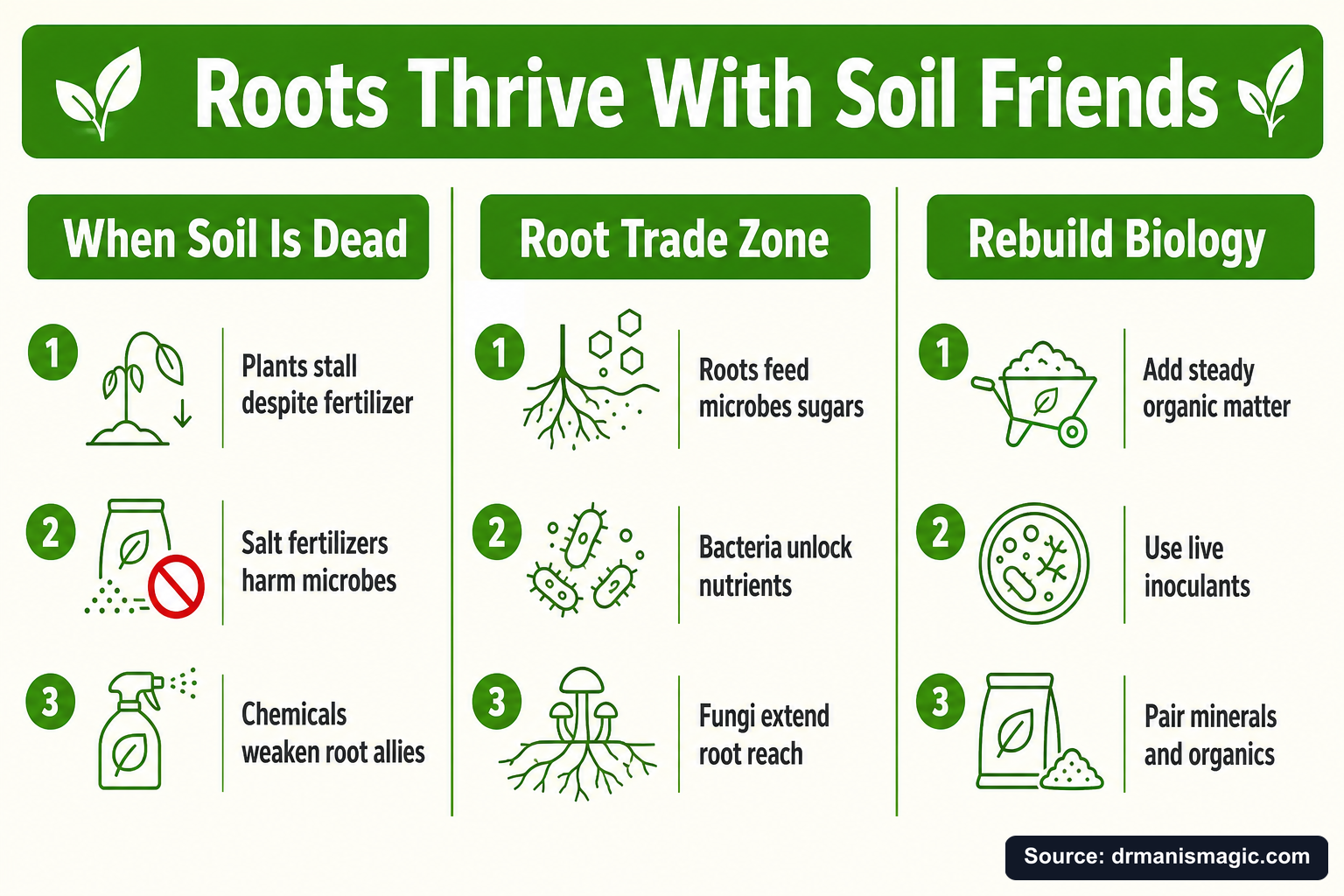
- Roots survive on their own, but they thrive only inside a living community of soil microbes called the rhizosphere.
- Bacteria, fungi, protozoa, and nematodes each play a specific role in feeding, protecting, and strengthening roots.
- Mycorrhizal fungi can extend a plant's root system dramatically, pulling in water and phosphorus from places roots cannot reach on their own.
- Salt-based synthetic fertilizers and broad-spectrum chemicals quietly destroy the very microbes that make plants resilient.
- Most microbial products on store shelves are either dried and barely alive or sitting in smelly, anaerobic liquid. Neither works well.
- Rebuilding lost soil biology takes time, organic matter, and genuinely live microbial inoculants applied consistently.
- The Three Plant Pillars — mineral-based soil, live microbials, and organic fertilizer — work together to restore and protect the invisible community your roots depend on.
What Is the Rhizosphere and Why Does It Matter for Root Health?
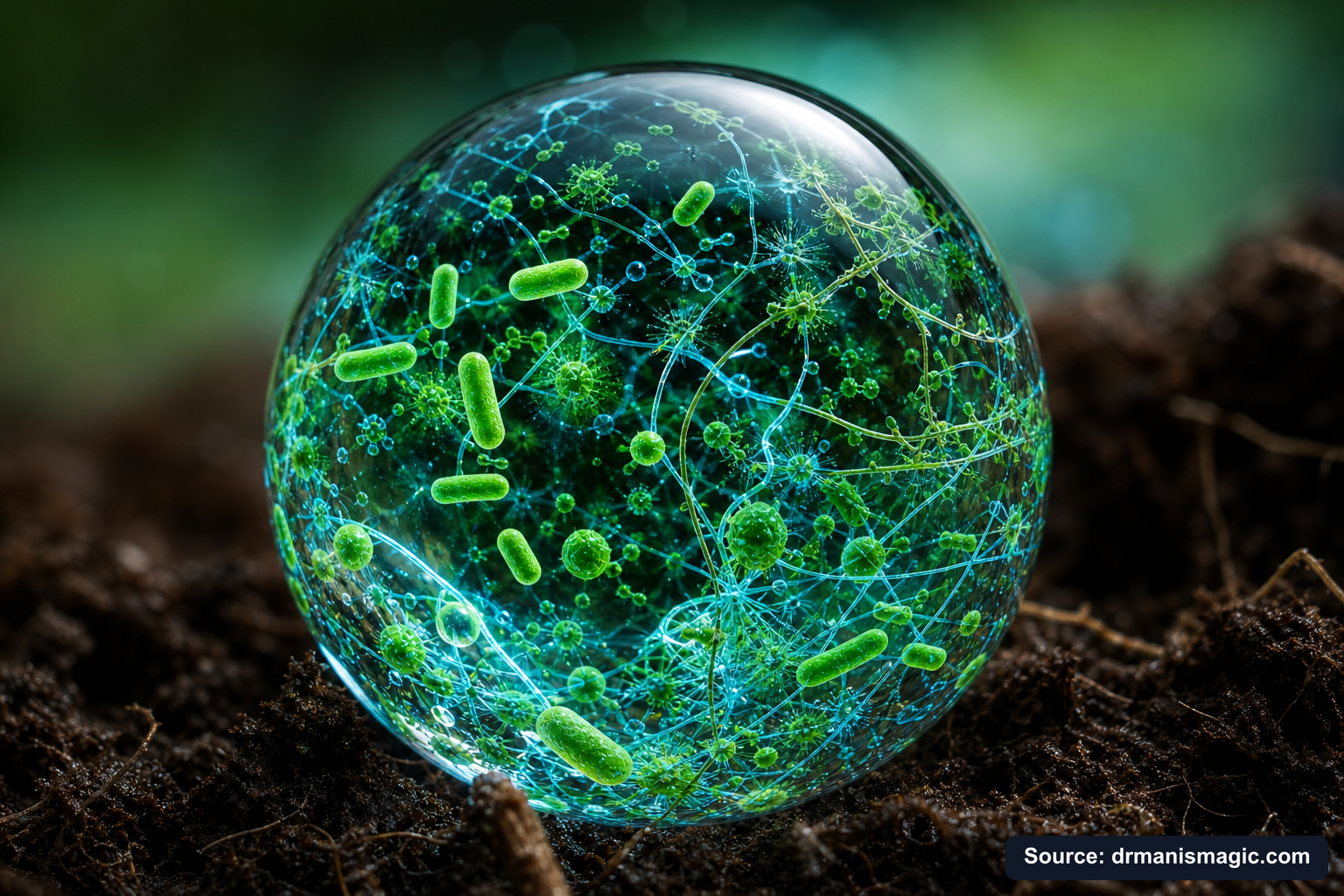
Quick Answer: The rhizosphere is the thin zone of soil directly around plant roots. It is one of the most biologically active places on Earth. Roots release sugars and carbon compounds that feed billions of microbes. Those microbes, in turn, unlock nutrients, suppress disease, and help roots access water. It is a living trade economy happening right beneath your feet.
The rhizosphere is not just dirt. It is a marketplace. A city. A battlefield. All at once.
Your plant's roots are constantly leaking. On purpose. They release carbon-rich sugars, proteins, and acids into the surrounding soil. Scientists call these root exudates. And those exudates are essentially food advertisements. They say to the microbial world: "Come here. Set up shop. I'll feed you, and you help me grow."
Billions of bacteria and fungi show up for that deal. They eat the exudates. They break down organic matter in the soil. They release nutrients that roots can actually absorb. Then protozoa and tiny nematodes graze on the bacteria, and when they excrete waste, those nutrients become even more available to the plant. It is a cycle of trade, feeding, and recycling that has been running for hundreds of millions of years.
According to UC ANR's soil food web research, this root-centered community cycles carbon, nitrogen, phosphorus, sulfur, and water. Roots are not isolated feeding organs. They are hubs inside a living network. And when that network breaks down, everything the plant does becomes harder.
After growing over 250,000 trees at our South Texas nursery, we saw this truth play out again and again. Trees in living soil thrived. Trees in sterile, microbe-dead growing conditions struggled, no matter how much fertilizer we added. The difference was always the biology.
What Do Beneficial Bacteria Actually Do for Plant Roots?
Quick Answer: Beneficial soil bacteria fix nitrogen from the air, dissolve locked-up phosphorus, crowd out disease-causing pathogens, produce growth hormones that stimulate root development, and help form the soil structure that allows water and oxygen to reach roots. They are the primary biochemical workforce behind healthy plant nutrition.
Bacteria are the most abundant members of the rhizosphere. In a single teaspoon of healthy soil, there can be one billion bacteria or more. And they are not just sitting there. They are working.
Here is what they do for your plant every single day.
Some bacteria fix nitrogen. They pull nitrogen gas right out of the atmosphere and convert it into a form plants can use. Free fertilizer. From the air. No bag required.
Other bacteria solubilize phosphorus. Phosphorus is everywhere in most soils, but it is locked up in forms plants cannot absorb. Certain bacteria produce acids that break those bonds and release the phosphorus into the root zone. Without those bacteria, much of your fertilizer just sits there doing nothing.
Bacteria also produce plant hormones. Auxins, cytokinins, gibberellins. These are the same hormones that trigger root branching, shoot growth, and stress response. Healthy bacterial communities essentially act as a slow-drip hormone supplement for your plant.
And then there is pathogen suppression. Beneficial bacteria crowd out harmful organisms by competing for space and food. Some produce natural antibiotics. Some trigger the plant's own immune system to be more alert. According to Extension's beneficial soil microbes resource, bacteria and fungi together form the primary biochemical workforce behind nutrient cycling and soil structure. When that workforce is gone, pathogens move in fast.
This is why broad-spectrum pesticides and salt-based fertilizers are so damaging. They do not just kill the bad guys. They wipe out the entire bacterial workforce that your plant depends on. And once that workforce is gone, your plant is on its own. Defenseless. Struggling to feed itself from dead soil.
See also: The Hidden Reason Synthetic Fertilizers Cause Root Rot
What Do Mycorrhizal Fungi Do That Roots Cannot Do Alone?
Quick Answer: Mycorrhizal fungi attach to plant roots and grow thread-like hyphae deep into surrounding soil, dramatically expanding the root system's reach. They deliver phosphorus, water, and micronutrients to the plant. In return, the plant feeds the fungi up to 20% of its total carbon production. This trade dramatically improves drought tolerance, nutrient uptake, and disease resistance.
Have you ever pulled up a weed and noticed fuzzy white threads clinging to the roots? That is mycorrhizal fungi. And that is one of the reasons weeds grow so aggressively. They have a fungal partner giving them a serious advantage.
The word mycorrhizae comes from Greek: mykes meaning fungus, and rhiza meaning root. Root fungus. And that is exactly what it is. A fungus that lives in partnership with roots.
Here is why this matters so much. A root can only absorb what is within its immediate reach. Mycorrhizal hyphae, the tiny threads the fungus grows, are up to 50 times finer than a root hair. They can reach into pockets of soil that roots never touch. They can access phosphorus, zinc, copper, and water from areas the root system would never explore on its own.
UC ANR research notes that arbuscular mycorrhizal fungi can receive up to 20% of the carbon a plant fixes through photosynthesis. In exchange, the fungus delivers nutrients and stress-tolerance services that would cost the plant far more energy to produce on its own. It is one of the most successful biological trades in nature.
But mycorrhizal fungi have limits. The University of Minnesota extension notes that they require living plant roots to survive. They are harmed by saturated soils, black fallow, non-host crops, and many synthetic fungicides. Kill the host. Kill the fungus. Kill the trade. And suddenly your plant is working three times as hard for a fraction of the results.
This is why we built Plant Super Boost with 400 to 500 species of fungi including mycorrhizae, harvested directly from active compost and stabilized while still alive. Not dried powder. Not a smelly anaerobic liquid. Genuinely living fungi, ready to go to work the moment they touch soil.
What Role Do Protozoa and Nematodes Play in the Soil Food Web?
Quick Answer: Protozoa and beneficial nematodes graze on bacteria in the soil. When they eat bacteria and excrete waste, they release nitrogen and other nutrients in forms plants can absorb immediately. They are the nutrient-release mechanism of the soil food web. Without them, nutrients stay locked inside microbial cells and never reach the plant.
Most gardeners have heard of bacteria. Most have heard of fungi. But protozoa and nematodes? That is where the conversation usually stops. And that is a shame, because these two groups are the reason the soil food web actually delivers nutrients to your plant.
Think of it this way. Bacteria eat organic matter and lock nutrients inside their cells. Those nutrients are not yet plant-available. They are trapped. Then protozoa, tiny single-celled organisms, come along and eat the bacteria. They cannot use all those nutrients themselves. So they excrete the excess. And that excess is nitrogen, phosphorus, and other minerals in a simple, plant-ready form.
Nematodes do the same thing at a slightly larger scale. Most people hear "nematode" and panic. They think of plant-parasitic nematodes, the bad kind that attack roots. But the vast majority of nematodes in healthy soil are beneficial. They eat bacteria, fungi, and other nematodes. They excrete nutrients. They keep the microbial community in balance.
Remove the protozoa and beneficial nematodes from your soil, and nutrients pile up inside bacterial cells but never reach your plant. It is like having a fully stocked warehouse with no delivery trucks. The goods are there. They just never arrive.
Plant Super Boost contains not just bacteria and fungi but protozoa and nematodes as well. A full spectrum. Because a partial soil food web is a broken one.
What Is the Soil Food Web and How Does It Feed Your Plants?
Quick Answer: The soil food web is the complete community of organisms in healthy soil, including bacteria, fungi, protozoa, nematodes, and larger organisms like earthworms and beetles. Each feeds on others, releasing nutrients at every step. The plant sits at the center, trading carbon with the whole system and receiving nutrition, water, and protection in return.
The soil food web is not complicated once you see it as a neighborhood economy. Everybody has a job. Everybody feeds somebody else. And the plant is the anchor tenant that keeps the whole economy running.
| Organism | What They Eat | What They Give the Plant | What Kills Them |
|---|---|---|---|
| Bacteria | Root exudates, organic matter | Nitrogen fixation, phosphorus solubilization, pathogen suppression, growth hormones, soil structure | Salt-based fertilizers, herbicides, pesticides |
| Mycorrhizal Fungi | Plant carbon (sugars) | Phosphorus, water, micronutrients, drought tolerance, disease resistance, root extension | Synthetic fungicides, waterlogged soil, black fallow |
| Protozoa | Bacteria | Plant-available nitrogen and phosphorus released from bacterial cells | Drying out, chemical inputs, compacted soil |
| Beneficial Nematodes | Bacteria, fungi, other nematodes | Nutrient release, pathogen suppression, microbial balance | Broad-spectrum pesticides, chemical fumigants |
| Earthworms | Organic matter, microbes | Soil aeration, casting nutrients, improved drainage | Pesticides, compaction, synthetic inputs |
Every layer of this web feeds the next. And your plant powers all of it by releasing carbon from its roots. That is the deal. Carbon for services. The most elegant system in nature. And it has been running without human interference for 400 million years.
The problem is we keep interfering. We add salts that burn the bacteria. We spray fungicides that wipe out the mycorrhizae. We compact the soil so protozoa and nematodes cannot move. And then we wonder why the plant struggles.
Live Microbes vs. Dead Microbes: Why Most Products on Store Shelves Do Not Work
Quick Answer: Most store-bought microbial products are either dried powders with dormant or dead spores, or smelly liquids that have gone anaerobic and lost most of their living microbes. Neither works reliably. Genuinely live, full-spectrum microbials harvested from active compost and stabilized naturally are far more effective because they arrive ready to work immediately.
This is the part of the story most companies do not want you to know.
Microbial products are a hot market right now. Walk into any garden center and you will see shelves full of bottles and bags promising billions of microbes. Sounds impressive. But here is what is actually inside most of them.
Option one: dried powder. These products are made in large factory vats, grown in bulk, then spray-dried into powder. The hope is that the bacterial spores will reactivate when you add water and pour them into soil. We have tested dozens of these products at our South Texas nursery. Across the board, we saw no meaningful plant response. The biology just was not there when the plant needed it.
Option two: smelly liquid. These products are usually made from compost tea or earthworm castings poured into a bottle. When they are fresh, they have some value. But by the time they reach you, they have gone anaerobic. The microbes are dying. The bottle may fizz when you open it. And the smell is unmistakable. Like sewage. That odor is not a quirk. It is a warning. It means the biology is gone.
Option three: lactobacillus-based products. Lactobacillus is vigorous and easy to keep alive. You might recognize it from yogurt. But in soil, it out-competes and overwhelms the beneficial microbial community. It belongs in your gut, not your garden.
| Product Type | Viability at Use | Spectrum | Odor | Our Assessment |
|---|---|---|---|---|
| Dried powder (lab-grown) | Very low | Narrow | Low | Tested dozens of batches. No meaningful plant results. |
| Powder rehydrated into liquid | Very low | Narrow | Low | Same problem. Avoid. |
| Compost tea (fresh, under 24 hours) | Moderate | Partial | Earthy | Good if you make and use it immediately. Very time-sensitive. |
| Compost tea (old, over 24 hours) | Low | Partial | Strong stench | Anaerobic. Microbes dying. Not recommended. |
| Lactobacillus-based liquid | High | Very narrow | Low | Crowds out beneficial microbes. Belongs in yogurt, not soil. |
| Plant Super Boost (stabilized, full-spectrum) | High | 2,000+ bacteria, 400-500 fungi including mycorrhizae, plus protozoa and nematodes | Earthy, not foul | Harvested from active compost. Stabilized naturally. Visibly alive under a microscope. |
The story behind Plant Super Boost is worth telling. Dr. Mani partnered with a world-famous compostologist who had advised the farming practices of royal families and governments across the globe. This expert had developed a proprietary, all-natural method to stabilize the full spectrum of microbes from active compost without letting them go anaerobic. No dying. No stench. Just living biology in a bottle.
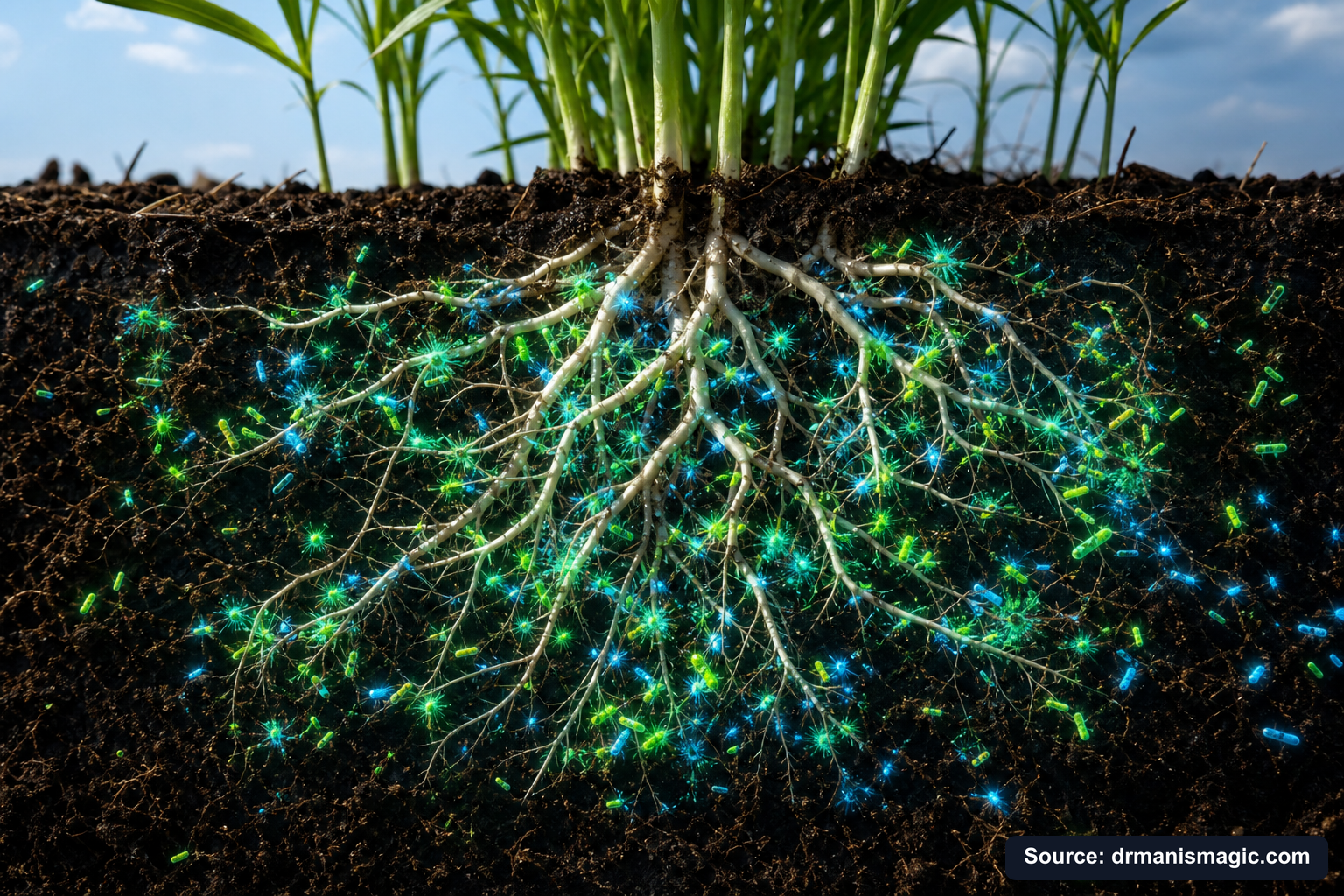
When this compostologist teamed up with us at US Citrus Nursery, we started seeing results we had never seen before. Trees that had been stuck for months began pushing new growth. Root zones that looked tired and thin came back to life. And when we put a drop of Plant Super Boost under a microscope, we could see the microbes moving. Actually moving. That is what genuinely live biology looks like.
Zero PFAS. Zero biosludge. Zero synthetic salts. Just live microbes, stabilized naturally, made in the USA.
You Never Had a Brown Thumb.
You were handed the wrong tools. This free guide hands you the right ones.
You watered it. You fed it. It died anyway.
It was never you. It was the dirt, the salt food, and the bad advice.
This guide shows you what really went wrong, and how to fix it for good.
- Why your plants really died, and why it was never your fault
- The salt hiding in your plant food that quietly burns the roots
- The hidden killer in almost every bag of store soil
- The tiny helpers that grow a whole forest for free
- The rescue trick that brings a half dead plant back to life

How Do Synthetic Fertilizers and Chemicals Destroy the Soil Food Web?
Quick Answer: Salt-based synthetic fertilizers create high-salt conditions in the root zone that damage and kill beneficial bacteria and fungi. Broad-spectrum pesticides and herbicides reduce microbial diversity. Synthetic fungicides wipe out mycorrhizal fungi. Each chemical application moves the soil further from the living ecosystem plants evolved to grow in, making plants progressively weaker and more dependent on chemical inputs.
Here is the part that should make you angry. And we say this not to point fingers, but because understanding this pattern is the first step to breaking it.
The chemical approach to gardening is a cycle. You add salt-based fertilizer. It gives the plant a quick green-up. But the salts damage the bacteria and fungi in the root zone. The plant, now without its microbial support system, becomes weaker. It gets stressed more easily. It becomes more susceptible to pests and disease. So you reach for a pesticide. The pesticide kills more microbes. The soil gets deader. The plant gets weaker. You need more fertilizer. The cycle repeats.
The companies selling you those inputs profit from every step of that cycle. We are not saying it is a conspiracy. We are saying it is a business model. And it is not designed with your plant's long-term health in mind.
Dr. Mani saw this playing out across the industry for decades. He watched synthetic inputs dominate the market since the 1950s, when companies like Miracle-Gro popularized salt-based fertilizer as the simple solution to plant nutrition. Those products were heavily marketed. They produced visible results fast. And they quietly destroyed the microbial communities that plants had evolved to rely on over hundreds of millions of years.
The result? A generation of gardeners who blame themselves for brown thumbs. When the real culprit is the inputs they were sold.
See also: Why Most Fertilizers Are Actually Salt in Disguise
What Happens to Roots When Soil Biology Is Gone?
Quick Answer: Without beneficial microbes, roots cannot access locked nutrients even when fertilizer is present, cannot suppress root pathogens like Phytophthora, cannot tolerate drought, and cannot build the soil structure they need to breathe. The result is yellowing leaves, stalled growth, root rot, and a plant that cannot recover from stress.
Imagine showing up to work and your entire support team has been wiped out. No assistants. No colleagues. No one to call for backup. You are doing every job yourself, with no tools, in conditions you were never designed to handle alone.
That is what a plant experiences in biologically dead soil.
Nutrients are present but locked up. Phosphorus sits in the soil bound to minerals, unavailable without the bacteria and mycorrhizae that would normally release it. Nitrogen has to come entirely from fertilizer inputs instead of from the atmosphere through bacterial fixation. Water stress hits harder because there are no mycorrhizal hyphae extending the root's reach into moist soil pockets.
And then the pathogens move in. Root rot organisms like Phytophthora thrive in conditions where beneficial competitors are absent. In a healthy rhizosphere, beneficial bacteria and fungi crowd out those pathogens and keep them in check. In dead soil, they have no competition. They spread unchecked. And the root system that was already struggling suddenly faces a disease it has no defenses against.
This is the hidden reason so many container plants and heavily fertilized garden plants develop root rot. It is not just about overwatering. It is about the absence of the biological community that would normally keep root pathogens suppressed. The Three Plant Pillars framework addresses this directly by combining mineral-based soil for proper drainage, live microbials for biological protection, and organic fertilizer that feeds the plant without destroying the biology.
Friend or Foe? Understanding Good Microbes vs. Harmful Ones
Quick Answer: The vast majority of soil bacteria, fungi, and nematodes are beneficial or neutral. Harmful pathogens are a small minority that thrive when beneficial populations are weakened. The goal is not to sterilize the soil but to build a thriving beneficial community that naturally crowds out harmful organisms through competition and suppression.
When most people hear "fungi in my soil," they panic. When they hear "nematodes," they reach for a fumigant. This is one of the most expensive mistakes a gardener can make.
The truth is that the overwhelming majority of microbes in healthy soil are either beneficial or neutral. Harmful pathogens, the plant-parasitic nematodes, the Phytophthora spores, the Fusarium strains, these are a small minority. And they only become a problem when the beneficial majority has been weakened or eliminated.
Think of it like your own immune system. You have trillions of microbes living in your gut. Most are beneficial. They protect you. When antibiotics wipe out that community, harmful bacteria and fungi seize the opportunity and cause infections. The answer is not to live in a sterile environment. The answer is to keep the beneficial community strong.
| Organism Group | Beneficial Role | Harmful Example | Warning Sign | What to Do |
|---|---|---|---|---|
| Bacteria | Nitrogen fixation, phosphorus release, pathogen suppression, growth hormones | Pathogenic bacteria causing crown gall or bacterial blight | Unusual galls, oozing cankers, wilting despite water | Build beneficial populations with live inoculants and organic matter |
| Fungi | Mycorrhizal nutrient and water delivery, soil structure (glomalin), pathogen competition | Phytophthora root rot, Fusarium wilt | Sudden wilting, brown mushy roots, rapid decline | Improve drainage, reduce synthetic fungicide use, inoculate with beneficial fungi |
| Nematodes | Graze bacteria and fungi, release nutrients, keep microbial balance | Root-knot nematodes, citrus nematodes | Galls on roots, stunted growth, yellowing | Build beneficial nematode populations; test soil if symptoms appear |
| Protozoa | Graze bacteria, release plant-available nitrogen | Rare pathogenic species | Usually not visible; detected in soil tests | Maintain organic matter and microbial diversity |
The goal is never to eliminate microbes. The goal is to feed and protect the beneficial majority so they crowd out the harmful minority on your plant's behalf. That is what nature does. And that is what the Three Plant Pillars system is designed to help you do.
How to Rebuild Dead or Depleted Soil Biology: A Step-by-Step Recovery Plan
Quick Answer: Restoring soil biology after chemical damage or long-term sterile growing conditions requires adding organic matter, reducing chemical inputs, improving soil structure, and consistently applying full-spectrum live microbial inoculants. Recovery takes months of consistent effort, not a single treatment. But each step compounds on the last, and results become visible faster than most people expect.
Here is something important to understand before you start. Rebuilding a living soil community is not a one-time fix. It is a process. And that process takes time. You cannot rush it with a single application any more than you can rebuild your gut microbiome overnight after a course of antibiotics.
But the good news? Every step you take compounds. Each application of live microbes gives the beneficial community a bigger population to work from. Each handful of organic matter gives them more food. Each reduction in chemical inputs gives them more room to thrive. And within weeks, sometimes days, you will start to see the difference in how your plants look and feel.
We have seen this happen hundreds of times with our own trees and with the plants of customers across the country. The recovery is real. But you have to start.
- Stop the bleeding first. Reduce or eliminate salt-based synthetic fertilizers, broad-spectrum pesticides, and synthetic fungicides wherever possible. You cannot rebuild a community while the thing that destroyed it is still running.
- Improve soil structure. Compacted, waterlogged soil suffocates microbes just as fast as chemicals do. Aerate, add organic material, and if you are working in containers, consider Super Soil, our mineral-based blend that drains properly, does not decompose, and keeps roots breathing.
- Add organic matter consistently. Compost, mulch, cover crops. These feed the microbial community. No food, no community. Aim for a two to four inch layer of organic mulch above the root zone wherever possible.
- Apply genuinely live, full-spectrum microbial inoculants monthly. Not dried powder. Not smelly old compost tea. Genuinely live biology that arrives ready to work. Apply consistently because environmental pressures, sterile inputs, and past damage keep reducing populations. Monthly applications keep the beneficial community growing faster than the harmful one.
- Switch to organic fertilizer that feeds microbes, not one that burns them. Organic, slow-release fertilizers made from ingredients like crab, kelp, and amino acids feed both the plant and the microbial community. They do not carry the salt load that synthetic fertilizers do. They work with the biology, not against it.
- Keep living roots in the soil as much as possible. Living roots feed the rhizosphere community with exudates. Bare soil between plantings starves the microbial web. Cover crops, interplanting, and mulching all help keep the community fed and active.
- Give it time and be consistent. The biggest mistake people make is expecting one application to fix years of damage. Commit to the process for a full growing season. The compounding results will surprise you.
One more thing on the subject of time. We hear this from growers more than almost anything else. They want to see their plants flourish, want to see fruit hanging from their own branches, want to experience the harvest they have been imagining for years. Every month spent fighting against biology instead of working with it is a month lost. Money can be replaced. Time cannot. The second-best time to start rebuilding your soil's living community is today.
What Does This Mean for Any Plant You Grow, Not Just Citrus?
Quick Answer: The soil food web benefits every plant species that grows in soil, from lawns and houseplants to vegetable gardens, flower beds, orchards, and tropical trees. Roots need microbial partnerships regardless of plant type. The Three Plant Pillars framework was developed and tested on over 250,000 citrus trees but applies equally to any plant in any growing environment.
We developed the Three Plant Pillars at US Citrus Nursery in South Texas. We tested it on over 250,000 citrus trees across three decades. That is our proof base. But here is what we learned: the biology does not care what kind of plant it is supporting.
Mycorrhizal fungi partner with over 80% of all land plant species. Nitrogen-fixing bacteria work in the root zones of grasses, vegetables, trees, and flowers alike. The soil food web, that interconnected community of bacteria, fungi, protozoa, and nematodes, powers growth in every ecosystem on Earth that has living plants in it.
The same system that transformed our citrus trees in South Texas will transform your lawn, your vegetable garden, your houseplants, your flower beds, and your fruit trees. Because roots are roots. And they all need friends to thrive.
We see this in the messages we receive from customers across the country. A doctor in Arizona who was ready to give up on his Meyer lemon tree. A woman in Georgia who had never successfully grown tomatoes in her raised beds. A retired teacher in Oregon watching his Japanese maple finally push the growth it had been holding back for three years. The biology does not discriminate. It just works, when you give it the conditions it needs.
For more on how these principles apply to your specific growing setup, the Free Plant Care Field Guide walks you through the full Three Plant Pillars system in plain, step-by-step language. No jargon. No guesswork. Just what to do and when to do it.
What Can You Do Right Now to Support Your Plant's Root Community?
Quick Answer: Start by reducing chemical inputs that harm soil biology. Add organic matter like compost or mulch. Ensure your soil drains well so roots can breathe. Then introduce full-spectrum live microbials monthly to rebuild the biological community your roots depend on. Pair with organic fertilizer that feeds both plant and microbes together.
You do not have to overhaul everything overnight. You just have to start. Here is the simplest way to begin.
Look at what you are adding to your soil. If it is a salt-based synthetic fertilizer, it is likely doing more damage to your microbial community than the nutrition it provides is worth. Swap it for something organic, slow-release, and microbe-friendly.
Look at your soil structure. Is it compacted? Does water pool instead of drain? Does it feel dense and airless? If so, your microbial community is suffocating along with your roots. Fix the structure and the biology will respond.
And then add life. Genuine, living, full-spectrum biology. The kind that arrives in a bottle that smells earthy and clean, not like a sewer. The kind where you could put a drop under a microscope and watch the organisms actually moving.
That is what the Three Plant Pillars system is built around. Mineral-based soil that breathes. Live microbials that work. Organic fertilizer that feeds without burning. When all three are in place, plants do not just survive. They thrive in the way they were designed to.
If you want to see what this looks like in practice, and if you want to skip the years of trial and error that most gardeners go through before they stumble onto this truth, start with the system we built, tested on a quarter-million trees, and have been using every single day at our South Texas nursery.
Your roots have been waiting for their friends. It is time to introduce them.
Explore the complete Three Plant Pillars system and see which products are right for your plants at drmanismagic.com. If you are not happy with your results within 30 days, we will refund your purchase. No hassle. No runaround. Just real people, real plants, and real results.
Frequently Asked Questions
If your plants keep struggling no matter what you do, the answer is probably underground. These questions dig into the hidden world of soil microbes and root health, and they explain exactly why the Three Plant Pillars from Dr. Mani's Magic work when everything else fails. Read these before you buy another bag of fertilizer or lose another plant.
What does it mean that roots need friends to thrive?
Roots were never designed to work alone. Underground, billions of bacteria, fungi, and other microbes form a living community around your roots called the rhizosphere. These microbes unlock nutrients, fight disease, and pull water from places roots cannot reach on their own. Without them, your plant is like a person trying to survive without food, water, or help from anyone. At Dr. Mani's Magic, we call rebuilding this community Pillar Two of the Three Plant Pillars.
Why do plants in forests thrive without fertilizer but my potted plant keeps dying?
Forest soil is alive with billions of microbes built up over hundreds of years. Your potted plant sits in dead, compacted sawdust mix with almost no microbial life at all. That is the real problem. No microbes means no nutrient cycling, no disease protection, and no real root growth. Dr. Mani saw this exact issue after growing over 250,000 trees in South Texas. The fix is not more fertilizer. The fix is living soil with live microbes working for your plant around the clock.
What are mycorrhizal fungi and why do my plant roots need them?
Mycorrhizal fungi are a type of beneficial fungus that wraps around and grows into plant roots. They act like a second root system, stretching far beyond where your roots can reach. They pull in phosphorus, water, and trace minerals and hand them directly to the plant. In return, the plant feeds the fungi with sugars. It is a trade deal that has worked for hundreds of millions of years. Dr. Mani's Plant Super Boost contains live mycorrhizae ready to get to work the moment you apply it.
Do synthetic fertilizers hurt the microbes that roots depend on?
Yes, and this is the part the big chemical companies do not want you to know. Salt-based synthetic fertilizers burn and kill the beneficial bacteria and fungi living around your roots. You might see a quick green flush after applying them, but underground you are wiping out the very helpers your plant needs to survive long term. Over months and years, the soil gets weaker, the plant gets more dependent, and you keep buying more product. Dr. Mani calls this the addiction cycle, and the Three Plant Pillars are how you break it for good.
What makes Dr. Mani's Plant Super Boost different from other microbial products?
Most microbial products on store shelves are either dried out and barely alive or sitting in smelly, rotting liquid that has gone anaerobic. Neither one delivers the living microbial punch your soil actually needs. Plant Super Boost uses a special stabilization process that keeps the bacteria, fungi, and mycorrhizae genuinely alive inside the bottle. When you mix it with water and pour it on your plants, those microbes go to work immediately. It does not smell bad either, because it is not rotting. It smells like earth, clean and natural.
What is the biggest mistake people make with potting soil that kills root health?
Using organic potting mix made from pine bark and wood. It feels light and fluffy at first, but over time it breaks down, compacts, and chokes off the oxygen your roots need to breathe. It also goes anaerobic, which means it starts to rot and breed disease. Dr. Mani's Super Soil is built on mineral-based sandy loam from the Rio Grande Valley. It does not decompose. It holds its structure permanently, keeps roots breathing, and drains perfectly every single time. That is Pillar One of the Three Plant Pillars.
How long does it take to see results when you start using live microbes and organic fertilizer together?
Most people notice real changes within 30 days. Leaves get darker and richer. New growth comes in stronger. The soil starts to feel different, lighter and more alive. The full transformation takes longer because you are rebuilding an entire underground ecosystem, not just giving the plant a quick chemical jolt. But unlike synthetic fertilizers that stall and then reverse, results from the Three Plant Pillars keep building over time. Your plant gets stronger every month instead of weaker. That is the difference between a band-aid and a real foundation.
About the Author
Dr. Mani Skaria, PhD
Dr. Mani Skaria, PhD, is a plant pathologist and the scientific founder of Dr. Mani's Magic. He earned his doctorate at Purdue University and spent 48 years studying how plants, soil, and living microbes work together, including his years as Professor Emeritus at Texas A&M and as a member of the USDA NAREEE Advisory Board. He invented micro-budding, a method for growing healthier, stronger trees, and has grown more than 250,000 trees on the family farm in Hargill, Texas - US Citrus Nursery. His life's work takes real lab science and practical experience and turns it into simple, safe, organic plant care anyone can use at home.


