


Why Plants in Nature Rarely Need Intervention | Dr. Mani's Magic
Why Plants in Nature Rarely Need Intervention (And What That Secret Means for Your Garden)
Close your eyes for a second. Picture an ancient forest. Nobody is out there with a bag of fertilizer. Nobody is checking pH levels or spraying fungicide. No one is repotting the oak trees or replacing the soil every spring. Yet those trees grow massive. Their roots run deep. Their leaves glow green. Their branches bend heavy with fruit, seeds, and life.
Now look at your patio. Your potted lemon tree with the yellowing leaves. Your garden bed that keeps getting attacked by pests. Your lawn that drinks fertilizer like water and still looks patchy in August. You have done everything the bag told you to do. You have watered on schedule. You have fed it every month. And still, something feels off. The plant looks tired. It looks like it is barely hanging on.
Here is the question nobody in the gardening aisle ever answers: why does a wild forest thrive without any of that, while your carefully tended plant keeps struggling? The answer is not about sunlight or watering schedules. The answer is alive. It is invisible. And once you understand it, everything about how you grow plants will change forever.

Plant Super Boost
Key Takeaways
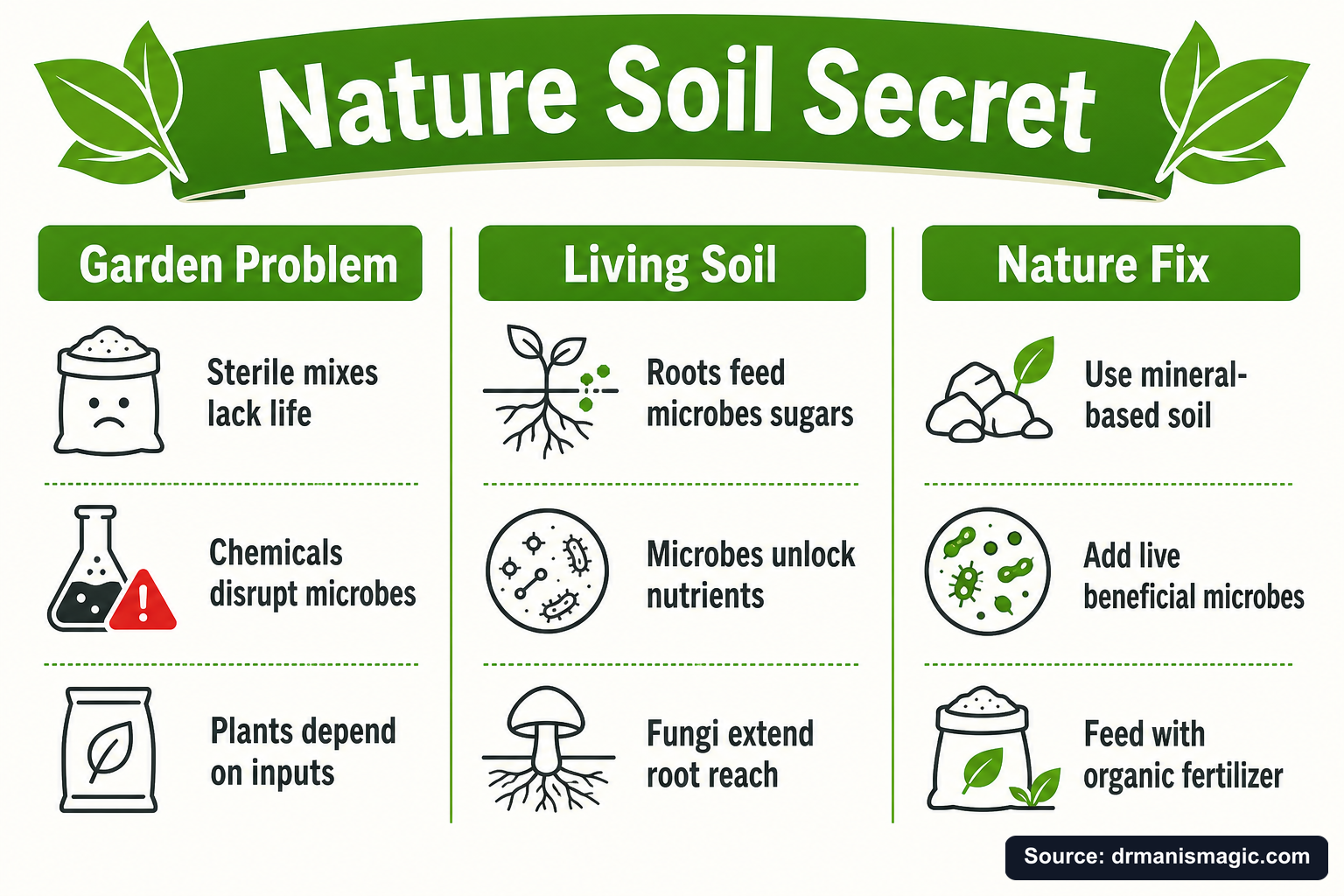
- Wild plants thrive because their soil is a living, self-regulating ecosystem packed with billions of beneficial bacteria, fungi, protozoa, and nematodes.
- The soil food web recycles nutrients, suppresses disease, and delivers plant food directly to roots, all without a single bag of fertilizer.
- Mycorrhizal fungi extend plant roots by miles, unlocking water and nutrients that roots alone could never reach.
- Managed gardens, containers, and lawns lose these biological systems through sterile potting mixes, salt-based fertilizers, fungicides, pesticides, and herbicides.
- The Three Plant Pillars (mineral-based soil, live microbials, and organic fertilizer) rebuild what nature already had in place.
- Most commercial microbe products are either dried and dead or sitting in a smelly, dying liquid by the time they reach your shelf.
- You can get your time back by working with nature's system instead of against it. The sooner you start, the sooner your plants become nearly bulletproof.
What Is the Soil Food Web and Why Do Wild Plants Depend on It?
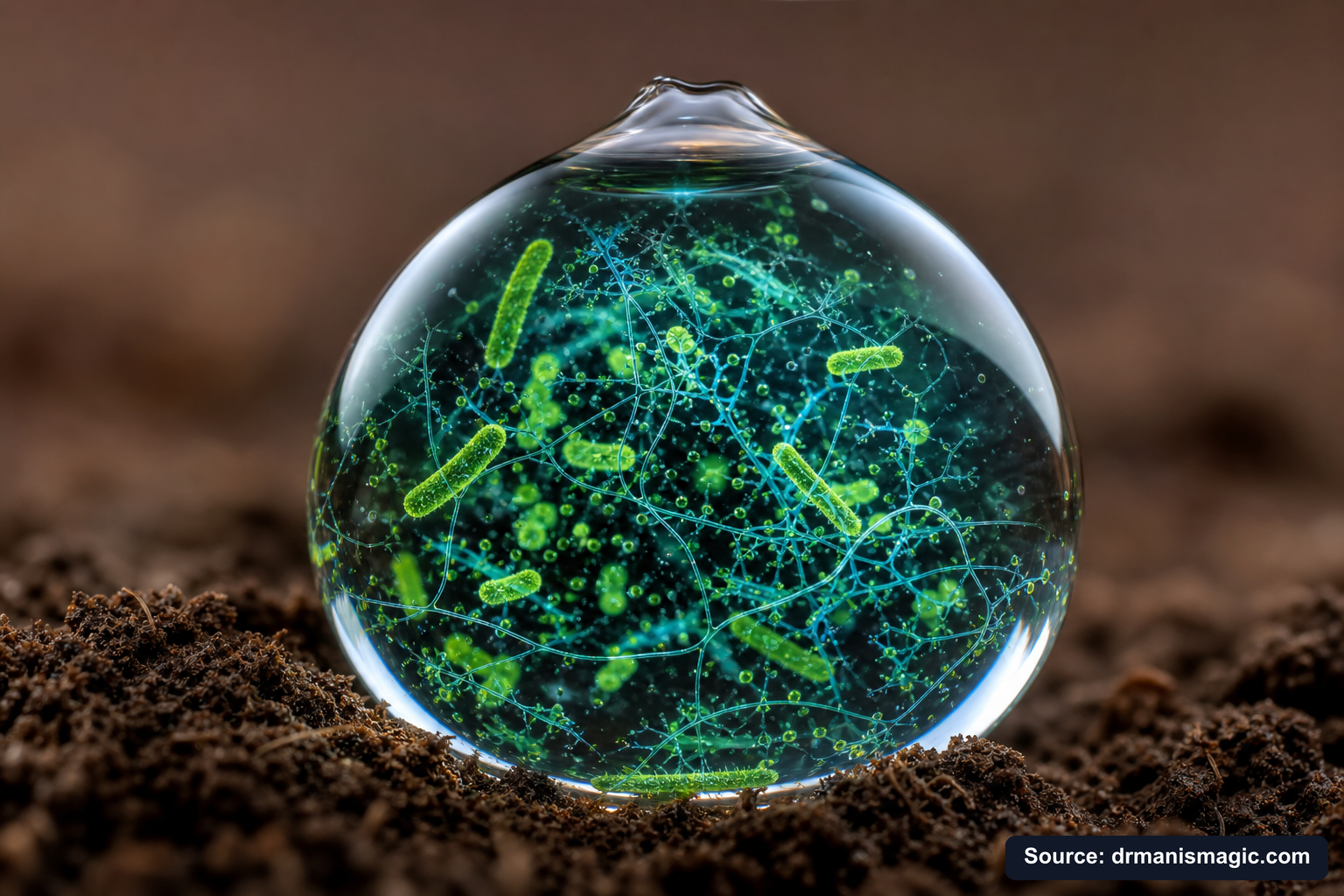
Quick Answer: The soil food web is a living network of bacteria, fungi, protozoa, nematodes, and other tiny creatures that recycle nutrients and feed plant roots automatically. Wild plants thrive because this network does all the heavy lifting that gardeners try to replace with bags and bottles.
Imagine a tiny city living underground, right beneath your feet. Millions of workers. Each one has a job. Together they build, clean, feed, and protect the plant above them. That city is the soil food web.
University of Minnesota Extension describes healthy agricultural soil as containing between 100 million and 1 billion bacteria in a single teaspoon. One teaspoon. Add in fungal threads, protozoa, and nematodes, and that teaspoon is more biologically active than almost anything we can create in a lab.
Here is how the cycle works in plain English.
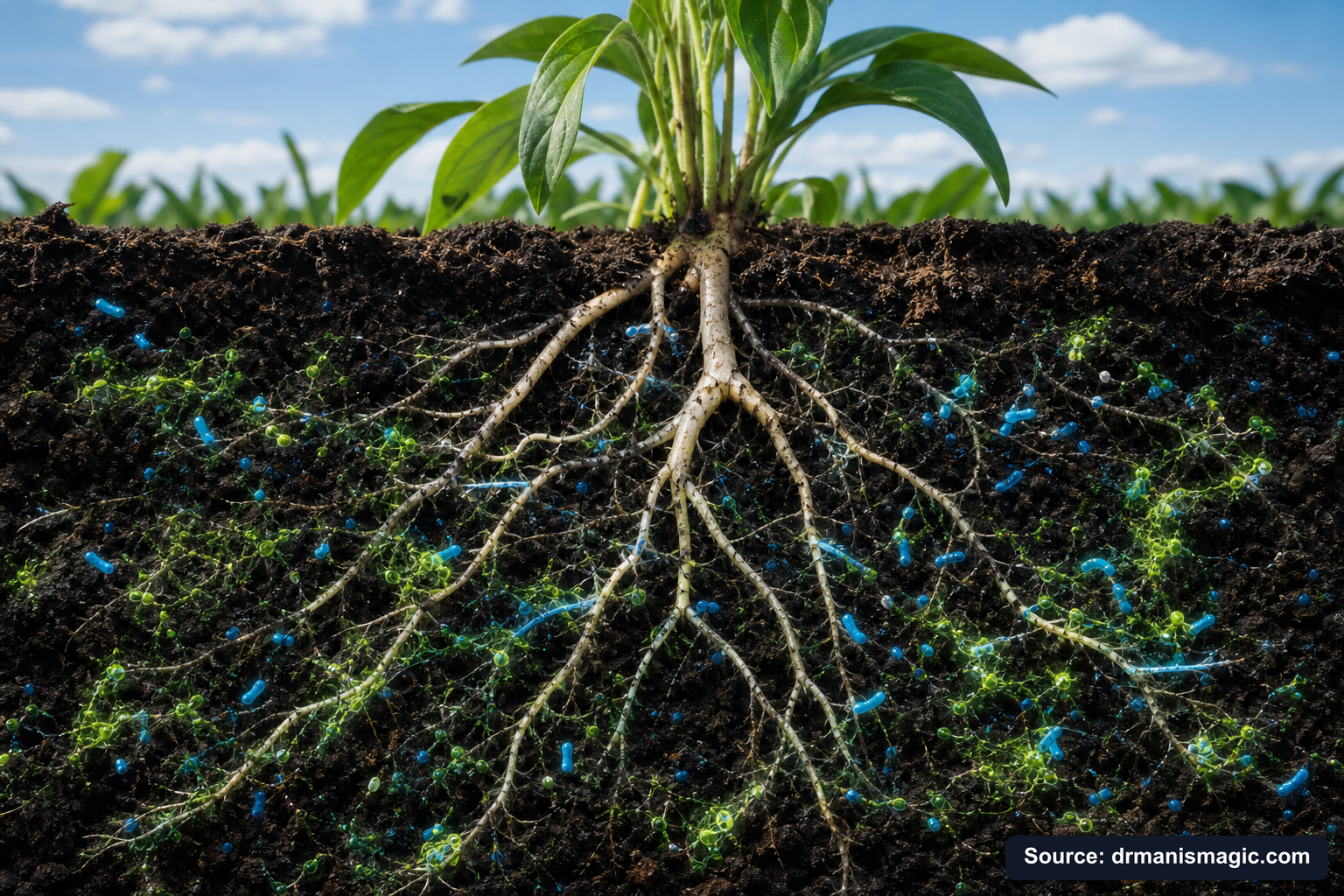
Plant roots push sugars into the soil. This is called root exudate. Think of it as the plant paying rent. Bacteria and fungi rush in to eat those sugars. Protozoa and nematodes rush in to eat the bacteria and fungi. When they eat and excrete waste, they release nutrients in plant-ready form, right next to the root tips where the plant can absorb them instantly.
Nobody ships in fertilizer. Nobody checks a schedule. The system feeds itself. The plant feeds the microbes. The microbes feed the plant. Round and round it goes, season after season, century after century.
This is what UC Davis and the University of Florida IFAS Extension call nutrient cycling through the rhizosphere. The rhizosphere is just a fancy word for the thin zone of soil right around the roots. It is the hottest, most biologically active real estate on earth. And in nature, it is always buzzing.
| Organism | What It Does for the Plant | Why It Matters |
|---|---|---|
| Beneficial Bacteria | Break down organic matter, fix nitrogen from the air, unlock bound minerals, suppress pathogens | Primary nutrient recyclers and disease fighters |
| Mycorrhizal Fungi | Extend root reach by 100x or more, deliver phosphorus, water, and micronutrients, improve drought and salt tolerance | The plant's invisible root system upgrade |
| Protozoa | Graze on bacteria, release nutrients near roots in plant-available form | The nutrient trigger that turns locked-up food into plant fuel |
| Beneficial Nematodes | Graze on bacteria and fungi, release nitrogen and other nutrients, suppress harmful pest nematodes | The recyclers and pest controllers most gardeners never think about |
| Microarthropods and Earthworms | Shred organic matter, aerate soil, create channels for water and root growth | The physical infrastructure crew |
Nature does not avoid problems. It distributes solutions. The forest does not need one perfect plant. It needs a resilient, interconnected system. When one link weakens, another picks up the slack. That is the design. And your garden can work the same way.
Why Do Wild Plants Not Need Fertilizer When Your Garden Plants Do?
Quick Answer: Wild plants do not need added fertilizer because their living soil constantly recycles nutrients through the food web. Managed gardens strip out this biology through sterile mixes, salt-based products, and chemical inputs, leaving plants with no living support system and total dependence on whatever humans pour in.
This is the question that woke Dr. Mani Skaria up decades ago. He spent 35 years as a plant pathologist at the Texas A&M Citrus Center. He watched citrus groves spend thousands on synthetic fertilizer. He watched them struggle anyway. He watched trees in wild, unmanaged settings grow without any of it.
The difference was not sunlight. It was not rain. It was what was alive in the soil.
When you buy a bag of potting mix at the big box store, you are buying something sterile. Purposely dead. The manufacturers sterilize it to prevent disease, which sounds smart. But they also kill every beneficial microbe in the process. You are planting your tree in biological silence.
Then you add salt-based fertilizer because the plant looks pale. The nitrogen hits fast. The plant greens up. You feel like a hero. But here is what actually happened underground. That salt pulled water away from the roots through osmosis. It scorched the tender root hairs. And it killed off any fragile beneficial bacteria trying to establish a foothold. Now your plant is dependent on you for every single meal, forever, because the kitchen that used to cook for it has been burned down.
After growing more than 250,000 citrus trees at US Citrus Nursery in South Texas, Dr. Mani saw this pattern repeat itself over and over. The trees that got the most synthetic fertilizer were often the most fragile. The trees with the richest biological soil were the ones that shrugged off heat, drought, and disease like it was nothing.
See also: The Hidden Reason Synthetic Fertilizers Cause Root Rot
What Role Do Mycorrhizal Fungi Play in Natural Plant Health?
Quick Answer: Mycorrhizal fungi connect to plant roots and expand the plant's reach into the soil by hundreds of times. They deliver phosphorus, water, and trace minerals that roots alone could never find. They also help plants resist drought, disease, salt, and toxic soils. Most managed gardens have lost them entirely.
Pull a weed out of a crack in the sidewalk sometime. Look at the roots. See those white, fuzzy threads wrapped around them? That is mycorrhizae. That is why the weed grows in a crack in the sidewalk with no soil, no fertilizer, and no water schedule. The fungus is doing the work.
Mycorrhizal fungi form one of the most important partnerships in all of biology. The plant feeds the fungus carbon through its roots. The fungus, in return, threads its hyphae (tiny, hair-like filaments) through the surrounding soil like a second root system. Those threads are 50 times thinner than a root hair. They can squeeze into spaces roots never could. They cover 100 times more ground. They find phosphorus locked in rock particles. They pull water from dry zones. They connect nearby plants in a network scientists sometimes call the "Wood Wide Web."
According to Purdue University Extension, mycorrhizal associations are found in about 80 to 90 percent of all land plant species. This is not an optional feature. It is a foundational partnership that plants evolved with over millions of years. When we strip it out, we take away one of the plant's most essential tools.
And most potting mixes strip it out completely. Most synthetic fertilizers suppress it. Most fungicides kill it outright. Then we wonder why our houseplants look tired and our fruit trees barely produce.
How Do Managed Gardens and Containers Lose Their Natural Biology?
Quick Answer: Containers, raised beds, and heavily managed gardens lose their biological support through sterile potting media, salt-based fertilizers, pesticides, herbicides, and fungicides. Each of these inputs kills or suppresses the living organisms that natural soil relies on, leaving plants isolated and dependent on human intervention.
Here is what happens step by step when you plant in a typical potting mix.
You open the bag. The mix smells like wood chips or bark. It is light and fluffy. It looks good. But it is mostly pine bark and organic debris. That material starts breaking down the moment moisture hits it. Within 6 to 12 months, it is compressing into a dense, soggy mass. Oxygen cannot move through it. Water pools at the bottom. Roots start to suffocate. Root rot follows.
On top of that, the mix started sterile. No beneficial bacteria. No fungi. No protozoa. No nematodes. The biological engine is missing before you even put the plant in the pot.
Then if you add a synthetic, salt-based fertilizer to try to push growth, you are pouring salt onto the very soil zone where beneficial microbes were trying to colonize. Colorado State University Extension research confirms that high salt concentrations in soil create osmotic stress for both plants and soil microorganisms, reducing biological activity and nutrient cycling efficiency.
Each layer of conventional gardening practice stacks another barrier between your plant and the natural system it evolved to rely on. And because we do not see it happening underground, we just add more products, more chemicals, more treatments. The plant gets weaker. We spend more. The big box store wins. You lose time you cannot get back.
See also: Why Most Fertilizers Are Actually Salt in Disguise
When Does Human Intervention Help Plants Versus When Does It Hurt Them?
Quick Answer: Intervention helps when it rebuilds biology, improves soil structure, or corrects a genuine deficiency in a contained system. It hurts when it adds salt-based products, kills beneficial microbes, or creates dependency by replacing natural processes instead of restoring them.
Not all intervention is bad. Let's be honest about that. If your plant is in a container, it does not have access to 20 feet of living forest soil. It needs you. But what it needs from you is very different from what most products tell you to provide.
Think of it this way. A forest plant has a team of billions working for it every day. Your potted plant has only what you give it. Your job is not to replace that team with chemicals. Your job is to rebuild the team.
| Action | When It Helps | When It Harms |
|---|---|---|
| Fertilizing | Organic, slow-release forms that feed microbes and plants together | Salt-based synthetic formulas that burn roots and kill beneficial bacteria |
| Adding microbes | Live, full-spectrum inoculants with genuine biological activity | Dead powder products or anaerobic liquids that smell like sewage and show no results |
| Choosing soil | Mineral-based, permanent soil that drains well and does not compress | Bark-heavy organic mixes that compact, hold excess water, and cause root rot |
| Using fungicides | Targeted biological fungicides in genuine disease outbreaks | Routine broad-spectrum fungicides that destroy mycorrhizal fungi and soil diversity |
| Using pesticides | Spot treatments with organic or targeted options when truly needed | Routine chemical sprays that reduce beneficial predator insects and soil microbes |
| Watering | Deep, infrequent watering that encourages deep root growth | Frequent shallow watering that keeps roots near the surface and promotes root rot |
| Using herbicides | Targeted spot applications when truly necessary | Broadcast glyphosate-based products that disrupt entire soil microbial communities |
The real cost of doing things the old way is not just money. It is time. You can always earn more money. You cannot earn more seasons. Every year that passes with a struggling plant is a year you did not get to see it thrive, harvest from it, or sit in its shade. Dr. Mani hears this from growers constantly. The number one thing people ask him is whether they will ever get to see fruit on a tree they planted in their own lifetime. That desire is real. And it is urgent. The three plant pillars are built to answer that need.
You Never Had a Brown Thumb.
You were handed the wrong tools. This free guide hands you the right ones.
You watered it. You fed it. It died anyway.
It was never you. It was the dirt, the salt food, and the bad advice.
This guide shows you what really went wrong, and how to fix it for good.
- Why your plants really died, and why it was never your fault
- The salt hiding in your plant food that quietly burns the roots
- The hidden killer in almost every bag of store soil
- The tiny helpers that grow a whole forest for free
- The rescue trick that brings a half dead plant back to life

What Are the Three Plant Pillars and How Do They Rebuild Nature's System?
Quick Answer: The Three Plant Pillars are the core framework developed by Dr. Mani Skaria after growing over 250,000 trees: Pillar One is mineral-based soil that never compacts, Pillar Two is live microbials that rebuild the biological engine, and Pillar Three is organic fertilizer that feeds both the plant and its microbes without salt damage.
After decades of research and testing at US Citrus Nursery, Dr. Mani cracked the code on what every plant actually needs. Not just citrus. Every plant. The lawn. The roses. The vegetable garden. The fiddle-leaf fig in your living room.
It comes down to three things that nature never skips.
Pillar One: Mineral-Based Soil. Most potting mixes are organic disasters. They are loaded with pine bark and sawdust that breaks down, compacts, and chokes roots of oxygen. Dr. Mani's Super Soil uses silica-rich sandy loam from the Rio Grande Valley. It does not decompose. It does not compact. Roots breathe. Water drains. The foundation stays solid for years without replacement. You can learn more at the Super Soil product page.
Pillar Two: Live Microbials. This is the invisible workforce. Without it, your plant is alone. With it, your plant has billions of allies fighting for it every day. We will go deep on this in the next section.
Pillar Three: Organic Fertilizer. Slow-release, salt-free nutrition from crab, kelp, and amino acids. It feeds the plant gently. It feeds the microbes too. It does not burn roots. It does not disrupt balance. It works with nature instead of against it. You can explore the full system through the Three Plant Pillars bundle.
When all three pillars are in place, something shifts. The plant stops being fragile. It stops needing constant rescue. It starts looking the way it was designed to look: strong, vibrant, producing, alive.
Why Do Most Commercial Microbe Products Fail to Deliver Real Results?
Quick Answer: Most commercial microbe products fail because they contain either dried, dormant lab-grown organisms that never properly reactivate, or liquid compost-tea products that go anaerobic and putrid during shipping. Neither delivers the living, diverse microbial community that plant roots actually need.
Walk into any garden center today and you will find shelves of microbial products. Bottles, powders, capsules. They all promise to inoculate your soil with beneficial bacteria and fungi. Most of them do not work. Dr. Mani's team tested dozens of them over years of trials on their nursery trees. The results were consistently disappointing.
Here is why.
The most common type is a dry powder. A factory grows specific microbial species in a giant vat, then dries them into spores and packages the powder. The hope is that adding water will reactivate those spores once they hit the soil. In our testing, it rarely does. The spores are often no longer viable. The spectrum of organisms is narrow. The plant gets almost nothing.
The second type is a liquid product made from compost tea or earthworm castings. These can be genuinely effective when fresh, meaning within 24 hours of brewing, actively aerated. But by the time they are bottled, shipped, and sitting on a shelf, they have gone anaerobic. The microbes are dying. The liquid smells like a backed-up drain. Some gardeners notice a faint fizzing when they open the bottle. That is fermentation gas. That is the microbes decomposing. There is some residual value from organic compounds like humic acid, but the living biology is mostly gone.
Then there is a third type, lactobacillus products. You know lactobacillus. It is in your yogurt. It is vigorous and easy to grow. But it overtakes beneficial soil microbes instead of supporting them. It belongs in your gut. Not your garden.
| Product Type | Viability When Applied | Microbial Spectrum | Odor | Real-World Results |
|---|---|---|---|---|
| Dry/powdered lab microbes | Very low (spores rarely reactivate) | Narrow, 1-10 species | Neutral | Minimal to none in our testing |
| Dried microbes rehydrated in liquid | Very low | Narrow | Neutral to slight | Minimal to none in our testing |
| Compost tea (fresh, under 24 hours, aerated) | Moderate to high | Broad, natural | Earthy, pleasant | Excellent when truly fresh; very time-sensitive |
| Compost tea (bottled, over 24 hours) | Low (anaerobic) | Partial, degraded | Strong, sewage-like | Residual organic compounds only; biology mostly dead |
| Lactobacillus products | High, but wrong organisms | Very narrow | Sour | Can outcompete beneficial microbes; not recommended |
| Plant Super Boost (stabilized full-spectrum) | High (genuinely live) | 2,000+ bacteria species, 400-500 fungi including mycorrhizae, plus protozoa and nematodes | Earthy, not offensive | Visible under microscope; lab-verified; proven on 250,000+ trees |
How Did Dr. Mani's Magic Solve the Live Microbe Problem?
Quick Answer: Dr. Mani partnered with a world-renowned compost expert who developed a proprietary, all-natural method to stabilize full-spectrum compost microbes without them dying or going anaerobic. The result is Plant Super Boost, a living liquid with visible microbial activity, verified by lab analysis, that smells earthy because it is alive, not decomposing.
The story behind Plant Super Boost reads like something out of a thriller novel.
There was a world-famous compostologist. A man who had advised royal families and governments on farming practices across multiple continents. He discovered a natural method to keep compost-harvested microbes alive and stable in a bottle, without them going anaerobic, without the stench, and without losing their biological power.
When large citrus groves started seeing extraordinary results using his method, the big chemical companies took notice. And not in a good way. He was blacklisted. At one point, he feared for his safety and stopped his production entirely.
Years later, through what Dr. Mani's family describes as a providential meeting, this compostologist connected with the team at US Citrus Nursery in South Texas. He joined the company. And together, they brought his method to life in a bottle called Plant Super Boost.
What makes it different is not marketing. It is verifiable. Take a drop of Plant Super Boost and look at it under a microscope. You will see movement. Living organisms, actively moving. That is not what you see in a dried powder or a stale compost tea. The lab analyses back it up. Over 2,000 bacterial species. 400 to 500 fungi including mycorrhizae. Protozoa. Nematodes. The full cast of characters that a healthy soil food web needs.
And it does not smell bad. That is not a small thing. If you have ever used fish emulsion or a badly brewed compost tea indoors, you know exactly what we mean. The earthy smell of Plant Super Boost is the smell of living biology, not rotting biology. Zero PFAS. Zero biosludge. Zero synthetic salts. Made in the USA.
See also: Why Dead Microbe Products Fail in Real Gardens
What Can You Do Right Now to Start Rebuilding Your Soil Biology?
Quick Answer: Start by stopping what kills biology, then add back what was lost. Swap sterile potting mix for mineral-based soil, apply live microbials monthly, switch to organic slow-release fertilizer, and reduce or eliminate synthetic pesticides, herbicides, and fungicides. Your soil will begin recovering within weeks.
Here is the good news. Soil biology is resilient. It wants to come back. Given half a chance and the right inputs, your garden can start shifting from a biological desert back toward a living ecosystem. You do not have to do everything at once. You just have to start.
Here is a practical recovery checklist to rebuild natural biology in any managed growing environment.
- Stop adding salt-based synthetic fertilizers. Every application is another wave of salt washing over your root zone, killing the beneficial bacteria trying to establish. Switch to a slow-release organic option like Crab, Kelp and Amino Acids, which feeds plants and microbes together without the burn.
- Replace or amend your soil with a mineral base. If your potting mix is more than a year old and compacting, it is already working against you. A mineral-based soil like Super Soil does not break down, does not suffocate roots, and gives microbes the stable, aerated environment they need to thrive.
- Apply live microbials every month. Rebuilding a biological community takes time. Microbes face constant pressure from pathogens, salt residue, and chemical inputs. Regular monthly applications of a full-spectrum, genuinely live product replenish the workforce and build resilience over time.
- Reduce or eliminate routine fungicide and pesticide applications. These products do not distinguish between harmful and helpful organisms. Every broad-spectrum spray sets back the biological recovery you are trying to build.
- Water deeply and less frequently. Shallow, frequent watering keeps roots near the surface and creates the wet conditions that root rot pathogens love. Deep, infrequent watering encourages roots to grow down into the living soil zone where the microbial community is strongest.
- Add organic matter as mulch or top dressing. This feeds the surface-level microbial community and slowly builds the organic matter layer that wild soils maintain naturally through leaf drop and decomposition.
- Be patient and consistent. The soil food web took nature thousands of years to build. It was damaged over years of chemical inputs. Recovery does not happen in a week. But within one growing season of consistent application of all three pillars, most growers see a measurable difference in plant health, leaf color, root development, and disease resistance.
The University of Maryland Extension notes that disrupted soils can recover microbial diversity when organic inputs and reduced chemical pressure are maintained over multiple seasons. You are not starting from zero. You are giving the system permission to come back.
The Simple Truth About Wild Plants and What It Means for You
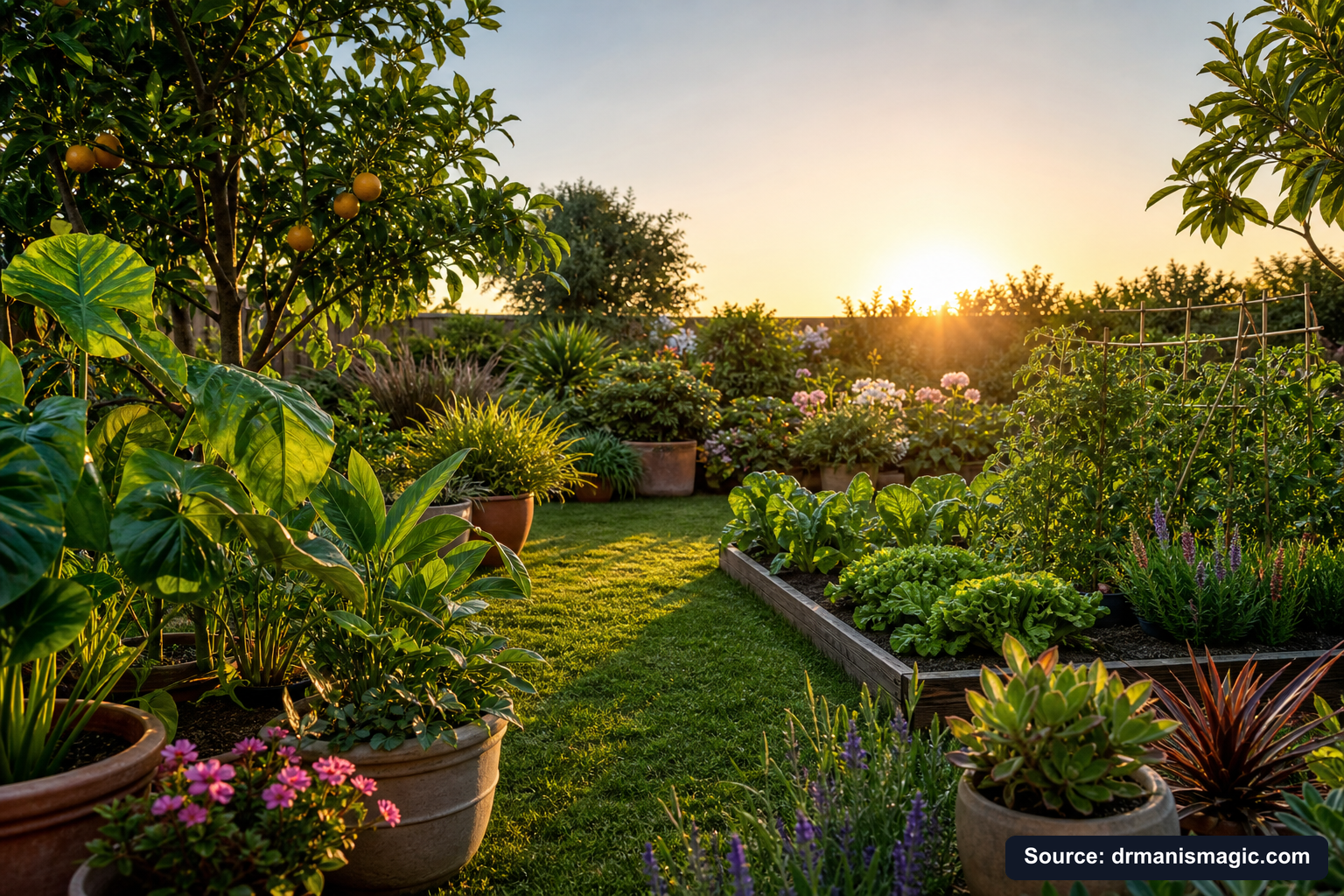
Wild plants do not thrive because they are lucky. They thrive because they are plugged into a system that took millions of years to perfect. A living soil. An invisible workforce. A web of mutual exchange between roots, bacteria, fungi, protozoa, and nematodes that keeps nutrients flowing, pathogens suppressed, and plants strong without anyone lifting a finger.
That system exists. It is real. It is verifiable. And it is exactly what Dr. Mani Skaria spent 40 years studying, testing on over 250,000 trees, and ultimately bottling for anyone who wants to grow something beautiful without the constant struggle.
You were not born with a brown thumb. The deck was stacked against you. The products you were sold were designed to create dependency, not health. The sterile soil. The salt-based fertilizers. The chemical inputs that quietly killed the very biology your plants needed most.
The good news is that nature is patient and forgiving. The moment you stop working against it and start working with it, things begin to shift. Roots reach deeper. Leaves come in greener. Fruit sets heavier. The plant that looked tired starts to look like it belongs exactly where it is planted.
You do not have endless seasons to experiment. The time you spend going in circles with the old approach is time you cannot get back. The best moment to build the right foundation was years ago. The second-best moment is right now.
If you are ready to stop guessing and start growing with the system nature already built, explore the full Free Plant Care Field Guide from Dr. Mani's Magic. It walks you through every step of the Three Plant Pillars in plain language, so you can give your plants the invisible workforce they were always meant to have.
Frequently Asked Questions
You just read about why wild forests thrive without a single bag of fertilizer. Now you probably have questions. Good. These are the exact questions gardeners ask us every day, and the answers will change how you think about every plant you own.
Why do wild plants thrive without any fertilizer or help from humans?
Wild plants thrive because their soil is alive. Billions of bacteria, fungi, and other microbes live underground and feed plant roots automatically. The plant pushes sugars into the soil. The microbes eat those sugars. Then the microbes release nutrients right next to the roots. It is a perfect loop. No bag of fertilizer needed. Dr. Mani spent 35 years studying this system and built the Three Plant Pillars around it. We proved it on over 250,000 citrus trees in South Texas.
What destroys the natural soil system in home gardens and containers?
Salt-based synthetic fertilizers are the biggest culprit. They burn and kill the beneficial microbes your plants depend on. Cheap potting mixes made from pine bark and sawdust rot and compact over time, choking roots of oxygen. Fungicides and pesticides wipe out the good guys along with the bad. Once you destroy the soil food web, your plant is on life support. That is why so many carefully tended plants still look tired and sick.
Can I actually rebuild the living soil system in my pots and garden beds?
Yes. That is exactly what the Three Plant Pillars do. You start with mineral-based soil that does not break down or compact. You add live microbes that go to work immediately. Then you feed with slow-release organic fertilizer that nourishes the microbes instead of killing them. Dr. Mani tested this combination on citrus trees, tropical trees, and houseplants for decades. Most people see real improvement within the first month.
Do plants feel pain or stress when they are struggling in bad soil?
Plants do not feel pain the way animals do. They have no brain or nervous system. But they do send out chemical and electrical signals when they are under stress. A struggling plant in compacted, lifeless soil is running those stress signals constantly. It is fighting just to survive. When you give it mineral-based soil, live microbes, and clean organic fertilizer, those stress signals stop. The plant shifts from survival mode into growth mode. You can actually see it happen.
Are the microbes in most store-bought products actually alive and working?
Most are not. Dried microbe powders are often dead by the time you open the bag. Liquid microbial products that smell bad have already gone anaerobic, meaning they are rotting. Dead microbes do nothing for your plants. Dr. Mani's Plant Super Boost uses a special stabilization method developed by a master compost expert. The microbes stay alive in the bottle and go to work the moment you water them in. It smells like earth, not sewage, because nothing is rotting.
Why does my plant keep struggling even when I follow the instructions on the fertilizer bag?
Because the instructions on that bag were written to sell more bags. Salt-based fertilizers give you a quick green burst, then damage the soil microbes that your plant actually depends on. Over time, your soil gets worse. Your plant gets weaker. You buy more fertilizer. That cycle was designed by big chemical companies starting back in the 1950s. It is not your fault. The brown thumb is not real. You were just never given the right foundation to start with.
How soon can I expect to see real results when I switch to the Three Plant Pillars system?
Most people notice visible improvement within 30 days. Leaves look greener. New growth appears. The plant stops looking tired. Over the following months, roots expand, blooms increase, and the plant builds real immunity to pests and disease. The longer you stay with the system, the stronger your plants get. Time is the one thing you cannot get back. Every month you spend fighting nature instead of working with it is a month of growth you will never recover.
About the Author
Ron Skaria, MD
Ron Skaria, MD, is the co-founder of Dr. Mani's Magic and the son of Dr. Mani. He trained as a medical doctor at Baylor College of Medicine, did his residency at UT Health Science Center - San Antonio and fellowship training at Texas Tech University. He now works full time on the family farm at US Citrus and US Citrus Nursery in Hargill, Texas, building Dr. Mani's Magic alongside his dad. He wrote the Brown Thumb Field Guide to put his father's 48 years of plant science into plain words any gardener can use. His belief is simple. You never had a brown thumb. You just never had the right help.


