


Why Plants Become Dependent on Synthetic Fertilizers | Dr. Mani's Magic
Why Plants Become Dependent on Synthetic Fertilizers (And How to Break the Cycle for Good)
Picture this. You buy a beautiful new plant. Maybe it's a fruit tree you've been dreaming about for years. You bring it home, pot it up, and give it a shot of that bright blue powder everyone uses. Within a week, it explodes. Dark green leaves. New shoots popping everywhere. You feel like a genius.
Then you miss a feeding. Maybe life gets busy. Maybe you run out of that blue powder. And you watch, week by week, as the color fades. The new growth stops. The leaves go pale yellow. The plant looks at you like it's starving. So you feed it again. It perks back up. And the cycle starts over. More feeding. More fading. More feeding. You're not growing a plant anymore. You're managing an addiction. Or so it feels.
Here's what's really going on. And it has nothing to do with the plant itself. The plant isn't hooked on anything. But something in the soil underneath it has been slowly dying. And once you understand what that something is, you'll never look at a bag of fertilizer the same way again. We grew over 250,000 trees at our South Texas nursery before we cracked this open. What we found changed everything.

Organic Fertilizer | Crab, Kelp & Amino Acids
Key Takeaways
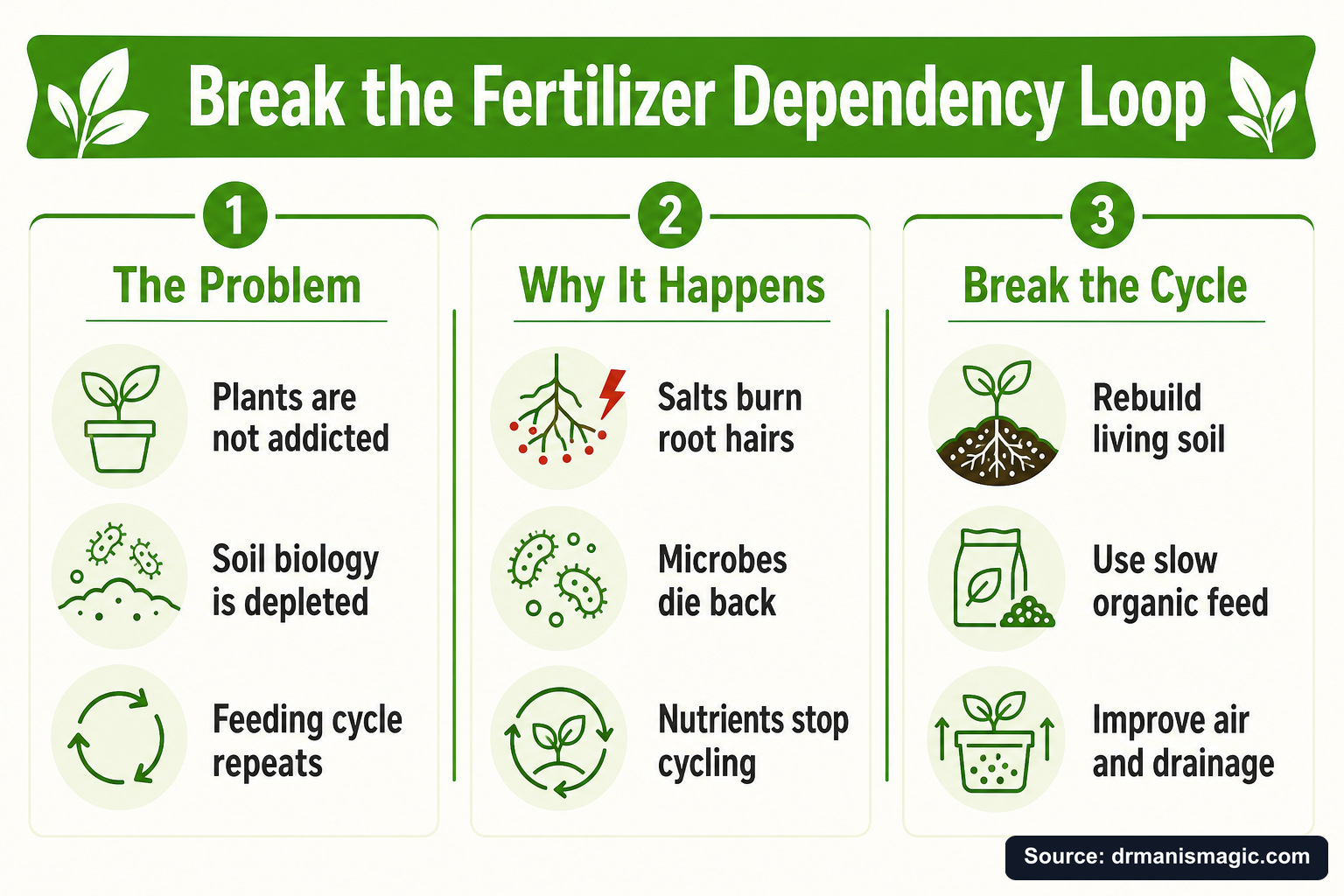
- Plants do not become chemically addicted to synthetic fertilizers. The soil around them becomes biologically depleted, and that is what creates the dependency loop.
- Salt-based synthetic fertilizers burn beneficial microbes and fine root hairs, leaving the plant's natural support system in ruins.
- Without living microbes in the soil, nutrients stop cycling naturally. The plant must then rely on you to keep shoveling in more food.
- The real fix is not to "wean" the plant. It is to rebuild the soil biology so the plant can feed itself again.
- Organic, slow-release fertilizers like those made from crab, kelp, and amino acids feed the microbes first, then the plant, creating a self-sustaining system.
- Salt buildup, compaction, low oxygen, and poor drainage are the hidden villains behind most "fertilizer dependency" stories.
- The Three Plant Pillars (mineral-based soil, live microbes, organic fertilizer) are the foundation for any plant to thrive long-term without constant feeding.
Do Plants Actually Get Addicted to Synthetic Fertilizer?
No. Plants cannot become chemically addicted to fertilizer. What happens instead is that repeated use of salt-based synthetic fertilizers slowly destroys the living soil ecosystem. Without that ecosystem, the soil cannot feed the plant on its own. The plant appears dependent because the system it relies on has been broken.
The word "addiction" is a useful shorthand for the feeling. But it is not the real mechanism.
Think of it this way. Imagine you hired a whole kitchen crew to cook your meals. Over time, you stopped cooking yourself. You forgot where the pots were. You forgot the recipes. Then one day the crew disappears. Now you are helpless. Not because you are addicted to the crew. But because you forgot how to cook without them.
That is what synthetic fertilizer does to your soil over time. It takes over the job that living microbes used to do. And while it is running the show, those microbes slowly fade away. The soil loses its ability to cycle nutrients on its own. When the fertilizer stops, the plant looks like it is starving. Because in a very real sense, it is.
According to the University of Minnesota Extension, healthy soil biology drives the entire nutrient cycle. Microbes mineralize organic matter, fix nitrogen from the air, suppress disease, and build the loose, oxygen-rich structure that roots need to thrive. When that biology collapses, nothing else works right.
What Is the Dependency Loop and Why Does It Keep Repeating?
The dependency loop works like this: soluble fertilizer feeds the plant fast, causing rapid top growth that demands even more water and nutrients. The salt in that fertilizer stresses the roots and kills microbes. With fewer microbes, the soil stops cycling nutrients naturally. So the plant looks hungry, and you feed it again. The loop repeats.
Here is the loop, step by step, so you can see exactly how it works.
- You apply a fast-release, salt-based fertilizer. The plant surges with green growth almost immediately.
- That burst of top growth demands more water and nutrients. The plant is growing faster than its roots and soil biology can support.
- The salt in the fertilizer builds up in the soil. It pulls water away from roots through a process called osmotic stress. The roots are physically unable to drink, even when water is present. This is called physiological drought. The plant is thirsty in wet soil.
- The salt also burns the fine root hairs that do most of the nutrient and water absorption. These tiny hairs are the most sensitive parts of the root system.
- The same salt kills or suppresses the beneficial microbes living in the root zone. Bacteria, fungi, and mycorrhizae all suffer when salt concentrations rise.
- Without those microbes, the nutrient cycle breaks down. Organic matter stops being converted into plant-available nutrition. Nitrogen stops being pulled from the air. Phosphorus stays locked in forms the plant cannot use.
- You see pale leaves, slow growth, or stress symptoms. You assume the plant is hungry. You apply more fertilizer. The loop repeats.
Meanwhile, the roots sitting in salt-damaged, oxygen-starved soil become vulnerable to pathogens like Pythium and Phytophthora, the two most common culprits behind root rot in container and garden plants worldwide. The plant is not just dependent. It is wounded.
See also: How Salt-Based Feeding Quietly Destroys Root Systems
Why Does Salt in Synthetic Fertilizer Hurt Your Roots?
Synthetic fertilizers are mineral salts. When their concentration in the soil is higher than the concentration inside the root cells, water moves out of the root and into the soil. The root dries out from the inside even when the soil is wet. This is osmotic stress, and it is the same reason ocean water makes you more thirsty if you drink it.
Every synthetic fertilizer has a salt index. It is a measure of how much salt pressure it puts on the soil compared to pure sodium nitrate. The higher the salt index, the more likely it is to cause osmotic stress, root burn, and microbial damage.
You can see this damage without a microscope. Brown leaf tips. Scorched edges. White crusty rings on the top of your potting soil. Yellowing that starts at the margins and moves inward. These are the fingerprints of salt.
The University of Maryland Extension notes that excess fertilizer or salt damage in flowers produces symptoms nearly identical to drought stress, because the root is experiencing physiological drought regardless of how much water is in the pot.
In containers, the problem is even worse. There is nowhere for the salt to go. It accumulates with every watering and every feeding. The salt index compounds over time like interest on a debt you did not know you owed.
What Does Salt Do to the Microbes in Your Soil?
Salt draws water out of microbial cells the same way it draws water out of root cells. High salt concentrations kill or suppress bacteria, fungi, and mycorrhizal networks. Once those microbes are gone, the nutrient cycle stops. The soil becomes a lifeless growing medium that cannot feed your plant without constant external input.
This is the piece most fertilizer advice completely skips over.
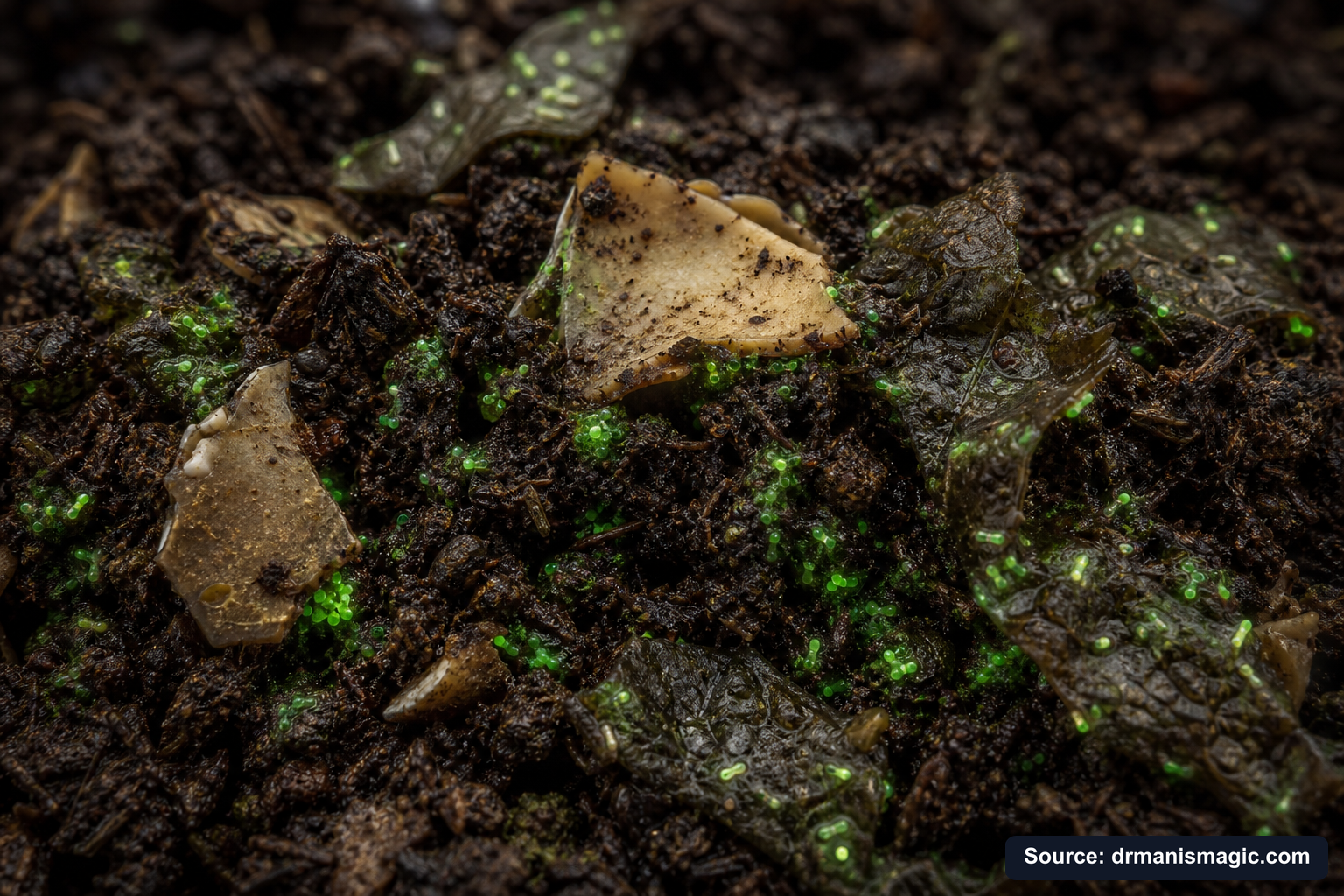
Your soil, at its best, is not dirt. It is a living city. Billions of bacteria and fungi work in the root zone every single day. They break down organic matter and release nutrients in forms the plant can actually absorb. They fix nitrogen from the air and deliver it directly to the roots. They build the loose, crumbly structure that lets oxygen and water move freely. They produce compounds that suppress disease organisms like Pythium and Phytophthora.
When you pour salt-based fertilizer into that city, it is like flooding the streets. The microbes cannot function in high-salt environments. Many die. The ones that survive reduce their activity. The whole city slows down.
And here is the thing about that city. It took time to build. The microbes, the fungal threads, the organic matter they feed on, the soil structure they create. You cannot rebuild it overnight. But you can destroy it in a single season of heavy synthetic feeding.
That is why plants on a heavy synthetic program look great for a while and then start to decline even when you keep feeding them. The soil has lost its ability to hold nutrients, cycle water properly, or support healthy roots. You are feeding a plant in a broken system.
How Does Organic Fertilizer Actually Work Differently?
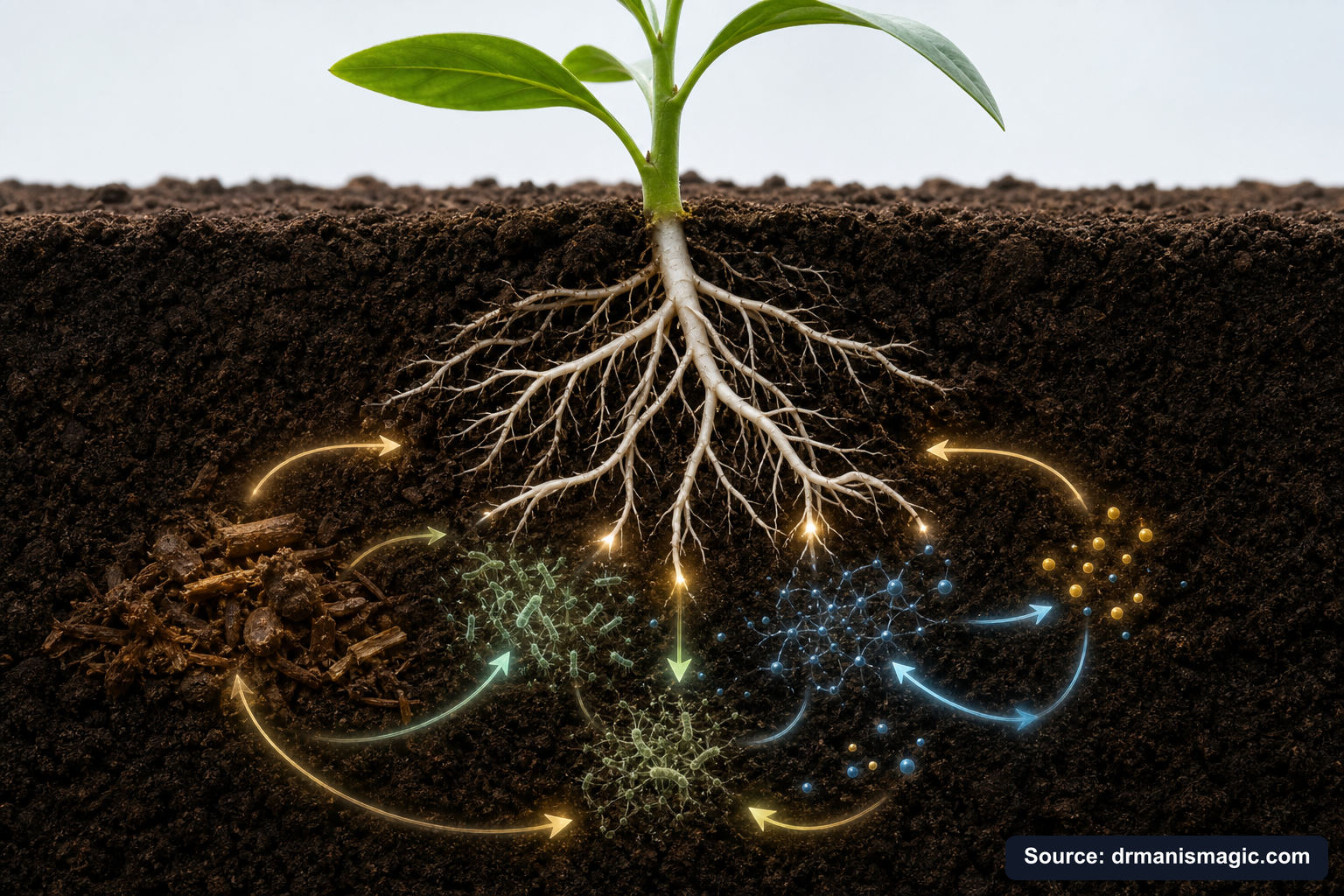
Organic fertilizer feeds the microbes first. The microbes digest the organic material and convert it into forms the plant can absorb. When those microbes die, they release that stored nutrition directly into the root zone. The whole process creates a slow, steady trickle of nutrients that mirrors how nature has always fed plants, without salt, without spikes, and without burning anything.
This is the part that most gardeners have never heard explained clearly. So let's walk through it like a story.
You sprinkle organic granules on your soil. The granules sit there. They are not immediately soluble. Nothing dramatic happens on day one.
But underground, something wakes up. Bacteria and fungi in the soil smell the organic material. They move toward it. They begin to digest it the same way your stomach digests food. They break down the proteins into amino acids. They release enzymes that unlock the phosphorus and potassium. They pull the nitrogen into their own cells.
Now here is the magic part. Those microbes live short lives. When they die, everything they stored inside their cells, all that nutrition they converted, spills directly into the root zone. The plant absorbs it. This cycle repeats continuously, creating a slow, steady trickle of plant-available nutrients that goes on for weeks and months after a single application.
No spikes. No crashes. No salt. No burning.
And because the organic material feeds the microbes rather than replacing them, the microbial community grows stronger with every feeding. The soil becomes more alive, not less. The nutrient cycle accelerates. Over time, the plant needs less external input because the soil is doing more of the work on its own.
This is the opposite of the dependency loop. This is what we call the recovery loop.
Our Crab, Kelp & Amino Acids fertilizer was designed specifically to work this way. The crab shells provide chitin, calcium, and slow-release nitrogen. The cold-processed kelp delivers natural plant hormones called auxins, trace minerals, and carbohydrates that microbes love to eat. The amino acids provide nitrogen in a form that bypasses the long conversion process and goes almost directly to the plant. And volcanic ash supplies silica and micronutrients that strengthen cell walls and build resilience. Zero synthetic salts. Zero biosludge. Zero PFAS.
What Is Chitin and Why Does It Matter for Soil Health?
Chitin is the structural material found in crab shells and insect exoskeletons. When added to soil, it feeds a specific group of bacteria that are natural enemies of soil-borne pathogens. These bacteria suppress diseases like root rot while simultaneously releasing nitrogen as they digest the chitin. It is nature's built-in pest and disease management system.
Most people hear "crab shells" and think it sounds gimmicky. It is not.
Chitin is one of the most abundant natural compounds on the planet. And when chitin-digesting bacteria in the soil consume it, two things happen at once. First, they multiply rapidly, crowding out the pathogens that cause root rot. Second, they release nitrogen slowly as a byproduct of digestion. That nitrogen feeds the plant in a gentle, steady stream.
Think of it as a two-for-one. You are feeding the soil and protecting the roots at the same time, using nothing but the leftovers from a seafood shell.
This is why crab-based fertilizers were used in coastal farming communities for centuries before synthetic fertilizers ever existed. People did not know the word chitin. But they knew the results.
What Does Kelp Actually Do for a Plant?
Kelp is packed with natural plant hormones called auxins and cytokinins, plus dozens of trace minerals and complex carbohydrates. Auxins regulate root growth and fruit development. Cytokinins stimulate cell division. The carbohydrates feed soil microbes. Together, kelp acts as a biostimulant that makes the plant's own growth systems work better, not a nutrient source, but a signal booster.
Auxins are the hormones that tell a root where to grow and how fast. They regulate the angle of root branching, the rate of root elongation, and the plant's response to gravity and water. When you apply kelp, you are giving the plant a natural dose of its own growth signals.
Kelp also contains alginic acid, a compound that improves soil structure by helping particles clump together into loose aggregates. Better soil structure means better drainage. Better drainage means more oxygen at the root zone. More oxygen means healthier roots and more active microbes.
The carbohydrates in cold-processed kelp are also a direct food source for the beneficial bacteria and fungi in the soil. Every time you apply a kelp-based fertilizer, you are stocking the pantry for your microbial workforce.
You Never Had a Brown Thumb.
You were handed the wrong tools. This free guide hands you the right ones.
You watered it. You fed it. It died anyway.
It was never you. It was the dirt, the salt food, and the bad advice.
This guide shows you what really went wrong, and how to fix it for good.
- Why your plants really died, and why it was never your fault
- The salt hiding in your plant food that quietly burns the roots
- The hidden killer in almost every bag of store soil
- The tiny helpers that grow a whole forest for free
- The rescue trick that brings a half dead plant back to life

Why Do Amino Acids Make Such a Difference as a Nitrogen Source?
Amino acids are the building blocks of proteins. When used as a nitrogen source, they can be absorbed directly by plant roots without needing to be broken down first. This means the plant gets nitrogen faster and with less energy spent. Amino acids also stimulate microbial activity and help the plant build enzymes, hormones, and chlorophyll more efficiently.
Most nitrogen sources require several conversion steps before the plant can use them. Organic matter has to be mineralized by microbes. Ammonia has to be converted to nitrate. Each step takes time and energy.
Amino acid nitrogen skips several of those steps. The plant can absorb certain amino acids directly through the roots and use them almost immediately. This is why amino acid-based fertilizers produce visible results faster than most other organic options, without the salt spike you get from synthetic quick-release products.
The other benefit is energy. Every conversion step inside the plant costs energy. When you deliver nitrogen in a pre-converted form, the plant can redirect that saved energy toward root growth, flowering, or fruit development. It is efficiency built into the input.
Synthetic vs Organic vs Slow-Release: What Is the Real Difference?
Synthetic fertilizers are fast, salty, and harsh on biology. Organic fertilizers are slow, gentle, and biology-building. Slow-release coated synthetics fall in the middle but still carry plastic coatings and salt risks. For long-term plant health, soil biology, and safety, organic wins in every category that matters beyond the first few weeks.
| Feature | Synthetic Fast-Release | Coated Slow-Release Synthetic | Organic (Crab / Kelp / Amino Acids) |
|---|---|---|---|
| Speed of action | Immediate (days) | Weeks (based on coating) | 2-4 weeks, then continuous |
| Salt content | High (salt-based by definition) | Moderate to high | Very low to none |
| Root burn risk | High, especially in containers | Moderate | Very low |
| Effect on microbes | Kills or suppresses beneficial bacteria and fungi | Moderate suppression, plastic residue | Feeds and multiplies microbial populations |
| Soil biology over time | Degrades with repeated use | Minimal improvement | Builds and strengthens over time |
| PFAS / biosludge risk | Some products contain biosludge fillers | Plastic coating residue in soil | Zero PFAS, Zero biosludge (clean-sourced) |
| Best for long-term plant health | No | No | Yes |
| Works with soil microbes | No, works against them | Partially | Yes, by design |
What Is the PFAS and Biosludge Problem in Fertilizers?
Some fertilizers, both synthetic and organic-labeled, are made with biosludge, which is treated municipal waste. Biosludge can contain PFAS, which are synthetic chemicals that do not break down in soil, water, or human tissue. They have been linked to serious health risks. Clean organic inputs with no biosludge or PFAS are the only safe choice for gardens where children, pets, and food crops are present.
This one surprises most gardeners. You switch to "organic" fertilizer thinking you are done with the chemical problem. Then you find out some organic fertilizers use biosludge as a cheap filler. Biosludge is the solid material left over after treating municipal wastewater. It is, in plain language, processed human waste.
The problem is not just the concept. It is what comes with it. PFAS, which stands for per- and polyfluoroalkyl substances, are industrial chemicals found in everything from nonstick cookware to firefighting foam. They pass through wastewater treatment unchanged and concentrate in biosludge. When that biosludge is applied to soil, PFAS accumulates. It does not break down. Ever. That is why they are called forever chemicals.
If you have kids running barefoot through your garden. If you have a dog. If you are growing food you plan to eat. This matters enormously.
When we formulated our products at US Citrus Nursery, this was a non-negotiable line. Zero biosludge. Zero PFAS. Zero synthetic salts. We grow food on this land. Our families are on this land. We were not willing to compromise on that, and we do not expect you to either.
How Do You Know If Your Plant Is Showing Salt Damage vs Root Rot vs Overwatering?
Salt damage usually shows as brown leaf tips, white soil crust, or scorched leaf margins in a plant that is otherwise upright and growing. Overwatering shows as yellowing, wilting, and soggy soil. Root rot caused by Pythium or Phytophthora shows as blackened, mushy roots with a sour smell. All three often overlap, especially when synthetic fertilizers are involved.
| Symptom | Salt Damage / Fertilizer Burn | Overwatering | Root Rot (Pythium / Phytophthora) |
|---|---|---|---|
| Leaf color | Brown tips and margins, scorched edges | Pale yellow, often uniform | Yellow to brown, rapid decline |
| Soil surface | White crust or mineral deposits | Stays wet for days after watering | May smell sour or rotten |
| Root appearance | Brown tips on fine roots, dry-looking | Pale, soft, waterlogged | Black, mushy, foul-smelling |
| Plant posture | Often upright but stressed | Wilting despite wet soil | Sudden collapse or severe wilt |
| Common cause | High salt index fertilizer, accumulation in containers | Poor drainage, organic potting mix compaction | Saturated, low-oxygen soil with pathogen pressure |
| Immediate fix | Flush soil deeply with plain water | Let soil dry, improve drainage | Remove affected roots, improve aeration, add beneficial microbes |
| Long-term fix | Switch to low-salt organic fertilizer, rebuild microbes | Mineral-based soil, proper watering schedule | Mineral-based soil, live microbial inoculant, organic nutrition |
These three problems overlap more often than they appear separately. Salt damage suppresses the microbes that fight Pythium. Overwatering in compacted organic potting mixes removes the oxygen those same microbes need to survive. The result is a plant under attack on three fronts at once.
See also: The Hidden Reason Synthetic Fertilizers Cause Root Rot
What Are the Three Plant Pillars and Why Do They Break the Dependency Cycle?
The Three Plant Pillars are mineral-based soil, live microbials, and organic fertilizer. Together, they recreate the conditions plants evolved in over millions of years. Mineral soil lets roots breathe and drains freely. Live microbes cycle nutrients and suppress disease. Organic fertilizer feeds the whole system without salt. With all three in place, the dependency loop cannot take hold.
Dr. Mani Skaria spent 40 years as a Professor of Plant Pathology at the Texas A&M Citrus Center before he figured this out. He watched plant after plant struggle on synthetic programs. He tested inputs from around the world. And eventually, he traced every persistent problem back to the same three missing pieces.
Mineral-based soil that does not compact or steal oxygen from roots. Living microbes that turn the soil into a self-sustaining nutrient factory. And organic fertilizer that feeds the system without burning it.
When all three are working together, something remarkable happens. The plant stops needing you to rescue it. The soil feeds the roots. The microbes protect the roots. The roots support the whole plant. Growth becomes consistent, not dramatic and then crashing. Health becomes the default, not the exception.
We tested this across 250,000 citrus trees at our South Texas nursery. We tested it on houseplants, tropical trees, flowers, and vegetables. The result was always the same. When the Three Plant Pillars are in place, the plants become, as Dr. Mani likes to say, nearly bulletproof.
You can learn exactly how to put all three pillars to work for your own plants in our Free Plant Care Field Guide.
And you can explore how to get all three pillars working together with our Three Plant Pillars bundle.
How Do You Break the Dependency Cycle and Rebuild a Healthy Soil System?
Breaking the dependency cycle takes three to six months of consistent soil rebuilding. You stop the salt input, flush accumulated salts, improve drainage and oxygen at the root zone, reintroduce live microbes, and switch to a slow-release organic fertilizer. The soil biology recovers, nutrient cycling restarts, and the plant gradually stops needing rescue feedings.
Here is the step-by-step recovery plan we recommend based on what we learned growing trees in South Texas.
- Stop the salt input immediately. Do not apply any more synthetic fertilizer. The cycle cannot break while you keep adding salt.
- Flush the soil. For containers, water deeply three times in a row with plain, unchlorinated water, letting it drain completely each time. This pushes accumulated salts down and out through the drainage holes. For garden beds, deep watering followed by several dry days helps move salts below the root zone.
- Check and fix your drainage. If water is sitting at the bottom of your pot or pooling in your garden bed, the roots are sitting in oxygen-depleted soil. No microbial recovery is possible without oxygen. For containers, consider transitioning to a mineral-based soil that does not compact over time. According to Penn State Extension, soil management for trees and shrubs depends critically on aeration and drainage to support root health and microbial activity.
- Reintroduce live microbes. Apply a liquid microbial inoculant that contains beneficial bacteria, fungi, and mycorrhizae. These are the workers that will restart the nutrient cycle. Do this monthly. The first application is the most important one. See our Plant Super Boost for a live microbial formula developed and used on our own nursery stock.
- Switch to a slow-release organic fertilizer. Apply it at the recommended rate and resist the urge to double it. Organic fertilizers are gentle. More is not better. Steady is better.
- Add organic matter carefully. Compost or mulch on the soil surface feeds the microbes and improves structure over time. Do not bury it deeply in containers. Surface application is enough.
- Be patient and watch the roots, not just the leaves. Above-ground recovery follows below-ground recovery. The leaves may not look dramatically different for four to six weeks. But if the roots are healing and the microbes are working, the plant will begin to show it. New growth will appear. Leaf color will deepen. The plant will stop looking like it is waiting for a rescue.
What About Lawns, Flowers, Vegetables, and Houseplants? Does This Apply to Everything?
Yes. The dependency loop works the same way in every plant system. Lawns that need constant synthetic nitrogen feeding to stay green are showing the same signs as a container plant on blue powder. The soil biology has been suppressed. Rebuild the biology and the lawn, the flower bed, the vegetable garden, and the houseplant collection all respond the same way.
We hear this question a lot. People assume the Three Plant Pillars are a citrus thing. They are not. We discovered them through citrus because that is what we grow. But the principles apply to every plant on the planet.
Your lawn grass does not care that it is a grass and not a lemon tree. It still needs oxygen at the root zone. It still needs living microbes to cycle nitrogen from the thatch layer. It still suffers when salt burns the soil and suppresses the biology.
Your flower bed dahlias do not care that they are annuals. They still need amino acid nitrogen to build chlorophyll. They still need kelp hormones to regulate root growth. They still need soil that drains and breathes.
Your kitchen windowsill herbs do not care that they are indoors. They still need a microbial community to protect their roots from Pythium. They still suffer when synthetic salts accumulate in a pot with no drainage escape.
The Three Plant Pillars work because they address the conditions every plant evolved to live in. Not just citrus. Every plant.
The Real Cost Is Not Money. It Is Time.
Here is the truth that nobody in the gardening industry wants to say out loud.
You can always earn more money. You can replace a dead plant. You can buy another bag of fertilizer. But you cannot get back the seasons you spent watching a tree struggle when it should have been thriving. You cannot get back the years you waited for fruit that never came because the soil was never right.
The number one thing people tell us when they call our nursery is that they want to see their tree bear fruit while they can still enjoy it. Not someday. Now. In their lifetime. In their backyard. For their grandchildren to reach up and pick.
That is not an unreasonable dream. It is the most human thing in the world. We were put on this earth to tend a garden. That drive has never left us.
But when you spend three years on the wrong fertilizer program, three years watching the soil get saltier and the roots get weaker and the growth get slower, you do not just lose money. You lose three years. And you cannot get those back.
The dependency cycle is not just a soil problem. It is a time problem. Every season spent in the loop is a season not spent watching your plant become everything it was meant to be.
The good news is that the recovery is real. The biology comes back. The roots heal. The plants respond. We have watched it happen 250,000 times.
If you are ready to stop the loop and start building something that lasts, explore the results from gardeners just like you who made the switch. Then start with the Three Plant Pillars. Not because it is complicated. Because it is the simplest, most natural way to grow anything.
Your plants are waiting. The soil is ready to be rebuilt. And the time to start is right now.
Frequently Asked Questions
If your plants keep fading the moment you skip a feeding, you are not alone. Millions of gardeners are stuck in the same loop and have no idea why. These questions get right to the heart of what is really happening in your soil, and what you can do about it starting today.
Do plants actually get addicted to synthetic fertilizers?
Not exactly. Plants cannot get chemically hooked on anything. But here is what does happen. Salt-based synthetic fertilizers slowly wipe out the beneficial bacteria and fungi living in your soil. Those microbes are the ones that naturally feed your plant. Once they are gone, your soil cannot do its job anymore. The plant looks dependent because its natural support system has been destroyed. We saw this pattern repeat across more than 250,000 trees at our South Texas nursery before we understood the full picture.
Are synthetic fertilizers actually good for your plants?
They give fast results. That part is real. Synthetic fertilizers flood the soil with nutrients plants can grab right away. You see green leaves and fast growth almost overnight. The problem is what happens underneath. Those same salt-based formulas burn your soil's living microbes. They fry the fine root hairs that absorb water. Over time, you are left with dead soil that cannot feed your plant on its own. Fast results up top, slow destruction down below.
Is synthetic fertilizer harmful to the environment?
Yes, and the damage goes further than most people realize. Synthetic fertilizers are loaded with nitrogen and phosphorus that run off into waterways. That runoff feeds toxic algae blooms that choke out fish and aquatic life. Even in your own backyard, the salt buildup poisons your soil biology over time. Many slow-release synthetic options are coated in plastic that leaches into the ground. Our organic fertilizer, made from crab, kelp, and amino acids, skips all of that entirely.
Can plants survive without any fertilizer at all?
In healthy ground soil, yes. Wild plants do it every day. They rely on microbes, decomposing matter, and natural nutrient cycles to stay fed. But in a pot or container, the rules change fast. Container plants eat through nutrients quickly, and watering flushes the rest out through the drainage holes. That is why Pillar Three of our Three Plant Pillars is organic fertilizer. Slow-release, earth-born nutrients keep your plant fed without burning the soil biology keeping it alive.
Which is better, organic or synthetic fertilizer?
Organic fertilizer wins for long-term plant health. Synthetics give you a fast pop of color, then fade. Organics work slower but build something that lasts. Our crab, kelp, and amino acids fertilizer feeds your soil microbes first. Those microbes then feed your plant in a steady, natural rhythm. No burn. No salt buildup. No toxic runoff. And because the microbes stay alive, your soil gets stronger over time instead of weaker. That is the difference between a band-aid and an actual cure.
Why do plants seem to grow so much better right after fertilizing?
Because synthetic fertilizers deliver nutrients in a form plants can grab instantly. It is like handing someone a plate of food instead of teaching them to cook. The plant eats fast and grows fast. But nothing underneath is getting stronger. The microbes that should be cycling nutrients naturally are being burned away. So the next time you skip a feeding, the plant has nothing to fall back on. That is the trap. Our Three Plant Pillars build a system where the soil feeds the plant, not just you.
Why is compost or organic matter better for soil than synthetic fertilizer?
Compost feeds the living creatures in your soil, not just the plant. Bacteria, fungi, and other microbes break down organic matter and release nutrients slowly over time. That is Pillar Two of our Three Plant Pillars at work. Synthetics skip that whole process and go straight to the plant, leaving the microbes with nothing to do. Over time, those microbes die off. Once they are gone, your soil cannot suppress disease, cycle nutrients, or hold structure. Compost keeps that whole system alive and running.
About the Author
Ron Skaria, MD
Ron Skaria, MD, is the co-founder of Dr. Mani's Magic and the son of Dr. Mani. He trained as a medical doctor and now works full time on the family farm in Hargill, Texas, building Dr. Mani's Magic alongside his dad. He wrote the Brown Thumb Field Guide to put his father's 48 years of plant science into plain words any gardener can use. His belief is simple. You never had a brown thumb. You just never had the right help.


