


Why Overfeeding Is a Modern Gardening Problem for Your Roots | Dr. Mani's Magic
Why Overfeeding Is a Modern Gardening Problem (And How Salt Is Quietly Killing Your Plants)
Picture this. Your tomato plant looks rough. Leaves going yellow. Tips turning brown. You do what any caring gardener does. You reach for the fertilizer. You give it a good dose. Maybe two.
A week later, it looks worse. So you water more. Then you fertilize again. The plant wilts in wet soil. You scratch your head. You Google the symptoms. Half the results say deficiency. The other half say overwatering. Nobody mentions the real culprit sitting right there in that bright blue granule bag. Salt.
Here at US Citrus Nursery, we have grown over 250,000 trees in the South Texas heat. We have watched this exact pattern play out more times than we can count. Gardeners feeding sick plants more food. Plants getting worse. Gardeners blaming themselves. Thinking they have a brown thumb. But the brown thumb is not real. The deck was stacked against you before you ever picked up a trowel. And today, we are going to show you exactly how that happened, and what to do instead.

Plant Super Boost
Key Takeaways
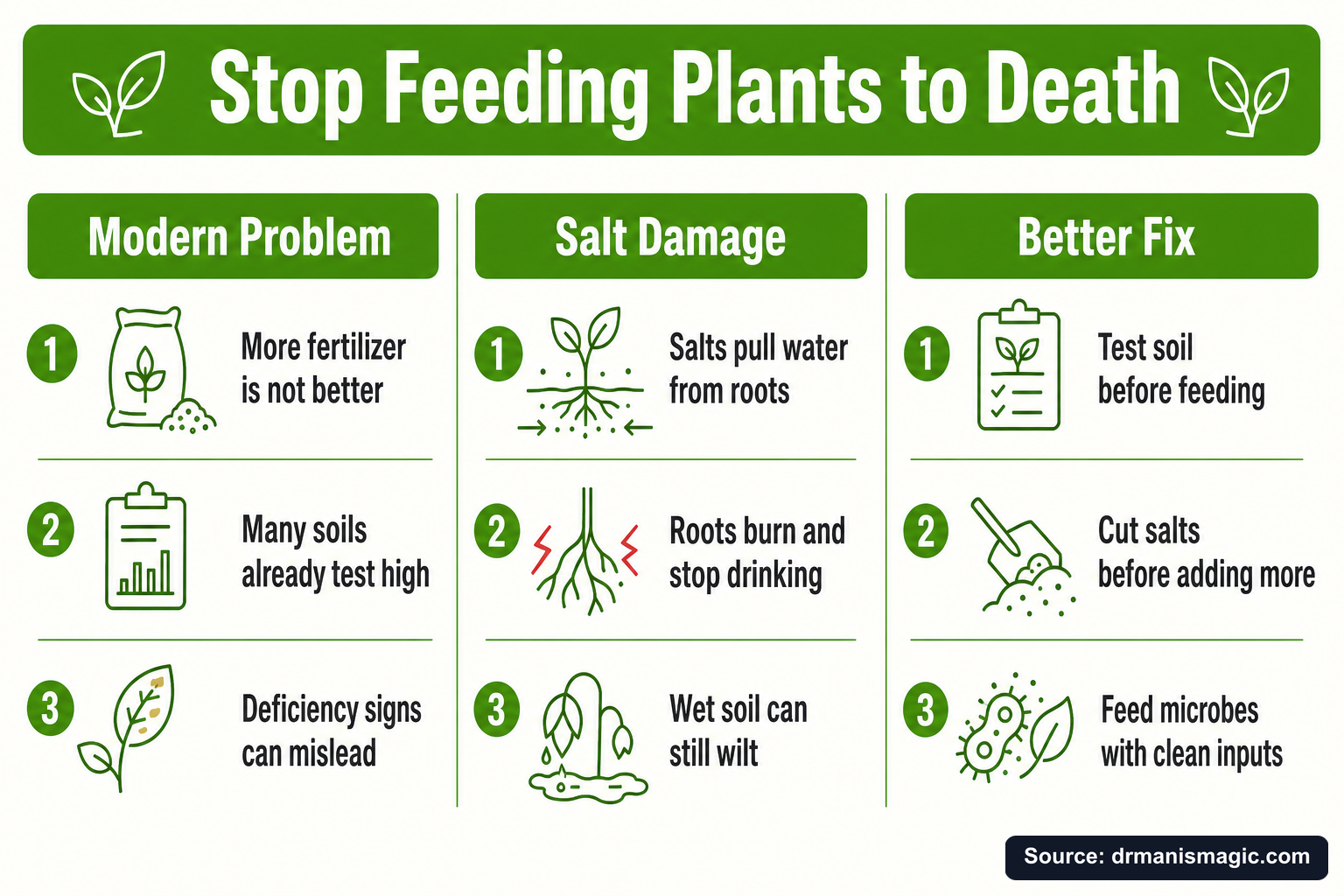
- Most modern fertilizers are salt-based. Salt pulls water away from roots, burns root tissue, and wipes out the beneficial microbes your plant depends on.
- A plant wilting in wet soil is not thirsty in the normal sense. Its roots are damaged. It cannot take up water even when water is right there.
- University of Minnesota research on over 137,000 soil tests found that most residential soils already have too much phosphorus. Adding more makes things worse, not better.
- Overfeeding starts a chain reaction: salt injury leads to more watering, more watering drowns roots, drowned roots invite disease, and disease looks like deficiency.
- Organic fertilizers feed the microbes first. The microbes convert nutrients into forms the plant can absorb. When those microbes die, they release even more nutrition. It is a built-in slow-release system.
- Biosludge fillers in some fertilizers, including some labeled organic, can carry PFAS forever chemicals into your garden soil.
- The Three Plant Pillars, developed and proven at US Citrus Nursery, give any plant the mineral foundation, living biology, and clean nutrition it actually needs to thrive long-term.
What Is Overfeeding and Why Is It Such a Modern Problem?
Quick Answer: Overfeeding happens when gardeners apply more fertilizer than plants can use, usually salt-based synthetic products applied without a soil test. Modern marketing teaches us that more nutrition equals more growth. The science says the opposite. Excess soluble fertilizer raises soil salt levels, damages roots, and disrupts the living biology that actually feeds your plant.
Overfeeding is not ancient. It is a product of the 1950s.
That is when a wave of cheap, imported synthetic fertilizers flooded the American market. The biggest early player was essentially an advertising agency that figured out how to sell salt-based nitrogen to home gardeners with catchy packaging. And it worked. Gardeners saw fast green-up and assumed fast meant good.
But here is what nobody explained. That green-up was a sugar rush. A spike. And like every spike, it was followed by a crash.
The fertilizer industry built its business model around that crash. Because when your plant crashes, you buy more. When your lawn burns, you buy more. When the tree drops its leaves, you buy more. The cycle never ends. And you, the gardener, keep thinking you are doing something wrong.
You are not doing something wrong. You are playing a rigged game.
Researchers at the University of Minnesota Extension analyzed data from 137,845 soil tests taken from residential lawns and gardens. They found that median phosphorus levels in those samples were already well above what plants need. In many cases, residential soils were more saturated with phosphorus than farm fields. People were adding nutrients their plants did not need, over and over, because the bag told them to.
That is the modern overfeeding problem. It is not just a dosing error. It is a diagnostic failure built into the system.
Why Do Fertilizer Salts Hurt Roots Instead of Helping Them?
Quick Answer: Synthetic fertilizers are made from soluble salts. When those salts build up in soil, they raise the electrical conductivity of the water around your roots. By osmosis, water actually flows out of the root cells instead of in. The root dehydrates. It cannot take up nutrients. The plant wilts even in wet soil. This is called physiological drought, and it is one of the most misdiagnosed problems in gardening.
Imagine you are eating a huge bag of salty chips. Your mouth dries out. You get thirsty. That is osmosis at work on your tongue. The salt is pulling moisture toward itself and away from your cells.
The exact same thing happens to your plant roots.
When soluble fertilizer salts build up in the soil around root tips, water moves in the wrong direction. Instead of flowing from the soil into the root, it flows from the root into the salty soil water. The root cells shrink. Tender root tissue gets physically scorched. And the plant sends up distress signals that look exactly like drought stress: wilting, brown leaf edges, yellowing, stunted growth.
So the gardener waters more. Which compresses the oxygen out of the soil. Which creates the warm, wet, low-oxygen environment that root rot pathogens like Pythium and Phytophthora love. Now you have a root rot problem on top of a salt problem. And the plant looks worse than ever.
Penn State Extension describes this cascade in their soil health research. The loss of oxygen in waterlogged soil is not just uncomfortable for roots. It is a direct invitation to anaerobic pathogens that destroy root systems fast.
More water does not fix salt injury. Less salt does.
Can Too Much Fertilizer Make Your Plant Look Deficient?
Quick Answer: Yes, and this is one of the cruelest tricks overfeeding plays. Salt accumulation can lock up nutrients already in the soil, making them chemically unavailable to the plant. So your plant shows yellowing leaves and slow growth, classic deficiency signs, even when the soil has plenty of nutrients. Adding more fertilizer makes the salt problem worse, not better.
This is where gardeners get stuck in a loop that can last for years.
Yellow leaves appear. The gardener reads that yellow leaves mean nitrogen deficiency. The gardener adds nitrogen fertilizer. The salt load increases. More nutrients get locked up. More yellow leaves appear. The gardener adds more fertilizer. Around and around.
The plant pathologists and soil scientists have a name for the mechanism. It is called nutrient lockout, and it is caused by high electrical conductivity in the root zone. When the salt index gets high enough, roots cannot absorb the nutrients even when those nutrients are physically present in the water around them.
This is exactly why Dr. Mani Skaria, founder of US Citrus Nursery and Professor Emeritus of Plant Pathology at the Texas A&M Citrus Center, spent decades looking for a better way to feed plants. Not a faster way. A smarter way. One that worked with the biology of the soil instead of burning through it.
See also: How Salt-Based Feeding Quietly Destroys Root Systems
What Does the Overfeeding Chain Reaction Actually Look Like?
Quick Answer: Overfeeding triggers a predictable chain: salt burns root tips, damaged roots take up less water, the gardener waters more, excess water pushes oxygen out of soil, low-oxygen conditions feed root rot pathogens like Pythium, the plant declines rapidly, and symptoms look like deficiency, heat stress, or drought. Breaking this chain requires stopping fertilizer, not adding more.
Step by step, here is how it happens. Walk through this slowly. You may recognize your own garden in it.
- Soluble fertilizer is applied. Salt concentration in the soil spikes.
- Root tips experience osmotic stress. Fine root hairs die. Water uptake drops.
- Plant wilts. Gardener sees the wilt and adds water.
- Excess water fills soil pore spaces. Oxygen drops sharply.
- Pythium, Phytophthora, and other water mold pathogens expand in the warm, wet, low-oxygen zone.
- Root rot accelerates. More roots die. Less nutrient uptake occurs.
- Plant shows yellowing, browning tips, and weak growth. Classic deficiency symptoms appear.
- Gardener adds more fertilizer to address the apparent deficiency.
- Repeat.
Oregon State University Extension research on soil oxygen and root health confirms that roots need oxygen to function, and that waterlogged, compacted soils create conditions where even healthy plants fail fast. The solution is not more product. It is restoring the biological engine beneath the soil surface.
See also: The Hidden Reason Synthetic Fertilizers Cause Root Rot
How Do You Tell the Difference Between Salt Burn, Overwatering, and True Root Rot?
Quick Answer: These three problems share symptoms but have different causes and different fixes. Salt burn shows brown leaf edges on otherwise normal leaves. Overwatering shows wilting with wet soil and no root damage yet. True root rot shows brown, mushy roots, a sour smell from the soil, and a plant that cannot recover even after drying out. Check the roots before you treat anything.
Guessing is expensive. Especially when the wrong treatment makes every one of these conditions worse.
Pull the plant from its pot. Or dig carefully around the base. Look at the roots. Healthy roots are white or tan and firm. Roots suffering from salt injury may look discolored at the tips but are still firm. Roots in true root rot are brown, soft, and often smell sour or rotten. That smell is the anaerobic bacteria breaking down dead root tissue.
| Symptom | Salt Burn / Overfertilizing | Overwatering | True Root Rot (Pythium / Phytophthora) |
|---|---|---|---|
| Leaf edges brown | Yes, crispy brown margin | Sometimes, soft yellowing | Yes, plus full leaf drop |
| Plant wilts in wet soil | Yes | Yes | Yes, severely |
| Soil smell | Normal | Slightly musty | Sour, rotten, sulfur-like |
| Root color | Tan, tips discolored | White but fragile | Brown, black, mushy |
| Root texture | Firm, but fewer fine roots | Soft, waterlogged | Slimy, disintegrating |
| Recovery with drying | Partial, if salts are flushed | Good, if caught early | Poor without treatment |
| Fix | Flush with water, stop fertilizing | Let soil dry, improve drainage | Remove affected roots, improve drainage, add live microbes |
What Is the Overfeeding-Overwatering-Root Rot Feedback Loop?
Quick Answer: This is the cycle most gardening advice misses entirely. Salt injury makes plants look thirsty. Watering more drives oxygen out of soil. No oxygen means root rot pathogens thrive. Root rot destroys more root tissue. The plant looks worse. Most gardeners never identify salt as the starting point, so the cycle repeats until the plant dies or the gardener gives up.
We call it the feedback loop because once you are in it, every logical response makes it worse.
Think of it like a slow leak in a boat. You see water rising. You bail faster. But the hole is still there. Bailing harder does not fix the hole. It just exhausts you while the boat keeps sinking.
The hole in this case is salt accumulation. And the fix is not more water. It is not more fertilizer. It is stopping the salt input, flushing what is there, and rebuilding the biological system that protects roots from pathogens in the first place.
That biological system is the microbe community living in your soil. And that is where the Three Plant Pillars come in.
Why Does Organic Fertilizer Work So Differently From Synthetic?
Quick Answer: Organic fertilizer does not feed the plant directly. It feeds the microbes first. The microbes eat the organic matter and convert it into plant-available nutrients slowly. When those microbes die, they release a second wave of nutrition directly into the root zone. It is a built-in, self-regulating slow-release system that mirrors exactly how nature has fed plants for millions of years.
This is the part most gardening content gets completely wrong. And it matters more than almost anything else.
Here is the picture we want you to hold in your mind.
You sprinkle organic fertilizer onto your soil. Billions of bacteria and fungi in the soil sense it. They move toward it. They eat it. They break it down into simpler forms. Those simpler forms are exactly what plant roots can absorb. And they trickle into the root zone slowly, steadily, week after week.
Then, when those microbes finish their work and die, their bodies become food. Their cell walls break down and release another round of nutrition right into the soil. Nitrogen. Minerals. Amino acids. All of it becomes available to the plant in the most bioavailable forms possible.
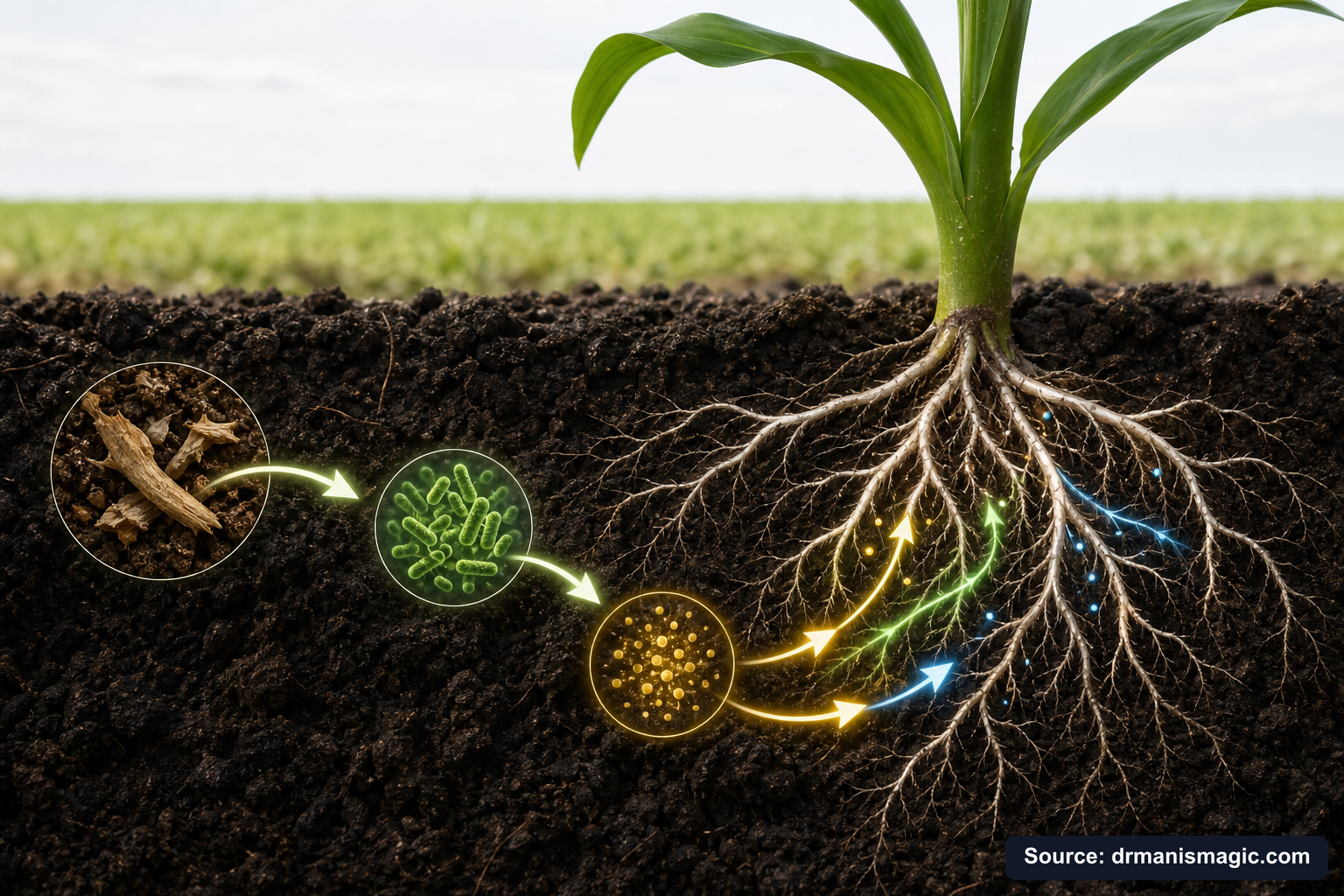
No spike. No crash. No salt. No burned root tips.
This is why organic fertilizer is not just a gentler version of synthetic fertilizer. It is a fundamentally different system. Synthetic fertilizer bypasses the biology entirely and dumps soluble nutrients straight into the water around the roots. Organic fertilizer works through the biology and makes the whole living system stronger with every application.
After growing over 250,000 trees at our South Texas nursery, we learned that the fastest way to grow a healthy plant is to feed the soil, not the plant. When the soil biology is strong, the plant takes what it needs, when it needs it. No guessing. No burning. No crash.
That is the principle behind Crab, Kelp & Amino Acids, our organic slow-release granular fertilizer. It is built specifically to feed the microbes that feed your plants, with zero synthetic salts, zero biosludge, and zero PFAS.
You Never Had a Brown Thumb.
You were handed the wrong tools. This free guide hands you the right ones.
You watered it. You fed it. It died anyway.
It was never you. It was the dirt, the salt food, and the bad advice.
This guide shows you what really went wrong, and how to fix it for good.
- Why your plants really died, and why it was never your fault
- The salt hiding in your plant food that quietly burns the roots
- The hidden killer in almost every bag of store soil
- The tiny helpers that grow a whole forest for free
- The rescue trick that brings a half dead plant back to life

What Is Biosludge, PFAS, and Why Should You Care What Is in Your Fertilizer Bag?
Quick Answer: Biosludge is treated municipal sewage waste used as a cheap filler in some fertilizers, including some labeled organic. It can carry PFAS, a group of synthetic chemicals that do not break down in soil or in the human body. They are called forever chemicals for a reason. Edible gardens, lawns where children play, and any soil with regular biosludge applications can accumulate PFAS over time. Always check what is actually in your fertilizer.
Most people have no idea this is happening.
You buy a bag of fertilizer. It says organic on the front. You feel good about that. You scatter it across your vegetable beds. Maybe near where your kids play. Your dog rolls in it.
But what if that fertilizer was bulked up with treated municipal waste? Human sewage, processed and dried, then mixed into fertilizer as a cheap nitrogen source. And what if that waste carried PFAS, the group of industrial chemicals linked to health concerns that have contaminated water supplies across the country?
This is not a fringe concern. The EPA has acknowledged that land application of biosolids is a significant pathway for PFAS to enter agricultural soil. Some states have already restricted or banned biosolids use on certain farmland as a result.
The label will not always tell you clearly. Look for words like biosolids, municipal biosolids, or wastewater residuals. If you see any of those, you are looking at biosludge.
Our Crab, Kelp & Amino Acids contains none of it. No biosludge. No PFAS. No synthetic salts. No plastic-coated slow-release prills leaching microplastics into your soil. Clean inputs only, made right here in the USA.
What Makes Crab Shell, Kelp, and Amino Acids Such Powerful Plant Nutrition?
Quick Answer: Crab shells bring chitin, a natural compound that triggers plants' immune systems and strengthens cell walls. Cold-processed kelp delivers natural plant hormones, trace minerals, and biostimulants that support root growth and stress resistance. Amino acids are pre-built protein fragments that plants can absorb directly without spending energy to break them down. Together, these three inputs feed plants cleanly, completely, and without any salt damage.
Let us go ingredient by ingredient. Because this is not a random mix. Every piece of it has a job.
Crab Shells and Chitin
Chitin is the structural material that makes up crab shells and the outer layer of insects. When chitin breaks down in soil, something remarkable happens. Plants sense it and interpret it as a signal that insects or fungal pathogens are nearby. So they activate their natural defense systems. Cell walls get stronger. Immune responses fire up. The plant becomes more resistant to disease without any chemical spray.
Chitin also feeds a specific group of beneficial bacteria in the soil that are natural antagonists to root-damaging fungi. More chitin in the soil means more of those protective microbes. It is a self-reinforcing system.
Crab shells also bring calcium and magnesium. Calcium is the primary mineral in woody plant tissue. Without it, cell walls are weak. Fruit cracks. New growth is distorted. Roots cannot push into compacted soil. Calcium is not a luxury nutrient. It is structural.
Cold-Processed Kelp
Kelp is one of the fastest-growing organisms on earth. It is packed with trace minerals pulled from deep ocean water, including iron, zinc, manganese, copper, boron, and molybdenum. All of these are micronutrients your plant needs in small amounts to run its enzyme systems, build chlorophyll, and support reproduction.
But the real power of kelp is in its natural plant hormones. Kelp contains auxins and cytokinins, the chemical messengers that tell roots to grow, tell cells to divide, and tell the plant to push through stress instead of stalling. Cold processing protects these hormones. Heat destroys them. That is why the processing method matters.
Amino Acids
Proteins are made of amino acids. Plants normally have to build their own amino acids from scratch using nitrogen, carbon, and energy from photosynthesis. That takes real metabolic work.
When you supply amino acids directly through the fertilizer, the plant skips that work. It absorbs the amino acids as-is and uses them immediately. This is one reason amino acid nitrogen is so gentle and effective. The plant decides how much it needs and takes only that. There is no force-feeding. No osmotic shock. No salt spike.
Feather meal and tankage, two of the amino acid sources in our formula, are high in nitrogen and phosphorus in organic form. They feed microbes, which then feed the plant, in a continuous, self-regulating loop.
Synthetic vs. Organic vs. Chitin-Based Fertilizers: Which One Actually Grows Healthy Plants?
Quick Answer: Synthetic fertilizers deliver nutrients fast but through salt chemistry that damages roots and kills microbes. Organic fertilizers work slowly through biology and build long-term soil health. Chitin and kelp-based inputs go further by activating plant immune responses, feeding protective microbes, and delivering hormone-like biostimulants. The comparison is not even close for long-term plant health.
| Feature | Synthetic Fast-Release | Slow-Release Synthetic (Coated) | Organic with Chitin & Kelp |
|---|---|---|---|
| Salt content | Very high | Moderate | Essentially zero |
| Root damage risk | High (osmotic stress, tip burn) | Lower but still present | Very low |
| Microbial impact | Kills beneficial microbes | Disrupts microbes over time | Feeds and protects microbes |
| PFAS or biosludge risk | Some products use biosludge fillers | Plastic coatings leach microplastics | Zero (when sourced clean) |
| Immune system activation | None | None | Yes, via chitin signaling |
| Plant hormone support | None | None | Yes, via kelp auxins and cytokinins |
| Overfeeding risk in containers | Very high, salts accumulate fast | Moderate | Very low, biology self-regulates |
| Long-term soil health | Declines over time | Neutral to slight decline | Improves with every application |
| Smell | Chemical | Chemical | Earthy, mild |
Should You Fertilize a Sick Plant?
Quick Answer: Almost never, and certainly not with synthetic fertilizer. A sick plant with damaged roots cannot process nutrients. Adding fertilizer, especially salt-based fertilizer, makes root damage worse. The right move is to stop all fertilizing, flush salts out of the soil with plain water, check the roots, restore drainage and oxygen, and then rebuild the microbial community before resuming any feeding.
This is the piece of advice that saves plants.
When a plant is struggling, the instinct is to give it more. More water. More food. More attention. But damaged roots are like a broken stomach. You would not force-feed someone with food poisoning. The body needs to heal first. Then it can process food again.
The same is true for plants. Heal the root zone. Restore the biology. Then feed gently and let the microbes do their slow, steady work.
Here is a simple recovery checklist for an overfed or salt-damaged plant:
- Stop all fertilizing immediately. Give the root zone a break.
- Flush the soil with plain water two or three times over one week. This dilutes and drains accumulated salts.
- Check the roots. Trim away any brown, mushy, or slimy sections with clean scissors.
- Improve drainage if needed. If water sits in the pot or bed, roots cannot breathe and recovery stalls.
- Add live beneficial microbes to the root zone. They outcompete pathogens and begin rebuilding the biological system. Learn more about how live microbes protect roots at Plant Super Boost.
- Wait for visible new growth before resuming any fertilization.
- When you do resume feeding, use an organic slow-release fertilizer with no added salts.
How Do the Three Plant Pillars Prevent Overfeeding From Happening in the First Place?
Quick Answer: The Three Plant Pillars, developed and proven across 250,000+ trees at US Citrus Nursery, work as a system. Mineral-based soil drains freely so salts cannot accumulate. Live microbes self-regulate nutrient availability so the plant never gets more than it can use. Organic fertilizer feeds the biology slowly so there is no spike, no crash, and no salt damage. The system is self-correcting by design.
Dr. Mani Skaria did not set out to sell fertilizer. He set out to solve a problem he faced in his own nursery. Why did some trees thrive and others stall? Why did conventional feeding programs produce inconsistent results? Why did the more he fertilized, the more problems appeared?
The answer he found after decades of research at the Texas A&M Citrus Center and his own nursery in Hargill, Texas, came down to three things working together. Not one thing. Three.
Mineral-based soil that does not compact or decompose. So oxygen always reaches the roots and water always drains. This alone eliminates one of the biggest overfeeding risk factors: salt accumulation in compacted, poorly draining soil.
Live microbes in the root zone. Bacteria, fungi, and mycorrhizae that protect root surfaces from pathogens, unlock bound nutrients, and regulate how much nutrition reaches the plant at any given time. Microbes do not let the plant overdose. They meter the nutrition out at the pace the plant can use it.
Organic fertilizer with no synthetic salts. Nutrition that enters through the biological system, not around it. Nutrition that strengthens the microbes instead of killing them.
When all three are in place, overfeeding becomes nearly impossible. The biology self-corrects. The soil drains. The microbes buffer. The plant takes what it needs and leaves the rest for later.
You can explore how all three work together at our Three Plant Pillars system page.
See also: Why Most Fertilizers Are Actually Salt in Disguise
Does This Apply to My Lawn, Houseplants, and Garden Beds, or Just Trees?
Quick Answer: The Three Plant Pillars apply to every plant that grows in soil. Lawns, raised bed vegetables, houseplants, flower borders, succulents, orchids, shrubs, fruit trees, and container plants all operate on the same biological principles. Salt hurts all roots the same way. Microbes help all root zones the same way. Clean organic nutrition builds all soil systems the same way. The crop changes. The biology does not.
We proved these principles on citrus because citrus is one of the most demanding and unforgiving plants you can grow. If a system works on 250,000 citrus trees in the blazing South Texas heat, it works on your tomatoes, your peace lily, your bermuda grass, and your rose bed.
The lawn that burns every summer after fertilizing. That is salt injury to grass roots. The houseplant with the crispy brown tips despite good watering. Salt accumulation in the container. The vegetable garden that produces beautifully for two years and then mysteriously collapses. The microbial community has been killed off by repeated synthetic applications and the soil biology has crashed.
Every one of these scenarios follows the same root-cause chain. And every one of them responds to the same root-cause solution.
Feed the soil. Protect the microbes. Keep the salt out. Let the biology do the work it evolved over millions of years to do.
What Is the Real Cost of Doing This the Old Way?
Quick Answer: The financial cost of repeated fertilizer purchases, replacement plants, and wasted inputs is real. But the deeper cost is time. Plants do not respond to money. They respond to the laws of biology. Every season spent fighting salt damage and root rot is a season your garden does not grow. And unlike money, time does not come back.
People call us from across the country. Retired doctors. Small business owners. Grandparents. People who have tried everything.
The number one thing they tell us they want is to see their tree bear fruit while they still can. Not in some abstract future. In their lifetime. In their backyard. With their own hands.
That is not a trivial wish. That is a primal one. We were put on this earth to tend a garden. That drive is in all of us. And it breaks our hearts to see it frustrated by products designed to keep you buying, not to keep your plants growing.
Every year spent with the wrong fertilizer, the wrong soil, and no living biology is a year that plant does not reach its potential. It is a year of time you cannot get back.
The best time to get the foundation right was when you first planted. The second best time is right now.
If you want to know exactly where to start, our Free Plant Care Field Guide walks you through the Three Plant Pillars step by step for any plant you are growing. No jargon. No guesswork. Just the foundation your plants have been waiting for.
You have already spent enough time on the old way. Let the biology work for you now.
Frequently Asked Questions
Overfeeding is one of the most common ways gardeners accidentally hurt the plants they love. These questions come up again and again from real growers who are tired of guessing and losing time. If you want straight answers grounded in 30-plus years of growing over 250,000 trees in South Texas, keep reading.
What is overfeeding in gardening and why does it keep happening?
Overfeeding happens when you give your plant more fertilizer than it can use. Most modern fertilizers are salt-based. That salt builds up in the soil, pulls water away from roots, and kills the beneficial microbes your plant depends on to absorb anything at all. It keeps happening because fertilizer companies profit when your plant crashes and you buy more. The cycle is built into the business model, not your bad luck.
Why do plants look worse after I fertilize them?
When a plant wilts after feeding, salt damage is usually the real problem. Salt-based fertilizers raise the concentration of minerals in the soil past what roots can handle. The roots cannot pull in water even when the soil is wet. So the plant looks thirsty and burned at the same time. More fertilizer makes it worse. What the plant actually needs is living microbes, clean organic nutrition, and mineral-based soil that drains properly. That is the foundation we proved across 250,000-plus trees at US Citrus Nursery.
What is the 70/30 rule in gardening?
The 70/30 rule is a design guideline. Keep 70 percent of your garden filled with reliable, permanent plants. Use the other 30 percent for seasonal experiments. It is a smart way to think about layout. But here is the part most people miss. Even the most beautiful 70/30 design fails fast if the soil is wrong. Sawdust-based potting mix compacts and chokes roots. Salt fertilizer burns them. Start with the Three Plant Pillars first. Then design all you want.
What is the 3-year rule for gardening?
The 3-year rule says a plant sleeps its first year, creeps in year two, and leaps in year three. That timeline assumes average conditions. With mineral-based soil, live microbes, and organic fertilizer working together, that timeline can move much faster. We have watched trees planted with our Three Plant Pillars system push growth in the first season that normally takes years. You cannot get lost time back. Starting on the right foundation from day one matters more than most people realize.
What is the 80/20 rule in gardening?
The 80/20 rule says 80 percent of your results come from 20 percent of your efforts. In gardening, that 20 percent is your soil, your microbes, and your fertilizer. Get those three things right and almost everything else takes care of itself. That is exactly what the Three Plant Pillars are built around. Mineral-based soil for roots to breathe. Live bacteria and fungi to unlock nutrients. Clean organic fertilizer that feeds the soil, not just the plant. Fix the foundation and the rest gets easy.
What is the 5-4-3-2-1 gardening method?
The 5-4-3-2-1 method is a planning system for beginners. It guides you to grow 5 vegetables, 4 herbs, 3 fruiting plants, 2 flowers, and 1 wildcard in a single bed. It prevents overcrowding and keeps things manageable. It is a great framework. But every single one of those plants will struggle if the soil is compacted, the microbes are dead, and the fertilizer is burning the roots. The Three Plant Pillars give every plant in that list the foundation it needs to actually thrive.
What is the 3-hour gardening rule?
The 3-hour rule tells you to avoid heavy outdoor gardening between 11 a.m. and 2 p.m. That protects you from heat and protects plants from stress during peak sun hours. It is solid advice. But there is a bigger time rule worth knowing. You can get money back. You cannot get time back. Every season you spend using the wrong soil or the wrong fertilizer is a season your plants fall behind. The best time to switch to clean inputs and living biology was last year. The second best time is today.
About the Author
Dr. Mani Skaria, PhD
Dr. Mani Skaria, PhD, is a plant pathologist and the scientific founder of Dr. Mani's Magic. He spent 48 years studying how plants, soil, and living microbes work together, including his years as Professor Emeritus at Texas A&M and as a member of the USDA NAREEE Advisory Board. He invented micro-budding, a method for growing healthier, stronger trees, and has grown more than 250,000 trees on the family farm in Hargill, Texas - US Citrus Nursery. His life's work takes real lab science and turns it into simple, safe, organic plant care anyone can use at home.


