


Why Some Organic Inputs Smell Like Death (And What It Means) | Dr. Mani's Magic
Why Some "Organic" Inputs Smell Like Death (And What That Smell Is Really Telling You)
You rip open the bag. The smell hits you like a wall. It is somewhere between a fish market, a compost pile, and something that crawled under your porch and died. You paid good money for this stuff. The label says "organic." It says "natural." It says "safe for kids and pets." But your nose is telling you a completely different story.
So you stand there, bag in hand, wondering: Is this normal? Is this going to hurt my plants? Should I put it on my roses, my citrus tree, my raised bed? Or is it going to burn the roots and make everything worse? You start Googling. You find fourteen different opinions on a Facebook gardening group. You close the laptop more confused than when you started. Sound familiar?
Here is the truth: that death smell does not automatically mean the product is dangerous. But it does mean something. And knowing what it means can save your plants, your lawn, your garden, and a whole lot of wasted time. After growing over 250,000 trees at our South Texas nursery, we have learned to read those smells like a roadmap. Let us show you exactly how to do it too.

Plant Super Boost
Key Takeaways
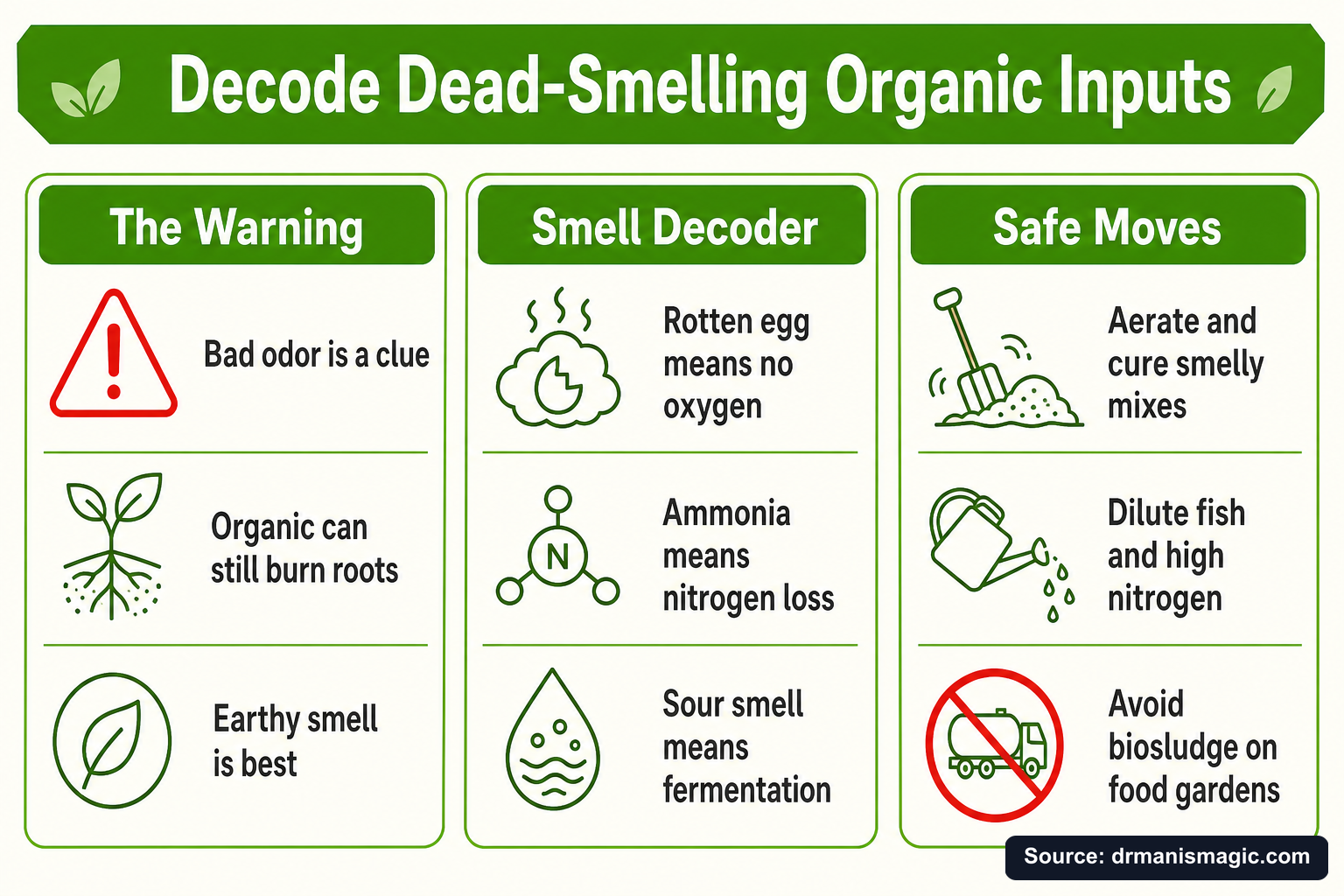
- The "death smell" in organic inputs usually signals anaerobic decomposition, not product quality or immediate danger to your plants.
- Different smells mean different things: ammonia means nitrogen loss, rotten egg means oxygen-starved decomposition, and sour/silage smell means fermentation.
- Organic does NOT mean salt-free. Some organic inputs can still burn roots, stress plants, and kill beneficial microbes if misused or over-applied.
- Biosludge-based fertilizers (made from treated municipal waste) can contain PFAS "forever chemicals" and should be avoided for food gardens and lawns.
- The safest organic inputs feed your soil microbes first, which then gently convert nutrients into forms your plant roots can absorb slowly and steadily.
- A stable, low-odor organic fertilizer is a sign of good processing, not weak nutrition. Earthy smell is good. Sewage smell is a warning.
- The Three Plant Pillars framework (mineral soil, live microbes, organic fertilizer) gives every plant the foundation it needs to thrive without the guesswork.
What Does the Smell of an Organic Fertilizer Actually Mean?
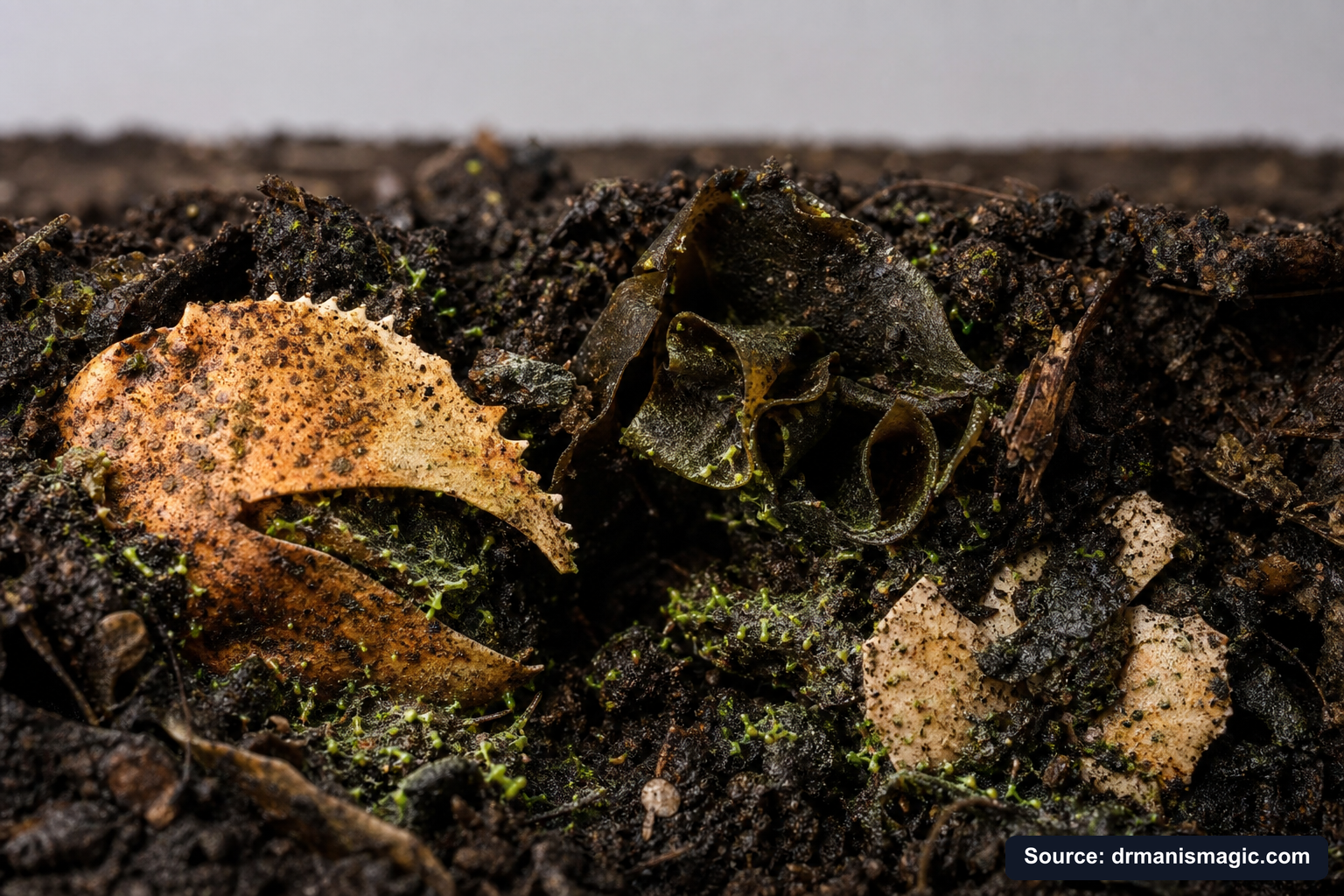
Quick Answer: The smell coming from organic fertilizers tells you what kind of microbial activity is happening inside the product. Rotten egg smell means low-oxygen decomposition. Ammonia smell means nitrogen is escaping into the air instead of feeding your plants. Earthy smell means healthy aerobic biology. The smell is a diagnostic clue, not just a nuisance.
Your nose is one of the best gardening tools you own. Seriously. The compounds that create those awful smells are not random. They are the chemical fingerprints of specific microbial processes happening inside that bag or bucket.
Cornell University's Composting program explains that when organic matter breaks down without enough oxygen, microbes shift into a different mode entirely. Instead of clean aerobic breakdown, they produce reduced sulfur compounds like hydrogen sulfide (that is your rotten egg smell), dimethyl sulfide, methanethiol, volatile fatty acids, and amines. These are the same compounds responsible for the smell of swamps, sewage, rotting meat, and decay. It is not a coincidence. It is chemistry.
When the same organic matter breaks down with plenty of oxygen, aerobic microbes do the work instead. They produce far fewer offensive gases. The result smells earthy, clean, almost sweet. Like fresh rain on good soil. That earthy smell is a green flag. It means biology is working the way it should.
The chart below gives you a quick smell decoder for the most common organic inputs.
| Smell | Likely Compounds | Microbial Condition | Common Sources | Plant Risk | What To Do |
|---|---|---|---|---|---|
| Rotten egg / sulfur | Hydrogen sulfide, dimethyl sulfide | Anaerobic (no oxygen) decomposition | Wet compost, waterlogged manure, fish hydrolysate stored improperly | Root toxicity if applied directly; promotes root rot pathogens like Pythium and Phytophthora | Aerate the product, add carbon, let it cure before applying |
| Ammonia / urine | Ammonia (NH3) | Excess nitrogen relative to carbon; immature compost | Manure, blood meal, fish emulsion, feather meal, high-protein hydrolysates | Direct root burn; nitrogen loss into air instead of feeding plant | Mix with carbon-rich material (straw, wood chips); dilute before applying; compost longer |
| Sour / silage / vinegar | Volatile fatty acids (acetic, butyric acid) | Fermentation; anaerobic conditions with sugary or starchy feedstocks | Immature compost, fermented fish, anaerobic digestate | Low pH stress; can inhibit seed germination and root growth | Aerate and cure; do not apply to seedlings or container plants |
| Sewage / carrion | Amines, putrescine, cadaverine, skatole | Protein putrefaction; deep anaerobic decomposition | Biosolids, improperly processed municipal compost, raw sewage sludge | Possible PFAS contamination; pathogen risk; do not use on food crops | Avoid use on vegetables, fruit trees, and lawns where children or pets play |
| Fishy | Trimethylamine, dimethylamine | Fish protein decomposition; can be aerobic or anaerobic | Fish emulsion, fish meal, fish hydrolysate | Usually low plant risk if diluted; attracts pets and pests; strong odor can linger for days | Dilute well; avoid use near indoor plants or in enclosed spaces; water in immediately |
| Manure / barnyard | Ammonia, hydrogen sulfide, methane | Mix of aerobic and anaerobic; dependent on age and moisture | Raw or composted manure, worm castings (if wet) | Fresh manure can burn roots; aged manure is generally safe | Age or compost before applying; keep away from root zones if fresh |
| Earthy / forest floor | Geosmin and other aerobic metabolites | Healthy aerobic decomposition; Actinomycetes bacteria active | Mature compost, stable microbial inoculants, well-processed organic fertilizer | No plant risk; sign of healthy biology | Apply with confidence |
| Chemical / salty crust on soil | Soluble salts; sodium, chloride, sulfate compounds | Not a microbial signal; osmotic stress indicator | Over-applied synthetic fertilizer; some heavy-use organic inputs | Salt damage, physiological drought, root burn, microbial die-off | Leach soil with water; stop fertilizing; switch to low-salt organic inputs |
Can the Rotten Egg Smell in Soil Mean Root Rot Is Already Happening?
Quick Answer: Yes. When your soil smells like rotten eggs near the root zone, it can mean anaerobic conditions have already developed underground. Low-oxygen soil is the exact environment where root rot pathogens like Pythium and Phytophthora thrive. The smell is a warning sign that your roots may already be under attack.
This is the part most gardening articles skip over. They explain what causes the smell in a bag. But they do not connect the dots to what is happening six inches underground where your roots live.
Here is what actually happens. When soil stays too wet for too long, the air pockets in the soil fill with water. Oxygen disappears. The aerobic microbes that normally protect your roots and break down nutrients start to die off or go dormant. Anaerobic microbes move in. They produce hydrogen sulfide and other toxic compounds. And certain water mold pathogens, especially Pythium and Phytophthora, absolutely love this environment. They attack the soft root tissue. The roots turn brown, mushy, and dead.
Your plant starts showing symptoms above ground. Yellowing leaves. Wilting even when the soil is wet. Dropping leaves. No new growth. You water more because it looks thirsty. That makes it worse. It is a vicious cycle.
The rotten egg smell rising from your soil is your plant's distress signal. It is telling you the oxygen is gone, the good microbes are gone, and the bad actors have moved in. This is why mineral-based soil structure matters so much. Soil that drains properly never gives anaerobic conditions a chance to develop in the first place.
Does Organic Fertilizer Smell Like That Because It Is Working?
Quick Answer: Not exactly. A strong death smell usually means the product was stored in poor conditions, has gone anaerobic, or contains high-protein ingredients that are actively putrefying. A healthy, well-processed organic fertilizer should smell earthy at most. The smell of sewage or carrion is not proof of potency. It is proof of poor processing.
There is a popular myth in gardening circles that says the worse an organic fertilizer smells, the stronger it is. The idea being that the more intense the decomposition, the more nutrients must be packed in there.
This is not accurate. And it has led a lot of good gardeners to suffer through fish emulsion on their houseplants, or coat their raised beds in something that smells like a storm drain, thinking they were doing the right thing.
Here is what is actually true. The smell is a signal about the process, not the potency. A beautifully processed organic fertilizer made from crab shells, cold-processed kelp, and amino acids can deliver all twelve essential nutrients a plant needs, including nitrogen, phosphorus, potassium, calcium, magnesium, iron, zinc, boron, and more, without smelling like anything worse than a walk in the woods after rain.
We built Crab, Kelp & Amino Acids specifically because we were tired of the smell problem. After growing over 250,000 citrus trees at our South Texas nursery, we knew there had to be a better way. And there was. Stable, well-processed inputs that smell like earth, not sewage. Your garden should be a place you want to be in every single day. Not just the twelve days of the month when the smell has dissipated.
What Does "Organic Does Not Mean Salt-Free" Actually Mean for Your Plants?
Quick Answer: Some organic fertilizers, especially those made from heavily processed animal byproducts or over-applied at high rates, can still deposit soluble salts in the soil. These salts create osmotic stress, meaning the plant's roots cannot pull in water even when the soil is wet. This is sometimes called physiological drought, and it can scorch leaves, stunt growth, and kill roots.
This is one of the most important things we can teach you. And almost nobody talks about it.
The word "organic" on a label does not guarantee the product is gentle on your soil. It means the nutrients come from carbon-based sources. That is a different thing entirely. Some organic inputs, especially blood meal, high-protein fish hydrolysates, and certain composted manures, can have a significant salt index when applied in large quantities.
Salt in the soil creates a physics problem. Plant roots absorb water through osmosis, which means water naturally flows from low-salt areas (the soil) into high-salt areas (the root). But when salt levels in the soil get too high, that flow reverses. Water is actually pulled OUT of the root instead of into it. The plant wilts. The leaf tips turn brown and crispy. Growth stops. In severe cases, roots die. This is called osmotic stress or physiological drought.
And salt does one more terrible thing. It kills your soil microbes. The beneficial bacteria and fungi that protect your roots, unlock nutrients, and build long-term soil health cannot survive high salt environments. Wipe them out and your plant loses its entire underground support system.
The University of California Agriculture and Natural Resources extension warns that soluble salts from over-applied fertilizers are one of the leading causes of container plant decline, even when those inputs are labeled as organic. (ucanr.edu)
See also: Organic Does Not Mean Salt-Free: How Salt-Based Feeding Quietly Destroys Root Systems
How Do Synthetic Fertilizers Cause Root Rot Through Salt?
Quick Answer: Synthetic fertilizers are made from salt-based compounds. When applied to soil, these salts raise the salt concentration around the roots, triggering osmotic stress and physiological drought. They also directly damage the beneficial microbes that protect roots, leaving plants defenseless against Pythium, Phytophthora, and other root rot pathogens.
Let us walk through exactly how this happens, step by step, because it is one of the most important things any plant owner can understand.
Step one: You apply a synthetic fertilizer. It dissolves quickly in the soil water. This is what makes it look like it "works fast." You see a burst of green growth within days.
Step two: But all those dissolved mineral salts raise the salt concentration in the soil water around the roots. The roots begin to experience osmotic stress. Water is being pulled away from them instead of into them.
Step three: The beneficial microbes in the root zone, the bacteria and fungi that naturally protect roots from disease, cannot tolerate the high salt environment. Their populations crash. Cornell University's research on soil biology confirms that high salt inputs significantly reduce microbial diversity and activity in the root zone. (composting.css.cornell.edu)
Step four: With the protective microbial community gone and the roots already stressed, Pythium and Phytophthora have a wide open door. These water mold pathogens move in. Root rot begins. The roots turn brown and mushy. The plant starts to decline.
Step five: You apply more fertilizer because the plant looks pale and sad. The cycle gets worse.
This is not a rare outcome. This is the predictable, repeatable result of using salt-based inputs on plants that were designed by nature to receive nutrition in a completely different way. Slow. Gentle. Delivered through living biology.
See also: The Hidden Reason Synthetic Fertilizers Cause Root Rot
How Does the Right Organic Fertilizer Actually Feed Your Plants?
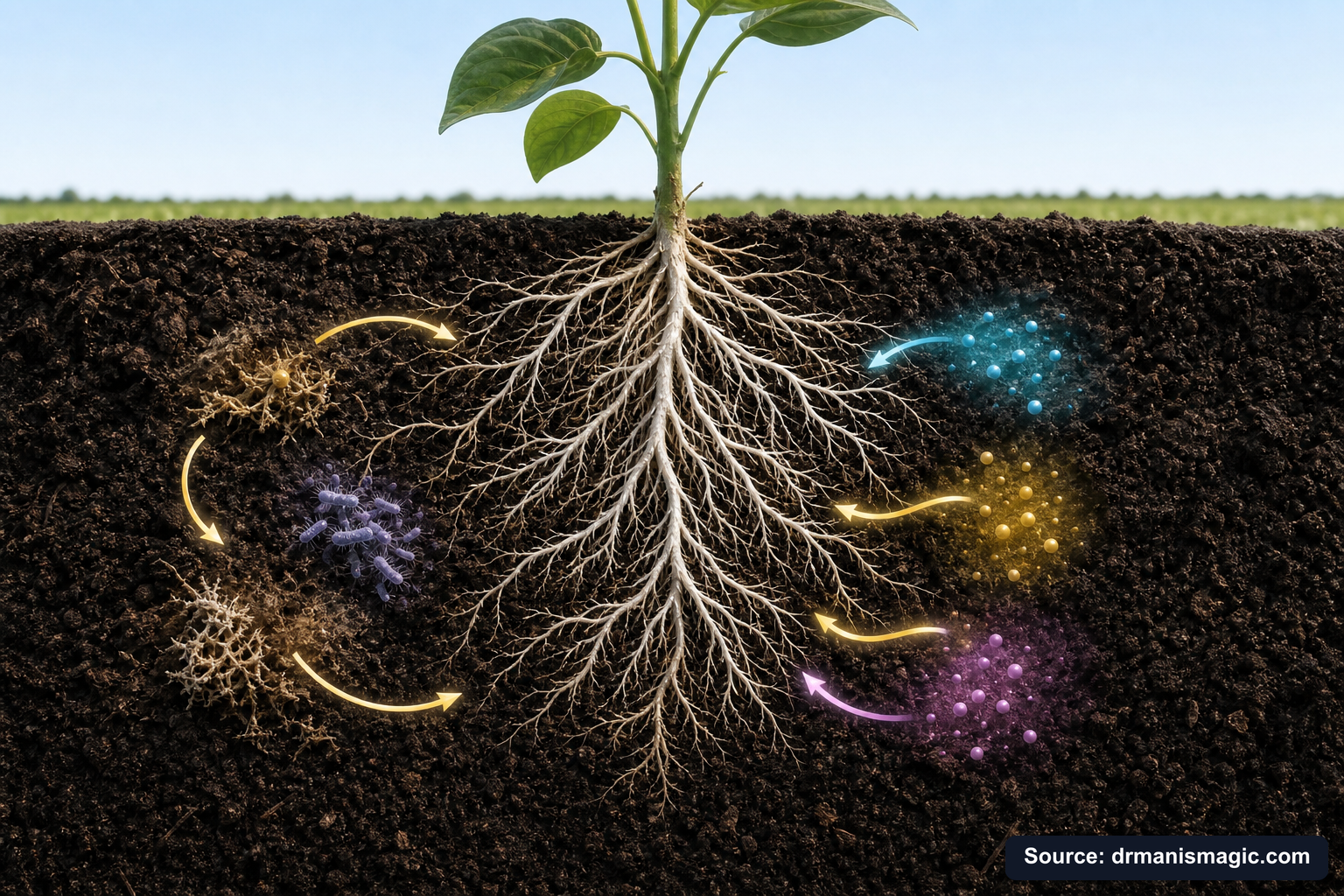
Quick Answer: A well-made organic fertilizer feeds your soil microbes first. The microbes eat the organic matter, digest it, and convert it into simple nutrient forms the plant can absorb. When those microbes eventually die, they release another round of nutrients directly into the root zone. This creates a slow, continuous, self-renewing feeding cycle that mirrors exactly how plants eat in nature.
This is the mechanism that changes everything. And once you understand it, you will never look at fertilizer the same way again.
Think about a forest. Nobody fertilizes a forest. Nobody shows up with a bag of anything. Yet those trees grow massive, produce fruit and seeds, fight off disease, and live for centuries. How?
The answer is living soil. Billions of bacteria, fungi, and other microorganisms break down leaves, wood, and other organic matter. They convert raw organic material into simple mineral forms: nitrate, phosphate, potassium ions, trace minerals. The plant roots absorb exactly what they need, when they need it. Nothing is wasted. Nothing burns. The whole system feeds itself.
That is what a good organic fertilizer recreates in your garden or container. When you apply something like granular crab meal, kelp, or amino acid-based fertilizer, the microbes in your soil go to work on it immediately. They eat it. They convert it. They release nutrients slowly into the root zone over weeks and months. And when those microbes eventually die, their bodies themselves become a nutrient source for the next generation of microbes and for the plant roots directly. It is a living, self-sustaining system.
Contrast that with synthetic fertilizer. It dumps a flood of dissolved salts into the soil all at once. The plant gets a shock of nutrients it cannot fully use. The excess burns roots and kills microbes. And then it is gone. You have to apply again. And again. Your plant becomes dependent on you like a patient on an IV drip, rather than a healthy organism feeding itself from a living ecosystem.
The slow-release pace of organic nutrition is not a limitation. It is the feature. It is the natural pace that plant roots evolved over millions of years to expect and use efficiently.
You Never Had a Brown Thumb.
You were handed the wrong tools. This free guide hands you the right ones.
You watered it. You fed it. It died anyway.
It was never you. It was the dirt, the salt food, and the bad advice.
This guide shows you what really went wrong, and how to fix it for good.
- Why your plants really died, and why it was never your fault
- The salt hiding in your plant food that quietly burns the roots
- The hidden killer in almost every bag of store soil
- The tiny helpers that grow a whole forest for free
- The rescue trick that brings a half dead plant back to life

What Makes Crab Shells, Kelp, and Amino Acids Special as Plant Inputs?
Quick Answer: Crab shells deliver chitin, calcium, and magnesium, which activates natural disease resistance in plants. Cold-processed kelp brings natural plant growth hormones, trace minerals, and carbohydrates that stimulate root growth and stress tolerance. Amino acids provide a direct, plant-ready nitrogen source that bypasses many conversion steps and supports rather than harms soil microbes.
Let us break each one down, because each ingredient does something distinct and powerful.
Crab Shells and Chitin. Chitin is the structural material that makes up crab shells. It is also the same material found in the cell walls of many harmful soil fungi and the exoskeletons of many pest insects. When you add chitin to the soil, your plants and soil microbes recognize it as a signal that a threat is nearby. The plant activates its natural immune response. It builds stronger cell walls. It produces compounds that resist disease. At the same time, beneficial bacteria called chitinase-producing bacteria multiply in the presence of chitin and actually consume harmful fungal pathogens directly. It is a built-in biological defense system triggered by a single ingredient.
Cold-Processed Kelp. Kelp from the ocean is packed with natural plant hormones called auxins and cytokinins. These hormones signal plant roots to grow longer and branch more widely. They tell the plant to push new growth. They also help the plant tolerate stress, whether that is heat, cold, drought, or transplant shock. Cold processing is critical here because heat destroys these delicate hormones. A kelp that has been heat-processed is a kelp that has lost most of its biological activity. The trace minerals in kelp, including iodine, selenium, and dozens of others, fill in the gaps that even a complete fertilizer program can miss.
Amino Acids. Proteins are made of amino acids. And nitrogen is the central atom in every amino acid molecule. When your fertilizer delivers nitrogen in amino acid form, the plant can absorb it directly through its roots with very little conversion required. This is faster and gentler than waiting for microbial conversion of larger protein chains. It also means less nitrogen is lost to the atmosphere as gas, which is what happens when ammonia-heavy inputs are applied. Amino acid nitrogen supports your microbes instead of bypassing them. It is cooperation, not competition.
What Is Biosludge and Should You Worry About PFAS in Organic Fertilizer?
Quick Answer: Biosludge is treated municipal wastewater solids, sometimes called "biosolids," that are used as filler in some fertilizers, both synthetic and organic. These materials can contain PFAS "forever chemicals," which do not break down and can accumulate in soil, plant tissue, and groundwater. For food gardens, lawns where children play, and container plants, this is a serious concern worth checking on every label.
This is the part of the organic fertilizer conversation that almost nobody wants to have. But it matters too much to skip.
PFAS stands for per- and polyfluoroalkyl substances. They are a class of thousands of synthetic chemicals used in nonstick cookware, food packaging, firefighting foam, and industrial processes. They are called "forever chemicals" because they do not break down in the environment or in the human body. They accumulate over time.
The U.S. Environmental Protection Agency and several state agricultural departments have confirmed that biosolid-based fertilizers and soil amendments can contain PFAS at levels that migrate into crop tissue, especially in leafy vegetables and root crops. The problem is that biosolids are cheap and plentiful, which makes them attractive as filler material for fertilizer manufacturers trying to reduce costs.
The label will rarely say "biosludge." Look instead for terms like "biosolids," "treated municipal waste," "Class A or Class B biosolids," or vague ingredients like "processed organic material" without a clear source. If the ingredient list does not specifically tell you where the nitrogen and phosphorus come from, it is worth asking.
At Dr. Mani's Magic, our Crab, Kelp & Amino Acids contains zero biosludge, zero PFAS, and zero synthetic salt fillers. Every ingredient is clearly sourced. That is not a marketing line. It is a promise we make because Dr. Mani's own family eats fruit from trees fertilized with these products. We would not put anything in the bag that we would not want in our own food.
Organic vs. Synthetic vs. Clean Organic: How Do They Actually Compare?
Quick Answer: Synthetic fertilizers act fast but leave salt damage and dead microbes behind. Low-quality organic fertilizers can still carry PFAS, ammonia toxicity, or anaerobic odors. Clean organic inputs like crab, kelp, and amino acids deliver complete nutrition slowly, feed microbes instead of killing them, and carry no salt, no biosludge, and no forever chemicals.
Here is the full comparison so you can see it clearly in one place.
| Feature | Synthetic Fast-Release | Low-Quality Organic (Manure, Biosludge) | Clean Organic (Crab, Kelp, Amino Acids) |
|---|---|---|---|
| Release speed | Immediate (flood then famine) | Variable; can be fast if anaerobic | Slow and steady; mirrors nature |
| Salt content | Very high (salt-based chemistry) | Moderate to high if over-applied | Very low; no salt-based compounds |
| Effect on microbes | Kills beneficial bacteria and fungi | Can suppress microbes if ammonia-heavy | Feeds and supports microbes |
| Root rot risk | High (salt stress + no microbial protection) | Moderate (ammonia or waterlogging) | Very low when soil drains well |
| PFAS / biosludge risk | Some products use biosolid fillers | High risk; biosolids are common fillers | Zero; clean, sourced ingredients only |
| Smell | Chemical / mineral | Sewage, manure, ammonia, or carrion | Earthy to mild; no offensive odor |
| Long-term soil health | Degrades over time; soil becomes dependent | Can improve if well-composted; risk if not | Builds long-term biological health |
| Safe for food gardens? | Residue concerns; plastic-coated prills | PFAS risk from biosolids; pathogen risk if raw | Yes; safe for vegetables, fruit trees, herbs |
| Safe for containers? | High salt accumulation risk | Ammonia toxicity risk if over-applied | Ideal for containers; no burn risk |
How Can You Tell If Your Plant Has Salt Damage, Overwatering, or True Root Rot?
Quick Answer: Salt damage shows as brown, crispy leaf edges and white crusty deposits on soil or pot surfaces. Overwatering shows as soft, yellowing leaves and soggy soil. True root rot shows as mushy, brown roots with a rotten smell coming from the soil, often alongside wilting that does not improve when you water. Each needs a different fix.
These three problems look very similar from above the soil. But the cause and the cure are completely different. Getting the diagnosis wrong can make things much worse.
| Symptom | Salt Damage / Osmotic Stress | Overwatering (No Root Rot Yet) | True Root Rot (Pythium / Phytophthora) |
|---|---|---|---|
| Leaf color | Brown tips and edges; scorched look | Pale yellow; uniform fading | Yellow to brown; rapid decline |
| Leaf texture | Dry and crispy at edges | Soft, limp, waterlogged feel | Wilted even when soil is wet |
| Soil surface | White or tan crusty deposits | Consistently wet; possible algae | Wet; may smell like rotten eggs |
| Root appearance | Tips may be burned; otherwise intact | White to tan; healthy if caught early | Brown, mushy, slimy; fall apart when touched |
| Soil smell | Chemical or salty | Musty or stale | Rotten egg or sewage |
| Primary cause | Over-fertilization; salt accumulation | Too frequent watering; poor drainage | Anaerobic soil; pathogen invasion; often follows overwatering |
| Fix | Flush soil deeply with water; stop fertilizing; switch to low-salt organic | Allow soil to dry; improve drainage; reduce watering frequency | Remove affected roots; repot in well-draining mineral soil; add live microbes; reduce watering |
What Is the Recovery Checklist If Your Plant Shows Root or Salt Damage?
Quick Answer: Recovery is possible in most cases if you act quickly. The key steps are to stop the damage source, improve drainage, remove dead roots, reintroduce beneficial microbes, and switch to a clean, slow-release organic nutrition program. Speed matters because roots that die cannot come back, and the longer the bad conditions last, the more of your plant's future you lose.
Here is exactly what to do, in order.
- Stop applying whatever you suspect caused the problem. Whether it is a smelly organic input, a synthetic fertilizer, or an overwatering habit, halt it immediately. You cannot fix a wound while the injury is still happening.
- If salt damage, flush the soil deeply. Water slowly and heavily, allowing water to run out the bottom of the container or move through the garden bed. Do this two to three times over a week. You are physically washing the accumulated salts out of the root zone. This is called leaching.
- Check the roots. Gently remove the plant from its container or carefully dig near the root ball. Healthy roots are white or light tan and firm. Rotted roots are brown, soft, and may smell like sulfur or decay. Cut off all mushy roots with clean scissors or pruners.
- Repot or amend with mineral-based, well-draining soil. Organic potting mixes based on pine bark and peat hold too much moisture and break down over time, creating exactly the anaerobic conditions that root rot loves. A mineral-based soil with sand, silica, and good pore structure keeps oxygen in the root zone. See our Super Soil for what that looks like in practice.
- Reintroduce beneficial microbes. The salt or anaerobic conditions that hurt your plant also wiped out the protective microbial community in the root zone. A live microbial inoculant with bacteria, fungi, and mycorrhizae will begin rebuilding that protective ecosystem within days. This is not optional if you want real recovery.
- Feed gently with a low-salt organic fertilizer. Your plant's roots are already stressed. They do not need a flood of nutrients right now. They need a slow, gentle trickle of complete nutrition that supports the microbes doing the recovery work. Start with a half-rate application of a clean organic granular fertilizer.
- Be patient and let biology work. Recovery does not happen in three days. It happens over weeks and months. Watch for new leaf growth and new root development as signs that the system is healing. Do not panic and over-fertilize to "speed things up." That will undo everything.
Why Does the Three Plant Pillars System Prevent Most of These Problems From Starting?
Quick Answer: The Three Plant Pillars framework, developed and proven across 250,000+ trees at US Citrus Nursery in South Texas, eliminates the root causes of most plant problems before they begin. Mineral-based soil keeps oxygen in the root zone. Live microbes protect roots and convert nutrients naturally. Clean organic fertilizer feeds biology without salt, without PFAS, and without the guesswork.
Every problem we have talked about in this article, rotten egg smell, root rot, salt damage, PFAS contamination, ammonia toxicity, dead microbes, all of them share a common thread. They happen when we try to shortcut the natural order of how plants actually grow.
Dr. Mani Skaria spent 40 years as a plant pathologist and citrus scientist, first at the Texas A&M Citrus Center and then at our own nursery in Hargill, South Texas. He watched synthetic fertilizers burn roots he had spent years building. He watched organic inputs applied without understanding cause anaerobic conditions and root rot just as damaging as anything synthetic. He watched plants struggle and die while growers spent more and more money chasing symptoms instead of fixing the cause.
And he distilled everything he learned into three non-negotiable foundations.
Pillar One: Mineral-Based Soil. Soil that does not decompose, does not compact, does not steal oxygen, and does not go anaerobic. Sand, silica, and mineral structure that keeps the root zone breathing no matter how much you water.
Pillar Two: Live Microbes. Bacteria, fungi, and mycorrhizae that rebuild the underground ecosystem your plant evolved in. These organisms protect roots, unlock nutrients, and create a self-sustaining biological community that makes your plant resilient instead of fragile.
Pillar Three: Clean Organic Fertilizer. Complete nutrition in a slow-release, biology-friendly form. No salts. No biosludge. No PFAS. No ammonia spikes. Just the full spectrum of macronutrients and micronutrients delivered at the pace nature intended, through the living biology you just put in place.
When all three pillars are working together, the conditions that create rotten egg smells, root rot, salt burn, and plant death simply do not develop. The soil drains. The oxygen stays. The microbes thrive. The nutrients arrive slowly. The plant grows the way it was designed to grow.
This system works for citrus trees. It works for roses, tomatoes, grass lawns, orchid houseplants, raised vegetable beds, ornamental shrubs, and container tropical trees. We have tested it on all of them. The biology does not care what species you are growing. It just needs the right foundation.
You can learn the full system and get started with a personalized plan through our Free Plant Care Field Guide, which walks you through the Three Plant Pillars step by step for your specific plants and growing situation.
A Closing Word About Time
Here is something Dr. Mani hears more than almost anything else from the gardeners who come to him. They want to see fruit on their own tree while they still have the years to enjoy it. They want to sit in their backyard, smell a lemon they grew themselves, and know they figured it out. That feeling is not small. It is deeply human. It is why we garden at all.
And the tragedy of bad inputs, smelly anaerobic fertilizers, salt-based synthetics, biosludge-contaminated amendments, is not just that they waste money. It is that they waste time. You apply something that sets your plant back six months. You try something else. That sets it back again. Two years go by and you are further behind than when you started. You cannot get those years back.
The right foundation, the right soil, the right microbes, the right clean organic nutrition, does not just grow better plants. It grows them faster, on a timeline that actually works in your favor. And it does it without making your backyard smell like a sewage treatment facility.
If you are ready to stop guessing and start building on a foundation that actually works, explore the Three Plant Pillars system and see how all three pieces fit together for your garden, your lawn, your trees, and every plant you want to grow. We have a 30-day money-back guarantee. No fine print. No runaround. Just results, or your money back.
Your plants are waiting. And so is the garden you have been picturing.
Frequently Asked Questions
You opened a bag of "organic" fertilizer and the smell stopped you cold. Now you have questions. Good. These are the exact questions Dr. Mani gets asked all the time, and the answers could save your plants, your lawn, and a whole lot of wasted time and money.
Why does organic fertilizer smell so bad?
That bad smell is a clue, not just a nuisance. When organic matter breaks down without enough oxygen, it produces gases like hydrogen sulfide and ammonia. Those gases smell like rotten eggs, sewage, or dead fish. It means the biology inside that bag went wrong. A good organic fertilizer should smell earthy, not like something died. At Dr. Mani's Magic, our Crab, Kelp, and Amino Acids fertilizer smells clean because it is processed the right way.
Does a bad smell mean the fertilizer will hurt my plants?
Not always, but it is a warning sign you should not ignore. A strong ammonia smell means nitrogen is escaping into the air instead of feeding your plants. A rotten egg smell means harmful gases are present that can stress roots. And any fertilizer that has gone anaerobic can disrupt the living microbes in your soil. Those microbes are Pillar Two of the Three Plant Pillars, and they are too important to gamble with.
Is fish emulsion safe to use on indoor plants or food gardens?
Fish emulsion works, but it comes with a serious problem. It can go anaerobic fast, especially indoors. When that happens, it smells like rotting sewage. People report that it makes pets sick and makes their home unbearable for days. For food gardens and indoor plants, you want a fertilizer that feeds your soil without making your space smell like a fish dock. That is exactly why Dr. Mani chose crab, kelp, and amino acids instead.
What does a good organic fertilizer smell like?
It should smell like earth after rain. Clean. Almost sweet. That earthy smell tells you aerobic microbes did their job right. The biology is healthy. The nutrients are stable and ready to feed your plants slowly and steadily. When you open a bag of Dr. Mani's Magic fertilizer, that is what you get. No fish market. No sewage. Just clean, earth-born nutrition that your plants, your nose, and your family can all live with.
Can organic fertilizers still burn plant roots?
Yes, they can. Organic does not automatically mean gentle. Some organic inputs are high in salts or break down so fast they release too much nitrogen at once. That burns roots just like synthetic fertilizers do. The difference with slow-release organic fertilizers made from crab, kelp, and amino acids is that nutrients release gradually. Your soil microbes convert them at a pace your plant roots can actually use. No burn. No stress. Just steady growth.
What is biosludge fertilizer and should I avoid it?
Biosludge is made from treated municipal waste, meaning sewage. Some fertilizers labeled "organic" are made from this material. The problem is that biosludge can carry PFAS, which are called "forever chemicals" because they do not break down. You do not want those in your food garden or on your lawn where your kids and pets play. Every product in the Dr. Mani's Magic line is made in the USA from clean, known ingredients. No mystery materials. No shortcuts.
Why do Dr. Mani's Magic products not smell bad if they contain live microbes?
Because the microbes in Plant Super Boost are stabilized using a special all-natural process. They are alive and active, but they are not rotting. Rotting is what causes the death smell in most organic products. Our stabilized microbes sit quietly in the bottle, ready to go to work the moment you mix them with water and pour them on your plants. That is the same microbial technology Dr. Mani tested on over 250,000 citrus trees in South Texas before it ever went into a bottle for you.
About the Author
Ron Skaria, MD
Ron Skaria, MD, is the co-founder of Dr. Mani's Magic and the son of Dr. Mani. He trained as a medical doctor and now works full time on the family farm in Hargill, Texas, building Dr. Mani's Magic alongside his dad. He wrote the Brown Thumb Field Guide to put his father's 48 years of plant science into plain words any gardener can use. His belief is simple. You never had a brown thumb. You just never had the right help.


