


Why Organic Feeding Builds Resilience in Plants and Soil | Dr. Mani's Magic
Why Organic Feeding Builds Resilience: The Root-Zone Truth Your Plants Have Been Waiting For
Picture this. You walk out to your backyard on a warm Saturday morning. Coffee in hand. You stop in front of that fruit tree you planted two years ago. The one you had big dreams for. The one you imagined heavy with fruit someday.
Instead, you see yellowing leaves. Thin, weak branches. A plant that looks like it is barely hanging on. You have watered it. You have fertilized it. You have done everything the bag said to do. And still, it just... sits there. Struggling. Slowly losing ground. And somewhere in the back of your mind, a quiet fear creeps in: What if I never get to see this thing actually thrive?
Here is what nobody told you. That fertilizer you have been using? It is not feeding your plant. Not really. It is burning it from the inside out. It is killing the invisible army of microbes that your plant needs to survive. And every month you keep going down that road, you are not just wasting money. You are wasting time. Time you cannot get back. The good news? The fix is simpler than you think. And once you understand what is really happening underground, everything changes.

Organic Fertilizer | Crab, Kelp & Amino Acids
Key Takeaways
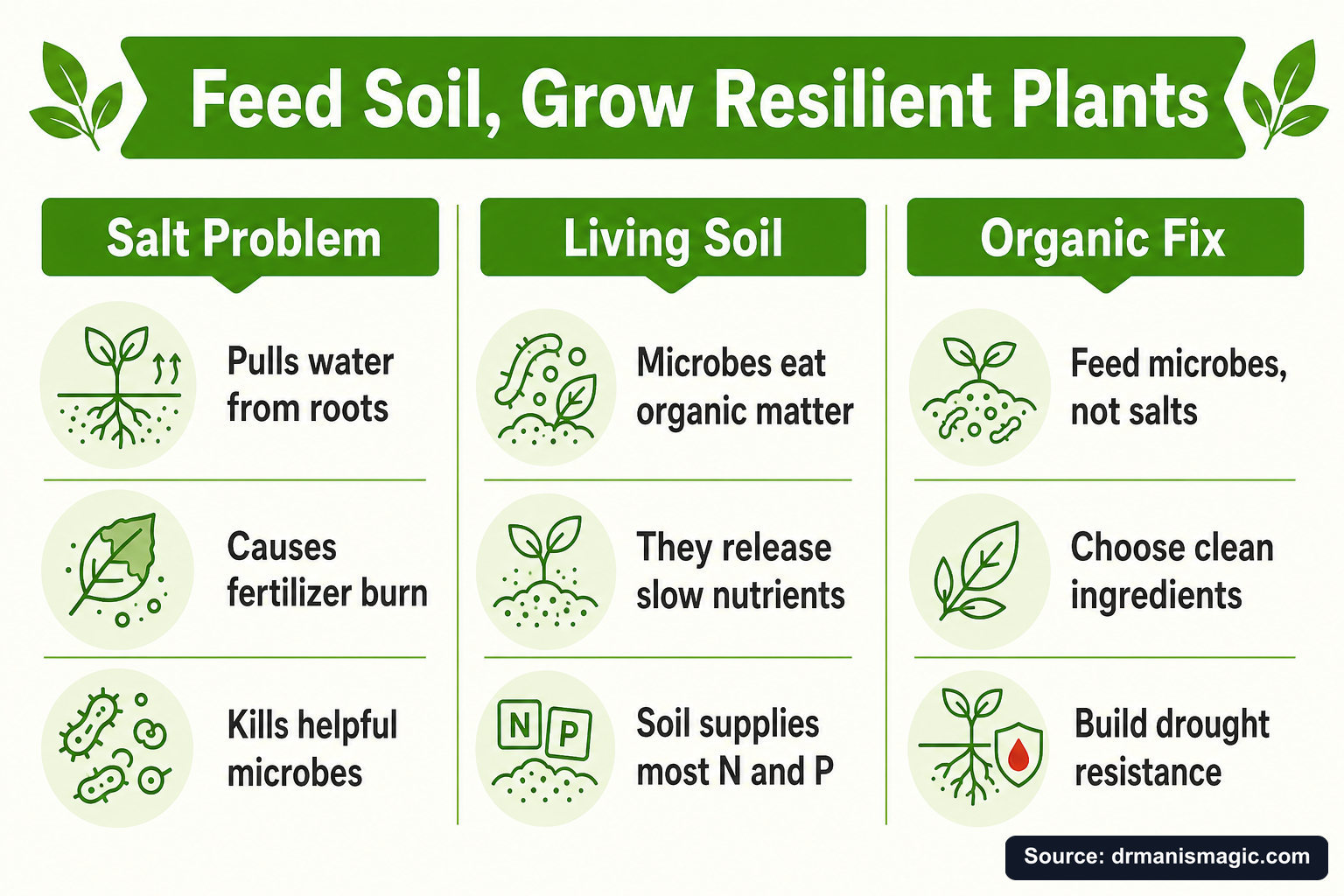
- Most synthetic fertilizers are salt-based, and that salt damages roots, kills beneficial microbes, and causes the very problems you are trying to fix.
- Organic fertilizer builds resilience by feeding the soil's living microbes first, which then convert nutrients into a gentle, steady stream the plant can actually use.
- University research shows that soil microbes supply roughly 75% of a plant's available nitrogen and 65% of its available phosphorus naturally.
- Healthy soil biology improves drought resistance, disease suppression, and nutrient retention all at the same time.
- Slow release is not a weakness. It is the natural pace plants evolved to thrive on.
- Some "natural" fertilizers contain biosludge and PFAS forever chemicals. Clean ingredients matter as much as organic labeling.
- The Three Plant Pillars — mineral soil, live microbes, and organic fertilizer — work together as one system, not three separate steps.
Why Do Synthetic Fertilizers Hurt Plants Instead of Helping Them?
Quick Answer: Synthetic fertilizers are made from salt-based compounds. When you apply them, the high salt concentration around your roots pulls water out of the plant instead of letting water in. This is called osmotic stress, and it is the same reason salt kills a slug. It also wipes out the beneficial microbes your plant depends on for long-term health.
Salt is the villain hiding in plain sight on the fertilizer shelf at your local big box store.
Here is the science in plain English. Plants drink water through their roots because the inside of the root contains a higher concentration of dissolved material than the water in the soil outside. Water naturally moves toward the more concentrated side. That is osmosis. It is basic biology.
When you pour a salt-heavy synthetic fertilizer around your roots, the salt outside the root becomes more concentrated than the inside. Suddenly, the water flow reverses. Water starts leaving the root. The plant wilts. The roots shrivel. Gardeners call this fertilizer burn. Scientists call it osmotic stress or physiological drought. Your plant calls it a crisis.
And while all of that is happening above ground, something equally bad is happening below. Salt is destroying the microscopic bacteria and fungi living in the soil around your roots. These are not just bystanders. They are the engine of your plant's immune system, its nutrient supply chain, and its long-term resilience. Once they are gone, your plant is on its own. Defenseless. Dependent on the next hit of synthetic salt just to stay alive.
The big chemical companies have known this for decades. And their solution? Sell you more fertilizer next season.
After growing over 250,000 trees at our South Texas nursery, we watched this cycle play out again and again. Plants that looked great for a few weeks after a synthetic feeding, then slowly declined. Yellowing leaves. Root rot. Pest pressure that seemed to come out of nowhere. It was not bad luck. It was predictable chemistry.
See also: How Salt-Based Feeding Quietly Destroys Root Systems
What Does Organic Fertilizer Actually Do Inside the Soil?
Quick Answer: Organic fertilizer does not feed your plant directly. It feeds the microbes in the soil first. Those microbes break the organic material down into simple nutrients, then release those nutrients slowly and steadily right into the root zone. It is a natural time-release system that keeps working long after you apply it.
This is the part most gardening articles skip right over. And it is the most important part.
When you sprinkle an organic granular fertilizer around your plant, nothing dramatic happens in the first hour. No immediate green surge. No overnight transformation. What happens instead is quieter, deeper, and far more powerful.
The microbes in your soil smell the organic material. Bacteria and fungi move toward it. They start eating it. Breaking it down. Converting it from complex proteins and carbon chains into simple mineral ions like nitrate and ammonium. The very forms your plant's roots are designed to absorb.
This process is called microbial mineralization. And it is the engine behind every forest, every meadow, every thriving garden that has ever existed without a fertilizer bag in sight.
But here is the part that makes it even better. When those microbes eventually die, their bodies become nutrients too. Every bacterium that ever lived in your soil is a tiny package of nitrogen, phosphorus, and trace elements. When it dies, it releases all of that directly into the root zone. Slow. Steady. Perfectly timed to what your plant needs.
University of Minnesota Extension explains that soil biological processes supply roughly 75% of plant-available nitrogen and 65% of plant-available phosphorus. Seventy-five percent. That is not a supplement. That is the main course.
Organic feeding is not slow because it is weak. It is slow because that is exactly how plants evolved to eat. Nature does not deliver a flood of salt-nitrogen all at once. It delivers a gentle, constant trickle from living soil. Organic fertilizer mimics that perfectly.
See also: Why Most Fertilizers Are Actually Salt in Disguise
How Does Salt in Fertilizer Actually Cause Root Rot?
Quick Answer: Salt buildup in soil damages fine root hairs and creates stress that weakens the plant's defenses. Weakened roots are easy targets for Pythium and Phytophthora, the water mold pathogens most responsible for root rot. Salt does not directly cause the rot, but it opens the door wide for the organisms that do.
Root rot sounds like a watering problem. And it can be. But most of the time, when we see root rot at our nursery, the real cause started with salt.
Here is how the sequence works. You apply a synthetic fertilizer with a high salt index. The salt damages fine root hairs. Those root hairs are the plant's primary nutrient and water absorbers. Damaged roots cannot take in water efficiently. The plant starts showing signs that look exactly like drought stress, even when the soil is wet. This is physiological drought. The water is there, but the roots cannot use it.
Now the soil around those damaged roots is stressed and oxygen-depleted. Wet, compacted, low-oxygen conditions are the perfect breeding ground for Pythium and Phytophthora, the two most common root rot pathogens in home gardens and containers. They move in fast. They spread through the root system. And by the time you see yellow leaves or wilting above ground, the damage underground is already severe.
The salt did not cause the rot by itself. But it weakened the roots, depleted the beneficial microbes that would normally fight those pathogens, and created the exact conditions those pathogens love. It is like leaving your front door open and turning off your alarm system at the same time.
Organic feeding keeps the door closed. It keeps the alarm on. Healthy microbes, especially fungi like mycorrhizae, form a protective web around roots that actively suppresses Pythium and Phytophthora. No salt. No damage. No invitation.
| Symptom | Salt Damage / Fertilizer Burn | Overwatering (Oxygen Deficiency) | True Root Rot (Pythium / Phytophthora) |
|---|---|---|---|
| Leaf appearance | Brown tips and edges; crispy margins | Yellow, drooping, soft leaves | Yellow to brown, limp, falling off |
| Root appearance | Brown, shriveled fine roots; firm larger roots | Brown, mushy roots; no firm white tips | Black, slimy, foul-smelling roots |
| Soil condition | White crusty salt deposits on surface | Waterlogged, soggy, dense | Often wet and compacted; poor drainage |
| Timing | Appears 24-72 hours after fertilizer application | Gradual over days to weeks of excess water | Sudden collapse, often after prolonged stress |
| Primary cause | Osmotic stress from high salt index | Lack of oxygen in root zone | Pathogen invasion of weakened roots |
| Best fix | Flush soil, switch to organic low-salt feeding | Improve drainage, reduce watering frequency | Remove infected roots, restore microbes, improve soil structure |
See also: The Hidden Reason Synthetic Fertilizers Cause Root Rot
Why Does Organic Feeding Make Plants More Drought-Resistant?
Quick Answer: Organic matter and the microbial activity it supports improve soil structure in a way that holds more water during dry periods and drains excess water during wet ones. This buffering effect means your plant is less vulnerable to swings in weather. Penn State Extension research confirms that high-organic-matter soils recover faster from both drought and flooding.
Soil with healthy organic matter is like a sponge with good judgment. It holds onto moisture when things get dry. It lets excess water drain when things get wet. And it does both without you having to think about it.
Here is what creates that sponge. Microbial activity builds something called soil aggregates. These are tiny clumps of soil particles held together by fungal threads and bacterial secretions. Aggregates create pores in the soil. Those pores hold air and water at the same time. Roots breathe through those pores. Water drains through them. Nutrients travel through them.
Synthetic salt feeding destroys aggregates over time. The salt kills the microbes that build them. The pores collapse. The soil compacts. Water either pools on the surface or runs straight through without being held. Your plant swings between drought stress and drowning stress, sometimes in the same week.
Penn State Extension specifically notes that soils with good organic matter levels rebound faster under drought or excess water than low-organic-matter soils. This is not a small difference. In a dry summer or a wet spring, it can be the difference between a thriving plant and a dead one.
Organic feeding builds those aggregates back. Every application adds carbon. Carbon feeds microbes. Microbes build structure. Structure holds water. Water keeps your plant alive when the weather turns ugly. The whole chain starts with what you put in the soil.
What Makes Crab Shells, Kelp, and Amino Acids Different From Regular Fertilizer?
Quick Answer: Crab shells bring chitin, calcium, and magnesium that trigger plant immune responses. Kelp delivers natural growth hormones, trace minerals, and carbohydrates. Amino acids provide a clean, low-salt nitrogen source that microbes love and plants absorb easily. Together they feed the whole system, not just one nutrient number on a label.
Let us walk through each ingredient. Because each one does something the others cannot.
Chitin From Crab Shells
Crab shells are loaded with chitin. Chitin is a complex natural compound, the same material that makes up insect exoskeletons and fungal cell walls. When chitin enters the soil, something remarkable happens. The microbes that break it down produce enzymes called chitinases. Those enzymes attack fungal pathogens and harmful nematodes. Your plant essentially gets a warning signal from the chitin that says: pest pressure is nearby. Get ready. The plant's immune system activates. It produces natural defense compounds before any attack even starts. This is not a chemical pesticide. It is biology working exactly the way it was designed to work.
Crab shells also bring calcium and magnesium. Calcium builds cell walls. Strong cell walls mean stronger stems, better fruit quality, and more resistance to cracking and blossom-end rot. Magnesium sits at the center of every chlorophyll molecule. No magnesium means no green. No photosynthesis. No growth.
Cold-Processed Kelp
Kelp is one of the fastest-growing organisms on earth. It pulls trace minerals directly from seawater. Every mineral your plant needs in tiny amounts — iron, zinc, manganese, copper, boron, molybdenum — kelp has it. And because those minerals come in a natural organic matrix, they are easier for soil microbes to process and easier for roots to absorb.
But the bigger story with kelp is the hormones. Kelp contains natural plant growth regulators called auxins and cytokinins. These are the same hormones that tell your plant when to grow roots, when to push new shoots, and when to set fruit. Cold-processed kelp preserves these hormones. Heat-processed kelp destroys them. The difference in root development you see from quality cold-processed kelp is not subtle. It is dramatic.
Kelp also delivers complex carbohydrates that feed soil microbes directly. Think of it as a meal for the living ecosystem around your roots. More food for microbes means more microbial activity. More microbial activity means more nutrients released to your plant. The cycle compounds.
Amino Acid Nitrogen
Conventional nitrogen fertilizers deliver nitrogen as a salt ion. Ammonium nitrate. Urea. These hit the soil hard, spike fast, and carry that high salt index that burns roots and kills microbes.
Amino acid nitrogen is different. Amino acids are the building blocks of protein. When plant proteins break down in the soil, they release amino acids. Microbes love amino acids. They eat them readily. And as they process those amino acids, they release nitrogen in a gentle, steady stream. The plant gets fed. The microbes get fed. Nobody gets burned.
Amino acid nitrogen also has a very low salt index compared to synthetic nitrogen sources. Your roots stay healthy. Your microbes stay alive. And your plant keeps growing instead of recovering from the last feeding.
Volcanic Ash and Trace Minerals
Volcanic ash brings silica and a spectrum of trace minerals that strengthen cell walls, improve drought resistance, and support overall plant resilience. Silicon is not always listed as essential, but research increasingly shows that plants with adequate silicon handle stress better. They are less susceptible to fungal attack. Their cell walls are physically harder for insects to penetrate. And they recover faster from heat and cold swings.
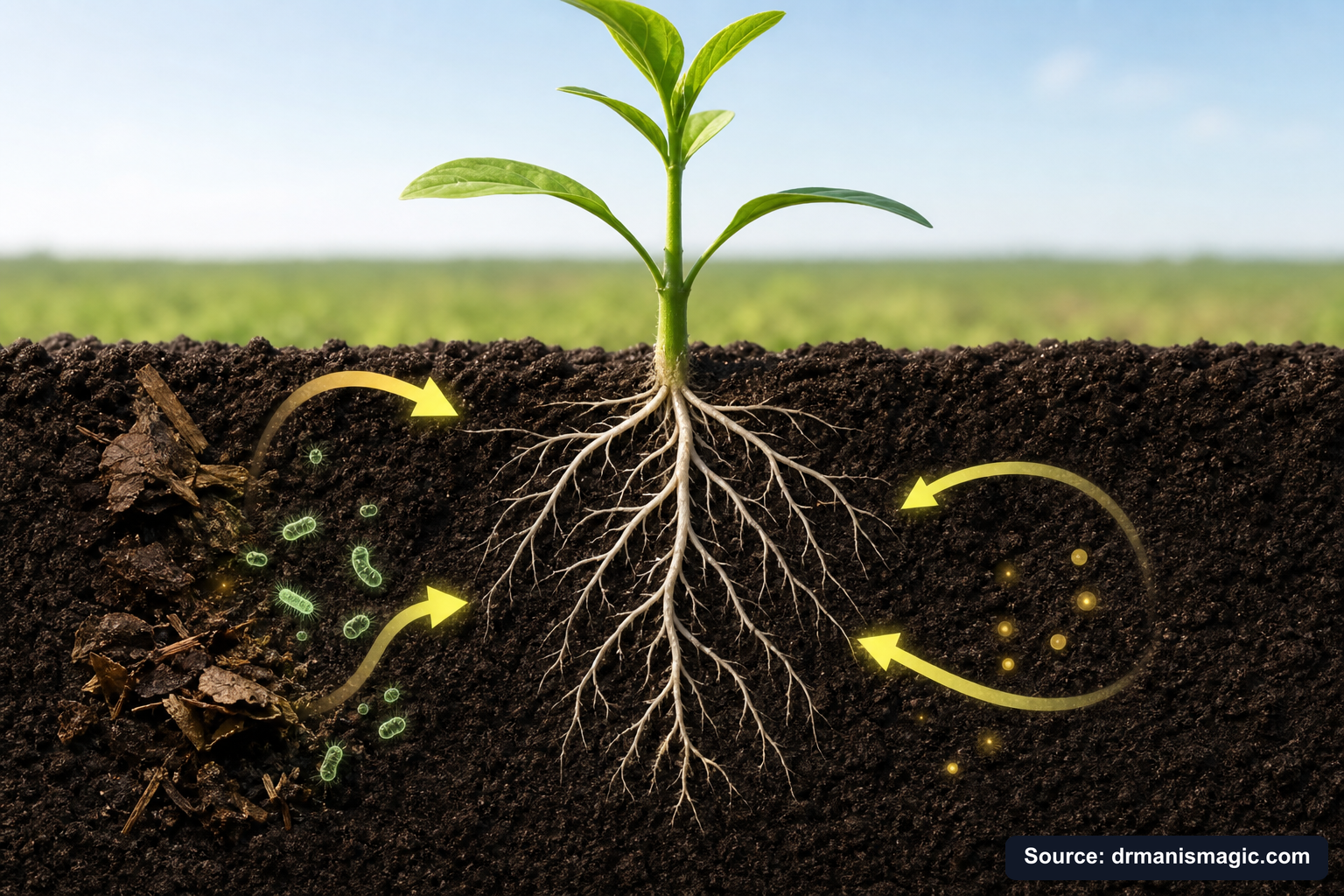
All of these ingredients work together in Crab, Kelp & Amino Acids, Dr. Mani's Magic's organic granular fertilizer formulated without synthetic salts, biosludge fillers, or PFAS forever chemicals.
You Never Had a Brown Thumb.
You were handed the wrong tools. This free guide hands you the right ones.
You watered it. You fed it. It died anyway.
It was never you. It was the dirt, the salt food, and the bad advice.
This guide shows you what really went wrong, and how to fix it for good.
- Why your plants really died, and why it was never your fault
- The salt hiding in your plant food that quietly burns the roots
- The hidden killer in almost every bag of store soil
- The tiny helpers that grow a whole forest for free
- The rescue trick that brings a half dead plant back to life

What Are PFAS and Biosludge, and Why Should You Care About Your Fertilizer Bag?
Quick Answer: Some fertilizers labeled "organic" or "natural" use biosludge, which is treated municipal waste, as a filler. Biosludge can contain PFAS, a class of synthetic chemicals that do not break down in soil, water, or the human body. These are called forever chemicals because they accumulate over time. Clean ingredient sourcing matters for your family, your pets, and your soil.
This one catches people off guard. You buy an organic fertilizer because you want something clean and safe. You do not want to poison your backyard. You definitely do not want your kids or your dog rolling around in treated sewage byproduct.
But some fertilizers that carry organic or natural labels use biosludge as a cheap filler. Biosludge is treated municipal waste. It is what gets left behind at wastewater treatment plants. Some of it contains PFAS, per- and polyfluoroalkyl substances, which are synthetic chemicals used in non-stick coatings, food packaging, firefighting foam, and hundreds of industrial applications. They are called forever chemicals because they do not break down. They accumulate in soil. They leach into groundwater. They build up in plant tissue. They build up in the human body.
This is not a fringe concern. The EPA has been tightening PFAS regulations for years precisely because contamination from biosolid fertilizers has shown up in farmland, drinking water, and food crops across the United States.
At Dr. Mani's Magic, our Crab, Kelp & Amino Acids contains zero biosludge, zero PFAS, and zero synthetic salt inputs. We know exactly where every ingredient comes from because we formulated this product ourselves to solve our own problems at our South Texas nursery. We would never put something on 250,000 trees that we would not feel comfortable having our own family touch.
When you are reading a fertilizer label, look for the ingredient list. If you see "biosolids," "sewage sludge," or vague terms like "processed organic waste," put it back on the shelf.
Organic Feeding vs. Synthetic Feeding: How Do They Actually Compare?
Quick Answer: Synthetic fertilizers deliver fast, concentrated, salt-heavy nutrients that spike and crash while damaging roots and soil biology. Organic feeding delivers slow, steady, biology-supported nutrition that builds soil structure, microbial health, and plant resilience over time. The short-term results look similar. The long-term outcomes are completely different.
Here is the honest side-by-side.
| Factor | Fast-Release Synthetic (Salt-Based) | Slow-Release Coated Synthetic | Organic / Chitin / Kelp / Amino Acids |
|---|---|---|---|
| Nutrient release speed | Immediate spike, then crash | Weeks to months, still salt-based | Weeks to months, microbe-mediated |
| Salt index / burn risk | High. Burns roots and fine root hairs | Moderate. Still salt when coating breaks | Very low. Almost no burn risk |
| Effect on soil microbes | Kills beneficial bacteria and fungi | Damages microbes when salt releases | Feeds and supports microbes |
| Soil structure over time | Destroys aggregates, causes compaction | Slowly degrades structure | Builds aggregates, improves porosity |
| Drought resilience | Reduces it. Salt causes physiological drought | Marginal improvement over fast-release | Improves it significantly |
| Disease pressure over time | Increases. Weaker roots, fewer protective microbes | Similar to fast-release long-term | Reduces. Chitin and microbes suppress pathogens |
| PFAS / biosludge risk | Possible, especially lower-cost brands | Plastic coating remains in soil | Zero when sourced cleanly |
| Best use case | Short-term display plants, not edibles | Short-term convenience in low-stakes settings | Any plant, lawn, garden, tree, houseplant, long-term |
| Container safety | Salts accumulate fast in pots | Moderate risk in containers | Safe for regular monthly container use |
The thing most gardeners never see is the hidden cost of the synthetic approach. The plant looks fine in month one. It looks okay in month three. But by month six, the soil is compacted. The microbes are depleted. The roots are thinner than they should be. The plant is more vulnerable to every stress that comes along. And then something goes wrong, a dry week, a disease, a cold snap, and the plant that seemed fine collapses fast. Because the foundation was never solid.
Organic feeding builds the foundation. Month after month, the soil gets better. The microbes multiply. The roots go deeper. The plant becomes what we call at the nursery practically bulletproof.
What Are the Three Plant Pillars and Why Does Fertilizer Only Work When All Three Are in Place?
Quick Answer: The Three Plant Pillars are mineral-based soil, live microbials, and organic fertilizer. Each one depends on the others. Great fertilizer in dead soil with no microbes delivers almost nothing. Great microbes in compacted, oxygen-poor soil cannot survive. The system only works when all three pillars are in place together.
Dr. Mani Skaria spent 40 years as a plant pathologist and Professor Emeritus at the Texas A&M Citrus Center. He invented micro-budding. He founded the Clean Citrus Program in Texas. He has seen more sick plants than most people ever will. And after all of that experience, he came back to the same three fundamentals every single time.
The Three Plant Pillars are not a marketing framework. They are a description of how plants actually work in nature.
Pillar One: Mineral-Based Soil. Roots need oxygen as much as they need water. Most commercial potting mixes are made from pine bark, wood chips, and other organic matter that starts decomposing the moment you open the bag. As it breaks down, it compacts. It steals oxygen from the root zone. It holds water in a way that promotes anaerobic conditions, the perfect environment for Pythium and Phytophthora. Mineral-based soil does not decompose. It holds its structure permanently. Roots can breathe. Water drains correctly. The foundation stays solid for years.
Pillar Two: Live Microbials. Bacteria, fungi, and mycorrhizae are not optional extras. They are the nutrient delivery system, the immune system, and the structural support team for every plant on earth. Without them, your plant is a building with no plumbing and no electricity. It might stand for a while, but it cannot function. Live microbials unlock bound nutrients, suppress root pathogens, extend root reach, and produce growth-promoting compounds your plant cannot make on its own.
Pillar Three: Organic Fertilizer and Biostimulants. This is where organic feeding completes the circuit. The right organic fertilizer does two things at once. It feeds the microbes that do the mineralizing work. And it delivers a complete spectrum of nutrients, macronutrients, micronutrients, amino acids, hormones, and trace minerals, in a form that is gentle enough to never burn and complete enough that you never have to chase individual deficiencies.
Take any one of those three away and you get a plant that struggles. Put all three in place and you get a plant that surprises you.
You can explore how all three work together through the Three Plant Pillars system we built at Dr. Mani's Magic, designed and proven at our South Texas nursery across 250,000-plus trees.
See also: Why Soil Structure Matters More Than Fertilizer
Does Organic Feeding Work for Lawns, Houseplants, and Gardens Too, or Just Fruit Trees?
Quick Answer: Organic feeding works for every plant that grows in soil: lawns, houseplants, ornamental gardens, vegetables, flowers, hedges, tropical trees, and fruit trees. The mechanism is the same across all of them. Microbes mineralize organic matter into plant-available nutrients. Healthy soil biology builds resilience. Salt-free feeding protects roots.
We get this question often. People hear about our work with citrus trees and assume the Three Plant Pillars only apply to one crop. They do not.
Grass has roots. Houseplants have roots. Roses have roots. Tomatoes have roots. Every single one of those roots lives in a zone of microbes, organic matter, and mineral particles. Every single one of them benefits from the same principles that made our 250,000 citrus trees thrive. The biology does not care what plant is sitting on top of the soil. It follows the same rules.
Salt-based synthetic fertilizers burn grass roots just like they burn citrus roots. Container houseplants suffer salt accumulation even faster than in-ground plants because there is nowhere for the salt to go. It just builds up. And vegetables grown in dead, compacted, low-microbial soil produce less, taste worse, and fall apart at the first sign of heat or drought.
The customer who inspired our avatar, John, was an overworked doctor with big dreams and not much time. He did not start with a grand plan. He started with a fruit tree and a brown thumb. Then he found the Three Plant Pillars. A few months later, his fruit trees were producing. His garden was bursting. His lawn was the kind of green that makes neighbors slow down when they drive past. Same principles. Every plant. Every time.
You can grab our Free Plant Care Field Guide to see how the Three Plant Pillars apply across different plants and situations, with simple, clear steps anyone can follow.
How Do You Actually Apply Organic Fertilizer the Right Way?
Quick Answer: Spread granular organic fertilizer evenly over the root zone, not piled against the trunk or stem. Water it in after application. For containers, apply monthly. For in-ground plants, trees, and lawns, apply every 6-8 weeks during the growing season. Organic fertilizer is very forgiving. You are far more likely to underfeed than overfeed.
Here is a simple recovery and establishment checklist for anyone starting fresh with organic feeding, or trying to bring a struggling plant back from synthetic damage:
- Stop the synthetic fertilizer immediately. Give your soil a break from salt inputs. If there is visible salt crust on the soil surface, flush the container with plain water two or three times to push accumulated salts out through the drainage holes.
- Check your soil structure. If you are in compacted, bark-heavy potting mix that has been in the pot for more than a year, consider repotting into a mineral-based soil. Oxygen has to reach those roots before anything else can help.
- Reintroduce live microbials. Drench the root zone with a quality live microbial product. You are rebuilding the biological community that synthetic feeding destroyed. Think of it as restocking the pond before you go fishing.
- Apply organic granular fertilizer at the recommended rate. Spread evenly over the root zone. Do not pile it against the trunk. Water in gently after application.
- Watch for new growth. New leaf flush is your confirmation that roots are recovering and nutrients are moving. In most plants this shows within 3-6 weeks of restoring all three pillars.
- Maintain the monthly rhythm. Organic feeding works by building, not by spiking. Consistency is more important than quantity. A small monthly dose outperforms a large quarterly dose every time.
- Trust the process. The soil is not a machine that responds instantly to inputs. It is a living ecosystem that takes a few weeks to rebuild momentum. Give it time. The results compound.
One thing we hear constantly from gardeners who switch: they are surprised by how much simpler it becomes. No complex schedules. No mixing and measuring chemical concentrates. No re-entry warnings. No worrying about what happens if the dog walks through the wet grass. Just a simple granular application, water it in, and walk away knowing the biology is doing the rest.
You can read what real gardeners and growers experienced when they made the switch on our customer reviews page.
The Real Cost Nobody Talks About: Time
Here is something we hear more than almost anything else from the people who reach out to us. They do not just want their plant to survive. They want to see it thrive while they are still around to enjoy it. They want to pick fruit from their own tree. They want to sit in their garden and smell what they grew. They want to hand something down.
That desire is ancient. It is in all of us. We were put on this earth to tend a garden. The drive to nurture something and watch it grow never goes away, no matter how old we are or how busy life gets.
And here is the hard truth about the synthetic salt approach. You do not just lose money when it fails. You lose months. You lose seasons. You go through the same frustrating cycle, buy the product, see a little green, watch it stall, watch it decline, start over again. A few years later, you are no closer to that fruit on the branch than you were the day you started.
Nature has rules. You can either work with them or fight them. Fighting them is expensive. Fighting them is slow. And fighting them costs you the one thing you absolutely cannot buy back.
The Three Plant Pillars are not a shortcut. They are the actual path. The one that works with the natural order instead of against it. When the right soil, the right microbes, and the right organic nutrition are all in sync, plants do not just survive. They accelerate. They build on themselves. They become the thing you imagined when you planted them.
Your Plants Are Waiting for This
Everything we have built at Dr. Mani's Magic, every formula, every product, every piece of advice we give, comes from 30-plus years of hands-on growing in South Texas. We did not develop the Three Plant Pillars to sell products. We developed them to solve our own problems. And then we made them available to anyone who wanted to stop struggling and start growing.
The soil biology that makes a 40-year-old oak tree magnificent is the same biology that makes a potted lemon tree produce fruit, that makes a houseplant stay green all winter, that makes a backyard garden feed a family all summer. It is not complicated. It is not expensive. And once it is working, it does not stop.
Organic feeding builds resilience because it builds the living system underneath every plant you own. It starts underground where you cannot see it. But you will feel it when your plant pushes new growth after a dry spell and shrugs it off. You will taste it in fruit that has depth and sweetness you have never gotten from a synthetic-fed tree. You will see it in a lawn that stays green when the neighbors' lawns go brown.
If you are ready to stop guessing and start growing on nature's terms, the Free Plant Care Field Guide is the best place to start. It walks you through the Three Plant Pillars step by step, without jargon, without complexity, and without anything to sell you on page one. Just the foundation that changes everything. And if you are not completely happy with your results within 30 days, we will refund your purchase. No excuses. No runaround. Just real support from real growers who care whether your plant makes it.
The best time to start was years ago. The second best time is right now.
Frequently Asked Questions
If you have ever wondered why your plants keep struggling no matter what you feed them, you are not alone. These are the questions real gardeners ask when they finally start connecting the dots between what goes into the soil and what comes out of it. Get the answers right here, grounded in over 30 years of real results from Dr. Mani's nursery and more than 250,000 trees tested.
Why does organic feeding build more resilience in plants than synthetic fertilizer?
Synthetic fertilizers are salt-based. That salt pulls water away from roots and wipes out the beneficial microbes living in your soil. Once those microbes are gone, your plant has no immune system left. Organic feeding works differently. It feeds the soil first. The living microbes in healthy soil then convert nutrients into a slow, steady stream that roots can actually absorb. That is how real resilience gets built, from the ground up.
What makes organic fertilizer better for the soil microbes my plants depend on?
Soil microbes are the hidden engine behind every healthy plant. They unlock nutrients, fight off disease, and keep roots breathing. Synthetic fertilizers are essentially poison to them. Organic fertilizer, like Dr. Mani's Crab, Kelp, and Amino Acids formula, feeds those microbes instead of killing them. The result is a living, self-sustaining soil ecosystem that gets stronger over time, not weaker. That is the difference between a plant that survives and one that truly thrives.
Is slow-release organic fertilizer actually effective, or does my plant need fast nutrients?
Slow release is not a weakness. It is exactly how nature designed plants to eat. Roots evolved over millions of years to absorb nutrients at a steady, gentle pace. When you dump a fast-acting synthetic fertilizer on your plant, you are forcing it to process a flood it was never built to handle. That is why you see burn, stress, and die-off. Organic slow release matches the natural rhythm of the plant. Growth feels slower at first, but the results last far longer and go far deeper.
Can organic fertilizer really replace synthetic fertilizer without hurting my results?
Yes, and then some. Dr. Mani tested this on over 250,000 citrus trees at US Citrus Nursery in South Texas over more than three decades. When the Three Plant Pillars are working together, which means mineral-based soil, live microbes, and clean organic fertilizer, plants grow faster, fight disease better, and produce more than they ever did on synthetic programs. The key is that all three pillars have to work together. One without the others leaves gaps. Together, they make your plant practically bulletproof.
Are all organic fertilizers safe, or do some still contain harmful ingredients?
This is a question most gardeners never think to ask, and it matters a lot. Some products labeled organic contain biosludge, which is treated sewage waste, and can carry PFAS forever chemicals right into your garden soil. Dr. Mani's Crab, Kelp, and Amino Acids fertilizer uses none of that. It is made from clean, natural inputs sourced right here in the USA. No toxic residue. No chemicals splashing on your skin. No warning labels to decode. Just real, earth-born nutrition your plants are built to use.
How long does it take to see results after switching to organic feeding?
Most gardeners using Dr. Mani's Magic products start seeing visible improvement within 30 days. New leaf growth looks greener and fuller. Roots get stronger. The plant stops looking like it is barely holding on and starts looking like it actually wants to grow. The deeper transformation in your soil biology takes a few months to fully build momentum. But here is the thing: every month you wait is time your plant is not getting. The best time to start was a year ago. The second best time is right now.
Do I need to use organic fertilizer, live microbes, and special soil all at once, or can I just start with one?
You can start with one, but you will get a fraction of the results. The Three Plant Pillars work as a system, not three separate steps. Mineral-based soil gives roots room to breathe and drain. Live microbes like Plant Super Boost turn your soil into a living engine. Organic fertilizer like Crab, Kelp, and Amino Acids fuels that engine without burning it out. Remove any one pillar and the whole system limps. Put all three together and your plants stop struggling and start dominating. That is the whole point of the system Dr. Mani built.
About the Author
Dr. Mani Skaria, PhD
Dr. Mani Skaria, PhD, is a plant pathologist and the scientific founder of Dr. Mani's Magic. He earned his doctorate at Purdue University and spent 48 years studying how plants, soil, and living microbes work together, including his years as Professor Emeritus at Texas A&M and as a member of the USDA NAREEE Advisory Board. He invented micro-budding, a method for growing healthier, stronger trees, and has grown more than 250,000 trees on the family farm in Hargill, Texas - US Citrus Nursery. His life's work takes real lab science and practical experience and turns it into simple, safe, organic plant care anyone can use at home.


